EP0302684A2 - Verfahren zur Abscheidung eines dünnen Filmes - Google Patents
Verfahren zur Abscheidung eines dünnen Filmes Download PDFInfo
- Publication number
- EP0302684A2 EP0302684A2 EP88307070A EP88307070A EP0302684A2 EP 0302684 A2 EP0302684 A2 EP 0302684A2 EP 88307070 A EP88307070 A EP 88307070A EP 88307070 A EP88307070 A EP 88307070A EP 0302684 A2 EP0302684 A2 EP 0302684A2
- Authority
- EP
- European Patent Office
- Prior art keywords
- target
- substrate
- thin film
- film deposition
- sputtering
- Prior art date
- Legal status (The legal status is an assumption and is not a legal conclusion. Google has not performed a legal analysis and makes no representation as to the accuracy of the status listed.)
- Withdrawn
Links
Images

Classifications
-
- C—CHEMISTRY; METALLURGY
- C23—COATING METALLIC MATERIAL; COATING MATERIAL WITH METALLIC MATERIAL; CHEMICAL SURFACE TREATMENT; DIFFUSION TREATMENT OF METALLIC MATERIAL; COATING BY VACUUM EVAPORATION, BY SPUTTERING, BY ION IMPLANTATION OR BY CHEMICAL VAPOUR DEPOSITION, IN GENERAL; INHIBITING CORROSION OF METALLIC MATERIAL OR INCRUSTATION IN GENERAL
- C23C—COATING METALLIC MATERIAL; COATING MATERIAL WITH METALLIC MATERIAL; SURFACE TREATMENT OF METALLIC MATERIAL BY DIFFUSION INTO THE SURFACE, BY CHEMICAL CONVERSION OR SUBSTITUTION; COATING BY VACUUM EVAPORATION, BY SPUTTERING, BY ION IMPLANTATION OR BY CHEMICAL VAPOUR DEPOSITION, IN GENERAL
- C23C14/00—Coating by vacuum evaporation, by sputtering or by ion implantation of the coating forming material
- C23C14/22—Coating by vacuum evaporation, by sputtering or by ion implantation of the coating forming material characterised by the process of coating
- C23C14/34—Sputtering
- C23C14/35—Sputtering by application of a magnetic field, e.g. magnetron sputtering
- C23C14/352—Sputtering by application of a magnetic field, e.g. magnetron sputtering using more than one target
-
- C—CHEMISTRY; METALLURGY
- C23—COATING METALLIC MATERIAL; COATING MATERIAL WITH METALLIC MATERIAL; CHEMICAL SURFACE TREATMENT; DIFFUSION TREATMENT OF METALLIC MATERIAL; COATING BY VACUUM EVAPORATION, BY SPUTTERING, BY ION IMPLANTATION OR BY CHEMICAL VAPOUR DEPOSITION, IN GENERAL; INHIBITING CORROSION OF METALLIC MATERIAL OR INCRUSTATION IN GENERAL
- C23C—COATING METALLIC MATERIAL; COATING MATERIAL WITH METALLIC MATERIAL; SURFACE TREATMENT OF METALLIC MATERIAL BY DIFFUSION INTO THE SURFACE, BY CHEMICAL CONVERSION OR SUBSTITUTION; COATING BY VACUUM EVAPORATION, BY SPUTTERING, BY ION IMPLANTATION OR BY CHEMICAL VAPOUR DEPOSITION, IN GENERAL
- C23C14/00—Coating by vacuum evaporation, by sputtering or by ion implantation of the coating forming material
- C23C14/22—Coating by vacuum evaporation, by sputtering or by ion implantation of the coating forming material characterised by the process of coating
- C23C14/34—Sputtering
- C23C14/3457—Sputtering using other particles than noble gas ions
Definitions
- This invention relates to a thin film deposition process. It relates particularly to the deposition of films of multicomponent materials such as lead lanthanum zirconate titanate.
- Thin films of ferroelectric perovskites are of interest for electro-optic device applications, where high quality thin films of materials with large electro-optic coefficients (deposited directly onto silicon integrated circuitry) would enable higher operational switching speeds in many nonlinear optical devices.
- a multicomponent material such as PLZT
- numerous problems are encountered in depositing a crystalline thin film having the same stoichiometry as the target material.
- the sputter rates and (2) the sticking coefficients of he individual components are very different; (3) the volatilities are different (for example, that of lead is very high) and hence the more volatile component(s) can be lost from the deposited layer if the substrate has to be heated.
- the temperature necessary for crystallisation in the perovskite phase is about 600°C.
- the possibility of negative ion resputtering of the most volatile component can further cause a component deficiency.
- a thin film deposition process comprising the steps of providing a first target area on a magnetron electrode, sputtering particles from said first target area so that they fall onto a heated substrate body for forming the required deposit, simultaneously operating a sputtering gun such that further particles are dislodged from a second target area and directed towards the substrate, the two resulting particle plasmas mixing at the substrate surface such that a deposit of a predetermined chemical composition is produced.
- the said first target may be of a ceramic PLZT material.
- the second target may be a metal body.
- the metal body may be formed with adjacent areas of two metals having a common dividing line.
- the invention also comprises an apparatus for depositing multicomponent materials by a thin film deposition process.
- the apparatus comprises a vacuum deposition chamber 1 which is provided with a gas pumping system 2.
- the chamber 1 includes a substrate heater 3 the temperature of which is stabilised by a heater control system 4.
- the heater 3 is capable of supporting a substrate body 6 which is arranged to receive the required deposit layer.
- the substrate body 6 surface is capable of being covered over or not covered by adjustment of a movable substrate shutter 7.
- the apparatus also includes an oxygen feed pipe by which an oxygen supply may be delivered to the surface of the substrate body 6 from an oxygen feed supply 8.
- a ceramic PLZT target body 9 is mounted on a magnetron electrode 11 which is adjustable in order to allow correct spacing for the sputtering system.
- the magnetron electrode 11 is provided with an electrical power supply 12 and a matching electrical network, in addition it has passages for allowing a flow of cooling water.
- the electrode 11 and target body 9 are surrounded by an earth shield 13.
- the target body 9 may also be covered over or not covered by adjustment of a movable target shutter 14.
- the magnetron electrode 11 thus gives the possibility of sputtering a single target material at a high rate of deposition onto the substrate body 6.
- the plasma 16 particles from the target body 9 will be directed normally towards the substrate body 6.
- a sputtering gun which in this embodiment is a Fast Atomic Beam (FAB) gun 17 is positioned where particles from a second sputtering target 18 may be caused to fall on the target body 6.
- the FAB gun 17 is provided with a power supply 19 and there is also a gas feed source 21 capable of delivering a suitable gas such as argon or argon/oxygen to the gun 17.
- the second sputtering target 18 may be adjusted externally by variations of the angle 22 and also by variations of its position such that sputtered target 18 material will tend to fall on the substrate body 6. These plasma particles 23 will thus be able to mix with the plasma particles 16 from target body 9 on the surface of the body 6.
- the substrate body 6 is placed on the substrate heater 3 in the deposition chamber 1.
- the separation between the substrate body 6 and the PLZT ceramic target body 9, mounted on the magnetron electrode 11, is adjusted to allow the correct geometry for the FAB sputtering system.
- the second sputtering target 18 which in this embodiment is made of lead is angled such that when the plasma from the FAB gun 17 irradiates the surface, the resulting sputtered lead particles will impinge on the substrate body 6 surface.
- the chamber 1 is evacuated by the gas pumping system 2 which is a liquid nitrogen cooled diffusion pump backed by a rotary pump. Argon is fed into the chamber at the required pressure through the FAB gun 17.
- the shutters 7 ad 14 are placed across the target 9 and substrate 6, to allow pre-cleaning of the targets 9 and 18 by the plasmas from the magnetron electrode 11 and FAB gun 17, respectively. Once the targets are clean the substrate deposition temperature is set at about 600°C on the substrate heater 3 and it is kept constant by the control system 4.
- the required reactive atmosphere is established using mass flow control electronics to feed argon into the FAB gun 17 and oxygen to the substrate 6 surface in the required concentrations.
- the FAB gun plasma particles 23 are adjusted to the required power levels using the power supply 19 and the magnetron plasma particles 16 are tuned to the correct power level using the power supply 12.
- the lead content of the deposited layers can be varied by altering the relative powers applied to the FAB gun 17 and the magnetron electrode 11.
- the magnetron electrode 11 serves to give a high rate of deposition of the plasma particles 16 on the substrate body 6. Because the material of the target body 9 can be a multicomponent material, this can result in a variation of the composition of the material actually forming the deposit for the reasons already described. A fine compositional tuning can thus be provided by sputtering the second target material from the target 18 and this can be effected as necessary by independently operating the gun 17.
- the material from the target body 18 is combined at a similar energy with the lead, lanthanum, zirconium and titanium particles from the target body 9 where these impinge on the substrate so that the stoichiometry of the deposit can be tailored to a given application. Lead particles can thus be added as required to the deposit.
- a further advantage of the technique is that the lead deposit is directional so that severe contamination problems and the problems involved with handling volatile lead compounds can be avoided.
- FIG. 2 An alternative construction for the second sputtering target 18 is shown in Figure 2.
- the target area is formed with areas 24, 26 of two metals having a common dividing line 27.
- the two metals could be lead and titanium.
- the irradiated area 28 is shown entirely to the left of the dividing line 27.
- the irradiated area 28 has been moved partially over the dividing line and in the right hand portion the irradiated area 28 is arranged equally on both sides of the dividing line. This arrangement thus allows the sputtered material at the substrate surface to contain particles from either part of the target 18 or any mixture of these particles.
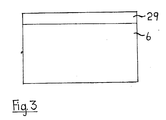
- Figure 3 is a cross-sectional view showing the product of the deposition process with the substrate body 6 supporting the deposited layer 29 of multicomponent material.
- the radiation source for the second sputtering target should be the FAB gun 17
- the FAB gun could be replaced by an alternative sputtering gun such as an ion gun.
- the deposition apparatus shown in Figure 1 could be rearranged to give other, equally effective sputtering geometries.
- the target body 9 could be of an alternative construction such as a multi-component metal target or a powder target.
- the power supply 12 and matching network for the magnetron electrode could be for radio frequency or direct current operation, If required, the substrate heater 3 could be mounted externally of the vacuum chamber.
- the oxygen feed supply 8 to the substrate body 6 could be replaced by any suitable gas feed.
- the gas feed source 21 to the gun 17 instead of argon could be any inert gas.
Landscapes
- Chemical & Material Sciences (AREA)
- Chemical Kinetics & Catalysis (AREA)
- Engineering & Computer Science (AREA)
- Materials Engineering (AREA)
- Mechanical Engineering (AREA)
- Metallurgy (AREA)
- Organic Chemistry (AREA)
- Physical Vapour Deposition (AREA)
- Physical Deposition Of Substances That Are Components Of Semiconductor Devices (AREA)
Applications Claiming Priority (2)
| Application Number | Priority Date | Filing Date | Title |
|---|---|---|---|
| GB8718653A GB2208390B (en) | 1987-08-06 | 1987-08-06 | Thin film deposition process |
| GB8718653 | 1987-08-06 |
Publications (2)
| Publication Number | Publication Date |
|---|---|
| EP0302684A2 true EP0302684A2 (de) | 1989-02-08 |
| EP0302684A3 EP0302684A3 (de) | 1990-10-10 |
Family
ID=10621924
Family Applications (1)
| Application Number | Title | Priority Date | Filing Date |
|---|---|---|---|
| EP19880307070 Withdrawn EP0302684A3 (de) | 1987-08-06 | 1988-08-01 | Verfahren zur Abscheidung eines dünnen Filmes |
Country Status (4)
| Country | Link |
|---|---|
| US (1) | US4911809A (de) |
| EP (1) | EP0302684A3 (de) |
| JP (1) | JPH01139763A (de) |
| GB (1) | GB2208390B (de) |
Cited By (4)
| Publication number | Priority date | Publication date | Assignee | Title |
|---|---|---|---|---|
| EP0396099A1 (de) * | 1989-05-02 | 1990-11-07 | Forschungszentrum Jülich Gmbh | Anordnung zum Abtragen von Material eines Targets |
| DE3920835A1 (de) * | 1989-06-24 | 1991-01-03 | Leybold Ag | Einrichtung zum beschichten von substraten |
| US5006219A (en) * | 1989-06-24 | 1991-04-09 | Leybold Aktiengesellschaft | Microwave cathode sputtering arrangement |
| EP0445897A1 (de) * | 1990-02-27 | 1991-09-11 | Fraunhofer-Gesellschaft Zur Förderung Der Angewandten Forschung E.V. | Verfahren zur Abscheidung dünner und dünnster Schichten |
Families Citing this family (13)
| Publication number | Priority date | Publication date | Assignee | Title |
|---|---|---|---|---|
| EP0390692A3 (de) * | 1989-03-29 | 1991-10-02 | Terumo Kabushiki Kaisha | Verfahren und Vorrichtung zur Herstellung einer Dünnschicht und Sensor |
| KR950009278B1 (ko) * | 1990-10-09 | 1995-08-18 | 니뽄 덴끼 가부시끼가이샤 | 반도체장치 제조방법 |
| JP3048072B2 (ja) * | 1991-05-25 | 2000-06-05 | ローム株式会社 | 酸化膜の成膜方法及びその装置 |
| JP2877618B2 (ja) * | 1992-07-06 | 1999-03-31 | シャープ株式会社 | 強誘電体膜の形成方法 |
| JP3211986B2 (ja) * | 1992-08-13 | 2001-09-25 | セントラル硝子株式会社 | グレー色電波透過型熱線遮蔽ガラス |
| EP0600303B1 (de) * | 1992-12-01 | 2002-02-06 | Matsushita Electric Industrial Co., Ltd. | Verfahren zur Herstellung einer elektrischen Dünnschicht |
| KR100197649B1 (ko) * | 1995-09-29 | 1999-06-15 | 김영환 | 박막 증착장치 |
| CA2333296A1 (en) * | 1998-05-14 | 1999-11-18 | David A. Baldwin | Apparatus for sputter deposition |
| US6265033B1 (en) * | 1998-09-11 | 2001-07-24 | Donald Bennett Hilliard | Method for optically coupled vapor deposition |
| US6460243B1 (en) * | 1999-11-22 | 2002-10-08 | International Business Machines Corporation | Method of making low stress and low resistance rhodium (RH) leads |
| JP4775968B2 (ja) * | 2007-08-22 | 2011-09-21 | インターナショナル・ビジネス・マシーンズ・コーポレーション | 配向膜形成装置及び方法 |
| JP5513529B2 (ja) * | 2010-01-26 | 2014-06-04 | キヤノンアネルバ株式会社 | 成膜方法、成膜装置、および該成膜装置の制御装置 |
| CN103140601B (zh) * | 2010-10-06 | 2015-08-05 | 株式会社爱发科 | 电介质成膜装置和电介质成膜方法 |
Family Cites Families (10)
| Publication number | Priority date | Publication date | Assignee | Title |
|---|---|---|---|---|
| FR1594542A (de) * | 1967-12-22 | 1970-06-08 | ||
| GB1482632A (en) * | 1974-09-11 | 1977-08-10 | Nordiko Ltd | Method and apparatus for sputtering |
| JPS57145982A (en) * | 1981-03-03 | 1982-09-09 | Toshiba Corp | Target for sputtering device |
| US4415427A (en) * | 1982-09-30 | 1983-11-15 | Gte Products Corporation | Thin film deposition by sputtering |
| GB8334369D0 (en) * | 1983-12-23 | 1984-02-01 | Ion Tech Ltd | Sputter deposition of alloys & c |
| AU566986B2 (en) * | 1984-09-04 | 1987-11-05 | Standard Oil Company, The | Deposition of passivated amorphous semi-conductor films by sputtering |
| JPS61238958A (ja) * | 1985-04-15 | 1986-10-24 | Hitachi Ltd | 複合薄膜形成法及び装置 |
| US4731172A (en) * | 1985-04-18 | 1988-03-15 | Matsushita Electric Industrial Co., Ltd. | Method for sputtering multi-component thin-film |
| GB2180262B (en) * | 1985-09-05 | 1990-05-09 | Plessey Co Plc | Methods of forming substances on substrates by reactive sputtering |
| US4793908A (en) * | 1986-12-29 | 1988-12-27 | Rockwell International Corporation | Multiple ion source method and apparatus for fabricating multilayer optical films |
-
1987
- 1987-08-06 GB GB8718653A patent/GB2208390B/en not_active Expired - Lifetime
-
1988
- 1988-08-01 EP EP19880307070 patent/EP0302684A3/de not_active Withdrawn
- 1988-08-05 US US07/228,897 patent/US4911809A/en not_active Expired - Fee Related
- 1988-08-05 JP JP63194687A patent/JPH01139763A/ja active Pending
Cited By (5)
| Publication number | Priority date | Publication date | Assignee | Title |
|---|---|---|---|---|
| EP0396099A1 (de) * | 1989-05-02 | 1990-11-07 | Forschungszentrum Jülich Gmbh | Anordnung zum Abtragen von Material eines Targets |
| DE3920835A1 (de) * | 1989-06-24 | 1991-01-03 | Leybold Ag | Einrichtung zum beschichten von substraten |
| US5006219A (en) * | 1989-06-24 | 1991-04-09 | Leybold Aktiengesellschaft | Microwave cathode sputtering arrangement |
| US5122252A (en) * | 1989-06-24 | 1992-06-16 | Leybold Aktiengesellschaft | Arrangement for the coating of substrates |
| EP0445897A1 (de) * | 1990-02-27 | 1991-09-11 | Fraunhofer-Gesellschaft Zur Förderung Der Angewandten Forschung E.V. | Verfahren zur Abscheidung dünner und dünnster Schichten |
Also Published As
| Publication number | Publication date |
|---|---|
| GB2208390B (en) | 1991-03-27 |
| GB8718653D0 (en) | 1987-09-09 |
| US4911809A (en) | 1990-03-27 |
| JPH01139763A (ja) | 1989-06-01 |
| GB2208390A (en) | 1989-03-30 |
| EP0302684A3 (de) | 1990-10-10 |
Similar Documents
| Publication | Publication Date | Title |
|---|---|---|
| US4911809A (en) | Thin film deposition process | |
| US4792463A (en) | Method of producing ferroelectric thin film | |
| WO1992001081A1 (en) | Method and apparatus for co-sputtering and cross-sputtering homogeneous films | |
| Velu et al. | Ferroelectric properties of PZT thin films prepared by sputtering with stoichiometric single oxide target: Comparison between conventional and rapid thermal annealing | |
| JPS63465A (ja) | スパツタ薄膜形成装置 | |
| JPH06252059A (ja) | 成膜方法及び成膜装置 | |
| US20060051495A1 (en) | Device and method for the evaporative deposition of a coating material | |
| US4033843A (en) | Simple method of preparing structurally high quality PbSnTe films | |
| US4882023A (en) | Method and system for producing thin films | |
| Xiao et al. | Epitaxial growth and crystallographic analyses of (Pb, La) TiO3 thin films by a multi‐ion‐beam reactive cosputtering technique | |
| GB2180262A (en) | Forming substances by reactive sputtering | |
| Safi | A novel reactive magnetron sputtering technique for producing insulating oxides of metal alloys and other compound thin films | |
| Fukami et al. | Ferroelectric films deposited by reactive sputtering and their properties | |
| JP2547203B2 (ja) | チタン酸ビスマス薄膜の形成方法 | |
| Petersen et al. | Excimer laser deposition of highly oriented PLZT thin films | |
| JP2547204B2 (ja) | チタン酸ビスマス薄膜の形成方法 | |
| US4761300A (en) | Method of vacuum depostion of pnictide films on a substrate using a pnictide bubbler and a sputterer | |
| Yoon et al. | Effect of deposition parameters on the deposition characteristics of chemically vapour deposited PbTiO3 | |
| JP3706409B2 (ja) | 複合酸化物薄膜の製造方法 | |
| Hayashi et al. | Preparation of Pb-Based Ferroelectric Thin Films by Ion-and Photo-Assisted Deposition | |
| EP0321071A1 (de) | Methode zur Herstellung supraleitender Dünnschichten | |
| JPH04107257A (ja) | 多元系複合化合物膜の形成方法及び装置 | |
| JPH06279180A (ja) | 結晶薄膜の作製法 | |
| Tossell et al. | Ferroelectric thin films | |
| Kingon et al. | Sputter deposition of ferroelectric thin films |
Legal Events
| Date | Code | Title | Description |
|---|---|---|---|
| PUAI | Public reference made under article 153(3) epc to a published international application that has entered the european phase |
Free format text: ORIGINAL CODE: 0009012 |
|
| AK | Designated contracting states |
Kind code of ref document: A2 Designated state(s): CH DE FR LI NL |
|
| PUAL | Search report despatched |
Free format text: ORIGINAL CODE: 0009013 |
|
| AK | Designated contracting states |
Kind code of ref document: A3 Designated state(s): CH DE FR LI NL |
|
| RAP1 | Party data changed (applicant data changed or rights of an application transferred) |
Owner name: GEC-MARCONI LIMITED |
|
| 17P | Request for examination filed |
Effective date: 19910321 |
|
| 17Q | First examination report despatched |
Effective date: 19930722 |
|
| STAA | Information on the status of an ep patent application or granted ep patent |
Free format text: STATUS: THE APPLICATION IS DEEMED TO BE WITHDRAWN |
|
| 18D | Application deemed to be withdrawn |
Effective date: 19931203 |