EP0302019B1 - Negativ-Photoresist auf Basis von Polyphenolen und ausgewählten Epoxid-oder Vinyletherverbindungen - Google Patents
Negativ-Photoresist auf Basis von Polyphenolen und ausgewählten Epoxid-oder Vinyletherverbindungen Download PDFInfo
- Publication number
- EP0302019B1 EP0302019B1 EP88810506A EP88810506A EP0302019B1 EP 0302019 B1 EP0302019 B1 EP 0302019B1 EP 88810506 A EP88810506 A EP 88810506A EP 88810506 A EP88810506 A EP 88810506A EP 0302019 B1 EP0302019 B1 EP 0302019B1
- Authority
- EP
- European Patent Office
- Prior art keywords
- formula
- composition according
- hydrogen
- structural units
- groups
- Prior art date
- Legal status (The legal status is an assumption and is not a legal conclusion. Google has not performed a legal analysis and makes no representation as to the accuracy of the status listed.)
- Expired - Lifetime
Links
- 235000013824 polyphenols Nutrition 0.000 title claims description 16
- 150000008442 polyphenolic compounds Chemical class 0.000 title claims description 11
- QYKIQEUNHZKYBP-UHFFFAOYSA-N Vinyl ether Chemical class C=COC=C QYKIQEUNHZKYBP-UHFFFAOYSA-N 0.000 title description 15
- 229920002120 photoresistant polymer Polymers 0.000 title description 13
- 150000002118 epoxides Chemical class 0.000 title 1
- 239000000203 mixture Substances 0.000 claims description 37
- -1 vinyl ether compound Chemical class 0.000 claims description 35
- ISWSIDIOOBJBQZ-UHFFFAOYSA-N Phenol Chemical compound OC1=CC=CC=C1 ISWSIDIOOBJBQZ-UHFFFAOYSA-N 0.000 claims description 34
- 150000001875 compounds Chemical class 0.000 claims description 24
- 229920001577 copolymer Polymers 0.000 claims description 23
- 239000011230 binding agent Substances 0.000 claims description 22
- 150000001450 anions Chemical class 0.000 claims description 17
- 239000001257 hydrogen Substances 0.000 claims description 17
- 229910052739 hydrogen Inorganic materials 0.000 claims description 17
- 150000002989 phenols Chemical class 0.000 claims description 17
- 150000003839 salts Chemical class 0.000 claims description 17
- 125000000391 vinyl group Chemical group [H]C([*])=C([H])[H] 0.000 claims description 17
- 125000002496 methyl group Chemical group [H]C([H])([H])* 0.000 claims description 16
- ZAMOUSCENKQFHK-UHFFFAOYSA-N Chlorine atom Chemical group [Cl] ZAMOUSCENKQFHK-UHFFFAOYSA-N 0.000 claims description 14
- 239000000758 substrate Substances 0.000 claims description 14
- WKBOTKDWSSQWDR-UHFFFAOYSA-N Bromine atom Chemical group [Br] WKBOTKDWSSQWDR-UHFFFAOYSA-N 0.000 claims description 13
- 239000000460 chlorine Chemical group 0.000 claims description 13
- 229910052801 chlorine Inorganic materials 0.000 claims description 13
- GDTBXPJZTBHREO-UHFFFAOYSA-N bromine Chemical group BrBr GDTBXPJZTBHREO-UHFFFAOYSA-N 0.000 claims description 12
- 229910052794 bromium Chemical group 0.000 claims description 12
- 238000000576 coating method Methods 0.000 claims description 12
- 229910052736 halogen Inorganic materials 0.000 claims description 12
- 150000002367 halogens Chemical class 0.000 claims description 12
- 125000004435 hydrogen atom Chemical group [H]* 0.000 claims description 12
- 125000002887 hydroxy group Chemical group [H]O* 0.000 claims description 12
- 238000004519 manufacturing process Methods 0.000 claims description 11
- 229920003986 novolac Polymers 0.000 claims description 11
- 230000005855 radiation Effects 0.000 claims description 11
- 230000015572 biosynthetic process Effects 0.000 claims description 9
- HHVCCCZZVQMAMT-UHFFFAOYSA-N 1-hydroxy-3-phenylpyrrole-2,5-dione Chemical class O=C1N(O)C(=O)C=C1C1=CC=CC=C1 HHVCCCZZVQMAMT-UHFFFAOYSA-N 0.000 claims description 8
- 239000000654 additive Substances 0.000 claims description 8
- 239000011248 coating agent Substances 0.000 claims description 8
- 125000001997 phenyl group Chemical group [H]C1=C([H])C([H])=C(*)C([H])=C1[H] 0.000 claims description 8
- 125000004178 (C1-C4) alkyl group Chemical group 0.000 claims description 7
- 125000004169 (C1-C6) alkyl group Chemical group 0.000 claims description 7
- OKKJLVBELUTLKV-UHFFFAOYSA-N Methanol Chemical class OC OKKJLVBELUTLKV-UHFFFAOYSA-N 0.000 claims description 7
- 229920001519 homopolymer Polymers 0.000 claims description 7
- 125000000229 (C1-C4)alkoxy group Chemical group 0.000 claims description 6
- 238000000034 method Methods 0.000 claims description 6
- 125000004432 carbon atom Chemical group C* 0.000 claims description 5
- 239000012952 cationic photoinitiator Substances 0.000 claims description 5
- 239000012670 alkaline solution Substances 0.000 claims description 4
- 230000000269 nucleophilic effect Effects 0.000 claims description 4
- 239000007787 solid Substances 0.000 claims description 4
- UFHFLCQGNIYNRP-UHFFFAOYSA-N Hydrogen Chemical compound [H][H] UFHFLCQGNIYNRP-UHFFFAOYSA-N 0.000 claims description 3
- 125000003178 carboxy group Chemical group [H]OC(*)=O 0.000 claims 2
- 150000002431 hydrogen Chemical class 0.000 claims 2
- 239000011253 protective coating Substances 0.000 claims 2
- 125000002485 formyl group Chemical class [H]C(*)=O 0.000 claims 1
- 150000003254 radicals Chemical class 0.000 description 16
- 239000010410 layer Substances 0.000 description 12
- 239000004593 Epoxy Substances 0.000 description 11
- WSFSSNUMVMOOMR-UHFFFAOYSA-N Formaldehyde Chemical compound O=C WSFSSNUMVMOOMR-UHFFFAOYSA-N 0.000 description 11
- PPBRXRYQALVLMV-UHFFFAOYSA-N Styrene Chemical compound C=CC1=CC=CC=C1 PPBRXRYQALVLMV-UHFFFAOYSA-N 0.000 description 10
- 229920000642 polymer Polymers 0.000 description 9
- 239000000243 solution Substances 0.000 description 9
- 239000000178 monomer Substances 0.000 description 8
- 0 CCC(***1(C)NCC1O)C=C Chemical compound CCC(***1(C)NCC1O)C=C 0.000 description 7
- 239000003822 epoxy resin Substances 0.000 description 7
- 229920000647 polyepoxide Polymers 0.000 description 7
- 239000007864 aqueous solution Substances 0.000 description 6
- RWGFKTVRMDUZSP-UHFFFAOYSA-N cumene Chemical compound CC(C)C1=CC=CC=C1 RWGFKTVRMDUZSP-UHFFFAOYSA-N 0.000 description 6
- 239000000463 material Substances 0.000 description 6
- 239000002904 solvent Substances 0.000 description 6
- 125000001424 substituent group Chemical group 0.000 description 6
- 229920002554 vinyl polymer Polymers 0.000 description 6
- 125000003903 2-propenyl group Chemical group [H]C([*])([H])C([H])=C([H])[H] 0.000 description 5
- QTBSBXVTEAMEQO-UHFFFAOYSA-N Acetic acid Chemical compound CC(O)=O QTBSBXVTEAMEQO-UHFFFAOYSA-N 0.000 description 5
- 238000006243 chemical reaction Methods 0.000 description 5
- 125000003055 glycidyl group Chemical group C(C1CO1)* 0.000 description 5
- 239000011241 protective layer Substances 0.000 description 5
- QPUYECUOLPXSFR-UHFFFAOYSA-N 1-methylnaphthalene Chemical compound C1=CC=C2C(C)=CC=CC2=C1 QPUYECUOLPXSFR-UHFFFAOYSA-N 0.000 description 4
- PXGOKWXKJXAPGV-UHFFFAOYSA-N Fluorine Chemical compound FF PXGOKWXKJXAPGV-UHFFFAOYSA-N 0.000 description 4
- CSNNHWWHGAXBCP-UHFFFAOYSA-L Magnesium sulfate Chemical compound [Mg+2].[O-][S+2]([O-])([O-])[O-] CSNNHWWHGAXBCP-UHFFFAOYSA-L 0.000 description 4
- KFSLWBXXFJQRDL-UHFFFAOYSA-N Peracetic acid Chemical compound CC(=O)OO KFSLWBXXFJQRDL-UHFFFAOYSA-N 0.000 description 4
- 239000002253 acid Substances 0.000 description 4
- 150000007513 acids Chemical class 0.000 description 4
- 125000000217 alkyl group Chemical group 0.000 description 4
- IISBACLAFKSPIT-UHFFFAOYSA-N bisphenol A Chemical compound C=1C=C(O)C=CC=1C(C)(C)C1=CC=C(O)C=C1 IISBACLAFKSPIT-UHFFFAOYSA-N 0.000 description 4
- JHIVVAPYMSGYDF-UHFFFAOYSA-N cyclohexanone Chemical compound O=C1CCCCC1 JHIVVAPYMSGYDF-UHFFFAOYSA-N 0.000 description 4
- 125000003700 epoxy group Chemical group 0.000 description 4
- 125000001495 ethyl group Chemical group [H]C([H])([H])C([H])([H])* 0.000 description 4
- 239000011737 fluorine Substances 0.000 description 4
- 229910052731 fluorine Inorganic materials 0.000 description 4
- 125000005843 halogen group Chemical group 0.000 description 4
- 238000007645 offset printing Methods 0.000 description 4
- 239000003960 organic solvent Substances 0.000 description 4
- BWHMMNNQKKPAPP-UHFFFAOYSA-L potassium carbonate Chemical compound [K+].[K+].[O-]C([O-])=O BWHMMNNQKKPAPP-UHFFFAOYSA-L 0.000 description 4
- 239000011541 reaction mixture Substances 0.000 description 4
- XLYOFNOQVPJJNP-UHFFFAOYSA-N water Substances O XLYOFNOQVPJJNP-UHFFFAOYSA-N 0.000 description 4
- UZKWTJUDCOPSNM-UHFFFAOYSA-N 1-ethenoxybutane Chemical compound CCCCOC=C UZKWTJUDCOPSNM-UHFFFAOYSA-N 0.000 description 3
- WFDIJRYMOXRFFG-UHFFFAOYSA-N Acetic anhydride Chemical compound CC(=O)OC(C)=O WFDIJRYMOXRFFG-UHFFFAOYSA-N 0.000 description 3
- CSCPPACGZOOCGX-UHFFFAOYSA-N Acetone Chemical compound CC(C)=O CSCPPACGZOOCGX-UHFFFAOYSA-N 0.000 description 3
- XKRFYHLGVUSROY-UHFFFAOYSA-N Argon Chemical compound [Ar] XKRFYHLGVUSROY-UHFFFAOYSA-N 0.000 description 3
- 229910017008 AsF 6 Inorganic materials 0.000 description 3
- XEKOWRVHYACXOJ-UHFFFAOYSA-N Ethyl acetate Chemical compound CCOC(C)=O XEKOWRVHYACXOJ-UHFFFAOYSA-N 0.000 description 3
- 229910018286 SbF 6 Inorganic materials 0.000 description 3
- HEMHJVSKTPXQMS-UHFFFAOYSA-M Sodium hydroxide Chemical compound [OH-].[Na+] HEMHJVSKTPXQMS-UHFFFAOYSA-M 0.000 description 3
- YXFVVABEGXRONW-UHFFFAOYSA-N Toluene Chemical compound CC1=CC=CC=C1 YXFVVABEGXRONW-UHFFFAOYSA-N 0.000 description 3
- BAPJBEWLBFYGME-UHFFFAOYSA-N acrylic acid methyl ester Natural products COC(=O)C=C BAPJBEWLBFYGME-UHFFFAOYSA-N 0.000 description 3
- 125000001797 benzyl group Chemical group [H]C1=C([H])C([H])=C(C([H])=C1[H])C([H])([H])* 0.000 description 3
- PXKLMJQFEQBVLD-UHFFFAOYSA-N bisphenol F Chemical compound C1=CC(O)=CC=C1CC1=CC=C(O)C=C1 PXKLMJQFEQBVLD-UHFFFAOYSA-N 0.000 description 3
- 239000003054 catalyst Substances 0.000 description 3
- 125000004093 cyano group Chemical group *C#N 0.000 description 3
- 125000000753 cycloalkyl group Chemical group 0.000 description 3
- 238000001035 drying Methods 0.000 description 3
- 150000002148 esters Chemical class 0.000 description 3
- LNEPOXFFQSENCJ-UHFFFAOYSA-N haloperidol Chemical compound C1CC(O)(C=2C=CC(Cl)=CC=2)CCN1CCCC(=O)C1=CC=C(F)C=C1 LNEPOXFFQSENCJ-UHFFFAOYSA-N 0.000 description 3
- 239000003999 initiator Substances 0.000 description 3
- 125000001449 isopropyl group Chemical group [H]C([H])([H])C([H])(*)C([H])([H])[H] 0.000 description 3
- VLKZOEOYAKHREP-UHFFFAOYSA-N n-Hexane Chemical compound CCCCCC VLKZOEOYAKHREP-UHFFFAOYSA-N 0.000 description 3
- 125000004108 n-butyl group Chemical group [H]C([H])([H])C([H])([H])C([H])([H])C([H])([H])* 0.000 description 3
- 125000004123 n-propyl group Chemical group [H]C([H])([H])C([H])([H])C([H])([H])* 0.000 description 3
- 125000001624 naphthyl group Chemical group 0.000 description 3
- IWDCLRJOBJJRNH-UHFFFAOYSA-N p-cresol Chemical compound CC1=CC=C(O)C=C1 IWDCLRJOBJJRNH-UHFFFAOYSA-N 0.000 description 3
- 238000002360 preparation method Methods 0.000 description 3
- 229920005989 resin Polymers 0.000 description 3
- 239000011347 resin Substances 0.000 description 3
- GHMLBKRAJCXXBS-UHFFFAOYSA-N resorcinol Chemical compound OC1=CC=CC(O)=C1 GHMLBKRAJCXXBS-UHFFFAOYSA-N 0.000 description 3
- 125000003107 substituted aryl group Chemical group 0.000 description 3
- 238000007669 thermal treatment Methods 0.000 description 3
- 239000000080 wetting agent Substances 0.000 description 3
- NQMUGNMMFTYOHK-UHFFFAOYSA-N 1-methoxynaphthalene Chemical compound C1=CC=C2C(OC)=CC=CC2=C1 NQMUGNMMFTYOHK-UHFFFAOYSA-N 0.000 description 2
- WXNZTHHGJRFXKQ-UHFFFAOYSA-N 4-chlorophenol Chemical compound OC1=CC=C(Cl)C=C1 WXNZTHHGJRFXKQ-UHFFFAOYSA-N 0.000 description 2
- FUGYGGDSWSUORM-UHFFFAOYSA-N 4-hydroxystyrene Chemical compound OC1=CC=C(C=C)C=C1 FUGYGGDSWSUORM-UHFFFAOYSA-N 0.000 description 2
- IGFHQQFPSIBGKE-UHFFFAOYSA-N 4-nonylphenol Chemical compound CCCCCCCCCC1=CC=C(O)C=C1 IGFHQQFPSIBGKE-UHFFFAOYSA-N 0.000 description 2
- QHPQWRBYOIRBIT-UHFFFAOYSA-N 4-tert-butylphenol Chemical compound CC(C)(C)C1=CC=C(O)C=C1 QHPQWRBYOIRBIT-UHFFFAOYSA-N 0.000 description 2
- ZCYVEMRRCGMTRW-UHFFFAOYSA-N 7553-56-2 Chemical compound [I] ZCYVEMRRCGMTRW-UHFFFAOYSA-N 0.000 description 2
- HRPVXLWXLXDGHG-UHFFFAOYSA-N Acrylamide Chemical compound NC(=O)C=C HRPVXLWXLXDGHG-UHFFFAOYSA-N 0.000 description 2
- NIXOWILDQLNWCW-UHFFFAOYSA-M Acrylate Chemical compound [O-]C(=O)C=C NIXOWILDQLNWCW-UHFFFAOYSA-M 0.000 description 2
- 229930185605 Bisphenol Natural products 0.000 description 2
- YMWUJEATGCHHMB-UHFFFAOYSA-N Dichloromethane Chemical compound ClCCl YMWUJEATGCHHMB-UHFFFAOYSA-N 0.000 description 2
- YNQLUTRBYVCPMQ-UHFFFAOYSA-N Ethylbenzene Chemical compound CCC1=CC=CC=C1 YNQLUTRBYVCPMQ-UHFFFAOYSA-N 0.000 description 2
- XEEYBQQBJWHFJM-UHFFFAOYSA-N Iron Chemical compound [Fe] XEEYBQQBJWHFJM-UHFFFAOYSA-N 0.000 description 2
- 125000003580 L-valyl group Chemical group [H]N([H])[C@]([H])(C(=O)[*])C(C([H])([H])[H])(C([H])([H])[H])[H] 0.000 description 2
- CERQOIWHTDAKMF-UHFFFAOYSA-N Methacrylic acid Chemical compound CC(=C)C(O)=O CERQOIWHTDAKMF-UHFFFAOYSA-N 0.000 description 2
- 239000004372 Polyvinyl alcohol Substances 0.000 description 2
- JUJWROOIHBZHMG-UHFFFAOYSA-N Pyridine Chemical compound C1=CC=NC=C1 JUJWROOIHBZHMG-UHFFFAOYSA-N 0.000 description 2
- PJANXHGTPQOBST-VAWYXSNFSA-N Stilbene Natural products C=1C=CC=CC=1/C=C/C1=CC=CC=C1 PJANXHGTPQOBST-VAWYXSNFSA-N 0.000 description 2
- XTXRWKRVRITETP-UHFFFAOYSA-N Vinyl acetate Chemical compound CC(=O)OC=C XTXRWKRVRITETP-UHFFFAOYSA-N 0.000 description 2
- 229960000583 acetic acid Drugs 0.000 description 2
- NIXOWILDQLNWCW-UHFFFAOYSA-N acrylic acid group Chemical group C(C=C)(=O)O NIXOWILDQLNWCW-UHFFFAOYSA-N 0.000 description 2
- 125000003545 alkoxy group Chemical group 0.000 description 2
- 150000001408 amides Chemical class 0.000 description 2
- RDOXTESZEPMUJZ-UHFFFAOYSA-N anisole Chemical compound COC1=CC=CC=C1 RDOXTESZEPMUJZ-UHFFFAOYSA-N 0.000 description 2
- VBVBHWZYQGJZLR-UHFFFAOYSA-I antimony pentafluoride Chemical compound F[Sb](F)(F)(F)F VBVBHWZYQGJZLR-UHFFFAOYSA-I 0.000 description 2
- 229910052786 argon Inorganic materials 0.000 description 2
- 125000003710 aryl alkyl group Chemical group 0.000 description 2
- YXVFYQXJAXKLAK-UHFFFAOYSA-N biphenyl-4-ol Chemical compound C1=CC(O)=CC=C1C1=CC=CC=C1 YXVFYQXJAXKLAK-UHFFFAOYSA-N 0.000 description 2
- 150000001735 carboxylic acids Chemical class 0.000 description 2
- 239000013078 crystal Substances 0.000 description 2
- 125000000113 cyclohexyl group Chemical group [H]C1([H])C([H])([H])C([H])([H])C([H])(*)C([H])([H])C1([H])[H] 0.000 description 2
- IYYZUPMFVPLQIF-UHFFFAOYSA-N dibenzothiophene Chemical compound C1=CC=C2C3=CC=CC=C3SC2=C1 IYYZUPMFVPLQIF-UHFFFAOYSA-N 0.000 description 2
- 239000006185 dispersion Substances 0.000 description 2
- ZSWFCLXCOIISFI-UHFFFAOYSA-N endo-cyclopentadiene Natural products C1C=CC=C1 ZSWFCLXCOIISFI-UHFFFAOYSA-N 0.000 description 2
- 238000005516 engineering process Methods 0.000 description 2
- 238000006735 epoxidation reaction Methods 0.000 description 2
- 238000005530 etching Methods 0.000 description 2
- 229910052740 iodine Inorganic materials 0.000 description 2
- 239000011630 iodine Substances 0.000 description 2
- 239000007788 liquid Substances 0.000 description 2
- RLSSMJSEOOYNOY-UHFFFAOYSA-N m-methyl-PhOH Natural products CC1=CC=CC(O)=C1 RLSSMJSEOOYNOY-UHFFFAOYSA-N 0.000 description 2
- 229910052943 magnesium sulfate Inorganic materials 0.000 description 2
- 235000019341 magnesium sulphate Nutrition 0.000 description 2
- 229910001507 metal halide Inorganic materials 0.000 description 2
- 150000005309 metal halides Chemical class 0.000 description 2
- 125000000956 methoxy group Chemical group [H]C([H])([H])O* 0.000 description 2
- 125000001280 n-hexyl group Chemical group C(CCCCC)* 0.000 description 2
- 125000000740 n-pentyl group Chemical group [H]C([H])([H])C([H])([H])C([H])([H])C([H])([H])C([H])([H])* 0.000 description 2
- 150000002825 nitriles Chemical class 0.000 description 2
- QWVGKYWNOKOFNN-UHFFFAOYSA-N o-methyl phenol Natural products CC1=CC=CC=C1O QWVGKYWNOKOFNN-UHFFFAOYSA-N 0.000 description 2
- 150000004965 peroxy acids Chemical class 0.000 description 2
- 229910052698 phosphorus Inorganic materials 0.000 description 2
- 229920000728 polyester Polymers 0.000 description 2
- 229920002451 polyvinyl alcohol Polymers 0.000 description 2
- 238000011417 postcuring Methods 0.000 description 2
- 235000015320 potassium carbonate Nutrition 0.000 description 2
- 229910000027 potassium carbonate Inorganic materials 0.000 description 2
- 238000007639 printing Methods 0.000 description 2
- 239000000047 product Substances 0.000 description 2
- 238000000746 purification Methods 0.000 description 2
- BBEAQIROQSPTKN-UHFFFAOYSA-N pyrene Chemical compound C1=CC=C2C=CC3=CC=CC4=CC=C1C2=C43 BBEAQIROQSPTKN-UHFFFAOYSA-N 0.000 description 2
- 229960001755 resorcinol Drugs 0.000 description 2
- 238000007127 saponification reaction Methods 0.000 description 2
- 125000002914 sec-butyl group Chemical group [H]C([H])([H])C([H])([H])C([H])(*)C([H])([H])[H] 0.000 description 2
- 230000035945 sensitivity Effects 0.000 description 2
- PJANXHGTPQOBST-UHFFFAOYSA-N stilbene Chemical compound C=1C=CC=CC=1C=CC1=CC=CC=C1 PJANXHGTPQOBST-UHFFFAOYSA-N 0.000 description 2
- 235000021286 stilbenes Nutrition 0.000 description 2
- 150000003460 sulfonic acids Chemical class 0.000 description 2
- PBYZMCDFOULPGH-UHFFFAOYSA-N tungstate Chemical compound [O-][W]([O-])(=O)=O PBYZMCDFOULPGH-UHFFFAOYSA-N 0.000 description 2
- 229920001567 vinyl ester resin Polymers 0.000 description 2
- 150000003739 xylenols Chemical class 0.000 description 2
- 125000006700 (C1-C6) alkylthio group Chemical group 0.000 description 1
- BQCIDUSAKPWEOX-UHFFFAOYSA-N 1,1-Difluoroethene Chemical compound FC(F)=C BQCIDUSAKPWEOX-UHFFFAOYSA-N 0.000 description 1
- CNDOSNMFHUSKGN-UHFFFAOYSA-N 1-(2-hydroxyphenyl)pyrrole-2,5-dione Chemical compound OC1=CC=CC=C1N1C(=O)C=CC1=O CNDOSNMFHUSKGN-UHFFFAOYSA-N 0.000 description 1
- YIKSHDNOAYSSPX-UHFFFAOYSA-N 1-propan-2-ylthioxanthen-9-one Chemical compound S1C2=CC=CC=C2C(=O)C2=C1C=CC=C2C(C)C YIKSHDNOAYSSPX-UHFFFAOYSA-N 0.000 description 1
- RMXNSQWYMVTLEU-UHFFFAOYSA-N 2,6-bis(prop-2-enyl)phenol Chemical class OC1=C(CC=C)C=CC=C1CC=C RMXNSQWYMVTLEU-UHFFFAOYSA-N 0.000 description 1
- OEPOKWHJYJXUGD-UHFFFAOYSA-N 2-(3-phenylmethoxyphenyl)-1,3-thiazole-4-carbaldehyde Chemical compound O=CC1=CSC(C=2C=C(OCC=3C=CC=CC=3)C=CC=2)=N1 OEPOKWHJYJXUGD-UHFFFAOYSA-N 0.000 description 1
- ZWEHNKRNPOVVGH-UHFFFAOYSA-N 2-Butanone Chemical compound CCC(C)=O ZWEHNKRNPOVVGH-UHFFFAOYSA-N 0.000 description 1
- ZNQVEEAIQZEUHB-UHFFFAOYSA-N 2-ethoxyethanol Chemical compound CCOCCO ZNQVEEAIQZEUHB-UHFFFAOYSA-N 0.000 description 1
- 229940093475 2-ethoxyethanol Drugs 0.000 description 1
- QTWJRLJHJPIABL-UHFFFAOYSA-N 2-methylphenol;3-methylphenol;4-methylphenol Chemical compound CC1=CC=C(O)C=C1.CC1=CC=CC(O)=C1.CC1=CC=CC=C1O QTWJRLJHJPIABL-UHFFFAOYSA-N 0.000 description 1
- WUQYBSRMWWRFQH-UHFFFAOYSA-N 2-prop-1-en-2-ylphenol Chemical compound CC(=C)C1=CC=CC=C1O WUQYBSRMWWRFQH-UHFFFAOYSA-N 0.000 description 1
- QWGLNWHWBCINBS-UHFFFAOYSA-N 3-nonylphenol Chemical compound CCCCCCCCCC1=CC=CC(O)=C1 QWGLNWHWBCINBS-UHFFFAOYSA-N 0.000 description 1
- VPWNQTHUCYMVMZ-UHFFFAOYSA-N 4,4'-sulfonyldiphenol Chemical class C1=CC(O)=CC=C1S(=O)(=O)C1=CC=C(O)C=C1 VPWNQTHUCYMVMZ-UHFFFAOYSA-N 0.000 description 1
- JLBJTVDPSNHSKJ-UHFFFAOYSA-N 4-Methylstyrene Chemical compound CC1=CC=C(C=C)C=C1 JLBJTVDPSNHSKJ-UHFFFAOYSA-N 0.000 description 1
- 125000004217 4-methoxybenzyl group Chemical group [H]C1=C([H])C(=C([H])C([H])=C1OC([H])([H])[H])C([H])([H])* 0.000 description 1
- 125000006181 4-methyl benzyl group Chemical group [H]C1=C([H])C(=C([H])C([H])=C1C([H])([H])[H])C([H])([H])* 0.000 description 1
- IKHGUXGNUITLKF-UHFFFAOYSA-N Acetaldehyde Chemical compound CC=O IKHGUXGNUITLKF-UHFFFAOYSA-N 0.000 description 1
- NLHHRLWOUZZQLW-UHFFFAOYSA-N Acrylonitrile Chemical compound C=CC#N NLHHRLWOUZZQLW-UHFFFAOYSA-N 0.000 description 1
- OSDWBNJEKMUWAV-UHFFFAOYSA-N Allyl chloride Chemical compound ClCC=C OSDWBNJEKMUWAV-UHFFFAOYSA-N 0.000 description 1
- NLXLAEXVIDQMFP-UHFFFAOYSA-N Ammonia chloride Chemical compound [NH4+].[Cl-] NLXLAEXVIDQMFP-UHFFFAOYSA-N 0.000 description 1
- 229910021630 Antimony pentafluoride Inorganic materials 0.000 description 1
- OKTJSMMVPCPJKN-UHFFFAOYSA-N Carbon Chemical compound [C] OKTJSMMVPCPJKN-UHFFFAOYSA-N 0.000 description 1
- 239000004215 Carbon black (E152) Substances 0.000 description 1
- 238000005821 Claisen rearrangement reaction Methods 0.000 description 1
- RWSOTUBLDIXVET-UHFFFAOYSA-N Dihydrogen sulfide Chemical class S RWSOTUBLDIXVET-UHFFFAOYSA-N 0.000 description 1
- BRLQWZUYTZBJKN-UHFFFAOYSA-N Epichlorohydrin Chemical compound ClCC1CO1 BRLQWZUYTZBJKN-UHFFFAOYSA-N 0.000 description 1
- DGAQECJNVWCQMB-PUAWFVPOSA-M Ilexoside XXIX Chemical compound C[C@@H]1CC[C@@]2(CC[C@@]3(C(=CC[C@H]4[C@]3(CC[C@@H]5[C@@]4(CC[C@@H](C5(C)C)OS(=O)(=O)[O-])C)C)[C@@H]2[C@]1(C)O)C)C(=O)O[C@H]6[C@@H]([C@H]([C@@H]([C@H](O6)CO)O)O)O.[Na+] DGAQECJNVWCQMB-PUAWFVPOSA-M 0.000 description 1
- GYCMBHHDWRMZGG-UHFFFAOYSA-N Methylacrylonitrile Chemical compound CC(=C)C#N GYCMBHHDWRMZGG-UHFFFAOYSA-N 0.000 description 1
- CTQNGGLPUBDAKN-UHFFFAOYSA-N O-Xylene Chemical compound CC1=CC=CC=C1C CTQNGGLPUBDAKN-UHFFFAOYSA-N 0.000 description 1
- OAICVXFJPJFONN-UHFFFAOYSA-N Phosphorus Chemical compound [P] OAICVXFJPJFONN-UHFFFAOYSA-N 0.000 description 1
- 206010034972 Photosensitivity reaction Diseases 0.000 description 1
- 239000004952 Polyamide Substances 0.000 description 1
- XUIMIQQOPSSXEZ-UHFFFAOYSA-N Silicon Chemical compound [Si] XUIMIQQOPSSXEZ-UHFFFAOYSA-N 0.000 description 1
- VMHLLURERBWHNL-UHFFFAOYSA-M Sodium acetate Chemical compound [Na+].CC([O-])=O VMHLLURERBWHNL-UHFFFAOYSA-M 0.000 description 1
- 238000003848 UV Light-Curing Methods 0.000 description 1
- BZHJMEDXRYGGRV-UHFFFAOYSA-N Vinyl chloride Chemical compound ClC=C BZHJMEDXRYGGRV-UHFFFAOYSA-N 0.000 description 1
- IKHGUXGNUITLKF-XPULMUKRSA-N acetaldehyde Chemical compound [14CH]([14CH3])=O IKHGUXGNUITLKF-XPULMUKRSA-N 0.000 description 1
- 239000002318 adhesion promoter Substances 0.000 description 1
- 150000001299 aldehydes Chemical class 0.000 description 1
- 229910000318 alkali metal phosphate Inorganic materials 0.000 description 1
- 229910052910 alkali metal silicate Inorganic materials 0.000 description 1
- 125000003342 alkenyl group Chemical group 0.000 description 1
- 125000004414 alkyl thio group Chemical group 0.000 description 1
- XYLMUPLGERFSHI-UHFFFAOYSA-N alpha-Methylstyrene Chemical compound CC(=C)C1=CC=CC=C1 XYLMUPLGERFSHI-UHFFFAOYSA-N 0.000 description 1
- 229910052782 aluminium Inorganic materials 0.000 description 1
- XAGFODPZIPBFFR-UHFFFAOYSA-N aluminium Chemical compound [Al] XAGFODPZIPBFFR-UHFFFAOYSA-N 0.000 description 1
- 235000019270 ammonium chloride Nutrition 0.000 description 1
- 125000005428 anthryl group Chemical group [H]C1=C([H])C([H])=C2C([H])=C3C(*)=C([H])C([H])=C([H])C3=C([H])C2=C1[H] 0.000 description 1
- 229910052787 antimony Inorganic materials 0.000 description 1
- 229910052785 arsenic Inorganic materials 0.000 description 1
- 125000003118 aryl group Chemical group 0.000 description 1
- 150000005840 aryl radicals Chemical class 0.000 description 1
- 125000005110 aryl thio group Chemical group 0.000 description 1
- 229910052796 boron Inorganic materials 0.000 description 1
- 230000001680 brushing effect Effects 0.000 description 1
- 229910052799 carbon Inorganic materials 0.000 description 1
- 150000004649 carbonic acid derivatives Chemical class 0.000 description 1
- 238000005266 casting Methods 0.000 description 1
- 229920002301 cellulose acetate Polymers 0.000 description 1
- 239000003795 chemical substances by application Substances 0.000 description 1
- 125000000068 chlorophenyl group Chemical group 0.000 description 1
- HNEGQIOMVPPMNR-IHWYPQMZSA-N citraconic acid Chemical compound OC(=O)C(/C)=C\C(O)=O HNEGQIOMVPPMNR-IHWYPQMZSA-N 0.000 description 1
- 239000000084 colloidal system Substances 0.000 description 1
- 230000000295 complement effect Effects 0.000 description 1
- 229930003836 cresol Natural products 0.000 description 1
- 239000012043 crude product Substances 0.000 description 1
- 238000001723 curing Methods 0.000 description 1
- 125000000582 cycloheptyl group Chemical group [H]C1([H])C([H])([H])C([H])([H])C([H])([H])C([H])(*)C([H])([H])C1([H])[H] 0.000 description 1
- 125000000058 cyclopentadienyl group Chemical group C1(=CC=CC1)* 0.000 description 1
- 125000001511 cyclopentyl group Chemical group [H]C1([H])C([H])([H])C([H])([H])C([H])(*)C1([H])[H] 0.000 description 1
- 239000012954 diazonium Substances 0.000 description 1
- 150000001989 diazonium salts Chemical class 0.000 description 1
- TXCDCPKCNAJMEE-UHFFFAOYSA-N dibenzofuran Chemical compound C1=CC=C2C3=CC=CC=C3OC2=C1 TXCDCPKCNAJMEE-UHFFFAOYSA-N 0.000 description 1
- 230000004069 differentiation Effects 0.000 description 1
- 238000007598 dipping method Methods 0.000 description 1
- 239000000975 dye Substances 0.000 description 1
- ZINJLDJMHCUBIP-UHFFFAOYSA-N ethametsulfuron-methyl Chemical compound CCOC1=NC(NC)=NC(NC(=O)NS(=O)(=O)C=2C(=CC=CC=2)C(=O)OC)=N1 ZINJLDJMHCUBIP-UHFFFAOYSA-N 0.000 description 1
- 238000006266 etherification reaction Methods 0.000 description 1
- 239000000945 filler Substances 0.000 description 1
- GVEPBJHOBDJJJI-UHFFFAOYSA-N fluoranthrene Natural products C1=CC(C2=CC=CC=C22)=C3C2=CC=CC3=C1 GVEPBJHOBDJJJI-UHFFFAOYSA-N 0.000 description 1
- XUCNUKMRBVNAPB-UHFFFAOYSA-N fluoroethene Chemical compound FC=C XUCNUKMRBVNAPB-UHFFFAOYSA-N 0.000 description 1
- 239000011888 foil Substances 0.000 description 1
- 239000012362 glacial acetic acid Substances 0.000 description 1
- 125000000623 heterocyclic group Chemical group 0.000 description 1
- 229930195733 hydrocarbon Natural products 0.000 description 1
- 230000007062 hydrolysis Effects 0.000 description 1
- 238000006460 hydrolysis reaction Methods 0.000 description 1
- 150000004679 hydroxides Chemical class 0.000 description 1
- 125000004356 hydroxy functional group Chemical group O* 0.000 description 1
- 125000001812 iodosyl group Chemical group O=I[*] 0.000 description 1
- 229910052742 iron Inorganic materials 0.000 description 1
- 125000001972 isopentyl group Chemical group [H]C([H])([H])C([H])(C([H])([H])[H])C([H])([H])C([H])([H])* 0.000 description 1
- 229910052743 krypton Inorganic materials 0.000 description 1
- 150000002605 large molecules Chemical class 0.000 description 1
- 125000000040 m-tolyl group Chemical group [H]C1=C([H])C(*)=C([H])C(=C1[H])C([H])([H])[H] 0.000 description 1
- 238000002844 melting Methods 0.000 description 1
- 230000008018 melting Effects 0.000 description 1
- QSHDDOUJBYECFT-UHFFFAOYSA-N mercury Chemical compound [Hg] QSHDDOUJBYECFT-UHFFFAOYSA-N 0.000 description 1
- 229910052751 metal Inorganic materials 0.000 description 1
- 239000002184 metal Substances 0.000 description 1
- 125000005397 methacrylic acid ester group Chemical group 0.000 description 1
- 125000005395 methacrylic acid group Chemical group 0.000 description 1
- XJRBAMWJDBPFIM-UHFFFAOYSA-N methyl vinyl ether Chemical compound COC=C XJRBAMWJDBPFIM-UHFFFAOYSA-N 0.000 description 1
- 238000000465 moulding Methods 0.000 description 1
- PSHKMPUSSFXUIA-UHFFFAOYSA-N n,n-dimethylpyridin-2-amine Chemical compound CN(C)C1=CC=CC=N1 PSHKMPUSSFXUIA-UHFFFAOYSA-N 0.000 description 1
- 125000003136 n-heptyl group Chemical group [H]C([H])([H])C([H])([H])C([H])([H])C([H])([H])C([H])([H])C([H])([H])C([H])([H])* 0.000 description 1
- 125000001298 n-hexoxy group Chemical group [H]C([H])([H])C([H])([H])C([H])([H])C([H])([H])C([H])([H])C([H])([H])O* 0.000 description 1
- 125000000449 nitro group Chemical group [O-][N+](*)=O 0.000 description 1
- 125000004433 nitrogen atom Chemical group N* 0.000 description 1
- SNQQPOLDUKLAAF-UHFFFAOYSA-N nonylphenol Chemical compound CCCCCCCCCC1=CC=CC=C1O SNQQPOLDUKLAAF-UHFFFAOYSA-N 0.000 description 1
- 125000003261 o-tolyl group Chemical group [H]C1=C([H])C(*)=C(C([H])=C1[H])C([H])([H])[H] 0.000 description 1
- 239000007800 oxidant agent Substances 0.000 description 1
- 125000001037 p-tolyl group Chemical group [H]C1=C([H])C(=C([H])C([H])=C1*)C([H])([H])[H] 0.000 description 1
- 125000002080 perylenyl group Chemical group C1(=CC=C2C=CC=C3C4=CC=CC5=CC=CC(C1=C23)=C45)* 0.000 description 1
- CSHWQDPOILHKBI-UHFFFAOYSA-N peryrene Natural products C1=CC(C2=CC=CC=3C2=C2C=CC=3)=C3C2=CC=CC3=C1 CSHWQDPOILHKBI-UHFFFAOYSA-N 0.000 description 1
- 125000005561 phenanthryl group Chemical group 0.000 description 1
- 125000003356 phenylsulfanyl group Chemical group [*]SC1=C([H])C([H])=C([H])C([H])=C1[H] 0.000 description 1
- 235000021317 phosphate Nutrition 0.000 description 1
- 150000003013 phosphoric acid derivatives Chemical class 0.000 description 1
- 239000011574 phosphorus Substances 0.000 description 1
- 230000036211 photosensitivity Effects 0.000 description 1
- 239000000049 pigment Substances 0.000 description 1
- 229920003023 plastic Polymers 0.000 description 1
- 239000004033 plastic Substances 0.000 description 1
- 239000004014 plasticizer Substances 0.000 description 1
- 229920002647 polyamide Polymers 0.000 description 1
- 125000005575 polycyclic aromatic hydrocarbon group Chemical group 0.000 description 1
- 239000004848 polyfunctional curative Substances 0.000 description 1
- 230000001681 protective effect Effects 0.000 description 1
- UMJSCPRVCHMLSP-UHFFFAOYSA-N pyridine Natural products COC1=CC=CN=C1 UMJSCPRVCHMLSP-UHFFFAOYSA-N 0.000 description 1
- 238000007763 reverse roll coating Methods 0.000 description 1
- 238000007650 screen-printing Methods 0.000 description 1
- 229910052710 silicon Inorganic materials 0.000 description 1
- 239000010703 silicon Substances 0.000 description 1
- 229920002050 silicone resin Polymers 0.000 description 1
- 229910052708 sodium Inorganic materials 0.000 description 1
- 239000011734 sodium Substances 0.000 description 1
- 239000001632 sodium acetate Substances 0.000 description 1
- 235000017281 sodium acetate Nutrition 0.000 description 1
- WBHQBSYUUJJSRZ-UHFFFAOYSA-M sodium bisulfate Chemical compound [Na+].OS([O-])(=O)=O WBHQBSYUUJJSRZ-UHFFFAOYSA-M 0.000 description 1
- 229910000342 sodium bisulfate Inorganic materials 0.000 description 1
- GEHJYWRUCIMESM-UHFFFAOYSA-L sodium sulfite Chemical compound [Na+].[Na+].[O-]S([O-])=O GEHJYWRUCIMESM-UHFFFAOYSA-L 0.000 description 1
- 235000010265 sodium sulphite Nutrition 0.000 description 1
- 229910000679 solder Inorganic materials 0.000 description 1
- 238000009987 spinning Methods 0.000 description 1
- 238000005507 spraying Methods 0.000 description 1
- 239000003381 stabilizer Substances 0.000 description 1
- QVLMUEOXQBUPAH-UHFFFAOYSA-N stilben-4-ol Chemical compound C1=CC(O)=CC=C1C=CC1=CC=CC=C1 QVLMUEOXQBUPAH-UHFFFAOYSA-N 0.000 description 1
- 238000003860 storage Methods 0.000 description 1
- 239000000126 substance Substances 0.000 description 1
- 125000005537 sulfoxonium group Chemical group 0.000 description 1
- 230000008961 swelling Effects 0.000 description 1
- 238000003786 synthesis reaction Methods 0.000 description 1
- 238000010345 tape casting Methods 0.000 description 1
- 125000000999 tert-butyl group Chemical group [H]C([H])([H])C(*)(C([H])([H])[H])C([H])([H])[H] 0.000 description 1
- 230000000930 thermomechanical effect Effects 0.000 description 1
- 229920006163 vinyl copolymer Polymers 0.000 description 1
- 229910052724 xenon Inorganic materials 0.000 description 1
- FHNFHKCVQCLJFQ-UHFFFAOYSA-N xenon atom Chemical compound [Xe] FHNFHKCVQCLJFQ-UHFFFAOYSA-N 0.000 description 1
- 239000008096 xylene Substances 0.000 description 1
- 125000005023 xylyl group Chemical group 0.000 description 1
Classifications
-
- G—PHYSICS
- G03—PHOTOGRAPHY; CINEMATOGRAPHY; ANALOGOUS TECHNIQUES USING WAVES OTHER THAN OPTICAL WAVES; ELECTROGRAPHY; HOLOGRAPHY
- G03F—PHOTOMECHANICAL PRODUCTION OF TEXTURED OR PATTERNED SURFACES, e.g. FOR PRINTING, FOR PROCESSING OF SEMICONDUCTOR DEVICES; MATERIALS THEREFOR; ORIGINALS THEREFOR; APPARATUS SPECIALLY ADAPTED THEREFOR
- G03F7/00—Photomechanical, e.g. photolithographic, production of textured or patterned surfaces, e.g. printing surfaces; Materials therefor, e.g. comprising photoresists; Apparatus specially adapted therefor
- G03F7/004—Photosensitive materials
- G03F7/038—Macromolecular compounds which are rendered insoluble or differentially wettable
-
- G—PHYSICS
- G03—PHOTOGRAPHY; CINEMATOGRAPHY; ANALOGOUS TECHNIQUES USING WAVES OTHER THAN OPTICAL WAVES; ELECTROGRAPHY; HOLOGRAPHY
- G03F—PHOTOMECHANICAL PRODUCTION OF TEXTURED OR PATTERNED SURFACES, e.g. FOR PRINTING, FOR PROCESSING OF SEMICONDUCTOR DEVICES; MATERIALS THEREFOR; ORIGINALS THEREFOR; APPARATUS SPECIALLY ADAPTED THEREFOR
- G03F7/00—Photomechanical, e.g. photolithographic, production of textured or patterned surfaces, e.g. printing surfaces; Materials therefor, e.g. comprising photoresists; Apparatus specially adapted therefor
- G03F7/004—Photosensitive materials
- G03F7/038—Macromolecular compounds which are rendered insoluble or differentially wettable
- G03F7/0385—Macromolecular compounds which are rendered insoluble or differentially wettable using epoxidised novolak resin
-
- Y—GENERAL TAGGING OF NEW TECHNOLOGICAL DEVELOPMENTS; GENERAL TAGGING OF CROSS-SECTIONAL TECHNOLOGIES SPANNING OVER SEVERAL SECTIONS OF THE IPC; TECHNICAL SUBJECTS COVERED BY FORMER USPC CROSS-REFERENCE ART COLLECTIONS [XRACs] AND DIGESTS
- Y10—TECHNICAL SUBJECTS COVERED BY FORMER USPC
- Y10S—TECHNICAL SUBJECTS COVERED BY FORMER USPC CROSS-REFERENCE ART COLLECTIONS [XRACs] AND DIGESTS
- Y10S430/00—Radiation imagery chemistry: process, composition, or product thereof
- Y10S430/1053—Imaging affecting physical property or radiation sensitive material, or producing nonplanar or printing surface - process, composition, or product: radiation sensitive composition or product or process of making binder containing
- Y10S430/1055—Radiation sensitive composition or product or process of making
- Y10S430/106—Binder containing
- Y10S430/108—Polyolefin or halogen containing
-
- Y—GENERAL TAGGING OF NEW TECHNOLOGICAL DEVELOPMENTS; GENERAL TAGGING OF CROSS-SECTIONAL TECHNOLOGIES SPANNING OVER SEVERAL SECTIONS OF THE IPC; TECHNICAL SUBJECTS COVERED BY FORMER USPC CROSS-REFERENCE ART COLLECTIONS [XRACs] AND DIGESTS
- Y10—TECHNICAL SUBJECTS COVERED BY FORMER USPC
- Y10S—TECHNICAL SUBJECTS COVERED BY FORMER USPC CROSS-REFERENCE ART COLLECTIONS [XRACs] AND DIGESTS
- Y10S430/00—Radiation imagery chemistry: process, composition, or product thereof
- Y10S430/1053—Imaging affecting physical property or radiation sensitive material, or producing nonplanar or printing surface - process, composition, or product: radiation sensitive composition or product or process of making binder containing
- Y10S430/1055—Radiation sensitive composition or product or process of making
- Y10S430/114—Initiator containing
- Y10S430/115—Cationic or anionic
Definitions
- the present invention relates to a composition
- a composition comprising essentially polyphenols and selected phenols with side groups of epoxypropyl and / or vinyl ether compounds and photoinitiators, a process for the production of relief structures and protective layers and the use of said compositions as an alkaline-aqueous-developable negative resist.
- EP-A 153,904 describes a method for producing protective layers and relief structures, such a radiation-sensitive film being used. The system is developed with organic solvents.
- purely aqueous developable negative resists in which a water-soluble or swellable binder, including polyvinyl alcohol, and an acrylic monomer are used as the polymerizable component.
- Acrylate-based systems are generally inferior to epoxy systems in terms of mechanical and electrical properties, temperature stability and adhesion to the substrate.
- systems that can be developed purely in water are relatively sensitive to moisture and their storage stability is limited.
- EP-A 124,292 describes an aqueous dispersion of an epoxy resin and an onium photoinitiator.
- the composition is used for the production of protective layers and relief images and can be developed in water.
- Wetting agents or protective colloids for example polyvinyl alcohol, are preferably added to the dispersions.
- not every epoxy resin is suitable; in some cases a reactive thinner must be added to ensure dispersibility.
- compositions consist essentially of a) at least one solid film-forming polyphenol, b) at least one compound which has at least two epoxy groups or at least two vinyl ether groups or at least one epoxy and one vinyl ether group in the molecule , further c) consist of at least one cationic photoinitiator for component b), and optionally d) customary additives.
- Aqueous-alkaline components b) are not described there.
- compositions consisting of a linear homopolymer of isopropenylphenol and an epoxy resin. These compositions can be crosslinked thermally or by free radicals, it being possible to use certain catalysts for this.
- compositions based on a vinyl ether-modified polyphenol and a cationically active photoinitiator are proposed.
- the polyphenols described there have such a high degree of conversion of the hydroxyl groups to vinyl ether function that they can no longer be developed in an alkaline aqueous solution.
- alkaline-aqueous developable negative resists based on epoxy or vinyl ether can be produced by combining selected epoxy phenols and / or vinyl ethers with binders based on polyphenols. It has also been found that such mixtures can be developed easily and economically, since the components can be dissolved in the non-crosslinked areas in the developer.
- Another advantage of the resists according to the invention is the high differentiation between the irradiated and non-irradiated areas. In this way, the resist can be developed from the unexposed areas in a very short time without residues and does not interfere with the following processing steps.
- the binder a1) is a solid, film-forming polyphenol, i.e. a polymer that has a certain content of phenolic hydroxyl groups. This should be at least high enough to guarantee development or at least swelling in an aqueous alkaline developer solution.
- Preferred homo- or copolymers of alkenylphenols ii) are in particular the compounds of the formula I. wherein R is hydrogen or methyl, R1, R and R3 independently of one another are hydrogen, C1-C4alkyl, C1-C4alkoxy, halogen, in particular chlorine or bromine, and methylol.
- the phenolic hydroxyl group is arranged in the o, m or p position to the alkenyl group, but preferably in the p position.
- Suitable comonomers are carboxyl-free vinyl monomers.
- suitable comonomers are styrene, acrylic and methacrylic acid esters, in particular (meth) acrylic acid methyl ester or (meth) acrylic acid 2-hydroxyethyl ester, acrylamide, vinyl acetate and N-substituted maleimides.
- the comonomer fraction of the binders of type ii) is preferably 0-50 mol%, based on the total polymer.
- Polymers of type ii) are known and are described, for example, in DE-OS 2,322,230 and in EP-A 153,682. Some of these polymers are also commercially available.
- Preferred binders of type iii) are copolymers based on N-hydroxyphenylmaleimides and vinyl monomers.
- the binders of type iii) preferably contain the structural unit of the formula II wherein R4 is C1-C4alkyl, C1-C4alkoxy or halogen, in particular chlorine or bromine, m is 1 or 2, n is 0, 1, 2, 3 or 4 and the sum of m and n is at most 5, the radicals R4 of a phenyl nucleus can be different within the given definitions.
- binders of type iii) are copolymers based on N-hydroxyphenylmaleimides, in particular those with structural elements of the formula II and carboxyl-free vinyl compounds.
- Suitable vinyl comonomers are:
- the proportion of the vinyl component in binders of type iii) is generally 20 to 70 mol%, preferably 40-60 mol%, particularly preferably about 50 mol%, based on the total proportion of monomer units.
- Homopolymers of structural units of the formula II and copolymers with vinyl compounds are known and are described, for example, in BE-PS 613.801 and in Kobunshi Kagaku 26 , 593-601 (1969) (Chem. Abstr. 72 , 21964n). Furthermore, Turner et al. in Photopolymer Conference, Ellenville Oct. 1985, pp. 35-47 on the use of such comonomers with vinyl compounds as binders in positive photoresists.
- binders of type iii) are copolymers based on N-hydroxyphenylmaleimides, in particular those with structural elements of the formula II, allyl compounds and optionally further vinyl compounds.
- Particularly preferred binders of type iii) are copolymers containing 50-100 mol%, based on the total polymer, of structural units of the formulas II and III.
- binders of type iii) consisting essentially of structural elements of the formulas II and III, in which the proportion of elements II makes up 10-80 mol%, based on the proportion of II and III.
- Very particularly preferred binders of type iii) are copolymers containing structural units of the formulas II and III, as defined above, in which A is selected from the group of the radicals of the formulas IV, V, VI, VIII and IX, R5 and R7 glycidyl groups of the formulas Xa or represent Xb, R9, R11 and at least one of the radicals R1 or R13 is a glycidyl group of the formula Xa and o and q are independently 1, 2 or 3.
- binders of type iii) which contain structural units of the formulas II and III, as defined above, in which A is a group of the formula VI and R9 is a group of the formula Xa, or in which A is a group of the formulas IV or V is, R5 and R7 are glycidyl groups of the formula Xb, o and q are 1 or 2 and p and r are 0.
- binders of type iii) are copolymers containing at least 50 mol%, based on the total polymer, of structural elements of the formulas II and III and, as the remaining portion, structural elements which are selected from carboxyl-free vinyl compounds selected from the group consisting of styrene types, esters or amides ⁇ , Derive ⁇ -unsaturated acids, nitriles from ⁇ , ⁇ -unsaturated acids, halogen-containing vinyl compounds, vinyl esters and vinyl ethers.
- the molecular weights of the N- (hydroxyphenyl) maleimide / allyl copolymers are generally between 500-100000 (weight average).
- the compounds of the formulas IIa and IIb are known per se or can be prepared by standard reactions. Further details can be found in US Pat. No. 4,289,699.
- the allyl compounds of the formula IIIa are also known and some are commercially available.
- R1, R, R3, R4, R6 or R8 are C1-C4alkyl, they are straight-chain or branched, preferably straight-chain, alkyl radicals. Examples of such groups are methyl, ethyl, n-propyl, isopropyl, n-butyl or sec-butyl. Methyl is preferred.
- alkyl part of R1, R, R3, R4, R6 or R8 has the meanings mentioned above as examples. Methoxy is preferred.
- halogen are R1, R, R3, R4, R6 or R8 fluorine, chlorine, bromine or iodine. Chlorine or bromine, in particular bromine, is preferred.
- radicals C1-C20alkyl it is preferably straight-chain groups. But it can also be branched alkyl groups.
- C1-C20alkyl radicals are methyl, ethyl, n-propyl, isopropyl, n-butyl, sec-butyl, tert-butyl, n-pentyl, isopentyl, n-hexyl, n-heptyl, n-octyl, 2-ethylhexyl, n-nonyl, n-decyl, n-undecyl, n-dodecyl, n-tetradecyl, n-hexadecyl, n-octadecyl or n-eicosyl.
- C1-C8alkyl radicals of this type are preferred, in particular the straight-chain and very particularly methyl or ethyl.
- a as halogen is fluorine, chlorine, bromine or iodine. Chlorine or bromine, in particular chlorine, is preferred.
- R10, R1 and R13 as cycloalkyl with 5 to 7 ring C atoms are generally cyclopentyl, cyclohexyl or cycloheptyl, but especially cyclohexyl. These radicals are optionally alkyl-substituted.
- R 1 or R 13 are, for example, phenyl or naphthyl.
- suitable substituents are alkyl groups, in particular methyl, alkoxy groups, in particular methoxy, halogen atoms, in particular chlorine or bromine, or cyano groups.
- substituted aryl radicals are o-, m- or p-tolyl, xylyl or chlorophenyl.
- the preferred aryl radical is phenyl.
- R1 or R13 are, for example, benzyl, ⁇ -methylbenzyl or ⁇ , ⁇ -dimethylbenzyl.
- substituents mentioned above for aryl are suitable as substituents.
- substituted aralkyl radicals are 4-methylbenzyl or 4-methoxybenzyl. Benzyl is preferred.
- the index m in the structural element of the formula II is preferably 1 or 2, particularly preferably 1.
- the index n in the structural element of the formula II is preferably 0, 1 or 2, particularly preferably 0.
- Component b1) of the negative resists according to the invention contains at least one alkaline-water-soluble phenol with epoxypropyl side groups and / or a soluble vinyl ether compound which have such a degree of hydroxyl groups that they are in an uncured state with salt formation in an alkaline aqueous solution let solve.
- compositions according to the invention can be used in the compositions according to the invention.
- these phenols with side epoxypropyl groups, or these vinyl ether compounds are polyfunctional. Smaller proportions of such monofunctional phenols or vinyl ether compounds can also be used in combination with polyfunctional phenols with side groups of epoxypropyl, or with vinyl ether compounds.
- Component b1) can be relatively low molecular weight phenols with side groups of epoxypropyl; Such hydroxyl groups must be present to such an extent in addition to the epoxy groups in order to ensure solubility in alkaline aqueous solutions. However, they can also be relatively high molecular weight compounds which, in addition to the epoxy groups or vinyl ether radicals, have a proportion of hydroxyl groups which is sufficient to achieve water solubility.
- components b1) are phenols with side groups of epoxypropyl or polyphenols partially etherified with glycidyl groups, for example partially glycidylated novolaks based on phenol and formaldehyde or based on cresol and formaldehyde.
- Preferred components b1) include compounds of the formula XI wherein R16 is C1-C6alkyl, Y represents a direct CC bond or a group -CH2-, -CH (CH3) -, -C (CH3) 2-, -O-, -S-, -CO- or -SO2 - means and R17 is hydrogen or methyl.
- the compounds of formula XI are new and also an object of the present invention.
- Further preferred components b1) are modified o-alkylphenol novolaks of the formula XII wherein R16 and R17 have the meaning defined above, R18 is hydrogen or C1-C6alkyl, in particular methyl, and u is 1 to 6.
- Further preferred components b1) are modified phenol novolaks from structural units of the formulas XIII and XIV wherein R18 has the meaning defined above, R19 is hydrogen, C1-C6-alkyl, chlorine or bromine, D is a direct CC bond or an -alkylene-O group having 2-12 C atoms, and wherein the proportion of Structural units of the formula XIII is so large that the uncrosslinked compound is soluble in an alkaline aqueous solution with salt formation.
- Further preferred components b1) are modified poly-hydroxystyrenes from structural units of the formulas XV and XVI or from structural units of the formulas XV and XVII wherein R0 and R1 are independently hydrogen or methyl, D has the meaning defined above and wherein the proportion of structural units of the formula XV is so large that the uncrosslinked compound is soluble in an alkaline aqueous solution with salt formation.
- These compounds are preferably modified poly-p-hydroxystyrenes.
- Phenols with pendant epoxypropyl groups are prepared, for example, by reacting allylphenol ethers or esters, for example acetic acid (2,6-diallylphenol) esters, with peracids, for example with peracetic acid, and then saponifying.
- allylphenol ethers or esters for example acetic acid (2,6-diallylphenol) esters
- peracids for example with peracetic acid
- the compounds of formula XI can be obtained by epoxidation of the diacetates of the corresponding (meth) allyl compounds with peracids and subsequent saponification to give bisphenol.
- the (meth) allyl compounds can be obtained by Claisen rearrangement of the corresponding (meth) allyl ethers. Examples of such reactions can be found in EP-A-14,816.
- the compounds of the formula XII can be prepared in an analogous manner by starting from the novocals on which the formula XII is based, instead of the bisphenols on which the formula XI is based.
- a large number of known and technically proven cationic photoinitiators for epoxy resins can be used as component c1) or b2) of the mixtures according to the invention.
- These are, for example, onium salts with weak nucleophilic anions.
- Examples of these are halonium salts, as mentioned under formula II in EP-A 153,904, iodosyl salts, as mentioned under formula IV of EP-A 153,904, sulfonium salts, as mentioned under formula III of EP-A 153,904, sulfoxonium salts, as for example in the EP -A 35,969, 44,274, 54,509 and 164,314, or diazonium salts, as described, for example, in US-A-3,708,296.
- UV-Curing, Science and Technology provides an overview of other common onium salt initiators.
- Preferred photoinitiators are metallocene salts, as described for example in EP-A 94,914 and very particularly in EP-A 94,915.
- Examples of monovalent carbocyclic-aromatic C6-C18 radicals are phenyl, naphthyl, anthryl and phenanthryl. Phenyl is preferred. Any substituents present on these radicals are alkyl, preferably C1-C6alkyl, such as methyl, ethyl, n-propyl, isopropyl, n-butyl, n-pentyl or n-hexyl, alkoxy, preferably C1-C6alkoxy, such as methoxy, ethoxy, n-propoxy, n-butoxy, n-pentoxy or n-hexoxy, alkylthio, preferably C1-C6alkylthio, such as methylthio, ethylthio, propylthio, Butylthio, pentylthio or hexylthio, halogen such as fluorine, chlorine, bromine or iodine, amino
- divalent carbocyclic-aromatic C12-C18 radicals are biphenyl-2,2'-diyl.
- Preferred halogen atoms Q are chlorine or in particular fluorine.
- Preferred anions LQ n - are BF 4 - , PF 6 - , AsF 6 - , SbF 6 - and SbF5 (OH) ⁇ .
- the very particularly preferred metallocene initiators in the context of this invention include the compounds of the formula XXI where s is 1 or 2, t is 1, 2, 3, 4 or 5, X is a non-nucleophilic anion, R9 is a ⁇ -arene and R30 is an anion of a ⁇ -arene, preferably a cyclopentadienyl anion.
- ⁇ -arenes R9 and anions of ⁇ -arenes R30 can be found in EP-A 94,915.
- Examples of preferred ⁇ -arenes R9 are toluene, xylene, ethylbenzene, cumene, methoxybenzene, methylnaphthalene, methoxynaphthalene, pyrene, perylene, stilbene, diphenylene oxide and diphenylene sulfide.
- Cumene, methylnaphthalene or stilbene are particularly preferred.
- non-nucleophilic anions X ⁇ are FSO 3 - , anions of organic sulfonic acids, of carboxylic acids or anions [LQ n ] ⁇ , as defined above.
- Preferred anions are derived from partially fluorinated or perfluoroaliphatic or partially fluorinated or perfluoroaromatic carboxylic acids, or in particular from partially fluorinated or perfluoroaliphatic or from partially fluorinated or perfluoroaromatic organic sulfonic acids or are preferably anions [LQ n ] ⁇ .
- Examples of anions X are BF 4 - , PF 6 - , AsF 6 - , SbF 6 - , SbF5OH ⁇ , CF3SO 3 - , C2F5SO 3 - , n-C3F7SO 3 - , n-C4F9SO 3 - , n-C6F13SO 3 - , n-C8F17SO 3 - , C6F5SO 3 - , phosphorus tungstate (PO40W 12 3- ) or silicon tungstate (SiO40W 12 4- ).
- PF 6 - , AsF 6 - , SbF 6 - , CF3SO 3 - , C2F5SO 3 - , n-C3F7SO 3 - , n-C4F9SO 3 - , n-C6F13SO 3 - and n-C8F17SO 3 - are preferred.
- sensitizers are preferably added to increase the light yield.
- the mixture according to the invention can also contain further additives d1) or c2) customary in the technique of negative resists.
- additives are wetting agents, leveling agents, stabilizers, dyes, pigments, fillers, adhesion promoters, plasticizers and additional resins.
- Additional resins are generally used to modify the mechanical properties of the layer. Examples include vinyl copolymers based on styrene or acrylate, polyesters, polyamides or silicone resins. These additional resins are generally added in small amounts, preferably up to 10% by weight, based on the mixture as a whole. They must be compatible with the other components of the mixture and should be soluble in organic solvents.
- catalysts, accelerators and hardeners for the epoxy component can also be added to the mixtures.
- these additives cure the epoxy component; optionally, this post-curing step takes place after the development of the photoresist.
- compositions according to the invention preferably contain 10-90% by weight of the binder a1), 5-80% by weight of the epoxy phenol or vinyl ether b1), 0.5-20% by weight of the photoinitiator c1) and 0-15% by weight of additives d1).
- the proportions of the individual components complement each other to 100% and the quantities are based on the total quantity.
- compositions very particularly preferably contain, based on the total amount, 30-85% by weight of binder a1), 10-60% by weight of epoxy-phenol or vinyl ether compound b1), 1-10% by weight of photoinitiator c1) and 0-10 % By weight of additives d1).
- the proportion of components a2), b2) and c2) is preferably 99-70% by weight, 1-20% by weight and 0-10% by weight, based on the amount of a2), b2) and c2).
- the individual components are dissolved in a suitable solvent.
- solvent should be inert, i.e. there should be no chemical reaction with the components and it should be possible to remove them again after drying after coating.
- Known coating processes include: spinning, dipping, knife coating, curtain casting, brushing, spraying or reverse roll coating.
- composition according to the invention can be transferred as a dry film from a temporary, flexible carrier to a substrate.
- a method is described, for example, in EP-A 153,904.
- the application quantity (layer thickness) and type of substrate (layer carrier) depend on the desired application area. It is particularly advantageous that the compositions according to the invention can be used in widely variable layer thicknesses. This layer thickness range includes values from approx. 0.5 ⁇ m to more than 100 ⁇ m.
- compositions according to the invention Possible fields of application of the compositions according to the invention are the use as photoresists for electronics (galvanoresist, etching resist, solder resist), the production of printing plates, such as offset printing plates or screen printing molds, the use in molding etching or the use as micro-resist in the production of integrated circuits.
- the possible layer supports and the processing conditions of the coated substrates are correspondingly different.
- Photographic information recording e.g. Foils made of polyester, cellulose acetate or paper coated with plastic; Specially treated aluminum for offset printing forms and copper-clad laminates for the production of printed circuits.
- the layer thicknesses for photographic materials and offset printing forms are preferably approximately 0.5 to 10 ⁇ m; for printed circuits 1 to approx. 100 ⁇ m.
- the solvent is usually removed by drying and a layer of the photoresist results on the support.
- the photosensitivity of the compositions according to the invention generally ranges from the UV region (approx. 200 nm) to approx. 600 nm and thus spans a very wide range.
- a large number of different types are therefore used as light sources. Both point sources and flat spotlights (lamp carpets) are suitable. Examples are: carbon arc lamps, xenon arc lamps, mercury vapor lamps, optionally doped with metal halides (metal halogen lamps), fluorescent lamps, argon incandescent lamps, electron flash lamps and photographic floodlights.
- the distance between the lamp and the image material according to the invention can vary depending on the application and lamp type or intensity, e.g. between 2 cm to 150 cm.
- Laser light sources are particularly suitable, e.g. Argon ion laser or krypton ion laser with strong emission lines (Ar laser) at 457, 476, 488, 514, 528 nm. With this type of exposure, a photomask in contact with the photopolymer layer is no longer necessary; the controlled laser beam writes directly on the layer.
- the high sensitivity of the materials according to the invention which allows high writing speeds at relatively low intensities, is very advantageous here. This method can be used to produce printed circuits in the electronics industry, lithographic offset printing plates or relief printing plates and photographic image recording materials.
- thermal treatment for a shorter time. Only the parts that have already been exposed are thermally post-cured. This thermal treatment is particularly recommended for metallocene photoinitiators. It can take place in conventional ovens, for example in convection ovens, but also with IR radiation, for example by irradiation with IR lasers, or in microwave devices.
- the temperatures used are generally 50-150 ° C, preferably 80-130 ° C; the curing time is usually between 1 and 15 minutes.
- the unexposed areas of the photoresist are removed in a manner known per se using a developer.
- Aqueous developers are particularly preferred as alkaline solutions, as are also used for the development of naphthodiazidequinone layers. These include, in particular, solutions of alkali metal silicates, phosphates and hydroxides and carbonates. Smaller amounts of wetting agents and / or organic solvents can optionally be added to these solutions.
- the relief image can be subjected to a thermal treatment again (thermal post-curing 2nd stage). Remaining epoxy groups or vinyl ether groups react with the phenolic hydroxyl groups of the binder or polymerize with themselves. To this end, the catalysts and accelerators customary in epoxy resin chemistry can be added during the coating (component d1 or c2), but they must not interfere with the exposure.
- the term 'exposure with a predetermined pattern of atkinic radiation' includes both exposure through a photomask which contains a predetermined pattern, for example a slide, and exposure with a laser beam which is moved, for example, under computer control over and onto the surface of the coated substrate Way creates an image.
- the invention relates to the use of the compositions defined above for the production of protective layers and relief structures.
- the film is exposed with a 5000 W metal halide lamp (distance 50 cm) through a 21 Step Stouffer Sensitivity Guide and then hardened 20 'at 110 degrees. After development in a solution consisting of 37.5 g of sodium methasilicate * 5 H2O in 1000 ml of water, the following number of stages is obtained: Exposure time: 15 " 45 " 120 " Number of stages: 2nd 4th 6
Landscapes
- Physics & Mathematics (AREA)
- Spectroscopy & Molecular Physics (AREA)
- General Physics & Mathematics (AREA)
- Epoxy Resins (AREA)
- Materials For Photolithography (AREA)
- Compositions Of Macromolecular Compounds (AREA)
- Polymerisation Methods In General (AREA)
Description
- Die vorliegende Erfindung betrifft eine Zusammensetzung enthaltend im wesentlichen Polyphenole und ausgewählte Phenole mit Epoxypropylseitengruppen und/oder Vinyletherverbindungen und Photoinitiatoren, ein Verfahren zur Herstellung von Reliefstrukturen und Schutzschichten und die Verwendung besagter Zusammensetzungen als alkalisch-wässrig-entwickelbarer Negativ-Resist.
- Negativresists auf Epoxidbasis sind bekannt. In der EP-A 153,904 wird ein Verfahren zur Herstellung von Schutzschichten und von Reliefstrukturen beschrieben, wobei ein solcher strahlungsempfindlicher Film verwendet wird. Das System wird mit organischen Lösungsmitteln entwickelt.
- Aus der JP-A-60-71,657 sind Kombinationen von vinylethermodifizierten Novolaken und Haloniumsalzen bekannt, die sich als Photoresists einsetzen lassen. Diese Kombinationen lassen sich, bedingt durch den geringen Gehalt an phenolischen OH-Gruppen nicht alkalisch-wässrig entwickeln.
- Aus der GB-A 2,009,435 sind rein wässrig entwickelbare Negativ-Resists bekannt, worin ein wasserlösliches oder quellbares Bindemittel, u.a. Polyvinylalkohol, und ein Acrylmonomeres als polymerisierbare Komponente verwendet werden. Systeme auf Acrylatbasis sind den Epoxidsystemen im allgemeinen hinsichtlich der mechanischen und elektrischen Eigenschaften, der Temperaturstabilität und der Adhäsion auf dem Substrat unterlegen. Ausserdem sind rein wässrig entwickelbare Systeme im Gegensatz zu alkalisch-wässrig oder sauer-wässrig entwickelbaren Systemen relativ feuchtigkeitsempfindlich und ihre Lagerstabilität ist begrenzt.
- In der EP-A 124,292 wird eine wässrige Dispersion eines Epoxidharzes und eines Onium-Photoinitiators beschrieben. Die Zusammensetzung wird zur Herstellung von Schutzschichten und von Reliefabbildungen eingesetzt und ist wässrig entwickelbar. Den Dispersionen werden bevorzugt Netzmittel oder Schutzkolloide, beispielsweise Polyvinylalkohol, zugesetzt. Es ist allerdings nicht jedes Epoxidharz geeignet; so muss in einigen Fällen ein reaktiver Verdünner zugesetzt werden, um die Dispergierbarkeit zu gewährleisten.
- Gemäss der EP-A-0 255 989 werden Zusammensetzungen vorgeschlagen, die im wesentlichen aus a) mindestens einem festen filmbildenden Polyphenol, b) mindestens einer Verbindung, die wenigstens zwei Epoxygruppen oder wenigstens zwei Vinylethergruppen oder wenigstens eine Epoxid- und eine Vinylethergruppe im Molekül aufweist, ferner c) mindestens aus einem kationischen Photoinitiator für die Komponente b), und gegebenenfalls d) üblichen Zusätzen bestehen. Wässrig-alkalische Komponenten b) werden dort nicht beschrieben.
- US-A-4,273,889 beschreibt härtbare Zusammensetzungen bestehend aus einem linearen Homopolymer von Isopropenylphenol und einem Epoxidharz. Diese Zusammensetzungen können thermisch oder radikalisch vernetzt werden, wobei hierfür bestimmte Katalysatoren eingesetzt werden können.
- Aus US-A-4,442,197 sind strahlungshärtbare Zusammensetzungen auf Basis eines kationisch polymerisierbaren Materials und eines kationischen Photoinitiators bekannt. Die dort beschriebenen Systeme sind wässrigalkalisch nicht entwickelbar.
- Schliesslich werden gemäss Patents Abstracts of Japan, Vol. 9, No. 205, (C-299)(1528) 22.8.85 Zusammensetzungen auf Basis eines Vinylethermodifizierten Polyphenols und eines kationisch wirksamen Photoinitiators vorgeschlagen. Die dort beschriebenen Polyphenole weisen einen derart hohen Umsetzungsgrad der Hydroxylgruppen zu Vinyletherfunktion, dass sie nicht mehr alkalisch-wässrig entwickelbar sind.
- Es wurde jetzt gefunden, dass man alkalisch-wässrig entwickelbare Negativ-Resists auf Epoxid- oder Vinyletherbasis herstellen kann, indem man ausgewählte Epoxy-Phenole und/oder Vinylether mit Bindemitteln auf der Basis von Polyphenolen kombiniert. Ferner wurde gefunden, dass sich solche Gemische problemlos und ökonomisch entwickeln lassen, da sich die Komponenten in den nicht vernetzten Bereichen im Entwickler lösen lassen. Ein weiterer Vorteil der erfindungsgemässen Resists ist die hohe Differenzierung zwischen den bestrahlten und nichtbestrahlten Bereichen. So lässt sich der Resist ohne Rückstände in sehr kurzer Zeit aus den nicht belichteten Flächenanteilen herausentwickeln und stört somit nicht die folgenden Verarbeitungsschritte.
- Die vorliegende Erfindung betrifft eine kationisch photopolymerisierbare Zusammensetzung bestehend im wesentlichen aus
- a1) mindestens einem festen, filmbildenden Polyphenol,
- b1) mindestens einem Phenol mit Epoxypropylseitengruppen und/oder einer polyfunktionellen Vinyletherverbindung, welche ein solches Ausmass an Hydroxylgruppen aufweisen, dass sie sich in ungehärtetem Zustand unter Salzbildung in einer alkalisch-wässrigen Lösung lösen lassen,
- c1) mindestens einem Oniumsalz mit einem Anion mit schwacher Nucleophilie oder einem Metallocensalz als kationischen Photoinitiator für die Komponente b1) und
- d1) gegebenenfalls üblichen Zusätzen.
- Das Bindemittel a1) ist ein festes, filmbildendes Polyphenol, d.h. ein Polymer, das einen bestimmten Gehalt an phenolischen Hydroxylgruppen aufweist. Dieser sollte zumindest so hoch sein, dass die Entwicklung oder zumindest die Quellung in einer wässrig alkalischen Entwicklerlösung gewährleistet ist.
- Geeignete alkalisch-wässrig lösliche, filmbildende Bindemittel a1) lassen sich im allgemeinen in folgende Gruppen einteilen:
- i) Novolake aus mindestens einem Phenol und mindestens einem Aldehyd,
- ii) Homo- und Copolymere von Alkenylphenolen und insbesondere
- iii) Homo- und Copolymere von N-Hydroxyphenylmaleinimiden.
- Bevorzugte Homo- oder Copolymere von Alkenylphenolen ii) sind insbesondere die Verbindungen der Formel I

- Als Comonomere kommen beispielsweise carboxylgruppenfreie Vinylmonomere in Betracht. Beispiele für solche Monomere sind Styrol, Acryl- und Methacrylsäureester, insbesondere (Meth)acrylsäuremethylester oder (Meth)acrylsäure-2-hydroxyethylester, Acrylamid, Vinylacetat und N-substituierte Maleinimide.
- Der Comonomerenanteil der Bindemittel des Typs ii) beträgt bevorzugt 0-50 Mol%, bezogen auf das Gesamtpolymere.
- Polymere des Typs ii) sind bekannt und beispielsweise in der DE-OS 2,322,230 und in der EP-A 153,682 beschrieben. Teilweise sind solche Polymere auch im Handel erhältlich.
- Bevorzugte Bindemittel des Typs iii) sind Copolymere auf Basis von N-Hydroxyphenylmaleinimiden und Vinylmonomeren. Die Bindemittel des Typs iii) enthalten bevorzugt die Struktureinheit der Formel II

- Eine weitere bevorzugte Gruppe von Bindemitteln des Typs iii) sind Copolymere auf der Basis von N-Hydroxyphenylmaleinimiden, insbesondere solche mit Strukturelementen der Formel II und carboxylgruppenfreien Vinylverbindungen.
- Beispiele für geeignete Vinyl-Comonomere sind:
-
- a) Styroltypen, wie beispielsweise Styrol, α-Methylstyrol, p-Methylstyrol oder p-Hydroxyphenylstyrol;
- b) Ester oder Amide α,β-ungesättigter Säuren, wie beispielsweise Acrylsäuremethylester, Acrylsäureamid, die entsprechenden Methacrylverbindungen oder Maleinsäuremethylester;
- c) Nitrile von α,β-ungesättigten Säuren, wie beispielsweise Acrylnitril oder Methacrylnitril;
- d) halogenhaltige Vinylverbindungen, wie beispielsweise Vinylchlorid, Vinylfluorid, Vinylidenchlorid oder Vinylidenfluorid;
- e) Vinylester, wie beispielsweise Vinylacetat oder
- f) Vinylether, wie beispielsweise Methylvinylether oder Butylvinylether.
- Der Anteil der Vinylkomponente bei Bindemitteln des Typs iii) beträgt in der Regel 20 bis 70 Mol%, bevorzugt 40-60 Mol%, besonders bevorzugt etwa 50 Mol%, bezogen auf den Gesamtanteil an Monomereinheiten.
- Homopolymere aus Struktureinheiten der Formel II und Copolymere mit Vinylverbindungen sind bekannt und werden beispielsweise in der BE-PS 613,801 sowie in Kobunshi Kagaku 26, 593-601 (1969) (Chem. Abstr. 72, 21964n) beschrieben. Ferner berichten Turner et al. in Photopolymer Conference, Ellenville Oct. 1985, S. 35-47 über den Einsatz von solchen Comonomeren mit Vinylverbindungen als Bindemittel in positiven Photolacken.
- Eine weitere bevorzugte Gruppe von Bindemitteln des Typs iii) sind Copolymere auf der Basis von N-Hydroxyphenylmaleinimiden, insbesondere solche mit Strukturelementen der Formel II, Allylverbindungen und gegebenenfalls weiteren Vinylverbindungen.
- Bei diesen Verbindungen handelt es sich insbesondere um Copolymere enthaltend 30-100 Mol%, bezogen auf das Gesamtpolymere, an Struktureinheiten der Formel II, wie oben definiert, und der Formel III, wobei der Anteil der Reste der Formel II, bezogen auf den gesamten Anteil von II und III, 5 bis 95 Mol% ausmacht

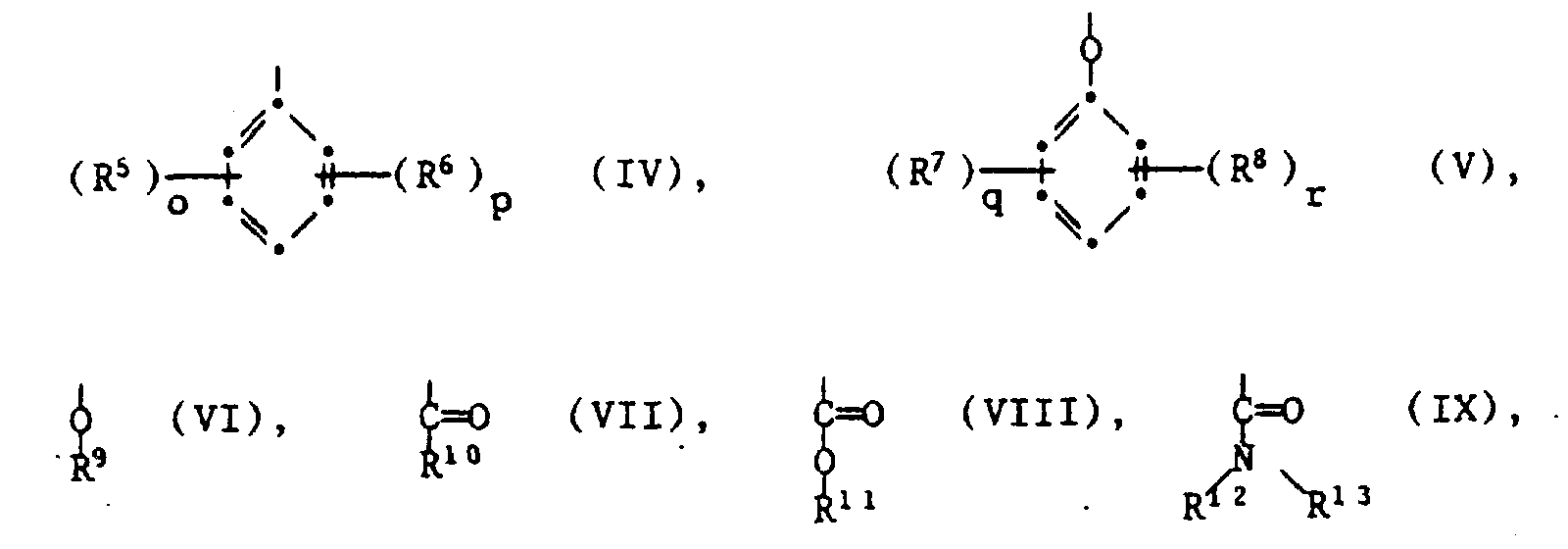

o und q unabhängig voneinander 0, 1, 2 oder 3 sind,
p und r unabhängig voneinander 0, 1, 2, 3, 4 oder 5 bedeuten, wobei die Summen o+p und q+r höchstens 5 betragen dürfen,
R⁹ Wasserstoff, C₁-C₂₀Alkyl, ein Glycidylrest der Formel Xa oder ein Rest der Formel VII ist,
R¹⁰ Wasserstoff, C₁-C₂₀Alkyl, Cycloalkyl mit 5 bis 7 Ring C-Atomen, Phenyl, Naphthyl oder Benzyl darstellt,
R¹¹ Wasserstoff, C₁-C₂₀Alkyl oder ein Glycidylrest der Formel Xa ist und die Gruppen R¹ und R¹³ unabhängig voneinander Wasserstoff, C₁-C₂₀Alkyl, Cycloalkyl mit 5 bis 7 Ring C-Atomen, gegebenenfalls substituiertes Aryl oder Aralkyl oder ein Glycidylrest der Formel Xa sind oder zusammen mit dem gemeinsamen Stickstoffatom einen fünf-oder sechsgliedrigen heterocyclischen Ring bilden und R¹⁴ und R¹⁵ unabhängig voneinander Wasserstoff oder Methyl sind, wobei die Reste R⁵ bis R¹⁵ und A eines Polymermoleküls innerhalb der gegebenen Definitionen unterschiedlich sein können. - Besonders bevorzugte Bindemittel des Typs iii) sind Copolymere enthaltend 50-100 Mol%, bezogen auf das Gesamtpolymere, an Struktureinheiten der Formeln II und III.
- Insbesondere bevorzugt werden Bindemittel des Typs iii) bestehend im wesentlichen aus Strukturelementen der Formeln II und III, worin der Anteil der Elemente II 10-80 Mol%, bezogen auf den Anteil von II und III, ausmacht.
- Ganz besonders bevorzugte Bindemittel des Typs iii) sind Copolymere enthaltend Struktureinheiten der Formeln II und III, wie oben definiert, worin A ausgewählt wird aus der Gruppe der Reste der Formeln IV, V, VI, VIII und IX, R⁵ und R⁷ Glycidylgruppen der Formeln Xa oder Xb darstellen, R⁹, R¹¹ und mindestens einer der Reste R¹ oder R¹³ eine Glycidylgruppe de Formel Xa ist und o und q unabhängig voneinander 1, 2 oder 3 sind.
- Insbesondere bevorzugt werden Bindemittel des Typs iii), die Struktureinheiten der Formeln II und III, wie oben definiert, enthalten, worin A eine Gruppe der Formel VI ist und R⁹ eine Gruppe der Formel Xa bedeutet, oder worin A eine Gruppe der Formeln IV oder V ist, R⁵ und R⁷ Glycidylgruppen der Formel Xb sind, o und q 1 oder 2 bedeuten und p und r 0 sind.
- Weitere Bindemittel des Typs iii) sind Copolymere enthaltend mindestens 50 Mol%, bezogen auf das Gesamtpolymere, an Strukturelementen der Formel II und III und als restlichen Anteil Strukturelemente, die sich von carboxylgruppenfreien Vinylverbindungen ausgewählt aus der Gruppe bestehend aus Styroltypen, Estern oder Amiden α,β-ungesättigter Säuren, Nitrilen von α,β-ungesättigten Säuren, halogenhaltigen Vinylverbindungen, Vinylestern und Vinylethern ableiten.
- Copolymere aus N-Hydroxyphenylmaleinimiden und Allylverbindungen wurden bislang nicht beschrieben.
- Sie lassen sich herstellen, indem man
- a) Verbindungen der Formel IIa und IIIa

- b) Verbindungen der Formel IIb und IIIa

- Die Molekulargewichte der N-(Hydroxyphenyl)-maleinimid / Allyl-Copolymeren liegen in der Regel zwischen 500-100000 (Gewichtsmittel).
- Die Verbindungen der Formeln IIa und IIb sind an sich bekannt oder können nach Standardreaktionen hergestellt werden. Nähere Einzelheiten dazu sind in der US-PS 4,289,699 zu finden. Die Allylverbindungen der Formel IIIa sind ebenfalls bekannt und teilweise im Handel erhältlich.
- Bedeuten R¹, R, R³, R⁴, R⁶ oder R⁸ C₁-C₄Alkyl, so handelt es sich dabei um geradkettige oder verzweigte, bevorzugt um geradkettige, Alkylreste. Beispiele für solche Gruppen sind Methyl, Ethyl, n-Propyl, Isopropyl, n-Butyl oder sek.Butyl. Bevorzugt wird Methyl.
- Als C₁-C₄Alkoxy besitzt der Alkylteil von R¹, R, R³, R⁴, R⁶ oder R⁸ die oben beispielhaft erwähnten Bedeutungen. Bevorzugt wird Methoxy.
- Als Halogen sind R¹, R, R³, R⁴, R⁶ oder R⁸ Fluor, Chlor, Brom oder Iod. Bevorzugt wird Chlor oder Brom, insbesondere Brom.
- Sind irgendwelche Reste C₁-C₂₀Alkyl, so handelt es sich dabei bevorzugt um geradkettige Gruppen. Es können aber auch verzweigte Alkylgruppen sein.
- Beispiele für C₁-C₂₀Alkylreste sind Methyl, Ethyl, n-Propyl, Isopropyl, n-Butyl, sek.Butyl, tert.Butyl, n-Pentyl, Isopentyl, n-Hexyl, n-Heptyl, n-Octyl, 2-Ethylhexyl, n-Nonyl, n-Decyl, n-Undecyl, n-Dodecyl, n-Tetradecyl, n-Hexadecyl, n-Octadecyl oder n-Eicosyl. Bevorzugt werden C₁-C₈Alkylreste dieses Typs, insbesondere die geradkettigen und ganz besonders Methyl oder Ethyl.
- A als Halogen ist Fluor, Chlor, Brom oder Iod. Bevorzugt wird Chlor oder Brom, insbesondere Chlor.
- Bei R¹⁰, R¹ und R¹³ als Cycloalkyl mit 5 bis 7 Ring C-Atomen handelt es sich in der Regel um Cyclopentyl, Cyclohexyl oder Cycloheptyl, insbesondere jedoch um Cyclohexyl. Diese Reste sind gegebenenfalls alkylsubstituiert.
- Als gegebenenfalls substituiertes Aryl sind R¹ oder R¹³ beispielsweise Phenyl oder Naphthyl. Als Substituenten kommen beispielsweise Alkylgruppen, insbesondere Methyl, Alkoxygruppen, insbesondere Methoxy, Halogenatome, insbesondere Chlor oder Brom, oder Cyanogruppen in Frage.
- Spezifische Beispiele für substituierte Arylreste sind o-, m- oder p-Tolyl, Xylyl oder Chlorphenyl. Bevorzugter Arylrest ist Phenyl.
- Als gegebenenfalls substituiertes Aralkyl sind R¹ oder R¹³ beispielsweise Benzyl, α-Methylbenzyl oder α,α-Dimethylbenzyl. Auch hier kommen als Substituenten die oben für Aryl beispielhaft erwähnten Reste in Frage.
- Spezifische Beispiele für substituierte Aralkylreste sind 4-Methylbenzyl oder 4-Methoxybenzyl. Bevorzugt wird Benzyl.
- Der Index m im Strukturelement der Formel II ist vorzugsweise 1 oder 2, besonders bevorzugt 1. Der Index n im Strukturelement der Formel II ist vorzugsweise 0, 1 oder 2, besonders bevorzugt 0.
- Die Komponente b1) der erfindungsgemässen Negativ-Resists enthält mindestens ein alkalisch-wässrig unter Salzbildung lösliches Phenol mit Epoxypropylseitengruppen und/oder eine lösliche Vinyletherverbindung, welche ein solches Ausmass an Hydroxylgruppen aufweisen, dass sie sich in ungehärtetem Zustand unter Salzbildung in einer alkalisch-wässrigen Lösung lösen lassen.
- Falls gewünscht, kann eine Mischung von Epoxidharzen oder Vinylethern in den erfindungsgemässen Zusammensetzungen verwendet werden.
- In der Regel sind diese Phenole mit Epoxypropylseitengruppen, oder diese Vinyletherverbindungen polyfunktionell. Es können auch kleinere Anteile an derartigen monofunktionellen Phenolen oder Vinyletherverbindungen in Kombination mit polyfunktionellen Phenolen mit Epoxypropylseitengruppen, oder mit Vinyletherverbindungen eingesetzt werden.
- Bei der Komponente b1) kann es sich um relativ niedermolekulare Phenole mit Epoxypropylseitengruppen handeln; Diese Hydroxyl-Gruppen müssen in einem solchen Ausmass neben den Epoxidgruppen vorhanden sein, um die Löslichkeit in alkalisch-wässrigen Lösungen zu gewährleisten. Es kann sich aber auch um relativ hochmolekulare Verbindungen handeln, die neben den Epoxidgruppen oder Vinyletherresten einen zur Erzielung der Wasserlöslichkeit ausreichenden Anteil an Hydroxy-Gruppen besitzen.
- Beispiele für Komponenten b1) sind Phenole mit Epoxypropylseitengruppen oder teilweise mit Glycidylgruppen veretherte Polyphenole, beispielsweise teilglycidylisierte Novolake auf Basis von Phenol und Formaldehyd oder auf Basis von Kresol und Formaldehyd.
- Zu den bevorzugten Komponenten b1) zählen Verbindungen der Formel XI

- Weitere bevorzugte Komponenten b1) sind modifizierte o-Alkylphenol-Novolake der Formel XII

- Weitere bevorzugte Komponenten b1) sind modifizierte Phenol-Novolake aus Struktureinheiten der Formeln XIII und XIV

- Weitere bevorzugte Komponenten b1) sind modifizierte Poly-Hydroxystyrole aus Struktureinheiten der Formeln XV und XVI oder aus Struktureinheiten der Formeln XV und XVII

- Vorzugsweise handelt es sich bei diesen Verbindungen um modifizierte Poly-p-hydroxystyrole.
- Die Herstellung von Phenolen mit Epoxypropylseitengruppen erfolgt beispielsweise durch Umsetzung von Allylphenolethern oder -estern, beispielsweise von Essigsäure-(2,6-diallylphenol)-ester, mit Persäuren, beispielsweise mit Peressigsäure, und anschliessender Verseifung.
- Die Verbindungen der Formel XI lassen sich durch Epoxidierung der Diacetate der entsprechenden (Meth)allylverbindungen mit Persäuren und anschliessender Verseifung zum Bisphenol erhalten. Die (Meth)allylverbindungen lassen sich durch Claisen-Umlagerung der entsprechenden (Meth)allylether erhalten. Beispiele für solche Umsetzungen findet man in der EP-A-14,816.
- Die Verbindungen der Formel XII lassen sich auf analoge Weise herstellen, indem man anstelle von den der Formel XI zugrundeliegenden Bisphenole von den der Formel XII zugrundeliegenden Novokalen ausgeht. Die Verbindungen enthaltend Stuktureinheiten der Formeln XIII und XIV lassen sich durch teilweise Veretherung der zugrundeliegenden Novolake mit Verbindungen der Typs CH₂=CH-D-Cl herstellen, wobei D die weiter oben definierte Bedeutung besitzt. Solche Umsetzungen sind in der JP-A-60-71,657 beschrieben.
- Die Polyhydroxystyrole aus Struktureinheiten der Formel XV und XVI bzw. der Formel XV und XVII lassen sich aus den an sich bekannten Polyhydroxystyrolen durch teilweise Umsetzung der phenolischen Hydroxylgruppen mit Verbindungen des Typs CH₂=CH-D-Cl, wie oben definiert, oder mit Epichlorhydrin erhalten.
- Als Komponente c1) bzw. b2) der erfindungsgemässen Gemische lässt sich eine Vielzahl bekannter und in der Technik erprobter kationischer Photoinitiatoren für Epoxidharze einsetzen. Dabei handelt es sich beispielsweise um Oniumsalze mit Anionen schwacher Nucleophilie. Beispiele dafür sind Haloniumsalze, wie unter Formel II in der EP-A 153,904 erwähnt, Iodosylsalze, wie unter Formel IV der EP-A 153,904 erwähnt, Sulfoniumsalze, wie unter Formel III der EP-A 153,904 erwähnt, Sulfoxoniumsalze, wie beispielsweise in den EP-A 35,969, 44,274, 54,509 und 164,314, beschrieben oder Diazoniumsalze, wie beispielsweise in der US-A-3,708,296 beschrieben.
- Eine Uebersicht über weitere gängige Oniumsalzinitiatoren bietet "UV-Curing, Science and Technology" (Editor: S.P. Pappas, Technology Marketing Corp., 642 Westover Road, Stanford, Conneticut, USA).
- Bevorzugte Photoinitiatoren sind Metallocensalze, wie beispielsweise in der EP-A 94,914 und ganz besonders in der EP-A 94,915 beschrieben.
- Die Ausführungen in diesen Publikationen sind ebenfalls Gegenstand der vorliegenden Beschreibung.
- Zu den bevorzugten Photoinitiatoren zählen die Verbindungen der Formeln XVIII, XIX und XX



- Beispiele für einwertige carbocyclisch-aromatische C₆-C₁₈Reste sind Phenyl, Naphthyl, Anthryl und Phenanthryl. Bevorzugt wird Phenyl. Gegebenenfalls vorliegende Substituenten dieser Reste sind Alkyl, bevorzugt C₁-C₆Alkyl, wie Methyl, Ethyl, n-Propyl, Isopropyl, n-Butyl, n-Pentyl oder n-Hexyl, Alkoxy, bevorzugt C₁-C₆Alkoxy, wie Methoxy, Ethoxy, n-Propoxy, n-Butoxy, n-Pentoxy oder n-Hexoxy, Alkylthio, bevorzugt C₁-C₆Alkylthio, wie Methylthio, Ethylthio, Propylthio, Butylthio, Pentylthio oder Hexylthio, Halogen, wie Fluor, Chlor, Brom oder Iod, Aminogruppen, Cyanogruppen, Nitrogruppen oder Arylthio, wie Phenylthio.
- Beispiele für zweiwertige carbocyclisch-aromatische C₁₂-C₁₈Reste sind Biphenyl-2,2′-diyl.
- Beispiele für bevorzugte Halogenatome Q sind Chlor oder insbesondere Fluor. Bevorzugte Anionen LQn - sind BF4 -, PF6 -, AsF6 -, SbF6 - und SbF₅(OH)⁻.
- Zu den ganz besonders bevorzugten Metalloceninitiatoren im Rahmen dieser Erfindung zählen die Verbindungen der Formel XXI

- Beispiele für π-Arene R⁹ und Anionen von π-Arenen R³⁰ findet man in der EP-A 94,915.
- Beispiele für bevorzugte π-Arene R⁹ sind Toluol, Xylol, Ethylbenzol, Cumol, Methoxybenzol, Methylnaphthalin, Methoxynaphthalin, Pyren, Perylen, Stilben, Diphenylenoxid und Diphenylensulfid.
- Ganz besonders bevorzugt man Cumol, Methylnaphthalin oder Stilben.
- Beispiele für nicht nukleophile Anionen X⁻ sind FSO3 -, Anionen von organischen Sulfonsäuren, von Carbonsäuren oder Anionen [LQn]⁻, wie oben definiert.
- Bevorzugte Anionen leiten sich ab von teilfluor- oder perfluoraliphatischen oder teilfluor- oder perfluoraromatischen Carbonsäuren, oder insbesondere von teilfluor- oder perfluoraliphatischen oder von teilfluor- oder perfluoraromatischen organischen Sulfonsäuren oder es handelt sich bevorzugt um Anionen [LQn]⁻.
- Beispiele für Anionen X sind BF4 -, PF6 -, AsF6 -, SbF6 -, SbF₅OH⁻, CF₃SO3 -, C₂F₅SO3 -, n-C₃F₇SO3 -, n-C₄F₉SO3 -, n-C₆F₁₃SO3 -, n-C₈F₁₇SO3 -, C₆F₅SO3 -, Phosphorwolframat (PO₄₀W12 3-) oder Siliciumwolframat (SiO₄₀W12 4-).
- Bevorzugt werden PF6 -, AsF6 -, SbF6 -, CF₃SO3 -, C₂F₅SO3 -, n-C₃F₇SO3 -, n-C₄F₉SO3 -, n-C₆F₁₃SO3 - und n-C₈F₁₇SO3 -.
- Man kann auch Kombinationen dieser Metallocensalze mit Oxidationsmitteln einsetzen. Solche Kombinationen sind in der EP-A 126,712 beschrieben.
- Zur Erhöhung der Lichtausbeute setzt man, je nach Initiatortyp, vorzugsweise Sensibilisatoren zu.
- Beispiele dafür sind polycyclische aromatische Kohlenwasserstoffe oder aromatische Ketoverbindungen. Spezifische Beispiele bevorzugter Sensibilisatoren sind in der EP-A 153,904 erwähnt.
- Die erfindungsgemässe Mischung kann noch weitere in der Technik der Negativ-Resists übliche Zusätze d1) bzw. c2) enthalten. Beispiele für solche Zusätze sind Netzmittel, Verlaufsmittel, Stabilisatoren, Farbstoffe, Pigmente, Füllstoffe, Haftvermittler, Weichmacher und Zusatzharze. Zusatzharze werden im allgemeinen verwendet, um die mechanischen Eigenschaften der Schicht zu modifizieren. Beispiele dafür sind Vinyl-copolymere auf Styrol- oder Acrylatbasis, Polyester, Polyamide oder Silikonharze. Diese Zusatzharze werden in der Regel in kleinen Mengen, bevorzugt bis 10 Gew.%, bezogen auf die Gesamtmischung, zugesetzt. Sie müssen mit den übrigen Bestandteilen der Mischung verträglich sein und sollten in organischen Lösungsmitteln löslich sein.
- Ferner können den Mischungen noch Katalysatoren, Beschleuniger und Härter für die Epoxidkomponente beigegeben werden. Diese Zusätze bewirken bei einer eventuellen thermischen Nachbehandlung eine Nachhärtung der Epoxidkomponente; gegebenenfalls erfolgt dieser Nachhärtungsschritt nach der Entwicklung des Photoresists.
- Die erfindungsgemässen Massen enthalten bevorzugt 10-90 Gew.% des Bindemittels a1), 5-80 Gew.% des Epoxy-Phenols oder Vinylethers b1), 0,5-20 Gew.% des Photoinitiators c1) und 0-15 Gew.% der Zusatzstoffe d1). Dabei ergänzen sich die Anteile der einzelnen Komponenten jeweils zu 100 % und die Mengenangaben sind auf die Gesamtmenge bezogen.
- Ganz besonders bevorzugt enthalten die Massen, bezogen auf die Gesamtmenge, 30-85 Gew.% Bindemittel a1), 10-60 Gew.% Epoxy-Phenol- oder Vinyletherverbindung b1), 1-10 Gew.% Photoinitiator c1) und 0-10 Gew.% Zusatzstoffe d1).
- Der Anteil der Komponenten a2), b2) und c2) beträgt vorzugsweise 99-70 Gew.%, 1-20 Gew.% und 0-10 Gew.-%, bezogen auf die Menge an a2), b2) und c2).
- Zur Herstellung von Beschichtungen löst man die einzelnen Komponenten in einem geeigneten Lösungsmittel. Die Wahl des Lösungsmittels und die Konzentration richtet sich hauptsächlich nach der Art der Komponenten und nach dem Beschichtungsverfahren. Das Lösungsmittel soll inert sein, d.h. es soll mit den Komponenten keine chemische Reaktion eingehen und es soll bei der Trocknung nach dem Beschichten wieder entfernt werden können.
- Bekannte Beschichtungsverfahren sind z.B.: Schleudern, Tauchen, Rakelbeschichtung, Vorhanggiessverfahren, Aufpinseln, Sprühen oder Reverse-Rollbeschichtung.
- Ferner kann die erfindungsgemässe Zusammensetzung als Dry-film von einem temporären, flexiblen Träger auf ein Substrat übertragen werden. Ein solches Verfahren ist z.B. in der EP-A 153,904 beschrieben.
- Die Auftragsmenge (Schichtdicke) und Art des Substrates (Schichtträger) sind abhängig vom gewünschten Applikationsgebiet. Besonders vorteilhaft ist es, dass die erfindungsgemässen Zusammensetzungen in weit variablen Schichtdicken eingesetzt werden können. Dieser Schichtdickenbereich umfasst Werte von ca. 0,5 µm bis mehr als 100 µm.
- Mögliche Einsatzgebiete der erfindungsgemässen Zusammensetzungen sind die Verwendung als Photoresists für die Elektronik (Galvanoresist, Aetzresist, Lötstoppresist), die Herstellung von Druckplatten, wie Offsetdruckplatten oder Siebdruckformen, der Einsatz beim Formteilätzen oder der Einsatz als Mikroresist bei der Herstellung integrierter Schaltkreise.
- Dementsprechend unterschiedlich sind die möglichen Schichtträger und die Verarbeitungsbedingungen der beschichteten Substrate.
- Für photographische Informationsaufzeichnung dienen z.B. Folien aus Polyester, Celluloseacetat oder mit Kunststoff beschichtete Papiere; für Offsetdruckformen speziell behandeltes Aluminium und für die Herstellung gedruckter Schaltungen kupferkaschierte Laminate. Die Schichtdicken für photographische Materialien und Offsetdruckformen betragen bevorzugt ca. 0,5 bis 10 µm; für gedruckte Schaltungen 1 bis ca. 100 µm.
- Nach dem Beschichten wird das Lösungsmittel in der Regel durch Trocknen entfernt und es resultiert eine Schicht des Photoresist auf dem Träger.
- Die Lichtempfindlichkeit der erfindungsgemässen Zusammensetzungen reicht in der Regel vom UV-Gebiet (ca. 200 nm) bis ca. 600 nm und umspannt somit einen sehr breiten Bereich. Als Lichtquellen kommen daher eine grosse Anzahl der verschiedensten Typen zur Anwendung. Es sind sowohl Punktquellen als auch flächenförmige Strahler (Lampenteppiche) geeignet. Beispiele sind: Kohlelichtbogenlampen, Xenon-Lichtbogenlampen, Quecksilberdampflampen, gegebenenfalls mit Metall-Halogeniden dotiert (Metall-Halogenlampen), Fluoreszenzlampen, Argonglühlampen, Elektronenblitzlampen und photographische Flutlichtlampen.
- Der Abstand zwischen Lampe und erfindungsgemässem Bildmaterial kann je nach Anwendungszweck und Lampentyp bzw. -stärke variieren, z.B. zwischen 2 cm bis 150 cm. Spezielle geeignet sind Laserlichtquellen, z.B. Argonionenlaser oder Kryptonionenlaser mit starken Emissionslinien (Ar-Laser) bei 457, 476, 488, 514, 528 nm. Bei dieser Art der Belichtung ist keine Photomaske im Kontakt mit der Photopolymerschicht mehr nötig; der gesteuerte Laser-Strahl schreibt direkt auf die Schicht. Hier ist die hohe Empfindlichkeit der erfindungsgemässen Materialien sehr vorteilhaft, die hohe Schreibgeschwindigkeiten bei relativ niedrigen Intensitäten erlaubt. Nach dieser Methode können gedruckte Schaltungen in der Elektronikindustrie, lithographische Offsetdruckplatten oder Reliefdruckplatten sowie photographische Bildaufzeichnungsmaterialien hergestellt werden.
- Nach der bildmässigen Belichtung des Materials und vor der Entwicklung kann es vorteilhaft sein, eine thermische Behandlung für kürzere Zeit durchzuführen. Dabei werden nur die bereits belichteten Teile thermisch nachgehärtet. Diese thermische Behandlung ist besonders empfehlenswert bei den Metallocen-Photoinitiatoren. Sie kann in konventionellen Oefen, beispielsweise in Konvektionsöfen, stattfinden, aber auch mit IR-Strahlung, beispielsweise durch Bestrahlung mit IR-Lasern, oder in Mikrowellengeräten erfolgen. Die angewandten Temperaturen liegen im allgemeinen bei 50-150°C, bevorzugt bei 80-130°C; die Härtungszeit liegt in der Regel zwischen 1 und 15 Minuten.
- Nach der Belichtung und gegebenenfalls thermischen Nachbehandlung werden die unbelichteten Stellen des Photolackes in an sich bekannter Weise mit einem Entwickler entfernt.
- Besonders bevorzugt als Entwickler werden wässrig alkalische Lösungen, wie sie auch für die Entwicklung von Naphthodiazidchinonschichten eingesetzt werden. Dazu zählen insbesondere Lösungen von Alkalimetallsilikaten, -phosphaten und -hydroxiden und -carbonaten. Diesen Lösungen können gegebenenfalls noch kleinere Mengen an Netzmitteln und/oder organischen Lösungsmitteln zugesetzt sein.
- Entwicklung mit organischen Lösungsmitteln ist ebenfalls möglich. In Frage kommen beispielsweise Cyclohexanon, 2-Ethoxyethanol, Aceton, MEK sowie Mischungen dieser Lösungsmittel.
- Nach der Belichtung und Entwicklung kann das Reliefbild nochmals einer thermischen Behandlung unterworfen werden (thermisch Nachhärtung 2. Stufe). Dabei reagieren verbliebene Epoxidgruppen oder Vinylethergruppen mit den phenolischen Hydroxylgruppen des Binders oder polymerisieren mit sich selbst. Dazu können die in der Epoxidharzchemie üblichen Katalysatoren und Beschleuniger bereits bei der Beschichtung zugesetzt werden (Komponente d1 bzw. c2), sie dürfen allerdings die Belichtung nicht stören.
- Durch diese zusätzliche thermische Netzwerkbildung werden besonders resistente und dauerhafte Reliefbilder erhalten, die sich, wie auch Beschichtungen gehärteter Epoxidharze, durch gute thermomechanische, chemische und elektrische Eigenschaften, insbesondere Stabilität, Haftung und hohen spezifischen Durchgangswiderstand auszeichnen.
- Die Erfindung betrifft daher auch ein Verfahren zur Erzeugung von Reliefstrukturen umfassend folgende Arbeitsschritte:
- a) Beschichten eines Substrates mit einer strahlungsempfindlichen Zusammensetzung, wie oben definiert,
- b) Belichten des beschichteten Substrates mit einem vorbestimmten Muster aktinischer Strahlung, gegebenenfalls
- c) thermische Nachbehandlung,
- d) Entwicklungsstufe und
- e) gegebenenfalls thermische Nachbehandlung des entwickelten Systems.
- Der Begriff 'Belichtung mit einem vorbestimmten Muster atkinischer Strahlung' beinhaltet sowohl die Belichtung durch eine Photomaske, die ein vorbestimmtes Muster enthält, beispielsweise ein Diapositiv, sowie die Belichtung durch einen Laserstrahl, der beispielsweise computergesteuert über die Oberfläche des beschichteten Substrates bewegt wird und auf diese Weise ein Bild erzeugt.
- Ferner betrifft die Erfindung ein Verfahren zur Herstellung von Schutzschichten umfassend folgende Arbeitsschritte:
- a) Beschichten eines Substrates mit einer strahlungsempfindlichen Zusammensetzung, wie oben definiert,
- b) Belichten der strahlungsempfindlichen Schicht in ihrer gesamten Fläche und
- c) gegebenenfalls thermische Nachbehandlung des belichteten Systems.
- Darüber hinaus betrifft die Erfindung die Verwendung der oben definierten Zusammensetzungen zur Herstellung von Schutzschichten und Reliefstrukturen.
- Die folgenden Beispiele erläutern die Erfindung:
-
- 1.1. Herstellung von 2,2'-Dihydroxy-3,3'-dimethyl-5,5'-diallyl-diphenyl-methan

- 1.2. Herstellung des Diacetats von 2

- 1.3. Epoxidierung des Diacetats 3

- 1.4. Verseifung des Diacetats 4
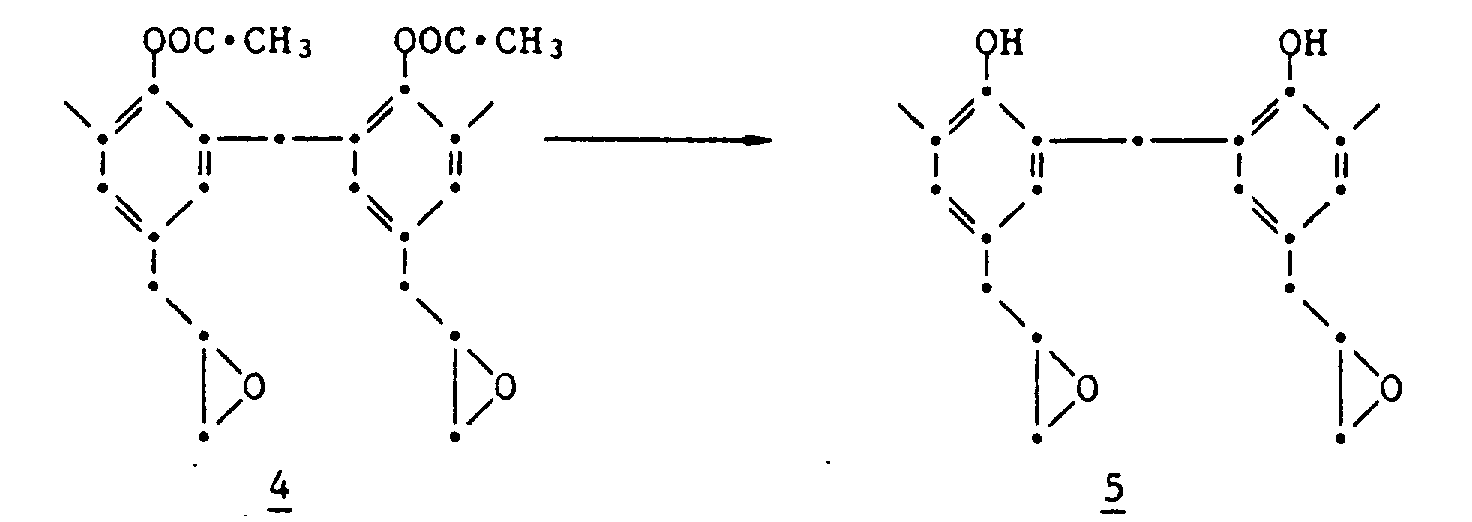
- Eine Lösung bestehend aus 2,5 g 2,2'-Dihydroxy-3,3'-dimethyl-5,5'-(2,3-epoxypropyl)-diphenylmethan; 5 g Cyclohexanon; 2,5 g eines p-Vinylphenol-polymer mit einem M

Belichtungszeit: 15" 45" 120" Stufenzahl: 2 4 6
Bevorzugte Novolake i) sind Verbindungen, die sich von einem C₁-C₆-Aldehyd, beispielsweise Formaldehyd und Acetaldehyd, und von einem zweikernigen, bevorzugt jedoch einkernigen, gegebenenfalls substituierten Phenol ableitet. Beispiele für bevorzugte Phenole sind Phenol selbst oder mit ein oder zwei C₁-C₉Alkylgruppen substituierte Phenole, wie beispielsweise o-, m- oder p-Kresol, Xylenol, p-tert.Butylphenol und o-, m- oder p-Nonylphenol, oder mit ein oder zwei Halogenatomen, bevorzugt Chlor oder Brom, substituierte Phenole, beispielsweise p-Chlorphenol, mit einem Phenylkern substituierte Phenole, wie z.B. p-Phenylphenol, oder auch Phenole mit mehr als einer phenolischen Gruppe, wie z.B. Resorcin, Bis-(4-hydroxyphenyl)-methan oder 2,2-Bis-(4-hydroxyphenyl)propan.
Claims (11)
- Kationisch photopolymerisierbare Zusammensetzung bestehend im wesentlichen ausa1) mindestens einem festen, filmbildenden Polyphenol,b1) mindestens einem Phenol mit Epoxypropylseitengruppen und/oder einer polyfunktionellen Vinyletherverbindung, welche ein solches Ausmassan Hydroxylgruppen aufweisen, dass sie sich in ungehärtetem Zustand unter Salzbildung in einer alkalisch-wässrigen Lösung lösen lassen,c1) mindestens einem Oniumsalz mit einem Anion mit schwacher Nucleophilie oder einem Mettallocensalz als kationischen Photoinitiator für die Komponente b1) und gegebenenfallsd1) üblichen Zusätzen.
- Zusammensetzung gemäss Anspruch 1, worin das Bindemittel a1) ausgewählt wird aus der Gruppe bestehend ausi) Novolaken aus mindestens einem Phenol und mindestens einem Aldehyd,ii) Homo- und Copolymeren von Alkenylphenolen undiii) Homo- und Copolymeren von N-Hydroxyphenylmaleinimiden.
- Zusammensetzung gemäss Anspruch 2, worin
der Novolak i) sich ableitet von einem zweikernigen oder einkernigen gegebenenfalls substituierten Phenol und einem C₁-C₆Aldehyd oder das Homo- oder Copolymere von Alkenylphenolen ii) das Strukturelement der Formel I enthält
das Homo- oder Copolymere von N-Hydroxyphenylmaleinimid iii) das Strukturelement der Formel II enthält
- Zusammensetzung gemäss Anspruch 3, worin das Bindemittel ii) ein Copolymeres auf Basis von Alkenylphenolen und carboxylgruppenfreien Vinylverbindungen ist oder
das Bindemittel iii) ein Copolymeres auf Basis von N-Hydroxyphenylmaleinimid und carboxylgruppenfreien Vinylverbindungen ist. - Zusammensetzung gemäss Anspruch 1, worin Komponente b1) eine Verbindung der Formel XI ist


- Zusammensetzung gemäss Anspruch 1, worin Komponente b1) ein modifizierter Phenol-Novolak aus Struktureinheiten der Foremln XIII und XIV ist

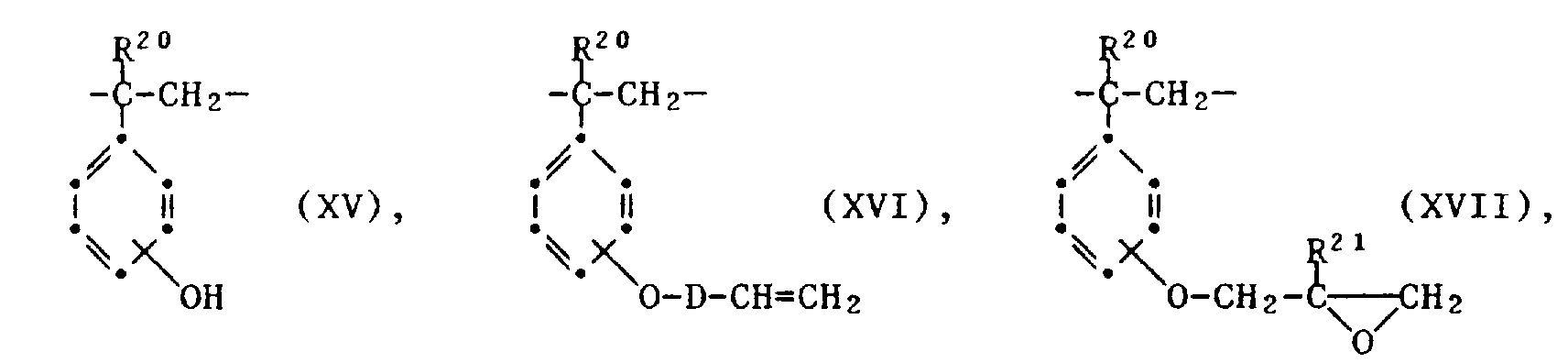
- Zusammensetzung gemäss den Anspruch 1, worin der Photoinitiator c1) eine Verbindung der Formel XVIII ist

- Verbindungen der Formel XI

- Verfahren zur Erzeugung von Reliefstrukturen umfassend folgende Arbeitsschritte:a) Beschichten eines Substrates mit einer strahlungsempfindlichen Zusammensetzung gemäss den Anspruch 1,b) Belichten des beschichteten Substrates mit einem vorbestimmten Muster aktinischer Strahlung, gegebenenfallsc) thermische Nachbehandlung,d) Entwicklungsstufe und gegebenenfallse) thermische Nachbehandlung des entwickelten Systems.
- Verfahren zur Erzeugung von Schutzschichten umfassend folgende Arbeitsschritte:a) Beschichten eines Substrates mit einer strahlungsempfindlichen Zusammensetzung gemäss den Anspruch 1,b) Belichten der strahlungsempfindlichen Schicht in ihrer gesamten Fläche undc) gegebenenfalls thermische Nachbehandlung.
- Verwendung der Zusammensetzung gemäss den Anspruch 1 zur Herstellung von Schutzschichten und Reliefstrukturen.
Applications Claiming Priority (4)
| Application Number | Priority Date | Filing Date | Title |
|---|---|---|---|
| CH287187 | 1987-07-28 | ||
| CH2871/87 | 1987-07-28 | ||
| CH546/88 | 1988-02-16 | ||
| CH54688 | 1988-02-16 |
Publications (3)
| Publication Number | Publication Date |
|---|---|
| EP0302019A2 EP0302019A2 (de) | 1989-02-01 |
| EP0302019A3 EP0302019A3 (en) | 1990-10-10 |
| EP0302019B1 true EP0302019B1 (de) | 1996-03-13 |
Family
ID=25684918
Family Applications (1)
| Application Number | Title | Priority Date | Filing Date |
|---|---|---|---|
| EP88810506A Expired - Lifetime EP0302019B1 (de) | 1987-07-28 | 1988-07-22 | Negativ-Photoresist auf Basis von Polyphenolen und ausgewählten Epoxid-oder Vinyletherverbindungen |
Country Status (6)
| Country | Link |
|---|---|
| US (1) | US4994346A (de) |
| EP (1) | EP0302019B1 (de) |
| JP (1) | JP2594124B2 (de) |
| KR (1) | KR960015641B1 (de) |
| CA (1) | CA1328883C (de) |
| DE (1) | DE3855088D1 (de) |
Families Citing this family (23)
| Publication number | Priority date | Publication date | Assignee | Title |
|---|---|---|---|---|
| US5300380A (en) * | 1986-08-06 | 1994-04-05 | Ciba-Geigy Corporation | Process for the production of relief structures using a negative photoresist based on polyphenols and epoxy compounds or vinyl ethers |
| US6210862B1 (en) | 1989-03-03 | 2001-04-03 | International Business Machines Corporation | Composition for photoimaging |
| EP0425418A3 (en) * | 1989-10-23 | 1992-01-22 | International Business Machines Corporation | Base developable negative tone photoresist |
| US5164278A (en) * | 1990-03-01 | 1992-11-17 | International Business Machines Corporation | Speed enhancers for acid sensitized resists |
| US5312715A (en) * | 1991-03-04 | 1994-05-17 | Shipley Company Inc. | Light-sensitive composition and process |
| US5206116A (en) * | 1991-03-04 | 1993-04-27 | Shipley Company Inc. | Light-sensitive composition for use as a soldermask and process |
| DE4112974A1 (de) * | 1991-04-20 | 1992-10-22 | Hoechst Ag | Negativ arbeitendes strahlungsempfindliches gemisch und damit hergestelltes strahlungsempfindliches aufzeichnungsmaterial |
| DE4112965A1 (de) * | 1991-04-20 | 1992-10-22 | Hoechst Ag | Negativ arbeitendes strahlungsempfindliches gemisch und damit hergestelltes strahlungsempfindliches aufzeichnungsmaterial |
| CA2115333A1 (en) * | 1993-02-16 | 1994-08-17 | Shigeo Hozumi | Polyfunctional vinyl ether compounds and photoresist resin composition containing the same |
| TW339421B (en) * | 1994-09-12 | 1998-09-01 | Sumitomo Kagaku Kk | A photoresist composition comprising a polyfunctional vinyl ether compound |
| JPH1041633A (ja) * | 1996-07-25 | 1998-02-13 | Hitachi Ltd | 多層配線板とそれに用いる感光性樹脂組成物 |
| US6559222B1 (en) | 1997-10-16 | 2003-05-06 | Sun Chemical Corporation | Photoneutralization of pH sensitive aqueous polymeric dispersions and methods for using same |
| US6680440B1 (en) | 1998-02-23 | 2004-01-20 | International Business Machines Corporation | Circuitized structures produced by the methods of electroless plating |
| US6602651B1 (en) | 1998-07-07 | 2003-08-05 | Kansai Paint Co., Ltd. | Water-based solder resist composition |
| US6066889A (en) * | 1998-09-22 | 2000-05-23 | International Business Machines Corporation | Methods of selectively filling apertures |
| US6204456B1 (en) | 1998-09-24 | 2001-03-20 | International Business Machines Corporation | Filling open through holes in a multilayer board |
| US6528218B1 (en) * | 1998-12-15 | 2003-03-04 | International Business Machines Corporation | Method of fabricating circuitized structures |
| JP4251612B2 (ja) * | 2003-01-30 | 2009-04-08 | ローム・アンド・ハース・エレクトロニック・マテリアルズ,エル.エル.シー. | エポキシ含有物質を含むネガ型感光性樹脂組成物 |
| JP4131864B2 (ja) * | 2003-11-25 | 2008-08-13 | 東京応化工業株式会社 | 化学増幅型ポジ型感光性熱硬化性樹脂組成物、硬化物の形成方法、及び機能素子の製造方法 |
| US7282324B2 (en) * | 2004-01-05 | 2007-10-16 | Microchem Corp. | Photoresist compositions, hardened forms thereof, hardened patterns thereof and metal patterns formed using them |
| KR100688570B1 (ko) * | 2005-08-31 | 2007-03-02 | 삼성전자주식회사 | 식각 마스크 패턴 형성용 코팅 조성물 및 이를 이용한반도체 소자의 미세 패턴 형성 방법 |
| KR101003678B1 (ko) * | 2008-12-03 | 2010-12-23 | 삼성전기주식회사 | 웨이퍼 레벨 패키지와 그 제조방법 및 칩 재활용방법 |
| WO2018038002A1 (ja) * | 2016-08-25 | 2018-03-01 | 富士フイルム株式会社 | 積層体の製造方法および電子デバイスの製造方法 |
Citations (1)
| Publication number | Priority date | Publication date | Assignee | Title |
|---|---|---|---|---|
| EP0255989A1 (de) * | 1986-08-06 | 1988-02-17 | Ciba-Geigy Ag | Negativ-Photoresist auf Basis von Polyphenolen und Epoxidverbindungen oder Vinylethern |
Family Cites Families (9)
| Publication number | Priority date | Publication date | Assignee | Title |
|---|---|---|---|---|
| US4256828A (en) * | 1975-09-02 | 1981-03-17 | Minnesota Mining And Manufacturing Company | Photocopolymerizable compositions based on epoxy and hydroxyl-containing organic materials |
| GB2009435B (en) * | 1977-11-16 | 1982-06-30 | Letraset International Ltd | Production of transfer materials |
| JPS5536212A (en) * | 1978-09-06 | 1980-03-13 | Mitsui Toatsu Chem Inc | Thermosetting resin composition |
| US4442197A (en) * | 1982-01-11 | 1984-04-10 | General Electric Company | Photocurable compositions |
| GB2137626B (en) * | 1983-03-31 | 1986-10-15 | Sericol Group Ltd | Water based photopolymerisable compositions and their use |
| JPS6071657A (ja) * | 1983-09-27 | 1985-04-23 | Agency Of Ind Science & Technol | 感光性樹脂組成物 |
| ATE37242T1 (de) * | 1984-02-10 | 1988-09-15 | Ciba Geigy Ag | Verfahren zur herstellung einer schutzschicht oder einer reliefabbildung. |
| JPS61173245A (ja) * | 1985-01-28 | 1986-08-04 | Fujitsu Ltd | ホトレジストパタ−ンの形成方法 |
| US4632971A (en) * | 1985-07-15 | 1986-12-30 | The Dow Chemical Company | Thermally stable capped thermoplastic phenolic resin |
-
1988
- 1988-07-20 US US07/221,846 patent/US4994346A/en not_active Expired - Lifetime
- 1988-07-22 DE DE3855088T patent/DE3855088D1/de not_active Expired - Fee Related
- 1988-07-22 EP EP88810506A patent/EP0302019B1/de not_active Expired - Lifetime
- 1988-07-26 CA CA000572983A patent/CA1328883C/en not_active Expired - Fee Related
- 1988-07-27 JP JP63187957A patent/JP2594124B2/ja not_active Expired - Fee Related
- 1988-07-28 KR KR1019880009568A patent/KR960015641B1/ko not_active Expired - Fee Related
Patent Citations (1)
| Publication number | Priority date | Publication date | Assignee | Title |
|---|---|---|---|---|
| EP0255989A1 (de) * | 1986-08-06 | 1988-02-17 | Ciba-Geigy Ag | Negativ-Photoresist auf Basis von Polyphenolen und Epoxidverbindungen oder Vinylethern |
Also Published As
| Publication number | Publication date |
|---|---|
| EP0302019A3 (en) | 1990-10-10 |
| US4994346A (en) | 1991-02-19 |
| KR890002711A (ko) | 1989-04-11 |
| CA1328883C (en) | 1994-04-26 |
| JPS6488538A (en) | 1989-04-03 |
| JP2594124B2 (ja) | 1997-03-26 |
| DE3855088D1 (de) | 1996-04-18 |
| EP0302019A2 (de) | 1989-02-01 |
| KR960015641B1 (ko) | 1996-11-18 |
Similar Documents
| Publication | Publication Date | Title |
|---|---|---|
| EP0302019B1 (de) | Negativ-Photoresist auf Basis von Polyphenolen und ausgewählten Epoxid-oder Vinyletherverbindungen | |
| EP0255989B1 (de) | Negativ-Photoresist auf Basis von Polyphenolen und Epoxidverbindungen oder Vinylethern | |
| EP0166682B1 (de) | Verfahren zur positiven Bilderzeugung | |
| EP2399905B1 (de) | Sulfoniumsalz, photosäuregenerator und lichtempfindliche harzzusammensetzung | |
| EP0272215B1 (de) | Verfahren zur Bilderzeugung | |
| EP0202196B1 (de) | Cyclische Acetale oder Ketale von beta-Ketoestern oder -amiden | |
| EP0473547A1 (de) | Olefinisch ungesättigte Oniumsalze | |
| EP0601974B1 (de) | Positiv-Photoresist mit verbesserten Prozesseigenschaften | |
| EP0681713B1 (de) | Sulfonsäureester, damit hergestellte strahlungsempfindliche gemische und deren verwendung | |
| EP0233567A2 (de) | Härtbare Mischungen, enthaltend N-Sulfonylaminosulfoniumsalze als kationisch wirksame Katalysatoren | |
| KR101959107B1 (ko) | 술포늄염, 광산 발생제, 경화성 조성물 및 레지스트 조성물 | |
| EP0659781A2 (de) | Maleinimidcopolymere, insbesonder für Photoresists | |
| EP0241423A2 (de) | Verfahren zur Herstellung positiver Abbildungen | |
| TWI805884B (zh) | 硫鎓鹽、光酸產生劑、能量線硬化性組成物、硬化體、化學增幅型正型光阻組成物、抗蝕劑圖案之製作方法和化學增幅型負型光阻組成物 | |
| EP0501919A1 (de) | Strahlungsempfindliche Zusammensetzungen auf der Basis von Polyphenolen und Acetalen | |
| US20210147352A1 (en) | Sulfonium salt, photoacid generator, curable composition, and resist composition | |
| EP4122915A1 (de) | Sulfoniumsalz, fotosäuregenerator, härtbare zusammensetzung und resistzusammensetzung | |
| JP2011195499A (ja) | スルホニウム塩、光酸発生剤及び感光性樹脂組成物 | |
| EP0510443B1 (de) | Negativ arbeitendes strahlungsempfindliches Gemisch und damit hergestelltes strahlungsempfindliches Aufzeichnungsmaterial | |
| KR20190017757A (ko) | 술포늄염, 광산 발생제, 경화성 조성물 및 레지스트 조성물 | |
| EP0475903A1 (de) | Säurelabile Lösungsinhibitoren und darauf basierende positiv und negativ arbeitende strahlungsempfindliche Zusammensetzung | |
| EP0126029B1 (de) | Verfahren zur Bilderzeugung | |
| JP5592202B2 (ja) | スルホニウム塩、光酸発生剤及び感光性樹脂組成物 | |
| TW201922697A (zh) | 光酸產生劑、硬化性組成物、硬化體、光阻組成物以及抗蝕劑圖案的製作方法 | |
| EP0545859A1 (de) | Strahlungsempfindliche Zusammensetzungen |
Legal Events
| Date | Code | Title | Description |
|---|---|---|---|
| PUAI | Public reference made under article 153(3) epc to a published international application that has entered the european phase |
Free format text: ORIGINAL CODE: 0009012 |
|
| 17P | Request for examination filed |
Effective date: 19880725 |
|
| AK | Designated contracting states |
Kind code of ref document: A2 Designated state(s): CH DE FR GB IT LI NL SE |
|
| PUAL | Search report despatched |
Free format text: ORIGINAL CODE: 0009013 |
|
| AK | Designated contracting states |
Kind code of ref document: A3 Designated state(s): CH DE FR GB IT LI NL SE |
|
| 17Q | First examination report despatched |
Effective date: 19930317 |
|
| GRAA | (expected) grant |
Free format text: ORIGINAL CODE: 0009210 |
|
| AK | Designated contracting states |
Kind code of ref document: B1 Designated state(s): CH DE FR GB IT LI NL SE |
|
| REF | Corresponds to: |
Ref document number: 3855088 Country of ref document: DE Date of ref document: 19960418 |
|
| ITF | It: translation for a ep patent filed | ||
| GBT | Gb: translation of ep patent filed (gb section 77(6)(a)/1977) |
Effective date: 19960430 |
|
| ET | Fr: translation filed | ||
| REG | Reference to a national code |
Ref country code: CH Ref legal event code: PUE Owner name: CIBA-GEIGY AG TRANSFER- CIBA SC HOLDING AG |
|
| PLBE | No opposition filed within time limit |
Free format text: ORIGINAL CODE: 0009261 |
|
| STAA | Information on the status of an ep patent application or granted ep patent |
Free format text: STATUS: NO OPPOSITION FILED WITHIN TIME LIMIT |
|
| NLS | Nl: assignments of ep-patents |
Owner name: CIBA SC HOLDING AG |
|
| 26N | No opposition filed | ||
| REG | Reference to a national code |
Ref country code: GB Ref legal event code: 732E |
|
| REG | Reference to a national code |
Ref country code: CH Ref legal event code: PFA Free format text: CIBA SC HOLDING AG TRANSFER- CIBA SPECIALTY CHEMICALS HOLDING INC. |
|
| NLT1 | Nl: modifications of names registered in virtue of documents presented to the patent office pursuant to art. 16 a, paragraph 1 |
Owner name: CIBA SPECIALTY CHEMICALS HOLDING INC. |
|
| REG | Reference to a national code |
Ref country code: FR Ref legal event code: TP |
|
| REG | Reference to a national code |
Ref country code: CH Ref legal event code: PUE Owner name: CIBA SPECIALTY CHEMICALS HOLDING INC. TRANSFER- VA |
|
| REG | Reference to a national code |
Ref country code: GB Ref legal event code: 732E |
|
| NLS | Nl: assignments of ep-patents |
Owner name: VANTICO AG |
|
| REG | Reference to a national code |
Ref country code: GB Ref legal event code: IF02 |
|
| REG | Reference to a national code |
Ref country code: FR Ref legal event code: TP |
|
| PGFP | Annual fee paid to national office [announced via postgrant information from national office to epo] |
Ref country code: NL Payment date: 20030630 Year of fee payment: 16 |
|
| PGFP | Annual fee paid to national office [announced via postgrant information from national office to epo] |
Ref country code: GB Payment date: 20030704 Year of fee payment: 16 |
|
| PGFP | Annual fee paid to national office [announced via postgrant information from national office to epo] |
Ref country code: SE Payment date: 20030708 Year of fee payment: 16 Ref country code: CH Payment date: 20030708 Year of fee payment: 16 |
|
| PGFP | Annual fee paid to national office [announced via postgrant information from national office to epo] |
Ref country code: DE Payment date: 20030710 Year of fee payment: 16 |
|
| PGFP | Annual fee paid to national office [announced via postgrant information from national office to epo] |
Ref country code: FR Payment date: 20030711 Year of fee payment: 16 |
|
| PG25 | Lapsed in a contracting state [announced via postgrant information from national office to epo] |
Ref country code: GB Free format text: LAPSE BECAUSE OF NON-PAYMENT OF DUE FEES Effective date: 20040722 |
|
| PG25 | Lapsed in a contracting state [announced via postgrant information from national office to epo] |
Ref country code: SE Free format text: LAPSE BECAUSE OF NON-PAYMENT OF DUE FEES Effective date: 20040723 |
|
| PG25 | Lapsed in a contracting state [announced via postgrant information from national office to epo] |
Ref country code: LI Free format text: LAPSE BECAUSE OF NON-PAYMENT OF DUE FEES Effective date: 20040731 Ref country code: CH Free format text: LAPSE BECAUSE OF NON-PAYMENT OF DUE FEES Effective date: 20040731 |
|
| PG25 | Lapsed in a contracting state [announced via postgrant information from national office to epo] |
Ref country code: NL Free format text: LAPSE BECAUSE OF NON-PAYMENT OF DUE FEES Effective date: 20050201 Ref country code: DE Free format text: LAPSE BECAUSE OF NON-PAYMENT OF DUE FEES Effective date: 20050201 |
|
| EUG | Se: european patent has lapsed | ||
| REG | Reference to a national code |
Ref country code: CH Ref legal event code: PL |
|
| GBPC | Gb: european patent ceased through non-payment of renewal fee |
Effective date: 20040722 |
|
| PG25 | Lapsed in a contracting state [announced via postgrant information from national office to epo] |
Ref country code: FR Free format text: LAPSE BECAUSE OF NON-PAYMENT OF DUE FEES Effective date: 20050331 |
|
| NLV4 | Nl: lapsed or anulled due to non-payment of the annual fee |
Effective date: 20050201 |
|
| REG | Reference to a national code |
Ref country code: FR Ref legal event code: ST |
|
| PG25 | Lapsed in a contracting state [announced via postgrant information from national office to epo] |
Ref country code: IT Free format text: LAPSE BECAUSE OF NON-PAYMENT OF DUE FEES Effective date: 20050722 |