EP0297616B2 - Rechnergesteuertes Funkteilnehmergerät - Google Patents
Rechnergesteuertes Funkteilnehmergerät Download PDFInfo
- Publication number
- EP0297616B2 EP0297616B2 EP88110582A EP88110582A EP0297616B2 EP 0297616 B2 EP0297616 B2 EP 0297616B2 EP 88110582 A EP88110582 A EP 88110582A EP 88110582 A EP88110582 A EP 88110582A EP 0297616 B2 EP0297616 B2 EP 0297616B2
- Authority
- EP
- European Patent Office
- Prior art keywords
- mobile radio
- software
- network
- radio
- mobile
- Prior art date
- Legal status (The legal status is an assumption and is not a legal conclusion. Google has not performed a legal analysis and makes no representation as to the accuracy of the status listed.)
- Expired - Lifetime
Links
- 238000011156 evaluation Methods 0.000 claims abstract description 9
- 238000000034 method Methods 0.000 description 3
- 206010010219 Compulsions Diseases 0.000 description 1
- 230000006978 adaptation Effects 0.000 description 1
- 230000000712 assembly Effects 0.000 description 1
- 238000000429 assembly Methods 0.000 description 1
- 230000006399 behavior Effects 0.000 description 1
- 230000005540 biological transmission Effects 0.000 description 1
- 239000002775 capsule Substances 0.000 description 1
- 230000001413 cellular effect Effects 0.000 description 1
- 238000010276 construction Methods 0.000 description 1
- 238000010586 diagram Methods 0.000 description 1
- 238000005516 engineering process Methods 0.000 description 1
- 238000011144 upstream manufacturing Methods 0.000 description 1
Images

Classifications
-
- H—ELECTRICITY
- H04—ELECTRIC COMMUNICATION TECHNIQUE
- H04W—WIRELESS COMMUNICATION NETWORKS
- H04W88/00—Devices specially adapted for wireless communication networks, e.g. terminals, base stations or access point devices
- H04W88/02—Terminal devices
- H04W88/06—Terminal devices adapted for operation in multiple networks or having at least two operational modes, e.g. multi-mode terminals
Definitions
- the invention relates to a radio subscriber unit for Operation in mobile networks with different Systems engineering.
- a radio subscriber unit namely a pager
- This pager can decode different message formats (ECHO or POCSAG).
- selection means are connected downstream of a decoder and a detector, which selects from a search routine one of several decoding schemes. The selection means check whether the selected coding scheme is suitable for decoding the received coded message for the user. If this is not the case, a next decoding scheme is tested.
- the radio subscriber unit known from WO 82/01268 can only operate if the received radio signal already contains a message coded for the user.
- Mobile radio devices for cellular networks are known (US-A-4,677,653), the allow access to multiple network operators by allowing the Device has multiple numbers, each of which is an operator assigned.
- From DE 34 44 989 A1 is a radio subscriber device known, which contains two radio parts, one for UHF and one for VHF.
- the subscriber terminal is for use in one uniform radio system provided. It is one Control available, which monitors both radio parts if possible channels in the UHF range to prove and to ensure that Channels in the VHF range are only occupied if there are no high-frequency UHF channels are assignable.
- the radio interfaces between Mobile device and mobile networks are largely incompatible, so that mobile devices of the mobile network Often a country is not in the mobile network of Neighboring country can be operated. Sets the customer Value continuous accessibility in both countries, he is forced to enter for every national mobile network to acquire own, special portable radio device and with to lead.
- Compatibility is not guaranteed even if a telecommunications administration due to reaching the Capacity limit of an older example one analog FDMA network a successor network, for example a digital TDMA network, mostly with improved Features and in a different frequency range, starts to build up. If the customer wishes full Coverage (existing in the old network), he must on the extended features of the new, more modern Dispense network. If he claims this, he is from the overall coverage of the older one Network excluded.
- the invention is based on the object to create radio subscriber equipment in several Mobile networks, especially with different System technology, with different frequency ranges and different transmission methods operated can be and the customers of it resulting Sacheungsvercardien largely relieve.
- To select the memory areas is one by the receiver of the Subscriber device driven evaluation the selection criterion the quality of the contact to the mobile network derived.
- the mobile devices according to the invention is a unrestricted cross-border operation possible regardless of whether the networks of telecommunications administrations are technically and frequency compatible or Not.
- the customer only needs a single mobile device to lead with you.
- the compatibility is so that from the radio interface mobile device - Mobile network laid in the mobile device inside Service.
- the telecommunications administrations are no longer forced to rush to more modern mobile networks build up nationwide, even before the trial operation successfully completed.
- the danger of Bad investment becomes for network operator and customer less, without the latter being modern Features, where offered, or at full capacity Must do without area coverage.
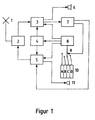
- FIG. 1 shows a block diagram of a Mobile phones according to the invention.
- the associated flow chart is shown in FIG. 2 shown.
- Fig. 1 shows a from the antenna 1, the duplexer 2, the receiver 3 with the downstream earpiece 6, the frequency synthesizer 4 and the transmitter 5 with upstream speech capsule 11 existing Mobile station by a microprocessor. 8 is controlled.
- an evaluation device 7 which controls a changeover switch 9, which has a number of Memory areas 10 optionally to the microprocessor. 8 on.
- the mobile device contains in this way the Software A - D several, engaged in system engineering distinctive mobile networks. Only one each Software is activated - indicated by the position the switch, in the example is the software of the Mobile network C activated.
- the receiver 3 may now too low field strength in See mobile network C see (Fig. 2). He enters corresponding signal to the evaluation device 7 Next, which locks the transmitter 5 and a consult the switch 9 and thus a change in the operation of the microprocessor 8 causes ("system search") see (Fig. 2) until the receiver 3, controlled by Milro processor 8 and Frequency Synethesizer 4, a the Quality requirements corresponding mobile network "has found. The "system search", caused by Evaluation 7, is terminated, the transmitter. 5 unlocked ( Figure 2). The mobile device is located back in working order.
- Radio device designed so that several high-frequency parts are provided, one of which by untrained Persons, i. the user without tools in the Radio is inserted and removed.
- the mobile device may be a radiotelephone act.
- the device can be a Broadband antenna or electronic or mechanical have tunable antenna.
Landscapes
- Engineering & Computer Science (AREA)
- Computer Networks & Wireless Communication (AREA)
- Signal Processing (AREA)
- Mobile Radio Communication Systems (AREA)
- Selective Calling Equipment (AREA)
Description
Claims (4)
- Rechnergesteuertes Funkteilnehmergerät,
das einen Sender (5) und einen Empfänger (3) hat und
dessen Software in Speicherbausteinen abgespeichert ist,
bei dem zum Betrieb des Funkteilnehmergerätes in Mobilfunknetzen
mit unterschiedlichen Funkschnittstellen zwischen dem Funkteilnehmergerät und dem Mobilfunknetz mehrere Speicherbereiche (10) mit der dem jeweiligen Mobilfunknetz entsprechenden Software (A, B, C, D) vorgesehen
und wahlweise aktivierbar ausgeführt sind und
bei dem eine vom Empfänger (3) des Funkteilnehmergerätes
gesteuerte Auswerteeinrichtung (7) vorgesehen ist, durch die
vor dem Aufbau einer den Qualitätsanforderungen entsprechenden Verbindung das Auswahlkriterium für die Speicherbereiche (10)
aus der Qualität des Kontaktes zum Mobilfunknetz abgeleitet wird
und bei dem, falls bei einer aktivierten Software (C) der Empfänger (3) eine zu geringe Feldstärke feststellt, die Auswerteeinrichtung (7) zum Finden
des den Qualitätsanforderungen entsprechenden Mobilfunknetzes einen Systemsuchlauf durch Weiterschalten in die nächste Software (D) veranlaßt. - Funkteilnehmergerät, nach Anspruch 1, wobei zum Betrieb für mehrere Frequenzbereiche mehrere Hochfrequenzteile vorgesehen sind, von denen jeweils einer durch ungeübte Personen ohne Werkzeug in das Gerät einsetz- und entnehmbar ist.
- Funkteilnehmergerät nach einem der vorhergehenden Ansprüche, wobei es eine Breitbandantenne oder eine elektronisch oder mechanisch abstimmbare Antenne aufweist.
- Funkteilnehmergerät nach einen der vorhergehenden Ansprüche, wobei es ein Funktelefon ist.
Priority Applications (1)
| Application Number | Priority Date | Filing Date | Title |
|---|---|---|---|
| AT88110582T ATE95022T1 (de) | 1987-07-02 | 1988-07-01 | Rechnergesteuertes funkteilnehmergeraet. |
Applications Claiming Priority (2)
| Application Number | Priority Date | Filing Date | Title |
|---|---|---|---|
| DE3721889 | 1987-07-02 | ||
| DE19873721889 DE3721889A1 (de) | 1987-07-02 | 1987-07-02 | Rechnergesteuertes teilnehmergeraet zum betrieb in fernmeldenetzen, insbesondere mobilfunknetzen, mit unterschiedlicher systemtechnik |
Publications (3)
| Publication Number | Publication Date |
|---|---|
| EP0297616A1 EP0297616A1 (de) | 1989-01-04 |
| EP0297616B1 EP0297616B1 (de) | 1993-09-22 |
| EP0297616B2 true EP0297616B2 (de) | 2003-02-12 |
Family
ID=6330776
Family Applications (2)
| Application Number | Title | Priority Date | Filing Date |
|---|---|---|---|
| EP88905796A Pending EP0368881A1 (de) | 1987-07-02 | 1988-07-01 | Rechnergesteuertes funkteilnehmergerät |
| EP88110582A Expired - Lifetime EP0297616B2 (de) | 1987-07-02 | 1988-07-01 | Rechnergesteuertes Funkteilnehmergerät |
Family Applications Before (1)
| Application Number | Title | Priority Date | Filing Date |
|---|---|---|---|
| EP88905796A Pending EP0368881A1 (de) | 1987-07-02 | 1988-07-01 | Rechnergesteuertes funkteilnehmergerät |
Country Status (5)
| Country | Link |
|---|---|
| EP (2) | EP0368881A1 (de) |
| AT (1) | ATE95022T1 (de) |
| DE (2) | DE3721889A1 (de) |
| ES (1) | ES2046242T5 (de) |
| WO (1) | WO1989000370A1 (de) |
Families Citing this family (35)
| Publication number | Priority date | Publication date | Assignee | Title |
|---|---|---|---|---|
| JP2820955B2 (ja) * | 1989-04-27 | 1998-11-05 | 株式会社リコー | 網制御装置 |
| IL93444A (en) * | 1989-04-27 | 1994-05-30 | Motorola Inc | Method and unit for communication with communication systems with different operating modes |
| FR2662891A1 (fr) * | 1990-05-30 | 1991-12-06 | Cit Alcatel | Dispositif de telechargement de logiciel pour un terminal de telecommunication. |
| JP2814297B2 (ja) * | 1990-08-07 | 1998-10-22 | 松下電器産業株式会社 | 無線電話装置 |
| DE4107998A1 (de) * | 1991-03-13 | 1992-09-17 | Aeg Mobile Communication | Mobiltelefonanordnung |
| DE4118992A1 (de) * | 1991-06-08 | 1992-12-10 | Aeg Mobile Communication | Mobiltelefonanordnung |
| DE4118994A1 (de) * | 1991-06-08 | 1992-12-10 | Aeg Mobile Communication | Mobiltelefonanordnung |
| DE4118993A1 (de) * | 1991-06-08 | 1992-12-10 | Aeg Mobile Communication | Mobiltelefonanordnung |
| DE4119672A1 (de) * | 1991-06-14 | 1992-12-17 | Standard Elektrik Lorenz Ag | Verbindungsaufbau zwischen endgeraeten fuer mobile teilnehmer eines netzverbundes |
| US5712868A (en) * | 1992-06-30 | 1998-01-27 | Motorola, Inc. | Dual mode communication network |
| DE4302820C2 (de) * | 1993-01-28 | 1997-03-20 | Mannesmann Ag | Einbaufunktelefongerät oder Mobilfunkhandgerät |
| DE4307966C2 (de) * | 1993-03-12 | 2001-04-05 | Siemens Ag | Mobilfunksystem |
| GB2283638A (en) * | 1993-10-12 | 1995-05-10 | Motorola Inc | Dual mode radio device |
| US5761621A (en) | 1993-12-15 | 1998-06-02 | Spectrum Information Technologies, Inc. | Apparatus and methods for networking omni-modal radio devices |
| DE4344702A1 (de) * | 1993-12-27 | 1995-07-06 | Deutsche Bundespost Telekom | Verfahren und Anordnung zum wechselweisen Betreiben eines mobilen Endgerätes über ein zellulares Mobilfunksystem und ein Schnurlossystem in einem Festnetz |
| DE4419889A1 (de) * | 1994-06-07 | 1995-12-21 | David Briscoe | Schnurlos-Telefon |
| GB2292047B (en) * | 1994-07-28 | 1998-09-16 | Motorola Ltd | Communications system |
| CA2154318A1 (en) * | 1994-08-25 | 1996-02-26 | Richard David Poole | Adaptable radio telephone handset |
| GB2294844B (en) * | 1994-11-07 | 1999-05-26 | Motorola Inc | Communications operating system and method therefor |
| DE19532069C2 (de) * | 1995-07-17 | 1997-08-28 | Hagenuk Telecom Gmbh | Verfahren zum automatischen Umschalten der Betriebsart in einem Mobiltelefon für Multi-Mode-Betrieb |
| EP0762791A3 (de) * | 1995-08-31 | 1999-05-06 | Hagenuk Gmbh | Verfahren zum automatischen Umschalten der Betriebsart in einem Mobiltelefon für Multi-Mode-Betrieb |
| AUPN755196A0 (en) | 1996-01-15 | 1996-02-08 | Benson, Keith | Improvements relating to mobile phones |
| US6349204B1 (en) | 1996-02-12 | 2002-02-19 | British Telecommunications Public Limited Company | Provision of telecommunications control program data pursuant to preliminary data exchange between system elements |
| DE19636730B4 (de) * | 1996-09-10 | 2004-07-15 | Siemens Ag | Mittel und Verfahren zum Betreiben einer Mobilstation |
| GB2319438A (en) * | 1996-11-13 | 1998-05-20 | Int Maritime Satellite Organiz | User Terminal for Multiple Services |
| DE19732294A1 (de) | 1997-07-26 | 1999-01-28 | Alsthom Cge Alcatel | Verfahren zur Steuerung der Anrufleitung und Kommunikationsendgerät |
| US6108562A (en) * | 1997-08-15 | 2000-08-22 | Telefonaktiebolaget Lm Ericsson (Publ) | Travel converter for a mobile telephone |
| AUPP411098A0 (en) | 1998-06-15 | 1998-07-09 | Newcom Technologies Pty Ltd | Communication method and apparatus improvements |
| RU2144264C1 (ru) * | 1998-11-05 | 2000-01-10 | ЯН Давид Евгеньевич | Способ беспроводной передачи и приема кодовой информации на расстоянии (варианты) и портативное устройство для беспроводной передачи кодовой информации на расстоянии |
| AU2001249287A1 (en) | 2000-03-21 | 2001-10-03 | Charles M. Leedom Jr. | A tiered wireless, multi-modal access system and method |
| DE10024597B4 (de) * | 2000-05-21 | 2004-02-19 | Herterkom Gmbh | Telekommunikationsnetz |
| JP4631226B2 (ja) | 2001-07-12 | 2011-02-16 | 日本電気株式会社 | 携帯電話端末およびそのカスタマイズ方法 |
| DE10247770B4 (de) * | 2002-10-14 | 2014-05-22 | Hewlett-Packard Development Co., L.P. | Verfahren zum Unterstützten einer Auswahl eines Mobilfunknetzes und mobiles Endgerät |
| DE10355643B4 (de) | 2003-11-28 | 2006-04-20 | Infineon Technologies Ag | Mobilstation zum Verarbeiten von Signalen des GSM- und des TD-SCDMA-Funkstandards |
| EP1962471A1 (de) * | 2007-02-21 | 2008-08-27 | Alcatel Lucent | Verfahren zur Bereitstellung eines Zugangs zu einem Echtzeitdienst |
Citations (1)
| Publication number | Priority date | Publication date | Assignee | Title |
|---|---|---|---|---|
| DE3444989A1 (de) † | 1984-12-10 | 1986-06-12 | Siemens AG, 1000 Berlin und 8000 München | Autotelefonsystem |
Family Cites Families (4)
| Publication number | Priority date | Publication date | Assignee | Title |
|---|---|---|---|---|
| KR900007702B1 (ko) * | 1980-10-01 | 1990-10-18 | 모토로라 인코포레이티드 | 통신 시스템에서의 메세이지 수신 장치 |
| DE3246907C2 (de) * | 1982-12-18 | 1985-06-13 | Philips Kommunikations Industrie AG, 8500 Nürnberg | Verfahren zur Überwachung einer zwischen ortsfester Funkstation und beweglicher Funkstation bestehenden Funkverbindung |
| DE3314557A1 (de) * | 1983-04-21 | 1984-10-25 | Albert Klein Funktechnik GmbH, 8944 Grönenbach | Sende- und empfangsanordnung fuer den sprechfunkverkehr |
| US4677653A (en) * | 1986-06-16 | 1987-06-30 | B/W Investments | Cellular mobile phone with a plurality of accessing telephone numbers for allowing access to the mobile phone by any one of the telephone numbers |
-
1987
- 1987-07-02 DE DE19873721889 patent/DE3721889A1/de not_active Withdrawn
-
1988
- 1988-07-01 EP EP88905796A patent/EP0368881A1/de active Pending
- 1988-07-01 AT AT88110582T patent/ATE95022T1/de not_active IP Right Cessation
- 1988-07-01 DE DE88110582T patent/DE3884289D1/de not_active Expired - Lifetime
- 1988-07-01 ES ES88110582T patent/ES2046242T5/es not_active Expired - Lifetime
- 1988-07-01 WO PCT/EP1988/000585 patent/WO1989000370A1/de not_active Ceased
- 1988-07-01 EP EP88110582A patent/EP0297616B2/de not_active Expired - Lifetime
Patent Citations (1)
| Publication number | Priority date | Publication date | Assignee | Title |
|---|---|---|---|---|
| DE3444989A1 (de) † | 1984-12-10 | 1986-06-12 | Siemens AG, 1000 Berlin und 8000 München | Autotelefonsystem |
Also Published As
| Publication number | Publication date |
|---|---|
| WO1989000370A1 (fr) | 1989-01-12 |
| EP0368881A1 (de) | 1990-05-23 |
| DE3721889A1 (de) | 1989-01-12 |
| DE3884289D1 (de) | 1993-10-28 |
| ES2046242T3 (es) | 1994-02-01 |
| ES2046242T5 (es) | 2003-06-16 |
| EP0297616A1 (de) | 1989-01-04 |
| EP0297616B1 (de) | 1993-09-22 |
| ATE95022T1 (de) | 1993-10-15 |
Similar Documents
| Publication | Publication Date | Title |
|---|---|---|
| EP0297616B2 (de) | Rechnergesteuertes Funkteilnehmergerät | |
| DE69212741T2 (de) | Zellular Telefon mit einer Mehrheit von Telefonnummern | |
| DE69731681T2 (de) | Fernprogrammierbares Mobil-Endgerät | |
| DE2741616C2 (de) | ||
| DE69031303T2 (de) | Automatische Mitteilung der Einbuchung in ein neues System | |
| DE69535140T2 (de) | Apparat zur Funkkommunikation mit mehrfachen Identifikationscodes | |
| DE19532069A1 (de) | Mobiltelefon für Multi-Mode-Betrieb | |
| DE4019010C2 (de) | ||
| EP0419948B1 (de) | Verfahren zur Einleitung vermittlungstechnischer Funktionen und Dienste | |
| EP0461572A2 (de) | Multifunktionales, in verschiedene Betriebsarten umsteuerbares Funkgerät | |
| EP0965237B1 (de) | Verfahren zum übergeben von Betriebsparametern von einer Zentrale an ein örtlich begrenztes drahtloses Telekommunikationssystem und entsprechendes drahtloses Telekommunikationssytstem | |
| WO2000041421A1 (de) | Mobilkommunikationssystem und mobiles endgerät für dieses system | |
| EP1487226B1 (de) | Verfahren zum Überprüfen der Leitweglenkung und Gebührenerfassung in einem Mobilkommunikationsnetz | |
| DE4328808A1 (de) | Schnurloses Systemtelefongerät | |
| EP0853860B1 (de) | Verfahren zum aufbau von nachrichtenverbindungen für gruppen- und/oder sammelruf | |
| EP0690641A2 (de) | Mobilfunksystem | |
| EP0017898B1 (de) | Funkanlage | |
| DE19636730B4 (de) | Mittel und Verfahren zum Betreiben einer Mobilstation | |
| DE2326163C3 (de) | Verfahren zum Feststellen der Grenzüberschreitung sendender beweglicher Funksprechstellen | |
| WO1993001688A1 (de) | Mobiltelefonanordnung mit mehreren sende-empfangs-geräten | |
| DE1487901C3 (de) | Verfahren zum Suchen freier Verbin dungswege in einem Fernmeldenetz | |
| DE69733569T2 (de) | Aufbau einer telekommunikationsverbindung | |
| WO1997021319A2 (de) | Verfahren zur anpassung von adaptiven funkteilnehmerstationen an übertragungsnetze und eine entsprechende funkteilnehmerstation | |
| DE4415565C2 (de) | Verfahren und Anordnung zum Übertragen von Fehlermeldungen in einem Mobilfunksystem | |
| EP0684746A2 (de) | Verfahren und Anordnung zum Übertragen von Rufinformationen in einem Mobilfunksystem |
Legal Events
| Date | Code | Title | Description |
|---|---|---|---|
| PUAI | Public reference made under article 153(3) epc to a published international application that has entered the european phase |
Free format text: ORIGINAL CODE: 0009012 |
|
| AK | Designated contracting states |
Kind code of ref document: A1 Designated state(s): ES GR |
|
| 17P | Request for examination filed |
Effective date: 19890119 |
|
| RBV | Designated contracting states (corrected) |
Designated state(s): AT BE CH DE ES FR GB GR IT LI LU NL SE |
|
| XX | Miscellaneous (additional remarks) |
Free format text: VERBUNDEN MIT 88905796.4/0368881 (EUROPAEISCHE ANMELDENUMMER/VEROEFFENTLICHUNGSNUMMER) DURCH ENTSCHEIDUNG VOM 31.10.90. |
|
| 17Q | First examination report despatched |
Effective date: 19910314 |
|
| RAP3 | Party data changed (applicant data changed or rights of an application transferred) |
Owner name: ALCATEL SEL AKTIENGESELLSCHAFT |
|
| GRAA | (expected) grant |
Free format text: ORIGINAL CODE: 0009210 |
|
| AK | Designated contracting states |
Kind code of ref document: B1 Designated state(s): AT BE CH DE ES FR GB GR IT LI LU NL SE |
|
| REF | Corresponds to: |
Ref document number: 95022 Country of ref document: AT Date of ref document: 19931015 Kind code of ref document: T |
|
| XX | Miscellaneous (additional remarks) |
Free format text: VERBUNDEN MIT 88905796.4/0368881 (EUROPAEISCHE ANMELDENUMMER/VEROEFFENTLICHUNGSNUMMER) DURCH ENTSCHEIDUNG VOM 31.10.90. |
|
| ITF | It: translation for a ep patent filed | ||
| GBT | Gb: translation of ep patent filed (gb section 77(6)(a)/1977) |
Effective date: 19930928 |
|
| REF | Corresponds to: |
Ref document number: 3884289 Country of ref document: DE Date of ref document: 19931028 |
|
| ET | Fr: translation filed | ||
| REG | Reference to a national code |
Ref country code: ES Ref legal event code: FG2A Ref document number: 2046242 Country of ref document: ES Kind code of ref document: T3 |
|
| REG | Reference to a national code |
Ref country code: GR Ref legal event code: FG4A Free format text: 3010038 |
|
| PLBI | Opposition filed |
Free format text: ORIGINAL CODE: 0009260 |
|
| 26 | Opposition filed |
Opponent name: ROBERT BOSCH GMBH Effective date: 19940520 |
|
| PG25 | Lapsed in a contracting state [announced via postgrant information from national office to epo] |
Ref country code: LU Free format text: LAPSE BECAUSE OF NON-PAYMENT OF DUE FEES Effective date: 19940731 |
|
| NLR1 | Nl: opposition has been filed with the epo |
Opponent name: ROBERT BOSCH GMBH |
|
| EAL | Se: european patent in force in sweden |
Ref document number: 88110582.9 |
|
| PLAW | Interlocutory decision in opposition |
Free format text: ORIGINAL CODE: EPIDOS IDOP |
|
| APAC | Appeal dossier modified |
Free format text: ORIGINAL CODE: EPIDOS NOAPO |
|
| APAE | Appeal reference modified |
Free format text: ORIGINAL CODE: EPIDOS REFNO |
|
| APAC | Appeal dossier modified |
Free format text: ORIGINAL CODE: EPIDOS NOAPO |
|
| APAC | Appeal dossier modified |
Free format text: ORIGINAL CODE: EPIDOS NOAPO |
|
| PLAW | Interlocutory decision in opposition |
Free format text: ORIGINAL CODE: EPIDOS IDOP |
|
| APAC | Appeal dossier modified |
Free format text: ORIGINAL CODE: EPIDOS NOAPO |
|
| APAE | Appeal reference modified |
Free format text: ORIGINAL CODE: EPIDOS REFNO |
|
| APAC | Appeal dossier modified |
Free format text: ORIGINAL CODE: EPIDOS NOAPO |
|
| REG | Reference to a national code |
Ref country code: GB Ref legal event code: IF02 |
|
| APAC | Appeal dossier modified |
Free format text: ORIGINAL CODE: EPIDOS NOAPO |
|
| PLAW | Interlocutory decision in opposition |
Free format text: ORIGINAL CODE: EPIDOS IDOP |
|
| RIC2 | Information provided on ipc code assigned after grant |
Free format text: 7H 04Q 7/32 A, 7H 04Q 7/38 B, 7H 04B 1/38 B |
|
| PUAH | Patent maintained in amended form |
Free format text: ORIGINAL CODE: 0009272 |
|
| STAA | Information on the status of an ep patent application or granted ep patent |
Free format text: STATUS: PATENT MAINTAINED AS AMENDED |
|
| 27A | Patent maintained in amended form |
Effective date: 20030212 |
|
| AK | Designated contracting states |
Designated state(s): AT BE CH DE ES FR GB GR IT LI LU NL SE |
|
| XX | Miscellaneous (additional remarks) |
Free format text: VERBUNDEN MIT 88905796.4/0368881 (EUROPAEISCHE ANMELDENUMMER/VEROEFFENTLICHUNGSNUMMER) DURCH ENTSCHEIDUNG VOM 31.10.90. |
|
| REG | Reference to a national code |
Ref country code: CH Ref legal event code: NV Representative=s name: CABINET ROLAND NITHARDT CONSEILS EN PROPRIETE INDU |
|
| NLR2 | Nl: decision of opposition |
Effective date: 20030212 |
|
| GBTA | Gb: translation of amended ep patent filed (gb section 77(6)(b)/1977) | ||
| PG25 | Lapsed in a contracting state [announced via postgrant information from national office to epo] |
Ref country code: GR Free format text: THE PATENT HAS BEEN ANNULLED BY A DECISION OF A NATIONAL AUTHORITY Effective date: 20030424 |
|
| REG | Reference to a national code |
Ref country code: GR Ref legal event code: EP Ref document number: 20030401407 Country of ref document: GR |
|
| REG | Reference to a national code |
Ref country code: SE Ref legal event code: RPEO |
|
| REG | Reference to a national code |
Ref country code: ES Ref legal event code: DC2A Date of ref document: 20030218 Kind code of ref document: T5 |
|
| NLR3 | Nl: receipt of modified translations in the netherlands language after an opposition procedure | ||
| ET3 | Fr: translation filed ** decision concerning opposition | ||
| APAH | Appeal reference modified |
Free format text: ORIGINAL CODE: EPIDOSCREFNO |
|
| PGFP | Annual fee paid to national office [announced via postgrant information from national office to epo] |
Ref country code: DE Payment date: 20070719 Year of fee payment: 20 |
|
| PGFP | Annual fee paid to national office [announced via postgrant information from national office to epo] |
Ref country code: ES Payment date: 20070727 Year of fee payment: 20 |
|
| PGFP | Annual fee paid to national office [announced via postgrant information from national office to epo] |
Ref country code: CH Payment date: 20070713 Year of fee payment: 20 Ref country code: AT Payment date: 20070716 Year of fee payment: 20 |
|
| PGFP | Annual fee paid to national office [announced via postgrant information from national office to epo] |
Ref country code: GB Payment date: 20070720 Year of fee payment: 20 |
|
| PGFP | Annual fee paid to national office [announced via postgrant information from national office to epo] |
Ref country code: BE Payment date: 20070802 Year of fee payment: 20 Ref country code: IT Payment date: 20070724 Year of fee payment: 20 Ref country code: SE Payment date: 20070712 Year of fee payment: 20 Ref country code: NL Payment date: 20070716 Year of fee payment: 20 |
|
| PGFP | Annual fee paid to national office [announced via postgrant information from national office to epo] |
Ref country code: FR Payment date: 20070710 Year of fee payment: 20 |
|
| PGFP | Annual fee paid to national office [announced via postgrant information from national office to epo] |
Ref country code: GR Payment date: 20070730 Year of fee payment: 20 |
|
| REG | Reference to a national code |
Ref country code: GB Ref legal event code: PE20 Expiry date: 20080630 |
|
| BE20 | Be: patent expired |
Owner name: *ALCATEL SEL A.G. Effective date: 20080701 |
|
| REG | Reference to a national code |
Ref country code: CH Ref legal event code: PL |
|
| NLV7 | Nl: ceased due to reaching the maximum lifetime of a patent |
Effective date: 20080701 |
|
| EUG | Se: european patent has lapsed | ||
| REG | Reference to a national code |
Ref country code: ES Ref legal event code: FD2A Effective date: 20080702 |
|
| PG25 | Lapsed in a contracting state [announced via postgrant information from national office to epo] |
Ref country code: NL Free format text: LAPSE BECAUSE OF EXPIRATION OF PROTECTION Effective date: 20080701 Ref country code: GB Free format text: LAPSE BECAUSE OF EXPIRATION OF PROTECTION Effective date: 20080630 |
|
| PG25 | Lapsed in a contracting state [announced via postgrant information from national office to epo] |
Ref country code: ES Free format text: LAPSE BECAUSE OF EXPIRATION OF PROTECTION Effective date: 20080702 |