EP0279343B1 - Anthelminthische Wirkstoffkombinationen - Google Patents
Anthelminthische Wirkstoffkombinationen Download PDFInfo
- Publication number
- EP0279343B1 EP0279343B1 EP88101931A EP88101931A EP0279343B1 EP 0279343 B1 EP0279343 B1 EP 0279343B1 EP 88101931 A EP88101931 A EP 88101931A EP 88101931 A EP88101931 A EP 88101931A EP 0279343 B1 EP0279343 B1 EP 0279343B1
- Authority
- EP
- European Patent Office
- Prior art keywords
- spp
- optionally substituted
- employed
- alkoxy
- represents hydrogen
- Prior art date
- Legal status (The legal status is an assumption and is not a legal conclusion. Google has not performed a legal analysis and makes no representation as to the accuracy of the status listed.)
- Expired - Lifetime
Links
- LYIAPOCBDHFNSZ-UHFFFAOYSA-N CC1=CCCC=C1C Chemical compound CC1=CCCC=C1C LYIAPOCBDHFNSZ-UHFFFAOYSA-N 0.000 description 1
- IQNFXOOTCGHFOH-UHFFFAOYSA-N CC1=CCCC=C1NC Chemical compound CC1=CCCC=C1NC IQNFXOOTCGHFOH-UHFFFAOYSA-N 0.000 description 1
Classifications
-
- A—HUMAN NECESSITIES
- A61—MEDICAL OR VETERINARY SCIENCE; HYGIENE
- A61K—PREPARATIONS FOR MEDICAL, DENTAL OR TOILETRY PURPOSES
- A61K31/00—Medicinal preparations containing organic active ingredients
- A61K31/33—Heterocyclic compounds
- A61K31/395—Heterocyclic compounds having nitrogen as a ring hetero atom, e.g. guanethidine or rifamycins
-
- A—HUMAN NECESSITIES
- A61—MEDICAL OR VETERINARY SCIENCE; HYGIENE
- A61K—PREPARATIONS FOR MEDICAL, DENTAL OR TOILETRY PURPOSES
- A61K31/00—Medicinal preparations containing organic active ingredients
- A61K31/33—Heterocyclic compounds
- A61K31/395—Heterocyclic compounds having nitrogen as a ring hetero atom, e.g. guanethidine or rifamycins
- A61K31/495—Heterocyclic compounds having nitrogen as a ring hetero atom, e.g. guanethidine or rifamycins having six-membered rings with two or more nitrogen atoms as the only ring heteroatoms, e.g. piperazine or tetrazines
- A61K31/505—Pyrimidines; Hydrogenated pyrimidines, e.g. trimethoprim
-
- A—HUMAN NECESSITIES
- A61—MEDICAL OR VETERINARY SCIENCE; HYGIENE
- A61P—SPECIFIC THERAPEUTIC ACTIVITY OF CHEMICAL COMPOUNDS OR MEDICINAL PREPARATIONS
- A61P33/00—Antiparasitic agents
- A61P33/10—Anthelmintics
-
- A—HUMAN NECESSITIES
- A61—MEDICAL OR VETERINARY SCIENCE; HYGIENE
- A61P—SPECIFIC THERAPEUTIC ACTIVITY OF CHEMICAL COMPOUNDS OR MEDICINAL PREPARATIONS
- A61P43/00—Drugs for specific purposes, not provided for in groups A61P1/00-A61P41/00
Definitions
- the present invention relates to anthelmintic active ingredient combinations of phenylguanidines or benzimidazoles and tetrahydropyrimidines.
- praziquantel a hexahydropyrazinoisoquinoline
- pyrantel a tetrahydropyrimidine
- a mixture of febantel and pyrantel is particularly preferred.
- the combinations according to the invention can also contain other active ingredients, e.g. B. against endoparasites.
- active ingredients e.g. B. against endoparasites.
- anthelmintics from the class of the hexahydropyrazinoisoquinolines, such as, for. B. praziquantel or benzazepines such as e.g. 2-Cyclohexylcarbonyl-1,2,3,4,6,7,8,12b-octahydropyrazino (2,1a) (2) benzazepin4-one, or salizylamides such as e.g. B. Niclosamide.
- Cyclophyllidea e.g. : Mesocestoides spp., Anoplocephala spp., Paranoplocephala spp., Moniezia spp., Thysanosomsa spp., Thysaniezia spp., Avitellina spp., Stilesia spp., Cittotaenia spp., Andyra spp., Bertiella spp., Echinococ spp., Hydatigera spp., Davainea spp., Raillietina spp., Hymenolepis spp., Echinolepis spp., Echinocotyle spp., Diorchis spp., Dipylidium spp., Joyeuxiella spp., Diplopylidium spp ...
- Echinochasmus spp. Hypoderaeum spp., Fasciola spp., Fasciolides spp., Fasciolopsis spp., Cyclocoelum spp., Typhlocoelum spp., Paramphistomum spp., Calicophoron spp., Cotylophoron spp., Gigantocotyler spp., Notocotylus spp., Catatropis spp., Plagiorchis spp., Prosthogonimus spp., Dicrocoelium spp., Eurytrema spp., Troglotrema spp., Paragonimus spp., Collyriclum spp., Nanophyetus spp., Opisthorchisch. Metorchis spp., Heterophyes spp., Metagonimus spp .
- Chab spp. Uncinaria spp., Bunostomum spp., Globocephalus spp., Syngamus spp., Cyathostoma spp., Metastrongylus spp., Dictyocaulus spp., Muellerius spp., Protostrongylus spp., Neostrongylus spp., Cystocaulus spp., Cystocaulus spp. , Spicocaulus spp., Elaphostrongylus spp.
- Parelaphostrongylus spp. Crenosomaspp., Paracrenosoma spp., Angiostrongylus spp., Aelurostrongylus spp., Filaroides spp., Parafilaroides spp., Trichostrongylus spp., Haemonchus spp., Ostergagia spp., Marshallagirus spp., Marshallagirus. , Hyostrongylus spp., Obeliscoides spp., Amidostomum spp., Ollulanus spp ..
- Oxyurida e.g. : Oxyuris spp., Enterobius spp., Passalurus spp., Syphacia spp., Aspiculuris spp., Heterakis spp ..
- Ascaridia spp. From the order of the Ascaridia e.g. : Ascaris spp., Toxascaris spp., Toxocara spp., Parascaris spp., Anisakis spp., Ascaridia spp ..
- Spirurida e.g. : Gnathostoma spp., Physaloptera spp., Thelazia spp., Gongylonema spp., Habronema spp., Parabronema spp., Draschia spp., Dracunculus spp ..
- Livestock and breeding animals include mammals such as Cattle, horses, sheep, pigs, goats, camels, water buffalos, donkeys, rabbits, fallow deer, reindeer, fur animals such as Mink, chinchilla, raccoon, birds such as Chickens, geese, turkeys, ducks, fresh and saltwater fish such as Trout, carp, eels, reptiles.
- mammals such as Cattle, horses, sheep, pigs, goats, camels, water buffalos, donkeys, rabbits, fallow deer, reindeer, fur animals such as Mink, chinchilla, raccoon, birds such as Chickens, geese, turkeys, ducks, fresh and saltwater fish such as Trout, carp, eels, reptiles.
- Laboratory and experimental animals include mice, rats, guinea pigs, golden hamsters, dogs and cats.
- the pets include dogs and cats.
- the combination according to the invention is particularly preferably used in dogs and cats.
- the application can be prophylactic as well as therapeutic.
- the active ingredients are used directly or in the form of suitable preparations enterally, parenterally, dermally.
- enteral application of the active ingredients takes place e.g. orally in the form of powder, tablets, capsules, pastes, drinkers, granules, orally applicable solutions, suspensions and emulsions, boluses, medicated feed or drinking water.
- Oral solutions are prepared by dissolving the active ingredient in a suitable solvent and possibly adding additives such as solubilizers, acids, bases, buffer salts, antioxidants, preservatives.
- the solutions are sterile filtered and filled.
- solvents physiologically compatible solvents such as water, alcohols such as ethanol, butanol, benzyl alcohol glycerol, propylene glycol, polyethylene glycols, N-methylpyrrolidone, and mixtures thereof.
- the active ingredients can optionally also be dissolved in physiologically compatible vegetable or synthetic oils.
- solubilizers solvents which promote the dissolution of the active ingredient in the main solvent or substances which prevent it from precipitating.
- solvents which promote the dissolution of the active ingredient in the main solvent or substances which prevent it from precipitating examples are polyvinyl pyrrolidone, polyoxyethylated castor oil, polyoxyethylated sorbitan esters.
- Preservatives are: benzyl alcohol, trichlorobutanol, p-hydroxybenzoic acid ester, n-butanol.
- Concentrates are applied directly. Concentrates are used orally after previous dilution to the application concentration.
- Emulsions can be used orally.
- Emulsions are either water in oil or oil in water.
- hydrophobic phase paraffin oils, silicone oils, natural vegetable oils such as sesame oil, almond oil, castor oil, synthetic triglycerides such as CapryI / capric acid biglyceride, triglyceride mixture with vegetable fatty acids of chain length C S-12 or other specially selected natural fatty acids, partial glyceride mixtures or saturated or unsaturated, possibly also hydroxyl- containing fatty acids, mono- and diglycerides of C 8 / C 10 fatty acids.
- Fatty acid esters such as ethyl stearate, di-N-butyryl adipate, lauric acid hexyl ester, dipropylene glycol pelargonate, esters of a branched fatty acid of medium chain length with saturated fatty alcohols with chain length C 16 -C 18 , isopropyl myristate, isopropyl palmitate, caprylic / capric acid esters of saturated fatty alcohols 12 chain chains C 18 , isopropyl stearate, oleic acid oleic acid, oleic acid decyl ester, ethyl oleate, lactic acid ethyl ester, waxy fatty acid esters such as artificial duckling gland fat, dibutyl phthalate, adipic acid diisopropyl ester, the latter related ester mixtures and others
- Fatty alcohols such as isotridecyl alcohol, 2-octyldodecanol, cetylstearyl alcohol, oleyl alcohol.
- Fatty acids such as Oleic acid and its mixtures.
- auxiliaries that may be mentioned are: viscosity-increasing and emulsion-stabilizing substances such as carboxymethyl cellulose, methyl cellulose and other cellulose and starch derivatives, polyacrylates, alginates, gelatin, gum arabic, polyvinyl pyrrolidone, polyvinyl alcohol, copolymers of methyl vinyl ether and maleic anhydride, polyethylene glycoloids, waxes, waxes Silicic acid or mixtures of the listed substances.
- viscosity-increasing and emulsion-stabilizing substances such as carboxymethyl cellulose, methyl cellulose and other cellulose and starch derivatives, polyacrylates, alginates, gelatin, gum arabic, polyvinyl pyrrolidone, polyvinyl alcohol, copolymers of methyl vinyl ether and maleic anhydride, polyethylene glycoloids, waxes, waxes Silicic acid or mixtures of the listed substances.
- Suspensions can be used orally. They are produced by suspending the active ingredient in a carrier liquid, optionally with the addition of other auxiliaries such as wetting agents, dyes, absorption-promoting substances, preservatives, antioxidants, light stabilizers.
- auxiliaries such as wetting agents, dyes, absorption-promoting substances, preservatives, antioxidants, light stabilizers.
- the surfactants specified above may be mentioned as wetting agents (dispersants).
- Semi-solid preparations can be administered orally. They differ from the suspensions and emulsions described above only in their higher viscosity.
- the active ingredient is mixed with suitable carriers, if appropriate with the addition of auxiliaries, and brought into the desired shape.
- Inorganic and organic substances serve as such.
- Inorganic substances are e.g. Table salt, carbonates such as calcium carbonate, hydrogen carbonates, aluminum oxides, silicas, clays, precipitated or colloidal silicon dioxide, phosphates.
- Organic substances are e.g. Sugar, cellulose, food and feed such as milk powder, animal meal, cereal flour and meal, starches.
- Excipients are preservatives, antioxidants, dyes, which have already been listed above.
- auxiliaries are lubricants and lubricants such as Magnesium stearate, stearic acid, talc, bentonite, decay-promoting substances such as starch or cross-linked polyvinylpyrrolidone, binders such as e.g. Starch, gelatin or linear polyvinylpyrrolidone and dry binders such as microcrystalline cellulose.
- lubricants and lubricants such as Magnesium stearate, stearic acid, talc, bentonite, decay-promoting substances such as starch or cross-linked polyvinylpyrrolidone, binders such as e.g. Starch, gelatin or linear polyvinylpyrrolidone and dry binders such as microcrystalline cellulose.
- the combination according to the invention is particularly preferably used in the form of tablets.
- Ready-to-use preparations contain the active ingredient in concentrations of 10 ppm-20 percent by weight, preferably 0.1-10 percent by weight.
- Preparations which are diluted before use contain the active ingredient in concentrations of 0.5-90% by weight, preferably 5 to 50% by weight.
- the preferred use concentration of the mixture according to the invention in dogs and cats per kg live weight is 1-300 mg tetrahydropyrimidine and 5-50 mg phenylguanidine or benzimidazole.
- Concentrations per kg of 10-100 mg tetrahydropyrimidine and 10-30 mg are particularly preferred Phenylguanidine or benzimidazole used.
- Tetrahydropyrimidine per kg of about 15 mg and phenylguanidine or benzimidazole with about 15 mg or about 25 is very particularly preferably used.
- anthelmintic agents such as B. Praziquantel can be added to the combination for use in an application amount per kg of 0.1-20 mg, preferably 1-10 mg, particularly preferably about 5 mg.
- Dogs experimentally infected with Ancylostoma caninum were treated after the parasite's prepatent period.
- the active ingredients were administered orally as a pure active ingredient in gelatin capsules.
- the efficiency was determined by counting the worms excreted with the faeces. The number of worms that were not killed and excreted by the treatment is then determined according to the section of the dogs. The following values were obtained:
- Dogs experimentally infected with Toxocara canis were treated after the parasite's prepatent period.
- the active ingredients were administered orally as a pure active ingredient in gelatin capsules.
- the efficiency was determined by counting the worms excreted with the faeces. The number of unexcreted worms not killed by the treatment is then determined according to the section of the dogs. The following values were obtained:
- the active ingredients are mixed with milk sugar and part of the corn starch and granulated with a solution of polyvinylpyrrolidone and sodium lauryl sulfate in water and the granules are dried.
- the dry granulate is mixed with the other auxiliaries.
- the ready-to-press mixture is pressed into tablets with a weight of 660 mg, e.g. B. on a tablet size with a diameter of 13 mm.
- the substances are weighed and mixed in an appropriate amount in the above ratio.
- the mixture is sieved and can be converted directly into soft 3.5 g compressed tablets on a tablet machine.
- the substances are weighed and mixed. Depending on the type and weight of the animals, a corresponding part of this is added to the feed - e.g. B. for a dog of 10 kg with an amount of 3.5 g for a single treatment.
- Methyl 4-hydroxybenzoate is dissolved in hot water. After cooling, sodium alginate is dissolved in it, forming a gel. After adding polysorbate 80, the active ingredients are suspended and homogenized. The result is a paste that can be applied either directly orally or via the feed.
Landscapes
- Health & Medical Sciences (AREA)
- Veterinary Medicine (AREA)
- Life Sciences & Earth Sciences (AREA)
- Chemical & Material Sciences (AREA)
- Public Health (AREA)
- Medicinal Chemistry (AREA)
- General Health & Medical Sciences (AREA)
- Animal Behavior & Ethology (AREA)
- Pharmacology & Pharmacy (AREA)
- Epidemiology (AREA)
- General Chemical & Material Sciences (AREA)
- Organic Chemistry (AREA)
- Nuclear Medicine, Radiotherapy & Molecular Imaging (AREA)
- Chemical Kinetics & Catalysis (AREA)
- Engineering & Computer Science (AREA)
- Tropical Medicine & Parasitology (AREA)
- Bioinformatics & Cheminformatics (AREA)
- Pharmaceuticals Containing Other Organic And Inorganic Compounds (AREA)
- Agricultural Chemicals And Associated Chemicals (AREA)
- Acyclic And Carbocyclic Compounds In Medicinal Compositions (AREA)
- Steroid Compounds (AREA)
Description
- Die vorliegende Erfindung betrifft anthelminthische Wirkstoffkombinationen aus Phenylguanidinen oder Benzimidazolen und Tetrahydropyrimidinen.
- Es ist bekannt, daß Phenylguanidine und Benzimidazole anthelminthisch wirksam sind z. B. gegen Ascariden, Hakenwürmer und Peitschenwürmer. Ihre Wirkung gegen Hakenwürmer ist dabei nicht immervoll befriedigend (US-P 3 996 368, 3 993 682).
- Es ist bekannt, daß Tetrahydropyrimidine anthelminthisch wirksam sind z. B. gegen Ascariden und Hakenwürmer. Aber auch bei diesen Verbindungen ist die Wirkung gegen Hakenwürmer nicht immer voll befriedigend (US-P 3 502 661).
- Es ist bekannt, daß eine Kombination aus Praziquantel (einem Hexahydropyrazinoisochinolin) und Pyrantel (einem Tetrahydropyrimidin) zur Bekämpfung von Necator americanus, einem Dünndarmparasiten des Menschen, eingesetzt werden kann (Isr. J. Med. Sci 21 (1985) S. 710). Über eine Anwendung dieser Mischung in der Veterinärmedizin ist nichts bekannt.
- Es wurde gefunden, daß eine Kombination von Phenylguanidinen der Formel

- Rl für Wasserstoff, gegebenenfalls substituiertes Alkyl, Cycloalkyl, Alkoxy, Aryl oderAmino steht,
- R2 für Wasserstoff, gegebenenfalls substituiertes Alkyl, Cycloalkyl, Alkenyl, Alkinyl, Aryl, Alkoxy, Alkenoxy, steht,
- R3 für Wasserstoff, gegebenenfalls substituiertes Alkyl, Cycloalkyl, Alkenyl, Alkinyl, Aryl, steht,
- R4 für Alkyl, Alkoxy, Phenoxy, Alkylthio, Phenylthio, Phenylsulfinyl, Phenylsulfonyl, Benzoyl steht, die gegebenenfalls substituiert sind durch Halogen, Alkoxy, Alkylthio, Halogenalkoxy, Halogenalkylthio, oder Benzimidazolen der Formel II

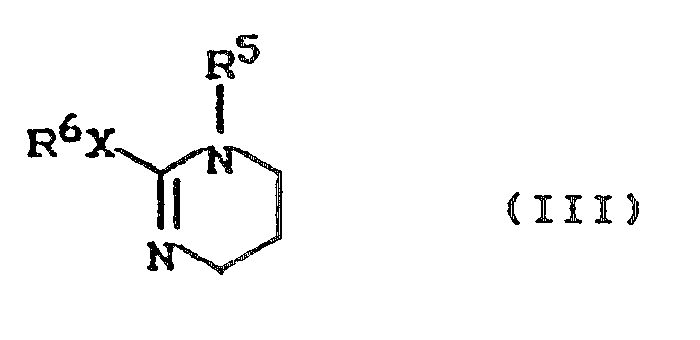
- R3 und R4 die bei den Verbindungen der Formel I angegebene Bedeutung haben zusammen mit Tetrahydropyrimidinen der Formel III

- R5 für Wasserstoff oder Alkyl steht,
- R6 für gegebenenfalls substituiertes Phenyl oder Thienyl steht,
- X für-(CH2)2-3-, -CH=CH- steht
- zur Bekämpfung von Hakenwürmern besonders geeignet ist; ausgenommen sind Mischungen von Pyrantel und Mebendazol.
- Die Wirkung dieser Kombination geht dabei über die Summe der Wirkung der Einzelwirkstoffe hinaus. Die Wirkstoffe beeinflussen sich in der Kombination synergistisch.
- Zu den Phenylguanidinen gehören z.B. Febantel, common name für
- [[2-[(Methoxyacetyl)amino]-4-(phenylthio)phenyl]carbonimidoyl]biscarbaminsäure dimethylester ; Netobimin, common name für die Verbindung der Formel

- Zu den Benzimidazolen gehören z.B. Fenbendazol, common name für
- [5-Phenylthio)-1 H-benzimidazol-2-yl]carbaminsäure methylester ;
- Albendazol, common name für [5(Propylthio)-1 H-benzimidazol-2-yl]carbaminsäure methylester ;
- Oxibendazol, common name für (5-Propoxy-1 H-benzimidazol-2-yl)carbaminsäure methylester ;
- Oxfendazol, common name für [5-(Phenylsulfinyl)-1 H-benzimidazol-2-yl]carbaminsäure methylester ;
- Mebendazol, common name für (5-Benzoyl-1 H-benzimidazol-2-yl)-carbaminsäure methylester ;
- Flubendazol, common name für [5-(4-Fluorbenzoyl)-1 H-benzimidazol-2-yl]carbaminsäure methylester ;
- Parbendazol, common name für (5-Butyl-1 H-benzimidazol-2-yl)carbaminsäure methylester ;
- Luxabendazol, common name für
- [5-(4-Fluorphenylsulfonyloxy)-1 H-benzimidazol-2-yl]carbaminsäure methylester.
- Zu den Tetrahydropyrimidinen gehören z.B.
- Pyrantel, common name für 1,4,5,6-Tetrahydro-1-methyl-2-[2-(2-thienyl)ethenyl]pyrimidin) ;
- Morantel, common name für 1,4,5,6-Tetrahydro-1-methyl-1-methyl-2-[2-(3-methyl-2-thienyl)ethenyl]pyrimidin; Oxantel, common name für (3-[2-(1,4,5,6-Tetrahydro-1-methyl-2-pyrimidinyl)ethenyl]phenol).
- Besonders bevorzugt ist eine Mischung aus Febantel und Pyrantel.
- Die erfindungsgemäßen Kombinationen können noch andere Wirkstoffe z. B. gegen Endoparasiten enthalten. Als solche seien genannt : Anthelminthika aus der Klasse der Hexahydropyrazinoisochinoline wie z. B. Praziquantel oder Benzazepine wie z.B. 2-Cyclohexylcarbonyl-1,2,3,4,6,7,8,12b-octahydropyra- zino(2,1a)(2)benzazepin4-on, oder Salizylamide wie z. B. Niclosamid.
- Die Wirkstoffe sind in der Kombination in folgendem Verhältnis vorhanden :
- Phenylguanidin bzw. Benzimidazol zu Tetrahydropyrimidin wie 1 zu 1 bis 2 zu 1.
- Die Zubereitungen eignen sich bei günstiger Warmblütertoxizität zur Bekämpfung von pathogenen Endoparasiten die bei Menschen und in der Tierhaltung und Tierzucht bei Nutz-, Zucht-, Zoo-, Labor-, Versuchs-und Hobbytieren vorkommen. Sie sind dabei gegen alle oder einzelne Entwicklungsstadien der Schädlinge sowie gegen resistente und normal sensible Arten wirksam. Durch die Bekämpfung der pathogenen Endoparasiten sollen Krankheit, Todesfälle und Leistungsminderungen (z.B. bei der Produktion von Fleisch, Milch, Wolle, Häuten, Eiern, usw.) vermindert werden, so daß durch den Einsatz der Wirkstoffe eine wirtschaftlichere und einfachere Tierhaltung möglich ist. Zu den pathogenen Endoparasiten zählen Cestoden, Trematoden, Nematoden, Acantocephalen, insbesondere :
- Aus derOrdnung der Pseudophyllidea z.B. : Diphyllobothrium spp., Spirometra spp., Schistocephalus spp., Ligula spp., Bothridium spp., Diplogonoporus spp..
- Aus der Ordnung der Cyclophyllidea z.B. : Mesocestoides spp., Anoplocephala spp., Paranoplocephala spp., Moniezia spp., Thysanosomsa spp., Thysaniezia spp., Avitellina spp., Stilesia spp., Cittotaenia spp., Andyra spp., Bertiella spp., Taenia spp., Echinococcus spp., Hydatigera spp., Davainea spp., Raillietina spp., Hymenolepis spp., Echinolepis spp., Echinocotyle spp., Diorchis spp., Dipylidium spp., Joyeuxiella spp., Diplopylidium spp..
- Aus der Unterklasse der Monogenea z.B. : Gyrodactylus spp., Dactylogyrus spp., Polystoma spp..
- Aus der Unterklasse der Digenea z.B. : Diplostomum spp., Posthodiplostomum spp., Schistosoma spp., Trichobilharzia spp., Ornithobilharzia spp., Austrobilharzia spp., Gigantobilharzia spp., Leucochloridium spp., Brachylaima spp., Echinostoma spp., Echinoparyphium spp., Echinochasmus spp., Hypoderaeum spp., Fasciola spp., Fasciolides spp., Fasciolopsis spp., Cyclocoelum spp., Typhlocoelum spp., Paramphistomum spp., Calicophoron spp., Cotylophoron spp., Gigantocotyle spp., Fischoederius spp., Gastrothylacus spp., Notocotylus spp., Catatropis spp., Plagiorchis spp., Prosthogonimus spp., Dicrocoelium spp., Eurytrema spp., Troglotrema spp., Paragonimus spp., Collyriclum spp., Nanophyetus spp., Opisthorchis spp., Clonorchis spp. Metorchis spp., Heterophyes spp., Metagonimus spp..
- Aus der Ordnung der Enoplida z.B. : Trichuris spp., Capillaria spp., Trichomosoides spp., Trichinella spp..
- Aus der Ordnung der Rhabditia z.B. : Micronema spp., Strongyloides spp..
- Aus der Ordnung der Strongylida z.B. : Stronylus spp., Triodontophorus spp., Oesophagodontus spp., Trichonema spp., Gyalocephalus spp., Cylindropharynx spp., Poteriostomum spp., Cyclococercus spp., Cylicostephanus spp., Oesophagostomum spp., Chabertia spp., Stephanurus spp., Ancylostoma spp., Uncinaria spp., Bunostomum spp., Globocephalus spp., Syngamus spp., Cyathostoma spp., Metastrongylus spp., Dictyocaulus spp., Muellerius spp., Protostrongylus spp., Neostrongylus spp., Cystocaulus spp., Pneumostrongylus spp., Spicocaulus spp., Elaphostrongylus spp. Parelaphostrongylus spp., Crenosomaspp., Paracrenosoma spp., Angiostrongylus spp., Aelurostrongylus spp., Filaroides spp., Parafilaroides spp., Trichostrongylus spp., Haemonchus spp., Ostergagia spp., Marshallagia spp., Cooperia spp., Nematodirus spp., Hyostrongylus spp., Obeliscoides spp., Amidostomum spp., Ollulanus spp..
- Aus der Ordnung der Oxyurida z.B. : Oxyuris spp., Enterobius spp., Passalurus spp., Syphacia spp., Aspiculuris spp., Heterakis spp..
- Aus der Ordnung der Ascaridia z.B. : Ascaris spp., Toxascaris spp., Toxocara spp., Parascaris spp., Anisakis spp., Ascaridia spp..
- Aus der Ordnung der Spirurida z.B. : Gnathostoma spp., Physaloptera spp., Thelazia spp., Gongylonema spp., Habronema spp., Parabronema spp., Draschia spp., Dracunculus spp..
- Zu den Nutz- und Zuchttieren gehören Säugetiere wie z.B. Rinder, Pferde, Schafe, Schweine, Ziegen, Kamele, Wasserbüffel, Esel, Kaninchen, Damwild, Rentiere, Pelztiere wie z.B. Nerze, Chinchilla, Waschbär, Vögel wie z.B. Hühner, Gänse, Puten, Enten, Süß-und Salzwasserfische wie z.B. Forellen, Karpfen, Aale, Reptilien.
- Zu Labor- und Versuchstieren gehören Mäuse, Ratten, Meerschweinchen, Goldhamster, Hunde und Katzen.
- Zu den Hobbytieren gehören Hunde und Katzen.
- Besonders bevorzugt erfolgt die Anwendung der erfindungsgemäßen Kombination bei Hunden und Katzen.
- Die Anwendung kann sowohl prophylaktisch als auch therapeutisch erfolgen.
- Die Anwendung der Wirkstoffe erfolgt direkt oder in Form von geeigneten Zubereitungen enteral, parenteral, dermal.
- Die enterale Anwendung der Wirkstoffe geschiehtz.B. oral in Form von Pulver, Tabletten, Kapseln, Pasten, Tränken, Granulaten, oral applizierbaren Lösungen, Suspensionen und Emulsionen, Boli, medikiertem Futter oder Trinkwasser.
- Geeignete Zubereitungen sind :
- Orale Lösungen, Konzentrate zur oralen Verabreichung nach Verdünnung ;
- Emulsionen und Suspensionen zur oralen Anwendung ; Halbfeste Zubereitungen ;
- Formulierungen bei, denen der Wirkstoff in einer Salbengrundlage oder in einer Öl in Wasser oder Wasser in Öl Emulsionsgrundlage verarbeitet ist;
- Feste Zubereitungen wie Pulver, Premixe oder Konzentrate, Granulate, Pellets, Tabletten, Boll, Kapseln.
- Orale Lösungen werden hergestellt, indem der Wirkstoff in einem geeigneten Lösunsmittel gelöst wird und eventuell Zusätze wie Lösungsvermittfer, Säuren, Basen, Puffersalze, Antioxidantien, Konservierungsmittel zugefügt werden. Die Lösungen werden steril filtriert und abgefüllt.
- Als Lösungsmittel seien genannt : Physiologisch verträgliche Lösungsmittel wie Wasser, Alkohole wie Ethanol, Butanol, Benzylalkohol Glycerin, Propylenglykol, Polyethylenglykole, N-Methyl-pyrrolidon, sowie Gemische derselben.
- Die Wirkstoffe lassen sich gegebenenfalls auch in physiologisch verträgiichen pflanzlichen oder synthetischen Ölen lösen.
- Als Lösungsvermittler seien genannt : Lösungsmittel, die die Lösung des Wirkstoffs im Hauplösungsmittel fördern oder Substanzen die sein Ausfallen verhindern. Beispiele sind Polyvinylpyrrolidon, polyoxyethyliertes Rhizinusöl, polyoxyethylierte Sorbitanester.
- Konservierungsmittel sind : Benzylalkohol, Trichlorbutanol, p-Hydroxybenzoesäureester, n-Butanol.
- Orale Lösungen werden direkt angewendet. Konzentrate werden nach vorheriger Verdünnung auf die Anwendungskonzentration oral angewendet.
- Emulsionen können oral angewendet werden.
- Emulsionen sind entweder vom Typ Wasser in Öl oder vom Typ Öl in Wasser.
- Sie werden hergestellt, indem man den Wirkstoff entweder in der hydrophoben oder in der hydrophilen Phase löst und diese unter Zuhilfenahme geeigneter Emulgatoren und gegebenenfalls weiterer Hilfsstoffe wie Farbstoffe, resorptionsfördemde Stoffe, Konservierungsstoffe, Antioxidantien, Lichtschutzmittel, viskositätserhöhende Stoffe, mit dem Lösungsmittel der anderen Phase homogenisiert.
- Als hydrophobe Phase (Öle) seien genannt : Paraffinöle, Silikonöle, natürliche Pflanzenöle wie Sesamöl, Mandelöl, Rizinusöl, synthetische Triglyceride wie CapryI/Caprinsäure-biglycerid, Triglyceridgemisch mit Pflanzenfettsäuren der Kettenlänge CS-12 oder anderen speziell ausgewählten natürlichen Fettsäuren, Partialglyceridgemische gesättigter oder ungesättigter eventuell auch hydroxylgruppenhaltiger Fettsäuren, Mono-und Diglyceride der C8/Ci0-Fettsäuren.
- Fettsäureester wie Ethylstearat, Di-N-butyryl-adipat, Laurinsäurehexylester, Dipropylen-glykolpelargonat, Ester einer verzweigten Fettsäure mittlerer Kettenlänge mit gesättigten Fettalkoholen der Kettenlänge C16-C18, Isopropylmyristat, Isopropylpalmitat, Capryl/Caprinsäureester von gesättigten Fettalkoholen der Kettenlänge C12-C18, Isopropylstearat, Ölsäureoleylester, Ölsäuredecylester, Ethyloleat, Milchsäureethylester, wachsartige Fettsäureester wie künstliches Entenbürzeldrüsenfett, Dibutylphthalat, Adipinsäurediisopropylester, letzterem verwandte Estergemische u.a.
- Fettalkohole wie Isotridecylalkohol, 2-Octyldodecanol, Cetylstearyl-alkohol, Oleylalkohol.
- Fettsäuren wie z.B. Ölsäure und ihre Gemische.
- Als hydrophile Phase seien genannt :
- Wasser, Alkohole wie z.B. Propylenglycol, Glycerin, Sorbitol und ihre Gemische.
- Als Emulgatoren seien genannt : nichtionogene Tenside, z.B. polyoxyethyliertes Rizinusöl, polyoxyethyliertes Sorbitan-monooleat, Sorbitanmonostearat, Glycerinmonostearat, Polyoxyethylstearat, Alkylphenolpolyglykolether ;
- ampholytische Tenside wie Di-Na-N-lauryl-ß-iminodiproprionat oder Lecithin ;
- anionaktive Tenside, wie Na-Laurylsulfat, Fettalkoholethersulfate, Mono/Dialkylpolyglykoletherorthophosphorsäureester-monoethanolaminsalz ;
- kationaktive Tenside wie Cetyltrimethylammoniumchlorid.
- Als weitere Hilfsstoffe seien genannt : Viskositätserhöhende und die Emulsion stabilisierende Stoffe wie Carboxymethylcellulose, Methylcellulose und andere Cellulose- und Stärke-Derivate, Polyacrylate, Alginate, Gelatine, Gummi-arabicum, Polyvinylpyrrolidon, Polyvinylalkohol, Copolymere aus Methylvinylether und Maleinsäureanhydrid, Polyethylenglykole, Wachse, kolloidale Kieselsäure oder Gemische der aufgeführten Stoffe.
- Suspensionen können oral angewendet werden. Sie werden hergestellt, indem man den Wirkstoff in einer Trägerflüssigkeit gegebenenfalls unter Zusatz weiterer Hilfsstoffe wie Netzmittel, Farbstoffe, resorptionsfördernde Stoffe, Konservierungsstoffe, Antioxidantien, Lichtschutzmittel suspendiert.
- Als Trägerflüssigkeiten seien alle homogenen Lösungsmittel und Lösungsmittelgemische genannt.
- Als Netzmittel (Dispergiermittel) seien die weiter oben angegebenen Tenside genannt.
- Als weitere Hilfsstoffe seien die weiter oben angegebenen genannt.
- Halbfeste Zubereitungen können oral verabreicht werden. Sie unterscheiden sich von den oben beschriebenen Suspensionen und Emulsionen nur durch ihre höhere Viskosität.
- Zur Herstellung fester Zubereitungen wird der Wirkstoff mit geeigneten Trägerstoffen gegebenenfalls unter Zusatz von Hilfsstoffen vermischt und in die gewünschte Form gebracht.
- Als Trägerstoffe seien genannt alle physiologisch verträglichen festem Inertstoffe. Als solche dienen anorganische und organische Stoffe. Anorganische Stoffe sind z.B. Kochsalz, Carbonate wie Calciumcarbonat, Hydrogencarbonate, Aluminiumoxide, Kieselsäuren, Tonerden, gefälltes oder kolloidales Siliciumdioxid, Phosphate.
- Organische Stoffe sind z.B. Zucker, Zellulose, Nahrungsund Futtermittel wie Milchpulver, Tiermehle, Getreidemehle und -schrote, Stärken.
- Hilfsstoffe sind Konservierungsstoffe, Antioxidantien, Farbstoffe, die bereits weiter oben aufgeführt worden sind.
- Weitere geeignete Hilfsstoffe sind Schmier- und Gleitmittel wie z.B. Magnesiumstearat, Stearinsäure, Talkum, Bentonite, zerfallsfördernde Substanzen wie Stärke oder quervernetztes Polyvinylpyrrolidon, Bindemittel wie z.B. Stärke, Gelatine oder lineares Polyvinylpyrrolidon sowie Trocken bindemittel wie mikdrokristalline Cellulose.
- Besonders bevorzugt erfolgt die Anwendung der erfindungsgemäßen Kombination in Form von Tabletten.
- Anwendungsfertige Zubereitungen enthalten den Wirkstoff in Konzentrationen von 10 ppm-20 Gewichtsprozent, bevorzugt von 0,1-10 Gewichtsprozent.
- Zubereitungen die vor Anwendung verdünntwerden, enthalten den Wirkstoff in Konzentrationen von 0,5-90 Gewichtsprozent, bevorzugt von 5 bis 50 Gewichtsprozent.
- Die bevorzugte Anwendungskonzentration der erfindungsgemäßen Mischung liegt bei Hund und Katze pro kg Lebendgewicht bei 1-300 mg Tetrahydropyrimidin und 5-50 mg Phenylguanidin bzw. Benzimidazol.
- Besonders bevorzugt werden Konzentrationen pro kg von 10-100 mg Tetrahydropyrimidin und 10-30 mg Phenylguanidin bzw. Benzimidazol eingesetzt.
- Ganz besonders bevorzugt wird Tetrahydropyrimidin pro kgg mit ca. 15 mg und Phenylguanidin bzw. Benzimidazol mit ca. 15 mg oder ca. 25 eingesetzt.
- Weitere anthelminthische Wirkstoffe wie z. B. Praziquantel können der Kombination zur Anwendung in einer Aufwandmenge pro kg von 0,1-20 mg, bevorzugt 1-10 mg, besonders bevorzugt ca. 5 mg, zugesetzt werden.
- Experimentell mit Ancylostoma caninum infizierte Hunde wurden nach Ablauf der Präpatenzzeit des Parasiten behandelt. Die Wirkstoffe wurden als reiner Wirkstoff in Gelatinekapseln oral appliziert.
- Der Wirkungsgrad wurde dadurch bestimmt, daß man die mit dem Kot ausgeschiedenen Würmer zählt. Anschließend wird die Anzahl der durch die Behandlung nicht abgetöteten und ausgeschiedenen Würmer nach Sektion der Hunde bestimmt. Dabei wurden folgende Werte erhalten :

- Experimentell mit Toxocara canis infizierte Hunde wurden nach Ablauf der Präpatenzzeit des Parasiten behandelt. Die Wirkstoffe wurden als reiner Wirkstoff in Gelatinekapseln oral appliziert.
- Der Wirkungsgrad wurde dadurch bestimmt, daß man die mit dem Kot ausgeschiedenen Würmer zählt. Anschließend wird die Anzahl der durch die Behandlung nicht abgetöteten uno ausgeschiedenen Würmer nach Sektion der Hunde bestimmt. Dabei wurden folgende Werte erhalten :

- Zusammensetzung:

- Im obigen Verhältnis werden die Wirkstoffe mit Milchzucker und einem Teil der Maisstärke gemischt und mit einer Lösung von Polyvinylpyrrolidon und Natriumlaurylsulfat in Wasser granuliert und das Granulat getrocknet. Das trockene Granulat wird mit den übrigen Hilfsstoffen gemischt. Die preßfertige Mischung wird zu Tabletten mit 660 mg Gewicht verpreßt z. B. auf eine Tablettengröße mit einem Durchmesser von 13 mm.
- Zusammensetzung :

- Die Substanzen werden in entsprechender Menge im obigen Verhältnis abgewogen und gemischt. Die Mischung wird gesiebt und kann direkt zu weichen Komprimaten von 3,5 g auf einer Tablettenmaschine ver-
- Zusammensetzung :

- Die Substanzen werden abgewogen und gemischt. Davon wird je nach Art und Gewicht der Tiere ein entsprechender Teil dem Futter beigemischt-z. B. für einen Hund von 10 kg bei einer Menge von 3,5 g für eine einzige Behandlung.
- Zusammensetzung:

- Methyl-4-hydroxybenzoat wird in heißem Wasser gelöst. Nach Erkalten wird Natriumalginat darin aufgelöst, wodurch sich ein Gel bildet. Nach Zufügen von Polysorbat 80 werden die Wirkstoffe darin suspendiert und homogenisiert. Es entsteht eine Paste, die sowohl direkt oral als auch über das Futter appliziert werden kann.
Claims (9)


Applications Claiming Priority (2)
| Application Number | Priority Date | Filing Date | Title |
|---|---|---|---|
| DE3705227 | 1987-02-19 | ||
| DE19873705227 DE3705227A1 (de) | 1987-02-19 | 1987-02-19 | Anthelminthische wirkstoffkombinationen |
Publications (3)
| Publication Number | Publication Date |
|---|---|
| EP0279343A2 EP0279343A2 (de) | 1988-08-24 |
| EP0279343A3 EP0279343A3 (en) | 1989-10-18 |
| EP0279343B1 true EP0279343B1 (de) | 1991-06-05 |
Family
ID=6321290
Family Applications (1)
| Application Number | Title | Priority Date | Filing Date |
|---|---|---|---|
| EP88101931A Expired - Lifetime EP0279343B1 (de) | 1987-02-19 | 1988-02-10 | Anthelminthische Wirkstoffkombinationen |
Country Status (11)
| Country | Link |
|---|---|
| US (1) | US5036069A (de) |
| EP (1) | EP0279343B1 (de) |
| JP (1) | JPH0643311B2 (de) |
| KR (1) | KR960013704B1 (de) |
| AU (1) | AU602340B2 (de) |
| CA (1) | CA1313816C (de) |
| DE (3) | DE3705227A1 (de) |
| DK (1) | DK169307B1 (de) |
| ES (1) | ES2037748T3 (de) |
| NZ (1) | NZ223540A (de) |
| ZA (1) | ZA881129B (de) |
Families Citing this family (21)
| Publication number | Priority date | Publication date | Assignee | Title |
|---|---|---|---|---|
| US5169846A (en) * | 1989-10-12 | 1992-12-08 | Crooks Michael J | Non-aqueous micellar solutions of anthelmintic benzimidazoles, closantel, or phenothiazine, and insect growth regulators |
| NZ247278A (en) * | 1991-02-12 | 1995-03-28 | Ancare Distributors | Veterinary anthelmintic drench comprising a suspension of praziquantel in a liquid carrier |
| PL185332B1 (pl) * | 1994-05-20 | 2003-04-30 | Janssen Pharmaceutica Nv | Kompozycja przeciwrobacza dla zwierząt towarzyszących człowiekowi zawierająca flubendazol |
| DE19601263A1 (de) * | 1996-01-16 | 1997-07-17 | Bayer Ag | Anthelmintische Paste |
| US5861142A (en) * | 1996-03-25 | 1999-01-19 | Schick; Mary Pichler | Method for promoting hair, nail, and skin keratinization |
| DE10008128A1 (de) * | 2000-02-22 | 2001-08-23 | Bayer Ag | Endoparasitizide Mittel |
| DE10131149A1 (de) * | 2001-06-28 | 2003-01-16 | Bayer Ag | Substituierte Benzinmidazole zur Bekämpfung von Endoparasiten |
| US7396819B2 (en) * | 2003-08-08 | 2008-07-08 | Virbac Corporation | Anthelmintic formulations |
| WO2005016356A1 (en) * | 2003-08-08 | 2005-02-24 | The Hartz Mountain Corporation | Improved anthelmintic formulations |
| WO2005094210A2 (en) * | 2004-03-12 | 2005-10-13 | The Hartz Mountain Corporation | Multi-action anthelmintic formulations |
| EP1734954A4 (de) * | 2004-04-07 | 2007-05-30 | Intervet Int Bv | Wirksame zusammensetzung aus einem benzimidazol, avermectin und praziquantel und relevante anwendungsverfahren |
| WO2006036624A2 (en) * | 2004-09-24 | 2006-04-06 | The Hartz Mountain Corporation | Lipid stabilized formulations |
| JP4297042B2 (ja) * | 2004-11-30 | 2009-07-15 | ブラザー工業株式会社 | シート材収納カセット及びそれを備える画像形成装置 |
| USD549582S1 (en) | 2006-09-27 | 2007-08-28 | 001 Corporation | Fragrance bottle and cap |
| US20080293645A1 (en) * | 2007-05-25 | 2008-11-27 | Schneider Lawrence F | Antiparasitic combination and method for treating domestic animals |
| GB2475701B (en) * | 2009-11-26 | 2011-10-19 | Michael Hilary Burke | A process for the preparation of an orally administered anthelmintic unit dose tablet |
| WO2014095845A1 (de) | 2012-12-19 | 2014-06-26 | Bayer Animal Health Gmbh | Tabletten mit verbesserter akzeptanz und guter lagerstabilität |
| EP3235815A1 (de) | 2016-04-19 | 2017-10-25 | Philipps-Universität Marburg | Wirkstoffe gegen parasitäre helminthen |
| BR102017010598A2 (pt) * | 2017-05-19 | 2018-12-04 | Flavio Alves Da Rocha | composições veterinárias de liberação retardada para controle de ovos e larvas de helmintos nas fezes dos ruminantes, uso das composições, uso de antelmínticos com essa finalidade |
| RU2696259C2 (ru) | 2017-10-23 | 2019-08-01 | Общество С Ограниченной Ответственностью "Сан Системз" | Солюбилизация хлоргексидина основания, антисептическая и дезинфицирующая композиции |
| KR20230061465A (ko) | 2020-09-04 | 2023-05-08 | 엘랑코 유에스 인코포레이티드 | 기호성 제형 |
Family Cites Families (4)
| Publication number | Priority date | Publication date | Assignee | Title |
|---|---|---|---|---|
| US3502661A (en) * | 1967-02-14 | 1970-03-24 | Pfizer & Co C | Process for making 1,4,5,6-tetrahydro-2-((2-substituted)vinyl) pyrimidines and 2-((2-substituted)vinyl)-2-imidazolines |
| IN142490B (de) * | 1974-05-15 | 1977-07-16 | Bayer Ag | |
| DE2441201C2 (de) * | 1974-08-28 | 1986-08-07 | Hoechst Ag, 6230 Frankfurt | Anthelminthisch wirksame 2-Carbalkoxyamino-5(6)-phenyl-sulfonyloxy-benzimidazole und Verfahren zu ihrer Herstellung |
| FR2461495A1 (fr) * | 1979-07-23 | 1981-02-06 | Vincent Andre | Medicament antiparasitaire a effet retard |
-
1987
- 1987-02-19 DE DE19873705227 patent/DE3705227A1/de not_active Withdrawn
- 1987-07-03 AU AU75228/87A patent/AU602340B2/en not_active Expired
-
1988
- 1988-02-10 DE DE8888101931T patent/DE3863085D1/de not_active Expired - Lifetime
- 1988-02-10 DE DE1994175001 patent/DE19475001I2/de active Active
- 1988-02-10 EP EP88101931A patent/EP0279343B1/de not_active Expired - Lifetime
- 1988-02-10 ES ES88101931T patent/ES2037748T3/es not_active Expired - Lifetime
- 1988-02-12 JP JP63028989A patent/JPH0643311B2/ja not_active Expired - Lifetime
- 1988-02-17 NZ NZ223540A patent/NZ223540A/xx unknown
- 1988-02-17 KR KR88001663A patent/KR960013704B1/ko not_active Expired - Lifetime
- 1988-02-17 CA CA000559072A patent/CA1313816C/en not_active Expired - Lifetime
- 1988-02-18 DK DK084588A patent/DK169307B1/da not_active IP Right Cessation
- 1988-02-18 ZA ZA881129A patent/ZA881129B/xx unknown
-
1989
- 1989-10-12 US US07/420,784 patent/US5036069A/en not_active Expired - Lifetime
Non-Patent Citations (1)
| Title |
|---|
| Purnomo et al. Southeast Asian J. Trop. Med. Publ. Hlth. 12 (1981),236-241,Papua New Guinea Med. J. 28: 41-44,1985 * |
Also Published As
| Publication number | Publication date |
|---|---|
| ZA881129B (en) | 1988-08-12 |
| JPS63203601A (ja) | 1988-08-23 |
| DE3863085D1 (de) | 1991-07-11 |
| KR880009646A (ko) | 1988-10-04 |
| US5036069A (en) | 1991-07-30 |
| EP0279343A3 (en) | 1989-10-18 |
| KR960013704B1 (en) | 1996-10-10 |
| JPH0643311B2 (ja) | 1994-06-08 |
| AU7522887A (en) | 1988-08-25 |
| ES2037748T3 (es) | 1995-04-01 |
| DK169307B1 (da) | 1994-10-10 |
| CA1313816C (en) | 1993-02-23 |
| AU602340B2 (en) | 1990-10-11 |
| DE3705227A1 (de) | 1988-09-01 |
| DK84588D0 (da) | 1988-02-18 |
| DE19475001I2 (de) | 2004-07-01 |
| EP0279343A2 (de) | 1988-08-24 |
| NZ223540A (en) | 1991-10-25 |
| DK84588A (da) | 1988-08-20 |
Similar Documents
| Publication | Publication Date | Title |
|---|---|---|
| EP0828506B1 (de) | Endoparasitizide mittel | |
| DK169307B1 (da) | Anthelmintisk virksomt middel samt anvendelse af blandinger af febantel eller benzimidazoler og tetrahydropyrimidiner til fremstilling af midlet | |
| HU218569B (hu) | Eljárás ciklusos depszipeptidek szulfonilezésére, az így előállított új vegyületek és parazitaellenes szerkénti alkalmazásuk | |
| KR100372348B1 (ko) | 내부기생충구제를위한곤충의니코틴효능성아세틸콜린수용체에대한길항물질및효능물질 | |
| EP2299995A1 (de) | Kombination von amidin-derivaten mit cyclischen depsipeptiden | |
| EP1259250B1 (de) | Endoparasitizide mittel | |
| MXPA96006179A (en) | Agonists and antagonists of the receptors of the nicotinic acid acetilcoline of insects for the control of endoparasi | |
| EP0912167B1 (de) | Oral applizierbare granulate von hexahydropyrazinderivaten | |
| EP1357932B1 (de) | Kristallmodifikation eines cyclischen depsipeptids mit besserer wirksamkeit | |
| DE102005011779A1 (de) | Endoparasitizide Mittel | |
| EP1189615B1 (de) | Endoparasitizide synergistische kombination enthaltend cyclische depsipeptide und piperazine | |
| EP2782572A1 (de) | Verwendung von fluopyram zur bekämpfung von endoparasiten | |
| HUP0102476A2 (hu) | Szubsztituált ciklooktadepszipeptidek | |
| DE102007061262A1 (de) | Neue Verwendung von Tribendimidin | |
| DE19515297A1 (de) | Endoparasitizide Mittel |
Legal Events
| Date | Code | Title | Description |
|---|---|---|---|
| PUAI | Public reference made under article 153(3) epc to a published international application that has entered the european phase |
Free format text: ORIGINAL CODE: 0009012 |
|
| 17P | Request for examination filed |
Effective date: 19880210 |
|
| AK | Designated contracting states |
Kind code of ref document: A2 Designated state(s): BE DE ES FR GB IT NL SE |
|
| PUAL | Search report despatched |
Free format text: ORIGINAL CODE: 0009013 |
|
| AK | Designated contracting states |
Kind code of ref document: A3 Designated state(s): BE DE ES FR GB IT NL SE |
|
| 17Q | First examination report despatched |
Effective date: 19900509 |
|
| GRAA | (expected) grant |
Free format text: ORIGINAL CODE: 0009210 |
|
| AK | Designated contracting states |
Kind code of ref document: B1 Designated state(s): BE DE ES FR GB IT NL SE |
|
| REF | Corresponds to: |
Ref document number: 3863085 Country of ref document: DE Date of ref document: 19910711 |
|
| GBT | Gb: translation of ep patent filed (gb section 77(6)(a)/1977) | ||
| ET | Fr: translation filed | ||
| ITF | It: translation for a ep patent filed | ||
| PLBE | No opposition filed within time limit |
Free format text: ORIGINAL CODE: 0009261 |
|
| STAA | Information on the status of an ep patent application or granted ep patent |
Free format text: STATUS: NO OPPOSITION FILED WITHIN TIME LIMIT |
|
| 26N | No opposition filed | ||
| MEDD | It: supplementary protection certificate for pharmaceutical products: granted |
Free format text: CCP 185, 19920429; BAYER AG |
|
| EAL | Se: european patent in force in sweden |
Ref document number: 88101931.9 |
|
| REG | Reference to a national code |
Ref country code: ES Ref legal event code: FG2A Ref document number: 2037748 Country of ref document: ES Kind code of ref document: T3 |
|
| REG | Reference to a national code |
Ref country code: GB Ref legal event code: IF02 |
|
| REG | Reference to a national code |
Ref country code: GB Ref legal event code: 732E |
|
| REG | Reference to a national code |
Ref country code: FR Ref legal event code: TP |
|
| PGFP | Annual fee paid to national office [announced via postgrant information from national office to epo] |
Ref country code: DE Payment date: 20070125 Year of fee payment: 20 |
|
| PGFP | Annual fee paid to national office [announced via postgrant information from national office to epo] |
Ref country code: NL Payment date: 20070204 Year of fee payment: 20 |
|
| PGFP | Annual fee paid to national office [announced via postgrant information from national office to epo] |
Ref country code: SE Payment date: 20070206 Year of fee payment: 20 |
|
| PGFP | Annual fee paid to national office [announced via postgrant information from national office to epo] |
Ref country code: GB Payment date: 20070207 Year of fee payment: 20 |
|
| PGFP | Annual fee paid to national office [announced via postgrant information from national office to epo] |
Ref country code: ES Payment date: 20070327 Year of fee payment: 20 |
|
| PGFP | Annual fee paid to national office [announced via postgrant information from national office to epo] |
Ref country code: BE Payment date: 20070417 Year of fee payment: 20 Ref country code: IT Payment date: 20070622 Year of fee payment: 20 |
|
| BE20 | Be: patent expired |
Owner name: *BAYER HEALTHCARE A.G. Effective date: 20080210 |
|
| REG | Reference to a national code |
Ref country code: GB Ref legal event code: PE20 |
|
| NLV7 | Nl: ceased due to reaching the maximum lifetime of a patent |
Effective date: 20080210 |
|
| EUG | Se: european patent has lapsed | ||
| PG25 | Lapsed in a contracting state [announced via postgrant information from national office to epo] |
Ref country code: NL Free format text: LAPSE BECAUSE OF EXPIRATION OF PROTECTION Effective date: 20080210 |
|
| PGFP | Annual fee paid to national office [announced via postgrant information from national office to epo] |
Ref country code: FR Payment date: 20070208 Year of fee payment: 20 |
|
| REG | Reference to a national code |
Ref country code: ES Ref legal event code: FD2A Effective date: 20080211 |
|
| PG25 | Lapsed in a contracting state [announced via postgrant information from national office to epo] |
Ref country code: GB Free format text: LAPSE BECAUSE OF EXPIRATION OF PROTECTION Effective date: 20080209 |
|
| PG25 | Lapsed in a contracting state [announced via postgrant information from national office to epo] |
Ref country code: ES Free format text: LAPSE BECAUSE OF EXPIRATION OF PROTECTION Effective date: 20080211 |