EP0262239B1 - Atemvorrichtung - Google Patents
Atemvorrichtung Download PDFInfo
- Publication number
- EP0262239B1 EP0262239B1 EP86113343A EP86113343A EP0262239B1 EP 0262239 B1 EP0262239 B1 EP 0262239B1 EP 86113343 A EP86113343 A EP 86113343A EP 86113343 A EP86113343 A EP 86113343A EP 0262239 B1 EP0262239 B1 EP 0262239B1
- Authority
- EP
- European Patent Office
- Prior art keywords
- outlet
- inlet
- valve
- respiratory device
- pipe
- Prior art date
- Legal status (The legal status is an assumption and is not a legal conclusion. Google has not performed a legal analysis and makes no representation as to the accuracy of the status listed.)
- Expired - Lifetime
Links
Images
Classifications
-
- A—HUMAN NECESSITIES
- A61—MEDICAL OR VETERINARY SCIENCE; HYGIENE
- A61M—DEVICES FOR INTRODUCING MEDIA INTO, OR ONTO, THE BODY; DEVICES FOR TRANSDUCING BODY MEDIA OR FOR TAKING MEDIA FROM THE BODY; DEVICES FOR PRODUCING OR ENDING SLEEP OR STUPOR
- A61M16/00—Devices for influencing the respiratory system of patients by gas treatment, e.g. ventilators; Tracheal tubes
- A61M16/08—Bellows; Connecting tubes ; Water traps; Patient circuits
- A61M16/0816—Joints or connectors
-
- A—HUMAN NECESSITIES
- A61—MEDICAL OR VETERINARY SCIENCE; HYGIENE
- A61M—DEVICES FOR INTRODUCING MEDIA INTO, OR ONTO, THE BODY; DEVICES FOR TRANSDUCING BODY MEDIA OR FOR TAKING MEDIA FROM THE BODY; DEVICES FOR PRODUCING OR ENDING SLEEP OR STUPOR
- A61M16/00—Devices for influencing the respiratory system of patients by gas treatment, e.g. ventilators; Tracheal tubes
- A61M16/08—Bellows; Connecting tubes ; Water traps; Patient circuits
- A61M16/0816—Joints or connectors
- A61M16/0833—T- or Y-type connectors, e.g. Y-piece
-
- A—HUMAN NECESSITIES
- A61—MEDICAL OR VETERINARY SCIENCE; HYGIENE
- A61M—DEVICES FOR INTRODUCING MEDIA INTO, OR ONTO, THE BODY; DEVICES FOR TRANSDUCING BODY MEDIA OR FOR TAKING MEDIA FROM THE BODY; DEVICES FOR PRODUCING OR ENDING SLEEP OR STUPOR
- A61M16/00—Devices for influencing the respiratory system of patients by gas treatment, e.g. ventilators; Tracheal tubes
- A61M16/20—Valves specially adapted to medical respiratory devices
- A61M16/208—Non-controlled one-way valves, e.g. exhalation, check, pop-off non-rebreathing valves
-
- A—HUMAN NECESSITIES
- A63—SPORTS; GAMES; AMUSEMENTS
- A63B—APPARATUS FOR PHYSICAL TRAINING, GYMNASTICS, SWIMMING, CLIMBING, OR FENCING; BALL GAMES; TRAINING EQUIPMENT
- A63B23/00—Exercising apparatus specially adapted for particular parts of the body
- A63B23/18—Exercising apparatus specially adapted for particular parts of the body for improving respiratory function
-
- A—HUMAN NECESSITIES
- A61—MEDICAL OR VETERINARY SCIENCE; HYGIENE
- A61M—DEVICES FOR INTRODUCING MEDIA INTO, OR ONTO, THE BODY; DEVICES FOR TRANSDUCING BODY MEDIA OR FOR TAKING MEDIA FROM THE BODY; DEVICES FOR PRODUCING OR ENDING SLEEP OR STUPOR
- A61M15/00—Inhalators
Definitions
- the invention relates to a breathing device for controlled inhalation and exhalation for the purpose of therapy of the respiratory tract, comprising an inlet connection for air to be inhaled, an outlet connection for exhaled air, a connection connection which is connected to the inlet connection and the outlet connection, a one-way valve provided in the inlet connection formed inlet valve, which opens in the direction of the flow in the inlet port and blocks in the opposite direction, an exhalation resistance arranged on the outlet port, referred to in the art as a stenosis, against which the patient exhales, and an outlet valve arranged in the flow path of the outlet port, designed as a one-way valve, the opens in the direction of the flow in the outlet connection and blocks in the opposite direction, as a result of which inhalation of air through the exhalation resistance and the outlet connection is prevented.
- a breathing device of this type is known from US-A-4,210,174.
- the outlet valve is arranged in the outlet port and the exhalation resistance is designed in the form of a cone valve of complex construction.
- the invention has for its object to provide a breathing device of the type mentioned, in which the outlet valve and the exhalation resistance can be cleaned and disinfected with little effort before each patient change.
- the device according to the invention has the advantage that it has a surprisingly simple structure and enables the cleaning and disinfection of the outlet valve and breathing resistance in a simple and time-saving manner.
- a medical device for example an aerosol nebulizer
- the inlet valve and the outlet valve are advantageously designed to be removable. It is therefore easily possible to disassemble the device into its individual components in order to clean and disinfect it.
- the outlet valve and inlet valve advantageously each consist of a ring insert and a flap which is articulated on one side and seals against the end face of this ring insert.
- the flap is preferably made of flexible, in particular rubber-elastic material.
- the flap can be attached to the ring insert in the simplest way by means of one or more, preferably two, pins. If very high demands are made on the tightness of the valves, an additional sealing lip can be provided between the ring insert and the flap.
- Such one-way valves which are designed as separate structural units, can be manufactured easily and in large numbers in terms of production technology and can be inserted into the breathing apparatus in the simplest way. They can easily be replaced for cleaning and disinfection purposes or in the event of a defect.
- the exhalation resistance can be plugged onto the outlet connection.
- the outlet valve is then expediently inserted into the free end of the outlet nozzle. After removing the attached exhalation resistance from the outlet port, the outlet valve is freely accessible and can be easily removed. After the exhalation resistance is plugged in again, it is firmly fixed in its intended position.
- the inlet valve is preferably inserted into the free end of the inlet connector; the inlet valve, which is, for example, only clamped, can also be easily removed there.
- the exhalation resistance is designed as a stepped tube, the inner diameter of the tube section on the outlet side being substantially smaller than that of the outlet connector.
- the resulting narrowing of the cross-section in the direction of the air outlet results in the desired flow resistance against which the patient must exhale.
- the stepped pipe can be easily plugged onto the end of the outlet nozzle; the flow resistance can be selected by the choice of the inside diameter of the pipe section on the outlet side.
- the exhalation resistance can also be formed by means of adjustable blow-out openings through which the exhaled air is released.
- Inlet neck and outlet neck form an acute angle. At no point does the flowing air have to be redirected more than absolutely necessary, which not only avoids additional flow resistance, but also significantly reduces the risk of internal pollution of the device.
- the angle between the inlet connection and the outlet connection is preferably between 30 and 50 degrees.
- An embodiment is particularly advantageous in which a mouthpiece is attached to the connecting piece.
- This mouthpiece can also be easily removed so that the entire device can be disassembled into its individual parts and disinfected well.
- the adapter connection of an inflatable breathing mask can also be attached to the connecting piece.
- a breathing device equipped with such an additional connection is particularly predestined for the implementation of the double therapy described above.
- a closable opening can be provided, to which a pressure measuring device can be connected. This makes it possible to control the pressure exerted by the patient when exhaling during therapy.
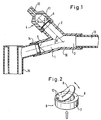
- the breathing apparatus shown in Fig. 1 has an inlet port (1) for air to be inhaled, an outlet port (2) for exhaled air and a connecting piece (3) which is connected to the patient's airways.
- Inlet nozzle (1) and Outlet (2) open obliquely into the connecting piece (3), enclosing an angle of approximately 60 degrees.
- An exhalation resistor (4) is attached to the end of the outlet connection (2).
- an inlet valve (5) designed as a one-way valve is inserted.
- a one-way valve of the same construction is located as an outlet valve (6) in the outlet port (2) before the exhalation resistor (4).
- the outlet valve (6) is drawn out. It consists of a ring insert (7), on the end face (8) of which a flap (9) is articulated on one side.
- the flap (9) is made of rubber-elastic material and is attached to the end face (8) of the ring insert (7) by means of two pins (10).
- the ring insert (7) itself and the pins (10) are made of plastic.
- the flap (9) seals airtight against the flat end face (8).
- the flexible flap (9) lifts off into the position shown in FIG. 2, so that the valve opens.
- the inlet valve (5) is of the same type as the described outlet valve (6).
- the inlet valve (5) and the outlet valve (6) are both clamped within the inlet connector (1) and the outlet connector (2) (see Fig. 1), so that they can be easily replaced.
- the exhalation resistance (4) is formed by a short stepped tube (11).
- the inside diameter of the pipe section (12) on the outlet side of the pipe (11) is considerably smaller than that of the outlet connector (2). This narrowing of the cross section results in the desired flow resistance against which the patient must exhale.
- a mouthpiece (13) is inserted into the free end of the connecting piece (3).
- the inlet connection (1) has at its free end a detachable connection (14) to which an aerosol nebulizer (15) is connected. If the patient breathes in through the mouthpiece (13), only air or a mixture of air and aerosol from the aerosol nebulizer (15) passes through the opened inlet valve (5) into the inlet port (1) and from there into the connecting port (3).
- the outlet valve (6) in the outlet port (2) is closed, so that no secondary air can penetrate through the exhalation resistor (4). If the patient then exhales the used air, the direction of flow within the breathing device is reversed.
- the inlet valve (5) closes instantly, while the outlet valve (6) opens due to the pressure, so that the exhaled air can escape through the exhalation resistor (4).
- the aerosol nebulizer (15) is reliably protected by the closed inlet valve (5) against contamination by the humidified and possibly contaminated exhaled air.
- precisely defined flow conditions are established within the device in each phase.
- the pressure exerted by the patient during exhalation can be controlled by a pressure measuring device (not shown), which is provided via a closable opening (16) approximately in the area of the transition between the inlet connection (1) and the connection connection (3).
Landscapes
- Health & Medical Sciences (AREA)
- Pulmonology (AREA)
- General Health & Medical Sciences (AREA)
- Life Sciences & Earth Sciences (AREA)
- Anesthesiology (AREA)
- Biomedical Technology (AREA)
- Heart & Thoracic Surgery (AREA)
- Hematology (AREA)
- Engineering & Computer Science (AREA)
- Animal Behavior & Ethology (AREA)
- Emergency Medicine (AREA)
- Public Health (AREA)
- Veterinary Medicine (AREA)
- Physical Education & Sports Medicine (AREA)
- Respiratory Apparatuses And Protective Means (AREA)
- Measurement Of The Respiration, Hearing Ability, Form, And Blood Characteristics Of Living Organisms (AREA)
Description
- Die Erfindung betrifft eine Atemvorrichtung zum kontrollierten Ein- und Ausatmen zwecks Therapie der Atemwege, umfassend einen Einlaßstutzen für einzuatmende Luft, einen Auslaßstutzen für ausgeatmete Luft, einen Verbindungsstutzen, der mit dem Einlaßstutzen und dem Auslaßstutzen in Verbindung steht, ein im Einlaßstutzen vorgesehenes, als Einwegventil ausgebildetes Einlaßventil, das in Richtung der Strömung im Einlaßstutzen öffnet und in Gegenrichtung sperrt, einen am Auslaßstutzen angeordneten, in der Fachwelt auch als Stenose bezeichneten Ausatemwiderstand, gegen den der Patient ausatmet, und ein im Strömungsweg des Auslaßstutzens angeordnetes, als Einwegventil ausgebildetes Auslaßventil, das in Richtung der Strömung im Auslaßstutzen öffnet und in Gegenrichtung sperrt, wodurch ein Einatmen von Luft durch den Ausatemwiderstand und den Auslaßstutzen verhindert wird.
- Eine Atemvorrichtung dieser Art ist aus der Druckschrift US-A-4 210 174 bekannt. Bei der dort in Fig. 5 dargestellten Ausführungsform ist das Auslaßventil im Auslaßstutzen angeordnet und der Ausatemwiderstand in Form eines kompliziert aufgebauten Kegelventils ausgebildet.
- Da beim therapeutischen Einsatz von Atemvorrichtungen der eingangs genannten Art zwangsläufig Sputum des Patienten zum Auslaßventil und den Ausatemwiderstand gelangt, müssen diese Bauteile zur Vermeidung der Übertragung von Krankheiten vor jedem Patientenwechsel sorgfältig gereinigt und desinfiziert werden, wozu diese Bauelemente aus bzw. von der Vorrichtung entfernt werden müssen. Bei der vorbekannten Vorrichtung muß der Ausatemwiderstand aufgrund seiner komplizierten Konstruktion, welche Nischen und sonstige, von einer Spülung schwer erfaßbare Innenräume bildet, zur Reinigung und Desinfizierung praktisch zerlegt und anschließend wieder sorgfältig Zusammengesetzt werden, was einen erheblichen Einsatz von entsprechend geschultem Laborpersonal bedingt.
- Aus der Druckschrift US-A-4 111 228 ist eine Atemvorrichtung für die Anästhesie bekannt, bei welcher in einem Einlaßstutzen ein Einlaßventil und in einem Auslaßstutzen ein Auslaßventil vorgesehen sind. Ein Ausatemwiderstand ist bei dieser Vorrichtung nicht vorhanden.
- Der Erfindung liegt die Aufgabe zugrunde, eine Atemvorrichtung der eingangs genannten Art zu schaffen, bei welcher das Auslaßventil und der Ausatemwiderstand vor jedem Patientenwechsel mit geringem personellem Aufwand gereinigt und desinfiziert werden können.
- Erfindungsgemäß wird diese Aufgabe mit den Merkmalen des kennzeichnenden Teils des Patentanspruchs 1 gelöst.
- Die erfindungsgemäße Vorrichtung weist den Vorteil auf, daß sie einen überraschend einfachen Aufbau besitzt und die Reinigung und Desinfektion von Auslaßventil und Atemwiderstand auf einfache und zeitsparende Weise ermöglicht.
- Weiterbildungen der Erfindung ergeben sich aus den dem Patentanspruch 1 nachgeordneten Unteransprüchen.
- An den Einlaßstutzen der erfindungsgemäßen Vorrichtung läßt sich problemlos ein medizin-technisches Gerät, beispielsweise ein Aerosol-Vernebler, anschließen. Dabei kann gewährleistet werden, daß die vom Patienten eingeatmete Luft ausschließlich aus dem Vernebelungsgerät stammt und keine Nebenluft unkontrolliert zuströmt. Dabei können gleichzeitig, d. h. während einer einzigen Behandlungssitzung, sowohl eine Atemtherapie als auch eine atemunterstützende Inhalationsbehandlung durchgeführt werden.
- Vorteilhaft sind das Einlaßventil und das Auslaßventil demontierbar ausgebildet. Es ist deshalb leicht möglich, das Gerät in seine Einzelbestandteile zu zerlegen, um es zu reinigen und zu desinfizieren.
- Vorteilhaft bestehen Auslaßventil und Einlaßventil jeweils aus einem Ringeinsatz und einer gegen die Stirnseite dieses Ringeinsatzes abdichtenden, einseitig angelenkten Klappe. Bevorzugt besteht die Klappe aus flexiblem, insbesondere gummielastischen Material. Die Klappe kann auf einfachste Weise mittels einer oder mehrerer, vorzugsweise zwei Stiften auf dem Ringeinsatz befestigt sein. Bei sehr hohen Ansprüchen an die erzielbare Dichtigkeit der Ventile kann eine zusätzliche Dichtlippe zwischen Ringeinsatz und Klappe vorgesehen sein. Solche, als separate Baueinheit ausgebildete Einwegventile lassen sich fertigungstechnisch leicht und in großen Stückzahlen herstellen und sind auf einfachste Weise in die Atemvorrichtung einsetzbar. Zu Reinigungs- und Desinfektionszwecken oder im Falle eines Defektes lassen sie sich leicht austauschen.
- In zweckmäßiger Weiterbildung der Erfindung ist der Ausatemwiderstand auf den Auslaßstutzen aufsteckbar. Das Auslaßventil ist dann zweckmäßigerweise in das freie Ende des Auslaßstutzens eingesetzt. Nach Abziehen des aufgesteckten Ausatemwiderstands vom Auslaßstutzen wird so das Auslaßventil frei zugänglich und läßt sich leicht herausnehmen. Nach dem Wiederaufstecken des Ausatemwiderstands ist es fest in seiner vorgesehenen Lage fixiert.
- Das Einlaßventil ist vorzugsweise in das freie Ende des Einlaßstutzens eingesetzt; das beispielsweise lediglich klemmend befestigte Einlaßventil läßt sich dort ebenfalls gut demontieren.
- Bei der erfindungsgemäßen Atemvorrichtung ist der Ausatemwiderstand als abgestuftes Rohr ausgebildet, wobei der Innendurchmesser des auslaßseitigen Rohrabschnitts wesentlich kleiner ist als derjenige des Auslaßstutzens. Die sich hierdurch ergebende Querschnittsverengung in Richtung des Luftauslasses ergibt den gewünschten Strömungswiderstand, gegen den der Patient ausatmen muß. Das abgestufte Rohr läßt sich gut auf das Ende des Auslaßstutzens aufstecken; der Strömungswiderstand ist durch die Wahl des Innendurchmessers des auslaßseitigen Rohrabschnitts wählbar. Der Ausatemwiderstand kann aber auch mittels einstellbarer Ausblasöffnungen, durch welche die ausgeatmete Luft ins Freie gelangt, gebildet werden.
- Besonders günstige Strömungsverhältnisse ergeben sich, wenn Einlaßstutzen und Auslaßstutzen gleichsinnig schräg in den Verbindungsstutzen einmünden. Einlaßstutzen und Auslaßstutzen bilden dabei einen spitzen Winkel. An keiner Stelle muß die strömende Luft mehr als unbedingt notwendig umgelenkt werden, wodurch nicht nur zusätzliche Strömungswiderstände vermieden werden, sondern auch die Gefahr der inneren Verschmutzung des Gerätes wesentlich herabgesetzt ist. Vorzugsweise beträgt der Winkel zwischen Einlaßstutzen und Auslaßstutzen zwischen 30 und 50 Winkelgraden.
- Besonders vorteilhaft ist eine Ausführungsform, bei der auf den Verbindunsstutzen ein Mundstück aufgesteckt ist. Dieses Mundstück läßt sich ebenfalls leicht abziehen, so daß sich das gesamte Gerät in seine Einzelteile zerlegen und gut desinfizieren läßt. Anstelle des Mundstücks kann auch der Adapteranschluß einer aufblasbaren Atemmaske an den Verbindungsstutzen angesteckt werden.
- Der mögliche Anschluß eines medizintechnischen Geräts, insbesondere eines Aerosol-Vernebelungsgerätes, wird erleichtert, wenn der Einlaßstutzen an seinem freien Ende einen speziell dafür vorgesehenen, lösbaren Anschluß aufweist. Eine mit einem solchen zusätzlichen Anschluß ausgerüstete Atemvorrichtung ist besonders für die Durchführung der oben beschriebenen Doppeltherapie prädestiniert.
- Schließlich kann eine verschließbare Öffnung vorgesehen sein, an welche eine Druckmeßvorrichtung anschließbar ist. Auf diese Weise wird eine Kontrolle des vom Patienten aufgebrachten Drucks beim Ausatmen während der Therapie ermöglicht.
- Ein Ausführungsbeispiel der Erfindung wird nachstehend anhand der beigefügten Zeichnungen näher erläutert. Es zeigen:
- Fig. 1:
- eine Atemvorrichtung gemäß der Erfindung, mit aufgestecktem, rohrabschnittsförmigen Ausatemwiderstand, aufgestecktem Mundstück und an den Einlaßstutzen angeschlossenem Aerosol-Vernebler, in einem Schnittbild; und
- Fig. 2:
- das in die Atemvorrichtung gemäß Fig. 1 eingesetzte Auslaßventil, in einer vergrößerten perspektivischen Darstellung.
- Die in Fig. 1 dargestellte Atemvorrichtung besitzt einen Einlaßstutzen (1) für einzuatmende Luft, einen Auslaßstutzen (2) für ausgeatmete Luft sowie einen Verbindungsstutzen (3), der mit den Atemwegen des Patienten in Verbindung steht. Einlaßstutzen (1) und Auslaßstutzen (2) münden schräg in den Verbindungsstutzen (3) ein, wobei sie einen Winkel von ungefähr 60 Winkelgraden einschließen. Auf das Ende des Auslaßstutzens (2) ist ein Ausatemwiderstand (4) aufgesteckt. Am freien Ende des Einlaßstutzens (1) ist ein als Einwegventil ausgebildetes Einlaßventil (5) eingesetzt. Ein Einwegventil gleicher Konstruktion befindet sich als Auslaßventil (6) im Auslaßstutzen (2) vor dem Ausatemwiderstand (4).
- In Fig. 2 ist das Auslaßventil (6) herausgezeichnet. Es besteht aus einem Ringeinsatz (7), auf dessen Stirnseite (8) eine Klappe (9) einseitig angelenkt ist. Die Klappe (9) besteht aus gummielastischem Material und ist mittels zweier Stifte (10) auf der Stirnseite (8) des Ringeinsatzes (7) befestigt. Der Ringeinsatz (7) selbst sowie die Stifte (10) bestehen aus Kunststoff. In geschlossenem Zustand dichtet die Klappe (9) luftdicht gegenüber der ebenen Stirnseite (8) ab. Bei Durchströmung in Pfeilrichtung von unten nach oben hebt die flexible Klappe (9) in die in Fig. 2 gezeigte Stellung ab, so daß das Ventil öffnet. - Das Einlaßventil (5) ist von derselben Art wie das beschriebene Auslaßventil (6).
- Das Einlaßventil (5) und das Auslaßventil (6) sind beide klemmend innerhalb des Einlaßstutzens (1) bzw. des Auslaßstutzens (2) befestigt (vgl. Fig. 1), so daß sie sich leicht austauschen lassen. Der Ausatmenwiderstand (4) wird gebildet von einem kurzen abgestuften Rohr (11). Der Innendurchmesser des auslaßseitigen Rohrabschnitts (12) des Rohres (11) ist wesentlich kleiner als derjenige des Auslaßstutzens (2). Durch diese Querschnittsverengung ergibt sich der gewünschte Strömungswiderstand, gegen den der Patient ausatmen muß.
- In das freie Ende des Verbindungsstutzens (3) ist ein Mundstück (13) eingesetzt. Der Einlaßstutzen (1) weist an seinem freien Ende einen lösbaren Anschluß (14) auf, an den ein Aerosol-Vernebelungsgerät (15) angeschlossen ist. Atmet nun der Patient über das Mundstück (13) ein, so gelangt ausschließlich Luft bzw. ein Gemisch aus Luft und Aerosol vom Aerosol-Vernebelungsgerät (15) durch das geöffnete Einlaßventil (5) in den Einlaßstutzen (1) und von da in den Verbindungsstutzen (3). Das Auslaßventil (6) im Auslaßstutzen (2) ist dagegen geschlossen, so daß keinerlei Nebenluft durch den Ausatemwiderstand (4) eindringen kann. Atmet der Patient anschließend die verbrauchte Luft aus, so kehrt sich die Strömungsrichtung innerhalb der Atemvorrichtung um. Das Einlaßventil (5) schließt augenblicklich, während das Auslaßventil (6) infolge des ein wirkenden Druckes öffnet, so daß die ausgeatmete Luft durch den Ausatemwiderstand (4) ins Freie gelangen kann. Das Aerosol-Vernebelungsgerät (15) wird dabei durch das geschlossene Einlaßventil (5) zuverlässig vor Verschmutzung durch die angefeuchtete und möglicherweise mit Krankheitskeimen beladene Ausatemluft geschützt. Infolge des wechselseitigen Öffnens und Schließens des Einlaßventils (5) bzw. des Auslaßventils (6) stellen sich in jeder Phase genau definierte Strömungsverhältnisse innerhalb des Geräts ein. Der vom Patienten aufgebrachte Druck während des Ausatmens kann durch eine (nicht dargestellte) Druckmeßvorrichtung kontrolliert werden, welche über eine verschließbare Öffnung (16) etwa im Bereich des Übergangs zwischen Einlaßstutzen (1) und Verbindungsstutzen (3) vorgesehen ist.
Claims (18)
- Atemvorrichtung zum kontrollierten Ein- und Ausatmen zwecks Therapie der Atemwege, umfassend- einen Einlaßstutzen (1) für einzuatmende Luft,- einen Auslaßstutzen (2) für ausgeatmete Luft,- einen Verbindungsstutzen (3), der mit dem Einlaßstutzen (1) und dem Auslaßstutzen (2) in Verbindung steht,- ein im Einlaßstutzen (1) vorgesehenes, als Einwegventil ausgebildetes Einlaßventil (5), das in Richtung der Strömung im Einlaßstutzen (1) öffnet und in Gegenrichtung sperrt,- einen am Auslaßstutzen (2) angeordneten Ausatemwiderstand (4), gegen den der Patient ausatmet, und- ein im Strömungsweg des Auslaßstutzens (2) angeordnetes, als Einwegventil ausgebildetes Auslaßventil (6), das in Richtung der Strömung im Auslaßstutzen (2) öffnet und in Gegenrichtung sperrt,- wodurch ein Einatmen von Luft durch den Ausatemwiderstand (4) und den Auslaßstutzen (2) verhindert wird,
dadurch gekennzeichnet, daß- das Auslaßventil (6) am Auslaßstutzen (2) vorgesehen ist und- der Ausatemwiderstand (4) als abgestuftes Rohr (11) ausgebildet ist, wobei der Innendurchmesser des auslaßseitigen Rohrabschnittes (12) wesentlich kleiner ist als derjenige des Auslaßstutzens (2). - Atemvorrichtung nach Anspruch 1, dadurch gekennzeichnet, daß der Ausatemwiderstand (4) einstellbare Auslaßöffnungen aufweist.
- Atemvorrichtung nach Anspruch 1 oder 2, dadurch gekennzeichnet, daß der Ausatemwiderstand (4) auf den Auslaßstutzen (2) aufsteckbar ist.
- Atemvorrichtung nach einem der vorangehenden Ansprüche, dadurch gekennzeichnet, daß das Auslaßventil (6) in das freie Ende des Auslaßstutzens (2) eingesetzt ist.
- Atemvorrichtung nach einem der vorangehenden Ansprüche, dadurch gekennzeichnet, daß das Einlaßventil (6) in das freie Ende des Einlaßstutzens (1) eingesetzt ist.
- Atemvorrichtung nach einem der vorangehenden Ansprüche, dadurch gekennzeichnet, daß das Auslaßventil (6) und/oder das Einlaßventil (5) demontierbar sind.
- Atemvorrichtung nach einem der vorangehenden Ansprüche, dadurch gekennzeichnet, daß das Auslaßventil (6) und/oder das Einlaßventil (5) aus einem Ringeinsatz (7) und einer gegen die Stirnseite (8) dieses Ringeinsatzes (7) abdichtenden, einseitig angelenkten Klappe (9) bestehen.
- Atemvorrichtung nach Anspruch 7, dadurch gekennzeichnet, daß die Klappe (9) aus flexiblem, insbesondere gummielastischem Material besteht.
- Atemvorrichtung nach Anspruch 7 oder 8, dadurch gekennzeichnet, daß die Klappe (9) mittels eines oder mehrerer, insbesondere zweier Stifte (10) auf dem Ringeinsatz (7) befestigt ist.
- Atemvorrichtung nach einem der Ansprüche 7 bis 9, dadurch gekennzeichnet, daß eine zusätzliche Dichtlippe (7) zwischen Ringeinsatz (7) und Klappe (9) vorgesehen ist.
- Atemvorrichtung nach einem der Ansprüche 7 bis 10, dadurch gekennzeichnet, daß das Einlaßventil (5) und das Auslaßventil (6) innerhalb des Einlaßstutzens (1) bzw. Auslaßstutzens (2) klemmend befestigt sind, so daß sie austauschbar sind.
- Atemvorrichtung nach einem der vorangehenden Ansprüche, dadurch gekennzeichnet, daß der Einlaßstutzen (1) an seinem freien Ende einen lösbaren Anschluß (14) für ein insbesondere als Aerosol-Vernebelungsgerät ausgebildetes medizinisches Gerät (15) aufweist.
- Atemvorrichtung nach den Ansprüchen 7 und 12, dadurch gekennzeichnet, daß der Ringeinsatz (7) des Einlaßventils (5) und ein Rohrstück des medizinischen Gerätes (15) in das freie Ende des Einlaßstutzens (1) einsetzbar sind.
- Atemvorrichtung nach einem der vorangehenden Ansprüche, dadurch gekennzeichnet, daß der Einlaßstutzen (1) und der Auslaßstutzen (2) gleichsinnig schräg in den Verbindungsstutzen (3) einmünden.
- Atemvorrichtung nach Anspruch 14, dadurch gekennzeichnet, daß der Einlaßstutzen (1) und der Auslaßstutzen (2) einen spitzen Winkel einschließen.
- Atemvorrichtung nach Anspruch 15, dadurch gekennzeichnet, daß der Winkel zwischen 40° und 70° liegt.
- Atemvorrichtung nach einem der vorangehenden Ansprüche, dadurch gekennzeichnet, daß auf den Verbindungsstutzen (3) ein Mundstück (13) aufgesteckt ist.
- Atemvorrichtung nach einem der vorangehenden Ansprüche, dadurch gekennzeichnet, daß eine verschließbare Öffnung (16) für den Anschluß einer Druckmeßvorrichtung vorgesehen ist.
Priority Applications (4)
| Application Number | Priority Date | Filing Date | Title |
|---|---|---|---|
| AT86113343T ATE83939T1 (de) | 1986-09-29 | 1986-09-29 | Atemvorrichtung. |
| DE8625936U DE8625936U1 (de) | 1986-09-29 | 1986-09-29 | Atemvorrichtung |
| DE8686113343T DE3687417D1 (de) | 1986-09-29 | 1986-09-29 | Atemvorrichtung. |
| EP86113343A EP0262239B1 (de) | 1986-09-29 | 1986-09-29 | Atemvorrichtung |
Applications Claiming Priority (1)
| Application Number | Priority Date | Filing Date | Title |
|---|---|---|---|
| EP86113343A EP0262239B1 (de) | 1986-09-29 | 1986-09-29 | Atemvorrichtung |
Publications (2)
| Publication Number | Publication Date |
|---|---|
| EP0262239A1 EP0262239A1 (de) | 1988-04-06 |
| EP0262239B1 true EP0262239B1 (de) | 1992-12-30 |
Family
ID=8195457
Family Applications (1)
| Application Number | Title | Priority Date | Filing Date |
|---|---|---|---|
| EP86113343A Expired - Lifetime EP0262239B1 (de) | 1986-09-29 | 1986-09-29 | Atemvorrichtung |
Country Status (3)
| Country | Link |
|---|---|
| EP (1) | EP0262239B1 (de) |
| AT (1) | ATE83939T1 (de) |
| DE (2) | DE8625936U1 (de) |
Cited By (2)
| Publication number | Priority date | Publication date | Assignee | Title |
|---|---|---|---|---|
| US9179691B2 (en) | 2007-12-14 | 2015-11-10 | Aerodesigns, Inc. | Delivering aerosolizable food products |
| EP4175703B1 (de) * | 2020-08-11 | 2024-10-02 | CEGLA Medizintechnik GmbH | Atemwegstherapiegerät |
Families Citing this family (18)
| Publication number | Priority date | Publication date | Assignee | Title |
|---|---|---|---|---|
| EP0281650B1 (de) * | 1987-03-10 | 1992-03-04 | Brugger, Stephan, Dipl.-Wirt.-Ing. | Aerosol-Zerstäuber |
| EP0311770B1 (de) * | 1987-08-14 | 1993-05-19 | Udo Dr. Raupach | Atemtherapiegerät |
| WO1989003707A1 (fr) * | 1987-10-22 | 1989-05-05 | Claude Liardet | Appareil de resistance a l'expiration destine a ameliorer la ventilation pulmonaire |
| DE9304771U1 (de) * | 1993-03-29 | 1993-05-19 | Kendall-Medizinische Erzeugnisse - GmbH, 8425 Neustadt | Flüssigkeitsvernebler für Medikamente |
| PT1091781E (pt) * | 1998-06-28 | 2004-03-31 | Alfred Enzinger | Dispositivo para a remocao de expextoracao a partir de um cateter traqueal |
| ITPI20020018A1 (it) * | 2002-03-28 | 2002-06-26 | Azienda Ospedaliera Pisana | Ventilazione polmonare a variazione di flusso |
| DE102011011874A1 (de) * | 2011-02-21 | 2012-08-23 | R. Cegla Gmbh & Co. Kg | Therapiegerät |
| WO2015016890A1 (en) * | 2013-07-31 | 2015-02-05 | Berendo Scientific, LLC | Head and neck exercise apparatuses |
| US10335635B2 (en) | 2013-07-31 | 2019-07-02 | Berendo Scientific, LLC | Head and neck exercise methods |
| CN110787426B (zh) * | 2019-11-08 | 2021-02-05 | 中国人民解放军陆军军医大学第二附属医院 | 呼吸训练装置 |
| CN111388812A (zh) * | 2020-03-25 | 2020-07-10 | 中国人民解放军第四军医大学 | 一种适用于新冠病毒患者雾化的气溶胶收集消毒一体装置 |
| US11717631B2 (en) * | 2020-11-04 | 2023-08-08 | Adel Bougatef | Ventilation system with three-port volume regulator |
| CN112619069B (zh) * | 2020-12-16 | 2022-04-22 | 无锡市儿童医院 | 一种小儿呼吸训练装置 |
| CN113244582B (zh) * | 2021-05-17 | 2022-05-03 | 河北省胸科医院 | 一种呼吸科用呼吸训练装置 |
| CN113893503B (zh) * | 2021-11-16 | 2022-08-09 | 中国人民解放军陆军军医大学第二附属医院 | 一种肺康复呼吸训练器 |
| CN115999125B (zh) * | 2023-01-03 | 2024-07-09 | 中国人民解放军西部战区总医院 | 一种用于慢阻肺的呼吸锻练装置 |
| CN118320386A (zh) * | 2024-05-06 | 2024-07-12 | 中国人民解放军总医院第一医学中心 | 一种用于呼吸内科肺功能康复理疗的装置 |
| CN120837786A (zh) * | 2025-09-16 | 2025-10-28 | 江苏艾博得医疗器械有限公司 | 一种微网雾化器 |
Family Cites Families (4)
| Publication number | Priority date | Publication date | Assignee | Title |
|---|---|---|---|---|
| US4111228A (en) * | 1975-07-23 | 1978-09-05 | Institutul Oncologic Bucuresti | Respiratory valve, especially for anaesthetic circuits |
| FI56120C (fi) * | 1978-04-18 | 1979-12-10 | Taisto Haekkinen | Ventil avsedd foer respirator eller foer annan upplivningsanvaendning laempad anordning |
| US4210174A (en) * | 1978-05-30 | 1980-07-01 | Instrumentation Industries, Inc. | Positive pressure valves |
| FR2573658B1 (fr) * | 1984-11-26 | 1989-02-24 | Air Liquide | Dispositif de pression expiratoire positive |
-
1986
- 1986-09-29 AT AT86113343T patent/ATE83939T1/de not_active IP Right Cessation
- 1986-09-29 EP EP86113343A patent/EP0262239B1/de not_active Expired - Lifetime
- 1986-09-29 DE DE8625936U patent/DE8625936U1/de not_active Expired
- 1986-09-29 DE DE8686113343T patent/DE3687417D1/de not_active Expired - Fee Related
Cited By (2)
| Publication number | Priority date | Publication date | Assignee | Title |
|---|---|---|---|---|
| US9179691B2 (en) | 2007-12-14 | 2015-11-10 | Aerodesigns, Inc. | Delivering aerosolizable food products |
| EP4175703B1 (de) * | 2020-08-11 | 2024-10-02 | CEGLA Medizintechnik GmbH | Atemwegstherapiegerät |
Also Published As
| Publication number | Publication date |
|---|---|
| ATE83939T1 (de) | 1993-01-15 |
| DE8625936U1 (de) | 1986-11-06 |
| DE3687417D1 (de) | 1993-02-11 |
| EP0262239A1 (de) | 1988-04-06 |
Similar Documents
| Publication | Publication Date | Title |
|---|---|---|
| EP0262239A1 (de) | Atemvorrichtung | |
| DE10126808C1 (de) | Inhalationsmaske | |
| DE2847681C2 (de) | Trachealtubus | |
| DE3900183C2 (de) | ||
| EP1960025B1 (de) | Schlauchsystem für beatmungsgeräte | |
| EP0281650B1 (de) | Aerosol-Zerstäuber | |
| DE60106837T2 (de) | HME Bypass-system | |
| DE69921834T2 (de) | Vorrichtung für die zu-und abfuhr von inhalationsgas bei einem patienten | |
| DE1616422B1 (de) | Ventil fuer Wiederbelebungsapparate | |
| EP1670530A1 (de) | Inhalationstherapievorrichtung mit ventil | |
| EP1897577A1 (de) | Vorrichtung zur Erzeugung eines kontinuierlichen positiven Atemwegdrucks (CPAP-Vorrichtung) | |
| EP0697225A2 (de) | Gaszuführleitung | |
| DE2505123A1 (de) | Endotrachealkanuele aus flexiblem kunststoff mit schwenkbarem sprechventil | |
| DE20206692U1 (de) | Vorrichtung zur Erzeugung eines kontinuierlichen positiven Atemwegdrucks (CPAP-Vorrichtung) und entsprechender Hohlkörper | |
| EP1695730A1 (de) | Bauteil für eine Inhalationsvorrichtung und Inhalationsvorrichtung mit diesem Bauteil | |
| EP1095269B1 (de) | Vorrichtung zur bestimmung des kohlendioxidgehaltes in ausgeatmeter atemluft | |
| DE202015100434U1 (de) | Atemmaske | |
| DE8703534U1 (de) | Aerosol-Zerstäuber | |
| DE102012002632B4 (de) | Beatmungssystem und Konnektorsystem hierfür zur Verminderung von Kontaminationen | |
| DE3513628C1 (de) | Vorrichtung zum Inhalieren von Allergenen | |
| EP3620195B1 (de) | Beatmungsvorrichtung | |
| DE1248230B (de) | Trachealkanuele | |
| DE60206165T2 (de) | Handteil eines inhalators | |
| DE1915540B2 (de) | Spirometrie-Atemmaske | |
| DE19546167A1 (de) | Vorrichtung zum manuellen Notfall-Beatmen mit einem Handbeatmungsbeutel |
Legal Events
| Date | Code | Title | Description |
|---|---|---|---|
| PUAI | Public reference made under article 153(3) epc to a published international application that has entered the european phase |
Free format text: ORIGINAL CODE: 0009012 |
|
| AK | Designated contracting states |
Kind code of ref document: A1 Designated state(s): AT BE CH DE FR GB IT LI LU NL SE |
|
| 17P | Request for examination filed |
Effective date: 19880621 |
|
| 17Q | First examination report despatched |
Effective date: 19900523 |
|
| GRAA | (expected) grant |
Free format text: ORIGINAL CODE: 0009210 |
|
| AK | Designated contracting states |
Kind code of ref document: B1 Designated state(s): AT BE CH DE FR GB IT LI LU NL SE |
|
| ITF | It: translation for a ep patent filed | ||
| REF | Corresponds to: |
Ref document number: 83939 Country of ref document: AT Date of ref document: 19930115 Kind code of ref document: T |
|
| REF | Corresponds to: |
Ref document number: 3687417 Country of ref document: DE Date of ref document: 19930211 |
|
| ET | Fr: translation filed | ||
| GBT | Gb: translation of ep patent filed (gb section 77(6)(a)/1977) |
Effective date: 19920205 |
|
| PLBE | No opposition filed within time limit |
Free format text: ORIGINAL CODE: 0009261 |
|
| STAA | Information on the status of an ep patent application or granted ep patent |
Free format text: STATUS: NO OPPOSITION FILED WITHIN TIME LIMIT |
|
| EPTA | Lu: last paid annual fee | ||
| 26N | No opposition filed | ||
| EAL | Se: european patent in force in sweden |
Ref document number: 86113343.7 |
|
| PGFP | Annual fee paid to national office [announced via postgrant information from national office to epo] |
Ref country code: LU Payment date: 19970912 Year of fee payment: 12 |
|
| PGFP | Annual fee paid to national office [announced via postgrant information from national office to epo] |
Ref country code: SE Payment date: 19980903 Year of fee payment: 13 |
|
| PGFP | Annual fee paid to national office [announced via postgrant information from national office to epo] |
Ref country code: GB Payment date: 19980918 Year of fee payment: 13 |
|
| PGFP | Annual fee paid to national office [announced via postgrant information from national office to epo] |
Ref country code: FR Payment date: 19980925 Year of fee payment: 13 Ref country code: AT Payment date: 19980925 Year of fee payment: 13 |
|
| PG25 | Lapsed in a contracting state [announced via postgrant information from national office to epo] |
Ref country code: LU Free format text: LAPSE BECAUSE OF NON-PAYMENT OF DUE FEES Effective date: 19980929 |
|
| PGFP | Annual fee paid to national office [announced via postgrant information from national office to epo] |
Ref country code: NL Payment date: 19980930 Year of fee payment: 13 Ref country code: BE Payment date: 19980930 Year of fee payment: 13 |
|
| PGFP | Annual fee paid to national office [announced via postgrant information from national office to epo] |
Ref country code: CH Payment date: 19981001 Year of fee payment: 13 |
|
| PG25 | Lapsed in a contracting state [announced via postgrant information from national office to epo] |
Ref country code: SE Free format text: THE PATENT HAS BEEN ANNULLED BY A DECISION OF A NATIONAL AUTHORITY Effective date: 19990929 Ref country code: GB Free format text: LAPSE BECAUSE OF NON-PAYMENT OF DUE FEES Effective date: 19990929 Ref country code: AT Free format text: LAPSE BECAUSE OF NON-PAYMENT OF DUE FEES Effective date: 19990929 |
|
| PG25 | Lapsed in a contracting state [announced via postgrant information from national office to epo] |
Ref country code: LI Free format text: LAPSE BECAUSE OF NON-PAYMENT OF DUE FEES Effective date: 19990930 Ref country code: CH Free format text: LAPSE BECAUSE OF NON-PAYMENT OF DUE FEES Effective date: 19990930 Ref country code: BE Free format text: LAPSE BECAUSE OF NON-PAYMENT OF DUE FEES Effective date: 19990930 |
|
| BERE | Be: lapsed |
Owner name: BRUGGER STEPHAN Effective date: 19990930 |
|
| PG25 | Lapsed in a contracting state [announced via postgrant information from national office to epo] |
Ref country code: NL Free format text: LAPSE BECAUSE OF NON-PAYMENT OF DUE FEES Effective date: 20000401 |
|
| EUG | Se: european patent has lapsed |
Ref document number: 86113343.7 |
|
| REG | Reference to a national code |
Ref country code: CH Ref legal event code: PL |
|
| GBPC | Gb: european patent ceased through non-payment of renewal fee |
Effective date: 19990929 |
|
| PG25 | Lapsed in a contracting state [announced via postgrant information from national office to epo] |
Ref country code: FR Free format text: LAPSE BECAUSE OF NON-PAYMENT OF DUE FEES Effective date: 20000531 |
|
| NLV4 | Nl: lapsed or anulled due to non-payment of the annual fee |
Effective date: 20000401 |
|
| REG | Reference to a national code |
Ref country code: FR Ref legal event code: ST |
|
| PGFP | Annual fee paid to national office [announced via postgrant information from national office to epo] |
Ref country code: DE Payment date: 20030930 Year of fee payment: 18 |
|
| PG25 | Lapsed in a contracting state [announced via postgrant information from national office to epo] |
Ref country code: DE Free format text: LAPSE BECAUSE OF NON-PAYMENT OF DUE FEES Effective date: 20050401 |
|
| PG25 | Lapsed in a contracting state [announced via postgrant information from national office to epo] |
Ref country code: IT Free format text: LAPSE BECAUSE OF NON-PAYMENT OF DUE FEES;WARNING: LAPSES OF ITALIAN PATENTS WITH EFFECTIVE DATE BEFORE 2007 MAY HAVE OCCURRED AT ANY TIME BEFORE 2007. THE CORRECT EFFECTIVE DATE MAY BE DIFFERENT FROM THE ONE RECORDED. Effective date: 20050929 |