EP0260596A2 - In 9-Stellung substituierte 2-Amino-6-alkoxy-purine, ihre Verwendung, diese Purine enthaltende Arzneimittel und Verfahren zur Herstellung der Purine - Google Patents
In 9-Stellung substituierte 2-Amino-6-alkoxy-purine, ihre Verwendung, diese Purine enthaltende Arzneimittel und Verfahren zur Herstellung der Purine Download PDFInfo
- Publication number
- EP0260596A2 EP0260596A2 EP87113220A EP87113220A EP0260596A2 EP 0260596 A2 EP0260596 A2 EP 0260596A2 EP 87113220 A EP87113220 A EP 87113220A EP 87113220 A EP87113220 A EP 87113220A EP 0260596 A2 EP0260596 A2 EP 0260596A2
- Authority
- EP
- European Patent Office
- Prior art keywords
- formula
- compounds
- benzyl
- amino
- defined above
- Prior art date
- Legal status (The legal status is an assumption and is not a legal conclusion. Google has not performed a legal analysis and makes no representation as to the accuracy of the status listed.)
- Withdrawn
Links
- 238000000034 method Methods 0.000 title claims description 21
- 239000008194 pharmaceutical composition Substances 0.000 title 1
- 150000001875 compounds Chemical class 0.000 claims abstract description 28
- 125000001797 benzyl group Chemical group [H]C1=C([H])C([H])=C(C([H])=C1[H])C([H])([H])* 0.000 claims abstract description 18
- 125000000217 alkyl group Chemical group 0.000 claims abstract description 10
- 125000004432 carbon atom Chemical group C* 0.000 claims abstract description 7
- 125000002252 acyl group Chemical group 0.000 claims abstract description 6
- 239000001257 hydrogen Substances 0.000 claims abstract description 6
- 229910052739 hydrogen Inorganic materials 0.000 claims abstract description 6
- 125000004435 hydrogen atom Chemical class [H]* 0.000 claims abstract description 4
- 125000001997 phenyl group Chemical group [H]C1=C([H])C([H])=C(*)C([H])=C1[H] 0.000 claims abstract description 3
- 125000006239 protecting group Chemical group 0.000 claims description 11
- 125000000026 trimethylsilyl group Chemical group [H]C([H])([H])[Si]([*])(C([H])([H])[H])C([H])([H])[H] 0.000 claims description 6
- 229910052783 alkali metal Inorganic materials 0.000 claims description 4
- 150000001340 alkali metals Chemical class 0.000 claims description 4
- 229910052700 potassium Inorganic materials 0.000 claims description 4
- 229910052708 sodium Inorganic materials 0.000 claims description 4
- RYYIULNRIVUMTQ-UHFFFAOYSA-N 6-chloroguanine Chemical compound NC1=NC(Cl)=C2N=CNC2=N1 RYYIULNRIVUMTQ-UHFFFAOYSA-N 0.000 claims description 3
- 239000003513 alkali Substances 0.000 claims description 3
- 150000001805 chlorine compounds Chemical class 0.000 claims description 3
- 229910052736 halogen Inorganic materials 0.000 claims description 3
- 150000002367 halogens Chemical class 0.000 claims description 3
- 229910052744 lithium Inorganic materials 0.000 claims description 3
- 125000003668 acetyloxy group Chemical group [H]C([H])([H])C(=O)O[*] 0.000 claims description 2
- 239000007795 chemical reaction product Substances 0.000 claims description 2
- 239000003814 drug Substances 0.000 claims description 2
- 125000002777 acetyl group Chemical group [H]C([H])([H])C(*)=O 0.000 claims 1
- 239000000654 additive Substances 0.000 claims 1
- 239000002552 dosage form Substances 0.000 claims 1
- 125000001449 isopropyl group Chemical group [H]C([H])([H])C([H])(*)C([H])([H])[H] 0.000 claims 1
- 201000010099 disease Diseases 0.000 abstract description 2
- 208000037265 diseases, disorders, signs and symptoms Diseases 0.000 abstract description 2
- 230000003612 virological effect Effects 0.000 abstract 1
- OKKJLVBELUTLKV-UHFFFAOYSA-N Methanol Chemical compound OC OKKJLVBELUTLKV-UHFFFAOYSA-N 0.000 description 24
- YXFVVABEGXRONW-UHFFFAOYSA-N Toluene Chemical compound CC1=CC=CC=C1 YXFVVABEGXRONW-UHFFFAOYSA-N 0.000 description 24
- IJGRMHOSHXDMSA-UHFFFAOYSA-N Atomic nitrogen Chemical compound N#N IJGRMHOSHXDMSA-UHFFFAOYSA-N 0.000 description 17
- 238000006243 chemical reaction Methods 0.000 description 13
- 239000000203 mixture Substances 0.000 description 13
- YMWUJEATGCHHMB-UHFFFAOYSA-N Dichloromethane Chemical compound ClCCl YMWUJEATGCHHMB-UHFFFAOYSA-N 0.000 description 12
- RTZKZFJDLAIYFH-UHFFFAOYSA-N Diethyl ether Chemical compound CCOCC RTZKZFJDLAIYFH-UHFFFAOYSA-N 0.000 description 12
- LFQSCWFLJHTTHZ-UHFFFAOYSA-N Ethanol Chemical compound CCO LFQSCWFLJHTTHZ-UHFFFAOYSA-N 0.000 description 10
- 238000003756 stirring Methods 0.000 description 10
- UHOVQNZJYSORNB-UHFFFAOYSA-N Benzene Chemical compound C1=CC=CC=C1 UHOVQNZJYSORNB-UHFFFAOYSA-N 0.000 description 9
- ZMANZCXQSJIPKH-UHFFFAOYSA-N Triethylamine Chemical compound CCN(CC)CC ZMANZCXQSJIPKH-UHFFFAOYSA-N 0.000 description 9
- 239000002904 solvent Substances 0.000 description 9
- FFUAGWLWBBFQJT-UHFFFAOYSA-N hexamethyldisilazane Chemical compound C[Si](C)(C)N[Si](C)(C)C FFUAGWLWBBFQJT-UHFFFAOYSA-N 0.000 description 8
- 229910052757 nitrogen Inorganic materials 0.000 description 8
- WFDIJRYMOXRFFG-UHFFFAOYSA-N Acetic anhydride Chemical compound CC(=O)OC(C)=O WFDIJRYMOXRFFG-UHFFFAOYSA-N 0.000 description 6
- XEKOWRVHYACXOJ-UHFFFAOYSA-N Ethyl acetate Chemical compound CCOC(C)=O XEKOWRVHYACXOJ-UHFFFAOYSA-N 0.000 description 6
- AZUYLZMQTIKGSC-UHFFFAOYSA-N 1-[6-[4-(5-chloro-6-methyl-1H-indazol-4-yl)-5-methyl-3-(1-methylindazol-5-yl)pyrazol-1-yl]-2-azaspiro[3.3]heptan-2-yl]prop-2-en-1-one Chemical compound ClC=1C(=C2C=NNC2=CC=1C)C=1C(=NN(C=1C)C1CC2(CN(C2)C(C=C)=O)C1)C=1C=C2C=NN(C2=CC=1)C AZUYLZMQTIKGSC-UHFFFAOYSA-N 0.000 description 5
- XDTMQSROBMDMFD-UHFFFAOYSA-N Cyclohexane Chemical compound C1CCCCC1 XDTMQSROBMDMFD-UHFFFAOYSA-N 0.000 description 5
- VYPSYNLAJGMNEJ-UHFFFAOYSA-N Silicium dioxide Chemical compound O=[Si]=O VYPSYNLAJGMNEJ-UHFFFAOYSA-N 0.000 description 5
- -1 acyl radical Chemical class 0.000 description 5
- 239000000376 reactant Substances 0.000 description 5
- 239000000741 silica gel Substances 0.000 description 5
- 229910002027 silica gel Inorganic materials 0.000 description 5
- PZJPLNUSOXWAMU-UHFFFAOYSA-N 2-[(2-amino-6-propan-2-yloxypurin-9-yl)methoxy]propane-1,3-diol Chemical group CC(C)OC1=NC(N)=NC2=C1N=CN2COC(CO)CO PZJPLNUSOXWAMU-UHFFFAOYSA-N 0.000 description 4
- MTVWFVDWRVYDOR-UHFFFAOYSA-N 3,4-Dihydroxyphenylglycol Chemical compound OCC(O)C1=CC=C(O)C(O)=C1 MTVWFVDWRVYDOR-UHFFFAOYSA-N 0.000 description 4
- XKRFYHLGVUSROY-UHFFFAOYSA-N Argon Chemical compound [Ar] XKRFYHLGVUSROY-UHFFFAOYSA-N 0.000 description 4
- 0 CCNC(C(N*C)NC(C)N1)C1ClC Chemical compound CCNC(C(N*C)NC(C)N1)C1ClC 0.000 description 4
- XTHFKEDIFFGKHM-UHFFFAOYSA-N Dimethoxyethane Chemical compound COCCOC XTHFKEDIFFGKHM-UHFFFAOYSA-N 0.000 description 4
- IAZDPXIOMUYVGZ-UHFFFAOYSA-N Dimethylsulphoxide Chemical compound CS(C)=O IAZDPXIOMUYVGZ-UHFFFAOYSA-N 0.000 description 4
- MVPPADPHJFYWMZ-UHFFFAOYSA-N chlorobenzene Chemical compound ClC1=CC=CC=C1 MVPPADPHJFYWMZ-UHFFFAOYSA-N 0.000 description 4
- 239000013078 crystal Substances 0.000 description 4
- HGCIXCUEYOPUTN-UHFFFAOYSA-N cyclohexene Chemical compound C1CCC=CC1 HGCIXCUEYOPUTN-UHFFFAOYSA-N 0.000 description 4
- 238000004128 high performance liquid chromatography Methods 0.000 description 4
- NXJCBFBQEVOTOW-UHFFFAOYSA-L palladium(2+);dihydroxide Chemical compound O[Pd]O NXJCBFBQEVOTOW-UHFFFAOYSA-L 0.000 description 4
- 230000035484 reaction time Effects 0.000 description 4
- 238000010992 reflux Methods 0.000 description 4
- 239000007858 starting material Substances 0.000 description 4
- HDIZAQPHCMAMNZ-UHFFFAOYSA-N 9-[1,3-bis(phenylmethoxy)propan-2-yloxymethyl]-6-propan-2-yloxypurin-2-amine Chemical compound C1=NC=2C(OC(C)C)=NC(N)=NC=2N1COC(COCC=1C=CC=CC=1)COCC1=CC=CC=C1 HDIZAQPHCMAMNZ-UHFFFAOYSA-N 0.000 description 3
- QGZKDVFQNNGYKY-UHFFFAOYSA-N Ammonia Chemical compound N QGZKDVFQNNGYKY-UHFFFAOYSA-N 0.000 description 3
- VEXZGXHMUGYJMC-UHFFFAOYSA-N Hydrochloric acid Chemical compound Cl VEXZGXHMUGYJMC-UHFFFAOYSA-N 0.000 description 3
- UFHFLCQGNIYNRP-UHFFFAOYSA-N Hydrogen Chemical compound [H][H] UFHFLCQGNIYNRP-UHFFFAOYSA-N 0.000 description 3
- KWYUFKZDYYNOTN-UHFFFAOYSA-M Potassium hydroxide Chemical compound [OH-].[K+] KWYUFKZDYYNOTN-UHFFFAOYSA-M 0.000 description 3
- HEMHJVSKTPXQMS-UHFFFAOYSA-M Sodium hydroxide Chemical compound [OH-].[Na+] HEMHJVSKTPXQMS-UHFFFAOYSA-M 0.000 description 3
- GDBPXOZUOLBXAR-UHFFFAOYSA-N [2-(chloromethoxy)-3-phenylmethoxypropoxy]methylbenzene Chemical compound C=1C=CC=CC=1COCC(OCCl)COCC1=CC=CC=C1 GDBPXOZUOLBXAR-UHFFFAOYSA-N 0.000 description 3
- 150000001298 alcohols Chemical class 0.000 description 3
- 239000000010 aprotic solvent Substances 0.000 description 3
- 239000002585 base Substances 0.000 description 3
- 239000003795 chemical substances by application Substances 0.000 description 3
- 238000001816 cooling Methods 0.000 description 3
- 238000001704 evaporation Methods 0.000 description 3
- IRSCQMHQWWYFCW-UHFFFAOYSA-N ganciclovir Chemical compound O=C1NC(N)=NC2=C1N=CN2COC(CO)CO IRSCQMHQWWYFCW-UHFFFAOYSA-N 0.000 description 3
- 230000001681 protective effect Effects 0.000 description 3
- 239000011734 sodium Substances 0.000 description 3
- 239000000126 substance Substances 0.000 description 3
- HXJUTPCZVOIRIF-UHFFFAOYSA-N sulfolane Chemical compound O=S1(=O)CCCC1 HXJUTPCZVOIRIF-UHFFFAOYSA-N 0.000 description 3
- WSLDOOZREJYCGB-UHFFFAOYSA-N 1,2-Dichloroethane Chemical compound ClCCCl WSLDOOZREJYCGB-UHFFFAOYSA-N 0.000 description 2
- QHHLLMASUBEZEZ-UHFFFAOYSA-N 1,3-bis(phenylmethoxy)propan-2-yloxymethyl acetate Chemical compound C=1C=CC=CC=1COCC(OCOC(=O)C)COCC1=CC=CC=C1 QHHLLMASUBEZEZ-UHFFFAOYSA-N 0.000 description 2
- RYHBNJHYFVUHQT-UHFFFAOYSA-N 1,4-Dioxane Chemical compound C1COCCO1 RYHBNJHYFVUHQT-UHFFFAOYSA-N 0.000 description 2
- 238000005160 1H NMR spectroscopy Methods 0.000 description 2
- HVCNXQOWACZAFN-UHFFFAOYSA-N 4-ethylmorpholine Chemical compound CCN1CCOCC1 HVCNXQOWACZAFN-UHFFFAOYSA-N 0.000 description 2
- ZCPOCPBDXIGEFE-UHFFFAOYSA-N 6-propan-2-yloxy-7h-purin-2-amine Chemical compound CC(C)OC1=NC(N)=NC2=C1NC=N2 ZCPOCPBDXIGEFE-UHFFFAOYSA-N 0.000 description 2
- KDCGOANMDULRCW-UHFFFAOYSA-N 7H-purine Chemical compound N1=CNC2=NC=NC2=C1 KDCGOANMDULRCW-UHFFFAOYSA-N 0.000 description 2
- CSCPPACGZOOCGX-UHFFFAOYSA-N Acetone Chemical compound CC(C)=O CSCPPACGZOOCGX-UHFFFAOYSA-N 0.000 description 2
- OKTJSMMVPCPJKN-UHFFFAOYSA-N Carbon Chemical compound [C] OKTJSMMVPCPJKN-UHFFFAOYSA-N 0.000 description 2
- HOOWCUZPEFNHDT-UHFFFAOYSA-N DHPG Natural products OC(=O)C(N)C1=CC(O)=CC(O)=C1 HOOWCUZPEFNHDT-UHFFFAOYSA-N 0.000 description 2
- QUSNBJAOOMFDIB-UHFFFAOYSA-N Ethylamine Chemical compound CCN QUSNBJAOOMFDIB-UHFFFAOYSA-N 0.000 description 2
- KFZMGEQAYNKOFK-UHFFFAOYSA-N Isopropanol Chemical compound CC(C)O KFZMGEQAYNKOFK-UHFFFAOYSA-N 0.000 description 2
- KDLHZDBZIXYQEI-UHFFFAOYSA-N Palladium Chemical compound [Pd] KDLHZDBZIXYQEI-UHFFFAOYSA-N 0.000 description 2
- CDBYLPFSWZWCQE-UHFFFAOYSA-L Sodium Carbonate Chemical compound [Na+].[Na+].[O-]C([O-])=O CDBYLPFSWZWCQE-UHFFFAOYSA-L 0.000 description 2
- 239000002253 acid Substances 0.000 description 2
- BFNBIHQBYMNNAN-UHFFFAOYSA-N ammonium sulfate Chemical compound N.N.OS(O)(=O)=O BFNBIHQBYMNNAN-UHFFFAOYSA-N 0.000 description 2
- 229910052921 ammonium sulfate Inorganic materials 0.000 description 2
- 235000011130 ammonium sulphate Nutrition 0.000 description 2
- 229910052786 argon Inorganic materials 0.000 description 2
- 230000037396 body weight Effects 0.000 description 2
- 238000009835 boiling Methods 0.000 description 2
- 239000003054 catalyst Substances 0.000 description 2
- 230000003197 catalytic effect Effects 0.000 description 2
- 239000003480 eluent Substances 0.000 description 2
- IIEWJVIFRVWJOD-UHFFFAOYSA-N ethyl cyclohexane Natural products CCC1CCCCC1 IIEWJVIFRVWJOD-UHFFFAOYSA-N 0.000 description 2
- 230000008020 evaporation Effects 0.000 description 2
- 239000007789 gas Substances 0.000 description 2
- VNWKTOKETHGBQD-UHFFFAOYSA-N methane Chemical compound C VNWKTOKETHGBQD-UHFFFAOYSA-N 0.000 description 2
- WTFMEERXQUFCSZ-UHFFFAOYSA-N n-(9-acetyl-6-propan-2-yloxypurin-2-yl)acetamide Chemical compound CC(C)OC1=NC(NC(C)=O)=NC2=C1N=CN2C(C)=O WTFMEERXQUFCSZ-UHFFFAOYSA-N 0.000 description 2
- SCVFZCLFOSHCOH-UHFFFAOYSA-M potassium acetate Chemical compound [K+].CC([O-])=O SCVFZCLFOSHCOH-UHFFFAOYSA-M 0.000 description 2
- BWHMMNNQKKPAPP-UHFFFAOYSA-L potassium carbonate Chemical compound [K+].[K+].[O-]C([O-])=O BWHMMNNQKKPAPP-UHFFFAOYSA-L 0.000 description 2
- 150000003212 purines Chemical class 0.000 description 2
- 239000011541 reaction mixture Substances 0.000 description 2
- 150000003839 salts Chemical class 0.000 description 2
- 230000035945 sensitivity Effects 0.000 description 2
- 125000004665 trialkylsilyl group Chemical group 0.000 description 2
- 239000008096 xylene Substances 0.000 description 2
- 150000003738 xylenes Chemical class 0.000 description 2
- JEXYCADTAFPULN-UHFFFAOYSA-N 1-propylsulfonylpropane Chemical compound CCCS(=O)(=O)CCC JEXYCADTAFPULN-UHFFFAOYSA-N 0.000 description 1
- LBLYYCQCTBFVLH-UHFFFAOYSA-N 2-Methylbenzenesulfonic acid Chemical compound CC1=CC=CC=C1S(O)(=O)=O LBLYYCQCTBFVLH-UHFFFAOYSA-N 0.000 description 1
- UIOKPPOKHMLZFP-UHFFFAOYSA-N 2-[(2-amino-6-butan-2-yloxypurin-9-yl)methoxy]propane-1,3-diol Chemical compound NC1=NC(=C2N=CN(C2=N1)COC(CO)CO)OC(C)CC UIOKPPOKHMLZFP-UHFFFAOYSA-N 0.000 description 1
- VXFFGMBXDYAKEO-UHFFFAOYSA-N 2-[(2-amino-6-ethoxypurin-9-yl)methoxy]propane-1,3-diol Chemical compound CCOC1=NC(N)=NC2=C1N=CN2COC(CO)CO VXFFGMBXDYAKEO-UHFFFAOYSA-N 0.000 description 1
- AGSBKXGTESVDMQ-UHFFFAOYSA-N 2-[(2-amino-6-methoxypurin-9-yl)methoxy]propane-1,3-diol Chemical compound COC1=NC(N)=NC2=C1N=CN2COC(CO)CO AGSBKXGTESVDMQ-UHFFFAOYSA-N 0.000 description 1
- HLTZHTMUHJPGKL-UHFFFAOYSA-N 2-[(2-amino-6-propan-2-yloxy-7h-purin-8-yl)methoxy]propane-1,3-diol Chemical compound CC(C)OC1=NC(N)=NC2=C1NC(COC(CO)CO)=N2 HLTZHTMUHJPGKL-UHFFFAOYSA-N 0.000 description 1
- KREKRUAIAHOWNJ-UHFFFAOYSA-N 2-[(2-amino-6-propoxypurin-9-yl)methoxy]propane-1,3-diol Chemical compound CCCOC1=NC(N)=NC2=C1N=CN2COC(CO)CO KREKRUAIAHOWNJ-UHFFFAOYSA-N 0.000 description 1
- ATQBLRXBTHTSIW-UHFFFAOYSA-N 2-[[2-amino-6-(2-methylpropoxy)purin-9-yl]methoxy]propane-1,3-diol Chemical compound CC(C)COC1=NC(N)=NC2=C1N=CN2COC(CO)CO ATQBLRXBTHTSIW-UHFFFAOYSA-N 0.000 description 1
- WJSVJNDMOQTICG-UHFFFAOYSA-N 2-amino-1-[(2-methyl-4-methylidene-5-oxooxolan-2-yl)methyl]-7h-purin-6-one Chemical compound NC1=NC=2N=CNC=2C(=O)N1CC1(C)CC(=C)C(=O)O1 WJSVJNDMOQTICG-UHFFFAOYSA-N 0.000 description 1
- ZXJUDIFIAGSPQH-UHFFFAOYSA-N 9-[1,3-bis(phenylmethoxy)propan-2-yloxymethyl]-6-chloropurin-2-amine Chemical compound C12=NC(N)=NC(Cl)=C2N=CN1COC(COCC=1C=CC=CC=1)COCC1=CC=CC=C1 ZXJUDIFIAGSPQH-UHFFFAOYSA-N 0.000 description 1
- 208000023275 Autoimmune disease Diseases 0.000 description 1
- HMEBDXDWRCRNON-UHFFFAOYSA-N CCCCN(C(C(C(N)Cl)NCC)N)C(I)[Tl] Chemical compound CCCCN(C(C(C(N)Cl)NCC)N)C(I)[Tl] HMEBDXDWRCRNON-UHFFFAOYSA-N 0.000 description 1
- VEXZGXHMUGYJMC-UHFFFAOYSA-M Chloride anion Chemical compound [Cl-] VEXZGXHMUGYJMC-UHFFFAOYSA-M 0.000 description 1
- 241000450599 DNA viruses Species 0.000 description 1
- OTMSDBZUPAUEDD-UHFFFAOYSA-N Ethane Chemical compound CC OTMSDBZUPAUEDD-UHFFFAOYSA-N 0.000 description 1
- 239000004606 Fillers/Extenders Substances 0.000 description 1
- 101100295738 Gallus gallus COR3 gene Proteins 0.000 description 1
- XQFRJNBWHJMXHO-RRKCRQDMSA-N IDUR Chemical compound C1[C@H](O)[C@@H](CO)O[C@H]1N1C(=O)NC(=O)C(I)=C1 XQFRJNBWHJMXHO-RRKCRQDMSA-N 0.000 description 1
- 102000014150 Interferons Human genes 0.000 description 1
- 108010050904 Interferons Proteins 0.000 description 1
- LRHPLDYGYMQRHN-UHFFFAOYSA-N N-Butanol Chemical class CCCCO LRHPLDYGYMQRHN-UHFFFAOYSA-N 0.000 description 1
- 206010028980 Neoplasm Diseases 0.000 description 1
- PMZURENOXWZQFD-UHFFFAOYSA-L Sodium Sulfate Chemical compound [Na+].[Na+].[O-]S([O-])(=O)=O PMZURENOXWZQFD-UHFFFAOYSA-L 0.000 description 1
- 241000700605 Viruses Species 0.000 description 1
- VAOBIPFOIFXDOS-UHFFFAOYSA-N [3-acetyloxy-2-[(2-amino-6-propan-2-yloxypurin-9-yl)methoxy]propyl] acetate Chemical compound CC(C)OC1=NC(N)=NC2=C1N=CN2COC(COC(C)=O)COC(C)=O VAOBIPFOIFXDOS-UHFFFAOYSA-N 0.000 description 1
- 230000000397 acetylating effect Effects 0.000 description 1
- 230000002378 acidificating effect Effects 0.000 description 1
- 239000004480 active ingredient Substances 0.000 description 1
- 150000003855 acyl compounds Chemical class 0.000 description 1
- 230000001476 alcoholic effect Effects 0.000 description 1
- 150000008044 alkali metal hydroxides Chemical class 0.000 description 1
- 150000001447 alkali salts Chemical class 0.000 description 1
- 150000003973 alkyl amines Chemical class 0.000 description 1
- 229910052782 aluminium Inorganic materials 0.000 description 1
- XAGFODPZIPBFFR-UHFFFAOYSA-N aluminium Chemical compound [Al] XAGFODPZIPBFFR-UHFFFAOYSA-N 0.000 description 1
- 229910021529 ammonia Inorganic materials 0.000 description 1
- 230000003602 anti-herpes Effects 0.000 description 1
- 239000003443 antiviral agent Substances 0.000 description 1
- 150000003940 butylamines Chemical class 0.000 description 1
- 239000006227 byproduct Substances 0.000 description 1
- 201000011510 cancer Diseases 0.000 description 1
- 239000002775 capsule Substances 0.000 description 1
- 150000004649 carbonic acid derivatives Chemical class 0.000 description 1
- 238000009903 catalytic hydrogenation reaction Methods 0.000 description 1
- 239000003086 colorant Substances 0.000 description 1
- 238000004440 column chromatography Methods 0.000 description 1
- 239000006071 cream Substances 0.000 description 1
- 239000012043 crude product Substances 0.000 description 1
- 230000002354 daily effect Effects 0.000 description 1
- 229910001873 dinitrogen Inorganic materials 0.000 description 1
- 229940079593 drug Drugs 0.000 description 1
- 241001493065 dsRNA viruses Species 0.000 description 1
- 238000010828 elution Methods 0.000 description 1
- 239000003995 emulsifying agent Substances 0.000 description 1
- 238000006266 etherification reaction Methods 0.000 description 1
- 230000003203 everyday effect Effects 0.000 description 1
- 239000000945 filler Substances 0.000 description 1
- 238000009472 formulation Methods 0.000 description 1
- 238000001640 fractional crystallisation Methods 0.000 description 1
- 239000000499 gel Substances 0.000 description 1
- 150000002314 glycerols Chemical class 0.000 description 1
- 150000002366 halogen compounds Chemical class 0.000 description 1
- 238000005984 hydrogenation reaction Methods 0.000 description 1
- 229960001438 immunostimulant agent Drugs 0.000 description 1
- 239000003022 immunostimulating agent Substances 0.000 description 1
- 230000003308 immunostimulating effect Effects 0.000 description 1
- 238000000338 in vitro Methods 0.000 description 1
- 238000001727 in vivo Methods 0.000 description 1
- 229940047124 interferons Drugs 0.000 description 1
- 150000004694 iodide salts Chemical class 0.000 description 1
- 239000007788 liquid Substances 0.000 description 1
- 239000000314 lubricant Substances 0.000 description 1
- 229940126601 medicinal product Drugs 0.000 description 1
- 238000002844 melting Methods 0.000 description 1
- 230000008018 melting Effects 0.000 description 1
- BQPIGGFYSBELGY-UHFFFAOYSA-N mercury(2+) Chemical class [Hg+2] BQPIGGFYSBELGY-UHFFFAOYSA-N 0.000 description 1
- 150000003956 methylamines Chemical group 0.000 description 1
- 239000003094 microcapsule Substances 0.000 description 1
- BAVYZALUXZFZLV-UHFFFAOYSA-N mono-methylamine Natural products NC BAVYZALUXZFZLV-UHFFFAOYSA-N 0.000 description 1
- GVOISEJVFFIGQE-YCZSINBZSA-N n-[(1r,2s,5r)-5-[methyl(propan-2-yl)amino]-2-[(3s)-2-oxo-3-[[6-(trifluoromethyl)quinazolin-4-yl]amino]pyrrolidin-1-yl]cyclohexyl]acetamide Chemical compound CC(=O)N[C@@H]1C[C@H](N(C)C(C)C)CC[C@@H]1N1C(=O)[C@@H](NC=2C3=CC(=CC=C3N=CN=2)C(F)(F)F)CC1 GVOISEJVFFIGQE-YCZSINBZSA-N 0.000 description 1
- 239000002674 ointment Substances 0.000 description 1
- 239000012074 organic phase Substances 0.000 description 1
- 235000011056 potassium acetate Nutrition 0.000 description 1
- 229910000027 potassium carbonate Inorganic materials 0.000 description 1
- 239000000843 powder Substances 0.000 description 1
- 239000002243 precursor Substances 0.000 description 1
- 229940002612 prodrug Drugs 0.000 description 1
- 239000000651 prodrug Substances 0.000 description 1
- 239000000047 product Substances 0.000 description 1
- BDERNNFJNOPAEC-UHFFFAOYSA-N propan-1-ol Chemical class CCCO BDERNNFJNOPAEC-UHFFFAOYSA-N 0.000 description 1
- 238000007127 saponification reaction Methods 0.000 description 1
- 238000000926 separation method Methods 0.000 description 1
- 229910000029 sodium carbonate Inorganic materials 0.000 description 1
- 229910052938 sodium sulfate Inorganic materials 0.000 description 1
- 235000011152 sodium sulphate Nutrition 0.000 description 1
- WBQTXTBONIWRGK-UHFFFAOYSA-N sodium;propan-2-olate Chemical compound [Na+].CC(C)[O-] WBQTXTBONIWRGK-UHFFFAOYSA-N 0.000 description 1
- 239000007787 solid Substances 0.000 description 1
- 238000006467 substitution reaction Methods 0.000 description 1
- 150000003457 sulfones Chemical class 0.000 description 1
- 239000000829 suppository Substances 0.000 description 1
- JOXIMZWYDAKGHI-UHFFFAOYSA-N toluene-4-sulfonic acid Chemical compound CC1=CC=C(S(O)(=O)=O)C=C1 JOXIMZWYDAKGHI-UHFFFAOYSA-N 0.000 description 1
- 241001529453 unidentified herpesvirus Species 0.000 description 1
- 241001430294 unidentified retrovirus Species 0.000 description 1
- XLYOFNOQVPJJNP-UHFFFAOYSA-N water Substances O XLYOFNOQVPJJNP-UHFFFAOYSA-N 0.000 description 1
Classifications
-
- C—CHEMISTRY; METALLURGY
- C07—ORGANIC CHEMISTRY
- C07D—HETEROCYCLIC COMPOUNDS
- C07D473/00—Heterocyclic compounds containing purine ring systems
-
- A—HUMAN NECESSITIES
- A61—MEDICAL OR VETERINARY SCIENCE; HYGIENE
- A61P—SPECIFIC THERAPEUTIC ACTIVITY OF CHEMICAL COMPOUNDS OR MEDICINAL PREPARATIONS
- A61P31/00—Antiinfectives, i.e. antibiotics, antiseptics, chemotherapeutics
- A61P31/12—Antivirals
-
- A—HUMAN NECESSITIES
- A61—MEDICAL OR VETERINARY SCIENCE; HYGIENE
- A61P—SPECIFIC THERAPEUTIC ACTIVITY OF CHEMICAL COMPOUNDS OR MEDICINAL PREPARATIONS
- A61P35/00—Antineoplastic agents
-
- A—HUMAN NECESSITIES
- A61—MEDICAL OR VETERINARY SCIENCE; HYGIENE
- A61P—SPECIFIC THERAPEUTIC ACTIVITY OF CHEMICAL COMPOUNDS OR MEDICINAL PREPARATIONS
- A61P37/00—Drugs for immunological or allergic disorders
- A61P37/02—Immunomodulators
- A61P37/04—Immunostimulants
Definitions
- DHPG 9- (1,3-Dihydroxy-2-propoxymethyl) guanine
- Biolf-62, BW 759U 9- (1,3-Dihydroxy-2-propoxymethyl) guanine
- the invention relates to compounds of formula 1 and drugs containing them as an active ingredient in which R1 is an alkyl group having 1 to 6 carbon atoms and R2 is hydrogen or a benzyl group or an acyl group CO-R3, where R3 is alkyl having 1 to 6 carbon atoms, benzyl or phenyl.
- the compounds according to the invention Compared to the well-known guanine derivative DHPG, the compounds according to the invention, through their lipophilic 6-alkoxy substitution, represent a new prodrug form with modified pharmacokinetics, which can be advantageous in particular use forms against herpes viruses.
- a preferred compound according to the claim is 2-amino-6-isopropoxy-9- (1,3-dihydroxy-2-propoxymethyl) -purine.
- the compounds of formula 1 according to the invention can be prepared by various methods.
- the 6-alkoxy-purines used as starting materials, as well as the Glycerol derivatives used as reactants are known.
- R 1 is an alkyl group
- 2-trimethylsilylamino-6-alkoxy-9-trimethylsilyl-purine of the formula 2 is advantageously used with halogen, in particular chlorine compounds of the formula 3, where R2 benzyl or acyl COR3 and R3 has the meaning given and the trimethylsilyl or benzyl protective group is split off and the acyl radical is optionally saponified.
- R 1 is an alkyl group
- 2-acetamino-6-alkoxy-9-acetyl-purine of the formula 4 is expediently used with reactive acetoxy compounds of the formula 5, where R2 is benzyl or acyl and the benzyl protective groups are split off and the acyl radicals are saponified.
- 2-amino-6-chloropurine of the formula 6 optionally as a bis (trimethylsilyl) compound of the formula 7 with halogen compounds of the formula 3, and the reaction products of the formula 8 or 9 after removal of the trimethylsilyl protective group in compound 9 with alkali alcoholates of the formula 10
- Alkali metal OR1 10 where R1 is an alkyl group, etherified and the benzyl protecting groups R2 split off.
- Alkali metal here means Li, Na or K, preferably Na or K.
- processes A to C which are analogy processes, are carried out under the usual conditions.
- the reaction temperatures are generally between about 0 and 150 ° C., preferably between about 50 and 100 ° C.
- the solvents and distributing agents can of course be used both in the form of uniform substances and in the form of mixtures. The following is carried out for the individual processes:
- the reactions according to process A) are expediently carried out using a solvent or distributing agent.
- Aprotic solvents such as benzene, toluene, the various xylenes, 1,2-dichloroethane, chlorobenzene, 1,2-dimethoxyethane and dioxane are particularly suitable.
- a base such as triethylamine or N-ethylmorpholine is recommended to trap the hydrohalic acid formed.
- the reaction times are a few minutes to several hours, usually 12 to 24 hours.
- trialkylsilyl protective groups can be split off, for example, by boiling the intermediate compound with an alcohol, such as methanol or ethanol.
- the reactions according to process B) are also advantageously carried out in a solvent or distribution medium.
- sulfones are particularly suitable as aprotic solvents, such as sulfolane (tetramethylene sulfone) or dipropyl sulfone.
- an acidic catalyst such as methane, ethane, benzene or toluenesulfonic acid, is recommended.
- the reaction times are usually several hours to a few days.
- the reactions according to process C) are expediently carried out in a solvent or distribution medium.
- Aprotic solvents such as benzene, toluene, the various xylenes, 1,2-dichloroethane, chlorobenzene, 1,2-dimethoxyethane and dioxane are particularly suitable.
- a base such as triethylamine or N-ethylmorpholine is recommended to trap the hydrohalic acid formed.
- the reaction times are a few minutes to several hours, usually 12 to 24 hours.
- the addition of catalytic amounts of mercury II compounds, such as Hg (CH) 2 or alkali iodides, such as NaJ can be advantageous.
- the use of a protective gas in the reaction vessel e.g. Nitrogen or argon.
- the trialkylsilyl protecting groups can be split off e.g. by boiling the intermediate compound with an alcohol such as methanol or ethanol.
- the alcohols required for etherification are reacted in the form of their alkali salts, preferably as Li, Na or K salts.
- the alcohol used is generally used in excess.
- other alcohols such as propanols, butanols, alkylene glycols or their mono- and di-alkyl ethers can also be used.
- the reaction temperatures are generally between about 25 and 130 ° C, preferably between about 60 and 100 ° C. Depending on the temperature and the reactants, the reaction times are usually between 4 and 24 hours.
- the benzyl protective groups R 2 are cleaved off, for example, by catalytic hydrogenation using palladium on carbon and hydrogen gas in the presence of traces of hydrochloric acid or aluminum III chloride or by means of palladium hydroxide and cyclohexene or cyclohexadiene-1.3 or -1.4 as a hydrogen generator.
- the hydrogenations are carried out in alcohols as solvents.
- bases such as ammonia, alkylamines, such as methyl- or ethylamine, the various propyl- or butylamines, or alkali metal hydroxides or carbonates, such as Sodium hydroxide, potassium hydroxide, sodium carbonate, potassium carbonate in aqueous or alcoholic (methanol, ethanol) solution, generally at temperatures from about 0 to 100 ° C., preferably at about 20
- Most of the compounds 1 are obtained by processes A to C as a mixture of purine 7 and 9 isomers in varying proportions, which can optionally be separated by fractional crystallization.
- the isomer separation is carried out by means of column chromatography, for example over silica gel.
- the isomers are characterized and their percentage is determined, for example, by High pressure liquid chromatography (HPLC) using Li-Chrosorb Si 60/5 ⁇ m from Merck, Darmstadt, Germany.
- the compounds of formula 1 according to the invention have valuable pharmaceutical properties. They are active in vitro and in vivo against various viruses and are therefore suitable for combating various diseases caused by DNA viruses, such as herpes, e.g. Type simplex 1 and 2, cytomegaly and RNA viruses, e.g. Retroviruses, as well as autoimmune diseases and for the treatment of cancer.
- Medicinal products containing them can be used enterally (orally), parenterally (intravenously), rectally or locally (topically). They can be administered in the form of solutions, powders (tablets, capsules including microcapsules), ointments (creams or gel) or suppositories.
- auxiliaries for such formulations are the pharmaceutically customary liquid or solid fillers and extenders, solvents, emulsifiers, lubricants, taste correctives, colorants and / or buffer substances.
- those of at least 0.1, preferably at least 0.2 to at most 10, preferably 8 mg / kg body weight, based on the body weight of 75 kg of an adult, are administered. They are expediently administered in dosage units which contain at least the effective daily amount of the compounds according to the invention, e.g. Contain 30 to 300, preferably 50 to 250 mg.
- the compounds according to the invention can also be administered in combination with other antiviral agents and immunostimulants, such as interferons.
- All other claimed compounds with R 1 alkyl having 1 to 6 carbon atoms and R 2 hydrogen or benzyl can also be prepared in an analogous manner, e.g. 2-amino-6-methoxy-9- (1,3-dihydroxy-2-propoxymethyl) purine, 2-amino-6-ethoxy-9- (1,3-dihydroxy-2-propoxymethyl) purine, 2- Amino-6-n-propoxy-9- (1,3-dihydroxy-2-propoxymethyl) -purine, 2-amino-6-iso-butoxy-9- (1,3-dihydroxy-2-propoxymethyl) -purine, 2-amino-6-sec-butoxy-9- (1,3-dihydroxy-2-propoxymethyl) purine.
- the compound according to Example 1a) can also be prepared according to Method B as follows: 27.7 g (0.1 mol) of 2-acetamino-6-isopropoxy-9-acetyl-purine together with 37.8 g (0.1 mol + 10% excess) of 1,3-dibenzyloxy-2-acetoxymethoxy propane and 0.2 g of toluene-4-sulfonic acid in 150 ml of anhydrous sulfolane heated to 95 ° C with stirring for 60 hours. The cooled reaction mixture is diluted with 1500 ml of toluene, filtered and chromatographed on Grace silica gel. Elution takes place with a mixture of methylene chloride / methanol (volume ratio 10: 1).
- 2-Acetamino-6-isopropoxy-9-acetyl-purine was obtained by acetylating 2-amino-6-isopropoxy-purine with acetic anhydride.
- 1,3-Dibenzyloxy-2-acetoxymethoxypropane was obtained by reacting 1,3-dibenzyloxy-2-chloromethoxypropane with potassium acetate in acetone at room temperature.
- Compound according to example 1a) can also be prepared according to method C as follows: A mixture of 17.0 g (0.1 mol) of 2-amino-6-chloropurine in 250 ml of hexamethyldisilazane and 3.3 g (0.025 mol) of ammonium sulfate (anhydrous) is refluxed for 3 hours under a protective nitrogen gas with stirring heated. The excess hexamethyldisilazane is then distilled off in vacuo, the residue is dissolved in 300 ml of toluene, a little mercury-II-cyanide is added and a solution of 35.3 g (0.1 mol + 10% excess) is stirred at 80 ° C. with nitrogen.
- 1,3-Dibenzyloxy-2-chloromethoxypropane was added dropwise in 100 ml of toluene. Once everything has been entered, stirring is continued for 3 hours at 80 ° C. The solvent toluene is then distilled off in vacuo, 400 ml of methanol are added to the residue and the mixture is heated under reflux for 30 minutes. It is evaporated, the residue is dissolved in methylene chloride and chromatographed on a Grace silica gel column. It is eluted with a mixture of ethyl acetate / cyclohexane (volume ratio 1: 1).
- the main fraction is evaporated and the residue (2-amino-6-chloro-9- (1,3-dibenzyloxy-2-propoxymethyl) -purine, crude product) is reacted directly with excess sodium isopropoxide in isopropanol (reflux for 1 hour). After cooling, it is neutralized with dilute hydrochloric acid, suctioned off from salts and evaporated to 1/4 of the volume.
- the solution is mixed with 100 ml of cyclohexane and 0.5 g of palladium hydroxide on carbon and then, as described in Example 1a), the benzyl protective groups are hydrogenated. After working up analogously, the identical compound 1a) is obtained with a melting point of 124 ° C.
Landscapes
- Health & Medical Sciences (AREA)
- Organic Chemistry (AREA)
- Chemical & Material Sciences (AREA)
- Life Sciences & Earth Sciences (AREA)
- General Health & Medical Sciences (AREA)
- Public Health (AREA)
- Medicinal Chemistry (AREA)
- Pharmacology & Pharmacy (AREA)
- General Chemical & Material Sciences (AREA)
- Animal Behavior & Ethology (AREA)
- Chemical Kinetics & Catalysis (AREA)
- Nuclear Medicine, Radiotherapy & Molecular Imaging (AREA)
- Veterinary Medicine (AREA)
- Immunology (AREA)
- Engineering & Computer Science (AREA)
- Bioinformatics & Cheminformatics (AREA)
- Virology (AREA)
- Communicable Diseases (AREA)
- Oncology (AREA)
- Pharmaceuticals Containing Other Organic And Inorganic Compounds (AREA)
Abstract
Verbindungen der Formel <IMAGE> worin R¹ eine Alkylgruppe mit 1 bis 6 Kohlenstoffatomen, R² Wasserstoff, eine Benzylgruppe oder eine Acylgruppe CO-R³ ist, wobei R³ Alkyl mit 1 bis 6 C-Atomen, Benzyl oder Phenyl ist, verschiedene Verfahren zu ihrer Herstellung und diese Verbindungen enthaltende Arzneimittel. Die Verbindungen eignen sich insbesondere zur Behandlung von Viruserkrankungen.
Description
- 9-(1,3-Dihydroxy-2-propoxymethyl)-guanin (DHPG, Biolf-62, BW 759U) ist als gutes Antiherpes-Virusmittel bekannt.
- Die Erfindung betrifft Verbindungen der Formel 1

- Gegenüber dem bekannten Guanin-Derivat DHPG, stellen die erfindungsgemäßen Verbindungen durch ihre lipophile 6-Alkoxy-Substitution eine neue Prodrug-Form mit veränderter Pharmakokinetik dar, die bei besonderen Anwendungsformen gegen Herpes-Viren von Vorteil sein können.
- Als bevorzugte Verbindung gemäß dem Anspruch sei 2-Amino-6-isopropoxy-9-(1,3-dihydroxy-2-propoxymethyl)-purin genannt.
- Die erfindungsgemäßen Verbindungen der Formel 1 können nach verschiedenen Methoden hergestellt werden. Die als Ausgangsstoffe verwendeten 6-Alkoxy-purine, sowie die als Reaktionspartner verwendeten Glycerin-Derivate sind bekannt.
- Wenn R¹ eine Alkylgruppe ist, setzt man zweckmäßig 2-Trimethylsilylamino-6-alkoxy-9-trimethylsilyl-purine der Formel 2


- Wenn R¹ eine Alkylgruppe ist, setzt man zweckmäßig 2-Acetamino-6-alkoxy-9-acetyl-purine der Formel 4


- Wenn man 2-Amino-6-chlorpurin der Formel 6, gegebenenfalls als Bis-(trimethylsilyl)-Verbindung der Formel 7


Alkalimetall-OR¹ 10
wobei R¹ eine Alkylgruppe ist, veräthert und die Benzylschutzgruppen R² abspaltet. Alkalimetall bedeutet dabei Li, Na oder K, vorzugsweise Na oder K. - Die Umsetzungen nach den Verfahren A bis C, die Analogieverfahren darstellen, werden unter den üblichen Bedingungen durchgeführt. Bei den Verfahren A) bis C) liegen die Reaktionstemperaturen im allgemeinen zwischen ca. 0 und 150°C, vorzugsweise zwischen ca. 50 und 100°C. Gewöhnlich arbeitet man bei Normaldruck, jedoch ist es auch möglich, bei erhöhtem oder vermindertem Druck zu arbeiten, wenngleich hiermit normalerweise keine Vorteile verbunden sind. Die Lösungs- und Verteilungsmittel können natürlich sowohl in Form einheitlicher Stoffe als auch in Form von Gemischen verwendet werden. Zu den einzelnen Verfahren wird noch folgendes ausgeführt:
- Die Umsetzungen nach Verfahren A) werden zweckmäßig einem Lösungs- oder Verteilungsmittel durchgeführt. Dafür kommen insbesondere aprotische Lösungsmittel in Frage, wie Benzol, Toluol, die verschiedenen Xylole, ferner 1,2-Dichlorethan, Chlorbenzol, 1,2-Dimethoxyethan, Dioxan. Zum Abfangen der gebildeten Halogenwasserstoffsäure empfiehlt sich die Verwendung einer Base, wie Triethylamin oder N-Ethylmorpholin. Die Reaktionszeiten betragen je nach Reaktionstemperatur und Reaktionspartner einige Minuten bis mehrere Stunden, meistens 12 bis 24 Stunden.
- Wegen der Feuchtigkeitsempfindlichkeit der als Ausgangsstoffe verwendeten trialkylsilyl-geschützten Purine 2 empfiehlt sich die Verwendung eines Schutzgases im Reaktionsgefäß, z.B. Stickstoff oder Argon. Die Abspaltung der Trialkylsilyl-Schutzgruppen kann z.B. durch Kochen der Zwischenverbindung mit einem Alkohol, wie Methanol oder Ethanol erfolgen.
- Die Umsetzungen nach Verfahren B) werden zweckmäßig ebenfalls in einem Lösungs- oder Verteilungsmittel durchgeführt. Dafür kommen insbesondere Sulfone als aprotische Lösungsmittel in Frage, wie Sulfolan (Tetramethylensulfon) oder Dipropylsulfon. Bei dieser Umsetzung empfiehlt sich die Verwendung eines sauren Katalysators, wie Methan-, Ethan-, Benzol- oder Toluol- sulfonsäure. Die Reaktionszeiten betragen je nach Reaktionstemperatur und Reaktionspartner meist mehrere Stunden bis zu einigen Tagen.
- Die Umsetzungen nach Verfahren C) werden zweckmäßig in einem Lösungs- oder Verteilungsmittel durchgeführt. Dafür kommen insbesondere aprotische Lösungsmittel in Frage, wie Benzol, Toluol, die verschiedenen Xylole, ferner 1,2-Dichlorethan, Chlorbenzol, 1,2-Dimethoxyethan, Dioxan. Zum Abfangen der gebildeten Halogenwasserstoffsäure empfiehlt sich die Verwendung einer Base, wie Triethylamin oder N-Ethylmorpholin. Die Reaktionszeiten betragen je nach Reaktionstemperatur und Reaktionspartner einige Minuten bis mehrere Stunden, meistens 12 bis 24 Stunden. Bei der Umsetzung nach Verfahren C kann ein Zusatz von katalytischen Mengen von Quecksilber-II-Verbindungen, wie Hg(CH)₂ oder Alkalijodiden, wie NaJ von Vorteil sein.
- Wegen der Feuchtigkeitsempfindlichkeit der als Ausgangsstoffe verwendeten trialkylsilyl-geschützten Purine 7 empfiehlt sich die Verwendung eines Schutzgases im Reaktionsgefäß, z.B. Stickstoff oder Argon. Die Abspaltung der Trialkylsilyl-Schutzgruppen kann z.B. durch Kochen der Zwischenverbindung mit einem Alkohol, wie Methanol oder Ethanol erfolgen.
- Die zur Veretherung benötigten Alkohole werden in Form ihrer Alkalisalze zur Umsetzung gebracht, vorzugsweise als Li-, Na- oder K-Salze. Als Lösungs- bzw. Verteilungsmittel wird im allgemeinen der eingesetzte Alkohol im Überschuß verwendet. Es können jedoch auch andere Alkohole wie Propanole, Butanole Alkylenglykole oder ihre Mono- und Di-alkylether verwendet werden. Die Reaktionstemperaturen liegen im allgemeinen zwischen ca. 25 und 130°C, vorzugsweise zwischen ca. 60 und 100°C. Die Reaktionszeiten liegen je nach Temperatur und Reaktionsteilnehmer meistens zwischen 4 und 24 Stunden.
- Die Abspaltung der Benzyl-Schutzgruppen R² erfolgt beispielsweise durch katalytische Hydrierung mittels Palladium auf Kohle und Wasserstoff-Gas in Gegenwart von Spuren Salzsäure oder Aluminium-III-chlorid oder mittels Palladium-hydroxyd und Cyclohexen oder Cyclohexadien-1,3 bzw. -1,4 als Wasserstoff-Generator. Die Hydrierungen werden in Alkoholen als Lösungsmittel durchgeführt.
- Die Verseifung der Acyl-Verbindungen mit R²= CO-R³ zu Verbindungen mit R²= Wasserstoff, erfolgt durch Einwirkung von Basen, wie Ammoniak, Alkylaminen, wie Methyl- oder Ethylamin, den verschiedenen Propyl- oder Butylaminen, oder Alkalihydroxyden oder -carbonaten, wie Natriumhydroxid, Kaliumhydroxid, Natriumcarbonat, Kaliumcarbonat in wäßriger oder alkoholischer (Methanol, Ethanol) Lösung, im allgemeinen bei Temperaturen von ca. 0 bis 100°C, vorzugsweise bei ca. 20 bis 80°C.
- Die meisten Verbindungen 1 fallen nach Verfahren A bis C als Gemisch von Purin-7- und -9-Isomeren in wechselnden Mengenverhältnissen an, die gegebenenfalls durch fraktionierte Kristallisation getrennt werden können. Im allgemeinen wird die Isomerentrennung mittels Säulenchromatographie z.B. über Kieselgel durchgeführt. Die Charakterisierung der Isomeren und ihre Prozentgehaltbestimmung erfolgt z.B. durch Hochdruckflüssigkeitschromatographie (HPLC) unter Verwendung von Li-Chrosorb Si 60/5 µm der Firma Merck, Darmstadt, Deutschland.
- Die erfindungsgemäßen Verbindungen der Formel 1 besitzen wertvolle pharmazeutische Eigenschaften. Sie sind in vitro und in vivo gegen Verschiedene Viren wirksam und eignen sich daher zur Bekämpfung verschiedener, durch DNS-Viren verursachter Krankheiten, wie Herpes, z.B. Typus simplex 1 und 2, Cytomegalie und RNS-Viren, z.B. Retroviren, sowie Autoimmunkrankheiten und zur Behandlung von Krebs. Arzneimittel, die sie enthalten, können enteral (oral), parenteral (intravenös), rektal oder lokal (topisch) angewendet werden. Sie können in Form von Lösungen, Pulvern (Tabletten, Kapseln einschließlich Mikrokapseln), Salben (Cremes oder Gel) oder Suppositorien verabreicht werden. Als Hilfsstoffe für derartige Formulierungen kommen die pharmazeutisch üblichen flüssigen oder festen Füllstoffe und Streckmittel, Lösemittel, Emulgatoren, Gleitstoffe, Geschmackskorrigentien, Farbstoffe und/oder Puffersubstanzen in Frage. Als zweckmäßige Dosierung werden solche von mindestens 0,1, vorzugsweise mindestens 0,2 bis höchstens 10, vorzugsweise 8 mg/kg Körpergewicht, bezogen auf das Körpergewicht von 75 kg eines Erwachsenen, verabreicht. Sie werden zweckmäßig in Dosierungseinheiten verabreicht, die mindestens die wirksame Tagesmenge der erfindungsgemäßen Verbindungen, z.B. 30 bis 300, vorzugsweise 50 bis 250 mg enthalten.
- Die erfindungsgemäßen Verbindungen können auch in Kombination mit anderen Antivirusmitteln und Immunstimulantien, wie Interferonen verabreicht werden.
- 3,70 g (0,076 Mol) 2-Amino-6-isopropoxy-9-(1,3-dibenzyloxy-2-propoxymethyl)-purin werden in einer Mischung von 40 ml absolutem Ethanol und 90 ml Cyclohexen gelöst, 0,50 g Palladiumhydroxyd auf Kohle (20 %ig) zugesetzt und die Reduktionsmischung unter Stickstoff-Schutzgas 72 Stunden (3 Tage) unter Rückfluß erhitzt. Innerhalb dieses Zeitraums werden etwa alle 6 Stunden weitere Portionen von etwa 0,3 g Palladium-Hydroxyd auf Kohle zugegeben. Danach wird der Katalysator abgesaugt, die Reduktionslösung eingedampft und der ölige Rückstand über Grace-Kieselgel mit dem Laufmittel Methylenchlorid/Methanol 20 : 1 auf einer Säule chromatographiert. Nach dem Eindampfen der Hauptfraktion erhält man ein Öl, welches durch Anrühren mit Ether zur Kristallisation gebracht wird. Es wird abgesaugt, mit Ether gewaschen und im Exsikkator getrocknet.
Ausbeute: 1,8 g = 84 % d. Th., weiße Kristalle, Fp. 126°C.
M 297 (massenspektrographisch)
¹H-NMR δ-Werte in Dimethylsulfoxid (Me₂SO-d₆, 270 MHz) : 6,4 (s, 2H - NH₂, C-2), 7,95 (s,1H - CH, C-8), 5,5 (s,2H - NCH₂O), 3,55 (m,1H - OCH(CH₂)₂), 3,3/3,4 (m,4H - CH(CH₂)₂), 5,45 (m,1H - OCH(CH₃)₂), 1,35 (d,6H - OCH(CH₃)₂), 4,6 (t,2H - CH(CH₂OH)₂)
Verbindung nach HPLC-Analyse : 99 %ig. - kann erhalten werden durch Umsetzung von 2-Amino-6-isopropoxy-(1,3-dihydroxy-2-propoxymethyl)purin (nach Beispiel 1a)) in überschüssigem Essigsäureanhydrid in Gegenwart von katalytischen Mengen von 4-N-Dimethylamin-pyridin durch 4-tägiges Rühren bei Zimmertemperatur. Eindampfen im Vakuum, Anrühren mit Ether. Weiße Kristalle vom Fp. 142°C.
- 4,8 g (0,025 Mol) 2-Amino-6-isopropoxy-purin werden in 100 ml Hexamethyldisilazan gelöst, 2,75 g Ammoniumsulfat (wasserfrei) zugegeben und die Reaktionsmischung unter Stickstoff 4 Stunden unter Rückfluß erhitzt. Das überschüssige Hexamethyldisilazan wird im Vakuum unter Stickstoff abdetilliert und der ölige Rückstand in 50 ml Toluol gelöst.
- Es werden 7,5 ml Triethylamin zugegeben und unter Stickstoff, Rühren und Eiskühlung 12,8 g (0,04 Mol) 1,3-Dibenzyloxy-2-chlormethoxy-propan zugetropft. Sodann wird 12 Stunden unter Rühren und Stickstoff auf 80°C erhitzt. Das Lösungsmittel Toluol wird im Vakuum abdestilliert, der ölige Rückstand mit 150 ml Methanol versetzt und 30 Minuten unter Rückfluß erhitzt. Nach Abkühlen wird von einer kleinen Menge Nebenprodukt abgesaugt, eingedampft, der Rückstand in Methylenchlorid gelöst, mit Wasser ausgeschüttelt, die organische Phase abgetrennt, über Natriumsulfat getrocknet, eingedampft und der ölige Rückstand über Grace-Kieselgel mit dem Laufmittel Essigester/Cyclohexan 10 : 1 auf einer Säule chromatographiert. Nach dem Eindampfen der Hauptfraktion erhält man ein Öl, welches durch Anrühren mit Ether/Cyclohexan kristallisiert. Es wird abgesaugt, mit Ether gewaschen und im Exsikkator getrocknet.
Ausbeute: 6,0 g = 50 % d. Th., weiße Kristalle, Fp. 93°C.
M 477 (massenspektrographisch)
¹H-NMR δ-Werte in Dimethylsulfoxid (Me₂SO-d₆, 270 MHz) : 6,35 (s,2H - NH₂, C-2), 7,95 (s,1H - CH, C-8), 5,5 (s,2H - NCH₂O), 4,1 (m,1H - OCH(CH₂)₂), 3,4/3,5 (m,4H - CH(CH₂)₂), 5,5 (m,1H - OCH(CH₃)₂), 1,3 (d,6H - OCH(CH₃)₂), 4,4 (s,4H - OCH₂Ph), 7,25 Ph
Verbindung nach HPLC-Analyse : 95,6 %ig. - In analoger Weise lassen sich auch alle anderen beanspruchten Verbindungen mit R¹ Alkyl mit 1 bis 6 Kohlenstoffatomen und R² Wasserstoff oder Benzyl darstellen, z.B. 2-Amino-6-methoxy-9-(1,3-dihydroxy-2-propoxymethyl)-purin, 2-Amino-6-äthoxy-9-(1,3-dihydroxy-2-propoxymethyl)-purin, 2-Amino-6-n-propoxy-9-(1,3-dihydroxy-2-propoxymethyl)-purin, 2-Amino-6-iso-butoxy-9-(1,3-dihydroxy-2-propoxymethyl)-purin, 2-Amino-6-sek-butoxy-9-(1,3-dihydroxy-2-propoxymethyl)-purin.
- Die Verbindung nach Beispiel 1a) kann auch nach Verfahren B wie folgt dargestellt werden:
27,7 g (0,1 Mol) 2-Acetamino-6-isopropoxy-9-acetyl-purin werden zusammen mit 37,8 g (0,1 Mol + 10 % Überschuß) 1,3-Dibenzyloxy-2-acetoxymethoxy-propan und 0,2 g Toluol-4-sulfonsäure in 150 ml wasserfreiem Sulfolan 60 Stunden unter Rühren auf 95°C erhitzt. Die erkaltete Reaktionsmischung wird mit 1500 ml Toluol verdünnt, filtriert und über Grace-Kieselgel chromatographiert. Die Elution erfolgt mit einer Mischung von Methylenchlorid/Methanol (Volumenverhältnis 10 : 1). Das Eluat wird eingedampft, der Rückstand wird in einer Mischung aus 500 ml Methanol und 500 ml flüssigem Ammoniak gelöst und 12 Stunden bei Zimmertemperatur gerührt. Nach Zusatz von etwas Aktivkohle wird abgesaugt, eingedampft und der Rückstand durch Anrühren mit einer Mischung von Ether/Cyclohexan zur Kristallisation gebracht.
Ausbeute: 19,5 g = 40 % d.Th., weiße Kristalle vom Fp. 90°C.
Die Substanz ist 2-Amino-6-isopropoxy-9-(1,3-dibenzyloxy-2-propoxymethyl)-purin, identisch mit Verbindung nach Beispiel 1b). Sie kann wie unter Beispiel 1a) beschrieben, in die Titelverbindung überführt werden. - 2-Acetamino-6-isopropoxy-9-acetyl-purin wurde durch Acetylierung von 2-Amino-6-isopropoxy-purin mit Essigsäureanhydrid gewonnen.
- 1,3-Dibenzyloxy-2-acetoxymethoxy-propan wurde durch Umsetzung von 1,3-Dibenzyloxy-2-chlormethoxy-propan mit Kaliumacetate in Aceton bei Zimmertemperatur gewonnen.
- Verbindung nach Beispiel 1a) kann auch nach Verfahren C wie folgt dargestellt werden:
Eine Mischung von 17,0 g (0,1 Mol) 2-Amino-6-chlor-purin in 250 ml Hexamethyldisilazan und 3,3 g (0,025 Mol) Ammoniumsulfat (wasserfrei) wird 3 Stunden unter Stickstoff-Schutzgas unter Rühren zum Rückfluß erhitzt. Danach wird das überschüssige Hexamethyldisilazan im Vakuum abdestilliert, der Rückstand in 300 ml Toluol gelöst, etwas Quecksilber-II-cyanid zugesetzt und bei 80°C unter Stickstoff und Rühren eine Lösung von 35,3 g (0,1 Mol + 10 % Überschuß) 1,3-Dibenzyloxy-2-chlormethoxy-propan in 100 ml Toluol zugetropft. Ist alles eingetragen, wird noch 3 Stunden bei 80°C nachgerührt. Danach wird das Lösungsmittel Toluol im Vakuum abdestilliert, der Rückstand mit 400 ml Methanol versetzt und 30 Minuten unter Rückfluß erhitzt. Es wird eingedampft, der Rückstand in Methylenchlorid gelöst und über eine Grace-Kieselgel-Säule chromatographiert. Es wird mit einer Mischung von Essigester/Cyclohexan (Volumenverhältnis 1 : 1) eluiert. Die Hauptfraktion wird eingedampft und der Rückstand (2-Amino-6-chlor-9-(1,3-dibenzyloxy-2-propoxymethyl)-purin, Rohprodukt) direkt mit überschüssigem Natrium-isopropylat in Isopropanol (1 Stunde Rückfluß) umgesetzt. Nach Abkühlung wird mit verdünnter Salzsäure neutralisiert, von Salzen abgesaugt und bis auf 1/4 des Volumens eingedampft. Die Lösung wird mit 100 ml Cyclohexan und 0,5 g Palladiumhydroxyd auf Kohle versetzt und dann werden, wie unter Beispiel 1a) beschrieben, die Benzylschutzgruppen abhydriert. Nach analoger Aufarbeitung erhält man die identische Verbindung 1a) mit einem Fp. 124°C.
Claims (4)
1. Verfahren zur Herstellung von Verbindungen der Formel 1,

worin
R¹ eine Alkylgruppe mit 1 bis 6 Kohlenstoffatomen,
R² Wasserstoff, eine Benzylgruppe oder eine Acylgruppe CO-R³ ist, wobei
R³ Alkyl mit 1 bis 6 Kohlenstoffatomen, Benzyl oder Phenyl ist,
dadurch gekennzeichnet, daß man
R¹ eine Alkylgruppe mit 1 bis 6 Kohlenstoffatomen,
R² Wasserstoff, eine Benzylgruppe oder eine Acylgruppe CO-R³ ist, wobei
R³ Alkyl mit 1 bis 6 Kohlenstoffatomen, Benzyl oder Phenyl ist,
dadurch gekennzeichnet, daß man
A) Verbindungen der Formel 2

in denen R¹ wie oben definiert ist,
mit Halogen-, insbesondere Chlorverbindungen der Formel 3 umsetzt, 
in denen R² wie oben definiert ist,
und daß man anschließend die Trimethylsilyl- bzw. Benzyl-Schutzgruppe abspaltet und den Acylrest gegebenenfalls verseift; oder
mit Halogen-, insbesondere Chlorverbindungen der Formel 3 umsetzt,
und daß man anschließend die Trimethylsilyl- bzw. Benzyl-Schutzgruppe abspaltet und den Acylrest gegebenenfalls verseift; oder
B) Verbindungen der Formel 4

in denen R¹ wie oben definiert ist, mit reaktiven Acetoxy-Verbindungen der Formel 5 umsetzt,

in der R² Benzyl oder Acyl und R³ wie oben definiert ist,
und daß man die Benzyl-Schutzgruppen abspaltet und die Acylrest verseift; oder
und daß man die Benzyl-Schutzgruppen abspaltet und die Acylrest verseift; oder
C) 2-Amino-6-chlorpurin der Formel 6, gegebenenfalls als Bis-(trimethylsilyl)-Verbindung der Formel 7

mit Halogen-, insbesondere Chlorverbindungen der Formel 3 umsetzt,

in denen R² wie oben definiert ist,
und die Umsetzungsprodukte der Formel 8 oder 9 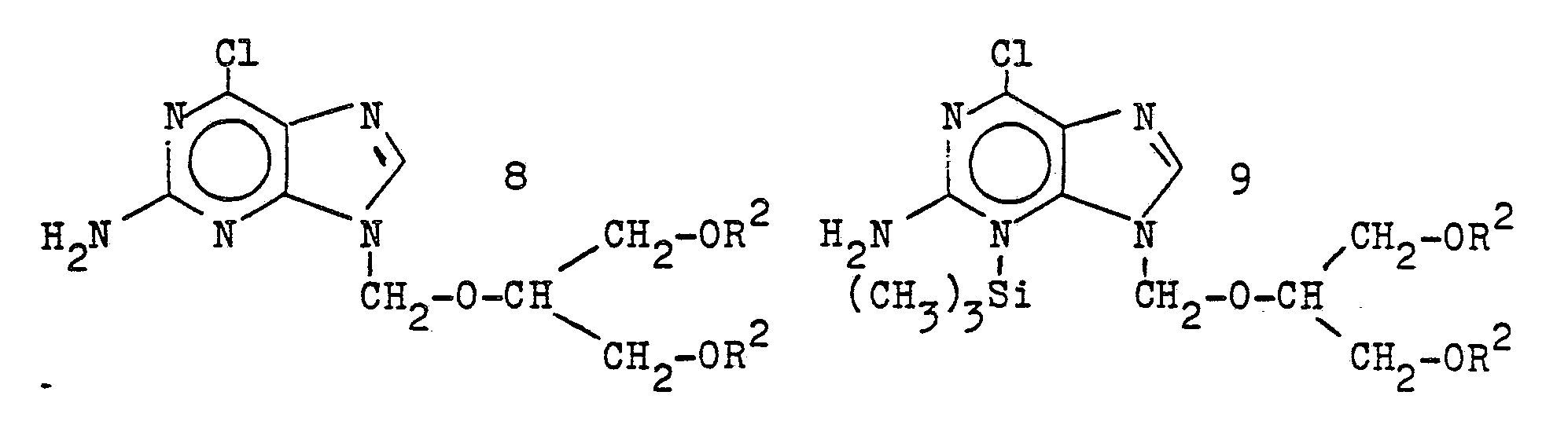
nach Abspaltung der Trimethylsilyl-Schutzgruppe in Verbindung 9 mit Alkali-Akoholaten der Formel 10
Alkalimetall-OR¹ 10
wobei R¹ wie oben definiert ist und Alkalimetall Li, Na oder K bedeutet, verethert und die Benzyl-Schutzgruppen R² abspaltet.
und die Umsetzungsprodukte der Formel 8 oder 9
Alkalimetall-OR¹ 10
wobei R¹ wie oben definiert ist und Alkalimetall Li, Na oder K bedeutet, verethert und die Benzyl-Schutzgruppen R² abspaltet.
2. Verfahren nach Anspruch 1, dadurch gekennzeichnet, daß man Verbindungen der Formel 1 mit R¹= Isopropyl und R²= H und/oder Acetyl herstellt.
3. Verfahren zur Herstellung eines Arzneimittels, dadurch gekennzeichnet, daß man eine wirksame Menge wenigstens einer Verbindung der Formel 1 wie erhalten nach den Verfahren gemäß Anspruch 1 oder 2 mit einem physiologisch annehmbaren Träger und ggf. weiteren Zusatz- und/oder Hilfsstoffen in eine geeignete Darreichungsform bringt.
Applications Claiming Priority (2)
| Application Number | Priority Date | Filing Date | Title |
|---|---|---|---|
| DE3631562 | 1986-09-17 | ||
| DE19863631562 DE3631562A1 (de) | 1986-09-17 | 1986-09-17 | In 9-stellung substituierte 2-amino-6-alkoxy-purine, ihre verwendung, diese purine enthaltende arzneimittel und verfahren zur herstellung der purine |
Publications (1)
| Publication Number | Publication Date |
|---|---|
| EP0260596A2 true EP0260596A2 (de) | 1988-03-23 |
Family
ID=6309737
Family Applications (1)
| Application Number | Title | Priority Date | Filing Date |
|---|---|---|---|
| EP87113220A Withdrawn EP0260596A2 (de) | 1986-09-17 | 1987-09-10 | In 9-Stellung substituierte 2-Amino-6-alkoxy-purine, ihre Verwendung, diese Purine enthaltende Arzneimittel und Verfahren zur Herstellung der Purine |
Country Status (5)
| Country | Link |
|---|---|
| EP (1) | EP0260596A2 (de) |
| JP (1) | JPS6383086A (de) |
| AT (1) | AT388734B (de) |
| DE (1) | DE3631562A1 (de) |
| DK (1) | DK485987A (de) |
Cited By (1)
| Publication number | Priority date | Publication date | Assignee | Title |
|---|---|---|---|---|
| EP0704445A1 (de) * | 1994-08-04 | 1996-04-03 | F. Hoffmann-La Roche AG | Herstellung N-9-substituierter Guanin-Verbindungen |
Family Cites Families (1)
| Publication number | Priority date | Publication date | Assignee | Title |
|---|---|---|---|---|
| EP0138683A3 (de) * | 1983-09-30 | 1988-01-20 | Merck & Co. Inc. | Purinderivate, ihre Verwendung in antiviralen Zubereitungen |
-
1986
- 1986-09-17 DE DE19863631562 patent/DE3631562A1/de not_active Withdrawn
-
1987
- 1987-09-10 EP EP87113220A patent/EP0260596A2/de not_active Withdrawn
- 1987-09-16 JP JP62229962A patent/JPS6383086A/ja active Pending
- 1987-09-16 DK DK485987A patent/DK485987A/da not_active Application Discontinuation
- 1987-10-08 AT AT0259087A patent/AT388734B/de not_active IP Right Cessation
Cited By (3)
| Publication number | Priority date | Publication date | Assignee | Title |
|---|---|---|---|---|
| EP0704445A1 (de) * | 1994-08-04 | 1996-04-03 | F. Hoffmann-La Roche AG | Herstellung N-9-substituierter Guanin-Verbindungen |
| US5565565A (en) * | 1994-08-04 | 1996-10-15 | Syntex (U.S.A.) Inc. | Preparation of N-9 substituted guanine compounds |
| CN1051084C (zh) * | 1994-08-04 | 2000-04-05 | 弗·哈夫曼-拉罗切有限公司 | N-9取代的鸟嘌呤化合物的制备 |
Also Published As
| Publication number | Publication date |
|---|---|
| ATA259087A (de) | 1989-01-15 |
| DK485987D0 (da) | 1987-09-16 |
| AT388734B (de) | 1989-08-25 |
| DE3631562A1 (de) | 1988-03-31 |
| DK485987A (da) | 1988-03-18 |
| JPS6383086A (ja) | 1988-04-13 |
Similar Documents
| Publication | Publication Date | Title |
|---|---|---|
| DE2539963C2 (de) | Purinverbindungen, Verfahren zu ihrer Herstellung und pharmazeutische Zubereitungen, welche diese Verbindungen enthalten | |
| DE69033915T2 (de) | Xanthinderivate, Verfahren zu ihrer Herstellung und ihre pharmazeutische Anwendung | |
| DE69012840T2 (de) | Adenosin-Derivate, die eine Aktivität gegen Bluthochdruck haben. | |
| DD213218A5 (de) | Verfahren zur herstellung von 9-(1,3-dihydroxy-2-propoxymethyl)-guaninderivaten | |
| DE2918261C2 (de) | ||
| EP0217207B1 (de) | In 6- und 9-Stellung substituierte 2-Aminopurine, ihre Verwendung, diese Purine enthaltende Arzneimittel und Verfahren zur Herstellung der Purine | |
| EP0496238A1 (de) | Substituierte Benzoxazepine und Benzthiazepine, Verfahren zu ihrer Herstellung und ihre Verwendung in Arzneimitteln | |
| EP0012230A1 (de) | Verfahren zur Herstellung von 1H-Tetrazol-1-Essigsäure und deren Estern | |
| EP0255894A2 (de) | Pyrimidinderivate, deren Herstellung und Arzneimittel, die diese Derivate enthalten | |
| DE69707860T2 (de) | Verfahren zur herstellung von tetrahydroindolizinen | |
| CH632759A5 (de) | Verfahren zur herstellung neuer substituierter purine. | |
| DD292003A5 (de) | Verfahren zum herstellen von 2-amino-oxazolin-verbindungen | |
| EP0206021B1 (de) | Neue Derivate des 1,1,2,2-Tetramethyl-1,2-bis-(2-fluor-4-hydroxyphenyl)-ethans | |
| DE2647966C2 (de) | Derivate des 4-(6'-Methoxy-2'- naphthyl)-butan-2-ons, Verfahren zu ihrer Herstellung und diese Verbindungen enthaltende Arzneimittel | |
| DE2462559B2 (de) | 4-Oximino-l -oxa-3-thiacyclopentane und deren 3-Oxide bzw. 33-Dioxide sowie 3-Oximino-l-oxa-4-thiacycIohexane und deren 4-Oxide bzw. 4,4-Dioxide | |
| DE3631562A1 (de) | In 9-stellung substituierte 2-amino-6-alkoxy-purine, ihre verwendung, diese purine enthaltende arzneimittel und verfahren zur herstellung der purine | |
| EP0533056A2 (de) | Substituierte Aminopropane, Verfahren zu ihrer Herstellung und ihre Verwendung als Antimykutiku | |
| DE69702580T2 (de) | Hydrochinon-Derivate und deren pharmazeutische Verwendung | |
| EP0044932A1 (de) | Gegebenenfalls N-substituierte Amino-desoxy-1.4;3.6-dianhydro-hexit-Derivate, Verfahren zu ihrer Herstellung und deren Verwendung | |
| DE2708827C2 (de) | ||
| DE69308009T2 (de) | Derivate des 5,6,7,9-Tetrahydro-1,2,3-trimethoxy-9-oxo-benzo(alpha)heptalens | |
| DE2825855C3 (de) | 15-substituierte-&iota;-Pentanorprostaglandin-derivate | |
| US4161533A (en) | 5-Sulfamoyl-orthanilic acids and process for their preparation | |
| DE2648239C3 (de) | Di-(trialkylstannyl)-pyrimidinderivate, Verfahren zu ihrer Herstellung und Verfahren zu ihrer Weiterverarbeitung zu nucleosidartigen Pyrimidinderivaten | |
| EP0298467A2 (de) | In 6- und 9-Stellung substituierte 2-Amino-8-aza-purine, ihre Verwendung, diese Purine enthaltende Arzneimittel und Verfahren zur Herstellung der Purine |
Legal Events
| Date | Code | Title | Description |
|---|---|---|---|
| PUAI | Public reference made under article 153(3) epc to a published international application that has entered the european phase |
Free format text: ORIGINAL CODE: 0009012 |
|
| AK | Designated contracting states |
Kind code of ref document: A2 Designated state(s): AT BE CH DE FR GB GR IT LI LU NL SE |
|
| STAA | Information on the status of an ep patent application or granted ep patent |
Free format text: STATUS: THE APPLICATION HAS BEEN WITHDRAWN |
|
| 18W | Application withdrawn |
Withdrawal date: 19890616 |
|
| R18W | Application withdrawn (corrected) |
Effective date: 19890616 |
|
| RIN1 | Information on inventor provided before grant (corrected) |
Inventor name: WINKLER, IRVIN, DR. Inventor name: WINKELMANN, ERHARDT, DR. |