EP0258551B1 - Mittel zur Ausrüstung von Textilien - Google Patents
Mittel zur Ausrüstung von Textilien Download PDFInfo
- Publication number
- EP0258551B1 EP0258551B1 EP87108534A EP87108534A EP0258551B1 EP 0258551 B1 EP0258551 B1 EP 0258551B1 EP 87108534 A EP87108534 A EP 87108534A EP 87108534 A EP87108534 A EP 87108534A EP 0258551 B1 EP0258551 B1 EP 0258551B1
- Authority
- EP
- European Patent Office
- Prior art keywords
- weight
- preparations
- vinyl acetate
- contain
- polyethylene glycol
- Prior art date
- Legal status (The legal status is an assumption and is not a legal conclusion. Google has not performed a legal analysis and makes no representation as to the accuracy of the status listed.)
- Expired - Lifetime
Links
- 239000004753 textile Substances 0.000 title claims description 16
- XTXRWKRVRITETP-UHFFFAOYSA-N Vinyl acetate Chemical compound CC(=O)OC=C XTXRWKRVRITETP-UHFFFAOYSA-N 0.000 claims description 18
- 239000000084 colloidal system Substances 0.000 claims description 18
- 229920001577 copolymer Polymers 0.000 claims description 18
- 230000001681 protective effect Effects 0.000 claims description 18
- JBSLOWBPDRZSMB-FPLPWBNLSA-N dibutyl (z)-but-2-enedioate Chemical compound CCCCOC(=O)\C=C/C(=O)OCCCC JBSLOWBPDRZSMB-FPLPWBNLSA-N 0.000 claims description 17
- 229920001223 polyethylene glycol Polymers 0.000 claims description 16
- 239000003995 emulsifying agent Substances 0.000 claims description 12
- 239000004908 Emulsion polymer Substances 0.000 claims description 9
- 239000002202 Polyethylene glycol Substances 0.000 claims description 9
- 239000000839 emulsion Substances 0.000 claims description 9
- 238000002360 preparation method Methods 0.000 claims description 9
- 229920000642 polymer Polymers 0.000 claims description 8
- 238000009988 textile finishing Methods 0.000 claims description 7
- 239000002736 nonionic surfactant Substances 0.000 claims description 4
- 238000007720 emulsion polymerization reaction Methods 0.000 claims description 3
- 150000002430 hydrocarbons Chemical class 0.000 claims description 2
- 125000004435 hydrogen atom Chemical group [H]* 0.000 claims description 2
- 230000000052 comparative effect Effects 0.000 description 18
- 239000006185 dispersion Substances 0.000 description 18
- 239000003795 chemical substances by application Substances 0.000 description 11
- 239000000178 monomer Substances 0.000 description 10
- 238000006243 chemical reaction Methods 0.000 description 7
- 239000000047 product Substances 0.000 description 7
- 239000003999 initiator Substances 0.000 description 5
- 239000000463 material Substances 0.000 description 5
- 239000004744 fabric Substances 0.000 description 4
- 238000004519 manufacturing process Methods 0.000 description 4
- 238000010992 reflux Methods 0.000 description 4
- XLYOFNOQVPJJNP-UHFFFAOYSA-N water Substances O XLYOFNOQVPJJNP-UHFFFAOYSA-N 0.000 description 4
- 229920001519 homopolymer Polymers 0.000 description 3
- 238000000034 method Methods 0.000 description 3
- 239000004014 plasticizer Substances 0.000 description 3
- 238000006116 polymerization reaction Methods 0.000 description 3
- 229920002689 polyvinyl acetate Polymers 0.000 description 3
- 239000011118 polyvinyl acetate Substances 0.000 description 3
- 239000007787 solid Substances 0.000 description 3
- 229920002554 vinyl polymer Polymers 0.000 description 3
- CSCPPACGZOOCGX-UHFFFAOYSA-N Acetone Chemical compound CC(C)=O CSCPPACGZOOCGX-UHFFFAOYSA-N 0.000 description 2
- 239000004372 Polyvinyl alcohol Substances 0.000 description 2
- CDBYLPFSWZWCQE-UHFFFAOYSA-L Sodium Carbonate Chemical compound [Na+].[Na+].[O-]C([O-])=O CDBYLPFSWZWCQE-UHFFFAOYSA-L 0.000 description 2
- 239000013530 defoamer Substances 0.000 description 2
- DOIRQSBPFJWKBE-UHFFFAOYSA-N dibutyl phthalate Chemical compound CCCCOC(=O)C1=CC=CC=C1C(=O)OCCCC DOIRQSBPFJWKBE-UHFFFAOYSA-N 0.000 description 2
- 239000000203 mixture Substances 0.000 description 2
- 229920002451 polyvinyl alcohol Polymers 0.000 description 2
- USHAGKDGDHPEEY-UHFFFAOYSA-L potassium persulfate Chemical compound [K+].[K+].[O-]S(=O)(=O)OOS([O-])(=O)=O USHAGKDGDHPEEY-UHFFFAOYSA-L 0.000 description 2
- 239000000126 substance Substances 0.000 description 2
- 229920000742 Cotton Polymers 0.000 description 1
- IGFHQQFPSIBGKE-UHFFFAOYSA-N Nonylphenol Natural products CCCCCCCCCC1=CC=C(O)C=C1 IGFHQQFPSIBGKE-UHFFFAOYSA-N 0.000 description 1
- 239000004698 Polyethylene Substances 0.000 description 1
- OFOBLEOULBTSOW-UHFFFAOYSA-N Propanedioic acid Natural products OC(=O)CC(O)=O OFOBLEOULBTSOW-UHFFFAOYSA-N 0.000 description 1
- XBDQKXXYIPTUBI-UHFFFAOYSA-M Propionate Chemical compound CCC([O-])=O XBDQKXXYIPTUBI-UHFFFAOYSA-M 0.000 description 1
- XBDQKXXYIPTUBI-UHFFFAOYSA-N Propionic acid Chemical class CCC(O)=O XBDQKXXYIPTUBI-UHFFFAOYSA-N 0.000 description 1
- UIIMBOGNXHQVGW-DEQYMQKBSA-M Sodium bicarbonate-14C Chemical compound [Na+].O[14C]([O-])=O UIIMBOGNXHQVGW-DEQYMQKBSA-M 0.000 description 1
- 125000005396 acrylic acid ester group Chemical group 0.000 description 1
- 239000008346 aqueous phase Substances 0.000 description 1
- 230000001174 ascending effect Effects 0.000 description 1
- 230000015572 biosynthetic process Effects 0.000 description 1
- 239000000872 buffer Substances 0.000 description 1
- 125000002091 cationic group Chemical group 0.000 description 1
- 239000001913 cellulose Substances 0.000 description 1
- 229920002678 cellulose Polymers 0.000 description 1
- 239000013065 commercial product Substances 0.000 description 1
- 238000001816 cooling Methods 0.000 description 1
- 238000007334 copolymerization reaction Methods 0.000 description 1
- 230000003111 delayed effect Effects 0.000 description 1
- 210000003298 dental enamel Anatomy 0.000 description 1
- 230000000694 effects Effects 0.000 description 1
- 150000002148 esters Chemical class 0.000 description 1
- UIWXSTHGICQLQT-UHFFFAOYSA-N ethenyl propanoate Chemical compound CCC(=O)OC=C UIWXSTHGICQLQT-UHFFFAOYSA-N 0.000 description 1
- 150000002170 ethers Chemical class 0.000 description 1
- 239000000835 fiber Substances 0.000 description 1
- 239000000945 filler Substances 0.000 description 1
- 239000005337 ground glass Substances 0.000 description 1
- 229920000126 latex Polymers 0.000 description 1
- VZCYOOQTPOCHFL-UPHRSURJSA-N maleic acid Chemical compound OC(=O)\C=C/C(O)=O VZCYOOQTPOCHFL-UPHRSURJSA-N 0.000 description 1
- 239000011976 maleic acid Substances 0.000 description 1
- 229910052751 metal Inorganic materials 0.000 description 1
- 239000002184 metal Substances 0.000 description 1
- 239000004745 nonwoven fabric Substances 0.000 description 1
- SNQQPOLDUKLAAF-UHFFFAOYSA-N nonylphenol Chemical compound CCCCCCCCCC1=CC=CC=C1O SNQQPOLDUKLAAF-UHFFFAOYSA-N 0.000 description 1
- 229920003023 plastic Polymers 0.000 description 1
- 239000004033 plastic Substances 0.000 description 1
- 238000007747 plating Methods 0.000 description 1
- 229920000058 polyacrylate Polymers 0.000 description 1
- 229920000151 polyglycol Polymers 0.000 description 1
- 239000010695 polyglycol Substances 0.000 description 1
- 150000003839 salts Chemical class 0.000 description 1
- 239000012748 slip agent Substances 0.000 description 1
- 229910000029 sodium carbonate Inorganic materials 0.000 description 1
- 239000007858 starting material Substances 0.000 description 1
- 239000003351 stiffener Substances 0.000 description 1
- 238000003756 stirring Methods 0.000 description 1
- 239000004094 surface-active agent Substances 0.000 description 1
- VZCYOOQTPOCHFL-UHFFFAOYSA-N trans-butenedioic acid Natural products OC(=O)C=CC(O)=O VZCYOOQTPOCHFL-UHFFFAOYSA-N 0.000 description 1
Classifications
-
- D—TEXTILES; PAPER
- D06—TREATMENT OF TEXTILES OR THE LIKE; LAUNDERING; FLEXIBLE MATERIALS NOT OTHERWISE PROVIDED FOR
- D06M—TREATMENT, NOT PROVIDED FOR ELSEWHERE IN CLASS D06, OF FIBRES, THREADS, YARNS, FABRICS, FEATHERS OR FIBROUS GOODS MADE FROM SUCH MATERIALS
- D06M15/00—Treating fibres, threads, yarns, fabrics, or fibrous goods made from such materials, with macromolecular compounds; Such treatment combined with mechanical treatment
- D06M15/19—Treating fibres, threads, yarns, fabrics, or fibrous goods made from such materials, with macromolecular compounds; Such treatment combined with mechanical treatment with synthetic macromolecular compounds
- D06M15/21—Macromolecular compounds obtained by reactions only involving carbon-to-carbon unsaturated bonds
- D06M15/327—Macromolecular compounds obtained by reactions only involving carbon-to-carbon unsaturated bonds of unsaturated alcohols or esters thereof
- D06M15/333—Macromolecular compounds obtained by reactions only involving carbon-to-carbon unsaturated bonds of unsaturated alcohols or esters thereof of vinyl acetate; Polyvinylalcohol
-
- D—TEXTILES; PAPER
- D06—TREATMENT OF TEXTILES OR THE LIKE; LAUNDERING; FLEXIBLE MATERIALS NOT OTHERWISE PROVIDED FOR
- D06M—TREATMENT, NOT PROVIDED FOR ELSEWHERE IN CLASS D06, OF FIBRES, THREADS, YARNS, FABRICS, FEATHERS OR FIBROUS GOODS MADE FROM SUCH MATERIALS
- D06M15/00—Treating fibres, threads, yarns, fabrics, or fibrous goods made from such materials, with macromolecular compounds; Such treatment combined with mechanical treatment
- D06M15/19—Treating fibres, threads, yarns, fabrics, or fibrous goods made from such materials, with macromolecular compounds; Such treatment combined with mechanical treatment with synthetic macromolecular compounds
- D06M15/21—Macromolecular compounds obtained by reactions only involving carbon-to-carbon unsaturated bonds
- D06M15/263—Macromolecular compounds obtained by reactions only involving carbon-to-carbon unsaturated bonds of unsaturated carboxylic acids; Salts or esters thereof
-
- D—TEXTILES; PAPER
- D06—TREATMENT OF TEXTILES OR THE LIKE; LAUNDERING; FLEXIBLE MATERIALS NOT OTHERWISE PROVIDED FOR
- D06M—TREATMENT, NOT PROVIDED FOR ELSEWHERE IN CLASS D06, OF FIBRES, THREADS, YARNS, FABRICS, FEATHERS OR FIBROUS GOODS MADE FROM SUCH MATERIALS
- D06M15/00—Treating fibres, threads, yarns, fabrics, or fibrous goods made from such materials, with macromolecular compounds; Such treatment combined with mechanical treatment
- D06M15/19—Treating fibres, threads, yarns, fabrics, or fibrous goods made from such materials, with macromolecular compounds; Such treatment combined with mechanical treatment with synthetic macromolecular compounds
- D06M15/37—Macromolecular compounds obtained otherwise than by reactions only involving carbon-to-carbon unsaturated bonds
- D06M15/53—Polyethers
Definitions
- aqueous emulsion polymers to the textile material to be finished in order to finish textile fabrics.
- auxiliary materials applied as part of the finish serve, inter alia, as fillers, as stiffening agents, anti-slip agents, aggravating agents, agents for improving the seam tear resistance, as anti-nagging agents and the like.
- Corresponding products based on vinyl acetate, dibutyl maleate, vinyl propionate and acrylic acid esters are used in particular as plastic dispersions or emulsions. These agents also serve to vary the handle, a very hard, stiff handle being obtained with polyvinyl acetate dispersions.
- plasticizers can improve the grip properties, this technical solution is subject to considerable restrictions. At the temperatures used in various stages of textile treatment, the plasticizers are at least partially volatile, so that an undesirable change in the handle of the textile material occurs.
- a known plasticizer of this type is, for example, dibutyl phthalate.
- US Pat. No. 3,001,957 discloses latices for textile finishing which contain emulsion polymers of vinyl acetate and / or its copolymers, such as with dibutyl maleate, and cationic protective colloids and emulsifiers.
- emulsion polymers of vinyl acetate and / or its copolymers such as with dibutyl maleate, and cationic protective colloids and emulsifiers.
- dispersions of polyvinyl acetate and / or its copolymers with maleic acid dialkyl esters are described which additionally contain emulsifiers such as polyglycol ethers and optionally protective colloids.
- the invention has for its object to improve the known emulsion homo- and / or copolymers based on vinyl acetate and its copolymers with dibutyl maleate (DBM) so that when used as a textile finishing agent they have significant advantages over comparable homo- or copolymers of the previously known type. In particular, they should give the textile a softer and fuller feel than previously known corresponding emulsion polymers based on vinyl acetate or its copolymers with DBM.
- DBM dibutyl maleate
- the invention is based on the surprising finding that the selection of a very specific protective colloid for the emulsion polymers of the type concerned here provides the desired effects of increased fullness and greater softness in the handle test of appropriately equipped textiles.
- the invention accordingly relates to agents for finishing textiles, in particular textile fabrics based on protective colloids, in addition to small amounts Emulsion polymers of vinyl acetate and / or its copolymers with dibutyl maleate containing customary auxiliaries, the polymer emulsions containing as protective colloid polyethylene glycol which was at least partly present during the emulsion polymerization, characterized in that polyethylene glycol has an average molecular weight of 3,000 to 50,000. The entire amount of the polyethylene glycol is preferably used as a protective colloid even during the emulsion polymerization or copolymerization.
- the polyethylene glycol mentioned as a protective colloid By using the polyethylene glycol mentioned as a protective colloid, it is possible to produce polyvinyl acetate homo- and copolymers which, in the application area of the textile finishing agents concerned here, are distinguished by a significantly softer feel of the treated textile than when the conventional protective colloids are used - for example polyvinyl alcohol and / or cellulose derivatives . It is also of considerable advantage that the dispersions used according to the invention have a very high shear stability, as a result of which the processing of the dispersions in the context of textile finishing is promoted in important work steps.
- the amount of the polyethylene glycols used as the protective colloid is preferably in the range from about 2 to 10% by weight, based on the total weight of the composition.
- the vinyl acetate polymer or copolymer content of the aqueous polymer emulsions is preferably about 40 to 60 percent by weight. If copolymers of vinyl acetate with DBM are used, the DBM content can be up to 50 mol%, based on the sum of vinyl acetate and DBM, with DBM contents in the range from about 5 to 45 mol% being particularly preferred . In general, the higher the DBM content in the copolymer, the greater or greater the softness and fullness of the textile handle.
- the aqueous polymer dispersions also contain the usual auxiliaries in small amounts, with emulsifiers, buffer substances, starters for the polymerization reaction and / or salts being particularly mentioned here.
- the content of these other customary auxiliaries in the emulsion polymers is preferably not above 5% by weight, the content of emulsifiers in particular being in the range of 0.5-3% by weight.
- Particularly suitable emulsifiers are those based on nonionic surfactants, in particular poly-ethylene oxide addition products to hydrocarbon compounds having a reactive hydrogen atom, alkylphenol-EO addition products being preferred emulsifiers.
- a nonionic surfactant that is particularly suitable as an emulsifier is, for example, nonylphenol x 10 EO. But there are also other nonionic surfactants with modified ones EO chain suitable. Particularly useful amounts of the nio-surfactant are in the range of 0.5-2% by weight. Particularly suitable amounts of the polyethylene glycol present as a protective colloid are in the range from approximately 3 to 10% by weight, polyethylene glycols having an average molecular weight of approximately 8,000 to 25,000 being particularly suitable.
- the dispersions are placed undiluted in the trough of a plating device, the lower roller is immersed in the dispersion, the contact pressure of the upper roller is set to 98.07 N / cm [10 kg / cm].
- the shear stability of the dispersion is observed. If after 30 minutes no deposits are visible on the top roller and the bottom roller shows a uniform film without tears, the friction resistance is rated as very good. If there are no changes within the first 10 minutes, the grade will be given well.
- the work was carried out in a ground glass apparatus with 2 l filling content, metal anchor stirrer, intensive cooler and dosing vessels. Most of the water was placed in the reaction vessel and the sodium carbonate, the emulsifier, the defoamer - if used - and the protective colloid were dissolved at 80 to 85 ° C. for 2 hours. The monomers were placed in a 0.5 liter metering funnel. To prepare the initiator solution, potassium persulfate was dissolved in cold water. The solution was placed in a further dosing funnel.
- the reaction was carried out with stirring (140 rpm). The reaction temperature was kept in the range between 80 and 88 ° C. If the reflux was too strong, the monomer addition was temporarily restricted. After the end of the monomer addition, the rest of the initiator solution was added quickly and the end of reflux was awaited. The after-reaction then took place within 30 minutes in the temperature range from 85 to 95 ° C.
- the work was done in a 200 l enamel apparatus with a filling capacity of 120 kg, an infinitely variable impeller stirrer, a 20 l dosing vessel and an ascending reflux condenser. After each batch, the apparatus was rinsed with water and then acetone and dried. 140-200 rpm were set as the stirrer speed.
- the major part of the aqueous phase was placed in the reactor and sodium bicarbonate, emulsifier, defoamer and protective colloid were dissolved in it at 75 ° C. for 2 hours (preliminary solution).
- the intended amount of monomer or the mixture of the monomers was placed in the metering vessel.
- the initiator (potassium persulfate) was dissolved in the remaining water and the solution was added to another metering vessel.
- the reaction temperature was kept in the range of 80 to 88 ° C. If the reflux was too strong, the monomer addition was delayed. After the monomer had been added, the temperature was raised to 85 to 95 ° C. for the after-reaction.
- the dispersions could be filled after cooling to about 35 ° C.
- the emulsion polymer was subsequently mixed with 3% by weight of PEG 12000.
- Comparative example 6.1 contains 3.5% by weight of PEG 12000 added subsequently.
- Comparative example 7.1 contains 3.5% by weight of PEG 12000 added subsequently.
- Comparative Example 8.1 5.0% by weight of PEG 12000 is added to this dispersion.
- the commercially available dispersion contains a vinyl acetate polymer at a solids concentration of 50% by weight of protective colloid: approximately 3.0% by weight of polyvinyl alcohol).
- Comparative example 9.1 contains 5.0% by weight of PEG 12000 added subsequently.
- the grades of the examined samples are summarized in the attached table.
- the shear stability of the materials from Comparative Examples 3 to 5 is poor.
Landscapes
- Chemical & Material Sciences (AREA)
- Chemical Kinetics & Catalysis (AREA)
- Engineering & Computer Science (AREA)
- Textile Engineering (AREA)
- Compositions Of Macromolecular Compounds (AREA)
- Treatments For Attaching Organic Compounds To Fibrous Goods (AREA)
- Polymerisation Methods In General (AREA)
- Polymerization Catalysts (AREA)
Description
- Es ist bekannt, zur Ausrüstung von textilen Flächengebilden wäßrige Emulsionspolymerisate auf das auszurüstende textile Gut aufzubringen. Diese im Rahmen der Ausrüstung aufgebrachten Hilfsstoffe dienen unter anderem als Füllmittel, als Versteifungsmittel, Schiebefestmittel, Erschwerungsmittel, Mittel zur Verbesserung der Nahtausreißfestigkeit, als Antisnaggingmittel und dergleichen. Als Kunststoffdispersionen bzw. -emulsionen werden insbesondere entsprechende Produkte auf Basis von Vinylacetat, Dibutylmaleinat, Vinylpropionat und Acrylsäureestern eingesetzt. Diese Mittel dienen gleichzeitig zur Variation des Griffes, wobei mit Polyvinylacetatdispersionen ein sehr harter, steifer Griff erhalten wird. Zwar kann man durch Mitverwendung von Weichmachern die Griffeigenschaften verbessern, diese technische Lösung unterliegt aber beträchtlichen Einschränkungen. Bei den in verschiedenen Stufen der Textilbehandlung eingesetzten Temperaturen sind die Weichmacher wenigstens anteilsweise flüchtig, so daß eine unerwünschte Griffveränderung des textilen Gutes eintritt. Ein bekannter Weichmacher dieser Art ist beispielsweise Dibutylphthalat.
- Um die Mängel derart weichgemachter Vinylacetathomopolymerisate besser auszugleichen, ist es bekannt, Copolymerisate des Vinylacetats mit Dibutylmaleinat (DBM) einzusetzen. Auch Polyvinylpropionate liefern einen weicheren und volleren Griff beim Einsatz als Ausrüstungsmittel im Vergleich mit den Vinylacetathomopolymerisaten. Besonders weiche und volle Griffnoten werden bei der Verwendung von Polyacrylat-Emulsionen bzw. -Dispersionen eingestellt. Aus wirtschaftlichen Überlegungnen heraus ist allerdings die Verwendung einer möglichst großen Menge an Vinylacetat bzw. seinen Homo- und/oder Co-Polymeren wünschenswert. Vinylacetat ist als besonders preisgünstige Komponente im Vergleich mit allen anderen hier betroffenen möglichen Monomeren für die Ausbildung des Textilausrüstungsmittels besonders begehrt.
- So sind aus der amerikanischen Patentschrift US 3001957 Latices für die Textilausrüstung bekannt, die Emulsionspolymerisate des Vinylacetats und/oder seinen Copolymeren wie mit Dibutylmaleinat enthalten sowie kationische Schutzkolloide und Emulgatoren. Auch in dem Artikel von Dr. Nischwitz "Vinyl-Polymere für die Bindung von Vliesstoffen" in Chemie-Fasern Textilindustrie, Vol. 23, No. 7, Juli 1973, Frankfurt am Main, Seiten 648 bis 651, werden Dispersionen von Polyvinylacetat und/oder seinen Copolymerisaten mit Maleinsäuredialkylestern beschrieben, die zusätzlich Emulgatoren wie Polyglykolether und gegebenenfalls Schutzkolloide enthalten.
- Der Erfindung liegt die Aufgabe zugrunde, die an sich bekannten Emulsionshomo- und/oder-copolymerisate auf Basis von Vinylacetat und seinen Copolymeren mit Dibutylmaleinat (DBM) so zu verbessern, daß sie bei ihrem Einsatz als Textilausrüstungsmittel wesentliche Vorteile gegenüber vergleichbaren Homo- bzw. Copolymerisaten der bisher bekannten Art besitzen. Sie sollen dabei insbesondere dem Textil einen weicheren und volleren Griff verleihen, als bisher bekannte entsprechende Emulsionspolymerisate auf Basis von Vinylacetat bzw. seinen Copolymeren mit DBM.
- Die Erfindung geht von der überraschenden Feststellung aus, daß die Auswahl eines ganz bestimmten Schutzkolloides für die Emulsionspolymerisate der hier betroffenen Art die angestrebten Wirkungen von erhöhter Fülle und größerer Weichheit bei der Griffprüfung entsprechend ausgerüsteter Textilien liefert.
- Gegenstand der Erfindung sind dementsprechend Mittel zur Ausrüstung von Textilien, insbesondere textilen Flächengebilden auf Basis von Schutzkolloide neben geringen Mengen üblicher Hilfsstoffe enthaltenden Emulsionspolymerisaten des Vinylacetats und/oder seinen Copolymerisaten mit Dibutylmaleinat, wobei die Polymeremulsionen als Schutzkolloid Polyethylenglykol enthalten, das wenigstens anteilsweise schon während der Emulsionspolymerisation vorgelegen hat, dadurch gekennzeichnet, daß Polyethylenglykol ein mittleres Molekulargewicht von 3.000 bis 50.000 aufweist. Bevorzugt wird das Polyethylenglykol in seiner gesamten Menge schon während der Emulsionspolymerisation bzw. copolymerisation als Schutzkolloid eingesetzt.
- Durch die Verwendung des genannten Polyethylenglykols als Schutzkolloid können Polyvinylacetathomo- und -copolymere hergestellt werden, die sich auf den hier betroffenen Anwendungsgebiet der textilen Ausrüstungsmittel durch einen deutlich weicheren Griff des behandelten Textiles als bei Verwendung der üblichen Schutzkolloide - beispielsweise Polyvinylalkohol und/oder Cellulosederivate - auszeichnen. Von beträchtlichem Vorteil ist weiterhin, daß die erfindungsgemäß eingesetzten Dispersionen eine sehr hohe Scherstabilität besitzen, wodurch die Verarbeitung der Dispersionen im Rahmen der Textilausrüstung in wichtigen Arbeitsschritten begünstigt wird. Durch die Optimierung der sich auf die Weichheit und den Griff auswirkenden Parameter der erfindungsgemäßen Mittel - insbesondere durch den Gehalt an Dibutylmaleinat und durch Menge und Typ des ausgesuchten Schutzkolloids innerhalb des angegebenen Rahmens können Produkte anfallen, die hinsichtlich der Weichheit des resultierenden Griffeindruckes bei der Anwendung auf Textilien Polyvinylpropionat-Dispersionen übertreffen. Gleichzeitig erfüllen diese Produkte aber alle sonstigen Anforderungen,insbesondere hinsichtlich Feststoffgehalt, Viskosität, Verdünnbarkeit, Friktionsbeständigkeit und Filmbeschaffenheit. Die Möglichkeiten der besonders preisgünstigen Textilausrüstung werden dadurch wesentlich erweitert.
- Die Menge der als Schutzkolloid eingesetzten Polyethylenglykole liegt bevorzugt im Bereich von etwa 2 - 10 Gew.-% - bezogen auf das Gesamtgewicht des Mittels. Der Gehalt der wäßrigen Polymeremulsionen an Vinylacetatpolymerisat bzw. -copolymerisat beträgt vorzugsweise etwa 40 bis 60 Gewichtsprozent. Wenn Copolymerisate des Vinylacetats mit DBM eingesetzt werden, so kann der DBM-Gehalt bis zu 50 Mol-% - bezogen auf die Summe von Vinylacetat und DBM - ausmachen, wobei DBM-Gehalte im Bereich von etwa 5 - 45 Mol-% besonders bevorzugt sind. Allgemein gilt, daß die Weichheit und Fülle des textilen Griffes um so größer bzw. höher wird, je höher der Gehalt an DBM im Copolymerisat gewählt ist.
- Die wäßrigen Polymerdispersionen enthalten im übrigen die üblichen Hilfsstoffe in geringen Mengen, wobei hier insbesondere Emulgatoren, Puffersubstanzen, Starter für die Polymerisationsreaktion und/oder Salze zu nennen sind. Der Gehalt der Emulsionspolymerisate an diesen sonstigen üblichen Hilfsstoffen liegt vorzugweise nicht oberhalb von 5 Gew.-%, wobei der Gehalt an Emulgatoren insbesondere etwa im Bereich von 0,5 - 3 Gew.-% liegen kann. Als übliche Emulgatoren sind insbesondere solche auf Niotensid-Basis geeignet, und zwar insbesondere Poly-ethylenoxid-Additionsprodukte an Kohlenwasserstoffverbindungen mit reaktivem Wasserstoffatom, wobei als bevorzugte Emulgatoren Alkylphenol-EO-Additionsprodukte vorliegen. Ein als Emulgator besonders geeignetes Niotensid ist z.B. das Nonylphenol x 10 EO. Es sind aber auch andere Niotenside mit veränderter EO-Kette geeignet. Besonders zweckmäßige Mengen des Nio-Tensids liegen im Bereich von 0,5 - 2 Gew.-%. Besonders geeignete Mengen des als Schutzkolloid vorliegenden Polyethylenglykols liegen im Bereich von etwa 3 bis 10 Gew.-%, wobei Polyethylenglykole eines mittleren Molekulargewichts von etwa 8 000 bis 25 000 besonders geeignet sein können.
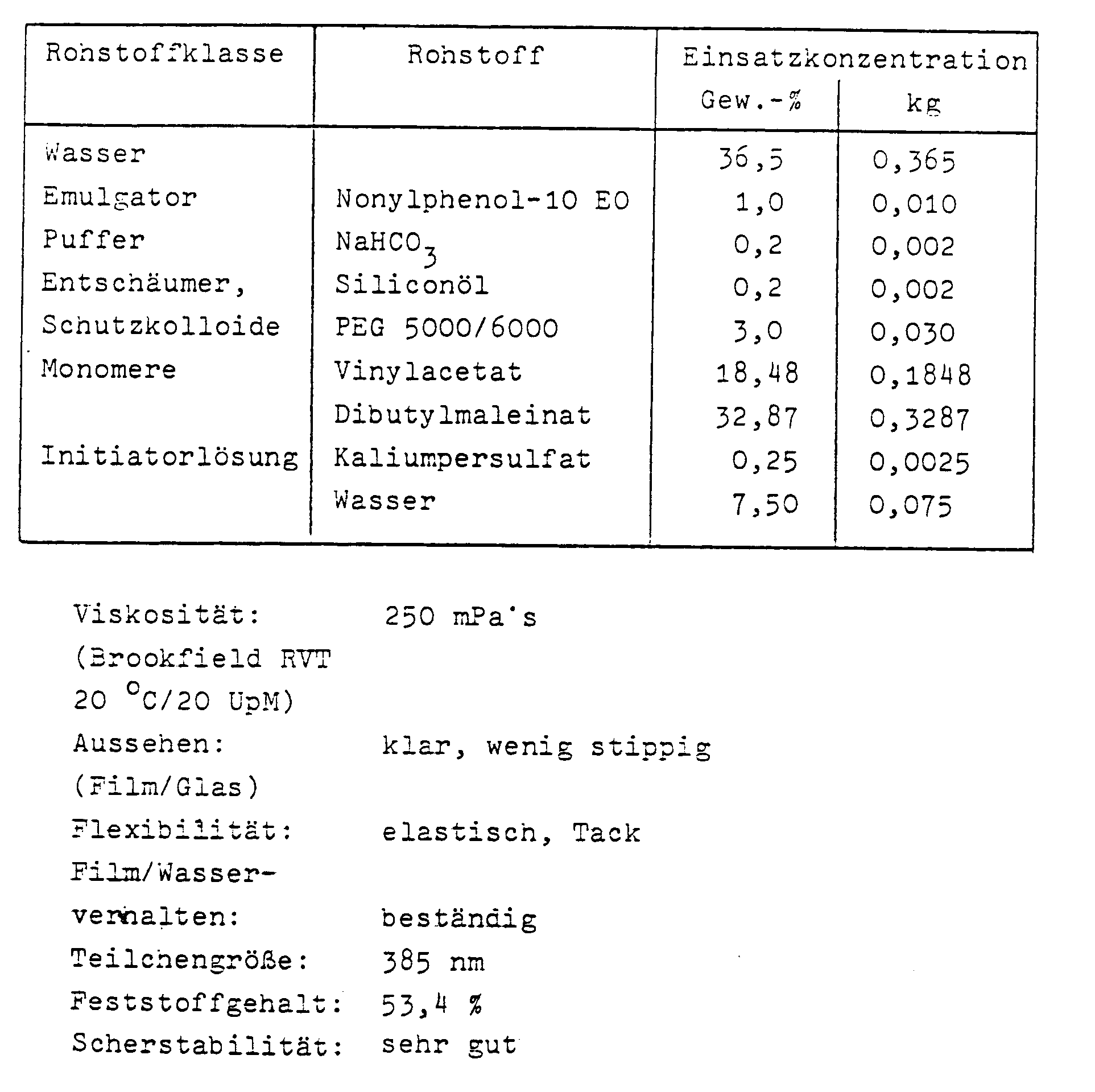
- In den nachfolgenden Beispielen wird zunächst die Herstellung einer Reihe von Vinylacetathomo- und -copolymerisaten im Sinne der Erfindung beschrieben, wobei wesentliche Herstellungsparameter dieser Polymeremulsionen jeweils angegeben sind. Die erfindungsgemäßen Emulsionen werden dann verglichen mit 4 Vergleichsmaterialien, die in Abwesenheit von Polyethylenglykol als Schutzkolloide hergestellt worden sind. Im Zusammenhang mit der Produktbeschreibung ist jeweils die Beurteilung der Scherstabilität, bestimmt durch Walzenauftrag nach dem Foulard-Verfahren angegeben. Hierzu gelten die folgenden Angaben:
Die Dispersionen werden mittels eines Labor-Foulard auf die Gewebe aufgebracht. Dabei werden die Dispersionen unverdünnt in den Trog einer Pflatsch-Vorrichtung gegeben, die Unterwalze taucht in die Dispersion ein, der Anpreßdruck der Oberwalze wird auf 98,07 N/cm [10Kp/cm] eingestellt. Während 30 Minuten Laufzeit bei einer Geschwindigkeit von 30 m/min. wird die Scherstabilität der Dispersion beobachtet. Wenn nach 30 Minuten keine Ablagerungen auf der Oberwalze zu sehen sind und die Unterwalze einen gleichmäßigen Film ohne Abrisse zeigt, wird die Friktionsbeständigkeit als sehr gut beurteilt. Wenn keine Veränderungen innerhalb der ersten 10 Minuten eintreten, wird die Note gut erteilt. - Treten bereits innerhalb der ersten 6 Sekunden Ablagerungen auf der Oberwalze oder Filmabrisse auf der Unterwalze auf, wird das Produkt als schlecht beurteilt.
- Gearbeitet wurde in einer Planschliffglasapparatur mit 2 l Füllinhalt, Metallankerrührer, Intensivkühler und Dosiergefäßen. Im Reaktionsgefäß wurde der größte Teil des Wassers vorgelegt und darin das Natriumcarbonat, der Emulgator, der Entschäumer - soweite verwendet - und das Schutzkolloid 2 Stunden bei 80 bis 85 °C gelöst. Die Monomeren wurden in einem 0,5 l-Dosiertrichter vorgelegt. Zur Herstellung der Initiatorlösung wurde Kaliumpersulfat in kaltem Wasser gelöst. Die Lösung wurde in einem weiteren Dosiertrichter vorgelegt.
- Zur Durchführung der Polymerisation wurden bei 82 bis 88 °C gleichzeitig Monomere und Initiatorlösung in den Reaktionsbehälter gegeben. Zudosiert wurde wie in der nachfolgenden Tabelle 1 angegeben.

- Die Reaktion wurde unter Rühren (140 UpM) durchgeführt. Die Reaktionstemperatur wurde dabei im Bereich zwischen 80 und 88°C gehalten. Bei zu starkem Rückfluß wurde die Monomerzugabe vorübergehend gedrosselt. Nach Ende der Monomerzugabe wurde der Rest der Initiatorlösung schnell zugegeben und das Ende des Rückflusses abgewartet. Die Nachreaktion fand sodann innerhalb von 30 Minuten im Temperaturbereich von 85 bis 95 °C statt.
- Gearbeitet wurde in einer 200 l-Emailleapparatur mit 120 kg Füllinhalt, einem stufenlos regelbaren Impellerrührer, einem 20 l-Dosiergefäß und einem aufsteigenden Rückflußkühler. Die Apparatur wurde nach jedem Ansatz mit Wasser und anschließend Aceton gespült und getrocknet. Als Rührerdrehzahl wurden 140 - 200 UpM eingestellt.
- Im Reaktor wurde der überwiegende Teil der wäßrigen Phase vorgelegt und darin Natriumbicarbonat, Emulgator, Entschäumer und Schutzkolloid 2 Stunden bei 75 °C gelöst (Vorlösung). Die vorgesehene Monomermenge oder die Mischung der Monomeren wurde im Dosiergefäß vorgelegt.
- Der Initiator (Kaliumpersulfat) wurde im restlichen Wasser gelöst und die Lösung in ein weiteres Dosiergefäß gegeben.
- Zur Durchführung der Polymerisation wurden bei 82 bis 88 °C gleichzeitig Monomer und Initiatorlösung in den Reaktor dosiert, und zwar mit den aus der folgenden Tabelle zu ersehenden Geschwindigkeiten.

- Die Reaktionstemperatur wurde im Bereich von 80 bis 88 °C gehalten. Bei zu starkem Rückfluß wurde die Monomerzugabe verzögert. Nach Ende der Monomerzugabe wurde zur Nachreaktion die Temperatur auf 85 bis 95°C erhöht. Die Dispersionen konnten nach Abkühlen auf ca. 35 °C abgefüllt werden.
-


-


-


-


-

-

-

-

-

-

-
-

-

-

-

-

-

-

-

-

-

-

-

-

-

- In Vergleichsbeispiel 2.1 wurde das Emulsionspolymerisat nachträglich mit 3 Gew.-% PEG 12000 versetzt.
-

-

-

-
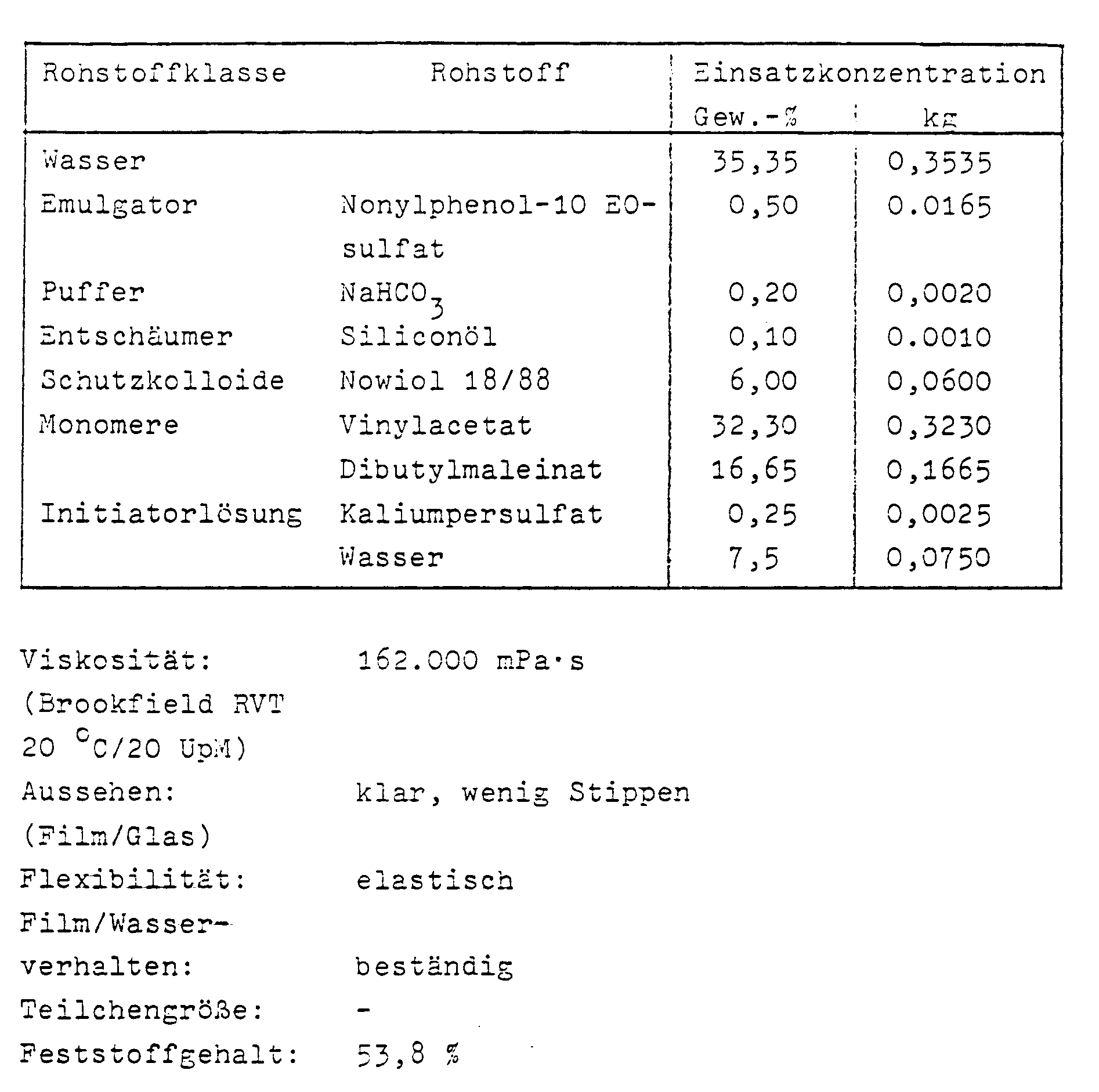
- Vergleichsbeispiel 6.1 enthält 3,5 Gew.-% nachträglich zugesetztes PEG 12000.
-

- Vergleichsbeispiel 7.1 enthält 3,5 Gew.-% nachträglich zugesetztes PEG 12000.
- Als Vergleichsbeispiel 8 wird die im Handel erhältliche Dispersion "Mowilith D 50" (Handelsprodukt der Fa. HOECHST AG) eingesetzt.
- Gemäß Vergleichsbeispiel 8.1 werden dieser Dispersion 5,0 Gew.-% PEG 12000 zugesetzt. Die im Handel vertriebene Dispersion enthält ein Vinylacetat-Polymerisat bei einer Festkörper-Konzentration von 50 Gew.-% Schutzkolloid : circa 3,0 Gew.-% Poly-Vinylalkohol).
-

- Vergleichsbeispiel 9.1 enthält 5,0 Gew.-% nachträglich zugesetztes PEG 12000.
- Die Dispersionen der Beispiele 1 bis 9 und 11 bis 15 sowie der Vergleichsbeispiele 1, 2, 2.1 und 6 bis 9.1 werden mittels Labor-Foulard auf Baumwollgewebe aufgebracht und mittels Spannrahmen bei 130 °C/60 sec getrocknet. Es werden dabei die Flottenkonzentrationen so eingestellt, daß eine Feststoffauflage von 4 % resultiert. Anschließend wurde der Griff beurteilt. Dabei gilt:

- Die Griffnoten der untersuchten Muster sind in der anliegenden Tabelle zusammengefaßt. Die Scherstabilität der Materialien aus den Vergleichsbeispielen 3 bis 5 ist schlecht.

Claims (6)
- Mittel zur Ausrüstung von Textilien, insbesondere textilen Flächengebilden, auf Basis von Schutzkolloide neben geringen Mengen üblicher Hilfsstoffe enthaltenden Emulsionspolymerisaten des Vinylacetats und/oder seinen Copolymerisaten mit Dibutylmaleinat, wobei die Polymeremulsionen als Schutzkolloid Polyethylenglykol enthalten, das wenigstens anteilsweise schon während der Emulsionspolymerisation vorgelegen hat, dadurch gekennzeichnet, daß Polyethylenglykol ein mittleres Molekulargewicht von 3000 bis 50000 aufweist.
- Mittel nach Anspruch 1, dadurch gekennzeichnet, daß sie das Polyethylenglykol-Schutzkolloid in Mengen von 2 bis 10 Gew.-% - bezogen auf wäßriges Emulsions(co)polymerisat - enthalten.
- Mittel nach Ansprüchen 1 und 2, dadurch gekennzeichnet, daß sie einen Gehalt an Vinylacetatpolymerisat bzw. -copolymerisat von 40 - 60 Gew.-% - bezogen auf das Gesamtgewicht des Textilausrüstungsmittel - aufweisen.
- Mittel nach Ansprüchen 1 bis 3, dadurch gekennzeichnet, daß sie einen Gehalt an Dibutylmaleinat von 0 - 50 Mol.-%, insbesondere von 5 - 45 Mol-% - jeweils bezogen auf die Summe von Vinylacetat und Dibutylmaleinat - aufweisen.
- Mittel nach Ansprüchen 1 bis 4, dadurch gekennzeichnet, daß sie im Rahmen üblicher Hilfsstoffe Emulgatoren auf Niotensid-Basis, insbesondere Poly-EO-Additionsprodukte an Kohlenwasserstoffverbindungen mit reaktivem Wasserstoffatom enthalten, wobei als bevorzugte Emulgatoren Alkylphenol-EO-Additionsprodukte vorliegen.
- Mittel nach Ansprüchen 1 bis 5, dadurch gekennzeichnet, daß die sonstigen üblichen Hilfsstoffe nicht mehr als 5 Gew.-% ausmachen und daß dabei weiterhin die Emulgatoren bevorzugt in Mengen von 0,5 bis 3 Gewichtsprozent vorliegen - Gew.-% jeweils wieder bezogen auf das Gesamtgewicht des Textilausrüstungsmittels.
Applications Claiming Priority (2)
| Application Number | Priority Date | Filing Date | Title |
|---|---|---|---|
| DE3620679 | 1986-06-20 | ||
| DE19863620679 DE3620679A1 (de) | 1986-06-20 | 1986-06-20 | Mittel zur ausruestung von textilien |
Publications (3)
| Publication Number | Publication Date |
|---|---|
| EP0258551A2 EP0258551A2 (de) | 1988-03-09 |
| EP0258551A3 EP0258551A3 (en) | 1990-04-11 |
| EP0258551B1 true EP0258551B1 (de) | 1992-11-25 |
Family
ID=6303318
Family Applications (1)
| Application Number | Title | Priority Date | Filing Date |
|---|---|---|---|
| EP87108534A Expired - Lifetime EP0258551B1 (de) | 1986-06-20 | 1987-06-12 | Mittel zur Ausrüstung von Textilien |
Country Status (6)
| Country | Link |
|---|---|
| US (1) | US4797964A (de) |
| EP (1) | EP0258551B1 (de) |
| JP (1) | JPS636174A (de) |
| BR (1) | BR8703074A (de) |
| DE (2) | DE3620679A1 (de) |
| IN (1) | IN169485B (de) |
Families Citing this family (11)
| Publication number | Priority date | Publication date | Assignee | Title |
|---|---|---|---|---|
| CA2020512C (en) * | 1989-07-10 | 1997-05-13 | Howard G. Katz | Non-thermoplastic binders for use in processing textile articles |
| US5087487A (en) * | 1989-07-10 | 1992-02-11 | National Starch And Chemical Investment Holding Corporation | Non-thermoplastic binder for use in processing textile articles |
| US5056960A (en) * | 1989-12-28 | 1991-10-15 | Phillips Petroleum Company | Layered geosystem and method |
| CA2106173A1 (en) * | 1992-09-23 | 1994-03-24 | Kalliopi S. Haley | Fabric finish stiffening composition |
| WO1995022455A1 (en) * | 1994-02-18 | 1995-08-24 | Reef Industries, Inc. | Continuous polymer and fabric composite and method |
| US5436293A (en) * | 1994-02-28 | 1995-07-25 | E. I. Du Pont De Nemours And Company | Poly(vinyl alcohol) polymer blend textile sizes with improved ability to be desized |
| KR20000040008A (ko) * | 1998-12-17 | 2000-07-05 | 구광시 | 나일론 연신사 제조용 유제 조성물. |
| JP5339980B2 (ja) * | 2009-03-23 | 2013-11-13 | 富士フイルム株式会社 | 分散組成物及び分散組成物の製造方法 |
| US20110005008A1 (en) * | 2009-04-16 | 2011-01-13 | Schoots Harrie P | Vinyl acetate/ethylene (vae) copolymers for fabric finishing |
| HUE043802T2 (hu) | 2015-07-22 | 2019-09-30 | Organik Kimya Sanayi Ve Tic A S | Javított ütésállósággal rendelkezõ, rediszpergálható por alakú, polimer-készítmények |
| CN111286969B (zh) * | 2020-04-07 | 2022-09-09 | 上海兆妩品牌管理有限公司 | 防掉毛高支数羊绒围巾及其制备方法 |
Family Cites Families (3)
| Publication number | Priority date | Publication date | Assignee | Title |
|---|---|---|---|---|
| US3001957A (en) * | 1957-11-08 | 1961-09-26 | Celanese Corp | Aqueous latex comprising vinyl acetate polymer and amino ether of starch and method of coating fibrous sheet material therewith |
| GB1299191A (en) * | 1969-01-10 | 1972-12-06 | Turner Brothers Asbest | Treatment of abestos |
| NL8001928A (nl) * | 1980-04-02 | 1981-11-02 | Synres Internationaal Nv | Werkwijze voor het maken van polymeerdispersies. |
-
1986
- 1986-06-20 DE DE19863620679 patent/DE3620679A1/de not_active Withdrawn
-
1987
- 1987-04-22 IN IN296/MAS/87A patent/IN169485B/en unknown
- 1987-06-12 DE DE8787108534T patent/DE3782782D1/de not_active Expired - Fee Related
- 1987-06-12 EP EP87108534A patent/EP0258551B1/de not_active Expired - Lifetime
- 1987-06-19 BR BR8703074A patent/BR8703074A/pt unknown
- 1987-06-20 JP JP62154262A patent/JPS636174A/ja active Pending
- 1987-06-22 US US07/065,232 patent/US4797964A/en not_active Expired - Fee Related
Non-Patent Citations (1)
| Title |
|---|
| Römpps Chemie-Lexikon, Seiten 3290, 3291 * |
Also Published As
| Publication number | Publication date |
|---|---|
| IN169485B (de) | 1991-10-26 |
| BR8703074A (pt) | 1988-03-08 |
| EP0258551A2 (de) | 1988-03-09 |
| JPS636174A (ja) | 1988-01-12 |
| DE3620679A1 (de) | 1987-12-23 |
| US4797964A (en) | 1989-01-17 |
| EP0258551A3 (en) | 1990-04-11 |
| DE3782782D1 (de) | 1993-01-07 |
Similar Documents
| Publication | Publication Date | Title |
|---|---|---|
| EP0450437B1 (de) | Copolymerisate auf Basis von C1-C8-Alkylacrylaten und/oder -methacrylaten, Verfahren zu ihrer Herstellung und ihre Verwendung | |
| DE4201603A1 (de) | Mischungen fluorhaltiger copolymerisate | |
| EP0370326B1 (de) | Verfahren zur Behandlung von faserigen Materialien mit modifizierten Organopolysiloxanen und die so behandelten Materialien | |
| EP0384125B1 (de) | Filmbildende, selbstvernetzende wässrige Kunststoffdispersion | |
| EP0182282B1 (de) | Polymerisationsemulgatoren | |
| DE3319340A1 (de) | Verfahren zur herstellung bi- oder polymodaler waessriger kunststoffdispersionen | |
| DE1594951B2 (de) | Bindemittel fuer faservliese | |
| EP0258551A2 (de) | Mittel zur Ausrüstung von Textilien | |
| EP0563962B1 (de) | Verfahren zur Herstellung von acyliertes aminofunktionelles Organopolysiloxan enthaltenden Emulsionen | |
| DE69001948T2 (de) | Waessrige emulsion, basierend auf gepfropften polyolefinen, verfahren zur herstellung und verwendung, insbesondere bei zusammensetzungen zur impraegnierung. | |
| EP0424765A2 (de) | Dispersionen von Perfluoralkylgruppen enthaltenden Copolymerisaten | |
| EP0213518A2 (de) | Antischaummittel für Polymerdispersionen | |
| DE2513162C2 (de) | Wäßriger Latex auf der Basis eines Acrylcopolymeren | |
| DE60015285T2 (de) | Verfahren zur Herstellung von Vinylacetat-Ethylen-Copolymer Emulsionen stabilisiert mit einer Polyethylenglykol-Polyvinylacetat- Mischung | |
| DE3626051A1 (de) | Waessrige dispersionen zur gleichzeitigen weichmachenden und hydrophilisierenden ausruestung von fasermaterialien, verfahren zu deren herstellung und deren verwendung | |
| EP0641833A1 (de) | Wässrige Wachs- und Silicondispersionen, deren Herstellung und Verwendung | |
| EP0110290B1 (de) | Wässrige Silicondispersionen, Verfahren zu deren Herstellung und Verwendung als Textilbehandlungsmittel | |
| DE1910488B2 (de) | Verfahren zur Herstellung mindestens 55 prozentiger Acrylatdispersionen | |
| DE69503766T2 (de) | Textilschlichte auf basis von gemischten polyvinylalcoholpolymeren mit verbesserter entschlichtbarkeit | |
| DE2753061A1 (de) | Staerkemittel | |
| DE3926005A1 (de) | Zusammensetzung in form einer waessrigen dispersion und verfahren zur behandlung von fasermaterialien | |
| DE3701579A1 (de) | Verfahren zur herstellung von verpastbaren vinylchlorid-polymerisaten durch kontinuierliche polymerisation in waessriger emulsion | |
| DE2014764B2 (de) | Von vakuolen freie faeden und filme aus acrylnitrilpolymerisaten | |
| EP0275476B1 (de) | Antischaummittel für Polymerdispersionen | |
| EP0086889A2 (de) | Verfahren zur Herstellung von Emulsionscopolymerisaten, die nach dem Verfahren hergestellten Emulsionscopolymerisate und deren Verwendung |
Legal Events
| Date | Code | Title | Description |
|---|---|---|---|
| PUAI | Public reference made under article 153(3) epc to a published international application that has entered the european phase |
Free format text: ORIGINAL CODE: 0009012 |
|
| AK | Designated contracting states |
Kind code of ref document: A2 Designated state(s): AT BE CH DE ES FR GB IT LI LU NL SE |
|
| PUAL | Search report despatched |
Free format text: ORIGINAL CODE: 0009013 |
|
| AK | Designated contracting states |
Kind code of ref document: A3 Designated state(s): AT BE CH DE ES FR GB IT LI LU NL SE |
|
| 17P | Request for examination filed |
Effective date: 19900827 |
|
| RBV | Designated contracting states (corrected) |
Designated state(s): DE |
|
| 17Q | First examination report despatched |
Effective date: 19910611 |
|
| GRAA | (expected) grant |
Free format text: ORIGINAL CODE: 0009210 |
|
| AK | Designated contracting states |
Kind code of ref document: B1 Designated state(s): DE |
|
| REF | Corresponds to: |
Ref document number: 3782782 Country of ref document: DE Date of ref document: 19930107 |
|
| PGFP | Annual fee paid to national office [announced via postgrant information from national office to epo] |
Ref country code: DE Payment date: 19930830 Year of fee payment: 7 |
|
| PLBE | No opposition filed within time limit |
Free format text: ORIGINAL CODE: 0009261 |
|
| STAA | Information on the status of an ep patent application or granted ep patent |
Free format text: STATUS: NO OPPOSITION FILED WITHIN TIME LIMIT |
|
| 26N | No opposition filed | ||
| PG25 | Lapsed in a contracting state [announced via postgrant information from national office to epo] |
Ref country code: DE Effective date: 19950301 |