EP0248601B1 - Sterilisierfähige Verpackung - Google Patents
Sterilisierfähige Verpackung Download PDFInfo
- Publication number
- EP0248601B1 EP0248601B1 EP87304752A EP87304752A EP0248601B1 EP 0248601 B1 EP0248601 B1 EP 0248601B1 EP 87304752 A EP87304752 A EP 87304752A EP 87304752 A EP87304752 A EP 87304752A EP 0248601 B1 EP0248601 B1 EP 0248601B1
- Authority
- EP
- European Patent Office
- Prior art keywords
- diaphragm
- container
- heat
- package
- product
- Prior art date
- Legal status (The legal status is an assumption and is not a legal conclusion. Google has not performed a legal analysis and makes no representation as to the accuracy of the status listed.)
- Expired - Lifetime
Links
- 239000000463 material Substances 0.000 claims abstract description 34
- 229920001169 thermoplastic Polymers 0.000 claims abstract description 23
- 239000004416 thermosoftening plastic Substances 0.000 claims abstract description 23
- 239000007787 solid Substances 0.000 claims abstract description 11
- 238000000034 method Methods 0.000 claims description 35
- 230000008569 process Effects 0.000 claims description 30
- 239000002184 metal Substances 0.000 claims description 13
- 229910052751 metal Inorganic materials 0.000 claims description 13
- 238000007789 sealing Methods 0.000 claims description 11
- -1 polypropylene Polymers 0.000 claims description 7
- 239000004743 Polypropylene Substances 0.000 claims description 6
- 229920001155 polypropylene Polymers 0.000 claims description 6
- 230000004888 barrier function Effects 0.000 claims description 5
- 238000004519 manufacturing process Methods 0.000 claims description 4
- 238000009877 rendering Methods 0.000 claims description 4
- 238000004826 seaming Methods 0.000 claims 1
- 238000007493 shaping process Methods 0.000 claims 1
- 238000003856 thermoforming Methods 0.000 abstract description 8
- 239000007788 liquid Substances 0.000 abstract description 5
- 235000021056 liquid food Nutrition 0.000 abstract description 5
- 230000009467 reduction Effects 0.000 abstract description 5
- 235000021057 semi-liquid food Nutrition 0.000 abstract description 5
- 238000004659 sterilization and disinfection Methods 0.000 abstract description 2
- 239000004033 plastic Substances 0.000 description 11
- 229920003023 plastic Polymers 0.000 description 11
- 239000010410 layer Substances 0.000 description 10
- 229920000139 polyethylene terephthalate Polymers 0.000 description 5
- 239000005020 polyethylene terephthalate Substances 0.000 description 5
- 238000010276 construction Methods 0.000 description 3
- 239000007789 gas Substances 0.000 description 3
- 239000012790 adhesive layer Substances 0.000 description 2
- 230000015572 biosynthetic process Effects 0.000 description 2
- 239000012530 fluid Substances 0.000 description 2
- 239000011888 foil Substances 0.000 description 2
- 239000005033 polyvinylidene chloride Substances 0.000 description 2
- 229920002472 Starch Polymers 0.000 description 1
- 239000000654 additive Substances 0.000 description 1
- 230000000996 additive effect Effects 0.000 description 1
- 239000004411 aluminium Substances 0.000 description 1
- 229910052782 aluminium Inorganic materials 0.000 description 1
- XAGFODPZIPBFFR-UHFFFAOYSA-N aluminium Chemical compound [Al] XAGFODPZIPBFFR-UHFFFAOYSA-N 0.000 description 1
- 239000005030 aluminium foil Substances 0.000 description 1
- QVGXLLKOCUKJST-UHFFFAOYSA-N atomic oxygen Chemical compound [O] QVGXLLKOCUKJST-UHFFFAOYSA-N 0.000 description 1
- 238000000071 blow moulding Methods 0.000 description 1
- 239000005025 cast polypropylene Substances 0.000 description 1
- 230000008859 change Effects 0.000 description 1
- 239000011248 coating agent Substances 0.000 description 1
- 238000000576 coating method Methods 0.000 description 1
- 239000012611 container material Substances 0.000 description 1
- 239000002537 cosmetic Substances 0.000 description 1
- 235000013365 dairy product Nutrition 0.000 description 1
- 230000001419 dependent effect Effects 0.000 description 1
- 230000000694 effects Effects 0.000 description 1
- 235000013305 food Nutrition 0.000 description 1
- 238000009998 heat setting Methods 0.000 description 1
- 229920001903 high density polyethylene Polymers 0.000 description 1
- 239000004700 high-density polyethylene Substances 0.000 description 1
- 238000005259 measurement Methods 0.000 description 1
- 238000000465 moulding Methods 0.000 description 1
- 239000001301 oxygen Substances 0.000 description 1
- 229910052760 oxygen Inorganic materials 0.000 description 1
- 239000002245 particle Substances 0.000 description 1
- 238000009928 pasteurization Methods 0.000 description 1
- 230000002093 peripheral effect Effects 0.000 description 1
- 230000004044 response Effects 0.000 description 1
- 230000000717 retained effect Effects 0.000 description 1
- 239000002356 single layer Substances 0.000 description 1
- 235000019698 starch Nutrition 0.000 description 1
- 239000008107 starch Substances 0.000 description 1
Images

Classifications
-
- B—PERFORMING OPERATIONS; TRANSPORTING
- B65—CONVEYING; PACKING; STORING; HANDLING THIN OR FILAMENTARY MATERIAL
- B65D—CONTAINERS FOR STORAGE OR TRANSPORT OF ARTICLES OR MATERIALS, e.g. BAGS, BARRELS, BOTTLES, BOXES, CANS, CARTONS, CRATES, DRUMS, JARS, TANKS, HOPPERS, FORWARDING CONTAINERS; ACCESSORIES, CLOSURES, OR FITTINGS THEREFOR; PACKAGING ELEMENTS; PACKAGES
- B65D77/00—Packages formed by enclosing articles or materials in preformed containers, e.g. boxes, cartons, sacks or bags
- B65D77/10—Container closures formed after filling
- B65D77/20—Container closures formed after filling by applying separate lids or covers, i.e. flexible membrane or foil-like covers
- B65D77/2024—Container closures formed after filling by applying separate lids or covers, i.e. flexible membrane or foil-like covers the cover being welded or adhered to the container
Definitions
- This invention relates to the production of retortable packages charged with a product (particularly a liquid or semi-liquid food product).
- a product particularly a liquid or semi-liquid food product.
- the enclosure of the package comprises a container of a thermoplastics material, and a diaphragm which is sealed to a rim formed at the charging or mouth end of the container.
- the diaphragm is made from metal foil, and is heat sealed to the container rim by means of a thin layer of a thermoplastics material which is carried by the metal foil.
- the package is thermally processed in, for example, a steam, steam/air or underwater retort to achieve pasteurisation or sterilisation.
- the enclosure With retortable packages it is commercially important that after retorting the enclosure should not only be intact but also should exhibit no significant visible signs of deformation, so as to have a consumer- acceptable appearance. A further requirement is that the enclosure can be stood stably upright, without rocking, on a display shelf or the like.
- Applicants have disclosed a sealing process by which retortable packages of a liquid or semi-liquid food product are made hydraulically solid.
- a headspace which is initially present in a thermoplastics container above the contained product is eliminated by evacuation of the headspace gas before sealing with an aluminium diaphragm; after sealing, an external pressure is applied to the diaphragm so as to stretch it non-elastically and redistribute the product lying adjacent the diaphragm.
- the diaphragm therefore has a dished, outwardly concave configuration, and lies wholly in contact with the product.
- a retortable package having a product contained within an enclosure, the enclosure comprising a container having a base and an upstanding side wall extending to a rim, at least the side wall being moulded from a thermoplastics material and being subject to shrinkage during a retorting process, the enclosure further comprising a diaphragm which is heat-sealed to the container rim and dished on to the product in the container so as to render the package substantially hydraulically solid, said diaphragm being of thermoplastics material and being heat-shrinkable so as during a subsequent retorting process to shrink and by reducing the concavity of the diaphragm substantially to compensate for volume shrinkage of the container caused by the retorting process.
- the enclosure may thus exhibit no readily visible effects of retorting.
- the dished diaphragm becomes generally planar.
- a method of making a retortable package of a product comprising the steps of:-
- the tests now to be described were all performed upon packages formed using upwardly tapered containers of circular cross-section, of the style generally known as 71 mm dairy pots.
- the containers had a rim diameter to pot height ratio of approximately 1:1, and were produced by thermoforming co-extruded multilayer thermoplastics laminate or sheet.
- the laminate was formed of two relatively thick polypropylene (PP) skin layers having sandwiched therebetween a thin oxygen barrier layer of polyvinylidene chloride (PVdC) and thin adhesive layers on either side of the barrier layer.
- PP polypropylene
- PVdC polyvinylidene chloride
- liquid or semi-liquid food product which the packages would contain commercially was simulated by a starch solution.
- the containers were closed after they had been filled with product so as to leave a headspace, and the headspace had subsequently been evacuated.
- a plane flexible web of material was then heat-sealed to the container rim so as to form a diaphragm enclosing the product and headspace within the container, after which the diaphragm was subjected to an external fluid pressure over the headspace so as to be stretched inwards into full contact with the product.
- the movement of the diaphragm into the container removed the headspace and caused some redistribution of the product, the resulting sealed package thereby being substantially hydraulically solid and void-free, with little or no permanent gas.
- the stretching of the sheet was non-elastic, so that when the fluid pressure was removed the enclosure was substantially stress-free.
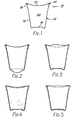
- Fig. 1 shows a vertical, diametral cross-section of a typical one of the test packages produced.
- the sealed enclosure 10 of the package contains a product 24 and comprises a unitary container 12 having a side wall 14, a base 16 and an outturned annular rim 18, and a closure diaphragm 20 having its peripheral margin 22 heat-sealed to the container rim 18.
- the containers were closed by diaphragms formed of 40 micron aluminium foil coated with a 50 micron layer of high density polyethylene to enable the diaphragm to be heat-sealed to the container rim.
- the containers were formed from two thickness of laminate, namely 1.8 mm and 2.5 mm; moreover, the containers formed from the 1.8 mm laminate were made using two different sets of thermoforming conditions, which gave them either relatively thin or relatively thick bases.
- a four-cavity thermoforming mould was used for each laminate, and for the 2.5 mm laminate the particular mould cavity employed was noted for each container.
- test packages were subjected to three different but conventional retorting processes, but it was found after completion of these processes that all of the packages had suffered some substantial and readily visible deformation such that the containers were considered to be commercially unacceptable. Table 1 below gives the results obtained.
- the closed packages were retorted in an underwater retort for 60 minutes at a temperature of 240°F and a pressure of 30 p.s.i. Before retorting all the packages had the appearance shown in Fig. 1. After retorting the packages with a metal diaphragm again had an appearance such as is depicted in Fig. 2 or Fig. 3, and were considered to be commercially unacceptable; however, the containers with a plastics diaphragm had an appearance usually as shown in Fig. 4 but occasionally as shown in Fig. 5.
- FIG. 4 depicts a typical container after retorting, and shows that the diaphragm had still retained its original smoothly curved concave appearance. The concavity of the diaphragm had been reduced, but this change was not apparent to a potential consumer of the packaged product; moreover, there was no wrinkling, folding, blistering or ballooning of the diaphragm such as might throw doubt on the condition of the packaged product, or otherwise generate consumer resistance.
- Fig. 6 shows the containers used in Test Series 2 in relation to the mould cavities in which they were formed and as plotted against base thickness. For each container the respective line represents the range of thicknesses which were measured at a number of points on the container base. The greater and more uniform base thicknesses given by cavities 2 and 3 can readily be seen. The results are shown in tabular form in Table 2 as follows:-
- thermoplastics diaphragms towards a substantially planar (undished) shape during retorting had rendered the plastics-lidded containers of Test Series 2 commercially acceptable after retorting.
- the minimum base thickness of the 30 containers of the Series 3 Tests was 0.65 mm, and Applicants believe that this is about the minimum figure for containers base thickness which would have ensured that a high proportion (e.g. 99.9% or more) of the particular containers under test would have been commercially acceptable after retorting. In this respect it is to be noted that the minimum base thickness of the successful, plastics-lidded containers of Test Series 2 was 0.74 mm.
- the closure material will be of a laminated construction, although this is not essential.
- the closure material is a five layer structure comprising outer skin layers of polypropylene and an intermediate barrier layer of polyvinylidene chloride (PVdC) which is bonded by thin adhesive layers to the polypropylene layers on either side.
- PVdC polyvinylidene chloride
- thermoretractibility of the diaphragm closures of the packages in accordance with the invention may be imparted entirely by an operation to stretch the diaphragm material into contact with the product as particularly described above in relation to the tests conducted by Applicants.
- the diaphragm material will have a degree of retractibility imparted to it during its original manufacture, and this inherent retractibility is additive to any retractibility created by the stretching operation.
- thermoforming operation on a relatively thick and usually self-supporting thermoplastics diaphragm material; in such circumstances thermoretractibility may again be conferred on the diaphragm on formation to its dished configuration, and possibly also during the original formation of the material.
- the diaphragm will usually be made wholly of thermoplastics material and the enclosure may therefore be fully microwaveable.
- the diaphragm may nevertheless be partially metallic, but any metal content which the diaphragm material does possess should not be such as to destroy the thermoretractile nature of the diaphragm material; it will therefore typically be in the form of a thin, vapour-deposited coating or discrete particles added for gas barrier or cosmetic reasons.
- the containers used in the tests described above had volume shrinkages lying within the range 3%-8%, Applicants believe that the invention may be valuable for use with containers having volume shrinkages of from 1% upwards.
- the containers may be formed by a thermoforming operation on thermoplastics sheet, or by another plastics moulding operation; moreover, the base of the container need not be integral with the side wall.
- the invention is used to relieve internal pressure and prevent side wall distortion during retorting of a container having a generally cylindrical side wall cut from a stretch-blow moulded PET (polyethylene terephthalate) tube.
- One end of the container destined to form what may be considered as the container base, is closed by a rigid metal end closure double-seamed to an end of the side wall, the other "top" end of the container being a dished, relatively flexible and thermoretractile, plastics diaphragm which is heat-sealed to a flange formed on the other end of the side wall and which makes full contact with the enclosed product so that the package is hydraulically solid.
- the PET side wall may be subject to some volume shrinkage during retorting but any resultant reduction in the enclosed volume of the container during that time is counteracted by reversion of the diaphragm towards a plane condition, as has previously been discussed in relation to the all-plastics container. It is to be noted that with this particular container construction the container may be supplied to the food packer with the diaphragm closure attached but plane (i.e. not dished).
- the packer fills the container with product through the opposite end under vacuum so as to leave an evacuated headspace, double-seams a metal end closure to that end so as to close the container, and subsequent dishes the diaphragm closure inwardly to remove the headspace, render the package hydraulically solid and render the diaphragm thermoretractile.
Landscapes
- Mechanical Engineering (AREA)
- Engineering & Computer Science (AREA)
- Packages (AREA)
- Food Preservation Except Freezing, Refrigeration, And Drying (AREA)
- Laminated Bodies (AREA)
- Supplying Of Containers To The Packaging Station (AREA)
- Polyoxymethylene Polymers And Polymers With Carbon-To-Carbon Bonds (AREA)
- Transition And Organic Metals Composition Catalysts For Addition Polymerization (AREA)
- Wrappers (AREA)
- Purification Treatments By Anaerobic Or Anaerobic And Aerobic Bacteria Or Animals (AREA)
- Road Repair (AREA)
- Vehicle Body Suspensions (AREA)
- Cookers (AREA)
Claims (10)
Priority Applications (1)
| Application Number | Priority Date | Filing Date | Title |
|---|---|---|---|
| AT87304752T ATE52988T1 (de) | 1986-05-29 | 1987-05-28 | Sterilisierfaehige verpackung. |
Applications Claiming Priority (2)
| Application Number | Priority Date | Filing Date | Title |
|---|---|---|---|
| GB8613029 | 1986-05-29 | ||
| GB8613029A GB2190892B (en) | 1986-05-29 | 1986-05-29 | Retortable packages |
Publications (3)
| Publication Number | Publication Date |
|---|---|
| EP0248601A2 EP0248601A2 (de) | 1987-12-09 |
| EP0248601A3 EP0248601A3 (en) | 1988-10-05 |
| EP0248601B1 true EP0248601B1 (de) | 1990-05-23 |
Family
ID=10598611
Family Applications (1)
| Application Number | Title | Priority Date | Filing Date |
|---|---|---|---|
| EP87304752A Expired - Lifetime EP0248601B1 (de) | 1986-05-29 | 1987-05-28 | Sterilisierfähige Verpackung |
Country Status (15)
| Country | Link |
|---|---|
| US (1) | US4735339A (de) |
| EP (1) | EP0248601B1 (de) |
| JP (1) | JPS6381A (de) |
| AT (1) | ATE52988T1 (de) |
| AU (1) | AU595314B2 (de) |
| CA (1) | CA1291075C (de) |
| DE (1) | DE3762839D1 (de) |
| DK (1) | DK269687A (de) |
| ES (1) | ES2015058B3 (de) |
| FI (1) | FI872352L (de) |
| GB (1) | GB2190892B (de) |
| GR (1) | GR3000510T3 (de) |
| NO (1) | NO872187L (de) |
| NZ (1) | NZ220268A (de) |
| ZA (1) | ZA873809B (de) |
Families Citing this family (21)
| Publication number | Priority date | Publication date | Assignee | Title |
|---|---|---|---|---|
| IT217195Z2 (it) * | 1989-09-26 | 1991-11-12 | Socama Eng | Contenitore per la conservazione edil consumo di cibi preconfezionati |
| FR2668126B1 (fr) * | 1990-10-19 | 1994-03-25 | Madrange Sa | Conditionnement pour l'emballage sous vide d'un produit notamment alimentaire presentant une surface quelconque, et procede de preparation d'un tel conditionnement. |
| US5234126A (en) * | 1991-01-04 | 1993-08-10 | Abbott Laboratories | Plastic container |
| US5217737A (en) * | 1991-05-20 | 1993-06-08 | Abbott Laboratories | Plastic containers capable of surviving sterilization |
| US5283033A (en) * | 1991-11-29 | 1994-02-01 | Advanced Retort Systems, Inc. | Process for sterilizing the contents of a sealed deformable package |
| EP0642454A1 (de) * | 1992-06-02 | 1995-03-15 | Aci Operations Pty. Ltd. | Behälter |
| CA2166947C (en) * | 1995-01-11 | 2007-03-13 | Patrick N. Kocher | Package with shrink film lidstock |
| US5744181A (en) * | 1995-03-01 | 1998-04-28 | W. R. Grace & Co.-Conn. | Packaging method using thermoplastic materials and package obtained thereby |
| US5752614A (en) * | 1996-11-19 | 1998-05-19 | Sonoco Products Company | Easy-opening closure for hermetic sealing a retortable container |
| US6408598B1 (en) | 1998-12-23 | 2002-06-25 | Cryovac, Inc. | Modified atmosphere package for high profile products from upwardly formed heat shrinkable film |
| BR9917484A (pt) * | 1999-09-10 | 2002-05-14 | Nestle Sa | Metodo para produzir um container vedado para produtos cozidos em forno ou similar |
| US6439413B1 (en) | 2000-02-29 | 2002-08-27 | Graham Packaging Company, L.P. | Hot-fillable and retortable flat paneled jar |
| US20030190272A1 (en) * | 2002-04-08 | 2003-10-09 | Dennis Raine | Sterilization containers and methods for radiation sterilization of liquid products |
| US20050145630A1 (en) * | 2004-01-05 | 2005-07-07 | Sonoco Development, Inc. | Easily openable closure for a retortable container having a metal end to which a membrane is sealed |
| KR20120058706A (ko) * | 2010-11-30 | 2012-06-08 | 이정민 | 이종물질 배출장치 |
| US8939695B2 (en) | 2011-06-16 | 2015-01-27 | Sonoco Development, Inc. | Method for applying a metal end to a container body |
| US8998027B2 (en) * | 2011-09-02 | 2015-04-07 | Sonoco Development, Inc. | Retort container with thermally fused double-seamed or crimp-seamed metal end |
| US10131455B2 (en) | 2011-10-28 | 2018-11-20 | Sonoco Development, Inc. | Apparatus and method for induction sealing of conveyed workpieces |
| US10399139B2 (en) | 2012-04-12 | 2019-09-03 | Sonoco Development, Inc. | Method of making a retort container |
| CA2871915A1 (en) | 2012-05-01 | 2013-11-07 | Berry Plastics Corporation | Retortable package |
| US9145251B2 (en) | 2012-10-26 | 2015-09-29 | Berry Plastics Corporation | Package |
Family Cites Families (9)
| Publication number | Priority date | Publication date | Assignee | Title |
|---|---|---|---|---|
| US3498018A (en) * | 1965-04-05 | 1970-03-03 | Mayer & Co Inc O | Method of forming a package |
| DE1586488A1 (de) * | 1967-05-06 | 1972-01-27 | Bellaplast Gmbh | Duennwandiger Behaelter aus Kunststoff mit luftdichtem Verschluss |
| BE758450A (fr) * | 1969-11-04 | 1971-04-16 | Ursina Franck A G | Procede pour l'etablissement d'une depression dans un recipientcontenant une denree et ferme hermetiquement, et recipient pour l'execution de ce procede |
| NZ195962A (en) * | 1980-01-16 | 1984-11-09 | Metal Box Co Ltd | Vacuum packing a product in a rigid container so as to leave no headspace |
| US4350263A (en) * | 1980-09-19 | 1982-09-21 | H. P. Hood, Inc. | Package having sealed closing means |
| GB2104049B (en) * | 1981-02-27 | 1985-06-19 | Nestle Sa | Sealing process for filled containers |
| AU554618B2 (en) * | 1981-06-19 | 1986-08-28 | American National Can Corp. | Hot hilled container and method |
| US4542029A (en) * | 1981-06-19 | 1985-09-17 | American Can Company | Hot filled container |
| US4605142A (en) * | 1984-07-17 | 1986-08-12 | Toyo Seikan Kaisha, Ltd. | Synthetic resin vessel and heat sealed lid |
-
1986
- 1986-05-29 GB GB8613029A patent/GB2190892B/en not_active Expired - Lifetime
-
1987
- 1987-05-11 NZ NZ220268A patent/NZ220268A/xx unknown
- 1987-05-14 AU AU72944/87A patent/AU595314B2/en not_active Ceased
- 1987-05-25 CA CA000537813A patent/CA1291075C/en not_active Expired - Lifetime
- 1987-05-26 NO NO872187A patent/NO872187L/no unknown
- 1987-05-26 US US07/054,263 patent/US4735339A/en not_active Expired - Fee Related
- 1987-05-26 DK DK269687A patent/DK269687A/da not_active Application Discontinuation
- 1987-05-27 FI FI872352A patent/FI872352L/fi not_active Application Discontinuation
- 1987-05-28 DE DE8787304752T patent/DE3762839D1/de not_active Expired - Lifetime
- 1987-05-28 EP EP87304752A patent/EP0248601B1/de not_active Expired - Lifetime
- 1987-05-28 ES ES87304752T patent/ES2015058B3/es not_active Expired - Lifetime
- 1987-05-28 AT AT87304752T patent/ATE52988T1/de not_active IP Right Cessation
- 1987-05-29 JP JP62132022A patent/JPS6381A/ja active Pending
- 1987-11-30 ZA ZA873809A patent/ZA873809B/xx unknown
-
1990
- 1990-05-24 GR GR90400289T patent/GR3000510T3/el unknown
Also Published As
| Publication number | Publication date |
|---|---|
| JPS6381A (ja) | 1988-01-05 |
| FI872352A0 (fi) | 1987-05-27 |
| AU595314B2 (en) | 1990-03-29 |
| ATE52988T1 (de) | 1990-06-15 |
| DK269687A (da) | 1987-11-30 |
| ES2015058B3 (es) | 1990-08-01 |
| AU7294487A (en) | 1987-12-03 |
| GR3000510T3 (en) | 1991-07-31 |
| GB2190892A (en) | 1987-12-02 |
| EP0248601A3 (en) | 1988-10-05 |
| CA1291075C (en) | 1991-10-22 |
| NO872187L (no) | 1987-11-30 |
| DK269687D0 (da) | 1987-05-26 |
| GB2190892B (en) | 1990-02-14 |
| DE3762839D1 (de) | 1990-06-28 |
| GB8613029D0 (en) | 1986-07-02 |
| FI872352A7 (fi) | 1987-11-30 |
| NZ220268A (en) | 1989-07-27 |
| EP0248601A2 (de) | 1987-12-09 |
| ZA873809B (en) | 1987-11-30 |
| NO872187D0 (no) | 1987-05-26 |
| FI872352L (fi) | 1987-11-30 |
| US4735339A (en) | 1988-04-05 |
Similar Documents
| Publication | Publication Date | Title |
|---|---|---|
| US4735339A (en) | Retortable packages | |
| CA1298772C (en) | Process for making a vacuum skin package and product formed thereby | |
| US3977153A (en) | Container for food products and method for making same | |
| JPS62260609A (ja) | 粒状製品用造形熱成形可撓性フイルム製容器とそれを製造する方法および装置 | |
| JP2005519819A (ja) | 射出成形材料によって包み込まれるか又は該材料から形成されるリム或いは他の特徴部を有するコンテナ | |
| US3620435A (en) | Food packaging container comprising molded laminated polyethylene and ethylene-vinylalcohol | |
| US4680917A (en) | Process for providing filled containers | |
| EP2998239B1 (de) | Schale, hermetisch abgedichteter behälter und verfahren zu deren herstellung | |
| JP2749907B2 (ja) | ハイプロフィール収縮包装 | |
| JP2000177784A (ja) | 電子レンジ用射出成形容器 | |
| EP0132468B1 (de) | Behälterkörper | |
| EP1544129A1 (de) | Warmgeformter Kunststoffbehälter und Verfahren zu dessen Herstellung | |
| JPH04242560A (ja) | 密封性ラミネート、該ラミネートから作製されたパック及び該ラミネートの製造方法 | |
| JP4059964B2 (ja) | 積層フィルムの製造方法 | |
| JPS6027000Y2 (ja) | 深絞り成形用複合フィルム | |
| JP2556395B2 (ja) | 容器の製造法 | |
| JP6371088B2 (ja) | 深絞り包装容器及びその製造方法 | |
| JPS6026998Y2 (ja) | 深絞り成形用複合フィルム | |
| JP2544630B2 (ja) | プラスチツク容器の製造法 | |
| EP1524202A1 (de) | Warmgeformter Kunststoffbehälter und Verfahren zu dessen Herstellung | |
| JPH0339237Y2 (de) | ||
| JP3324977B2 (ja) | 密封成形容器 | |
| JPS58203012A (ja) | カツプ状薄肉容器の製造方法 | |
| CA1219820A (en) | Container body | |
| JPH01226502A (ja) | 密封容器の製造方法 |
Legal Events
| Date | Code | Title | Description |
|---|---|---|---|
| PUAI | Public reference made under article 153(3) epc to a published international application that has entered the european phase |
Free format text: ORIGINAL CODE: 0009012 |
|
| 17P | Request for examination filed |
Effective date: 19870609 |
|
| AK | Designated contracting states |
Kind code of ref document: A2 Designated state(s): AT BE CH DE ES FR GB GR IT LI NL SE |
|
| PUAL | Search report despatched |
Free format text: ORIGINAL CODE: 0009013 |
|
| AK | Designated contracting states |
Kind code of ref document: A3 Designated state(s): AT BE CH DE ES FR GB GR IT LI NL SE |
|
| RAP1 | Party data changed (applicant data changed or rights of an application transferred) |
Owner name: MB GROUP PLC |
|
| 17Q | First examination report despatched |
Effective date: 19890608 |
|
| RAP1 | Party data changed (applicant data changed or rights of an application transferred) |
Owner name: CMB PACKAGING (UK) LIMITED |
|
| GRAA | (expected) grant |
Free format text: ORIGINAL CODE: 0009210 |
|
| AK | Designated contracting states |
Kind code of ref document: B1 Designated state(s): AT BE CH DE ES FR GB GR IT LI NL SE |
|
| REF | Corresponds to: |
Ref document number: 52988 Country of ref document: AT Date of ref document: 19900615 Kind code of ref document: T |
|
| ITF | It: translation for a ep patent filed | ||
| REF | Corresponds to: |
Ref document number: 3762839 Country of ref document: DE Date of ref document: 19900628 |
|
| RBV | Designated contracting states (corrected) |
Designated state(s): AT BE CH DE ES FR GR IT LI NL SE |
|
| ET | Fr: translation filed | ||
| REG | Reference to a national code |
Ref country code: GR Ref legal event code: FG4A Free format text: 3000510 |
|
| NLT1 | Nl: modifications of names registered in virtue of documents presented to the patent office pursuant to art. 16 a, paragraph 1 |
Owner name: CMB FOODCAN PLC TE WORCESTER, GROOT-BRITTANNIE. |
|
| PLBE | No opposition filed within time limit |
Free format text: ORIGINAL CODE: 0009261 |
|
| STAA | Information on the status of an ep patent application or granted ep patent |
Free format text: STATUS: NO OPPOSITION FILED WITHIN TIME LIMIT |
|
| 26N | No opposition filed | ||
| PGFP | Annual fee paid to national office [announced via postgrant information from national office to epo] |
Ref country code: FR Payment date: 19920408 Year of fee payment: 6 |
|
| PGFP | Annual fee paid to national office [announced via postgrant information from national office to epo] |
Ref country code: AT Payment date: 19920409 Year of fee payment: 6 |
|
| PGFP | Annual fee paid to national office [announced via postgrant information from national office to epo] |
Ref country code: SE Payment date: 19920413 Year of fee payment: 6 |
|
| PGFP | Annual fee paid to national office [announced via postgrant information from national office to epo] |
Ref country code: DE Payment date: 19920415 Year of fee payment: 6 Ref country code: BE Payment date: 19920415 Year of fee payment: 6 |
|
| PGFP | Annual fee paid to national office [announced via postgrant information from national office to epo] |
Ref country code: CH Payment date: 19920416 Year of fee payment: 6 |
|
| PGFP | Annual fee paid to national office [announced via postgrant information from national office to epo] |
Ref country code: GR Payment date: 19920430 Year of fee payment: 6 |
|
| PGFP | Annual fee paid to national office [announced via postgrant information from national office to epo] |
Ref country code: ES Payment date: 19920518 Year of fee payment: 6 |
|
| ITTA | It: last paid annual fee | ||
| PGFP | Annual fee paid to national office [announced via postgrant information from national office to epo] |
Ref country code: NL Payment date: 19920531 Year of fee payment: 6 |
|
| PG25 | Lapsed in a contracting state [announced via postgrant information from national office to epo] |
Ref country code: AT Effective date: 19930528 |
|
| PG25 | Lapsed in a contracting state [announced via postgrant information from national office to epo] |
Ref country code: SE Effective date: 19930529 Ref country code: ES Free format text: LAPSE BECAUSE OF NON-PAYMENT OF DUE FEES Effective date: 19930529 |
|
| PG25 | Lapsed in a contracting state [announced via postgrant information from national office to epo] |
Ref country code: LI Effective date: 19930531 Ref country code: CH Effective date: 19930531 Ref country code: BE Effective date: 19930531 |
|
| BERE | Be: lapsed |
Owner name: CMB PACKAGING (UK) LTD Effective date: 19930531 |
|
| PG25 | Lapsed in a contracting state [announced via postgrant information from national office to epo] |
Ref country code: GR Free format text: THE PATENT HAS BEEN ANNULLED BY A DECISION OF A NATIONAL AUTHORITY Effective date: 19931130 |
|
| PG25 | Lapsed in a contracting state [announced via postgrant information from national office to epo] |
Ref country code: NL Effective date: 19931201 |
|
| NLV4 | Nl: lapsed or anulled due to non-payment of the annual fee | ||
| PG25 | Lapsed in a contracting state [announced via postgrant information from national office to epo] |
Ref country code: FR Effective date: 19940131 |
|
| REG | Reference to a national code |
Ref country code: CH Ref legal event code: PL |
|
| PG25 | Lapsed in a contracting state [announced via postgrant information from national office to epo] |
Ref country code: DE Effective date: 19940201 |
|
| REG | Reference to a national code |
Ref country code: FR Ref legal event code: ST |
|
| REG | Reference to a national code |
Ref country code: GR Ref legal event code: MM2A Free format text: 3000510 |
|
| EUG | Se: european patent has lapsed |
Ref document number: 87304752.6 Effective date: 19931210 |
|
| REG | Reference to a national code |
Ref country code: ES Ref legal event code: FD2A Effective date: 19990301 |
|
| PG25 | Lapsed in a contracting state [announced via postgrant information from national office to epo] |
Ref country code: IT Free format text: LAPSE BECAUSE OF NON-PAYMENT OF DUE FEES;WARNING: LAPSES OF ITALIAN PATENTS WITH EFFECTIVE DATE BEFORE 2007 MAY HAVE OCCURRED AT ANY TIME BEFORE 2007. THE CORRECT EFFECTIVE DATE MAY BE DIFFERENT FROM THE ONE RECORDED. Effective date: 20050528 |