EP0247618A2 - Neue heterocyclenhaltige Trisazofarbstoffe - Google Patents
Neue heterocyclenhaltige Trisazofarbstoffe Download PDFInfo
- Publication number
- EP0247618A2 EP0247618A2 EP87107778A EP87107778A EP0247618A2 EP 0247618 A2 EP0247618 A2 EP 0247618A2 EP 87107778 A EP87107778 A EP 87107778A EP 87107778 A EP87107778 A EP 87107778A EP 0247618 A2 EP0247618 A2 EP 0247618A2
- Authority
- EP
- European Patent Office
- Prior art keywords
- alkyl
- optionally substituted
- phenyl
- chlorine
- hydrogen
- Prior art date
- Legal status (The legal status is an assumption and is not a legal conclusion. Google has not performed a legal analysis and makes no representation as to the accuracy of the status listed.)
- Granted
Links
- 0 Nc(c(O)c(c(C*(C1)S(O)(=O)=O)c2)C(N)=C1N)c2S(O)(=O)=O Chemical compound Nc(c(O)c(c(C*(C1)S(O)(=O)=O)c2)C(N)=C1N)c2S(O)(=O)=O 0.000 description 2
Classifications
-
- C—CHEMISTRY; METALLURGY
- C09—DYES; PAINTS; POLISHES; NATURAL RESINS; ADHESIVES; COMPOSITIONS NOT OTHERWISE PROVIDED FOR; APPLICATIONS OF MATERIALS NOT OTHERWISE PROVIDED FOR
- C09D—COATING COMPOSITIONS, e.g. PAINTS, VARNISHES OR LACQUERS; FILLING PASTES; CHEMICAL PAINT OR INK REMOVERS; INKS; CORRECTING FLUIDS; WOODSTAINS; PASTES OR SOLIDS FOR COLOURING OR PRINTING; USE OF MATERIALS THEREFOR
- C09D11/00—Inks
- C09D11/30—Inkjet printing inks
- C09D11/32—Inkjet printing inks characterised by colouring agents
- C09D11/328—Inkjet printing inks characterised by colouring agents characterised by dyes
-
- C—CHEMISTRY; METALLURGY
- C09—DYES; PAINTS; POLISHES; NATURAL RESINS; ADHESIVES; COMPOSITIONS NOT OTHERWISE PROVIDED FOR; APPLICATIONS OF MATERIALS NOT OTHERWISE PROVIDED FOR
- C09B—ORGANIC DYES OR CLOSELY-RELATED COMPOUNDS FOR PRODUCING DYES, e.g. PIGMENTS; MORDANTS; LAKES
- C09B35/00—Disazo and polyazo dyes of the type A<-D->B prepared by diazotising and coupling
- C09B35/38—Trisazo dyes ot the type
- C09B35/44—Trisazo dyes ot the type the component K being a hydroxy amine
- C09B35/46—Trisazo dyes ot the type the component K being a hydroxy amine the component K being an amino naphthol
- C09B35/467—D being derived from diaminodiaryl linked through CON<, SO2N<, CSN<
-
- D—TEXTILES; PAPER
- D06—TREATMENT OF TEXTILES OR THE LIKE; LAUNDERING; FLEXIBLE MATERIALS NOT OTHERWISE PROVIDED FOR
- D06P—DYEING OR PRINTING TEXTILES; DYEING LEATHER, FURS OR SOLID MACROMOLECULAR SUBSTANCES IN ANY FORM
- D06P3/00—Special processes of dyeing or printing textiles, or dyeing leather, furs, or solid macromolecular substances in any form, classified according to the material treated
- D06P3/02—Material containing basic nitrogen
- D06P3/04—Material containing basic nitrogen containing amide groups
- D06P3/32—Material containing basic nitrogen containing amide groups leather skins
- D06P3/3206—Material containing basic nitrogen containing amide groups leather skins using acid dyes
- D06P3/3226—Material containing basic nitrogen containing amide groups leather skins using acid dyes dis-polyazo
Definitions
- the invention relates to compounds of the formula I. in the D phenyl, optionally substituted by fluorine, chlorine, bromine, nitro, cyano, C1-C4-alkylsulfonyl, C1-C8-alkyl, C1-C4-alkoxy, carboxyl, C1-C4-alkoxycarbonyl, hydroxysulfonyl, carbamoyl, C1-C4- Mono- or dialkylcarbamoyl, pyrrolidinocarbonyl, piperidinocarbonyl, morpholinocarbonyl, piperazinocarbonyl, N- (C1-C4-alkyl) piperazinocarbonyl, sulfamoyl, C1-C4-mono- or dialkylsulfamoyl, pyrrolidinosulfonyl, piperidolinosulfonyl (ciperidolinosulfonyl), Alkyl) piperaz
- C1-C4 mono- or dialkylcarbamoyl or sulfamoyl are z.
- B CONHCH3, CONHC2H5, CONHC3H7, CONHC4H9, CON (CH3) 2, CON (C2H5) 2, CON (C3H7) 2, SO2NHCH3, SO2NHC2H5, SO2NHC3H7, SO2NHC4H9, SO2N (CH3) 2, SO2N (C2H5) 2, SO2N (C3H7) 2 or
- the residues K of the coupling components come predominantly from the thiazole, thiophene, carbazole, indole, pyridine, quinoline, imidazole, pyrimidine or pyrazole series.
- the coupling components preferably correspond to formulas III - XIII: in which R is hydrogen, C1-C4alkyl, phenyl or thienyl optionally substituted by chlorine, bromine, methyl, methoxy, ethoxy, dimethylamino or diethylamino, R1 and R2 independently of one another hydrogen, optionally substituted C1-C10-alkyl, C5-C7-cycloalkyl, optionally substituted phenyl, allyl or together with the nitrogen atom connecting them a five- or six-membered saturated heterocyclic radical, R3 is hydrogen or C1-C4 alkyl, R4 is hydrogen, C1-C4-alkyl or optionally substituted phenyl, R5 is hydrogen or optional
- dyes which, as coupling components, have those of the formulas III to XI.
- the C1-C10 alkyl radicals are substituted in the radicals R1, R2 and R5, come hydroxy, C1-C4-alkoxy, phenoxy, hydroxysulfonylphenoxy, C1-C4-dialkylamino, pyrrolidino, piperidino, morpholino, piperazino, N.
- - (C1-C4-alkyl) piperazino, phenyl, hydroxysulfonylphenyl, cyano, C1-C4-alkoxycarbonyl or C1-C4-alkanoylamino are considered as substituents.
- the alkyl chain can also be interrupted by 1 to 4 oxygen atoms.
- halogen in particular fluorine, chlorine or bromine, C1-C4-alkyl, C1-C4-alkoxy, C1-C4- Mono- or dialkylamino, hydroxy, nitro or hydroxysulfonyl.
- the radicals R1, R2 and R5 are for example: CH3, C2H5, C3H7, C4H9, C5H11, C6H13, C7H15, C8H17, C9H19, C10H21, C2H4OH, C3H6OH, CH2CHOHCH3, C2H4OCH3, C2H4OC2H5, C2OH4CH (CH2) 3OC4H9, C2H4OC2H4OH, C2H4OC2H4OCH3, (CH2) 3OC2H4OH, (CH2) 3OC2H4OCH3, (CH2) 3OC2H4OC2H5, (CH2) 3OC2H4OC4H9, (CH2) 3OC2H4OC6H5, (CH2) 3OC2H4OC6H4, (CH2) 3OC2H4OC6H4SO3H, C2H4N (CH3) 2, C2H4N (C2H5) 2, C2H4N ( CH2) 4, C2H4N (CH2) 5, (CH
- the radicals R1 and R2 are furthermore, for example, cyclopentyl, cyclohexyl or cycloheptyl.
- radicals R1 and R2 together with the connecting nitrogen atom form a five- or six-membered saturated heterocyclic radical
- the following radicals may be mentioned, for example: pyrrolidino, piperidino, morpholino, piperazino, N- (C1-C4-alkyl) piperazino or N- (2-hydroxyethyl) piperazino.
- the radical X is, for example, methoxycarbonyl, ethoxycarbonyl, propoxycarbonyl, isopropoxycarbonyl, butoxycarbonyl, isobutoxycarbonyl, sec-butoxycarbonyl, methyl, ethyl, propyl, isopropyl, butyl, isobutyl or sec-butylcarbonyl or -sulfonyl, phenylcarbonyl, phenylsulfonyl, 4-fluorophenyl, 4-chlorophenyl, 4-bromophenyl, 2-methylphenyl, 4-methoxyphenyl, 2-ethoxyphenyl, 4-nitrophenyl or 4-hydroxysulfonylphenylcarbonyl or sulfonyl.
- Suitable salts of the dyes I are metal or ammonium salts.
- Metal salts are especially lithium, sodium or potassium salts.
- Ammonium salts in the sense of the invention are understood to mean those salts which have either unsubstituted or substituted ammonium cations. Substituted ammonium cations are e.g. B.
- Alkyl is generally to be understood as straight-chain or branched C1-C2 Alkyl alkyl which can be substituted by hydroxyl groups and / or interrupted by oxygen atoms.
- a diazonium compound of the formula II can be used to prepare the dyes of the formula I. in which D has the meaning given above and A ⁇ is an anion (for example chloride or sulfate), with a coupling component of the formula III HK (III), in which K has the meaning given above, implement by methods known per se.
- the dyes of the formula I generally have black hues and can in some cases be converted into stable liquid settings. They are particularly suitable for dyeing leather and paper. In the form of liquid settings, they are suitable as inks. Such inks can e.g. can be used for the ink jet process, since a large part of the dyes are characterized by good water solubility and thermal stability.
- thiazole coupling components have the following structure: wherein R, R1 and R2 each have the meaning given above.
- Example 1 1-amino-8-naphthol-3,6-disulfonic acid is replaced by an equal amount of 1-amino-8-naphthol-4,6-disulfonic acid and a dye is obtained in the form of the free acid of the formula corresponds. Its color and properties are very similar to the dye from Example 1.
Landscapes
- Chemical & Material Sciences (AREA)
- Organic Chemistry (AREA)
- Engineering & Computer Science (AREA)
- Textile Engineering (AREA)
- Wood Science & Technology (AREA)
- Materials Engineering (AREA)
- Life Sciences & Earth Sciences (AREA)
- Inks, Pencil-Leads, Or Crayons (AREA)
- Coloring (AREA)
- Heterocyclic Compounds Containing Sulfur Atoms (AREA)
- Quinoline Compounds (AREA)
- Indole Compounds (AREA)
- Pyridine Compounds (AREA)
- Plural Heterocyclic Compounds (AREA)
Abstract
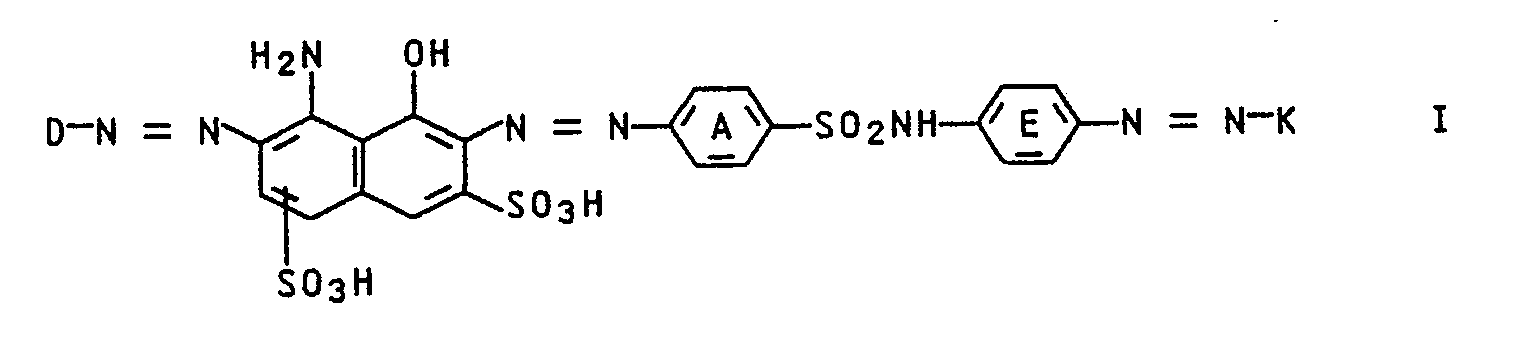
D gegebenenfalls durch Fluor, Chlor, Brom, Nitro, Cyan, C₁- bis C₄-Alkylsulfonyl, C₁- bis C₈-Alkyl, C₁- bis C₄-Alkoxy, Carboxyl, C₁-bis C₄-Alkoxycarbonyl, Hydroxysulfonyl oder gegebenenfalls substituiertes Carbamoyl oder Sulfamoyl substituiertes Phenyl und
K der Rest einer heterocyclischen Kupplungskomponente sind, wobei die Ringe A und E noch durch Methyl, Methoxy, Chlor oder Hydroxysulfonyl substituiert sein können.
Description
- Die Erfindung betrifft Verbindungen der Formel I

D Phenyl, das gegebenenfalls durch Fluor, Chlor, Brom, Nitro, Cyano, C₁-C₄-Alkylsulfonyl, C₁-C₈-Alkyl, C₁-C₄-Alkoxy, Carboxyl, C₁-C₄-Alkoxycarbonyl, Hydroxysulfonyl, Carbamoyl, C₁-C₄-Mono- oder Dialkylcarbamoyl, Pyrrolidinocarbonyl, Piperidinocarbonyl, Morpholinocarbonyl, Piperazinocarbonyl, N-(C₁-C₄-Alkyl)piperazinocarbonyl, Sulfamoyl, C₁-C₄-Mono- oder Dialkylsulfamoyl, Pyrrolidinosulfonyl, Piperidinosulfonyl, Morpholinosulfonyl, Piperazinosulfonyl oder N-(C₁-C₄-Alkyl)piperazinosulfonyl substituiert ist und
K den Rest einer heterocyclischen Kupplungskomponente bedeuten, wobei die Ringe A und E noch durch Methyl, Methoxy, Chlor oder Hydroxysulfonyl substituiert sein können, und deren Salze.
C₁-C₄-Mono- oder Dialkylcarbamoyl- oder -sulfamoylreste sind z. B.:
CONHCH₃, CONHC₂H₅, CONHC₃H₇, CONHC₄H₉, CON(CH₃)₂, CON(C₂H₅)₂, CON(C₃H₇)₂,

- Die Reste K der Kupplungskomponenten entstammen überwiegend der Thiazol-, Thiophen-, Carbazol-, Indol-, Pyridin-, Chinolin-, Imidazol-, Pyrimidin-oder Pyrazolreihe. Die Kupplungskomponenten entsprechen vorzugsweise den Formeln III - XIII:

R Wasserstoff, C₁-C₄-Alkyl, gegebenenfalls durch Chlor, Brom, Methyl, Methoxy, Ethoxy, Dimethylamino oder Diethylamino substituiertes Phenyl oder Thienyl,
R¹ und R² unabhängig voneinander Wasserstoff, gegebenenfalls substituiertes C₁-C₁₀-Alkyl, C₅-C₇-Cycloalkyl, gegebenenfalls substituiertes Phenyl, Allyl oder zusammen mit dem sie verbindenden Stickstoffatom einen fünf- oder sechsgliedrigen gesättigten heterocyclischen Rest,
R³ Wasserstoff oder C₁-C₄-Alkyl,
R⁴ Wasserstoff, C₁-C₄-Alkyl oder gegebenenfalls substituiertes Phenyl,
R⁵ Wasserstoff oder gegebenenfalls substituiertes C₁-C₁₀-Alkyl, gegebenenfalls substituiertes Phenyl oder Allyl und
X Cyano, Nitro, C₁-C₄-Mono- oder Dialkylcarbamoyl, Pyrrolidinocarbonyl, Piperidinocarbonyl, Morpholinocarbonyl, Piperazinocarbonyl, N-(C₁-C₄-Alkyl)piperazinocarbonyl, C₁-C₄-Alkoxycarbonyl, C₁-C₄-Alkylcarbonyl, gegebenenfalls substituiertes Phenylcarbonyl, C₁-C₄-Alkylsulfonyl oder gegebenenfalls substituiertes Phenylsulfonyl bedeuten. - Besonders hervorzuheben sind Farbstoffe, die als Kupplungskomponenten solche der Formeln III bis XI aufweisen.
- Alle in den oben genannten Resten auftretenden Alkylgruppen können sowohl geradkettig als auch verzweigt sein.
- Für den Fall, daß in den Resten R¹, R² und R⁵ die C₁-C₁₀-Alkylreste substituiert sind, kommen Hydroxy, C₁-C₄-Alkoxy, Phenoxy, Hydroxysulfonylphenoxy, C₁-C₄-Dialkylamino, Pyrrolidino, Piperidino, Morpholino, Piperazino, N-(C₁-C₄-Alkyl)piperazino, Phenyl, Hydroxysulfonylphenyl, Cyano, C₁-C₄-Alkoxycarbonyl oder C₁-C₄-Alkanoylamino als Substituenten in Betracht. Weiterhin kann die Alkylkette auch durch 1 bis 4 Sauerstoffatome unterbrochen sein.
- Für den Fall, daß in den Resten R¹, R², R⁴, R⁵ und X die dort auftretenden Phenylreste substituiert sind, kommen Halogen, insbesondere Fluor, Chlor oder Brom, C₁-C₄-Alkyl, C₁-C₄-Alkoxy, C₁-C₄-Mono- oder Dialkylamino, Hydroxy, Nitro oder Hydroxysulfonyl in Betracht.
- Die Reste R¹, R² und R⁵ sind beispielsweise:
CH₃, C₂H₅, C₃H₇, C₄H₉, C₅H₁₁, C₆H₁₃, C₇H₁₅, C₈H₁₇, C₉H₁₉, C₁₀H₂₁, C₂H₄OH, C₃H₆OH, CH₂CHOHCH₃, C₂H₄OCH₃, C₂H₄OC₂H₅, C₂H₄OC₄H₉, (CH₂)₃OH, (CH₂)₃OCH₃, (CH₂)₃OC₂H₅, (CH₂)₃OC₄H₉, C₂H₄OC₂H₄OH, C₂H₄OC₂H₄OCH₃, (CH₂)₃OC₂H₄OH, (CH₂)₃OC₂H₄OCH₃, (CH₂)₃OC₂H₄OC₂H₅, (CH₂)₃OC₂H₄OC₄H₉, (CH₂)₃OC₂H₄OC₆H₅, (CH₂)₃OC₂H₄OC₆H₄SO₃H, C₂H₄N(CH₃)₂, C₂H₄N(C₂H₅)₂, C₂H₄N(CH₂)₄, C₂H₄N(CH₂)₅, (CH₂)₃NHCOCH₃, (CH₂)₃N(CH₃)₂, (CH₂)₃N(C₂H₅)₂, (CH₂)₃N(CH₂)₄, (CH₂)₃N(CH₂)₅, (CH₂)₃N(C₂H₄)₂O, (CH₂)₃N(C₂H₄)₂NCH₃, C₂H₄CN, C₂H₄COOCH₃, C₂H₄COOC₂H₅, CH₂-CH=CH₂, CH₂C₆H₅, C₂H₄C₆H₅, C₂H₄C₆H₄SO₃H, C₆H₅, C₆H₄Cl, C₆H₄Br, C₆H₄CH₃, C₆H₄OCH₃, C₆H₄OC₂H₅ oder C₆H₄SO₃H. - Die Reste R¹ und R² sind weiterhin beispielsweise Cyclopentyl, Cyclohexyl oder Cycloheptyl.
- Für den Fall, daß die Reste R¹ und R² zusammen mit dem die verbindenden Stickstoffatom einen fünf- oder sechsgliedrigen gesättigten heterocyclischen Rest bilden, sind folgende Reste beispielsweise zu nennen: Pyrrolidino, Piperidino, Morpholino, Piperazino, N-(C₁-C₄-Alkyl)piperazino oder N-(2-Hydroxyethyl)piperazino.
- Der Rest X ist beispielsweise Methoxycarbonyl, Ethoxycarbonyl, Propoxycarbonyl, Isopropoxycarbonyl, Butoxycarbonyl, Isobutoxycarbonyl, sec-Butoxycarbonyl, Methyl-, Ethyl-, Propyl-, Isopropyl-, Butyl-, Isobutyl- oder sec-Butylcarbonyl oder -sulfonyl, Phenylcarbonyl, Phenylsulfonyl, 4-Fluorphenyl-, 4-Chlorphenyl-, 4-Bromphenyl-, 2-Methylphenyl-, 4-Methoxyphenyl-, 2-Ethoxyphenyl-, 4-Nitrophenyl- oder 4-Hydroxysulfonylphenylcarbonyl oder -sulfonyl.
- Als Salze der Farbstoffe I kommen dabei Metall- oder Ammoniumsalze in Betracht. Metallsalze sind insbesondere Lithium, Natrium oder Kaliumsalze. Unter Ammoniumsalzen im erfindungsgemäßen Sinne sind solche Salze zu verstehen, die entweder unsubstituierte oder substituierte Ammoniumkationen aufweisen. Substituierte Ammoniumkationen sind z. B. Monoalkyl-, Dialkyl-, Trialkyl-, Tetraalkyl- oder Benzyltrialkylammoniumkationen oder solche Kationen, die sich von stickstoffhaltigen fünf- oder sechsgliedrigen gesättigten Heterocyclen ableiten, wie Pyrrolidinium-, Piperidinium-, Morpholinium-, Piperazinium-oder N-Alkylpiperaziniumkationen oder deren N-monoalkyl- oder N,N-dialkylsubstituierten Produkte. Unter Alkyl ist dabei im allgemeinen geradkettiges oder verzweigtes C₁-C₂₀-Alkyl zu verstehen, das durch Hydroxylgruppen substituiert und/oder durch Sauerstoffatome unterbrochen sein kann.
- Zur Herstellung der Farbstoffe der Formel I kann man eine Diazoniumverbindung der Formel II

HK (III),
in der K die oben genannte Bedeutung besitzt, nach an sich bekannten Methoden umsetzen. - Die Farbstoffe der Formel I haben in der Regel schwarze Farbtöne und können teilweise in stabile Flüssigeinstellungen übergeführt werden. Sie eignen sich insbesondere zum Färben von Leder und Papier. In Form der Flüssigeinstellungen sind sie als Tinten geeignet. Solche Tinten können z.B. für das Ink-Jet-Verfahren verwendet werden, da sich ein großer Teil der Farbstoffe durch gute Wasserlöslichkeit und Thermostabilität auszeichnet.
- Von besonderer Bedeutung sind Verbindungen der Formel Ia
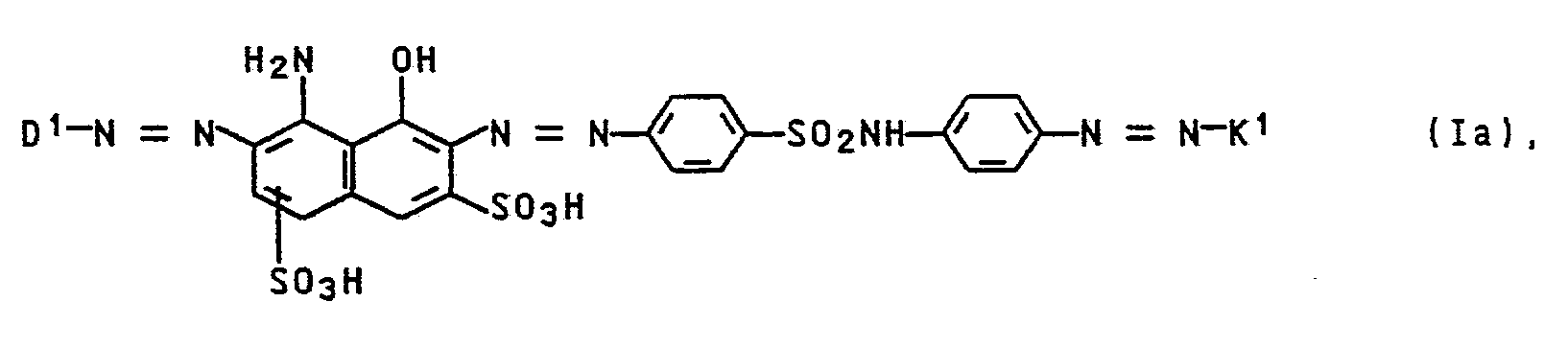
D¹ Phenyl, das gegebenenfalls durch Chlor, Brom, Nitro, Cyano, Hydroxysulfonyl, Sulfamoyl, C₁-C₄-Mono- oder Dialkylsulfamoyl, Pyrrolidinosulfonyl, Piperidinosulfonyl, Morpholinosulfonyl, Piperazinosulfonyl oder N-(C₁-C₄-Alkyl)piperazinosulfonyl substituiert ist und
K¹ den Rest einer Kupplungskomponente aus der Thiazolreihe bedeuten, sowie deren Salze. - Insbesondere besitzen dabei die Thiazolkupplungskomponenten die folgende Struktur:

- Weitere Einzelheiten der Herstellung können den Beispielen entnommen werden, in denen sich Angaben über Teile und Prozente, sofern nicht anders vermerkt, auf das Gewicht beziehen.
- 11,5 Teile 4-Nitroanilin wurden in 85 Teilen Wasser und 33 Volumenteilen 38 %iger Salzsäure bei 5 °C mit 27,4 Volumenteilen 23 %iger Natriumnitritlösung diazotiert. Nach 30 Minuten wurde der Nitritüberschuß mit Amidosulfonsäure entfernt. 31,8 Teile 1-Amino-8-naphtol-3,6-disulfonsäure wurden in 140 Teilen Wasser mit 50 %iger Natronlauge neutral gelöst und bei 10 °C in die Diazoniumsalzlösung eingetropft. Nach beendeter Kupplung wurde mit Natriumacetatlösung ein pH-Wert von 3,5 eingestellt. 29,3 Teile 4,4ʹ-Diaminobenzolsulfanilid wurden in 300 Teilen Wasser und 40 Volumenteilen 38 %iger Salzsäure gelöst und bei 0 °C mit 53,7 Volumenteilen 23 %iger Natriumnitritlösung tetrazotiert. Nach 30 Minuten entfernte man den Nitritüberschuß mit Amidosulfonsäure und ließ die Tetrazoniumsalzlösung innerhalb von 10 Minuten bei 0 °C in die Suspension der ersten Kupplung einlaufen. Man stellte mit 50 %iger Natronlauge einen pH-Wert von 9,5 ein und ließ nach beendeter halbseitiger Kupplung (ca. 30 Minuten bei 0/5 °C) eine Lösung von 19,5 Teilen 2-Diethylamino-4-phenylthiazol in 20 Volumenteilen 0,5-N-Salzsäure zulaufen. Der pH-Wert wurde mit Natronlauge auf 10 gestellt und das Reaktionsgemisch bis zur beendeten Kupplung bei 5 - 10 °C gerührt. Anschließend wurde auf 60 °C erwärmt und der Farbstoff mit Natriumchloridlösung ausgefällt. Man erhielt nach Isolierung und Trocknung 82 Teile eines schwarzen Farbstoffs, der in Form der freien Säure der Formel

- Man ersetzt in Beispiel 1 2-Diethylamino-4-phenylthiazol durch eine äquimolare Menge 2-(4ʹ-Hydroxysulfonylphenylamino)-4-phenylthiazol (mit Natronlauge in Wasser bei pH = 9 gelöst) und fällte den Farbstoff bei pH = 4,5 aus. Man erhielt 97 Teile eines schwarzen Farbstoffs, der in Form der freien Säure der Formel

- Man ersetzt in Beispiel 1 1-Amino-8-naphthol-3,6-disulfonsäure durch eine gleich große Menge 1-Amino-8-naphthol-4,6-disulfonsäure und erhielt einen Farbstoff, der in Form der freien Säure der Formel

- 8 Teile Sulfanilamid wurden in 75 Teilen Wasser/25 Volumenteilen 38 %iger Salzsäure bei 0 °C mit 18 Volumenteilen 23 %iger Natriumnitritlösung diazotiert. Nach 30 Minuten wurde der Nitritüberschuß mit Amidosulfonsäure zerstört. 18,7 Teile 1-Amino-8-naphthol-3,6-disulfonsäure wurden in 100 Teilen Wasser mit 50 %iger Natronlauge neutral gelöst und bei unter 10 °C in die Diazoniumsalzlösung getropft. Nach beendeter Kupplung wurde mit Natronlauge ein pH-Wert von 6 - 7 eingestellt, dann ließ man bei 0 °C eine aus 17,3 Teilen 4,4ʹ-Diaminobenzolsulfanilid nach Beispiel 1 bereitete Tetrazoniumsalzlösung einlaufen. Man stellte mit Natronlauge einen pH-Wert von etwa 9 ein und rührte 15 Minuten bei 0 bis 5 °C. Nach beendeter halbseitiger Kupplung wurden bei 0 °C 9,7 Teile 3-Cyano-2-morpholinothiophen in 20 Volumenteilen 0,5-N-Salzsäure zugetropft und der pH-Wert mit Natronlauge auf 9 - 10 eingestellt. Nach beendeter Kupplung wurde mit 38 %iger Salzsäure ein pH-Wert von 5 eingestellt und der Farbstoff mit Natriumchlorid ausgefällt. Nach Isolierung und Trocknung erhielt man 55 Teile eines schwarzen Farbstoffpulvers, das in Form der freien Säure die Formel

- In den folgenden Tabellen sind weitere Beispiele aufgeführt, die analog den voranstehenden Vorschriften hergestellt wurden.


Claims (5)

D Phenyl, das gegebenenfalls durch Fluor, Chlor, Brom, Nitro, Cyano, C₁-C₄-Alkylsulfonyl, C₁-C₈-Alkyl, C₁-C₄-Alkoxy, Carboxyl, C₁-C₄-Alkoxycarbonyl, Hydroxysulfonyl, Carbamoyl, C₁-C₄-Mono- oder Dialkylcarbamoyl, Pyrrolidinocarbonyl, Piperidinocarbonyl, Morpholinocarbonyl, Piperazinocarbonyl, N-(C₁-C₄-Alkyl)piperazinocarbonyl, Sulfamoyl, C₁-C₄-Mono- oder Dialkylsulfamoyl, Pyrrolidinosulfonyl, Piperidinosulfonyl, Morpholinosulfonyl, Piperazinosulfonyl oder N-(C₁-C₄-Alkyl)piperazinosulfonyl substituiert ist und
K den Rest einer heterocyclischen Kupplungskomponente bedeuten, wobei die Ringe A und E noch durch Methyl, Methoxy, Chlor oder Hydroxysulfonyl substituiert sein können, und deren Salze.

R Wasserstoff, C₁-C₄-Alkyl, gegebenenfalls durch Chlor, Brom, Methyl, Methoxy, Ethoxy, Dimethylamino oder Diethylamino substituiertes Phenyl oder Thienyl,
R¹ und R² unabhängig voneinander Wasserstoff, gegebenenfalls substituiertes C₁-C₁₀-Alkyl, C₅-C₇-Cycloalkyl, gegebenenfalls substituiertes Phenyl, Allyl oder zusammen mit dem sie verbindenden Stickstoffatom einen fünf- oder sechsgliedrigen gesättigten heterocyclischen Rest,
R³ Wasserstoff oder C₁-C₄-alkyl,
R⁴ Wasserstoff, C₁-C₄-Alkyl oder Phenyl,
R⁵ Wasserstoff oder gegebenenfalls substituiertes C₁-C₁₀-Alkyl, gegebenenfalls substituiertes Phenyl oder Allyl und
X Cyano, Nitro, C₁-C₄-Mono- oder Dialkylcarbamoyl, Pyrrolidinocarbonyl, Piperidinocarbonyl, Morpholinocarbonyl, Piperazinocarbonyl, N-(C₁-C₄-Alkyl)piperazinocarbonyl, C₁-C₄-Alkoxycarbonyl, C₁-C₄-Alkylcarbonyl, gegebenenfalls substituiertes Phenylcarbonyl, C₁-C₄-Alkylsulfonyl oder gegebenenfalls substituiertes Phenylsulfonyl bedeuten, und deren Salze.

D¹ Phenyl, das gegebenenfalls durch Chlor, Brom, Nitro, Cyano, Hydroxysulfonyl, Sulfamoyl, C₁-C₄-Mono- oder Dialkylsulfamoyl, Pyrrolidinosulfonyl, Piperidinosulfonyl, Morpholinosulfonyl, Piperazinosulfonyl oder N-(C₁-C₄-Alkyl)piperazinosulfonyl substituiert ist und
K¹ den Rest einer Kupplungskomponente aus der Thiazolreihe bedeuten, und deren Salze.
Applications Claiming Priority (2)
| Application Number | Priority Date | Filing Date | Title |
|---|---|---|---|
| DE19863618265 DE3618265A1 (de) | 1986-05-30 | 1986-05-30 | Neue heterocyclenhaltige trisazofarbstoffe |
| DE3618265 | 1986-05-30 |
Publications (3)
| Publication Number | Publication Date |
|---|---|
| EP0247618A2 true EP0247618A2 (de) | 1987-12-02 |
| EP0247618A3 EP0247618A3 (en) | 1990-05-16 |
| EP0247618B1 EP0247618B1 (de) | 1993-07-28 |
Family
ID=6301981
Family Applications (1)
| Application Number | Title | Priority Date | Filing Date |
|---|---|---|---|
| EP87107778A Expired - Lifetime EP0247618B1 (de) | 1986-05-30 | 1987-05-29 | Neue heterocyclenhaltige Trisazofarbstoffe |
Country Status (4)
| Country | Link |
|---|---|
| US (1) | US4784668A (de) |
| EP (1) | EP0247618B1 (de) |
| JP (1) | JP2510584B2 (de) |
| DE (2) | DE3618265A1 (de) |
Cited By (1)
| Publication number | Priority date | Publication date | Assignee | Title |
|---|---|---|---|---|
| WO1999064520A1 (de) * | 1998-06-05 | 1999-12-16 | Basf Aktiengesellschaft | Tris- und polyazofarbstoffe sowie ihre mischungen |
Families Citing this family (7)
| Publication number | Priority date | Publication date | Assignee | Title |
|---|---|---|---|---|
| US5413630A (en) * | 1993-12-13 | 1995-05-09 | Xerox Corporation | Colorant and ink compositions |
| DE19530176A1 (de) * | 1995-08-17 | 1997-02-20 | Basf Ag | Saure Diazofarbstoffe |
| GB9608493D0 (en) * | 1996-04-25 | 1996-07-03 | Zeneca Ltd | Compositions, processes and uses |
| GB9618779D0 (en) * | 1996-09-09 | 1996-10-23 | Clariant Int Ltd | Improvements in or relating to organic compounds |
| USRE38531E1 (en) * | 1996-09-09 | 2004-06-08 | Clariant Finance (Bvi) Limited | Tetrakisazo dyes, their production and use |
| GB9921929D0 (en) * | 1999-09-16 | 1999-11-17 | Avecia Ltd | Compound |
| US8968522B2 (en) * | 2009-07-15 | 2015-03-03 | Butamax Advanced Biofuels Llc | Recovery of butanol isomers from a mixture of butanol isomers, water, and an organic extractant |
Family Cites Families (8)
| Publication number | Priority date | Publication date | Assignee | Title |
|---|---|---|---|---|
| US2676957A (en) * | 1951-12-22 | 1954-04-27 | Gen Aniline & Film Corp | Deaminated trisazo dye |
| GB763064A (en) * | 1952-07-02 | 1956-12-05 | Hoechst Ag | Manufacture of polyazo-dyestuffs |
| US3998803A (en) * | 1968-05-15 | 1976-12-21 | Fidelity Union Trust Company, Executive Trustee Under The Sandoz Trust | 5-arylazo-6-hydroxy-pyridone-2 dyes containing an amino or substituted amino group |
| CH1353173A4 (de) * | 1972-09-22 | 1975-05-30 | ||
| US4468348A (en) * | 1972-09-26 | 1984-08-28 | Sandoz Ltd. | Trisazo dyes having a 4-(1-amino-3,6-disulfo-8-hydroxy-7-phenylazonaphthyl-2-azo)phenylazo group linked to a coupling component radical |
| FR2214684B1 (de) * | 1973-01-18 | 1978-04-14 | Ugine Kuhlmann | |
| FR2258429B1 (de) * | 1974-01-22 | 1976-10-08 | Ugine Kuhlmann | |
| FR2360634A1 (fr) * | 1976-08-03 | 1978-03-03 | Ugine Kuhlmann | Nouveaux colorants trisazoiques hydrosolubles |
-
1986
- 1986-05-30 DE DE19863618265 patent/DE3618265A1/de not_active Withdrawn
-
1987
- 1987-05-13 US US07/049,225 patent/US4784668A/en not_active Expired - Fee Related
- 1987-05-27 JP JP62128556A patent/JP2510584B2/ja not_active Expired - Lifetime
- 1987-05-29 EP EP87107778A patent/EP0247618B1/de not_active Expired - Lifetime
- 1987-05-29 DE DE8787107778T patent/DE3786703D1/de not_active Expired - Lifetime
Cited By (1)
| Publication number | Priority date | Publication date | Assignee | Title |
|---|---|---|---|---|
| WO1999064520A1 (de) * | 1998-06-05 | 1999-12-16 | Basf Aktiengesellschaft | Tris- und polyazofarbstoffe sowie ihre mischungen |
Also Published As
| Publication number | Publication date |
|---|---|
| DE3618265A1 (de) | 1987-12-03 |
| JP2510584B2 (ja) | 1996-06-26 |
| JPS6322867A (ja) | 1988-01-30 |
| EP0247618B1 (de) | 1993-07-28 |
| US4784668A (en) | 1988-11-15 |
| EP0247618A3 (en) | 1990-05-16 |
| DE3786703D1 (de) | 1993-09-02 |
Similar Documents
| Publication | Publication Date | Title |
|---|---|---|
| DE1966451C2 (de) | Basische Azoverbindungen, Verfahren zu ihrer Herstellung und Verfahren zum Färben oder Bedrucken | |
| EP0783028B1 (de) | Wasserlösliche Azofarbstoffe, Verfahren zu ihrer Herstellung und ihre Verwendung | |
| EP0247618B1 (de) | Neue heterocyclenhaltige Trisazofarbstoffe | |
| DE2738885A1 (de) | Azofarbstoffe | |
| EP0156216B1 (de) | Isothiazolazofarbstoffe | |
| DE2302582C3 (de) | Wasserlösliche Azofarbstoffe der Diamino-pyrimidin-Reihe, Verfahren zu ihrer Herstellung und Farbstoffzubereitungen | |
| DE2727268A1 (de) | Verfahren zur herstellung von azofarbstoffen | |
| EP0696619B1 (de) | Verfahren zum Färben von Papier | |
| DE2636427A1 (de) | Farbstoffzubereitungen fuer cellulose oder cellulosehaltiges fasermaterial | |
| EP0532994B1 (de) | Unsymmetrische 1:2-chrom-komplexfarbstoffe | |
| EP0267385B1 (de) | Asymmetrische 1:2-Chromkomplexfarbstoffe | |
| DE2716033A1 (de) | Saure azofarbstoffe | |
| DE2030783A1 (de) | Neue Farbstoffe, insbesondere zum Far ben hydrophober Fasern geeignet | |
| DE2033281A1 (en) | Water-soluble azo dyes - from diazotised heterocyclic amines and pyridone-(6) coupling components | |
| DE3049552A1 (de) | Komplexfarbstoff-gemische | |
| EP0189836B1 (de) | Basische Azofarbstoffe | |
| EP0084150A1 (de) | Benzisothiazolazofarbstoffe | |
| DE19548785A1 (de) | Saure Polyazofarbstoffe | |
| DE2533723A1 (de) | Monoazofarbstoffe | |
| DE964974C (de) | Verfahren zur Herstellung von Mono- und Disazofarbstoffen | |
| EP0093306B1 (de) | Verfahren zur Herstellung von Azoverbindungen und neue Azoverbindungen | |
| DE2203460B2 (de) | Monoazofarbstoffe und Verfahren zum Färben und Bedrucken | |
| DE2738510A1 (de) | Wasserloesliche azofarbstoffe | |
| DE894294C (de) | Verfahren zur Herstellung von Monoazofarbstoffen der Pyrazolonreihe | |
| DE19511691A1 (de) | Reaktive Azofarbstoffe mit einer Kupplungskomponente aus der Reihe der Aminoaphthalinsulfonsäuren |
Legal Events
| Date | Code | Title | Description |
|---|---|---|---|
| PUAI | Public reference made under article 153(3) epc to a published international application that has entered the european phase |
Free format text: ORIGINAL CODE: 0009012 |
|
| AK | Designated contracting states |
Kind code of ref document: A2 Designated state(s): CH DE FR GB IT LI |
|
| RIN1 | Information on inventor provided before grant (corrected) |
Inventor name: SEYBOLD, GUENTHER, DR. Inventor name: MAYER, UDO, DR. Inventor name: BREITSCHAFT, WALTER, DR.DIPL.-CHEM |
|
| PUAL | Search report despatched |
Free format text: ORIGINAL CODE: 0009013 |
|
| RHK1 | Main classification (correction) |
Ipc: C09B 35/46 |
|
| AK | Designated contracting states |
Kind code of ref document: A3 Designated state(s): CH DE FR GB IT LI |
|
| 17P | Request for examination filed |
Effective date: 19900412 |
|
| 17Q | First examination report despatched |
Effective date: 19920122 |
|
| GRAA | (expected) grant |
Free format text: ORIGINAL CODE: 0009210 |
|
| AK | Designated contracting states |
Kind code of ref document: B1 Designated state(s): CH DE FR GB IT LI |
|
| REF | Corresponds to: |
Ref document number: 3786703 Country of ref document: DE Date of ref document: 19930902 |
|
| ITF | It: translation for a ep patent filed | ||
| GBT | Gb: translation of ep patent filed (gb section 77(6)(a)/1977) |
Effective date: 19930816 |
|
| ET | Fr: translation filed | ||
| PLBE | No opposition filed within time limit |
Free format text: ORIGINAL CODE: 0009261 |
|
| STAA | Information on the status of an ep patent application or granted ep patent |
Free format text: STATUS: NO OPPOSITION FILED WITHIN TIME LIMIT |
|
| 26N | No opposition filed | ||
| PGFP | Annual fee paid to national office [announced via postgrant information from national office to epo] |
Ref country code: FR Payment date: 19980424 Year of fee payment: 12 |
|
| PGFP | Annual fee paid to national office [announced via postgrant information from national office to epo] |
Ref country code: CH Payment date: 19980505 Year of fee payment: 12 |
|
| PGFP | Annual fee paid to national office [announced via postgrant information from national office to epo] |
Ref country code: GB Payment date: 19980515 Year of fee payment: 12 |
|
| PGFP | Annual fee paid to national office [announced via postgrant information from national office to epo] |
Ref country code: DE Payment date: 19980526 Year of fee payment: 12 |
|
| PG25 | Lapsed in a contracting state [announced via postgrant information from national office to epo] |
Ref country code: DE Free format text: LAPSE BECAUSE OF THE APPLICANT RENOUNCES Effective date: 19990528 |
|
| PG25 | Lapsed in a contracting state [announced via postgrant information from national office to epo] |
Ref country code: GB Free format text: LAPSE BECAUSE OF NON-PAYMENT OF DUE FEES Effective date: 19990529 |
|
| PG25 | Lapsed in a contracting state [announced via postgrant information from national office to epo] |
Ref country code: LI Free format text: LAPSE BECAUSE OF NON-PAYMENT OF DUE FEES Effective date: 19990531 Ref country code: CH Free format text: LAPSE BECAUSE OF NON-PAYMENT OF DUE FEES Effective date: 19990531 |
|
| REG | Reference to a national code |
Ref country code: CH Ref legal event code: PL |
|
| GBPC | Gb: european patent ceased through non-payment of renewal fee |
Effective date: 19990529 |
|
| PG25 | Lapsed in a contracting state [announced via postgrant information from national office to epo] |
Ref country code: FR Free format text: LAPSE BECAUSE OF NON-PAYMENT OF DUE FEES Effective date: 20000131 |
|
| REG | Reference to a national code |
Ref country code: FR Ref legal event code: ST |
|
| PG25 | Lapsed in a contracting state [announced via postgrant information from national office to epo] |
Ref country code: IT Free format text: LAPSE BECAUSE OF NON-PAYMENT OF DUE FEES;WARNING: LAPSES OF ITALIAN PATENTS WITH EFFECTIVE DATE BEFORE 2007 MAY HAVE OCCURRED AT ANY TIME BEFORE 2007. THE CORRECT EFFECTIVE DATE MAY BE DIFFERENT FROM THE ONE RECORDED. Effective date: 20050529 |