EP0246790B2 - Système de freinage de véhicule - Google Patents
Système de freinage de véhicule Download PDFInfo
- Publication number
- EP0246790B2 EP0246790B2 EP87304148A EP87304148A EP0246790B2 EP 0246790 B2 EP0246790 B2 EP 0246790B2 EP 87304148 A EP87304148 A EP 87304148A EP 87304148 A EP87304148 A EP 87304148A EP 0246790 B2 EP0246790 B2 EP 0246790B2
- Authority
- EP
- European Patent Office
- Prior art keywords
- vehicle
- load
- braking
- axle
- weight
- Prior art date
- Legal status (The legal status is an assumption and is not a legal conclusion. Google has not performed a legal analysis and makes no representation as to the accuracy of the status listed.)
- Expired - Lifetime
Links
Images

Classifications
-
- B—PERFORMING OPERATIONS; TRANSPORTING
- B60—VEHICLES IN GENERAL
- B60T—VEHICLE BRAKE CONTROL SYSTEMS OR PARTS THEREOF; BRAKE CONTROL SYSTEMS OR PARTS THEREOF, IN GENERAL; ARRANGEMENT OF BRAKING ELEMENTS ON VEHICLES IN GENERAL; PORTABLE DEVICES FOR PREVENTING UNWANTED MOVEMENT OF VEHICLES; VEHICLE MODIFICATIONS TO FACILITATE COOLING OF BRAKES
- B60T8/00—Arrangements for adjusting wheel-braking force to meet varying vehicular or ground-surface conditions, e.g. limiting or varying distribution of braking force
- B60T8/26—Arrangements for adjusting wheel-braking force to meet varying vehicular or ground-surface conditions, e.g. limiting or varying distribution of braking force characterised by producing differential braking between front and rear wheels
- B60T8/266—Arrangements for adjusting wheel-braking force to meet varying vehicular or ground-surface conditions, e.g. limiting or varying distribution of braking force characterised by producing differential braking between front and rear wheels using valves or actuators with external control means
-
- B—PERFORMING OPERATIONS; TRANSPORTING
- B60—VEHICLES IN GENERAL
- B60T—VEHICLE BRAKE CONTROL SYSTEMS OR PARTS THEREOF; BRAKE CONTROL SYSTEMS OR PARTS THEREOF, IN GENERAL; ARRANGEMENT OF BRAKING ELEMENTS ON VEHICLES IN GENERAL; PORTABLE DEVICES FOR PREVENTING UNWANTED MOVEMENT OF VEHICLES; VEHICLE MODIFICATIONS TO FACILITATE COOLING OF BRAKES
- B60T8/00—Arrangements for adjusting wheel-braking force to meet varying vehicular or ground-surface conditions, e.g. limiting or varying distribution of braking force
- B60T8/17—Using electrical or electronic regulation means to control braking
- B60T8/1701—Braking or traction control means specially adapted for particular types of vehicles
- B60T8/1708—Braking or traction control means specially adapted for particular types of vehicles for lorries or tractor-trailer combinations
Definitions
- the present invention relates to vehicle braking systems of the electronically compensated type wherein, instead of the conventional hydraulic or pneumatic control system operating between the foot pedal and the brake actuators, the analysis of data concerning braking parameters, brake demand, vehicle loading, brake efficiency and the like is performed electronically and the brake actuators are controlled electronically in accordance with such analysis.
- the main sources of braking parameter change are measured and the pressure demands to inner closed loop pressure systems are adjusted by outer open loops to compensate for said parameter changes.
- One of the basic parameters which is measured in such systems is the vehicle loading (axle loads). It is with the method of determining the vehicle loading that the present invention is concerned.
- axle load measurements are made deliberately to have a long time constant so as to be assured of a good average load figure which has been established during the recent normal (non-braking) operation of the vehicle.
- the main sources of braking system disturbance in practice are vehicle load and operating gradient, both of which can change suddenly, and brake deterioration which is much more gradual.
- the sudden changes require compensation by corresponding sudden corrections whilst slow changes can be countered by a gradual adaptation over a time period which can extend into days or weeks depending on vehicle usage.
- a foot pedal transducer In a compensated braking system, a foot pedal transducer generates a first signal indicating the braking level desired by the driver and additional sensors measure the vehicle axle loads and the operating gradient.
- the system makes appropriate open loop corrections to the brake pressure demands being interpreted from the driver pedal input with the aim of restoring the vehicle deceleration to a level which is in proportion to the driver's demand.
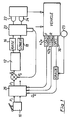
- FIG. 1 there is shown a pressure control loop taking an input Pi from a brake pedal transducer 10 which is used to provide a pressure error signal Pe by comparison of the input Pi with a pressure transducer output signal Po, this pressure error Pe forming the input to a pressure controller 12 which generates an output signal which causes the pressure developed by an electro-pneumatic or electro-hydraulic converter to change in a direction such as to reduce the amplitude of the pressure error Pe.
- Such a pressure controller 12 depends upon the type of converter employed. Two such converter principles are well known, namely an analogue system in which a valve is employed with pressure output developed porportional to solenoid current and a digital system (as shown) in which a pair of simpler solenoid valves 16,18 is employed to raise or lower a control chamber pressure by selective energisation.
- One form of pneumatic converter employs a relay valve 20 which responds to this control chamber pressure and which re-balances into the closed condition when the brake pressures in the left and right brake actuators 22,24 become equal to this control pressure.
- a relay valve 20 which responds to this control chamber pressure and which re-balances into the closed condition when the brake pressures in the left and right brake actuators 22,24 become equal to this control pressure.
- Such a valve has an advantage in that the control chamber pressure responds rapidly to valve opening, giving a fast control loop which is accurate and responsive.
- the compensated system of Fig.1 comprises a number of closed loop controllers (only one shown in Fig.1) which are separate for each axle or for each wheel and which are supplied with pressure demands by a braking correction sub-system 26 such that front and rear systems may receive different pressure demands for equal braking inputs.
- One principal disturbance to braking is caused by gradient and this can be sensed by a comparison between deceleration as sensed by a vehicle decelerometer and similar figures generated from speeds sensed by sensors 23 at the vehicle wheels and differentiated electronically after being combined to form a vehicle reference signal in a manner which is well known in anti-lock systems.
- the gradient figure generated is a deceleration error DE with a sign which indicates uphill or downhill and which can be added directly to braking demand in the sub-system 26 to achieve appropriate correction of the demand signal Pi.
- Another basic parameter which disturbs the braking performance is the vehicle loading and it is known to take axle load readings, generated by suitable transducers on the vehicle, and to use these as correction inputs to the sub-system 26 for modifying the brake demand signals Pi.
- This is achieved by the use of a (preferably digital) multiplier which forms a suitably scaled product of pedal input demand and axle load measurement to form the actual pressure demand input Pi which is compared with Po to form the error Pe.
- a system in accordance with the preamble of claim 1 is known [EP-A 149 137] in which a single load sensor on one axle provides signals indicative of the vehicle axle load.
- the instantaneous load prevailing at the instant that a braking operation is initiated is stored.
- the stored reading is then subsequently compared with dynamic load changes established by the load sensor under actual braking and the difference used to establish the degree of load apportioning between the front and rear axles.
- the load readings in order to allow for variations resulting from suspension movements, it is necessary for the load readings to be averaged over several time-spaced readings. Thus, a rapidly changing response is not possible.
- load readings taken during braking are inherently of very doubtful quality since, under all but possibly the lightest braking, the braking forces applied are transmitted through axle and suspension components in which the axle load is being sensed.
- the Gross Vehicle Weight is taken from the combined axle load measurements which, as explained below, are stored, the deceleration D of the vehicle is measured during the stopping phase and the height h of the centre of gravity and wheel base L are pre-stored quantities.
- the axle load measurements are taken with load transducers (42a, 42b) situated on each axle to be controlled, or by pressure transducers sensing the suspension pressure in air-suspended vehicles, and the signals are fed to the braking correction sub-system 26 via an open loop.
- the axle load measurements are made deliberately to have a long time constant (for example, approximately 4 seconds), so as to be assured of a good average load figure which has been established during the recent normal (non-braking) operation of the vehicle.
- the reason for establishing the load value during a non-braking period is due to the disturbance of the load transducers which occurs during a braking period, which is caused by brake reaction stresses in the axles and deflection of the suspension components. Thus it is necessary to utilise stored values which are acquired at a recent earlier time for obtaining the appropriate braking correction.
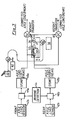
- FIG 3 shows in further detail one method by which the individual axle load values are processed to give a modified load signal according to the weight transfer effect, the corrected axle load then being used by the apportioning multiplier to act on the driver demand (Figure 1) to give an apportioned axle demand.
- Front and rear axle loads are provided by respective sensors 42a, 42b which are designed so as to have a long time constant (e.g. about 4 seconds).
- a braking detector 44 Upon detection by a braking detector 44 that a braking operation has been initiated, the actual axle load sensor signals are disabled by gates 46a, 46b and the prevailing load signals stored in respective stores 48a, 48b.
- the previous mean load measurement occurring over the previous 4 seconds or so is stored as soon as braking is commenced, the actual load signals occurring during braking not being used at all during braking.
- Signals corresponding to the fixed parameters h and L are divided in a divider and the quotient is multiplied in a first multiplier 32 by a signal corresponding to the GVW (the combined axle loads) and then in a second multiplier 34 is multiplied by a signal D corresponding to the deceleration, as provided by a vehicle decelerometer 36.
- the resulting weight transfer quantity W is then added to and subtracted from the signals corresponding to the front and rear axle load signals respectively, to provide corrected axle loads.
- Fig.2 which illustrates the method of compensation by which the braking correction is effected in the open correction loop of Figure 1 by means of an apportioning multiplier 50, to give a corrected pressure demand which is fed to the closed pressure control loop.
- the height of the centre of gravity, h will vary in accordance with the load, in which case the value for h will be computed from a base value representing the unladen value for h plus a component which is proportional to the vehicle total load value.
- This value for h can be assessed for accuracy as follows. If during a braking operation skidding occurs, then both the front and rear axle skid points should occur at the same time for a correctly balanced braking system. However, if skidding occurs only on the front axle, then too much weight transfer allowance has taken place and the value for h can be decremented as an adaptive feature. Conversely, if only rear axle skidding occurs, then insufficient weight transfer allowance has been made and the value of h would be accordingly incremented.
- delays in apportioning can take place because of limitations in the deceleration signal response. This can be countered by producing a transient correction of the deceleration signal D which is derived from the driver braking demand Pi. This is made into a transient signal by the use of a filter 40 (Fig.3) to form a "Fast Driver Demand minus Filtered Driver Demand" signal T, where the filter has a similar time constant to the deceleration measurement. The transient correction T is then added to the measured deceleration from the vehicle decelerometer 36 to produce the effective deceleration D, to give immediate weight transfer figures and rapid apportioning response as the braking becomes effective.
Landscapes
- Engineering & Computer Science (AREA)
- Transportation (AREA)
- Mechanical Engineering (AREA)
- Regulating Braking Force (AREA)
- Hydraulic Control Valves For Brake Systems (AREA)
Claims (4)
- Système de freinage de véhicule du type compensé électroniquement, dans lequel des signaux de consigne du conducteur envoyés à des systèmes de pression internes à boucle fermée pour les freins avant et arrière sont ajustés en fonction de signaux de charge délivrés par un capteur de charge assoeié à un essieu du véhicule, ce signal de charge lui-même étant modifié pour tenir compte de l'effet de report de charge de l'essieu arrière à l'essieu avant, qui se produit pendant le freinage, caractérisé en ce que des capteurs de charge sont assoeiés respectivement aux essieux arrière et avant du véhicule et que la grandeur du report de charge pendant une opération de freinage est calculée électroniquement à partir d'une expression dans laquelle entrent la décélération effective du véhicule au cours du freinage et le poids brut du véhicule tel que déterminé par des signaux de charge mémorisés, qui sont mesurés pendant une période précédant l'opération de freinage, calcul lors duquel on n'utilise absolument pas des signaux de charge apparaissant pendant cette opération de freinage, ladite expression pour le calcul du report de charge étant :

- Système de freinage de véhicule selon la revendication 1, dans lequel les mesures de la charge d'essieu sont exécutées de manière à posséder une longue constante de temps, afin de fournir une valeur de charge moyenne qui a été établie pendant le fonctionnement récent normal, sans freinage, du véhicule.
- Système de freinage de véhicule selon la revendication 1, dans lequel une correction transitoire pour le signal de décélération, produit par un décéloromètre, est dérivé du signal de consigne du conducteur par soustraction, du signal de consigne du conducteur, d'une version filtrée de ce dernier signal obtenue en utilisant un filtre (40) possédant une constante de temps semblable à celle de la mesure de la décélération.
- Système de freinage de véhicule selon l'une quelconque des revendications 1 à 3, dans lequel des valeurs de poids mémorisées sont modifiées par un facteur additionnel déterminé à partir du poids brut du véhicule ou du poids de l'essieu arrière, et cette valeur est adaptée si un glissement ne se produit pas sensiblement simultanément au niveau des deux essieux.
Applications Claiming Priority (2)
| Application Number | Priority Date | Filing Date | Title |
|---|---|---|---|
| GB868612066A GB8612066D0 (en) | 1986-05-17 | 1986-05-17 | Vehicle braking system |
| GB8612066 | 1986-05-17 |
Publications (4)
| Publication Number | Publication Date |
|---|---|
| EP0246790A2 EP0246790A2 (fr) | 1987-11-25 |
| EP0246790A3 EP0246790A3 (en) | 1989-03-15 |
| EP0246790B1 EP0246790B1 (fr) | 1990-08-01 |
| EP0246790B2 true EP0246790B2 (fr) | 1994-05-18 |
Family
ID=10598043
Family Applications (1)
| Application Number | Title | Priority Date | Filing Date |
|---|---|---|---|
| EP87304148A Expired - Lifetime EP0246790B2 (fr) | 1986-05-17 | 1987-05-11 | Système de freinage de véhicule |
Country Status (5)
| Country | Link |
|---|---|
| US (1) | US4795219A (fr) |
| EP (1) | EP0246790B2 (fr) |
| JP (1) | JP2554653B2 (fr) |
| DE (1) | DE3764024D1 (fr) |
| GB (1) | GB8612066D0 (fr) |
Families Citing this family (37)
| Publication number | Priority date | Publication date | Assignee | Title |
|---|---|---|---|---|
| DE3805589A1 (de) * | 1988-02-23 | 1989-08-31 | Lucas Ind Plc | Verfahren und vorrichtung zum steuern einer bremsanlage fuer schwerfahrzeuge |
| SE462152B (sv) * | 1988-09-09 | 1990-05-14 | Saab Scania Ab | Saett och arrangemang foer bromsanpassning mellan ett dragfordon och en tillkopplad semitrailer |
| EP0374484A1 (fr) * | 1988-12-22 | 1990-06-27 | Robert Bosch Gmbh | Procédé et dispositif pour accorder l'application de freinage |
| GB8904365D0 (en) * | 1989-02-25 | 1989-04-12 | Lucas Ind Plc | Trailer brake control for towing vehicles having electronic brake control |
| GB8905311D0 (en) * | 1989-03-08 | 1989-04-19 | Lucas Ind Plc | Electronic braking system |
| DE3910209A1 (de) * | 1989-03-30 | 1990-10-04 | Bosch Gmbh Robert | Antiblockierregelsystem |
| JPH02267055A (ja) * | 1989-04-07 | 1990-10-31 | Isuzu Motors Ltd | ブレーキ制御装置 |
| DE3921309A1 (de) * | 1989-06-29 | 1991-01-10 | Bosch Gmbh Robert | Druckmittelbetaetigbare bremsanlage fuer mehrachsige kraftfahrzeuge |
| DE3933652A1 (de) * | 1989-10-09 | 1991-04-11 | Bosch Gmbh Robert | Antiblockierregelsystem und antriebsschlupfregelsystem |
| US5240312A (en) * | 1989-10-27 | 1993-08-31 | Mercedes-Benz Ag | Process and system for anti-lock control |
| US5136513A (en) * | 1990-06-11 | 1992-08-04 | Ford Motor Company | Vehicle inertia and center of gravity estimator |
| US5127495A (en) * | 1990-09-28 | 1992-07-07 | Allied-Signal Inc. | Parking brake and method therefor |
| US5148894A (en) * | 1990-10-11 | 1992-09-22 | Allied-Signal Inc. | Disk brake/parking brake with threaded piston rod and motor |
| US5222787A (en) * | 1990-11-20 | 1993-06-29 | Allied-Signal Inc. | Electro-hydraulic braking system |
| US5176431A (en) * | 1991-06-27 | 1993-01-05 | Allied-Signal Inc. | Vehicle deceleration prediction based on vehicle dive |
| US5257856A (en) * | 1991-07-23 | 1993-11-02 | Honda Giken Kogyo Kabushiki Kaisha | Method of and system for controlling brakes |
| GB9118709D0 (en) * | 1991-08-31 | 1991-10-16 | Lucas Ind Plc | Trailer braking control system for a towing vehicle |
| JPH0585327A (ja) * | 1991-09-25 | 1993-04-06 | Aisin Seiki Co Ltd | アンチスキツド装置 |
| JP2668751B2 (ja) * | 1991-11-30 | 1997-10-27 | 三菱自動車工業株式会社 | 後輪制動力制御装置 |
| FR2684946B1 (fr) * | 1991-12-13 | 1994-01-28 | Renault Regie Nale Usines | Procede de controle de la deceleration d'un vehicule. |
| EP0617679B1 (fr) * | 1991-12-24 | 1996-05-15 | Lucas Industries Public Limited Company | Systeme de distribution du freinage destine a un vehicule a plusieurs essieux, utilisant des sources de freinage secondaires |
| DE4200046C2 (de) * | 1992-01-03 | 1995-08-24 | Daimler Benz Ag | Bremsanlage mit einstellbar veränderbarer Vorderachs-/Hinterachs-Bremskraftverteilung |
| JP3382269B2 (ja) * | 1992-11-04 | 2003-03-04 | 本田技研工業株式会社 | 車両のアンチロック制御方法 |
| JPH06166365A (ja) * | 1992-12-02 | 1994-06-14 | Sumitomo Electric Ind Ltd | 車体減速度フィードバック電子制御ブレーキ装置 |
| JP2753793B2 (ja) * | 1993-06-03 | 1998-05-20 | 本田技研工業株式会社 | 車両における車輪前後力制御方法 |
| GB2291945B (en) * | 1994-08-02 | 1999-01-20 | Monroe Auto Equipment Co | Control system for load levelling applications |
| GB9313218D0 (en) * | 1993-06-26 | 1993-08-11 | Lucas Ind Plc | Electronic braking system with system test |
| JP2925461B2 (ja) * | 1994-09-27 | 1999-07-28 | 日産ディーゼル工業株式会社 | 車両の追突防止装置 |
| US5772289A (en) * | 1994-10-11 | 1998-06-30 | Nissan Diesel Co., Ltd. | Vehicle braking force controller |
| DE4438222B4 (de) * | 1994-10-26 | 2008-02-14 | Knorr-Bremse Systeme für Nutzfahrzeuge GmbH | Verfahren und Vorrichtung zur Steuerung bzw. Regelung der Bremsanlage eines Fahrzeugs |
| DE19501286B4 (de) * | 1995-01-18 | 2010-03-25 | Knorr-Bremse Systeme für Nutzfahrzeuge GmbH | Verfahren und Vorrichtung zur Steuerung einer Bremsanlage eines Fahrzeugs |
| DE19615831A1 (de) * | 1996-04-20 | 1997-10-23 | Bosch Gmbh Robert | Verfahren und Vorrichtung zur Bestimmung einer charakteristischen Größe einer Radbremse |
| DE19726116B4 (de) * | 1997-06-20 | 2016-12-08 | Wabco Gmbh | Verfahren zur Abbremsung eines Fahrzeugs |
| GB2363435B (en) † | 2000-06-17 | 2004-03-03 | Knorr Bremse Systeme | Vehicle braking system using stored vehicle parameters for electronic control of braking |
| US7178881B2 (en) * | 2003-06-25 | 2007-02-20 | Delphi Technologies, Inc. | Rear pressure control and rear dynamic proportioning in a vehicle brake system |
| US9056537B2 (en) * | 2013-03-28 | 2015-06-16 | Bendix Commercial Vehicle Systems Llc | Method to reduce load transfer between axles of a common set during braking |
| US10500916B2 (en) * | 2017-10-23 | 2019-12-10 | Brooks Strong | Axel load monitoring system |
Family Cites Families (10)
| Publication number | Priority date | Publication date | Assignee | Title |
|---|---|---|---|---|
| US3131975A (en) * | 1960-04-21 | 1964-05-05 | North American Aviation Inc | Slope control wheel brake control system |
| US3556608A (en) * | 1968-09-12 | 1971-01-19 | Bendix Corp | Anti-skid means |
| DE1902944C3 (de) * | 1969-01-22 | 1978-10-12 | Dr.Ing.H.C. F. Porsche Ag, 7000 Stuttgart | Steuereinrichtung zum Vermeiden von Kurvenschleudern bei Kraftfahrzeugen |
| IT1143485B (it) * | 1981-04-03 | 1986-10-22 | Ettore Cordiano | Impianto frenante per autoveicoli con ripartitore di frenata controllato mediante elaboratore elettronico |
| DE3246201A1 (de) * | 1982-12-14 | 1984-06-14 | Wabco Westinghouse Fahrzeugbremsen GmbH, 3000 Hannover | Verfahren und einrichtung zur ermittlung des gewichtes eines fahrzeuges |
| JPS59145654A (ja) * | 1983-02-09 | 1984-08-21 | Sumitomo Electric Ind Ltd | 自動車のブレ−キ制御方法 |
| DE3345694C2 (de) * | 1983-12-17 | 1996-04-04 | Teves Gmbh Alfred | Hydraulische Bremsanlage |
| DE3345913A1 (de) * | 1983-12-20 | 1985-06-27 | Robert Bosch Gmbh, 7000 Stuttgart | Bremskraftregelanlage |
| GB8513688D0 (en) * | 1985-05-30 | 1985-07-03 | Lucas Ind Plc | Vehicle braking system |
| GB8513686D0 (en) * | 1985-05-30 | 1985-07-03 | Lucas Ind Plc | Vehicle braking system |
-
1986
- 1986-05-17 GB GB868612066A patent/GB8612066D0/en active Pending
-
1987
- 1987-05-11 EP EP87304148A patent/EP0246790B2/fr not_active Expired - Lifetime
- 1987-05-11 DE DE8787304148T patent/DE3764024D1/de not_active Expired - Lifetime
- 1987-05-18 JP JP62120985A patent/JP2554653B2/ja not_active Expired - Fee Related
- 1987-05-18 US US07/056,626 patent/US4795219A/en not_active Expired - Lifetime
Also Published As
| Publication number | Publication date |
|---|---|
| EP0246790A2 (fr) | 1987-11-25 |
| GB8612066D0 (en) | 1986-06-25 |
| JP2554653B2 (ja) | 1996-11-13 |
| DE3764024D1 (de) | 1990-09-06 |
| EP0246790A3 (en) | 1989-03-15 |
| EP0246790B1 (fr) | 1990-08-01 |
| US4795219A (en) | 1989-01-03 |
| JPS6322761A (ja) | 1988-01-30 |
Similar Documents
| Publication | Publication Date | Title |
|---|---|---|
| EP0246790B1 (fr) | Système de freinage de véhicule | |
| US4712839A (en) | Vehicle braking system | |
| EP0204483B1 (fr) | Système de freinage de véhicule | |
| EP0370671B1 (fr) | Commande de freinage de remorque pour véhicules tracteurs munis d'une commande électronique de freinage | |
| EP0385648B1 (fr) | Commande de freins de remorque pour véhicules tracteurs munis de commande électronique de freins | |
| US5646849A (en) | Method for proportionally controlling the brakes of a vehicle based on front and rear wheel speeds | |
| JP4183291B2 (ja) | 車両のブレーキシステムを制御する方法及び装置 | |
| US4677557A (en) | Multiple-axle vehicular braking effort distribution method and system | |
| KR100291128B1 (ko) | 브레이크시스템 | |
| US5482359A (en) | System and method for determining relative vehicle mass | |
| US5344222A (en) | Method for controlling a braking operation including determining brake coefficient forces | |
| EP0062246B1 (fr) | Système de freinage pour véhicules à moteur | |
| US4647115A (en) | Vehicular anti-brake lock system and method of controlling braking pressure | |
| GB2136519A (en) | Method of and device for controlling the distribution of brake force | |
| EP0370678A2 (fr) | Freinage d'une remorque dans des systèmes de freinage commandés électroniquement | |
| EP0386952B1 (fr) | Système de freinage électronique | |
| US7066559B2 (en) | Brake pressure estimating apparatus and method | |
| US5887957A (en) | Circuit arrangement for a brake system with electronic brake force distribution control | |
| US5938295A (en) | Process and apparatus for controlling the brake system of a vehicle | |
| US5855419A (en) | Process for controlling a distribution of braking force in a vehicle | |
| US6282479B1 (en) | Vehicle stability enhancement system in high center of gravity vehicle | |
| EP0301243B1 (fr) | Système de commande de frein tracteur-remorque monté sur remorque | |
| EP0820393B1 (fr) | Regulation de freinage differentiel dans les vehicules a moteur | |
| US7185957B2 (en) | Braking force distribution control apparatus and method | |
| US5941924A (en) | Method and device for controlling a vehicle braking system |
Legal Events
| Date | Code | Title | Description |
|---|---|---|---|
| PUAI | Public reference made under article 153(3) epc to a published international application that has entered the european phase |
Free format text: ORIGINAL CODE: 0009012 |
|
| AK | Designated contracting states |
Kind code of ref document: A2 Designated state(s): DE FR GB IT |
|
| PUAL | Search report despatched |
Free format text: ORIGINAL CODE: 0009013 |
|
| AK | Designated contracting states |
Kind code of ref document: A3 Designated state(s): DE FR GB IT |
|
| 17P | Request for examination filed |
Effective date: 19890210 |
|
| 17Q | First examination report despatched |
Effective date: 19890622 |
|
| GRAA | (expected) grant |
Free format text: ORIGINAL CODE: 0009210 |
|
| AK | Designated contracting states |
Kind code of ref document: B1 Designated state(s): DE FR GB IT |
|
| ITF | It: translation for a ep patent filed | ||
| REF | Corresponds to: |
Ref document number: 3764024 Country of ref document: DE Date of ref document: 19900906 |
|
| ET | Fr: translation filed | ||
| PLBI | Opposition filed |
Free format text: ORIGINAL CODE: 0009260 |
|
| ITTA | It: last paid annual fee | ||
| 26 | Opposition filed |
Opponent name: ROBERT BOSCH GMBH Effective date: 19910423 |
|
| PUAH | Patent maintained in amended form |
Free format text: ORIGINAL CODE: 0009272 |
|
| STAA | Information on the status of an ep patent application or granted ep patent |
Free format text: STATUS: PATENT MAINTAINED AS AMENDED |
|
| 27A | Patent maintained in amended form |
Effective date: 19940518 |
|
| AK | Designated contracting states |
Kind code of ref document: B2 Designated state(s): DE FR GB IT |
|
| ITF | It: translation for a ep patent filed | ||
| ET3 | Fr: translation filed ** decision concerning opposition | ||
| REG | Reference to a national code |
Ref country code: FR Ref legal event code: TP |
|
| REG | Reference to a national code |
Ref country code: GB Ref legal event code: IF02 |
|
| REG | Reference to a national code |
Ref country code: GB Ref legal event code: 732E |
|
| REG | Reference to a national code |
Ref country code: GB Ref legal event code: 732E |
|
| APAH | Appeal reference modified |
Free format text: ORIGINAL CODE: EPIDOSCREFNO |
|
| PGFP | Annual fee paid to national office [announced via postgrant information from national office to epo] |
Ref country code: DE Payment date: 20060508 Year of fee payment: 20 |
|
| PGFP | Annual fee paid to national office [announced via postgrant information from national office to epo] |
Ref country code: GB Payment date: 20060510 Year of fee payment: 20 |
|
| PGFP | Annual fee paid to national office [announced via postgrant information from national office to epo] |
Ref country code: FR Payment date: 20060515 Year of fee payment: 20 |
|
| PGFP | Annual fee paid to national office [announced via postgrant information from national office to epo] |
Ref country code: IT Payment date: 20060531 Year of fee payment: 20 |
|
| REG | Reference to a national code |
Ref country code: GB Ref legal event code: PE20 |
|
| PG25 | Lapsed in a contracting state [announced via postgrant information from national office to epo] |
Ref country code: GB Free format text: LAPSE BECAUSE OF EXPIRATION OF PROTECTION Effective date: 20070510 |