EP0244889A1 - Circuit d'entrée pour dispositif à couplage de charge - Google Patents
Circuit d'entrée pour dispositif à couplage de charge Download PDFInfo
- Publication number
- EP0244889A1 EP0244889A1 EP87200594A EP87200594A EP0244889A1 EP 0244889 A1 EP0244889 A1 EP 0244889A1 EP 87200594 A EP87200594 A EP 87200594A EP 87200594 A EP87200594 A EP 87200594A EP 0244889 A1 EP0244889 A1 EP 0244889A1
- Authority
- EP
- European Patent Office
- Prior art keywords
- clock
- input
- charge
- gate
- electrode
- Prior art date
- Legal status (The legal status is an assumption and is not a legal conclusion. Google has not performed a legal analysis and makes no representation as to the accuracy of the status listed.)
- Granted
Links
- 239000004065 semiconductor Substances 0.000 claims description 13
- 238000005036 potential barrier Methods 0.000 claims description 7
- 230000032258 transport Effects 0.000 description 11
- 238000010586 diagram Methods 0.000 description 6
- 230000000875 corresponding effect Effects 0.000 description 3
- 238000009826 distribution Methods 0.000 description 3
- 238000005516 engineering process Methods 0.000 description 3
- 230000002238 attenuated effect Effects 0.000 description 1
- 230000004888 barrier function Effects 0.000 description 1
- 230000001276 controlling effect Effects 0.000 description 1
- 230000001419 dependent effect Effects 0.000 description 1
- 238000002513 implantation Methods 0.000 description 1
- 230000001939 inductive effect Effects 0.000 description 1
- 239000000543 intermediate Substances 0.000 description 1
- 238000004519 manufacturing process Methods 0.000 description 1
- 229910052710 silicon Inorganic materials 0.000 description 1
- 239000010703 silicon Substances 0.000 description 1
- 239000000758 substrate Substances 0.000 description 1
Images
Classifications
-
- G—PHYSICS
- G11—INFORMATION STORAGE
- G11C—STATIC STORES
- G11C19/00—Digital stores in which the information is moved stepwise, e.g. shift registers
- G11C19/28—Digital stores in which the information is moved stepwise, e.g. shift registers using semiconductor elements
-
- G—PHYSICS
- G11—INFORMATION STORAGE
- G11C—STATIC STORES
- G11C19/00—Digital stores in which the information is moved stepwise, e.g. shift registers
- G11C19/28—Digital stores in which the information is moved stepwise, e.g. shift registers using semiconductor elements
- G11C19/282—Digital stores in which the information is moved stepwise, e.g. shift registers using semiconductor elements with charge storage in a depletion layer, i.e. charge coupled devices [CCD]
- G11C19/285—Peripheral circuits, e.g. for writing into the first stage; for reading-out of the last stage
-
- G—PHYSICS
- G11—INFORMATION STORAGE
- G11C—STATIC STORES
- G11C27/00—Electric analogue stores, e.g. for storing instantaneous values
- G11C27/04—Shift registers
Definitions
- the invention relates to a semiconductor device comprising a charge-coupled device provided at a surface of a semiconductor body and comprising an input stage for forming charge packets in dependence upon an input signal, and a row of clock electrodes provided with connection means for applying clock voltages on behalf of the sequential storage and transport of these charge packets in an underlying charge transport channel, the input stage comprising, viewed in the charge transport direction, in order of succession an input diode, a first electrode (designated hereinafter as sample gate) and a second electrode (designated hereinafter as input gate), while the input diode is provided with a connection for applying a fixed voltage, the input gate is provided with means for applying the input signal and the sample gate is provided with means for applying a sample clock voltage for closing and interrupting the connection between the input diode and the region below the input gate.
- a charge-coupled device comprising such an input stage designated as SHC2 (sample and hold circuit 2) is described in the article "A Comparison of CCD Analog Input Circuit Characteristics" by H. Wallings, International Conference on Technology and Applications of Charge-Coupled Devices, Edinburgh, September 1974, p. 13-21.
- This input has a linear characteristic and is moreover very suitable for applications at high frequencies.
- the disadvantage is mentioned that the input signal should be supplied or should be attenuated in pulsatory form in order to guarantee that the charge packet below the input gate can be transferred as a whole to the storage zone below the first clock electrode.
- the aforementioned solutions also have disadvantages.
- the invention has inter alia for its object to provide a semiconductor device of the kind described above, in which the input signal can vary without distortion in a comparatively large voltage range, for example by 2 V at a clock voltage of 5 V.
- a semiconductor device of the kind described in the opening paragraph is characterized in that the said conection means comprise an amplifier, whose output is connected to the first clock electrode following the input gate and to whose input the clock voltage fitting in the row of clock electrodes can be applied, as a result of which upon application of this clock voltage a potential well can be induced below the first clock electrode, which well is sufficiently deep to cause the whole charge packet formed below the input gate to flow into this potential well.
- An important preferred embodiment which renders it possible to operate the device with the usual low supply voltage (for example 5 V), is characterized in that the said amplifier comprises a bootstrapped driver circuit.
- the invention will be described with reference to a surface channel CCD.
- the invention in itself may also be used in charge-coupled devices having a buried channel (BCCD)m for certain applications, for example those in which stringent requirements are imposed on the linearity, charge-coupled devices having a surface channel or BCCD's having an input structure in surface channel technology are often preferred.
- BCCD buried channel
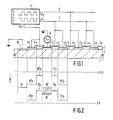
- Fig. 1 shows a charge-coupled device of the kind described in the opening paragraph, which is controlled with the usual clock voltages.
- the device which in this case is of the n -channel type, but may of course also be of the p -channel type, comprises a p -type semiconductor body 1 of, for example, silicon, at whose surface 2 the channel 3 is located.
- the surface 2 is provided with a row of clock electrodes 4,5, which are separated by an intermediate oxide layer 6 from the surface.
- the clock electrodes each comprise a transfer part a and a storage part b , which parts are distinguished from each other by means which are present to induce upon application of a clock voltage below the transfer part a a potential barrier and below the storage part a potential well in the channel 3.
- these means are constituted by the thicker oxide 6 below the transfer parts 4a, 5a and the thinner oxide below the storage parts 4b,5b.
- these means may also comprise other known means varying the threshold voltage, such as, for example, regions implanted in the channel.
- the electrode configuration with transfer part and storage part is used on behalf of the two-phase mode of operation.
- this electrode configuration serves to operate the device as a one-bit-per-electrode device, in which all the storage sites but one are filled with information and the vacancy is displaced in the direction opposite to the charge transport direction. Moreover, other electrode configurations, such as one- or three-layer configurations, may also be used.
- the clock electrodes 4,5 are connected in known manner via clock lines 7 and 8, respectively, to a clock voltage source 9, which supplies the clock voltages 0 ⁇ 1,0 ⁇ 2 indicated diagrammatically in the block 9.
- the input of the charge-coupled device comprises, viewed in the charge transport direction (from the left to the right), in order of succession: an n+ source zone 10 (designated hereinafter as input diode), which supplies electrons for forming the charge packets; a first electrode 11, which constitutes a sample gate, and a second electrode 12, which constitutes the input gate.
- an n+ source zone 10 designated hereinafter as input diode
- input diode which supplies electrons for forming the charge packets
- first electrode 11 which constitutes a sample gate
- second electrode 12 which constitutes the input gate.
- the input diode 10 is connected to a fixed potential, for example earth.
- the input gate 12 is connected to a voltage source 13, which comprises a signal source and which supplies a signal-dependent voltage to the input electrode 11 determining the size of the charge packet to be formed below the input electrode 12.
- the sample electrode 11, which is composed for reasons of manufacturing technology in the same manner as the clock electrodes 4,5 of a part 11a on thicker oxide and a part 11b on thinner oxide, serves as a switch between the input diode 10 and the storage region below the input electrode 12.
- a sample clock 0 ⁇ s is applied to the sample gate 11, which clock is supplied by the source 9.
- the body 1 is applied to a reference voltage of, for example, -3.5 V, while clock voltages 0 ⁇ 1,0 ⁇ 2 having levels of 0 and 5 V are applied to the clock electrodes 4.5.
- the clock 0 ⁇ s also varies between 0 and 5 V.
- Fig. 2 shows the potential distribution occurring at these voltages in a part of the device, the quantity V representing the surface potential which is plotted in downward direction, as is usual for CCD's.
- the potential levels of the substrate voltage and 5V are also indicated by broken lines.
- the level 15 represents the potential level of the input diode 10.
- the surface potential below the sample gate 11 is indicated by reference numeral 16, the surface a and b designating the potentials below the parts 11a and 11b, respectively.
- the potential difference, for example, between the levels 17 ⁇ a and 17 ⁇ b determinative of the maximum quantity of charge per charge packet is about 3 V.
- the highest possible surface potential level 18 (so in the Figure the lowest level) below the input gate 12 corresponding to V in maximum is determined by the potential level 15 of the input diode 10.
- the lowest effective potential level 18 below the input gate 12 corresponding to the highest input signal V in is determined by the height of the potential barrier 17a. If, as shown in Fig. 2, V in exceeds this maximum value, the level 18 will fall below the potential level 17a. In this situation, it will no longer be possible to transfer the whole quantity of charge stored below the input gate 12 to the potential well 17b below the first clock electrode 4.
- the potential difference between the levels 18 and 17 is so small, i.e. smaller than 1 V, that inter alia due to fluctuations in the threshold voltage at a maximum input voltage V in the potential level 12 often lies below the level 17a so that it is not possible to transfer the whole charge packet.
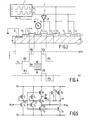
- Fig. 3 shows an embodiment of a semiconductor device, in which the problem described above is avoided in a simple manner.
- the device is provided for identical parts with the same reference numerals as the device shown in Fig. 1.
- the first clock electrode 4 is now connected not directly, but through the amplifier 20, to the clock line 7.
- a bootstrap circuit is used for this amplifier so that the supply voltage of 5 V need not be modified.
- Fig. 5 shows by way of example the circuit diagram of such a circuit.
- transistors of the depletion type are indicated by a double line in the channel region, while transistors of the enhancement type are indicated therein by a single line.
- the clock signal 0 ⁇ 1 supplied by the clock voltage source 9 is supplied to the gate of the transistor T1, while the amplified output signal 0 ⁇ 0 is derived from the drain of the transistor T5.
- the circuit comprises two supply lines of 0 V and 5 V. From the lefthand side, the circuit comprises in the first place a first inverter stage comprising the series-combination of a driver transistor T1 and a load transistor T2.
- the first inverter stage is followed by a second similar inverter stage comprising the driver transistor T3 and the load transistor T4.
- the input of this second inverter stage i.e. the gate of T3, is connected to the input 21 of the first inverter stage.
- the gates of the load transistors T2 and T4 are connected to their source zones.
- the inverter stage T3,T4 is followed by a series-combination of three transistors, i.e. T5, T6 and T7.
- the gate electrodes of the transistors T5 and T7 are connected to the output 21 of the first inverter stage.
- the gate of T6 is connected to the output 22 of the second inverter stage T3,T4.
- the junction point 23 of T5 and T6 is connected to the output terminal 24, at which the output signal can be derived, which can be applied to the first clock electrode 4.
- the junction point 25 between the transistors T6 and T7 is connected to a plate of the bootstrap capacitance C.
- a series-combination is shown of two transistors, i.e. the transistor T8, whose gate is connected to the output 21 of the first inverter stage, and the depletion transistor T9, whose gate is connected to the source zone 26.
- the transistor T10 is connected parallel to T9 and its gate is connected to the output 24, i.e. the junction point 23.
- the junction point 26 between T8 and T9 is connected to the second plate of the bootstrap capacitance C.
- the junction points 21 and 22 pass to 0 V and 5 V, respectively.
- the transistors T5 and T7 are then non-conducting and T6 becomes conducting.
- T8 becomes non-conducting, as a result of which the voltage at the junction point 26 increases to 5 V. Due to the fact that the bootstrap capacitance C is connected to the junction point 26 and the transistors T5 and T7 are non-conducting, the voltage at the junction point 25 which was already applied to 5 V, to a value of practically 10 V. Due to capacitive voltage divisions, the ultimate potential value at the point 25 may be slightly lower than 10 V.
- the transistor T6 Since in this situation the transistor T6 is conducting, the junction point 23 and hence the output 24 follows the voltage source of the junction point 25 to nearly 10 V.
- the transistor T10 which in this situation is also conducting, only serves to increase the speed at which the junction point 26 is charged.
- the level 18 will lie above the potential level 17 ⁇ a so that the whole quantity of charge stored at this value of V in below the input gate 12 can flow to the charge transport channel 3.
- the signal distortion described in the preamble that may occur in conventional devices due to incomplete charge transport is avoided in a simple manner in the device described here according to the invention without it being necessary to reduce the input signal V in .
- the remaining clock electrodes can be driven by means of conventional low clock voltage 0 ⁇ 1,0 ⁇ 2 of 0 and 5 V so that the dissipation substantially does not increase.
- the invention is not limited to the embodiment shown, but that many variations are possible for those skilled in the art without departing from the scope of the invention.
- the invention may be used not only in charge-coupled devices with incorporated potential barriers, but also in devices in which this barrier is not present, such as, for example, in the four-phase device described in the aforementioned petitionion.
Landscapes
- Solid State Image Pick-Up Elements (AREA)
- Transforming Light Signals Into Electric Signals (AREA)
- Networks Using Active Elements (AREA)
- Design And Manufacture Of Integrated Circuits (AREA)
- Mechanical Treatment Of Semiconductor (AREA)
- Bipolar Transistors (AREA)
- Noodles (AREA)
Applications Claiming Priority (2)
| Application Number | Priority Date | Filing Date | Title |
|---|---|---|---|
| NL8600891 | 1986-04-09 | ||
| NL8600891A NL8600891A (nl) | 1986-04-09 | 1986-04-09 | Halfgeleiderinrichting. |
Publications (2)
| Publication Number | Publication Date |
|---|---|
| EP0244889A1 true EP0244889A1 (fr) | 1987-11-11 |
| EP0244889B1 EP0244889B1 (fr) | 1990-10-24 |
Family
ID=19847850
Family Applications (1)
| Application Number | Title | Priority Date | Filing Date |
|---|---|---|---|
| EP87200594A Expired - Lifetime EP0244889B1 (fr) | 1986-04-09 | 1987-03-31 | Circuit d'entrée pour dispositif à couplage de charge |
Country Status (10)
| Country | Link |
|---|---|
| US (1) | US4774719A (fr) |
| EP (1) | EP0244889B1 (fr) |
| JP (1) | JPH0724307B2 (fr) |
| KR (1) | KR950004868B1 (fr) |
| CN (1) | CN1005939B (fr) |
| AT (1) | ATE57786T1 (fr) |
| AU (1) | AU592171B2 (fr) |
| CA (1) | CA1291567C (fr) |
| DE (1) | DE3765687D1 (fr) |
| NL (1) | NL8600891A (fr) |
Families Citing this family (5)
| Publication number | Priority date | Publication date | Assignee | Title |
|---|---|---|---|---|
| JPH0728029B2 (ja) * | 1987-05-21 | 1995-03-29 | 株式会社東芝 | 電荷転送素子 |
| NL8800851A (nl) * | 1988-04-05 | 1989-11-01 | Philips Nv | Halfgeleidergeheugeninrichting. |
| US6573541B1 (en) | 2000-09-29 | 2003-06-03 | International Business Machines Corporation | Charge coupled device with channel well |
| US7046283B1 (en) | 2000-10-11 | 2006-05-16 | Dalsa, Inc. | Arrangements of clock line drivers |
| JP4249433B2 (ja) * | 2002-05-15 | 2009-04-02 | Necエレクトロニクス株式会社 | 電荷転送素子及びその製造方法 |
Family Cites Families (2)
| Publication number | Priority date | Publication date | Assignee | Title |
|---|---|---|---|---|
| US3925805A (en) * | 1974-01-28 | 1975-12-09 | Hughes Aircraft Co | System for transferring charge between spaced apart CCDs by direct series connection |
| NL8600890A (nl) * | 1986-04-09 | 1987-11-02 | Philips Nv | Halfgeleiderinrichting. |
-
1986
- 1986-04-09 NL NL8600891A patent/NL8600891A/nl not_active Application Discontinuation
-
1987
- 1987-03-31 DE DE8787200594T patent/DE3765687D1/de not_active Expired - Lifetime
- 1987-03-31 AT AT87200594T patent/ATE57786T1/de active
- 1987-03-31 EP EP87200594A patent/EP0244889B1/fr not_active Expired - Lifetime
- 1987-03-31 US US07/033,129 patent/US4774719A/en not_active Expired - Fee Related
- 1987-04-02 CA CA000533696A patent/CA1291567C/fr not_active Expired - Lifetime
- 1987-04-04 CN CN87102618.XA patent/CN1005939B/zh not_active Expired
- 1987-04-06 KR KR1019870003241A patent/KR950004868B1/ko not_active Expired - Lifetime
- 1987-04-08 JP JP62084883A patent/JPH0724307B2/ja not_active Expired - Lifetime
- 1987-04-08 AU AU71189/87A patent/AU592171B2/en not_active Ceased
Non-Patent Citations (1)
| Title |
|---|
| INTERNATIONAL CONFERENCE ON TECHNOLOGY AND APPLICATIONS OF CHARGE COUPLED DEVICES, September 1974, pages 13-21, Edinburg, GB; H. WALLINGA: "A comparison of CCD analog input circuit characteristics" * |
Also Published As
| Publication number | Publication date |
|---|---|
| JPS62243365A (ja) | 1987-10-23 |
| AU592171B2 (en) | 1990-01-04 |
| ATE57786T1 (de) | 1990-11-15 |
| DE3765687D1 (de) | 1990-11-29 |
| KR870010633A (ko) | 1987-11-30 |
| AU7118987A (en) | 1987-10-15 |
| KR950004868B1 (ko) | 1995-05-15 |
| CA1291567C (fr) | 1991-10-29 |
| NL8600891A (nl) | 1987-11-02 |
| CN87102618A (zh) | 1987-10-21 |
| JPH0724307B2 (ja) | 1995-03-15 |
| US4774719A (en) | 1988-09-27 |
| EP0244889B1 (fr) | 1990-10-24 |
| CN1005939B (zh) | 1989-11-29 |
Similar Documents
| Publication | Publication Date | Title |
|---|---|---|
| US5157279A (en) | Data output driver with substrate biasing producing high output gain | |
| JPH0357267A (ja) | 垂直デプリーションmosトランジスタ及びツェナー・ダイオードを有するvdmos/論理集積回路 | |
| JPS62120121A (ja) | Cmos出力ドライブ回路 | |
| EP0281113B1 (fr) | Circuit de tampon à semiconducteurs | |
| EP0244889A1 (fr) | Circuit d'entrée pour dispositif à couplage de charge | |
| US3986044A (en) | Clocked IGFET voltage level sustaining circuit | |
| US4771445A (en) | Charge-coupled device having an improved input stage | |
| US4027174A (en) | Dynamic decoder circuit | |
| JPS6065571A (ja) | 半導体装置 | |
| JP4085512B2 (ja) | ハイサイドスイッチ回路 | |
| CA1101994A (fr) | Traduction non-disponible | |
| US4503550A (en) | Dynamic CCD input source pulse generating circuit | |
| JPS6143799B2 (fr) | ||
| US5821588A (en) | Transistor and semiconductor device | |
| EP0013117B1 (fr) | Circuit logique MOS dynamique | |
| EP0132536A1 (fr) | Circuit d'attaque à transistor | |
| EP0205221B1 (fr) | Dispositif à couplage de charge | |
| GB1579032A (en) | Low noise ccd input circuit | |
| JPS6222459B2 (fr) | ||
| JPS6142359B2 (fr) | ||
| US6069826A (en) | Method of rewriting in nonvolatile semiconductor memory device | |
| US4707844A (en) | Integrated circuit having reduced clock cross-talk | |
| JPS63215077A (ja) | Mosトランジスタ | |
| KR810001711B1 (ko) | 선형 전하 결합소자의 동작방법 | |
| JPH03295312A (ja) | パワーmos型電界効果トランジスタの駆動回路 |
Legal Events
| Date | Code | Title | Description |
|---|---|---|---|
| PUAI | Public reference made under article 153(3) epc to a published international application that has entered the european phase |
Free format text: ORIGINAL CODE: 0009012 |
|
| 17P | Request for examination filed |
Effective date: 19870331 |
|
| AK | Designated contracting states |
Kind code of ref document: A1 Designated state(s): AT BE CH DE FR GB IT LI NL SE |
|
| D17P | Request for examination filed (deleted) | ||
| R17P | Request for examination filed (corrected) |
Effective date: 19880502 |
|
| 17Q | First examination report despatched |
Effective date: 19891124 |
|
| GRAA | (expected) grant |
Free format text: ORIGINAL CODE: 0009210 |
|
| AK | Designated contracting states |
Kind code of ref document: B1 Designated state(s): AT BE CH DE FR GB IT LI NL SE |
|
| PG25 | Lapsed in a contracting state [announced via postgrant information from national office to epo] |
Ref country code: NL Effective date: 19901024 Ref country code: BE Effective date: 19901024 |
|
| REF | Corresponds to: |
Ref document number: 57786 Country of ref document: AT Date of ref document: 19901115 Kind code of ref document: T |
|
| REF | Corresponds to: |
Ref document number: 3765687 Country of ref document: DE Date of ref document: 19901129 |
|
| ITF | It: translation for a ep patent filed | ||
| ET | Fr: translation filed | ||
| NLV1 | Nl: lapsed or annulled due to failure to fulfill the requirements of art. 29p and 29m of the patents act | ||
| PG25 | Lapsed in a contracting state [announced via postgrant information from national office to epo] |
Ref country code: LI Effective date: 19910331 Ref country code: CH Effective date: 19910331 Ref country code: AT Effective date: 19910331 |
|
| PG25 | Lapsed in a contracting state [announced via postgrant information from national office to epo] |
Ref country code: SE Effective date: 19910401 |
|
| PLBE | No opposition filed within time limit |
Free format text: ORIGINAL CODE: 0009261 |
|
| STAA | Information on the status of an ep patent application or granted ep patent |
Free format text: STATUS: NO OPPOSITION FILED WITHIN TIME LIMIT |
|
| 26N | No opposition filed | ||
| REG | Reference to a national code |
Ref country code: CH Ref legal event code: PL |
|
| PGFP | Annual fee paid to national office [announced via postgrant information from national office to epo] |
Ref country code: GB Payment date: 19940301 Year of fee payment: 8 |
|
| PGFP | Annual fee paid to national office [announced via postgrant information from national office to epo] |
Ref country code: FR Payment date: 19940330 Year of fee payment: 8 |
|
| ITTA | It: last paid annual fee | ||
| PGFP | Annual fee paid to national office [announced via postgrant information from national office to epo] |
Ref country code: DE Payment date: 19940527 Year of fee payment: 8 |
|
| EUG | Se: european patent has lapsed |
Ref document number: 87200594.7 Effective date: 19911108 |
|
| PG25 | Lapsed in a contracting state [announced via postgrant information from national office to epo] |
Ref country code: GB Effective date: 19950331 |
|
| ITPR | It: changes in ownership of a european patent |
Owner name: CAMBIO RAGIONE SOCIALE;PHILIPS ELECTRONICS N.V. |
|
| GBPC | Gb: european patent ceased through non-payment of renewal fee |
Effective date: 19950331 |
|
| PG25 | Lapsed in a contracting state [announced via postgrant information from national office to epo] |
Ref country code: FR Free format text: LAPSE BECAUSE OF NON-PAYMENT OF DUE FEES Effective date: 19951130 |
|
| PG25 | Lapsed in a contracting state [announced via postgrant information from national office to epo] |
Ref country code: DE Effective date: 19951201 |
|
| REG | Reference to a national code |
Ref country code: FR Ref legal event code: ST |
|
| PG25 | Lapsed in a contracting state [announced via postgrant information from national office to epo] |
Ref country code: IT Free format text: LAPSE BECAUSE OF NON-PAYMENT OF DUE FEES Effective date: 20050331 |