EP0244747A2 - Ethylenisch ungesättigte Phosphinsäure- oder Thiophosphinsäureisocyanate bzw. -isothiocyanate und Verfahren zu ihrer Herstellung - Google Patents
Ethylenisch ungesättigte Phosphinsäure- oder Thiophosphinsäureisocyanate bzw. -isothiocyanate und Verfahren zu ihrer Herstellung Download PDFInfo
- Publication number
- EP0244747A2 EP0244747A2 EP87106211A EP87106211A EP0244747A2 EP 0244747 A2 EP0244747 A2 EP 0244747A2 EP 87106211 A EP87106211 A EP 87106211A EP 87106211 A EP87106211 A EP 87106211A EP 0244747 A2 EP0244747 A2 EP 0244747A2
- Authority
- EP
- European Patent Office
- Prior art keywords
- carbon atoms
- ethylenically unsaturated
- radical
- acid
- methyl
- Prior art date
- Legal status (The legal status is an assumption and is not a legal conclusion. Google has not performed a legal analysis and makes no representation as to the accuracy of the status listed.)
- Granted
Links
- 238000002360 preparation method Methods 0.000 title claims abstract description 6
- 239000012948 isocyanate Substances 0.000 title claims description 17
- 239000002253 acid Substances 0.000 title claims description 10
- 150000002513 isocyanates Chemical class 0.000 title claims description 8
- 238000000034 method Methods 0.000 title claims description 8
- 150000002540 isothiocyanates Chemical class 0.000 title claims description 7
- ACVYVLVWPXVTIT-UHFFFAOYSA-N phosphinic acid Chemical class O[PH2]=O ACVYVLVWPXVTIT-UHFFFAOYSA-N 0.000 title claims description 3
- -1 unsaturated aliphatic radical Chemical class 0.000 claims abstract description 23
- 125000004432 carbon atom Chemical group C* 0.000 claims abstract description 16
- 150000001875 compounds Chemical class 0.000 claims abstract description 14
- 229910052717 sulfur Inorganic materials 0.000 claims abstract description 8
- NINIDFKCEFEMDL-UHFFFAOYSA-N Sulfur Chemical compound [S] NINIDFKCEFEMDL-UHFFFAOYSA-N 0.000 claims abstract description 4
- QVGXLLKOCUKJST-UHFFFAOYSA-N atomic oxygen Chemical compound [O] QVGXLLKOCUKJST-UHFFFAOYSA-N 0.000 claims abstract description 4
- 229910052760 oxygen Inorganic materials 0.000 claims abstract description 4
- 239000001301 oxygen Substances 0.000 claims abstract description 4
- 239000011593 sulfur Substances 0.000 claims abstract description 4
- 150000005840 aryl radicals Chemical class 0.000 claims abstract 3
- WEVYAHXRMPXWCK-UHFFFAOYSA-N Acetonitrile Chemical compound CC#N WEVYAHXRMPXWCK-UHFFFAOYSA-N 0.000 claims description 63
- 238000006243 chemical reaction Methods 0.000 claims description 8
- 150000003567 thiocyanates Chemical class 0.000 claims description 5
- CIUQDSCDWFSTQR-UHFFFAOYSA-N [C]1=CC=CC=C1 Chemical class [C]1=CC=CC=C1 CIUQDSCDWFSTQR-UHFFFAOYSA-N 0.000 claims description 3
- 150000001913 cyanates Chemical class 0.000 claims description 3
- 239000002904 solvent Substances 0.000 claims description 3
- 229910052783 alkali metal Inorganic materials 0.000 claims description 2
- 150000001340 alkali metals Chemical class 0.000 claims description 2
- 229910052784 alkaline earth metal Inorganic materials 0.000 claims description 2
- 125000001495 ethyl group Chemical group [H]C([H])([H])C([H])([H])* 0.000 claims description 2
- 230000007717 exclusion Effects 0.000 claims description 2
- 125000000391 vinyl group Chemical group [H]C([*])=C([H])[H] 0.000 claims description 2
- QGZKDVFQNNGYKY-UHFFFAOYSA-O Ammonium Chemical compound [NH4+] QGZKDVFQNNGYKY-UHFFFAOYSA-O 0.000 claims 1
- 150000001805 chlorine compounds Chemical class 0.000 claims 1
- 125000002496 methyl group Chemical group [H]C([H])([H])* 0.000 claims 1
- 125000004430 oxygen atom Chemical group O* 0.000 claims 1
- 229920000642 polymer Polymers 0.000 abstract description 7
- VKRPOCSOUSXAPR-UHFFFAOYSA-N [PH2](=S)SNC(=O)N Chemical group [PH2](=S)SNC(=O)N VKRPOCSOUSXAPR-UHFFFAOYSA-N 0.000 abstract 1
- HZQJUSYJQUFQIJ-UHFFFAOYSA-N [PH2](=S)SNC(=O)OCC Chemical compound [PH2](=S)SNC(=O)OCC HZQJUSYJQUFQIJ-UHFFFAOYSA-N 0.000 abstract 1
- 239000000543 intermediate Substances 0.000 abstract 1
- 229910052799 carbon Inorganic materials 0.000 description 24
- 229910052739 hydrogen Inorganic materials 0.000 description 22
- 229910052757 nitrogen Inorganic materials 0.000 description 18
- 229910052698 phosphorus Inorganic materials 0.000 description 16
- 239000000047 product Substances 0.000 description 11
- YMWUJEATGCHHMB-UHFFFAOYSA-N Dichloromethane Chemical compound ClCCl YMWUJEATGCHHMB-UHFFFAOYSA-N 0.000 description 9
- 239000000706 filtrate Substances 0.000 description 9
- 238000003756 stirring Methods 0.000 description 9
- 238000001816 cooling Methods 0.000 description 7
- 239000011230 binding agent Substances 0.000 description 5
- 239000000203 mixture Substances 0.000 description 5
- ZVCDLGYNFYZZOK-UHFFFAOYSA-M sodium cyanate Chemical compound [Na]OC#N ZVCDLGYNFYZZOK-UHFFFAOYSA-M 0.000 description 5
- YGYAWVDWMABLBF-UHFFFAOYSA-N Phosgene Chemical compound ClC(Cl)=O YGYAWVDWMABLBF-UHFFFAOYSA-N 0.000 description 4
- SOIFLUNRINLCBN-UHFFFAOYSA-N ammonium thiocyanate Chemical compound [NH4+].[S-]C#N SOIFLUNRINLCBN-UHFFFAOYSA-N 0.000 description 4
- 238000009835 boiling Methods 0.000 description 4
- UHOVQNZJYSORNB-UHFFFAOYSA-N Benzene Chemical compound C1=CC=CC=C1 UHOVQNZJYSORNB-UHFFFAOYSA-N 0.000 description 3
- YXFVVABEGXRONW-UHFFFAOYSA-N Toluene Chemical compound CC1=CC=CC=C1 YXFVVABEGXRONW-UHFFFAOYSA-N 0.000 description 3
- XOTDDFXRMVMRMK-UHFFFAOYSA-N [chloro(ethenyl)phosphoryl]benzene Chemical class C=CP(=O)(Cl)C1=CC=CC=C1 XOTDDFXRMVMRMK-UHFFFAOYSA-N 0.000 description 3
- 125000000217 alkyl group Chemical group 0.000 description 3
- 125000002887 hydroxy group Chemical group [H]O* 0.000 description 3
- GYTPJBLRBFIDLC-UHFFFAOYSA-N 1-[chloro(methyl)phosphoryl]ethene Chemical compound CP(Cl)(=O)C=C GYTPJBLRBFIDLC-UHFFFAOYSA-N 0.000 description 2
- BXHVJZNLIQULLT-UHFFFAOYSA-N 1-[isocyanato(methyl)phosphoryl]ethene Chemical compound C=CP(=O)(C)N=C=O BXHVJZNLIQULLT-UHFFFAOYSA-N 0.000 description 2
- HNYBPZUFJDVXDM-UHFFFAOYSA-N 1-[isothiocyanato(methyl)phosphoryl]ethene Chemical compound C=CP(=O)(C)N=C=S HNYBPZUFJDVXDM-UHFFFAOYSA-N 0.000 description 2
- VEXZGXHMUGYJMC-UHFFFAOYSA-M Chloride anion Chemical compound [Cl-] VEXZGXHMUGYJMC-UHFFFAOYSA-M 0.000 description 2
- XSQUKJJJFZCRTK-UHFFFAOYSA-N Urea Chemical compound NC(N)=O XSQUKJJJFZCRTK-UHFFFAOYSA-N 0.000 description 2
- 125000003545 alkoxy group Chemical group 0.000 description 2
- 125000003277 amino group Chemical group 0.000 description 2
- 125000003118 aryl group Chemical group 0.000 description 2
- 238000004519 manufacturing process Methods 0.000 description 2
- 150000003839 salts Chemical class 0.000 description 2
- PKXJOJDPYONUCO-UHFFFAOYSA-N 1-[ethenyl(isocyanato)phosphoryl]butane Chemical compound CCCCP(=O)(C=C)N=C=O PKXJOJDPYONUCO-UHFFFAOYSA-N 0.000 description 1
- 125000003903 2-propenyl group Chemical group [H]C([*])([H])C([H])=C([H])[H] 0.000 description 1
- WKBOTKDWSSQWDR-UHFFFAOYSA-N Bromine atom Chemical compound [Br] WKBOTKDWSSQWDR-UHFFFAOYSA-N 0.000 description 1
- KDMKUZNPJCLSSS-UHFFFAOYSA-N C1(=CC=CC=C1)C=CP(=O)N=C=O Chemical compound C1(=CC=CC=C1)C=CP(=O)N=C=O KDMKUZNPJCLSSS-UHFFFAOYSA-N 0.000 description 1
- USKBMQBCCPXVJH-UHFFFAOYSA-N C1(=CC=CC=C1)C=CP(=O)N=C=S Chemical compound C1(=CC=CC=C1)C=CP(=O)N=C=S USKBMQBCCPXVJH-UHFFFAOYSA-N 0.000 description 1
- REGLJOFDXJZLKE-UHFFFAOYSA-N C1(=CC=CC=C1)C=CP(=S)N=C=O Chemical compound C1(=CC=CC=C1)C=CP(=S)N=C=O REGLJOFDXJZLKE-UHFFFAOYSA-N 0.000 description 1
- QQSIIHUOUFDXKL-UHFFFAOYSA-N C1(=CC=CC=C1)C=CP(=S)N=C=S Chemical compound C1(=CC=CC=C1)C=CP(=S)N=C=S QQSIIHUOUFDXKL-UHFFFAOYSA-N 0.000 description 1
- ZAMOUSCENKQFHK-UHFFFAOYSA-N Chlorine atom Chemical compound [Cl] ZAMOUSCENKQFHK-UHFFFAOYSA-N 0.000 description 1
- PXGOKWXKJXAPGV-UHFFFAOYSA-N Fluorine Chemical compound FF PXGOKWXKJXAPGV-UHFFFAOYSA-N 0.000 description 1
- ARNVKCXZWLBYMG-UHFFFAOYSA-N [PH2](=S)NC(=O)OCC Chemical class [PH2](=S)NC(=O)OCC ARNVKCXZWLBYMG-UHFFFAOYSA-N 0.000 description 1
- HILFWGCEJRLFCQ-UHFFFAOYSA-N [ethenyl(isocyanato)phosphoryl]benzene Chemical compound O=C=NP(=O)(C=C)C1=CC=CC=C1 HILFWGCEJRLFCQ-UHFFFAOYSA-N 0.000 description 1
- BZDKONCZJCXJCM-UHFFFAOYSA-N [ethenyl(isothiocyanato)phosphoryl]benzene Chemical compound S=C=NP(=O)(C=C)C1=CC=CC=C1 BZDKONCZJCXJCM-UHFFFAOYSA-N 0.000 description 1
- 238000005299 abrasion Methods 0.000 description 1
- 239000012670 alkaline solution Substances 0.000 description 1
- 125000005137 alkenylsulfonyl group Chemical group 0.000 description 1
- 125000005907 alkyl ester group Chemical group 0.000 description 1
- 125000004390 alkyl sulfonyl group Chemical group 0.000 description 1
- 150000003863 ammonium salts Chemical class 0.000 description 1
- 150000004945 aromatic hydrocarbons Chemical class 0.000 description 1
- 125000004104 aryloxy group Chemical group 0.000 description 1
- GDTBXPJZTBHREO-UHFFFAOYSA-N bromine Substances BrBr GDTBXPJZTBHREO-UHFFFAOYSA-N 0.000 description 1
- 229910052794 bromium Inorganic materials 0.000 description 1
- 239000004202 carbamide Substances 0.000 description 1
- 239000007795 chemical reaction product Substances 0.000 description 1
- 150000008280 chlorinated hydrocarbons Chemical class 0.000 description 1
- 239000000460 chlorine Substances 0.000 description 1
- 229910052801 chlorine Inorganic materials 0.000 description 1
- TWHRSXSVVRRMIE-UHFFFAOYSA-N chloro-ethenyl-methyl-sulfanylidene-lambda5-phosphane Chemical compound CP(Cl)(=S)C=C TWHRSXSVVRRMIE-UHFFFAOYSA-N 0.000 description 1
- 239000007859 condensation product Substances 0.000 description 1
- 239000000470 constituent Substances 0.000 description 1
- XLJMAIOERFSOGZ-UHFFFAOYSA-M cyanate Chemical compound [O-]C#N XLJMAIOERFSOGZ-UHFFFAOYSA-M 0.000 description 1
- 239000012954 diazonium Substances 0.000 description 1
- 150000001989 diazonium salts Chemical class 0.000 description 1
- 150000002148 esters Chemical class 0.000 description 1
- BNTXSQSOEKZEFQ-UHFFFAOYSA-N ethenyl-isocyanato-methyl-sulfanylidene-$l^{5}-phosphane Chemical compound C=CP(=S)(C)N=C=O BNTXSQSOEKZEFQ-UHFFFAOYSA-N 0.000 description 1
- YJCMNZKKOHHMBF-UHFFFAOYSA-N ethenyl-isothiocyanato-methyl-sulfanylidene-lambda5-phosphane Chemical compound C=CP(=S)(C)N=C=S YJCMNZKKOHHMBF-UHFFFAOYSA-N 0.000 description 1
- 229910052731 fluorine Inorganic materials 0.000 description 1
- 239000011737 fluorine Substances 0.000 description 1
- 229910052736 halogen Inorganic materials 0.000 description 1
- 150000002367 halogens Chemical class 0.000 description 1
- WSFJFIDCQBAQQZ-UHFFFAOYSA-N hydroxy(sulfido)phosphanium Chemical class S[PH2]=O WSFJFIDCQBAQQZ-UHFFFAOYSA-N 0.000 description 1
- 229910052744 lithium Inorganic materials 0.000 description 1
- 125000005394 methallyl group Chemical group 0.000 description 1
- UHZYTMXLRWXGPK-UHFFFAOYSA-N phosphorus pentachloride Chemical compound ClP(Cl)(Cl)(Cl)Cl UHZYTMXLRWXGPK-UHFFFAOYSA-N 0.000 description 1
- 229920002120 photoresistant polymer Polymers 0.000 description 1
- 238000006068 polycondensation reaction Methods 0.000 description 1
- 229910052700 potassium Inorganic materials 0.000 description 1
- 239000002244 precipitate Substances 0.000 description 1
- 150000003254 radicals Chemical class 0.000 description 1
- 239000012429 reaction media Substances 0.000 description 1
- 239000011541 reaction mixture Substances 0.000 description 1
- 230000008707 rearrangement Effects 0.000 description 1
- 229910052708 sodium Inorganic materials 0.000 description 1
- 239000011734 sodium Substances 0.000 description 1
- 239000007858 starting material Substances 0.000 description 1
- 125000001424 substituent group Chemical group 0.000 description 1
- 125000003107 substituted aryl group Chemical group 0.000 description 1
- 229920002803 thermoplastic polyurethane Polymers 0.000 description 1
- UMGDCJDMYOKAJW-UHFFFAOYSA-N thiourea group Chemical group NC(=S)N UMGDCJDMYOKAJW-UHFFFAOYSA-N 0.000 description 1
- 229920002554 vinyl polymer Polymers 0.000 description 1
Classifications
-
- C—CHEMISTRY; METALLURGY
- C07—ORGANIC CHEMISTRY
- C07F—ACYCLIC, CARBOCYCLIC OR HETEROCYCLIC COMPOUNDS CONTAINING ELEMENTS OTHER THAN CARBON, HYDROGEN, HALOGEN, OXYGEN, NITROGEN, SULFUR, SELENIUM OR TELLURIUM
- C07F9/00—Compounds containing elements of Groups 5 or 15 of the Periodic Table
- C07F9/02—Phosphorus compounds
- C07F9/28—Phosphorus compounds with one or more P—C bonds
- C07F9/30—Phosphinic acids [R2P(=O)(OH)]; Thiophosphinic acids ; [R2P(=X1)(X2H) (X1, X2 are each independently O, S or Se)]
- C07F9/36—Amides thereof
Definitions
- the invention relates to ethylenically unsaturated phosphinic acid or thiophosphinic acid isocyanates or isothiocyanates and a process for their preparation.
- the compounds of the invention are used as starting products for the production of photocrosslinkable polymers which are suitable, for example, for the production of planographic printing forms or photoresists.
- binders which are formed by reacting polymers containing hydroxyl or amino groups with at least one saturated alkyl, alkyloxy, aryl or aryloxysulfonyl isocyanate.
- the binders e.g. As alkylsulfonyl urethane resins - but can only be developed in conjunction with diazonium salt polycondensation products or photopolymerizable compounds in an aqueous-alkaline medium if they have relatively high acid numbers, which deteriorates the abrasion resistance of the hardened layer.
- DE-A 20 53 364 and 30 36 077 describe light-sensitive mixtures which are used as binders Contain reaction products from a hydroxyl-containing polymer and alkenylsulfonyl isocyanates.
- the mixtures show an inadequate ink acceptance, so that an unacceptably high number of misprints occurs at the start of printing.
- the alkenyl sulfonyl isocyanates required for the preparation of these binders are very complex and costly to produce, such as. B. emerges from DE-C 12 97 601.
- the object of the invention was therefore to provide starting materials for the preparation of light-crosslinkable polymers which are soluble in aqueous alkaline solutions, have better oleophilicity and are more accessible than the abovementioned polymers.
- binders which can be prepared from these new compounds according to the invention are condensation products from the compounds according to the invention and hydroxyl- or amino group-containing polymers.
- R1 is an ethylenically unsaturated aliphatic radical having 2 to 6, in particular 2 to 4, particularly preferably 2 to 3 carbon atoms, for.
- B. a vinyl, allyl, methallyl or crotyl radical and R2 is a saturated aliphatic radical with 1 to 6, preferably 1 to 2 carbon atoms or an optionally substituted aryl radical with 6 to 10 carbon atoms, in particular an optionally substituted phenyl radical is.
- halogen z.
- B fluorine, chlorine or bromine
- Alkyl alkoxy with 1 to 6 carbon atoms and aryl or aryloxy with 6 to 10 carbon atoms.
- the (thio) phosphinic acid derivatives mentioned can be obtained in good yields from the corresponding (thio) phosphinic acid chlorides of the general formula II wherein R1, R2 and X have the meanings given above, by reaction with inorganic cyanates or thiocyanates.
- alkali metal and alkaline earth metal salts in particular the Na, K and Li salts, but also the ammonium salts, are particularly suitable as inorganic cyanates or thiocyanates.
- the molar ratio of the (thio) phosphinoyl chlorides of the formula II to the inorganic cyanate or thiocyanate salts is preferably around 1.
- Aprotic, indifferent solvents are suitable as the reaction medium. These include e.g. B. acetonitrile, aromatic hydrocarbons and chlorinated hydrocarbons. Benzene or toluene, but in particular acetonitrile, are preferably used.
- the reaction mixture is stirred with the exclusion of moisture at temperatures of 10-100 ° C., preferably at 20-60 ° C., until no more product is formed. Depending on the starting product used, this can take 4 hours or up to 3 days.
- the (thio) phosphinoyl chlorides of the formula II are partly known compounds, partly accessible by known processes.
- Methyl vinyl or phenyl vinyl phosphinic acid chlorides can be prepared in accordance with DE-C 23 57 678 according to the following reaction scheme:
- the (meth) allylphosphinic acid alkyl esters and crotylphosphinic acid alkyl esters obtainable according to DE-C 26 01 467 by an Arbusov reaction can also be converted into the corresponding phosphinic acid chlorides with phosgene.
Landscapes
- Chemical & Material Sciences (AREA)
- Organic Chemistry (AREA)
- Health & Medical Sciences (AREA)
- Life Sciences & Earth Sciences (AREA)
- Biochemistry (AREA)
- General Health & Medical Sciences (AREA)
- Molecular Biology (AREA)
- Addition Polymer Or Copolymer, Post-Treatments, Or Chemical Modifications (AREA)
Abstract
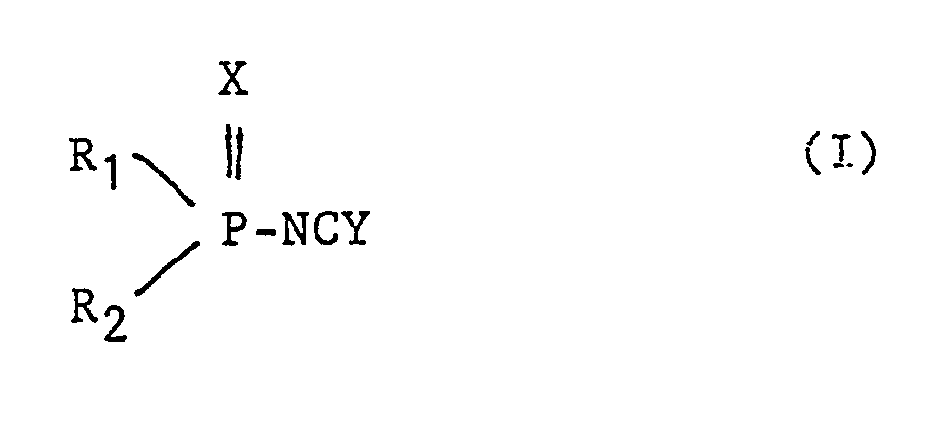
X und Y gleich oder verschieden sind und Sauerstoff oder Schwefel bedeuten,
R₁ ein ethylenisch ungesättigter aliphatischer Rest mit 2 bis 6 C-Atomen und
R₂ ein gesättigter aliphatischer Rest mit 1 bis 6 C-Atomen oder ein Arylrest mit 6 bis 10 C-Atomen
ist. Die Verbindungen sind Zwischenprodukte für die Herstellung von lichtvernetzbaren Polymeren mit seitenständigen (Thio)phosphinyl(thio)urethan- oder (Thio)phosphinyl(thio)harnstoffgruppen.
Description
- Die Erfindung betrifft ethylenisch ungesättigte Phosphinsäure- oder Thiophosphinsäureisocyanate bzw. -isothiocyanate sowie ein Verfahren zu ihrer Herstellung.
- Die erfindungsgemäßen Verbindungen finden Anwendung als Ausgangsprodukte für die Herstellung von photovernetzbaren Polymeren, die beispielsweise zur Herstellung von Flachdruckformen oder Photoresists geeignet sind.
- In der DE-A 20 53 363 werden Bindemittel beschrieben, die durch Umsetzung von hydroxyl- oder aminogruppenhaltigen Polymeren mit mindestens einem gesättigten Alkyl-, Alkyloxy-, Aryl- oder Aryloxysulfonylisocyanat entstehen. Die Bindemittel - z. B. Alkylsulfonylurethanharze - sind aber in Verbindung mit Diazoniumsalz-Polykondensationsprodukten oder photopolymerisierbaren Verbindungen nur dann im wäßrig-alkalischen Milieu entwickelbar, wenn sie relativ hohe Säurezahlen aufweisen, wodurch die Abriebfestigkeit der gehärteten Schicht verschlechtert wird.
- In den DE-A 20 53 364 und 30 36 077 werden lichtempfindliche Gemische beschrieben, die als Bindemittel Umsetzungsprodukte aus einem hydroxylgruppenhaltigen Polymeren und Alkenylsulfonylisocyanaten enthalten. Die Gemische zeigen aber eine unzureichende Farbannahme, so daß beim Druckbeginn eine unvertretbar hohe Anzahl von Fehldrucken entsteht. Zudem sind die für die Darstellung dieser Bindemittel benötigten Alkenylsulfonylisocyanate nur sehr aufwendig und kostspielig herzustellen, wie z. B. aus der DE-C 12 97 601 hervorgeht.
- Die Aufgabe der Erfindung war es daher, Ausgangsstoffe für die Herstellung von lichtvernetzbaren Polymeren bereitzustellen, die in wäßrig-alkalischen Lösungen löslich sind, eine bessere Oleophilie aufweisen und leichter zugänglich sind als die vorstehend genannten Polymeren.
- Überraschenderweise wurde nun gefunden, daß ethylenisch ungesättigte (Thio)phosphinsäureisocyanate bzw. -isothiocyanate der allgemeinen Formel I diese Aufgaben in herausragender Weise erfüllen. Die Bindemittel, die aus diesen neuen, erfindungsgemäßen Verbindungen hergestellt werden können, sind Kondensationsprodukte aus den erfindungsgemäßen Verbindungen und hydroxyl- oder aminogruppenhaltigen Polymeren.
- Sie weisen als funktionelle Einheiten in der Seitenkette ethylenisch ungesättigte (Thio)phosphinyl urethan- oder -thiourethan- bzw. -harnstoff- oder -thioharnstoff-gruppierungen auf. Die Anwendung dieser Verbindungen wird in der gleichzeitig eingereichten Patentanmeldung P ... ....... (86/K019) beschrieben.
- Erfindungsgemäß werden Verbindungen der allgemeinen Formel I
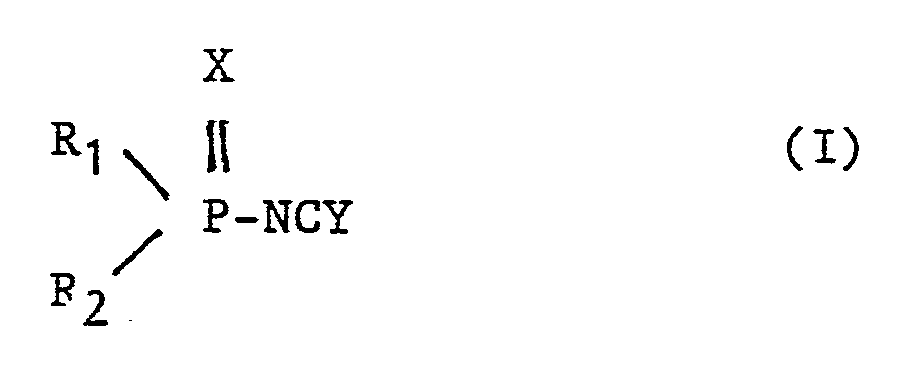
X und Y gleich oder verschieden sind und Sauerstoff oder Schwefel bedeuten,
R₁ ein ethylenisch ungesättigter aliphatischer Rest mit 2 bis 6, insbesondere 2 bis 4, besonders bevorzugt aber 2 bis 3 C-Atomen, z. B. ein Vinyl-, Allyl-, Methallyl- oder Crotylrest und
R₂ ein gesättigter aliphatischer Rest mit 1 bis 6, vorzugsweise 1 bis 2 C-Atomen oder ein ggf. substituierter Arylrest mit 6 bis 10 C-Atomen, insbesondere ein ggf. substituierter Phenylrest
ist. - Als Substituenten kommen in Frage: Halogen, z. B. Fluor, Chlor oder Brom; Alkyl, Alkoxy mit 1 bis 6 C-Atomen und Aryl oder Aryloxy mit 6 bis 10 C-Atomen.
- Als bevorzugte ungesättigte (Thio)phosphinsäureiso(thio)cyanate werden genannt:
Allylmethylphosphinsäureisocyanat,
Allylmethylthiophosphinsäureisocyanat,
Allylmethylphosphinsäureisothiocyanat,
Allylmethylthiophosphinsäureisothiocyanat,
Crotylmethylphosphinsäureisocyanat,
β-Methallylmethylphosphinsäureisocyanat,
β-Methallylmethylphosphinsäureisothiocyanat,
Methylvinylphosphinsäureisocyanat,
Methylvinylthiophosphinsäureisocyanat,
Methylvinylphosphinsäureisothiocyanat,
Methylvinylthiophosphinsäureisothiocyanat
Ethylvinylphosphinsäureisocyanat,
Butylvinylphosphinsäureisocyanat,
Phenylvinylphosphinsäureisocyanat,
Phenylvinylthiophosphinsäureisocyanat,
Phenylvinylphosphinsäureisothiocyanat,
Phenylvinylthiophosphinsäureisothiocyanat. - Die genannten (Thio)phosphinsäurederivate lassen sich in guten Ausbeuten aus den entsprechenden (Thio)phosphinsäurechloriden der allgemeinen Formel II
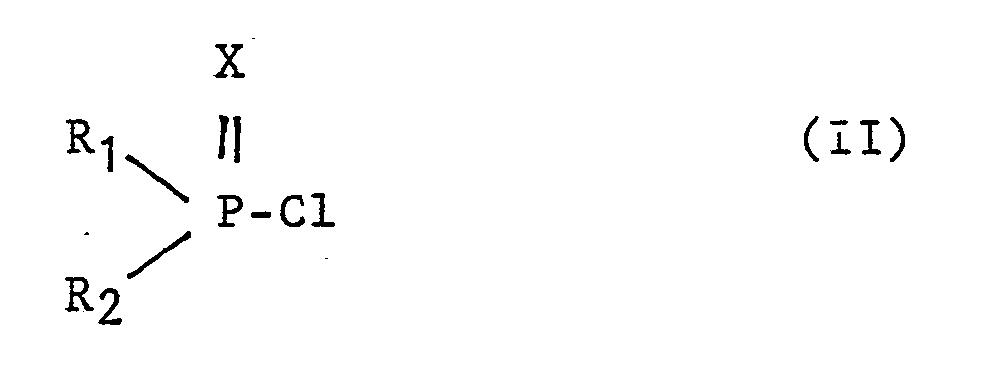
R₁, R₂ und X die oben angegebenen Bedeutungen haben, durch Umsetzung mit anorganischen Cyanaten bzw. Thiocyanaten herstellen. - Als anorganische Cyanate bzw. Thiocyanate sind die Alkali- und Erdalkalisalze, insbesondere die Na-, K- und Li-salze, aber auch die Ammoniumsalze besonders geeignet.
- Das Molverhältnis der (Thio)phosphinsäurechloride der Formel II zu den anorganischen Cyanat- bzw. Thiocyanatsalzen liegt vorzugsweise um 1.
- Als Reaktionsmedium sind aprotische, indifferente Lösungsmittel geeignet. Zu diesen zählen z. B. Acetonitril, aromatische Kohlenwasserstoffe und chlorierte Kohlenwasserstoffe. Vorzugsweise werden Benzol oder Toluol, insbesondere aber Acetonitril angewendet.
- Das Reaktionsgemisch wird unter Feuchtigkeitsausschluß bei Temperaturen von 10 - 100°C, vorzugsweise bei 20 - 60°C, solange gerührt, bis kein Produkt mehr gebildet wird. Je nach eingesetztem Ausgangsprodukt kann dies 4 Stunden, aber auch bis zu 3 Tage in Anspruch nehmen.
- Die (Thio)phosphinsäurechloride der Formel II sind teils bekannte Verbindungen, teils nach bekannten Verfahren zugänglich. Methyl-vinyl- bzw. Phenyl-vinyl-phosphinsäurechloride können entsprechend der DE-C 23 57 678 gemäß folgendem Reaktionsschema hergestellt werden:

- Auch die entsprechend der DE-C 26 01 467 durch eine Arbusov-Reaktion erhältlichen (Meth)allylphosphinsäurealkylester und Crotylphosphinsäurealkylester lassen sich mit Phosgen in die entsprechenden Phosphinsäurechloride überführen.
- Weiterhin ist bekannt, daß durch thermische Umlagerung von Phosphonigsäurealkylestern und anschließende Umsetzung mit Phosphorpentachlorid die entsprechenden Allyl- phosphinsäurechloride gemäß dem folgenden Reaktionsschema dargestellt werden können. [A.I. Pudovik et al in: Z. obsc. chim. 37(3), 700 (1967)].

- Die Erfindung wird durch die folgenden Beispiele erläutert.
- 100 g (0,8 mol) Methyl-vinyl-phosphinsäurechlorid wurden in 100 ml Acetonitril gelöst. Unter lebhaftem Rühren wurden dazu portionsweise 52,2 g (0,8 mol) Natriumcyanat gegeben. Die Temperatur wurde durch Kühlung bei maximal ca. 40° C gehalten. Das Produkt wurde nach 24-stündigem Rühren abgesaugt und mit Acetonitril nachgewaschen. Das Filtrat wurde im Vakuum eingeengt. Der dabei entstandene Rückstand wurde bei einer Temperatur von 58 - 60° C und einem Druck von 52,6 Pa destilliert. Man erhielt 88 g (= 83,5 % d. Th.) Methyl-vinyl-phosphinsäureisocyanat.
C₄H₆NO₂P (131)
Ber.: 36,6 % C 4,6 % H 10,7 % N 23,7 % P
Gef.: 35,9 % C 4,6 % H 10,3 % N 24,0 % P
- 50 g (0,35 mol) Methyl-vinyl-thiophosphinsäurechlorid wurden in 80 ml Acetonitril gelöst. Unter lebhaftem Rühren wurden dazu portionsweise 27,1 g (0,35 mol) Ammoniumthiocyanat gegeben. Durch leichte Kühlung wurde die Temperatur bei ca. 30° C gehalten. Nach 3 Tagen Rühren wurde das Produkt abgesaugt und mit Acetonitril nachgewaschen. Das Filtrat wurde im Vakuum eingeengt. Der dabei entstandene Rückstand wurde bei einer Temperatur von 69-70° C und einem Druck von 1,33 Pa destilliert. Man erhielt 45 g (= 78 % d. Th.) Methyl-vinyl-thiophosphinsäureisothiocyanat.
C₄H₆NPS₂ (163)
Ber.: 29,5 % C 3,7 % H 8,6 % N 19,0 % P 39,3 % S
Gef.: 29,5 % C 3,7 % H 8,4 % N 20,2 % P 39,4 % S
- 100 g (0,8 mol) Methyl-vinyl-phosphinsäurechlorid wurden in 160 ml Acetonitril gelöst. Unter lebhaftem Rühren wurden dazu portionsweise 61 g (0,8 mol) Ammoniumthiocyanat gegeben. Durch leichte Kühlung wurde die Temperatur bei maximal 30° C gehalten. Nach 3 Tagen Rühren wurde das Produkt abgesaugt und mit Acetonitril nachgewaschen. Das Filtrat wurde im Vakuum eingeengt. Der dabei entstandene Rückstand wurde bei einer Temperatur von 70° C und einem Druck von 6,7 Pa destilliert. Man erhielt 65 g (= 55,1 % d. Th.) Methyl-vinyl-phosphinsäureisothiocyanat.
C₄H₆NOPS (147)
Ber.: 32,6 % C 4,1 % H 9,5 % N 21,2 % P 21,8 % S
Gef.: 32,4 % C 4,1 % H 9,3 % N 21,2 % P 21,9 % S
- 120 g (0,81 mol) Allyl-methyl-phosphinsäureethylester wurden in 100 ml Dichlormethan gelöst, und unter Kühlung wurde bei einer Temperatur von 10-15°C innerhalb von 2,5 Stunden Phosgen eingeleitet. Es wurde noch eine Stunde bei 25° C nachgerührt, und anschließend wurden die leichtflüchtigen Bestandteile unter vermindertem Druck abdestilliert. Der Rückstand wurde bei einer Temperatur von 62-66° C und einem Druck von 130 Pa destilliert. Man erhielt 102 g (= 91 % d. Th.) Allyl-methyl-phosphinsäurechlorid.
C₄H₈ClOP (138)
Ber.: 34,7 % C 5,8 H 22,4 % P
Gef.: 34,9 % C 5,8 H 22,7 % P
- 166 g (1,2 mol) Allyl-methyl-phosphinsäurechlorid wurden in 300 ml Acetonitril gelöst und mit 78 g (1,2 mol) Natriumcyanat auf 50-55° C unter Rühren erwärmt. Nach 5,5 Stunden wurde das Produkt abgesaugt und mit Acetonitril gewaschen, das Filtrat eingeengt und der Rückstand bei einer Temperatur von 78-80° C und einem Druck von 25 Pa destilliert. Man erhielt 123 g (= 71 % d. Th.) Allyl-methyl-phosphinsäureisocyanat.
C₅H₈NO₂P (145)
Ber.: 41,4 % C 5,6 % H 9,7 % N 21,4 % P
Gef.: 41,6 % C 5,7 % H 9,5 % N 21,0 % P
- 200 g (1,23 mol) Crotyl-methyl-phosphinsäureethylester wurden in 150 ml Dichlormethan gelöst, und unter Kühlung wurde bei einer Temperatur von 12-15° C innerhalb von 3,5 Stunden Phosgen eingeleitet. Es wurde noch eine Stunde bei 25° C nachgerührt und anschließend destilliert. Man erhielt 182 g (= 97 % d. Th.) Crotyl-methyl-phosphinsäurechlorid vom Siedepunkt 83-85° C (260 Pa.).
C₅H₁₀ClOP (153)
Ber.: 39,4 % C 6,6 % H 20,3 % P
Gef.: 39,9 % C 6,5 % H 20,1 % P
- 170 g (1,1 mol) Crotyl-methyl-phosphinsäurechlorid wurden in 300 ml Acetonitril gelöst und mit 73 g (1,1 mol) Natriumcyanat auf 55° C unter Rühren erwärmt. Nach 4,5 Stunden wurde das Produkt abgesaugt und mit Acetonitril gewaschen, das Filtrat eingeengt und der Rückstand bei einer Temperatur von 76-78° C und einem Druck von 27 Pa destilliert. Man erhielt 123 g (= 70 % d. Th.) Crotyl-methyl-phosphinsäureisocyanat.
C₆H₁₀NO₂P (159)
Ber.: 45,3 % C 6,3 % H 8,8 % N 19,5 % P
Gef.: 45,0 % C 6,2 % H 8,6 % N 19,4 % P
- 140 g (0,86 mol) β-Methallyl-methyl-phosphinsäureethylester wurden in 120 ml Dichlormethan gelöst, und innerhalb von 3 Stunden wurde bei einer Temperatur von 15-2O° C Phosgen eingeleitet. Es wurde noch 2 Stunden bei 25° C nachgerührt und anschließend destilliert. Man erhielt 127 g (= 97 % d.Th.) β-Methallyl-methyl-phosphinsäurechlorid vom Siedepunkt 66-68° C (27 Pa).
C₅H₁₀ClOP (153)
Ber.: 39,4 % C 6,6 % H 20,3 % P
Gef.: 39,8 % C 6,8 % H 20,6 % P
- 127 g (0,83 mol) β-Methallyl-methyl-phosphinsäurechlorid wurden in 200 ml Acetonitril gelöst und zusammen mit 54 g (0,83 mol) Natriumcyanat unter Rühren auf 50-55° C erwärmt. Nach 5 Stunden wurde das Produkt abgesaugt und mit Acetonitril gewaschen, das Filtrat eingeengt und bei einer Temperatur von 70-75° C und einem Druck von 13 Pa destilliert. Man erhielt 115 g (= 87 % d. Th.) β-Methallyl-methyl-phosphinsäureisocyanat.
C₆H₁₀NO₂P (159)
Ber.: 45,3 % C 6,3 % H 8,8 % N 19,5 % P
Gef.: 45,2 % C 6,4 % H 8,6 % N 18,9 % P
- 106 g (0,57 mol) Phenyl-vinyl-phosphinsäurechlorid wurden in 150 ml Acetonitril gelöst und mit 38 g (0,59 mol) Natriumcyanat bei einer Temperatur von 30°C gerührt. Nach 23 Stunden wurde das Produkt abgesaugt und mit Acetonitril gewaschen, das Filtrat eingeengt und der Rückstand bei einer Temperatur von 107-110°C und einem Druck von 33 Pa destilliert. Man erhielt 84 g (= 77 % d.Th) Phenyl-vinyl-phosphinsäureisocyanat.
C₉H₈NO₂P (193)
Ber.: 56,0 % C 4,2 % H 7,3 % N 16,0 % P
Gef.: 54,9 % C 4,0 % H 7,1 % N 16,0 % P
- 83 g (0,55 mol) β-Methallyl-methyl-phosphinsäurechlorid wurden in 200 ml Acetonitril mit 42 g (0,55 mol) Ammoniumthiocyanat unter leichter Kühlung versetzt und anschließend bei einer Temperatur von ca. 30° C gerührt. Nach 3 Tagen wurde vom Niederschlag abgesaugt und dieser mit etwas Acetonitril gewaschen, das Filtrat eingeengt und destilliert. Man erhielt 72 g (= 75 % d. Th.) ß-Methallyl-methyl-phosphinsäureisothiocyanat vom Siedepunkt 98-100° C (66 Pa).
C₆H₁₀NOPS (175)
Ber.: 41,1 % C 5,8 % H 8,0 % N 17,7 % P 18,3 % S
Gef.: 41,0 % C 5,6 % H 8,6 % N 17,4 % P 18,0 % S
- 61 g (0,33 mol) Phenyl-vinyl-phosphinsäurechlorid wurden in 150 ml Acetonitril mit 25 g (0,33 mol) Ammoniumthiocyanat unter leichter Kühlung versetzt und anschließend 40 Stunden bei einer Temperatur von 30° C gerührt. Das gebildete Salz wurde abgesaugt und mit etwas Acetonitril gewaschen, das Filtrat eingeengt und destilliert. Man erhielt 54 g (= 80 % d. Th.) Phenyl-vinyl-phosphinsäureisothiocyanat vom Siedepunkt 130-132° C (66 Pa).
C₉H₈NOPS (209)
Ber.: 51,7 % C 3,9 % H 6,7 % N 14,8 % P 15,3 % S
Gef.: 51,8 % C 3,8 % H 7,2 % N 14,4 % P 15,8 % S
Claims (10)

X und Y gleich oder verschieden sind und Sauerstoff oder Schwefel bedeuten,
R₁ ein ethylenisch ungesättigter aliphatischer Rest mit 2 bis 6 C-Atomen und
R₂ ein gesättigter aliphatischer Rest mit 1 bis 6 C-Atomen oder ein Arylrest mit 6 bis 10 C-Atomen
ist.
R₁ eine Vinylgruppe,
R₂ ein Methyl-, Ethyl- oder ein unsubstituierter Phenylrest ist und
X und Y Sauerstoffatome
sind.


X und Y gleich oder verschieden sind und Sauerstoff oder Schwefel bedeuten,
R₁ ein ethylenisch ungesättigter aliphatischer Rest mit 2 bis 6 C-Atomen,
R₂ ein gesättigter aliphatischer Rest mit 1 bis 6 C-Atomen oder ein Arylrest mit 6 bis 10 C-Atomen
ist, mit anorganischen Cyanaten bzw. Thiocyanaten umsetzt.
Applications Claiming Priority (2)
| Application Number | Priority Date | Filing Date | Title |
|---|---|---|---|
| DE19863615614 DE3615614A1 (de) | 1986-05-09 | 1986-05-09 | Ethylenisch ungesaettigte phosphinsaeure- oder thiophosphinsaeureisocyanate bzw. -isothiocyanate und verfahren zu ihrer herstellung |
| DE3615614 | 1986-05-09 |
Publications (3)
| Publication Number | Publication Date |
|---|---|
| EP0244747A2 true EP0244747A2 (de) | 1987-11-11 |
| EP0244747A3 EP0244747A3 (en) | 1988-01-27 |
| EP0244747B1 EP0244747B1 (de) | 1990-05-30 |
Family
ID=6300442
Family Applications (1)
| Application Number | Title | Priority Date | Filing Date |
|---|---|---|---|
| EP87106211A Expired - Lifetime EP0244747B1 (de) | 1986-05-09 | 1987-04-29 | Ethylenisch ungesättigte Phosphinsäure- oder Thiophosphinsäureisocyanate bzw. -isothiocyanate und Verfahren zu ihrer Herstellung |
Country Status (4)
| Country | Link |
|---|---|
| US (1) | US4859795A (de) |
| EP (1) | EP0244747B1 (de) |
| JP (1) | JPS62267290A (de) |
| DE (2) | DE3615614A1 (de) |
Cited By (1)
| Publication number | Priority date | Publication date | Assignee | Title |
|---|---|---|---|---|
| US10641941B2 (en) | 2016-12-13 | 2020-05-05 | Lumileds Llc | LED-based light fixture |
Families Citing this family (3)
| Publication number | Priority date | Publication date | Assignee | Title |
|---|---|---|---|---|
| US9227947B2 (en) | 2008-08-01 | 2016-01-05 | Hexion Inc. | Process for the manufacture of epichlorohydrin |
| CN103180331A (zh) | 2010-09-23 | 2013-06-26 | Icl-Ip美国公司 | 基本上不含多羟基膦酸酯的单羟基环膦酸酯、其制备法及从其获得的阻燃性软质聚氨酯泡沫 |
| CN120441984B (zh) * | 2025-04-28 | 2026-01-23 | 领地再生资源(山东)有限公司 | 一种废旧聚乙烯塑料回收再生制备阻燃聚乙烯塑料的工艺 |
Family Cites Families (3)
| Publication number | Priority date | Publication date | Assignee | Title |
|---|---|---|---|---|
| US3048631A (en) * | 1959-06-23 | 1962-08-07 | Univ Illinois | Novel phosphonitrilic isothiocyanate derivatives |
| US3621083A (en) * | 1968-04-30 | 1971-11-16 | Stauffer Chemical Co | Process for preparation of phosphorus containing compounds |
| DE3615612A1 (de) * | 1986-05-09 | 1987-11-12 | Hoechst Ag | Lichtempfindliches gemisch und daraus hergestelltes lichtempfindliches aufzeichnungsmaterial |
-
1986
- 1986-05-09 DE DE19863615614 patent/DE3615614A1/de not_active Withdrawn
-
1987
- 1987-04-29 EP EP87106211A patent/EP0244747B1/de not_active Expired - Lifetime
- 1987-04-29 DE DE8787106211T patent/DE3762971D1/de not_active Expired - Fee Related
- 1987-05-08 US US07/047,102 patent/US4859795A/en not_active Expired - Fee Related
- 1987-05-08 JP JP62110883A patent/JPS62267290A/ja active Pending
Cited By (1)
| Publication number | Priority date | Publication date | Assignee | Title |
|---|---|---|---|---|
| US10641941B2 (en) | 2016-12-13 | 2020-05-05 | Lumileds Llc | LED-based light fixture |
Also Published As
| Publication number | Publication date |
|---|---|
| EP0244747B1 (de) | 1990-05-30 |
| EP0244747A3 (en) | 1988-01-27 |
| JPS62267290A (ja) | 1987-11-19 |
| US4859795A (en) | 1989-08-22 |
| DE3615614A1 (de) | 1987-11-12 |
| DE3762971D1 (de) | 1990-07-05 |
Similar Documents
| Publication | Publication Date | Title |
|---|---|---|
| EP0264752B1 (de) | Verfahren zur Herstellung von N,N-Diaryl-harnstoffen | |
| WO2004076439A1 (de) | Verfahren zur herstellung von 4-fluor-1,3-dioxolan-2-on | |
| EP0244747B1 (de) | Ethylenisch ungesättigte Phosphinsäure- oder Thiophosphinsäureisocyanate bzw. -isothiocyanate und Verfahren zu ihrer Herstellung | |
| DE1150387B (de) | Verfahren zur Herstellung von Di- bzw. Trithiophosphonsaeureestern | |
| DE60107997T2 (de) | Material, das organische Schwefel- und Phosphorgruppen enthält, wobei die Phosphorgruppe über ein Sauerstoffatom an ein Metalloxid gebunden ist | |
| DE1089376B (de) | Verfahren zur Herstellung von Thiophosphorsaeureestern bzw. Thiophosphonsaeureestern | |
| EP0008071B1 (de) | 1-Iminomethylen-substituierte 2-(Phenoxy-alkyl)-2-imidazolinderivate, Verfahren zu ihrer Herstellung, Mittel, welche diese Derivate als aktive Komponente enthalten und ihre Verwendung zur Bekämpfung von Schädlingen | |
| DE1568635B2 (de) | Verfahren zur Herstellung vernetzbarer Urethangruppen enthaltender Verbindungen | |
| EP1029866B1 (de) | Verfahren zur Herstellung von Dithiophosphorsäurepolysulfid-Gemischen | |
| DE3141815A1 (de) | Bis(cycloharnstoffe), ihre verwendung in lagerungsstabilen massen und herstellung von polyurethanen unter verwendung solcher massen | |
| DE60005183T2 (de) | Polymerisierbare sauere verbindungen und verfahren zur herstellung | |
| DE19732030B4 (de) | Verfahren zur Herstellung von Chlormethansulfonylchlorid | |
| DE1137012B (de) | Verfahren zur Herstellung von Phosphon- bzw. Thionophosphonsaeureestern | |
| DE2950386A1 (de) | Verfahren zur herstellung von polymethylenpolyphenylpolycarbamaten | |
| DE3510416C2 (de) | ||
| DE19641925C2 (de) | Verfahren zur Herstellung von 3-(Imidazol-l-yl)-7-chlor-benzo-1,2,4,- triazin-l-oxid | |
| DE1126382B (de) | Verfahren zur Herstellung von Thiophosphorsaeureestern | |
| DD258985A1 (de) | Verfahren zur herstellung neuer benzoyl-triazolyl-essigsaeure oder -thioessigsaeurederivate | |
| DE2726128A1 (de) | Verfahren zur herstellung von 2-dialkoxyphosphinylimino-1,3-dithietanen | |
| DE1114181B (de) | Verfahren zur Herstellung von stickstoff- und phosphorhaltigen Kondensationsprodukten | |
| DE1156070B (de) | Verfahren zur Herstellung von Phosphor-, Phosphon-, Phosphin- bzw. Thiophosphor-, -phosphon-, -phosphinsaeureestern | |
| EP1228036A2 (de) | Verfahren zur herstellung von iminodicarbonsäuren | |
| DE2638804B2 (de) | Amidophosphorthiolate, Verfahren zu ihrer Herstellung und ihre Verwendung als Herbizid | |
| DE2648766A1 (de) | Neue, endstaendige aminogruppen aufweisende poly(thio)aether, verfahren zu ihrer herstellung und ihre verwendung | |
| DE3544064A1 (de) | Verfahren zur herstellung von p-hydroxiarylphosphinoxiden bzw. -sulfiden |
Legal Events
| Date | Code | Title | Description |
|---|---|---|---|
| PUAI | Public reference made under article 153(3) epc to a published international application that has entered the european phase |
Free format text: ORIGINAL CODE: 0009012 |
|
| AK | Designated contracting states |
Kind code of ref document: A2 Designated state(s): DE FR GB |
|
| PUAL | Search report despatched |
Free format text: ORIGINAL CODE: 0009013 |
|
| AK | Designated contracting states |
Kind code of ref document: A3 Designated state(s): DE FR GB |
|
| 17P | Request for examination filed |
Effective date: 19880527 |
|
| 17Q | First examination report despatched |
Effective date: 19890316 |
|
| GRAA | (expected) grant |
Free format text: ORIGINAL CODE: 0009210 |
|
| AK | Designated contracting states |
Kind code of ref document: B1 Designated state(s): DE FR GB |
|
| REF | Corresponds to: |
Ref document number: 3762971 Country of ref document: DE Date of ref document: 19900705 |
|
| ET | Fr: translation filed | ||
| GBT | Gb: translation of ep patent filed (gb section 77(6)(a)/1977) | ||
| PGFP | Annual fee paid to national office [announced via postgrant information from national office to epo] |
Ref country code: FR Payment date: 19910315 Year of fee payment: 5 |
|
| PGFP | Annual fee paid to national office [announced via postgrant information from national office to epo] |
Ref country code: GB Payment date: 19910321 Year of fee payment: 5 |
|
| PLBE | No opposition filed within time limit |
Free format text: ORIGINAL CODE: 0009261 |
|
| STAA | Information on the status of an ep patent application or granted ep patent |
Free format text: STATUS: NO OPPOSITION FILED WITHIN TIME LIMIT |
|
| 26N | No opposition filed | ||
| PG25 | Lapsed in a contracting state [announced via postgrant information from national office to epo] |
Ref country code: GB Effective date: 19920429 |
|
| PGFP | Annual fee paid to national office [announced via postgrant information from national office to epo] |
Ref country code: DE Payment date: 19920611 Year of fee payment: 6 |
|
| GBPC | Gb: european patent ceased through non-payment of renewal fee | ||
| PG25 | Lapsed in a contracting state [announced via postgrant information from national office to epo] |
Ref country code: FR Effective date: 19921230 |
|
| REG | Reference to a national code |
Ref country code: FR Ref legal event code: ST |
|
| PG25 | Lapsed in a contracting state [announced via postgrant information from national office to epo] |
Ref country code: DE Effective date: 19940101 |