EP0244740B1 - Diaminopyridin-Azofarbstoffe mit Acyloxyresten - Google Patents
Diaminopyridin-Azofarbstoffe mit Acyloxyresten Download PDFInfo
- Publication number
- EP0244740B1 EP0244740B1 EP87106163A EP87106163A EP0244740B1 EP 0244740 B1 EP0244740 B1 EP 0244740B1 EP 87106163 A EP87106163 A EP 87106163A EP 87106163 A EP87106163 A EP 87106163A EP 0244740 B1 EP0244740 B1 EP 0244740B1
- Authority
- EP
- European Patent Office
- Prior art keywords
- cyano
- hydrogen
- formula
- parts
- alkyl
- Prior art date
- Legal status (The legal status is an assumption and is not a legal conclusion. Google has not performed a legal analysis and makes no representation as to the accuracy of the status listed.)
- Expired - Lifetime
Links
- 239000000987 azo dye Substances 0.000 title description 2
- 125000004423 acyloxy group Chemical group 0.000 title 1
- ZZYXNRREDYWPLN-UHFFFAOYSA-N pyridine-2,3-diamine Chemical compound NC1=CC=CN=C1N ZZYXNRREDYWPLN-UHFFFAOYSA-N 0.000 title 1
- -1 B2 is B1 Chemical group 0.000 claims description 51
- 229910052739 hydrogen Inorganic materials 0.000 claims description 16
- 239000001257 hydrogen Substances 0.000 claims description 16
- 125000004093 cyano group Chemical group *C#N 0.000 claims description 15
- 150000002431 hydrogen Chemical class 0.000 claims description 14
- ZAMOUSCENKQFHK-UHFFFAOYSA-N Chlorine atom Chemical compound [Cl] ZAMOUSCENKQFHK-UHFFFAOYSA-N 0.000 claims description 12
- 229910052801 chlorine Inorganic materials 0.000 claims description 12
- 239000000460 chlorine Substances 0.000 claims description 12
- UFHFLCQGNIYNRP-UHFFFAOYSA-N Hydrogen Chemical compound [H][H] UFHFLCQGNIYNRP-UHFFFAOYSA-N 0.000 claims description 10
- 125000000956 methoxy group Chemical group [H]C([H])([H])O* 0.000 claims description 10
- 125000002496 methyl group Chemical group [H]C([H])([H])* 0.000 claims description 9
- WKBOTKDWSSQWDR-UHFFFAOYSA-N Bromine atom Chemical compound [Br] WKBOTKDWSSQWDR-UHFFFAOYSA-N 0.000 claims description 8
- 125000001797 benzyl group Chemical group [H]C1=C([H])C([H])=C(C([H])=C1[H])C([H])([H])* 0.000 claims description 7
- GDTBXPJZTBHREO-UHFFFAOYSA-N bromine Substances BrBr GDTBXPJZTBHREO-UHFFFAOYSA-N 0.000 claims description 7
- 229910052794 bromium Inorganic materials 0.000 claims description 7
- 150000001875 compounds Chemical class 0.000 claims description 7
- 125000001997 phenyl group Chemical group [H]C1=C([H])C([H])=C(*)C([H])=C1[H] 0.000 claims description 7
- 125000006125 ethylsulfonyl group Chemical group 0.000 claims description 6
- 125000000449 nitro group Chemical group [O-][N+](*)=O 0.000 claims description 6
- 125000002861 (C1-C4) alkanoyl group Chemical group 0.000 claims description 4
- 125000004178 (C1-C4) alkyl group Chemical group 0.000 claims description 4
- 238000004043 dyeing Methods 0.000 claims description 4
- 125000001495 ethyl group Chemical group [H]C([H])([H])C([H])([H])* 0.000 claims description 4
- 125000002485 formyl group Chemical group [H]C(*)=O 0.000 claims description 4
- 125000006273 (C1-C3) alkyl group Chemical group 0.000 claims description 3
- 125000000229 (C1-C4)alkoxy group Chemical group 0.000 claims description 3
- 125000001309 chloro group Chemical group Cl* 0.000 claims description 3
- 125000001301 ethoxy group Chemical group [H]C([H])([H])C([H])([H])O* 0.000 claims description 3
- 229910052736 halogen Inorganic materials 0.000 claims description 3
- 150000002367 halogens Chemical group 0.000 claims description 3
- 125000004170 methylsulfonyl group Chemical group [H]C([H])([H])S(*)(=O)=O 0.000 claims description 3
- 239000001301 oxygen Substances 0.000 claims description 3
- 229910052760 oxygen Inorganic materials 0.000 claims description 3
- 125000001424 substituent group Chemical group 0.000 claims description 3
- 125000002023 trifluoromethyl group Chemical group FC(F)(F)* 0.000 claims description 3
- QVGXLLKOCUKJST-UHFFFAOYSA-N atomic oxygen Chemical compound [O] QVGXLLKOCUKJST-UHFFFAOYSA-N 0.000 claims description 2
- 229920000728 polyester Polymers 0.000 claims description 2
- 125000002924 primary amino group Chemical group [H]N([H])* 0.000 claims 2
- 239000000975 dye Substances 0.000 description 12
- 239000000203 mixture Substances 0.000 description 12
- 239000000243 solution Substances 0.000 description 11
- 238000005859 coupling reaction Methods 0.000 description 9
- XLYOFNOQVPJJNP-UHFFFAOYSA-N water Substances O XLYOFNOQVPJJNP-UHFFFAOYSA-N 0.000 description 9
- QTBSBXVTEAMEQO-UHFFFAOYSA-N Acetic acid Chemical compound CC(O)=O QTBSBXVTEAMEQO-UHFFFAOYSA-N 0.000 description 8
- 230000010933 acylation Effects 0.000 description 8
- 238000005917 acylation reaction Methods 0.000 description 8
- 150000003254 radicals Chemical class 0.000 description 8
- 230000008878 coupling Effects 0.000 description 7
- 238000010168 coupling process Methods 0.000 description 7
- 125000003277 amino group Chemical group 0.000 description 6
- 239000012954 diazonium Substances 0.000 description 5
- 150000001989 diazonium salts Chemical class 0.000 description 5
- 238000000034 method Methods 0.000 description 5
- 238000003756 stirring Methods 0.000 description 5
- VEXZGXHMUGYJMC-UHFFFAOYSA-N Hydrochloric acid Chemical compound Cl VEXZGXHMUGYJMC-UHFFFAOYSA-N 0.000 description 4
- XBDQKXXYIPTUBI-UHFFFAOYSA-N dimethylselenoniopropionate Natural products CCC(O)=O XBDQKXXYIPTUBI-UHFFFAOYSA-N 0.000 description 4
- 239000011541 reaction mixture Substances 0.000 description 4
- LPXPTNMVRIOKMN-UHFFFAOYSA-M sodium nitrite Chemical compound [Na+].[O-]N=O LPXPTNMVRIOKMN-UHFFFAOYSA-M 0.000 description 4
- 229960000583 acetic acid Drugs 0.000 description 3
- 239000002253 acid Substances 0.000 description 3
- 125000004453 alkoxycarbonyl group Chemical group 0.000 description 3
- 230000007935 neutral effect Effects 0.000 description 3
- 239000000843 powder Substances 0.000 description 3
- CSCPPACGZOOCGX-UHFFFAOYSA-N Acetone Chemical compound CC(C)=O CSCPPACGZOOCGX-UHFFFAOYSA-N 0.000 description 2
- QGZKDVFQNNGYKY-UHFFFAOYSA-N Ammonia Chemical compound N QGZKDVFQNNGYKY-UHFFFAOYSA-N 0.000 description 2
- LSNNMFCWUKXFEE-UHFFFAOYSA-M Bisulfite Chemical compound OS([O-])=O LSNNMFCWUKXFEE-UHFFFAOYSA-M 0.000 description 2
- QAOWNCQODCNURD-UHFFFAOYSA-N Sulfuric acid Chemical compound OS(O)(=O)=O QAOWNCQODCNURD-UHFFFAOYSA-N 0.000 description 2
- 238000006243 chemical reaction Methods 0.000 description 2
- 238000001816 cooling Methods 0.000 description 2
- 125000004473 dialkylaminocarbonyl group Chemical group 0.000 description 2
- 238000009998 heat setting Methods 0.000 description 2
- 150000002440 hydroxy compounds Chemical class 0.000 description 2
- 229910052500 inorganic mineral Inorganic materials 0.000 description 2
- ZXEKIIBDNHEJCQ-UHFFFAOYSA-N isobutanol Chemical compound CC(C)CO ZXEKIIBDNHEJCQ-UHFFFAOYSA-N 0.000 description 2
- KQNPFQTWMSNSAP-UHFFFAOYSA-N isobutyric acid Chemical compound CC(C)C(O)=O KQNPFQTWMSNSAP-UHFFFAOYSA-N 0.000 description 2
- 239000000463 material Substances 0.000 description 2
- 239000011707 mineral Substances 0.000 description 2
- 238000002360 preparation method Methods 0.000 description 2
- 235000019260 propionic acid Nutrition 0.000 description 2
- IUVKMZGDUIUOCP-BTNSXGMBSA-N quinbolone Chemical compound O([C@H]1CC[C@H]2[C@H]3[C@@H]([C@]4(C=CC(=O)C=C4CC3)C)CC[C@@]21C)C1=CCCC1 IUVKMZGDUIUOCP-BTNSXGMBSA-N 0.000 description 2
- 235000010288 sodium nitrite Nutrition 0.000 description 2
- MFRQKYMUZZIFRF-UHFFFAOYSA-N 1-amino-7-(7-amino-4-hydroxyheptoxy)heptan-4-ol Chemical compound NCCCC(O)CCCOCCCC(O)CCCN MFRQKYMUZZIFRF-UHFFFAOYSA-N 0.000 description 1
- LSPMHHJCDSFAAY-UHFFFAOYSA-N 2,6-dichloro-4-methylpyridine-3-carbonitrile Chemical compound CC1=CC(Cl)=NC(Cl)=C1C#N LSPMHHJCDSFAAY-UHFFFAOYSA-N 0.000 description 1
- 125000006282 2-chlorobenzyl group Chemical group [H]C1=C([H])C(Cl)=C(C([H])=C1[H])C([H])([H])* 0.000 description 1
- 125000004182 2-chlorophenyl group Chemical group [H]C1=C([H])C(Cl)=C(*)C([H])=C1[H] 0.000 description 1
- 125000002927 2-methoxybenzyl group Chemical group [H]C1=C([H])C([H])=C(C(OC([H])([H])[H])=C1[H])C([H])([H])* 0.000 description 1
- 125000004200 2-methoxyethyl group Chemical group [H]C([H])([H])OC([H])([H])C([H])([H])* 0.000 description 1
- 125000004204 2-methoxyphenyl group Chemical group [H]C1=C([H])C(*)=C(OC([H])([H])[H])C([H])=C1[H] 0.000 description 1
- 125000006179 2-methyl benzyl group Chemical group [H]C1=C([H])C(=C(C([H])=C1[H])C([H])([H])*)C([H])([H])[H] 0.000 description 1
- 125000006283 4-chlorobenzyl group Chemical group [H]C1=C([H])C(=C([H])C([H])=C1Cl)C([H])([H])* 0.000 description 1
- 125000004217 4-methoxybenzyl group Chemical group [H]C1=C([H])C(=C([H])C([H])=C1OC([H])([H])[H])C([H])([H])* 0.000 description 1
- 125000004172 4-methoxyphenyl group Chemical group [H]C1=C([H])C(OC([H])([H])[H])=C([H])C([H])=C1* 0.000 description 1
- 125000006181 4-methyl benzyl group Chemical group [H]C1=C([H])C(=C([H])C([H])=C1C([H])([H])[H])C([H])([H])* 0.000 description 1
- TYMLOMAKGOJONV-UHFFFAOYSA-N 4-nitroaniline Chemical compound NC1=CC=C([N+]([O-])=O)C=C1 TYMLOMAKGOJONV-UHFFFAOYSA-N 0.000 description 1
- RXQNKKRGJJRMKD-UHFFFAOYSA-N 5-bromo-2-methylaniline Chemical compound CC1=CC=C(Br)C=C1N RXQNKKRGJJRMKD-UHFFFAOYSA-N 0.000 description 1
- ODMRBRUDPUNEHF-UHFFFAOYSA-N 6-amino-2-chloro-4-methylpyridine-3-carbonitrile Chemical compound CC1=CC(N)=NC(Cl)=C1C#N ODMRBRUDPUNEHF-UHFFFAOYSA-N 0.000 description 1
- MYMOFIZGZYHOMD-UHFFFAOYSA-N Dioxygen Chemical compound O=O MYMOFIZGZYHOMD-UHFFFAOYSA-N 0.000 description 1
- IOVCWXUNBOPUCH-UHFFFAOYSA-N Nitrous acid Chemical compound ON=O IOVCWXUNBOPUCH-UHFFFAOYSA-N 0.000 description 1
- CDBYLPFSWZWCQE-UHFFFAOYSA-L Sodium Carbonate Chemical compound [Na+].[Na+].[O-]C([O-])=O CDBYLPFSWZWCQE-UHFFFAOYSA-L 0.000 description 1
- VMHLLURERBWHNL-UHFFFAOYSA-M Sodium acetate Chemical class [Na+].CC([O-])=O VMHLLURERBWHNL-UHFFFAOYSA-M 0.000 description 1
- 125000002777 acetyl group Chemical group [H]C([H])([H])C(*)=O 0.000 description 1
- 230000021736 acetylation Effects 0.000 description 1
- 238000006640 acetylation reaction Methods 0.000 description 1
- 150000008065 acid anhydrides Chemical class 0.000 description 1
- 125000002252 acyl group Chemical group 0.000 description 1
- 125000004442 acylamino group Chemical group 0.000 description 1
- 125000002947 alkylene group Chemical group 0.000 description 1
- 150000001412 amines Chemical class 0.000 description 1
- 150000003927 aminopyridines Chemical class 0.000 description 1
- 229910021529 ammonia Inorganic materials 0.000 description 1
- CODNYICXDISAEA-UHFFFAOYSA-N bromine monochloride Chemical compound BrCl CODNYICXDISAEA-UHFFFAOYSA-N 0.000 description 1
- 125000000484 butyl group Chemical group [H]C([*])([H])C([H])([H])C([H])([H])C([H])([H])[H] 0.000 description 1
- 125000004744 butyloxycarbonyl group Chemical group 0.000 description 1
- 125000001589 carboacyl group Chemical group 0.000 description 1
- 239000003795 chemical substances by application Substances 0.000 description 1
- 125000002668 chloroacetyl group Chemical group ClCC(=O)* 0.000 description 1
- 238000004040 coloring Methods 0.000 description 1
- 230000001808 coupling effect Effects 0.000 description 1
- 230000001419 dependent effect Effects 0.000 description 1
- 125000000664 diazo group Chemical group [N-]=[N+]=[*] 0.000 description 1
- 125000000118 dimethyl group Chemical group [H]C([H])([H])* 0.000 description 1
- 230000008030 elimination Effects 0.000 description 1
- 238000003379 elimination reaction Methods 0.000 description 1
- 125000003754 ethoxycarbonyl group Chemical group C(=O)(OCC)* 0.000 description 1
- 125000006260 ethylaminocarbonyl group Chemical group [H]N(C(*)=O)C([H])([H])C([H])([H])[H] 0.000 description 1
- 239000004744 fabric Substances 0.000 description 1
- 239000012362 glacial acetic acid Substances 0.000 description 1
- 150000004820 halides Chemical class 0.000 description 1
- 125000000268 heptanoyl group Chemical group O=C([*])C([H])([H])C([H])([H])C([H])([H])C([H])([H])C([H])([H])C([H])([H])[H] 0.000 description 1
- 125000003104 hexanoyl group Chemical group O=C([*])C([H])([H])C([H])([H])C([H])([H])C([H])([H])C([H])([H])[H] 0.000 description 1
- 125000005935 hexyloxycarbonyl group Chemical group 0.000 description 1
- 125000002887 hydroxy group Chemical group [H]O* 0.000 description 1
- 229910052740 iodine Inorganic materials 0.000 description 1
- 125000000959 isobutyl group Chemical group [H]C([H])([H])C([H])(C([H])([H])[H])C([H])([H])* 0.000 description 1
- 125000005929 isobutyloxycarbonyl group Chemical group [H]C([H])([H])C([H])(C([H])([H])[H])C([H])([H])OC(*)=O 0.000 description 1
- 238000002955 isolation Methods 0.000 description 1
- 125000001449 isopropyl group Chemical group [H]C([H])([H])C([H])(*)C([H])([H])[H] 0.000 description 1
- 125000005928 isopropyloxycarbonyl group Chemical group [H]C([H])([H])C([H])(OC(*)=O)C([H])([H])[H] 0.000 description 1
- 238000004519 manufacturing process Methods 0.000 description 1
- 125000001160 methoxycarbonyl group Chemical group [H]C([H])([H])OC(*)=O 0.000 description 1
- 125000004458 methylaminocarbonyl group Chemical group [H]N(C(*)=O)C([H])([H])[H] 0.000 description 1
- 150000002762 monocarboxylic acid derivatives Chemical class 0.000 description 1
- 125000003261 o-tolyl group Chemical group [H]C1=C([H])C(*)=C(C([H])=C1[H])C([H])([H])[H] 0.000 description 1
- 125000002801 octanoyl group Chemical group C(CCCCCCC)(=O)* 0.000 description 1
- 238000005457 optimization Methods 0.000 description 1
- 125000003854 p-chlorophenyl group Chemical group [H]C1=C([H])C(*)=C([H])C([H])=C1Cl 0.000 description 1
- 125000001037 p-tolyl group Chemical group [H]C1=C([H])C(=C([H])C([H])=C1*)C([H])([H])[H] 0.000 description 1
- 125000001148 pentyloxycarbonyl group Chemical group 0.000 description 1
- 125000001501 propionyl group Chemical group O=C([*])C([H])([H])C([H])([H])[H] 0.000 description 1
- 125000001436 propyl group Chemical group [H]C([*])([H])C([H])([H])C([H])([H])[H] 0.000 description 1
- 125000004742 propyloxycarbonyl group Chemical group 0.000 description 1
- 125000002914 sec-butyl group Chemical group [H]C([H])([H])C([H])([H])C([H])(*)C([H])([H])[H] 0.000 description 1
- 125000005930 sec-butyloxycarbonyl group Chemical group [H]C([H])([H])C([H])([H])C([H])(OC(*)=O)C([H])([H])[H] 0.000 description 1
- 239000002904 solvent Substances 0.000 description 1
- IIACRCGMVDHOTQ-UHFFFAOYSA-N sulfamic acid Chemical compound NS(O)(=O)=O IIACRCGMVDHOTQ-UHFFFAOYSA-N 0.000 description 1
- 125000003774 valeryl group Chemical group O=C([*])C([H])([H])C([H])([H])C([H])([H])C([H])([H])[H] 0.000 description 1
- 238000005406 washing Methods 0.000 description 1
Classifications
-
- C—CHEMISTRY; METALLURGY
- C09—DYES; PAINTS; POLISHES; NATURAL RESINS; ADHESIVES; COMPOSITIONS NOT OTHERWISE PROVIDED FOR; APPLICATIONS OF MATERIALS NOT OTHERWISE PROVIDED FOR
- C09B—ORGANIC DYES OR CLOSELY-RELATED COMPOUNDS FOR PRODUCING DYES, e.g. PIGMENTS; MORDANTS; LAKES
- C09B29/00—Monoazo dyes prepared by diazotising and coupling
- C09B29/0025—Monoazo dyes prepared by diazotising and coupling from diazotized amino heterocyclic compounds
- C09B29/0074—Monoazo dyes prepared by diazotising and coupling from diazotized amino heterocyclic compounds the heterocyclic ring containing nitrogen and sulfur as heteroatoms
- C09B29/0077—Monoazo dyes prepared by diazotising and coupling from diazotized amino heterocyclic compounds the heterocyclic ring containing nitrogen and sulfur as heteroatoms containing a five-membered heterocyclic ring with one nitrogen and one sulfur as heteroatoms
- C09B29/0085—Thiazoles or condensed thiazoles
-
- C—CHEMISTRY; METALLURGY
- C09—DYES; PAINTS; POLISHES; NATURAL RESINS; ADHESIVES; COMPOSITIONS NOT OTHERWISE PROVIDED FOR; APPLICATIONS OF MATERIALS NOT OTHERWISE PROVIDED FOR
- C09B—ORGANIC DYES OR CLOSELY-RELATED COMPOUNDS FOR PRODUCING DYES, e.g. PIGMENTS; MORDANTS; LAKES
- C09B29/00—Monoazo dyes prepared by diazotising and coupling
- C09B29/0025—Monoazo dyes prepared by diazotising and coupling from diazotized amino heterocyclic compounds
- C09B29/0059—Monoazo dyes prepared by diazotising and coupling from diazotized amino heterocyclic compounds the heterocyclic ring containing only sulfur as heteroatom
-
- C—CHEMISTRY; METALLURGY
- C09—DYES; PAINTS; POLISHES; NATURAL RESINS; ADHESIVES; COMPOSITIONS NOT OTHERWISE PROVIDED FOR; APPLICATIONS OF MATERIALS NOT OTHERWISE PROVIDED FOR
- C09B—ORGANIC DYES OR CLOSELY-RELATED COMPOUNDS FOR PRODUCING DYES, e.g. PIGMENTS; MORDANTS; LAKES
- C09B29/00—Monoazo dyes prepared by diazotising and coupling
- C09B29/0025—Monoazo dyes prepared by diazotising and coupling from diazotized amino heterocyclic compounds
- C09B29/0074—Monoazo dyes prepared by diazotising and coupling from diazotized amino heterocyclic compounds the heterocyclic ring containing nitrogen and sulfur as heteroatoms
- C09B29/0077—Monoazo dyes prepared by diazotising and coupling from diazotized amino heterocyclic compounds the heterocyclic ring containing nitrogen and sulfur as heteroatoms containing a five-membered heterocyclic ring with one nitrogen and one sulfur as heteroatoms
- C09B29/0081—Isothiazoles or condensed isothiazoles
-
- C—CHEMISTRY; METALLURGY
- C09—DYES; PAINTS; POLISHES; NATURAL RESINS; ADHESIVES; COMPOSITIONS NOT OTHERWISE PROVIDED FOR; APPLICATIONS OF MATERIALS NOT OTHERWISE PROVIDED FOR
- C09B—ORGANIC DYES OR CLOSELY-RELATED COMPOUNDS FOR PRODUCING DYES, e.g. PIGMENTS; MORDANTS; LAKES
- C09B29/00—Monoazo dyes prepared by diazotising and coupling
- C09B29/34—Monoazo dyes prepared by diazotising and coupling from other coupling components
- C09B29/36—Monoazo dyes prepared by diazotising and coupling from other coupling components from heterocyclic compounds
- C09B29/3604—Monoazo dyes prepared by diazotising and coupling from other coupling components from heterocyclic compounds containing only a nitrogen as heteroatom
- C09B29/3617—Monoazo dyes prepared by diazotising and coupling from other coupling components from heterocyclic compounds containing only a nitrogen as heteroatom containing a six-membered heterocyclic with only one nitrogen as heteroatom
- C09B29/3621—Monoazo dyes prepared by diazotising and coupling from other coupling components from heterocyclic compounds containing only a nitrogen as heteroatom containing a six-membered heterocyclic with only one nitrogen as heteroatom from a pyridine ring
- C09B29/3639—Monoazo dyes prepared by diazotising and coupling from other coupling components from heterocyclic compounds containing only a nitrogen as heteroatom containing a six-membered heterocyclic with only one nitrogen as heteroatom from a pyridine ring from a pyridine ring containing one or more amino groups
-
- Y—GENERAL TAGGING OF NEW TECHNOLOGICAL DEVELOPMENTS; GENERAL TAGGING OF CROSS-SECTIONAL TECHNOLOGIES SPANNING OVER SEVERAL SECTIONS OF THE IPC; TECHNICAL SUBJECTS COVERED BY FORMER USPC CROSS-REFERENCE ART COLLECTIONS [XRACs] AND DIGESTS
- Y10—TECHNICAL SUBJECTS COVERED BY FORMER USPC
- Y10S—TECHNICAL SUBJECTS COVERED BY FORMER USPC CROSS-REFERENCE ART COLLECTIONS [XRACs] AND DIGESTS
- Y10S534/00—Organic compounds -- part of the class 532-570 series
- Y10S534/02—Azo compounds containing chains of eight or more carbon atoms not provided for elsewhere in this class
Definitions
- R1, B1 and B2 in formula I are, for example, methyl, ethyl, propyl, isopropyl, butyl, isobutyl or sec-butyl.
- R1 can also be 2-methoxyethyl, 2-ethoxyethyl, 2-methoxypropyl, 3-methoxypropyl, 4-methoxybutyl, 2-formyloxyethyl, 2-acetyloxyethyl, 2-propionyloxyethyl, 2-isobutyryloxyethyl, 2-hexanoyloxyethyl, 2-octanoyloxyethyl, 2- ( 2'-ethylhexanoyloxy) ethyl, 2- or 3-formyloxypropyl, 2- or 3-acetyloxypropyl, 2- or 3-propionyloxypropyl, 2- or 3-isobutyryloxypropyl, 2- or 3-hexanoyloxypropyl, 2- or 3-octanoyloxypropyl, 2 - Or 3- (2'-ethylhexanoyloxy) propyl, 4-acetyloxybutyl or 4- (2
- B1 and B2 may also be benzyl, 2-methylbenzyl, 4-methylbenzyl, 2-methoxybenzyl, 4-methoxybenzyl, 2,4-dimethoxybenzyl, 2-chlorobenzyl, 4-chlorobenzyl, phenyl, 2-methylphenyl, 4-methylphenyl, 2,4 -Dimethylphenyl, 2-methoxyphenyl, 4-methoxyphenyl, 2-chlorophenyl, 4-chlorophenyl or 2,6-dichlorophenyl mean.
- alkylene radicals R2 are: T in formula I means, for example, formyl, acetyl, propionyl, isobutyryl, pentanoyl, 2,2-dimethylpropanoyl, hexanoyl, heptanoyl, octanoyl, 2-ethylhexanoyl, chloroacetyl or methoxyacetyl.
- B2 in formula I means, for example, chlorine or bromine.
- B2 also means, like X1, X2, X3 and Z, e.g. Methoxycarbonyl, ethoxycarbonyl, propoxycarbonyl, isopropoxycarbonyl, butoxycarbonyl, isobutoxycarbonyl, sec-butoxycarbonyl or pentyloxycarbonyl.
- X1 and Z also mean e.g. Hexyloxycarbonyl, heptyloxycarbonyl. Octyloxycarbonyl, 2-ethylhexyloxycarbonyl or nonyloxycarbonyl.
- X1 can also e.g. for methylaminocarbonyl, ethylaminocarbonyl, propylaminocarbonyl, isopropylaminocarbonyl, butylaminocarbonyl, isobutylaminocarbonyl, sec-butylaminocarbonyl, pentylaminocarbonyl, hexylaminocarbonyl, heptylaminocarbonyl, octylaminocarbonyl, 2-ethylhexylaminocarbonyl, dimethyl.
- Z can also be, for example, 2-methoxyethoxycarbonyl, 2-ethoxyethoxycarbonyl or 3-methoxypropoxycarbonyl.
- the acylation can advantageously be combined with the preparation of the hydroxyalkylaminopyridine, which saves its intermediate isolation and minimizes the use of acylation agents.
- the azo dyes of the formula III in which D, L3 and L4 each have the meaning given above are acylated to give the dyes of the formula I according to the invention.
- the degree of acylation can be controlled as a function of the amount of mineral acid or sulfonic acid and the water content of the reaction mixture and reaches 100% if it is free of water.
- Complete acylation is usually not necessary to achieve optimal coloring properties of the resulting dyes. Often the choice of the degree of acylation allows the optimization of divergent color and fastness properties such as bath depletion, temperature dependence, build-up and fastness to heat setting.
- the new dyes of the formula I are preferably suitable for dyeing synthetic polyesters and are distinguished by their excellent dyeing behavior with very good fastness to light, washing and heat setting.
- Such mixtures contain, for example, individual components of the formula IV correspond in which D has the meaning given above.
- the radicals A1 and A2 have the following meaning:
- Such mixtures arise, for example, if 2,6-dichloro-3-cyano-4-methylpyridine is first reacted with ammonia and then with a corresponding alkanolamine, then acylated and then the coupling reaction is carried out.
- the degree of acylation i.e. the molar ratio IVa: IVc and IVb: IVd, depending on the reaction conditions.
- the isomer ratios IVa: IVb and IVc: IVd are also dependent on the coupling activity of the diazo component and the use ratio of the coupling component and can vary within wide ranges.
- An isomer ratio of IVa: IVb and IVc: IVd 3: 2 to 3: 1 is preferred.
- ⁇ max values were measured in acetone in each case.
- the resulting diazonium salt solution was then allowed to flow to the coupling component solution which was prepared as follows: A mixture of 17 parts of 2-chloro-3-cyano-4-methyl-6-aminopyridine, 20 parts by volume of isobutanol, 18 parts of 3-aminopropyl-4-hydroxybutyl ether and 8 parts of soda was heated on a descending condenser to 145 for 5 hours with good stirring. Heated 150 ° C until a thin layer chromatogram indicated complete implementation. After cooling to approximately 100 ° C., 35 parts of acetic acid and 15 parts of 96% sulfuric acid were then added dropwise at 35/40 ° C. with further gentle cooling. After stirring for three hours at a pressure of 45 mmHg, 96% of the hydroxy compound was acetylated.
- the reaction mixture was diluted with 300 parts of ice and 100 parts by volume of water.
- the diazonium salt reacts by slowly adding 100 parts by volume of saturated sodium acetate solution (pH of the reaction mixture about 2) and stirring for about one hour at about + 5 ° C.
- the reaction mixture was then filtered off with suction, the filter material was washed neutral and dried at 80.degree.
- the brown-red powder obtained corresponds to approximately 92% of the isomer mixture of the formula and still contains about 8% of the non-acetylated hydroxy compounds.
- the diazonium salt was consumed. It was then sucked off cold, the filter material was washed neutral and dried at 80 ° C.
- the red-brown powder obtained corresponds to approximately 75% of the isomer mixture and still contains about 25% of the unacylated hydroxy isomers.
- the coupling reaction ended after a short time.
- the dye was filtered off, washed neutral and dried at 80 ° C.
- the red powder obtained corresponds to approximately 85% of the mixture of the acyl isomers. and dyed PES in scarlet tones with very high fastness properties.
Landscapes
- Chemical & Material Sciences (AREA)
- Organic Chemistry (AREA)
- Coloring (AREA)
- Pharmaceuticals Containing Other Organic And Inorganic Compounds (AREA)
- Addition Polymer Or Copolymer, Post-Treatments, Or Chemical Modifications (AREA)
- Polymerization Catalysts (AREA)
- Plural Heterocyclic Compounds (AREA)
- Pyridine Compounds (AREA)
- Heat Sensitive Colour Forming Recording (AREA)
Description
- Die Erfindung betrifft Verbindungen der Formel I

in der
D für ein Rest der Formel
einer der beiden Reste L¹ und L² für eine unsubstituierte Aminogruppe und der andere für den Rest
stehen, wobei - R¹
- Wasserstoff, C₁-C-₄-Alkyl, C₁-C₄-Alkoxy- C₂-C₄-alkyl oder C₁-C₈-Acyloxy- C₂-C₄-alkyl,
- R²
- gegebenenfalls durch Sauerstoff unterbrochenes C₂-C₁₀-Alkylen,
- T
- gegebenenfalls durch Chlor oder Methoxy substituiertes C₁-C₈-Alkanoyl,
- B¹
- C₁-C₄-Alkyl oder gegebenenfalls durch Methyl, Methoxy oder Chlor substituiertes Benzyl oder Phenyl,
- B²
- den Rest B¹, Wasserstoff, Halogen, Cyano oder C₁-C₅-Alkoxycarbonyl,
- X¹
- Wasserstoff, Nitro, Cyano, C₁-C₉-Alkoxycarbonyl, C₁-C₉-Mono- oder Dialkylaminocarbonyl, Trifluormethyl, Methylsulfonyl oder Ethylsulfonyl,
- X²
- Nitro oder C₁-C₅-Alkoxycarbonyl,
- X³
- den Rest X², Cyano oder Formyl
- Y
- Wasserstoff, Chlor, Brom, Methyl, Methoxy oder Ethoxy und
- Z
- Wasserstoff, Chlor, Brom, Cyano oder C₁-C₉-Alkoxycarbonyl, das gegebenenfalls durch C₁-C₄-Alkoxy substituiert ist, bedeuten, und wobei mindestens einer der Substituenten X¹, Y und Z von Wasserstoff verschieden sind.
- Aus der EP-A-135 131 ist ein ähnlicher Farbstoff bekannt.
- R¹, B¹ und B² in Formel I sind beispielsweise Methyl, Ethyl, Propyl, Isopropyl, Butyl, Isobutyl oder sec-Butyl.
- R¹ kann weiterhin 2-Methoxyethyl, 2-Ethoxyethyl, 2-Methoxypropyl, 3-Methoxypropyl, 4-Methoxybutyl, 2-Formyloxyethyl, 2-Acetyloxyethyl, 2-Propionyloxyethyl, 2-Isobutyryloxyethyl, 2-Hexanoyloxyethyl, 2-Octanoyloxyethyl, 2-(2'-Ethylhexanoyloxy)ethyl, 2- oder 3-Formyloxypropyl, 2- oder 3-Acetyloxypropyl, 2- oder 3-Propionyloxypropyl, 2- oder 3-Isobutyryloxypropyl, 2- oder 3-Hexanoyloxypropyl, 2- oder 3-Octanoyloxypropyl, 2- oder 3-(2' -Ethylhexanoyloxy)propyl, 4-Acetyloxybutyl oder 4-(2' -Ethylhexanoyloxy)butyl bedeuten.
- B¹ und B² können weiterhin Benzyl, 2-Methylbenzyl, 4-Methylbenzyl, 2-Methoxybenzyl, 4-Methoxybenzyl, 2,4-Dimethoxybenzyl, 2-Chlorbenzyl, 4-Chlorbenzyl, Phenyl, 2-Methylphenyl, 4-Methylphenyl, 2,4-Dimethylphenyl, 2-Methoxyphenyl, 4-Methoxyphenyl, 2-Chlorphenyl, 4-Chlorphenyl oder 2,6-Dichlorphenyl bedeuten.
- Alkylenreste R² sind beispielsweise:

T in Formel I bedeutet beispielsweise Formyl, Acetyl, Propionyl, Isobutyryl, Pentanoyl, 2,2-Dimethylpropanoyl, Hexanoyl, Heptanoyl, Octanoyl, 2-Ethylhexanoyl, Chloracetyl oder Methoxyacetyl. - B² in Formel I bedeutet beispielsweise Chlor oder Brom.
- B² bedeutet weiterhin, wie auch X¹, X², X³ und Z, z.B. Methoxycarbonyl, Ethoxycarbonyl, Propoxycarbonyl, Isopropoxycarbonyl, Butoxycarbonyl, Isobutoxycarbonyl, sec-Butoxycarbonyl oder Pentyloxycarbonyl.
- X¹ und Z bedeuten weiterhin z.B. Hexyloxycarbonyl, Heptyloxycarbonyl. Octyloxycarbonyl, 2-Ethylhexyloxycarbonyl oder Nonyloxycarbonyl.
- X¹ kann außerdem auch z.B. für Methylaminocarbonyl, Ethylaminocarbonyl, Propylaminocarbonyl, Isopropylaminocarbonyl, Butylaminocarbonyl, Isobutylaminocarbonyl, sec-Butylaminocarbonyl, Pentylaminocarbonyl, Hexylaminocarbonyl, Heptylaminocarbonyl, Octylaminocarbonyl, 2-Ethylhexylaminocarbonyl, Nonylaminocarbonyl, Dimethylaminocarbonyl oder Diethylaminocarbonyl stehen.
- Z kann außerdem auch z.B. für 2-Methoxyethoxycarbonyl, 2-Ethoxyethoxycarbonyl oder 3-Methoxypropoxycarbonyl stehen.
- Zur Herstellung der erfindungsgemäßen Verbindungen der Formel I kann man Kupplungskomponenten der Formel II

in der einer der Reste L³ und L⁴ eine unsubstituierte Aminogruppe und der andere den Rest
in dem R¹ und R² die obengenannte Bedeutung besitzen, bedeuten, in einer überschüssigen organischen Monocarbonsäure der Formel T²-OH, wobei T² für gegebenenfalls durch Chlor oder Methoxy substituiertes C₁-C₈-Alkanoyl steht, in Gegenwart einer Mineralsäure oder organischen Sulfonsäure bei einer Temperatur von 0 bis 120 °C, vorzugsweise 20 bis 60 °C und gegebenenfalls unter Eliminierung von Reaktionswasser behandeln und anschließend nach bekannten Verfahren mit Diazoniumsalzen, die sich von Aminen der Formel D-NH₂ ableiten, wobei D die obengenannte Bedeutung besitzt, zu Farbstoffen der Formel I kuppeln. - Die Acylierung läßt sich dabei vorteilhaft mit der Herstellung des Hydroxyalkylaminopyridins verbinden, was dessen Zwischenisolierung erspart und den Einsatz an Acylierungsagens minimiert.
- Ebenso können auch die Azofarbstoffe der Formel III

in der D, L³ und L⁴ jeweils die obengenannte Bedeutung besitzen, zu den erfindungsgemäßen Farbstoffen der Formel I acyliert werden. - Der Acylierungsgrad kann dabei in Abhängigkeit von der Mineralsäure- oder der Sulfonsäuremenge und dem Wassergehalt der Reaktionsmischung gesteuert werden und erreicht bei Wasserfreiheit 100 %.
- Eine vollständige Acylierung ist zur Erzielung optimaler Färbeeigenschaften der resultierenden Farbstoffe meist nicht notwendig. Oftmals gestattet gerade die Wahl des Acylierungsgrades die Optimierung divergierender Färbe- und Echtheitsteigenschaften wie Baderschöpfung, Temperaturabhangigkeit, Aufbauvermögen und Thermofixierechtheit.
- Die in der DE-A-2 156 545 und DE-A-2 251 702 beschriebenen Acylierungsverfahren für Aminopyridine, unter Verwendung von Säureanhydriden oder -halogeniden, verschließen jedoch bei den Verbindungen der Formel II auch die unsubstituierte Aminogruppe. Die entsprechenden Acylaminoverbindungen sind jedoch nicht mehr kupplungsfähig, so daß acylierte Farbstoffe der Formel I über diesen Weg nicht oder nur mit erheblichen Ausbeuteverlusten erhältlich sind.
- Die neuen Farbstoffe der Formel I eignen sich vorzugsweise zum Färben synthetischer Polyester und zeichnen sich dabei durch ihr hervorragendes färberisches Verhalten bei sehr guten Licht-, Wasch- und Thermofixierechtheiten aus.
- Von besonderer Bedeutung sind dabei Farbstoffe der Formel I, in der D für einen Rest der Formel

einer der beiden Reste L¹ und L² fur eine unsubstituierte Aminogruppe und der andere für den Rest -NH-R³-O-T¹ stehen, wobei - R³
- (CH₂)₂O(CH₂)₂, (CH₂)₃O(CH₂)₃ oder (CH₂)₃O(CH₂)₄,
- T¹
- C₁-C₄-Alkanoyl,
- X⁴
- Nitro, Cyano, Methylsulfonyl oder Ethylsulfonyl,
- Y²
- Wasserstoff, Chlor oder Brom,
- Z²
- Wasserstoff, Cyano oder C₁-C₅-Alkoxycarbonyl,
- B³
- C₁-C₃-Alkyl, Benzyl oder Phenyl und
- R⁴
- Methyl oder Ethyl bedeuten.
- Vorteilhaft sind auch Mischungen von solchen erfindungsgemäßen Verbindungen der Formel I, in denen einer der beiden Reste L¹ und L² eine unsubstituierte Aminogruppe und der andere den Rest -NH-R³-O-T³ bedeuten, wobei R³ die obengenannte Bedeutung besitzt und T³ für C₁-C₄-Alkanoyl steht, mit solchen Farbstoffen der Formel I, in denen einer der beiden Reste L¹ und L² eine unsubstituierte Aminogruppe und der andere den Rest -NH-R³-OH bedeutet, wobei R³ die obengenannte Bedeutung besitzt.
- Solche Mischungen enthalten beispielsweise Einzelkomponenten, die der Formel IV

entsprechen, in der D die obengenannte Bedeutung besitzt. In den Einzelkomponenten IVa bis IVd haben die Reste A¹ und A² die folgende Bedeutung: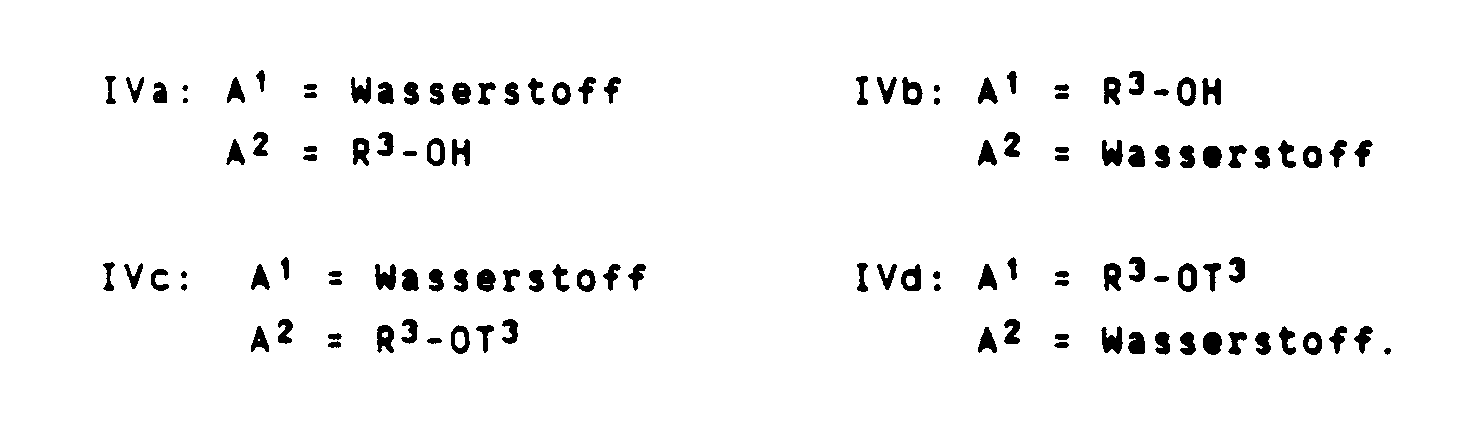
- Solche Mischungen entstehen beispielsweise, wenn man 2,6-Dichlor-3-cyano-4-methylpyridin zunächst mit Ammoniak und anschließend mit einem entsprechenden Alkanolamin umsetzt, danach acyliert und anschließend die Kupplungsreaktion durchführt. Wie oben bereits ausgeführt, ist der Acylierungsgrad, d.h. das Molverhältnis IVa:IVc und IVb:IVd, von den Reaktionsbedingungen abhängig.
- Die Isomerenverhältnisse IVa:IVb und IVc:IVd sind darüberhinaus von der Kupplungsaktivität der Diazokomponente und dem Einsatzverhältnis der Kupplungskomponente abhängig und können in weiten Bereichen schwanken. Bevorzugt ist ein Isomerenverhältnis von IVa:IVb und IVc:IVd = 3:2 bis 3:1.
- Weitere Einzelheiten der Herstellung können den Beispielen entnommen werden, in denen sich Angaben über Teile und Prozente, sofern nicht anders vermerkt, auf das Gewicht beziehen.
- Die λmax-Werte wurden jeweils in Aceton gemessen.
- 13,8 Teile 4-Nitroanilin wurden mit 30 Volumenteilen 30 %iger Salzsäure in 200 Volumenteilen heißem Wasser gelöst. Die noch warme Lösung goß man auf 300 Teile Eis und fügte rasch 30 Volumenteile 3,33 normale Natriumnitritlösung hinzu. Man rührte etwa 15 Minuten in Gegenwart eines Überschusses an salpetriger Säure nach und zerstörte dann diesen Überschuß mit wenig Amidosulfonsäure. Die erhaltene Diazoniumsalz-Lösung ließ man dann zur Lösung der Kupplungskomponente fließen, die wie folgt bereitet wurde:
Ein Gemisch aus 17 Teilen 2-Chlor-3-cyano-4-methyl-6-aminopyridin, 20 Volumenteilen Isobutanol, 18 Teilen 3-Aminopropyl-4-hydroxybutylether und 8 Teilen Soda wurde am absteigenden Kühler unter guter Rührung 5 Stunden auf 145/150 °C erhitzt, bis ein Dünnschichtchromatogramm vollständige Umsetzung anzeigte. Nach dem Abkühlen auf ungefähr 100 °C wurden dann 35 Teile Essigsäure und bei 35/40 °C unter weiterer leichter Kühlung 15 Teile 96 %ige Schwefelsäure zugetropft. Nach dreistündigem Rühren bei einem Druck von 45 mmHg waren 96 % der Hydroxyverbindung acetyliert. - Zur Kupplung wurde das Reaktionsgemisch mit 300 Teilen Eis und 100 Volumenteilen Wasser verdünnt. Durch langsame Zugabe von 100 Volumenteilen gesättigter Natriumacetatlösung (pH-Wert des Reaktionsgemisches ca. 2) und etwa einstündiges Rühren bei ca. +5°C reagiert das Diazoniumsalz ab. Danach wurde das Reaktionsgemisch abgesaugt, das Filtergut neutral gewaschen und bei 80 °C getrocknet.
- Das erhaltene braunrote Pulver entspricht zu ca. 92 % dem Isomerengemisch der Formel

und enthält noch etwa 8 % der nicht acetylierten Hydroxyverbindungen. - Es färbte PES-Gewebe nach dem Hochtemperaturverfahren mit sehr hoher Farbstärke, wobei das Färbebad bereits bei 125/130 °C vollständig ausgezogen wurde. Die Färbung zeigte ausgezeichnete Gebrauchsechtheiten.
- 17,3 Teile 2-Chlor-4-nitranilin wurden mit 40 Volumenteilen 30 %iger Salzsäure in 120 Teilen Wasser eine Stunde verrührt. Man stellte mit Wasser und Eis ein Volumen von 500 Teilen und eine Temperatur von 10°C ein und gab dann unter die Oberfläche 30 Volumenteile einer 3,33n Natriumnitritlösung zu. Nach zweistündigem Rühren bei 10°C und überschüssiger Säure wurden zur Diazoniumsalzlösung zunächst 250 Teile Eis gegeben. Dazu goß man die Lösung der Kupplungskomponente, die analog dem Verfahren des Beispiels 1 hergestellt jedoch mit 40 Teilen Propionsäure anstatt Essigsäure acyliert wurde. (Der Wassergehalt des Acetylierungsgemisches betrug 10 %).
- Nach zweistündigem Rühren bei 5 bis 10°C war das Diazoniumsalz verbraucht. Man saugte danach kalt ab, wusch das Filtergut neutral und trocknete bei 80°C.
- Das erhaltene rotbraune Pulver entspricht zu ca. 75 % dem Isomerengemisch

und enthält noch etwa 25 % der unacylierten Hydroxyisomeren. - Der Farbstoff ergab auf PES nach dem Hochtemperaturverfahren bei 125/130 °C gefärbt, sehr farbstarke rotorange Färbungen mit sehr guten Gebrauchsechtheiten.
- 16,3 Teile 2-Cyano-4-nitranilin wurden in 150 Volumenteilen Eisessig und 50 Volumenteilen Propionsäure bei 10/15 °C angerührt. Dazu tropfte man 31,5 Teile einer 40 %igen Nitrosylschwefelsäure und rührte zwei Stunden bei 10/15 °C nach, bis vollständige Lösung eingetreten war. Die Lösung ließ man zu einer Kupplungskomponentenlösung einlaufen, die aus 250 Teilen Eis und der mit 40 Teilen Isobuttersäure acylierten Komponente des Beispiels 1 bereitet wurde. Das Acylierungsgemisch enthielt 2 % Wasser.
- Die Kupplungsreaktion war nach kurzer Zeit beendet. Man saugte den Farbstoff ab, wusch neutral und trocknete bei 80 °C.
- Das erhaltene rote Pulver entspricht zu ca. 85 % dem Gemisch der Acylisomeren.

und färbte PES in Scharlachtönen mit sehr hohen Echtheiten. - Nach den Vorschriften der Beispiele 1 bis 3 können, gegebenenfalls bei geringfügiger Variation von Konzentration, Temperatur und Lösungsmittel, die in den folgenden Tabellen dargestellten Farbstoffe erhalten werden, die färberisch und echtheitsmäßig vergleichbar günstige Ergebnisse liefern.
- Bei den nachstehend durch die Substituenten gekennzeichneten Farbstoffen ist jeweils nur das Hauptisomere angegeben. Es liegen jedoch immer die Isomerengemische, die sowohl vollständig oder auch nur teilacyliert sein können, wie sie bei der beschriebenen Herstellungsweise entstehen, vor.


Claims (3)
- Verbindungen der Formel I
 D für einen Rest der Formeleiner der beiden Reste L¹ und L² für eine unsubstituierte Aminogruppe und der andere für den Rest
 R¹ Wasserstoff, C₁-C₄-Alkyl, C₁-C₄-Alkoxy- C₂-C₄-alkyl oder C₁-C₈-Acyloxy- C₂-C₄-alkyl,R² gegebenenfalls durch Sauerstoff unterbrochenes C₂-C₁₀-Alkylen,T gegebenenfalls durch Chlor oder Methoxy substituiertes C₁-C₈-Alkanoyl,B¹ C₁-C₄-Alkyl oder gegebenenfalls durch Methyl, Methoxy oder Chlor substituiertes Benzyl oder Phenyl,B² den Rest B¹, Wasserstoff, Halogen, Cyano oder C₁-C₅-Alkoxycarbonyl,X¹ Wasserstoff, Nitro, Cyano, C₁-C₉-Alkoxycarbonyl, C₁-C₉-Mono- oder Dialkylaminocarbonyl, Trifluormethyl, Methylsulfonyl oder Ethylsulfonyl,X² Nitro oder C₁-C₅-Alkoxycarbonyl,X³ den Rest X², Cyano oder Formyl,Y Wasserstoff, Chlor, Brom, Methyl, Methoxy oder Ethoxy undZ Wasserstoff, Chlor, Brom, Cyano oder C₁-C₉-Alkoxycarbonyl, das gegebenenfalls durch C₁-C₄-Alkoxy substituiert ist, bedeuten, und wobei mindestens einer der Substituenten X¹, Y und Z von Wasserstoff verschieden ist.
 - Verbindungen gemäß Anspruch 1, dadurch gekennzeichnet, daß
D für einen Rest der Formel R³ (CH₂)-O-(CH₂)₂, (CH₂)₃O(CH₂)₃ oder (CH₂)₃O(CH₂)₄,T¹ C₁-C₄-Alkanoyl,X⁴ Nitro, Cyano, Methylsulfonyl oder Ethylsulfonyl,Y² Wasserstoff, Chlor oder Brom,Z² Wasserstoff, Cyano oder C₁-C₅-Alkoxycarbonyl,B³ C₁-C₃-Alkyl, Benzyl oder Phenyl undR⁴ Methyl oder Ethyl bedeuten.
 - Verwendung der Verbindungen gemäß Anspruch 1 zum Färben synthetischer Polyester.
Applications Claiming Priority (2)
| Application Number | Priority Date | Filing Date | Title |
|---|---|---|---|
| DE3615093 | 1986-05-03 | ||
| DE19863615093 DE3615093A1 (de) | 1986-05-03 | 1986-05-03 | Diaminopyridin-azofarbstoffe mit acyloxy-resten |
Publications (3)
| Publication Number | Publication Date |
|---|---|
| EP0244740A2 EP0244740A2 (de) | 1987-11-11 |
| EP0244740A3 EP0244740A3 (en) | 1989-04-26 |
| EP0244740B1 true EP0244740B1 (de) | 1992-07-01 |
Family
ID=6300153
Family Applications (1)
| Application Number | Title | Priority Date | Filing Date |
|---|---|---|---|
| EP87106163A Expired - Lifetime EP0244740B1 (de) | 1986-05-03 | 1987-04-28 | Diaminopyridin-Azofarbstoffe mit Acyloxyresten |
Country Status (4)
| Country | Link |
|---|---|
| US (1) | US4855412A (de) |
| EP (1) | EP0244740B1 (de) |
| JP (1) | JPH07108954B2 (de) |
| DE (2) | DE3615093A1 (de) |
Families Citing this family (19)
| Publication number | Priority date | Publication date | Assignee | Title |
|---|---|---|---|---|
| IN167384B (de) * | 1985-05-14 | 1990-10-20 | Basf Ag | |
| DE3528759A1 (de) * | 1985-08-10 | 1987-02-19 | Basf Ag | Heterocyclische azofarbstoffe |
| US5144240A (en) * | 1985-08-14 | 1992-09-01 | Picker International, Inc. | Nmr spectroscopy and imaging coil |
| DE3738374A1 (de) * | 1987-11-12 | 1989-05-24 | Basf Ag | Thien-3-ylazofarbstoffe und ihre verwendung |
| DE3938093A1 (de) * | 1989-11-16 | 1991-05-23 | Basf Ag | Thiazolazofarbstoffe |
| JPH0649373A (ja) * | 1991-05-28 | 1994-02-22 | Mitsubishi Kasei Hoechst Kk | モノアゾ染料 |
| DE4138550A1 (de) * | 1991-11-23 | 1993-05-27 | Basf Ag | Thiophenazofarbstoffe mit einer kupplungskomponente aus der diaminopyridinreihe |
| US5403363A (en) * | 1992-12-07 | 1995-04-04 | Basf Aktiengesellschaft | Dye mixtures containing azo dyes having a coupling component from the diaminopyridine series |
| TW293835B (de) * | 1994-08-29 | 1996-12-21 | Ciba Geigy Ag | |
| GB9806810D0 (en) * | 1998-03-31 | 1998-05-27 | Zeneca Ltd | Compositions |
| US20040024085A1 (en) * | 2002-01-30 | 2004-02-05 | Takahiro Ishizuka | Ink composition and inkjet recording method |
| US8758679B2 (en) | 2006-03-31 | 2014-06-24 | The Invention Science Fund I, Llc | Surveying sterilizer methods and systems |
| US8114342B2 (en) | 2006-03-31 | 2012-02-14 | The Invention Science Fund I, Llc | Methods and systems for monitoring sterilization status |
| US8932535B2 (en) | 2006-03-31 | 2015-01-13 | The Invention Science Fund I, Llc | Surveying sterilizer methods and systems |
| US20070231192A1 (en) | 2006-03-31 | 2007-10-04 | Searete Llc, A Limited Liability Corporation Of The State Of Delaware | Sterilization methods and systems |
| US11185604B2 (en) | 2006-03-31 | 2021-11-30 | Deep Science Llc | Methods and systems for monitoring sterilization status |
| US8277724B2 (en) | 2006-03-31 | 2012-10-02 | The Invention Science Fund I, Llc | Sterilization methods and systems |
| US7638090B2 (en) * | 2006-03-31 | 2009-12-29 | Searete Llc | Surveying sterilizer methods and systems |
| US20070286398A1 (en) * | 2006-06-07 | 2007-12-13 | Venkatesan Ramamoorthy | Voice Recognition Dialing For Alphabetic Phone Numbers |
Family Cites Families (7)
| Publication number | Priority date | Publication date | Assignee | Title |
|---|---|---|---|---|
| US29640A (en) * | 1860-08-14 | Improvement in automatic rakes for harvesters | ||
| DE2251702B2 (de) * | 1972-10-21 | 1976-11-18 | Basf Ag, 6700 Ludwigshafen | Dispersionsazofarbstoffe der 2,6- diaminopyridinreihe, verfahren zu deren herstellung und ihre verwendung |
| USRE29640E (en) | 1970-12-19 | 1978-05-23 | Basf Aktiengesellschaft | Certain substituted 2,6-diamino-4-methyl-nicotinitriles the corresponding nicotinamides and derivatives thereof |
| DE2062717C3 (de) * | 1970-12-19 | 1975-02-13 | Basf Ag | Azofarbstoffe aus 2,6-Diaminopyridin-derivaten, Verfahren zu deren Herstellung und Verwendung |
| CH596263A5 (de) * | 1972-03-10 | 1978-03-15 | Basf Ag | |
| US3980659A (en) * | 1972-06-22 | 1976-09-14 | Cassella Farbwerke Mainkur Aktiengesellschaft | Certain 6-amino-4-hydrocarbyl-nicotinamides |
| DE3330155A1 (de) * | 1983-08-20 | 1985-03-07 | Basf Ag, 6700 Ludwigshafen | Isothiazolazofarbstoffe |
-
1986
- 1986-05-03 DE DE19863615093 patent/DE3615093A1/de not_active Withdrawn
-
1987
- 1987-04-24 US US07/042,243 patent/US4855412A/en not_active Expired - Lifetime
- 1987-04-28 DE DE8787106163T patent/DE3780076D1/de not_active Expired - Lifetime
- 1987-04-28 JP JP62103462A patent/JPH07108954B2/ja not_active Expired - Lifetime
- 1987-04-28 EP EP87106163A patent/EP0244740B1/de not_active Expired - Lifetime
Also Published As
| Publication number | Publication date |
|---|---|
| DE3615093A1 (de) | 1987-11-05 |
| DE3780076D1 (de) | 1992-08-06 |
| JPS62263259A (ja) | 1987-11-16 |
| EP0244740A3 (en) | 1989-04-26 |
| EP0244740A2 (de) | 1987-11-11 |
| US4855412A (en) | 1989-08-08 |
| JPH07108954B2 (ja) | 1995-11-22 |
Similar Documents
| Publication | Publication Date | Title |
|---|---|---|
| EP0244740A2 (de) | Diaminopyridin-Azofarbstoffe mit Acyloxyresten | |
| DE1544375B1 (de) | Wasserunloesliche Monoazofarbstoffe | |
| DE2201113C2 (de) | "Disperse Monoazofarbstoffe, Verfahren zu ihrer Herstellung und ihre Verwendung zum Färben von synthetischen organischen Textilmaterialien" | |
| US2906747A (en) | Pyrazolone-1-carboxylic acid amidine monoazo dyestuffs | |
| EP0087616B1 (de) | Isothiazolazofarbstoffe | |
| EP0197471B1 (de) | Azofarbstoffe mit Thiophen-Diazokomponenten | |
| DE2256171B2 (de) | Verfahren zur Herstellung von Disazopigmenten | |
| DE2531445B2 (de) | Sulfogruppenfreie wasserloesliche azofarbstoffe und deren verwendung zum faerben und/oder bedrucken von synthetischen textilfasern | |
| EP0084150B1 (de) | Benzisothiazolazofarbstoffe | |
| CH421343A (de) | Verfahren zur Herstellung von Azoverbindungen | |
| DE2842186A1 (de) | Azofarbstoffe | |
| DE2307169A1 (de) | Azofarbstoffe | |
| DE3016301A1 (de) | Wasserunloesliche azofarbstoffe, verfahren zu ihrer herstellung und ihre verwendung | |
| DE2743097C2 (de) | ||
| EP0026596A1 (de) | Dispersionsmonoazofarbstoffe, ihre Herstellung und Verwendung zum Färben synthetischer Textilmaterialien | |
| JPS59152957A (ja) | ポリエステル繊維用アゾ染料 | |
| DE1922901C3 (de) | Azofarbstoffe, enthaltend einen Sulfolanylpyrazolrest | |
| DE1644093A1 (de) | Verfahren zur Herstellung von wasserloeslichen basischen Azofarbstoffen | |
| DE1544375C (de) | Wasserunlösliche Monoazofarbstoffe | |
| CH502413A (de) | Verfahren zur Herstellung von wasserlöslichen Azofarbstoffen | |
| DE1544391C (de) | Verfahren zur Herstellung wasserunlöslicher Monoazofarbstoffe | |
| DE2255525C3 (de) | Diaminopyrimidin-DispersionsazoterbsUttte, Verfahren zu deren Herstellung und Ihre Verwendung | |
| DE1039676B (de) | Verfahren zur Herstellung von Monoazofarbstoffen | |
| DE3705223A1 (de) | Azofarbstoffe | |
| DE3514368A1 (de) | Kationische isothiazolazofarbstoffe |
Legal Events
| Date | Code | Title | Description |
|---|---|---|---|
| PUAI | Public reference made under article 153(3) epc to a published international application that has entered the european phase |
Free format text: ORIGINAL CODE: 0009012 |
|
| AK | Designated contracting states |
Kind code of ref document: A2 Designated state(s): CH DE FR GB IT LI |
|
| PUAL | Search report despatched |
Free format text: ORIGINAL CODE: 0009013 |
|
| AK | Designated contracting states |
Kind code of ref document: A3 Designated state(s): CH DE FR GB IT LI |
|
| 17P | Request for examination filed |
Effective date: 19890310 |
|
| 17Q | First examination report despatched |
Effective date: 19910403 |
|
| GRAA | (expected) grant |
Free format text: ORIGINAL CODE: 0009210 |
|
| AK | Designated contracting states |
Kind code of ref document: B1 Designated state(s): CH DE FR GB IT LI |
|
| ITF | It: translation for a ep patent filed | ||
| REF | Corresponds to: |
Ref document number: 3780076 Country of ref document: DE Date of ref document: 19920806 |
|
| GBT | Gb: translation of ep patent filed (gb section 77(6)(a)/1977) | ||
| ET | Fr: translation filed | ||
| PLBE | No opposition filed within time limit |
Free format text: ORIGINAL CODE: 0009261 |
|
| STAA | Information on the status of an ep patent application or granted ep patent |
Free format text: STATUS: NO OPPOSITION FILED WITHIN TIME LIMIT |
|
| 26N | No opposition filed | ||
| PGFP | Annual fee paid to national office [announced via postgrant information from national office to epo] |
Ref country code: FR Payment date: 19980312 Year of fee payment: 12 |
|
| PGFP | Annual fee paid to national office [announced via postgrant information from national office to epo] |
Ref country code: CH Payment date: 19980325 Year of fee payment: 12 |
|
| PGFP | Annual fee paid to national office [announced via postgrant information from national office to epo] |
Ref country code: GB Payment date: 19980415 Year of fee payment: 12 |
|
| PGFP | Annual fee paid to national office [announced via postgrant information from national office to epo] |
Ref country code: DE Payment date: 19980427 Year of fee payment: 12 |
|
| PG25 | Lapsed in a contracting state [announced via postgrant information from national office to epo] |
Ref country code: GB Free format text: LAPSE BECAUSE OF NON-PAYMENT OF DUE FEES Effective date: 19990428 Ref country code: DE Free format text: LAPSE BECAUSE OF THE APPLICANT RENOUNCES Effective date: 19990428 |
|
| PG25 | Lapsed in a contracting state [announced via postgrant information from national office to epo] |
Ref country code: LI Free format text: LAPSE BECAUSE OF NON-PAYMENT OF DUE FEES Effective date: 19990430 Ref country code: CH Free format text: LAPSE BECAUSE OF NON-PAYMENT OF DUE FEES Effective date: 19990430 |
|
| GBPC | Gb: european patent ceased through non-payment of renewal fee |
Effective date: 19990428 |
|
| REG | Reference to a national code |
Ref country code: CH Ref legal event code: PL |
|
| PG25 | Lapsed in a contracting state [announced via postgrant information from national office to epo] |
Ref country code: FR Free format text: LAPSE BECAUSE OF NON-PAYMENT OF DUE FEES Effective date: 19991231 |
|
| REG | Reference to a national code |
Ref country code: FR Ref legal event code: ST |
|
| PG25 | Lapsed in a contracting state [announced via postgrant information from national office to epo] |
Ref country code: IT Free format text: LAPSE BECAUSE OF NON-PAYMENT OF DUE FEES;WARNING: LAPSES OF ITALIAN PATENTS WITH EFFECTIVE DATE BEFORE 2007 MAY HAVE OCCURRED AT ANY TIME BEFORE 2007. THE CORRECT EFFECTIVE DATE MAY BE DIFFERENT FROM THE ONE RECORDED. Effective date: 20050428 |