EP0244448B1 - Optisches phosphatglas mit anomaler positiver teildispersion und verfahren zu seiner herstellung - Google Patents
Optisches phosphatglas mit anomaler positiver teildispersion und verfahren zu seiner herstellung Download PDFInfo
- Publication number
- EP0244448B1 EP0244448B1 EP86906264A EP86906264A EP0244448B1 EP 0244448 B1 EP0244448 B1 EP 0244448B1 EP 86906264 A EP86906264 A EP 86906264A EP 86906264 A EP86906264 A EP 86906264A EP 0244448 B1 EP0244448 B1 EP 0244448B1
- Authority
- EP
- European Patent Office
- Prior art keywords
- amounts
- content
- weight
- displays
- oxides
- Prior art date
- Legal status (The legal status is an assumption and is not a legal conclusion. Google has not performed a legal analysis and makes no representation as to the accuracy of the status listed.)
- Expired - Lifetime
Links
- 230000003287 optical effect Effects 0.000 title claims abstract description 13
- 238000000034 method Methods 0.000 title claims abstract description 9
- 239000005365 phosphate glass Substances 0.000 title claims abstract description 8
- 230000002547 anomalous effect Effects 0.000 title claims abstract description 5
- 238000004519 manufacturing process Methods 0.000 title claims description 4
- 239000002245 particle Substances 0.000 title abstract 2
- 239000011521 glass Substances 0.000 claims abstract description 18
- 239000000203 mixture Substances 0.000 claims abstract description 14
- 150000002222 fluorine compounds Chemical class 0.000 claims abstract description 4
- 125000005341 metaphosphate group Chemical group 0.000 claims abstract description 4
- 229910052758 niobium Inorganic materials 0.000 claims abstract description 4
- 229910052726 zirconium Inorganic materials 0.000 claims abstract description 3
- 239000006185 dispersion Substances 0.000 claims description 10
- BASFCYQUMIYNBI-UHFFFAOYSA-N platinum Chemical compound [Pt] BASFCYQUMIYNBI-UHFFFAOYSA-N 0.000 claims description 8
- 238000003756 stirring Methods 0.000 claims description 8
- 239000000155 melt Substances 0.000 claims description 6
- 229910052697 platinum Inorganic materials 0.000 claims description 4
- 229910052715 tantalum Inorganic materials 0.000 claims description 3
- 229910000831 Steel Inorganic materials 0.000 claims description 2
- 229910000287 alkaline earth metal oxide Inorganic materials 0.000 claims description 2
- 238000000137 annealing Methods 0.000 claims description 2
- 239000010959 steel Substances 0.000 claims description 2
- 229910052688 Gadolinium Inorganic materials 0.000 abstract description 2
- 230000005540 biological transmission Effects 0.000 abstract description 2
- 229910052796 boron Inorganic materials 0.000 abstract description 2
- 230000009466 transformation Effects 0.000 abstract description 2
- 229910052727 yttrium Inorganic materials 0.000 abstract description 2
- 230000000704 physical effect Effects 0.000 abstract 1
- WUKWITHWXAAZEY-UHFFFAOYSA-L calcium difluoride Chemical compound [F-].[F-].[Ca+2] WUKWITHWXAAZEY-UHFFFAOYSA-L 0.000 description 5
- KRHYYFGTRYWZRS-UHFFFAOYSA-M Fluoride anion Chemical compound [F-] KRHYYFGTRYWZRS-UHFFFAOYSA-M 0.000 description 4
- 230000002159 abnormal effect Effects 0.000 description 4
- 229910001634 calcium fluoride Inorganic materials 0.000 description 4
- 238000002844 melting Methods 0.000 description 4
- 230000008018 melting Effects 0.000 description 4
- 229910052782 aluminium Inorganic materials 0.000 description 3
- XAGFODPZIPBFFR-UHFFFAOYSA-N aluminium Chemical compound [Al] XAGFODPZIPBFFR-UHFFFAOYSA-N 0.000 description 3
- QVQLCTNNEUAWMS-UHFFFAOYSA-N barium oxide Chemical compound [Ba]=O QVQLCTNNEUAWMS-UHFFFAOYSA-N 0.000 description 3
- 239000011777 magnesium Substances 0.000 description 3
- 239000010955 niobium Substances 0.000 description 3
- 239000005304 optical glass Substances 0.000 description 3
- MCMNRKCIXSYSNV-UHFFFAOYSA-N Zirconium dioxide Chemical compound O=[Zr]=O MCMNRKCIXSYSNV-UHFFFAOYSA-N 0.000 description 2
- DHAHRLDIUIPTCJ-UHFFFAOYSA-K aluminium metaphosphate Chemical compound [Al+3].[O-]P(=O)=O.[O-]P(=O)=O.[O-]P(=O)=O DHAHRLDIUIPTCJ-UHFFFAOYSA-K 0.000 description 2
- 229910052793 cadmium Inorganic materials 0.000 description 2
- BDOSMKKIYDKNTQ-UHFFFAOYSA-N cadmium atom Chemical compound [Cd] BDOSMKKIYDKNTQ-UHFFFAOYSA-N 0.000 description 2
- JKWMSGQKBLHBQQ-UHFFFAOYSA-N diboron trioxide Chemical compound O=BOB=O JKWMSGQKBLHBQQ-UHFFFAOYSA-N 0.000 description 2
- SIWVEOZUMHYXCS-UHFFFAOYSA-N oxo(oxoyttriooxy)yttrium Chemical compound O=[Y]O[Y]=O SIWVEOZUMHYXCS-UHFFFAOYSA-N 0.000 description 2
- IRPGOXJVTQTAAN-UHFFFAOYSA-N 2,2,3,3,3-pentafluoropropanal Chemical compound FC(F)(F)C(F)(F)C=O IRPGOXJVTQTAAN-UHFFFAOYSA-N 0.000 description 1
- KLZUFWVZNOTSEM-UHFFFAOYSA-K Aluminum fluoride Inorganic materials F[Al](F)F KLZUFWVZNOTSEM-UHFFFAOYSA-K 0.000 description 1
- 229910016036 BaF 2 Inorganic materials 0.000 description 1
- ZOXJGFHDIHLPTG-UHFFFAOYSA-N Boron Chemical compound [B] ZOXJGFHDIHLPTG-UHFFFAOYSA-N 0.000 description 1
- 229910004261 CaF 2 Inorganic materials 0.000 description 1
- OYPRJOBELJOOCE-UHFFFAOYSA-N Calcium Chemical compound [Ca] OYPRJOBELJOOCE-UHFFFAOYSA-N 0.000 description 1
- PXGOKWXKJXAPGV-UHFFFAOYSA-N Fluorine Chemical compound FF PXGOKWXKJXAPGV-UHFFFAOYSA-N 0.000 description 1
- FYYHWMGAXLPEAU-UHFFFAOYSA-N Magnesium Chemical compound [Mg] FYYHWMGAXLPEAU-UHFFFAOYSA-N 0.000 description 1
- 229910019142 PO4 Inorganic materials 0.000 description 1
- OAICVXFJPJFONN-UHFFFAOYSA-N Phosphorus Chemical compound [P] OAICVXFJPJFONN-UHFFFAOYSA-N 0.000 description 1
- 229910052784 alkaline earth metal Inorganic materials 0.000 description 1
- PNEYBMLMFCGWSK-UHFFFAOYSA-N aluminium oxide Inorganic materials [O-2].[O-2].[O-2].[Al+3].[Al+3] PNEYBMLMFCGWSK-UHFFFAOYSA-N 0.000 description 1
- QVGXLLKOCUKJST-UHFFFAOYSA-N atomic oxygen Chemical compound [O] QVGXLLKOCUKJST-UHFFFAOYSA-N 0.000 description 1
- 229910052788 barium Inorganic materials 0.000 description 1
- DSAJWYNOEDNPEQ-UHFFFAOYSA-N barium atom Chemical compound [Ba] DSAJWYNOEDNPEQ-UHFFFAOYSA-N 0.000 description 1
- OYLGJCQECKOTOL-UHFFFAOYSA-L barium fluoride Chemical compound [F-].[F-].[Ba+2] OYLGJCQECKOTOL-UHFFFAOYSA-L 0.000 description 1
- 229910001632 barium fluoride Inorganic materials 0.000 description 1
- XNJIKBGDNBEQME-UHFFFAOYSA-L barium(2+);dioxido(oxo)phosphanium Chemical compound [Ba+2].[O-][P+]([O-])=O.[O-][P+]([O-])=O XNJIKBGDNBEQME-UHFFFAOYSA-L 0.000 description 1
- JZKFIPKXQBZXMW-UHFFFAOYSA-L beryllium difluoride Chemical compound F[Be]F JZKFIPKXQBZXMW-UHFFFAOYSA-L 0.000 description 1
- 229910052791 calcium Inorganic materials 0.000 description 1
- 239000011575 calcium Substances 0.000 description 1
- ROPDWRCJTIRLTR-UHFFFAOYSA-L calcium metaphosphate Chemical compound [Ca+2].[O-]P(=O)=O.[O-]P(=O)=O ROPDWRCJTIRLTR-UHFFFAOYSA-L 0.000 description 1
- 238000005266 casting Methods 0.000 description 1
- 229910052729 chemical element Inorganic materials 0.000 description 1
- 238000001816 cooling Methods 0.000 description 1
- 239000013078 crystal Substances 0.000 description 1
- 238000010586 diagram Methods 0.000 description 1
- DWYMPOCYEZONEA-UHFFFAOYSA-L fluoridophosphate Chemical compound [O-]P([O-])(F)=O DWYMPOCYEZONEA-UHFFFAOYSA-L 0.000 description 1
- 239000011737 fluorine Substances 0.000 description 1
- 229910052731 fluorine Inorganic materials 0.000 description 1
- 239000010436 fluorite Substances 0.000 description 1
- 239000005303 fluorophosphate glass Substances 0.000 description 1
- UIWYJDYFSGRHKR-UHFFFAOYSA-N gadolinium atom Chemical compound [Gd] UIWYJDYFSGRHKR-UHFFFAOYSA-N 0.000 description 1
- 229910001938 gadolinium oxide Inorganic materials 0.000 description 1
- 229940075613 gadolinium oxide Drugs 0.000 description 1
- CMIHHWBVHJVIGI-UHFFFAOYSA-N gadolinium(iii) oxide Chemical compound [O-2].[O-2].[O-2].[Gd+3].[Gd+3] CMIHHWBVHJVIGI-UHFFFAOYSA-N 0.000 description 1
- 229910052500 inorganic mineral Inorganic materials 0.000 description 1
- 238000003780 insertion Methods 0.000 description 1
- 230000037431 insertion Effects 0.000 description 1
- 229910052749 magnesium Inorganic materials 0.000 description 1
- ORUIBWPALBXDOA-UHFFFAOYSA-L magnesium fluoride Chemical compound [F-].[F-].[Mg+2] ORUIBWPALBXDOA-UHFFFAOYSA-L 0.000 description 1
- 239000012803 melt mixture Substances 0.000 description 1
- QSHDDOUJBYECFT-UHFFFAOYSA-N mercury Chemical compound [Hg] QSHDDOUJBYECFT-UHFFFAOYSA-N 0.000 description 1
- 229910052753 mercury Inorganic materials 0.000 description 1
- RHJYKEDKMHDZBL-UHFFFAOYSA-L metaphosphoric acid (hpo3), magnesium salt Chemical compound [Mg+2].[O-]P(=O)=O.[O-]P(=O)=O RHJYKEDKMHDZBL-UHFFFAOYSA-L 0.000 description 1
- 239000011707 mineral Substances 0.000 description 1
- GUCVJGMIXFAOAE-UHFFFAOYSA-N niobium atom Chemical compound [Nb] GUCVJGMIXFAOAE-UHFFFAOYSA-N 0.000 description 1
- ZKATWMILCYLAPD-UHFFFAOYSA-N niobium pentoxide Inorganic materials O=[Nb](=O)O[Nb](=O)=O ZKATWMILCYLAPD-UHFFFAOYSA-N 0.000 description 1
- URLJKFSTXLNXLG-UHFFFAOYSA-N niobium(5+);oxygen(2-) Chemical compound [O-2].[O-2].[O-2].[O-2].[O-2].[Nb+5].[Nb+5] URLJKFSTXLNXLG-UHFFFAOYSA-N 0.000 description 1
- UFQXGXDIJMBKTC-UHFFFAOYSA-N oxostrontium Chemical compound [Sr]=O UFQXGXDIJMBKTC-UHFFFAOYSA-N 0.000 description 1
- 229910052760 oxygen Inorganic materials 0.000 description 1
- 239000001301 oxygen Substances 0.000 description 1
- BPUBBGLMJRNUCC-UHFFFAOYSA-N oxygen(2-);tantalum(5+) Chemical compound [O-2].[O-2].[O-2].[O-2].[O-2].[Ta+5].[Ta+5] BPUBBGLMJRNUCC-UHFFFAOYSA-N 0.000 description 1
- UZLYXNNZYFBAQO-UHFFFAOYSA-N oxygen(2-);ytterbium(3+) Chemical compound [O-2].[O-2].[O-2].[Yb+3].[Yb+3] UZLYXNNZYFBAQO-UHFFFAOYSA-N 0.000 description 1
- 230000000737 periodic effect Effects 0.000 description 1
- 235000021317 phosphate Nutrition 0.000 description 1
- 150000003013 phosphoric acid derivatives Chemical class 0.000 description 1
- 239000011574 phosphorus Substances 0.000 description 1
- 229910052698 phosphorus Inorganic materials 0.000 description 1
- 239000002994 raw material Substances 0.000 description 1
- 238000001228 spectrum Methods 0.000 description 1
- 229910052712 strontium Inorganic materials 0.000 description 1
- CIOAGBVUUVVLOB-UHFFFAOYSA-N strontium atom Chemical compound [Sr] CIOAGBVUUVVLOB-UHFFFAOYSA-N 0.000 description 1
- FVRNDBHWWSPNOM-UHFFFAOYSA-L strontium fluoride Chemical compound [F-].[F-].[Sr+2] FVRNDBHWWSPNOM-UHFFFAOYSA-L 0.000 description 1
- 229910001637 strontium fluoride Inorganic materials 0.000 description 1
- 239000000126 substance Substances 0.000 description 1
- GUVRBAGPIYLISA-UHFFFAOYSA-N tantalum atom Chemical compound [Ta] GUVRBAGPIYLISA-UHFFFAOYSA-N 0.000 description 1
- PBCFLUZVCVVTBY-UHFFFAOYSA-N tantalum pentoxide Inorganic materials O=[Ta](=O)O[Ta](=O)=O PBCFLUZVCVVTBY-UHFFFAOYSA-N 0.000 description 1
- 231100000331 toxic Toxicity 0.000 description 1
- 230000002588 toxic effect Effects 0.000 description 1
- 238000005303 weighing Methods 0.000 description 1
- 229910003454 ytterbium oxide Inorganic materials 0.000 description 1
- 229940075624 ytterbium oxide Drugs 0.000 description 1
- VWQVUPCCIRVNHF-UHFFFAOYSA-N yttrium atom Chemical compound [Y] VWQVUPCCIRVNHF-UHFFFAOYSA-N 0.000 description 1
- 229910052845 zircon Inorganic materials 0.000 description 1
- GFQYVLUOOAAOGM-UHFFFAOYSA-N zirconium(iv) silicate Chemical compound [Zr+4].[O-][Si]([O-])([O-])[O-] GFQYVLUOOAAOGM-UHFFFAOYSA-N 0.000 description 1
Images

Classifications
-
- C—CHEMISTRY; METALLURGY
- C03—GLASS; MINERAL OR SLAG WOOL
- C03C—CHEMICAL COMPOSITION OF GLASSES, GLAZES OR VITREOUS ENAMELS; SURFACE TREATMENT OF GLASS; SURFACE TREATMENT OF FIBRES OR FILAMENTS MADE FROM GLASS, MINERALS OR SLAGS; JOINING GLASS TO GLASS OR OTHER MATERIALS
- C03C3/00—Glass compositions
- C03C3/12—Silica-free oxide glass compositions
- C03C3/23—Silica-free oxide glass compositions containing halogen and at least one oxide, e.g. oxide of boron
- C03C3/247—Silica-free oxide glass compositions containing halogen and at least one oxide, e.g. oxide of boron containing fluorine and phosphorus
Definitions
- the application relates to an optical phosphate glass with anomalous positive partial dispersion, which is free of alkalis and calcium, and a method for its production.
- BeF 2 beryllium fluoride
- phosphates from groups I to 111 of the periodic table of the chemical elements are preferably used as glass formers.
- the fluoride components are more than 50% by weight of the raw materials used. Because of this high fluoride content, it is difficult to melt larger units of these glasses without streaks.
- Glasses are known from DE-OS 32 01 370 which, as glass formers, generally contain calcium metaphosphate (1-20% by weight) in addition to larger amounts of aluminum metaphosphate (13-39% by weight). In addition, they have a fluoride content of between 19 and 47% by weight. In addition to barium oxide, yttrium oxide and / or ytterbium oxide is also present in amounts of 1.5 to 12% by weight. Remelting of the examples given in DE-OS 32 01 370 showed that even with the smallest melting batches of about 50 g, turbidity could not be avoided when slowly stirring and the melts crystallized in some examples.
- the task also consists in specifying a method for smear-free melting of the glass in large units.
- the optical phosphate glass with an abnormal partial dispersion + Av. between 2.2 and 7.0 of a refractive index N. between 1.60 and 1.66 and an Abbe number v e between 65 and 55 has the following elementary composition in percent by weight (% by weight): Magnesium (Mg): 1 , 5 to 3.5; Strontium (Sr); 1.5 to 4.5; Barium (Ba): 30.0 to 47.0; Aluminum (AI): 2.5 to 5.5; Phosphorus (P): 10.0 to 16.0; Fluorine (F): 2.5 to 4.5; Oxygen (O): 24.0 to 30.0; Yttrium (Y): 0 to 7.0; Gadolinium (Gd); 0 to 13.0; Boron (B): 0 to 1.0; Zircon (Zr): 0 to 3.0; Niobium (Nb): 0 to 5.0; Tantalum (Ta): 0 to 5.0, where the F / P ratio is between
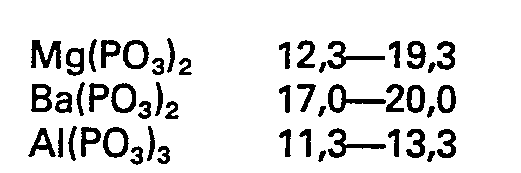
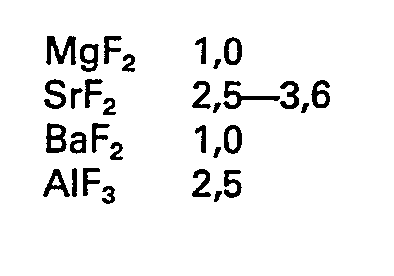
- the object is alternatively achieved by a process for producing such a phosphate glass, specifically by melting a mixture with the following starting composition (in% by weight): magnesium metaphosphate (Mg (PO 3 ) 2 ): 12.3 to 19.3; Barium metaphosphate (Ba (P0 3 ) 2 ): 17.0 to 20.0; Aluminum metaphosphate (AI (P0 3 ) 3 ): 11.3 to 13.3, the content of alkaline earth metal metaphosphates between 29.3 and 37.3 and the total content of all metaphosphates used between 40.6 and 49.6; Magnesium fluoride (MgF 2 ): 1.0; Strontium fluoride (SrF 2 ): 2.5 to 3.6; Barium fluoride (BaF 2 ): 1.0; Aluminum fluoride (AIF 3 ): 2.5, the alkaline earth fluoride content being between 4.5 and 5.6 and the total content of all fluorides used being between 7.0 and 8.1; Strontium oxide (SrO):
- Tables 3 and 4 below show the starting compositions of the glasses according to the invention contained in Tables 1 and 2.
- Table 3 contains those examples which, in addition to the essential components, also have the optional components Y 2 0 3 , Gd 2 0 3 and Nb 2 0 5, individually or in combination, while Table 4 lists those examples which are given as optional components Gd 2 0 3 , B 2 0 3 , Zr0 2 , Nb 2 0 5 and Ta 2 O 5 included individually or in combination.
- the batch is appropriately melted in a platinum crucible.
- the procedure for performing a melt weighing 6 kg is described below.
- the melt mixture consists of a material mixture as it is listed in Table 3 under melting example No. 1.
- the well-mixed mixture is placed in portions in a platinum crucible, the temperature of which is 1100 to 1150 ° C.
- the insertion time is approx. 1 hour.
- the mixture is then brought back to about 1150 ° C. and refined for about 45 minutes while stirring at intervals. If the melt is free of bubbles, the stirring speed is reduced to approx. 80 rpm and then reduced to a casting temperature of approx. 900 ° C.
- the melt is finally poured into steel molds preheated to approx. 550 ° C and cooled in an annealing furnace.
- the glass is low in fluorescence and can be processed into compacts with large diameters. It is used especially for highly corrected photo lenses.
Landscapes
- Chemical & Material Sciences (AREA)
- Life Sciences & Earth Sciences (AREA)
- Engineering & Computer Science (AREA)
- Chemical Kinetics & Catalysis (AREA)
- General Chemical & Material Sciences (AREA)
- Geochemistry & Mineralogy (AREA)
- Materials Engineering (AREA)
- Organic Chemistry (AREA)
- Glass Compositions (AREA)
Description
- Die Anmeldung betrifft ein optisches Phosphatglas mit anomaler positiver Teildispersion, welches frei von Alkalien und Calcium ist, sowie ein Verfahren zu dessen Herstellung.
- Seit einer Reihe von Jahren sind die Hersteller von optischem Glas bemüht, die Forderung der rechnenden Optiker zu erfüllen, nämlich die bisher in apochromatischen Systemen zur Korrektur des sekundären Spektrums mitverwendeten Kristalle - wie beispielsweise Calciumfluorid - durch stabile optische Gläser mit ähnlichen optischen Eigenschaften zu ersetzen. Es existieren heute optische Gläser auf Fluorphosphatbasis mit fast identischen optischen Lage-Parametern wie denjenigen des Calciumfluorids (Mineralname: Fluorit, CaF2).
- Als Glasbildner wurde bei diesen Systemen zunächst das stark giftige Berylliumfluorid (BeF2) eingesetzt. Inzwischen dienen vorzugsweise Phosphate der I. bis 111. Gruppe des Periodensystems der chemischen Elemente als Glasbildner.
- Zur Erzielung hoher positiver Δve-Werte betragen die Fluoridkomponenten mehr als 50 Gew.-% der eingesetzten Rohstoffe. Wegen dieses hohen Fluoridanteils ist es schwierig, größere Einheiten dieser Gläser schlierenfrei zu erschmelzen.
- Inzwischen werden diese Fluorphosphatgläser aber nicht nur für Mikro-Optiken, sondern auch für Foto-Optiken - und hier speziell für hochkorrigierte Teleobjective - eingesetzt. Dies bedeutet, daß neben den Mikro-Linsen von kleinem Durchmesser absolut schlierenfreie Linsen von bis zu mehr als 200 mm Durchmesser hergestellt werden müssen. Darüber hinaus besteht die Forderung, die Brechwerte gegenüber denjenigen des Calciumfluorids (ne = 1,4349) wesentlich zu erhöhen.
- Aus der DE-OS 32 01 370 sind Gläser bekannt, die als Glasbildner neben größeren Mengen von Aluminiummetaphosphat (13-39 Gew.-%) grundsätzlich auch Calciummetaphosphat (1-20 Gew.-%) enthalten. Darüber hinaus weisen sie einen Fluoridanteil zwischen 19 und 47 Gew.-% auf, Außerdem ist neben Bariumoxid auch Yttriumoxid und/oder Ytterbiumoxid in Mengen von 1,5 bis 12 Gew.-% enthalten. Nachschmelzen von in der DE-OS 32 01 370 angeführten Beispielen ergaben, daß selbst bei kleinsten Schmelzansätzen von ca. 50 g beim langsamen Abrühren Trübungen nicht zu vermeiden waren und die Schmelzen von einigen Beispielen auskristallisierten.
- Es ist die Aufgabe der vorliegenden Erfindung, ein optisches Phosphatglas extremer optischer Lage bereitzustellen, dessen Brechzahl höher als diejenige des Calciumfluorids ist, dessen Dispersion relativ klein und dessen anomale positive Teildispersion relativ groß ist. Die Aufgabe besteht darüber hinaus darin, ein Verfahren zum schlierenfreien Erschmelzen des Glases in großen Einheiten anzugeben.
- Diese Aufgabe wird erfindungsgemäß dadurch gelöst, daß das optische Phosphatglas mit einer anomalen Teildispersion +Av. zwischen 2,2 und 7,0 einer Brechzahl N. zwischen 1.60 und 1.66 und einer Abbe-Zahl ve zwischen 65 und 55 folgende elementare Zusammensetzung in Gewichts-Prozent (Gew.-%) auf-weist: Magnesium (Mg): 1,5 bis 3,5; Strontium (Sr); 1,5 bis 4,5; Barium (Ba): 30,0 bis 47,0; Aluminium (AI): 2,5 bis 5,5; Phosphor (P): 10,0 bis 16,0; Fluor (F): 2,5 bis 4,5; Sauerstoff (O): 24,0 bis 30,0; Yttrium (Y): 0 bis 7,0; Gadolinium (Gd); 0 bis 13,0; Bor (B): 0 bis 1,0; Zirkon (Zr): 0 bis 3,0; Niob (Nb): 0 bis 5,0; Tantal (Ta): 0 bis 5,0, wobei das F/P-Verhältnis zwischen 0,15 und 0,4 liegt und die Summe der Erdalkalien zwischen 36 und 52 beträgt. Die Aufgabe wird alternativ durch ein Verfahren zur Herstellung eines derartigen Phosphatglases gelöst, und zwar durch Erschmelzen eines Gemenges mit folgender Ausgangszusammensetzung (in Gew.-%): Magnesiummetaphosphate (Mg(PO3)2): 12,3 bis 19,3; Bariummetaphosphat (Ba(P03)2): 17,0 bis 20,0; Aluminiummetaphosphat (AI(P03)3): 11,3 bis 13,3, wobei der Gehalt an Erdalkalimetaphosphaten zwischen 29,3 und 37,3 und der Gesamtgehalt aller eingesetzten Metaphosphate zwischen 40,6 und 49,6 beträgt; Magnesiumfluorid (MgF2): 1,0; Strontiumfluorid (SrF2): 2,5 bis 3,6; Bariumfluorid (BaF2): 1,0; Aluminiumfluorid (AIF3): 2,5, wobei der Gehalt an Erdalkalifluoriden zwischen 4,5 und 5,6 und der Gesamtgehalt aller eingesetzten Fluoride zwischen 7,0 und 8,1 beträgt; Strontiumoxid (SrO): 1,0; Bariumoxid (BaO): 25,3 bis 39,3; Aluminiumoxid (AI203): 2,0 bis 5,0; Yttriumoxid (Y203): 0 bis 8,0; Gadoliniumoxid (Gd203): 0 bis 14,0; Bortrioxid (B203): 0 bis 1,1; Zirkondioxid (Zr02): 0 bis 3,3; Niobpentoxid (Nb205): 0 bis 6,0; Tantalpentoxid (Ta205): 0 bis 6,0, wobei der gehalt an Erdalkalioxiden zwischen 26,3 und 40,3, der Gehalt an Oxiden der dreiwertigen Elemente zwischen 2,0 und 19,0, der Gehalt an Oxiden der vier- und fünfwertigen Elemente (Zr, bzw. Ta und Nb) bis zu 6,0 und der Gesamtgehalt aller eingesetzten Oxide zwischen 42,3 und 51,3 beträgt.
- Weitere Ausgestaltungen ergeben sich aus den Unteransprüchen.
- In der Zeichnung sind in dem optischen Lageplan (ne-ve-Diagramm) die in den nachfolgenden Tabellen 1 und 2 aufgeführten erfindungsgemäßen Einzelbeispiele angekreuzt. Außerdem sind die aus der DE-OS 32 01 370 bekannten Gläser durch kleine Kreise gekennzeichnet. Die strichlinierte Grenze verdeutlicht, daß die erfindungsgemäßen Gläser bereits hinsichtlich ihrer ne/ve Parameter-Kombinationen in einem anderen Koordinatenfeld liegen, als die zum Stand der Technik gehörenden Beispiele.


- In den nachfolgenden Tabellen 3 und 4 sind die Ausgangszusammensetzungen der in den Tabellen 1 und 2 enthaltenen erfindungsgemäßen Gläser angegeben. Dabei sind in Tabelle 3 diejenigen Beispiele enthalten, welche neben den essentiellen Komponenten noch die wahlweise einzusetzenden Komponenten Y203, Gd203 und Nb205 einzeln oder in Kombination aufweisen, während in Tabelle 4 diejenigen Beispiele aufgeführt sind, welche als wahlweise einzusetzende Komponenten Gd203, B203, Zr02, Nb205 und Ta2O5 einzeln oder in Kombination enthalten.


- Das Gemenge wird zweckmäßig in einem Platintiegel erschmolzen. Nachfolgend ist die Durchführung einer Schmelze von 6 kg Einwaage beschrieben.
- Das Schmelzgemenge besteht aus einem Materialgemisch, wie es in der Tabelle 3 unter dem Schmelzbeispiel Nr. 1 aufgeführt wird. Das gut durchmischte Gemenge wird portionsweise in einen Platintiegel eingelegt, dessen Temperatur 1100 bis 1150°C beträgt. Die Einlegezeit liegt bei ca. 1 Stunde. Ist das Ausgangsgemenge eingeschmolzen, wird die Temperatur auf ca. 1250°C erhöht und unter Rühren etwa 15 Minuten lang bei dieser Temperatur belassen. Die Rührgeschwindigkeit des Platinrührers beträgt dabei beispielsweise 120 U/min (= Umdrehungen pro Minute). Anschließend wird auf ca. 1150°C zurückgefahren und etwa 45 Minuten lang unter Intervall-Rühren geläutert. Ist die Schmelze blasenfrei, so wird die Rühgeschwindigkeit auf ca. 80 U/min reduziert und sodann auf eine Abgußtemperatur von ca. 900°C abgefahren. Die Schmelze wird schließlich in auf ca. 550°C vorgewärmte Stahlformen abgegossen und in einem Temperofen abgekühlt.
- Das so hergestellte Glas ist farblos und schlierenfrei und hat nach der Feinkühlung folgende optische Daten:
- n, = 1,6186
- Ve = 64,81
- gg' = 0,4832
- +Δve = 5,85
- Hierbei bedeuten:
- n, = Brechzahl
- ve = Abbe-Zahl (Reziprok-Wert der Dispersion)
- gg' = (eigentliche) anomale Teildispersion, wobei gilt:

- dabei bedeuten die tiefgestellten Indizes:
- g = blaue Quecksilberlinie (435,84 nm);
- F' = blaue Cadmiumlinie (479,99 nm);
- C' = rote Cadmiumlinie (643,85 nm);
- +Δve = positive Abweichung von der sogenannten "Normalgeraden", wie sie beispielsweise in der Zeichnung der DE-PS 14 96 563 bzw. der korrespondierenden US―PS 34 51 829 graphisch dargestellt und näher erläutert wurde. Dieser Differenzbetrag wird als "positiver anomaler Teildispersionswert" bezeichnet.
- Das erhaltene Glas weist die folgende Transmissionscharakterisitik auf:

- °20/300°C = 12,2 [10-6·1/°C]
- Transformationstemperatur Tg = 612°C
- Dichte ϕ = 4,07 g/cm3
- Knoop-Härte HK = 389.
- Das Glas ist fluoreszenzarm und zu Preßlingen mit großen Durchmessern verarbeitbar. Es wird insbesondere für hochkorrigierte Fotoobjektive verwendet.
Claims (6)




Priority Applications (1)
| Application Number | Priority Date | Filing Date | Title |
|---|---|---|---|
| AT86906264T ATE60314T1 (de) | 1985-10-19 | 1986-10-17 | Optisches phosphatglas mit anomaler positiver teildispersion und verfahren zu seiner herstellung. |
Applications Claiming Priority (4)
| Application Number | Priority Date | Filing Date | Title |
|---|---|---|---|
| DE3537291 | 1985-10-19 | ||
| DE3537291 | 1985-10-19 | ||
| DE19863634675 DE3634675A1 (de) | 1985-10-19 | 1986-10-11 | Optisches phosphatglas mit anomaler positiver teildispersion und verfahren zu seiner herstellung |
| DE3634675 | 1986-10-11 |
Publications (2)
| Publication Number | Publication Date |
|---|---|
| EP0244448A1 EP0244448A1 (de) | 1987-11-11 |
| EP0244448B1 true EP0244448B1 (de) | 1991-01-23 |
Family
ID=25837119
Family Applications (1)
| Application Number | Title | Priority Date | Filing Date |
|---|---|---|---|
| EP86906264A Expired - Lifetime EP0244448B1 (de) | 1985-10-19 | 1986-10-17 | Optisches phosphatglas mit anomaler positiver teildispersion und verfahren zu seiner herstellung |
Country Status (3)
| Country | Link |
|---|---|
| EP (1) | EP0244448B1 (de) |
| DE (2) | DE3634675A1 (de) |
| WO (1) | WO1987002351A1 (de) |
Families Citing this family (3)
| Publication number | Priority date | Publication date | Assignee | Title |
|---|---|---|---|---|
| JPH02124740A (ja) * | 1988-10-06 | 1990-05-14 | Sumita Kogaku Glass Seizosho:Kk | フツリン酸塩光学ガラス |
| US7088903B2 (en) | 2003-09-16 | 2006-08-08 | Kabushiki Kaisha Ohara | Optical glass having a small photoelastic constant |
| CN114804622B (zh) * | 2021-01-21 | 2023-08-01 | 成都光明光电股份有限公司 | 近红外特殊色散玻璃 |
Family Cites Families (5)
| Publication number | Priority date | Publication date | Assignee | Title |
|---|---|---|---|---|
| BE471354A (de) * | 1946-01-29 | |||
| DE1088674B (de) * | 1958-06-13 | 1960-09-08 | Jenaer Glaswerk Schott & Gen | Verfahren zum Herstellen alkali- und berylliumfreier, fluoridhaltiger Phosphatglaeser |
| DE1596854A1 (de) * | 1967-02-23 | 1971-03-25 | Jenaer Glaswerk Schott & Gen | Verwendung eines Glases als optisches Glas mit weitgehend temperaturunabhaengiger optischer Weglaenge |
| DE2342484B2 (de) * | 1973-08-23 | 1977-12-29 | Ernst Leitz Wetzlar Gmbh, 6330 Wetzlar | Verfahren zum herstellen eines fluorophosphatglases mit einer brechzahl n tief e groesser als 1,57, einem abbe-wert ny tief e kleiner als 70 und einer relativ hohen positiven anomalen teildispersion |
| JPS604145B2 (ja) * | 1981-01-20 | 1985-02-01 | 株式会社ニコン | 弗化物燐酸塩光学ガラス |
-
1986
- 1986-10-11 DE DE19863634675 patent/DE3634675A1/de active Granted
- 1986-10-17 DE DE8686906264T patent/DE3677207D1/de not_active Expired - Fee Related
- 1986-10-17 WO PCT/DE1986/000416 patent/WO1987002351A1/de not_active Ceased
- 1986-10-17 EP EP86906264A patent/EP0244448B1/de not_active Expired - Lifetime
Also Published As
| Publication number | Publication date |
|---|---|
| WO1987002351A1 (fr) | 1987-04-23 |
| EP0244448A1 (de) | 1987-11-11 |
| DE3677207D1 (de) | 1991-02-28 |
| DE3634675A1 (de) | 1987-04-23 |
| DE3634675C2 (de) | 1988-09-22 |
Similar Documents
| Publication | Publication Date | Title |
|---|---|---|
| DE4013392C2 (de) | ||
| DE69600652T2 (de) | Durchsichtige Glaskeramik | |
| DE2514017C2 (de) | Verfahren zur Herstellung eines optischen Fluorphosphatglases mit hoher positiver anomaler Teildispersion, relativ hoher Brechzahl und hoher Abbezahl | |
| JP5744504B2 (ja) | 光学ガラス、光学素子およびプリフォーム | |
| DE3743609C2 (de) | ||
| DE2621741A1 (de) | Glaeser fuer absorptionssteilkantenfilter | |
| DE102006033434A1 (de) | Optisches Glas, optisches Element und Verfahren zu dessen Herstellung | |
| DE102007047490A1 (de) | Optisches Glas | |
| DE102006013599A1 (de) | Bleifreie optische Gläser der Schwerflintlage | |
| DE2342484B2 (de) | Verfahren zum herstellen eines fluorophosphatglases mit einer brechzahl n tief e groesser als 1,57, einem abbe-wert ny tief e kleiner als 70 und einer relativ hohen positiven anomalen teildispersion | |
| DE2205844C3 (de) | Durch Alkaliionenaustausch chemisch gehärtetes Brillen-Fernteilglas | |
| DE102009011508B4 (de) | Optisches Glas und seine Verwendung | |
| DE3609803A1 (de) | Optisches glas | |
| DE3201370A1 (de) | Optisches fluorphosphatglas | |
| EP0245297B1 (de) | Optische fluorphosphatgläser | |
| DE60300906T2 (de) | Optisches Glas mit anomaler Dispersion | |
| EP0243421B1 (de) | Optisches fluorphosphatglas mit anomaler positiver teildispersion und verfahren zu seiner herstellung | |
| EP0020668B1 (de) | Verfahren zum herstellen eines berylliumfreien fluorophosphatglases | |
| US4200467A (en) | Zirconium-containing borosilicate glasses | |
| DE60200080T2 (de) | Optisches Glas für Verfahren zum Formen | |
| EP0245298B1 (de) | Optisches fluorphosphatglas mit anomaler positiver teildispersion und verfahren zu seiner herstellung | |
| DE3634675C2 (de) | ||
| DE2625313A1 (de) | Brillenlinse mit hoher mechanischer festigkeit | |
| DE3427696A1 (de) | Hochbrechendes optisches glas mit niedriger dispersion geeignet fuer mehrfokalkorrekturbrillen | |
| DE102005034785B3 (de) | Glaszusammensetzung ausschließlich bestehend aus Oxiden,welche bei Reaktion mit Fluor schon bei niedrigen Temperaturen flüchtige Fluoride ausbilden, sowie deren Verwendung |
Legal Events
| Date | Code | Title | Description |
|---|---|---|---|
| PUAI | Public reference made under article 153(3) epc to a published international application that has entered the european phase |
Free format text: ORIGINAL CODE: 0009012 |
|
| AK | Designated contracting states |
Kind code of ref document: A1 Designated state(s): AT CH DE FR GB LI NL |
|
| 17P | Request for examination filed |
Effective date: 19871012 |
|
| 17Q | First examination report despatched |
Effective date: 19890210 |
|
| RAP1 | Party data changed (applicant data changed or rights of an application transferred) |
Owner name: WILD LEITZ GMBH |
|
| GRAA | (expected) grant |
Free format text: ORIGINAL CODE: 0009210 |
|
| AK | Designated contracting states |
Kind code of ref document: B1 Designated state(s): AT CH DE FR GB LI NL |
|
| REF | Corresponds to: |
Ref document number: 60314 Country of ref document: AT Date of ref document: 19910215 Kind code of ref document: T |
|
| RAP2 | Party data changed (patent owner data changed or rights of a patent transferred) |
Owner name: LEICA INDUSTRIEVERWALTUNG GMBH |
|
| REF | Corresponds to: |
Ref document number: 3677207 Country of ref document: DE Date of ref document: 19910228 |
|
| GBT | Gb: translation of ep patent filed (gb section 77(6)(a)/1977) | ||
| ET | Fr: translation filed | ||
| PLBE | No opposition filed within time limit |
Free format text: ORIGINAL CODE: 0009261 |
|
| STAA | Information on the status of an ep patent application or granted ep patent |
Free format text: STATUS: NO OPPOSITION FILED WITHIN TIME LIMIT |
|
| 26N | No opposition filed | ||
| REG | Reference to a national code |
Ref country code: CH Ref legal event code: PUE Owner name: LEICA INDUSTRIEVERWALTUNG GMBH TRANSFER- CORNING F Ref country code: CH Ref legal event code: NV Representative=s name: AMMANN PATENTANWAELTE AG BERN |
|
| NLS | Nl: assignments of ep-patents |
Owner name: CORNING FRANCE S.A. |
|
| REG | Reference to a national code |
Ref country code: FR Ref legal event code: TP |
|
| REG | Reference to a national code |
Ref country code: GB Ref legal event code: 732E |
|
| REG | Reference to a national code |
Ref country code: GB Ref legal event code: IF02 |
|
| PGFP | Annual fee paid to national office [announced via postgrant information from national office to epo] |
Ref country code: AT Payment date: 20020912 Year of fee payment: 17 |
|
| PGFP | Annual fee paid to national office [announced via postgrant information from national office to epo] |
Ref country code: GB Payment date: 20020913 Year of fee payment: 17 |
|
| PGFP | Annual fee paid to national office [announced via postgrant information from national office to epo] |
Ref country code: NL Payment date: 20020919 Year of fee payment: 17 |
|
| PGFP | Annual fee paid to national office [announced via postgrant information from national office to epo] |
Ref country code: FR Payment date: 20021003 Year of fee payment: 17 |
|
| PGFP | Annual fee paid to national office [announced via postgrant information from national office to epo] |
Ref country code: DE Payment date: 20021031 Year of fee payment: 17 |
|
| PGFP | Annual fee paid to national office [announced via postgrant information from national office to epo] |
Ref country code: CH Payment date: 20021223 Year of fee payment: 17 |
|
| PG25 | Lapsed in a contracting state [announced via postgrant information from national office to epo] |
Ref country code: GB Free format text: LAPSE BECAUSE OF NON-PAYMENT OF DUE FEES Effective date: 20031017 Ref country code: AT Free format text: LAPSE BECAUSE OF NON-PAYMENT OF DUE FEES Effective date: 20031017 |
|
| PG25 | Lapsed in a contracting state [announced via postgrant information from national office to epo] |
Ref country code: LI Free format text: LAPSE BECAUSE OF NON-PAYMENT OF DUE FEES Effective date: 20031031 Ref country code: CH Free format text: LAPSE BECAUSE OF NON-PAYMENT OF DUE FEES Effective date: 20031031 |
|
| PG25 | Lapsed in a contracting state [announced via postgrant information from national office to epo] |
Ref country code: NL Free format text: LAPSE BECAUSE OF NON-PAYMENT OF DUE FEES Effective date: 20040501 Ref country code: DE Free format text: LAPSE BECAUSE OF NON-PAYMENT OF DUE FEES Effective date: 20040501 |
|
| GBPC | Gb: european patent ceased through non-payment of renewal fee |
Effective date: 20031017 |
|
| REG | Reference to a national code |
Ref country code: CH Ref legal event code: PL |
|
| PG25 | Lapsed in a contracting state [announced via postgrant information from national office to epo] |
Ref country code: FR Free format text: LAPSE BECAUSE OF NON-PAYMENT OF DUE FEES Effective date: 20040630 |
|
| NLV4 | Nl: lapsed or anulled due to non-payment of the annual fee |
Effective date: 20040501 |
|
| REG | Reference to a national code |
Ref country code: FR Ref legal event code: ST |