EP0243798A2 - Magnetisches Aufzeichnungsmedium und Verfahren zu dessen Herstellung - Google Patents
Magnetisches Aufzeichnungsmedium und Verfahren zu dessen Herstellung Download PDFInfo
- Publication number
- EP0243798A2 EP0243798A2 EP87105572A EP87105572A EP0243798A2 EP 0243798 A2 EP0243798 A2 EP 0243798A2 EP 87105572 A EP87105572 A EP 87105572A EP 87105572 A EP87105572 A EP 87105572A EP 0243798 A2 EP0243798 A2 EP 0243798A2
- Authority
- EP
- European Patent Office
- Prior art keywords
- magnetic recording
- film
- protective film
- organic compound
- magnetic
- Prior art date
- Legal status (The legal status is an assumption and is not a legal conclusion. Google has not performed a legal analysis and makes no representation as to the accuracy of the status listed.)
- Granted
Links
- 230000005291 magnetic effect Effects 0.000 title claims abstract description 53
- 238000004519 manufacturing process Methods 0.000 title claims abstract description 13
- 230000001681 protective effect Effects 0.000 claims abstract description 60
- 150000002894 organic compounds Chemical class 0.000 claims abstract description 36
- 230000005294 ferromagnetic effect Effects 0.000 claims abstract description 31
- 238000006116 polymerization reaction Methods 0.000 claims abstract description 31
- 239000007790 solid phase Substances 0.000 claims abstract description 15
- QWUWMCYKGHVNAV-UHFFFAOYSA-N 1,2-dihydrostilbene Chemical group C=1C=CC=CC=1CCC1=CC=CC=C1 QWUWMCYKGHVNAV-UHFFFAOYSA-N 0.000 claims abstract description 10
- 235000010290 biphenyl Nutrition 0.000 claims abstract description 8
- 239000004305 biphenyl Substances 0.000 claims abstract description 8
- 125000006267 biphenyl group Chemical group 0.000 claims abstract description 8
- ZUOUZKKEUPVFJK-UHFFFAOYSA-N phenylbenzene Natural products C1=CC=CC=C1C1=CC=CC=C1 ZUOUZKKEUPVFJK-UHFFFAOYSA-N 0.000 claims abstract description 8
- -1 dibenzyl or diphenyl Chemical class 0.000 claims abstract description 3
- 238000010438 heat treatment Methods 0.000 claims description 36
- 229910052751 metal Inorganic materials 0.000 claims description 25
- 239000002184 metal Substances 0.000 claims description 25
- 239000000758 substrate Substances 0.000 claims description 23
- 238000000034 method Methods 0.000 claims description 21
- 239000012298 atmosphere Substances 0.000 claims description 12
- 239000007789 gas Substances 0.000 claims description 9
- IJGRMHOSHXDMSA-UHFFFAOYSA-N Atomic nitrogen Chemical compound N#N IJGRMHOSHXDMSA-UHFFFAOYSA-N 0.000 claims description 7
- 125000004435 hydrogen atom Chemical group [H]* 0.000 claims description 5
- UFWIBTONFRDIAS-UHFFFAOYSA-N Naphthalene Chemical compound C1=CC=CC2=CC=CC=C21 UFWIBTONFRDIAS-UHFFFAOYSA-N 0.000 claims description 4
- WDECIBYCCFPHNR-UHFFFAOYSA-N chrysene Chemical compound C1=CC=CC2=CC=C3C4=CC=CC=C4C=CC3=C21 WDECIBYCCFPHNR-UHFFFAOYSA-N 0.000 claims description 4
- YNPNZTXNASCQKK-UHFFFAOYSA-N phenanthrene Chemical compound C1=CC=C2C3=CC=CC=C3C=CC2=C1 YNPNZTXNASCQKK-UHFFFAOYSA-N 0.000 claims description 4
- BBEAQIROQSPTKN-UHFFFAOYSA-N pyrene Chemical compound C1=CC=C2C=CC3=CC=CC4=CC=C1C2=C43 BBEAQIROQSPTKN-UHFFFAOYSA-N 0.000 claims description 4
- 125000004432 carbon atom Chemical group C* 0.000 claims description 3
- 229910052757 nitrogen Inorganic materials 0.000 claims description 3
- YJTKZCDBKVTVBY-UHFFFAOYSA-N 1,3-Diphenylbenzene Chemical group C1=CC=CC=C1C1=CC=CC(C=2C=CC=CC=2)=C1 YJTKZCDBKVTVBY-UHFFFAOYSA-N 0.000 claims description 2
- FMMWHPNWAFZXNH-UHFFFAOYSA-N Benz[a]pyrene Chemical compound C1=C2C3=CC=CC=C3C=C(C=C3)C2=C2C3=CC=CC2=C1 FMMWHPNWAFZXNH-UHFFFAOYSA-N 0.000 claims description 2
- XBDYBAVJXHJMNQ-UHFFFAOYSA-N Tetrahydroanthracene Natural products C1=CC=C2C=C(CCCC3)C3=CC2=C1 XBDYBAVJXHJMNQ-UHFFFAOYSA-N 0.000 claims description 2
- SLGBZMMZGDRARJ-UHFFFAOYSA-N Triphenylene Natural products C1=CC=C2C3=CC=CC=C3C3=CC=CC=C3C2=C1 SLGBZMMZGDRARJ-UHFFFAOYSA-N 0.000 claims description 2
- MWPLVEDNUUSJAV-UHFFFAOYSA-N anthracene Chemical compound C1=CC=CC2=CC3=CC=CC=C3C=C21 MWPLVEDNUUSJAV-UHFFFAOYSA-N 0.000 claims description 2
- 150000004945 aromatic hydrocarbons Chemical class 0.000 claims description 2
- QVGXLLKOCUKJST-UHFFFAOYSA-N atomic oxygen Chemical compound [O] QVGXLLKOCUKJST-UHFFFAOYSA-N 0.000 claims description 2
- CZZYITDELCSZES-UHFFFAOYSA-N diphenylmethane Chemical compound C=1C=CC=CC=1CC1=CC=CC=C1 CZZYITDELCSZES-UHFFFAOYSA-N 0.000 claims description 2
- GVEPBJHOBDJJJI-UHFFFAOYSA-N fluoranthrene Natural products C1=CC(C2=CC=CC=C22)=C3C2=CC=CC3=C1 GVEPBJHOBDJJJI-UHFFFAOYSA-N 0.000 claims description 2
- QSQIGGCOCHABAP-UHFFFAOYSA-N hexacene Chemical compound C1=CC=CC2=CC3=CC4=CC5=CC6=CC=CC=C6C=C5C=C4C=C3C=C21 QSQIGGCOCHABAP-UHFFFAOYSA-N 0.000 claims description 2
- 239000001257 hydrogen Substances 0.000 claims description 2
- 229910052739 hydrogen Inorganic materials 0.000 claims description 2
- 239000011261 inert gas Substances 0.000 claims description 2
- LSQODMMMSXHVCN-UHFFFAOYSA-N ovalene Chemical compound C1=C(C2=C34)C=CC3=CC=C(C=C3C5=C6C(C=C3)=CC=C3C6=C6C(C=C3)=C3)C4=C5C6=C2C3=C1 LSQODMMMSXHVCN-UHFFFAOYSA-N 0.000 claims description 2
- 239000001301 oxygen Substances 0.000 claims description 2
- 229910052760 oxygen Inorganic materials 0.000 claims description 2
- SLIUAWYAILUBJU-UHFFFAOYSA-N pentacene Chemical compound C1=CC=CC2=CC3=CC4=CC5=CC=CC=C5C=C4C=C3C=C21 SLIUAWYAILUBJU-UHFFFAOYSA-N 0.000 claims description 2
- 125000002080 perylenyl group Chemical group C1(=CC=C2C=CC=C3C4=CC=CC5=CC=CC(C1=C23)=C45)* 0.000 claims description 2
- CSHWQDPOILHKBI-UHFFFAOYSA-N peryrene Natural products C1=CC(C2=CC=CC=3C2=C2C=CC=3)=C3C2=CC=CC3=C1 CSHWQDPOILHKBI-UHFFFAOYSA-N 0.000 claims description 2
- IFLREYGFSNHWGE-UHFFFAOYSA-N tetracene Chemical compound C1=CC=CC2=CC3=CC4=CC=CC=C4C=C3C=C21 IFLREYGFSNHWGE-UHFFFAOYSA-N 0.000 claims description 2
- 125000005580 triphenylene group Chemical group 0.000 claims description 2
- AAAQKTZKLRYKHR-UHFFFAOYSA-N triphenylmethane Chemical compound C1=CC=CC=C1C(C=1C=CC=CC=1)C1=CC=CC=C1 AAAQKTZKLRYKHR-UHFFFAOYSA-N 0.000 claims description 2
- JAIHDOVRCZNXDU-UHFFFAOYSA-N violanthrene Chemical compound C12=C3C4=CC=C2C2=CC=CC=C2CC1=CC=C3C1=CC=C2CC3=CC=CC=C3C3=CC=C4C1=C32 JAIHDOVRCZNXDU-UHFFFAOYSA-N 0.000 claims description 2
- 150000001875 compounds Chemical class 0.000 claims 1
- 239000010408 film Substances 0.000 description 98
- XKRFYHLGVUSROY-UHFFFAOYSA-N Argon Chemical compound [Ar] XKRFYHLGVUSROY-UHFFFAOYSA-N 0.000 description 14
- 239000000178 monomer Substances 0.000 description 12
- 229910052786 argon Inorganic materials 0.000 description 7
- 238000006243 chemical reaction Methods 0.000 description 7
- 239000012159 carrier gas Substances 0.000 description 6
- 230000000052 comparative effect Effects 0.000 description 6
- 239000000523 sample Substances 0.000 description 6
- OKTJSMMVPCPJKN-UHFFFAOYSA-N Carbon Chemical compound [C] OKTJSMMVPCPJKN-UHFFFAOYSA-N 0.000 description 4
- 229910052799 carbon Inorganic materials 0.000 description 4
- 238000005260 corrosion Methods 0.000 description 4
- 239000007787 solid Substances 0.000 description 4
- 229910045601 alloy Inorganic materials 0.000 description 3
- 239000000956 alloy Substances 0.000 description 3
- 238000010586 diagram Methods 0.000 description 3
- 238000002844 melting Methods 0.000 description 3
- 230000008018 melting Effects 0.000 description 3
- 239000000839 emulsion Substances 0.000 description 2
- 230000008020 evaporation Effects 0.000 description 2
- 238000001704 evaporation Methods 0.000 description 2
- 239000010419 fine particle Substances 0.000 description 2
- 239000007788 liquid Substances 0.000 description 2
- 239000000463 material Substances 0.000 description 2
- 239000007769 metal material Substances 0.000 description 2
- 239000000203 mixture Substances 0.000 description 2
- 230000010355 oscillation Effects 0.000 description 2
- 239000012071 phase Substances 0.000 description 2
- 238000007747 plating Methods 0.000 description 2
- 230000035484 reaction time Effects 0.000 description 2
- 239000010409 thin film Substances 0.000 description 2
- 229910052721 tungsten Inorganic materials 0.000 description 2
- 239000004215 Carbon black (E152) Substances 0.000 description 1
- 229910000531 Co alloy Inorganic materials 0.000 description 1
- VGGSQFUCUMXWEO-UHFFFAOYSA-N Ethene Chemical compound C=C VGGSQFUCUMXWEO-UHFFFAOYSA-N 0.000 description 1
- 239000005977 Ethylene Substances 0.000 description 1
- 229910018104 Ni-P Inorganic materials 0.000 description 1
- 229910018536 Ni—P Inorganic materials 0.000 description 1
- 229910052782 aluminium Inorganic materials 0.000 description 1
- XAGFODPZIPBFFR-UHFFFAOYSA-N aluminium Chemical compound [Al] XAGFODPZIPBFFR-UHFFFAOYSA-N 0.000 description 1
- 230000008901 benefit Effects 0.000 description 1
- 238000001311 chemical methods and process Methods 0.000 description 1
- 230000007797 corrosion Effects 0.000 description 1
- 230000003247 decreasing effect Effects 0.000 description 1
- 229910001873 dinitrogen Inorganic materials 0.000 description 1
- 238000009826 distribution Methods 0.000 description 1
- 239000003822 epoxy resin Substances 0.000 description 1
- 230000001747 exhibiting effect Effects 0.000 description 1
- 239000001307 helium Substances 0.000 description 1
- 229910052734 helium Inorganic materials 0.000 description 1
- SWQJXJOGLNCZEY-UHFFFAOYSA-N helium atom Chemical compound [He] SWQJXJOGLNCZEY-UHFFFAOYSA-N 0.000 description 1
- 229930195733 hydrocarbon Natural products 0.000 description 1
- 150000002430 hydrocarbons Chemical class 0.000 description 1
- 230000006698 induction Effects 0.000 description 1
- JEIPFZHSYJVQDO-UHFFFAOYSA-N iron(III) oxide Inorganic materials O=[Fe]O[Fe]=O JEIPFZHSYJVQDO-UHFFFAOYSA-N 0.000 description 1
- 238000004093 laser heating Methods 0.000 description 1
- 239000007791 liquid phase Substances 0.000 description 1
- 239000011159 matrix material Substances 0.000 description 1
- 238000000053 physical method Methods 0.000 description 1
- 238000005240 physical vapour deposition Methods 0.000 description 1
- 229920003023 plastic Polymers 0.000 description 1
- 239000004033 plastic Substances 0.000 description 1
- 238000005498 polishing Methods 0.000 description 1
- 229920000647 polyepoxide Polymers 0.000 description 1
- 239000002861 polymer material Substances 0.000 description 1
- 229920000136 polysorbate Polymers 0.000 description 1
- 229920005749 polyurethane resin Polymers 0.000 description 1
- 239000012429 reaction media Substances 0.000 description 1
- 229920005989 resin Polymers 0.000 description 1
- 239000011347 resin Substances 0.000 description 1
- 238000004544 sputter deposition Methods 0.000 description 1
- 238000000859 sublimation Methods 0.000 description 1
- 230000008022 sublimation Effects 0.000 description 1
- 239000000126 substance Substances 0.000 description 1
- 238000012546 transfer Methods 0.000 description 1
- WFKWXMTUELFFGS-UHFFFAOYSA-N tungsten Chemical compound [W] WFKWXMTUELFFGS-UHFFFAOYSA-N 0.000 description 1
- 239000010937 tungsten Substances 0.000 description 1
- 238000001771 vacuum deposition Methods 0.000 description 1
- 229910000859 α-Fe Inorganic materials 0.000 description 1
Images

Classifications
-
- G—PHYSICS
- G11—INFORMATION STORAGE
- G11B—INFORMATION STORAGE BASED ON RELATIVE MOVEMENT BETWEEN RECORD CARRIER AND TRANSDUCER
- G11B5/00—Recording by magnetisation or demagnetisation of a record carrier; Reproducing by magnetic means; Record carriers therefor
- G11B5/62—Record carriers characterised by the selection of the material
- G11B5/72—Protective coatings, e.g. anti-static or antifriction
-
- G—PHYSICS
- G11—INFORMATION STORAGE
- G11B—INFORMATION STORAGE BASED ON RELATIVE MOVEMENT BETWEEN RECORD CARRIER AND TRANSDUCER
- G11B5/00—Recording by magnetisation or demagnetisation of a record carrier; Reproducing by magnetic means; Record carriers therefor
- G11B5/84—Processes or apparatus specially adapted for manufacturing record carriers
-
- G—PHYSICS
- G11—INFORMATION STORAGE
- G11B—INFORMATION STORAGE BASED ON RELATIVE MOVEMENT BETWEEN RECORD CARRIER AND TRANSDUCER
- G11B5/00—Recording by magnetisation or demagnetisation of a record carrier; Reproducing by magnetic means; Record carriers therefor
- G11B5/62—Record carriers characterised by the selection of the material
- G11B5/72—Protective coatings, e.g. anti-static or antifriction
- G11B5/722—Protective coatings, e.g. anti-static or antifriction containing an anticorrosive material
-
- G—PHYSICS
- G11—INFORMATION STORAGE
- G11B—INFORMATION STORAGE BASED ON RELATIVE MOVEMENT BETWEEN RECORD CARRIER AND TRANSDUCER
- G11B5/00—Recording by magnetisation or demagnetisation of a record carrier; Reproducing by magnetic means; Record carriers therefor
- G11B5/62—Record carriers characterised by the selection of the material
- G11B5/72—Protective coatings, e.g. anti-static or antifriction
- G11B5/725—Protective coatings, e.g. anti-static or antifriction containing a lubricant, e.g. organic compounds
-
- Y—GENERAL TAGGING OF NEW TECHNOLOGICAL DEVELOPMENTS; GENERAL TAGGING OF CROSS-SECTIONAL TECHNOLOGIES SPANNING OVER SEVERAL SECTIONS OF THE IPC; TECHNICAL SUBJECTS COVERED BY FORMER USPC CROSS-REFERENCE ART COLLECTIONS [XRACs] AND DIGESTS
- Y10—TECHNICAL SUBJECTS COVERED BY FORMER USPC
- Y10S—TECHNICAL SUBJECTS COVERED BY FORMER USPC CROSS-REFERENCE ART COLLECTIONS [XRACs] AND DIGESTS
- Y10S428/00—Stock material or miscellaneous articles
- Y10S428/90—Magnetic feature
-
- Y—GENERAL TAGGING OF NEW TECHNOLOGICAL DEVELOPMENTS; GENERAL TAGGING OF CROSS-SECTIONAL TECHNOLOGIES SPANNING OVER SEVERAL SECTIONS OF THE IPC; TECHNICAL SUBJECTS COVERED BY FORMER USPC CROSS-REFERENCE ART COLLECTIONS [XRACs] AND DIGESTS
- Y10—TECHNICAL SUBJECTS COVERED BY FORMER USPC
- Y10T—TECHNICAL SUBJECTS COVERED BY FORMER US CLASSIFICATION
- Y10T428/00—Stock material or miscellaneous articles
- Y10T428/26—Web or sheet containing structurally defined element or component, the element or component having a specified physical dimension
- Y10T428/263—Coating layer not in excess of 5 mils thick or equivalent
- Y10T428/264—Up to 3 mils
- Y10T428/265—1 mil or less
-
- Y—GENERAL TAGGING OF NEW TECHNOLOGICAL DEVELOPMENTS; GENERAL TAGGING OF CROSS-SECTIONAL TECHNOLOGIES SPANNING OVER SEVERAL SECTIONS OF THE IPC; TECHNICAL SUBJECTS COVERED BY FORMER USPC CROSS-REFERENCE ART COLLECTIONS [XRACs] AND DIGESTS
- Y10—TECHNICAL SUBJECTS COVERED BY FORMER USPC
- Y10T—TECHNICAL SUBJECTS COVERED BY FORMER US CLASSIFICATION
- Y10T428/00—Stock material or miscellaneous articles
- Y10T428/31504—Composite [nonstructural laminate]
- Y10T428/31678—Of metal
Definitions
- the present invention relates to a magnetic recording medium in which a protective film is formed on a thin ferro-magnetic film and a method of manufactur wisdoming the same and, more particularly, to an improvement of a protective film and a method of manufacturing the same.
- a magnetic recording medium having a thin ferro-magnetic film as a magnetic recording layer is prepared as follows.
- a ferro-magnetic metal material e.g., -Fe2O3 fine particles and/or fine particles of Ba-ferrite, is dispersed in a resin matrix, e.g., an epoxy resin or polyurethane resin, to prepare an emulsion.
- the emulsion is coated on a substrate to form a thin ferro-magnetic film.
- a ferro-magnetic metal material e.g., a Co based alloy
- a non-magnetic disk substrate plated with an Ni-p alloy or a plastic tape base by plating, vacuum deposition, sputtering, or the like, forming a thin ferro-magnetic metal film.
- the former type of thin ferro-magnetic metal film has poor high-density recording characteristics.
- the latter type of thin ferro-magnetic metal film has excellent high-density recording characteristics. However, it is easily worn or damaged by contact of a head, and easily oxidized and corroded in air. Consequently, its recording characteristic is degraded.
- a thin carbon film such as a sputtered carbon film, evaporated carbon film, or the like, prepared by the PVD method, is often used.
- the thin carbon film has a so-called "island structure", and includes a large number of interfaces. This often induces poor anti-corrosion properties of the recording film or poor wear-resistance thereof over a long period of use. Thus, problems in durability and reliability are posed.
- a protective thin film of polymer material is formed by plasma polymerization.
- a polymerized film obtained by plasma polymerization is formed as a protective film, a material which exhibits a liquid or gas phase at room temperature and under atmospheric pressure is used as a monomer, and a resultant film is too soft to be used as a protective film. Therefore, as is apparent from the results of the CSS (Contact Start and Stop) test, there cannot be obtained the film of sufficient durability and wear resistance.
- a protective film according to the present invention can be particularly suited for a magnetic disk but can be applied to various other magnetic recording media such as a magnetic tape, a floppy disk, a magnetic card, and the like.
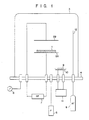
- Figs. l and 2 are schematic diagrams for explaining examples of manufacturing a magnetic recording medium according to the present invention, in which Fig. l is a diagram for explaining a case wherein a sublimating organic compound is evaporated inside a reaction chamber, and Fig. 2 is a diagram for explaining a case wherein an evaporated sublimating organic compound is introduced into the reaction chamber from the outside.
- a sublimating organic compound which exhibits a solid phase at room temperature and under atmospheric pressure is evaporated and a protective film is formed on the surface of the thin ferro-magnetic metal film by plasma polymerization of the evaporated sublimating organic compound.
- Examples of the sublimating organic compound which exhibits a solid phase at room temperature and under atmospheric pressure are: an aromatic hydrocarbon such as naphthalene, antracene, tetracene, pentacene, hexacene, perylene, phenanthrene, chrysene, triphenylene, pyrene, benzopyrene, violanthrene, furonene, or ovalene; a derivative thereof; an aliphatic-aromatic hydrocarbon such as diphenyl, diphenylmethane, dibenzyl, triphenylmethane, or terphenyl; a single derivative thereof; and a derivative mixture thereof.
- dibenzyl and diphenyl are preferable since they can be rapidly sublimated and have a high vapor pressure upon melting.
- a preferred protective film in the magnetic recording medium of the present invention will be described below.
- a protective film consisting of a polymerized film which is prepared by plasma polymerization using dibenzyl or diphenyl as the sublimating orga-nic compound a ratio (H/C) of the number of hydrogen atoms to the number of carbon atoms falls within the range of 0.8 to l.2, and its film thickness falls within the range of 50 to 600 ⁇ .
- the reason why the sublimating organic compound which exhibits a solid phase at room temperature and under atmospheric pressure is used as a material for preparing a protective film of the present invention by plasma polymerization is that the characteristics of a polymerized film are much superior to those of organic compounds which exhibit a liquid or gas phase at room temperature and under atmospheric pressure.
- the protective film of the present invention prepared by plasma polymerization has a small wear coefficient, and has excellent wear-resistance and durability, such that if there is frequently in contact with a magnetic head, its surface is not easily damaged.
- the reason why the film thickness of the protective film by plasma polymerization preferably falls within the range of 50 to 600 ⁇ is as follows. If the film thickness is below 50 ⁇ , the resultant film has a poor wear resistance. If the film thickness exceeds 600 ⁇ , a spacing loss is increased, and read out characteristics of recorded information are badly influenced.
- the present invention can be suited for a magnetic disk but can also be applied to various other magnetic recording media such as a magnetic tape, a floppy disk, a magnetic card, and the like.
- the magnetic disk When the present invention is applied to a magnetic disk, the magnetic disk is prepared as follows. A chemical plating under layer such as an Ni-P layer is formed on an aluminum substrate and the under layer surface is subjected to post-treatment such as polishing. Thereafter, a thin ferro-magnetic metal film such as Co base alloy is formed on the surface of the under layer by a physical or chemical technique. The resultant magnetic disk is set on an opposing electrode type plasma polymerization apparatus, as shown in Fig. l.
- reference numeral l denotes a magnetic disk body wherein the thin ferro-magnetic metal film is formed on the substrate surface; 2A and 2B, opposing electrodes; 3, a bell jar; 4, a table; 5, a vacuum pump for evacuating the interior of bell jar 3; 6, an absolute vacuum gauge; 7, an RF power source connected to electrodes 2A and 2B; 8, a carrier gas source; 9, a sublimating solid organic compound; l0, a resistance heater for sublimating solid organic compound 9; ll, a power source connected to resistance heater l0; and l2, a nozzle for introducing a carrier gas into bell jar 3.
- a plasma generation apparatus used herein is not only limited to the one illustrated in Fig. l but can be any reaction system comprising an RF oscillation apparatus of, e.g., an induction coil type, a waveguide tube type, or the like.
- sublimating solid organic compound 9 is placed on resistance heater l0, and a voltage is applied to heater l0 to sublimate the organic compound. Then, plasma polymerization is performed using the sublimated organic compound to form the protective film concerning the present invention on the thin ferro-magnetic metal film.
- the sublimating organic compound is used as one which exhibits a solid phase at room temperature and under atmospheric pressure, as described above.
- One or a mixture of these organic compounds is placed in the presence of an inert carrier gas such as argon, helium, or nitrogen, and plasma polymerization is performed.
- an inert carrier gas such as argon, helium, or nitrogen
- an energy density is maintained to fall within range of 0.2 to 4 W/cm2 and, more preferably, 0.5 to 3 W/cm2. and an output from the RF power source is to fall within the range of 30 to 500 W and more preferably l00 to 450 W, in accordance with the relationship between the RF power and a total electrode area.
- the RF power source normally has an oscillation frequency of l3.56 MHz. The present invention is not limited to this frequency. Any frequencies varying from a DC wave to a microwave can be used.
- the pressure inside the bell jar preferably falls within the range of 0.005 Torr to 3 Torr and, more preferably, 0.0l to l.5 Torr.
- a reaction time preferably falls within the range of 5 seconds to l0 minutes and, more preferably, l0 seconds to 3 minutes although it is influenced by the type of monomer, a sublimation rate, and arrangement of electrodes, and the like, thus obtaining a protective film having a desired film thickness.
- the thickness distribution of the obtained protective film normally falls within the range of l0 to l,000 ⁇ and, more preferably, 50 to 600 ⁇ .
- a protective film concerning the present invention was formed on the surface of a 5 ⁇ magnetic disk body on which a thin ferro-magnetic metal film was formed by the plasma polymerization method in the presence of diphenyl (C6H5C6H5) or dibenzyl (C6H5CH2CH2C6H5) as a sublimating solid organic compound, using the opposing electrode type plasma polymerization apparatus shown in Fig. l.
- stainless electrodes having a diameter of l30 mm were used and were separately held at a distance of 25 mm.
- a frequency of the RF power source was set at l3.56 MHz, and power was set at l00 or 200 W.
- Twelve milligrams of diphenyl having a melting point of 70°C or dibenzyl having a melting point of 52°C were placed on a tungsten boat as a monomer, and were sublimated upon application of a voltage of 5 V.
- argon gas As a carrier gas, pure argon gas or pure nitrogen gas was used, and a inside pressure of the bell jar was set at 0.l Torr. And any positive heating was not given to the said magnetic disk.
- the film thicknesses of these protective films were measured using a probe type film thickness gauge.
- the surfaces of the films were observed using an electron microscope, resulting the protective films had uniform surfaces without any pin holes.
- the CSS cycles of the resultant magnetic disks were tested using a CSS tester. Table l also shows these test results.
- the characteristic feature of the present invention is a method of causing the protective film obtained by plasma polymerization described above to be further subjected to a heat treatment. With this method, the resultant film can have a stronger structure, and a smoother surface, and the durability and wear-resistance particularly coefficient of friction can still be improved.
- a heating method can be any method that can transfer heat energy to the protective film, such as resistance heating, RF heating, laser heating, infrared heating, and the like.
- An atmosphere during heating can be vacuum or inert gas, or the outer atmosphere.
- a reactive medium atmosphere may be adopted as an atmosphere during heating, thereby still improving characteristics of the protective film.
- reaction medium atmosphere an atmosphere containing any one or a plurality of oxygen, hydrogen, nitrogen, can be used.
- a heating temperature falls within the range of 50 to 300°C and, more preferably, 80 to 250°C. If the heating temperature is too low, the film structure and its surface property cannot be improved. If the heating temperature is too high, the protective film and the thin ferro-magnetic metal film are badly influenced.
- the film thickness is also changed accordingly.
- a heat treatment is preferably performed to cause the ratio of change in film thickness to fall within the range of ⁇ 20%.
- a heat treatment time is short if the heating temperature is high. If the heating temperature is low, the heat treatment time is set to be long. Normal strictlyly, the heat treatment time falls within the range of l0 seconds to l20 minutes.
- Comparative Example 3 was not subjected to a heat treatment (Sample No. 6 in Table l).
- a thin ferro-magnetic metal film is formed on a substrate, a sublimating organic compound which exhibits a solid phase at room temperature and under atmospheric pressure is evaporated; then, a protective film is formed on the thin ferro-magnetic metal film by plasma polymerization using the evaporated organic compound.
- a plasma polymerization film is formed while heating the substrate.
- the heating temperature of a substrate preferably falls within the range of 50 to 300°C and, more preferably, to 80 to 250°C although it varies in accordance with the types of organic monomer and reaction conditions. If the heating temperature is below 50°C, a strong and smooth protective film cannot be obtained. If the heating temperature exceeds 300°C, the strength of adhesion with the thin ferro-magnetic metal film becomes low, and the hardness of the protective film is decreased.
- Protective films were prepared by the method of the present invention under the conditions shown in Table 3 using the plasma polymerization apparatus shown in Fig. l, and the performance of the resultant protective films was tested. Table 3 also shows the test results. Note that comparative Example 4 was not subjected to a heat treatment of a substrate (sample No. 6 in Table l).
- a protective film is formed on a thin ferro-magnetic metal film formed on a substrate by plasma polymerization while heating the substrate to a temperature of 50 to 300°C in the same manner as in method (B). Thereafter, a heat treatment of the protective film is performed at a temperature of 50 to 300°C, thereby obtaining a magnetic recording medium.
- Protective films were prepared using the reaction apparatus shown in Fig. l under the conditions given in Table 4.
- a monomer dibenzyl was used.
- the protective film was deposited on a 3.5 ⁇ diameter magnetic disk (Ni-Cr-Co alloy sputter type thin film recording layer).
- As a carrier gas pure argon gas was used.
- An inner pressure of a bell jar immediately before plasma polymerization was set at 0.l Torr.
- the resultant film thicknesses were given by the monomer amount. Evaporation of a monomer was performed by heating a small boat for evaporation to about 80°C. Table 4 also shows the results.
- As the anti-corrosion properties time from when the resultant magnetic recording medium was exposed to a 95%RH atmosphere at a temperature of 65°C until corrosion occurred is shown.
- a sublimating organic compound which exhibits a solid phase at room temperature and under atmospheric pressure is heated and evaporated in a closed chamber in advance, and a protective film is formed while introducing the evaporated organic compound into a plasma polymerization reaction chamber.
- This method has the following advantage. A monomer can be stably supplied under controlled conditions over a long period of time.
- FIG. 2 An example according to this method is shown in Fig. 2.
- opposing plasma generating flat RF electrodes 2A and 2B having a diameter of l30 mm are arranged in vacuum chamber 3.
- 5 ⁇ in diameter hard disk l as a magnetic memory disk is placed on the surface of electrode 2B.
- Monomer supply nozzle l3 and argon supply nozzle l2 for supplying argon gas as a carrier gas are arranged in vacuum chamber 3.
- the interior of vacuum chamber 3 was evacuated to a vacuum pressure using vacuum pump 5.
- 4 is a table and 6 is an absolute vacuum gauge.
- the monomer was sublimated and evaporated, and was supplied from monomer supply nozzle l3 through heating pipe l6 and flow meter l7.
- Argon gas 8 was supplied from argon gas supply nozzle l2 at a constant flow rate (20 cc/minute) through a pipe and flow meter l8.
- RF power source 7 was connected to electrodes 2A and 2B, so that a 200-W plasma output was generated around the electrodes at a frequency of l3.56 MHz.
- the protective film obtained by this method can have the same performance as that of the protective film obtained by Sample Nos. 5 to 7 in Table l as was aforementioned (a monomer generation source is arranged in a reaction chamber).
Landscapes
- Manufacturing Of Magnetic Record Carriers (AREA)
- Physical Vapour Deposition (AREA)
Applications Claiming Priority (10)
| Application Number | Priority Date | Filing Date | Title |
|---|---|---|---|
| JP8496686A JPH071545B2 (ja) | 1986-04-15 | 1986-04-15 | 磁気記録媒体用保護膜の製造方法 |
| JP84966/86 | 1986-04-15 | ||
| JP12764486A JPS62285224A (ja) | 1986-06-02 | 1986-06-02 | 磁気記録媒体の製造方法 |
| JP127644/86 | 1986-06-02 | ||
| JP217216/86 | 1986-09-17 | ||
| JP21721686A JPS6374120A (ja) | 1986-09-17 | 1986-09-17 | 磁気記録媒体の製造方法 |
| JP227988/86 | 1986-09-29 | ||
| JP22798886A JPS6383920A (ja) | 1986-09-29 | 1986-09-29 | 磁気記録媒体用保護膜の製造方法 |
| JP23445986A JPH0630147B2 (ja) | 1986-10-03 | 1986-10-03 | 磁気記録媒体の製造方法 |
| JP234459/86 | 1986-10-03 |
Publications (3)
| Publication Number | Publication Date |
|---|---|
| EP0243798A2 true EP0243798A2 (de) | 1987-11-04 |
| EP0243798A3 EP0243798A3 (en) | 1989-02-15 |
| EP0243798B1 EP0243798B1 (de) | 1991-01-02 |
Family
ID=27525119
Family Applications (1)
| Application Number | Title | Priority Date | Filing Date |
|---|---|---|---|
| EP87105572A Expired - Lifetime EP0243798B1 (de) | 1986-04-15 | 1987-04-15 | Magnetisches Aufzeichnungsmedium und Verfahren zu dessen Herstellung |
Country Status (4)
| Country | Link |
|---|---|
| US (1) | US4769281A (de) |
| EP (1) | EP0243798B1 (de) |
| KR (1) | KR870010492A (de) |
| DE (1) | DE3766872D1 (de) |
Cited By (2)
| Publication number | Priority date | Publication date | Assignee | Title |
|---|---|---|---|---|
| GB2240113A (en) * | 1990-01-02 | 1991-07-24 | Shell Int Research | Preparation of adsorbent carbonaceous layers |
| EP1406249A4 (de) * | 2001-05-08 | 2004-11-17 | Fujitsu Ltd | Verfahren zur herstellung eines magnetaufzeichnungsmediums |
Families Citing this family (5)
| Publication number | Priority date | Publication date | Assignee | Title |
|---|---|---|---|---|
| US4981713A (en) * | 1990-02-14 | 1991-01-01 | E. I. Du Pont De Nemours And Company | Low temperature plasma technology for corrosion protection of steel |
| US5186899A (en) * | 1990-11-13 | 1993-02-16 | Drago Thomas E | Fixture for supporting a refrigerant sampling tube in a closed system |
| US11898248B2 (en) * | 2019-12-18 | 2024-02-13 | Jiangsu Favored Nanotechnology Co., Ltd. | Coating apparatus and coating method |
| US12170189B2 (en) | 2019-12-18 | 2024-12-17 | Jiangsu Favored Nanotechnology Co., Ltd. | Coating apparatus and coating method |
| CN113774363A (zh) * | 2020-06-09 | 2021-12-10 | 江苏菲沃泰纳米科技股份有限公司 | 镀膜设备及其镀膜方法 |
Family Cites Families (9)
| Publication number | Priority date | Publication date | Assignee | Title |
|---|---|---|---|---|
| DE3024918A1 (de) * | 1979-07-02 | 1981-01-22 | Fuji Photo Film Co Ltd | Magnetisches aufzeichnungsmaterial und verfahren zu dessen herstellung |
| JPS5829119A (ja) * | 1981-08-14 | 1983-02-21 | Shin Etsu Chem Co Ltd | 帯電防止性磁気テ−プ |
| JPS59160828A (ja) * | 1983-03-01 | 1984-09-11 | Fuji Photo Film Co Ltd | 磁気記録媒体 |
| JPS60121526A (ja) * | 1983-12-06 | 1985-06-29 | Olympus Optical Co Ltd | 磁気記録媒体 |
| US4693927A (en) * | 1984-03-19 | 1987-09-15 | Fuji Photo Film Company Limited | Magnetic recording medium and process for producing the same |
| US4552820A (en) * | 1984-04-25 | 1985-11-12 | Lin Data Corporation | Disc media |
| JPS6168725A (ja) * | 1984-09-10 | 1986-04-09 | Shin Etsu Chem Co Ltd | 磁気記録媒体およびその製造方法 |
| US4554217A (en) * | 1984-09-20 | 1985-11-19 | Verbatim Corporation | Process for creating wear and corrosion resistant film for magnetic recording media |
| JPS61213221A (ja) * | 1985-03-19 | 1986-09-22 | Japan Synthetic Rubber Co Ltd | プラズマ重合膜の製法 |
-
1987
- 1987-04-10 US US07/036,791 patent/US4769281A/en not_active Expired - Lifetime
- 1987-04-14 KR KR870003571A patent/KR870010492A/ko not_active Ceased
- 1987-04-15 EP EP87105572A patent/EP0243798B1/de not_active Expired - Lifetime
- 1987-04-15 DE DE8787105572T patent/DE3766872D1/de not_active Expired - Fee Related
Cited By (3)
| Publication number | Priority date | Publication date | Assignee | Title |
|---|---|---|---|---|
| GB2240113A (en) * | 1990-01-02 | 1991-07-24 | Shell Int Research | Preparation of adsorbent carbonaceous layers |
| EP1406249A4 (de) * | 2001-05-08 | 2004-11-17 | Fujitsu Ltd | Verfahren zur herstellung eines magnetaufzeichnungsmediums |
| US7258893B2 (en) | 2001-05-08 | 2007-08-21 | Fujitsu Limited | Method of fabricating a magnetic recording medium |
Also Published As
| Publication number | Publication date |
|---|---|
| EP0243798A3 (en) | 1989-02-15 |
| DE3766872D1 (de) | 1991-02-07 |
| US4769281A (en) | 1988-09-06 |
| EP0243798B1 (de) | 1991-01-02 |
| KR870010492A (ko) | 1987-11-30 |
Similar Documents
| Publication | Publication Date | Title |
|---|---|---|
| EP0230911B1 (de) | Magnetisches Aufzeichnungsmedium | |
| US5397644A (en) | Magnetic disk having a sputtered hydrogen-doped carbon protective film | |
| US4713288A (en) | Magnetic recording medium | |
| KR940002327B1 (ko) | 강자성의 금속박막 자기 기록 매체 및 그 제조방법 | |
| EP0243798B1 (de) | Magnetisches Aufzeichnungsmedium und Verfahren zu dessen Herstellung | |
| US4749608A (en) | Magnetic recording medium | |
| US4873138A (en) | Metallic thin film type magnetic recording medium | |
| US4816341A (en) | Magnetic recording medium | |
| US5989673A (en) | Caromium-tantalum oxides (Cr-TaOx), sputtering targets and thin film seedlayer/sublayers for thin film magnetic recording media | |
| US4803130A (en) | Reactive sputtering process for recording media | |
| EP0216079B1 (de) | Herstellung eines Kohlenstoffüberzuges und dessen Verwendung | |
| US5288543A (en) | Protective film on sliding members and method of forming same | |
| US4533603A (en) | Magnetic recording medium | |
| US5744234A (en) | Magnetic recording medium | |
| EP0655733B1 (de) | Magnetischer Aufzeichnungsträger und Verfahren zu seiner Herstellung | |
| JPH01257198A (ja) | ダイヤモンド状炭素膜のコーディング方法 | |
| JPS60121526A (ja) | 磁気記録媒体 | |
| JPH071545B2 (ja) | 磁気記録媒体用保護膜の製造方法 | |
| JPS62287421A (ja) | 磁気デイスク用保護膜の製造装置 | |
| JPH11189876A (ja) | 成膜装置および磁気記録媒体の製造方法 | |
| JPS6383920A (ja) | 磁気記録媒体用保護膜の製造方法 | |
| JPH02273319A (ja) | 磁気ディスク用保護膜の製造装置 | |
| JPS63183617A (ja) | 磁気記録媒体 | |
| JPH11158638A (ja) | 炭素薄膜の製造方法 | |
| JPS62262228A (ja) | 磁気記録媒体用保護膜の製造方法 |
Legal Events
| Date | Code | Title | Description |
|---|---|---|---|
| PUAI | Public reference made under article 153(3) epc to a published international application that has entered the european phase |
Free format text: ORIGINAL CODE: 0009012 |
|
| AK | Designated contracting states |
Kind code of ref document: A2 Designated state(s): DE FR GB NL |
|
| PUAL | Search report despatched |
Free format text: ORIGINAL CODE: 0009013 |
|
| AK | Designated contracting states |
Kind code of ref document: A3 Designated state(s): DE FR GB NL |
|
| 17P | Request for examination filed |
Effective date: 19890605 |
|
| 17Q | First examination report despatched |
Effective date: 19891120 |
|
| GRAA | (expected) grant |
Free format text: ORIGINAL CODE: 0009210 |
|
| AK | Designated contracting states |
Kind code of ref document: B1 Designated state(s): DE FR GB NL |
|
| ET | Fr: translation filed | ||
| REF | Corresponds to: |
Ref document number: 3766872 Country of ref document: DE Date of ref document: 19910207 |
|
| PLBE | No opposition filed within time limit |
Free format text: ORIGINAL CODE: 0009261 |
|
| STAA | Information on the status of an ep patent application or granted ep patent |
Free format text: STATUS: NO OPPOSITION FILED WITHIN TIME LIMIT |
|
| 26N | No opposition filed | ||
| PGFP | Annual fee paid to national office [announced via postgrant information from national office to epo] |
Ref country code: DE Payment date: 20000410 Year of fee payment: 14 |
|
| PGFP | Annual fee paid to national office [announced via postgrant information from national office to epo] |
Ref country code: FR Payment date: 20000411 Year of fee payment: 14 |
|
| PGFP | Annual fee paid to national office [announced via postgrant information from national office to epo] |
Ref country code: GB Payment date: 20000412 Year of fee payment: 14 |
|
| PGFP | Annual fee paid to national office [announced via postgrant information from national office to epo] |
Ref country code: NL Payment date: 20000428 Year of fee payment: 14 |
|
| PG25 | Lapsed in a contracting state [announced via postgrant information from national office to epo] |
Ref country code: GB Free format text: LAPSE BECAUSE OF NON-PAYMENT OF DUE FEES Effective date: 20010415 |
|
| PG25 | Lapsed in a contracting state [announced via postgrant information from national office to epo] |
Ref country code: FR Free format text: THE PATENT HAS BEEN ANNULLED BY A DECISION OF A NATIONAL AUTHORITY Effective date: 20010430 |
|
| PG25 | Lapsed in a contracting state [announced via postgrant information from national office to epo] |
Ref country code: NL Free format text: LAPSE BECAUSE OF NON-PAYMENT OF DUE FEES Effective date: 20011101 |
|
| GBPC | Gb: european patent ceased through non-payment of renewal fee |
Effective date: 20010415 |
|
| NLV4 | Nl: lapsed or anulled due to non-payment of the annual fee |
Effective date: 20011101 |
|
| PG25 | Lapsed in a contracting state [announced via postgrant information from national office to epo] |
Ref country code: DE Free format text: LAPSE BECAUSE OF NON-PAYMENT OF DUE FEES Effective date: 20020201 |
|
| REG | Reference to a national code |
Ref country code: FR Ref legal event code: ST |