EP0243220B1 - Verfahren und Vorrichtung zur Ultraschallextraktion von ölhaltigen Stoffen aus ölhaltigen Saaten - Google Patents
Verfahren und Vorrichtung zur Ultraschallextraktion von ölhaltigen Stoffen aus ölhaltigen Saaten Download PDFInfo
- Publication number
- EP0243220B1 EP0243220B1 EP87400614A EP87400614A EP0243220B1 EP 0243220 B1 EP0243220 B1 EP 0243220B1 EP 87400614 A EP87400614 A EP 87400614A EP 87400614 A EP87400614 A EP 87400614A EP 0243220 B1 EP0243220 B1 EP 0243220B1
- Authority
- EP
- European Patent Office
- Prior art keywords
- solvent
- seeds
- extraction
- treatment
- oil
- Prior art date
- Legal status (The legal status is an assumption and is not a legal conclusion. Google has not performed a legal analysis and makes no representation as to the accuracy of the status listed.)
- Expired - Lifetime
Links
- 238000000034 method Methods 0.000 title claims abstract description 40
- 230000008569 process Effects 0.000 title claims abstract description 30
- 238000002137 ultrasound extraction Methods 0.000 title 1
- 239000002904 solvent Substances 0.000 claims abstract description 82
- 238000000605 extraction Methods 0.000 claims abstract description 39
- 238000011282 treatment Methods 0.000 claims abstract description 17
- 238000005406 washing Methods 0.000 claims abstract description 12
- 238000009210 therapy by ultrasound Methods 0.000 claims abstract description 9
- 238000005507 spraying Methods 0.000 claims abstract description 7
- 239000000463 material Substances 0.000 claims abstract description 6
- 238000003756 stirring Methods 0.000 claims abstract description 6
- VLKZOEOYAKHREP-UHFFFAOYSA-N n-Hexane Chemical compound CCCCCC VLKZOEOYAKHREP-UHFFFAOYSA-N 0.000 claims description 30
- CURLTUGMZLYLDI-UHFFFAOYSA-N Carbon dioxide Chemical compound O=C=O CURLTUGMZLYLDI-UHFFFAOYSA-N 0.000 claims description 8
- 238000011144 upstream manufacturing Methods 0.000 claims description 6
- 238000004821 distillation Methods 0.000 claims description 5
- 239000012530 fluid Substances 0.000 claims description 5
- 229910002092 carbon dioxide Inorganic materials 0.000 claims description 4
- 239000001569 carbon dioxide Substances 0.000 claims description 4
- 238000004064 recycling Methods 0.000 claims description 3
- 238000000638 solvent extraction Methods 0.000 claims 1
- 239000003921 oil Substances 0.000 description 43
- 235000019198 oils Nutrition 0.000 description 43
- 238000000227 grinding Methods 0.000 description 6
- 238000007731 hot pressing Methods 0.000 description 6
- 238000007654 immersion Methods 0.000 description 6
- 239000000203 mixture Substances 0.000 description 6
- 238000002604 ultrasonography Methods 0.000 description 6
- 238000005325 percolation Methods 0.000 description 5
- 238000013019 agitation Methods 0.000 description 4
- 230000008901 benefit Effects 0.000 description 4
- 238000010411 cooking Methods 0.000 description 4
- 238000000926 separation method Methods 0.000 description 4
- 239000007921 spray Substances 0.000 description 4
- UHOVQNZJYSORNB-UHFFFAOYSA-N Benzene Chemical compound C1=CC=CC=C1 UHOVQNZJYSORNB-UHFFFAOYSA-N 0.000 description 3
- QGJOPFRUJISHPQ-UHFFFAOYSA-N Carbon disulfide Chemical compound S=C=S QGJOPFRUJISHPQ-UHFFFAOYSA-N 0.000 description 3
- 238000004140 cleaning Methods 0.000 description 3
- 238000009434 installation Methods 0.000 description 3
- 238000007670 refining Methods 0.000 description 3
- 230000000295 complement effect Effects 0.000 description 2
- 230000007423 decrease Effects 0.000 description 2
- 230000000694 effects Effects 0.000 description 2
- 239000003925 fat Substances 0.000 description 2
- 235000019197 fats Nutrition 0.000 description 2
- 235000012054 meals Nutrition 0.000 description 2
- 238000011084 recovery Methods 0.000 description 2
- 238000007789 sealing Methods 0.000 description 2
- 238000003860 storage Methods 0.000 description 2
- JHQIPSUBSIYUNS-UHFFFAOYSA-N 3-ethenyl-1,3-oxazolidine-2-thione Chemical compound C=CN1CCOC1=S JHQIPSUBSIYUNS-UHFFFAOYSA-N 0.000 description 1
- 241000208838 Asteraceae Species 0.000 description 1
- 240000002791 Brassica napus Species 0.000 description 1
- 235000004977 Brassica sinapistrum Nutrition 0.000 description 1
- 102000004190 Enzymes Human genes 0.000 description 1
- 108090000790 Enzymes Proteins 0.000 description 1
- 241000208818 Helianthus Species 0.000 description 1
- 235000003222 Helianthus annuus Nutrition 0.000 description 1
- OYHQOLUKZRVURQ-HZJYTTRNSA-N Linoleic acid Chemical compound CCCCC\C=C/C\C=C/CCCCCCCC(O)=O OYHQOLUKZRVURQ-HZJYTTRNSA-N 0.000 description 1
- CDBYLPFSWZWCQE-UHFFFAOYSA-L Sodium Carbonate Chemical compound [Na+].[Na+].[O-]C([O-])=O CDBYLPFSWZWCQE-UHFFFAOYSA-L 0.000 description 1
- 235000019486 Sunflower oil Nutrition 0.000 description 1
- XSTXAVWGXDQKEL-UHFFFAOYSA-N Trichloroethylene Chemical group ClC=C(Cl)Cl XSTXAVWGXDQKEL-UHFFFAOYSA-N 0.000 description 1
- 230000009471 action Effects 0.000 description 1
- 238000004061 bleaching Methods 0.000 description 1
- 230000015556 catabolic process Effects 0.000 description 1
- 230000008859 change Effects 0.000 description 1
- 230000006835 compression Effects 0.000 description 1
- 238000007906 compression Methods 0.000 description 1
- 238000006731 degradation reaction Methods 0.000 description 1
- 230000001627 detrimental effect Effects 0.000 description 1
- 238000004090 dissolution Methods 0.000 description 1
- 239000013013 elastic material Substances 0.000 description 1
- 230000002349 favourable effect Effects 0.000 description 1
- 239000000835 fiber Substances 0.000 description 1
- 235000013305 food Nutrition 0.000 description 1
- 230000005484 gravity Effects 0.000 description 1
- 238000000265 homogenisation Methods 0.000 description 1
- 150000002540 isothiocyanates Chemical class 0.000 description 1
- OYHQOLUKZRVURQ-IXWMQOLASA-N linoleic acid Natural products CCCCC\C=C/C\C=C\CCCCCCCC(O)=O OYHQOLUKZRVURQ-IXWMQOLASA-N 0.000 description 1
- 235000020778 linoleic acid Nutrition 0.000 description 1
- 238000012423 maintenance Methods 0.000 description 1
- 238000010297 mechanical methods and process Methods 0.000 description 1
- 238000009996 mechanical pre-treatment Methods 0.000 description 1
- 230000005226 mechanical processes and functions Effects 0.000 description 1
- 238000002156 mixing Methods 0.000 description 1
- 238000012986 modification Methods 0.000 description 1
- 230000004048 modification Effects 0.000 description 1
- 238000006386 neutralization reaction Methods 0.000 description 1
- 230000003647 oxidation Effects 0.000 description 1
- 238000007254 oxidation reaction Methods 0.000 description 1
- 150000002978 peroxides Chemical class 0.000 description 1
- 238000003825 pressing Methods 0.000 description 1
- 102000004169 proteins and genes Human genes 0.000 description 1
- 108090000623 proteins and genes Proteins 0.000 description 1
- 238000010791 quenching Methods 0.000 description 1
- 230000000717 retained effect Effects 0.000 description 1
- 238000002791 soaking Methods 0.000 description 1
- 239000011877 solvent mixture Substances 0.000 description 1
- 239000000126 substance Substances 0.000 description 1
- 239000002600 sunflower oil Substances 0.000 description 1
- 239000004094 surface-active agent Substances 0.000 description 1
- 231100000331 toxic Toxicity 0.000 description 1
- 230000002588 toxic effect Effects 0.000 description 1
- 230000009466 transformation Effects 0.000 description 1
- XLYOFNOQVPJJNP-UHFFFAOYSA-N water Substances O XLYOFNOQVPJJNP-UHFFFAOYSA-N 0.000 description 1
Images

Classifications
-
- C—CHEMISTRY; METALLURGY
- C11—ANIMAL OR VEGETABLE OILS, FATS, FATTY SUBSTANCES OR WAXES; FATTY ACIDS THEREFROM; DETERGENTS; CANDLES
- C11B—PRODUCING, e.g. BY PRESSING RAW MATERIALS OR BY EXTRACTION FROM WASTE MATERIALS, REFINING OR PRESERVING FATS, FATTY SUBSTANCES, e.g. LANOLIN, FATTY OILS OR WAXES; ESSENTIAL OILS; PERFUMES
- C11B1/00—Production of fats or fatty oils from raw materials
- C11B1/10—Production of fats or fatty oils from raw materials by extracting
- C11B1/106—Production of fats or fatty oils from raw materials by extracting using ultra-sounds
-
- B—PERFORMING OPERATIONS; TRANSPORTING
- B01—PHYSICAL OR CHEMICAL PROCESSES OR APPARATUS IN GENERAL
- B01D—SEPARATION
- B01D11/00—Solvent extraction
- B01D11/02—Solvent extraction of solids
- B01D11/0203—Solvent extraction of solids with a supercritical fluid
-
- B—PERFORMING OPERATIONS; TRANSPORTING
- B01—PHYSICAL OR CHEMICAL PROCESSES OR APPARATUS IN GENERAL
- B01D—SEPARATION
- B01D11/00—Solvent extraction
- B01D11/02—Solvent extraction of solids
- B01D11/0215—Solid material in other stationary receptacles
- B01D11/0223—Moving bed of solid material
- B01D11/023—Moving bed of solid material using moving bands, trays fixed on moving transport chains
-
- B—PERFORMING OPERATIONS; TRANSPORTING
- B01—PHYSICAL OR CHEMICAL PROCESSES OR APPARATUS IN GENERAL
- B01D—SEPARATION
- B01D11/00—Solvent extraction
- B01D11/02—Solvent extraction of solids
- B01D11/0261—Solvent extraction of solids comprising vibrating mechanisms, e.g. mechanical, acoustical
- B01D11/0265—Applying ultrasound
-
- B—PERFORMING OPERATIONS; TRANSPORTING
- B01—PHYSICAL OR CHEMICAL PROCESSES OR APPARATUS IN GENERAL
- B01J—CHEMICAL OR PHYSICAL PROCESSES, e.g. CATALYSIS OR COLLOID CHEMISTRY; THEIR RELEVANT APPARATUS
- B01J19/00—Chemical, physical or physico-chemical processes in general; Their relevant apparatus
- B01J19/08—Processes employing the direct application of electric or wave energy, or particle radiation; Apparatus therefor
- B01J19/10—Processes employing the direct application of electric or wave energy, or particle radiation; Apparatus therefor employing sonic or ultrasonic vibrations
Definitions
- the subject of the present invention is a process for extracting oil and fat present in oil seeds using ultrasonic waves in the presence of a solvent, as well as the associated device.
- oil will be defined as comprising oil and fats.
- the hot pressing process is a mechanical and thermal process which has the drawback of bringing the oil thus extracted to a relatively high temperature detrimental to its quality and of requiring further complementary treatments.
- Another disadvantage of this process is that it consumes a great deal of energy, in particular heat energy in the so-called "cooking" phase.
- the hot pressing method essentially comprises a prior grinding step, a first pressing, a second grinding followed by chemical extraction by percolation. It is therefore understandable that the mechanical equipment is very busy and that it requires significant maintenance.
- This process provides for passing the cake after the first extraction into a solvent bath, this bath being subjected to the action of ultrasonic waves emitted by intrusive transducers placed on the wall of the tank containing the bath, these transducers being arranged such that the ultrasonic waves intersect at right angles.
- Such a process is therefore complementary to a main extraction carried out according to a conventional operating mode and the residual oil recovered by cleaning the cake using ultrasound was previously brought to high temperatures and the quality of the oil recovered. makes subsequent treatments necessary.
- this method of processing an oil cake in a tank has the drawback of high consumption of ultrasonic energy and poor propagation since the volumes are large and the oil mixed with the solvent attenuates ultrasonic energy.
- the object of the present invention is therefore to propose an extraction process which overcomes these drawbacks and which reduces the amount of energy required while improving the mass ratio of seeds treated / quantity of energy consumed for a mass of oil. extracted.
- This process is further characterized in that the treatment of the seeds is grinding and / or flattening.
- the ultrasonic treatment is carried out by passing the cake and the solvent through a tube comprising two transducers in the form of diametrically opposite plates; the solvent can be hexane or a fluid in the super-critical state such as carbon dioxide.
- the washing comprises at least one spray, the miscella being recycled from downstream to upstream.
- the method is also characterized in that one works under pressure when one uses a super-critical fluid so that the solvent remains in the super-critical state and / or that one works in vacuum when a volatile solvent is used in order to limit leaks to the outside from the extractor for safety purposes.
- the associated device comprises a mechanical working unit, a sealed supply of seeds previously treated mechanically, an extraction tank with mixer, a continuous ultrasonic treatment unit consisting of a tube comprising at least one set of diametrically opposed ultrasonic transducers. , a solvent supply, a washing unit consisting of at least one conveyor, at least one solvent spraying ramp and at least one recycling circuit, a watertight discharge of the miscella, a watertight discharge of the cake residual.
- the isolated extraction enclosure when using a volatile solvent withstands a slight vacuum up to 0.8 bar.
- the mechanical working unit comprises rollers with a smooth surface and an adjustable center distance in the case of flattening and / or rollers with a grooved surface in the case of grinding.
- Figure 1 the device 1 according to the invention which comprises a supply of oil seeds symbolized by the arrow 2, these dry oil seeds being directed into a mechanical processing means 3 consisting of two rollers 4 and 5 whose spacing can be adjusted so that the spacing between the surfaces of the roller is adjustable with great precision, these rollers being conventionally driven counter-rotationally.
- the surface of these rollers is smooth in the case of a flattening and has a grooved shape during grinding.
- the evacuation is carried out by gravity through the conduit 6, which is provided with a non-return device 7 so as to eliminate any leakage to the outside from the insulating enclosure 8 shown in phantom.
- This enclosure must also be resistant to pressure in the case of the implementation of the process using a super-critical fluid as solvent and the seals will also be provided for a slight internal depression in the case where the implementation provides for a volatile solvent in this case we can reach depressions between 0.8 and 1 bar.
- this evacuation 6 and the non-return device 7 can be easily replaced by a conveyor using an Archimedes screw whose variable pitch allows the punctual compression of the material thus creating a sealing plug .
- the evacuation 6 therefore feeds a tank 9 containing solvent 10, the seed plus solvent assembly being agitated, using a mixer 11.
- the tank 9 is permanently supplied with solvent by the pipe 12 itself connected to the solvent tank 13 outside the enclosure 8. This supply of solvent is intended to compensate for the volume of solvent discharged via the strainer 14 located at the bottom of the tank 9, the first miscella then being transferred via of the pipe 15.
- This tank 9 is also provided with an outlet 16 through which the seed-solvent mixture is sucked by means of the pump 17, the latter pushing the solvent plus seed assembly up to the separation station 18 provided with a sieve 19 through which another part of the miscella flows while the seeds retained on the sieve are pushed into the ultrasonic device 21.
- the miscella is evacuated via the line 20 q ui joins the evacuation pipe 15.
- a supply of clean solvent 22 intended to replace the miscella which has just been evacuated and so that the medium is conductive of the ultrasonic waves.
- the ultrasonic device comprises at least one pair of plates such as 23, 24, diametrically opposite, these plates being ultrasonic transducers conventionally connected to a generator (not shown). Similarly, there is shown a second set of plates 25, 26 equivalent to the first and playing the same role.
- the solvent cake mixture is then evacuated via the pipe 27 to a conveyor 28 of the movable belt type, the belt being for example made up of a wire mesh or a strip provided with perforations. The evacuation being ensured by the pump 170.
- An equalization rule 29 is fixed on the carrier frame.
- Spray bars 30, 31, 32 and 33 are arranged over the entire length of the conveyor 28 so that they can water the cake over the entire length of the conveyor. Washing takes place from downstream to upstream, provision is made for the spraying 30 to be directly supplied with the solvent coming from the reservoir 13. This solvent recovered by a tank 34 located at the bottom of the conveyor 28 recovers the solvent loaded with oil by the first rinse.
- a pump 35 has the role of transferring this solvent to the spraying boom 31 located upstream of the boom 30, the solvent plus oil mixture then being recovered by the tank 36 this mixture being pumped by the pump 37 to supply the spray boom 32 located upstream of the boom 31, the solvent plus oil mixture again loaded with oil is collected by the tank 38 and pumped via the pump 39 which feeds the spray boom 33 located upstream of the ramp 32, that is to say at the head of the conveyor 28, the final miscella then being collected by the tank 40 and discharged onto the central collection line 41 provided with a pump 42 located outside the enclosure 8.
- the cake is then discharged through the end of the conveyor into the feed hopper 43 of a screw conveyor 44 with variable pitch, the latter being reduced as the enclosure 8 passes so as to create a sealing plug in 45.
- the cake is then evacuated as indicated by arrow 46 at the outlet of the screw conveyor towards a device making it possible to recover the solvent of the desolvator type.
- the miscella pumped through the pump 42 is treated by a distillation tower 47 which aims to separate the solvent from the oil, the latter being evacuated at 48 to a usual refining device while that the solvent is recycled at 49 to the storage tank 13.
- the method according to the invention consists in treating the seeds mechanically in 3 to give each seed a flattened configuration so as to increase its contact surface.
- This flattening can optionally be followed by a grinding which has the effect of increasing this contact surface but which has the drawback of "stuffing" the device, which makes it necessary to provide a means of cleaning.
- the seeds are then introduced into the tray 9 filled with solvent via the line 12 while the mixer 11 ensures mixing of the assembly so that the agitation promotes the first extraction.
- the latter consists in extracting the free oil from the oil seeds by dissolving the oil in the solvent.
- This extraction is a function of time and it is accepted that to obtain an extraction rate of approximately 80% it is necessary that the seed remains in contact with the solvent for a time interval of the order of 10 minutes. It is understood that the efficiency is a function of the intensity of the mixture and that by increasing the agitation, the extraction is favored, the calculation of the most favorable ratio being within the reach of the skilled person.
- partial evacuation of the solvent loaded with oil is provided so that it can be recycled as quickly as possible.
- the other part of the miscella and seeds is pumped to be sent to a separation section in which a grid allows the miscella to be removed while retaining the partially designated seeds.
- the seeds are conducted in an ultrasonic device while being sprayed with clean solvent.
- the actual ultrasonic transmitter the frequency of which varies between 10 and 50 kHz, consists of two plates playing the role of diametrically opposite transducers. The role of ultrasound is then not to rinse but to break the inextractable, that is to say to extract the residual oil.
- the miscella obtained is then discharged at the same time as the cake, to lead to a perforated conveyor belt 28, the latter initially separating the miscella which it discharges at 40 and the cake which it is necessary to rinse in order to recover all of the oil extracted.
- the method provides for equalizing a regular layer of cake which is subjected to a sprinkling of solvent less and less loaded with oil so that the last washing is carried out with clean solvent directly from the tank. storage 13 via the ramp 30.
- the oiled cake is then removed via the screw conveyor 44 to a desolvent so as to recover the solvent absorbed by the cake. All of the miscellas collected from lines 15, 20 and 21 are pumped into a distillation unit outside the enclosure, which separates the oil from the solvent, which is then recycled.
- the solvent used is a food grade solvent, hexane. It is understood that the effects of the solvent are improved by increasing the temperature. This is how this particular embodiment gives an optimum with hexane heated between 50 and 55 ° .
- the present process can also be used with super-critical solvents such as carbon dioxide taken under its super-critical conditions, that is to say 73 bars of pressure at 31.3 ° C. Indeed, the solubility of the oils is increased and the density is 0.468 gram per cubic centimeter while the viscosity decreases considerably compared to the viscosity of a conventional solvent.
- This process can be improved by a preliminary treatment of the seeds, consisting of husking. It has thus been shown that, on a rate of 25% of hulls, by removing 15%, the protein content of the meal obtained goes from 30% to 40%. Likewise, the oil obtained with prior husking has in its final composition less wax, which leads to a simplified refining and therefore less costly.
- the ultrasonic efficiency is also improved by the fact that the shells behave like an "elastic material", the ultrasounds are less absorbed and more effective on the cells containing the oil. Furthermore, it will be noted that the quantity of solvent required is reduced by the same amount since the volume of solvent absorbed by the shells is eliminated.
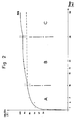
- FIG. 2 represents an extraction curve according to the invention in which the seeds are subjected to a stay of 10 minutes in the extraction tank 9, these same seeds being consecutively subjected to an ultrasonic treatment of 20 minutes.
- Part B of the curve represents the extraction curve using ultrasound and after 20 minutes the value of 93.83% of extraction is reached.
- Part C of the curve then represents the additional extraction obtained by washing the cake, which leads to a 99% extraction rate after 15 minutes of washing.
- the meal does not contain toxic products such as isothiocyanate or vinyloxazolidinethione resulting from transformation by an enzyme, mirinase which acts during cooking.
- the oleaginous products obtained are of very good quality since they contain much less peroxide and the secondary oxidation products are completely absent which is of great interest in the case of sunflower oil containing 60% linoleic acid.
- the products obtained at the end of the process are light in color, which moreover requires less bleaching earth during refining.
- the acidity rate is lower which leads to lower amounts of soda for neutralization.
- the invention has an additional advantage as regards the operating coefficient proportional to the availability of the material. It is known in conventional processes of the hot pressing type when the installation is stopped for a few minutes for a reason such as a power cut that there are risks of jamming at the level of the screw which most often require a complete cleaning of the barrel screw before restarting because the already high-capacity drive motors cannot overcome clogging.
Landscapes
- Chemical & Material Sciences (AREA)
- Chemical Kinetics & Catalysis (AREA)
- Organic Chemistry (AREA)
- Physics & Mathematics (AREA)
- Acoustics & Sound (AREA)
- Engineering & Computer Science (AREA)
- Life Sciences & Earth Sciences (AREA)
- Toxicology (AREA)
- Health & Medical Sciences (AREA)
- Mechanical Engineering (AREA)
- Oil, Petroleum & Natural Gas (AREA)
- Wood Science & Technology (AREA)
- General Health & Medical Sciences (AREA)
- Fats And Perfumes (AREA)
- Extraction Or Liquid Replacement (AREA)
- Pretreatment Of Seeds And Plants (AREA)
- Preparation Of Compounds By Using Micro-Organisms (AREA)
- Compounds Of Unknown Constitution (AREA)
- Saccharide Compounds (AREA)
- Nonmetallic Welding Materials (AREA)
- Photographic Processing Devices Using Wet Methods (AREA)
Claims (18)
Priority Applications (1)
| Application Number | Priority Date | Filing Date | Title |
|---|---|---|---|
| AT87400614T ATE55147T1 (de) | 1986-03-20 | 1987-03-19 | Verfahren und vorrichtung zur ultraschallextraktion von oelhaltigen stoffen aus oelhaltigen saaten. |
Applications Claiming Priority (2)
| Application Number | Priority Date | Filing Date | Title |
|---|---|---|---|
| FR8604143A FR2596060B1 (fr) | 1986-03-20 | 1986-03-20 | Extraction d'huile de graines oleagineuses par ultrasons |
| FR8604143 | 1986-03-20 |
Publications (2)
| Publication Number | Publication Date |
|---|---|
| EP0243220A1 EP0243220A1 (de) | 1987-10-28 |
| EP0243220B1 true EP0243220B1 (de) | 1990-08-01 |
Family
ID=9333440
Family Applications (1)
| Application Number | Title | Priority Date | Filing Date |
|---|---|---|---|
| EP87400614A Expired - Lifetime EP0243220B1 (de) | 1986-03-20 | 1987-03-19 | Verfahren und Vorrichtung zur Ultraschallextraktion von ölhaltigen Stoffen aus ölhaltigen Saaten |
Country Status (15)
| Country | Link |
|---|---|
| EP (1) | EP0243220B1 (de) |
| JP (1) | JPS62232499A (de) |
| CN (1) | CN1009941B (de) |
| AT (1) | ATE55147T1 (de) |
| BR (1) | BR8701265A (de) |
| DE (1) | DE3764011D1 (de) |
| EG (1) | EG18006A (de) |
| ES (1) | ES2014955B3 (de) |
| FR (1) | FR2596060B1 (de) |
| GR (1) | GR3000992T3 (de) |
| IL (1) | IL81953A0 (de) |
| IN (1) | IN171343B (de) |
| OA (1) | OA08502A (de) |
| PT (1) | PT84522B (de) |
| ZA (1) | ZA872035B (de) |
Cited By (1)
| Publication number | Priority date | Publication date | Assignee | Title |
|---|---|---|---|---|
| WO2020146295A1 (en) * | 2019-01-11 | 2020-07-16 | Gildrien Farm. Llc | A method of extracting one or more chemical extracts from a plant product |
Families Citing this family (23)
| Publication number | Priority date | Publication date | Assignee | Title |
|---|---|---|---|---|
| DE4416135A1 (de) * | 1994-05-06 | 1995-11-09 | Theis Hansch Gerhard | Verfahren zur Herstellung eines Extraktes von insektenblütigem, gehöseltem Pollen mit Ultraschall |
| JP2009519357A (ja) * | 2005-12-13 | 2009-05-14 | 蘭欽 楊 | 水浸出法による植物油脂、植物粗蛋白及び植物繊維の調製方法 |
| AR059659A1 (es) * | 2006-01-13 | 2008-04-23 | Alfa Copenhagen S S | Metodo para la extraccion |
| US8697138B2 (en) | 2007-03-28 | 2014-04-15 | Aker Biomarine As | Methods of using krill oil to treat risk factors for cardiovascular, metabolic, and inflammatory disorders |
| EP2144618B2 (de) | 2007-03-28 | 2024-11-20 | Aker Biomarine Antarctic As | Biologisch wirksame krill-öl-zusammensetzungen |
| ES2327308B1 (es) * | 2007-12-26 | 2010-07-26 | Instituto Andaluz De Investigacion Y Formacion Agraria, Pesquera, Alimentaria Y De La Produccion E. | Aparato y procedimiento para el calentamiento en continuo y uniforme de masa de aceituna molida por ultrasonidos. |
| US8372812B2 (en) | 2009-02-26 | 2013-02-12 | Aker Biomarine Asa | Phospholipid and protein tablets |
| IT1400193B1 (it) * | 2010-04-15 | 2013-05-24 | Pieralisi Maip Societa Per Azioni | Procedimento ed impianto per la produzione di olio dalle olive con trattamento della pasta di olive con ultrasuoni. |
| CN103906436B (zh) * | 2011-06-09 | 2016-06-01 | 联邦科学技术研究组织 | 植物油的提取 |
| CN102492539A (zh) * | 2011-12-22 | 2012-06-13 | 济宁金百特生物机械有限公司 | 一种利用连续逆流超声提取机提取南极磷虾虾油的方法 |
| CN102586003B (zh) * | 2012-02-15 | 2013-08-14 | 龙岩市茶丽健茶油开发有限公司 | 一种二甲醚亚临界浸取茶籽油设备 |
| CN102942991B (zh) * | 2012-12-04 | 2014-08-06 | 深圳国能环保节能科技有限公司 | 一种微藻油脂提取方法 |
| CN103053796A (zh) * | 2013-01-22 | 2013-04-24 | 江南大学 | 一种玉米酒糟(ddgs)连续浸出脱脂方法 |
| AU2014203179C1 (en) | 2013-06-14 | 2017-05-04 | Aker Biomarine Antarctic As | Lipid extraction processes |
| CN103920332B (zh) * | 2013-11-27 | 2016-03-30 | 大连隆星新材料有限公司 | 蜡水自动分离系统 |
| GB201400431D0 (en) | 2014-01-10 | 2014-02-26 | Aker Biomarine As | Phospholipid compositions and their preparation |
| FR3017308B1 (fr) | 2014-02-10 | 2022-06-17 | Idco | Dispositif et procede d'extraction de produits biologiques par micro-ondes et ultrasons |
| CN114304375A (zh) | 2015-02-11 | 2022-04-12 | 阿克海洋生物南极股份公司 | 脂质组合物 |
| PT3256003T (pt) | 2015-02-11 | 2023-02-15 | Aker Biomarine Antarctic As | Processo de extração de lipídios |
| CN104740892A (zh) * | 2015-03-02 | 2015-07-01 | 王瑞达 | 一种错流强制循环提取罐 |
| CN114921283A (zh) * | 2015-09-30 | 2022-08-19 | 公立大学法人大阪 | 植物油的制造方法以及制造装置 |
| CN108607234A (zh) * | 2018-04-04 | 2018-10-02 | 俞潺潺 | 一种中药提取装置 |
| CN110106015A (zh) * | 2019-05-15 | 2019-08-09 | 诸暨市众创机械设备厂 | 一种茶籽油的提炼工艺及其在保健油中的应用 |
Family Cites Families (3)
| Publication number | Priority date | Publication date | Assignee | Title |
|---|---|---|---|---|
| FR1004547A (fr) * | 1947-05-08 | 1952-03-31 | Rech S Ind Et Chimiques Soc Et | Procédé et installation pour l'extraction et le traitement des matières grasses végétales |
| FR1142134A (fr) * | 1955-02-19 | 1957-09-13 | Extracteur-séparateur d'huiles et autres substances par ultra-sons | |
| GB2097014B (en) * | 1981-04-13 | 1984-08-01 | Baikoff Eugene Marc Alexandre | Ultrasonic extraction of vegetable oil |
-
1986
- 1986-03-20 FR FR8604143A patent/FR2596060B1/fr not_active Expired
-
1987
- 1987-03-19 EP EP87400614A patent/EP0243220B1/de not_active Expired - Lifetime
- 1987-03-19 AT AT87400614T patent/ATE55147T1/de not_active IP Right Cessation
- 1987-03-19 PT PT84522A patent/PT84522B/pt not_active IP Right Cessation
- 1987-03-19 ES ES87400614T patent/ES2014955B3/es not_active Expired - Lifetime
- 1987-03-19 ZA ZA872035A patent/ZA872035B/xx unknown
- 1987-03-19 OA OA59089A patent/OA08502A/xx unknown
- 1987-03-19 DE DE8787400614T patent/DE3764011D1/de not_active Expired - Lifetime
- 1987-03-20 JP JP62064450A patent/JPS62232499A/ja active Pending
- 1987-03-20 IN IN243/DEL/87A patent/IN171343B/en unknown
- 1987-03-20 CN CN87102848A patent/CN1009941B/zh not_active Expired
- 1987-03-20 IL IL81953A patent/IL81953A0/xx unknown
- 1987-03-20 BR BR8701265A patent/BR8701265A/pt unknown
- 1987-03-22 EG EG173/87A patent/EG18006A/xx active
-
1990
- 1990-10-29 GR GR90400831T patent/GR3000992T3/el unknown
Cited By (2)
| Publication number | Priority date | Publication date | Assignee | Title |
|---|---|---|---|---|
| WO2020146295A1 (en) * | 2019-01-11 | 2020-07-16 | Gildrien Farm. Llc | A method of extracting one or more chemical extracts from a plant product |
| EP3908301A4 (de) * | 2019-01-11 | 2022-03-16 | Gildrien Farm, LLC | Verfahren zur extraktion eines oder mehrerer chemischer extrakte aus einem pflanzenprodukt |
Also Published As
| Publication number | Publication date |
|---|---|
| ES2014955B3 (es) | 1991-03-01 |
| IL81953A0 (en) | 1987-10-20 |
| IN171343B (de) | 1992-09-19 |
| CN87102848A (zh) | 1988-01-13 |
| ES2014955A4 (es) | 1990-08-01 |
| OA08502A (fr) | 1988-07-29 |
| CN1009941B (zh) | 1990-10-10 |
| FR2596060A1 (fr) | 1987-09-25 |
| DE3764011D1 (de) | 1990-09-06 |
| PT84522A (fr) | 1987-04-01 |
| ZA872035B (en) | 1987-08-26 |
| EG18006A (en) | 1991-06-30 |
| EP0243220A1 (de) | 1987-10-28 |
| JPS62232499A (ja) | 1987-10-12 |
| BR8701265A (pt) | 1987-12-29 |
| PT84522B (pt) | 1989-11-10 |
| FR2596060B1 (fr) | 1988-07-08 |
| GR3000992T3 (en) | 1991-12-10 |
| ATE55147T1 (de) | 1990-08-15 |
Similar Documents
| Publication | Publication Date | Title |
|---|---|---|
| EP0243220A1 (de) | Verfahren und Vorrichtung zur Ultraschallextraktion von ölhaltigen Stoffen aus ölhaltigen Saaten | |
| FR2705035A1 (fr) | Procédé et installation d'extraction sans solvant de produits naturels par micro-ondes. | |
| EP0092697B1 (de) | Verfahren und Fermentationsvorrichtung zum Herstellen von Alkohol | |
| FR3070869A1 (fr) | Procede et dispositif d'extraction en continu de produits organiques solides ou pateux par micro-ondes | |
| WO2011138248A1 (fr) | Procede et installation de traitement de tissus vegetaux pour en extraire une substance vegetale, notamment un jus | |
| EP0583200A1 (de) | Verfahren zur kontinuierlichen Lösungsmittelextraktion mit Ultraschallbearbeitung und Kolonne für die Anwendung dieses Verfahrens | |
| EP0012687B1 (de) | Verfahren und Einrichtung zur Extraktion von löslichen Grundbestandteilen aus pflanzlichen Rohstoffen | |
| CH625251A5 (de) | ||
| CA2092423C (fr) | Procede et dispositif pour le pelage de produits alimentaires tels que des poissons, des fruits ou des legumes | |
| FR2701664A1 (fr) | Procédé et installation de séparation des phases solides et liquides de matières organiques animales ou végétales. | |
| EP0159082B1 (de) | Verfahren zur Behandlung von Wolle | |
| WO2021239867A1 (fr) | Procédé de pressage à froid et dispositif mettant en œuvre ce procédé | |
| FR2507621A1 (fr) | Procede d'extraction des matieres solubles des cannes a sucre et appareil de mise en oeuvre | |
| LU85413A1 (fr) | Procede et appareil pour le transfert d'energie thermique et/ou de matiere entre un liquide et une matiere solide | |
| EP0217238B1 (de) | Verfahren und Vorrichtung zur Extraktion des Zuckers aus Zuckerrohr | |
| FR2504151A1 (fr) | Installation pour l'extraction du jus sucre de la bagasse de canne a sucre ou produit analogue | |
| EP1685232A1 (de) | Wärmebehandlungseinrichtung und -verfahren | |
| BE399776A (de) | ||
| BE655177A (de) | ||
| BE441751A (de) | ||
| CH269796A (fr) | Procédé et installation pour l'extraction, sous forme d'émulsions et à partir de matières oléagineuses d'origine végétale, de matières grasses destinées à des usages techniques. | |
| BE569278A (de) | ||
| FR2674455A1 (fr) | Procede et dispositif pour soumettre des particules a un traitement sous vide dans un milieu liquide. | |
| BE412741A (de) | ||
| BE356659A (de) |
Legal Events
| Date | Code | Title | Description |
|---|---|---|---|
| PUAI | Public reference made under article 153(3) epc to a published international application that has entered the european phase |
Free format text: ORIGINAL CODE: 0009012 |
|
| AK | Designated contracting states |
Kind code of ref document: A1 Designated state(s): AT BE CH DE ES FR GB GR IT LI LU NL SE |
|
| 17P | Request for examination filed |
Effective date: 19880201 |
|
| 17Q | First examination report despatched |
Effective date: 19881020 |
|
| ITF | It: translation for a ep patent filed | ||
| GRAA | (expected) grant |
Free format text: ORIGINAL CODE: 0009210 |
|
| AK | Designated contracting states |
Kind code of ref document: B1 Designated state(s): AT BE CH DE ES FR GB GR IT LI LU NL SE |
|
| REF | Corresponds to: |
Ref document number: 55147 Country of ref document: AT Date of ref document: 19900815 Kind code of ref document: T |
|
| REF | Corresponds to: |
Ref document number: 3764011 Country of ref document: DE Date of ref document: 19900906 |
|
| GBT | Gb: translation of ep patent filed (gb section 77(6)(a)/1977) | ||
| REG | Reference to a national code |
Ref country code: GR Ref legal event code: FG4A Free format text: 3000992 |
|
| PLBE | No opposition filed within time limit |
Free format text: ORIGINAL CODE: 0009261 |
|
| STAA | Information on the status of an ep patent application or granted ep patent |
Free format text: STATUS: NO OPPOSITION FILED WITHIN TIME LIMIT |
|
| 26N | No opposition filed | ||
| PGFP | Annual fee paid to national office [announced via postgrant information from national office to epo] |
Ref country code: GR Payment date: 19921224 Year of fee payment: 7 |
|
| PGFP | Annual fee paid to national office [announced via postgrant information from national office to epo] |
Ref country code: LU Payment date: 19930127 Year of fee payment: 7 |
|
| PGFP | Annual fee paid to national office [announced via postgrant information from national office to epo] |
Ref country code: AT Payment date: 19930218 Year of fee payment: 7 |
|
| PGFP | Annual fee paid to national office [announced via postgrant information from national office to epo] |
Ref country code: SE Payment date: 19930219 Year of fee payment: 7 |
|
| PGFP | Annual fee paid to national office [announced via postgrant information from national office to epo] |
Ref country code: BE Payment date: 19930408 Year of fee payment: 7 |
|
| EPTA | Lu: last paid annual fee | ||
| PG25 | Lapsed in a contracting state [announced via postgrant information from national office to epo] |
Ref country code: LU Free format text: LAPSE BECAUSE OF NON-PAYMENT OF DUE FEES Effective date: 19940319 Ref country code: AT Effective date: 19940319 |
|
| PG25 | Lapsed in a contracting state [announced via postgrant information from national office to epo] |
Ref country code: SE Free format text: LAPSE BECAUSE OF NON-PAYMENT OF DUE FEES Effective date: 19940320 |
|
| PG25 | Lapsed in a contracting state [announced via postgrant information from national office to epo] |
Ref country code: BE Effective date: 19940331 |
|
| BERE | Be: lapsed |
Owner name: GUILLOT BERNARD RENE Effective date: 19940331 |
|
| PG25 | Lapsed in a contracting state [announced via postgrant information from national office to epo] |
Ref country code: GR Free format text: THE PATENT HAS BEEN ANNULLED BY A DECISION OF A NATIONAL AUTHORITY Effective date: 19940930 |
|
| EUG | Se: european patent has lapsed |
Ref document number: 87400614.1 Effective date: 19941010 |
|
| REG | Reference to a national code |
Ref country code: GR Ref legal event code: MM2A Free format text: 3000992 |
|
| ITTA | It: last paid annual fee | ||
| PGFP | Annual fee paid to national office [announced via postgrant information from national office to epo] |
Ref country code: GB Payment date: 19960322 Year of fee payment: 10 |
|
| PGFP | Annual fee paid to national office [announced via postgrant information from national office to epo] |
Ref country code: ES Payment date: 19960327 Year of fee payment: 10 |
|
| PGFP | Annual fee paid to national office [announced via postgrant information from national office to epo] |
Ref country code: DE Payment date: 19960328 Year of fee payment: 10 |
|
| PGFP | Annual fee paid to national office [announced via postgrant information from national office to epo] |
Ref country code: FR Payment date: 19960329 Year of fee payment: 10 |
|
| PGFP | Annual fee paid to national office [announced via postgrant information from national office to epo] |
Ref country code: NL Payment date: 19960331 Year of fee payment: 10 |
|
| PGFP | Annual fee paid to national office [announced via postgrant information from national office to epo] |
Ref country code: CH Payment date: 19960402 Year of fee payment: 10 |
|
| PG25 | Lapsed in a contracting state [announced via postgrant information from national office to epo] |
Ref country code: GB Effective date: 19970319 |
|
| PG25 | Lapsed in a contracting state [announced via postgrant information from national office to epo] |
Ref country code: ES Free format text: LAPSE BECAUSE OF NON-PAYMENT OF DUE FEES Effective date: 19970320 |
|
| PG25 | Lapsed in a contracting state [announced via postgrant information from national office to epo] |
Ref country code: LI Effective date: 19970331 Ref country code: CH Effective date: 19970331 |
|
| PG25 | Lapsed in a contracting state [announced via postgrant information from national office to epo] |
Ref country code: NL Effective date: 19971001 |
|
| GBPC | Gb: european patent ceased through non-payment of renewal fee |
Effective date: 19970319 |
|
| REG | Reference to a national code |
Ref country code: CH Ref legal event code: PL |
|
| PG25 | Lapsed in a contracting state [announced via postgrant information from national office to epo] |
Ref country code: FR Free format text: LAPSE BECAUSE OF NON-PAYMENT OF DUE FEES Effective date: 19971128 |
|
| NLV4 | Nl: lapsed or anulled due to non-payment of the annual fee |
Effective date: 19971001 |
|
| PG25 | Lapsed in a contracting state [announced via postgrant information from national office to epo] |
Ref country code: DE Effective date: 19971202 |
|
| REG | Reference to a national code |
Ref country code: FR Ref legal event code: ST |
|
| REG | Reference to a national code |
Ref country code: ES Ref legal event code: FD2A Effective date: 19990405 |
|
| PG25 | Lapsed in a contracting state [announced via postgrant information from national office to epo] |
Ref country code: IT Free format text: LAPSE BECAUSE OF NON-PAYMENT OF DUE FEES;WARNING: LAPSES OF ITALIAN PATENTS WITH EFFECTIVE DATE BEFORE 2007 MAY HAVE OCCURRED AT ANY TIME BEFORE 2007. THE CORRECT EFFECTIVE DATE MAY BE DIFFERENT FROM THE ONE RECORDED. Effective date: 20050319 |