EP0242678A2 - Verfahren zur Herstellung von Phosphorpentoxid mit verminderter Reaktivität - Google Patents
Verfahren zur Herstellung von Phosphorpentoxid mit verminderter Reaktivität Download PDFInfo
- Publication number
- EP0242678A2 EP0242678A2 EP87105015A EP87105015A EP0242678A2 EP 0242678 A2 EP0242678 A2 EP 0242678A2 EP 87105015 A EP87105015 A EP 87105015A EP 87105015 A EP87105015 A EP 87105015A EP 0242678 A2 EP0242678 A2 EP 0242678A2
- Authority
- EP
- European Patent Office
- Prior art keywords
- gas
- oxygen
- dip tube
- zone
- phosphorus pentoxide
- Prior art date
- Legal status (The legal status is an assumption and is not a legal conclusion. Google has not performed a legal analysis and makes no representation as to the accuracy of the status listed.)
- Granted
Links
Images
Classifications
-
- C—CHEMISTRY; METALLURGY
- C01—INORGANIC CHEMISTRY
- C01B—NON-METALLIC ELEMENTS; COMPOUNDS THEREOF; METALLOIDS OR COMPOUNDS THEREOF NOT COVERED BY SUBCLASS C01C
- C01B25/00—Phosphorus; Compounds thereof
- C01B25/12—Oxides of phosphorus
Definitions
- the present invention relates to a process for the preparation of hexagonal phosphorus pentoxide with reduced reactivity by deposition from a gas stream containing phosphorus pentoxide obtained in a combustion zone from liquid yellow phosphorus and dry oxygen-containing gases in a condensation zone downstream of the combustion zone and provided with a water-cooled dip tube.
- Phosphorus pentoxide exists in three crystalline modifications, of which the two orthorhombic modifications (so-called 0 and 0 'forms) are inert, while the hexagonal modification (so-called H form) reacts violently with water.
- US Pat. No. 3,077,382 discloses a process for the preparation of phosphorus pentoxide with a reactivity which lies between the reactivity of the inert orthorhombic form and the commercially available P 4 O 10 types in the H form. After this procedure, the hot phosphorus Pentoxide-containing gas stream passed through a fluidized bed of monomeric P 4 0 10 particles, which are kept at temperatures between 90 and 365 ° C, the phosphorus pentoxide condenses from the gas stream.
- the reactivity of hexagonal phosphorus pentoxide can be reduced by tempering the phosphorus pentoxide in a heated rotary tube, bowl kneader or trough heat exchanger with a transport and mixing screw at temperatures between 200 and 390 ° C.
- the oxygen-containing gases consist of a mixture of air and pure oxygen; that the gas pentoxide-containing gas stream flowing out of the combustion zone passes through an intermediate zone indirectly cooled by a fluidate before it enters the condensation zone; that the gas flow in the dip tube has an average temperature of 450 to 600 ° C; and that the residence time of the gas flow in the immersion tube is 2 to 5 seconds.
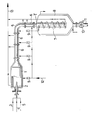
- a spray nozzle 2 projects into a combustion chamber 1 and is connected to supply lines (3, 4, 5) for air, liquid yellow phosphorus and oxygen.
- the combustion chamber 1 is at its end opposite the spray nozzle 2 via a multi-part exhaust pipe 6 with an immersion pipe 7, the immersion pipe 7 having a temperature measuring device T near its upper end.
- the immersion tube 7 is surrounded at a radial distance by a water-cooled condensation chamber 8, which has at its lower end a removal nozzle 11 which can be closed with a cellular wheel 10.
- branch lines which open into the double jackets of the combustion chamber 1 and the parts of the exhaust pipe 6 and are connected to the cooling coil of the dip pipe 7, in which there are flow meters 9. Furthermore, branch ducts extend from the double jackets of the combustion chamber 1 and the parts of the exhaust pipe 6 and from the cooling coil of the immersion pipe 7, which open into a cooling water return line 13.
- the volume of the gas containing phosphorus pentoxide is an important influencing variable.
- the liquid yellow phosphorus can be burned with pure oxygen, with air or with a mixture of both components. The more air that is introduced into the combustion zone in addition to the amount of oxygen required for the combustion of the yellow phosphorus, the greater the volume of the gas containing phosphorus pentoxide and thus the dwell time of this gas in the dip tube, so that only a small proportion of the P 4 0 10 is separated from the gas in the immersion tube and the larger part in the condensation zone.
- the P 4 0 10 that can be removed from the removal nozzle of the condensation chamber has a higher activity overall.
- the amount of gas must therefore be measured so that the dwell time in the immersion tube is not less than 2 seconds.
- it must be ensured that, with a small volume of the gas containing phosphorus pentoxide, not too much material settles in the dip tube, which covers its cooling surface with an insulating layer.
- This insulating layer causes insufficient cooling of the gas stream phosphorpentoxid reiteraten with the result of the simultaneous deposition of P 4 0 10 has in its orthorhombic modification, whereby the removable out of the withdrawal connection portion of the condensation chamber P 4 0 10 in total to a low reactivity.
- the amount of gas must therefore be measured so that the dwell time in the dip tube does not exceed 5 seconds.
- the intensity of the cooling in the intermediate zone that is, by adjusting the amount of cooling water which flows through the multi-part exhaust pipe, and by the volume of 'phosphorpentoxid inconveniencen gas stream, that is, by adjusting the secondary air to the spray nozzle, a P 4 0 10 with the desired physical structure and the desired chemical reactivity.
- a system according to the drawing was used, but the double jackets of the three-part exhaust pipe 6 were not subjected to cooling water.
- Example 1 The system used in Example 1 was used, each however, 33 m 3 of cooling water at 23 ° C. were passed through the three double jackets of the three-part exhaust pipe 6 per hour.
- the dip tube 7 had a length of 5000 mm and a diameter of 500 mm; its cross section is therefore 0.196 m 2 and its volume is 0.98 m 3 .
- the temperature of the gas containing the P 4 0 10 was
- the average temperature in the dip tube was about 500 ° C.
- the dry gas volume of 1047 Nm 3 / h corresponds to a volume of approximately 2960 operating m 3 / h or 0.82 Bm 3 / s .
- the P 4 0 10 deposited in the condensation chamber 8 had a hexagonal structure and had a reactivity of 5.8 ° C./s.
- the temperature of the gas containing the P 4 0 10 in the dip tube 7 was 586 ° C. at the measuring point T and 397 ° C. at the outlet of the dip tube; the average temperature in the dip tube was about 492 ° C.
- the dry gas volume of 947 Nm 3 / h corresponds to a volume of approximately 2650 Bm 3 / h or 0.73 Bm 3 / s.
- the P 4 0 10 deposited in the condensation chamber 8 had a hexagonal structure and had a reactivity of 4.7 ° C./s.
- the temperature of the gas containing the P 4 0 10 was 580 ° C. in the dip tube 7 at the measuring point T and 396 ° C. at the outlet of the dip tube; the average temperature in the dip tube was about 488 ° C.
- the dry gas volume of 597 Nm 3 / h corresponds to a volume of approximately 1670 Bm 3 / h or 0.46 Bm 3 / s.
- the P 4 0 10 deposited in the condensation chamber 8 had a hexagonal structure and had a reactivity of 3.4 ° C./s.
- the temperature of the gas containing the P 4 0 10 was 610 ° C in the dip tube 7 at the measuring point T and 399 ° C at the outlet of the dip tube; the average temperature in the dip tube was about 505 ° C.
- the dry gas volume of 397 Nm 3 / h corresponds to a volume of approximately 1140 Bm 3 / h or 0.32 Bm 3 / s.
- the P 4 0 10 deposited in the condensation chamber 8 had a hexagonal structure and had a reactivity of 1.9 ° C./s.
- the temperature of the gas containing the P 4 0 10 was 560 ° C. in the dip tube 7 at the measuring point T and 384 ° C. at the outlet of the dip tube; the average temperature in the dip tube was about 472 ° C.
- the dry gas volume of 297 Nm 3 / h corresponds to a volume of approximately 820 Bm 3 / h or 0.23 Bm 3 / s.
- the P 0 deposited in the condensation chamber 8 had a reactivity of 1.6 ° C./s. 4 10
- the temperature of the gas containing the P 4 0 10 was 805 ° C in the dip tube 7 at the measuring point T and 560 ° C at the outlet of the dip tube; the average temperature in the dip tube was about 682 ° C.
- the dry gas volume of 397 Nm 3 / h corresponds to a volume of approximately 1400 Bm 3 / h or 0.39 Bm 3 / s.
- the P 4 O 10 deposited in the condensation chamber 8 had a hexagonal structure and had a reactivity of 3.6 ° C./s.
- the temperature of the gas containing the P 4 0 10 was 500 ° C in the dip tube 7 at the measuring point T and 310 ° C at the outlet of the dip tube; the average temperature in the dip tube was about 405 ° C.
- the dry gas volume of 547 Nm 3 / h corresponds to a volume of approximately 1370 Bm 3 / h or 0.38 Bm 3 / s.
- the P 4 0 10 deposited in the condensation chamber 8 had a reactivity of 1.8 ° C./s.
Landscapes
- Chemical & Material Sciences (AREA)
- Organic Chemistry (AREA)
- Inorganic Chemistry (AREA)
- Treating Waste Gases (AREA)
- Luminescent Compositions (AREA)
- Investigating Or Analyzing Non-Biological Materials By The Use Of Chemical Means (AREA)
- Organic Low-Molecular-Weight Compounds And Preparation Thereof (AREA)
- Glass Compositions (AREA)
Abstract
Description
- Die vorliegende Erfindung betrifft ein Verfahren zur Herstellung von hexagonalem Phosphorpentoxid mit verminderter Reaktivität durch Abscheidung aus einem in einer Verbrennungszone aus flüssigem gelbem Phosphor und trockenen sauerstoffhaltigen Gasen erhaltenen phosphorpentoxidhaltigen Gasstrom in einer der Verbrennungszone nachgeschalteten, mit einem wassergekühlten Tauchrohr versehenen Kondensationszone.
- Phosphorpentoxid existiert in drei kristallinen Modifikationen, von denen die beiden orthorhombischen Modifikationen (sog. 0- bzw. 0'-Formen) reaktionsträge sind, während die hexagonale Modifikation (sog..H-Form) sich mit Wasser stürmisch umsetzt.
- Für die Umsetzung von Phosphorpentoxid mit Alkoholen zu Phosphorsäureestern empfiehlt es sich, ein P4010 mit geringerer Aktivität zu verwenden, um von Braunfärbung des Esters begleitete Nebenreaktionen infolge zu starker Wärmeentwicklung bei der Umsetzung zu vermeiden, während bei der Verwendung des Phosphorpentoxids bei organischen Kondensationsreaktionen ein P4010 mit hoher Reaktivität erwünscht ist. Es ist daher erforderlich, für die verschiedenen Einsatzgebiete Phosphorpentoxid mit unterschiedlicher Reaktivität zu verwenden.
- Aus der US-PS 3 077 382 ist ein Verfahren zur Herstellung von Phosphorpentoxid mit einer Reaktivität, welche zwischen der Reaktivität der reaktionsträgen orthorhombischen Form und der handelsüblichen P4O10-Sorten in der H-Form liegt, bekannt. Nach diesem Verfahren wird der heiße phosphorpentoxidhaltige Gasstrom durch ein Fließbett aus monomeren P4010-Teilchen geleitet, welche auf Temperaturen zwischen 90 und 365°C gehalten werden, wobei das Phosphorpentoxid aus dem Gasstrom kondensiert.
- Nach einem älteren Vorschlag (deutsche Patentanmeldung P 35 02 705.3) läßt sich die Reaktivität von hexagonalem Phosphorpentoxid dadurch vermindern, daß man das Phosphorpentoxid im beheizten Drehrohr, Muldenkneter oder Trogwärmetauscher mit Transport- und Mischschnecke bei Temperaturen zwischen 200 und 390°C tempert.
- Nachteilig ist bei diesen Verfahren zur nachträglichen Behandlung des Phosphorpentoxids, daß sie einen beträchtlichen apparativen Aufwand erfordern und einen hohen Energiebedarf haben.
- Es ist daher Aufgabe der vorliegenden Erfindung, ein Verfahren zur Herstellung von Phosphorpentoxid anzugeben, bei welchem aus einem in einer Verbrennungszone aus gelbem Phosphor und sauerstoffhaltigen Gasen erhaltenen phosphorpentoxidhaltigen-Gasstrom in einer nachgeschalteten, mit Tauchrohr versehenen Kondensationszone mit geringem apparativem und energetischem Aufwand ein Phosphorpentoxid mit einstellbarer Reaktivität abgeschieden wird. Das wird erfindungsgemäß dadurch erreicht, daß die sauerstoffhaltigen Gase aus einem Gemisch aus Luft und reinem Sauerstoff bestehen; daß der aus der Verbrennungszone abströmende phosphorpentoxidhaltige Gasstrom vor seinem Eintritt in die Kondensationszone eine durch ein Fluidat indirekt gekühlte Zwischenzone passiert; daß der Gasstrom im Tauchrohr eine mittlere Temperatur von 450 bis 600°C aufweist; und daß die Verweilzeit des Gasstromes im Tauchrohr 2 bis 5 Sekunden beträgt.
- Das Verfahren gemäß der Erfindung kann weiterhin wahlweise auch noch dadurch ausgestaltet sein, daß
- a) die sauerstoffhaltigen Gase ein Volumenverhältnis von Luft zu reinem Sauerstoff von (0,7 bis 7) : 1 aufweisen;
- b) die Zwischenzone durch strömendes Wasser indirekt gekühlt wird;
- c) das Wasser Temperaturen von 10 bis 30°C, vorzugsweise von 18 bis 25°C, aufweist;
- d) die Zwischenzone in mehrere Abschnitte unterteilt ist;
- e) der Gasstrom im Tauchrohr eine mittlere Temperatur von 470 bis 550°C aufweist;
- f) die Verweilzeit des Gasstromes im Tauchrohr durch Verkleinern des Volumenverhältnisses von Luft zu reinem Sauerstoff bei den zur Verbrennung des gelben Phosphors verwendeten sauerstoffhaltigen Gasen vergrößert wird, und umgekehrt.
- Während sehr rasch an gekühlten Flächen auf etwa 350°C abgekühltes phosphorpentoxidhaltiges Gas ein lockeres, wenig fließfähiges hexagonales P4010 mit hoher Reaktivität liefert, führt nach dem erfindungsgemäßen Verfahren die Abscheidung aus einem Gasstrom mit Temperaturen von 450 bis 600°C zu einem hexagonalem P4010 mit deutlich niedrigerer Reaktivität.
- Zur Durchführung des Verfahrens gemäß der Erfindung ist eine in Anlehnung an die aus der US-PS 4 219 533 bekannte Vorrichtung gestaltete Anlage geeignet, welche in der beigefügten Zeichnung schematisch dargestellt ist.
- In eine Brennkammer 1 ragt eine Sprühdüse 2 hinein, welche mit Zuführungsleitungen (3, 4, 5) für Luft, flüssigen gelben Phosphor und Sauerstoff verbunden ist. Die Brennkammer 1 steht mit ihrem der Sprühdüse 2 gegenüberliegenden Ende über ein mehrteiliges Abgasrohr 6 mit einem Tauchrohr 7 in Verbindung, wobei das Tauchrohr 7 nahe seinem oberen Ende eine Temperaturmeßeinrichtung T aufweist. Das Tauchrohr 7 ist mit radialem Abstand von einer wassergekühlten Kondensationskammer 8 umgeben, welche an ihrem unteren Ende einen mit einem Zellenrad 10 verschließbaren Entnahmestutzen 11 aufweist.
- Von einer Kühlwasser-Vorlaufleitung 12 gehen mehrere, in die Doppelmäntel der Brennkammer 1 und der Teile des Abgasrohres 6 einmündende sowie mit der Kühlschlange des Tauchrohres 7 verbundene Zweigleitungen ab, in welchen sich Durchflußmengenmesser 9 befinden. Weiterhin gehen von den Doppelmänteln der Brennkammer 1 und der-Teile des Abgasrohres 6 sowie von der Kühlschlange des Tauchrohres 7 Zweigleitungen ab, welche in eine Kühlwasser-Rücklaufleitung 13 einmünden.
- Beim erfindungsgemäßen Verfahren ist das Volumen des phosphorpentoxidhaltigen Gases eine wichtige Einflußgröße. Wie aus der Zeichnung ersichtlich ist, kann die Verbrennung des flüssigen gelben Phosphors mit reinem Sauerstoff, mit Luft oder mit einem Gemisch beider Komponenten erfolgen. Je mehr Luft man zusätzlich zu der zur Verbrennung des gelben Phosphors erforderlichen Sauerstoffmenge in die Verbrennungszone einbringt, um so größer ist das Volumen des phosphorpentoxidhaltigen Gases und damit die Verweilzeit dieses Gases im Tauchrohr um so geringer, so daß nur ein kleiner Anteil des P4010 aus dem Gas im Tauchrohr und der größere Anteil in der Kondensationszone abgeschieden wird.
- Deshalb weist in diesem Fall das aus dem Entnahmestutzen der Kondensationskammer entnehmbare P4010 insgesamt eine höhere Aktivität auf. Die Gasmenge ist daher so zu bemessen, daß die Verweilzeit im Tauchrohr 2 Sekunden nicht unterschreitet. Andererseits muß sichergestellt sein, daß sich bei geringem Volumen des phosphorpentoxidhaltigen Gases nicht zuviel Material im Tauchrohr absetzt, welches seine Kühlfläche mit einer isolierenden Schicht belegt. Diese isolierende Schicht verursacht eine ungenügende Abkühlung des phosphorpentoxidhaltigen Gasstromes mit der Folge der gleichzeitigen Abscheidung von P4010 in seiner orthorhombischen Modifikation, wodurch das aus dem Entnahmestutzen der Kondensationskammer entnehmbare P4010 insgesamt eine zu geringe Reaktivität aufweist. Die Gasmenge ist deshalb so zu bemessen, daß die Verweilzeit im Tauchrohr 5 Sekunden nicht überschreitet.
- Beim Verfahren gemäß der Erfindung läßt sich durch die Intensität der Kühlung in der Zwischenzone, d. h. durch die Einstellung der Kühlwassermenge, welche das mehrteilige Abgasrohr durchströmt und durch das Volumen des' phosphorpentoxidhaltigen Gasstromes, d. h. durch die Einstellung der Zusatzluft an der Sprühdüse, ein P4010 mit gewünschter physikalischer Struktur und damit einhergehend gewünschter chemischer Reaktivität erhalten.
- In den folgenden Beispielen, welche der näheren Erläuterung der Erfindung dienen sollen, wird mit dem jeweils erhaltenen P4010 zur Bestimmung seiner Reaktivität ein Test durchgeführt, der in Anlehnung an die in der US-PS 3 077 382 (vergl. Spalte 6, Zeilen 33 bis 47) beschriebene Prüfmethode ausgearbeitet wurde:
- 150 ml mit Phosphorpentoxid getrocknetes Kerosin (Aromatenanteil kleiner als 1 %) wird mit einer Temperatur von 22 bis 24°C in ein 500-ml-Dewargefäß eingefüllt und 20 g des zu testenden Phosphorpentoxids hinzugefügt. Die Mischung wird 30 s mit einem Kreuzblattrührer bei 600 Upm gerührt und anschließend unter weiterem Rühren 100 ml 2-Ethylhexanol mit einer Temperatur von 22 bis 24°C zugesetzt.
- Die in der Suspension mit einem Fühler gemessene Temperatur wird auf einen x, y-Schreiber übertragen und gegen die Zeit aufgezeichnet.
- Die Zeit t, welche zwischen dem Anstieg von 5 auf 30°C liegt, wird graphisch ermittelt und daraus der Reaktivitätskoeffizient

- Es wurde eine Anlage gemäß der Zeichnung benutzt, jedoch wurden die Doppelmäntel des dreiteiligen Abgasrohres 6 nicht mit Kühlwasser beaufschlagt.
- In der im wesentlichen zylindrischen Brennkammer 1 wurden stündlich 100 1 (≙ 170 kg) flüssiger gelber Phosphor mit 680 m3 trockener Luft von 5 bar verbrannt. Das phosphorpentoxidhaltige Gas trat mit einer Temperatur von 900°C in das Tauchrohr 7 ein. Beim Austritt aus dem Tauchrohr wies das Gas eine Temperatur von ca. 680°C auf. In der Kondensationskammer 8 wurde das Gas schlagartig abge- . kühlt. An den Wänden der Kondensationskammer 8 setzte sich hexagonales P4010 ab. Das aus dem Entnahmestutzen 11 abgezogene P4010 wies eine Reaktivität von 5,6°C/s und hexagonale Struktur auf.
- Es wurde die in Beispiel 1 benutzte Anlage verwendet, jedoch wurden durch die drei Doppelmäntel des dreiteiligen Abgasrohres 6 stündlich 33 m3 Kühlwasser von 23°C geleitet.
- In der Brennkammer 1 wurden stündlich 100 1 flüssiger gelber Phosphor mit 1200 Nm3 trockener Luft verbrannt.. Bei der Verbrennung des gelben Phosphors gemäß der Gleichunq

- Das Tauchrohr 7 wies bei einer Länge von 5000 mm einen Durchmesser von 500 mm auf; sein Querschnitt beträgt mithin 0,196 m2 und sein Volumen 0,98 m3. Die Temperatur des das P4010 enthaltenden Gases betrug
- im oberen Bereich des Tauchrohres 7 (an der Meßstelle T) 600°C, während seine Temperatur am Ausgang des Tauchrohres 400°C betrug; die mittlere Temperatur im Tauchrohr betrug etwa 500°C.
- Demgemäß entspricht das trockene Gasvolumen von 1047 Nm3/h einem Volumen von etwa 2960 Betriebs-m3/h oder 0,82 Bm3/s.
- Die mittlere Verweilzeit des das P4010 enthaltenden Gases im Tauchrohr betrug damit 0,98 : 0,82 = 1,2 Sekunden.
- Das in der Kondensationskammer 8 abgeschiedene P4010 hatte hexagonale Struktur und wies eine Reaktivität von 5,8°C/s auf.
- Es wurde die in den Beispielen 1 und 2 benutzte Anlage verwendet; jedoch wurden durch jeden der Doppelmäntel des dreiteiligen Abgasrohres 6 9 m3, also insgesamt 27 m3 Kühlwasser von 23°C geleitet.
- In der Brennkammer 1 wurden stündlich 100 1 flüssiger gelber Phosphor mit einer aus 1000 Nm3 Luft und 100 Nm3 Sauerstoff bestehenden trockenen Gasmischung verbrannt. Das dabei gebildete P4010 war in einer Gasmenge von 1100 - 153 = 947 Nm3 enthalten.
- Die Temperatur des das P4010 enthaltenden Gases betrug im Tauchrohr 7 an der Meßstelle T 586°C und am Ausgang des Tauchrohres 397°C; die mittlere Temperatur im Tauchrohr betrug etwa 492°C.
- Demgemäß entspricht das trockene Gasvolumen von 947 Nm3/h einem Volumen von etwa 2650 Bm3/h oder 0,73 Bm3/s.
- Die mittlere Verweilzeit des das P4010 enthaltenden Gases im Tauchrohr betrug damit 0,98 : 0,73 = 1,3 Sekunden.
- Das in der Kondensationskammer 8 abgeschiedene P4010 hatte hexagonale Struktur und wies eine Reaktivität von 4,7°C/s auf.
- Es wurde die entsprechend dem Beispiel 3 mit Kühlwasser beaufschlagte Anlage verwendet.
- In der Brennkammer 1 wurden stündlich 100 1 flüssiger gelber Phosphor mit einer aus 650 Nm3 Luft und 100 Nm3 Sauerstoff bestehenden trockenen Gasmischung verbrannt. Das dabei gebildete P4010 war in einer Gasmenge von 750 - 153 = 597 Nm3 enthalten.
- Die Temperatur des das P4010 enthaltenden Gases betrug im Tauchrohr 7 an der Meßstelle T 580°C und am Ausgang des Tauchrohres 396°C; die mittlere Temperatur im Tauchrohr betrug etwa 488°C.
- Demgemäß entspricht das trockene Gasvolumen von 597 Nm3/h einem Volumen von etwa 1670 Bm3/h oder 0,46 Bm3/s. Die mittlere Verweilzeit des das P4010 enthaltenden Gases im Tauchrohr betrug damit 0,98 : 0,46 = 2,13 Sekunden. Das in der Kondensationskammer 8 abgeschiedene P4010 hatte hexagonale Struktur und wies eine Reaktivität von 3,4°C/s auf.
- Es wurde die in den Beispielen 1 und 2 benutzte Anlage verwendet; jedoch wurden durch jeden der Doppelmäntel des dreiteiligen Abgasrohres 6 8 m3, also insgesamt 24 m3 Kühlwasser von 23°C geleitet.
- In der Brennkammer 1 wurden stündlich 100 1 flüssiger gelber Phosphor mit einer aus 350 Nm3 Luft und 200 Nm3 Sauerstoff bestehenden trockenen Gasmischung verbrannt. Das dabei gebildete P4010 war in einer Gasmenge von 550 - 153 = 397 Nm3 enthalten.
- Die Temperatur des das P4010 enthaltenden Gases betrug im Tauchrohr 7 an der Meßstelle T 610°C und am Ausgang des Tauchrohres 399°C; die mittlere Temperatur im Tauchrohr betrug etwa 505°C.
- Demgemäß entspricht das trockene Gasvolumen.von 397 Nm3/h einem Volumen von etwa 1140 Bm3/h oder 0,32 Bm3/s.
- Die mittlere Verweilzeit des das P4010 enthaltenden Gases im Tauchrohr betrug damit 0,98 : 0,32 = 3,06 Sekunden.
- Das in der Kondensationskammer 8 abgeschiedene P4010 hatte hexagonale Struktur und wies eine Reaktivität von 1,9°C/s auf.
- Es wurde die entsprechend Beispiel 5 mit Kühlwasser beaufschlagte Anlage verwendet.
- In der Brennkammer 1 wurden stündlich 100 1 flüssiger gelber Phosphor mit einer aus 200 Nm3 Luft und 250 Nm3 Sauerstoff bestehenden trockenen Gasmischung verbrannt. Das dabei gebildete P4010 war in einer Gasmenge von 450 - 153 = 297 Nm3 enthalten.
- Die Temperatur des das P4010 enthaltenden Gases betrug im Tauchrohr 7 an der Meßstelle T 560°C und am Ausgang des Tauchrohres 384°C; die mittlere Temperatur im Tauchrohr betrug etwa 472°C.
- Demgemäß entspricht das trockene Gasvolumen von 297 Nm3/h einem Volumen von etwa 820 Bm3/h oder 0,23 Bm3/s.
- Die mittlere Verweilzeit des das P4O10 enthaltenden Gases im Tauchrohr betrug damit 0,98 : 0,23 = 4,3 Sekunden.
- Das in der Kondensationskammer 8 abgeschiedene P 0 wies eine Reaktivität von 1,6°C/s auf. 4 10
- Es wurde die in den Beispielen 1 und 2 benutzte Anlage verwendet; jedoch wurden durch jeden der Doppelmäntel des dreiteiligen Abgasrohres 6 4,5 m3, also insgesamt 13,5 m3 Kühlwasser von 23°C geleitet.
- In der Brennkammer 1 wurden stündlich 100 1 flüssiger gelber Phosphor mit einer aus 350 Nm3 Luft und 200 Nm3 Sauerstoff bestehenden trockenen Gasmischung verbrannt. Das dabei gebildete P4010 war in einer Gasmenge von 550 - 153 = 397 Nm3 enthalten.
- Die Temperatur des das P4010 enthaltenden Gases betrug im Tauchrohr 7 an der Meßstelle T 805°C und am Ausgang des Tauchrohres 560°C; die mittlere Temperatur im Tauchrohr betrug etwa 682°C.
- Demgemäß entspricht das trockene Gasvolumen von 397 Nm3/h einem Volumen von etwa 1400 Bm3/h oder 0,39 Bm3/s.
- Die mittlere Verweilzeit des das P4010 enthaltenden Gases im Tauchrohr betrug damit 0,98 : 0,39 = 2,5 Sekunden.
- Das in der Kondensationskammer 8 abgeschiedene P4O10 hatte hexagonale Struktur und wies eine Reaktivität von 3,6°C/s auf.
- Es wurde die entsprechend dem Beispiel 3 mit Kühlwasser beaufschlagte Anlage verwendet.
- In der Brennkammer 1 wurden stündlich 100 1 flüssiger gelber Phosphor mit einer aus 500 Nm3 Luft und 200 Nm3 Sauerstoff bestehenden trockenen Gasmischung verbrannt. Das dabei gebildete P4010 war in einer Gasmenge von 700 - 153 = 547 Nm3 enthalten.
- Die Temperatur des das P4010 enthaltenden Gases betrug im Tauchrohr 7 an der Meßstelle T 500°C und am Ausgang des Tauchrohres 310°C; die mittlere Temperatur im Tauchrohr betrug etwa 405°C.
- Demgemäß entspricht das trockene Gasvolumen von 547 Nm3/h einem Volumen von etwa 1370 Bm3/h oder 0,38 Bm3/s.
- Die mittlere Verweilzeit des das P4010 enthaltenden Gases im Tauchrohr betrug damit 0,98 : 0,38 = 2,6 Sekunden. Das in der Kondensationskammer 8 abgeschiedene P4010 wies eine Reaktivität von 1,8°C/s auf.
- Nach einer Betriebszeit von 90 Stunden begann der Eingang des Tauchrohres 7 mit glasigem, orthorhomischem P4010 zuzuwachsen, was zu einem den Abbruch der Produktion erfordernden Druckanstieg in der Brennkammer 1 führte.
Claims (7)
Applications Claiming Priority (2)
| Application Number | Priority Date | Filing Date | Title |
|---|---|---|---|
| DE3614041 | 1986-04-25 | ||
| DE19863614041 DE3614041A1 (de) | 1986-04-25 | 1986-04-25 | Verfahren zur herstellung von phosphorpentoxid mit verminderter reaktivitaet |
Publications (3)
| Publication Number | Publication Date |
|---|---|
| EP0242678A2 true EP0242678A2 (de) | 1987-10-28 |
| EP0242678A3 EP0242678A3 (en) | 1989-02-01 |
| EP0242678B1 EP0242678B1 (de) | 1991-10-02 |
Family
ID=6299534
Family Applications (1)
| Application Number | Title | Priority Date | Filing Date |
|---|---|---|---|
| EP87105015A Expired - Lifetime EP0242678B1 (de) | 1986-04-25 | 1987-04-04 | Verfahren zur Herstellung von Phosphorpentoxid mit verminderter Reaktivität |
Country Status (5)
| Country | Link |
|---|---|
| US (1) | US4777025A (de) |
| EP (1) | EP0242678B1 (de) |
| JP (1) | JPS62256706A (de) |
| CA (1) | CA1266552A (de) |
| DE (2) | DE3614041A1 (de) |
Cited By (1)
| Publication number | Priority date | Publication date | Assignee | Title |
|---|---|---|---|---|
| FR2812626A1 (fr) * | 2000-08-04 | 2002-02-08 | Atofina | Procede de preparation de poudre de pentoxyde de phosphore ayant une coulabilite amelioree |
Families Citing this family (5)
| Publication number | Priority date | Publication date | Assignee | Title |
|---|---|---|---|---|
| CN101117215B (zh) * | 2007-07-03 | 2010-11-03 | 罗宗恬 | 黄磷生产磷酸盐的一步法工艺及装置 |
| CL2008003539A1 (es) * | 2007-11-28 | 2009-07-03 | Procedimiento para la produccion de p4o6 que comprende mezclar o2 o una mezcla de o2 mas un gas inerte y fosforo en donde el producto obtenido se mantiene dentro de una unidad de reaccion a una temperatura entre los 1600 y 2000 k durante por lo menos 1 segundo. | |
| US8551437B2 (en) * | 2008-11-12 | 2013-10-08 | Straitmark Holding Ag | Process for the manufacture of P4O6 with improved yield |
| WO2020106677A1 (en) | 2018-11-19 | 2020-05-28 | Monsanto Technology Llc | Phosphorus oxide and phosphoric acid production processes |
| CN115744846A (zh) * | 2022-11-17 | 2023-03-07 | 云南磷化集团有限公司 | 一种催化碳热还原磷矿制黄磷的方法 |
Family Cites Families (10)
| Publication number | Priority date | Publication date | Assignee | Title |
|---|---|---|---|---|
| DE444664C (de) * | 1926-09-04 | 1927-05-27 | Ludwig Wolf Dr | Herstellung von Phosphortrioxyd |
| US2907635A (en) * | 1957-10-08 | 1959-10-06 | Monsanto Chemicals | Process for producing polymeric phosphorus pentoxide |
| US2988426A (en) * | 1957-10-08 | 1961-06-13 | Monsanto Chemicals | Method for producing polymeric phosphorus pentoxide |
| US3034860A (en) * | 1960-04-04 | 1962-05-15 | Stauffer Chemical Co | Production of polymeric phosphorus pentoxide |
| US3077382A (en) * | 1960-04-11 | 1963-02-12 | Stauffer Chemical Co | Method for recovering phosphoric acid anhydride |
| FR1292032A (fr) * | 1961-06-12 | 1962-04-27 | Stauffer Chemical Co | Procédé et appareillage pour le traitement de l'anhydride phosphorique |
| DE2736765A1 (de) * | 1977-08-16 | 1979-03-01 | Hoechst Ag | Vorrichtung zur herstellung von hexagonalem phosphorpentoxid |
| US4713228A (en) * | 1983-05-23 | 1987-12-15 | Fmc Corporation | Heat recovery in the manufacture of phosphorus acids |
| DD222268A1 (de) * | 1983-12-13 | 1985-05-15 | Piesteritz Agrochemie | Verfahren zur kontinuierlichen herstellung von phosphoroxiden |
| DE3502705A1 (de) * | 1985-01-28 | 1986-07-31 | Hoechst Ag, 6230 Frankfurt | Verfahren zur verminderung der reaktivitaet und zur verbesserung des fliessverhaltens von phosphorpentoxid |
-
1986
- 1986-04-25 DE DE19863614041 patent/DE3614041A1/de not_active Withdrawn
-
1987
- 1987-03-26 CA CA000533016A patent/CA1266552A/en not_active Expired - Fee Related
- 1987-04-04 EP EP87105015A patent/EP0242678B1/de not_active Expired - Lifetime
- 1987-04-04 DE DE8787105015T patent/DE3773422D1/de not_active Expired - Fee Related
- 1987-04-13 US US07/037,985 patent/US4777025A/en not_active Expired - Fee Related
- 1987-04-23 JP JP62098793A patent/JPS62256706A/ja active Pending
Cited By (2)
| Publication number | Priority date | Publication date | Assignee | Title |
|---|---|---|---|---|
| FR2812626A1 (fr) * | 2000-08-04 | 2002-02-08 | Atofina | Procede de preparation de poudre de pentoxyde de phosphore ayant une coulabilite amelioree |
| WO2002012119A1 (fr) * | 2000-08-04 | 2002-02-14 | Atofina | Procede de preparation de poudre de pentoxyde de phosphore ayant une coulabilite amelioree |
Also Published As
| Publication number | Publication date |
|---|---|
| CA1266552A (en) | 1990-03-13 |
| EP0242678B1 (de) | 1991-10-02 |
| US4777025A (en) | 1988-10-11 |
| EP0242678A3 (en) | 1989-02-01 |
| JPS62256706A (ja) | 1987-11-09 |
| DE3773422D1 (de) | 1991-11-07 |
| DE3614041A1 (de) | 1987-11-05 |
Similar Documents
| Publication | Publication Date | Title |
|---|---|---|
| DE2103243C3 (de) | Verfahren und Vorrichtung zur Herstellung von weitgehend kugelförmigen, Kieselsäure enthaltenden Hydrogelen | |
| DE3024319C2 (de) | Kontinuierliches Verfahren zur Herstellung von Trichlorsilan | |
| EP0010218A1 (de) | Vorrichtung zur Erhöhung des Graphitierungsgrades von Russen sowie die Verwendung dieser Russe | |
| EP0480180A1 (de) | Verfahren und Anlage zur Herstellung von Ammoniumpolyphosphat | |
| EP0242678B1 (de) | Verfahren zur Herstellung von Phosphorpentoxid mit verminderter Reaktivität | |
| DE3003915A1 (de) | Verfahren zum herstellen von stahl | |
| DE69519334T2 (de) | Perlförmiges Vanillin oder Ethylvanillin und Verfahren zu deren Herstellung | |
| DE1908747A1 (de) | Verfahren zum Abscheiden von pyrogenem Titandioxid-Pigment aus einer Gassuspension | |
| EP0000698B1 (de) | Vorrichtung zur Herstellung von hexagonalem Phosphorpentoxid | |
| DE1245340B (de) | Verfahren zur Herstellung von Einkristallnadeln aus Siliciumnitrid | |
| DE2608438C2 (de) | Verfahren zur Herstellung eines Petrolpechbindemittels für die Herstellung von Kohleelektroden | |
| DE69103290T2 (de) | Kontinuierliches Verfahren zur Herstellung von Tetraphosphorpolysulfiden. | |
| DE2527943C2 (de) | Verfahren zur Umwandlung von Pech in kristalloides Pech | |
| EP1529818B1 (de) | Russ | |
| EP0189766B1 (de) | Verfahren zur Verminderung der Reaktivität und zur Verbesserung des Fliessverhaltens von Phosphorpentoxid | |
| DE2129167A1 (de) | Verfahren zur Herstellung von SiIi ciumcarbid Whiskern | |
| DE2228636A1 (de) | Verfahren und vorrichtung zur kontinuierlichen aufarbeitung von phosphorhaltigen rueckstaenden | |
| DE1442971A1 (de) | Verfahren und Vorrichtung zum Konzentrieren und Reinigen von durch nassen Aufschlussgewonnener Phosphorsaeure | |
| DE857052C (de) | Verfahren zur Abtrennung von Phthalsaeureanhydrid aus Daempfen oder Gasen | |
| DE2617595C2 (de) | Verfahren zum Gewinnen eines Feststoffes aus der Dampfphase eines Dampf-Gas-Gemisches und Vorrichtung zu dessen Durchführung | |
| DE3002555A1 (de) | Verfahren zur herstellung von russ | |
| DE2244839A1 (de) | Verfahren zur herstellung von citracon- oder itaconsaeure | |
| EP0094003B1 (de) | Verfahren zur Herstellung von Zinn-(IV)-chlorid | |
| DE2532365C3 (de) | Verfahren zur Oxidation von Naphthalin mit Sauerstoff | |
| DE3009732C2 (de) | Verfahren zur Herstellung von Phosphorsäure |
Legal Events
| Date | Code | Title | Description |
|---|---|---|---|
| PUAI | Public reference made under article 153(3) epc to a published international application that has entered the european phase |
Free format text: ORIGINAL CODE: 0009012 |
|
| AK | Designated contracting states |
Kind code of ref document: A2 Designated state(s): DE FR GB IT NL |
|
| PUAL | Search report despatched |
Free format text: ORIGINAL CODE: 0009013 |
|
| AK | Designated contracting states |
Kind code of ref document: A3 Designated state(s): DE FR GB IT NL |
|
| 17P | Request for examination filed |
Effective date: 19890303 |
|
| 17Q | First examination report despatched |
Effective date: 19901116 |
|
| GRAA | (expected) grant |
Free format text: ORIGINAL CODE: 0009210 |
|
| AK | Designated contracting states |
Kind code of ref document: B1 Designated state(s): DE FR GB IT NL |
|
| REF | Corresponds to: |
Ref document number: 3773422 Country of ref document: DE Date of ref document: 19911107 |
|
| ITF | It: translation for a ep patent filed | ||
| ET | Fr: translation filed | ||
| GBT | Gb: translation of ep patent filed (gb section 77(6)(a)/1977) | ||
| PGFP | Annual fee paid to national office [announced via postgrant information from national office to epo] |
Ref country code: FR Payment date: 19920306 Year of fee payment: 6 |
|
| PGFP | Annual fee paid to national office [announced via postgrant information from national office to epo] |
Ref country code: GB Payment date: 19920312 Year of fee payment: 6 |
|
| PGFP | Annual fee paid to national office [announced via postgrant information from national office to epo] |
Ref country code: NL Payment date: 19920430 Year of fee payment: 6 |
|
| PLBE | No opposition filed within time limit |
Free format text: ORIGINAL CODE: 0009261 |
|
| STAA | Information on the status of an ep patent application or granted ep patent |
Free format text: STATUS: NO OPPOSITION FILED WITHIN TIME LIMIT |
|
| 26N | No opposition filed | ||
| PG25 | Lapsed in a contracting state [announced via postgrant information from national office to epo] |
Ref country code: GB Effective date: 19930404 |
|
| PG25 | Lapsed in a contracting state [announced via postgrant information from national office to epo] |
Ref country code: NL Effective date: 19931101 |
|
| GBPC | Gb: european patent ceased through non-payment of renewal fee |
Effective date: 19930404 |
|
| NLV4 | Nl: lapsed or anulled due to non-payment of the annual fee | ||
| PG25 | Lapsed in a contracting state [announced via postgrant information from national office to epo] |
Ref country code: FR Effective date: 19931229 |
|
| REG | Reference to a national code |
Ref country code: FR Ref legal event code: ST |
|
| PGFP | Annual fee paid to national office [announced via postgrant information from national office to epo] |
Ref country code: DE Payment date: 19980514 Year of fee payment: 12 |
|
| PG25 | Lapsed in a contracting state [announced via postgrant information from national office to epo] |
Ref country code: DE Free format text: LAPSE BECAUSE OF NON-PAYMENT OF DUE FEES Effective date: 20000201 |
|
| PG25 | Lapsed in a contracting state [announced via postgrant information from national office to epo] |
Ref country code: IT Free format text: LAPSE BECAUSE OF NON-PAYMENT OF DUE FEES;WARNING: LAPSES OF ITALIAN PATENTS WITH EFFECTIVE DATE BEFORE 2007 MAY HAVE OCCURRED AT ANY TIME BEFORE 2007. THE CORRECT EFFECTIVE DATE MAY BE DIFFERENT FROM THE ONE RECORDED. Effective date: 20050404 |