EP0242093A1 - Resynchronisation serieller Datenblocks - Google Patents
Resynchronisation serieller Datenblocks Download PDFInfo
- Publication number
- EP0242093A1 EP0242093A1 EP19870302930 EP87302930A EP0242093A1 EP 0242093 A1 EP0242093 A1 EP 0242093A1 EP 19870302930 EP19870302930 EP 19870302930 EP 87302930 A EP87302930 A EP 87302930A EP 0242093 A1 EP0242093 A1 EP 0242093A1
- Authority
- EP
- European Patent Office
- Prior art keywords
- bits
- data
- sub
- block
- blocks
- Prior art date
- Legal status (The legal status is an assumption and is not a legal conclusion. Google has not performed a legal analysis and makes no representation as to the accuracy of the status listed.)
- Withdrawn
Links
Images
Classifications
-
- G—PHYSICS
- G11—INFORMATION STORAGE
- G11B—INFORMATION STORAGE BASED ON RELATIVE MOVEMENT BETWEEN RECORD CARRIER AND TRANSDUCER
- G11B20/00—Signal processing not specific to the method of recording or reproducing; Circuits therefor
- G11B20/10—Digital recording or reproducing
- G11B20/12—Formatting, e.g. arrangement of data block or words on the record carriers
- G11B20/1201—Formatting, e.g. arrangement of data block or words on the record carriers on tapes
- G11B20/1207—Formatting, e.g. arrangement of data block or words on the record carriers on tapes with transverse tracks only
- G11B20/1209—Formatting, e.g. arrangement of data block or words on the record carriers on tapes with transverse tracks only for discontinuous data, e.g. digital information signals, computer programme data
-
- G—PHYSICS
- G11—INFORMATION STORAGE
- G11B—INFORMATION STORAGE BASED ON RELATIVE MOVEMENT BETWEEN RECORD CARRIER AND TRANSDUCER
- G11B27/00—Editing; Indexing; Addressing; Timing or synchronising; Monitoring; Measuring tape travel
- G11B27/10—Indexing; Addressing; Timing or synchronising; Measuring tape travel
- G11B27/19—Indexing; Addressing; Timing or synchronising; Measuring tape travel by using information detectable on the record carrier
- G11B27/28—Indexing; Addressing; Timing or synchronising; Measuring tape travel by using information detectable on the record carrier by using information signals recorded by the same method as the main recording
- G11B27/30—Indexing; Addressing; Timing or synchronising; Measuring tape travel by using information detectable on the record carrier by using information signals recorded by the same method as the main recording on the same track as the main recording
- G11B27/3027—Indexing; Addressing; Timing or synchronising; Measuring tape travel by using information detectable on the record carrier by using information signals recorded by the same method as the main recording on the same track as the main recording used signal is digitally coded
Definitions
- the present invention relates generally to digital signal recording systems and, more particularly, to a system having re-synchronizing signals separating blocks of recorded data to maintain precise read clock synchronization with a digital data stream.
- a read clock is synchronized and phase-locked to the data transitions recorded on a recording media such as a magnetic disc or tape.
- This synchronization is effected with a burst of recorded synchronization signals, commonly referred to as a preamble, at the beginning of a data block.
- a synchronization signal referred to as a postamble is also included at the end of a data block. If a dropout in the signal occurs, for example, because of a flaw in the recording media, resulting in the temporary loss of the data signal, the read clock will no longer be phase-locked to the data transitions. When the signal returns, the read clock will require re-synchronization with the data signal.
- Slight speed variations in the system or drift of the clock frequency during the period of time that the read clock was not phase-locked may have caused the data stream to slip with respect to the read clock some integral number of bits or, in the case of a code such as Modified Frequency Modulation (MFM), some integral number of half bits.
- MFM Modified Frequency Modulation
- the intrarecord re-synchronization system designed by Irwin reduces the amount of data lost by providing resynchronization marks between arbitrarily small sub-blocks of data within a block of recorded data; but does not provide for recovery of the data lost. Further, as the size of the sub-blocks decrease, the number of re-synchronization marks increase, and the throughput of the system is decreased.
- a magnetic tape recording and reproducing apparatus employing error correction and detection capability.
- the data and error correction bits are recorded in sub-blocks which are separated by short re-synchronization signals.
- the number of bits in each sub-block is chosen such that the number of bits lost when a sub-block, or a multiple of sub-blocks, is lost is less than the total number of correctable bits provided by the error correction method utilized.
- a data format utilizing a majority logic decodable highly interleaved error correction code and having re-synchronization or fiducial marks between successive sub-blocks of data provides a method of error correction which reduces the error-rate to an extremely low level.
- the recorded data bits and error-correction code bits are recorded in blocks comprised of sub-blocks that are lambda bits in length where lambda is the degree of interleave used. After every lambda bit sub-block a unique fiducial mark is inserted. Detection of this unique mark allows a bit counter to be updated thus re-synchronizing the data to a read clock. Thus, if the error correction code corrects t bits in each code word, the interleaved code can correct for the complete loss of any t consecutive sub-blocks. With independent re-synchronization of each sub-block any single loss of signal of length less than or equal to (t-1) ⁇ lambda bits can be corrected, even if clock synchronization is lost.
- a fiducial mark consists of a header, a key and a trailer in that order encoded in the same code (such as MFM) as the data.
- the key is a k bit pattern which identifies the start of the next data sub-block.
- control circuitry begins searching for the key. When the key is detected, it is then known that the next data sub-block begins a fixed number of bits later. This allows the control circuitry to correct for any slippage between the read clock and the data.
- a key must be sufficiently long and distinctive enough to be distinguished reliably from any non-key portions of the data stream that the key may be compared with. The key should also be short enough and simple enough to be easily identified when actually encountered by the control circuitry.
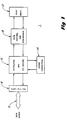
- Interface bus 2 provides data words from a host system (not shown) in parallel format to interface circuitry 4 which performs all interfacing functions including converting the input data into serial format.
- the error correction logic circuit 6 provides the functions of data encoding and decoding for error correction purposes and interleaving of the code words.
- the coded words are 63 bits in length and comprise 45 bits of data and 18 check bits.
- the error correction logic circuit 6 comprises eighteen 912-bit shift registers (not shown) which form a linear feedback shift register which simultaneously performs code word generation and code word interleaving.
- a majority logic decodable error correction code which combines 45 data bits and 18 check bits into each code word is interleaved to degree 896 (lambda).
- the error correction code utilized is capable of correcting any three single bits in error in each code word.
- the error correction logic circuit 6 formats each block of data and error correction code into sub-blocks of lambda bits and appends a string of 16 zeros to each such sub-block to reserve space for a fiducial mark to be added by the data control circuitry 8.
- the data control circuitry 8 provides data write/head encoding and decoding functions and generates the data track preamble and the fiducial marks.
- Miller Squared Frequency Modulation encoding is utilized to write the data on tracks 10 on the media (not shown) by the read/write circuitry 12.
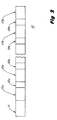
- Two blocks 13 and 17 of data are written on each track 10 in sub-blocks 13a, 13b ..., and 17a, 17b ....
- the data must be synchronized with the read clock.
- a highly redundant preamble 11 is generated by the data control circuitry 8.
- Read synchronization is further ensured by inserting a unique 16-bit fiducial mark 15a, 15b, ..., 19a, 19b, ..., after each sub-block 13a, 13b, ..., 17a, 17b, ..., as shown in Figure 2. Since two blocks 13, 17 of data are recorded on each track 10, fiducial mark 19a which separates the two data blocks 13, 17 precedes the first data sub-block 17a in the second block 17.
- the detection of the fiducial marks 15a, 15b, ..., 19a, 19b, ..., by the read/write circuitry 12 updates a bit counter (not shown) which allows the data control circuitry 8 to re-synchronize the read clock with the data stream if any bit slip has occurred.
- Decoded data is coupled to the error correction logic circuitry 6 for de-interleaving and error detection. Any errors detected are corrected by error correction circuitry 14. Since the error correction code is capable of correcting any three random bits in each 63 bit code word, the interleaved code allows the original data to be recovered as long as any burst error is confined to less than three sub-blocks (2688 bits). Even if clock synchronization is lost, any signal dropout of length 2 lambda (1792) bits or less can be corrected.
- the re-synchronization system is designed to correct for some maximum amount of bit slip, b, which will reduce the error rate to an acceptable level.
- the 16-bit fiducial mark utilized in the preferred embodiment allows re-synchronization after bit slips of up to + or - 4 bits.
- the fiducial mark is comprised of an eight-bit header, a four-bit key and a four-bit trailer, in that order.
- the key 21 is a k bit pattern which identifies the start of the following data sub-block; for example, fiducial mark 15a will identify the start of data sub-block 13b (as shown in Figure 2).
- control circuitry 12 (as shown in Figure 1) will begin looking for the key 21.
- key 21 it is known that the data begins a fixed number of bits after the trailing edge 23, thus allowing the control circuitry 12 to correct for any slippage between the read clock and the data.
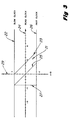
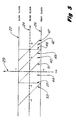
- the horizontal axis 24 measures time on the read clock.
- the vertical axis 29 measures the number of bits missed by the read clock.
- Horizontal lines 22 and 26 represent a read clock that is slow or fast, respectively, by the maximum correctable amount for the preferred embodiment.
- a disallowed pattern of the data channel code may be used.
- a more reliable solution is to add a header 32 (defined by slanting lines 31 and 33) of known content, such as a string of zeros, between the end of the data and the start 33 of the key 30.
- the maximum useful length of the header 32 is 2 b bits. Since the search for the key 30 begins b bits (27) prior to the anticipated start 29 of the key 30 this search will always be in the header 32, even when the start 33 of the key 30 appears b bits late due to a fast clock 26 during a data dropout.
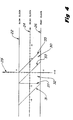
- control circuitry 12 (as shown in Figure 1) will anticipate the start of the next data sub-block based on the read clock 24.
- a trailer 42 of length b bits must be appended to key 40 to delay the default (i. e., no key detected) start 48 of the next data sub-block. This provides adequate search time to detect the key 40 when bit slip has occurred due to a fast clock 26 and the key 40 appears late.
- the optimal fiducial mark size is thus k + 3b bits. This allows for a header 44 of 2b bits prior to the start 51 of the key 40 and a trailer 42 of b bits after the end 49 of the key 40.
- the key search begins b bits prior to the anticipated start 29 of the key 40.
- the key 40 bit pattern should be chosen to provide maximum orthogonality with the 2b non-key bit patterns that are part header 44 and part key 40.
Landscapes
- Engineering & Computer Science (AREA)
- General Engineering & Computer Science (AREA)
- Signal Processing (AREA)
- Signal Processing For Digital Recording And Reproducing (AREA)
Applications Claiming Priority (2)
| Application Number | Priority Date | Filing Date | Title |
|---|---|---|---|
| US85104986A | 1986-04-11 | 1986-04-11 | |
| US851049 | 1986-04-11 |
Publications (1)
| Publication Number | Publication Date |
|---|---|
| EP0242093A1 true EP0242093A1 (de) | 1987-10-21 |
Family
ID=25309838
Family Applications (1)
| Application Number | Title | Priority Date | Filing Date |
|---|---|---|---|
| EP19870302930 Withdrawn EP0242093A1 (de) | 1986-04-11 | 1987-04-03 | Resynchronisation serieller Datenblocks |
Country Status (2)
| Country | Link |
|---|---|
| EP (1) | EP0242093A1 (de) |
| JP (1) | JPS62241175A (de) |
Cited By (5)
| Publication number | Priority date | Publication date | Assignee | Title |
|---|---|---|---|---|
| EP0367217A1 (de) * | 1988-11-02 | 1990-05-09 | Hitachi, Ltd. | Verfahren zur Aufzeichnung und Wiedergabe von Informationssignalen und Gerät dafür |
| EP0438355A1 (de) * | 1990-01-17 | 1991-07-24 | Fujitsu Limited | Verfahren zum Lesen eines Synchronisierungssignals von einem Aufnahmemedium und Apparat dafür |
| EP0420211A3 (en) * | 1989-09-29 | 1992-02-19 | Kabushiki Kaisha Toshiba | Optical disk apparatus |
| EP0473293A1 (de) * | 1990-08-03 | 1992-03-04 | Canon Kabushiki Kaisha | Synchronsignal-Detektorschaltung und dieselbe enthaltender Synchronsignal-Detektorapparat |
| EP0410722A3 (de) * | 1989-07-26 | 1994-01-26 | Sony Corp |
Citations (4)
| Publication number | Priority date | Publication date | Assignee | Title |
|---|---|---|---|---|
| US3641534A (en) * | 1969-12-29 | 1972-02-08 | Ibm | Intrarecord resynchronization in digital-recording systems |
| EP0133790A1 (de) * | 1983-07-30 | 1985-03-06 | Sony Corporation | Plattenwiedergabegerät |
| EP0164746A2 (de) * | 1984-06-15 | 1985-12-18 | Matsushita Electric Industrial Co., Ltd. | Optisches Informationsaufzeichnungs- und Wiedergabegerät und optische Platte |
| EP0166785A1 (de) * | 1983-12-16 | 1986-01-08 | Sony Corporation | Vorrichtung für platten-wiedergabe |
-
1987
- 1987-04-03 EP EP19870302930 patent/EP0242093A1/de not_active Withdrawn
- 1987-04-08 JP JP8670087A patent/JPS62241175A/ja active Pending
Patent Citations (4)
| Publication number | Priority date | Publication date | Assignee | Title |
|---|---|---|---|---|
| US3641534A (en) * | 1969-12-29 | 1972-02-08 | Ibm | Intrarecord resynchronization in digital-recording systems |
| EP0133790A1 (de) * | 1983-07-30 | 1985-03-06 | Sony Corporation | Plattenwiedergabegerät |
| EP0166785A1 (de) * | 1983-12-16 | 1986-01-08 | Sony Corporation | Vorrichtung für platten-wiedergabe |
| EP0164746A2 (de) * | 1984-06-15 | 1985-12-18 | Matsushita Electric Industrial Co., Ltd. | Optisches Informationsaufzeichnungs- und Wiedergabegerät und optische Platte |
Cited By (14)
| Publication number | Priority date | Publication date | Assignee | Title |
|---|---|---|---|---|
| US6657831B2 (en) | 1988-11-02 | 2003-12-02 | Hitachi, Ltd. | Information signal recording and playback method and apparatus therefor |
| EP0367217A1 (de) * | 1988-11-02 | 1990-05-09 | Hitachi, Ltd. | Verfahren zur Aufzeichnung und Wiedergabe von Informationssignalen und Gerät dafür |
| US7019927B2 (en) | 1988-11-02 | 2006-03-28 | Hitachi, Ltd. | Information signal recording and playback method and apparatus therefor |
| EP0710956A1 (de) * | 1988-11-02 | 1996-05-08 | Hitachi, Ltd. | Wiedergabegerät für Informationssignale und Verfahren zur Wiedergabe von Informationssignalen |
| US5589995A (en) * | 1988-11-02 | 1996-12-31 | Hitachi, Ltd. | Header information of information signal recording and reproducing method and apparatus therefor |
| US5956193A (en) * | 1988-11-02 | 1999-09-21 | Hitachi, Ltd. | Information signal recording and playback method and apparatus therefor |
| US6424477B1 (en) | 1988-11-02 | 2002-07-23 | Hitachi, Ltd. | Information signal recording and playback method and apparatus therefor |
| EP0410722A3 (de) * | 1989-07-26 | 1994-01-26 | Sony Corp | |
| EP0420211A3 (en) * | 1989-09-29 | 1992-02-19 | Kabushiki Kaisha Toshiba | Optical disk apparatus |
| US5218590A (en) * | 1989-09-29 | 1993-06-08 | Kabushiki Kaisha Toshiba | Optical disk apparatus having improved recording capacity |
| EP0438355A1 (de) * | 1990-01-17 | 1991-07-24 | Fujitsu Limited | Verfahren zum Lesen eines Synchronisierungssignals von einem Aufnahmemedium und Apparat dafür |
| US5604723A (en) * | 1990-01-17 | 1997-02-18 | Fujitsu Limited | Method for reading a synchronizing signal from a record medium and an apparatus thereof |
| EP0473293A1 (de) * | 1990-08-03 | 1992-03-04 | Canon Kabushiki Kaisha | Synchronsignal-Detektorschaltung und dieselbe enthaltender Synchronsignal-Detektorapparat |
| US5446715A (en) * | 1990-08-03 | 1995-08-29 | Canon Kabushiki Kaisha | Circuit for detecting a synchronous signal included in an information signal |
Also Published As
| Publication number | Publication date |
|---|---|
| JPS62241175A (ja) | 1987-10-21 |
Similar Documents
| Publication | Publication Date | Title |
|---|---|---|
| JP3280335B2 (ja) | データ記録媒体及びデータ記録エンコーダ | |
| JP3083011B2 (ja) | データ記録方法及び装置 | |
| EP1083687B1 (de) | Verfahren und vorrichtung zur modulation und demodulation von daten mittels eines kodes variabler länge | |
| US5163136A (en) | System for assembling playback data frames using indexed frame buffer group according to logical frame numbers in valid subcode or frame header | |
| JPH07254231A (ja) | 記録媒体およびその信号記録装置ならびに信号再生装置 | |
| KR100393386B1 (ko) | 로버스트 재동기를 가진 실행 길이 제한 인코딩/디코딩 방법 및 장치 | |
| JPH0656694B2 (ja) | 信号転送装置 | |
| JP3428039B2 (ja) | 同期信号検出器、同期信号検出方法及び復号化装置 | |
| KR100633498B1 (ko) | 데이터 스트림의 동기화 및 재동기화용 방법, 시스템 및 프로그램을 포함하는 기록매체 | |
| US4183066A (en) | Technique for recording data on magnetic disks at plural densities | |
| US5379160A (en) | Magnetic disk drive apparatus including improved decoding circuit | |
| EP0242093A1 (de) | Resynchronisation serieller Datenblocks | |
| US5264970A (en) | Digital signal reproducing apparatus | |
| US6574756B1 (en) | Method and apparatus for identifying the start of a data field using a fault tolerant sync word | |
| US6583941B1 (en) | Method and apparatus for thermal asperity recovery for word sync detection in data channels | |
| US7167524B2 (en) | Method of inserting sync data in modulated data and recording medium containing the sync data | |
| US7248557B2 (en) | Robust header configuration and method for reading sector identifiers contained therein | |
| CN1042783C (zh) | 二进制信号判定电路 | |
| JP3903569B2 (ja) | 記録再生方法 | |
| CA2112452C (en) | Enhanced data formats and machine operations for enabling error correction | |
| JPH0991885A (ja) | 同期情報付加方法及び同期情報付加装置、並びに同期情報検出方法及び同期情報検出装置 | |
| US6707627B1 (en) | Error checking in a disk drive system using a modulo code | |
| JP2658741B2 (ja) | 光学的記録再生方法 | |
| EP0410897A2 (de) | Gerät zur Wiedergabe von digitalen Signalen | |
| JPH0346166A (ja) | 復調回路 |
Legal Events
| Date | Code | Title | Description |
|---|---|---|---|
| PUAI | Public reference made under article 153(3) epc to a published international application that has entered the european phase |
Free format text: ORIGINAL CODE: 0009012 |
|
| AK | Designated contracting states |
Kind code of ref document: A1 Designated state(s): DE FR GB IT |
|
| 17P | Request for examination filed |
Effective date: 19880323 |
|
| 17Q | First examination report despatched |
Effective date: 19900130 |
|
| STAA | Information on the status of an ep patent application or granted ep patent |
Free format text: STATUS: THE APPLICATION IS DEEMED TO BE WITHDRAWN |
|
| 18D | Application deemed to be withdrawn |
Effective date: 19900612 |
|
| RIN1 | Information on inventor provided before grant (corrected) |
Inventor name: WINTERS KEL D. Inventor name: BROMLEY DAVID J. Inventor name: BAUGH RICHARD A. Inventor name: SPENNER BRUCE F. |