EP0241672A1 - Verfahren zur Herstellung thermoplastisch verarbeitbarer aromatischer Polyamide und Polyamidimide - Google Patents
Verfahren zur Herstellung thermoplastisch verarbeitbarer aromatischer Polyamide und Polyamidimide Download PDFInfo
- Publication number
- EP0241672A1 EP0241672A1 EP87102249A EP87102249A EP0241672A1 EP 0241672 A1 EP0241672 A1 EP 0241672A1 EP 87102249 A EP87102249 A EP 87102249A EP 87102249 A EP87102249 A EP 87102249A EP 0241672 A1 EP0241672 A1 EP 0241672A1
- Authority
- EP
- European Patent Office
- Prior art keywords
- aromatic
- acid
- formula
- polyamides
- bisamide
- Prior art date
- Legal status (The legal status is an assumption and is not a legal conclusion. Google has not performed a legal analysis and makes no representation as to the accuracy of the status listed.)
- Granted
Links
- 239000004760 aramid Substances 0.000 title claims abstract description 13
- 229920003235 aromatic polyamide Polymers 0.000 title claims abstract description 13
- 229920002312 polyamide-imide Polymers 0.000 title claims abstract description 11
- 238000004519 manufacturing process Methods 0.000 title claims abstract description 4
- 125000003118 aryl group Chemical group 0.000 claims abstract description 24
- 239000000155 melt Substances 0.000 claims abstract description 8
- 238000007056 transamidation reaction Methods 0.000 claims abstract 2
- 238000000034 method Methods 0.000 claims description 19
- -1 4-acetamidophenoxy Chemical group 0.000 claims description 15
- 239000002253 acid Substances 0.000 claims description 12
- KZTYYGOKRVBIMI-UHFFFAOYSA-N diphenyl sulfone Chemical compound C=1C=CC=CC=1S(=O)(=O)C1=CC=CC=C1 KZTYYGOKRVBIMI-UHFFFAOYSA-N 0.000 claims description 10
- 239000004962 Polyamide-imide Substances 0.000 claims description 9
- 239000003054 catalyst Substances 0.000 claims description 9
- 238000006243 chemical reaction Methods 0.000 claims description 8
- FTQWRYSLUYAIRQ-UHFFFAOYSA-N n-[(octadecanoylamino)methyl]octadecanamide Chemical compound CCCCCCCCCCCCCCCCCC(=O)NCNC(=O)CCCCCCCCCCCCCCCCC FTQWRYSLUYAIRQ-UHFFFAOYSA-N 0.000 claims description 6
- QQVIHTHCMHWDBS-UHFFFAOYSA-N perisophthalic acid Natural products OC(=O)C1=CC=CC(C(O)=O)=C1 QQVIHTHCMHWDBS-UHFFFAOYSA-N 0.000 claims description 5
- KKEYFWRCBNTPAC-UHFFFAOYSA-N Terephthalic acid Chemical compound OC(=O)C1=CC=C(C(O)=O)C=C1 KKEYFWRCBNTPAC-UHFFFAOYSA-N 0.000 claims description 4
- 125000000217 alkyl group Chemical group 0.000 claims description 3
- SRPWOOOHEPICQU-UHFFFAOYSA-N trimellitic anhydride Chemical compound OC(=O)C1=CC=C2C(=O)OC(=O)C2=C1 SRPWOOOHEPICQU-UHFFFAOYSA-N 0.000 claims description 3
- 150000001447 alkali salts Chemical class 0.000 claims description 2
- 125000004432 carbon atom Chemical group C* 0.000 claims description 2
- LNETULKMXZVUST-UHFFFAOYSA-N 1-naphthoic acid Chemical compound C1=CC=C2C(C(=O)O)=CC=CC2=C1 LNETULKMXZVUST-UHFFFAOYSA-N 0.000 claims 1
- 150000008064 anhydrides Chemical class 0.000 abstract description 7
- 150000001735 carboxylic acids Chemical class 0.000 abstract 1
- 150000003628 tricarboxylic acids Chemical class 0.000 abstract 1
- 239000000047 product Substances 0.000 description 10
- 239000004952 Polyamide Substances 0.000 description 9
- 239000000203 mixture Substances 0.000 description 9
- 229920002647 polyamide Polymers 0.000 description 9
- 238000006068 polycondensation reaction Methods 0.000 description 9
- QTBSBXVTEAMEQO-UHFFFAOYSA-N Acetic acid Chemical compound CC(O)=O QTBSBXVTEAMEQO-UHFFFAOYSA-N 0.000 description 6
- VTYYLEPIZMXCLO-UHFFFAOYSA-L Calcium carbonate Chemical compound [Ca+2].[O-]C([O-])=O VTYYLEPIZMXCLO-UHFFFAOYSA-L 0.000 description 6
- 150000004984 aromatic diamines Chemical class 0.000 description 6
- XLYOFNOQVPJJNP-UHFFFAOYSA-N water Substances O XLYOFNOQVPJJNP-UHFFFAOYSA-N 0.000 description 6
- 238000009833 condensation Methods 0.000 description 5
- PLIKAWJENQZMHA-UHFFFAOYSA-N 4-aminophenol Chemical compound NC1=CC=C(O)C=C1 PLIKAWJENQZMHA-UHFFFAOYSA-N 0.000 description 4
- OFOBLEOULBTSOW-UHFFFAOYSA-N Malonic acid Chemical compound OC(=O)CC(O)=O OFOBLEOULBTSOW-UHFFFAOYSA-N 0.000 description 4
- 239000007795 chemical reaction product Substances 0.000 description 4
- 230000005494 condensation Effects 0.000 description 4
- 229920000642 polymer Polymers 0.000 description 4
- 238000002360 preparation method Methods 0.000 description 4
- RFFLAFLAYFXFSW-UHFFFAOYSA-N 1,2-dichlorobenzene Chemical compound ClC1=CC=CC=C1Cl RFFLAFLAYFXFSW-UHFFFAOYSA-N 0.000 description 3
- WFDIJRYMOXRFFG-UHFFFAOYSA-N Acetic anhydride Chemical compound CC(=O)OC(C)=O WFDIJRYMOXRFFG-UHFFFAOYSA-N 0.000 description 3
- ARCGXLSVLAOJQL-UHFFFAOYSA-N anhydrous trimellitic acid Natural products OC(=O)C1=CC=C(C(O)=O)C(C(O)=O)=C1 ARCGXLSVLAOJQL-UHFFFAOYSA-N 0.000 description 3
- 229910000019 calcium carbonate Inorganic materials 0.000 description 3
- 235000010216 calcium carbonate Nutrition 0.000 description 3
- 150000001875 compounds Chemical class 0.000 description 3
- 150000004985 diamines Chemical class 0.000 description 3
- 239000012071 phase Substances 0.000 description 3
- 239000000843 powder Substances 0.000 description 3
- 239000002904 solvent Substances 0.000 description 3
- GPAPPPVRLPGFEQ-UHFFFAOYSA-N 4,4'-dichlorodiphenyl sulfone Chemical compound C1=CC(Cl)=CC=C1S(=O)(=O)C1=CC=C(Cl)C=C1 GPAPPPVRLPGFEQ-UHFFFAOYSA-N 0.000 description 2
- IJGRMHOSHXDMSA-UHFFFAOYSA-N Atomic nitrogen Chemical compound N#N IJGRMHOSHXDMSA-UHFFFAOYSA-N 0.000 description 2
- IAZDPXIOMUYVGZ-UHFFFAOYSA-N Dimethylsulphoxide Chemical compound CS(C)=O IAZDPXIOMUYVGZ-UHFFFAOYSA-N 0.000 description 2
- SECXISVLQFMRJM-UHFFFAOYSA-N N-Methylpyrrolidone Chemical compound CN1CCCC1=O SECXISVLQFMRJM-UHFFFAOYSA-N 0.000 description 2
- 239000004642 Polyimide Substances 0.000 description 2
- 150000007513 acids Chemical class 0.000 description 2
- 230000010933 acylation Effects 0.000 description 2
- 238000005917 acylation reaction Methods 0.000 description 2
- 238000000354 decomposition reaction Methods 0.000 description 2
- 150000001991 dicarboxylic acids Chemical class 0.000 description 2
- USIUVYZYUHIAEV-UHFFFAOYSA-N diphenyl ether Chemical compound C=1C=CC=CC=1OC1=CC=CC=C1 USIUVYZYUHIAEV-UHFFFAOYSA-N 0.000 description 2
- 230000000694 effects Effects 0.000 description 2
- 239000011261 inert gas Substances 0.000 description 2
- 238000002844 melting Methods 0.000 description 2
- 230000008018 melting Effects 0.000 description 2
- 239000002798 polar solvent Substances 0.000 description 2
- 229920001721 polyimide Polymers 0.000 description 2
- 239000000376 reactant Substances 0.000 description 2
- 229920001169 thermoplastic Polymers 0.000 description 2
- 239000004416 thermosoftening plastic Substances 0.000 description 2
- UTDAGHZGKXPRQI-UHFFFAOYSA-N 4-[4-[4-(4-aminophenoxy)phenyl]sulfonylphenoxy]aniline Chemical compound C1=CC(N)=CC=C1OC1=CC=C(S(=O)(=O)C=2C=CC(OC=3C=CC(N)=CC=3)=CC=2)C=C1 UTDAGHZGKXPRQI-UHFFFAOYSA-N 0.000 description 1
- 241000611421 Elia Species 0.000 description 1
- FXHOOIRPVKKKFG-UHFFFAOYSA-N N,N-Dimethylacetamide Chemical compound CN(C)C(C)=O FXHOOIRPVKKKFG-UHFFFAOYSA-N 0.000 description 1
- QSACCXVHEVWNMX-UHFFFAOYSA-N N-acetylanthranilic acid Chemical compound CC(=O)NC1=CC=CC=C1C(O)=O QSACCXVHEVWNMX-UHFFFAOYSA-N 0.000 description 1
- ISWSIDIOOBJBQZ-UHFFFAOYSA-N Phenol Chemical compound OC1=CC=CC=C1 ISWSIDIOOBJBQZ-UHFFFAOYSA-N 0.000 description 1
- VMHLLURERBWHNL-UHFFFAOYSA-M Sodium acetate Chemical compound [Na+].CC([O-])=O VMHLLURERBWHNL-UHFFFAOYSA-M 0.000 description 1
- GTDPSWPPOUPBNX-UHFFFAOYSA-N ac1mqpva Chemical compound CC12C(=O)OC(=O)C1(C)C1(C)C2(C)C(=O)OC1=O GTDPSWPPOUPBNX-UHFFFAOYSA-N 0.000 description 1
- 125000000738 acetamido group Chemical group [H]C([H])([H])C(=O)N([H])[*] 0.000 description 1
- 150000001242 acetic acid derivatives Chemical class 0.000 description 1
- ZOIORXHNWRGPMV-UHFFFAOYSA-N acetic acid;zinc Chemical compound [Zn].CC(O)=O.CC(O)=O ZOIORXHNWRGPMV-UHFFFAOYSA-N 0.000 description 1
- 125000001931 aliphatic group Chemical group 0.000 description 1
- 239000003513 alkali Substances 0.000 description 1
- 150000001408 amides Chemical class 0.000 description 1
- 239000000010 aprotic solvent Substances 0.000 description 1
- 239000008346 aqueous phase Substances 0.000 description 1
- 150000004982 aromatic amines Chemical class 0.000 description 1
- 150000001491 aromatic compounds Chemical class 0.000 description 1
- 230000015572 biosynthetic process Effects 0.000 description 1
- 235000011092 calcium acetate Nutrition 0.000 description 1
- 150000004649 carbonic acid derivatives Chemical class 0.000 description 1
- 238000005266 casting Methods 0.000 description 1
- 238000012512 characterization method Methods 0.000 description 1
- 238000005260 corrosion Methods 0.000 description 1
- 230000007797 corrosion Effects 0.000 description 1
- 238000002474 experimental method Methods 0.000 description 1
- 239000012530 fluid Substances 0.000 description 1
- 239000011888 foil Substances 0.000 description 1
- 230000009477 glass transition Effects 0.000 description 1
- 239000008187 granular material Substances 0.000 description 1
- 238000010438 heat treatment Methods 0.000 description 1
- 239000007788 liquid Substances 0.000 description 1
- 239000000463 material Substances 0.000 description 1
- OETHQSJEHLVLGH-UHFFFAOYSA-N metformin hydrochloride Chemical compound Cl.CN(C)C(=N)N=C(N)N OETHQSJEHLVLGH-UHFFFAOYSA-N 0.000 description 1
- WCYWZMWISLQXQU-UHFFFAOYSA-N methyl Chemical compound [CH3] WCYWZMWISLQXQU-UHFFFAOYSA-N 0.000 description 1
- 239000000178 monomer Substances 0.000 description 1
- 238000000465 moulding Methods 0.000 description 1
- 229910052757 nitrogen Inorganic materials 0.000 description 1
- 238000003825 pressing Methods 0.000 description 1
- 230000036632 reaction speed Effects 0.000 description 1
- 230000035484 reaction time Effects 0.000 description 1
- 238000001226 reprecipitation Methods 0.000 description 1
- 239000001632 sodium acetate Substances 0.000 description 1
- 235000017281 sodium acetate Nutrition 0.000 description 1
- 239000007787 solid Substances 0.000 description 1
- 239000007790 solid phase Substances 0.000 description 1
- 239000007858 starting material Substances 0.000 description 1
- LXEJRKJRKIFVNY-UHFFFAOYSA-N terephthaloyl chloride Chemical compound ClC(=O)C1=CC=C(C(Cl)=O)C=C1 LXEJRKJRKIFVNY-UHFFFAOYSA-N 0.000 description 1
- 239000004246 zinc acetate Substances 0.000 description 1
Classifications
-
- C—CHEMISTRY; METALLURGY
- C08—ORGANIC MACROMOLECULAR COMPOUNDS; THEIR PREPARATION OR CHEMICAL WORKING-UP; COMPOSITIONS BASED THEREON
- C08G—MACROMOLECULAR COMPOUNDS OBTAINED OTHERWISE THAN BY REACTIONS ONLY INVOLVING UNSATURATED CARBON-TO-CARBON BONDS
- C08G69/00—Macromolecular compounds obtained by reactions forming a carboxylic amide link in the main chain of the macromolecule
- C08G69/02—Polyamides derived from amino-carboxylic acids or from polyamines and polycarboxylic acids
- C08G69/26—Polyamides derived from amino-carboxylic acids or from polyamines and polycarboxylic acids derived from polyamines and polycarboxylic acids
- C08G69/32—Polyamides derived from amino-carboxylic acids or from polyamines and polycarboxylic acids derived from polyamines and polycarboxylic acids from aromatic diamines and aromatic dicarboxylic acids with both amino and carboxylic groups aromatically bound
-
- C—CHEMISTRY; METALLURGY
- C08—ORGANIC MACROMOLECULAR COMPOUNDS; THEIR PREPARATION OR CHEMICAL WORKING-UP; COMPOSITIONS BASED THEREON
- C08G—MACROMOLECULAR COMPOUNDS OBTAINED OTHERWISE THAN BY REACTIONS ONLY INVOLVING UNSATURATED CARBON-TO-CARBON BONDS
- C08G69/00—Macromolecular compounds obtained by reactions forming a carboxylic amide link in the main chain of the macromolecule
- C08G69/42—Polyamides containing atoms other than carbon, hydrogen, oxygen, and nitrogen
-
- C—CHEMISTRY; METALLURGY
- C08—ORGANIC MACROMOLECULAR COMPOUNDS; THEIR PREPARATION OR CHEMICAL WORKING-UP; COMPOSITIONS BASED THEREON
- C08G—MACROMOLECULAR COMPOUNDS OBTAINED OTHERWISE THAN BY REACTIONS ONLY INVOLVING UNSATURATED CARBON-TO-CARBON BONDS
- C08G73/00—Macromolecular compounds obtained by reactions forming a linkage containing nitrogen with or without oxygen or carbon in the main chain of the macromolecule, not provided for in groups C08G12/00 - C08G71/00
- C08G73/06—Polycondensates having nitrogen-containing heterocyclic rings in the main chain of the macromolecule
- C08G73/10—Polyimides; Polyester-imides; Polyamide-imides; Polyamide acids or similar polyimide precursors
- C08G73/14—Polyamide-imides
Definitions
- Aromatic polyamides with the repeating unit aromatic polyamideimides with the repeating unit are not only characterized by high temperature resistance and good mechanical properties; they can also be processed thermoplastically (see Elias / Vohwinkel, "New polymeric materials for industrial use", 2nd episode, Carl Hanser Verlag 1983, page 242 f.).
- Aromatic polyamides can also be prepared by reacting aromatic dicarboxylic acids with aromatic diisocyanates (DE-OS 19 28 435) and by reacting aromatic dicarboxylic acid diaryl esters with aromatic diamines.
- the US-PSS 43 58 561, 43 48 513 and 44 47 574 describe the preparation of polyamideimides by reacting acylated aromatic diamines with aromatic tricarboxylic acid anhydrides and dicarboxylic acids. If only partially acylated diamines are used, as described, water-containing acetic acid is released in the course of the polycondensation, the high corrosion effect of which requires expensive special equipment. The products obtained have very high softening temperatures which are in the range of the decomposition temperature. The products are therefore unsuitable for thermoplastic processing.
- the process for the preparation of the polyamides or polyamideimides consists in reacting an approximately equimolar mixture of the aromatic polycarboxylic acid and / or its anhydride and the aromatic bissamides, optionally in the presence of a catalyst, in the melt at temperatures between 200 and 380 ° C.
- the invention also relates to the polyamides and polyamideimides prepared by this process according to claim 6.
- the addition of the small amount of the catalyst has a very considerable effect on the formation of the reaction products.
- the J value which is a measure of the molecular weight, is increased considerably.
- the color quality of the polymer is significantly improved.
- the polycondensation time is drastically reduced.
- the molecular weight of the polyamides obtained is between 10,000 and 200,000, preferably between 20,000 and 70,000.
- aromatic polycarboxylic acids or their anhydrides can be used according to the invention: Isophathalic acid, which can be replaced by up to 60 mole percent with terephthalic acid, - trimellitic acid, the monoanhydride of trimellitic acid, which is formed when the acid is heated, - An acid of the general formula containing at least 2 aromatic rings
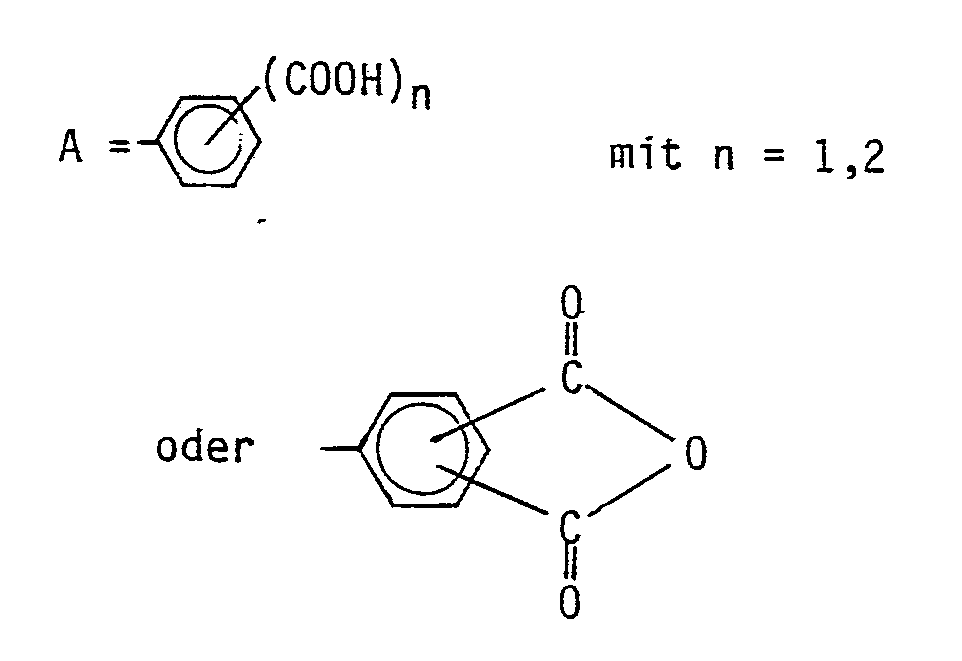
- X stands for the following difunctional residues: -CH2-, -CO-, -O-, -S-, -SO2 and - O - Ph - SO2 - Ph - O -, A stands for the following aromatic radicals Ph stands for the difunctional p-phenylene radical.
- X can in particular mean - O - Ph - SO2 - Ph - O - to have (see Lorenz et al. Macromolecular Chemistry 130 , 65 (1969).
- aromatic bisamides of the following formula or mixtures thereof can be used: R- CO - HN - Ph - X - Ph - Y - Ph - X - Ph - NH - CO - R
- R stands for an alkyl radical with 1 to 4 carbon atoms, in particular the methyl radical.
- aromatic diamines Based on 1 mol of aromatic diamines, 0.95 to 1.05 mol, preferably 1.0 mol, of aromatic dicarboxylic acid are used.
- the reaction of the aromatic dicarboxylic acids or the anhydrides with the bisamides can be carried out in the presence of 0.1 to 5%, based on the amount by weight of polycarboxylic acid (anhydride) and bisamide, of a catalyst.
- Suitable catalysts include inorganic basic salts, in particular alkali and alkaline earth carbonates, such as, for. B. calcium carbonate, and acetates, e.g. B. zinc acetate or sodium acetate.
- the catalyst usually remains in the product. However, it should, if it should be desirable, by reprecipitation of the reaction product from a suitable solvent, such as. B. N-methylpyrrolidone are removed.
- the resulting products can be processed into foils by pressing at elevated temperatures (> 200 ° C).
- Casting films can also be produced in a conventional manner from the organic solutions of the polyamides in suitable, aprotic polar solvents.
- the J value of the polyamides obtained which is a measure of the relative molar mass, is determined in the following experiments in mixtures of 1,2-dichlorobenzene and phenol in a volume ratio of 1: 1.
Landscapes
- Chemical & Material Sciences (AREA)
- Health & Medical Sciences (AREA)
- Chemical Kinetics & Catalysis (AREA)
- Medicinal Chemistry (AREA)
- Polymers & Plastics (AREA)
- Organic Chemistry (AREA)
- Polyamides (AREA)
- Macromolecular Compounds Obtained By Forming Nitrogen-Containing Linkages In General (AREA)
Abstract
Description
- Aromatische Polyamide mit der wiederkehrenden Einheit


- Bekannte Verfahren zur Herstellung von aromatischen Polyamiden sind:
- 1. Tieftemperatur-Lösungspolykondensation durch Umsetzung von aromatischen Dicarbonsäuredichloriden mit aromatischen Diaminen in polaren Lösungsmitteln (US-PSS 32 87 324, 35 41 056, 36 00 350, 38 19 587, 37 67 756, 38 69 429, 36 73 143, 38 17 941, 30 63 966 und DE-AS 22 19 703).
- 2. Grenzflächenpolykondensation durch Reaktion zwischen einem aromatischen Dicarbonsäuredichlorid und einem aromatischen Diamin an der Grenzfläche einer organischen und einer wäßrigen Phase (DE-OSS 19 08 297, 23 25 139 und DE-PS 30 06 899).
- Aromatische Polyamide können auch durch Reaktion von aromatischen Dicarbonsäuren mit aromatischen Diisocyanaten (DE-OS 19 28 435) und durch Umsetzung von aromatischen Dicarbonsäurediarylestern mit aromatischen Diaminen hergestellt werden.
- So beschreiben Brode et al. die Darstellung von 4,4′-[Sulfonylbis(p-phenylenoxy)]dianilin (X = O, Y = SO₂) aus p-Aminophenol und 4,4′-Dichlordiphenylsulfon und dessen Kondensation mit aromatischen Säurechloriden wie z. B. Terephthalsäurechlorid zu aromatischen Polyamiden mit Glasübergangstemperaturen (Tg) zwischen 230 und 320 °C. (Polymer Prepr. Am. Chem. Soc. Div. Pol. Chem. 15, 761 (1974) und Adv. Chem. Ser. 1975, 142; vgl. CA 84, 55 30s und CA 83, 1931 86 f).
- Diese Verfahren haben den Nachteil, daß sie auf den Einsatz von aktivierten, schwierig handhabbaren Monomeren angewiesen sind.
- Es sind auch Verfahren bekannt, bei denen man aromatische Polyamide direkt durch Reaktion von aromatischen Dicarbonsäuren und aromatischen Diaminen in Gegenwart von aromatischen Phosphiten erhält. Als Lösemittel haben sich für dieses Verfahren N-Methylsäureamide, insbesondere N-Methylpyrrolidon, bewährt. Mit anderen dipolar aprotischen Lösemitteln, wie z. B. Dimethylsulfoxid, werden dagegen keine polymeren Amide erhalten (vgl. F. Higashi et al, J. Polym. Sci., Polym. Chem. Ed. 18, 1711 ff. (1980)).
- Es ist schließlich ein Verfahren bekannt, nach dem aromatische Polyamide durch Schmelzpolykondensation von bestimmten Dicarbonsäuren mit bestimmten Diaminen in Gegenwart von P-haltigen Verbindungen hergestellt werden (vgl. deutsche Patentanmeldung P 36 09 011.5).
- Neben diesen Verfahren, bei denen die Kondensation in einem Lösemittel durchgeführt wird, hat es auch Versuche gegeben, Polyamide und Polyamidimide in der Schmelze herzustellen. So beschreibt die US-PS 31 09 836 ein Verfahren zur Herstellung von Polyamiden der wiederkehrenden Einheiten (CO - Ar - NH), das darin besteht, Acetamidobenzoesäure 3 Stunden im Vakuum auf 200 bis 300 °C zu erhitzen. Dieses Ver fahren liefert - im Gegensatz zu den Behauptungen in dieser Schrift - keine thermoplastisch verarbeitbaren Produkte, da die Schmelzpunkte der Reaktionsprodukte im Bereich der Zersetzungstemperatur oder darüber liegen.
- Ein ähnliches Verfahren wird in der DE-OS 21 18 388 beschrieben. Die Umsetzung findet in fester Phase statt. Daher ist die Reaktionsgeschwindigkeit sehr klein. Eine thermoplastische Verarbeitung des erhaltenen Produkts, beispielsweise in einem Extruder, ist nicht möglich.
- Es ist auch vorgeschlagen worden, aromatische Polyamide durch Umamidierung von acylierten aromatischen Aminen in der Schmelze herzustellen. Um die Verarbeitbarkeit zu verbessern, wurden nicht rein aromatische Ausgangsverbindungen, sondern Gemische mit aliphatischen Vertretern eingesetzt. Die Diamine werden nicht vollständig, sondern nur teilweise acyliert. Schließlich wird der Reaktionsschmelze Essigsäure, Essigsäureanhydrid, Dimethylacetamid oder ein anderes Mittel zur Verbesserung der Fließfähigkeit zugesetzt (vgl. Keske et al. Polymer Prepr. 25, Part XXV, S. 25 (1984) und US-PS 36 54 227). Die US-PSS 43 58 561, 43 48 513 und 44 47 574 beschreiben die Herstellung von Polyamidimiden durch Umsetzung acylierter aromatischer Diamine mit aromatischen Tricarbonsäureanhydriden und Dicarbonsäuren. Setzt man nur teilweise acylierte Diamine ein, wie dies beschrieben ist, wird im Verlauf der Polykondensation wasserhaltige Essigsäure freigesetzt, deren hohe Korrosionswirkung aufwendige Spezialapparaturen erfordert. Die erhaltenen Produkte weisen sehr hohe Erweichungstemperaturen aus, die im Bereich der Zersetzungstemperatur liegen. Die Produkte sind daher für eine thermoplastische Verarbeitung ungeeignet.
- Die Darstellung eines Polyimid-Formpulvers wird in der DE-OS 21 18 388 beschrieben. Man setzt entweder das Dianhydrid einer aromatischen Tetracarbonsäure (IV) mit einem Bisamid (II) um oder führt die Selbstkondensation einer aromatischen Verbindung durch, die gleichzeitig eine Acetamido- und eine Anhydridgruppe aufweist. Auch die US-PS 3 654 227 beschreibt die Umsetzung von aromatischen Bisamiden mit aro matischen Tetracarbonsäuredianhydriden zu oligomeren Polyimiden. In beiden Fällen werden also keine hochmolekularen thermoplastisch verarbeitbaren Polyamide erhalten.
- Es wurde jetzt ein Verfahren gefunden, mit dem sich bestimmte aromatische Bisamide mit bestimmten aromatischen Polycarbonsäuren oder deren Anhydriden in der Schmelze zu aromatischen Polyamiden bzw. zu aromatischen Polyamidimiden umsetzen lassen. Erstaunlicherweise sind die erhaltenen Produkte nicht nur thermoplastisch verarbeitbar, wie dies aus dem Stand der Technik bekannt war, sondern zeigen in der Schmelze Doppelbrechung. Die Charakterisierung flüssigkristalliner Phasen durch Doppelbrechung in der Schmelze wird in der US-PS 4 118 372 beschrieben. Damit ist es gelungen, eine neue Klasse technisch interessanter aromatischer Polyamide zu erschließen.
- Das Verfahren zur Herstellung der Polyamide bzw. Polyamidimide besteht darin, daß man eine etwa äquimolare Mischung der aromatischen Polycarbonsäure und/oder ihres Anhydrids und der aromatischen Bissamide, gegebenenfalls in Gegenwart eines Katalysators, in der Schmelze bei Temperaturen zwischen 200 und 380 °C umsetzt.
- Gegenstand der Erfindung sind auch die nach diesem Verfahren hergestellten Polyamide und Polyamidimide gemäß Anspruch 6.
- Der Zusatz der geringen Menge des Katalysators hat einen ganz erheblichen Effekt auf die Bildung der Reaktionsprodukte.
- Der J-Wert, der ein Maß für das Molekulargewicht darstellt, wird erheblich erhöht.
- Die Farbqualität des Polymeren wird deutlich verbessert.
- Die Polykondensationszeit wird drastisch reduziert.
- Das Molekulargewicht der erhaltenen Polyamide liegt zwischen 10 000 und 200 000, bevorzugt zwischen 20 000 bis 70 000. - Erfindungsgemäß können folgende aromatische Polycarbonsäuren oder deren Anhydride eingesetzt werden:
- Isophathalsäure, die bis zu 60 Molprozent durch Terephthalsäure ersetzt sein kann,
- Trimellithsäure,
- das Monoanhydrid der Trimellithsäure, das bereits beim Erhitzen der Säure entsteht,
- eine mindestens 2 aromatische Ringe enthaltene Säure der allgemeinen Formel
- Hierbei steht X für folgende difunktionelle Reste:
-CH₂-, -CO-, -O-, -S-, -SO₂ und - O - Ph - SO₂ - Ph - O -,
A steht für folgende aromatische Reste

- Vorzugsweise handelt es sich um eine aromatische Dicarbonsäure der Formel
HOOC - Ph - X - Ph - COOH
Hierbei kann X insbesondere die Bedeutung
- O - Ph - SO₂ - Ph - O -
haben
(vgl. Lorenz et al. Makromolekulare Chemie 130, 65 (1969). - Erfindungsgemäß können aromatische Bisamide folgender Formel oder deren Mischungen eingesetzt werden:
R- CO - HN - Ph - X - Ph - Y - Ph - X - Ph - NH - CO - R - Hierbei steht R für einen Alkylrest mit 1 bis 4 C-Atomen, insbesondere den Methylrest.
4,4′-Bis(4-aminophenoxy)diphenylsulfon (X = O, Y = SO₂) und
4,4′-Bis(4-aminophenylensulfonyl)diphenylether (X = SO₂, Y = O) - Die Verbindung mit X = O und Y = SO₂ wird durch Umsetzung von p-Aminophenol mit 4,4′-Dichlordiphenylsulfon und anschließende Acylierung erhalten.
- Die Herstellung der Verbindung mit X = SO₂ und Y = O ist mit Hilfe der US-PS 3 859 252 und anschließende Acylierung möglich.
- Bis zu 50 Molprozent der soeben aufgeführten Bisamide können durch folgende aromatischen Bisamide ersetzt werden:
- Aromatische Bisamide der allgemeinen Formel
R - CO -HN - Ph ( Z - Ph )m - Ph - CO - R
mit m = 0 oder 1, R = C(1-4)-Alkyl
und Z = -O-, -S-, -SO₂-, -CO-, -CH₂-. - Bezogen auf 1 Mol aromatischer Diamine werden 0,95 bis 1,05 Mol, vorzugsweise 1,0 Mol, aromatischer Dicarbonsäure eingesetzt.
- Die Umsetzung der aromatischen Dicarbonsäuren bzw. der Anhydride mit den Bisamiden kann in Gegenwart von 0,1 bis 5 %, bezogen auf die eingesetzte Gewichtsmenge Polycarbonsäure(anhydrid) und Bisamid, eines Katalysators durchgeführt werden.
- Geeignete Katalysatoren umfassen
anorganische basische Salze insbesondere Alkali- und Erdalkalicarbonate, wie z. B. Calciumcarbonat, sowie Acetate, z. B. Zinkacetat oder Natriumacetat. - Üblicherweise arbeitet man unter Inertgas bei Normaldruck. Es kann jedoch, wenn dies aus irgendwelchen Gründen wünschenswert sein sollte, auch bei leichtem Über- oder Unterdruck gearbeitet werden. Die zur Erzielung ausreichend hochmolekularer Produkte notwendigen Reaktionszeiten liegen zwischen 1 und 4 Stunden.
- Die Polykondensation wird in der Schmelze bei Temperaturen zwischen 200 und 390 °C, vorzugsweise 250 bis 380 °C, durchgeführt. Es gibt insbesondere drei Varianten, in denen das Verfahren durchgeführt werden kann:
- I. Die Reaktanden und die Katalysatoren werden gemeinsam aufgeschmolzen und bei Temperaturen zwischen 200 und 280 °C vorkondensiert. Dann wird die Temperatur auf maximal 350 bis 390 °C erhöht und das Präpolymere nachkondensiert. Der stattfindende Molekulargewichtsaufbau ist an der starken Erhöhung der Schmelzviskosität zu erkennen.
- II. Eine Pulvermischung der Reaktanden und Katalysatoren wird in einem Kneter unter allmählicher Temperatursteigerung von 220 auf 350 °C solange behandelt, bis das bei der Kondensation entstehende Wasser entfernt ist. Alternativ ist es auch möglich, die Polykondensation in einem Extruder durchzuführen. Auch in diesem Fall beschickt man das Gerät mit einer Pulvermischung der Komponenten und sorgt durch geeignete Temperatureinstellung für eine vollständige Entfernung des Reaktionswassers.
- III. Schließlich ist es auch möglich, entsprechend Variante I die Ausgangsprodukte zunächst zu einem Vorkondensat bei einer Temperatur von 200 bis 280 °C umzusetzen und anschließend das Vorkondensat in einem Kneter oder in einem Extruder nachzukondensieren. Im Extruder werden dann üblicherweise Temperaturen von 280 bis 370 °C, vorzugsweise 290 bis 350 °C, erforderlich sein. Diese Variante ist besonders bevorzugt.
- Sollte das Endprodukt noch kein ausreichend hohes Molekulargewicht aufweisen, ist es möglich, eine Molekulargewichtserhöhung durch Festphasennachkondensation zu erzielen. Eine solche Vorgehensweise ist dem Fachmann vertraut. Generell ist zu beachten, daß zur Polykondensation der Polyamidimide höhere Temperaturen erforderlich sind als im Falle der Polyamide.
- Der Katalysator verbleibt üblicherweise im Produkt. Er kann jedoch, falls es wünschenswert sein sollte, durch Umfällung des Reaktionsproduktes aus einem geeigneten Lösemittel, wie z. B. N-Methylpyrrolidon, entfernt werden.
- Zur Herstellung von ausreichend hochmolekularen Produkten ist es notwendig, die während der Polykonsation gebildete Säure aus dem Reaktionssystem zu entfernen. Gemäß Variante I reicht hierzu das Über- bzw. Durchleiten von Inertgas aus. Es kann jedoch auch Vakuum angelegt werden.
- Am Ende der Polykondensation erhält man eine mehr oder weniger viskose Schmelze des Polymeren, die direkt zu Granulat weiterverarbeitet werden kann.
- Die anfallenden Produkte können durch Verpressen bei erhöhter Temperatur (> 200 °C) zu Folien verarbeitet werden. Aus den organischen Lösungen der Polyamide in geeigneten, aprotischen polaren Lösemitteln können in üblicher Weise auch Gießfolien hergestellt werden.
- Der J-Wert der erhaltenen Polyamide, der ein Maß für die relative Molmasse darstellt, wird in den folgenden Versuchen in Gemischen aus 1,2-Dichlorbenzol und Phenol im Volumenverhältnis 1 : 1 bestimmt.
- 23,83 g (0,05 Mol) 4,4′-Bis (4-acetamidophenoxy)diphenylsulfon und 9,61 g (0,05 Mol) Trimellithsäureanhydrid werden unter Stickstoff im PK-Rohr bei 250 °C aufgeschmolzen und 40 Minuten bei 290 °C gerührt. Im Verlauf von 10 Minuten wird die Temperatur auf 350 °C erhöht. Nach 25 Minuten bei 350 °C unter Wasserstrahlvakuum läßt man erkalten. Der goldbraune Festkörper zeigt eine Viskositätszahl J von 90 cm³/g.
- 25,83 g (0,05 Mol) 4,4′-Bis(4-acetamidophenolxy)diphenylsulfon und 9,61 g (0,05 Mol) Trimellithsäureanhydrid und 0,30 g CaCO₃ werden nach Aufschmelzen bei 250 °C 15 Minuten bei 280 °C gerührt. Die Temperatur wird im Verlauf von 10 Minuten auf 300 °C, dann innerhalb von 10 Minuten auf 320, 340 und schließlich 360 °C erhöht. Nach 2 Minuten bei 360 °C läßt man erkalten.
J-Wert = 45 cm³/g - 25,83 g (0,05 Mol) 4,4′-Bis(4-Acetamidophenxy)diphenylsulfon, 8,31 g (0,05 Mol) Isophthalsäure und 0,30 g CaCO₃ werden 30 Minuten bei 250 °C gerührt; danach wird die Temperatur innerhalb von 20 Minuten auf 350 °C erhöht. Nach 20 Minuten bei 350 °C im Wasserstrahlvakuum läßt man erkalten.
J-Wert = 40 c³m/g
Claims (6)

dadurch gekennzeichnet,
daß man
- Isophthalsäure, die bis zu 60 % durch Terephthalsäure ersetzt sein kann
- eine Säure der Formel



R - CO - NH - Ph - X - Ph - Y - Ph - X - Ph - NH - CO - R
mit R = C(1-4) Alkyl,
das bis zu 50 Mol % durch ein Bisamid der Formel
R - CO - HN - Ph (Z-Ar)m - NH - CO - R
mit m = 0 oder 1,
Z = -O-, -S-, -SO₂-, -CO-, CH₂ und
R = C(1-4)Alkyl
ersetzt sein kann,
dadurch gekennzeichnet,
daß man als aromatische Polycarbonsäurekomponente Isophthalsäure oder Trimellithsäureanhydrid einsetzt.
dadurch gekennzeichnet,
daß man als Bisamid 4,4′-Bis(4-acetamidophenoxy)diphenylsulfon einsetzt.
dadurch gekennzeichnet,
daß man die Umsetzung in Gegenwart von 0,1 bis 5 %, bezogen auf die Gewichtsmenge aromatischer Polycarbonsäurekomponente und Bisamid, eines basischen Katalysators durchführt.
dadurch gekennzeichnet,
daß man als Katalysator ein anorganisches basisches Salz verwendet.
Priority Applications (1)
| Application Number | Priority Date | Filing Date | Title |
|---|---|---|---|
| AT87102249T ATE67773T1 (de) | 1986-04-17 | 1987-02-17 | Verfahren zur herstellung thermoplastisch verarbeitbarer aromatischer polyamide und polyamidimide. |
Applications Claiming Priority (2)
| Application Number | Priority Date | Filing Date | Title |
|---|---|---|---|
| DE3612935 | 1986-04-17 | ||
| DE19863612935 DE3612935A1 (de) | 1986-04-17 | 1986-04-17 | Verfahren zur herstellung thermoplastisch verarbeitbarer aromatischer polyamide und polyamidimide |
Publications (2)
| Publication Number | Publication Date |
|---|---|
| EP0241672A1 true EP0241672A1 (de) | 1987-10-21 |
| EP0241672B1 EP0241672B1 (de) | 1991-09-25 |
Family
ID=6298879
Family Applications (1)
| Application Number | Title | Priority Date | Filing Date |
|---|---|---|---|
| EP87102249A Expired - Lifetime EP0241672B1 (de) | 1986-04-17 | 1987-02-17 | Verfahren zur Herstellung thermoplastisch verarbeitbarer aromatischer Polyamide und Polyamidimide |
Country Status (5)
| Country | Link |
|---|---|
| US (1) | US4824932A (de) |
| EP (1) | EP0241672B1 (de) |
| JP (1) | JPS62252427A (de) |
| AT (1) | ATE67773T1 (de) |
| DE (2) | DE3612935A1 (de) |
Cited By (1)
| Publication number | Priority date | Publication date | Assignee | Title |
|---|---|---|---|---|
| EP0327690A3 (de) * | 1988-01-19 | 1990-10-24 | Hüls Aktiengesellschaft | Formmassen, enthaltend imidgruppenhaltige aromatische Polyamide und ihre Verwendung. |
Families Citing this family (3)
| Publication number | Priority date | Publication date | Assignee | Title |
|---|---|---|---|---|
| US20080174016A1 (en) * | 2006-12-28 | 2008-07-24 | Mitsui Mining & Smelting Co., Ltd. | Flexible Printed Wiring Board and Semiconductor Device |
| US20120211258A1 (en) * | 2011-02-18 | 2012-08-23 | Hitachi Cable, Ltd. | Polyamide-imide resin insulating coating material and insulated wire using the same |
| DE202013103502U1 (de) | 2013-08-05 | 2013-10-04 | Carl Weiske Gmbh & Co.Kg | Kunststoffzusammensetzung und diese enthaltende Fasern mit hoher Lichtechtheit und Flammbeständigkeit |
Citations (5)
| Publication number | Priority date | Publication date | Assignee | Title |
|---|---|---|---|---|
| FR1601964A (en) * | 1968-12-31 | 1970-09-21 | Polyimides for adhesive compositions | |
| DE2226951A1 (de) * | 1971-06-07 | 1973-02-08 | Ici Ltd | Polyamide, deren herstellung und deren verwendung |
| US4348513A (en) * | 1980-01-16 | 1982-09-07 | Standard Oil Company (Indiana) | Injection moldable amide-imide copolymers and terpolymers |
| US4358561A (en) * | 1980-01-16 | 1982-11-09 | Standard Oil Company (Indiana) | Injection moldable amide-imide copolymers |
| US4447574A (en) * | 1982-06-29 | 1984-05-08 | Standard Oil Company (Indiana) | Injection moldable amide-imide polymers containing calcium moieties |
Family Cites Families (10)
| Publication number | Priority date | Publication date | Assignee | Title |
|---|---|---|---|---|
| DE1595681A1 (de) * | 1966-09-19 | 1970-01-22 | Bayer Ag | Verfahren zur Herstellung von hochschmelzenden Polyamiden |
| DE1720699A1 (de) * | 1967-08-17 | 1971-07-15 | Bayer Ag | Verfahren zur Herstellung hochschmelzender loeslicher Polyamide |
| US4003879A (en) * | 1971-06-07 | 1977-01-18 | Imperial Chemical Industries Limited | Polyamides |
| US3753948A (en) * | 1971-06-09 | 1973-08-21 | Union Carbide Corp | Preparation of polyamic acids in ketone solvents |
| US4018747A (en) * | 1975-01-20 | 1977-04-19 | Uniroyal, Inc. | Production of fiber-forming polyamides by transamidation of N-alicyclic diamides with dicarboxylic acids |
| US4317902A (en) * | 1980-05-19 | 1982-03-02 | Monsanto Company | SO3 -Containing aromatic polyamides |
| US4410684A (en) * | 1983-02-07 | 1983-10-18 | The Upjohn Company | Aromatic copolyamides containing ether linkages |
| US4621134A (en) * | 1984-04-25 | 1986-11-04 | Mitsubishi Petrochemical Co., Ltd. | Aromatic polythioetheramide |
| DE3539846A1 (de) * | 1985-11-09 | 1987-05-14 | Huels Chemische Werke Ag | Thermoplastisch verarbeitbare aromatische polyamide mit chemisch eingebauten ether- und sulfonylgruppen und verfahren zu ihrer herstellung |
| DE3609011A1 (de) * | 1986-03-18 | 1987-09-24 | Huels Chemische Werke Ag | Verfahren zur herstellung thermoplastisch verarbeitbarer aromatischer polyamide |
-
1986
- 1986-04-17 DE DE19863612935 patent/DE3612935A1/de not_active Withdrawn
- 1986-12-30 US US06/947,897 patent/US4824932A/en not_active Expired - Fee Related
-
1987
- 1987-02-17 AT AT87102249T patent/ATE67773T1/de not_active IP Right Cessation
- 1987-02-17 EP EP87102249A patent/EP0241672B1/de not_active Expired - Lifetime
- 1987-02-17 DE DE8787102249T patent/DE3773246D1/de not_active Expired - Lifetime
- 1987-04-16 JP JP62092125A patent/JPS62252427A/ja active Pending
Patent Citations (5)
| Publication number | Priority date | Publication date | Assignee | Title |
|---|---|---|---|---|
| FR1601964A (en) * | 1968-12-31 | 1970-09-21 | Polyimides for adhesive compositions | |
| DE2226951A1 (de) * | 1971-06-07 | 1973-02-08 | Ici Ltd | Polyamide, deren herstellung und deren verwendung |
| US4348513A (en) * | 1980-01-16 | 1982-09-07 | Standard Oil Company (Indiana) | Injection moldable amide-imide copolymers and terpolymers |
| US4358561A (en) * | 1980-01-16 | 1982-11-09 | Standard Oil Company (Indiana) | Injection moldable amide-imide copolymers |
| US4447574A (en) * | 1982-06-29 | 1984-05-08 | Standard Oil Company (Indiana) | Injection moldable amide-imide polymers containing calcium moieties |
Cited By (1)
| Publication number | Priority date | Publication date | Assignee | Title |
|---|---|---|---|---|
| EP0327690A3 (de) * | 1988-01-19 | 1990-10-24 | Hüls Aktiengesellschaft | Formmassen, enthaltend imidgruppenhaltige aromatische Polyamide und ihre Verwendung. |
Also Published As
| Publication number | Publication date |
|---|---|
| US4824932A (en) | 1989-04-25 |
| EP0241672B1 (de) | 1991-09-25 |
| DE3773246D1 (de) | 1991-10-31 |
| ATE67773T1 (de) | 1991-10-15 |
| JPS62252427A (ja) | 1987-11-04 |
| DE3612935A1 (de) | 1987-10-22 |
Similar Documents
| Publication | Publication Date | Title |
|---|---|---|
| EP0237722B1 (de) | Verfahren zur Herstellung thermoplastisch verarbeitbarer aromatischer Polyamide | |
| EP0774480A1 (de) | Verfahren zur Herstellung von verzweigten Polyamiden | |
| DE3707125A1 (de) | Aromatische polyamide und polybenzoxazole mit diphenylhexafluorpropaneinheiten | |
| CH684893A5 (de) | Verfahren zur Herstellung von amorphen teilaromatischen hochmolekularen Copolyamiden. | |
| EP0573485A1 (de) | Aromatische copolyamide, verfahren zu ihrer herstellung und ihre verwendung zur herstellung von geformten gebilden. | |
| DE2708848C2 (de) | ||
| EP0424860A2 (de) | Vollaromatische Polyamide, Verfahren zu ihrer Herstellung und daraus geformte Gebilde | |
| DE2932589C3 (de) | Polyimidharzmasse sowie Verwendung derselben | |
| DE2521305A1 (de) | Aromatische polyimide mit endstaendigen phthalsaeurenitrilgruppen und verfahren zur herstellung derselben | |
| EP0213286A2 (de) | Verfahren zur Herstellung aromatischer Polyamide | |
| EP0241672B1 (de) | Verfahren zur Herstellung thermoplastisch verarbeitbarer aromatischer Polyamide und Polyamidimide | |
| DE3835405A1 (de) | Vollaromatische polyamide, verfahren zu ihrer herstellung und daraus geformte gebilde | |
| EP0445673B1 (de) | Aromatische Copolyamide, Verfahren zu ihrer Herstellung und daraus geformte Gebilde | |
| DE69212336T2 (de) | Diaminomesitylen-perfluoroalkyle und daraus gewonnene polyimide | |
| DE2202145C3 (de) | Verfahren zur Herstellung von Polyamidimiden | |
| DE3539846A1 (de) | Thermoplastisch verarbeitbare aromatische polyamide mit chemisch eingebauten ether- und sulfonylgruppen und verfahren zu ihrer herstellung | |
| EP0442399B1 (de) | Vollaromatische Polyamide, Verfahren zu ihrer Herstellung und daraus geformte Gebilde | |
| EP0378105A2 (de) | Hochtemperaturbeständige Polysulfon-Polyimid-Blockcopolykondensate, Verfahren zu ihrer Herstellung durch Schmelzkondensation und ihre Verwendung | |
| DE2358504B2 (de) | Verfahren zur Herstellung von Hydantoinringe in der Hauptkette enthaltenden Polykondensaten | |
| DE4224248C2 (de) | Nadimid-terminierte Polyarylate und gehärtete Polyarylatharze | |
| EP0386088A1 (de) | Neue lösliche und/oder schmelzbare polyamid-polyamid-, polyamid-polyamidimid- und polyamid-polyimid-blockcopolymere | |
| EP0281954A1 (de) | Aromatische Polyamide auf Basis von Phenoxyterephthalsäure und Verfahren zu ihrer Herstellung | |
| EP0307575B1 (de) | Verfahren zur Herstellung von hochmolekularen aromatischen Polyamiden | |
| EP0585829A2 (de) | Rekristallisierbare Polyimide | |
| DE1962845A1 (de) | Verfahren zur Herstellung eines hitzehaertbaren Harzes |
Legal Events
| Date | Code | Title | Description |
|---|---|---|---|
| PUAI | Public reference made under article 153(3) epc to a published international application that has entered the european phase |
Free format text: ORIGINAL CODE: 0009012 |
|
| AK | Designated contracting states |
Kind code of ref document: A1 Designated state(s): AT BE CH DE FR GB IT LI NL |
|
| 17P | Request for examination filed |
Effective date: 19871121 |
|
| 17Q | First examination report despatched |
Effective date: 19890207 |
|
| GRAA | (expected) grant |
Free format text: ORIGINAL CODE: 0009210 |
|
| AK | Designated contracting states |
Kind code of ref document: B1 Designated state(s): AT BE CH DE FR GB IT LI NL |
|
| REF | Corresponds to: |
Ref document number: 67773 Country of ref document: AT Date of ref document: 19911015 Kind code of ref document: T |
|
| ET | Fr: translation filed | ||
| REF | Corresponds to: |
Ref document number: 3773246 Country of ref document: DE Date of ref document: 19911031 |
|
| GBT | Gb: translation of ep patent filed (gb section 77(6)(a)/1977) | ||
| ITF | It: translation for a ep patent filed | ||
| PGFP | Annual fee paid to national office [announced via postgrant information from national office to epo] |
Ref country code: GB Payment date: 19920128 Year of fee payment: 6 |
|
| PGFP | Annual fee paid to national office [announced via postgrant information from national office to epo] |
Ref country code: FR Payment date: 19920131 Year of fee payment: 6 |
|
| PG25 | Lapsed in a contracting state [announced via postgrant information from national office to epo] |
Ref country code: AT Effective date: 19920217 |
|
| PGFP | Annual fee paid to national office [announced via postgrant information from national office to epo] |
Ref country code: CH Payment date: 19920225 Year of fee payment: 6 |
|
| PGFP | Annual fee paid to national office [announced via postgrant information from national office to epo] |
Ref country code: DE Payment date: 19920226 Year of fee payment: 6 |
|
| PG25 | Lapsed in a contracting state [announced via postgrant information from national office to epo] |
Ref country code: BE Effective date: 19920228 |
|
| PGFP | Annual fee paid to national office [announced via postgrant information from national office to epo] |
Ref country code: NL Payment date: 19920229 Year of fee payment: 6 |
|
| PLBE | No opposition filed within time limit |
Free format text: ORIGINAL CODE: 0009261 |
|
| STAA | Information on the status of an ep patent application or granted ep patent |
Free format text: STATUS: NO OPPOSITION FILED WITHIN TIME LIMIT |
|
| BERE | Be: lapsed |
Owner name: HULS A.G. Effective date: 19920228 |
|
| 26N | No opposition filed | ||
| PG25 | Lapsed in a contracting state [announced via postgrant information from national office to epo] |
Ref country code: GB Effective date: 19930217 |
|
| PG25 | Lapsed in a contracting state [announced via postgrant information from national office to epo] |
Ref country code: LI Effective date: 19930228 Ref country code: CH Effective date: 19930228 |
|
| PG25 | Lapsed in a contracting state [announced via postgrant information from national office to epo] |
Ref country code: NL Effective date: 19930901 |
|
| GBPC | Gb: european patent ceased through non-payment of renewal fee |
Effective date: 19930217 |
|
| NLV4 | Nl: lapsed or anulled due to non-payment of the annual fee | ||
| PG25 | Lapsed in a contracting state [announced via postgrant information from national office to epo] |
Ref country code: FR Effective date: 19931029 |
|
| REG | Reference to a national code |
Ref country code: CH Ref legal event code: PL |
|
| PG25 | Lapsed in a contracting state [announced via postgrant information from national office to epo] |
Ref country code: DE Effective date: 19931103 |
|
| REG | Reference to a national code |
Ref country code: FR Ref legal event code: ST |
|
| PG25 | Lapsed in a contracting state [announced via postgrant information from national office to epo] |
Ref country code: IT Free format text: LAPSE BECAUSE OF NON-PAYMENT OF DUE FEES;WARNING: LAPSES OF ITALIAN PATENTS WITH EFFECTIVE DATE BEFORE 2007 MAY HAVE OCCURRED AT ANY TIME BEFORE 2007. THE CORRECT EFFECTIVE DATE MAY BE DIFFERENT FROM THE ONE RECORDED. Effective date: 20050217 |