EP0241428A2 - Verwendung von 2-Aminoalkyl-5-pyridinol-Verbindungen als Nootropika und Antidepressiva - Google Patents
Verwendung von 2-Aminoalkyl-5-pyridinol-Verbindungen als Nootropika und Antidepressiva Download PDFInfo
- Publication number
- EP0241428A2 EP0241428A2 EP87810213A EP87810213A EP0241428A2 EP 0241428 A2 EP0241428 A2 EP 0241428A2 EP 87810213 A EP87810213 A EP 87810213A EP 87810213 A EP87810213 A EP 87810213A EP 0241428 A2 EP0241428 A2 EP 0241428A2
- Authority
- EP
- European Patent Office
- Prior art keywords
- addition salts
- acid addition
- formula
- preparation
- treatment
- Prior art date
- Legal status (The legal status is an assumption and is not a legal conclusion. Google has not performed a legal analysis and makes no representation as to the accuracy of the status listed.)
- Granted
Links
Classifications
-
- A—HUMAN NECESSITIES
- A61—MEDICAL OR VETERINARY SCIENCE; HYGIENE
- A61K—PREPARATIONS FOR MEDICAL, DENTAL OR TOILETRY PURPOSES
- A61K31/00—Medicinal preparations containing organic active ingredients
- A61K31/33—Heterocyclic compounds
- A61K31/395—Heterocyclic compounds having nitrogen as a ring hetero atom, e.g. guanethidine or rifamycins
- A61K31/435—Heterocyclic compounds having nitrogen as a ring hetero atom, e.g. guanethidine or rifamycins having six-membered rings with one nitrogen as the only ring hetero atom
- A61K31/44—Non condensed pyridines; Hydrogenated derivatives thereof
-
- A—HUMAN NECESSITIES
- A61—MEDICAL OR VETERINARY SCIENCE; HYGIENE
- A61P—SPECIFIC THERAPEUTIC ACTIVITY OF CHEMICAL COMPOUNDS OR MEDICINAL PREPARATIONS
- A61P25/00—Drugs for disorders of the nervous system
- A61P25/24—Antidepressants
-
- A—HUMAN NECESSITIES
- A61—MEDICAL OR VETERINARY SCIENCE; HYGIENE
- A61P—SPECIFIC THERAPEUTIC ACTIVITY OF CHEMICAL COMPOUNDS OR MEDICINAL PREPARATIONS
- A61P25/00—Drugs for disorders of the nervous system
- A61P25/26—Psychostimulants, e.g. nicotine, cocaine
-
- A—HUMAN NECESSITIES
- A61—MEDICAL OR VETERINARY SCIENCE; HYGIENE
- A61P—SPECIFIC THERAPEUTIC ACTIVITY OF CHEMICAL COMPOUNDS OR MEDICINAL PREPARATIONS
- A61P25/00—Drugs for disorders of the nervous system
- A61P25/28—Drugs for disorders of the nervous system for treating neurodegenerative disorders of the central nervous system, e.g. nootropic agents, cognition enhancers, drugs for treating Alzheimer's disease or other forms of dementia
Definitions
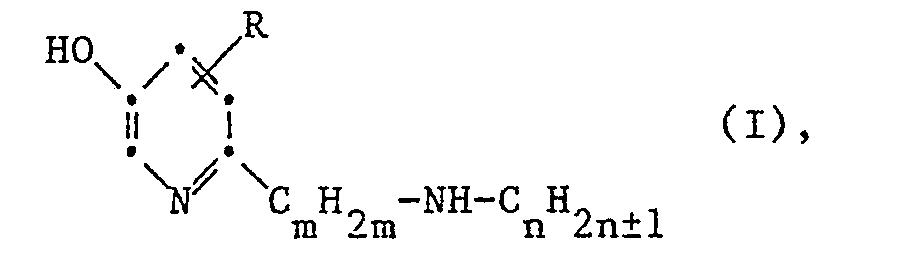
- the present invention relates to the use of secondary 2-aminoalkyl-5-pyridinols of the general formula I. wherein R is hydrogen or lower alkyl, m is an integer from 2 to 4, and n is an integer from 1 to 7, or their therapeutically usable acid addition salts as nootropics and antidepressants or for the preparation of nootropically and antidepressant drugs for therapeutic purposes and prophylactic treatment for celebral insufficiency.
- R is lower alkyl
- this group can be in any of the free positions 2-, 4- or 6- of the pyridine radical.
- the lower alkyl group is e.g. Ethyl, n- or isopropyl, n- or isobutyl, n-pentyl, n-hexyl or n-heptyl, but preferably methyl.
- R primarily means hydrogen.
- the alkylene group C m H 2m preferably means 1,2-propylene, but also ethylene, 1,3-propylene, 1,2-, 1,3- or 1,4-butylene.
- the group C n H 2n + 1 preferably represents lower alkyl, for example methyl, ethyl, n- or iso-propyl, n-, iso- or tert- (butyl, pentyl, hexyl or heptyl); especially for isopropyl.
- the group C n H 2n-1 mentioned means either lower alkenyl, for example allyl, methallyl, 2- or 3- (butenyl, pentenyl, hexenyl or heptenyl), or else ring-closed lower cycloalkyl, for example cyclopropyl, cyclobutyl, cyclopentyl, cyclohexyl or cycloheptyl; in particular, however, cyclopropyl or cyclohexyl.
- the acid addition salts of the dibasic compounds of the formula I are, in particular, therapeutically usable acid addition salts.
- Acids that give therapeutically useful acid addition salts are e.g. inorganic acids such as hydrohalic acids e.g. Hydrochloric or hydrobromic acid, or sulfuric, phosphoric, nitric or perchloric acid; or organic acids such as aliphatic or aromatic carboxylic or sulfonic acids e.g.
- Ant vinegar, propion, amber, glycol, milk, fumaric, apple, wine, lemon, maleic, hydroxymalein, pyrux, phenylacetic, benzoic, 4-aminobenzoic, Anthranil, 4-hydroxybenzoic, salicyl, pamoe, nicotine, methanesulfonic, ethanesulfonic, hydroxyethanesulfonic, ethylenesulfonic, benzenesulfonic, halobenzenesulfonic, toluenesulfonic, naphthalenesulfonic, sulfanilic, cyclohexylsulfonic; or ascorbic acid; the salts are known and have been described, for example, in EP Patent No. 19739.
- the compounds of the formula I mentioned above have a nootropic and antidepressant activity and, for example, provide protection against the amnesiogenic effect of a cerebral electric shock and improve memory performance and the ability to concentrate.
- the vigilance stimulus effects, improvements in concentration and antidepressant effects are coupled with very good tolerability and very low toxicity.
- the compounds of formula I according to the invention also have a clear effect on the vigilance state of cats.
- the total sleep time was reduced depending on the dose.
- the relative proportion of REM sleep rapid eye movement sleep
- the 2- (2-isopropylaminopropyl) -5-pyridinol monofumarate shows the total sleep time at a dose of 10 mg / kg p.o. by 28% and at a dose of 30 mg / kg p.o. reduced by 54%.
- the compounds of the formula I and II can be used for the production of pharmaceutical preparations which contain an effective amount of the active substance together or in a mixture with excipients which are suitable for enteral or parenteral administration.
- the pharmaceutical preparations can be sterilized and / or contain auxiliaries, for example preservatives, stabilizers, wetting agents and / or emulsifiers, solubilizers, salts for regulating the osmotic pressure and / or buffers.
- auxiliaries for example preservatives, stabilizers, wetting agents and / or emulsifiers, solubilizers, salts for regulating the osmotic pressure and / or buffers.
- the present pharmaceutical preparations which, if desired, can further contain pharmacologically valuable substances, are produced in a manner known per se, for example by means of conventional mixing, granulating or coating processes, and contain from 1% to 75%, in particular from 10% to 50% of the active ingredient.
- the test device consists of a large box (35 x 20 x 10 cm), which is connected to a small box (10 x 10 x 18 cm) by a sliding door. While the small box is brightly lit from above by a 100 watt lamp, the large box is dark.
- the bottom of both compartments consists of an electrically conductive grating, the grating bars (6 mm diameter) are arranged at a distance of 13 mm each.
- groups of 10 male mice each with a body weight of 20-22 g are placed individually in the brightly lit box. Because mice have a spontaneous preference for dark, most go to the dark compartment within 30 seconds.
- the sliding door is closed and a foot shock (1 mA, 50 Hz, 5 seconds) administered.
- the animals are immediately removed from the experimental apparatus. Two separate experiments are carried out (in the morning between 8 a.m. and 11 a.m. in the afternoon between 12 p.m. and 3 p.m.).
- the test device consists of a box (50 x 50 x 50 cm) normally illuminated with daylight with an electrically conductive grating, the grating bars (4 mm diameter) are arranged at a distance of 13 mm each.
- a wooden platform (12 mm high, 67 mm inner diameter) In the middle of the grate is a wooden platform (12 mm high, 67 mm inner diameter), which is surrounded by a plastic tube (18 cm high, 68 mm diameter).
- groups of 50 male mice each with a body weight of 20-22 g were used by placing one animal on the platform surrounded by the plastic tube, removing the plastic tube after 10 seconds and measuring the length of time the animal took to Descending and touching the grating with all 4 paws required. When all 4 paws touch the grating, a foot shock (1 mA, 50 Hz, 1 second) is administered.
- Example 3 Production of 10,000 tablets, each containing 10 mg of the active substance:
- Example 4 Production of 1000 capsules, each containing 50 mg of the active substance.
- Tablets or capsules which contain another compound of the formula I are prepared in an analogous manner.
Landscapes
- Health & Medical Sciences (AREA)
- Medicinal Chemistry (AREA)
- Veterinary Medicine (AREA)
- Public Health (AREA)
- General Health & Medical Sciences (AREA)
- Animal Behavior & Ethology (AREA)
- Life Sciences & Earth Sciences (AREA)
- Chemical & Material Sciences (AREA)
- Pharmacology & Pharmacy (AREA)
- Neurosurgery (AREA)
- Neurology (AREA)
- Engineering & Computer Science (AREA)
- Bioinformatics & Cheminformatics (AREA)
- Biomedical Technology (AREA)
- Chemical Kinetics & Catalysis (AREA)
- General Chemical & Material Sciences (AREA)
- Organic Chemistry (AREA)
- Nuclear Medicine, Radiotherapy & Molecular Imaging (AREA)
- Psychiatry (AREA)
- Epidemiology (AREA)
- Pain & Pain Management (AREA)
- Hospice & Palliative Care (AREA)
- Pharmaceuticals Containing Other Organic And Inorganic Compounds (AREA)
- Pyridine Compounds (AREA)
Abstract
Description
- Die vorliegende Erfindung betrifft die Verwendung von sekundären 2-Aminoalkyl-5-pyridinolen der allgemeinen Formel I

- Der Ausdruck "nieder" definiert in den oben oder nachfolgend genannten organischen Resten oder Verbindungen solche mit höchstens 7, vorzugsweise 4, insbesondere 1 oder 2 Kohlenstoffatomen.
- Bedeutet R Niederalkyl, so kann diese Gruppe in irgendeiner der freien Stellungen 2-, 4- oder 6- des Pyridinrestes stehen. Der Niederalkylrest ist z.B. Aethyl, n- oder Isopropyl, n- oder Isobutyl, n-Pentyl, n-Hexyl oder n-Heptyl, vorzugsweise jedoch Methyl. Das Symbol R bedeutet jedoch in erster Linie Wasserstoff.
- Die Alkylengruppe CmH2m bedeutet vorzugsweise 1,2-Propylen, aber auch Aethylen, 1,3-Propylen, 1,2-, 1,3- oder 1,4-Butylen.
- Die Gruppe CnH2n+1 steht vorzugsweise für Niederalkyl, z.B. Methyl, Aethyl, n- oder iso-Propyl, n-, iso- oder tert.-(Butyl, Pentyl, Hexyl oder Heptyl); insbesondere für Isopropyl.
- Die genannte Gruppe CnH2n-1 bedeutet entweder Niederalkenyl, z.B. Allyl, Methallyl, 2- oder 3-(Butenyl, Pentenyl, Hexenyl oder Heptenyl), oder auch ringgeschlossenes niederes Cycloalkyl, z.B. Cyclopropyl, Cyclobutyl, Cyclopentyl, Cyclohexyl oder Cycloheptyl; insbesondere jedoch Cyclopropyl oder Cyclohexyl.
- Die oben genannten Verbindungen der Formel I sind bekannt und beispielsweise im EP-Patent Nr. 19739 als antihypertensiv, aber insbesondere als kardioprotektiv, wie z.B. antiischämisch (d.h. antianginal) wirksam beschrieben worden.
- Die Säureadditionssalze der dibasischen Verbindungen der Formel I sind insbesondere therapeutisch verwendbare Säureadditionssalze. Säuren, die therapeutisch verwendbare Säureadditionssalze ergeben, sind z.B. anorganische Säuren, wie Halogenwasserstoffsäuren, z.B. Chlorwasserstoff- oder Bromwasserstoffsäure, oder Schwefel-, Phosphor-, Salpeter- oder Perchlorsäure; oder organische Säuren, wie aliphatische oder aromatische Carbon- oder Sulfonsäuren, z.B. Ameisen-, Essig-, Propion-, Bernstein-, Glykol-, Milch-, Fumar-, Aepfel-, Wein-, Zitronen-, Malein-, Hydroxymalein-, Brenztrauben-, Phenylessig-, Benzoe-, 4-Aminobenzoe-, Anthranil-, 4-Hydroxybenzoe-, Salicyl-, Pamoe-, Nikotin-, Methansulfon-, Aethansulfon-, Hydroxyäthansulfon-, Aethylensulfon-, Benzolsulfon-, Halogenbenzolsulfon-, Toluolsulfon-, Naphthalinsulfon-, Sulfanil-, Cyclohexylsulfaminsäure; oder Ascorbinsäure; die Salze sind bekannt und beispielsweise im EP-Patent Nr. 19739 beschrieben worden.
- Es wurde nun überraschenderweise gefunden, dass die oben genannten Verbindungen der Formel I nootropisch und antidepressiv wirksam sind und beispielsweise einen Schutz vor amnesiogener Wirkung eines cerebralen Elektroschocks und eine Verbesserung der Gedächtnisleistung sowie Konzentrationsfähigkeit bewirken. Die vigilanzstimu lierenden Wirkungen, Verbesserungen der Konzentrationsfähigkeit und antidepressive Effekte sind gekoppelt mit einer sehr guten Verträglichkeit und sehr niedriger Toxizität.
- Aufgrund dieser Eigenschaften sind die Verbindungen der Formel I zur Behandlung von cerebraler Leistungsinsuffizienz, insbesondere von Gedächtnisstörungen verschiedener Genese, Insuffizienz der Vigilanzregulation, wie senile Demenz, Multiinfarkt-Demenz oder Demenz vom Alzheimer-Typ, ferner von Folgeerscheinungen von Hirntraumen oder Apoplexie sowie Altersdepressionen geeignet. Die Verbindungen werden enteral oder parenteral, vorzugsweise oral oder intravenös, z.B. durch Gelatine-Kapseln oder in Form von Stärke enthaltenden Suspensionen bzw. wässrigen Lösungen, verabreicht. Die verwendete Dosis kann in einem Bereich zwischen 1 bis 30 mg/kg/Tag i.p., oder zwischen 10 und 100 mg/kg/Tag bei peroraler Verabreichung liegen.
- Die erfindungsgemässen Verbindungen der Formel I zeigen auch deutliche Wirkung auf den Vigilanzzustand von Katzen. Die Gesamtschlafzeit wurde dosisabhängig verkürzt. Der relative Anteil an REM-Schlaf (Rapid-Eye-Movement-Sleep), der verschiedentlich mit Gedächtnisaktivitäten in Verbindung gebracht wird, wurde interessanterweise nicht verkleinert im Gegenteil im Vergleich zur Gesamtschlafzeit stark verlängert. Dies ist umso bemerkenswerter, als dass praktisch alle psychoaktiven Substanzen REM-Schalf-verkürzend wirken.
- Als Beispiel für Illustration der Erfindung sei das 2-(2-Isopropylaminopropyl)-5-pyridinol-monofumarat genannt, welches die Gesamtschlafzeit bei einer Dosis von 10 mg/kg p.o. um 28 % und bei einer Dosis von 30 mg/kg p.o. um 54 % verkürzt.
- Die vorliegende Erfindung betrifft insbesondere die Verwendung von Verbindungen der Formel I, worin R Wasserstoff oder Methyl bedeutet, m für die ganze Zahl 2 oder 3 steht, und n eine ganze Zahl von 2 bis 6 bedeutet, und ihren Säureadditionssalzen, insbesondere therapeu tisch verwendbaren Säureadditionssalzen als Nootropika und Antidepressiva bzw. zur Herstellung eines nootropisch und stimulierend antidepressiv wirksamen Arzneimittels.
- Besonders hervorzuheben ist die Verwendung von Verbindungen der Formel II
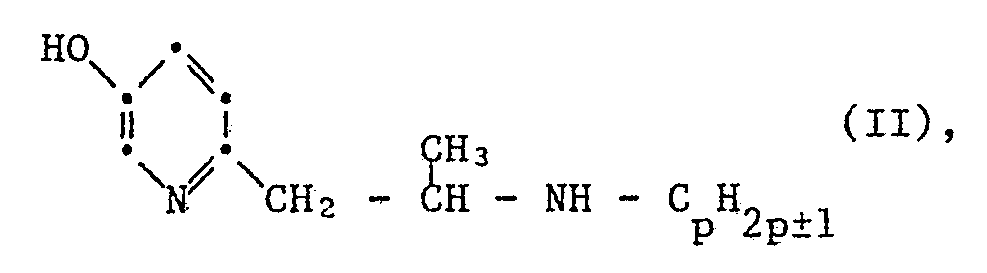
- Bevorzugt ist die Verwendung von Verbindungen der allgemeinen Formel II, worin CpH2p±1, tert.-Butyl, Allyl oder Cyclopropyl oder in erster Linie Isopropyl bedeutet, und ihren Säureadditionssalzen, insbesondere pharmazeutisch verwendbaren Säureadditionssalzen als Nootropikum bzw. zur Herstellung eines nootropisch wirksamen Arzneimittels.
- Die Herstellung der Verbindungen der Formel I und/oder II wird z.B. im EP-Patent Nr. 19739 ausführlich beschrieben.
- Die Verbindungen der Formel I und II können zur Herstellung von pharmazeutischen Präparaten verwendet werden, welche eine wirksame Menge der Aktivsubstanz zusammen oder im Gemisch mit Trägerstoffen enthalten, die sich zur enteralen oder parenteralen Verabreichung eignen. Vorzusweise verwendet man Tabletten oder Gelatinekapseln, welche den Wirkstoff zusammen mit Verdünnungsmitteln, z.B. Laktose, Dextrose, Rohrzucker, Mannitol, Sorbitol, Cellulose und/oder Glycin, und Schmiermitteln, z.B. Kieselerde, Talk, Stearinsäure oder Salze davon, wie Magnesium- oder Calciumstearat, und/oder Polyäthylenglykol, aufweisen; Tabletten enthalten ebenfalls Bindemittel, z.B. Magnesiumaluminiumsilikat, Stärke-Paste, Gelatine, Traganth, Methylcellulose, Natriumcarboxymethylcelullose und/oder Polyvinylpyrrolidon, und, wenn erwünscht, Sprengmitel, z.B. Stärken, Agar, Alginsäure oder ein Salz davon, Enzyme der Bindemittel und/oder Brausemischungen, oder Adsorptionsmittel, Farbstoffe, Geschmackstoffe und Süssmittel, Injizierbare Präparate sind vorzugsweise isotonische wässerige Lösungen oder Suspensionen, und Suppositorien in erster Linie Fettemulsionen oder -suspensionen. Die pharmazeutischen Präparate können sterilisiert sein und/oder Hilfsstoffe, z.B. Konservier-, Stabilisier-, Netz- und/oder Emulgiermittel, Löslichkeitsvermittler, Salze zur Regulierung des osmotischen Drucks und/oder Puffer enthalten. Die vorliegenden pharmazeutischen Präparate, die, wenn erwünscht, weiter pharmakologisch wertvolle Stoffe enthalten können, werden in an sich bekannter Weise, z.B. mittels konventioneller Misch-, Granulier- oder Dragierverfahren, hergestellt und enthalten von 1 % bis 75 %, insbesondere von 10 % bis 50 %, des Aktivstoffes.
- Die folgenden Beispiele dienen zur Illustration der Erfindung.
- Die Testvorrichtung besteht aus einer grossen Box (35 x 20 x 10 cm), die durch eine Schiebetür mit einer kleinen Box (10 x 10 x 18 cm) verbunden ist. Während die kleine Box durch eine 100 Watt Lampe von oben hell erleuchtet wird, ist die grosse Box dunkel. Der Boden beider Abteile besteht aus einem elektrisch leitenden Gitterrost, dessen Gitterstäbe (6 mm Durchmesser) in einem Abstand von jeweils 13 mm angeordnet sind. Zum Training werden Gruppen von jeweils 10 männlichen Mäusen mit einem Körpergewicht von 20-22 g einzeln in die hell erleuchtete Box gesetzt. Da Mäuse eine Spontanpräferenz für Dunkel haben, gehen die meisten innerhalb von 30 Sekunden ins dunkle Abteil. Sobald sie dieses vollständig betreten haben, wird die Schiebetür geschlossen und ein Fussschock (1 mA, 50 Hz, 5 Sekunden) verabreicht. Die Tiere werden darauf sofort aus dem Versuchsapparat entfernt. Zwei separate Versuche werden durchgeführt (vormittags zwischen 8-11 und nachmittags zwischen 12-15 Uhr).
- Zur Prüfung des Lerneffektes (Retest) werden die Mäuse nach 24 Stunden wiederum einzeln ins helle Abteil gesetzt und die Zeitspanne, bis sie sich ganz im dunklen Abteil befinden, gemessen. Ueblicherweise bleiben nun die meisten Tiere über die ganze Beobachtungszeit von 150 Sekunden im hellen Abteil. Der Lerneffekt wird weitgehend aufgehoben bzw. die Erinnerung an den Fussschock mindestens partiell ausgelöscht, wenn als amnesiogene Behandlung unmittelbar anschliessend an den Fussschock des Lerndurchgangs eine temporale Elektroschockbehandlung angeschlossen wird. Parameter des Elektroschocks: 50 mA, 0,4 Sekunden, 50 Hz.
- Zur Prüfung und zum Vergleich ihrer Schutzwirkung gegenüber der amnesiogenen Wirkung des Elektroschocks werden den in verschiedene Gruppen aufgeteilten Tieren die Testsubstanzen 30 Minuten vor dem Lerndurchgang in Dosen von 0,1 mg/kg, 1 mg/kg, 10 mg/kg und 30 mg/kg (für jede Dosis werden 10 Mäuse verwendet) verabreicht. Als Lösung wird 0,5 % Methylcellulose (Methocel) oder die Lösung alleine (= Placebo) intraperitoneal verabreicht und die Tiere unmittelbar nach dem Lerndurchgang der Elektroschockbehandlung unterzogen. 24 Stunden später wird anhand der Verweildauer in der beleuchteten Box das Ausmass des noch erhalten gebliebenen Lerneffektes gemessen und mit demjenigen der anderen Testsubstanzen wie auch von Kontrolltieren mit alleiniger Verabreichung des jeweils verwendeten Lösungsmittels und Training ohne, wie auch solchen mit anschliessender Elektroschockbehandlung, verglichen. Eine mit dem Placebo behandelte Gruppe ohne Elektroschockbehandlung dient zur Kontrolle des Lernens im Vermeidungstest, eine zweite mit Placebo behandelte Kontrollgruppe mit anschliessender Elektroschockbehandlung dient zur Ueberwachung des Ausmasses der amnesiogenen Wirkung des Elektroschocks.
- Die oben erwähnten Wirkungen lassen sich beispielsweise nach intraperitonealer Verabreichung von 0,1 mg/kg 2-(2-Isopropylaminopropyl)-5-pyridinol-monofumarat nachweisen.
- Die Testvorrichtung besteht aus einer mit Tageslicht normal beleuchteten Box (50 x 50 x 50 cm) mit einem elektrisch leitenden Gitterrost, dessen Gitterstäbe (4 mm Durchmesser) in einem Abstand von jeweils 13 mm angeordnet sind. In der Mitte des Gitterrostes ist eine hölzerne Plattform (12 mm Höhe, 67 mm innerer Durchmesser) angebracht, welche von einer Plastikröhre (18 cm hoch, 68 mm Durchmesser) umgeben ist. Zur Durchführung des Trainings werden Gruppen von jeweils 50 männlichen Mäusen mit einem Körpergewicht von 20-22 g verwendet, indem jeweils ein Tier auf die von der Plastikröhre umgebene Plattform gesetzt, nach 10 Sekunden die Plastikröhre entfernt und die Zeitdauer gemessen wird, welche das Tier zum Hinabsteigen und Berühren des Gitterrostes mit allen 4 Pfoten benötigt. Wenn alle 4 Pfoten den Gitterrost berühren, wird ein Fussschock (1 mA, 50 Hz, 1 Sekunde) verabreicht.
- Zur Prüfung des Lerneffektes (Retest) werden die Mäuse nach 24 Stunden wiederum einzeln auf die von der Plastikröhre umgebene Plattform gesetzt.
- Zur Prüfung und zum Vergleich der Verbesserung der Gedächtnisleistung werden bei den einzelnen Gruppen der Versuchstiere 30 bzw. 60 Minuten vor dem Lerndurchgang oder innerhalb von 10 Sekunden nach Verabreichung des Fussschocks die Testsubstanzen in Dosen von 0,3 mg/kg, 3 mg/kg und 30 mg/kg (für jede Dosis werden 50 Mäuse verwendet) jeweils als Suspension in 0,5 % von Methylcellulose (Methocel) oder die Lösung alleine (= Placebo) intraperitoneal verabreicht. Die Verabreichung erfolgt entweder 30 (i.p.) bzw. 60 (p.o.) Minuten vor oder unmittelbar nach dem Versuch. 24 Stunden später wird anhand der Verweildauer jedes einzelnen Tieres auf der Plattform das Ausmass der Verbesserung oder Verschlechterung des Lerneffekts im Vergleich zu den Kontrolltieren, denen lediglich das Lösungsmittel verabreicht worden war, ermittelt. So lässt sich eine Verbesserung der Gedächtnisleistung z.B. durch i.p. Verabreichung von 2-(2-Isopropyl-aminopropyl)-5-pyridinol-monofumarat vor oder nach dem Lerndurchgang wie folgt nachweisen:

-
- 2-(2-Isopropylaminopropyl)-5-pyridinoldihydrochlorid 100 g
Milchzucker 3435 g
Maisstärke 125 g
Polyäthylenglykol 6000 150 g
Talkpulver 150 g
Magnesiumstearat 40 g
Gereinigtes Wasser q.s. - Verfahren: Sämtliche pulverigen Bestandteile werden mit einem Sieb von 0,6 mm Maschenweite gesiebt. Dann wird der Wirkstoff mit Milchzucker, Talk, Magnesiumstearat und mit der Hälfte der Stärke in einem geeigneten Mischer vermischt. Die andere Hälfte der Stärke wird in 65 ml Wasser suspendiert und die Suspension zur siedenden Lösung von Polyäthylenglykol in 260 ml Wasser gegeben. Die erhaltene Paste wird zu den Pulvern gegeben und gegebenenfalls unter Zugabe einer weiteren Wassermenge granuliert. Das Granulat wird über Nacht bei 35° getrocknet, durch ein Sieb von 1,2 mm Maschenweite getrieben und zu Tabletten von 10,3 mm Durchmesser, welche eine Bruchrille aufweisen, gepresst.
- 2-(2-Isopropylaminopropyl)-5-pyridinolmonofumarat 50 g
Maisstärke 5 g
Milchzucker 143,75 g
Magnesiumstearat 1 g
Netzmittel 0,25 g - Verfahren: Sämtliche pulverigen Bestandteile werden mit einem Sieb von 0,6 mm Maschenweite gesiebt. Dann wird der Wirkstoff zuerst mit Magnesiumstearat und Netzmittel und darauffolgend mit Stärke und Milchzucker in einem geeigneten Mischer homogenisiert. Kapseln Nr. 2 werden mit je 200 mg des Gemisches mit einer Füllmaschine gefüllt.
- In analoger Weise werden Tabletten oder Kapseln, welche eine andere Verbindung Verbindung der Formel I enthalten, hergestellt.
Claims (17)

Applications Claiming Priority (2)
| Application Number | Priority Date | Filing Date | Title |
|---|---|---|---|
| CH143286 | 1986-04-11 | ||
| CH1432/86 | 1986-04-11 |
Publications (3)
| Publication Number | Publication Date |
|---|---|
| EP0241428A2 true EP0241428A2 (de) | 1987-10-14 |
| EP0241428A3 EP0241428A3 (en) | 1990-07-04 |
| EP0241428B1 EP0241428B1 (de) | 1992-03-18 |
Family
ID=4210322
Family Applications (1)
| Application Number | Title | Priority Date | Filing Date |
|---|---|---|---|
| EP87810213A Expired - Lifetime EP0241428B1 (de) | 1986-04-11 | 1987-04-06 | Verwendung von 2-Aminoalkyl-5-pyridinol-Verbindungen als Nootropika und Antidepressiva |
Country Status (5)
| Country | Link |
|---|---|
| US (1) | US4746670A (de) |
| EP (1) | EP0241428B1 (de) |
| JP (1) | JPS62242620A (de) |
| AU (1) | AU604734B2 (de) |
| DE (1) | DE3777432D1 (de) |
Cited By (2)
| Publication number | Priority date | Publication date | Assignee | Title |
|---|---|---|---|---|
| EP0330826A3 (de) * | 1988-02-03 | 1991-10-02 | ASTA Pharma Aktiengesellschaft | Verwendung von Pyridin-2-ethern beziehungsweise Pyridin-2-thioethern mit einem stickstoffhaltigen cycloaliphatischen Ring als antidepressiv wirkende Arzneimittel |
| RU2145855C1 (ru) * | 1999-05-26 | 2000-02-27 | Смирнов Леонид Дмитриевич | Анксиолитическое, противоалкогольное, церебропротекторное лекарственное средство |
Family Cites Families (2)
| Publication number | Priority date | Publication date | Assignee | Title |
|---|---|---|---|---|
| NO154130C (no) * | 1979-05-03 | 1986-07-23 | Ciba Geigy Ag | Analogifremgangsmaate til fremstilling av terapeutisk aktive 2-aminoalkyl-5-pyridinoler. |
| US4260619A (en) * | 1980-02-19 | 1981-04-07 | Ciba-Geigy Corporation | 2-Aminoalkyl-5-pyridinols |
-
1987
- 1987-04-01 US US07/037,911 patent/US4746670A/en not_active Expired - Fee Related
- 1987-04-06 EP EP87810213A patent/EP0241428B1/de not_active Expired - Lifetime
- 1987-04-06 DE DE8787810213T patent/DE3777432D1/de not_active Expired - Lifetime
- 1987-04-10 JP JP62087225A patent/JPS62242620A/ja active Granted
- 1987-07-30 AU AU76279/87A patent/AU604734B2/en not_active Ceased
Cited By (2)
| Publication number | Priority date | Publication date | Assignee | Title |
|---|---|---|---|---|
| EP0330826A3 (de) * | 1988-02-03 | 1991-10-02 | ASTA Pharma Aktiengesellschaft | Verwendung von Pyridin-2-ethern beziehungsweise Pyridin-2-thioethern mit einem stickstoffhaltigen cycloaliphatischen Ring als antidepressiv wirkende Arzneimittel |
| RU2145855C1 (ru) * | 1999-05-26 | 2000-02-27 | Смирнов Леонид Дмитриевич | Анксиолитическое, противоалкогольное, церебропротекторное лекарственное средство |
Also Published As
| Publication number | Publication date |
|---|---|
| EP0241428A3 (en) | 1990-07-04 |
| US4746670A (en) | 1988-05-24 |
| AU604734B2 (en) | 1991-01-03 |
| JPS62242620A (ja) | 1987-10-23 |
| AU7627987A (en) | 1989-02-02 |
| JPH0580450B2 (de) | 1993-11-09 |
| EP0241428B1 (de) | 1992-03-18 |
| DE3777432D1 (de) | 1992-04-23 |
Similar Documents
| Publication | Publication Date | Title |
|---|---|---|
| DE3019350C2 (de) | ||
| DE69429003T2 (de) | Flavonoid und biflavonoid,derivate, pharmazeutische zusammensetzung und ihre anxiolytische wirkung | |
| DE68903178T2 (de) | Arylamido (und arylthioamido)-azabicycloalkane zur steigerung des erinnerungsvermoegens oder zur behebung von gedaechtnisschwaeche. | |
| DE2721171C3 (de) | Vincamin-5-pyridoxalphosphat, seine Herstellung und enthaltende Zubereitungen | |
| EP0607775A2 (de) | Verwendung von Leflunomid zur Hemmung von Interleukin 1 beta | |
| DE1795792A1 (de) | Die serumlipoidkonzentration vermindernde arzneimittel | |
| EP0038438B1 (de) | Substituierte 1,2,5-Oxadiazol-2-oxide zur Anwendung als Arzneimittel und sie enthaltende Arzneimittel | |
| DE69202166T2 (de) | Verwendung von Tetrahydrothienopyridinderivate als Angiogenese-Inhibitoren. | |
| DE2846251A1 (de) | Guanidinbenzoesaeureverbindungen, verfahren zu deren herstellung und arzneimittel, welche diese enthalten | |
| EP0003602B1 (de) | Pyrrolidin-Derivate zur Anwendung als therapeutische Wirkstoffe und diese enthaltende Arzneimittel | |
| DE2512609A1 (de) | Pharmazeutische zubereitung | |
| EP0241428B1 (de) | Verwendung von 2-Aminoalkyl-5-pyridinol-Verbindungen als Nootropika und Antidepressiva | |
| DE2314335A1 (de) | Neue amide der apovincaminsaeure, deren salze, herstellung und medikamente, die diese enthalten | |
| EP0665014B1 (de) | 3-Benzoyl-3,7-diazabicyclo(3,3,1)nonan-Verbindungen mit anti-arrhythmischer Wirkung | |
| EP0496274A1 (de) | Tricyclisches Pyridonderivat | |
| DE2251559C2 (de) | 5,6-Dihydro-pyrrolo[3,4-b]pyridinderivate, Verfahren zu ihrer Herstellung und pharmazeutische Zusammensetzungen | |
| DE2749520A1 (de) | Harnstoffderivate, verfahren zu deren herstellung und diese enthaltende pharmazeutische und veterinaermedizinische zusammensetzungen | |
| DE68915595T2 (de) | Verwendung von Isoxazolinonen als cerebro-aktive Medikamente. | |
| DE2755017C2 (de) | ||
| DE2029510C3 (de) | Dibenzofuranderivate und deren pharmazeutisch verträgliche Säureadditionssalze sowie Verfahren zu deren Herstellung und Arzneimittel mit einem Gehalt dieser Verbindungen | |
| DE3611427A1 (de) | Bis-tertiaerbutylamino-substituierte 1,3,5-triazinderivate, verfahren zu ihrer herstellung, diese verbindungen enthaltende arzneimittel und ihre verwendung | |
| DE3238305C2 (de) | ||
| DE3854064T2 (de) | Hydrochinonylphenyl-Buttersäureamid-Derivate. | |
| DE2043188A1 (de) | Neue Oxazolindenvate, ihre Her stellung und Verwendung | |
| DE10131217A1 (de) | 3-Phenyl-3,7-diazabicyclo 3,3,1 nonan-Verbindungen sowie Verfahren zu ihrer Herstellung und diese Verbindungen enthaltende Arzneimittel |
Legal Events
| Date | Code | Title | Description |
|---|---|---|---|
| PUAI | Public reference made under article 153(3) epc to a published international application that has entered the european phase |
Free format text: ORIGINAL CODE: 0009012 |
|
| 17P | Request for examination filed |
Effective date: 19870408 |
|
| AK | Designated contracting states |
Kind code of ref document: A2 Designated state(s): BE CH DE FR GB IT LI LU NL SE |
|
| PUAL | Search report despatched |
Free format text: ORIGINAL CODE: 0009013 |
|
| AK | Designated contracting states |
Kind code of ref document: A3 Designated state(s): BE CH DE FR GB IT LI LU NL SE |
|
| 17Q | First examination report despatched |
Effective date: 19910806 |
|
| GRAA | (expected) grant |
Free format text: ORIGINAL CODE: 0009210 |
|
| PGFP | Annual fee paid to national office [announced via postgrant information from national office to epo] |
Ref country code: DE Payment date: 19920202 Year of fee payment: 6 |
|
| PGFP | Annual fee paid to national office [announced via postgrant information from national office to epo] |
Ref country code: SE Payment date: 19920224 Year of fee payment: 6 |
|
| AK | Designated contracting states |
Kind code of ref document: B1 Designated state(s): BE CH DE FR GB IT LI LU NL SE |
|
| PGFP | Annual fee paid to national office [announced via postgrant information from national office to epo] |
Ref country code: GB Payment date: 19920318 Year of fee payment: 6 |
|
| PGFP | Annual fee paid to national office [announced via postgrant information from national office to epo] |
Ref country code: BE Payment date: 19920407 Year of fee payment: 6 |
|
| PGFP | Annual fee paid to national office [announced via postgrant information from national office to epo] |
Ref country code: LU Payment date: 19920415 Year of fee payment: 6 |
|
| PGFP | Annual fee paid to national office [announced via postgrant information from national office to epo] |
Ref country code: CH Payment date: 19920423 Year of fee payment: 6 |
|
| REF | Corresponds to: |
Ref document number: 3777432 Country of ref document: DE Date of ref document: 19920423 |
|
| ITTA | It: last paid annual fee | ||
| PGFP | Annual fee paid to national office [announced via postgrant information from national office to epo] |
Ref country code: NL Payment date: 19920430 Year of fee payment: 6 |
|
| ITF | It: translation for a ep patent filed | ||
| ET | Fr: translation filed | ||
| GBT | Gb: translation of ep patent filed (gb section 77(6)(a)/1977) | ||
| EPTA | Lu: last paid annual fee | ||
| PLBE | No opposition filed within time limit |
Free format text: ORIGINAL CODE: 0009261 |
|
| STAA | Information on the status of an ep patent application or granted ep patent |
Free format text: STATUS: NO OPPOSITION FILED WITHIN TIME LIMIT |
|
| 26N | No opposition filed | ||
| PG25 | Lapsed in a contracting state [announced via postgrant information from national office to epo] |
Ref country code: LU Free format text: LAPSE BECAUSE OF NON-PAYMENT OF DUE FEES Effective date: 19930406 Ref country code: GB Effective date: 19930406 |
|
| PG25 | Lapsed in a contracting state [announced via postgrant information from national office to epo] |
Ref country code: SE Effective date: 19930407 |
|
| PG25 | Lapsed in a contracting state [announced via postgrant information from national office to epo] |
Ref country code: LI Effective date: 19930430 Ref country code: CH Effective date: 19930430 Ref country code: BE Effective date: 19930430 |
|
| BERE | Be: lapsed |
Owner name: CIBA-GEIGY A.G. Effective date: 19930430 |
|
| PG25 | Lapsed in a contracting state [announced via postgrant information from national office to epo] |
Ref country code: NL Effective date: 19931101 |
|
| GBPC | Gb: european patent ceased through non-payment of renewal fee |
Effective date: 19930406 |
|
| NLV4 | Nl: lapsed or anulled due to non-payment of the annual fee | ||
| PG25 | Lapsed in a contracting state [announced via postgrant information from national office to epo] |
Ref country code: FR Effective date: 19931229 |
|
| REG | Reference to a national code |
Ref country code: CH Ref legal event code: PL |
|
| PG25 | Lapsed in a contracting state [announced via postgrant information from national office to epo] |
Ref country code: DE Effective date: 19940101 |
|
| REG | Reference to a national code |
Ref country code: FR Ref legal event code: ST |
|
| EUG | Se: european patent has lapsed |
Ref document number: 87810213.6 Effective date: 19931110 |
|
| PG25 | Lapsed in a contracting state [announced via postgrant information from national office to epo] |
Ref country code: IT Free format text: LAPSE BECAUSE OF NON-PAYMENT OF DUE FEES;WARNING: LAPSES OF ITALIAN PATENTS WITH EFFECTIVE DATE BEFORE 2007 MAY HAVE OCCURRED AT ANY TIME BEFORE 2007. THE CORRECT EFFECTIVE DATE MAY BE DIFFERENT FROM THE ONE RECORDED. Effective date: 20050406 |
|
| PG25 | Lapsed in a contracting state [announced via postgrant information from national office to epo] |
Ref country code: FR Effective date: 19920430 |