EP0240705B1 - In der Wärme schrumpffähige Folie - Google Patents
In der Wärme schrumpffähige Folie Download PDFInfo
- Publication number
- EP0240705B1 EP0240705B1 EP87102895A EP87102895A EP0240705B1 EP 0240705 B1 EP0240705 B1 EP 0240705B1 EP 87102895 A EP87102895 A EP 87102895A EP 87102895 A EP87102895 A EP 87102895A EP 0240705 B1 EP0240705 B1 EP 0240705B1
- Authority
- EP
- European Patent Office
- Prior art keywords
- film
- copolymer
- ethylene
- thickness
- area
- Prior art date
- Legal status (The legal status is an assumption and is not a legal conclusion. Google has not performed a legal analysis and makes no representation as to the accuracy of the status listed.)
- Expired - Lifetime
Links
- 229920006257 Heat-shrinkable film Polymers 0.000 title claims description 13
- 229920001577 copolymer Polymers 0.000 claims description 58
- 229920000573 polyethylene Polymers 0.000 claims description 32
- 239000004711 α-olefin Substances 0.000 claims description 26
- 239000000155 melt Substances 0.000 claims description 23
- 229920002959 polymer blend Polymers 0.000 claims description 19
- 238000002844 melting Methods 0.000 claims description 18
- 230000008018 melting Effects 0.000 claims description 18
- VGGSQFUCUMXWEO-UHFFFAOYSA-N Ethene Chemical compound C=C VGGSQFUCUMXWEO-UHFFFAOYSA-N 0.000 claims description 17
- 239000005977 Ethylene Substances 0.000 claims description 17
- VXNZUUAINFGPBY-UHFFFAOYSA-N 1-Butene Chemical compound CCC=C VXNZUUAINFGPBY-UHFFFAOYSA-N 0.000 claims description 16
- 125000004432 carbon atom Chemical group C* 0.000 claims description 8
- PEDCQBHIVMGVHV-UHFFFAOYSA-N Glycerine Chemical compound OCC(O)CO PEDCQBHIVMGVHV-UHFFFAOYSA-N 0.000 claims description 6
- WSSSPWUEQFSQQG-UHFFFAOYSA-N 4-methyl-1-pentene Chemical compound CC(C)CC=C WSSSPWUEQFSQQG-UHFFFAOYSA-N 0.000 claims description 5
- DCTOHCCUXLBQMS-UHFFFAOYSA-N 1-undecene Chemical compound CCCCCCCCCC=C DCTOHCCUXLBQMS-UHFFFAOYSA-N 0.000 claims description 4
- LIKMAJRDDDTEIG-UHFFFAOYSA-N 1-hexene Chemical compound CCCCC=C LIKMAJRDDDTEIG-UHFFFAOYSA-N 0.000 claims description 3
- 235000011187 glycerol Nutrition 0.000 claims description 3
- 229920005684 linear copolymer Polymers 0.000 claims description 3
- AFFLGGQVNFXPEV-UHFFFAOYSA-N 1-decene Chemical compound CCCCCCCCC=C AFFLGGQVNFXPEV-UHFFFAOYSA-N 0.000 claims description 2
- CRSBERNSMYQZNG-UHFFFAOYSA-N 1-dodecene Chemical compound CCCCCCCCCCC=C CRSBERNSMYQZNG-UHFFFAOYSA-N 0.000 claims description 2
- 238000000113 differential scanning calorimetry Methods 0.000 claims description 2
- YWAKXRMUMFPDSH-UHFFFAOYSA-N pentene Chemical compound CCCC=C YWAKXRMUMFPDSH-UHFFFAOYSA-N 0.000 claims description 2
- 239000000203 mixture Substances 0.000 description 31
- 238000001938 differential scanning calorimetry curve Methods 0.000 description 20
- -1 polypropylene Polymers 0.000 description 13
- 239000004698 Polyethylene Substances 0.000 description 11
- 229920000642 polymer Polymers 0.000 description 10
- 229920000089 Cyclic olefin copolymer Polymers 0.000 description 9
- 230000000694 effects Effects 0.000 description 7
- 238000000034 method Methods 0.000 description 7
- 238000004806 packaging method and process Methods 0.000 description 7
- 230000008859 change Effects 0.000 description 6
- 229920000092 linear low density polyethylene Polymers 0.000 description 6
- 239000004707 linear low-density polyethylene Substances 0.000 description 6
- 239000000463 material Substances 0.000 description 6
- 229920001862 ultra low molecular weight polyethylene Polymers 0.000 description 6
- 238000004519 manufacturing process Methods 0.000 description 5
- VYPSYNLAJGMNEJ-UHFFFAOYSA-N Silicium dioxide Chemical compound O=[Si]=O VYPSYNLAJGMNEJ-UHFFFAOYSA-N 0.000 description 4
- 235000015278 beef Nutrition 0.000 description 4
- 235000019726 broiler meat Nutrition 0.000 description 4
- 239000003795 chemical substances by application Substances 0.000 description 4
- 238000001816 cooling Methods 0.000 description 4
- 229920006280 packaging film Polymers 0.000 description 4
- 239000012785 packaging film Substances 0.000 description 4
- 238000000137 annealing Methods 0.000 description 3
- 230000000903 blocking effect Effects 0.000 description 3
- 239000000498 cooling water Substances 0.000 description 3
- 238000006073 displacement reaction Methods 0.000 description 3
- XLYOFNOQVPJJNP-UHFFFAOYSA-N water Substances O XLYOFNOQVPJJNP-UHFFFAOYSA-N 0.000 description 3
- IJGRMHOSHXDMSA-UHFFFAOYSA-N Atomic nitrogen Chemical compound N#N IJGRMHOSHXDMSA-UHFFFAOYSA-N 0.000 description 2
- 241001137251 Corvidae Species 0.000 description 2
- 241000186660 Lactobacillus Species 0.000 description 2
- 239000004793 Polystyrene Substances 0.000 description 2
- 238000002441 X-ray diffraction Methods 0.000 description 2
- 238000010521 absorption reaction Methods 0.000 description 2
- 235000013361 beverage Nutrition 0.000 description 2
- 230000000052 comparative effect Effects 0.000 description 2
- 229920001038 ethylene copolymer Polymers 0.000 description 2
- 238000000855 fermentation Methods 0.000 description 2
- 230000004151 fermentation Effects 0.000 description 2
- 238000010438 heat treatment Methods 0.000 description 2
- 230000006872 improvement Effects 0.000 description 2
- 229940039696 lactobacillus Drugs 0.000 description 2
- 235000013372 meat Nutrition 0.000 description 2
- 235000015255 meat loaf Nutrition 0.000 description 2
- 239000005022 packaging material Substances 0.000 description 2
- 235000015108 pies Nutrition 0.000 description 2
- 229920002223 polystyrene Polymers 0.000 description 2
- 229920005604 random copolymer Polymers 0.000 description 2
- 239000000377 silicon dioxide Substances 0.000 description 2
- 101000878457 Macrocallista nimbosa FMRFamide Proteins 0.000 description 1
- 239000004743 Polypropylene Substances 0.000 description 1
- 239000011954 Ziegler–Natta catalyst Substances 0.000 description 1
- 239000000654 additive Substances 0.000 description 1
- 230000002411 adverse Effects 0.000 description 1
- XAGFODPZIPBFFR-UHFFFAOYSA-N aluminium Chemical compound [Al] XAGFODPZIPBFFR-UHFFFAOYSA-N 0.000 description 1
- 229910052782 aluminium Inorganic materials 0.000 description 1
- 238000004458 analytical method Methods 0.000 description 1
- 239000002216 antistatic agent Substances 0.000 description 1
- 238000013459 approach Methods 0.000 description 1
- 230000015556 catabolic process Effects 0.000 description 1
- 238000007334 copolymerization reaction Methods 0.000 description 1
- 238000005336 cracking Methods 0.000 description 1
- 238000004132 cross linking Methods 0.000 description 1
- 230000003247 decreasing effect Effects 0.000 description 1
- 238000006731 degradation reaction Methods 0.000 description 1
- 230000001627 detrimental effect Effects 0.000 description 1
- 238000010586 diagram Methods 0.000 description 1
- 235000014113 dietary fatty acids Nutrition 0.000 description 1
- HNPSIPDUKPIQMN-UHFFFAOYSA-N dioxosilane;oxo(oxoalumanyloxy)alumane Chemical compound O=[Si]=O.O=[Al]O[Al]=O HNPSIPDUKPIQMN-UHFFFAOYSA-N 0.000 description 1
- UAUDZVJPLUQNMU-KTKRTIGZSA-N erucamide Chemical compound CCCCCCCC\C=C/CCCCCCCCCCCC(N)=O UAUDZVJPLUQNMU-KTKRTIGZSA-N 0.000 description 1
- 239000005038 ethylene vinyl acetate Substances 0.000 description 1
- 239000000194 fatty acid Substances 0.000 description 1
- 229930195729 fatty acid Natural products 0.000 description 1
- 150000004665 fatty acids Chemical class 0.000 description 1
- 239000007789 gas Substances 0.000 description 1
- 229920001519 homopolymer Polymers 0.000 description 1
- 238000007654 immersion Methods 0.000 description 1
- 230000005865 ionizing radiation Effects 0.000 description 1
- 229920000554 ionomer Polymers 0.000 description 1
- 230000001678 irradiating effect Effects 0.000 description 1
- 239000000314 lubricant Substances 0.000 description 1
- 238000005259 measurement Methods 0.000 description 1
- 238000012986 modification Methods 0.000 description 1
- 230000004048 modification Effects 0.000 description 1
- 229910052757 nitrogen Inorganic materials 0.000 description 1
- 238000012858 packaging process Methods 0.000 description 1
- 230000002093 peripheral effect Effects 0.000 description 1
- 230000000704 physical effect Effects 0.000 description 1
- 235000013550 pizza Nutrition 0.000 description 1
- 229920003023 plastic Polymers 0.000 description 1
- 239000004033 plastic Substances 0.000 description 1
- 229920001155 polypropylene Polymers 0.000 description 1
- 229920000915 polyvinyl chloride Polymers 0.000 description 1
- 239000004800 polyvinyl chloride Substances 0.000 description 1
- 239000000843 powder Substances 0.000 description 1
- 230000005855 radiation Effects 0.000 description 1
- 238000010526 radical polymerization reaction Methods 0.000 description 1
- 235000020995 raw meat Nutrition 0.000 description 1
- 238000007789 sealing Methods 0.000 description 1
- 230000035945 sensitivity Effects 0.000 description 1
- 229920006300 shrink film Polymers 0.000 description 1
- 230000002269 spontaneous effect Effects 0.000 description 1
- 239000007858 starting material Substances 0.000 description 1
- 238000003860 storage Methods 0.000 description 1
- 238000005303 weighing Methods 0.000 description 1
Images
Classifications
-
- C—CHEMISTRY; METALLURGY
- C08—ORGANIC MACROMOLECULAR COMPOUNDS; THEIR PREPARATION OR CHEMICAL WORKING-UP; COMPOSITIONS BASED THEREON
- C08L—COMPOSITIONS OF MACROMOLECULAR COMPOUNDS
- C08L23/00—Compositions of homopolymers or copolymers of unsaturated aliphatic hydrocarbons having only one carbon-to-carbon double bond; Compositions of derivatives of such polymers
- C08L23/02—Compositions of homopolymers or copolymers of unsaturated aliphatic hydrocarbons having only one carbon-to-carbon double bond; Compositions of derivatives of such polymers not modified by chemical after-treatment
- C08L23/04—Homopolymers or copolymers of ethene
- C08L23/08—Copolymers of ethene
- C08L23/0807—Copolymers of ethene with unsaturated hydrocarbons only containing four or more carbon atoms
- C08L23/0815—Copolymers of ethene with unsaturated hydrocarbons only containing four or more carbon atoms with aliphatic 1-olefins containing one carbon-to-carbon double bond
-
- B—PERFORMING OPERATIONS; TRANSPORTING
- B29—WORKING OF PLASTICS; WORKING OF SUBSTANCES IN A PLASTIC STATE IN GENERAL
- B29C—SHAPING OR JOINING OF PLASTICS; SHAPING OF MATERIAL IN A PLASTIC STATE, NOT OTHERWISE PROVIDED FOR; AFTER-TREATMENT OF THE SHAPED PRODUCTS, e.g. REPAIRING
- B29C55/00—Shaping by stretching, e.g. drawing through a die; Apparatus therefor
- B29C55/02—Shaping by stretching, e.g. drawing through a die; Apparatus therefor of plates or sheets
- B29C55/10—Shaping by stretching, e.g. drawing through a die; Apparatus therefor of plates or sheets multiaxial
- B29C55/12—Shaping by stretching, e.g. drawing through a die; Apparatus therefor of plates or sheets multiaxial biaxial
-
- C—CHEMISTRY; METALLURGY
- C08—ORGANIC MACROMOLECULAR COMPOUNDS; THEIR PREPARATION OR CHEMICAL WORKING-UP; COMPOSITIONS BASED THEREON
- C08J—WORKING-UP; GENERAL PROCESSES OF COMPOUNDING; AFTER-TREATMENT NOT COVERED BY SUBCLASSES C08B, C08C, C08F, C08G or C08H
- C08J5/00—Manufacture of articles or shaped materials containing macromolecular substances
- C08J5/18—Manufacture of films or sheets
-
- B—PERFORMING OPERATIONS; TRANSPORTING
- B29—WORKING OF PLASTICS; WORKING OF SUBSTANCES IN A PLASTIC STATE IN GENERAL
- B29K—INDEXING SCHEME ASSOCIATED WITH SUBCLASSES B29B, B29C OR B29D, RELATING TO MOULDING MATERIALS OR TO MATERIALS FOR MOULDS, REINFORCEMENTS, FILLERS OR PREFORMED PARTS, e.g. INSERTS
- B29K2023/00—Use of polyalkenes or derivatives thereof as moulding material
- B29K2023/04—Polymers of ethylene
- B29K2023/06—PE, i.e. polyethylene
-
- C—CHEMISTRY; METALLURGY
- C08—ORGANIC MACROMOLECULAR COMPOUNDS; THEIR PREPARATION OR CHEMICAL WORKING-UP; COMPOSITIONS BASED THEREON
- C08J—WORKING-UP; GENERAL PROCESSES OF COMPOUNDING; AFTER-TREATMENT NOT COVERED BY SUBCLASSES C08B, C08C, C08F, C08G or C08H
- C08J2323/00—Characterised by the use of homopolymers or copolymers of unsaturated aliphatic hydrocarbons having only one carbon-to-carbon double bond; Derivatives of such polymers
- C08J2323/02—Characterised by the use of homopolymers or copolymers of unsaturated aliphatic hydrocarbons having only one carbon-to-carbon double bond; Derivatives of such polymers not modified by chemical after treatment
- C08J2323/04—Homopolymers or copolymers of ethene
-
- C—CHEMISTRY; METALLURGY
- C08—ORGANIC MACROMOLECULAR COMPOUNDS; THEIR PREPARATION OR CHEMICAL WORKING-UP; COMPOSITIONS BASED THEREON
- C08L—COMPOSITIONS OF MACROMOLECULAR COMPOUNDS
- C08L2205/00—Polymer mixtures characterised by other features
- C08L2205/02—Polymer mixtures characterised by other features containing two or more polymers of the same C08L -group
-
- C—CHEMISTRY; METALLURGY
- C08—ORGANIC MACROMOLECULAR COMPOUNDS; THEIR PREPARATION OR CHEMICAL WORKING-UP; COMPOSITIONS BASED THEREON
- C08L—COMPOSITIONS OF MACROMOLECULAR COMPOUNDS
- C08L2205/00—Polymer mixtures characterised by other features
- C08L2205/03—Polymer mixtures characterised by other features containing three or more polymers in a blend
Definitions
- the present invention relates to a shrink packaging material. More particularly, the present invention relates to a plastic packaging film prepared from a defined ethylene- ⁇ -olefin copolymer as a main component, which is excellent in heat shrinkability at relatively low temperature and little varying in thickness.
- heat shrinkable films as polyvinyl chloride film, biaxially stretched polypropylene film, polyethylene film and so on.
- polyethylene film is manufactured by the so-called inflation method in which a tubular film is extruded from a circular die and directly blown-up under gas pressure. This film, because of low production cost, high strength at the heat sealing joint and other advantages, has been widely used in shrink-wrapping applications.
- the heat shrinkable polyethylene film produced by the inflation method because of the very nature of the film-forming technique involved, has not been subjected to effective molecular orientation so that the film is inadequate in strength, high in elongation and shows a high rate of shrinkage only at high temperatures close to its melting point, thus being not fully satisfactory in such various properties as required for shrink packaging film.
- the so-called irradiated polyethylene film which has been offered as an improvement over the above film in regard to the disadvantages just mentioned is a film which is obtainable by irradiating a polyethylene film with ionizing radiation so as to induce intermolecular crosslinking and, then, stretching the same.
- This irradiated polyethylene film has effects due to molecular orientation caused by stretching, showing increased strength and decreased elongation, for instance, but is disadvantageous in that it has a poor heat sealability, does not permit the reclamation and reuse of scraps, and is costly because of the radiation treatment required.
- the present inventors conducted a detailed study of the heat shrinkable polyethylene film from technical as well as material points of view and previously invented a heat shrinkable polyethylene film with improved heat shrinkability by orientation while retaining the desirable properties of polyethylene film such as good heat sealability and high impact resistance and a method for production of such heat shrinkable polyethylene film (United States Patent No. 4,354,997 and No. 4,463,153).
- the film obtainable in accordance with this prior invention develops the shrinkage and shrinkage stress necessary for shrink packaging even at a temperature below its melting point to establish an intimate contact with the object being packaged but the technique is not necessarily satisfactory in tube stability during stretching operation and in the uniformity of stretching result with a large variation in thickness. Moreover, the orientation effect induced by stretching is not fully realized so that the low-temperature heat shrinkability of the film is still inadequate. Therefore, when the object to be packaged is one, such as raw meat, that is liable to undergo degradation at a relatively low temperature region of about 85° to 90°C, intimate shrink packaging results cannot be attained with such film.
- a shrink film of ethylene- ⁇ -olefin copolymers which is obtained by stretching biaxially a film made of a copolymer of ethylene with at least one C8-C18 ⁇ -olefin, which copolymer has two distinct crystallite melting points below 128°C, the difference between these melting points being at lest 15°C, and stretching being carried within the temperature range defined by these melting points.
- the copolymer may be blended with a homopolymer of ethylene or copolymer of ethylene with an ethylenically unsaturated comonomer, which may constitute up to about 95 weight % of the blend.
- an ethylene- ⁇ -olefin copolymer composition which comprises a mixture of at least two ethylene-rich ethylene- ⁇ -olefin copolymers (A) and (B): (A) 95 to 45 wt % of a random copolymer between ethylene and a C5 to C10 ⁇ -olefin, which has a melt index of 0.1 to 20g/10 min, a density of 0.910 to 0.940 g/cm3, a crystallinity of 40 to 70% (measured by X-ray analysis), a m.p.
- EP-A-0 104 097 discloses a composition of at least one ethylene polymer having a density between 0.91 and 0.94 and being polimerized by radical polymerization and at least one ethylene/ ⁇ -olefin copolymer.
- Such composition comprises 25 to 95 % by weight of the radical polymer having a fluidity between 0.15 and 3 dg/min and 5 to 75 % Anlagen weight of at least an ethylene/ ⁇ -olefin copolymer having at least 4 carbon atoms and a density between 0.905 and 0.940 and a fluidity between 0.4 and 3 dg/min.
- Such compositions are used for films having a thickness between 8 and 200 microns.
- the present invention provides a biaxially stretched, heat shrinkable ethylene polymer film having an area heat shrinkage of at least 20 % at 90°C and a thickness variation of not more than 20 %, said heat shrinkable ethylene polymer film being produced by stretching a film of a polymer mixture at least 2 times its original length in each of machine and transverse directions, said polymer mixture comprising (A) 90 to 50 % by weight of at least one linear copolymer of ethylene and 0.5 to 20 % by mole of ⁇ -olefin with 4 to 18 carbon atoms having a density of 0.90 to 0.93 g/cm3 at 25°C and a melt index of 0.2 to 3.0 g/10 min.
- the heat shrinkable ethylene polymer film is little varying in thickness and has an excellent heat shrinkability at low temperature.
- a heat shrinkable film having a more excellent shrinkability at low temperature can be obtained. That is, a heat shrinkable film having an area heat shrinkage of not less than 15 % at 85°C, preferably a heat shrinkage of not less than 15 % at 85°C in each of machine and transverse directions is obtained.
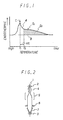
- Fig. 1 is a schematic graph showing a differential scanning calorimetry curve of a polymer for explaining a manner of determining the endothermic area ratio defined above.
- Fig. 2 is a schematic diagram showing a biaxial stretching apparatus used in the examples.
- the polymer used in the present invention is the ethylene copolymer (A) mentioned below or a mixture of the copolymer (A) and the ethylene polymer (B) mentioned below.
- the ⁇ -olefin which is copolymerized with ethylene for the production of the linear ethylene- ⁇ -olefin copolymer (A) to be used in the present invention is preferably ⁇ -olefins containing 4 to 18 carbon atoms, especially 4 to 8 carbon atoms.
- Examples of the ⁇ -olefin include butene-1, pentene-1, hexene-1, heptene-1, octene-1, 4-methylpentene-1, decene-1, undecene-1 and dodecene-1.
- the copolymerization reaction of these comonomers can be carried out by a low or medium pressure method using a Ziegler-Natta catalyst.
- the ⁇ -olefin content in the copolymer (A) is preferably in the range of 0.5 to 20 % by mole, particularly 0.5 to 10 % by mole.
- An ethylene- ⁇ -olefin copolymer having a density of 0.90 to 0.93 g/cm3 at 25°C and a melt index of 0.2 to 3.0 g/10 min is preferably employed as the copolymer (A).
- Those copolymers (A) may be used alone or as an admixture thereof.
- a copolymer of ethylene and o-olefin containing 4 to 12 carbon atoms, particularly 4 to 8 carbon atoms and which has an ⁇ -olefin content of 0.5 to 10 % by mole is preferably employed as the copolymer (A) used in the mixture.
- a copolymer of ethylene and ⁇ -olefin containing 4 to 8 carbon atoms and which has an ⁇ -olefin content of 5 to 20 % by mole is preferably employed as the ethylene polymer (B).
- the polymer mixture is preferably a mixture of 90 to 50 % by weight of the copolymer (A) and 10 to 50 % by weight of the polymer (B).
- the polymer mixture is melted and extruded into a film which is then biaxially stretched to give a heat shrinkable film with an especially desirable heat shrinkability at low temperature.
- the proportion of the polymer (B) is less than 10 % by weight, the resulting film is poor in heat shrinkability at low temperature.
- the proportion of the polymer (B) is more than 50 % by weight, the resulting film is marked in blocking property so that the wound film cannot be smoothly unwound, which results in a poor operation efficiency, and, in particular case, undesirable phenomena such as blocking occur on the film surface, which results in poor commercial value. Further, the resulting film is poor in toughness, which results in poor in handling property.
- the copolymer or copolymer mixture used in the practice of the present invention must indicate a differential scanning calorimetry curve (hereinafter referred to as "DSC curve") wherein the endothermic area under the temperature lower than the melting temperature (main endothermic peak temperature) of the copolymer or copolymer mixture by 10°C accounts for at least 55 % of the total endothermic area.
- DSC curve differential scanning calorimetry curve
- Fig. 1 is a schematic graph showing a DSC curve of a copolymer or a copolymer mixture.
- the curve A is DSC curve and the straight line B is a base line.
- the main endothermic peak in DSC curve is indicated by the arrow C.
- the melting temperature is expressed in terms of main endothermic peak temperature T1 corresponding to the main endothermic peak C.
- the total endothermic area S1 means the area of the portion which is surrounded by the DSC curve A and the base line B.
- endothermic area S2 Endothermic area below the temperature lower than the melting temperature (main endothermic peak temperature) by 10°C
- the endothermic area S2 is the area of the shadowed portion in Fig. 1. That is, the endothermic area S2 means the area of a portion which is surrounded by the DSC curve A and the base line B and exists on the low-temperature side with respect to the temperature T2 lower than the melting temperature T1 by 10°C.
- the uniformity of stretching is not easily obtained.
- the stretching temperature is increased in order to assure the uniformity of stretching, the stability of stretching is adversely affected and the orientation effect does not develop well so that the low-temperature heat shrinkability is not as satisfactory as desired.
- uniform and stable stretching is possible without the need to limit the stretching temperature within a narrow temperature gradient range but selecting a stretching temperature from within a comparatively broad range below the temperature lower than the melting temperature of the copolymer or copolymer mixture by 10°C.
- the invention provides a practically useful heat shrinkable film with an area heat shrinkage of 20 % or more at 90°C, preferably an area heat shrinkage of 15 % or more at 85°C, more preferably a heat shrinkage of 15 % or more in each of machine and transverse directions at 85°C, and a thickness variation of not more than 20 %.
- high pressure polyethylene ethylene-vinyl acetate copolymer, ionomers, ethylene-propylene copolymer, etc. can also be incorporated into the above copolymer or copolymer mixture.
- additives as lubricating agents, antiblocking agents, antistatic agents and antifogging agents can, of course, be incorporated for exploiting the respective useful properties.
- an antiblocking agent such as finely divided silica powder or higher fatty acid amide.
- the above-specified copolymer or copolymer mixture is melted by heating, kneaded and extruded into a tube which is then solidified by rapidly cooling to give a material film which is a substantially non-stretched film.
- the tubular film thus obtained is fed to a tubular stretching equipment such as shown in Fig. 2, by which it is expanded and stretched and, at the same time, biaxially oriented in a temperature region where an effectively high degree of orientation is induced, for example, at a temperature lower than the melting temperature of the copolymer or copolymer mixture by 10°C or more, preferably at a temperature lower than said melting temperature by 20°C or more.
- the stretching ratio may not be the same for both machine and transverse directions but in order to assure satisfactory physical characteristics, it is desirable to use a stretching ratio of at least 2 and preferably at least 2.5 in each direction.
- the upper limit of the stretching ratio is usually 6 in each direction.
- the film emerging from the stretching equipment can be annealed if necessary. This annealing helps control the spontaneous shrinkage of the film during storage.
- an ethylene polymer comprising at least one linear ethylene- ⁇ -olefin copolymer, the DSC curve of which shows that the endothermic area under the temperature lower than the melting temperature (main endothermic peak temperature) by 10°C is at least 55 % of the total endothermic area, permits stable stretching at a comparatively low temperature below the melting temperature of the ethylene polymer with the consequent decrease in film thickness variation and improvement in orientation effect, so that a superior heat shrinkable film with an excellent low-temperature heat shrinkability can be obtained stably.
- an ultra-low density ethylene polymer with a density of not more than 0.910 g/cm3, which is not generally employed for the purpose, results in an excellent heat shrinkability even under lower temperature condition or moderate shrink conditions without losing other general physical properties required of packaging materials, so that the resulting film can be used satisfactorily for packaging products which cannot be heated to high temperatures.
- Area skrinkage (%) 100 - A x B where A and B represent the lengths (in cm) in the machine and transverse directions, respectively, after immersion.
- Thickness of each tubular film in the circumferential direction thereof were recorded with a contact-type micrometer (Model K306C made by Anritsu Electric Co., Ltd.) at a full scale of 8 ⁇ m. From the obtained chart, the maximum thickness (T max ), minimum thickness (T min ), and average thickness (T) were determined. Then, thickness veriation (%) was calculated by means of the following equation. wherein T represents the arithmetic mean of readings at the chart positions corresponding to the intervals of 10 mm on the film sample.
- the ⁇ -olefin content (% by mole) of the copolymers used in Examples was obtained as follows.
- the DSC curve of this polymer mixture showed that the main peak temperature was 120°C and the endothermic area under 110°C accounted for 60.7 % of the total endothermic area.
- the slit diameter of the circular die was 75 mm and the slit gap was 0.8 mm.
- the molten tubular film thus extruded was cooled while guiding it over the outer surface of a cylindrical mandrel having an outer diameter of 66 mm as disposed just below the die and internally supplied with circulating cooling water at 20°C, with the exterior surface of the film being passed through a water bath, to thereby give a tubular unstretched film with a diameter of about 65 mm and a thickness of 190 ⁇ m.
- This unstretched film as the material film was guided to the biaxial stretching device illustrated in Fig. 1, where the material film 1 was expanded and stretched.
- the voltage and current of the circular infrared heaters of the preheater 4 were adjusted so that the film temperature at the exit of the preheater was kept at 65°C.
- the eight circular infrared heaters of the main heater 5 were grouped in 4 sections and the voltage and current of each section were adjusted. While an air stream was supplied along the outer surface of the tube from a cooling air ring 6 positioned below the main heater, a pressurized air was blown into the tubular film between low-speed nip rolls 2 and high-speed nip rolls 3. The pressure of the pressurized air and the relative peripheral speeds of the low-speed and high-speed nip rolls 2 and 3 were controlled so as to effect tubular stretching in a stretching ratio of 3 in each of the machine and transverse directions.
- the thus stretched tubular film was collapsed through collapser rolls 7 and the nip rolls 3 and withdrawn in flattened form from the stretching apparatus and fed to a tubular annealing apparatus where the flattened film was again inflated with air and annealed for 10 seconds with a hot air blast at 75°C from a heating cylinder and, then, cooled to room temperature through a cooling cylinder. The cooled film was collapsed again and taken up.
- the resulting film had a thickness of 20.8 ⁇ m, a thickness variation of 12 %, heat shrinkages of 16.7 % and 18.0 % in machine and transverse directions, respectively, at 85°C, and an area heat shrinkage of 31.7 % at 85°C.
- the seal portion and remaining portion of the package had sufficient strength, indicating that the packaging film of the present invention was excellent for practical purposes.
- the DSC curve of this mixture showed that the main peak temperature was 122°C and the endothermic area under 112°C was 63.1 % of the total endothermic area.
- this polymer mixture was used to prepare an unstretched film which was then tubular-stretched 3 times in both machine and transverse directions and annealed at 75°C to give a collapsed heat shrinkable film.
- the resulting film had a thickness of 20.4 ⁇ m, a thickness variation of 8.5 %, heat shrinkages of 16.1 % and 16.8 % in machine and transverse directions, respectively, at 85°C, and an area heat shrinkage of 30.2 % at 85°C.
- this polymer mixture was extruded to prepare an unstretched film which was then tubular-stretched 3 times in each of the machine and transverse directions and annealed at 70°C to give a collapsed heat shrinkable film.
- the DSC curve of the above polymer mixture showed that the main peak temperature was 122°C and the endothermic area under 112°C accounted for 60.5 % of the total endothermic area.
- the resulting film had a thickness of 20.3 ⁇ m, a thickness variation of 9 %, and heat shrinkages of 18.2 % and 18.9 % in machine and transverse directions, respectively, at 85°C, and an area heat shrinkage of 32.4 % at 85°C.
- Polystyrene bottles containing a Lactobacillus fermentation beverage each measuring 75 mm in height and 40 mm in maximum diameter, were pre-packaged with the above film, 5 bottles per batch, and passed through a shrink tunnel heater at 100°C for 3 seconds.
- Example 2 The same procedures as in Example 1 except that a mixture of 70 parts by weight of a linear low density polyethylene (ethylene-octene-1 copolymer) with a melt index of 1.0 g/10 min., a density of 0.920 g/cm3 at 25°C and an octene-1 content of 3 % by mole and 30 parts by weight of the same ultra-low density polyethylene as used in Example 2 was used were repeated to give a heat shrinkable film.
- a linear low density polyethylene ethylene-octene-1 copolymer
- the DSC curve of the polymer mixture used showed that the main paek temperature was 121°C and the endothermic area under 111°C accounted for 62.5 % of the total endothermic area.
- the thus obtained film had a thickness of 17.8 ⁇ m, a thickness variation of 14.5 %, heat shrinkages of 15.8 % and 16.1 % in machine and transverse directions, respectively, at 85°C, and an area heat shrinkage of 29.4 % at 85°C.
- Example 2 To a mixture of 85 parts by weight of the same ultra-low density polyethylene as used in Example 2 and 15 parts by weight of the same ultra-low density polyethylene as used in Example 3 were added 3,500 ppm of a silica type antiblocking agent (available under the commercial name "Radiolite®F", Showa Kagaku Kabushiki Kaisha) and 1,200 ppm of erucic amide.
- a silica type antiblocking agent available under the commercial name "Radiolite®F", Showa Kagaku Kabushiki Kaisha
- 1,200 ppm of erucic amide 1,200 ppm of erucic amide.
- the above polymer mixture was extruded to prepare an unstretched film which was then tubular-stretched 3 times in each of machine and transverse directions and further annealed at 75°C. After cooling, the tubular film was collapsed and taken up.
- the DSC curve of the above polymer mixture showed that the main peak temperature was 123°C and the endothermic area under 113°C accounted for 61.3 % of the total endothermic area.
- the resulting film had a thickness of 21.2 ⁇ m, heat shrinkages of 18.1 % and 18.6 % in machine and transverse directions, respectively, at 85°C, and an area heat shrinkage of 33.3 % at 85°C.
- Raw broiler meat was shrink-packaged with the above film in the same manner as Example 1. The film was tightly fitted over the meat and the broiler meat also showed no apparent change.
- the extruded film was cooled as it was guided over the outer surface of a cylindrical mandrel internally supplied with circulating cooling water, with the external side being passed through a water bath, to give a tubular unstretched film with a diameter of about 66 mm and a thickness of 250 ⁇ m.
- This unstretched film as the material film was fed to the biaxial stretching apparatus shown in Fig. 2 where it was stretched 4 times in both machine and transverse directions at 95° to 105°C.
- the stretched film was annealed with a tubular annealing apparatus using a hot air stream of 75°C for 10 seconds and, then, cooled to room temperature. The cooled film was collapsed and taken up.
- the stability of the tube during stretching operation was satisfactory without a vertical dislocation of the stretching point or a swing of the tube, nor was observed an uneven stretching result such as necking.
- the stretched film had a thickness of 16 ⁇ m, an area heat shrinkage of 31.5 % at 90°C and a thickness variation of 15 %.
- the stability of the tube during stretching operation was satistactory without a vertical displacement of the stretching point or a swing of the tube, nor was observed an uneven stretching result.
- the resulting stretched film had an average thickness of 16 ⁇ m, a thickness variation of 8 % and an area heat shrinkage of 27 % at 90°C.
- Polystyrene bottles containing a Lactobacillus fermentation beverage each measuring 75 mm in height and 40 mm in maximum diameter, were pre-packaged with the above film, 5 bottles per batch, and passed through a hot-wind shrink tunnel heater at 100°C for 3 seconds.
- the DSC curve of the above copolymer mixture showed that the main peak temperature was 124°C and the endothermic area under 114°C accounted for 58.8% of the total endothermic area.
- the extruded film was guided and taken up as it was cooled over the outer surface of a cylindrical mandrel internally supplied with circulating cooling water, with the external side of the film being passed through a water bath, to thereby produce a tubular unstretched film with a diameter of about 66 mm and a thickness of 320 ⁇ m.
- This unstretched film was guided to a biaxial stretching apparatus, where it was stretched at 95° to 105°C 4.3 times in the machine direction and 3.8 times in the transverse direction. The film was then annealed at 75°C for 10 seconds and taken up in collapsed form.
- the resulting film had an average thickness of 20 ⁇ m, a thickness variation of 10%, and an area heat shrinkage of 25.8% at 90°C.
- Shrink-packaging was carried out with this film in the same manner as Example 6. As a result, tightly-fitted packages were obtained and no change was found in the packaged product.
- the tube showed swinging and the necking phenomenon.
- the stretching temperature 95° to 105°C
- the necking became more pronounced to cause an increased uneveness.
- the stretching temperature was increased to a range of 103° to 108° in order to suppress the necking phenomenon, the vertical displacement and swing of the tube were amplified to interfere with stretching stability.
- the stretched film obtained at the stretching temperature of 103° to 108°C had an average thickness of 16 ⁇ m, a thickness variation of 27 %, and an area heat shrinkage of 15.4 % at 90°C.
- This film was poor in flatness and not suitable for continuous packaging with an automatic packaging machine. Moreover, when the film was subjected to the same shrinking treatment as in Example 6, it failed to give a satisfactory package, showing many creases and raised areas. Although the packaged condition could be improved by increasing the tunnel temperature or the residence time in the tunnel, the product packaged underwent partial melting and deformation so that its market value was drastically reduced.
- the DSC curve of the copolymer mixture used showed that the main peak temperature was 127°C and the endothermic area under 117°C accounted for 50.4 % of the total endothermic area.
- the necking phenomenon in the stretched area was remarkable.
- the stretching temperature was increased to a range of 105° to 112°C in order to suppress the necking phenomenon, the tube showed marked swinging so that no stable stretching result could be obtained.
- the stretched film obtained at the stretching temperature of 105° to 112°C had an average thickness of 16 ⁇ m, a thickness variation of 23 %, and an area heat shrinkage value of 16.4 % at 90°C.
Landscapes
- Chemical & Material Sciences (AREA)
- Engineering & Computer Science (AREA)
- Manufacturing & Machinery (AREA)
- Health & Medical Sciences (AREA)
- Chemical Kinetics & Catalysis (AREA)
- Medicinal Chemistry (AREA)
- Polymers & Plastics (AREA)
- Organic Chemistry (AREA)
- Mechanical Engineering (AREA)
- Materials Engineering (AREA)
- Shaping By String And By Release Of Stress In Plastics And The Like (AREA)
- Manufacture Of Macromolecular Shaped Articles (AREA)
Claims (4)
- Biaxial gereckte, wärmeaufschrumpfbare Ethylenpolymerfolie, die eine Flächenwärmeschrumpfung von mindestens 20% bei 90° C und eine Veränderung der Dicke von nicht mehr als 20% aufweist, wobei die wärmeaufschrumpfbare Ethylenpolymerfolie durch Recken einer Folie aus einem Polymergemisch jeweils in Maschinenrichtung und in Querrichtung auf mindestens das Zweifache ihrer ursprünglichen Länge hergestellt wird, wobei das Polymergemisch umfaßt (A) 90 bis 50 Gew.-% von mindestens einem linearen Copolymer von Ethylen und 0,5 bis 20 Mol-% eines α-Olefins mit 4 bis 18 Kohlenstoffatomen, das eine Dichte von 0,90 bis 0,93 g/cm³ bei 25° C und einen Schmelzflußindex von 0.2 bis 3,0 g/10 Min. aufweist und (B) 10 bis 50 Gew.-% mindestens eines Ethylenpolymeren, das eine Dichte von 0,87 bis 0.91 g/cm³ bei 25° C aufweist, und dessen Dichte um mindestens 0,014 g/cm³ geringer ist als die Dichte des Copolymers (A) und das einen Schmelzflußindex von 0,2 bis 5,0 g/10 Min. aufweist, wobei das Polymergemisch eine Differential-Scanning-Calorimetrie-Kurve (DSC-Kurve) beschreibt, worin ein endothermer Bereich unterhalb der Temperatur, die um 10° C niedriger ist als die Schmelztemperatur (Temperatur des endothermen Hauptpeaks) des Polymergemisches mindestens 55% der gesamten endothermen Fläche beträgt, wobei die Flächenwärmeschrumpfung mittels der Gleichung berechnet wird:

worin A und B jeweils die Längen (in cm) in den Maschinen- und den Querrichtungen einer quadratischen Probe der schrumpfbaren Folie angeben, 10 cm x 10 cm, nachdem die Probe in ein bei 90° C gehaltenes Glycerinbad 10 Minuten lang eingetaucht wurde,
wobei die Veränderung der Dicke mittels der Gleichung berechnet wird:
- Wärmeaufschrumpfbare Ethylenpolymerfolie nach Anspruch 1, wobei das α-Olefin mindestens ein Element ausgewählt aus der Gruppe bestehend aus Buten-1, Penten-1, Hexen-1, Hepten-1, Okten-1, 4-Methylpenten-1, Decen-1, Undecen-1 und Dodecen-1 ist.
- Wärmeaufschrumpfbare Ethylenpolymerfolie nach einem der Ansprüche 1 oder 2, wobei die wärmeaufschrumpfbare Folie eine Flächerwärmeschrumpfung von mindestens 15% bei 85° C aufweist.
- Wärmeaufschrumpfbare Ethylenpolymerfolie nach Anspruch 3, wobei das Ethylenpolymer (B) ein Copolymer aus Ethylen und 5 bis 20 Mol-% eines α-Olefins ist und die Wärmeschrumpfung der Folie bei 85° C jeweils in Maschinen- und Querrichtung mindestens 15% beträgt.
Applications Claiming Priority (6)
| Application Number | Priority Date | Filing Date | Title |
|---|---|---|---|
| JP4416986 | 1986-03-03 | ||
| JP44170/86 | 1986-03-03 | ||
| JP61044170A JPH0613192B2 (ja) | 1986-03-03 | 1986-03-03 | 熱収縮性フィルム |
| JP44169/86 | 1986-03-03 | ||
| JP109436/86 | 1986-05-15 | ||
| JP10943686A JPS6310639A (ja) | 1986-03-03 | 1986-05-15 | 熱収縮性フィルムの製造方法 |
Publications (3)
| Publication Number | Publication Date |
|---|---|
| EP0240705A2 EP0240705A2 (de) | 1987-10-14 |
| EP0240705A3 EP0240705A3 (en) | 1989-12-06 |
| EP0240705B1 true EP0240705B1 (de) | 1994-02-02 |
Family
ID=27291808
Family Applications (1)
| Application Number | Title | Priority Date | Filing Date |
|---|---|---|---|
| EP87102895A Expired - Lifetime EP0240705B1 (de) | 1986-03-03 | 1987-02-28 | In der Wärme schrumpffähige Folie |
Country Status (8)
| Country | Link |
|---|---|
| US (1) | US4801652A (de) |
| EP (1) | EP0240705B1 (de) |
| AU (1) | AU589498B2 (de) |
| CA (1) | CA1297651C (de) |
| DE (1) | DE3788970T2 (de) |
| DK (1) | DK102087A (de) |
| FI (1) | FI87930C (de) |
| MX (1) | MX168639B (de) |
Cited By (1)
| Publication number | Priority date | Publication date | Assignee | Title |
|---|---|---|---|---|
| US7147930B2 (en) | 2003-12-16 | 2006-12-12 | Curwood, Inc. | Heat-shrinkable packaging films with improved sealing properties and articles made thereof |
Families Citing this family (32)
| Publication number | Priority date | Publication date | Assignee | Title |
|---|---|---|---|---|
| KR960007297B1 (ko) * | 1987-07-13 | 1996-05-30 | 미쓰비시 가가꾸 가부시끼가이샤 | 폴리에틸렌 필름으로 제조된 포대 |
| JPH07103276B2 (ja) * | 1987-09-11 | 1995-11-08 | 日本石油化学株式会社 | エチレン系熱可塑性樹脂組成物 |
| IT1223335B (it) * | 1987-11-02 | 1990-09-19 | Enichem Anic Spa | Film biorientati di copolimeri etilene olefina |
| US4804714A (en) * | 1987-11-20 | 1989-02-14 | Union Carbide Corporation | Polyolefin blends |
| JP2554362B2 (ja) * | 1988-07-12 | 1996-11-13 | 昭和電工株式会社 | 低温熱収縮性フィルム |
| US5032463A (en) * | 1988-07-18 | 1991-07-16 | Viskase Corporation | Very low density polyethylene film from blends |
| US5110870A (en) * | 1989-01-06 | 1992-05-05 | Mitsubishi Kasei Corporation | Extensible film or sheet and process for producing the same |
| US5306549A (en) * | 1989-04-10 | 1994-04-26 | Kohjin Co., Ltd. | Biaxially stretched polyethylene film |
| EP0404368A3 (de) * | 1989-06-02 | 1991-05-29 | Uniplast Industries Inc. | Mischungen aus linearem Polyethylen niedriger Dichte und Polyethylen niedriger Dichte und daraus hergestellte Schrumpffolien |
| GB8914703D0 (en) * | 1989-06-27 | 1989-08-16 | Dow Europ Sa | Bioriented film |
| CA2020649C (en) * | 1989-07-20 | 2002-06-25 | Richard Kenneth Roberts | Tough monolayer shrink film for products containing moisture |
| JP2904903B2 (ja) * | 1989-10-09 | 1999-06-14 | 株式会社興人 | ポリエチレン系フイルム |
| ES2050202T3 (es) * | 1989-10-18 | 1994-05-16 | Showa Denko Kk | Una pelicula estirada termo-contraible a baja temperatura. |
| CA2032272C (en) * | 1989-12-18 | 2000-08-29 | John Douglas Snyder | Improved heat shrinkable polyolefin film |
| IL92868A0 (en) * | 1989-12-25 | 1990-09-17 | Syfan | Shrink films |
| EP0461848B1 (de) * | 1990-06-12 | 1996-04-10 | Mitsui Petrochemical Industries, Ltd. | Äthylen-/Penten-1-Copolymerzusammensetzungen und ihre Verwendung |
| US5847053A (en) * | 1991-10-15 | 1998-12-08 | The Dow Chemical Company | Ethylene polymer film made from ethylene polymer blends |
| US5272016A (en) * | 1992-03-23 | 1993-12-21 | Viskase Corporation | Multilayer stretch/shrink film |
| US5279872A (en) * | 1992-03-23 | 1994-01-18 | Viskase Corporation | Multilayer stretch/shrink film |
| JPH06136195A (ja) * | 1992-09-08 | 1994-05-17 | Mitsui Petrochem Ind Ltd | エチレン系共重合体組成物 |
| US5464905A (en) * | 1992-11-19 | 1995-11-07 | Mitsui Petrochemical Industries, Ltd. | Ethylene/α-olefin copolymer composition, graft modified ethylene/α-olefin copolymer composition, ethylene copolymer composition, and multi-stage olefin polymerization process |
| CA2103401C (en) | 1992-11-19 | 2002-12-17 | Mamoru Takahashi | Ethylene copolymer composition |
| EP0706455B1 (de) * | 1993-06-24 | 2003-08-27 | American National Can Company | Mehrschichtige strukturen aus single-site katalysierten polymeren |
| US7316833B1 (en) | 1993-06-24 | 2008-01-08 | Penchiney Emballage Flexible Europe | Multi-layer thermoplastic films and packages made therefrom |
| CA2125999C (en) * | 1993-07-12 | 1998-09-22 | Paul Nick Georgelos | Puncture resistant heat shrinkable film containing narrow molecular weight ethylene alpha olefin |
| CN1068018C (zh) * | 1994-05-09 | 2001-07-04 | 陶氏化学公司 | 中等模量的薄膜及制造方法 |
| US5759675A (en) * | 1994-09-20 | 1998-06-02 | Kohjin Co., Ltd. | Multi-layer stretchable, shrinkable polyethylene film and process for the preparation thereof |
| US5792534A (en) | 1994-10-21 | 1998-08-11 | The Dow Chemical Company | Polyolefin film exhibiting heat resistivity, low hexane extractives and controlled modulus |
| GB2323325B (en) * | 1997-03-18 | 2001-04-25 | Hoechst Trespaphan Gmbh | Polymeric films |
| AU1983900A (en) * | 1999-01-18 | 2000-08-01 | Cryovac, Inc. | Heat-shrinkable, irradiated, polyethylene mono-layer film |
| CN101117036A (zh) | 2006-07-31 | 2008-02-06 | 陶氏全球科技股份有限公司 | 层状膜组合、由其制备的包装以及使用方法 |
| MX2014002227A (es) | 2011-08-26 | 2014-04-30 | Dow Global Technologies Llc | Pelicula de polietileno biorientada. |
Family Cites Families (10)
| Publication number | Priority date | Publication date | Assignee | Title |
|---|---|---|---|---|
| US3299194A (en) * | 1964-03-09 | 1967-01-17 | Du Pont | Oriented films of ethylene polymers |
| GB1035887A (en) * | 1964-04-15 | 1966-07-13 | Du Pont | Improvements relating to films |
| JPS5628826A (en) * | 1979-08-20 | 1981-03-23 | Kohjin Co Ltd | Thermoshrinking film and manufacturing thereof |
| JPS56152853A (en) * | 1980-04-30 | 1981-11-26 | Nippon Oil Co Ltd | Polyethylene resin composition |
| JPS5734145A (en) * | 1980-08-07 | 1982-02-24 | Mitsui Petrochem Ind Ltd | Ethylene-alpha-olefin copolymer composition |
| US4597920A (en) * | 1981-04-23 | 1986-07-01 | E. I. Du Pont De Nemours And Company | Shrink films of ethylene/α-olefin copolymers |
| CA1174423A (en) * | 1981-04-23 | 1984-09-18 | Ralph C. Golike | Shrink films of ethylene/alpha-olefin copolymers |
| JPS5838738A (ja) * | 1981-08-31 | 1983-03-07 | Mitsubishi Chem Ind Ltd | ポリオレフイン組成物 |
| FR2528055B1 (fr) * | 1982-06-03 | 1986-01-24 | Charbonnages Ste Chimique | Compositions de polyethylene radicalaire et de copolymeres ethylene/a-olefine et leur application a la fabrication de films |
| JPS58222131A (ja) * | 1982-06-16 | 1983-12-23 | Asahi Chem Ind Co Ltd | エチレン−α−オレフイン共重合体組成物 |
-
1987
- 1987-02-26 CA CA000530633A patent/CA1297651C/en not_active Expired - Lifetime
- 1987-02-27 DK DK102087A patent/DK102087A/da not_active Application Discontinuation
- 1987-02-27 AU AU69568/87A patent/AU589498B2/en not_active Ceased
- 1987-02-28 DE DE3788970T patent/DE3788970T2/de not_active Expired - Fee Related
- 1987-02-28 EP EP87102895A patent/EP0240705B1/de not_active Expired - Lifetime
- 1987-03-02 FI FI870891A patent/FI87930C/fi not_active IP Right Cessation
- 1987-03-02 US US07/020,980 patent/US4801652A/en not_active Expired - Lifetime
- 1987-03-03 MX MX005449A patent/MX168639B/es unknown
Cited By (1)
| Publication number | Priority date | Publication date | Assignee | Title |
|---|---|---|---|---|
| US7147930B2 (en) | 2003-12-16 | 2006-12-12 | Curwood, Inc. | Heat-shrinkable packaging films with improved sealing properties and articles made thereof |
Also Published As
| Publication number | Publication date |
|---|---|
| FI87930C (fi) | 1993-03-10 |
| CA1297651C (en) | 1992-03-24 |
| DE3788970T2 (de) | 1994-08-18 |
| DK102087D0 (da) | 1987-02-27 |
| DK102087A (da) | 1987-09-04 |
| DE3788970D1 (de) | 1994-03-17 |
| MX168639B (es) | 1993-06-02 |
| US4801652A (en) | 1989-01-31 |
| FI870891A7 (fi) | 1987-09-04 |
| AU6956887A (en) | 1987-09-10 |
| FI870891A0 (fi) | 1987-03-02 |
| EP0240705A2 (de) | 1987-10-14 |
| EP0240705A3 (en) | 1989-12-06 |
| AU589498B2 (en) | 1989-10-12 |
| FI87930B (fi) | 1992-11-30 |
Similar Documents
| Publication | Publication Date | Title |
|---|---|---|
| EP0240705B1 (de) | In der Wärme schrumpffähige Folie | |
| EP0405916B1 (de) | Biorientierter Film | |
| EP0450088B1 (de) | Biaxial orientierte polyethylenfolie | |
| US4701496A (en) | Composition for drawn film, cold drawn film made of said composition and process for manufacture of said film | |
| US5132074A (en) | Process of making stretchable, heat shrinkable polyethylene film | |
| JPH0613613B2 (ja) | 単層ポリエチレン収縮性フイルム | |
| US4336212A (en) | Composition for drawn film, cold drawn film made of said composition and process for manufacture of said film | |
| JPH0354048B2 (de) | ||
| US5759675A (en) | Multi-layer stretchable, shrinkable polyethylene film and process for the preparation thereof | |
| US5306549A (en) | Biaxially stretched polyethylene film | |
| EP0732196B1 (de) | Heissschrumpfbarer polyolefin verbundfilm | |
| CA2175084C (en) | Multilayered, bioriented, heat shrinkable film | |
| US5635286A (en) | Heat shrinkable polyethylene laminate film | |
| EP0359907A2 (de) | Verfahren zur Herstellung von heissschrumpfbaren Polyethylen-Folien | |
| JP3004314B2 (ja) | ポリエチレン系熱収縮性積層フイルム | |
| JPH0613192B2 (ja) | 熱収縮性フィルム | |
| CA2032272C (en) | Improved heat shrinkable polyolefin film | |
| KR100203444B1 (ko) | 선형 저밀도 폴리에틸렌 열수축성 필름 조성물 및 그 필름의 제조방법 | |
| JPH05131599A (ja) | ポリエチレン系熱収縮性積層フイルム | |
| JPH06226925A (ja) | 複合延伸フィルム | |
| JPH09239926A (ja) | ポリオレフィン系熱収縮性積層フィルム |
Legal Events
| Date | Code | Title | Description |
|---|---|---|---|
| PUAI | Public reference made under article 153(3) epc to a published international application that has entered the european phase |
Free format text: ORIGINAL CODE: 0009012 |
|
| AK | Designated contracting states |
Kind code of ref document: A2 Designated state(s): BE DE FR GB IT SE |
|
| PUAL | Search report despatched |
Free format text: ORIGINAL CODE: 0009013 |
|
| AK | Designated contracting states |
Kind code of ref document: A3 Designated state(s): BE DE FR GB IT SE |
|
| 17P | Request for examination filed |
Effective date: 19900530 |
|
| 17Q | First examination report despatched |
Effective date: 19910904 |
|
| GRAA | (expected) grant |
Free format text: ORIGINAL CODE: 0009210 |
|
| AK | Designated contracting states |
Kind code of ref document: B1 Designated state(s): BE DE FR GB IT SE |
|
| PG25 | Lapsed in a contracting state [announced via postgrant information from national office to epo] |
Ref country code: SE Effective date: 19940202 Ref country code: BE Effective date: 19940202 |
|
| REF | Corresponds to: |
Ref document number: 3788970 Country of ref document: DE Date of ref document: 19940317 |
|
| ITF | It: translation for a ep patent filed | ||
| ET | Fr: translation filed | ||
| PLBE | No opposition filed within time limit |
Free format text: ORIGINAL CODE: 0009261 |
|
| STAA | Information on the status of an ep patent application or granted ep patent |
Free format text: STATUS: NO OPPOSITION FILED WITHIN TIME LIMIT |
|
| 26N | No opposition filed | ||
| REG | Reference to a national code |
Ref country code: GB Ref legal event code: IF02 |
|
| PGFP | Annual fee paid to national office [announced via postgrant information from national office to epo] |
Ref country code: FR Payment date: 20030225 Year of fee payment: 17 |
|
| PGFP | Annual fee paid to national office [announced via postgrant information from national office to epo] |
Ref country code: GB Payment date: 20030226 Year of fee payment: 17 |
|
| PGFP | Annual fee paid to national office [announced via postgrant information from national office to epo] |
Ref country code: DE Payment date: 20030313 Year of fee payment: 17 |
|
| PG25 | Lapsed in a contracting state [announced via postgrant information from national office to epo] |
Ref country code: GB Free format text: LAPSE BECAUSE OF NON-PAYMENT OF DUE FEES Effective date: 20040228 |
|
| PG25 | Lapsed in a contracting state [announced via postgrant information from national office to epo] |
Ref country code: DE Free format text: LAPSE BECAUSE OF NON-PAYMENT OF DUE FEES Effective date: 20040901 |
|
| GBPC | Gb: european patent ceased through non-payment of renewal fee | ||
| PG25 | Lapsed in a contracting state [announced via postgrant information from national office to epo] |
Ref country code: FR Free format text: LAPSE BECAUSE OF NON-PAYMENT OF DUE FEES Effective date: 20041029 |
|
| REG | Reference to a national code |
Ref country code: FR Ref legal event code: ST |
|
| PG25 | Lapsed in a contracting state [announced via postgrant information from national office to epo] |
Ref country code: IT Free format text: LAPSE BECAUSE OF NON-PAYMENT OF DUE FEES;WARNING: LAPSES OF ITALIAN PATENTS WITH EFFECTIVE DATE BEFORE 2007 MAY HAVE OCCURRED AT ANY TIME BEFORE 2007. THE CORRECT EFFECTIVE DATE MAY BE DIFFERENT FROM THE ONE RECORDED. Effective date: 20050228 |