EP0239114B1 - Schwingförderer nach dem Gleitförderprinzip - Google Patents
Schwingförderer nach dem Gleitförderprinzip Download PDFInfo
- Publication number
- EP0239114B1 EP0239114B1 EP87104516A EP87104516A EP0239114B1 EP 0239114 B1 EP0239114 B1 EP 0239114B1 EP 87104516 A EP87104516 A EP 87104516A EP 87104516 A EP87104516 A EP 87104516A EP 0239114 B1 EP0239114 B1 EP 0239114B1
- Authority
- EP
- European Patent Office
- Prior art keywords
- movement
- leaf springs
- counterweight
- conveyor
- trough
- Prior art date
- Legal status (The legal status is an assumption and is not a legal conclusion. Google has not performed a legal analysis and makes no representation as to the accuracy of the status listed.)
- Expired - Lifetime
Links
- 230000001133 acceleration Effects 0.000 claims abstract description 9
- 230000001419 dependent effect Effects 0.000 claims abstract description 9
- 230000008878 coupling Effects 0.000 claims abstract description 7
- 238000010168 coupling process Methods 0.000 claims abstract description 7
- 238000005859 coupling reaction Methods 0.000 claims abstract description 7
- 239000006096 absorbing agent Substances 0.000 claims abstract 3
- 230000003534 oscillatory effect Effects 0.000 claims abstract 2
- 230000005284 excitation Effects 0.000 claims description 9
- 230000035939 shock Effects 0.000 claims 1
- 230000003068 static effect Effects 0.000 description 5
- 230000010355 oscillation Effects 0.000 description 4
- 230000015572 biosynthetic process Effects 0.000 description 2
- 238000013016 damping Methods 0.000 description 2
- 238000005516 engineering process Methods 0.000 description 2
- 238000011835 investigation Methods 0.000 description 2
- 239000002245 particle Substances 0.000 description 2
- 230000001788 irregular Effects 0.000 description 1
- 238000012423 maintenance Methods 0.000 description 1
- 238000012544 monitoring process Methods 0.000 description 1
- 239000007787 solid Substances 0.000 description 1
- 125000006850 spacer group Chemical group 0.000 description 1
Images
Classifications
-
- B—PERFORMING OPERATIONS; TRANSPORTING
- B65—CONVEYING; PACKING; STORING; HANDLING THIN OR FILAMENTARY MATERIAL
- B65G—TRANSPORT OR STORAGE DEVICES, e.g. CONVEYORS FOR LOADING OR TIPPING, SHOP CONVEYOR SYSTEMS OR PNEUMATIC TUBE CONVEYORS
- B65G27/00—Jigging conveyors
- B65G27/08—Supports or mountings for load-carriers, e.g. framework, bases, spring arrangements
Definitions
- the invention relates to a vibratory conveyor according to the sliding conveyor principle with a drive oscillating movement for a conveyor trough, which has a coupling to a counterweight, through which the movement of the conveyor trough in the conveying direction is connected with a vertical upward movement and the return movement with a vertical downward movement, the vertical movement Acceleration generated by the upward movement does not lead to a lifting of the parts to be conveyed from the conveyor trough, with a drive for the conveyor trough mounted on the counter mass, which accelerates in the conveying direction at an angle of incidence ( T ) of 45 to 70 ° to the trough bottom with a frequency of clearly generated under 25 Hz and a movement amplitude of 5 to 40 mm.
- T angle of incidence
- Vibratory conveyors in the form of vibratory conveying pots have been known for many years and are used industrially in a variety of ways to feed mass parts.
- the vibrating conveyor pots have on their outer circumference a coiled path on which the mass parts are separated and, if necessary, sorted according to their position, so that they can be removed one after the other in the desired orientation at the upper end of the coiled path.
- the vibrating bowls which have been used in principle unchanged for many years, have a drive which consists of inclined leaf springs which are aligned approximately tangentially on the outer circumferential circle of the vibrating bowl and connect the lower counterweight to the useful mass formed by the rocker bowl. The leaf springs are at an angle of 70 to 80 ° to the horizontal.
- a centrally located excitation magnet originally used has proven to be unsuitable because of its very low efficiency.
- excitation magnets provided on the outer circumferential circle of the feed pot, which are aligned approximately perpendicular to the leaf spring.
- the mass parts are imprinted with a harmonic excitation, a micro-throwing motion with a discharge angle of 10 to 20 ° .
- the micro-throws lead to a not inconsiderable mechanical load on the mass parts, generate considerable noise and cause very irregular conveyance, which depends on a large number of unmanageable parameters.
- the vibratory bowls therefore require constant monitoring and maintenance.
- DE-OS 3 331 050 has attempted to replace the micro-throwing movement with a pure sliding movement.
- a purely horizontal acceleration is exerted on the conveyor trough, which leads to a higher speed than the return movement caused by springs (non-harmonic excitation).
- the parts which are strongly accelerated in the forward direction, slide a little further when braking. Since the restoring movement takes place at a lower speed, the parts are conveyed back with the restoring movement by the amount of the restoring movement, but they do not slide since the static friction is not overcome due to the low speed.
- This funding principle poses considerable problems in terms of control technology and is very critical in its setting, since during the forward movement itself the static friction must not be exceeded, but only when braking, while the braking must also be maintained when braking the backward movement.
- the application of this principle presupposes extraordinarily well-defined parts, which must already be predetermined in their position if they are not uniformly designed on all sides. A practical application of this principle therefore seems possible at most for special cases.
- a vibratory conveyor pot in which a hyperbolic elastic sleeve, which consists of hyperbolic spring elements, is connected on the one hand to a countermass and on the other hand forms a flange, which in turn is connected to the bottom of the feed pot via a spring connection is.
- a pneumatic damper assembly is provided between the flange and the bottom. The vibration excitation takes place between the stationary one Counter mass and the upper flange of the elastic sleeve.
- the arrangement in which the upper flange forms an oscillating intermediate mass serves to subject the oscillating pot to an oscillation in which the movement excitations in the vertical and in the angular path direction occur out of phase, so that each point of the oscillating cup moves on an elliptical path.
- the implementation of a sliding promotion is not disclosed.
- the invention has for its object to make the advantages inherent in the sliding conveyor principle achievable with an industrially feasible vibratory conveyor.
- the arrangement of the speed-dependent dampers according to the invention has no model in vibratory conveyor technology.
- the known vibrating bowls working at higher frequencies have not been equipped with dampers.
- the invention is based on extensive investigations, which have shown that the defined sliding movement can only be realized before an adequate damping system is present.
- the speed-dependent dampers are provided according to the invention.
- the use of the speed-dependent damper is particularly advantageous if the drive is formed by leaf springs known per se with one or more oscillating magnets, the leaf springs being arranged perpendicular to the starting angle.
- the vibratory bowl feeder thus forms a mass-spring system that is stabilized by the speed-dependent dampers.
- the leaf springs each have an inner articulation point on the pot on an inner circle and an outer articulation point on the counterweight on an outer circle , if the leaf springs have approximately the direction of the respective tangents on the inner circle and if at least one of the articulation points of each leaf spring has a swivel joint, which is preferably attached to the upper articulation point and is designed as a pin joint with an axis perpendicular to the bottom of the conveying pot.
- the radius of the outer circle is of the order of 1.5 times the radius of the inner circle, so that the leaf spring forms an angle of approximately 50 ° with the tangent at the point of articulation of the outer circle.
- the vibrating conveyor pot is set into a rotating oscillating motion, which supports the formation of the sliding motion on the coiled transport path of the conveyor pot.
- the dampers are preferably arranged on the circumference of a partial circle of the feed pot and aligned approximately tangentially.
- the dampers are approximately perpendicular to the plane of the leaf springs, so that they can dampen the movement impressed by the leaf springs on the feed pot with full efficiency. It is not necessary to provide a damper for each leaf spring. Rather, the arrangement of two dampers for a drive system with, for example, five leaf springs is generally sufficient for a vibratory feeder.
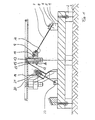
- Figure 1 shows a circular mounting plate 1, which stands with four rubber feet 2 non-slip on a solid surface 3.
- Five mounting bases are welded onto the mounting plate 1, which have an upper, inclined support surface 6, into which a threaded hole is made.
- the mounting bases 5 are located on an outer circle around the center of the mounting plate 1.
- a protruding through a corresponding hole in a leaf spring 7 Fastening screw 8
- the leaf spring is attached with its lower end to the mounting base 5, whereby it lies flat on the support surface 6.
- the beveled bearing surface 6 thus defines the angle of the leaf spring 7 with the horizontal.
- the other end of the leaf spring 7 is fastened by means of a further fastening screw 9 to a support surface 10 of an extension 11 of a pivot pin 12.
- the pin 13 of the swivel joint 12 is fixedly connected to a base plate 14 of a vibratory feed pot (not shown). Below the base plate 14, the pin is surrounded by a spacer sleeve 15, to which a socket part 16 rotatably supported on the pin 13 with the attachment 11 is connected. The socket part 16 is secured at the bottom by two nuts 17.
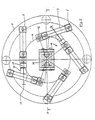
- FIG. 2 shows that the swivel joints 12 are located on an inner circle 18 around the center M of the mounting plate 1.
- the leaf springs 7 extend with their central axis approximately in the direction of the tangent of the inner circle 18, each runs through the axis of rotation of the pivot joint 12.
- the fastening points of the leaf springs 7 on the bases 6, which are formed by the screws 8, lie on an outer circle, the radius of which is approximately 1.5 times the radius of the inner circle 18.
- the central axis of the leaf springs 7 forms an angle of slightly more than 50 ° with the tangent intersecting the respective attachment point 8 on the outer circle.
- the base plate 14 At the center M of the mounting plate 1 there is an oscillating magnet 19 which periodically attracts the base plate 14 of the oscillating conveyor pot and thus sets it in vibration via the restoring forces of the leaf springs 7.
- the oscillation frequency of the oscillating magnet 19 is between 3 and 8 Hz. Due to the coupling of the base plate 14 via the leaf springs 7 arranged in the manner described to the base plate 1 which represents the counterweight, the base plate 14 is set into a rotating oscillating movement, with a vertical opening at the same time - and downward movement is carried out.
- the contact surface 6 of the mounting base 5 is approximately at an angle of 30 ° to the horizontal, so that the leaf springs 7 also form this angle with the horizontal with their oscillating plane.
- the movement of the base plate 14 takes place perpendicular to the plane of oscillation of the leaf springs 7, so that an upward movement occurs at an angle of approximately 60 ° to the horizontal. This upward movement is superimposed on the rotational path movement in the conveying direction.
- the base plate 14 is also connected to the mounting plate 1 via two dampers 20, which are designed as speed-dependent air dampers.
- the air dampers are articulated on the outer circumference of a partial circle of the base plate 14 (approximately inner circle 18), the upper and lower articulation points 21, 22 being located at almost equal distances from the center point M of the mounting plate 1.
- the swivel joints 12 enable the leaf springs 7 to be rotated relative to the tangential of the outer circle, since they absorb the rotational movement transmitted to the base plate 14.
- the arrangement of a journal bearing with a vertical axis of rotation is not sufficient, since a further rotary component arises during the rotational movement of the base plate 14.
- this additional component is so small that it is absorbed by the bearing play.
- ball joints or the like which have a further degree of freedom, instead of the pivot pins 12.
- mass parts can be pre-conveyed at a defined speed and noise reduced by orders of magnitude compared to conventional vibratory feeders.
- the susceptibility to faults is significantly reduced because the parts are no longer subjected to throwing movements.
Landscapes
- Engineering & Computer Science (AREA)
- Mechanical Engineering (AREA)
- Jigging Conveyors (AREA)
- Gear-Shifting Mechanisms (AREA)
- Moving Of Heads (AREA)
- Portable Nailing Machines And Staplers (AREA)
- Escalators And Moving Walkways (AREA)
Priority Applications (1)
| Application Number | Priority Date | Filing Date | Title |
|---|---|---|---|
| AT87104516T ATE53367T1 (de) | 1986-03-26 | 1987-03-26 | Schwingfoerderer nach dem gleitfoerderprinzip. |
Applications Claiming Priority (2)
| Application Number | Priority Date | Filing Date | Title |
|---|---|---|---|
| DE3610139 | 1986-03-26 | ||
| DE19863610139 DE3610139A1 (de) | 1986-03-26 | 1986-03-26 | Schwingfoerderer nach dem gleitfoerderprinzip |
Publications (2)
| Publication Number | Publication Date |
|---|---|
| EP0239114A1 EP0239114A1 (de) | 1987-09-30 |
| EP0239114B1 true EP0239114B1 (de) | 1990-06-06 |
Family
ID=6297284
Family Applications (1)
| Application Number | Title | Priority Date | Filing Date |
|---|---|---|---|
| EP87104516A Expired - Lifetime EP0239114B1 (de) | 1986-03-26 | 1987-03-26 | Schwingförderer nach dem Gleitförderprinzip |
Country Status (4)
| Country | Link |
|---|---|
| EP (1) | EP0239114B1 (cg-RX-API-DMAC10.html) |
| AT (1) | ATE53367T1 (cg-RX-API-DMAC10.html) |
| DE (2) | DE3610139A1 (cg-RX-API-DMAC10.html) |
| ES (1) | ES2015909B3 (cg-RX-API-DMAC10.html) |
Families Citing this family (2)
| Publication number | Priority date | Publication date | Assignee | Title |
|---|---|---|---|---|
| DE3801956A1 (de) * | 1988-01-23 | 1989-07-27 | Schlafhorst & Co W | Verfahren und vorrichtung zum foerdern von kopsen und huelsen |
| DE4214050A1 (de) * | 1992-04-29 | 1993-11-04 | Guenther Ohrt | Schwingfoerderer, insbesondere schwingrinnenfoerderer |
Family Cites Families (4)
| Publication number | Priority date | Publication date | Assignee | Title |
|---|---|---|---|---|
| DE210209C (cg-RX-API-DMAC10.html) * | ||||
| AT255966B (de) * | 1965-04-23 | 1967-07-25 | Syntron Company Division Of Li | Zweimassen-Drehschwingungseinrichtung, insbesondere für eine Fördereinrichtung für Massenartikel |
| CA941397A (en) * | 1971-11-12 | 1974-02-05 | Daniel J. Baljet | Spring system for vibratory parts feeders |
| DE3331050A1 (de) * | 1983-08-29 | 1985-03-14 | Rhein-Nadel Automation GmbH, 5100 Aachen | Vorrichtung zur reihenfoermig geordneten zufuhr von werkstuecken mit einem vibrationsantrieb |
-
1986
- 1986-03-26 DE DE19863610139 patent/DE3610139A1/de active Granted
-
1987
- 1987-03-26 EP EP87104516A patent/EP0239114B1/de not_active Expired - Lifetime
- 1987-03-26 ES ES87104516T patent/ES2015909B3/es not_active Expired - Lifetime
- 1987-03-26 AT AT87104516T patent/ATE53367T1/de not_active IP Right Cessation
- 1987-03-26 DE DE8787104516T patent/DE3763057D1/de not_active Expired - Fee Related
Also Published As
| Publication number | Publication date |
|---|---|
| DE3610139C2 (cg-RX-API-DMAC10.html) | 1990-02-08 |
| DE3610139A1 (de) | 1987-10-01 |
| ATE53367T1 (de) | 1990-06-15 |
| DE3763057D1 (de) | 1990-07-12 |
| ES2015909B3 (es) | 1990-09-16 |
| EP0239114A1 (de) | 1987-09-30 |
Similar Documents
| Publication | Publication Date | Title |
|---|---|---|
| DE60002924T2 (de) | Abstreifer für Förderbänder bei unterschiedlichem Verschleiss | |
| DE3001207C2 (de) | Gelenk-Rotor für Hubschrauber | |
| DE2356933C3 (de) | Straßenfertiger mit an Zugarmen angeschlossener Einbauvorrichtung | |
| DE3402861C2 (cg-RX-API-DMAC10.html) | ||
| DE2127433A1 (de) | Unwuchterreger zum Antrieb eines Schwingförderers oder eines Schwingsie bes | |
| EP2601426B1 (de) | Drehschwingungstilger mit zweiarmigem pendel | |
| EP0239114B1 (de) | Schwingförderer nach dem Gleitförderprinzip | |
| EP1899245B1 (de) | Linear-vibrationsförderer | |
| DE3415068A1 (de) | Hubschrauber-rotor | |
| EP0428648B1 (de) | Spurlager für den schaft eines spinnrotors | |
| DE19701403C1 (de) | Mehrblattrotor für ein Drehflügelflugzeug | |
| EP0116890A1 (de) | Schwingförderer mit Schwingungsisolation | |
| DE1828880U (de) | Vorrichtung zum ausstreuen koernigen oder pulvrigen materials. | |
| DE8608259U1 (de) | Schwingförderer nach dem Gleitförderprinzip | |
| EP1731451B1 (de) | Schwingsystem für einen Vibrations-Linearförderer zum Fördern eines Fördergutes und Vibrations-Linearförderer | |
| DE3147164C2 (cg-RX-API-DMAC10.html) | ||
| DE3221422C3 (de) | Einblatt-Windturbine mit Fliehkraftregelung | |
| DE2251814B2 (de) | Schwingherd zur aufbereitung von schuettgut | |
| DE1900811C (de) | Antrieb fur einen Vibrationsförderer | |
| DE3214578A1 (de) | Vorrichtung zur stabilisierung eines baryzentrisch aufgehaengten balkens, vorzugsweise eines spruehrahmens fuer pflanzenschutzgeraete | |
| DE435143C (de) | Klassiervorrichtung, deren Sieb mit einer darunter befindlichen Stuetze und einer Ein-richtung zum Erschuettern des Siebes zusammenwirkt und an der Stuetze unbefestigt ist | |
| AT156225B (de) | Schwingsieb mit Gegengewicht. | |
| DE1675809B1 (de) | Mehrteiliges Kreuzstueck fuer Kardangelenk | |
| DE1248445B (de) | Siebvorrichtung, insbesondere fuer feuchtes oder klebriges Siebgut | |
| DE2512647C3 (de) | Schwingförderanlage mit einem nur durch einen einzigen Motor angetriebenen Schwingungserzeuger |
Legal Events
| Date | Code | Title | Description |
|---|---|---|---|
| PUAI | Public reference made under article 153(3) epc to a published international application that has entered the european phase |
Free format text: ORIGINAL CODE: 0009012 |
|
| AK | Designated contracting states |
Kind code of ref document: A1 Designated state(s): AT BE CH DE ES FR GB IT LI NL SE |
|
| 17P | Request for examination filed |
Effective date: 19880318 |
|
| RAP1 | Party data changed (applicant data changed or rights of an application transferred) |
Owner name: FACTRON MASCHINENGESELLSCHAFT MBH + CO. KG |
|
| 17Q | First examination report despatched |
Effective date: 19890613 |
|
| RAP3 | Party data changed (applicant data changed or rights of an application transferred) |
Owner name: FACTRON MASCHINENBAUGESELLSCHAFT MBH + CO. KG |
|
| GRAA | (expected) grant |
Free format text: ORIGINAL CODE: 0009210 |
|
| AK | Designated contracting states |
Kind code of ref document: B1 Designated state(s): AT BE CH DE ES FR GB IT LI NL SE |
|
| REF | Corresponds to: |
Ref document number: 53367 Country of ref document: AT Date of ref document: 19900615 Kind code of ref document: T |
|
| REF | Corresponds to: |
Ref document number: 3763057 Country of ref document: DE Date of ref document: 19900712 |
|
| GBT | Gb: translation of ep patent filed (gb section 77(6)(a)/1977) | ||
| ET | Fr: translation filed | ||
| ITF | It: translation for a ep patent filed | ||
| PLBE | No opposition filed within time limit |
Free format text: ORIGINAL CODE: 0009261 |
|
| STAA | Information on the status of an ep patent application or granted ep patent |
Free format text: STATUS: NO OPPOSITION FILED WITHIN TIME LIMIT |
|
| ITTA | It: last paid annual fee | ||
| 26N | No opposition filed | ||
| ITPR | It: changes in ownership of a european patent |
Owner name: CESSIONE;RIWA PRAEZISIONSTECHNIK GMBH & CO. BETRIE |
|
| REG | Reference to a national code |
Ref country code: CH Ref legal event code: PUE Owner name: RIWA PRAEZISIONSTECHNIK GMBH & CO. BETRIEBS KG Ref country code: CH Ref legal event code: PFA Free format text: FMB-RIWA PRAEZISIONSTECHNIK GMBH & CO. AUTOMATISIERUNGS KG |
|
| REG | Reference to a national code |
Ref country code: GB Ref legal event code: 732 |
|
| BECN | Be: change of holder's name |
Effective date: 19920316 |
|
| PGFP | Annual fee paid to national office [announced via postgrant information from national office to epo] |
Ref country code: BE Payment date: 19930211 Year of fee payment: 7 |
|
| PGFP | Annual fee paid to national office [announced via postgrant information from national office to epo] |
Ref country code: SE Payment date: 19930212 Year of fee payment: 7 |
|
| PGFP | Annual fee paid to national office [announced via postgrant information from national office to epo] |
Ref country code: ES Payment date: 19930223 Year of fee payment: 7 |
|
| PGFP | Annual fee paid to national office [announced via postgrant information from national office to epo] |
Ref country code: FR Payment date: 19930224 Year of fee payment: 7 |
|
| PGFP | Annual fee paid to national office [announced via postgrant information from national office to epo] |
Ref country code: GB Payment date: 19930312 Year of fee payment: 7 |
|
| PGFP | Annual fee paid to national office [announced via postgrant information from national office to epo] |
Ref country code: CH Payment date: 19930329 Year of fee payment: 7 |
|
| PGFP | Annual fee paid to national office [announced via postgrant information from national office to epo] |
Ref country code: NL Payment date: 19930331 Year of fee payment: 7 Ref country code: AT Payment date: 19930331 Year of fee payment: 7 |
|
| PGFP | Annual fee paid to national office [announced via postgrant information from national office to epo] |
Ref country code: DE Payment date: 19930510 Year of fee payment: 7 |
|
| REG | Reference to a national code |
Ref country code: ES Ref legal event code: PC2A Owner name: FMB-RIWA PR ZISIONSTECHNIK GMBH & CO. AUTOMATISIER |
|
| PG25 | Lapsed in a contracting state [announced via postgrant information from national office to epo] |
Ref country code: GB Effective date: 19940326 Ref country code: AT Effective date: 19940326 |
|
| PG25 | Lapsed in a contracting state [announced via postgrant information from national office to epo] |
Ref country code: SE Free format text: LAPSE BECAUSE OF NON-PAYMENT OF DUE FEES Effective date: 19940327 |
|
| PG25 | Lapsed in a contracting state [announced via postgrant information from national office to epo] |
Ref country code: ES Free format text: LAPSE BECAUSE OF NON-PAYMENT OF DUE FEES Effective date: 19940328 |
|
| PG25 | Lapsed in a contracting state [announced via postgrant information from national office to epo] |
Ref country code: LI Effective date: 19940331 Ref country code: CH Effective date: 19940331 Ref country code: BE Effective date: 19940331 |
|
| BERE | Be: lapsed |
Owner name: FMB-RIWA PRAZISIONSTECHNIK G.M.B.H. & CO. AUTOMAT Effective date: 19940331 |
|
| PG25 | Lapsed in a contracting state [announced via postgrant information from national office to epo] |
Ref country code: NL Effective date: 19941001 |
|
| NLV4 | Nl: lapsed or anulled due to non-payment of the annual fee | ||
| GBPC | Gb: european patent ceased through non-payment of renewal fee |
Effective date: 19940326 |
|
| PG25 | Lapsed in a contracting state [announced via postgrant information from national office to epo] |
Ref country code: FR Effective date: 19941130 |
|
| REG | Reference to a national code |
Ref country code: CH Ref legal event code: PL |
|
| PG25 | Lapsed in a contracting state [announced via postgrant information from national office to epo] |
Ref country code: DE Effective date: 19941201 |
|
| REG | Reference to a national code |
Ref country code: FR Ref legal event code: ST |
|
| EUG | Se: european patent has lapsed |
Ref document number: 87104516.7 Effective date: 19941010 |
|
| REG | Reference to a national code |
Ref country code: ES Ref legal event code: FD2A Effective date: 19990301 |
|
| PG25 | Lapsed in a contracting state [announced via postgrant information from national office to epo] |
Ref country code: IT Free format text: LAPSE BECAUSE OF NON-PAYMENT OF DUE FEES;WARNING: LAPSES OF ITALIAN PATENTS WITH EFFECTIVE DATE BEFORE 2007 MAY HAVE OCCURRED AT ANY TIME BEFORE 2007. THE CORRECT EFFECTIVE DATE MAY BE DIFFERENT FROM THE ONE RECORDED. Effective date: 20050326 |