EP0228657A2 - In Wasser redispergierbare, wasserlösliches Polymer und mindestens eine organische Siliciumverbindung enthaltende Pulver, Verfahren zu ihrer Herstellung und Verwendung solcher Pulver - Google Patents
In Wasser redispergierbare, wasserlösliches Polymer und mindestens eine organische Siliciumverbindung enthaltende Pulver, Verfahren zu ihrer Herstellung und Verwendung solcher Pulver Download PDFInfo
- Publication number
- EP0228657A2 EP0228657A2 EP86117587A EP86117587A EP0228657A2 EP 0228657 A2 EP0228657 A2 EP 0228657A2 EP 86117587 A EP86117587 A EP 86117587A EP 86117587 A EP86117587 A EP 86117587A EP 0228657 A2 EP0228657 A2 EP 0228657A2
- Authority
- EP
- European Patent Office
- Prior art keywords
- water
- powders
- silicon compound
- powder
- bonded
- Prior art date
- Legal status (The legal status is an assumption and is not a legal conclusion. Google has not performed a legal analysis and makes no representation as to the accuracy of the status listed.)
- Granted
Links
- 239000000843 powder Substances 0.000 title claims abstract description 62
- 150000003377 silicon compounds Chemical class 0.000 title claims abstract description 48
- 229920003169 water-soluble polymer Polymers 0.000 title claims abstract description 19
- XLYOFNOQVPJJNP-UHFFFAOYSA-N water Substances O XLYOFNOQVPJJNP-UHFFFAOYSA-N 0.000 title claims description 27
- 238000000034 method Methods 0.000 title claims description 13
- 238000002360 preparation method Methods 0.000 title claims description 3
- 239000000203 mixture Substances 0.000 claims abstract description 25
- XUIMIQQOPSSXEZ-UHFFFAOYSA-N Silicon Chemical group [Si] XUIMIQQOPSSXEZ-UHFFFAOYSA-N 0.000 claims abstract description 22
- 229910052710 silicon Inorganic materials 0.000 claims abstract description 22
- 239000010703 silicon Substances 0.000 claims abstract description 16
- 238000001694 spray drying Methods 0.000 claims abstract description 12
- 239000000126 substance Substances 0.000 claims abstract description 10
- 238000009835 boiling Methods 0.000 claims abstract description 9
- 239000011230 binding agent Substances 0.000 claims abstract description 8
- 239000007788 liquid Substances 0.000 claims abstract description 7
- 239000007787 solid Substances 0.000 claims abstract description 7
- 125000001424 substituent group Chemical group 0.000 claims abstract description 7
- 125000004435 hydrogen atom Chemical group [H]* 0.000 claims abstract description 6
- 125000003545 alkoxy group Chemical group 0.000 claims abstract description 5
- QVGXLLKOCUKJST-UHFFFAOYSA-N atomic oxygen Chemical compound [O] QVGXLLKOCUKJST-UHFFFAOYSA-N 0.000 claims abstract description 5
- 125000002887 hydroxy group Chemical group [H]O* 0.000 claims abstract description 5
- 239000001301 oxygen Substances 0.000 claims abstract description 5
- 229910052760 oxygen Inorganic materials 0.000 claims abstract description 5
- 238000004519 manufacturing process Methods 0.000 claims abstract description 4
- 239000003973 paint Substances 0.000 claims abstract description 4
- 239000000654 additive Substances 0.000 claims abstract description 3
- 239000004927 clay Substances 0.000 claims abstract description 3
- 239000000470 constituent Substances 0.000 claims abstract description 3
- 239000000463 material Substances 0.000 claims abstract description 3
- 239000004215 Carbon black (E152) Substances 0.000 claims description 7
- 229930195733 hydrocarbon Natural products 0.000 claims description 7
- 239000000839 emulsion Substances 0.000 claims description 4
- 239000000725 suspension Substances 0.000 claims description 2
- 150000002430 hydrocarbons Chemical group 0.000 claims 1
- 239000010419 fine particle Substances 0.000 abstract 1
- 125000001183 hydrocarbyl group Chemical group 0.000 abstract 1
- -1 hydrocarbon radical Chemical class 0.000 description 32
- VYPSYNLAJGMNEJ-UHFFFAOYSA-N Silicium dioxide Chemical compound O=[Si]=O VYPSYNLAJGMNEJ-UHFFFAOYSA-N 0.000 description 10
- 229920001296 polysiloxane Polymers 0.000 description 10
- 150000003254 radicals Chemical class 0.000 description 9
- 229920002472 Starch Polymers 0.000 description 7
- 239000007789 gas Substances 0.000 description 7
- 229920002451 polyvinyl alcohol Polymers 0.000 description 7
- 235000019422 polyvinyl alcohol Nutrition 0.000 description 7
- 235000019698 starch Nutrition 0.000 description 7
- 239000004372 Polyvinyl alcohol Substances 0.000 description 6
- 239000007864 aqueous solution Substances 0.000 description 6
- VTYYLEPIZMXCLO-UHFFFAOYSA-L Calcium carbonate Chemical compound [Ca+2].[O-]C([O-])=O VTYYLEPIZMXCLO-UHFFFAOYSA-L 0.000 description 4
- 239000003795 chemical substances by application Substances 0.000 description 4
- 125000002496 methyl group Chemical group [H]C([H])([H])* 0.000 description 4
- 150000004756 silanes Chemical class 0.000 description 4
- 235000012239 silicon dioxide Nutrition 0.000 description 4
- 239000007921 spray Substances 0.000 description 4
- QTBSBXVTEAMEQO-UHFFFAOYSA-N Acetic acid Chemical compound CC(O)=O QTBSBXVTEAMEQO-UHFFFAOYSA-N 0.000 description 3
- 239000004567 concrete Substances 0.000 description 3
- 101150038956 cup-4 gene Proteins 0.000 description 3
- 239000000945 filler Substances 0.000 description 3
- 230000007062 hydrolysis Effects 0.000 description 3
- 238000006460 hydrolysis reaction Methods 0.000 description 3
- 238000012986 modification Methods 0.000 description 3
- 230000004048 modification Effects 0.000 description 3
- 239000000377 silicon dioxide Substances 0.000 description 3
- 239000002023 wood Substances 0.000 description 3
- 238000010521 absorption reaction Methods 0.000 description 2
- 239000011455 calcium-silicate brick Substances 0.000 description 2
- 125000004432 carbon atom Chemical group C* 0.000 description 2
- 229920003086 cellulose ether Polymers 0.000 description 2
- 239000004568 cement Substances 0.000 description 2
- SWXVUIWOUIDPGS-UHFFFAOYSA-N diacetone alcohol Chemical compound CC(=O)CC(C)(C)O SWXVUIWOUIDPGS-UHFFFAOYSA-N 0.000 description 2
- 238000001035 drying Methods 0.000 description 2
- 125000001495 ethyl group Chemical group [H]C([H])([H])C([H])([H])* 0.000 description 2
- 235000013312 flour Nutrition 0.000 description 2
- 239000006260 foam Substances 0.000 description 2
- 239000001257 hydrogen Substances 0.000 description 2
- 229910052739 hydrogen Inorganic materials 0.000 description 2
- 230000002209 hydrophobic effect Effects 0.000 description 2
- 125000001449 isopropyl group Chemical group [H]C([H])([H])C([H])(*)C([H])([H])[H] 0.000 description 2
- 125000004123 n-propyl group Chemical group [H]C([H])([H])C([H])([H])C([H])([H])* 0.000 description 2
- 239000002904 solvent Substances 0.000 description 2
- PBQAYLNBRDAQQX-UHFFFAOYSA-N 2-ethylhexyl(trimethoxy)silane Chemical compound CCCCC(CC)C[Si](OC)(OC)OC PBQAYLNBRDAQQX-UHFFFAOYSA-N 0.000 description 1
- IIVWHGMLFGNMOW-UHFFFAOYSA-N 2-methylpropane Chemical compound C[C](C)C IIVWHGMLFGNMOW-UHFFFAOYSA-N 0.000 description 1
- 125000003903 2-propenyl group Chemical group [H]C([*])([H])C([H])=C([H])[H] 0.000 description 1
- SLRMQYXOBQWXCR-UHFFFAOYSA-N 2154-56-5 Chemical compound [CH2]C1=CC=CC=C1 SLRMQYXOBQWXCR-UHFFFAOYSA-N 0.000 description 1
- UUEWCQRISZBELL-UHFFFAOYSA-N 3-trimethoxysilylpropane-1-thiol Chemical compound CO[Si](OC)(OC)CCCS UUEWCQRISZBELL-UHFFFAOYSA-N 0.000 description 1
- 239000005995 Aluminium silicate Substances 0.000 description 1
- 229920002134 Carboxymethyl cellulose Polymers 0.000 description 1
- 235000008733 Citrus aurantifolia Nutrition 0.000 description 1
- 229920001353 Dextrin Polymers 0.000 description 1
- 239000004375 Dextrin Substances 0.000 description 1
- 239000001828 Gelatine Substances 0.000 description 1
- 239000005909 Kieselgur Substances 0.000 description 1
- 229920000881 Modified starch Polymers 0.000 description 1
- WHNWPMSKXPGLAX-UHFFFAOYSA-N N-Vinyl-2-pyrrolidone Chemical compound C=CN1CCCC1=O WHNWPMSKXPGLAX-UHFFFAOYSA-N 0.000 description 1
- BLRPTPMANUNPDV-UHFFFAOYSA-N Silane Chemical compound [SiH4] BLRPTPMANUNPDV-UHFFFAOYSA-N 0.000 description 1
- DBMJMQXJHONAFJ-UHFFFAOYSA-M Sodium laurylsulphate Chemical compound [Na+].CCCCCCCCCCCCOS([O-])(=O)=O DBMJMQXJHONAFJ-UHFFFAOYSA-M 0.000 description 1
- 235000011941 Tilia x europaea Nutrition 0.000 description 1
- YUDRVAHLXDBKSR-UHFFFAOYSA-N [CH]1CCCCC1 Chemical compound [CH]1CCCCC1 YUDRVAHLXDBKSR-UHFFFAOYSA-N 0.000 description 1
- CIUQDSCDWFSTQR-UHFFFAOYSA-N [C]1=CC=CC=C1 Chemical compound [C]1=CC=CC=C1 CIUQDSCDWFSTQR-UHFFFAOYSA-N 0.000 description 1
- 150000003926 acrylamides Chemical class 0.000 description 1
- 125000005041 acyloxyalkyl group Chemical group 0.000 description 1
- 239000000853 adhesive Substances 0.000 description 1
- 230000001070 adhesive effect Effects 0.000 description 1
- 239000012615 aggregate Substances 0.000 description 1
- 125000002877 alkyl aryl group Chemical group 0.000 description 1
- 125000000217 alkyl group Chemical group 0.000 description 1
- 229910052782 aluminium Inorganic materials 0.000 description 1
- 235000012211 aluminium silicate Nutrition 0.000 description 1
- 239000002518 antifoaming agent Substances 0.000 description 1
- 239000012736 aqueous medium Substances 0.000 description 1
- 150000005840 aryl radicals Chemical class 0.000 description 1
- 125000004429 atom Chemical group 0.000 description 1
- 229910000019 calcium carbonate Inorganic materials 0.000 description 1
- OSGAYBCDTDRGGQ-UHFFFAOYSA-L calcium sulfate Chemical compound [Ca+2].[O-]S([O-])(=O)=O OSGAYBCDTDRGGQ-UHFFFAOYSA-L 0.000 description 1
- 239000011203 carbon fibre reinforced carbon Substances 0.000 description 1
- 235000010948 carboxy methyl cellulose Nutrition 0.000 description 1
- 125000002057 carboxymethyl group Chemical group [H]OC(=O)C([H])([H])[*] 0.000 description 1
- 239000005018 casein Substances 0.000 description 1
- BECPQYXYKAMYBN-UHFFFAOYSA-N casein, tech. Chemical compound NCCCCC(C(O)=O)N=C(O)C(CC(O)=O)N=C(O)C(CCC(O)=N)N=C(O)C(CC(C)C)N=C(O)C(CCC(O)=O)N=C(O)C(CC(O)=O)N=C(O)C(CCC(O)=O)N=C(O)C(C(C)O)N=C(O)C(CCC(O)=N)N=C(O)C(CCC(O)=N)N=C(O)C(CCC(O)=N)N=C(O)C(CCC(O)=O)N=C(O)C(CCC(O)=O)N=C(O)C(COP(O)(O)=O)N=C(O)C(CCC(O)=N)N=C(O)C(N)CC1=CC=CC=C1 BECPQYXYKAMYBN-UHFFFAOYSA-N 0.000 description 1
- 235000021240 caseins Nutrition 0.000 description 1
- 229940075614 colloidal silicon dioxide Drugs 0.000 description 1
- 150000001875 compounds Chemical class 0.000 description 1
- 238000009833 condensation Methods 0.000 description 1
- 230000005494 condensation Effects 0.000 description 1
- 229920001577 copolymer Polymers 0.000 description 1
- 235000019425 dextrin Nutrition 0.000 description 1
- 239000000975 dye Substances 0.000 description 1
- 239000003995 emulsifying agent Substances 0.000 description 1
- 239000011381 foam concrete Substances 0.000 description 1
- 239000000417 fungicide Substances 0.000 description 1
- 229920000159 gelatin Polymers 0.000 description 1
- 235000019322 gelatine Nutrition 0.000 description 1
- 239000008187 granular material Substances 0.000 description 1
- 230000003370 grooming effect Effects 0.000 description 1
- 125000004051 hexyl group Chemical group [H]C([H])([H])C([H])([H])C([H])([H])C([H])([H])C([H])([H])C([H])([H])* 0.000 description 1
- 229920013821 hydroxy alkyl cellulose Polymers 0.000 description 1
- NLYAJNPCOHFWQQ-UHFFFAOYSA-N kaolin Chemical compound O.O.O=[Al]O[Si](=O)O[Si](=O)O[Al]=O NLYAJNPCOHFWQQ-UHFFFAOYSA-N 0.000 description 1
- 239000004571 lime Substances 0.000 description 1
- 229920000609 methyl cellulose Polymers 0.000 description 1
- 235000010981 methylcellulose Nutrition 0.000 description 1
- 239000010445 mica Substances 0.000 description 1
- 229910052618 mica group Inorganic materials 0.000 description 1
- 235000019426 modified starch Nutrition 0.000 description 1
- 125000004108 n-butyl group Chemical group [H]C([H])([H])C([H])([H])C([H])([H])C([H])([H])* 0.000 description 1
- 239000007764 o/w emulsion Substances 0.000 description 1
- MSRJTTSHWYDFIU-UHFFFAOYSA-N octyltriethoxysilane Chemical compound CCCCCCCC[Si](OCC)(OCC)OCC MSRJTTSHWYDFIU-UHFFFAOYSA-N 0.000 description 1
- 125000000962 organic group Chemical group 0.000 description 1
- 150000003961 organosilicon compounds Chemical class 0.000 description 1
- 125000005375 organosiloxane group Chemical group 0.000 description 1
- 239000002245 particle Substances 0.000 description 1
- 235000019362 perlite Nutrition 0.000 description 1
- 239000000049 pigment Substances 0.000 description 1
- 229920000058 polyacrylate Polymers 0.000 description 1
- 229920000642 polymer Polymers 0.000 description 1
- 229920000193 polymethacrylate Polymers 0.000 description 1
- 229920001843 polymethylhydrosiloxane Chemical group 0.000 description 1
- 229920002689 polyvinyl acetate Polymers 0.000 description 1
- 239000011118 polyvinyl acetate Substances 0.000 description 1
- 229920000036 polyvinylpyrrolidone Polymers 0.000 description 1
- 235000013855 polyvinylpyrrolidone Nutrition 0.000 description 1
- 235000019353 potassium silicate Nutrition 0.000 description 1
- 230000002265 prevention Effects 0.000 description 1
- 235000018102 proteins Nutrition 0.000 description 1
- 108090000623 proteins and genes Proteins 0.000 description 1
- 102000004169 proteins and genes Human genes 0.000 description 1
- 230000001698 pyrogenic effect Effects 0.000 description 1
- 239000010453 quartz Substances 0.000 description 1
- 239000004576 sand Substances 0.000 description 1
- 238000007127 saponification reaction Methods 0.000 description 1
- 125000002914 sec-butyl group Chemical group [H]C([H])([H])C([H])([H])C([H])(*)C([H])([H])[H] 0.000 description 1
- 229910000077 silane Inorganic materials 0.000 description 1
- 235000019333 sodium laurylsulphate Nutrition 0.000 description 1
- NTHWMYGWWRZVTN-UHFFFAOYSA-N sodium silicate Chemical compound [Na+].[Na+].[O-][Si]([O-])=O NTHWMYGWWRZVTN-UHFFFAOYSA-N 0.000 description 1
- 239000000243 solution Substances 0.000 description 1
- 239000000454 talc Substances 0.000 description 1
- 229910052623 talc Inorganic materials 0.000 description 1
- RLQWHDODQVOVKU-UHFFFAOYSA-N tetrapotassium;silicate Chemical compound [K+].[K+].[K+].[K+].[O-][Si]([O-])([O-])[O-] RLQWHDODQVOVKU-UHFFFAOYSA-N 0.000 description 1
- 125000003944 tolyl group Chemical group 0.000 description 1
- 235000019354 vermiculite Nutrition 0.000 description 1
- 239000007762 w/o emulsion Substances 0.000 description 1
- 210000002268 wool Anatomy 0.000 description 1
- 150000003738 xylenes Chemical class 0.000 description 1
Classifications
-
- C—CHEMISTRY; METALLURGY
- C08—ORGANIC MACROMOLECULAR COMPOUNDS; THEIR PREPARATION OR CHEMICAL WORKING-UP; COMPOSITIONS BASED THEREON
- C08J—WORKING-UP; GENERAL PROCESSES OF COMPOUNDING; AFTER-TREATMENT NOT COVERED BY SUBCLASSES C08B, C08C, C08F, C08G or C08H
- C08J3/00—Processes of treating or compounding macromolecular substances
- C08J3/12—Powdering or granulating
- C08J3/122—Pulverisation by spraying
-
- C—CHEMISTRY; METALLURGY
- C04—CEMENTS; CONCRETE; ARTIFICIAL STONE; CERAMICS; REFRACTORIES
- C04B—LIME, MAGNESIA; SLAG; CEMENTS; COMPOSITIONS THEREOF, e.g. MORTARS, CONCRETE OR LIKE BUILDING MATERIALS; ARTIFICIAL STONE; CERAMICS; REFRACTORIES; TREATMENT OF NATURAL STONE
- C04B28/00—Compositions of mortars, concrete or artificial stone, containing inorganic binders or the reaction product of an inorganic and an organic binder, e.g. polycarboxylate cements
- C04B28/02—Compositions of mortars, concrete or artificial stone, containing inorganic binders or the reaction product of an inorganic and an organic binder, e.g. polycarboxylate cements containing hydraulic cements other than calcium sulfates
-
- C—CHEMISTRY; METALLURGY
- C08—ORGANIC MACROMOLECULAR COMPOUNDS; THEIR PREPARATION OR CHEMICAL WORKING-UP; COMPOSITIONS BASED THEREON
- C08K—Use of inorganic or non-macromolecular organic substances as compounding ingredients
- C08K5/00—Use of organic ingredients
- C08K5/54—Silicon-containing compounds
-
- C—CHEMISTRY; METALLURGY
- C09—DYES; PAINTS; POLISHES; NATURAL RESINS; ADHESIVES; COMPOSITIONS NOT OTHERWISE PROVIDED FOR; APPLICATIONS OF MATERIALS NOT OTHERWISE PROVIDED FOR
- C09D—COATING COMPOSITIONS, e.g. PAINTS, VARNISHES OR LACQUERS; FILLING PASTES; CHEMICAL PAINT OR INK REMOVERS; INKS; CORRECTING FLUIDS; WOODSTAINS; PASTES OR SOLIDS FOR COLOURING OR PRINTING; USE OF MATERIALS THEREFOR
- C09D7/00—Features of coating compositions, not provided for in group C09D5/00; Processes for incorporating ingredients in coating compositions
- C09D7/40—Additives
-
- C—CHEMISTRY; METALLURGY
- C04—CEMENTS; CONCRETE; ARTIFICIAL STONE; CERAMICS; REFRACTORIES
- C04B—LIME, MAGNESIA; SLAG; CEMENTS; COMPOSITIONS THEREOF, e.g. MORTARS, CONCRETE OR LIKE BUILDING MATERIALS; ARTIFICIAL STONE; CERAMICS; REFRACTORIES; TREATMENT OF NATURAL STONE
- C04B2103/00—Function or property of ingredients for mortars, concrete or artificial stone
- C04B2103/0045—Polymers chosen for their physico-chemical characteristics
- C04B2103/0057—Polymers chosen for their physico-chemical characteristics added as redispersable powders
-
- C—CHEMISTRY; METALLURGY
- C08—ORGANIC MACROMOLECULAR COMPOUNDS; THEIR PREPARATION OR CHEMICAL WORKING-UP; COMPOSITIONS BASED THEREON
- C08J—WORKING-UP; GENERAL PROCESSES OF COMPOUNDING; AFTER-TREATMENT NOT COVERED BY SUBCLASSES C08B, C08C, C08F, C08G or C08H
- C08J2383/00—Characterised by the use of macromolecular compounds obtained by reactions forming in the main chain of the macromolecule a linkage containing silicon with or without sulfur, nitrogen, oxygen, or carbon only; Derivatives of such polymers
- C08J2383/04—Polysiloxanes
Definitions
- the invention relates to water-redispersible, water-soluble polymer and powders containing at least one organic silicon compound, at least 50% by weight of organic silicon compound used to prepare these powders being liquid or solid at room temperature and 1020 hPa (abs.), A boiling point of at least 150 ° C at 1020 hPa (abs.), Average high at least 1.8 SiC-bonded organic radicals per silicon atom and per molecule at least one hydrogen atom bonded directly to silicon or at least one He hydroxyl group bonded directly to silicon or at least one hydrocarbon radical bonded to silicon via oxygen, which may be substituted by an alkoxy group, or have a mixture of at least two such condensable substituents, organic silicon compound in amounts of at least 30 percent by weight, based on the total weight of the respective powder (calculated as anhydrous powder), was used for the production of this powder, and these powders by spray drying aqueous mixtures of their constituents were manufactured.
- the invention further relates to a method for Production of water-redispersible, water-soluble polymer and powders containing at least one organic silicon compound by spray drying, characterized in that emulsions or suspensions of organic silicon compound which consists of at least 50% by weight of such organic silicon compound which is at room temperature and 1020 hPa (abs.) is liquid or solid, a boiling point of at least 150 ° C at 1020 hPa (abs.), an average of at most 1.8 SiC-bonded organic residues per silicon atom and per molecule at least one hydrogen atom directly bonded to silicon or at least one hydroxyl group bonded directly to silicon or at least one hydrocarbon radical bonded to silicon via oxygen, which may be substituted by an alkoxy group, or has a mixture of at least two such condensable substituents, in water which contains water-soluble polymer, the amount of water dispe rgieri organic silicon compound is at least 30 percent by weight, based on the total weight of the distributed in water at 1020 hPa (abs
- polyvinyl alcohols produced by saponification of polyvinyl acetate with a degree of hydrolysis of 70 to 99.5 mol percent, preferably 80 to 99 mol percent, in particular 80 to 90 mol percent and a viscosimetrically determined molecular weight of 15,000 to 100,000 are preferred.
- water-soluble polymers which can be used to produce the powders according to the invention or in the process according to the invention are vinylpyrrolidone polymers, in particular polyvinylpyrrolidones with a molecular weight of 5000 to 400,000, starches and starch derivatives, such as hydroxyalkylated starches, phosphated starches, sulfated starches Starches that are both phosphated and sulfated, carboxymethyl starches, degraded starches, for example dextrins, water-soluble polyacrylates, water-soluble polymethacrylates, water-soluble poly (meth) acrylamides, polymaleinates, polyvinylsulfonates, water-soluble cellulose ethers, such as carboxymethyl celluloses, hydroxyalkyl celluloses, methyl celluloses, mixed cellulose ethers and water-soluble proteins, such as casein and gelatine.
- vinylpyrrolidone polymers in particular polyvinylpyrrolidones with a
- the powders according to the invention can contain one type of water-soluble polymer or at least two different types of water-soluble polymer. Likewise, one type of water-soluble polymer or a mixture of at least two different types of water-soluble polymer can be used in the method according to the invention.
- Water-soluble polymer is preferably used in amounts of 3 to 60 percent by weight, more preferably in amounts of 5 to 50 percent by weight, in particular 5 to 15 percent by weight, in each case based on the weight of organosilicon compound used to produce the respective powder.
- the organic silicon compounds used to produce the powders according to the invention or in the process according to the invention can, for example, be those of the formula be, where R is a monovalent hydrocarbon radical which may have at least one substituent which is inert towards water at the respective drying temperature, R is the same or different alkyl or alkoxyalkylene radicals each having 1 to 4 carbon atoms per radical and a is 0 or 1 with the proviso that such Silanes have a boiling point of at least 150 ° C at 1020 hPa (abs.).
- silanes can be mixed with silanes of the formula are present, where R and R each have the meaning given above and b is 2 or 3 with the proviso that the average value of a and b is at most 1.8 and that the boiling point of such mixtures is at least 150 ° C at 1020 hPa (abs .) is.
- the organic silicon compounds used to produce the powders according to the invention or in the process according to the invention can also, for example, partial hydrolyzates of the abovementioned silanes or silane mixtures or organo (poly) siloxanes from units of the formula be in which R and R 1 each have the meaning given above for them, c 0.1, 2 or 3, on average 0 to 1.8, d 0 or 1, on average 0 to 1, e 0, 1, 2 or 3, on average 0.01 to 2.0 and f 0, 1, 2 or 3, on average 0.00 to 0.5, with the proviso that the sum of c + d + e + f per unit is at most 3.5.
- organic silicon compounds used to produce the powders according to the invention or in the process according to the invention can also be, for example, methyl hydrogen polysiloxanes end-blocked by trimethylsiloxy groups or copolymers of dimethylsiloxane and methyl hydrogen siloxane units end-blocked by trimethylsiloxy groups.
- the organic radicals R preferably contain at most 18 carbon atoms per radical.
- hydrocarbon radicals R are alkyl radicals, such as the methyl, ethyl, n-propyl, isopropyl and 2-ethylhexyl radical, and also hexyl and octadecyl radicals; Hydrocarbon radicals with at least one aliphatic carbon-carbon double bond, such as the Vi nyl, allyl, ethylallyl and butadienyl; Cycloalkyl radicals, such as the cyclohexyl radical; Aryl radicals, such as the phenyl radical; Alkaryl groups such as tolyl groups; and aralkyl radicals, such as the benzyl radical.
- substituted hydrocarbon radicals R are halogenated hydrocarbon radicals, such as the 3,3,3-trifluoropropyl radical and 3-chloropropyl radical and chlorophenyl radicals; M ercaptoalkyl radicals, such as the 3-mercaptopropyl radical; and acyloxyalkyl groups such as the 3-methacryloxypropyl group.
- alkyl radicals R are the methyl, ethyl, n-propyl, isopropyl, n-butyl, sec-butyl and tert-butyl radical.
- alkoxyalkylene radical is the methoxyethylene radical.
- organic silicon compounds which can be used to prepare the powders according to the invention or in the process according to the invention are 3-mercaptopropyltrimethoxysilane, vinyltris (methoxyethyleneoxy) silane, 3-methacrylpropyltris (methoxyethyleneoxy) silane, n-octyltriethoxysilane, 2-ethylhexyltrimethoxysilane , the organopolysiloxane of the empirical formula with an average molecular weight of about 600 g / mol and a viscosity of about 20 mm 2 .s -1 at 25 ° C the organopolysiloxane of the empirical formula with an average molecular weight of about 650 g / mol and a viscosity of about 30 mm 2 .s -1 at 25 ° C, the organopolysiloxane of the empirical formula with an average molecular weight of about 3000 g / mol and a viscosity
- the powders according to the invention can contain one type of organic silicon compound or at least two different types of organic silicon compound. Likewise, one type of organic silicon compound or a mixture of at least two different types of organic silicon compounds can be used in the method according to the invention.
- At least some of the organic silicon compounds must have an average of at least 0.8 SiC-bonded, optionally halogenated hydrocarbon radicals per silicon atom.
- organic silicon compound For the preparation of the powders according to the invention or in the process according to the invention, a total of 40 to 97 percent by weight, in particular 70 to 95 percent by weight, based in each case on the total weight of the respective powder (calculated as anhydrous powder), organic silicon compound is used.
- the powders according to the invention can optionally contain further substances and, if appropriate, also spray other substances in the process according to the invention are, but only in amounts that ensure that the finished powder, based on the total weight of the respective powder (calculated as anhydrous powder), still contain at least 30 percent by weight of organic silicon compound.
- Such further substances are or may be water-miscible solvent such as diacetone alcohol, water-immiscible solvent, such as G e-mix of xylene isomers, other ionic or non-ionic emulsifiers as water-soluble polymers such as sodium lauryl sulfate, fungicides, anti-foaming agents, soluble dyes, pigments, fillers with a surface area of at least 50 m 2 / g, such as pyrogenic silicon dioxide and fillers with a surface area of less than 50 m 2 / g, such as chalk powder, acicular calcium carbonate and quartz powder.
- water-miscible solvent such as diacetone alcohol
- water-immiscible solvent such as G e-mix of xylene isomers
- other ionic or non-ionic emulsifiers as water-soluble polymers such as sodium lauryl sulfate, fungicides, anti-foaming agents, soluble dyes,
- the amount of water is preferably 45 to 95 percent by weight, in particular 60 to 85 percent by weight, in each case based on the total weight of the respective mixture to be sprayed.
- the spray drying can be carried out in any devices which are suitable and already well known for the spray drying of liquids, for example those with at least one swirl atomizing nozzle or with a rotating atomizing disc, in a preferably heated dry gas stream.
- the inlet temperature of the dry gas stream which is usually air, is preferably 80 ° to 250 ° C., in particular 110 ° to 190 ° C., and the outlet temperature of the gas stream formed during drying is 40 ° to 100 ° C., in particular 50 ° to 90 ° C.
- antiblocking (antiback) agents can be introduced into the device in which the spray drying takes place, however again, of course, only in quantities which ensure that the finished powders, based on the total weight of the respective powder (calculated as anhydrous powder, still contain at least 30% by weight of organic silicon compound. Quantities of such antiblocking agents are from 1 to 20% by weight, based on the Total weight of organic silicon compound used in each case, preferably if antiblocking agents are also used.
- the antiblocking agents are mostly inorganic, solid substances with average particle sizes of 0.01 to 50 micrometers. These can be, for example, aluminum silicates, colloidal silicon dioxide gel, pyrogenically produced silicon dioxide, ground clays , Light spar, talc, cements, chalk powder or diatomaceous earth.
- the powders of the invention or prepared according to au tone for producing building blocks or B such as concrete, including gas concrete or cellular concrete or sand-lime bricks in the dry state or in diluted with water form, for example with hydraulic binders such as cement or lime and aggregates, as well as grooming, clay , Fillers, such as silicon dioxide or kaolin, or paints are mixed. They can be used in water-diluted form to make bulk materials hydrophobic, such as perlites (blähava), vermiculites (expanded mica), aerated concrete granules and wood wool or wood flour.
- building blocks or B such as concrete, including gas concrete or cellular concrete or sand-lime bricks in the dry state or in diluted with water form, for example with hydraulic binders such as cement or lime and aggregates, as well as grooming, clay , Fillers, such as silicon dioxide or kaolin, or paints are mixed. They can be used in water-diluted form to make bulk materials hydrophobic, such as perlites (b
- the powders according to the invention or those produced according to the invention can be used in a form diluted with water as binders for finely divided inorganic substances such as sand or organic substances such as wood flour.
- the powders according to the invention or those produced according to the invention can also be used, for example, as additives for adhesives or for foam prevention or foam control in aqueous media.
- this emulsion is converted into a stiff oil-in-water emulsion into which a further 250 g of the organopolysiloxane described in more detail above are kneaded.
- the mixture thus obtained is first mixed with 296 g of water, then with 4 g of acetic acid and finally in a spray dryer (Nubilosa AJM 014, where the name "Nubilosa” should be a registered trademark), using a swirl atomizing nozzle, at a nozzle pressure of 4000 hPa (abs.), a throughput of 2 l / hour, an air inlet temperature of 150 ° C and a gas outlet temperature of 65 ° C in a water-redispersible, free-flowing powder with a residual moisture content of 2.6%.
- Example 2 250 g of the organopolysiloxane described in more detail in Example 1 are mixed with 496 g of the 10% aqueous solution of a polyvinyl alcohol described in Example 1. The mixture thus obtained is mixed with a further 250 g of the organopolysiloxane described in more detail in Example 1.
- the mixture thus obtained is diluted with so much water that the run-out time is 30 seconds in the DIN (German Industrial Standard) cup 4 and then spray-dried as described in Example 1 with the modifications that the air inlet temperature is 175 ° C. and the gas outlet temperature is 85 ° C. is.
- a water-redispersible, free-flowing powder with a residual moisture content of 2.1% is obtained.
- Example 2 The procedure described in Example 2 is repeated with the modifications that the spray pressure is 5400 hPa (abs.) And the air inlet temperature is 165 ° C. during spray drying. A readily free-flowing powder which is redispersible in water and has a residual moisture content of 1.3% is obtained.
- 250 g of the organopolysiloxane described in more detail in Example 1 are mixed with 765 g of a 16.25% aqueous solution of a polyvinyl alcohol with a degree of hydrolysis of 81 mole percent and a molecular weight of 26,000, a 4% aqueous solution of this polyvinyl alcohol at 20 ° C has a viscosity of 5 mPa.s, mixed.
- the mixture thus obtained is mixed with a further 250 g of the organopolysiloxane described in more detail in Example 1.
- the mixture thus obtained is mixed with 250 g of water. Its run-out time is then 15 seconds in a DIN cup 4.
- the emulsion thus obtained is finally, as indicated in example 3, converted into a free-flowing powder which is redispersible in water and has a residual moisture content of 1.7%.
- Example 4 The procedure described in Example 4 is repeated with the modification that the concentration of the solution of the same polyvinyl alcohol is not 16.25% but only 13.66%. A readily free-flowing powder which is redispersible in water and has a residual moisture content of 1.8% is obtained.
- S-value represents the sum of the water absorption values in each row of the table. The lower the S-value, the slower the water absorption.
- Mixtures are prepared from the substances listed in the following Table II and so much water that the mixtures have a flow time of 13 to 15 seconds in DIN cup 4, the pH of which is adjusted to 7.0 with NaHCO 3 and then be sprayed in the spray dryer of the type specified in Example 1 at an air inlet temperature of 165 ° C. and a gas outlet temperature of 85 ° C. and the nozzle pressures given in Table II below. Powders which are readily pourable and redispersible in water are obtained in each case.
Landscapes
- Chemical & Material Sciences (AREA)
- Organic Chemistry (AREA)
- Engineering & Computer Science (AREA)
- Chemical Kinetics & Catalysis (AREA)
- Polymers & Plastics (AREA)
- Materials Engineering (AREA)
- Ceramic Engineering (AREA)
- Health & Medical Sciences (AREA)
- Medicinal Chemistry (AREA)
- Wood Science & Technology (AREA)
- Inorganic Chemistry (AREA)
- Life Sciences & Earth Sciences (AREA)
- Structural Engineering (AREA)
- Processes Of Treating Macromolecular Substances (AREA)
- Compositions Of Macromolecular Compounds (AREA)
- Silicon Polymers (AREA)
Abstract
Description
- Es kann beispielsweise erwünscht sein, hydraulische Bindemittel schon vor ihrer Auslieferung an den Endverbraucher im noch trockenen Zustand mit organischen Siliciumverbindungen ohne großen Aufwand vermischen zu können, ohne daß beim Endverbraucher die Weiterverarbeitung der Bindemittel durch einen Gehalt an derartigen Siliciumverbindungen gestört wird. Es bestand beispielsweise aus dem vorstehend angegebenen Grund die Aufgabe, in Wasser redispergierbare, mindestens eine organische Siliciumverbindung enthaltende Pulver bereitzustellen, wobei mindestens 50 Gewichtsprozent der zu Herstellung dieser Pulver verwendeten organischen Siliciumverbindung(en) bei Raumtemperatur und 1020 hPa (abs.) flüssig oder fest sind und direkt an Silicium gebundenen Wasserstoff und/oder kondensationsfähige Gruppen aufweisen und diese Pulver mindestens 30 Gewichtsprozent, bezogen auf ihr Gewicht, organische Siliciumverbindung enthalten. Diese Aufgabe wird durch die Erfindung gelöst.
- Gegenstand der Erfindung sind in Wasser redispergierbare, wasserlösliches Polymer und mindestens eine organische Siliciumverbindung enthaltende Pulver, wobei mindestens 50 Gewichtsprozent von zur Herstellung dieser Pulver verwendeter organischer Siliciumverbindung bei Raumtemperatur und 1020 hPa (abs.) flüssig oder fest sind, einen Siedepunkt von mindestens 150°C bei 1020 hPa (abs.), durchschnittlich höchstens 1,8 SiC-gebundene organische Reste je Siliciumatom und je Molekül mindestens ein direkt an Silicium gebundenes Wasserstoffatom oder mindestens eine direkt an Silicium gebunde-He Hydroxylgruppe oder mindestens einen über Sauerstoff an Silicium gebundenen Kohlenwasserstoffrest, der durch eine Alkoxygruppe substituiert sein kann, oder ein Gemisch aus mindestens zwei derartige kondensationsfähige Substituenten aufweisen, zur Herstellung dieser Pulver organische Siliciumverbindung in Mengen von insgesamt mindestens 30 Gewichtsprozent, bezogen auf das Gesamtgewicht des jeweiligen Pulvers (berechnet als wasserfreies Pulver), verwendet wurde und wobei diese Pulver durch Sprühtrocknung wäßriger Mischungen ihrer Bestandteile hergestellt wurden.
- In Wasser redispergierbare, wasserlösliches Polymer und organische Siliciumverbindung enthaltende Pulver sind aus US-3 210 208 (ausgegeben 5. Oktober 1965, G.M. Grass et al., Smith Kline & French Laboratories) bereits bekannt. Diese Druckschrift erwähnt jedoch keine organischen Siliciumverbindungen mit kondensationsfähigen Atomen bzw. Gruppen.
- Aus EP-PS 53 223 (veröffentlicht 9. Juni 1982, M. Roth et al., Wacker-Chemie GmbH) sind bereits auch Gemische aus wasserlöslichem Polymer und organischer Siliciumverbindung mit kondensationsfähigen Gruppen bekannt. Diese Druckschrift erwähnt jedoch keine Sprühtrocknung.
- Die beiden vorstehend genannten Druckschriften konnten den Gegenstand der Erfindung auch nicht nahelegen, weil nicht zu erwarten war, daß bei den bei der Sprühtrocknung angewendeten verhältnismäßig hohen Temperaturen trotz der Anwesenheit von Wasser bei Einsatz von Verbindungen mit kondensierbaren und teilweise auch hydrolysierbaren Substituenten noch brauchbare Produkte erhalten werden würden.
- Gegenstand der Erfindung ist weiterhin ein Verfahren zur Herstellung von in Wasser redispergierbaren, wasserlösliches Polymer und mindestens eine organische Siliciumverbindung enthaltenden Pulvern durch Sprühtrocknung, dadurch gekennzeichnet, daß Emulsionen oder Suspensionen von organischer Siliciumverbindung, die zu mindestens 50 Gewichtsprozent aus solcher organischer Siliciumverbindung besteht, die bei Raumtemperatur und 1020 hPa (abs.) flüssig oder fest ist, einen Siedepunkt von mindestens 150°C bei 1020 hPa (abs.), durchschnittlich höchstens 1,8 SiC-gebundene organische Reste je Siliciumatom und je Molekül mindestens ein direkt an Silicium gebundenes Wasserstoffatom oder mindestens eine direkt an Silicium gebundene Hydroxylgruppe oder mindestens einen über Sauerstoff an Silicium gebundenen Kohlenwasserstoffrest, der durch eine Alkoxygruppe substituiert sein kann, oder ein Gemisch aus mindestens zwei derartiger kondensationsfähiger Substituenten aufweist, in Wasser, das wasserlösliches Polymer enthält, wobei die Menge von in Wasser dispergierter organischer Siliciumverbindung insgesamt mindestens 30 Gewichtsprozent, bezogen auf das Gesamtgewicht der im Wasser verteilten, bei 1020 hPa (abs.) und Temperaturen unter 150°C nicht-siedenden Stoffe, beträgt, in an sich bekannter Weise sprühgetrocknet werden.
- Als wasserlösliche Polymere sind durch Verseifung von Polyvinylacetat hergestellte Polyvinylalkohole mit einem Hydrolysegrad von 70 bis 99,5 Molprozent, vorzugsweise 80 bis 99 Molprozent, insbesondere 80 bis 90 Molprozent und einem viskosimetrisch ermitteltem Molekulargewicht von 15 000 bis 100 000 bevorzugt. Weitere Beispiele für wasserlösliche Polymere, die zur Herstellung der erfindungsgemäßen Pulver oder bei dem erfindungsgemäßen Verfahren eingesetzt werden können, sind Vinylpyrrolidon-Polymere, insbesondere Polyvinylpyrrolidone mit einem Molekulargewicht von 5000 bis 400 000, Stärken und Stärkederivate, wie hydroxyalkylierte Stärken, phosphatierte Stärken, sulfatierte Stärken, Stärken, die sowohl phosphatiert als auch sulfatiert sind, Carboxymethylstärken, abgebaute Stärken, z.B. Dextrine, wasserlösliche Polyacrylate, wasserlösliche Polymethacrylate, wasserlösliche Poly(meth)-acrylamide, Polymaleinate, Polyvinylsulfonate, wasserlösliche Celluloseether, wie Carboxymethylcellulosen, Hydroxyalkylcellulosen, Methylcellulosen, Cellulosemischether sowie wasserlösliche Proteine, wie Casein, Sojaproteine und Gelatine.
- Die erfindungsgemäßen Pulver können eine Art von wasserlöslichem Polymer oder mindestens zwei verschiedene Arten von wasserlöslichem Polymer enthalten. Ebenso kann bei dem erfindungsgemäßen Verfahren eine Art von wasserlöslichem Polymer oder ein Gemisch aus mindestens zwei verschiedenen Arten von wasserlöslichem Polymer eingesetzt werden.
- Wasserlösliches Polymer wird vorzugsweise in Mengen von 3 bis 60 Gewichtsprozent, bevorzugter in Mengen von 5 bis 50 Gewichtsprozent, insbesondere 5 bis 15 Gewichtsprozent, jeweils bezogen auf das Gewicht von zur Herstellung des jeweiligen Pulvers eingesetzter Organosiliciumverbindung, verwendet.
- Die zur Herstellung der erfindungsgemäßen Pulver oder bei dem erfindungsgemäßen Verfahren verwendeten organischen Siliciumverbindungen können beispielsweise solche der Formel


- Die zur Herstellung der erfindungsgemäßen Pulver oder bei dem erfindungsgemäßen Verfahren verwendeten organischen Siliciumverbindungen können beispielsweise auch Teilhydrolysate der vorstehend genannten Silane bzw. Silangemische oder Organo(poly)siloxane aus Einheiten der Formel
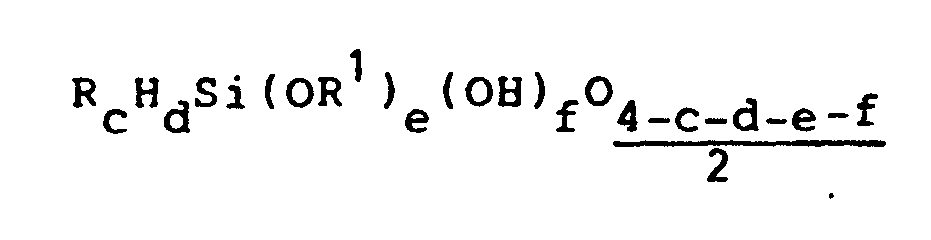
- Die zur Herstellung der erfindungsgemäßen Pulver oder bei dem erfindungsgemäßen Verfahren verwendeten organischen Siliciumverbindungen können beispielsweise auch durch Trimethylsiloxygruppen endblockierte Methylhydrogenpolysiloxane oder durch Trimethylsiloxygruppen endblockierte Mischpolymere aus Dimethylsiloxan- und Methylhydrogensiloxaneinheiten sein.
- Vorzugsweise enthalten die organischen Reste R höchstens 18 Kohlenstoffatome je Rest. Beispiele für Kohlenwasserstoffreste R sind Alkylreste, wie der Methyl-, Ethyl-, n-Propyl-, Isopropyl- und 2-Ethylhexylrest sowie Hexyl- und Octadecylreste; Kohlenwasserstoffreste mit mindestens einer aliphatischen Kohlenstoff-Kohlenstoff-Doppelbindung, wie der Vinyl-, Allyl-, Ethylallyl- und Butadienylrest; Cycloalkylreste, wie der Cyclohexylrest; Arylreste, wie der Phenylrest; Alkarylreste, wie Tolylreste; und Aralkylreste, wie der Benzylrest.
- Beispiele für substituierte Kohlenwasserstoffreste R sind halogenierte Kohlenwasserstoffreste, wie der 3,3,3-Trifluorpropylrest und 3-Chlorpropylrest sowie Chlorphenylreste; Mer- captoalkylreste, wie der 3-Mercaptopropylrest; und Acyloxyalkylreste, wie der 3-Methacryloxypropylrest.
- Beispiele für Alkylreste R sind der Methyl-, Ethyl-, n-Propyl-, Isopropyl-, n-Butyl-, sec.-Butyl- und tert.-Butylrest. Das wichtigste Beispiel für einen Alkoxyalkylenrest ist der Methoxyethylenrest.
- Einzelne Beispiele für zur Herstellung der erfindungsgemässen Pulver oder bei dem erfindungsgemäßen Verfahren verwendbare organische Siliciumverbindungen sind 3-Mercaptopropyltrimethoxysilan, Vinyltris-(methoxyethylenoxy)-silan, 3-Meth- acrylpropyltris-(methoxyethylenoxy)-silan, n-Octyltriethoxysilan, 2-Ethylhexyltrimethoxysilan, Polyethylsilikate, das Organopolysiloxan der Summenformel


das Organosiloxan der Formel
- Die erfindungsgemäßen Pulver können eine Art von organischer Siliciumverbindung oder mindestens zwei verschiedene Arten von organischer Siliciumverbindung enthalten. Ebenso kann bei dem erfindungsgemäßen Verfahren eine Art von organischer Siliciumverbindung oder ein Gemisch aus mindestens zwei verschiedenen Arten von organischen Siliciumverbindungen eingesetzt werden.
- Wenn eine Hydrophobierung der erfindungsgemäßen oder erfindungsgemäß hergestellten Pulver erwünscht ist, so muß mindestens ein Teil der organischen Siliciumverbindungen durchschnittlich mindestens 0,8 SiC-gebundene, gegebenenfalls halogenierte Kohlenwasserstoffreste je Siliciumatom aufweisen.
- Vorzugsweise werden zur Herstellung der erfindungsgemäßen Pulver oder bei dem erfindungsgemäßen Verfahren insgesamt 40 bis 97 Gewichtsprozent, bei dem insbesondere 70 bis 95 Gewichtsprozent, jeweils bezogen auf das Gesamtgewicht des jeweiligen Pulvers (berechnet als wasserfreies Pulver), organische Siliciumverbindung eingesetzt.
- Zusätzlich zu organischer Siliciumverbindung und wasserlöslichem Polymer können die erfindungsgemäßen Pulver gegebenenfalls weitere Stoffe enthalten und bei dem erfindungsgemäßen Verfahren gegebenenfalls weitere Stoffe mitversprüht werden, jedoch nur in Mengen, die gewährleisten, daß die fertigen Pulver, bezogen auf das Gesamtgewicht des jeweiligen Pulvers (berechnet als wasserfreies Pulver), insgesamt noch mindestens 30 Gewichtsprozent organische Siliciumverbindung enthalten. Beispiele für solche weiteren Stoffe sind bzw. können sein mit Wasser mischbare Lösungsmittel, wie Diacetonalkohol, mit Wasser nicht mischbare Lösungsmittel, wie Ge-mische aus Xylolisomeren, andere ionogene oder nicht-ionogene Emulgatoren als wasserlösliche Polymere, wie Natriumlaurylsulfat, Fungicide, Antischaummittel, lösliche Farbstoffe, Pigmente, Füllstoffe mit einer Oberfläche von mindestens 50 m2/g, wie pyrogen erzeugtes Siliciumdioxyd und Füllstoffe mit einer Oberfläche von weniger als 50 m2/g, wie Kreidepulver, nadelförmiges Calciumcarbonat und Quarzmehl.
- In den zu versprühenden Gemischen beträgt die Menge von Wasser vorzugsweise 45 bis 95 Gewichtsprozent, insbesondere 60 bis 85 Gewichtsprozent, jeweils bezogen auf das Gesamtgewicht des jeweiligen zu versprühenden Gemisches.
- Die Sprühtrocknung kann in beliebigen zur Sprühtrocknung von Flüssigkeiten geeigneten und bereits vielfach bekannten Vorrichtungen, beispielsweise solchen mit mindestens einer Drallzerstäuberdüse oder mit einer rotierenden Zerstäuberscheibe, in einem vorzugsweise erwärmten Trockengasstrom durchgeführt werden.
- Vorzugsweise beträgt die Eintrittstemperatur des Trockengasstroms, wobei es sich meist um Luft handelt, 80° bis 250°C, insbesondere 110° bis 190°C und die Austrittstemperatur des beim Trocknen gebildeten Gasstroms 40° bis 100°C, insbesondere 50° bis 90°C.
- Getrennt von dem der Sprühtrocknung zugeführten Gemisch können in die Vorrichtung, in der die Sprühtrocknung stattfindet, Antiblock-(Antiback)-mittel eingeführt werden, jedoch selbstverständlich wieder nur in Mengen, die gewährleisten, daß die fertigen Pulver, bezogen auf das Gesamtgewicht des jeweiligen Pulvers (berechnet als wasserfreies Pulver, insgesamt noch mindestens 30 Gewichtsprozent organische Siliciumverbindung enthalten. Dabei sind Mengen derartiger Antiblockmittel von 1 bis 20 Gewichtsprozent, bezogen auf das Gesamtgewicht von jeweils verwendeter organischer Siliciumverbindung, bevorzugt, wenn Antiblockmittel mitverwendet werden. Die Antiblockmittel sind meist anorganische, feste Stoffe mit mittleren Teilchengrößen von 0,01 bis 50 mikrometer. Es kann sich dabei z.B. um Aluminiumsilikate, kolloidales Siliciumdioxydgel, pyrogen erzeugtes Siliciumdioxyd, gemahlene Tone, Leichtspat, Talkum, Zemente, Kreidepulver oder Diatomeenerde handeln.
- Die erfindungsgemäßen oder erfindungsgemäß hergestellten Pulver können im trockenen Zustand oder in mit Wasser verdünnter Form beispielsweise mit hydraulischen Bindemitteln, wie Zement oder Kalk und Zuschlagstoffen zur Herstellung von Bausteinen oder Bauteilen,wie Beton, einschließlich Gasbeton oder Schaumbeton oder Kalksandsteinen, sowie mit Putzen, Lehm, Füllstoffen, wie Siliciumdioxyd oder Kaolin, oder Anstrichfarben vermischt werden. Sie können in mit Wasser verdünnter Form zur Hydrophobierung von Schüttgütern, wie Perliten (Blählava), Vermiculiten (Blähglimmer) Gasbetongranulaten und Holzwolle oder Holzmehl verwendet werden. Weiterhin können die erfindungsgemäßen oder erfindungsgemäß hergestellten Pulver in mit Wasser verdünnter Form als Bindemittel für feinteilige anorganische Stoffe, wie Sand, oder organische Stoffe, wie Holzmehl, verwendet werden. Schließlich können die erfindungsgemäßen oder erfindungsgemäß hergestellten Pulver z.B. auch als Zusätze für Klebstoffe oder zur Schaumverhütung oder Schaumbekämpfung in wäßrigen Medien verwendet werden.
- In den folgenden Beispielen beziehen sich alle Angaben von Prozentsätzen und Teilen auf das Gewicht, soweit nichts anderes angegeben ist.
- Aus 250 g des im Handel erhältlichen Organopolysiloxans der Summenformel

- 250 g des in Beispiel 1 näher beschriebenen Organopolysiloxans werden mit 496 g der in Beispiel 1 näher beschriebenen 10 %-igen wäßrigen Lösung eines Polyvinylalkohols vermischt. Die so erhaltene Mischung wird mit weiteren 250 g des in Beispiel 1 näher beschriebenen Organopolysiloxans vermischt.
- Das so erhaltene Gemisch wird mit soviel Wasser verdünnt, daß die Auslaufzeit 30 Sekunden im DIN (Deutsche IndustrieNorm)- Becher 4 beträgt und dann wie in Beispiel 1 beschrieben sprühgetrocknet mit den Abänderungen, daß die Lufteintrittstemperatur 175°C und die Gasaustrittstemperatur 85°C beträgt. Es wird ein in Wasser redispergierbares, gut rieselfähiges Pulver mit einem Restfeuchte-Gehalt von 2,1 % erhalten.
- Die im Beispiel 2 beschriebene Arbeitsweise wird wiederholt mit den Abänderungen, daß bei der Sprühtrocknung der Düsendruck 5400 hPa (abs.) und die Lufteintrittstemperatur 165°C beträgt. Es wird ein in Wasser redispergierbares, gut rieselfähiges Pulver mit einem Restfeuchte-Gehalt von 1,3 % erhalten.
- 250 g des in Beispiel 1 näher beschriebenen Organopolysiloxans werden mit 765 g einer 16,25 %-igen wäßrigen Lösung eines Polyvinylalkohols mit einem Hydrolysegrad von 81 Molprozent und einem Molekulargewicht von 26 000, wobei eine 4 %-ige wäßrige Lösung dieses Polyvinylalkohols bei 20°C eine Viskosität von 5 mPa.s hat, vermischt. Die so erhaltene Mischung wird mit weiteren 250 g des in Beispiel 1 näher beschriebenen Organopolysiloxans vermischt. Das so erhaltene Gemisch wird mit 250 g Wasser vermischt. Seine Auslaufzeit beträgt dann 15 Sekunden im DIN-Becher 4. Die so erhaltene Emulsion wird schließlich, wie in Beispiel 3 angegeben, in ein in Wasser redispergierbares, gut rieselfähiges Pulver mit einem Restfeuchte-Gehalt von 1,7 % umgewandelt.
- Die in Beispiel 4 beschriebene Arbeitsweise wird wiederholt mit der Abänderung, daß die Konzentration der Lösung des gleichen Polyvinylalkohols nicht 16,25 %, sondern nur 13,66 % beträgt. Es wird ein in Wasser redispergierbares, gut rieselfähiges Pulver mit einem Restfeuchte-Gehalt von 1,8 % erhalten.
- Gemische aus folgenden pulverförmigen Bestandteilen:

- Die Ergebnisse dieser Prüfung sind in der folgenden Tabelle I angegeben. Dabei stellt der mit "S-Wert" bezeichnete Wert die Summe der Wasseraufnahmewerte in jeder Reihe der Tabelle dar. Je niedriger der S-Wert ist, desto langsamer erfolgt die Wasseraufnahme.

- Aus den in der folgenden Tabelle II angegebenen Stoffen und soviel Wasser, daß die Gemische eine Auslaufzeit von 13 bis 15 Sekunden im DIN-Becher 4 haben, werden Gemische hergestellt, deren pH-Wert mit NaHCO3 auf 7,0 eingestellt wird und die dann in dem Sprühtrockner der in Beispiel 1 angegebenen Art bei einer Lufteintrittstemperatur von 165°C und einer Gasaustrittstemperatur von 85°C und den in der folgenden Tabelle II angegebenen Düsendrücken versprüht werden. Es werden jeweils in Wasser redispergierbare, gut rieselfähige Pulver erhalten.


Claims (5)
daß Emulsionen oder Suspensionen von organischer Siliciumverbindung, die zu mindestens 50 Gewichtsprozent aus solcher organischer Siliciumverbindung besteht, die bei Raumtemperatur und 1020 hPa (abs.) flüssig oder fest ist, einen Siedepunkt von mindestens 150°C bei 1020 hPa (abs.), durchschnittlich höchstens 1,8 SiC-gebundene organische Reste je Siliciumatom und je Molekül mindestens ein direkt an Silicium gebundenes Wasserstoffatom oder mindestens eine direkt an Silciium gebundene Hydroxylgruppe oder mindestens einen über Sauerstoff an Silicium gebundenen Kohlenwasserstoffrest, der durch eine Alkoxygruppe substituiert sein kann, oder ein Gemisch aus mindestens zwei derartiger kondensationsfähiger Substituenten aufweist, in Wasser, das wasserlösliches Polymer enthält, wobei die Menge von in Wasser dispergierter organischer Siliciumverbindung insgesamt mindestens 30 Gewichtsprozent, bezogen auf das Gesamtgewicht der im Wasser verteilten, bei 1020 hPa (abs.) und Temperaturen unter 150°C nicht-siedenden Stoffe, beträgt, in an sich bekannter Weise sprühgetrocknet werden.
Priority Applications (1)
| Application Number | Priority Date | Filing Date | Title |
|---|---|---|---|
| AT86117587T ATE102974T1 (de) | 1985-12-19 | 1986-12-17 | In wasser redispergierbare, wasserloesliches polymer und mindestens eine organische siliciumverbindung enthaltende pulver, verfahren zu ihrer herstellung und verwendung solcher pulver. |
Applications Claiming Priority (2)
| Application Number | Priority Date | Filing Date | Title |
|---|---|---|---|
| DE3545030 | 1985-12-19 | ||
| DE3545030 | 1985-12-19 |
Publications (3)
| Publication Number | Publication Date |
|---|---|
| EP0228657A2 true EP0228657A2 (de) | 1987-07-15 |
| EP0228657A3 EP0228657A3 (en) | 1989-05-24 |
| EP0228657B1 EP0228657B1 (de) | 1994-03-16 |
Family
ID=6288919
Family Applications (1)
| Application Number | Title | Priority Date | Filing Date |
|---|---|---|---|
| EP86117587A Expired - Lifetime EP0228657B1 (de) | 1985-12-19 | 1986-12-17 | In Wasser redispergierbare, wasserlösliches Polymer und mindestens eine organische Siliciumverbindung enthaltende Pulver, Verfahren zu ihrer Herstellung und Verwendung solcher Pulver |
Country Status (7)
| Country | Link |
|---|---|
| US (1) | US4704416A (de) |
| EP (1) | EP0228657B1 (de) |
| JP (1) | JPS62148529A (de) |
| AT (1) | ATE102974T1 (de) |
| AU (1) | AU589239B2 (de) |
| CA (1) | CA1296460C (de) |
| DE (1) | DE3689721D1 (de) |
Cited By (19)
| Publication number | Priority date | Publication date | Assignee | Title |
|---|---|---|---|---|
| EP0573036A1 (de) | 1992-06-04 | 1993-12-08 | Wacker-Chemie GmbH | Verwendung von Polypropylenglykol als Schwindmass-reduzierender Zusatz in Dispersionspulver-Zusammensetzungen für Baustoffe |
| US5567750A (en) * | 1993-06-24 | 1996-10-22 | Wacker-Chemie Gmbh | Redispersible dispersion powder composition |
| EP0754737A3 (de) * | 1995-07-10 | 1997-01-29 | Wacker Chemie Gmbh | |
| WO1997018258A1 (de) * | 1995-11-14 | 1997-05-22 | Wacker-Chemie Gmbh | Verfahren zur herstellung von in wasser redispergierbaren, organosiliciumverbindungen enthaltenden pulverzusammensetzungen |
| EP0751175A3 (de) * | 1995-06-26 | 1997-12-29 | Clariant GmbH | Dispersionspulver mit erhöhter Selbstentzündungstemperatur |
| US5753733A (en) * | 1994-01-27 | 1998-05-19 | Wacker-Chemie Gmbh | Redispersible, silicon-modified dispersion powder composition, process for its preparation and its use |
| DE19850658A1 (de) * | 1998-11-03 | 2000-06-15 | Elotex Ag Sempach Station | Redispergierbares Material, Verfahren zu dessen Herstellung und dessen Verwendung sowie ein wäßriges System, enthaltend das redispergierbare Material |
| US6090868A (en) * | 1995-11-14 | 2000-07-18 | Wacker-Chemie Gmbh | Process for treating mineral coating agent and binder compositions with plastics |
| US6191235B1 (en) | 1994-01-27 | 2001-02-20 | Wacker-Chemie Gmbh | Process for the preparation of a redispersible dispersion powder composition |
| EP1083157A3 (de) * | 1999-09-10 | 2002-12-18 | Dow Corning Corporation | Zusammensetzung zur Hydrophobierung van Gips, Verfahren zur Herstellung und Anwendung |
| WO2004041748A1 (en) * | 2002-11-06 | 2004-05-21 | Haggai Shoshany | Gypsum product and method therefor |
| WO2004103928A1 (de) * | 2003-05-22 | 2004-12-02 | Wacker Polymer Systems Gmbh & Co. Kg | Hydrophobierendes additiv |
| FR2870851A1 (fr) * | 2004-05-27 | 2005-12-02 | Rhodia Chimie Sa | Nouvelle agent hydrofugeant hydrodispersable, sa preparation et son utilisation dans le domaine de la construction et plus particulierement dans les compositions de liants mineraux |
| EP1982964A1 (de) | 2007-04-20 | 2008-10-22 | Evonik Degussa GmbH | Organosiliciumverbindung enthaltende Mischung und deren Verwendung |
| WO2011121027A1 (de) * | 2010-04-01 | 2011-10-06 | Evonik Degussa Gmbh | Härtbare mischung |
| WO2013044980A1 (en) * | 2011-09-30 | 2013-04-04 | Akzo Nobel Chemicals International B.V. | Curable mixture |
| US8703874B2 (en) | 2008-11-06 | 2014-04-22 | Thomas Aberle | Powder to hydrophobise and its use |
| EP1756203B2 (de) † | 2004-03-15 | 2016-08-03 | Rhodia Chimie | Getrocknete emulsion, herstellungsverfahren dafür und verwendung davon |
| CN114836173A (zh) * | 2022-04-11 | 2022-08-02 | 江苏涌新材料科技有限公司 | 一种疏水粉末及其制备方法与应用 |
Families Citing this family (21)
| Publication number | Priority date | Publication date | Assignee | Title |
|---|---|---|---|---|
| JPS63146805A (ja) * | 1986-07-07 | 1988-06-18 | G C Dental Ind Corp | 歯科用シリコ−ン精密印象材 |
| DE3704439A1 (de) * | 1987-02-12 | 1988-08-25 | Wacker Chemie Gmbh | Verfahren zur herstellung von wasserabweisenden gegenstaenden aus gips und hydrophobierungsmittel enthaltende gipspulver |
| US4818294A (en) * | 1987-06-26 | 1989-04-04 | E.C.C. America Inc. | Kaolinite aggregation using organo-silicon compounds |
| DE3734491A1 (de) * | 1987-10-12 | 1989-04-20 | Henkel Kgaa | Verfahren zur herstellung eines als kleisterbasis geeigneten trockenproduktes |
| US5108782A (en) * | 1990-05-18 | 1992-04-28 | P. H. Glatfelter Company | Silicone release composition |
| US5229212A (en) * | 1990-05-18 | 1993-07-20 | P. H. Glatfelter Company | Silicone release coated substrate |
| US5510481A (en) * | 1990-11-26 | 1996-04-23 | The Regents, University Of California | Self-assembled molecular films incorporating a ligand |
| EP0721004B1 (de) * | 1995-01-06 | 2001-03-21 | Rohm And Haas Company | Wasserdispergierbare Pulverzusammensetzung für wasserbeständige Überzugsmittel |
| DE19526759A1 (de) * | 1995-07-21 | 1997-01-23 | Wacker Chemie Gmbh | Redispergierbare, vernetzbare Dispersionspulver |
| DE19615776A1 (de) * | 1996-04-20 | 1997-10-23 | Henkel Kgaa | Löslichkeitsverbessertes Enzymgranulat |
| GB9611776D0 (en) * | 1996-06-06 | 1996-08-07 | Dow Corning | Cementitious materials |
| US5973060A (en) * | 1998-02-10 | 1999-10-26 | Dow Corning Toray Silicone Co., Ltd. | Silicone rubber particulate composition and methods for the preparation thereof |
| US6346570B1 (en) * | 1999-08-30 | 2002-02-12 | Kuraray Co., Ltd. | Water resistant composition, coating agent, and recording material |
| GB0024642D0 (en) | 2000-10-07 | 2000-11-22 | Dow Corning | Hydrophobic gypsum |
| GB0024638D0 (en) * | 2000-10-07 | 2000-11-22 | Dow Corning | Cementitious materials |
| US7875674B2 (en) * | 2008-05-01 | 2011-01-25 | Wacker Chemical Corporation | Building materials incorporated with hydrophobic silicone resin(s) |
| CN104922071A (zh) | 2010-04-09 | 2015-09-23 | 帕西拉制药有限公司 | 用于配制大直径合成膜囊泡的方法 |
| BE1021766B1 (nl) | 2013-09-26 | 2016-01-15 | Cormitec B.V.B.A | Werkwijze voor het vervaardigen van water afstotende producten. |
| US9809497B2 (en) * | 2015-12-01 | 2017-11-07 | Wacker Chemical Corporation | Omniphobic grout additive |
| US20230192558A1 (en) * | 2021-12-20 | 2023-06-22 | Raytheon Technologies Corporation | Pva based binder application for cmcs |
| CN115521158B (zh) * | 2022-10-11 | 2023-08-18 | 南京工业大学 | 一种高透气性陶瓷纤维过滤管的制备方法 |
Family Cites Families (6)
| Publication number | Priority date | Publication date | Assignee | Title |
|---|---|---|---|---|
| GB892787A (en) * | 1959-09-16 | 1962-03-28 | Dow Corning | Improvements in or relating to anti-foaming agents |
| US3210208A (en) * | 1962-05-01 | 1965-10-05 | Smith Kline French Lab | Process of coating organopolysiloxane particles |
| US3959102A (en) * | 1973-08-06 | 1976-05-25 | Essilor International (Compagnie Generale D'optique S.A.) | Method for preparing a crosslinked graft copolymer of silicone and polyvinylpyrrolidone for use as a contact lens, and a contact lens produced thereby |
| US4281233A (en) * | 1977-05-03 | 1981-07-28 | Ceskoslovenska Akademie Ved | Hydrophilic macroporous three dimensional copolymers of hydroxyalkyl acrylates or methacrylates with crosslinking agents and the method of their manufacturing |
| DE3101413C2 (de) * | 1981-01-17 | 1983-10-20 | Hoechst Ag, 6230 Frankfurt | Pulverförmige Polymerisatmasse, Verfahren zu ihrer Herstellung und ihre Verwendung |
| US4446259A (en) * | 1982-09-30 | 1984-05-01 | E. I. Du Pont De Nemours And Company | Coating composition of a blend of a glycidyl acrylic polymer and a reactive polysiloxane |
-
1986
- 1986-10-08 US US06/916,763 patent/US4704416A/en not_active Expired - Lifetime
- 1986-10-23 CA CA000521241A patent/CA1296460C/en not_active Expired - Lifetime
- 1986-12-15 JP JP61296862A patent/JPS62148529A/ja active Granted
- 1986-12-16 AU AU66583/86A patent/AU589239B2/en not_active Ceased
- 1986-12-17 AT AT86117587T patent/ATE102974T1/de not_active IP Right Cessation
- 1986-12-17 DE DE86117587T patent/DE3689721D1/de not_active Expired - Fee Related
- 1986-12-17 EP EP86117587A patent/EP0228657B1/de not_active Expired - Lifetime
Cited By (29)
| Publication number | Priority date | Publication date | Assignee | Title |
|---|---|---|---|---|
| EP0573036A1 (de) | 1992-06-04 | 1993-12-08 | Wacker-Chemie GmbH | Verwendung von Polypropylenglykol als Schwindmass-reduzierender Zusatz in Dispersionspulver-Zusammensetzungen für Baustoffe |
| US5567750A (en) * | 1993-06-24 | 1996-10-22 | Wacker-Chemie Gmbh | Redispersible dispersion powder composition |
| US5753733A (en) * | 1994-01-27 | 1998-05-19 | Wacker-Chemie Gmbh | Redispersible, silicon-modified dispersion powder composition, process for its preparation and its use |
| US6191235B1 (en) | 1994-01-27 | 2001-02-20 | Wacker-Chemie Gmbh | Process for the preparation of a redispersible dispersion powder composition |
| EP0751175A3 (de) * | 1995-06-26 | 1997-12-29 | Clariant GmbH | Dispersionspulver mit erhöhter Selbstentzündungstemperatur |
| US6270692B1 (en) | 1995-06-26 | 2001-08-07 | Clariant Gmbh | Dispersion powders with increased autoignition temperature |
| CN1054390C (zh) * | 1995-07-10 | 2000-07-12 | 瓦克化学有限公司 | 用于无机基质的涂覆组合物 |
| EP0754737A3 (de) * | 1995-07-10 | 1997-01-29 | Wacker Chemie Gmbh | |
| US5681892A (en) * | 1995-07-10 | 1997-10-28 | Wacker-Chemie Gmbh | Coating composition based on water redispersible powders comprising water-soluble polymer and organosilicon compound |
| RU2141983C1 (ru) * | 1995-07-10 | 1999-11-27 | Вакер-Хеми ГмбХ | Состав для нанесения покрытия на основе порошков, содержащих редиспергируемые в воде водорастворимый полимер и кремнийорганическое соединение, а также способ нанесения покрытия |
| WO1997018258A1 (de) * | 1995-11-14 | 1997-05-22 | Wacker-Chemie Gmbh | Verfahren zur herstellung von in wasser redispergierbaren, organosiliciumverbindungen enthaltenden pulverzusammensetzungen |
| US6090868A (en) * | 1995-11-14 | 2000-07-18 | Wacker-Chemie Gmbh | Process for treating mineral coating agent and binder compositions with plastics |
| US6020403A (en) * | 1995-11-14 | 2000-02-01 | Wacker-Chemie Gmbh | Process for preparing water-redispersible powder compositions comprising organosilicon compounds |
| DE19850658A1 (de) * | 1998-11-03 | 2000-06-15 | Elotex Ag Sempach Station | Redispergierbares Material, Verfahren zu dessen Herstellung und dessen Verwendung sowie ein wäßriges System, enthaltend das redispergierbare Material |
| EP1083157A3 (de) * | 1999-09-10 | 2002-12-18 | Dow Corning Corporation | Zusammensetzung zur Hydrophobierung van Gips, Verfahren zur Herstellung und Anwendung |
| WO2004041748A1 (en) * | 2002-11-06 | 2004-05-21 | Haggai Shoshany | Gypsum product and method therefor |
| WO2004103928A1 (de) * | 2003-05-22 | 2004-12-02 | Wacker Polymer Systems Gmbh & Co. Kg | Hydrophobierendes additiv |
| EP1756203B2 (de) † | 2004-03-15 | 2016-08-03 | Rhodia Chimie | Getrocknete emulsion, herstellungsverfahren dafür und verwendung davon |
| FR2870851A1 (fr) * | 2004-05-27 | 2005-12-02 | Rhodia Chimie Sa | Nouvelle agent hydrofugeant hydrodispersable, sa preparation et son utilisation dans le domaine de la construction et plus particulierement dans les compositions de liants mineraux |
| WO2005118683A3 (fr) * | 2004-05-27 | 2006-07-20 | Rhodia Chimie Sa | Nouvel agent hydrofugeant hydrodispersable, sa preparation et son utilisation dans le domaine de la construction et plus particulierement dans les compositions de liants mineraux |
| CN101358014B (zh) * | 2007-04-20 | 2014-05-07 | 赢创德固赛有限责任公司 | 含有有机硅化合物的混合物及其应用 |
| WO2008128819A1 (de) * | 2007-04-20 | 2008-10-30 | Evonik Degussa Gmbh | Organosiliciumverbindung enthaltende mischung und deren verwendung |
| RU2516298C2 (ru) * | 2007-04-20 | 2014-05-20 | Эвоник Дегусса Гмбх | Смеси, содержащие кремнийорганические соединения, и их применение |
| EP1982964A1 (de) | 2007-04-20 | 2008-10-22 | Evonik Degussa GmbH | Organosiliciumverbindung enthaltende Mischung und deren Verwendung |
| US8703874B2 (en) | 2008-11-06 | 2014-04-22 | Thomas Aberle | Powder to hydrophobise and its use |
| WO2011121027A1 (de) * | 2010-04-01 | 2011-10-06 | Evonik Degussa Gmbh | Härtbare mischung |
| US9040608B2 (en) | 2010-04-01 | 2015-05-26 | Evonik Degussa Gmbh | Curable mixture |
| WO2013044980A1 (en) * | 2011-09-30 | 2013-04-04 | Akzo Nobel Chemicals International B.V. | Curable mixture |
| CN114836173A (zh) * | 2022-04-11 | 2022-08-02 | 江苏涌新材料科技有限公司 | 一种疏水粉末及其制备方法与应用 |
Also Published As
| Publication number | Publication date |
|---|---|
| US4704416A (en) | 1987-11-03 |
| EP0228657B1 (de) | 1994-03-16 |
| CA1296460C (en) | 1992-02-25 |
| ATE102974T1 (de) | 1994-04-15 |
| JPH0521929B2 (de) | 1993-03-26 |
| JPS62148529A (ja) | 1987-07-02 |
| AU589239B2 (en) | 1989-10-05 |
| DE3689721D1 (de) | 1994-04-21 |
| AU6658386A (en) | 1987-06-25 |
| EP0228657A3 (en) | 1989-05-24 |
Similar Documents
| Publication | Publication Date | Title |
|---|---|---|
| EP0228657B1 (de) | In Wasser redispergierbare, wasserlösliches Polymer und mindestens eine organische Siliciumverbindung enthaltende Pulver, Verfahren zu ihrer Herstellung und Verwendung solcher Pulver | |
| EP0278518B1 (de) | Verfahren zur Herstellung von wasserabweisenden Gegenständen aus Gips und Hydrophobierungsmittel enthaltende Gipspulver | |
| EP0824510B1 (de) | Emulsionen von organosiliciumverbindungen für die hydrophobierung von baustoffen | |
| EP0242798B1 (de) | Wässerige Emulsionen von Organopolysiloxan und Verwendung solcher Emulsionen | |
| EP0919526B1 (de) | Organosiliciumverbindungenhaltige hydrophobierende Pulver enthaltende Baustoffmassen | |
| DE10003495C2 (de) | Hydrophobierungsmittel zur Hydrophobierung von gipsgebundenen Baustoffen, Verfahren zu dessen Herstellung sowie dessen Verwendung | |
| EP1817371B2 (de) | Hydrophobierendes additiv | |
| EP0754737B1 (de) | Beschichtungsmassen auf Basis von in Wasser redispergierbaren, wasserlösliches Polymer und Organosiliciumverbindung enthaltenden Pulvern | |
| DE69626520T2 (de) | Zellulosematerialen und verfahren zur verwendung davon | |
| EP0056622B1 (de) | Pulverförmige Polymerkomposition, Verfahren zu ihrer Herstellung und ihre Verwendung | |
| DE69110438T3 (de) | Redispergierbare Pulver aus Vinylpolymeren. | |
| DE60108152T2 (de) | Granuliertes hydrophobes zusatzmaterial für zementzusammensetzungen | |
| DE1223287B (de) | Verfahren zum Herstellen von wasserabweisenden Formkoerpern und UEberzuegen aus anorganischen Massen | |
| EP0392253A2 (de) | Zubereitung zur wasserabweisenden Imprägnierung poröser mineralischer Baustoffe | |
| DE2837891A1 (de) | Anorganisches bindemittel und verfahren zu seiner herstellung | |
| DE1519987B2 (de) | Stabile schaumregulierungsmittel | |
| EP0685438A1 (de) | Verfahren zur wasserabweisenden Imprägnierung von Gips | |
| EP1688401B1 (de) | Mineralisches Dämmelement und Verfahren zu seiner Herstellung | |
| EP0279373B1 (de) | In Wasser redispergierbare, Organo(poly)siloxan enthaltende Pulver und Verfahren zu ihrer Herstellung | |
| EP0861284B1 (de) | Verfahren zur herstellung von in wasser redispergierbaren, organosiliciumverbindungen enthaltenden pulverzusammensetzungen | |
| DE1769508A1 (de) | Verfahren zur Herstellung von Hydrophobiermitteln | |
| DE2606273A1 (de) | Verfahren zur herstellung von hydrophobiermitteln | |
| DE69523934T2 (de) | Durch kondensation zum selbsthärtenden elastomer härtende wässrige silikondispersion | |
| DE2456979B1 (de) | Rieselfaehige harnstoffharzmassen | |
| EP2510057A1 (de) | Siliconharzemulsion und deren einsatz bei der hydrophobierung von gips |
Legal Events
| Date | Code | Title | Description |
|---|---|---|---|
| PUAI | Public reference made under article 153(3) epc to a published international application that has entered the european phase |
Free format text: ORIGINAL CODE: 0009012 |
|
| 17P | Request for examination filed |
Effective date: 19861217 |
|
| AK | Designated contracting states |
Kind code of ref document: A2 Designated state(s): AT BE CH DE FR GB IT LI NL SE |
|
| PUAL | Search report despatched |
Free format text: ORIGINAL CODE: 0009013 |
|
| AK | Designated contracting states |
Kind code of ref document: A3 Designated state(s): AT BE CH DE FR GB IT LI NL SE |
|
| 17Q | First examination report despatched |
Effective date: 19920330 |
|
| RAP1 | Party data changed (applicant data changed or rights of an application transferred) |
Owner name: WACKER-CHEMIE GMBH |
|
| ITF | It: translation for a ep patent filed | ||
| GRAA | (expected) grant |
Free format text: ORIGINAL CODE: 0009210 |
|
| AK | Designated contracting states |
Kind code of ref document: B1 Designated state(s): AT BE CH DE FR GB IT LI NL SE |
|
| REF | Corresponds to: |
Ref document number: 102974 Country of ref document: AT Date of ref document: 19940415 Kind code of ref document: T |
|
| REF | Corresponds to: |
Ref document number: 3689721 Country of ref document: DE Date of ref document: 19940421 |
|
| GBT | Gb: translation of ep patent filed (gb section 77(6)(a)/1977) |
Effective date: 19940415 |
|
| ET | Fr: translation filed | ||
| PLBE | No opposition filed within time limit |
Free format text: ORIGINAL CODE: 0009261 |
|
| STAA | Information on the status of an ep patent application or granted ep patent |
Free format text: STATUS: NO OPPOSITION FILED WITHIN TIME LIMIT |
|
| EAL | Se: european patent in force in sweden |
Ref document number: 86117587.5 |
|
| 26N | No opposition filed | ||
| PGFP | Annual fee paid to national office [announced via postgrant information from national office to epo] |
Ref country code: SE Payment date: 19991202 Year of fee payment: 14 Ref country code: AT Payment date: 19991202 Year of fee payment: 14 |
|
| PGFP | Annual fee paid to national office [announced via postgrant information from national office to epo] |
Ref country code: GB Payment date: 19991203 Year of fee payment: 14 |
|
| PGFP | Annual fee paid to national office [announced via postgrant information from national office to epo] |
Ref country code: NL Payment date: 19991213 Year of fee payment: 14 |
|
| PGFP | Annual fee paid to national office [announced via postgrant information from national office to epo] |
Ref country code: BE Payment date: 19991224 Year of fee payment: 14 |
|
| PG25 | Lapsed in a contracting state [announced via postgrant information from national office to epo] |
Ref country code: GB Free format text: LAPSE BECAUSE OF NON-PAYMENT OF DUE FEES Effective date: 20001217 Ref country code: AT Free format text: LAPSE BECAUSE OF NON-PAYMENT OF DUE FEES Effective date: 20001217 |
|
| PG25 | Lapsed in a contracting state [announced via postgrant information from national office to epo] |
Ref country code: SE Free format text: LAPSE BECAUSE OF NON-PAYMENT OF DUE FEES Effective date: 20001218 |
|
| PG25 | Lapsed in a contracting state [announced via postgrant information from national office to epo] |
Ref country code: BE Free format text: LAPSE BECAUSE OF NON-PAYMENT OF DUE FEES Effective date: 20001231 |
|
| BERE | Be: lapsed |
Owner name: WACKER-CHEMIE G.M.B.H. Effective date: 20001231 |
|
| PG25 | Lapsed in a contracting state [announced via postgrant information from national office to epo] |
Ref country code: NL Free format text: LAPSE BECAUSE OF NON-PAYMENT OF DUE FEES Effective date: 20010701 |
|
| GBPC | Gb: european patent ceased through non-payment of renewal fee |
Effective date: 20001217 |
|
| EUG | Se: european patent has lapsed |
Ref document number: 86117587.5 |
|
| NLV4 | Nl: lapsed or anulled due to non-payment of the annual fee |
Effective date: 20010701 |
|
| PGFP | Annual fee paid to national office [announced via postgrant information from national office to epo] |
Ref country code: FR Payment date: 20041217 Year of fee payment: 19 |
|
| PGFP | Annual fee paid to national office [announced via postgrant information from national office to epo] |
Ref country code: CH Payment date: 20041222 Year of fee payment: 19 |
|
| PGFP | Annual fee paid to national office [announced via postgrant information from national office to epo] |
Ref country code: DE Payment date: 20050131 Year of fee payment: 19 |
|
| PG25 | Lapsed in a contracting state [announced via postgrant information from national office to epo] |
Ref country code: IT Free format text: LAPSE BECAUSE OF NON-PAYMENT OF DUE FEES Effective date: 20051217 |
|
| PG25 | Lapsed in a contracting state [announced via postgrant information from national office to epo] |
Ref country code: LI Free format text: LAPSE BECAUSE OF NON-PAYMENT OF DUE FEES Effective date: 20051231 Ref country code: CH Free format text: LAPSE BECAUSE OF NON-PAYMENT OF DUE FEES Effective date: 20051231 |
|
| PG25 | Lapsed in a contracting state [announced via postgrant information from national office to epo] |
Ref country code: DE Free format text: LAPSE BECAUSE OF NON-PAYMENT OF DUE FEES Effective date: 20060701 |
|
| REG | Reference to a national code |
Ref country code: CH Ref legal event code: PL |
|
| PG25 | Lapsed in a contracting state [announced via postgrant information from national office to epo] |
Ref country code: FR Free format text: LAPSE BECAUSE OF NON-PAYMENT OF DUE FEES Effective date: 20060831 |
|
| REG | Reference to a national code |
Ref country code: FR Ref legal event code: ST Effective date: 20060831 |