EP0225347B2 - Polyestergarn und verfahren zu dessen herstellung - Google Patents
Polyestergarn und verfahren zu dessen herstellung Download PDFInfo
- Publication number
- EP0225347B2 EP0225347B2 EP86903197A EP86903197A EP0225347B2 EP 0225347 B2 EP0225347 B2 EP 0225347B2 EP 86903197 A EP86903197 A EP 86903197A EP 86903197 A EP86903197 A EP 86903197A EP 0225347 B2 EP0225347 B2 EP 0225347B2
- Authority
- EP
- European Patent Office
- Prior art keywords
- comonomers
- derivatives
- process according
- tex
- alkyl group
- Prior art date
- Legal status (The legal status is an assumption and is not a legal conclusion. Google has not performed a legal analysis and makes no representation as to the accuracy of the status listed.)
- Expired - Lifetime
Links
- 229920000728 polyester Polymers 0.000 title claims abstract description 16
- 238000000034 method Methods 0.000 title claims description 17
- 125000000217 alkyl group Chemical group 0.000 claims abstract description 9
- -1 polyethylene terephthalate units Polymers 0.000 claims abstract description 9
- 125000004432 carbon atom Chemical group C* 0.000 claims abstract description 6
- 125000000753 cycloalkyl group Chemical group 0.000 claims abstract description 3
- 229920001577 copolymer Polymers 0.000 claims abstract 2
- 238000002074 melt spinning Methods 0.000 claims abstract 2
- 238000006068 polycondensation reaction Methods 0.000 claims description 8
- AKOGNYJNGMLDOA-UHFFFAOYSA-N (4-acetyloxyphenyl) acetate Chemical compound CC(=O)OC1=CC=C(OC(C)=O)C=C1 AKOGNYJNGMLDOA-UHFFFAOYSA-N 0.000 claims description 4
- PGJQPLVEUVHSFQ-UHFFFAOYSA-N methyl-4-acetoxybenzoate Chemical compound COC(=O)C1=CC=C(OC(C)=O)C=C1 PGJQPLVEUVHSFQ-UHFFFAOYSA-N 0.000 claims description 4
- ORTVZLZNOYNASJ-UPHRSURJSA-N (z)-but-2-ene-1,4-diol Chemical compound OC\C=C/CO ORTVZLZNOYNASJ-UPHRSURJSA-N 0.000 claims description 2
- 125000000218 acetic acid group Chemical group C(C)(=O)* 0.000 claims description 2
- 125000005907 alkyl ester group Chemical group 0.000 claims description 2
- 229920006395 saturated elastomer Polymers 0.000 claims description 2
- PUPZLCDOIYMWBV-UHFFFAOYSA-N (+/-)-1,3-Butanediol Chemical class CC(O)CCO PUPZLCDOIYMWBV-UHFFFAOYSA-N 0.000 claims 1
- 239000008186 active pharmaceutical agent Substances 0.000 claims 1
- 230000015572 biosynthetic process Effects 0.000 claims 1
- 238000003786 synthesis reaction Methods 0.000 claims 1
- 238000004519 manufacturing process Methods 0.000 abstract description 6
- 229920000642 polymer Polymers 0.000 abstract description 6
- 125000003118 aryl group Chemical group 0.000 abstract description 2
- LYCAIKOWRPUZTN-UHFFFAOYSA-N Ethylene glycol Chemical compound OCCO LYCAIKOWRPUZTN-UHFFFAOYSA-N 0.000 description 23
- OKKJLVBELUTLKV-UHFFFAOYSA-N Methanol Chemical compound OC OKKJLVBELUTLKV-UHFFFAOYSA-N 0.000 description 15
- 238000009833 condensation Methods 0.000 description 6
- WOZVHXUHUFLZGK-UHFFFAOYSA-N dimethyl terephthalate Chemical compound COC(=O)C1=CC=C(C(=O)OC)C=C1 WOZVHXUHUFLZGK-UHFFFAOYSA-N 0.000 description 6
- 238000009987 spinning Methods 0.000 description 6
- WGCNASOHLSPBMP-UHFFFAOYSA-N hydroxyacetaldehyde Natural products OCC=O WGCNASOHLSPBMP-UHFFFAOYSA-N 0.000 description 5
- 229920001634 Copolyester Polymers 0.000 description 4
- 238000002844 melting Methods 0.000 description 4
- 230000008018 melting Effects 0.000 description 4
- 238000005809 transesterification reaction Methods 0.000 description 4
- 238000010438 heat treatment Methods 0.000 description 3
- 239000000203 mixture Substances 0.000 description 3
- QPFMBZIOSGYJDE-UHFFFAOYSA-N 1,1,2,2-tetrachloroethane Chemical compound ClC(Cl)C(Cl)Cl QPFMBZIOSGYJDE-UHFFFAOYSA-N 0.000 description 2
- BXJGUBZTZWCMEX-UHFFFAOYSA-N 2,3-dimethylbenzene-1,4-diol Chemical compound CC1=C(C)C(O)=CC=C1O BXJGUBZTZWCMEX-UHFFFAOYSA-N 0.000 description 2
- GDBUZIKSJGRBJP-UHFFFAOYSA-N 4-acetoxy benzoic acid Chemical compound CC(=O)OC1=CC=C(C(O)=O)C=C1 GDBUZIKSJGRBJP-UHFFFAOYSA-N 0.000 description 2
- FJKROLUGYXJWQN-UHFFFAOYSA-N 4-hydroxybenzoic acid Chemical compound OC(=O)C1=CC=C(O)C=C1 FJKROLUGYXJWQN-UHFFFAOYSA-N 0.000 description 2
- IJGRMHOSHXDMSA-UHFFFAOYSA-N Atomic nitrogen Chemical compound N#N IJGRMHOSHXDMSA-UHFFFAOYSA-N 0.000 description 2
- QIGBRXMKCJKVMJ-UHFFFAOYSA-N Hydroquinone Chemical compound OC1=CC=C(O)C=C1 QIGBRXMKCJKVMJ-UHFFFAOYSA-N 0.000 description 2
- XEEYBQQBJWHFJM-UHFFFAOYSA-N Iron Chemical compound [Fe] XEEYBQQBJWHFJM-UHFFFAOYSA-N 0.000 description 2
- KKEYFWRCBNTPAC-UHFFFAOYSA-N Terephthalic acid Chemical compound OC(=O)C1=CC=C(C(O)=O)C=C1 KKEYFWRCBNTPAC-UHFFFAOYSA-N 0.000 description 2
- ADCOVFLJGNWWNZ-UHFFFAOYSA-N antimony trioxide Chemical compound O=[Sb]O[Sb]=O ADCOVFLJGNWWNZ-UHFFFAOYSA-N 0.000 description 2
- 230000005494 condensation Effects 0.000 description 2
- 239000008187 granular material Substances 0.000 description 2
- 238000009998 heat setting Methods 0.000 description 2
- 239000000463 material Substances 0.000 description 2
- KKEYFWRCBNTPAC-UHFFFAOYSA-L terephthalate(2-) Chemical compound [O-]C(=O)C1=CC=C(C([O-])=O)C=C1 KKEYFWRCBNTPAC-UHFFFAOYSA-L 0.000 description 2
- CNHDIAIOKMXOLK-UHFFFAOYSA-N toluquinol Chemical compound CC1=CC(O)=CC=C1O CNHDIAIOKMXOLK-UHFFFAOYSA-N 0.000 description 2
- MTULFFCSNLBUSM-UHFFFAOYSA-N (4-acetyloxy-2,5-dimethoxyphenyl) acetate Chemical compound COC1=CC(OC(C)=O)=C(OC)C=C1OC(C)=O MTULFFCSNLBUSM-UHFFFAOYSA-N 0.000 description 1
- KUZVIVNLNXNLAQ-UHFFFAOYSA-N (4-acetyloxy-3-methylphenyl) acetate Chemical compound CC(=O)OC1=CC=C(OC(C)=O)C(C)=C1 KUZVIVNLNXNLAQ-UHFFFAOYSA-N 0.000 description 1
- OZXMAFKBBGXKSP-UHFFFAOYSA-N (5-acetyloxynaphthalen-1-yl) acetate Chemical compound C1=CC=C2C(OC(=O)C)=CC=CC2=C1OC(C)=O OZXMAFKBBGXKSP-UHFFFAOYSA-N 0.000 description 1
- JTUIDPCUTRXCPW-UHFFFAOYSA-N (6-acetyloxynaphthalen-2-yl) acetate Chemical compound C1=C(OC(C)=O)C=CC2=CC(OC(=O)C)=CC=C21 JTUIDPCUTRXCPW-UHFFFAOYSA-N 0.000 description 1
- BOKGTLAJQHTOKE-UHFFFAOYSA-N 1,5-dihydroxynaphthalene Chemical compound C1=CC=C2C(O)=CC=CC2=C1O BOKGTLAJQHTOKE-UHFFFAOYSA-N 0.000 description 1
- ZIIRLFNUZROIBX-UHFFFAOYSA-N 2,3,5-trichlorobenzene-1,4-diol Chemical compound OC1=CC(Cl)=C(O)C(Cl)=C1Cl ZIIRLFNUZROIBX-UHFFFAOYSA-N 0.000 description 1
- AUFZRCJENRSRLY-UHFFFAOYSA-N 2,3,5-trimethylhydroquinone Chemical compound CC1=CC(O)=C(C)C(C)=C1O AUFZRCJENRSRLY-UHFFFAOYSA-N 0.000 description 1
- AYNPIRVEWMUJDE-UHFFFAOYSA-N 2,5-dichlorohydroquinone Chemical compound OC1=CC(Cl)=C(O)C=C1Cl AYNPIRVEWMUJDE-UHFFFAOYSA-N 0.000 description 1
- GPASWZHHWPVSRG-UHFFFAOYSA-N 2,5-dimethylbenzene-1,4-diol Chemical compound CC1=CC(O)=C(C)C=C1O GPASWZHHWPVSRG-UHFFFAOYSA-N 0.000 description 1
- BBMFSGOFUHEVNP-UHFFFAOYSA-N 4-hydroxy-2-methylbenzoic acid Chemical compound CC1=CC(O)=CC=C1C(O)=O BBMFSGOFUHEVNP-UHFFFAOYSA-N 0.000 description 1
- 229940090248 4-hydroxybenzoic acid Drugs 0.000 description 1
- LTPOSIZJPSDSIL-UHFFFAOYSA-N 5,6-diphenylmorpholin-2-one Chemical compound O1C(=O)CNC(C=2C=CC=CC=2)C1C1=CC=CC=C1 LTPOSIZJPSDSIL-UHFFFAOYSA-N 0.000 description 1
- NYYMNZLORMNCKK-UHFFFAOYSA-N 5-hydroxynaphthalene-1-carboxylic acid Chemical compound C1=CC=C2C(C(=O)O)=CC=CC2=C1O NYYMNZLORMNCKK-UHFFFAOYSA-N 0.000 description 1
- KAUQJMHLAFIZDU-UHFFFAOYSA-N 6-Hydroxy-2-naphthoic acid Chemical compound C1=C(O)C=CC2=CC(C(=O)O)=CC=C21 KAUQJMHLAFIZDU-UHFFFAOYSA-N 0.000 description 1
- ISWSIDIOOBJBQZ-UHFFFAOYSA-N Phenol Chemical compound OC1=CC=CC=C1 ISWSIDIOOBJBQZ-UHFFFAOYSA-N 0.000 description 1
- RQMBBMQDXFZFCC-UHFFFAOYSA-N [4-(4-acetyloxyphenyl)phenyl] acetate Chemical group C1=CC(OC(=O)C)=CC=C1C1=CC=C(OC(C)=O)C=C1 RQMBBMQDXFZFCC-UHFFFAOYSA-N 0.000 description 1
- VVEWFTVOIZKGNN-UHFFFAOYSA-N acetic acid 2,3,5-trichlorobenzene-1,4-diol Chemical compound C(C)(=O)O.C(C)(=O)O.ClC1=C(O)C=C(C(=C1Cl)O)Cl VVEWFTVOIZKGNN-UHFFFAOYSA-N 0.000 description 1
- IWAOTYDFIQQFPL-UHFFFAOYSA-N acetic acid;2,3,5-trimethylbenzene-1,4-diol Chemical compound CC(O)=O.CC(O)=O.CC1=CC(O)=C(C)C(C)=C1O IWAOTYDFIQQFPL-UHFFFAOYSA-N 0.000 description 1
- QNSQGSQXCYJWMD-UHFFFAOYSA-N acetic acid;2-chlorobenzene-1,4-diol Chemical compound CC(O)=O.CC(O)=O.OC1=CC=C(O)C(Cl)=C1 QNSQGSQXCYJWMD-UHFFFAOYSA-N 0.000 description 1
- VCCBEIPGXKNHFW-UHFFFAOYSA-N biphenyl-4,4'-diol Chemical group C1=CC(O)=CC=C1C1=CC=C(O)C=C1 VCCBEIPGXKNHFW-UHFFFAOYSA-N 0.000 description 1
- 239000006085 branching agent Substances 0.000 description 1
- 239000003054 catalyst Substances 0.000 description 1
- AJPXTSMULZANCB-UHFFFAOYSA-N chlorohydroquinone Chemical compound OC1=CC=C(O)C(Cl)=C1 AJPXTSMULZANCB-UHFFFAOYSA-N 0.000 description 1
- 238000004040 coloring Methods 0.000 description 1
- 230000000052 comparative effect Effects 0.000 description 1
- 150000001875 compounds Chemical class 0.000 description 1
- 230000001143 conditioned effect Effects 0.000 description 1
- 239000003431 cross linking reagent Substances 0.000 description 1
- MTHSVFCYNBDYFN-UHFFFAOYSA-N diethylene glycol Chemical compound OCCOCCO MTHSVFCYNBDYFN-UHFFFAOYSA-N 0.000 description 1
- SUNVJLYYDZCIIK-UHFFFAOYSA-N durohydroquinone Chemical compound CC1=C(C)C(O)=C(C)C(C)=C1O SUNVJLYYDZCIIK-UHFFFAOYSA-N 0.000 description 1
- 230000032050 esterification Effects 0.000 description 1
- 238000005886 esterification reaction Methods 0.000 description 1
- 239000004744 fabric Substances 0.000 description 1
- 229910052742 iron Inorganic materials 0.000 description 1
- 229940071125 manganese acetate Drugs 0.000 description 1
- UOGMEBQRZBEZQT-UHFFFAOYSA-L manganese(2+);diacetate Chemical compound [Mn+2].CC([O-])=O.CC([O-])=O UOGMEBQRZBEZQT-UHFFFAOYSA-L 0.000 description 1
- 238000005259 measurement Methods 0.000 description 1
- 239000000178 monomer Substances 0.000 description 1
- MNZMMCVIXORAQL-UHFFFAOYSA-N naphthalene-2,6-diol Chemical compound C1=C(O)C=CC2=CC(O)=CC=C21 MNZMMCVIXORAQL-UHFFFAOYSA-N 0.000 description 1
- 229910052757 nitrogen Inorganic materials 0.000 description 1
- 238000006116 polymerization reaction Methods 0.000 description 1
- 229920005862 polyol Polymers 0.000 description 1
- 150000003077 polyols Chemical class 0.000 description 1
- 230000036316 preload Effects 0.000 description 1
- 238000002360 preparation method Methods 0.000 description 1
- 239000007858 starting material Substances 0.000 description 1
- 239000000126 substance Substances 0.000 description 1
- ISIJQEHRDSCQIU-UHFFFAOYSA-N tert-butyl 2,7-diazaspiro[4.5]decane-7-carboxylate Chemical compound C1N(C(=O)OC(C)(C)C)CCCC11CNCC1 ISIJQEHRDSCQIU-UHFFFAOYSA-N 0.000 description 1
- 230000000930 thermomechanical effect Effects 0.000 description 1
Images

Classifications
-
- D—TEXTILES; PAPER
- D01—NATURAL OR MAN-MADE THREADS OR FIBRES; SPINNING
- D01F—CHEMICAL FEATURES IN THE MANUFACTURE OF ARTIFICIAL FILAMENTS, THREADS, FIBRES, BRISTLES OR RIBBONS; APPARATUS SPECIALLY ADAPTED FOR THE MANUFACTURE OF CARBON FILAMENTS
- D01F6/00—Monocomponent artificial filaments or the like of synthetic polymers; Manufacture thereof
- D01F6/78—Monocomponent artificial filaments or the like of synthetic polymers; Manufacture thereof from copolycondensation products
- D01F6/84—Monocomponent artificial filaments or the like of synthetic polymers; Manufacture thereof from copolycondensation products from copolyesters
Definitions
- the invention relates to a chemically modified polyester yarn and a method for producing the same.
- low-shrinkage polyester threads which are also high-strength and low-stretch for technical purposes
- CH-A-513 992 describes a process for spinning, drawing and heat setting in one operation.
- up to 1% by weight of branching components are also used to reduce the shrinkage.
- the branching components listed not only hinder the stretching of the thread, but also reduce the strength and the modulus and thus the dimensional stability.
- This process results in a thermal shrinkage of more than 7% measured at 160 ° C with a breaking strength of at most 80 cN / tex with a titer of about 1100 dtex.
- a yarn with such a high tendency to shrink no longer meets the requirements for the dimensional stability of a tire.
- the breaking strength, thermal shrinkage and initial module must be coordinated with one another within certain limits.
- the object of the invention is to provide a yarn with a high initial modulus and a low shrinkage, in particular with a high dimensional stability (DS).
- R - (X) n added, where R is a saturated or unsaturated linear alkyl group from C 3 to C 10 or a cycloalkyl or aromatic radical having 6 or more carbon atoms, X OR ', and / or COOR "and n is 2, where R' is the same H, CO-alkyl or an alkyl group with 1 or more carbon atoms and R "is H or alkyl, and that the comonomers are added to the polymerization melt before the polycondensation.
- the copolyester can be prepared in a customary manner either by direct condensation of ethylene glycol and terephthalic acid or by transesterification of dimethyl terephthalate with ethylene glycol and subsequent polycondensation of the diglycol terephthalate initially formed.
- the comonomer together with the monomers before the transesterification. Esterification phase or added to the mixture before the polycondensation phase.
- Difunctional, conformationally fixed comonomers have proven to be particularly suitable for reducing thermal shrinkage and simultaneously increasing the dimensional stability DS.
- Conformationally fixed is to be understood as meaning atomic frameworks whose arrangement or types of bonds are suitable for keeping the relative position of the above-mentioned functions relative to one another constant within certain limits.
- difunctional compounds must be used in concentrations of 1 to 10% by weight, based on the polyester.
- Comonomers of aromatic diols are also suitable, such as hydroquinone, 2-chlorohydroquinone , 2,5-dichlorohydroquinone, 2,3,5-trichlorohydroquinone, 2-methylhydroquinone, 2,3-dimethylhydroquinone, 2,5-dimethylhydroquinone, 2,3,5 -Trimethylhydroquinone. 2,3,5,6-tetramethylhydroquinone, 4,4'-dihydroxybiphenyl, 2,6-naphthalenediol, 1,5-naphthalenediol or their derivatives such as hydroquinone diacetate.
- 2-chlorohydroquinone diacetate 2,3,5-trichlorohydroquinone diacetate, 2-methylhydroquinone diacetate, 2,5-dimethoxyhydroquinone diacetate, 2,3,5-trimethylhydroquinone diacetate, 4,4'-diacetoxybiphenyl, 2,6-diacetoxynaphthalene, 1,5-diacetoxynaphthalene.
- Aromatic hydroxycarboxylic acids such as 4-hydroxybenzoic acid, 6-hydroxy-2-naphthoic acid, 5-hydroxy-1-naphthoic acid, in particular acetyl compounds and alkyl esters such as methyl 4-hydroxybenzoic acid, methyl 6-hydroxy-2-naphthoate, 4-acetoxybenzoic acid can also be used according to the invention.
- the polyester yarn produced by the process according to the invention is characterized by a code number DS of ⁇ 31135.
- the prerequisite is that Ft is in the range of 50 cN / tex and 80 cN / tex, preferably from 60 cN / tex to 80 cN / tex.
- Polyester is understood to mean a polymer of at least 85% by weight of terephthalate and ethylene glycol units.
- To produce the copolyester 6.1 kg of ethylene glycol and 10 kg of dimethyl terephthalate are placed in an autoclave. 4 g of crystallized manganese acetate are added as the transesterification catalyst. The mixture is heated to 230 ° C. for 2.5 hours, during which the methanol released and the excess of glycol are distilled off under normal pressure. The following substances are added in succession at 230 ° C.: 3 g of phosphorous acid and 3.5 g of antimony trioxide. When heating up to 280 ° C, the pressure is reduced to below 0.5 mbar.
- the comonomer according to the invention is added directly into the polymer melt before the polycondensation.
- the vacuum is broken after 3.5 to 5 hours by introducing nitrogen, the polymer melt is discharged from the autoclave, for example in the form of a cable, cooled and the solidified polymer is cut.
- the intrinsic viscosity measured at 25 ° C in a mixture of phenol / tetrachloroethane 1: 1 (according to H. Frind, Faserforschung (1954), page 296) is approximately 0.67 dl / g.
- the granules are then dried in a tumble dryer under a vacuum of 0.5 mbar, first at 150 ° C.
- the post-condensation time depends on the type of comonomer and the achievable vacuum and is up to 30 hours.
- the dry granulate is processed on a known spinning machine for processing high-viscosity polyesters and drawing high-strength multifilament yarns.
- the polyester melted at a temperature of about 285 to 310 ° C is extracted from the spinneret with e.g. 192 continuous filaments pressed in a known manner, regularly cooled, converged, provided with a preparation and wound up or directly drawn.
- the undrawn yarn is drawn and wound up several times on hot aggregates in several stages.
- the spinning and especially the drawing can, at different speeds, respectively. integrated or in the split process.
- the heat transfer during drawing takes place via an iron, hot rollers or an oven, where the thread is oriented and fixed in a crystallized manner.
- the longitudinal tension under which the thread material is held is sufficient to prevent shrinkage during each stage of the heat treatment and to cause repeated stretching.
- the thread material is given a breaking strength of at least 65 cN / tex and the elongation at break, measured at 25 ° C. on the conditioned thread at an elongation rate of 2.7% D / s, is 8 to 15%, preferably 9 to 12%.
- the thermal shrinkage (TS) is 1 to 3% (measured at 190 ° C.).
- the shrinkage values were determined using a thermomechanical analyzer (thermofilter from TEXTECHNO / Mönchengladbach).
- the thread is first pretreated with a preload of 0.4 cN / dtex for 1 minute at 235 ° C and then the shrinkage of the cooled thread is monitored at a heating rate of 20 K / min.
- the clamping length is 10 cm and the shrinkage value at the desired temperature is e.g. 190 ° C determined from the curve.
- the module is determined from the steepness of the force-elongation curve in the initial area as follows:
- the filament is stretched at a clamping length of 500 mm with a force expansion measuring device (company ZWICK type 1474) at a speed of 2.5 cm / min and the force is registered until it reaches 2 cN.
- the force expansion function (apart from a very small thrust piece) is very linear.
- This force value divided by the titer of the filament bundle is taken as the initial module [cN / dtex] or [cN / tex].
- Example 4 The procedure corresponds to that of Examples 1 to 3 but without using a comonomer. After 2 hours, 3.4 liters of methanol or 1 liter of glycol developed after a further 30 minutes. The polycondensation lasted 3 hours 50 minutes. The polymer had an IV of 0.70 dl / g and a melting point of 255 ° C. After a post-condensation of 25 hours, the IV was 0.99 dl / g. The properties of the yarns are set out in Table 1 as Example 4.
- the measurement results of the examples are shown in the curves of the single figure.
- the ordinate gives the dimensional stability with the dimension cN 2 / tex 2 and the abscissa the spinning speeds in m / min.
- the yarns produced by the process according to the invention are preferably suitable as yarns with low shrinkage and high Young's modulus (LSHM) for the production of tire cord fabrics and other technical applications such as for drive belts and seat belts.
- LSHM Young's modulus
Landscapes
- Chemical & Material Sciences (AREA)
- Chemical Kinetics & Catalysis (AREA)
- General Chemical & Material Sciences (AREA)
- Engineering & Computer Science (AREA)
- Textile Engineering (AREA)
- Polyesters Or Polycarbonates (AREA)
- Artificial Filaments (AREA)
- Yarns And Mechanical Finishing Of Yarns Or Ropes (AREA)
Description
- Die Erfindung betrifft ein chemisch modifiziertes Polyestergarn und ein Verfahren zur Herstellung desselben.
- Die Herstellung von schrumpfarmen Polyesterfäden, welche auch für technische Zwecke hochfest und dehnungsarm sind, ist bekannt. So beschreibt die CH-A-513 992 ein Verfahren zum Spinnen, Verstrecken und Thermofixieren in einem Arbeitsgang. Zur Erniedrigung des Schrumpfes werden neben dem Thermofixieren auch bis zu 1 Gew% Verzweigungskomponenten mitverwendet. Die aufgeführten Verzweigungskomponenten behindern nicht nur die Verstreckung des Fadens, sondern erniedrigen auch die Festigkeit und den Modul und damit die Dimensionsstabilität. Bei diesem Verfahren resultiert ein bei 160° C gemessener Thermoschrumpf von mehr als 7 % mit einer Bruchfestigkeit von höchstens 80 cN/tex bei einem Titer von etwa 1100 dtex. Ein Garn mit einer so hohen Schrumpftendenz genügt jedoch nicht mehr den Anforderungen an die Dimensionsstabilität eines Reifens. Hier müssen Bruchfestigkeit, Thermoschrumpf und Anfangsmodul (Young's modul) in bestimmten Grenzen aufeinander abgestimmt sein.
- Es ist aber auch ein Verfahren zur Herstellung chemisch modifizierter, schnellgesponnener Fäden bekannt (DE-B-1266992). In diesem Verfahren werden jedoch lediglich die Färbeeigenschaften durch Zusatz von Kettenverzweigungsmitteln bzw. Vernetzungsmitteln wie Polyolen in Mengen von 0,1 bis 1,0 Mol.-% beschrieben.
- Nach der EP-A-0 169 415 werden zwar auch dimensionsstabile, schrumpfarme Polyestergarne erhalten, aber dazu sind höhere intrinsische Viskositäten von wenigstens 0,9 dl/g erforderlich. Auch sind der Druckschrift weder Werte für Dimensionsstabilitäten noch Anfangsmoduli zu entnehmen, woraus zusammen mit der Festigkeit und dem Thermoschrumpf die Dimensionssatabilität errechnet werden könnte.
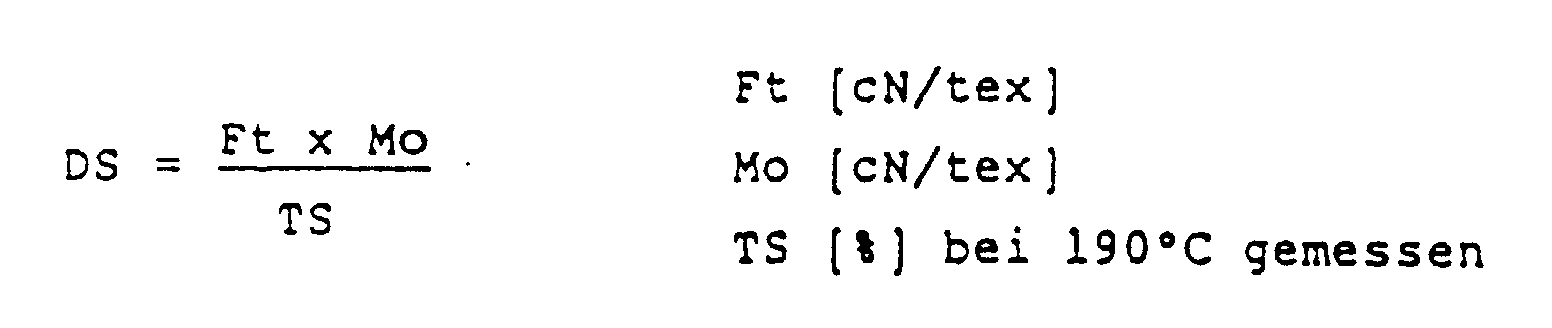
- Es wurde nun gefunden, dass die Dimensionsstabilität eines Reifens durch eine Kennzahl ausgedrückt werden kann, wenn die wesentlichen Parameter wie Bruchdehnung bzw. Festigkeit (Ft), Anfangsmodul (Mo) und Thermoschrumpf (TS) in bestimmten Grenzen gehalten werden. Zur Bewertung eines dimensionsstabilen Garnes mit niedrigem Schrumpf und hohem Anfangsmodul (LSHM) wird folgende Kennzahl vorgeschlagen:
- Es ist auf mechanischithermischem Weg bisher nicht gelungen, bei einer gegebenen Bezugsdehnung bzw. Festigkeit (Ft) und einem hohen Anfangsmodul, einen niedrigen Schrumpf zu erzielen.
- Aufgabe der Erfindung ist es, ein Garn mit einem hohen Anfangsmodul und einem niedrigen Schrumpf, insbesondere mit einer hohen Dimensionsstabilität (DS) zur Verfügung zu stellen.
- Die Aufgabe wird erfindungsgemäss nach dem Kennzeichen von Anspruch 1 gelöst. Zur Erniedrigung des Thermoschrumpfes werden während der Polyesterherstellung ein oder mehrere difunktionelle Comonomere mit der allgemeinen Formel:

- Die Herstellung des Copolyesters kann in üblicher Weise entweder durch Direktkondensation von Ethylenglykol und Terephthalsäure oder durch Umesterung von Dimethylterephthalat mit Ethylenglykol und anschliessender Polykondensation des zunächst gebildeten Diglykolterephthalats erfolgen. Das Comonomer wird zusammen mit den Monomeren vor der Umesterung resp. Veresterungsphase oder vor der Polykondensationsphase dem Gemisch zugegeben.
- Als besonders geeignet zur Erniedrigung des Thermoschrumpfes und zur gleichzeitigen Erhöhung der Dimensionsstabilität DS haben sich difunktionelle, konformationell fixierte Comonomere bewährt.
- Unter konformationell fixiert sollen Atomgerüste verstanden werden, deren Anordnung oder Bindungsarten geeignet sind, die relative Position obengenannter Funktionen zueinander innerhalb bestimmter Grenzen konstant zu halten.
- Diese difunktionelle Verbindungen müssen allerdings in Konzentrationen von 1 bis 10 Gew.-%, bezogen auf den Polyester, eingesetzt werden.
- Auch Comonomere von aromatischen Diolen sind geeignet, wie Hydrochinon, 2-Chlorhydrochinon, 2,5-Dichlorhydrochinon, 2,3,5-Trichlorhydrochinon, 2-Methylhydrochinon, 2,3-Dimethylhydrochinon, 2,5-Dimethylhydrochinon, 2,3,5-Trimethylhydrochinon. 2,3,5,6-Tetramethylhydrochinon, 4,4'-Dihydroxybiphenyl, 2,6-Naphthalindiol, 1,5-Naphthalindiol oder deren Derivate wie Hydrochinondiacetat. 2-Chlorhydrochinondiacetat, 2,3,5-Trichlorhydrochinondiacetat, 2-Methylhydrochinondiacetat, 2,5-Dimethoxyhydrochinondiacetat, 2,3,5-Trimethylhydrochinondiacetat, 4,4'-Diacetoxybiphenyl, 2,6-Diacetoxynaphthalin, 1,5-Diacetoxynaphthalin.
- Auch aromatische Hydroxycarbonsäuren wie 4-Hydroxybenzoesäure, 6-Hydroxy-2-Naphthoesäure, 5-Hydroxy-1-Naphthoesäure, insbesondere Acetylverbindungen und Alkylester wie 4-Hydroxybenzoesäuremethylester, 6-Hydroxy-2-Naphthoesäuremethylester, 4-Acetoxybenzoesäure können erfindungsgemäss eingesetzt werden.
- Von den difunktionellen starren und aromatischen Comonomeren haben sich Hydrochinondiacetat oder 4-Acetoxybenzoesäuremethylester am besten bewährt.
- Das nach dem erfindungsgemässen Verfahren hergestellte Polyestergarn, ist durch eine Kennzahl DS von ≧31135 gekennzeichnet. Voraussetzung ist, dass sich Ft in den Grenzen von 50 cN/tex und 80 cN/tex, vorzugsweise von 60 cN/tex bis 80 cN/tex bewegt. Gleichzeitig wird ein Young's Modul von 1000 cN/tex bis 1400 cN/tex, vorzugsweise 1200 cN/tex bis 1300 cN/tex stipuliert sowie ein Thermoschrumpf TS von 1 bis 3 %.
- Das Verfahren soll anhand von Beispielen näher erläutert werden.
- Unter Polyester ist ein Polymer aus wenigstens 85 Gew.-% Terephthalat- und Ethylenglykoleinheiten zu verstehen. Zur Herstellung des Copolyesters bringt man in einen Autoklaven 6,1 kg Ethylenglykol und 10 kg Dimethylterephthalat. Als Umesterungskatalysator werden 4 g kristallisiertes Manganacetat zugegeben. Die Mischung wird während 2,5 Stunden auf 230°C erhitzt, wobei das freiwerdende Methanol und der Glykolüberschuss unter Normaldruck abdestilliert wird. Bei 230°C gibt man nacheinander die folgenden Substanzen zu: 3 g phosphorige Säure und 3,5 g Antimontrioxid. Beim Aufheizen bis 280°C wird der Druck bis unter 0.5 mbar gesenkt. Das erfindungsgemässe Comonomer wird direkt in die Polymerschmelze vor der Polykondensation zugegeben. Je nach Comonomertyp wird nach 3,5 bis 5 Stunden durch Einleiten von Stickstoff das Vakuum gebrochen, die Polymerschmelze aus dem Autoklaven beispielsweise in Kabelform ausgetragen, gekühlt und das erstarrte Polymer geschnitten. Die Grenzviskosität, gemessen bei 25°C in einem Gemisch von Phenol/Tetrachlorethan 1:1 (gemäss H. Frind, Faserforschung (1954), Seite 296) beträgt ca. 0,67 dl/g. Das Granulat wird dann in einem Taumeltrockner unter einem Vakuum von 0,5 mbar zuerst 2 Stunden bei 150°C getrocknet, dann während einigen Stunden bei 235°C auf eine IV. welche zwischen 0,80 und 1,00 liegt, nachkondensiert und trocken gelagert. Die Nachkondensationszeit ist vom Comonomertyp und vom erreichbaren Vakuum abhängig und beträgt bis zu 30 Stunden.
- Zur Verspinnung wird das trockene Granulat auf einer bekannten Spinnmaschine zur Verarbeitung von hochviskosen Polyestern und Verstreckung von hochfesten multifilen Garnen verarbeitet. Der bei einer Temperatur von etwa 285 bis 310°C aufgeschmolzene Polyester wird aus der Spinndüse mit z.B. 192 Endlosfäden in bekannter Weise gepresst, regelmässig gekühlt, konvergiert, mit einer Präparation versehen und aufgewickelt oder direkt verstreckt.
- Das unverstreckte Garn wird mehrmals auf heissen Aggregaten in mehreren Stufen verstreckt und aufgespult. Die Spinnung und besonders die Verstreckung kann, bei verschiedenen Geschwindigkeiten resp. integriert oder im Splitverfahren erfolgen. Die Wärmeübertragung bei der Verstreckung erfolgt via Bügeleisen, heissen Walzen oder Oefen, wo der Faden kristallisiert orientiert und fixiert wird. Die Längsspannung, unter der das Fadenmaterial gehalten wird, genügt, um Schrumpfen während jeder Stufe der Wärmebehandlung zu verhindern und eine mehrmalige Verstreckung zu verursachen. Während dieses Prozesses wird dem Fadenmaterial eine Bruchfestigkeit von wenigstens 65 cN/tex verliehen und die Bruchdehnung, gemessen bei 25°C am konditionierten Faden bei einer Dehnungsgeschwindigkeit von 2.7 % D/s beträgt 8 bis 15 %, vorzugsweise 9 bis 12 %.
- Beim erfindungsgemässen Copolyester liegt der Thermoschrumpf (TS) bei 1 bis 3 % (bei 190°C gemessen). Die Schrumpfwerte wurden mit Hilfe eines thermomechanischen Analysators (Thermofilgerät von TEXTECHNO/Mönchengladbach) bestimmt. Dabei wird der Faden zuerst mit einer Vorspannung von 0,4 cN/dtex während 1 Minute bei 235°C vorbehandelt und anschliessend der Schrumpf des abgekühlten Fadens bei einer Aufheizgeschwindigkeit von 20 K/min verfolgt. Die Einspannlänge beträgt 10 cm und der Schrumpfwert wird bei der erwünschten Temperatur z.B. 190°C aus der Kurve ermittelt.
- Der Modul wird aus der Steilheit der Kraft-Dehnungskurve im Anfangsbereich wie folgt ermittelt: Mit einem Kraftdehnungsmessgerät (Firma ZWICK Typ 1474) wird bei einer Einspannlänge von 500 mm das Filament mit einer Geschwindigkeit von 2,5 cm/min gedehnt und dabei die Kraft registriert bis diese 2 cN beträgt. In diesem Bereich verläuft bei den erfindungsgemässen Filamenten die Kraftdehnungsfunktion (abgesehen von einem sehr kleinen Anlaufstück) sehr linear. Man legt nun an die Kurve eine Tangente an und kann aus der Steilheit die auf 100 % Dehnung extrapolierte Kraft berechnen. Dieser Kraftwert dividiert durch den Titer des Filamentbündels wird als Anfangsmodul [cN/dtex] respektive [cN/tex] genommen.
- Die Erfindung soll anhand von Beispielen näher erläutert werden, deren Ergebnisse in der Tabelle zusammengefasst sind.
- Als Comonomer wurden 300 g Hydrochinondiacetat (3 Gew.-% bezogen auf den Polyester) gemeinsam mit den anderen beiden Edukten Ethylenglykol und Dimethylterephthalat eingesetzt. Die übrigen Bedingungen entsprachen dem beschriebenen allgemeinen Vorgehen. Nach 2 Stunden Umesterungsdauer hatten sich 6,3 l Methanol entwickelt und nach weiteren 30 Minuten noch 1,1 l Glykol. Die folgende Polykondensation dauerte 4 Stunden 50 Minuten, wobei der Copolyester eine IV von 0,70 dl/g und einen Schmelzpunkt von 254°C aufwies. Nach einer Postkondensation von 28 Stunden bei 235°C wurde eine IV von 0,90 dl/g erreicht.
- Einige Eigenschaften der resultierenden Garne sind in Tabelle 1 dargelegt, wobei ein Modellfaden mit 14 Fibrillen hergestellt wurde.
- Als Comonomer wurden 300 g 4-Acetoxybenzoesäure in gleicher Weise wie in Beispiel 1 eingesetzt. Nach 2 Stunden resultierten 3,7 l Methanol und nach weiteren 30 Minuten ebenfalls 1,1 l Gly ol. Nach 4 Stunden 30 Minuten erreichte die IV 0,65 dl/g und der Schmelzpunkt betrug 248°C. Nach einer Nachkondensation von ebenfalls 28 Stunden erreichte man eine IV von 0,80 dl/g. Die Tabelle zeigt die Garneigenschaften.
- Als Comonomer wurden 100 g 2-Buten-1,4-diol in gleicher Weise wie in Beispiel 1 eingesetzt. Nach 2,5 Stunden wurden 3,7 l Methanol und nach weiteren 30 Minuten noch 1,5 l Glykol freigesetzt. Die Polykondensation dauerte 4 Stunden und man erreichte eine IV von 0,68 dl/g bzw. einen Schmelzpunkt von 253°C. Nach einer Nachkondensation von 28 Stunden betrug die IV 0,97 dl/g.
- Das Vorgehen entspricht demjenigen von Beispiel 1 bis 3 ohne jedoch ein Comonomer einzusetzen. Nach 2 Stunden entwickelten sich 3,4 l Methanol bzw. 1 l Glycol nach weiteren 30 Minuten. Die Polykondensation dauerte 3 Stunden 50 Minuten. Das Polymer wies eine IV von 0,70 dl/g und einen Schmelzpunkt von 255°C auf. Nach einer Nachkondensation von 25 Stunden betrug die IV 0,99 dl/g. Die Eigenschaften der Garne sind in der Tabelle 1 als Beispiel 4 dargelegt.

- Die Messergebnisse der Beispiele sind in den Kurven der einzigen Figur zusammengestellt. Darin sind als Ordinate die Dimensionsstabilität mit der Dimension cN2/tex2 und als Abszisse die Spinngeschwindigkeiten in m/min angegeben.
- Die beste Dimensionsstabilität von 48280 cN2/tex2 zeigt Beispiel 2 bei einem Thermoschrumpf von 1,75 % bei einer Spinngeschwindigkeit von 3000 m/min.
- Die nach dem erfindungsgemässen Verfahren hergestellte Garne sind in bevorzugter Weise als Garne mit niedrigem Schrumpf und hohem Young's Modul (LSHM) zur Herstellung von Reifenkordgeweben und andere technische Anwendungen wie für Treibriemen und Sicherheitsgurten geeignet.
Claims (7)
- Chemisch modifizientes Polyestergarn gekennzeichnet durch eine Dimensionsstabilität DS ≧ 31135 cN2/tex2, wobei gleichzeitig die Festigkeit Ft von 50 - 80 cN/tex, der Anfangsmodul 1'000 bis 1'400 cN/tex und der Thermoschrumpf bei 190°C 1,0 bis 3.0 % und die intrinsische Viskosität 0.75 bis 0.85 dl/g beträgt.
- Verfahren zur Herstellung von dimensionsstabilen, schrumpfarmen, chemisch modifizierten technischen Polyestergarnen durch Schmelzspinnen bei Geschwindigkeiten von 3000 bis 4000 m/min, unter Verwendung eines Copolymerisates, das wenigstens 85 Gew.% Polyethylenterephthalat Einheiten und Comonomere enthält, mit einer intrinsischen Viskosität von 0,75 bis 0,85 dl/g und einem Gesamttiter von wenigstens 500 dtex, dadurch gekennzeichnet, dass, während der Polyesterherstellung 1 bis 10 Gew.%, bezogen auf den Polyester, ein oder mehrere difunktionelle und Konformationell fixierte Comonmere mit der allgemeinen Formel:

- Verfahren nach Anspruch 2, dadurch gekennzeichnet, dass als Comonomere ungesättigte aliphatische Diole oder deren Derivate oder ungesättigte aliphatische Hydroxycarbonsäuren oder deren Derivate verwendet werden.
- Verfahren nach dem Anspruch 2, dadurch gekennzeichnet, dass als Comonomere aromatische Diole oder deren Derivate und/oder aromatische Hydroxycarbonsäuren oder deren Derivate verwendet werden.
- Verfahren nach Anspruch 4, dadurch gekennzeichnet, dass das ungesättigte aliphatische Diol 2-Buten-1,4-diol ist.
- Verfahren nach Anspruch 2, dadurch gekennzeichnet, dass die Derivate Acetylverbindungen und/oder Alkylester sind.
- Verfahren nach Anspruch 5, dadurch gekennzeichnet, dass die Acetylverbindung Hydrochinondiacetat oder 4-Acetoxybenzoesäure-methylester ist.
Priority Applications (1)
| Application Number | Priority Date | Filing Date | Title |
|---|---|---|---|
| AT86903197T ATE79911T1 (de) | 1985-06-21 | 1986-06-19 | Polyestergarn und verfahren zu dessen herstellung. |
Applications Claiming Priority (4)
| Application Number | Priority Date | Filing Date | Title |
|---|---|---|---|
| CH263685 | 1985-06-21 | ||
| CH2330/86 | 1986-06-10 | ||
| CH233086 | 1986-06-10 | ||
| PCT/CH1986/000090 WO1986007616A1 (fr) | 1985-06-21 | 1986-06-19 | Procede pour la preparation de fils en polyester modifie et fil en polyester obtenu par ce procede |
Publications (3)
| Publication Number | Publication Date |
|---|---|
| EP0225347A1 EP0225347A1 (de) | 1987-06-16 |
| EP0225347B1 EP0225347B1 (de) | 1992-08-26 |
| EP0225347B2 true EP0225347B2 (de) | 1997-08-13 |
Family
ID=25690171
Family Applications (1)
| Application Number | Title | Priority Date | Filing Date |
|---|---|---|---|
| EP86903197A Expired - Lifetime EP0225347B2 (de) | 1985-06-21 | 1986-06-19 | Polyestergarn und verfahren zu dessen herstellung |
Country Status (5)
| Country | Link |
|---|---|
| US (1) | US5045260A (de) |
| EP (1) | EP0225347B2 (de) |
| AT (1) | ATE79911T1 (de) |
| DE (1) | DE3686560D1 (de) |
| WO (1) | WO1986007616A1 (de) |
Families Citing this family (5)
| Publication number | Priority date | Publication date | Assignee | Title |
|---|---|---|---|---|
| US5547755A (en) * | 1988-11-24 | 1996-08-20 | Rhone-Poulenc Viscosuisse Sa | Pre-adherized polyester filament yarn for tire cord |
| US5576105A (en) * | 1992-09-14 | 1996-11-19 | Rhone - Poulenc Viscosuisse S.A. | Tire core made from an improved polyester filament yarn |
| US5593629A (en) * | 1995-02-22 | 1997-01-14 | Wellman, Inc. | Method for increased productivity of industrial fiber |
| KR101068030B1 (ko) * | 2011-06-03 | 2011-09-28 | 주식회사 지오솔테크 | 내가수분해성 및 생분해성 지방족/방향족 코폴리에스테르 수지 조성물 |
| CN108130609B (zh) * | 2017-12-14 | 2020-02-21 | 江苏恒力化纤股份有限公司 | 一种低收缩型聚酯工业丝及其制备方法 |
Family Cites Families (11)
| Publication number | Priority date | Publication date | Assignee | Title |
|---|---|---|---|---|
| DE1065608B (de) * | 1957-03-23 | 1959-09-17 | Farbwerke Hoechst Aktiengesellschaft vormals Meister Lucius Sv Bruning, Frankfurt'M | Verfahren zur Herstellung von hochmolekularem PoIyathylenglykolterephthalsaureester |
| NL275321A (de) * | 1961-02-27 | |||
| FR1603030A (de) * | 1968-06-04 | 1971-03-15 | ||
| NL6812442A (de) * | 1968-08-31 | 1970-03-03 | ||
| DE2023526A1 (de) * | 1970-05-14 | 1971-11-25 | Farbwerke Hoechst AG, vorm. Meister Lucius & Brüning, 6000 Frankfurt | Verfahren zur Herstellung von schrumpfarmen Polyesterfäden |
| US3991013A (en) * | 1974-05-10 | 1976-11-09 | E. I. Du Pont De Nemours And Company | Copolyesters of derivatives of hydroquinone |
| US4070432A (en) * | 1975-02-13 | 1978-01-24 | Allied Chemical Corporation | Production of low shrink polyester fiber |
| US4092299A (en) * | 1976-06-23 | 1978-05-30 | Monsanto Company | High draw ratio polyester feed yarn and its draw texturing |
| US4113704A (en) * | 1976-06-24 | 1978-09-12 | Monsanto Company | Polyester filament-forming polymer and its method of production |
| JPS5945202A (ja) * | 1982-09-03 | 1984-03-14 | Toyo Tire & Rubber Co Ltd | 均一性の優れた空気入りタイヤ |
| JPH0641513B2 (ja) * | 1984-11-20 | 1994-06-01 | 三菱レイヨン株式会社 | ポリエステルの製造法 |
-
1986
- 1986-06-19 DE DE8686903197T patent/DE3686560D1/de not_active Expired - Lifetime
- 1986-06-19 EP EP86903197A patent/EP0225347B2/de not_active Expired - Lifetime
- 1986-06-19 WO PCT/CH1986/000090 patent/WO1986007616A1/de not_active Ceased
- 1986-06-19 AT AT86903197T patent/ATE79911T1/de not_active IP Right Cessation
-
1990
- 1990-04-12 US US07/508,907 patent/US5045260A/en not_active Expired - Fee Related
Also Published As
| Publication number | Publication date |
|---|---|
| US5045260A (en) | 1991-09-03 |
| ATE79911T1 (de) | 1992-09-15 |
| EP0225347B1 (de) | 1992-08-26 |
| WO1986007616A1 (fr) | 1986-12-31 |
| EP0225347A1 (de) | 1987-06-16 |
| DE3686560D1 (de) | 1992-10-01 |
Similar Documents
| Publication | Publication Date | Title |
|---|---|---|
| EP0530860B1 (de) | Zweikomponenten-Schlingennähgarn und Verfahren zu seiner Herstellung | |
| DE1928436B2 (de) | Pillingfreie orientierte fasern auf der basis von terephthalatpolyestern | |
| DE68925445T2 (de) | Thermoplastische Copolyätherester-Elastomere | |
| EP0985752B1 (de) | Copolyesterfaser | |
| DE2023526A1 (de) | Verfahren zur Herstellung von schrumpfarmen Polyesterfäden | |
| DE2458373B2 (de) | Verfahren zur Herstellung von Polyesterfäden mit guter Anfärbbarkeit | |
| AT399350B (de) | Verfahren zur herstellung von pet-fäden mit verbesserter produktivität | |
| DE69028693T2 (de) | Kautschuk verstärkende polyesterfaser und verfahren zu ihrer herstellung | |
| DE69213474T2 (de) | Polyestergarne mit hohem modul fuer reifenkorden und verbundmaterialien | |
| EP0225347B1 (de) | Polyestergarn und verfahren zu dessen herstellung | |
| DE60220692T2 (de) | Pellet aus polytrimethylenterephthalat und herstellungsverfahren dafür | |
| DE60122737T2 (de) | Polyesterfaser | |
| DE3782798T2 (de) | Kraeuselung von polyestergarnen. | |
| EP0630995B1 (de) | Multifilament-Garn aus Polyäthylennaphthalat und Verfahren zu seiner Herstellung | |
| EP0991689B1 (de) | Fadenbildende kettenverzweigte polyester und copolyester | |
| DE2920641C2 (de) | ||
| DE19519898B4 (de) | Verfahren zur Verbesserung der Streckfähigkeit von Polyester | |
| DE1966884C3 (de) | Verfahren zur Herstellung von faserbildenden aromatischen Polyestern | |
| EP0823500B1 (de) | POY-Polyesterfaser für Strecktexturierung und Verfahren zu deren Herstellung | |
| WO1993022367A1 (de) | Verfahren zur herstellung eines polyesters sowie dessen verwendung | |
| US5322921A (en) | Polyester yarn | |
| DE10201834B4 (de) | Herstellung dimensionsstabiler Polyesterfäden | |
| DE19956730B4 (de) | Verfahren zur Herstellung von Polyesterfasern mit hervorragendem Wasserabsorptionsvermögen | |
| KR100234556B1 (ko) | 고강도 생분해성 지방족 폴리에스테르 섬유의 제조방법 | |
| DE68902927T2 (de) | Verfahren fuer dimensionell stabiles polyestergarn. |
Legal Events
| Date | Code | Title | Description |
|---|---|---|---|
| PUAI | Public reference made under article 153(3) epc to a published international application that has entered the european phase |
Free format text: ORIGINAL CODE: 0009012 |
|
| AK | Designated contracting states |
Kind code of ref document: A1 Designated state(s): AT BE CH DE FR GB LI LU NL |
|
| 17P | Request for examination filed |
Effective date: 19870620 |
|
| 17Q | First examination report despatched |
Effective date: 19890323 |
|
| RAP1 | Party data changed (applicant data changed or rights of an application transferred) |
Owner name: RHONE-POULENC VISCOSUISSE SA |
|
| GRAA | (expected) grant |
Free format text: ORIGINAL CODE: 0009210 |
|
| AK | Designated contracting states |
Kind code of ref document: B1 Designated state(s): AT BE CH DE FR GB LI LU NL |
|
| REF | Corresponds to: |
Ref document number: 79911 Country of ref document: AT Date of ref document: 19920915 Kind code of ref document: T |
|
| GBT | Gb: translation of ep patent filed (gb section 77(6)(a)/1977) | ||
| REF | Corresponds to: |
Ref document number: 3686560 Country of ref document: DE Date of ref document: 19921001 |
|
| ET | Fr: translation filed | ||
| PLBI | Opposition filed |
Free format text: ORIGINAL CODE: 0009260 |
|
| 26 | Opposition filed |
Opponent name: AKZO FASER AKTIENGESELLSCHAFT Effective date: 19930525 |
|
| NLR1 | Nl: opposition has been filed with the epo |
Opponent name: AKZO FASER AG. |
|
| EPTA | Lu: last paid annual fee | ||
| PLAB | Opposition data, opponent's data or that of the opponent's representative modified |
Free format text: ORIGINAL CODE: 0009299OPPO |
|
| R26 | Opposition filed (corrected) |
Opponent name: AKZO NOBEL FASER AG Effective date: 19930525 |
|
| PGFP | Annual fee paid to national office [announced via postgrant information from national office to epo] |
Ref country code: LU Payment date: 19950601 Year of fee payment: 10 |
|
| PGFP | Annual fee paid to national office [announced via postgrant information from national office to epo] |
Ref country code: BE Payment date: 19950608 Year of fee payment: 10 |
|
| PGFP | Annual fee paid to national office [announced via postgrant information from national office to epo] |
Ref country code: AT Payment date: 19950612 Year of fee payment: 10 |
|
| RAP2 | Party data changed (patent owner data changed or rights of a patent transferred) |
Owner name: RHONE-POULENC VISCOSUISSE SA |
|
| NLT2 | Nl: modifications (of names), taken from the european patent patent bulletin |
Owner name: RHONE-POULENC VISCOSUISSE SA |
|
| PG25 | Lapsed in a contracting state [announced via postgrant information from national office to epo] |
Ref country code: LU Free format text: LAPSE BECAUSE OF NON-PAYMENT OF DUE FEES Effective date: 19960619 Ref country code: AT Effective date: 19960619 |
|
| PG25 | Lapsed in a contracting state [announced via postgrant information from national office to epo] |
Ref country code: BE Effective date: 19960630 |
|
| PLAW | Interlocutory decision in opposition |
Free format text: ORIGINAL CODE: EPIDOS IDOP |
|
| BERE | Be: lapsed |
Owner name: S.A. RHONE-POULENC VISCOSUISSE Effective date: 19960630 |
|
| PLAW | Interlocutory decision in opposition |
Free format text: ORIGINAL CODE: EPIDOS IDOP |
|
| PUAH | Patent maintained in amended form |
Free format text: ORIGINAL CODE: 0009272 |
|
| STAA | Information on the status of an ep patent application or granted ep patent |
Free format text: STATUS: PATENT MAINTAINED AS AMENDED |
|
| 27A | Patent maintained in amended form |
Effective date: 19970813 |
|
| AK | Designated contracting states |
Kind code of ref document: B2 Designated state(s): AT BE CH DE FR GB LI LU NL |
|
| REG | Reference to a national code |
Ref country code: CH Ref legal event code: AEN Free format text: AUFRECHTERHALTUNG DES PATENTES IN GEAENDERTER FORM |
|
| NLR2 | Nl: decision of opposition | ||
| GBTA | Gb: translation of amended ep patent filed (gb section 77(6)(b)/1977) | ||
| NLR3 | Nl: receipt of modified translations in the netherlands language after an opposition procedure | ||
| EN | Fr: translation not filed | ||
| ET3 | Fr: translation filed ** decision concerning opposition | ||
| REG | Reference to a national code |
Ref country code: FR Ref legal event code: RN Ref country code: FR Ref legal event code: FC |
|
| PGFP | Annual fee paid to national office [announced via postgrant information from national office to epo] |
Ref country code: GB Payment date: 19980526 Year of fee payment: 13 |
|
| PGFP | Annual fee paid to national office [announced via postgrant information from national office to epo] |
Ref country code: FR Payment date: 19980622 Year of fee payment: 13 |
|
| PGFP | Annual fee paid to national office [announced via postgrant information from national office to epo] |
Ref country code: NL Payment date: 19980630 Year of fee payment: 13 |
|
| PGFP | Annual fee paid to national office [announced via postgrant information from national office to epo] |
Ref country code: DE Payment date: 19980724 Year of fee payment: 13 |
|
| PGFP | Annual fee paid to national office [announced via postgrant information from national office to epo] |
Ref country code: CH Payment date: 19980909 Year of fee payment: 13 |
|
| REG | Reference to a national code |
Ref country code: CH Ref legal event code: PUE Owner name: RHONE-POULENC VISCOSUISSE SA TRANSFER- RHODIA FILT |
|
| PG25 | Lapsed in a contracting state [announced via postgrant information from national office to epo] |
Ref country code: GB Free format text: LAPSE BECAUSE OF NON-PAYMENT OF DUE FEES Effective date: 19990619 |
|
| PG25 | Lapsed in a contracting state [announced via postgrant information from national office to epo] |
Ref country code: LI Free format text: LAPSE BECAUSE OF NON-PAYMENT OF DUE FEES Effective date: 19990630 Ref country code: FR Free format text: THE PATENT HAS BEEN ANNULLED BY A DECISION OF A NATIONAL AUTHORITY Effective date: 19990630 Ref country code: CH Free format text: LAPSE BECAUSE OF NON-PAYMENT OF DUE FEES Effective date: 19990630 |
|
| PG25 | Lapsed in a contracting state [announced via postgrant information from national office to epo] |
Ref country code: NL Free format text: LAPSE BECAUSE OF NON-PAYMENT OF DUE FEES Effective date: 20000101 |
|
| GBPC | Gb: european patent ceased through non-payment of renewal fee |
Effective date: 19990619 |
|
| REG | Reference to a national code |
Ref country code: CH Ref legal event code: PL |
|
| NLV4 | Nl: lapsed or anulled due to non-payment of the annual fee |
Effective date: 20000101 |
|
| PG25 | Lapsed in a contracting state [announced via postgrant information from national office to epo] |
Ref country code: DE Free format text: LAPSE BECAUSE OF NON-PAYMENT OF DUE FEES Effective date: 20000503 |
|
| REG | Reference to a national code |
Ref country code: FR Ref legal event code: ST |