EP0216005A2 - Machine à tamiser - Google Patents
Machine à tamiser Download PDFInfo
- Publication number
- EP0216005A2 EP0216005A2 EP86105946A EP86105946A EP0216005A2 EP 0216005 A2 EP0216005 A2 EP 0216005A2 EP 86105946 A EP86105946 A EP 86105946A EP 86105946 A EP86105946 A EP 86105946A EP 0216005 A2 EP0216005 A2 EP 0216005A2
- Authority
- EP
- European Patent Office
- Prior art keywords
- screening
- stack
- screen
- deck
- decks
- Prior art date
- Legal status (The legal status is an assumption and is not a legal conclusion. Google has not performed a legal analysis and makes no representation as to the accuracy of the status listed.)
- Granted
Links
Images
Classifications
-
- B—PERFORMING OPERATIONS; TRANSPORTING
- B07—SEPARATING SOLIDS FROM SOLIDS; SORTING
- B07B—SEPARATING SOLIDS FROM SOLIDS BY SIEVING, SCREENING, SIFTING OR BY USING GAS CURRENTS; SEPARATING BY OTHER DRY METHODS APPLICABLE TO BULK MATERIAL, e.g. LOOSE ARTICLES FIT TO BE HANDLED LIKE BULK MATERIAL
- B07B1/00—Sieving, screening, sifting, or sorting solid materials using networks, gratings, grids, or the like
- B07B1/46—Constructional details of screens in general; Cleaning or heating of screens
-
- B—PERFORMING OPERATIONS; TRANSPORTING
- B07—SEPARATING SOLIDS FROM SOLIDS; SORTING
- B07B—SEPARATING SOLIDS FROM SOLIDS BY SIEVING, SCREENING, SIFTING OR BY USING GAS CURRENTS; SEPARATING BY OTHER DRY METHODS APPLICABLE TO BULK MATERIAL, e.g. LOOSE ARTICLES FIT TO BE HANDLED LIKE BULK MATERIAL
- B07B2201/00—Details applicable to machines for screening using sieves or gratings
- B07B2201/04—Multiple deck screening devices comprising one or more superimposed screens
Definitions
- the invention relates to a screening machine system for a moor deck screening machine, designed according to the throwing screening principle, for solving different classification tasks, preferably with separating cuts in the range from 5.0 mm to 0.04 mm, in a closed machine unit.
- Screening machines are basically divided into throwing screens and plane screens according to their mode of operation.
- sieve excitation takes place in a component perpendicular to the sieve plane.
- Flat sieves vibrate in the sieve plane.
- H. Schubert contains more detailed information on this: Processing of solid mineral raw materials, Vol. I, VEB German Publishing House for Basic Industry, Leipzig, 3rd edition.
- Multi-deck screening machines designed as throwing screens are already known. They differ mainly in the type of sieve excitation described above, less in the number of sieve decks available. In general, one to at most four-deck screens are offered and used, so that up to 5 grain size classes can be obtained.
- Vibratory rotary screens are also known as multi-deck screening machines, in which the movement of plane and throwing screens is combined. A representative of this is the vibration separator from FBLehmann Maschinenfabrik GmbH, FRG. It performs three-dimensional sieving movements over 2 flywheels and a spring ring and generates up to 5 grain size classes in one machine.
- a similar machine type is the wobble screening machine, for example from Allgaier-Werke GmbH, FRG, usually with 3 screening decks and 4 grain size classes.
- the disadvantage of the vibratory rotary screens is their small available screen area of a maximum of 5 - 6 m 2 per screen deck. All the above-mentioned multi-deck screen machines have the common disadvantage that the screenings are given up via a central task and accordingly its grain size distribution density and the applied sieve mesh sizes are classified in such a way that the sieve surface occupancy of individual sieve decks is overloaded or underloaded and thus the sieve quality or the selectivity of the product is impaired.
- Patent specification DD 151 882 or EP 0 028 792 describes a multi-deck screening machine designed as a throwing sieve, which is distinguished by special design features such as steep sieve excitation between 45 ° to 85 ° (throwing angle) and a return element. This means that new construction elements have been introduced in the construction of screening machines, through which the material to be screened can be conveyed back to the feed side in a return direction opposite to the direction of transport, and which enables a greater degree of selectivity for a large number of grain size classes.
- each zone consists of at least one screen deok and one blind deck
- the sieve and blind decks are longitudinally divided and stackable and mutually sealed in their frame profile, and that these two decks contain feed-throughs for the material to be sieved on their inlet and outlet sides in order to thereby distribute the material to be sieved within the sieving machine and to remove it to ensure the material to be screened from the screening machine.
- different mesh sizes or sieve fabrics are placed on both sides of at least one sieve deck.
- the function of the return element is to convey the material to be screened against the direction of conveyance for a repeated repetition of the screening process to the inlet or feed side within the screening machine.
- the sieve stack consisting of sieve decks, blind decks and, depending on the selection of the sieve system, feedback elements, is clamped in a vibration frame by means of a steel cable or tensioning screws in a vibration-stable and dust-tight manner.
- the screen decks contain screening aids in the underbody.
- the feed material is pre-sorted into larger grain bobbin areas (grit groups) in the pre-screening stack in order to achieve an optimal sieving area occupation after the return in the post-screening stack according to the classification behavior of the screenings and their grain size distribution density.
- This screening machine system applies to the production of a large number of grain size classes.
- the same screening processes running in parallel are included the goal of producing fewer grain size classes with high throughput in a single multi-deck screening machine.
- the sieve machine system with a main sieve stack consisting of at least 5 sieve decks and a blind deck the feed material is guided over the individual sieve decks in such a way that for certain fractions which are enriched in the feed material, more sieve area is available.
- the longitudinal division of the screen decks proves to be very positive for adaptation to the grain size distribution density of the feed material, since different mesh sizes can be applied on the right and left sides.
- the task-related substances can be classified in a single machine unit with high selectivity with low space requirements, low investment and maintenance costs and low dedusting effort.
- the invention is explained in more detail below on the basis of 4 exemplary embodiments.
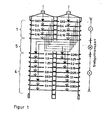
- FIG. 1 shows a cross section through the entire sieve stack of a sieve machine system developed on the basis of a multi-deck sieving machine according to DD 151 882 or EP 028 792, consisting of pre-sieve stack 1, return element 5 and post-sieve stack 4, the sieve stack being longitudinally divided in the middle.
- the entire stack of sieves is firmly clamped to a multi-deck sieving machine in a vibration-stable and dust-tight manner by means of steel cable bracing.
- the feed material is broken down into 5 grain groups:> 63 mm; 0.63 - 0.4 mm; 0.4-0.25mm; 0.25 - 0.16 mm and ⁇ 0.16 mm. This means that both halves of the sieve are covered with identical sieves.
- the grain groups are transported from the discharge side to the feed side opposite to the sieve excitation. It can be seen from FIG. 1 that 2 to 3 grit groups are combined with one another on the right and left half of the sieve.
- the mesh widths are 2 mm on the right half of the sieve; 1.6 mm; 1.25 mm; 1 mm; 0.8 mm; 0.63 mm; 0.5 mm and 0.4 mm and the mesh width 0.315 mm on the left half of the sieve; 0.25 mm; 0.2 mm; 0.16 mm; 0.125 mm; 0.1 mm; 0.08mm and 0.063mm.
- the black arrows indicate the transfer points of grain groups from the feedthroughs to the screen decks of the after-sieve stack 4.
- the screening machine system is basically the same as in the first, but the material to be screened is separated in the following order: pre-screening stacks, return elements, post-screening stacks.
- the grain size distribution density of the feed material can be matched very precisely to the partition surface assignment of the respective mesh sizes and relative free sieve surfaces.
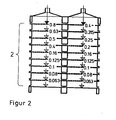
- FIG. 2 shows a screening machine system with a main screening stack 2 which, as in embodiment 1 is divided lengthways.
- the adaptation to the grain size distribution density of a feed is shown, which has high proportions below 0.1 mm.
- the mesh sizes 0.063 mm to 0.16 mm are placed on both sides to offer the screenings more screen area in the fine area.
- the fractions> 0.4 mm (right-hand side) and 0.4 - 0.16 mm (left-hand side) are fed back into the feed material. In this way, the feed material is enriched with certain grain sizes, but these are in the areas in which the screen area offered is not fully utilized.
- Screening aids in the form of rubber or wooden balls have proven to be effective after the installation of a sub-floor with coarse screen fabric to prevent the screen decks from going blind with fine mesh sizes.
- the sieve stack is firmly clamped to the vibration frame by means of clamping screws.
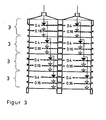
- FIG. 3 shows a screening machine system with several partial screen stacks 3.
- the feed material is broken down into four partial flows on each screen half by means of bushings in the front part of the screen decks.
- These partial flows are each fed to a partial sieve stack, which consists of two sieve decks with 0.4 mm and 0.16 mm mesh size and a blind deck.
- the sieve stack therefore consists of 8 partial sieve stacks with a total of 11 sieve and blind decks.
- This sieve stack is also firmly braced with the vibration frame to a multi-deck screening machine by means of steel cable tensioning, screening aids being provided in the underbody of the screening deck.
Landscapes
- Combined Means For Separation Of Solids (AREA)
- Threshing Machine Elements (AREA)
- Holo Graphy (AREA)
- Non-Silver Salt Photosensitive Materials And Non-Silver Salt Photography (AREA)
- Eye Examination Apparatus (AREA)
- Selective Calling Equipment (AREA)
- Breeding Of Plants And Reproduction By Means Of Culturing (AREA)
Priority Applications (1)
| Application Number | Priority Date | Filing Date | Title |
|---|---|---|---|
| AT86105946T ATE70743T1 (de) | 1985-09-23 | 1986-04-30 | Siebmaschinensystem. |
Applications Claiming Priority (2)
| Application Number | Priority Date | Filing Date | Title |
|---|---|---|---|
| DD85280888A DD256227A3 (de) | 1985-09-23 | 1985-09-23 | Siebmaschinensystem |
| DD280888 | 1985-09-23 |
Publications (3)
| Publication Number | Publication Date |
|---|---|
| EP0216005A2 true EP0216005A2 (fr) | 1987-04-01 |
| EP0216005A3 EP0216005A3 (en) | 1988-10-12 |
| EP0216005B1 EP0216005B1 (fr) | 1991-12-27 |
Family
ID=5571487
Family Applications (1)
| Application Number | Title | Priority Date | Filing Date |
|---|---|---|---|
| EP86105946A Expired - Lifetime EP0216005B1 (fr) | 1985-09-23 | 1986-04-30 | Machine à tamiser |
Country Status (5)
| Country | Link |
|---|---|
| EP (1) | EP0216005B1 (fr) |
| JP (1) | JPS6268575A (fr) |
| AT (1) | ATE70743T1 (fr) |
| DD (1) | DD256227A3 (fr) |
| DE (1) | DE3683110D1 (fr) |
Cited By (1)
| Publication number | Priority date | Publication date | Assignee | Title |
|---|---|---|---|---|
| US8844729B2 (en) | 2006-09-25 | 2014-09-30 | Basf Se | Method for grading water-absorbent polymer particles |
Families Citing this family (1)
| Publication number | Priority date | Publication date | Assignee | Title |
|---|---|---|---|---|
| GB2444996A (en) * | 2006-11-22 | 2008-06-25 | Toshiba Res Europ Ltd | Inter-Relay Interference Avoidance in a Wireless Communications Network |
Family Cites Families (2)
| Publication number | Priority date | Publication date | Assignee | Title |
|---|---|---|---|---|
| DD151882A1 (de) * | 1979-11-08 | 1981-11-11 | Dressler Ernst Heinrich | Mehrdecksiebmaschine |
| JPS61138574A (ja) * | 1984-12-11 | 1986-06-26 | 株式会社 サタケ | 竪型選別装置の螺旋搬送装置 |
-
1985
- 1985-09-23 DD DD85280888A patent/DD256227A3/de not_active IP Right Cessation
-
1986
- 1986-04-30 DE DE8686105946T patent/DE3683110D1/de not_active Expired - Lifetime
- 1986-04-30 EP EP86105946A patent/EP0216005B1/fr not_active Expired - Lifetime
- 1986-04-30 AT AT86105946T patent/ATE70743T1/de not_active IP Right Cessation
- 1986-09-22 JP JP61222238A patent/JPS6268575A/ja active Pending
Cited By (2)
| Publication number | Priority date | Publication date | Assignee | Title |
|---|---|---|---|---|
| US8844729B2 (en) | 2006-09-25 | 2014-09-30 | Basf Se | Method for grading water-absorbent polymer particles |
| EP2076338B2 (fr) † | 2006-09-25 | 2022-01-26 | Basf Se | Procédé destiné à classer des particules poylmères absorbant l'eau |
Also Published As
| Publication number | Publication date |
|---|---|
| EP0216005A3 (en) | 1988-10-12 |
| JPS6268575A (ja) | 1987-03-28 |
| EP0216005B1 (fr) | 1991-12-27 |
| DE3683110D1 (de) | 1992-02-06 |
| DD256227A3 (de) | 1988-05-04 |
| ATE70743T1 (de) | 1992-01-15 |
Similar Documents
| Publication | Publication Date | Title |
|---|---|---|
| EP0584302B1 (fr) | Dispositif pour tamis plan | |
| DE69418785T2 (de) | Sortiervorrichtung für Nichteisenmaterialien | |
| AT6073U1 (de) | Mehrdecksiebmaschine | |
| WO1998036854A1 (fr) | Monture pour blutoir horizontal et son procede de fabrication | |
| DE102009032689B3 (de) | Siebmaschine | |
| EP1480763B1 (fr) | Dispositif cribleur | |
| DE3741924C2 (de) | Vibrationssiebmaschine | |
| DE1196946B (de) | Siebmaschine | |
| EP0028792B1 (fr) | Crible à tamis multiples | |
| EP0216005B1 (fr) | Machine à tamiser | |
| DE2923662C2 (de) | Schwingsieb, insbesondere Kreisschwingsieb | |
| DE19517850C2 (de) | Siebmaschine zur Vorsortierung von Materialmischungen | |
| DE102020125280B3 (de) | Schwingsiebmaschine | |
| DE3043497C2 (de) | Schwingende Siebmaschine | |
| DE69119228T2 (de) | Verfahren und Vorrichtung zum Sieben von körnigen Materialien | |
| DE602004011125T2 (de) | Strukturelle anordnung für schwingeinrichtungen | |
| EP0824972B1 (fr) | Procédé de séparation d'un mélange de matières solides | |
| EP0992293B1 (fr) | Tamis, en particulier tamis à vacillement | |
| DE102006020215A1 (de) | Verfahren zum Fraktionieren und Bearbeiten einer Papierfasersuspension | |
| DE4012802A1 (de) | Verfahren zum betrieb eines mehretagensiebes | |
| DE971791C (de) | Vorrichtung zum Entwaessern von Faserstoffsuspensionen | |
| EP0482566B1 (fr) | Crible pour séparer des matériaux de poids différents | |
| DE19526841C1 (de) | Anordnung zum Trennen nach der Form | |
| DE8910068U1 (de) | Mehretagensieb | |
| DE2847153B2 (de) | Siebmaschine zur Absiebung von sich elektrostatisch aufladenden Kunststoffen, im besonderen vonSuspensions-Polyvinylchlorid |
Legal Events
| Date | Code | Title | Description |
|---|---|---|---|
| PUAI | Public reference made under article 153(3) epc to a published international application that has entered the european phase |
Free format text: ORIGINAL CODE: 0009012 |
|
| AK | Designated contracting states |
Kind code of ref document: A2 Designated state(s): AT BE CH DE GB LI SE |
|
| PUAL | Search report despatched |
Free format text: ORIGINAL CODE: 0009013 |
|
| AK | Designated contracting states |
Kind code of ref document: A3 Designated state(s): AT BE CH DE GB LI SE |
|
| 17P | Request for examination filed |
Effective date: 19890313 |
|
| 17Q | First examination report despatched |
Effective date: 19900216 |
|
| GRAA | (expected) grant |
Free format text: ORIGINAL CODE: 0009210 |
|
| AK | Designated contracting states |
Kind code of ref document: B1 Designated state(s): AT BE CH DE GB LI SE |
|
| REF | Corresponds to: |
Ref document number: 70743 Country of ref document: AT Date of ref document: 19920115 Kind code of ref document: T |
|
| REF | Corresponds to: |
Ref document number: 3683110 Country of ref document: DE Date of ref document: 19920206 |
|
| GBT | Gb: translation of ep patent filed (gb section 77(6)(a)/1977) | ||
| PLBE | No opposition filed within time limit |
Free format text: ORIGINAL CODE: 0009261 |
|
| STAA | Information on the status of an ep patent application or granted ep patent |
Free format text: STATUS: NO OPPOSITION FILED WITHIN TIME LIMIT |
|
| 26N | No opposition filed | ||
| PGFP | Annual fee paid to national office [announced via postgrant information from national office to epo] |
Ref country code: CH Payment date: 19930308 Year of fee payment: 8 |
|
| PGFP | Annual fee paid to national office [announced via postgrant information from national office to epo] |
Ref country code: SE Payment date: 19930309 Year of fee payment: 8 |
|
| PGFP | Annual fee paid to national office [announced via postgrant information from national office to epo] |
Ref country code: BE Payment date: 19930420 Year of fee payment: 8 |
|
| PGFP | Annual fee paid to national office [announced via postgrant information from national office to epo] |
Ref country code: GB Payment date: 19930422 Year of fee payment: 8 |
|
| PGFP | Annual fee paid to national office [announced via postgrant information from national office to epo] |
Ref country code: AT Payment date: 19930423 Year of fee payment: 8 |
|
| PGFP | Annual fee paid to national office [announced via postgrant information from national office to epo] |
Ref country code: DE Payment date: 19930629 Year of fee payment: 8 |
|
| PG25 | Lapsed in a contracting state [announced via postgrant information from national office to epo] |
Ref country code: LI Effective date: 19940430 Ref country code: GB Effective date: 19940430 Ref country code: CH Effective date: 19940430 Ref country code: BE Effective date: 19940430 Ref country code: AT Effective date: 19940430 |
|
| PG25 | Lapsed in a contracting state [announced via postgrant information from national office to epo] |
Ref country code: SE Effective date: 19940501 |
|
| BERE | Be: lapsed |
Owner name: AKADEMIE DER WISSENSCHAFTEN DER DDR Effective date: 19940430 |
|
| REG | Reference to a national code |
Ref country code: CH Ref legal event code: PL |
|
| PG25 | Lapsed in a contracting state [announced via postgrant information from national office to epo] |
Ref country code: DE Effective date: 19950103 |
|
| GBPC | Gb: european patent ceased through non-payment of renewal fee |
Effective date: 19940430 |
|
| EUG | Se: european patent has lapsed |
Ref document number: 86105946.7 Effective date: 19941210 |
|
| EUG | Se: european patent has lapsed |
Ref document number: 86105946.7 |