EP0211223B1 - Spherical grains of poly(alpha-amino acid)and production method thereof - Google Patents
Spherical grains of poly(alpha-amino acid)and production method thereof Download PDFInfo
- Publication number
- EP0211223B1 EP0211223B1 EP86108802A EP86108802A EP0211223B1 EP 0211223 B1 EP0211223 B1 EP 0211223B1 EP 86108802 A EP86108802 A EP 86108802A EP 86108802 A EP86108802 A EP 86108802A EP 0211223 B1 EP0211223 B1 EP 0211223B1
- Authority
- EP
- European Patent Office
- Prior art keywords
- poly
- spherical grains
- amino acid
- grains
- spherical
- Prior art date
- Legal status (The legal status is an assumption and is not a legal conclusion. Google has not performed a legal analysis and makes no representation as to the accuracy of the status listed.)
- Expired - Lifetime
Links
- -1 poly(alpha-amino acid) Polymers 0.000 title claims description 142
- 238000004519 manufacturing process Methods 0.000 title 1
- 230000002209 hydrophobic effect Effects 0.000 claims abstract description 34
- 238000000034 method Methods 0.000 claims abstract description 30
- 239000012736 aqueous medium Substances 0.000 claims abstract description 23
- 239000003960 organic solvent Substances 0.000 claims abstract description 23
- 239000000843 powder Substances 0.000 claims abstract description 14
- 239000006185 dispersion Substances 0.000 claims abstract description 13
- 239000002537 cosmetic Substances 0.000 claims abstract description 10
- 239000000945 filler Substances 0.000 claims abstract description 10
- 238000004587 chromatography analysis Methods 0.000 claims abstract description 5
- 238000001704 evaporation Methods 0.000 claims abstract description 3
- 239000002609 medium Substances 0.000 claims abstract description 3
- 239000011148 porous material Substances 0.000 claims description 18
- 239000000654 additive Substances 0.000 claims description 17
- XLYOFNOQVPJJNP-UHFFFAOYSA-N water Substances O XLYOFNOQVPJJNP-UHFFFAOYSA-N 0.000 claims description 17
- 230000000996 additive effect Effects 0.000 claims description 14
- 150000004676 glycans Chemical class 0.000 claims description 5
- 239000000463 material Substances 0.000 claims description 5
- 229920001282 polysaccharide Polymers 0.000 claims description 5
- 239000005017 polysaccharide Substances 0.000 claims description 5
- 238000009835 boiling Methods 0.000 claims description 4
- 239000004034 viscosity adjusting agent Substances 0.000 claims description 4
- 229920003169 water-soluble polymer Polymers 0.000 claims description 2
- 239000002253 acid Substances 0.000 abstract description 4
- 229920001308 poly(aminoacid) Polymers 0.000 abstract 1
- 239000000243 solution Substances 0.000 description 24
- 238000010521 absorption reaction Methods 0.000 description 18
- NNBZCPXTIHJBJL-UHFFFAOYSA-N decalin Chemical compound C1CCCC2CCCCC21 NNBZCPXTIHJBJL-UHFFFAOYSA-N 0.000 description 16
- HEDRZPFGACZZDS-UHFFFAOYSA-N Chloroform Chemical compound ClC(Cl)Cl HEDRZPFGACZZDS-UHFFFAOYSA-N 0.000 description 14
- KVNYFPKFSJIPBJ-UHFFFAOYSA-N 1,2-diethylbenzene Chemical compound CCC1=CC=CC=C1CC KVNYFPKFSJIPBJ-UHFFFAOYSA-N 0.000 description 12
- KBPLFHHGFOOTCA-UHFFFAOYSA-N 1-Octanol Chemical compound CCCCCCCCO KBPLFHHGFOOTCA-UHFFFAOYSA-N 0.000 description 10
- 229920002307 Dextran Polymers 0.000 description 9
- YMWUJEATGCHHMB-UHFFFAOYSA-N Dichloromethane Chemical compound ClCCl YMWUJEATGCHHMB-UHFFFAOYSA-N 0.000 description 9
- OKKJLVBELUTLKV-UHFFFAOYSA-N Methanol Chemical compound OC OKKJLVBELUTLKV-UHFFFAOYSA-N 0.000 description 9
- 108010050934 polyleucine Proteins 0.000 description 9
- PXXNTAGJWPJAGM-UHFFFAOYSA-N vertaline Natural products C1C2C=3C=C(OC)C(OC)=CC=3OC(C=C3)=CC=C3CCC(=O)OC1CC1N2CCCC1 PXXNTAGJWPJAGM-UHFFFAOYSA-N 0.000 description 8
- SCYULBFZEHDVBN-UHFFFAOYSA-N 1,1-Dichloroethane Chemical compound CC(Cl)Cl SCYULBFZEHDVBN-UHFFFAOYSA-N 0.000 description 7
- 239000004372 Polyvinyl alcohol Substances 0.000 description 7
- 229920002451 polyvinyl alcohol Polymers 0.000 description 7
- 235000019422 polyvinyl alcohol Nutrition 0.000 description 7
- YXFVVABEGXRONW-UHFFFAOYSA-N Toluene Chemical compound CC1=CC=CC=C1 YXFVVABEGXRONW-UHFFFAOYSA-N 0.000 description 6
- 239000007864 aqueous solution Substances 0.000 description 6
- 238000005227 gel permeation chromatography Methods 0.000 description 6
- WRIDQFICGBMAFQ-UHFFFAOYSA-N (E)-8-Octadecenoic acid Natural products CCCCCCCCCC=CCCCCCCC(O)=O WRIDQFICGBMAFQ-UHFFFAOYSA-N 0.000 description 5
- LQJBNNIYVWPHFW-UHFFFAOYSA-N 20:1omega9c fatty acid Natural products CCCCCCCCCCC=CCCCCCCCC(O)=O LQJBNNIYVWPHFW-UHFFFAOYSA-N 0.000 description 5
- QSBYPNXLFMSGKH-UHFFFAOYSA-N 9-Heptadecensaeure Natural products CCCCCCCC=CCCCCCCCC(O)=O QSBYPNXLFMSGKH-UHFFFAOYSA-N 0.000 description 5
- WHUUTDBJXJRKMK-VKHMYHEASA-N L-glutamic acid Chemical compound OC(=O)[C@@H](N)CCC(O)=O WHUUTDBJXJRKMK-VKHMYHEASA-N 0.000 description 5
- 239000005642 Oleic acid Substances 0.000 description 5
- ZQPPMHVWECSIRJ-UHFFFAOYSA-N Oleic acid Natural products CCCCCCCCC=CCCCCCCCC(O)=O ZQPPMHVWECSIRJ-UHFFFAOYSA-N 0.000 description 5
- 238000013019 agitation Methods 0.000 description 5
- 235000008206 alpha-amino acids Nutrition 0.000 description 5
- 229930195712 glutamate Natural products 0.000 description 5
- QXJSBBXBKPUZAA-UHFFFAOYSA-N isooleic acid Natural products CCCCCCCC=CCCCCCCCCC(O)=O QXJSBBXBKPUZAA-UHFFFAOYSA-N 0.000 description 5
- ZQPPMHVWECSIRJ-KTKRTIGZSA-N oleic acid Chemical compound CCCCCCCC\C=C/CCCCCCCC(O)=O ZQPPMHVWECSIRJ-KTKRTIGZSA-N 0.000 description 5
- RTZKZFJDLAIYFH-UHFFFAOYSA-N Diethyl ether Chemical compound CCOCC RTZKZFJDLAIYFH-UHFFFAOYSA-N 0.000 description 4
- XLYOFNOQVPJJNP-ZSJDYOACSA-N Heavy water Chemical compound [2H]O[2H] XLYOFNOQVPJJNP-ZSJDYOACSA-N 0.000 description 4
- 150000001371 alpha-amino acids Chemical class 0.000 description 4
- ZSIAUFGUXNUGDI-UHFFFAOYSA-N hexan-1-ol Chemical compound CCCCCCO ZSIAUFGUXNUGDI-UHFFFAOYSA-N 0.000 description 4
- 239000007788 liquid Substances 0.000 description 4
- 230000014759 maintenance of location Effects 0.000 description 4
- TVMXDCGIABBOFY-UHFFFAOYSA-N n-Octanol Natural products CCCCCCCC TVMXDCGIABBOFY-UHFFFAOYSA-N 0.000 description 4
- 238000006116 polymerization reaction Methods 0.000 description 4
- 238000000926 separation method Methods 0.000 description 4
- 239000000725 suspension Substances 0.000 description 4
- 125000000999 tert-butyl group Chemical group [H]C([H])([H])C(*)(C([H])([H])[H])C([H])([H])[H] 0.000 description 4
- UHOVQNZJYSORNB-UHFFFAOYSA-N Benzene Chemical compound C1=CC=CC=C1 UHOVQNZJYSORNB-UHFFFAOYSA-N 0.000 description 3
- LFQSCWFLJHTTHZ-UHFFFAOYSA-N Ethanol Chemical compound CCO LFQSCWFLJHTTHZ-UHFFFAOYSA-N 0.000 description 3
- CTQNGGLPUBDAKN-UHFFFAOYSA-N O-Xylene Chemical compound CC1=CC=CC=C1C CTQNGGLPUBDAKN-UHFFFAOYSA-N 0.000 description 3
- 108010020346 Polyglutamic Acid Proteins 0.000 description 3
- 229920005654 Sephadex Polymers 0.000 description 3
- 239000012507 Sephadex™ Substances 0.000 description 3
- ZMANZCXQSJIPKH-UHFFFAOYSA-N Triethylamine Chemical compound CCN(CC)CC ZMANZCXQSJIPKH-UHFFFAOYSA-N 0.000 description 3
- 238000007796 conventional method Methods 0.000 description 3
- 238000004132 cross linking Methods 0.000 description 3
- 239000012153 distilled water Substances 0.000 description 3
- 238000000635 electron micrograph Methods 0.000 description 3
- 150000002148 esters Chemical class 0.000 description 3
- 238000001914 filtration Methods 0.000 description 3
- ZGEYCCHDTIDZAE-UHFFFAOYSA-N glutamic acid 5-methyl ester Chemical compound COC(=O)CCC(N)C(O)=O ZGEYCCHDTIDZAE-UHFFFAOYSA-N 0.000 description 3
- 125000001165 hydrophobic group Chemical group 0.000 description 3
- 108700004370 poly-gamma-methylglutamate Proteins 0.000 description 3
- 229920002643 polyglutamic acid Polymers 0.000 description 3
- 229920000642 polymer Polymers 0.000 description 3
- 108010000222 polyserine Proteins 0.000 description 3
- 238000002360 preparation method Methods 0.000 description 3
- 238000012545 processing Methods 0.000 description 3
- 239000002994 raw material Substances 0.000 description 3
- CXWXQJXEFPUFDZ-UHFFFAOYSA-N tetralin Chemical compound C1=CC=C2CCCCC2=C1 CXWXQJXEFPUFDZ-UHFFFAOYSA-N 0.000 description 3
- OWEGMIWEEQEYGQ-UHFFFAOYSA-N 100676-05-9 Natural products OC1C(O)C(O)C(CO)OC1OCC1C(O)C(O)C(O)C(OC2C(OC(O)C(O)C2O)CO)O1 OWEGMIWEEQEYGQ-UHFFFAOYSA-N 0.000 description 2
- CSCPPACGZOOCGX-UHFFFAOYSA-N Acetone Chemical compound CC(C)=O CSCPPACGZOOCGX-UHFFFAOYSA-N 0.000 description 2
- 239000005995 Aluminium silicate Substances 0.000 description 2
- YNQLUTRBYVCPMQ-UHFFFAOYSA-N Ethylbenzene Chemical compound CCC1=CC=CC=C1 YNQLUTRBYVCPMQ-UHFFFAOYSA-N 0.000 description 2
- KFZMGEQAYNKOFK-UHFFFAOYSA-N Isopropanol Chemical compound CC(C)O KFZMGEQAYNKOFK-UHFFFAOYSA-N 0.000 description 2
- GUBGYTABKSRVRQ-PICCSMPSSA-N Maltose Natural products O[C@@H]1[C@@H](O)[C@H](O)[C@@H](CO)O[C@@H]1O[C@@H]1[C@@H](CO)OC(O)[C@H](O)[C@H]1O GUBGYTABKSRVRQ-PICCSMPSSA-N 0.000 description 2
- LRHPLDYGYMQRHN-UHFFFAOYSA-N N-Butanol Chemical compound CCCCO LRHPLDYGYMQRHN-UHFFFAOYSA-N 0.000 description 2
- UFWIBTONFRDIAS-UHFFFAOYSA-N Naphthalene Chemical compound C1=CC=CC2=CC=CC=C21 UFWIBTONFRDIAS-UHFFFAOYSA-N 0.000 description 2
- URLKBWYHVLBVBO-UHFFFAOYSA-N Para-Xylene Chemical group CC1=CC=C(C)C=C1 URLKBWYHVLBVBO-UHFFFAOYSA-N 0.000 description 2
- YGYAWVDWMABLBF-UHFFFAOYSA-N Phosgene Chemical compound ClC(Cl)=O YGYAWVDWMABLBF-UHFFFAOYSA-N 0.000 description 2
- 108010039918 Polylysine Proteins 0.000 description 2
- VYPSYNLAJGMNEJ-UHFFFAOYSA-N Silicium dioxide Chemical compound O=[Si]=O VYPSYNLAJGMNEJ-UHFFFAOYSA-N 0.000 description 2
- 238000000944 Soxhlet extraction Methods 0.000 description 2
- DKGAVHZHDRPRBM-UHFFFAOYSA-N Tert-Butanol Chemical compound CC(C)(C)O DKGAVHZHDRPRBM-UHFFFAOYSA-N 0.000 description 2
- WYURNTSHIVDZCO-UHFFFAOYSA-N Tetrahydrofuran Chemical compound C1CCOC1 WYURNTSHIVDZCO-UHFFFAOYSA-N 0.000 description 2
- 238000000862 absorption spectrum Methods 0.000 description 2
- 238000004220 aggregation Methods 0.000 description 2
- 230000002776 aggregation Effects 0.000 description 2
- 125000005907 alkyl ester group Chemical group 0.000 description 2
- 235000012211 aluminium silicate Nutrition 0.000 description 2
- RDOXTESZEPMUJZ-UHFFFAOYSA-N anisole Chemical compound COC1=CC=CC=C1 RDOXTESZEPMUJZ-UHFFFAOYSA-N 0.000 description 2
- BTANRVKWQNVYAZ-UHFFFAOYSA-N butan-2-ol Chemical compound CCC(C)O BTANRVKWQNVYAZ-UHFFFAOYSA-N 0.000 description 2
- 238000006243 chemical reaction Methods 0.000 description 2
- 239000013078 crystal Substances 0.000 description 2
- DOIRQSBPFJWKBE-UHFFFAOYSA-N dibutyl phthalate Chemical compound CCCCOC(=O)C1=CC=CC=C1C(=O)OCCCC DOIRQSBPFJWKBE-UHFFFAOYSA-N 0.000 description 2
- 230000007717 exclusion Effects 0.000 description 2
- 239000011521 glass Substances 0.000 description 2
- 238000011835 investigation Methods 0.000 description 2
- ZXEKIIBDNHEJCQ-UHFFFAOYSA-N isobutanol Chemical compound CC(C)CO ZXEKIIBDNHEJCQ-UHFFFAOYSA-N 0.000 description 2
- 229920000126 latex Polymers 0.000 description 2
- IVSZLXZYQVIEFR-UHFFFAOYSA-N m-xylene Chemical group CC1=CC=CC(C)=C1 IVSZLXZYQVIEFR-UHFFFAOYSA-N 0.000 description 2
- 239000011159 matrix material Substances 0.000 description 2
- 125000002496 methyl group Chemical group [H]C([H])([H])* 0.000 description 2
- 239000012046 mixed solvent Substances 0.000 description 2
- 230000003287 optical effect Effects 0.000 description 2
- 108010054442 polyalanine Proteins 0.000 description 2
- 229920000656 polylysine Polymers 0.000 description 2
- 108010087948 polymethionine Proteins 0.000 description 2
- 229920001184 polypeptide Polymers 0.000 description 2
- 108010033356 polyvaline Proteins 0.000 description 2
- 108090000765 processed proteins & peptides Proteins 0.000 description 2
- 102000004196 processed proteins & peptides Human genes 0.000 description 2
- 238000004366 reverse phase liquid chromatography Methods 0.000 description 2
- 239000007787 solid Substances 0.000 description 2
- 239000011800 void material Substances 0.000 description 2
- DURPTKYDGMDSBL-UHFFFAOYSA-N 1-butoxybutane Chemical compound CCCCOCCCC DURPTKYDGMDSBL-UHFFFAOYSA-N 0.000 description 1
- DKPFZGUDAPQIHT-UHFFFAOYSA-N Butyl acetate Natural products CCCCOC(C)=O DKPFZGUDAPQIHT-UHFFFAOYSA-N 0.000 description 1
- MQIUGAXCHLFZKX-UHFFFAOYSA-N Di-n-octyl phthalate Natural products CCCCCCCCOC(=O)C1=CC=CC=C1C(=O)OCCCCCCCC MQIUGAXCHLFZKX-UHFFFAOYSA-N 0.000 description 1
- 239000001828 Gelatine Substances 0.000 description 1
- CKLJMWTZIZZHCS-REOHCLBHSA-N L-aspartic acid Chemical compound OC(=O)[C@@H](N)CC(O)=O CKLJMWTZIZZHCS-REOHCLBHSA-N 0.000 description 1
- COLNVLDHVKWLRT-QMMMGPOBSA-N L-phenylalanine Chemical compound OC(=O)[C@@H](N)CC1=CC=CC=C1 COLNVLDHVKWLRT-QMMMGPOBSA-N 0.000 description 1
- OYHQOLUKZRVURQ-HZJYTTRNSA-N Linoleic acid Chemical compound CCCCC\C=C/C\C=C/CCCCCCCC(O)=O OYHQOLUKZRVURQ-HZJYTTRNSA-N 0.000 description 1
- FYYHWMGAXLPEAU-UHFFFAOYSA-N Magnesium Chemical compound [Mg] FYYHWMGAXLPEAU-UHFFFAOYSA-N 0.000 description 1
- 229920000805 Polyaspartic acid Polymers 0.000 description 1
- 239000004793 Polystyrene Substances 0.000 description 1
- 125000002777 acetyl group Chemical group [H]C([H])([H])C(*)=O 0.000 description 1
- 238000001042 affinity chromatography Methods 0.000 description 1
- 125000001931 aliphatic group Chemical group 0.000 description 1
- 150000001370 alpha-amino acid derivatives Chemical class 0.000 description 1
- PZZYQPZGQPZBDN-UHFFFAOYSA-N aluminium silicate Chemical compound O=[Al]O[Si](=O)O[Al]=O PZZYQPZGQPZBDN-UHFFFAOYSA-N 0.000 description 1
- 229910000323 aluminium silicate Inorganic materials 0.000 description 1
- 125000003710 aryl alkyl group Chemical group 0.000 description 1
- 235000003704 aspartic acid Nutrition 0.000 description 1
- 239000011324 bead Substances 0.000 description 1
- 125000001797 benzyl group Chemical group [H]C1=C([H])C([H])=C(C([H])=C1[H])C([H])([H])* 0.000 description 1
- 125000000051 benzyloxy group Chemical group [H]C1=C([H])C([H])=C(C([H])=C1[H])C([H])([H])O* 0.000 description 1
- OQFSQFPPLPISGP-UHFFFAOYSA-N beta-carboxyaspartic acid Natural products OC(=O)C(N)C(C(O)=O)C(O)=O OQFSQFPPLPISGP-UHFFFAOYSA-N 0.000 description 1
- BJQHLKABXJIVAM-UHFFFAOYSA-N bis(2-ethylhexyl) phthalate Chemical compound CCCCC(CC)COC(=O)C1=CC=CC=C1C(=O)OCC(CC)CCCC BJQHLKABXJIVAM-UHFFFAOYSA-N 0.000 description 1
- 125000002915 carbonyl group Chemical group [*:2]C([*:1])=O 0.000 description 1
- 238000005119 centrifugation Methods 0.000 description 1
- 150000001875 compounds Chemical class 0.000 description 1
- 230000001276 controlling effect Effects 0.000 description 1
- 230000007423 decrease Effects 0.000 description 1
- 230000003247 decreasing effect Effects 0.000 description 1
- 230000001419 dependent effect Effects 0.000 description 1
- 125000003438 dodecyl group Chemical group [H]C([H])([H])C([H])([H])C([H])([H])C([H])([H])C([H])([H])C([H])([H])C([H])([H])C([H])([H])C([H])([H])C([H])([H])C([H])([H])C([H])([H])* 0.000 description 1
- 239000003995 emulsifying agent Substances 0.000 description 1
- 125000004494 ethyl ester group Chemical group 0.000 description 1
- 125000001495 ethyl group Chemical group [H]C([H])([H])C([H])([H])* 0.000 description 1
- 229920000159 gelatin Polymers 0.000 description 1
- 235000019322 gelatine Nutrition 0.000 description 1
- 150000008282 halocarbons Chemical class 0.000 description 1
- FUZZWVXGSFPDMH-UHFFFAOYSA-N hexanoic acid Chemical compound CCCCCC(O)=O FUZZWVXGSFPDMH-UHFFFAOYSA-N 0.000 description 1
- 238000002329 infrared spectrum Methods 0.000 description 1
- 238000005342 ion exchange Methods 0.000 description 1
- 229960004592 isopropanol Drugs 0.000 description 1
- NLYAJNPCOHFWQQ-UHFFFAOYSA-N kaolin Chemical compound O.O.O=[Al]O[Si](=O)O[Si](=O)O[Al]=O NLYAJNPCOHFWQQ-UHFFFAOYSA-N 0.000 description 1
- 238000004898 kneading Methods 0.000 description 1
- 229960004232 linoleic acid Drugs 0.000 description 1
- 229910052749 magnesium Inorganic materials 0.000 description 1
- 239000011777 magnesium Substances 0.000 description 1
- ZLNQQNXFFQJAID-UHFFFAOYSA-L magnesium carbonate Chemical compound [Mg+2].[O-]C([O-])=O ZLNQQNXFFQJAID-UHFFFAOYSA-L 0.000 description 1
- 239000001095 magnesium carbonate Substances 0.000 description 1
- 229910000021 magnesium carbonate Inorganic materials 0.000 description 1
- 238000005259 measurement Methods 0.000 description 1
- UZKWTJUDCOPSNM-UHFFFAOYSA-N methoxybenzene Substances CCCCOC=C UZKWTJUDCOPSNM-UHFFFAOYSA-N 0.000 description 1
- 150000004702 methyl esters Chemical class 0.000 description 1
- UQDUPQYQJKYHQI-UHFFFAOYSA-N methyl laurate Chemical compound CCCCCCCCCCCC(=O)OC UQDUPQYQJKYHQI-UHFFFAOYSA-N 0.000 description 1
- 239000011259 mixed solution Substances 0.000 description 1
- 239000000203 mixture Substances 0.000 description 1
- SYSQUGFVNFXIIT-UHFFFAOYSA-N n-[4-(1,3-benzoxazol-2-yl)phenyl]-4-nitrobenzenesulfonamide Chemical class C1=CC([N+](=O)[O-])=CC=C1S(=O)(=O)NC1=CC=C(C=2OC3=CC=CC=C3N=2)C=C1 SYSQUGFVNFXIIT-UHFFFAOYSA-N 0.000 description 1
- 230000007935 neutral effect Effects 0.000 description 1
- 229940078552 o-xylene Drugs 0.000 description 1
- 125000002347 octyl group Chemical group [H]C([*])([H])C([H])([H])C([H])([H])C([H])([H])C([H])([H])C([H])([H])C([H])([H])C([H])([H])[H] 0.000 description 1
- COLNVLDHVKWLRT-UHFFFAOYSA-N phenylalanine Natural products OC(=O)C(N)CC1=CC=CC=C1 COLNVLDHVKWLRT-UHFFFAOYSA-N 0.000 description 1
- XNGIFLGASWRNHJ-UHFFFAOYSA-L phthalate(2-) Chemical compound [O-]C(=O)C1=CC=CC=C1C([O-])=O XNGIFLGASWRNHJ-UHFFFAOYSA-L 0.000 description 1
- 229920000724 poly(L-arginine) polymer Polymers 0.000 description 1
- 108700024573 poly-gamma-benzyl-L-glutamate Proteins 0.000 description 1
- 108010011110 polyarginine Proteins 0.000 description 1
- 108010064470 polyaspartate Proteins 0.000 description 1
- 229920002704 polyhistidine Polymers 0.000 description 1
- 239000002685 polymerization catalyst Substances 0.000 description 1
- 230000000379 polymerizing effect Effects 0.000 description 1
- 108010055896 polyornithine Proteins 0.000 description 1
- 229920002714 polyornithine Polymers 0.000 description 1
- 229920002223 polystyrene Polymers 0.000 description 1
- 238000003825 pressing Methods 0.000 description 1
- 125000001436 propyl group Chemical group [H]C([*])([H])C([H])([H])C([H])([H])[H] 0.000 description 1
- 230000001105 regulatory effect Effects 0.000 description 1
- 238000009877 rendering Methods 0.000 description 1
- 150000003839 salts Chemical class 0.000 description 1
- 239000000377 silicon dioxide Substances 0.000 description 1
- 239000002904 solvent Substances 0.000 description 1
- WSWCOQWTEOXDQX-MQQKCMAXSA-N sorbic acid group Chemical group C(\C=C\C=C\C)(=O)O WSWCOQWTEOXDQX-MQQKCMAXSA-N 0.000 description 1
- 239000012798 spherical particle Substances 0.000 description 1
- 239000000126 substance Substances 0.000 description 1
- 150000005846 sugar alcohols Polymers 0.000 description 1
- YLQBMQCUIZJEEH-UHFFFAOYSA-N tetrahydrofuran Natural products C=1C=COC=1 YLQBMQCUIZJEEH-UHFFFAOYSA-N 0.000 description 1
- 239000008096 xylene Substances 0.000 description 1
Images


Classifications
-
- C—CHEMISTRY; METALLURGY
- C08—ORGANIC MACROMOLECULAR COMPOUNDS; THEIR PREPARATION OR CHEMICAL WORKING-UP; COMPOSITIONS BASED THEREON
- C08J—WORKING-UP; GENERAL PROCESSES OF COMPOUNDING; AFTER-TREATMENT NOT COVERED BY SUBCLASSES C08B, C08C, C08F, C08G or C08H
- C08J3/00—Processes of treating or compounding macromolecular substances
- C08J3/12—Powdering or granulating
- C08J3/16—Powdering or granulating by coagulating dispersions
-
- A—HUMAN NECESSITIES
- A61—MEDICAL OR VETERINARY SCIENCE; HYGIENE
- A61K—PREPARATIONS FOR MEDICAL, DENTAL OR TOILETRY PURPOSES
- A61K8/00—Cosmetics or similar toiletry preparations
- A61K8/02—Cosmetics or similar toiletry preparations characterised by special physical form
- A61K8/0241—Containing particulates characterized by their shape and/or structure
- A61K8/025—Explicitly spheroidal or spherical shape
-
- A—HUMAN NECESSITIES
- A61—MEDICAL OR VETERINARY SCIENCE; HYGIENE
- A61K—PREPARATIONS FOR MEDICAL, DENTAL OR TOILETRY PURPOSES
- A61K8/00—Cosmetics or similar toiletry preparations
- A61K8/18—Cosmetics or similar toiletry preparations characterised by the composition
- A61K8/72—Cosmetics or similar toiletry preparations characterised by the composition containing organic macromolecular compounds
- A61K8/84—Cosmetics or similar toiletry preparations characterised by the composition containing organic macromolecular compounds obtained by reactions otherwise than those involving only carbon-carbon unsaturated bonds
- A61K8/88—Polyamides
-
- A—HUMAN NECESSITIES
- A61—MEDICAL OR VETERINARY SCIENCE; HYGIENE
- A61Q—SPECIFIC USE OF COSMETICS OR SIMILAR TOILETRY PREPARATIONS
- A61Q1/00—Make-up preparations; Body powders; Preparations for removing make-up
- A61Q1/12—Face or body powders for grooming, adorning or absorbing
-
- B—PERFORMING OPERATIONS; TRANSPORTING
- B01—PHYSICAL OR CHEMICAL PROCESSES OR APPARATUS IN GENERAL
- B01J—CHEMICAL OR PHYSICAL PROCESSES, e.g. CATALYSIS OR COLLOID CHEMISTRY; THEIR RELEVANT APPARATUS
- B01J20/00—Solid sorbent compositions or filter aid compositions; Sorbents for chromatography; Processes for preparing, regenerating or reactivating thereof
- B01J20/22—Solid sorbent compositions or filter aid compositions; Sorbents for chromatography; Processes for preparing, regenerating or reactivating thereof comprising organic material
- B01J20/26—Synthetic macromolecular compounds
-
- B—PERFORMING OPERATIONS; TRANSPORTING
- B01—PHYSICAL OR CHEMICAL PROCESSES OR APPARATUS IN GENERAL
- B01J—CHEMICAL OR PHYSICAL PROCESSES, e.g. CATALYSIS OR COLLOID CHEMISTRY; THEIR RELEVANT APPARATUS
- B01J20/00—Solid sorbent compositions or filter aid compositions; Sorbents for chromatography; Processes for preparing, regenerating or reactivating thereof
- B01J20/281—Sorbents specially adapted for preparative, analytical or investigative chromatography
- B01J20/282—Porous sorbents
- B01J20/285—Porous sorbents based on polymers
-
- C—CHEMISTRY; METALLURGY
- C08—ORGANIC MACROMOLECULAR COMPOUNDS; THEIR PREPARATION OR CHEMICAL WORKING-UP; COMPOSITIONS BASED THEREON
- C08G—MACROMOLECULAR COMPOUNDS OBTAINED OTHERWISE THAN BY REACTIONS ONLY INVOLVING UNSATURATED CARBON-TO-CARBON BONDS
- C08G69/00—Macromolecular compounds obtained by reactions forming a carboxylic amide link in the main chain of the macromolecule
- C08G69/02—Polyamides derived from amino-carboxylic acids or from polyamines and polycarboxylic acids
- C08G69/08—Polyamides derived from amino-carboxylic acids or from polyamines and polycarboxylic acids derived from amino-carboxylic acids
-
- C—CHEMISTRY; METALLURGY
- C08—ORGANIC MACROMOLECULAR COMPOUNDS; THEIR PREPARATION OR CHEMICAL WORKING-UP; COMPOSITIONS BASED THEREON
- C08J—WORKING-UP; GENERAL PROCESSES OF COMPOUNDING; AFTER-TREATMENT NOT COVERED BY SUBCLASSES C08B, C08C, C08F, C08G or C08H
- C08J3/00—Processes of treating or compounding macromolecular substances
- C08J3/12—Powdering or granulating
- C08J3/14—Powdering or granulating by precipitation from solutions
-
- A—HUMAN NECESSITIES
- A61—MEDICAL OR VETERINARY SCIENCE; HYGIENE
- A61K—PREPARATIONS FOR MEDICAL, DENTAL OR TOILETRY PURPOSES
- A61K2800/00—Properties of cosmetic compositions or active ingredients thereof or formulation aids used therein and process related aspects
- A61K2800/40—Chemical, physico-chemical or functional or structural properties of particular ingredients
- A61K2800/41—Particular ingredients further characterized by their size
- A61K2800/412—Microsized, i.e. having sizes between 0.1 and 100 microns
-
- C—CHEMISTRY; METALLURGY
- C08—ORGANIC MACROMOLECULAR COMPOUNDS; THEIR PREPARATION OR CHEMICAL WORKING-UP; COMPOSITIONS BASED THEREON
- C08J—WORKING-UP; GENERAL PROCESSES OF COMPOUNDING; AFTER-TREATMENT NOT COVERED BY SUBCLASSES C08B, C08C, C08F, C08G or C08H
- C08J2377/00—Characterised by the use of polyamides obtained by reactions forming a carboxylic amide link in the main chain; Derivatives of such polymers
Definitions
- the present invention relates to spherical grains used for various applications such as a filler in chromatography, a cosmetic powder and also to a method of producing such spherical grains.
- Spherical grains of various materials conventionally find various uses such as fillers in various types of chromatography, cosmetic powders, and latices for investigation of biological reactions. Such spherical grains, however, still suffer problems and shortcomings which have to be solved.
- a spherical particle gel of a dextran-based material, called Sephadex® and frequently used as a filler for gel chromatography has a drawback in that the strength thereof needs to be increased by conducting a complicated crosslinking procedure because this filler exhibits a low strength under pressure.
- the amount of the polymers which can be fractionated by using the known filler material is reduced undesirably (in molecular weight terms) as their degree of crosslinking is increased.
- the present inventors have found that various properties of spherical grains can be easily controlled by employing poly( ⁇ -amino acids) which is an entirely different raw material as compared to that conventionally used for the applications described above.
- Another object of the present invention is to provide a method for preparing such spherical grains.
- novel spherical grains of poly( ⁇ -amino acid) are provided.
- a method of producing spherical grains which comprises the steps of adding a solution of a hydrophobic poly( ⁇ -amino acid) dissolved in an organic solvent to an aqueous medium and agitating the medium while evaporating the organic solvent so as to obtain a dispersion of the spherical grains of poly( ⁇ -amino acid) dispersed in the aqueous medium; and isolating the thus obtained spherical grains of poly( ⁇ -amino acid) from the dispersion.
- poly( ⁇ -amino acid) As described above, there has been no conventional technique of spherically granulating a poly( ⁇ -amino acid) itself. Hitherto, poly( ⁇ -amino acids) have been fixed to a suitable carrier (for example, polystyrene beads) to provide a suitable material for a separation operation of isomers.
- a suitable carrier for example, polystyrene beads
- the present invention makes use of the fact that spherical grains of hydrophobic poly( ⁇ -amino acid) can be directly formed by adding a solution of a particular poly( ⁇ -amino acid), that is a hydrophobic poly( ⁇ -amino acid) dissolved in an organic solvent, to an aqueous medium (in which the solution is insoluble or only slightly soluble) in order to suspend the poly( ⁇ -amino acid) therein.
- liquid drops comprising the organic solvent containing a hydrophobic poly( ⁇ -amino acid) are dispersed in the aqueous medium by adding the above-described solution to the aqueous medium and agitating it.
- the organic solvent is gradually evaporated so that a dispersion of the spherical grains of the hydrophobic poly( ⁇ -amino acid) is obtained in the aqueous medium. Then, the spherical grains of the hydrophobic poly( ⁇ -amino acid) isolated from the dispersion by suitable separation techniques (for example filtration or centrifugation).
- poly( ⁇ -amino acids) can be used in the present invention.
- the suitable poly( ⁇ -amino acids) can be easily prepared by a conventional method.
- a method of preparation of poly( ⁇ -methyl glutamate) is illustrated below by way of example:
- NCA N-carboxy anhydride
- ⁇ -methyl glutamate is suspended in tetrahydrofuran, after which COCl2 is charged into the solution at a temperature of 40 o C to obtain a transparent solution. After the excess COCl2 has been distilled off, the solution is concentrated under reduced pressure, whereby NCA is obtained.
- NCA is dissolved in dichloroethane, and thereafter the NCA is polymerized by adding to the solution 2 to 0.5 equivalents of triethylamine (a polymerization catalyst) relative to NCA.
- a polymerization catalyst a polymerization catalyst relative to NCA.
- NCA can easily be prepared by the Leuchs method, the Curtus method or preferably the above-described Fuchs-Fartling method.
- poly( ⁇ -amino acids) having any polymerization degree can be used.
- the hydrophobic poly( ⁇ -amino acids) used for obtaining a dispersion in an aqueous medium in accordance with the present invention includes naturally hydrophobic poly( ⁇ -amino acids) such as polyalanine, polyvaline, polyleucine, poly n-leucine, polythreonine, polymethionine, polycystine, poly (phenylalanine), polytryptophane, poly(phenylglycine) and the like.
- poly( ⁇ -amino acids) it is preferable to use polyalanine, polyvaline, polyleucine, polymethionine, polycystine, poly(phenylalanine), polytryptophane or poly(phenylglycine).
- useful poly( ⁇ -amino acids) are those obtained by converting hydrophilic poly( ⁇ -amino acids) to hydrophobic poly( ⁇ -amino acids) (hydrophilic ⁇ -amino acid polymers having hydrophobic groups introduced).
- modified poly( ⁇ -amino acids) include hydrophobically esterified acid poly( ⁇ -amino acids such as polyglutamic acid and aspartic acid, e.g.
- alkyl esters such as methyl, ethyl, propyl, t-butyl or octyl esters: aralkyl esters such as the benzyl ester; cyclohexanemethyl esters; and tetrahydropyranmethyl esters of these ⁇ -amino acids. It is preferred to use the methyl ester, ethyl ester, t-butyl ester, benzyl ester, or the cyclohexane methylester of polyglutamic acid or polyaspartic acid.
- hydrophobically carboxylated basic poly( ⁇ -amino acids) such as polylysine, polyarginine, polyhistidine, polyornithine, e.g. carbobenzoxylated, carboethoxylated and carbo-t-butoxylated ⁇ -amino acids. It is preferred to use a carbobenzoxylated or carboethoxylated polylysine.
- poly( ⁇ -amino acid) prepared by introducing a hydrophobic moiety such as the benzyl group, t-butyl group or acetyl group to a water-soluble neutral poly( ⁇ -amino acid) such as polyserine.
- a hydrophobic moiety such as the benzyl group, t-butyl group or acetyl group
- a water-soluble neutral poly( ⁇ -amino acid) such as polyserine.
- spherical grains of the modified poly( ⁇ -amino acids) thus obtained may be used without any processing or may be changed into spherical grains of hydrophilic poly( ⁇ -amino acids) by removing the hydrophobic groups from the hydrophobic poly( ⁇ -amino acids), depending on the intended applications. That is to say, spherical grains of hydrophobic and hydrophilic poly( ⁇ -amino acids) (including amphiphatic poly( ⁇ -amino acids)) can be finally obtained in accordance with the present invention by employing hydrophobic poly( ⁇ -amino acids) during the preparation of the dispersion described above.
- the method of the invention employs a solution of a hydrophobic poly( ⁇ -amino acid) dissolved in an organic solvent.
- This organic solvent can form liquid drops containing the hydrophobic poly( ⁇ -amino acid) when the solution is added to the aqueous medium and is being evaporated by continuously agitating the aqueous medium. Therefore, the organic solvent used in the method of the invention should easily dissolve hydrophobic poly( ⁇ -amino acids), be insoluble in water, and have a lower boiling point than that of the aqueous medium.
- Preferred examples of this organic solvent are chloroform, dichloromethane, dichloroethane, and similar halogenated hydrocarbons, benzene, or a mixture of these solvents.
- a solution of hydrophobic poly( ⁇ -amino acids) dissolved in an organic solvent is added to an aqueous medium.
- a solution can be obtained by adding hydrophobic poly( ⁇ -amino acids) in an organic solvent as described above, or, more generally, it can be obtained as a polymerization solution of the hydrophobic poly( ⁇ -amino acid) and can be used without any processing.
- a solution obtained by polymerizing ⁇ -amino acids in an organic solvent is used and a hydrophobic poly( ⁇ -amino acid) is obtained without requiring any processing.
- the grain size of the spherical grains the poly( ⁇ -amino acid) obtained can be easily controlled in accordance with the method of the present invention.
- the factors which control the grain size are mainly viscosity and the agitation speed of the organic solvent-aqueous medium system employed.
- the grain diameter of the spherical grains obtained is increased as the poly( ⁇ -amino acid) concentration in the organic solvent is increased and the viscosity of the aqueous medium system decreases.
- higher agitation speed causes the spherical grains size to be decreased.
- a viscosity modifier When regulating the grain diameter of the spherical grains by controlling the viscosity and the agitation speed of the organic solvent-aqueous medium system, it is preferred to add a viscosity modifier or to regulate the concentration of the poly( ⁇ -amino acid) solution.
- Suitable examples of the viscosity modifier are water-soluble polymers such as partially acetylated polyvinyl alcohol and gelatine.
- emulsifiers such as cetylpyridium salts and sorbic esters.
- the invention makes it possible to produce porous spherical grains of opened cell structure, various porosity and pore sizes which can be employed as a filler in gel chromatography or a moisture- or air-permeable cosmetic powder.
- an additive which is non-compatible with the poly( ⁇ -amino acid), compatible with the organic solvent in which the poly( ⁇ -amino acid) is dissolved, insoluble in the aqueous medium, and which has a higher boiling point than the organic solvent and the aqueous medium, is added to the solution of the hydrophobic poly( ⁇ -amino acid) dissolved in the organic solvent.
- porous spherical grains of hydrophobic poly( ⁇ -amino acid) can be obtained by removing the additive in the latter processes and the degree of porosity and the pore diameter of the spherical grains can be controlled by adjusting the amount of the additive.
- the amount of the additive is generally variable in a range of about 1 - 3 parts by weight based on the solid contents contained in the polymer solution, being dependent upon the type of additive selected.
- a crystalline substance such as naphthalene in a solid form may be added, and generally one may add liquids such as decalin, tetralin, toluene, xylene, ethylbenzene, diethylbenzene, anisole, hexanol, octanol, and dibutyl ether; aliphatic acids, such as oleic acid or linolic acid; and dialkyl phthalate such as dibutyl phthalate or dioctyl phthalate.
- liquids such as decalin, tetralin, toluene, xylene, ethylbenzene, diethylbenzene, anisole, hexanol, octanol, and dibutyl ether; aliphatic acids, such as oleic acid or linolic acid; and dialkyl phthalate such as dibutyl phthalate or dioc
- spherical grains comprising poly( ⁇ -amino acid) as a matrix.
- Microscopic observation of the poly( ⁇ -amino acid) spherical grains of the present invention showed that the grains were spheres (particularly in the case of those having a large grain diameter) and that the crystals of polypeptide were formed in aggregation.
- the poly( ⁇ -amino acid) spherical grains of the present invention are characterized by being rigid, as compared with conventionally used spherical grains such as Sephadex®.
- the infrared absorption spectrum of the spherical grains of the present invention showed that a ⁇ -structure is at least partially present, the presence of such a ⁇ -structure being considered to further contribute to the hardening.
- the grain size of the spherical grains of the present invention can be controlled in the required range by producing them in accordance with the above-described method. Generally, the grain size of the spherical grains of the present invention is within the range of 0.1 to 500 ⁇ m, preferably 1 to 300 ⁇ m.
- the pore diameter and the degree of porosity of the spherical grains of the present invention can be controlled as required over a wide range by producing them making use of the additives for rendering the grains porous, as described above.
- the pore diameter and the porosity can vary in accordance with the desired application, and the spherical grains obtained by the above-described method of the present invention can be controlled in such a way that one may obtain products having a pore diameter in which a water-soluble polysaccharide having a molecular weight in a range of 102 (maltose) to 106 (dextran) can diffuse, and a porosity of 10 to 95%.
- the spherical grains of the present invention can be controlled such that they maintain a suitable rigidity and possess a desired porosity without the requirement to carry out any hardening treatment such as crosslinking which is necessary with conventional spherical grains.
- spherical grains of hydrophobic poly( ⁇ -amino acids) can be obtained by using naturally hydrophobic poly( ⁇ -amino acids) and/or by using modified poly( ⁇ -amino acids) the raw material of which has been made hydrophobic as described above.
- Such spherical grains of hydrophobic poly( ⁇ -amino acids) are particularly suitable for reversed phase chromatography and affinity chromatography.
- Spherical grains of a modified poly( ⁇ -amino acid) which is made hydrophobic but which has a relatively low hydrophobic property that is amphiphatic poly( ⁇ -amino acids) (for example, polymethyl or polyethyl glutamate), are preferably used as gel grains for utilization in gel chromatography both in water-systems and organic solvent-systems.
- the spherical grains of hydrophilic poly( ⁇ -amino acids) can be formed by removing the hydrophobic groups from the spherical grains obtained by using a modified poly( ⁇ -amino acid) the raw material of which has been made hydrophobic by conventionally known method.
- the spherical grains of hydrophilic poly( ⁇ -amino acids) can be used, for example, as ion-exchange spherical grains.
- the spherical grains of poly( ⁇ -amino acids) of the present invention can be used also as a cosmetic powder.
- the porous spherical grains of amphiphatic poly( ⁇ -amino acids) described above are suitable for such applications.
- Optical microscopic observation of the spherical grains obtained showed that the spherical grains of the present invention were substantially spheres and the polypeptide crystals were formed by aggregation, as shown in Figs. 1 and 2.
- 3 g of partially dodecylated poly- ⁇ -methylglutamate (a dodecylation rate of 35%) prepared by a conventional method were dissolved in 200 ml of a mixed solvent of dichloroethane/dichloromethane (1/4) and suspended in an aqueous solution containing 3.5 wt% of partially acetylated polyvinylalcohol. The suspension was agitated for 8 hours at 30 o C in order to evaporate the mixed solvent to obtain an aqueous dispersion of spherical grains of a partially dodecylated poly- ⁇ -methylglutamate.
- the dispersion was concentrated by a centrifugal operation so as to separate the spherical grains which were then sieved to obtain poreless spherical grains of partially dodecylated poly- ⁇ -methylglutamate having an average diameter of 5 to 15 ⁇ m (the porosity is 10% or less).
- the grain diameter of the main product was 25 to 44 ⁇ m, 90% or more of the grains obtained having a diameter of 10 to 105 ⁇ m.
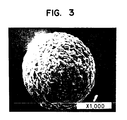
- Optical microscopic observation of the grains obtained showed that they were spheres and had the porous structure as shown in Fig. 3.
- the infrared spectrum of the spherical grains, as shown in Fig. 4 showed peaks of carbonyl groups based on the reversed parallel ⁇ -structure (shown by 1 in the figure), the ⁇ -helix structure (shown by 2 in the figure), and the parallel ⁇ -structure (shown by 3 in the figure).
- a conventional gel chromatography operation was carried out in an aqueous system for the purpose of estimating the porosity and the pore diameter of the spherical grains obtained.
- the spherical grains were charged in a column having an internal diameter of 5 mm and a length of 30 cm and homologues of dextran and maltose, polyhydric alcohols, and heavy water were eluted as standard samples, the relationship between the retention volumes and the molecular weights of the samples being extrapolated to a column void volume, and the molecular weight at this void volume was defined as an exclusion limit molecular weight (which could be considered as the maximum pore diameter).
- the porosity was calculated from the eluting position of heavy water. As a result, it was found that the spherical grains of poly ( ⁇ -methyl glutamate) had a maximum pore diameter corresponding to 8100 in terms of the molecular weight of dextran and a porosity of 70%.
- Spherical grain A (using diethylbenzene as the additive for making the grains porous)
- the spherical grains were collected by filtration and then washed with methanol and ether to obtain porous spherical grains of polyleucine having a diameter of 44 to 75 ⁇ m (the maximum pore diameter: 105 in terms of the molecular weight of dextran, i.e. a pore diameter in which a water-soluble polysaccharide having the said molecular weight can diffuse, porosity: 70%) at a yield of 75%.
- the spherical grains of the present invention can be prepared so as to have the desired pore diameter and the porosity over a wide range and thus can be prepared so as to fractionate compounds having various molecular weights used as gel for gel chromatography.
- the grains had the porosity of 68%.
- the end point was determined as the time just before the sample suddenly softened and adhered to the glass plate upon addition of one droplet of oleic acid to the sample.
- the water absorption was measured by the same procedure as set forth above, except that distilled water was used instead of oleic acid.
- A W/S wherein A represents oil absorption or water absorption [ml/g]; W represents the amount of oil or distilled water added up to the end point [ml]; and S represents the weight of the sample [g].
- the speed of oil absorption was measured by pressing a predetermined amount of the sample into a cell and then dropping a predetermined amount of oleic acid on the surface of the pressed sample to observe the speed at which the oil was absorbed in the pressed sample.
- the speed of water absorption was measured with the same method as set forth above, except that distilled water was used.
Landscapes
- Chemical & Material Sciences (AREA)
- Health & Medical Sciences (AREA)
- Life Sciences & Earth Sciences (AREA)
- Organic Chemistry (AREA)
- Chemical Kinetics & Catalysis (AREA)
- Animal Behavior & Ethology (AREA)
- Analytical Chemistry (AREA)
- General Health & Medical Sciences (AREA)
- Public Health (AREA)
- Veterinary Medicine (AREA)
- Polymers & Plastics (AREA)
- Medicinal Chemistry (AREA)
- Birds (AREA)
- Epidemiology (AREA)
- Dispersion Chemistry (AREA)
- Processes Of Treating Macromolecular Substances (AREA)
- Cosmetics (AREA)
- Polyamides (AREA)
- Preparation Of Compounds By Using Micro-Organisms (AREA)
- Macromolecular Compounds Obtained By Forming Nitrogen-Containing Linkages In General (AREA)
- Investigating Or Analysing Biological Materials (AREA)
- Treatment Of Liquids With Adsorbents In General (AREA)
- Organic Low-Molecular-Weight Compounds And Preparation Thereof (AREA)
Priority Applications (1)
| Application Number | Priority Date | Filing Date | Title |
|---|---|---|---|
| AT86108802T ATE85983T1 (de) | 1985-06-27 | 1986-06-27 | Sphaerische poly(alpha-aminosaeure)koerner und verfahren zu deren herstellung. |
Applications Claiming Priority (2)
| Application Number | Priority Date | Filing Date | Title |
|---|---|---|---|
| JP60141677A JPS621728A (ja) | 1985-06-27 | 1985-06-27 | ポリアミノ酸の球状粒子とその製造方法 |
| JP141677/85 | 1985-06-27 |
Publications (3)
| Publication Number | Publication Date |
|---|---|
| EP0211223A2 EP0211223A2 (en) | 1987-02-25 |
| EP0211223A3 EP0211223A3 (en) | 1989-05-03 |
| EP0211223B1 true EP0211223B1 (en) | 1993-02-24 |
Family
ID=15297631
Family Applications (1)
| Application Number | Title | Priority Date | Filing Date |
|---|---|---|---|
| EP86108802A Expired - Lifetime EP0211223B1 (en) | 1985-06-27 | 1986-06-27 | Spherical grains of poly(alpha-amino acid)and production method thereof |
Country Status (7)
| Country | Link |
|---|---|
| US (2) | US4840975A (enExample) |
| EP (1) | EP0211223B1 (enExample) |
| JP (1) | JPS621728A (enExample) |
| KR (1) | KR930010463B1 (enExample) |
| AT (1) | ATE85983T1 (enExample) |
| CA (1) | CA1293592C (enExample) |
| DE (1) | DE3687807T2 (enExample) |
Families Citing this family (9)
| Publication number | Priority date | Publication date | Assignee | Title |
|---|---|---|---|---|
| JPH01127039A (ja) * | 1987-11-10 | 1989-05-19 | Chuichi Hirayama | 発熱物質吸着体 |
| US5279821A (en) * | 1988-10-07 | 1994-01-18 | Chuichi Hirayama | Pyrogen adsorbent containing amide groups |
| JPH079429B2 (ja) * | 1988-10-12 | 1995-02-01 | 財団法人化学及血清療法研究所 | 人工担体およびその製造方法 |
| JPH02209155A (ja) * | 1989-02-08 | 1990-08-20 | Mitsui Toatsu Chem Inc | β↓2―ミクログロブリン用多孔質吸着材 |
| JP3460340B2 (ja) * | 1994-09-09 | 2003-10-27 | Jsr株式会社 | ポリ−α−アミノ酸のエマルジョンおよびその製造方法並びにポリ−α−アミノ酸の中空ポリマー粒子 |
| US6013738A (en) * | 1997-09-23 | 2000-01-11 | Board Of Supervisors Of Louisiana State University And Agricultural And Mechanical College | Composition and method for chiral separations |
| US6533939B2 (en) * | 2000-03-09 | 2003-03-18 | Showa Denko Kabushiki Kaisha | Packing agent for reversed phase liquid chromatography and production process thereof |
| DE10200209A1 (de) * | 2002-01-04 | 2003-07-17 | Goldschmidt Ag Th | Kosmetische und pharmazeutische Öl-in-Wasser-Emulsionen |
| US20060140992A1 (en) * | 2002-10-31 | 2006-06-29 | Idemitsu Technofine Co., Ltd. | Cosmetics excellent in texture and oil-dispersibility |
Family Cites Families (11)
| Publication number | Priority date | Publication date | Assignee | Title |
|---|---|---|---|---|
| US2572844A (en) * | 1947-08-05 | 1951-10-30 | Du Pont | Polymers from a composition consisting of a plurality of amino acid n-carboanhydrides |
| US3052655A (en) * | 1958-08-01 | 1962-09-04 | Sidney W Fox | Thermal polymerization of amino acid mixtures containing aspartic acid or a thermal precursor of aspartic acid |
| BE608244A (enExample) * | 1960-09-17 | 1900-01-01 | ||
| DE1570392A1 (de) * | 1965-10-12 | 1970-01-29 | Huels Chemische Werke Ag | Verfahren zur Herstellung von Polyamidpulvern erhoehter Viskositaet |
| CH528561A (de) * | 1970-05-05 | 1972-09-30 | Hag Ag | Verfahren zum Behandeln von Polyamidgranulat |
| JPS5112673B2 (enExample) * | 1971-09-06 | 1976-04-21 | ||
| US3847886A (en) * | 1972-05-17 | 1974-11-12 | Hercules Inc | Method of preparing small particles of a solid polymer |
| CS179075B1 (en) * | 1974-11-26 | 1977-10-31 | Stoy Vladimir | Mode of manufacture of spherical particles from polymer |
| US4081491A (en) * | 1976-07-22 | 1978-03-28 | Shell Oil Company | Saturated epoxy resin coating compositions exhibiting improved weatherability |
| JPS5339355A (en) * | 1976-09-24 | 1978-04-11 | Maruki Shokai | Process for producing fine powder polyamide resin |
| DE2906647C2 (de) * | 1979-02-21 | 1980-12-11 | Chemische Werke Huels Ag, 4370 Marl | Verfahren zur Herstellung von pulver· förmigen Beschichtungsmittel!! auf der Basis von Polyamiden mit mindestens 10 aliphatisch gebundenen Kohlenstoffatomen pro Carbonamidgruppe |
-
1985
- 1985-06-27 JP JP60141677A patent/JPS621728A/ja active Granted
-
1986
- 1986-06-27 DE DE8686108802T patent/DE3687807T2/de not_active Expired - Fee Related
- 1986-06-27 KR KR1019860005196A patent/KR930010463B1/ko not_active Expired - Fee Related
- 1986-06-27 AT AT86108802T patent/ATE85983T1/de active
- 1986-06-27 CA CA000512657A patent/CA1293592C/en not_active Expired - Lifetime
- 1986-06-27 EP EP86108802A patent/EP0211223B1/en not_active Expired - Lifetime
-
1987
- 1987-11-03 US US07/117,925 patent/US4840975A/en not_active Expired - Lifetime
-
1989
- 1989-06-20 US US07/368,558 patent/US4948816A/en not_active Expired - Fee Related
Also Published As
| Publication number | Publication date |
|---|---|
| JPS621728A (ja) | 1987-01-07 |
| US4948816A (en) | 1990-08-14 |
| EP0211223A3 (en) | 1989-05-03 |
| KR870000371A (ko) | 1987-02-18 |
| JPH0513168B2 (enExample) | 1993-02-19 |
| CA1293592C (en) | 1991-12-24 |
| US4840975A (en) | 1989-06-20 |
| KR930010463B1 (ko) | 1993-10-25 |
| DE3687807D1 (de) | 1993-04-01 |
| DE3687807T2 (de) | 1993-06-09 |
| ATE85983T1 (de) | 1993-03-15 |
| EP0211223A2 (en) | 1987-02-25 |
Similar Documents
| Publication | Publication Date | Title |
|---|---|---|
| EP0324177A1 (en) | Composite separating agent | |
| EP0211223B1 (en) | Spherical grains of poly(alpha-amino acid)and production method thereof | |
| EP0285694A1 (en) | Porous polymeric beads for the delivery of an active ingredient | |
| CA2617645A1 (en) | Hydrophilic crosslinked polymer | |
| EP0831113B1 (en) | Alkylated porous resin, process for production thereof, and use thereof | |
| GB1594374A (en) | Hydrophilic copolymers | |
| JP3601229B2 (ja) | 多孔性球状セルロース粒子 | |
| Reinholdsson et al. | Preparation and properties of porous particles from trimethylolpropane trimethacrylate | |
| CN1045610C (zh) | 液相色谱用粒度单分散大孔交联聚苯乙烯微球的制备 | |
| EP0298171B1 (en) | Beads of cross-linked glucomannan and production thereof | |
| US4846968A (en) | Resolving agent | |
| JP5261262B2 (ja) | 細孔を有する微生物セルロース粒子の製造方法 | |
| US4937081A (en) | Process for producing porous, spherical particles | |
| CN117839648B (zh) | 一种分离纯化材料及其制备方法和制得的色谱柱 | |
| Kotha et al. | Beaded reactive polymers, 1. Effect of synthesis variables on pore size and its distribution in beaded glycidyl methacrylate-divinyl benzene copolymers | |
| CA1325203C (en) | Use of porous spherical grains of poly(ó-amino acid) as a filler in chromatography | |
| US3583957A (en) | Method of producing a polymer in minute globular particles | |
| EP1001744B1 (en) | MICROPARTICLES BASED ON HYBRID POLYMERIC MATERIALS FOR CONTROLLED RELEASE OF BIOLOGICALLY ACTIVE MOLECULES, A PROCESS FOR PREPARING THE SAME AND THEIR USES FOR $i(IN VIVO) AND $i(IN VITRO) THERAPY, PROPHYLAXIS AND DIAGNOSTICS | |
| JP7666599B2 (ja) | 充填剤およびその製造方法、並びにサイズ排除クロマトグラフィー用カラム | |
| JPH0651797B2 (ja) | ポリアミノ酸の架橋球状粒子とその製造方法 | |
| JPS62278451A (ja) | 光学分割剤 | |
| CN1078724A (zh) | 珠状交联葡甘露聚糖的制备方法 | |
| JP3530527B6 (ja) | 分散液の製造法及びポリマー粒子の製造法 | |
| JPS63260935A (ja) | 多孔質ポリアミノ酸球状粒子の製造法 | |
| JP3482984B2 (ja) | 水酸基含有多孔質樹脂の製造方法 |
Legal Events
| Date | Code | Title | Description |
|---|---|---|---|
| PUAI | Public reference made under article 153(3) epc to a published international application that has entered the european phase |
Free format text: ORIGINAL CODE: 0009012 |
|
| AK | Designated contracting states |
Kind code of ref document: A2 Designated state(s): AT BE CH DE FR GB IT LI LU NL SE |
|
| PUAL | Search report despatched |
Free format text: ORIGINAL CODE: 0009013 |
|
| AK | Designated contracting states |
Kind code of ref document: A3 Designated state(s): AT BE CH DE FR GB IT LI LU NL SE |
|
| 17P | Request for examination filed |
Effective date: 19890811 |
|
| 17Q | First examination report despatched |
Effective date: 19901109 |
|
| RTI1 | Title (correction) | ||
| GRAA | (expected) grant |
Free format text: ORIGINAL CODE: 0009210 |
|
| ITF | It: translation for a ep patent filed | ||
| AK | Designated contracting states |
Kind code of ref document: B1 Designated state(s): AT BE CH DE FR GB IT LI LU NL SE |
|
| REF | Corresponds to: |
Ref document number: 85983 Country of ref document: AT Date of ref document: 19930315 Kind code of ref document: T |
|
| REF | Corresponds to: |
Ref document number: 3687807 Country of ref document: DE Date of ref document: 19930401 |
|
| ET | Fr: translation filed | ||
| PLBE | No opposition filed within time limit |
Free format text: ORIGINAL CODE: 0009261 |
|
| STAA | Information on the status of an ep patent application or granted ep patent |
Free format text: STATUS: NO OPPOSITION FILED WITHIN TIME LIMIT |
|
| 26N | No opposition filed | ||
| EPTA | Lu: last paid annual fee | ||
| EAL | Se: european patent in force in sweden |
Ref document number: 86108802.9 |
|
| PGFP | Annual fee paid to national office [announced via postgrant information from national office to epo] |
Ref country code: SE Payment date: 19990429 Year of fee payment: 14 |
|
| PGFP | Annual fee paid to national office [announced via postgrant information from national office to epo] |
Ref country code: AT Payment date: 19990430 Year of fee payment: 14 |
|
| PGFP | Annual fee paid to national office [announced via postgrant information from national office to epo] |
Ref country code: BE Payment date: 19990517 Year of fee payment: 14 |
|
| PGFP | Annual fee paid to national office [announced via postgrant information from national office to epo] |
Ref country code: LU Payment date: 19990528 Year of fee payment: 14 |
|
| PGFP | Annual fee paid to national office [announced via postgrant information from national office to epo] |
Ref country code: NL Payment date: 19990630 Year of fee payment: 14 |
|
| PGFP | Annual fee paid to national office [announced via postgrant information from national office to epo] |
Ref country code: CH Payment date: 19990917 Year of fee payment: 14 |
|
| PG25 | Lapsed in a contracting state [announced via postgrant information from national office to epo] |
Ref country code: LU Free format text: LAPSE BECAUSE OF NON-PAYMENT OF DUE FEES Effective date: 20000627 Ref country code: AT Free format text: LAPSE BECAUSE OF NON-PAYMENT OF DUE FEES Effective date: 20000627 |
|
| PG25 | Lapsed in a contracting state [announced via postgrant information from national office to epo] |
Ref country code: SE Free format text: LAPSE BECAUSE OF NON-PAYMENT OF DUE FEES Effective date: 20000628 |
|
| PG25 | Lapsed in a contracting state [announced via postgrant information from national office to epo] |
Ref country code: LI Free format text: LAPSE BECAUSE OF NON-PAYMENT OF DUE FEES Effective date: 20000630 Ref country code: CH Free format text: LAPSE BECAUSE OF NON-PAYMENT OF DUE FEES Effective date: 20000630 Ref country code: BE Free format text: LAPSE BECAUSE OF NON-PAYMENT OF DUE FEES Effective date: 20000630 |
|
| BERE | Be: lapsed |
Owner name: IHARA HIROTAKA Effective date: 20000630 Owner name: MOTOZATO YOSHIAKI Effective date: 20000630 Owner name: HIRAYAMA CHUICHI Effective date: 20000630 Owner name: JURIDICAL FOUNDATION THE CHEMO-SERO-THERAPEUTIC R Effective date: 20000630 |
|
| PG25 | Lapsed in a contracting state [announced via postgrant information from national office to epo] |
Ref country code: NL Free format text: LAPSE BECAUSE OF NON-PAYMENT OF DUE FEES Effective date: 20010101 |
|
| REG | Reference to a national code |
Ref country code: CH Ref legal event code: PL |
|
| EUG | Se: european patent has lapsed |
Ref document number: 86108802.9 |
|
| NLV4 | Nl: lapsed or anulled due to non-payment of the annual fee |
Effective date: 20010101 |
|
| PGFP | Annual fee paid to national office [announced via postgrant information from national office to epo] |
Ref country code: FR Payment date: 20010413 Year of fee payment: 16 |
|
| PGFP | Annual fee paid to national office [announced via postgrant information from national office to epo] |
Ref country code: GB Payment date: 20010622 Year of fee payment: 16 |
|
| PGFP | Annual fee paid to national office [announced via postgrant information from national office to epo] |
Ref country code: DE Payment date: 20010831 Year of fee payment: 16 |
|
| REG | Reference to a national code |
Ref country code: GB Ref legal event code: IF02 |
|
| PG25 | Lapsed in a contracting state [announced via postgrant information from national office to epo] |
Ref country code: GB Free format text: LAPSE BECAUSE OF NON-PAYMENT OF DUE FEES Effective date: 20020627 |
|
| PG25 | Lapsed in a contracting state [announced via postgrant information from national office to epo] |
Ref country code: DE Free format text: LAPSE BECAUSE OF NON-PAYMENT OF DUE FEES Effective date: 20030101 |
|
| GBPC | Gb: european patent ceased through non-payment of renewal fee |
Effective date: 20020627 |
|
| PG25 | Lapsed in a contracting state [announced via postgrant information from national office to epo] |
Ref country code: FR Free format text: LAPSE BECAUSE OF NON-PAYMENT OF DUE FEES Effective date: 20030228 |
|
| REG | Reference to a national code |
Ref country code: FR Ref legal event code: ST |
|
| PG25 | Lapsed in a contracting state [announced via postgrant information from national office to epo] |
Ref country code: IT Free format text: LAPSE BECAUSE OF NON-PAYMENT OF DUE FEES Effective date: 20050627 |