EP0207274B1 - Schaltungsanordnung zur Ansteuerung einer lichtemittierenden Diode - Google Patents
Schaltungsanordnung zur Ansteuerung einer lichtemittierenden Diode Download PDFInfo
- Publication number
- EP0207274B1 EP0207274B1 EP86106886A EP86106886A EP0207274B1 EP 0207274 B1 EP0207274 B1 EP 0207274B1 EP 86106886 A EP86106886 A EP 86106886A EP 86106886 A EP86106886 A EP 86106886A EP 0207274 B1 EP0207274 B1 EP 0207274B1
- Authority
- EP
- European Patent Office
- Prior art keywords
- circuit
- led
- temperature
- rising
- linear
- Prior art date
- Legal status (The legal status is an assumption and is not a legal conclusion. Google has not performed a legal analysis and makes no representation as to the accuracy of the status listed.)
- Expired - Lifetime
Links
- 230000005855 radiation Effects 0.000 claims description 32
- 230000000630 rising effect Effects 0.000 claims description 31
- 238000011144 upstream manufacturing Methods 0.000 claims description 2
- 230000004888 barrier function Effects 0.000 description 16
- 230000005540 biological transmission Effects 0.000 description 12
- 238000010586 diagram Methods 0.000 description 7
- 239000004065 semiconductor Substances 0.000 description 6
- 239000003990 capacitor Substances 0.000 description 4
- 230000007423 decrease Effects 0.000 description 3
- 238000011835 investigation Methods 0.000 description 3
- 238000000034 method Methods 0.000 description 2
- 238000010276 construction Methods 0.000 description 1
- 230000003111 delayed effect Effects 0.000 description 1
- 230000001419 dependent effect Effects 0.000 description 1
- 230000000694 effects Effects 0.000 description 1
- 238000002474 experimental method Methods 0.000 description 1
- 230000017525 heat dissipation Effects 0.000 description 1
- 238000010438 heat treatment Methods 0.000 description 1
- 230000006698 induction Effects 0.000 description 1
- 230000003287 optical effect Effects 0.000 description 1
- 239000013307 optical fiber Substances 0.000 description 1
- 230000005693 optoelectronics Effects 0.000 description 1
- 238000007493 shaping process Methods 0.000 description 1
- 230000008054 signal transmission Effects 0.000 description 1
- 230000003068 static effect Effects 0.000 description 1
Images


Classifications
-
- H—ELECTRICITY
- H04—ELECTRIC COMMUNICATION TECHNIQUE
- H04B—TRANSMISSION
- H04B10/00—Transmission systems employing electromagnetic waves other than radio-waves, e.g. infrared, visible or ultraviolet light, or employing corpuscular radiation, e.g. quantum communication
- H04B10/50—Transmitters
- H04B10/58—Compensation for non-linear transmitter output
-
- H—ELECTRICITY
- H04—ELECTRIC COMMUNICATION TECHNIQUE
- H04B—TRANSMISSION
- H04B10/00—Transmission systems employing electromagnetic waves other than radio-waves, e.g. infrared, visible or ultraviolet light, or employing corpuscular radiation, e.g. quantum communication
- H04B10/50—Transmitters
- H04B10/501—Structural aspects
- H04B10/502—LED transmitters
Definitions
- the invention relates to a circuit arrangement for controlling a light-emitting diode (hereinafter abbreviated to LED) with a circuit stage for compensating for the influence of temperature on the radiation power, with a non-linear compensation stage connected upstream to compensate for temperature changes which occur due to the electrical power loss in the LED is.
- a light-emitting diode hereinafter abbreviated to LED
- the radiation power ⁇ 0 of a light-emitting diode for a given forward current I F depends on the temperature.
- NTC resistors or the base-emitter paths of transistors as described, for example, in the magazine “Electronics” , Issue 26, 1984, page 90.
- such circuits can only compensate for slow, “static” temperature fluctuations, but not short-term, “dynamic” temperature fluctuations that occur during operation, which are caused by temperature changes in the diode junction due to the power loss changes occurring in the junction.
- the invention is therefore based on the object of providing a circuit arrangement for controlling an LED, with which the compensation of the temperature changes influencing the radiation power is effective over a relatively wide range, and in particular a thermal overshoot behavior of the LED can be compensated for.
- This object is achieved according to the invention by two non-linear compensation stages and a circuit stage which differentiates between the rising and falling edges of the LED control signal and, depending on this, makes one or the other of the two compensation stages effective.
- the object is achieved in accordance with an alternative embodiment of the circuit according to the invention by a second non-linear compensation stage connected in series with the first non-linear compensation stage and a circuit stage which is located between the rising and falling edges of the LED -Drive signal distinguishes and makes a second non-linear compensation stage effective in addition to the first compensation stage when a falling edge occurs.
- a second non-linear compensation stage which is in series with the first, to be additionally effective, depending on whether a rising or falling edge of the LED control signal occurs.
- the temperature or radiation power compensation is carried out essentially completely for the rising or falling edge with the first compensation stage.
- the residual compensation then takes place for the opposite edge with the second compensation stage, which is additionally connected to the first compensation stage by means of the circuit stage distinguishing between the rising and falling edge.
- the temperature profile in the LED when a rising edge occurs differs from the temperature profile that occurs on a falling edge.
- the second, connected compensation stage be made additionally.
- the time constant of the non-linear compensation stage can be switched between two time constant values, and that the circuit stage distinguishing between the rising and falling edges of the LED drive signal performs the switchover between the two time constants.
- the non-linear compensation stage or the non-linear compensation stages essentially have an RC circuit.
- RL circuits instead of the RC circuit.
- the radiant power increases, but the power loss in the junction also increases, so that the junction temperature T S also increases at the same time.
- the radiation power decreases with increasing junction temperature.
- the efficiency ( ⁇ ) of an LED is the ratio of radiation power ⁇ 0 to electrical power P tot ⁇ is therefore temperature-dependent.
- a junction temperature range of - 60 ° C ⁇ T S ⁇ + 100 ° C applies to the temperature coefficient TK TK ⁇ - 0.6% / ° C, based on the maximum radiation power at the electrical maximum values for P tot .
- Fig. 1 shows the course of the radiation power ⁇ 0 when applying a rectangular pulse with a frequency of 1 kHz.
- An infrared LED of type 1A148 (ASEA HAFO) was used as the LED.
- the forward current value I max was 100 mA and the forward current value I min was 10 mA, so that in this example a current swing ⁇ I of 90 mA results.
- the optical output signal of the diode shown in FIG. 1 shows, overshoots occur on the edges.
- the overshoot on the rising edge has a time constant ⁇ 1 which is not the same but less than the time constant ⁇ 2 of the overshoot on the falling edge.
- This thermal behavior of the LED can be illustrated using the equivalent circuit diagram shown in FIG. 2:
- the switch S of this equivalent circuit diagram is in the one shown Switch position so that the RC element consisting of the capacitor C1 and R2 acts, the time constants ⁇ 1 ⁇ C1R2 is.
- the switch On the falling edge CD (see FIG. 1), the switch is in the switch position shown in broken lines, so that the RC element C2R2 is effective, ⁇ 2 ⁇ C2R2 is.
- ⁇ 1 is smaller than ⁇ 2.
- the input voltage U e for the LED occurs in the equivalent circuit at the terminal of the resistor R0 facing away from the current or voltage source, and the output voltage which corresponds to the output radiant power ⁇ 0 of the LED is tapped via the resistor R2.
- the time constant ⁇ 1 in this example is 30 ⁇ s and for I min of 10 mA, the time constant ⁇ 2 is approximately 45 ⁇ s.
- the junction temperature T S and thus the radiation power ⁇ 0 depends on the electrical power loss occurring in the LED, which is largely converted into heat in the junction.
- the stroke of the power loss P tot is therefore 167 mW.
- Fig. 3 the radiation power ⁇ 0 is plotted against the forward current I F applied.
- the letters A, B, C, D correspond to the signal points A, B, C and D in Fig. 1. In the following Explanations are made to both FIG. 1 and FIG. 3.
- the barrier layer is relatively cold. As already mentioned, the colder the barrier layer, the greater the radiation power or the efficiency of an LED. At point A the radiant power is ⁇ 0min for I min (cf. FIG. 3).
- the forward voltage or forward current jumps from I min to I max , ie from point A to B, the increasing electrical power loss does not have an immediate or delayed effect on the heating of the barrier layer, so that the efficiency of the LED with regard to the temperature behavior initially remains the same and therefore there is a radiation power in point B above the radiation power ⁇ 0max .
- the barrier layer then heats up, however, so that the efficiency drops in accordance with the curve after point B in FIG.
- the barrier layer has reached a steady state at point C, which is established by the barrier layer being in thermal equilibrium with the housing after a certain time.
- the barrier remains warm, so that with regard to the temperature behavior of the LED, the radiation power drops below the value ⁇ 0min and the radiation power curve overshoots as a result (cf. FIG. 1D). Since due to the no longer existing or small electrical power loss of the barrier layer, no further internal heat is supplied, this can cool down by heat dissipation to the housing, so that the radiation power ⁇ 0min according to the curve shown in FIG. 1 after point D gradually increases and reaches point A in the diagram of FIG. 3, at which the radiation power has the value ⁇ 0min .
- the input voltage U e present at the input of the circuit arrangement is amplified in a first amplifier 41 and fed to a compensation stage 42, which is constructed in such a way that it transforms the current or voltage curve for the control of the LED in such a way that due to the thermal Behavior of the LED occurring distortions, such as overshoots, are compensated.
- the output signal of the compensation stage 42 can be amplified again by means of a second amplifier 43.
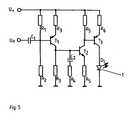
- FIG. 5 An exemplary embodiment for the compensation stage is shown in FIG. 5.
- the input voltage U e reaches a connecting capacitor C1 at the connection point of two resistors R1 and R2, which are between the operating voltage U+ and ground and serve as a voltage divider.
- the connection point of the resistors R1 and R2 is connected to the base of a pnp transistor T1.
- the Emitter of this transistor T1 is connected to the operating voltage source U+ via an emitter resistor R3, and the collector of this transistor T1 is connected to ground via a collector resistor R3.
- This collector resistor R3 is a series connection of a capacitor C2 and a resistor R4 in parallel.
- connection point between resistor R3 and collector of the first transistor T1 is connected to the base of a second transistor T2 of the npn type, the collector of which is connected to the operating voltage source U+ via a collector resistor R5, and whose emitter is connected to ground via an emitter resistor R7.
- the collector of the second transistor T2 is connected to the base of a third transistor T3 of the pnp type, the emitter of which is applied to the operating voltage source U+ via an emitter resistor R6.
- the collector of the third transistor T3 is connected to an LED 1, the cathode of which is grounded.
- This means that the signal with which the LED is driven is just transformed according to the invention in such a way that there is essentially an inversely proportional signal curve to the overshoot curve of the output signal of the LED 1.
- the barrier layer heats up relatively quickly due to the electrical power loss.
- the semiconductor chip is in thermal contact with the housing of the LED and continuously gives off its heat. Since the barrier layer or the semiconductor chip continues to be supplied due to the internal electrical power loss due to the maximum forward current I max across the pulse width, the barrier layer always remains considerably warmer than the housing.
- the LED drive voltage U e is fed, optionally via a first amplifier 61, both to a switching stage 62 and to a circuit stage 63, ie a differentiator 63, which differentiates between the rising and falling edges of the LED drive signal.
- the output signal of the differentiator 63 switches the switching stage 62 into the upper or lower switching state depending on whether a rising or a falling edge has been detected, so that the control signal U e either via a compensator stage 64 or via a compensator stage 65 - and, if appropriate reaches the LED 1 via a second amplifier 66.
- the differentiator 63 is designed such that it only provides an output signal for switching the switching stage 62 when edges with a certain minimum steepness occur. If the slope is below the minimum slope, there is no changeover between the compensation stages 64 and 65. As became clear from the preceding explanations, compensation is necessary in particular if the control signals change relatively briefly, ie jump in amplitude with short rise times, such as occur in video signals (tr ⁇ 200 ⁇ s). If the signal change is relatively slow, there is relatively enough time for a temperature equalization between the junction and the LED housing or the environment, so that overshoots or distortions due to a brief change in the junction temperature do not or not significantly distort the output signal of the LED .
- a further embodiment of the invention consists in combining the two separate compensation stages 64 and 65 shown schematically in FIG. 6 in a combination stage and, when using RC and / or LR elements for signal shaping of the control signal for the LED, only within the single switching stage to make a switchover between two time constant values ⁇ 1 and ⁇ 2, for example by changing the capacitor, resistance and / or induction values when a rising or falling edge of the LED drive signal occurs.
- the circuit arrangement according to the invention can be further simplified and manufactured inexpensively.
- the control signal U e is fed - if necessary via a first amplifier 71 to a first compensation stage 72 and at the same time to a differentiator 73 which, depending on whether a rising or falling edge occurs, switches over a switching stage 74 which is connected after the first compensation stage 72.
- An output of the switching stage 74 is connected to a second compensation stage 75 and at the second output of the switching stage 74 there is a bypass line 76 with which the second compensation stage 75 can be bypassed or rendered ineffective.
- the output signal of the second compensation stage 75 or the first compensation stage 72 with an effective bypass line 76 reaches the LED 1, possibly via a second amplifier.
- the time constants for the distortions differ with regard to the rising and falling edge of the control signal.
- a compensation stage therefore, either the distortion occurring on the rising edge or the distortion occurring on the falling edge can be completely compensated, and a certain residual distortion remains from the respective other distortion.
- This residual distortion can be compensated for by an additional compensation stage, which is activated for the edge for which residual distortion remains.
- This additional compensation stage is the second compensation stage 75 shown in FIG. 7, which is activated by the differentiator 73 and the switching stage 74 each time the edge occurs, which has not yet been fully compensated.
Landscapes
- Physics & Mathematics (AREA)
- Electromagnetism (AREA)
- Engineering & Computer Science (AREA)
- Computer Networks & Wireless Communication (AREA)
- Signal Processing (AREA)
- Nonlinear Science (AREA)
- Led Devices (AREA)
Applications Claiming Priority (2)
| Application Number | Priority Date | Filing Date | Title |
|---|---|---|---|
| DE3519711 | 1985-06-01 | ||
| DE19853519711 DE3519711A1 (de) | 1985-06-01 | 1985-06-01 | Schaltungsanordnung zur ansteuerung einer lichtemittierenden diode |
Publications (3)
| Publication Number | Publication Date |
|---|---|
| EP0207274A2 EP0207274A2 (de) | 1987-01-07 |
| EP0207274A3 EP0207274A3 (en) | 1989-04-12 |
| EP0207274B1 true EP0207274B1 (de) | 1993-01-07 |
Family
ID=6272214
Family Applications (1)
| Application Number | Title | Priority Date | Filing Date |
|---|---|---|---|
| EP86106886A Expired - Lifetime EP0207274B1 (de) | 1985-06-01 | 1986-05-21 | Schaltungsanordnung zur Ansteuerung einer lichtemittierenden Diode |
Country Status (4)
| Country | Link |
|---|---|
| US (1) | US4771219A (OSRAM) |
| EP (1) | EP0207274B1 (OSRAM) |
| DE (2) | DE3519711A1 (OSRAM) |
| DK (1) | DK164680C (OSRAM) |
Families Citing this family (5)
| Publication number | Priority date | Publication date | Assignee | Title |
|---|---|---|---|---|
| US5825399A (en) * | 1996-02-28 | 1998-10-20 | Eastman Kodak Company | Data-dependent thermal compensation for an LED printhead |
| US5929568A (en) * | 1997-07-08 | 1999-07-27 | Korry Electronics Co. | Incandescent bulb luminance matching LED circuit |
| NL1033688C2 (nl) * | 2007-04-13 | 2008-10-14 | Omron Europ B V | Werkwijze en inrichting voor het omzetten van een ingangsspanning naar een galvanisch gescheiden uitgangssignaal. |
| DE112010002867A5 (de) * | 2009-07-09 | 2012-12-13 | Jacobs University Bremen Ggmbh | Sendevorrichtung für eine optische datenübertragung mit einer nichtlinearen lichtquelle und zugehöriger empfangsvorrichtung |
| US11784637B1 (en) * | 2022-05-10 | 2023-10-10 | Cambridge Gan Devices Limited | Edge detection circuit |
Family Cites Families (6)
| Publication number | Priority date | Publication date | Assignee | Title |
|---|---|---|---|---|
| US3705316A (en) * | 1971-12-27 | 1972-12-05 | Nasa | Temperature compensated light source using a light emitting diode |
| JPS5851435B2 (ja) * | 1976-05-25 | 1983-11-16 | 富士通株式会社 | 発光素子の駆動方式 |
| US4160934A (en) * | 1977-08-11 | 1979-07-10 | Bell Telephone Laboratories, Incorporated | Current control circuit for light emitting diode |
| FR2415332A1 (fr) * | 1978-01-20 | 1979-08-17 | Thomson Csf | Dispositif d'alimentation de source lumineuse a semi-conducteur |
| US4182977A (en) * | 1978-06-01 | 1980-01-08 | Trw Inc. | Constant output light emitting device |
| FR2495412A1 (fr) * | 1980-12-02 | 1982-06-04 | Thomson Csf | Systeme de transmission d'informations a modulation directe de la lumiere a liaison optique a bande passante etendue vers les frequences basses et le continu |
-
1985
- 1985-06-01 DE DE19853519711 patent/DE3519711A1/de active Granted
-
1986
- 1986-05-21 EP EP86106886A patent/EP0207274B1/de not_active Expired - Lifetime
- 1986-05-21 DE DE8686106886T patent/DE3687433D1/de not_active Expired - Fee Related
- 1986-05-30 DK DK254186A patent/DK164680C/da active
- 1986-06-02 US US06/869,709 patent/US4771219A/en not_active Expired - Fee Related
Also Published As
| Publication number | Publication date |
|---|---|
| DE3519711A1 (de) | 1986-12-04 |
| DE3519711C2 (OSRAM) | 1988-10-20 |
| DE3687433D1 (de) | 1993-02-18 |
| EP0207274A2 (de) | 1987-01-07 |
| DK254186A (da) | 1986-12-02 |
| DK164680B (da) | 1992-07-27 |
| DK164680C (da) | 1992-12-14 |
| US4771219A (en) | 1988-09-13 |
| EP0207274A3 (en) | 1989-04-12 |
| DK254186D0 (da) | 1986-05-30 |
Similar Documents
| Publication | Publication Date | Title |
|---|---|---|
| DE3003466C2 (OSRAM) | ||
| DE69225589T2 (de) | Vorverstärker | |
| DE2947771C2 (de) | Direkt gekoppelte Verstärkeranordnung mit Stabilisierung des Ausgangsgleichstroms | |
| DE2535753A1 (de) | Schaltungen zur frequenzabhaengigen anhebung/absenkung von breitbandsignalen in abhaengigkeit von ihrer amplitude | |
| DE3519711C2 (OSRAM) | ||
| DE2445738C2 (de) | Leistungsverstärker mit Temperaturkompensation | |
| DE3212451C2 (de) | Schaltungsanordnung zum Erzeugen eines auf einen Pegel eines Eingangssignals bezogenen Ausgangssignals | |
| DE3433817A1 (de) | Konstantspannung-schaltkreis | |
| DE4138661C1 (OSRAM) | ||
| DE2837728C2 (OSRAM) | ||
| DE69128652T2 (de) | Steuerschaltung | |
| EP0658266A1 (de) | Verfahren und vorrichtung zur ansteuerung mit gepulsten signalen. | |
| DE2655320A1 (de) | Steuerbarer elektronischer widerstand | |
| DE2416533B2 (de) | Elektronische Schaltungsanordnung zur Spannungsstabilisierung | |
| EP0277377A1 (de) | Schaltungsanordnung zur Bildung eines begrenzten Stromes | |
| DE3045511C2 (de) | Verfahren zum Regeln des Ausgangssignals eines Halbleiterlasers und Schaltungsanordnung zur Durchführung dieses Verfahrens | |
| EP0135190A1 (de) | Schaltregler mit einem Komparator, dem eine periodische Vergleichsgrösse mit vorgegebenem zeitlichen Verlauf zugeführt ist | |
| DE4223274A1 (de) | Treiberschaltung fuer induktive lasten | |
| DE2037695A1 (de) | Integrierter Differenzverstärker mit gesteuerter Gegenkopplung | |
| EP0202618B1 (de) | Optoelektrischer Transimpedanzempfänger | |
| DE2521387B2 (de) | Eingangs-schaltungsanordnung fuer einen vhf- oder uhf-kanalwaehler eines fernsehgeraetes | |
| DE1156110B (de) | Regelschaltung fuer einen Verstaerker | |
| DE69833102T2 (de) | Verstärkeranordnung | |
| DE2506035C3 (de) | Filmschaltung | |
| DE864888C (de) | Schaltungsanordnung zur selbsttaetigen Pegelregelung |
Legal Events
| Date | Code | Title | Description |
|---|---|---|---|
| PUAI | Public reference made under article 153(3) epc to a published international application that has entered the european phase |
Free format text: ORIGINAL CODE: 0009012 |
|
| AK | Designated contracting states |
Kind code of ref document: A2 Designated state(s): BE DE FR GB IT NL SE |
|
| PUAL | Search report despatched |
Free format text: ORIGINAL CODE: 0009013 |
|
| AK | Designated contracting states |
Kind code of ref document: A3 Designated state(s): BE DE FR GB IT NL SE |
|
| 17P | Request for examination filed |
Effective date: 19890510 |
|
| RAP1 | Party data changed (applicant data changed or rights of an application transferred) |
Owner name: RICHARD HIRSCHMANN GMBH & CO. |
|
| 17Q | First examination report despatched |
Effective date: 19910517 |
|
| GRAA | (expected) grant |
Free format text: ORIGINAL CODE: 0009210 |
|
| AK | Designated contracting states |
Kind code of ref document: B1 Designated state(s): BE DE FR GB IT NL SE |
|
| REF | Corresponds to: |
Ref document number: 3687433 Country of ref document: DE Date of ref document: 19930218 |
|
| PGFP | Annual fee paid to national office [announced via postgrant information from national office to epo] |
Ref country code: SE Payment date: 19930225 Year of fee payment: 8 |
|
| ITF | It: translation for a ep patent filed | ||
| PGFP | Annual fee paid to national office [announced via postgrant information from national office to epo] |
Ref country code: FR Payment date: 19930331 Year of fee payment: 8 |
|
| GBT | Gb: translation of ep patent filed (gb section 77(6)(a)/1977) |
Effective date: 19930330 |
|
| PGFP | Annual fee paid to national office [announced via postgrant information from national office to epo] |
Ref country code: GB Payment date: 19930507 Year of fee payment: 8 |
|
| ET | Fr: translation filed | ||
| PGFP | Annual fee paid to national office [announced via postgrant information from national office to epo] |
Ref country code: BE Payment date: 19930517 Year of fee payment: 8 |
|
| PGFP | Annual fee paid to national office [announced via postgrant information from national office to epo] |
Ref country code: NL Payment date: 19930531 Year of fee payment: 8 |
|
| PGFP | Annual fee paid to national office [announced via postgrant information from national office to epo] |
Ref country code: DE Payment date: 19930713 Year of fee payment: 8 |
|
| PLBE | No opposition filed within time limit |
Free format text: ORIGINAL CODE: 0009261 |
|
| STAA | Information on the status of an ep patent application or granted ep patent |
Free format text: STATUS: NO OPPOSITION FILED WITHIN TIME LIMIT |
|
| 26N | No opposition filed | ||
| PG25 | Lapsed in a contracting state [announced via postgrant information from national office to epo] |
Ref country code: GB Effective date: 19940521 |
|
| PG25 | Lapsed in a contracting state [announced via postgrant information from national office to epo] |
Ref country code: SE Effective date: 19940522 |
|
| PG25 | Lapsed in a contracting state [announced via postgrant information from national office to epo] |
Ref country code: BE Effective date: 19940531 |
|
| BERE | Be: lapsed |
Owner name: RICHARD HIRSCHMANN G.M.B.H. & CO. Effective date: 19940531 |
|
| PG25 | Lapsed in a contracting state [announced via postgrant information from national office to epo] |
Ref country code: NL Effective date: 19941201 |
|
| NLV4 | Nl: lapsed or anulled due to non-payment of the annual fee | ||
| GBPC | Gb: european patent ceased through non-payment of renewal fee |
Effective date: 19940521 |
|
| EUG | Se: european patent has lapsed |
Ref document number: 86106886.4 Effective date: 19941210 |
|
| PG25 | Lapsed in a contracting state [announced via postgrant information from national office to epo] |
Ref country code: FR Effective date: 19950131 |
|
| PG25 | Lapsed in a contracting state [announced via postgrant information from national office to epo] |
Ref country code: DE Effective date: 19950201 |
|
| EUG | Se: european patent has lapsed |
Ref document number: 86106886.4 |
|
| REG | Reference to a national code |
Ref country code: FR Ref legal event code: ST |
|
| PG25 | Lapsed in a contracting state [announced via postgrant information from national office to epo] |
Ref country code: IT Free format text: LAPSE BECAUSE OF NON-PAYMENT OF DUE FEES;WARNING: LAPSES OF ITALIAN PATENTS WITH EFFECTIVE DATE BEFORE 2007 MAY HAVE OCCURRED AT ANY TIME BEFORE 2007. THE CORRECT EFFECTIVE DATE MAY BE DIFFERENT FROM THE ONE RECORDED. Effective date: 20050521 |