EP0204890B1 - Verfahren zur Herstellung von Bauelementen - Google Patents
Verfahren zur Herstellung von Bauelementen Download PDFInfo
- Publication number
- EP0204890B1 EP0204890B1 EP86102572A EP86102572A EP0204890B1 EP 0204890 B1 EP0204890 B1 EP 0204890B1 EP 86102572 A EP86102572 A EP 86102572A EP 86102572 A EP86102572 A EP 86102572A EP 0204890 B1 EP0204890 B1 EP 0204890B1
- Authority
- EP
- European Patent Office
- Prior art keywords
- stacks
- pressing
- outer layer
- recesses
- decorative
- Prior art date
- Legal status (The legal status is an assumption and is not a legal conclusion. Google has not performed a legal analysis and makes no representation as to the accuracy of the status listed.)
- Expired - Lifetime
Links
- 238000004519 manufacturing process Methods 0.000 title claims abstract description 10
- 238000003825 pressing Methods 0.000 claims abstract description 23
- 238000000034 method Methods 0.000 claims description 21
- -1 polypropylene Polymers 0.000 claims description 6
- KXGFMDJXCMQABM-UHFFFAOYSA-N 2-methoxy-6-methylphenol Chemical compound [CH]OC1=CC=CC([CH])=C1O KXGFMDJXCMQABM-UHFFFAOYSA-N 0.000 claims description 5
- 229920001568 phenolic resin Polymers 0.000 claims description 5
- 239000005011 phenolic resin Substances 0.000 claims description 5
- 229920005989 resin Polymers 0.000 claims description 5
- 239000011347 resin Substances 0.000 claims description 5
- 239000004952 Polyamide Substances 0.000 claims description 3
- 239000004698 Polyethylene Substances 0.000 claims description 3
- 239000004743 Polypropylene Substances 0.000 claims description 3
- 229920002647 polyamide Polymers 0.000 claims description 3
- 229920000573 polyethylene Polymers 0.000 claims description 3
- 229920001155 polypropylene Polymers 0.000 claims description 3
- 238000010276 construction Methods 0.000 claims description 2
- CDBYLPFSWZWCQE-UHFFFAOYSA-L Sodium Carbonate Chemical compound [Na+].[Na+].[O-]C([O-])=O CDBYLPFSWZWCQE-UHFFFAOYSA-L 0.000 claims 1
- 239000003795 chemical substances by application Substances 0.000 claims 1
- 239000012778 molding material Substances 0.000 abstract 1
- 239000010410 layer Substances 0.000 description 49
- 239000000463 material Substances 0.000 description 6
- 239000000123 paper Substances 0.000 description 6
- DGAQECJNVWCQMB-PUAWFVPOSA-M Ilexoside XXIX Chemical compound C[C@@H]1CC[C@@]2(CC[C@@]3(C(=CC[C@H]4[C@]3(CC[C@@H]5[C@@]4(CC[C@@H](C5(C)C)OS(=O)(=O)[O-])C)C)[C@@H]2[C@]1(C)O)C)C(=O)O[C@H]6[C@@H]([C@H]([C@@H]([C@H](O6)CO)O)O)O.[Na+] DGAQECJNVWCQMB-PUAWFVPOSA-M 0.000 description 5
- 239000002655 kraft paper Substances 0.000 description 5
- 229910052708 sodium Inorganic materials 0.000 description 5
- 239000011734 sodium Substances 0.000 description 5
- 230000015572 biosynthetic process Effects 0.000 description 3
- 239000002648 laminated material Substances 0.000 description 3
- 229920000877 Melamine resin Polymers 0.000 description 2
- 229920003180 amino resin Polymers 0.000 description 2
- 238000000465 moulding Methods 0.000 description 2
- 239000012791 sliding layer Substances 0.000 description 2
- 239000004640 Melamine resin Substances 0.000 description 1
- 238000004026 adhesive bonding Methods 0.000 description 1
- 238000005452 bending Methods 0.000 description 1
- 239000011230 binding agent Substances 0.000 description 1
- 229920002678 cellulose Polymers 0.000 description 1
- 239000001913 cellulose Substances 0.000 description 1
- 239000011093 chipboard Substances 0.000 description 1
- 238000007796 conventional method Methods 0.000 description 1
- 230000001419 dependent effect Effects 0.000 description 1
- 239000011888 foil Substances 0.000 description 1
- 238000000227 grinding Methods 0.000 description 1
- 238000003754 machining Methods 0.000 description 1
- 238000003801 milling Methods 0.000 description 1
- 239000002985 plastic film Substances 0.000 description 1
- 229920006255 plastic film Polymers 0.000 description 1
- 238000012805 post-processing Methods 0.000 description 1
- 238000002360 preparation method Methods 0.000 description 1
- 229920003002 synthetic resin Polymers 0.000 description 1
- 239000000057 synthetic resin Substances 0.000 description 1
Images


Classifications
-
- B—PERFORMING OPERATIONS; TRANSPORTING
- B29—WORKING OF PLASTICS; WORKING OF SUBSTANCES IN A PLASTIC STATE IN GENERAL
- B29C—SHAPING OR JOINING OF PLASTICS; SHAPING OF MATERIAL IN A PLASTIC STATE, NOT OTHERWISE PROVIDED FOR; AFTER-TREATMENT OF THE SHAPED PRODUCTS, e.g. REPAIRING
- B29C53/00—Shaping by bending, folding, twisting, straightening or flattening; Apparatus therefor
- B29C53/02—Bending or folding
- B29C53/04—Bending or folding of plates or sheets
- B29C53/06—Forming folding lines by pressing or scoring
- B29C53/063—Forming folding lines by pressing or scoring combined with folding
-
- B—PERFORMING OPERATIONS; TRANSPORTING
- B29—WORKING OF PLASTICS; WORKING OF SUBSTANCES IN A PLASTIC STATE IN GENERAL
- B29C—SHAPING OR JOINING OF PLASTICS; SHAPING OF MATERIAL IN A PLASTIC STATE, NOT OTHERWISE PROVIDED FOR; AFTER-TREATMENT OF THE SHAPED PRODUCTS, e.g. REPAIRING
- B29C37/00—Component parts, details, accessories or auxiliary operations, not covered by group B29C33/00 or B29C35/00
- B29C37/0053—Moulding articles characterised by the shape of the surface, e.g. ribs, high polish
- B29C37/0057—Moulding single grooves or ribs, e.g. tear lines
-
- B—PERFORMING OPERATIONS; TRANSPORTING
- B29—WORKING OF PLASTICS; WORKING OF SUBSTANCES IN A PLASTIC STATE IN GENERAL
- B29K—INDEXING SCHEME ASSOCIATED WITH SUBCLASSES B29B, B29C OR B29D, RELATING TO MOULDING MATERIALS OR TO MATERIALS FOR MOULDS, REINFORCEMENTS, FILLERS OR PREFORMED PARTS, e.g. INSERTS
- B29K2711/00—Use of natural products or their composites, not provided for in groups B29K2601/00 - B29K2709/00, for preformed parts, e.g. for inserts
- B29K2711/12—Paper, e.g. cardboard
- B29K2711/126—Impregnated
-
- B—PERFORMING OPERATIONS; TRANSPORTING
- B29—WORKING OF PLASTICS; WORKING OF SUBSTANCES IN A PLASTIC STATE IN GENERAL
- B29L—INDEXING SCHEME ASSOCIATED WITH SUBCLASS B29C, RELATING TO PARTICULAR ARTICLES
- B29L2031/00—Other particular articles
- B29L2031/44—Furniture or parts thereof
- B29L2031/441—Countertops
-
- Y—GENERAL TAGGING OF NEW TECHNOLOGICAL DEVELOPMENTS; GENERAL TAGGING OF CROSS-SECTIONAL TECHNOLOGIES SPANNING OVER SEVERAL SECTIONS OF THE IPC; TECHNICAL SUBJECTS COVERED BY FORMER USPC CROSS-REFERENCE ART COLLECTIONS [XRACs] AND DIGESTS
- Y10—TECHNICAL SUBJECTS COVERED BY FORMER USPC
- Y10T—TECHNICAL SUBJECTS COVERED BY FORMER US CLASSIFICATION
- Y10T156/00—Adhesive bonding and miscellaneous chemical manufacture
- Y10T156/10—Methods of surface bonding and/or assembly therefor
- Y10T156/1002—Methods of surface bonding and/or assembly therefor with permanent bending or reshaping or surface deformation of self sustaining lamina
- Y10T156/1026—Methods of surface bonding and/or assembly therefor with permanent bending or reshaping or surface deformation of self sustaining lamina with slitting or removal of material at reshaping area prior to reshaping
-
- Y—GENERAL TAGGING OF NEW TECHNOLOGICAL DEVELOPMENTS; GENERAL TAGGING OF CROSS-SECTIONAL TECHNOLOGIES SPANNING OVER SEVERAL SECTIONS OF THE IPC; TECHNICAL SUBJECTS COVERED BY FORMER USPC CROSS-REFERENCE ART COLLECTIONS [XRACs] AND DIGESTS
- Y10—TECHNICAL SUBJECTS COVERED BY FORMER USPC
- Y10T—TECHNICAL SUBJECTS COVERED BY FORMER US CLASSIFICATION
- Y10T156/00—Adhesive bonding and miscellaneous chemical manufacture
- Y10T156/10—Methods of surface bonding and/or assembly therefor
- Y10T156/1002—Methods of surface bonding and/or assembly therefor with permanent bending or reshaping or surface deformation of self sustaining lamina
- Y10T156/1043—Subsequent to assembly
- Y10T156/1044—Subsequent to assembly of parallel stacked sheets only
-
- Y—GENERAL TAGGING OF NEW TECHNOLOGICAL DEVELOPMENTS; GENERAL TAGGING OF CROSS-SECTIONAL TECHNOLOGIES SPANNING OVER SEVERAL SECTIONS OF THE IPC; TECHNICAL SUBJECTS COVERED BY FORMER USPC CROSS-REFERENCE ART COLLECTIONS [XRACs] AND DIGESTS
- Y10—TECHNICAL SUBJECTS COVERED BY FORMER USPC
- Y10T—TECHNICAL SUBJECTS COVERED BY FORMER US CLASSIFICATION
- Y10T156/00—Adhesive bonding and miscellaneous chemical manufacture
- Y10T156/10—Methods of surface bonding and/or assembly therefor
- Y10T156/1089—Methods of surface bonding and/or assembly therefor of discrete laminae to single face of additional lamina
- Y10T156/1092—All laminae planar and face to face
Definitions
- the invention relates to a method for producing a component from decorative laminated materials with a core and a decorative layer, wherein the core is divided into an outer layer and an inner layer and the outer layer is provided with one or more recesses, along which a deformation is carried out after the pressing.
- Such a method is used where components made of decorative laminates are used for the interior construction of houses, the manufacture of furniture and the interior trim of vehicles.
- the invention is therefore based on the object of developing a method of the type mentioned in such a way that the preparation of the zones provided for the deformation can be carried out in a simple manner and with little effort, with in particular machining post-processing after the pressing being to be omitted.
- the outer layer is formed from a plurality of separate, directly adjacent stacks and in that the recesses after the pressing are formed by removing stacks from the outer layer.
- the zones intended for deformation are prepared during the pressing process.
- the production of the molded component requires only two operations. After the laminates have been pressed into sheets, the only thing left to do is to deform them into the desired components. A gluing of preformed elements to the desired molded part is not necessary.
- the decorative laminated materials can be prefabricated and immediately afterwards or further processed into the desired components.
- the prefabricated decorative laminates can be stored temporarily for any length of time.
- shaped components with roundings can be produced which have a radius of curvature of less than 2 cm.
- the thickness of the decorative laminates with which the process can be carried out is not limited to large or small values. Since decorative laminates with a thickness of less than 4 mm can still be processed to shaped components using conventional methods, use of the method according to the invention only makes sense for laminates that are thicker than 4 mm.
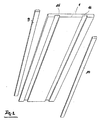
- a decorative laminate 1 is first produced in plate form, as shown in FIG. 1.
- This laminate 1 is essentially formed by a decorative layer 2, 3, 4 consisting of a transparent surface sheet 2 forming the later surface of the component, a decorative sheet 3, a cover sheet 4, and a core.
- the transparent surface web 2 is formed by cellulose paper soaked in melamine resin.
- the decorative sheet 3 is a plain-colored, a colored or printed paper sheet, which is also impregnated with a resin, preferably an aminoplast resin, the essential component of which is a melamine-formaldehyde resin.
- the cover sheet 4 is also made of paper and is impregnated with an aminoplast resin.
- the core 5 is divided according to the invention into an inner layer 6 and an outer layer 7.
- the inner layer 6 is formed by several superimposed webs of sodium kraft paper which are impregnated with a phenolic resin.
- the inner layer 6 is adjoined by the outer layer 7 which, in the exemplary embodiment shown here, is likewise formed from sodium kraft paper soaked in phenolic resin.
- the outer layer 7 does not formed by contiguous sheets of sodium kraft paper, but as shown in Figure 1, formed by several stacks 8, 9, 10, 11 and 12.
- stacks also consist of sodium kraft paper webs, which are stacked on top of one another and soaked with phenolic resin.
- the stacks 8 to 12 are separated from one another, but are arranged on the inner layer 6 in such a way that they adjoin one another directly. Their dimensions are chosen so that they completely cover the underlying inner layer 6 before pressing.
- the height of layers 6 and 7, in particular the number of core paper webs used per layer 6, 7, can be chosen to be of any size.
- the layers 6 and 7 can comprise so many core paper webs that the decorative laminate 1 has a thickness of 4 to 20 mm and much more after pressing. So that the decorative laminate 1 can then be formed into a desired component, the outer layer 7 is specially designed according to the invention.
- the decorative laminate 1 To manufacture the components, the decorative laminate 1 must be deformed along defined routes. So that this is possible, the outer layer 7 is designed so that a stack 9, 11 is always arranged along these distances, which can be removed from the outer layer 7 after pressing, so that a recess 15, 16 is formed, along which the decorative laminate can then be deformed. So that such recesses 15 and 16 can be formed, the stacks 9, 11, which are seated in the later recesses 15, 16 before the pressing, are embedded in the outer layer 7 in such a way that they lie directly on the inner layer 6 or on the adjacent stacks 8 and 10 or 10 and 12, but are separated from them by a cover 13 or a film 14. As FIG.
- the stack 9 is embedded in a casing 13, while the stack 11 is shielded by a film 14, three three of its boundary surfaces, and is separated from the adjacent inner layer 6 and the stacks 10 and 12.
- the casing 13 or the film 14 is a very thin plastic film made of polypropylene, polyamide or polyethylene. Cases or tubes 13 and foils 14 made of other materials can of course also be used. You only have to meet the condition that they are stable at the pressing temperature of the decorative laminate 1.
- the decorative laminate 1 shown in Figure 1 is pressed at a temperature of about 150 ° C and a pressure of 1200 N / cm 2 , so that the resin does not fully harden during pressing.
- the stack 9 or 11 is surrounded by such a casing 13 or film 14 before pressing, the paper webs forming the stacks 9 and 11 connect, however, the casing 13 or film 14 connects the stacks 9 and 11 with the inner layer 6 and the laterally adjacent stacks 8, 10 and 12 prevented.
- the stacks 9 and 11 of the outer layer 7 can be removed in a simple manner. As FIG. 2 shows, removing the stacks 9 and 11 creates two cutouts 15 and 16 which extend over the entire length of the stacks 9 and 11 previously arranged here.
- the decorative laminate 1 can now be bent along the recesses 15 and 16 by placing it in a molding press and under the action of pressure and heat.
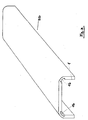
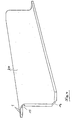
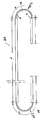
- the component 20 shown in FIGS. 3, 4 and 5 can be produced from the laminate 1 shown in FIG. 2 by bending in the region of the recesses 15 and 16. Despite a thickness of more than 10 mm, components 20 can be produced from the decorative laminate 1 shown in FIG. 2, the roundings of which have a radius of curvature which is less than 2 cm. There is also the possibility of increasing the number of cutouts as desired, so that, for example, a component 20 as shown in cross section in FIG. 6 can also be formed.
- the outer layer 7 with only a single stack 9 if the component 20 to be formed is to have only one rounding, e.g. the worktop in a kitchen, which has a forward-facing rounding and is flush with the opposite edge against a wall.
- the stacks 9 and 11, in the place of which the recesses 15, 16 are later to be formed, can also be arranged in such a way that their longitudinal axes do not run parallel, but perpendicular to the longitudinal axes of the remaining stacks 8, 10 and 12, which are permanent with them the inner layer 6 are pressed.
- the outer layer 7 it is possible to produce the outer layer 7 from stacks 8, 9, 10, 11 and 12 which have already been pre-pressed. Laminates, chipboard or other materials can be used to form the stack. Stacks 8, 9, 10, 11 and 12 are formed from the respectively selected material to form a decorative laminate 1, as shown in FIG. 1. These must have the same height over their entire length and also be the same height among one another, so that the outward-facing side of the outer layer 7 has no unevenness. The stacks 8, 9, 10, 11 and 12 formed from any material have, in terms of length and width, dimensions such that they completely cover the underlying inner layer 6.
- the decorative laminate 1 can be bent in a corresponding manner after pressing to form components, measures must also be taken here that enable recesses 15, 16 to occur after pressing, along which the deformation can be made.
- the stacks 9 and 11 are also inserted into a casing or a tube 13 to form recesses 15 and 16 and arranged between the adjacent stacks.
- the other alternative is to surround the boundary surfaces of the stacks 9 and 11, which adjoin the inner layer 6 or the adjacent stacks 8, 10 or 10, 12, with a film 14, so that a connection between the Stacking or the inner layer 6 is excluded.
- the sheath or the tube 13 or the film 14 are made of the materials described above.
- the stacks 8, 10 and 12 of the outer layer 7 are permanently connected to the inner layer 6 when the decorative laminate 1 is pressed. After pressing, the desired components can be produced from the decorative laminate 1, as described above.
- the components 20 can also be produced in such a way that they have a decorative layer on both sides and the cutouts also show the corresponding decor.
- FIG. 5 shows how far a decorative laminate 1 can be bent in the area of the cutouts 15 and 16 for the production of rounded edges.
- the wall thickness of a component produced by the method according to the invention in the region of its cutouts 15 and 16 is determined by the thickness of the inner layer 6 and the cover sheet 4, decorative sheet 3 and transparent surface sheet 2 that follow to the outside.
- the thickness of which is approximately 10 mm, approximately 50 sodium kraft paper webs impregnated with phenolic resin are required for the formation of the inner and outer layers 6 and 7, which are stacked on top of one another in accordance with the manner shown in FIG. 1 and explained in the associated description will.
- stacks 8, 9, 10, 11 and 12 are accordingly formed in the outer layer 7 such that as much material is removed after the outer layer 7 has been pressed can that the desired wall thickness remains.
- the recesses 15 and 16 can be dimensioned such that their wall, which is formed by the inner layer 6 and the decorative layer 2, 3, 4, only has 10% of the total original thickness of the laminate 1.
Landscapes
- Engineering & Computer Science (AREA)
- Mechanical Engineering (AREA)
- Laminated Bodies (AREA)
- Glass Compositions (AREA)
- Thin Magnetic Films (AREA)
- Treatment Of Sludge (AREA)
- Silicates, Zeolites, And Molecular Sieves (AREA)
- Casting Or Compression Moulding Of Plastics Or The Like (AREA)
- Paper (AREA)
- Sewage (AREA)
- Nonmetallic Welding Materials (AREA)
- Compositions Of Oxide Ceramics (AREA)
- Finishing Walls (AREA)
- Shaping Of Tube Ends By Bending Or Straightening (AREA)
Priority Applications (1)
| Application Number | Priority Date | Filing Date | Title |
|---|---|---|---|
| AT86102572T ATE52444T1 (de) | 1985-05-10 | 1986-02-27 | Verfahren zur herstellung von bauelementen. |
Applications Claiming Priority (2)
| Application Number | Priority Date | Filing Date | Title |
|---|---|---|---|
| DE19853516862 DE3516862A1 (de) | 1985-05-10 | 1985-05-10 | Verfahren zur herstellung von bauelementen |
| DE3516862 | 1985-05-10 |
Publications (3)
| Publication Number | Publication Date |
|---|---|
| EP0204890A2 EP0204890A2 (de) | 1986-12-17 |
| EP0204890A3 EP0204890A3 (en) | 1987-02-04 |
| EP0204890B1 true EP0204890B1 (de) | 1990-05-09 |
Family
ID=6270370
Family Applications (1)
| Application Number | Title | Priority Date | Filing Date |
|---|---|---|---|
| EP86102572A Expired - Lifetime EP0204890B1 (de) | 1985-05-10 | 1986-02-27 | Verfahren zur Herstellung von Bauelementen |
Country Status (9)
| Country | Link |
|---|---|
| US (1) | US4701232A (enExample) |
| EP (1) | EP0204890B1 (enExample) |
| JP (1) | JPS61266231A (enExample) |
| AT (1) | ATE52444T1 (enExample) |
| DE (1) | DE3516862A1 (enExample) |
| DK (1) | DK162973C (enExample) |
| FI (1) | FI861897A7 (enExample) |
| NO (1) | NO861860L (enExample) |
| ZA (1) | ZA862608B (enExample) |
Families Citing this family (13)
| Publication number | Priority date | Publication date | Assignee | Title |
|---|---|---|---|---|
| NL8700898A (nl) * | 1987-04-15 | 1988-11-01 | Ploeg Lunteren Bv | Werkwijze voor het buigen van een massieve plaat uit een hogedruk laminaat van fenolhars en volgens de werkwijze gebogen plaat. |
| GB8925380D0 (en) * | 1989-11-09 | 1989-12-28 | Leonard Ian | Producing prostheses |
| IT225029Z2 (it) * | 1991-08-08 | 1996-09-18 | Berloni Mobili Spa | Foglio laminato plastico per il rivestimento di piani autoportanti dotato di zone di spessore assotigliato |
| CA2380683C (en) | 1991-10-28 | 2006-08-08 | Advanced Cardiovascular Systems, Inc. | Expandable stents and method for making same |
| DE4308391C2 (de) * | 1993-03-16 | 1996-08-14 | Ttk Kunststoff Tech Gmbh | Verfahren und Vorrichtung zur Herstellung von Gehäusen oder dergleichen sowie derartige Gehäuse oder dergleichen |
| US5486324A (en) * | 1994-06-06 | 1996-01-23 | Klein, Jr.; Frederick H. | Method of making tight radius plastic corner components for static structures |
| DE19629355C1 (de) * | 1996-07-20 | 1997-09-18 | Robert Buhmann | Gebogene Paneele und Verfahren zum Herstellen derselben |
| ES2137894B1 (es) * | 1998-04-22 | 2000-09-16 | Aismalibar Sa | Material estratificado de alta presion para suelos. |
| US6399172B1 (en) | 1999-11-17 | 2002-06-04 | Rock-Tenn Company | Hinged panel for furniture |
| WO2002083397A1 (en) * | 2001-04-17 | 2002-10-24 | Allegheny Solid Surface Technologies | Methods and arrangements for texturing, patterning and bending polymer sheet materials |
| DE102004012111B3 (de) * | 2004-03-12 | 2005-07-07 | Ross Design Gmbh | Plattenförmiges Element mit Inlay |
| US7947207B2 (en) | 2005-04-12 | 2011-05-24 | Abbott Cardiovascular Systems Inc. | Method for retaining a vascular stent on a catheter |
| ITUD20130132A1 (it) * | 2013-10-15 | 2015-04-16 | Spring Due Srl | Pannello per elementi d'arredo e relativo procedimento di rifinitura |
Family Cites Families (10)
| Publication number | Priority date | Publication date | Assignee | Title |
|---|---|---|---|---|
| US2542860A (en) * | 1946-01-19 | 1951-02-20 | Clements Macmillan | Edge construction |
| US2648370A (en) * | 1950-03-18 | 1953-08-11 | North American Aviation Inc | Method and apparatus for progressive forming of c-stage plastic material |
| US2739637A (en) * | 1954-02-08 | 1956-03-27 | North American Aviation Inc | Method and device for bending c-stage postformable plastic material |
| US2867864A (en) * | 1955-07-13 | 1959-01-13 | Cabinet Top Ind | Corner construction and method of forming same |
| US3215579A (en) * | 1963-01-23 | 1965-11-02 | Formica Corp | Process for releasing laminates |
| US3418189A (en) * | 1964-06-02 | 1968-12-24 | Formica Corp | Process for making decorative laminates |
| CH570260A5 (enExample) * | 1972-05-19 | 1975-12-15 | Dimmler C E Ag | |
| CH596975A5 (enExample) * | 1976-09-24 | 1978-03-31 | United Patents Trust Reg | |
| DE2856281A1 (de) * | 1978-12-27 | 1980-07-10 | Roemmler H Resopal Werk Gmbh | Nachformbare dekorative schichtpresstoffplatte |
| AT364861B (de) * | 1979-09-06 | 1981-11-25 | Isovolta | Verfahren zur herstellung von schichtstoff-form- teilen |
-
1985
- 1985-05-10 DE DE19853516862 patent/DE3516862A1/de active Granted
-
1986
- 1986-02-27 AT AT86102572T patent/ATE52444T1/de not_active IP Right Cessation
- 1986-02-27 EP EP86102572A patent/EP0204890B1/de not_active Expired - Lifetime
- 1986-04-08 ZA ZA862608A patent/ZA862608B/xx unknown
- 1986-04-29 DK DK195486A patent/DK162973C/da not_active IP Right Cessation
- 1986-05-07 US US06/860,678 patent/US4701232A/en not_active Expired - Fee Related
- 1986-05-07 FI FI861897A patent/FI861897A7/fi not_active Application Discontinuation
- 1986-05-09 NO NO861860A patent/NO861860L/no unknown
- 1986-05-09 JP JP61105024A patent/JPS61266231A/ja active Pending
Also Published As
| Publication number | Publication date |
|---|---|
| DE3516862A1 (de) | 1986-11-13 |
| ATE52444T1 (de) | 1990-05-15 |
| DK162973B (da) | 1992-01-06 |
| NO861860L (no) | 1986-11-11 |
| DK162973C (da) | 1992-06-09 |
| DE3516862C2 (enExample) | 1993-04-01 |
| EP0204890A3 (en) | 1987-02-04 |
| DK195486D0 (da) | 1986-04-29 |
| ZA862608B (en) | 1986-12-30 |
| FI861897L (fi) | 1986-11-11 |
| FI861897A0 (fi) | 1986-05-07 |
| EP0204890A2 (de) | 1986-12-17 |
| US4701232A (en) | 1987-10-20 |
| FI861897A7 (fi) | 1986-11-11 |
| DK195486A (da) | 1986-11-11 |
| JPS61266231A (ja) | 1986-11-25 |
Similar Documents
| Publication | Publication Date | Title |
|---|---|---|
| DE2823669C3 (de) | Heißverformbare Kunstharz-Schichtpreßstoffplatte, sowie Verfahren zum Verformen dieser Platten | |
| EP0249592B1 (de) | Kunstharz-Schichtpressstoffplatte sowie daraus hergestellter Bauteil mit zumindest einem gerundeten Oberflächenbereich | |
| DE3516862C2 (enExample) | ||
| CH647454A5 (de) | Verfahren zur herstellung eines ueberzogenen geschaeumten produktes. | |
| EP2905135A2 (de) | Verfahren zur Herstellung eines Paneels | |
| DE3235237C2 (de) | Verfahren zur Herstellung von künstlichen Furnieren | |
| EP0038488A2 (de) | Verfahren zum Herstellen eines flüssigkeitsdichten Behälters | |
| DE3119884C1 (de) | Verfahren zur Herstellung von starre und flexible Bereiche aufweisenden Leiterplatten | |
| EP0527484A1 (de) | Leichtbau-Flächenelement und Verfahren zur Herstellung eines solchen | |
| DE3906594A1 (de) | Verfahren zur herstellung eines postforming-laminats | |
| DE3142587A1 (de) | Dekoratives laminat und verfahren zu dessen herstellung | |
| DE1453351B2 (de) | Verfahren zur Herstellung vorgefertigter quadratischer Parkettelemente | |
| EP1123672B1 (de) | Verfahren zur Herstellung einer gewölbten Möbelplatte sowie nach diesem Verfahren hergestellte Möbelplatte | |
| EP2127833B1 (de) | Verfahren zum Beschichten eines Werkstücks | |
| DE2521539A1 (de) | Imitierte jalousietuer und verfahren zur herstellung derselben | |
| DE102021003857B3 (de) | Verfahren zur Herstellung eines Interieurbauteils für einen Innenraum eines Kraftwagens | |
| EP3927558B1 (de) | Verfahren zur herstellung eines wert-oder sicherheitsdokumentes sowie sicherheitsdokument mit einem sicherheitshologramm | |
| DE3131820A1 (de) | Verfahren zur herstellung einer verbundplatte | |
| EP0025430A2 (de) | Verfahren zum Herstellen von Schichtstoff-Formteilen | |
| DE2633349A1 (de) | Aus plattenfoermigem material gebildete abgerundete ecke | |
| DE2638787C3 (de) | Verfahren zur Herstellung eines Möbelwandelementes oder Türblattes | |
| DE202011108623U1 (de) | Möbelfront mit Schindelfurnier | |
| DE3626857A1 (de) | Dekorative schichtpressstoffplatte und verfahren zu deren herstellung | |
| DE2111141A1 (de) | Schichtpressstoffplatte mit witterungsbestaendiger Oberflaechenschicht und Verfahren zu ihrer Herstellung | |
| DE8128714U1 (de) | "verbundelement" |
Legal Events
| Date | Code | Title | Description |
|---|---|---|---|
| PUAI | Public reference made under article 153(3) epc to a published international application that has entered the european phase |
Free format text: ORIGINAL CODE: 0009012 |
|
| PUAL | Search report despatched |
Free format text: ORIGINAL CODE: 0009013 |
|
| AK | Designated contracting states |
Kind code of ref document: A2 Designated state(s): AT BE CH DE FR GB IT LI NL SE |
|
| RBV | Designated contracting states (corrected) |
Designated state(s): AT BE CH FR GB IT LI NL SE |
|
| AK | Designated contracting states |
Kind code of ref document: A3 Designated state(s): AT BE CH FR GB IT LI NL SE |
|
| 17P | Request for examination filed |
Effective date: 19870713 |
|
| 17Q | First examination report despatched |
Effective date: 19880629 |
|
| RAP1 | Party data changed (applicant data changed or rights of an application transferred) |
Owner name: RESOPAL GMBH |
|
| GRAA | (expected) grant |
Free format text: ORIGINAL CODE: 0009210 |
|
| AK | Designated contracting states |
Kind code of ref document: B1 Designated state(s): AT BE CH FR GB IT LI NL SE |
|
| REF | Corresponds to: |
Ref document number: 52444 Country of ref document: AT Date of ref document: 19900515 Kind code of ref document: T |
|
| GBT | Gb: translation of ep patent filed (gb section 77(6)(a)/1977) | ||
| ITF | It: translation for a ep patent filed | ||
| ET | Fr: translation filed | ||
| PLBE | No opposition filed within time limit |
Free format text: ORIGINAL CODE: 0009261 |
|
| STAA | Information on the status of an ep patent application or granted ep patent |
Free format text: STATUS: NO OPPOSITION FILED WITHIN TIME LIMIT |
|
| 26N | No opposition filed | ||
| PGFP | Annual fee paid to national office [announced via postgrant information from national office to epo] |
Ref country code: SE Payment date: 19920124 Year of fee payment: 7 |
|
| PGFP | Annual fee paid to national office [announced via postgrant information from national office to epo] |
Ref country code: GB Payment date: 19920128 Year of fee payment: 7 Ref country code: CH Payment date: 19920128 Year of fee payment: 7 Ref country code: BE Payment date: 19920128 Year of fee payment: 7 |
|
| PGFP | Annual fee paid to national office [announced via postgrant information from national office to epo] |
Ref country code: AT Payment date: 19920221 Year of fee payment: 7 |
|
| PGFP | Annual fee paid to national office [announced via postgrant information from national office to epo] |
Ref country code: FR Payment date: 19920226 Year of fee payment: 7 |
|
| ITTA | It: last paid annual fee | ||
| PGFP | Annual fee paid to national office [announced via postgrant information from national office to epo] |
Ref country code: NL Payment date: 19920229 Year of fee payment: 7 |
|
| PG25 | Lapsed in a contracting state [announced via postgrant information from national office to epo] |
Ref country code: GB Effective date: 19930227 Ref country code: AT Effective date: 19930227 |
|
| PG25 | Lapsed in a contracting state [announced via postgrant information from national office to epo] |
Ref country code: SE Effective date: 19930228 Ref country code: LI Effective date: 19930228 Ref country code: CH Effective date: 19930228 Ref country code: BE Effective date: 19930228 |
|
| BERE | Be: lapsed |
Owner name: RESOPAL G.M.B.H. Effective date: 19930228 |
|
| PG25 | Lapsed in a contracting state [announced via postgrant information from national office to epo] |
Ref country code: NL Effective date: 19930901 |
|
| NLV4 | Nl: lapsed or anulled due to non-payment of the annual fee | ||
| GBPC | Gb: european patent ceased through non-payment of renewal fee |
Effective date: 19930227 |
|
| PG25 | Lapsed in a contracting state [announced via postgrant information from national office to epo] |
Ref country code: FR Effective date: 19931029 |
|
| REG | Reference to a national code |
Ref country code: CH Ref legal event code: PL |
|
| REG | Reference to a national code |
Ref country code: FR Ref legal event code: ST |
|
| EUG | Se: european patent has lapsed |
Ref document number: 86102572.4 Effective date: 19930912 |
|
| PG25 | Lapsed in a contracting state [announced via postgrant information from national office to epo] |
Ref country code: IT Free format text: LAPSE BECAUSE OF NON-PAYMENT OF DUE FEES;WARNING: LAPSES OF ITALIAN PATENTS WITH EFFECTIVE DATE BEFORE 2007 MAY HAVE OCCURRED AT ANY TIME BEFORE 2007. THE CORRECT EFFECTIVE DATE MAY BE DIFFERENT FROM THE ONE RECORDED. Effective date: 20050227 |