EP0199467B1 - Wiederholende photoleitfähige und photovernetzbare Einheiten enthaltende Polyester und Elemente daraus - Google Patents
Wiederholende photoleitfähige und photovernetzbare Einheiten enthaltende Polyester und Elemente daraus Download PDFInfo
- Publication number
- EP0199467B1 EP0199467B1 EP86302224A EP86302224A EP0199467B1 EP 0199467 B1 EP0199467 B1 EP 0199467B1 EP 86302224 A EP86302224 A EP 86302224A EP 86302224 A EP86302224 A EP 86302224A EP 0199467 B1 EP0199467 B1 EP 0199467B1
- Authority
- EP
- European Patent Office
- Prior art keywords
- polyester
- component
- recurring units
- photocrosslinkable
- mole percent
- Prior art date
- Legal status (The legal status is an assumption and is not a legal conclusion. Google has not performed a legal analysis and makes no representation as to the accuracy of the status listed.)
- Expired
Links
Classifications
-
- G—PHYSICS
- G03—PHOTOGRAPHY; CINEMATOGRAPHY; ANALOGOUS TECHNIQUES USING WAVES OTHER THAN OPTICAL WAVES; ELECTROGRAPHY; HOLOGRAPHY
- G03F—PHOTOMECHANICAL PRODUCTION OF TEXTURED OR PATTERNED SURFACES, e.g. FOR PRINTING, FOR PROCESSING OF SEMICONDUCTOR DEVICES; MATERIALS THEREFOR; ORIGINALS THEREFOR; APPARATUS SPECIALLY ADAPTED THEREFOR
- G03F7/00—Photomechanical, e.g. photolithographic, production of textured or patterned surfaces, e.g. printing surfaces; Materials therefor, e.g. comprising photoresists; Apparatus specially adapted therefor
- G03F7/004—Photosensitive materials
- G03F7/038—Macromolecular compounds which are rendered insoluble or differentially wettable
- G03F7/0384—Macromolecular compounds which are rendered insoluble or differentially wettable with ethylenic or acetylenic bands in the main chain of the photopolymer
-
- C—CHEMISTRY; METALLURGY
- C08—ORGANIC MACROMOLECULAR COMPOUNDS; THEIR PREPARATION OR CHEMICAL WORKING-UP; COMPOSITIONS BASED THEREON
- C08G—MACROMOLECULAR COMPOUNDS OBTAINED OTHERWISE THAN BY REACTIONS ONLY INVOLVING UNSATURATED CARBON-TO-CARBON BONDS
- C08G63/00—Macromolecular compounds obtained by reactions forming a carboxylic ester link in the main chain of the macromolecule
- C08G63/68—Polyesters containing atoms other than carbon, hydrogen and oxygen
- C08G63/685—Polyesters containing atoms other than carbon, hydrogen and oxygen containing nitrogen
- C08G63/6854—Polyesters containing atoms other than carbon, hydrogen and oxygen containing nitrogen derived from polycarboxylic acids and polyhydroxy compounds
- C08G63/6858—Polycarboxylic acids and polyhydroxy compounds in which at least one of the two components contains aliphatic unsaturation
-
- G—PHYSICS
- G03—PHOTOGRAPHY; CINEMATOGRAPHY; ANALOGOUS TECHNIQUES USING WAVES OTHER THAN OPTICAL WAVES; ELECTROGRAPHY; HOLOGRAPHY
- G03F—PHOTOMECHANICAL PRODUCTION OF TEXTURED OR PATTERNED SURFACES, e.g. FOR PRINTING, FOR PROCESSING OF SEMICONDUCTOR DEVICES; MATERIALS THEREFOR; ORIGINALS THEREFOR; APPARATUS SPECIALLY ADAPTED THEREFOR
- G03F7/00—Photomechanical, e.g. photolithographic, production of textured or patterned surfaces, e.g. printing surfaces; Materials therefor, e.g. comprising photoresists; Apparatus specially adapted therefor
- G03F7/004—Photosensitive materials
- G03F7/038—Macromolecular compounds which are rendered insoluble or differentially wettable
- G03F7/0388—Macromolecular compounds which are rendered insoluble or differentially wettable with ethylenic or acetylenic bands in the side chains of the photopolymer
-
- G—PHYSICS
- G03—PHOTOGRAPHY; CINEMATOGRAPHY; ANALOGOUS TECHNIQUES USING WAVES OTHER THAN OPTICAL WAVES; ELECTROGRAPHY; HOLOGRAPHY
- G03G—ELECTROGRAPHY; ELECTROPHOTOGRAPHY; MAGNETOGRAPHY
- G03G5/00—Recording members for original recording by exposure, e.g. to light, to heat, to electrons; Manufacture thereof; Selection of materials therefor
- G03G5/02—Charge-receiving layers
- G03G5/04—Photoconductive layers; Charge-generation layers or charge-transporting layers; Additives therefor; Binders therefor
- G03G5/06—Photoconductive layers; Charge-generation layers or charge-transporting layers; Additives therefor; Binders therefor characterised by the photoconductive material being organic
- G03G5/07—Polymeric photoconductive materials
- G03G5/075—Polymeric photoconductive materials obtained otherwise than by reactions only involving carbon-to-carbon unsaturated bonds
Definitions
- the present invention relates to polyesters comprising recurring photoconductive and photocrosslinkable components and radiation-sensitive elements comprising such polyesters.
- Lithographic elements and processes for making such elements are well known.
- a typical lithographic process for the preparation of lithographic plates requires preparation of the original to be duplicated.
- a negative or positive silver halide graphics arts transparency of the original is prepared with a magnification/reduction camera by exposing a silver halide graphics arts film to the original.
- the film is then developed.
- the transparency is masked on a stripping table to arrange the borders as desired. Additional transparencies can be overlayed to make corrections or add to the image areas.
- the transparency and a light-sensitive lithographic element are punched for alignment and mounted on a vacuum frame. After the vacuum is applied the lithographic element is exposed through the transparency with high intensity UV radiation to crosslink or degrade the non-image areas of the photosensitive material coated on the lithographic element.
- the plate is developed by washing away the unexposed (uncrosslinked) areas in case of a negative working lithographic element, or the exposed (degraded) areas in the case of a positive working lithographic element to produce a lithographic element.
- the lithographic plates of U.S. Patent 3 929 489 are typical.
- This patent discloses a lithographic element in which a radiation-sensitive layer comprises a polyester having radiation-sensitive photocrosslinkable components.
- the disadvantage of the lithographic plates of the prior art as exemplified in U.S. Patent 3 929 489 is that they require the preparation of a separate silver halide graphic arts transparency to make a lithographic plate. It is the objective of the present invention to eliminate the need for the aforementioned transparency from the process of making a lithographic plate.
- a photoconductive-photocrosslinkable polyester comprising at least 12 mole percent recurring units containing an arylamine photoconductive component and at least 15 mole percent recurring units containing a photopolymerizable component and wherein each of said components is responsive to a different wavelength of light.
- polyesters are useful in making radiation-sensitive elements, particularly lithographic elements, comprising a conductive support in electrical contact with the radiation-sensitive layer having therein a polyester of the present invention.
- the element can be used in forming a lithographic plate comprising the steps of
- This method does not use a separate silver halide transparency in making a lithographic plate.
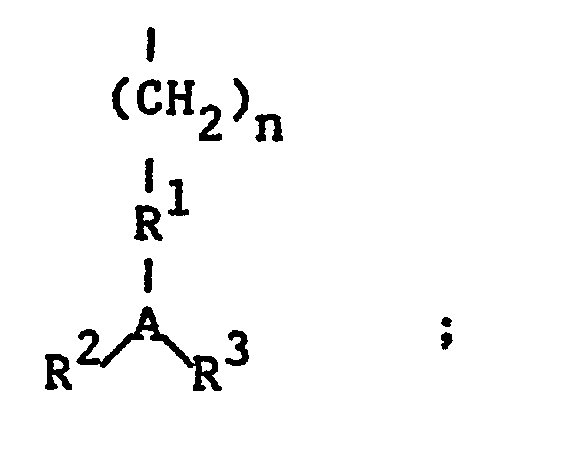
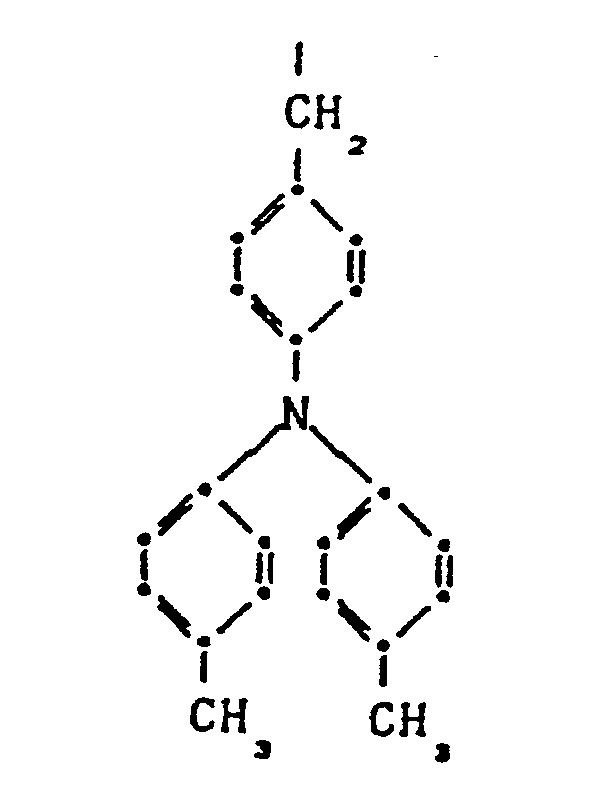
- the polymerized recurring units containing the arylamine photoconductive component a) comprises from 12 to 50 mole percent of the polyester and b) have the structure wherein
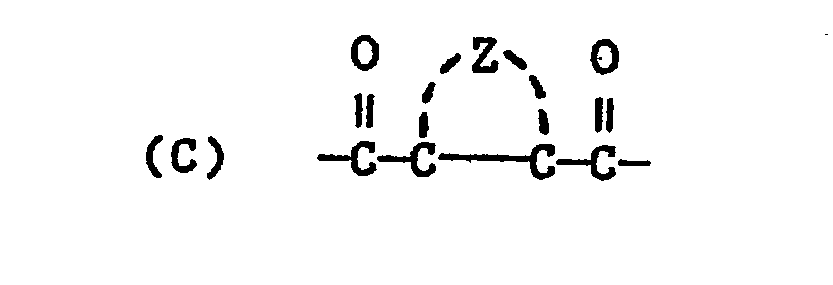
- the polymerized recurring units containing the photocrosslinkable component a) comprise from 15 to 50 mole percent of the polyester, b) the photocrosslinkable component is attached to the condensation residue of an organic diacid, and c) the recurring units are selected from those having the structures wherein
- Alkanetriyl refers to groups such as methylidyne, ethylidyne, propylidyne, benzylidyne, propane-1,3,3-triyl and the like.
- Alkenylidyne refers to anologous unsaturated alkanetriyl groups such as ethen-1,2,2-triyl, propen-1,3,3-triyl, 1- ⁇ 2-thienyl)-1-propen-1,3,3-triyl and the like.
- Alkyl refers to groups such as methyl, ethyl, propyl, isopropyl and the like.
- Aryl refers to groups such as phenyl, naphthyl, methylphenyl, dimethylphenyl and the like.
- Alkylidene refers to methylene, propylene and the like.
- Aralkylidene refers to phenylmethylene, phenylpropylene and the like.
- the arylamine photoconductive component and the photocrosslinkable component respond to different wavelengths of light.
- either the photoconductive component or the photocrosslinkable component can be sensitized to a different wavelength. Methods and materials for accomplishing such sensitization are well known in the photocrosslinking and the photoconductive arts.
- the recurring arylamine photoconductive component is appended to the condensation residue of a diacid component, or the condensation residue of a diol, diamine, or hydroxy substituted amine component of the polyesters of this invention.
- Such recurring arylamine photoconductive components are attached to the diacid residue of the polyester, for example, by basic condensation of an arylamine photoconductor having an aldehyde substituent with an active methylene of a diacid radical to produce an unsaturated bond joining the photoconductor to the diacid portion of the polyester.
- the unsaturated bond is thereafter reduced by hydrogenation over a palladium/charcoal catalyst.
- Examples of useful arylamine photoconductors having the required aldehyde group include 4,4'-(4- formylbenzylidene)bis(N,N-diethyl-m-toluidine), 4-anilinobenzaldehyde; 4,4'-(4-formylbenzylidene)-bis(N,N-dibenzyl-m-toluidine); 4,4 !- (4-formylbenzylidene)bis(N,N-dicyclohexyl-m-toluidine); 4,4'-(4- formylbenzylidene)bis(N-benzyl-N-ethyl-m-toluidine); 4-diethylamino-4'-formyltetraphenyl-methane; 1-[4-(N,N-dimethylamino)phenyl]-1-(4-formylphenyl)-I-phenylethane; 4-(2-naphthylamin
- the recurring arylamine photoconductor group can also be attached to a diacid precursor of the polyester followed by polycondensation of the diacid component with the other appropriate condensation polymer components.
- the arylamine is attached to the diacid component of a preformed polymer. The alternative method is preferred in the event that high molecular weight polymers are desired.
- Particularly useful arylamine photoconductors which can be attached to the diacid residue of the polyesters include triphenylamine-type photoconductors, including substituted triphenylamines.
- Especially useful organic photoconductors in this regard are triphenylamine, 4-diphenylaminochalcone, 4-hy- droxymethyltriphenylamine, 4-carboxytriphenylamine, and 4-(a-hydroxyethyl)triphenylamine.
- Other useful triphenylamine photoconductors are disclosed in, for example, U.S. Patent 3 180 730 granted to Klup- fel et al, April 27, 1965.
- dicarboxcyclic acids containing the pendant arylamine are chemically reduced to yield the corresponding diol.
- Exemplary dicarboxylic acids containing an arylamine photoconductive component and which are readily reduced to diols include 2- ⁇ 4-[bis(4-di- ethylamino-o-tolyl)methyl]benzyl malonic acid; 2-(4-anilinobenzyl)malonic acid; 2-(4-[bis(4-dibenzylami- no-o-tolyl)methyl]benzyl malonic acid; 2- ⁇ 4-[bis(4-dicyclohexylamino-o-tolyl)methyl]benzyl malonic acid; 2- ⁇ 4- ⁇ bis[4-(N-ethyl-N-benzyl)amino-o-tolyl]methyl benzyl malonic acid; 2-(4-[(4-diethylaminophe- nyldiphenyl)methyl]benzyl malonic acid; 2-(4-[1-(4-dimethylaminophenyl)-I-phenylethyl]benz
- Attachment of the arylamine to organic diamines or hydroxyamines can be carried out by known techniques such as by attaching the arylamine to an organic compound already having the diamine or hydroxyamine functionality.
- an arylamine can be treated to form the diamine or hydroxyamine functionality.
- the photocrosslinkable component of the polyesters is attached to the diacid condensation residue.
- These components can be derived from the following dicarboxylic acids or their functional equivalents: wherein
- Such acids are fully disclosed by Philipot et al, U.S. Patent 3 674 745, issued July 4,1972.
- muconic acids are trans, trans-muconic acid; cis, trans-muconic acid; cis, cis-muconic acid; a,a'-cis, trans-dimethylmuconic acid, and a,a'-cis, cis-dimethylmuconic acids.
- Other compounds useful in forming repeating units are more fully disclosed in McConkey U.S. Patent 3 - 615 434, issued October 26, 1971.
- Such a carbocyclic nucleus can be substituted or unsubstituted.
- Particularly suitable acid units are 4-cyclohexene-1,2-dicarboxylic acid, 5-norbornene-2,3-dicarboxylic acid, hexachloro-5-[2:2:1]bicycloheptene-2,3-dicarboxylic acid and the like.
- Such acids are fully disclosed in Canadian Patent 824 096, issued September 30, 1969. wherein
- alkyl and aryl groups can be substituted with such substituents as do not interfere with the condensation reaction, such as halo, nitro, aryl, alkoxy, aryloxy and the like.
- Particularly suited cyclohexadiene dicarboxylic acid units include 1,3-cyclohexadiene-1,4-dicarboxylic acid; 1,3-cyclohexadiene-1,3-dicarboxylic acid, 1,3-cyclohexadiene-1,2-dicarboxylic acid; 1,5-cyclohexadiene-1,4-dicarboxylic acid; 1,5-cyclohexadiene-1,3-dicarboxylic acid; and alkylated and acylated derivatives of such dicarboxylic acids.
- Such acids as well as the functional derivatives thereof are fully disclosed in Belgian Patent 754 892, issued October 15, 1970.
- polyesters of this invention comprise, when desired, additional recurring units for any desired purpose such as varying solubility, charge control, compatibility with other components, adhesion, and toughness.
- the present polymers include optional repeating units comprising unsubstituted and substituted alkylene, arylene, arylenealkylene, cycloalkylene, heterocyclic groups and ethylenically unsaturated groups.
- Preferred components for affecting the water solubility of the polyesters are up to 20 mole percent of anionic iminodisulfonyl and anionic sulfo components.
- Such components include
- polyesters of this invention were prepared by the standard high-temperature, melt-condensation procedure.
- a polymerization flask was charged with the appropriate glycols and diesters or their respective derivatives.
- the flask was capped with a Vigreaux condenser which was fitted with a nitrogen inlet tube. Gas was flushed through the system at 40 mUmin.
- the flask was immersed in a 235°C salt bath to a level just below the stoppered side arm. When the chemical mixture became a homogeneous melt, one drop of tetraisopropyl orthotitanate was added as a catalyst.
- the volatiles were distilled at 235 ° C and at atmospheric pressure for 4 hours.
- the condenser and inlet tube were replaced with a stainless steel stirrer attached so as to be vacuum tight.
- the pressure was reduced to about 0.05 mm Hg and the polymer stirred at 200 rpm.
- the torque applied by the melt to the stirrer was measured. When the torque was high enough to indicate sufficient polymerization, the stirring and vacuum were stopped and the polymerization flask removed from the bath as quickly as possible.
- the polymerization flask was immersed in liquid nitrogen and the flask was broken away from the cold, solidified glassy polymer.
- Each polymer prepared is listed in Table I.
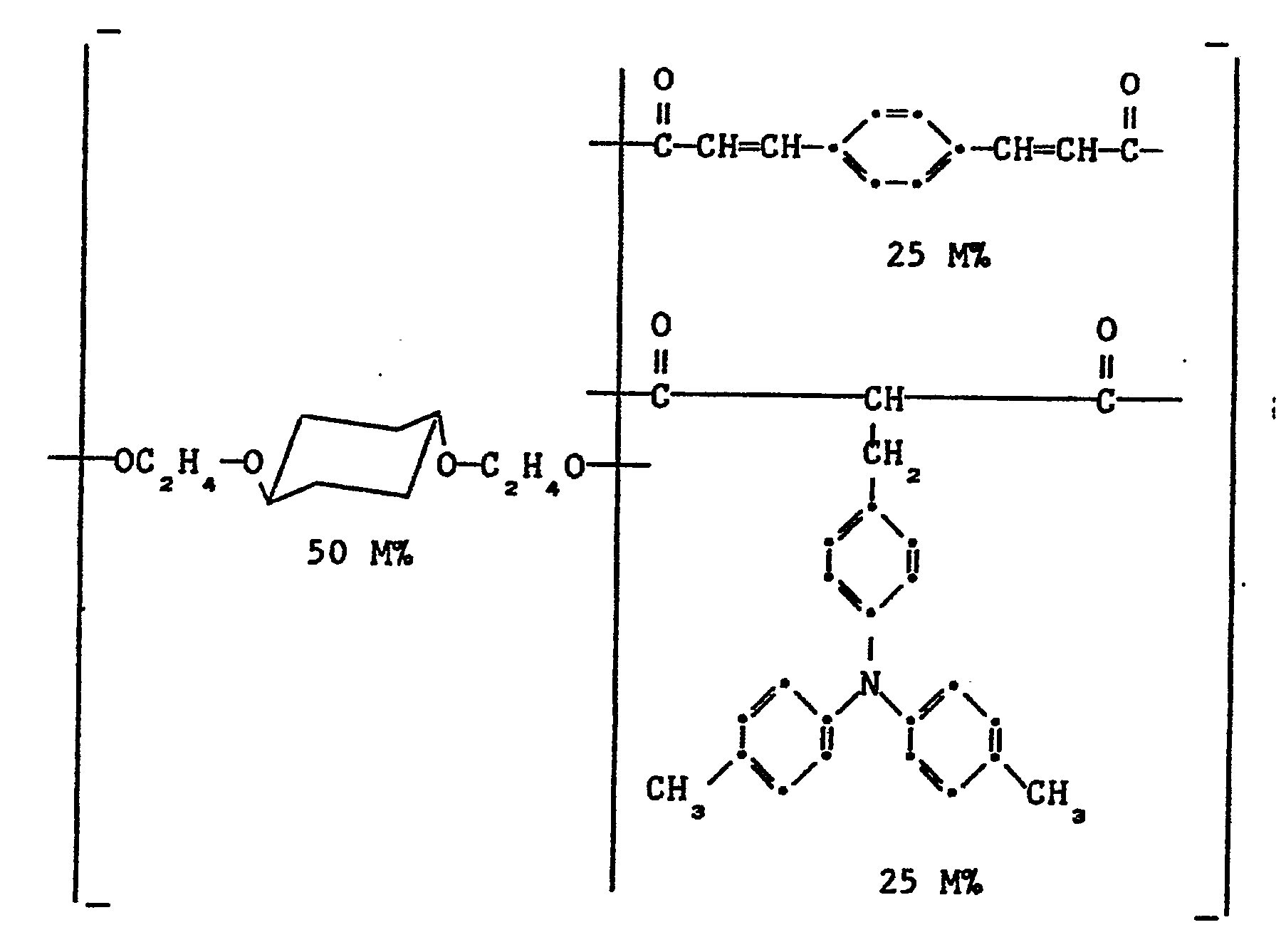
- the glassy-amorphous polymer was amber-orange in color with a Tg of 49 ° C. This polymer is listed as Polymer 1 in Table I, infra.
- This polyester was a bright orange glassy-amorphous polymer with a relatively high Tg of 75 ° C.
- the photocrosslinkable component was incorporated into the portion of the polyester derived from acids, and the triarylamine photoconductive component was incorporated into both the acid-derived and diol-derived portions of the polymer. See Polyester 6.
- This polyester, Polyester 6, an amber-orange glassy polymer had a Tg of 67 ° C.
- Table I lists the polyesters of examples 1-3 and compositional variations of other photocrosslinkable- photoconductive polyesters including the mole percents of the various starting acid and diol monomers.
- Coating compositions containing the polyesters of this invention can be prepared by dispersing or dissolving the polyester in any suitable solvent or combination of solvents used in the art to prepare polymer dopes.
- the solvents are chosen to be a) substantially unreactive toward the polyesters within the time periods contemplated for maintaining the solvent and polymer in association and b) compatible with the substrate employed for coating. The best choice of solvent will vary with the exact polymer and application under consideration.
- Exemplary preferred solvents include benzyl alcohol, water, cyclohexanone, dioxane, 2-methoxyethyl acetate, N,N-dimethylformamide, chloroform, trichloroethylene, 1,2-dichlorethane, 1,1-dichloroethane, 1,1,2-trichloroethane, tetrachloroethane, chlorobenzene and mixtures thereof.
- Optimum concentrations of the polyesters in the coating solutions will also vary, depending upon the specific polymer, and coating method employed. Useful coatings are obtained when the coating solutions contain about 1 to 50 percent by weight, and, preferably, about 2 to 10 percent by weight polyester. Higher concentrations, of course, give satisfactory results. In any case coating compositions are designed so that the resulting layer comprises from 0.54 to 5.4 g/m 2 (50 to 500 mg of the polymer/ft 2 ).
- Elements comprising a support and a radiation-sensitive layer comprising the polyester of this invention can be prepared from the described coating compositions by conventional coating techniques such as spray coating, dip coating, whirl coating, roller coating, etc.
- the support in the element is conductive. It is in electrical contact with the coated composition of this invention.
- conductive supports are well known in electrophotography.
- Specific support materials which are useful in forming printing plates, particularly lithographic printing plates, include supports such as zinc, anodized aluminum, grained aluminum, copper and specially prepared metal and paper supports.
- the polyesters of the invention are particularly useful in forming lithographic elements. Their use eliminates the need to prepare a separate silver halide graphic arts transparency.
- the element is first corona-charged. After charging, the layer is exposed by, for example, a programmed laser thereby discharging the layer in exposed areas. An electrostatic latent image of the original is thus formed. The latent image is then developed with a toner composition of the type well known in electrophotography. Such toner compositions are disclosed in U.S. Patents 3 973 902; 3 117 884; 2 907 674 and many other patents. The toner composition is selected so that deposition of the toner occurs in the discharged areas of the layer, thereby forming a positive electrophotographic image of the original. The positive electrophotographic image serves as a mask eliminating the need for preparing a separate silver halide graphic arts transparency.
- the layer is then exposed with UV radiation causing the polyester in the layer to crosslink in the exposed areas.
- the uncrosslinked and toned portion of the layer is washed away with a developer. The result is a lithographic plate having crosslinked oleophilic printing surfaces.
- Developing is carried out by flushing, soaking, swabbing or otherwise treating the layer with a solution (hereinafter referred to as a developer) which selectively solubilizes the unexposed areas of the layer.
- a developer a solution which selectively solubilizes the unexposed areas of the layer.
- the developer for polyesters containing ionic groups is typically an aqueous alkaline solution having a pH in the range of from about 9 to 14.
- Basicity can be imparted to the developer by the incorporation of soluble inorganic basic compounds such as alkali metal hydroxides, phosphates, sulfates, silicates, carbonates and the like as well as combinations thereof.
- aqueous alkaline commercial developer known as Polymatic" LP available from Eastman Kodak Company is used in the examples hereinafter.
- basic, soluble organic substances such as amines, triethanol amine, diethylene amine, diethylaminoethanol, etc. can be incorporated.
- the developers for substantially non-ionic polymers are organic solvent developers such as Polymat- icTM LN-L Developer available from Eastman Kodak Company.
- the element can then be treated in any known manner consistent with its intended use. For example, printing plates are typically subjected to desensitizing etches. Where the developed layer forms a resist layer, the element is typically subjected to acidic or basic etchants and to plating baths.
- polyesters of this invention were formulated at 5% by weight of the solvent and polymer in 1,2-dichloroethane with 4.4 weight percent, based on the polyester weight, of the coumarin sensitizer
- the dry coating was 4 to 12 ⁇ m thick.
- the coumarin sensitizer was
- the formulations were whirl-coated on anodized-grained-subbed aluminum.
- the films were exposed imagewise through a variable-density scale with a source which contained a high-pressure mercury vapor light source.
- the films were developed with the PolymaticTM LN Developer.
- the photographic speed results are listed in Table II in terms of the number of steps developed as a result of exposure through a step tablet having 14 density steps.
- Polymers 2, 4 and 6 were dissolved in 1,2-dichloroethane at 12 weight percent with 4.6 weight percent of 3-benzoyl-5,7-dipropoxycoumarin sensitizer. Each solution was whirl-coated on anodized aluminum at 2400 rpm until dry. The dry layer thickness was about 2 ⁇ m and the coverage of the polyester was 4.3 g/m2 (400 mg/ft2).
- the layers were then charged with a corona charger to their maximum holding potential, V o . They were then exposed with a 350 nm light source through a contact negative. The photodischarge speeds are shown in Table III.
- the electrostatic latent image was toned with a liquid toner under zero bias yielding high contrast images. These images were fused using a conventional lab hot plate.
- the layers were then exposed with 366 ⁇ 405 nm radiation through the developed electrophotographic image.
- the coatings were developed with the PoIymaticTM LN Developer. The developer removed the electrophotographic image and uncrosslinked polymer areas, leaving an image of crosslinked polymer on the aluminum support which could subsequently be used as a printing plate.
- the results of this example show that the polyesters of the invention can be used to make a lithographic plate without the use of a silver halide transparency.
- This example illustrates the use of a sensitizer to enhance the photoconductive response of the polyesters of this invention.
- Coatings were made with 96.4 weight percent of Polyester 2 (Table I) in dichloromethane and toluene (3:1 ratio) at a coverage of 150 mg/ft 2 (1.6 g/m 2 ).
- the coatings were made on aluminized poly(ethylene terephthalate) film support, and then fumed as described in U.S. patent 4 429 030 and were 1.8 11 m thick.
- the films were charged with a corona charger to their maximum holding potential. They were held at this charge level for 30 seconds before measuring the charge potential Vo.
- the films were then discharged with 640 nm monochromatic light (tungsten light source). Discharge speeds were measured in a negative and positive mode (bimodal). The speeds are recorded as the exposures required at 640 nm to reduce the initial voltage Vo to half its value (Si/2) in ergs/cm 2 . The results are recorded in Table IV.
Landscapes
- Physics & Mathematics (AREA)
- Chemical & Material Sciences (AREA)
- General Physics & Mathematics (AREA)
- Chemical Kinetics & Catalysis (AREA)
- Spectroscopy & Molecular Physics (AREA)
- Medicinal Chemistry (AREA)
- Health & Medical Sciences (AREA)
- Polymers & Plastics (AREA)
- Organic Chemistry (AREA)
- Polyesters Or Polycarbonates (AREA)
- Photoreceptors In Electrophotography (AREA)
- Photosensitive Polymer And Photoresist Processing (AREA)
- Polymerisation Methods In General (AREA)
- Macromonomer-Based Addition Polymer (AREA)
Claims (8)
wobei gilt, daß sämtliche Alkyl- und Arylgruppen, die als solche vorliegen oder Teil einer anderen Gruppe sind, gegebenenfalls substituiert sein können.







Applications Claiming Priority (2)
| Application Number | Priority Date | Filing Date | Title |
|---|---|---|---|
| US06/718,315 US4609606A (en) | 1985-04-01 | 1985-04-01 | Polyesters comprising recurring photoconductive and photocrosslinkable units and elements thereof |
| US718315 | 1991-06-12 |
Publications (2)
| Publication Number | Publication Date |
|---|---|
| EP0199467A1 EP0199467A1 (de) | 1986-10-29 |
| EP0199467B1 true EP0199467B1 (de) | 1989-02-08 |
Family
ID=24885645
Family Applications (1)
| Application Number | Title | Priority Date | Filing Date |
|---|---|---|---|
| EP86302224A Expired EP0199467B1 (de) | 1985-04-01 | 1986-03-26 | Wiederholende photoleitfähige und photovernetzbare Einheiten enthaltende Polyester und Elemente daraus |
Country Status (5)
| Country | Link |
|---|---|
| US (1) | US4609606A (de) |
| EP (1) | EP0199467B1 (de) |
| JP (1) | JPS61230137A (de) |
| CA (1) | CA1251884A (de) |
| DE (1) | DE3662050D1 (de) |
Families Citing this family (9)
| Publication number | Priority date | Publication date | Assignee | Title |
|---|---|---|---|---|
| US4950732A (en) * | 1986-12-29 | 1990-08-21 | Eastman Kodak Company | Condensation copolymers containing bis-methine moieties and products therefrom |
| EP0340244A1 (de) * | 1987-02-03 | 1989-11-08 | Eastman Kodak Company | Lichtempfindliche zusammensetzung für schnelle entwicklung in wasserhaltigen lösungen und druckplatte damit |
| US5213853A (en) * | 1991-11-26 | 1993-05-25 | Eastman Kodak Company | Photosensitive crosslinkable polyester alignment layers for liquid crystal displays |
| KR100300490B1 (ko) * | 1993-09-14 | 2002-03-21 | 시바타 미노루 | 평판인쇄판 |
| US7652128B2 (en) * | 2004-11-05 | 2010-01-26 | Xerox Corporation | Toner composition |
| CN105793779A (zh) | 2013-08-25 | 2016-07-20 | 分子玻璃公司 | 用于有机电子应用的分子玻璃混合物 |
| US10593886B2 (en) | 2013-08-25 | 2020-03-17 | Molecular Glasses, Inc. | OLED devices with improved lifetime using non-crystallizable molecular glass mixture hosts |
| US10461269B2 (en) | 2013-12-20 | 2019-10-29 | Molecular Glasses, Inc. | Crosslinkable, /polymerizable and combinations thereof charge-transporting molecular glass mixtures, luminescent molecular glass mixtures, or combinations thereof for organic light emitting diodes and other organic electronics and photonics applications and method of making same |
| US10160829B2 (en) | 2015-08-20 | 2018-12-25 | 3M Innovative Properties Company | Functionalized polyester polymers and film articles |
Family Cites Families (17)
| Publication number | Priority date | Publication date | Assignee | Title |
|---|---|---|---|---|
| US2956878A (en) * | 1956-11-13 | 1960-10-18 | Eastman Kodak Co | Photosensitive polymers and their applications in photography |
| US3459690A (en) * | 1967-01-24 | 1969-08-05 | Ppg Industries Inc | Ungelled,organic solvent-soluble interpolymers containing unsaturated aldehydes and coating compositions made therefrom |
| GB1230772A (de) * | 1967-03-31 | 1971-05-05 | ||
| US3929489A (en) * | 1973-09-14 | 1975-12-30 | Eastman Kodak Co | Lithographic plates having radiation sensitive elements developable with aqueous alcohol |
| US4187112A (en) * | 1973-11-19 | 1980-02-05 | Toyobo Co., Ltd. | Photosensitive plate containing nitrogen containing condensation type polyesters |
| JPS5340537B2 (de) * | 1974-12-27 | 1978-10-27 | ||
| US4101326A (en) * | 1976-02-09 | 1978-07-18 | Eastman Kodak Company | Process for making stabilized polyesters used in radiation-sensitive compositions for lithographic plates having improved wear life including hindered phenols and phosphoric acid esters |
| US4139390A (en) * | 1977-02-10 | 1979-02-13 | Eastman Kodak Company | Presensitized printing plate having a print-out image |
| US4190446A (en) * | 1978-09-06 | 1980-02-26 | Eastman Kodak Company | Photocrosslinkable, high-temperature-resistant polymers and their use in color imaging devices |
| US4267961A (en) * | 1978-09-06 | 1981-05-19 | Eastman Kodak Company | Photocrosslinkable, high-temperature-resistant polymers and their use in color imaging devices |
| US4258112A (en) * | 1978-10-23 | 1981-03-24 | Eastman Kodak Company | Sensitizer for electrophoretic migration imaging dispersions |
| US4340454A (en) * | 1979-09-14 | 1982-07-20 | Eastman Kodak Company | Photocrosslinkable, high-temperature-resistant polymers and their use in color imaging devices |
| US4291115A (en) * | 1979-09-18 | 1981-09-22 | E. I. Du Pont De Nemours And Company | Elements and method which use photopolymerizable compositions based on salt-forming polymers and polyhydroxy polyethers |
| DE2952698A1 (de) * | 1979-12-29 | 1981-07-02 | Hoechst Ag, 6230 Frankfurt | Photopolymerisierbares gemisch und damit hergestelltes photopolymerisierbares kopiermaterial |
| US4331751A (en) * | 1980-11-17 | 1982-05-25 | Eastman Kodak Company | Electrically photosensitive materials and elements for photoelectrophoretic imaging processes |
| US4361636A (en) * | 1981-04-22 | 1982-11-30 | Eastman Kodak Company | Ionic polyesters for electrically photosensitive composite particles, materials, elements and photoelectrophotoretic imaging methods |
| US4395475A (en) * | 1981-07-20 | 1983-07-26 | Eastman Kodak Company | Condensation polymeric photoconductors containing pendant arylamines |
-
1985
- 1985-04-01 US US06/718,315 patent/US4609606A/en not_active Expired - Fee Related
- 1985-05-24 CA CA000482282A patent/CA1251884A/en not_active Expired
-
1986
- 1986-03-26 DE DE8686302224T patent/DE3662050D1/de not_active Expired
- 1986-03-26 EP EP86302224A patent/EP0199467B1/de not_active Expired
- 1986-03-31 JP JP61071419A patent/JPS61230137A/ja active Pending
Also Published As
| Publication number | Publication date |
|---|---|
| EP0199467A1 (de) | 1986-10-29 |
| CA1251884A (en) | 1989-03-28 |
| JPS61230137A (ja) | 1986-10-14 |
| US4609606A (en) | 1986-09-02 |
| DE3662050D1 (en) | 1989-03-16 |
Similar Documents
| Publication | Publication Date | Title |
|---|---|---|
| JP3189914B2 (ja) | ポリアリールアミンポリエステルを含む電子写真画像形成部材 | |
| EP0199467B1 (de) | Wiederholende photoleitfähige und photovernetzbare Einheiten enthaltende Polyester und Elemente daraus | |
| US2956878A (en) | Photosensitive polymers and their applications in photography | |
| JP2000292913A (ja) | ポジ型感光性樹脂組成物 | |
| EP0568827A2 (de) | Lichtempfindliche Bildaufzeichnungszusammensetzungen | |
| US4946761A (en) | Image-forming layer | |
| US4395475A (en) | Condensation polymeric photoconductors containing pendant arylamines | |
| JPS60258169A (ja) | 2,3‐ビス(ジアルキルアミノフエニル)キノキサリン及び該化合物を含有する電子写真記録材料 | |
| JPH1165107A (ja) | ポジ型感光性樹脂組成物 | |
| US3702765A (en) | Alkali-soluble light sensitive polymers and compositions and processes for using such polymers | |
| JPH0617991B2 (ja) | 光可溶化組成物 | |
| JPS5936259B2 (ja) | 印刷版の形成方法 | |
| JPH01216362A (ja) | 電子写真記録材料 | |
| US4528256A (en) | Electrophotographic recording material with condensation product | |
| EP0063528B1 (de) | Kondensationspolymere Photoleiter mit freien Arylaminseitenketten, photoleitfähige Zusammensetzungen und elektrophotographische Elemente, die diese Photoleiter enthalten | |
| US4124760A (en) | Photopolymerizable diepoxides containing a nitrogen heterocycle | |
| US6376144B1 (en) | Organic photoconductive composition | |
| US5637428A (en) | Lithographic printing plate | |
| JPH0448211B2 (de) | ||
| US3677754A (en) | Photosensitive element comprising light-sensitive polymers and process of using | |
| US4407921A (en) | Electrophotographic elements with polyester binder resins having aprotic end groups | |
| JP2640159B2 (ja) | 電子写真式製版用印刷原版 | |
| US3627732A (en) | Light-sensitive polyesters | |
| JPS6234151A (ja) | 水性アルカリ現像液で現像可能な感光性画像形成材料 | |
| JPS6155643A (ja) | 水性アルカリ現像液で現像可能な感光性画像形成材料 |
Legal Events
| Date | Code | Title | Description |
|---|---|---|---|
| PUAI | Public reference made under article 153(3) epc to a published international application that has entered the european phase |
Free format text: ORIGINAL CODE: 0009012 |
|
| AK | Designated contracting states |
Kind code of ref document: A1 Designated state(s): DE FR GB |
|
| 17P | Request for examination filed |
Effective date: 19870202 |
|
| 17Q | First examination report despatched |
Effective date: 19880520 |
|
| GRAA | (expected) grant |
Free format text: ORIGINAL CODE: 0009210 |
|
| AK | Designated contracting states |
Kind code of ref document: B1 Designated state(s): DE FR GB |
|
| REF | Corresponds to: |
Ref document number: 3662050 Country of ref document: DE Date of ref document: 19890316 |
|
| ET | Fr: translation filed | ||
| PLBE | No opposition filed within time limit |
Free format text: ORIGINAL CODE: 0009261 |
|
| STAA | Information on the status of an ep patent application or granted ep patent |
Free format text: STATUS: NO OPPOSITION FILED WITHIN TIME LIMIT |
|
| 26N | No opposition filed | ||
| PGFP | Annual fee paid to national office [announced via postgrant information from national office to epo] |
Ref country code: GB Payment date: 19930219 Year of fee payment: 8 |
|
| PGFP | Annual fee paid to national office [announced via postgrant information from national office to epo] |
Ref country code: FR Payment date: 19930315 Year of fee payment: 8 |
|
| PGFP | Annual fee paid to national office [announced via postgrant information from national office to epo] |
Ref country code: DE Payment date: 19930401 Year of fee payment: 8 |
|
| PG25 | Lapsed in a contracting state [announced via postgrant information from national office to epo] |
Ref country code: GB Effective date: 19940326 |
|
| GBPC | Gb: european patent ceased through non-payment of renewal fee |
Effective date: 19940326 |
|
| PG25 | Lapsed in a contracting state [announced via postgrant information from national office to epo] |
Ref country code: FR Effective date: 19941130 |
|
| PG25 | Lapsed in a contracting state [announced via postgrant information from national office to epo] |
Ref country code: DE Effective date: 19941201 |
|
| REG | Reference to a national code |
Ref country code: FR Ref legal event code: ST |