EP0198264A2 - Carbamoylimidazole - Google Patents
Carbamoylimidazole Download PDFInfo
- Publication number
- EP0198264A2 EP0198264A2 EP86103814A EP86103814A EP0198264A2 EP 0198264 A2 EP0198264 A2 EP 0198264A2 EP 86103814 A EP86103814 A EP 86103814A EP 86103814 A EP86103814 A EP 86103814A EP 0198264 A2 EP0198264 A2 EP 0198264A2
- Authority
- EP
- European Patent Office
- Prior art keywords
- halogen
- dimethyl
- phenyl
- tetrahydroquinolin
- formula
- Prior art date
- Legal status (The legal status is an assumption and is not a legal conclusion. Google has not performed a legal analysis and makes no representation as to the accuracy of the status listed.)
- Withdrawn
Links
- 0 C*(*1)C1(C1(C)C)C(*)(CS)N(C(*2C=CC=C2)=O)C2=C1C=CC(C)C=C2 Chemical compound C*(*1)C1(C1(C)C)C(*)(CS)N(C(*2C=CC=C2)=O)C2=C1C=CC(C)C=C2 0.000 description 4
Classifications
-
- C—CHEMISTRY; METALLURGY
- C07—ORGANIC CHEMISTRY
- C07D—HETEROCYCLIC COMPOUNDS
- C07D231/00—Heterocyclic compounds containing 1,2-diazole or hydrogenated 1,2-diazole rings
- C07D231/02—Heterocyclic compounds containing 1,2-diazole or hydrogenated 1,2-diazole rings not condensed with other rings
- C07D231/10—Heterocyclic compounds containing 1,2-diazole or hydrogenated 1,2-diazole rings not condensed with other rings having two or three double bonds between ring members or between ring members and non-ring members
- C07D231/12—Heterocyclic compounds containing 1,2-diazole or hydrogenated 1,2-diazole rings not condensed with other rings having two or three double bonds between ring members or between ring members and non-ring members with only hydrogen atoms, hydrocarbon or substituted hydrocarbon radicals, directly attached to ring carbon atoms
-
- C—CHEMISTRY; METALLURGY
- C07—ORGANIC CHEMISTRY
- C07D—HETEROCYCLIC COMPOUNDS
- C07D403/00—Heterocyclic compounds containing two or more hetero rings, having nitrogen atoms as the only ring hetero atoms, not provided for by group C07D401/00
- C07D403/02—Heterocyclic compounds containing two or more hetero rings, having nitrogen atoms as the only ring hetero atoms, not provided for by group C07D401/00 containing two hetero rings
- C07D403/12—Heterocyclic compounds containing two or more hetero rings, having nitrogen atoms as the only ring hetero atoms, not provided for by group C07D401/00 containing two hetero rings linked by a chain containing hetero atoms as chain links
-
- A—HUMAN NECESSITIES
- A01—AGRICULTURE; FORESTRY; ANIMAL HUSBANDRY; HUNTING; TRAPPING; FISHING
- A01N—PRESERVATION OF BODIES OF HUMANS OR ANIMALS OR PLANTS OR PARTS THEREOF; BIOCIDES, e.g. AS DISINFECTANTS, AS PESTICIDES OR AS HERBICIDES; PEST REPELLANTS OR ATTRACTANTS; PLANT GROWTH REGULATORS
- A01N47/00—Biocides, pest repellants or attractants, or plant growth regulators containing organic compounds containing a carbon atom not being member of a ring and having no bond to a carbon or hydrogen atom, e.g. derivatives of carbonic acid
- A01N47/08—Biocides, pest repellants or attractants, or plant growth regulators containing organic compounds containing a carbon atom not being member of a ring and having no bond to a carbon or hydrogen atom, e.g. derivatives of carbonic acid the carbon atom having one or more single bonds to nitrogen atoms
- A01N47/28—Ureas or thioureas containing the groups >N—CO—N< or >N—CS—N<
- A01N47/38—Ureas or thioureas containing the groups >N—CO—N< or >N—CS—N< containing the group >N—CO—N< where at least one nitrogen atom is part of a heterocyclic ring; Thio analogues thereof
-
- C—CHEMISTRY; METALLURGY
- C07—ORGANIC CHEMISTRY
- C07D—HETEROCYCLIC COMPOUNDS
- C07D215/00—Heterocyclic compounds containing quinoline or hydrogenated quinoline ring systems
- C07D215/02—Heterocyclic compounds containing quinoline or hydrogenated quinoline ring systems having no bond between the ring nitrogen atom and a non-ring member or having only hydrogen atoms or carbon atoms directly attached to the ring nitrogen atom
- C07D215/04—Heterocyclic compounds containing quinoline or hydrogenated quinoline ring systems having no bond between the ring nitrogen atom and a non-ring member or having only hydrogen atoms or carbon atoms directly attached to the ring nitrogen atom with only hydrogen atoms or radicals containing only hydrogen and carbon atoms, directly attached to the ring carbon atoms
- C07D215/08—Heterocyclic compounds containing quinoline or hydrogenated quinoline ring systems having no bond between the ring nitrogen atom and a non-ring member or having only hydrogen atoms or carbon atoms directly attached to the ring nitrogen atom with only hydrogen atoms or radicals containing only hydrogen and carbon atoms, directly attached to the ring carbon atoms with acylated ring nitrogen atom
-
- C—CHEMISTRY; METALLURGY
- C07—ORGANIC CHEMISTRY
- C07D—HETEROCYCLIC COMPOUNDS
- C07D215/00—Heterocyclic compounds containing quinoline or hydrogenated quinoline ring systems
- C07D215/02—Heterocyclic compounds containing quinoline or hydrogenated quinoline ring systems having no bond between the ring nitrogen atom and a non-ring member or having only hydrogen atoms or carbon atoms directly attached to the ring nitrogen atom
- C07D215/12—Heterocyclic compounds containing quinoline or hydrogenated quinoline ring systems having no bond between the ring nitrogen atom and a non-ring member or having only hydrogen atoms or carbon atoms directly attached to the ring nitrogen atom with substituted hydrocarbon radicals attached to ring carbon atoms
-
- C—CHEMISTRY; METALLURGY
- C07—ORGANIC CHEMISTRY
- C07D—HETEROCYCLIC COMPOUNDS
- C07D215/00—Heterocyclic compounds containing quinoline or hydrogenated quinoline ring systems
- C07D215/02—Heterocyclic compounds containing quinoline or hydrogenated quinoline ring systems having no bond between the ring nitrogen atom and a non-ring member or having only hydrogen atoms or carbon atoms directly attached to the ring nitrogen atom
- C07D215/16—Heterocyclic compounds containing quinoline or hydrogenated quinoline ring systems having no bond between the ring nitrogen atom and a non-ring member or having only hydrogen atoms or carbon atoms directly attached to the ring nitrogen atom with hetero atoms or with carbon atoms having three bonds to hetero atoms with at the most one bond to halogen, e.g. ester or nitrile radicals, directly attached to ring carbon atoms
- C07D215/18—Halogen atoms or nitro radicals
-
- C—CHEMISTRY; METALLURGY
- C07—ORGANIC CHEMISTRY
- C07D—HETEROCYCLIC COMPOUNDS
- C07D215/00—Heterocyclic compounds containing quinoline or hydrogenated quinoline ring systems
- C07D215/02—Heterocyclic compounds containing quinoline or hydrogenated quinoline ring systems having no bond between the ring nitrogen atom and a non-ring member or having only hydrogen atoms or carbon atoms directly attached to the ring nitrogen atom
- C07D215/16—Heterocyclic compounds containing quinoline or hydrogenated quinoline ring systems having no bond between the ring nitrogen atom and a non-ring member or having only hydrogen atoms or carbon atoms directly attached to the ring nitrogen atom with hetero atoms or with carbon atoms having three bonds to hetero atoms with at the most one bond to halogen, e.g. ester or nitrile radicals, directly attached to ring carbon atoms
- C07D215/20—Oxygen atoms
-
- C—CHEMISTRY; METALLURGY
- C07—ORGANIC CHEMISTRY
- C07D—HETEROCYCLIC COMPOUNDS
- C07D215/00—Heterocyclic compounds containing quinoline or hydrogenated quinoline ring systems
- C07D215/02—Heterocyclic compounds containing quinoline or hydrogenated quinoline ring systems having no bond between the ring nitrogen atom and a non-ring member or having only hydrogen atoms or carbon atoms directly attached to the ring nitrogen atom
- C07D215/16—Heterocyclic compounds containing quinoline or hydrogenated quinoline ring systems having no bond between the ring nitrogen atom and a non-ring member or having only hydrogen atoms or carbon atoms directly attached to the ring nitrogen atom with hetero atoms or with carbon atoms having three bonds to hetero atoms with at the most one bond to halogen, e.g. ester or nitrile radicals, directly attached to ring carbon atoms
- C07D215/20—Oxygen atoms
- C07D215/24—Oxygen atoms attached in position 8
- C07D215/26—Alcohols; Ethers thereof
-
- C—CHEMISTRY; METALLURGY
- C07—ORGANIC CHEMISTRY
- C07D—HETEROCYCLIC COMPOUNDS
- C07D215/00—Heterocyclic compounds containing quinoline or hydrogenated quinoline ring systems
- C07D215/02—Heterocyclic compounds containing quinoline or hydrogenated quinoline ring systems having no bond between the ring nitrogen atom and a non-ring member or having only hydrogen atoms or carbon atoms directly attached to the ring nitrogen atom
- C07D215/16—Heterocyclic compounds containing quinoline or hydrogenated quinoline ring systems having no bond between the ring nitrogen atom and a non-ring member or having only hydrogen atoms or carbon atoms directly attached to the ring nitrogen atom with hetero atoms or with carbon atoms having three bonds to hetero atoms with at the most one bond to halogen, e.g. ester or nitrile radicals, directly attached to ring carbon atoms
- C07D215/36—Sulfur atoms
-
- C—CHEMISTRY; METALLURGY
- C07—ORGANIC CHEMISTRY
- C07D—HETEROCYCLIC COMPOUNDS
- C07D215/00—Heterocyclic compounds containing quinoline or hydrogenated quinoline ring systems
- C07D215/02—Heterocyclic compounds containing quinoline or hydrogenated quinoline ring systems having no bond between the ring nitrogen atom and a non-ring member or having only hydrogen atoms or carbon atoms directly attached to the ring nitrogen atom
- C07D215/16—Heterocyclic compounds containing quinoline or hydrogenated quinoline ring systems having no bond between the ring nitrogen atom and a non-ring member or having only hydrogen atoms or carbon atoms directly attached to the ring nitrogen atom with hetero atoms or with carbon atoms having three bonds to hetero atoms with at the most one bond to halogen, e.g. ester or nitrile radicals, directly attached to ring carbon atoms
- C07D215/48—Carbon atoms having three bonds to hetero atoms with at the most one bond to halogen
-
- C—CHEMISTRY; METALLURGY
- C07—ORGANIC CHEMISTRY
- C07D—HETEROCYCLIC COMPOUNDS
- C07D219/00—Heterocyclic compounds containing acridine or hydrogenated acridine ring systems
- C07D219/02—Heterocyclic compounds containing acridine or hydrogenated acridine ring systems with only hydrogen, hydrocarbon or substituted hydrocarbon radicals, directly attached to carbon atoms of the ring system
-
- C—CHEMISTRY; METALLURGY
- C07—ORGANIC CHEMISTRY
- C07D—HETEROCYCLIC COMPOUNDS
- C07D219/00—Heterocyclic compounds containing acridine or hydrogenated acridine ring systems
- C07D219/04—Heterocyclic compounds containing acridine or hydrogenated acridine ring systems with hetero atoms or with carbon atoms having three bonds to hetero atoms with at the most one bond to halogen, e.g. ester or nitrile radicals, directly attached to carbon atoms of the ring system
-
- C—CHEMISTRY; METALLURGY
- C07—ORGANIC CHEMISTRY
- C07D—HETEROCYCLIC COMPOUNDS
- C07D233/00—Heterocyclic compounds containing 1,3-diazole or hydrogenated 1,3-diazole rings, not condensed with other rings
- C07D233/54—Heterocyclic compounds containing 1,3-diazole or hydrogenated 1,3-diazole rings, not condensed with other rings having two double bonds between ring members or between ring members and non-ring members
- C07D233/56—Heterocyclic compounds containing 1,3-diazole or hydrogenated 1,3-diazole rings, not condensed with other rings having two double bonds between ring members or between ring members and non-ring members with only hydrogen atoms or radicals containing only hydrogen and carbon atoms, attached to ring carbon atoms
-
- C—CHEMISTRY; METALLURGY
- C07—ORGANIC CHEMISTRY
- C07D—HETEROCYCLIC COMPOUNDS
- C07D249/00—Heterocyclic compounds containing five-membered rings having three nitrogen atoms as the only ring hetero atoms
- C07D249/02—Heterocyclic compounds containing five-membered rings having three nitrogen atoms as the only ring hetero atoms not condensed with other rings
- C07D249/08—1,2,4-Triazoles; Hydrogenated 1,2,4-triazoles
Definitions
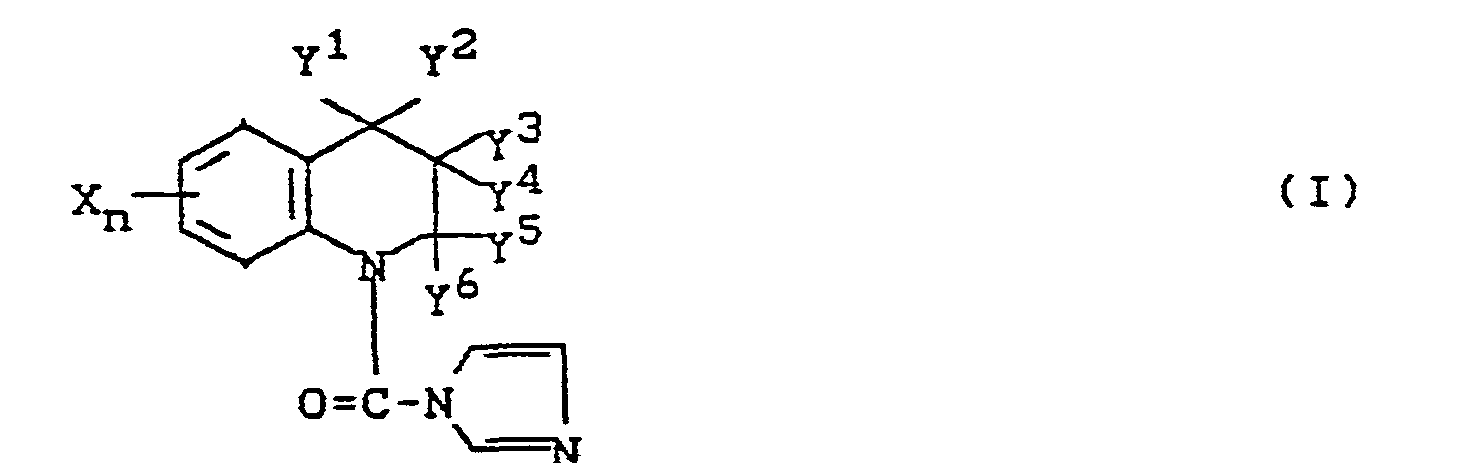
- the present invention relates to new carbamoylimidazoles, processes for their preparation and their use as herbicides and fungicides for agriculture and horticulture and new intermediates for their production.
- the compounds of the formula (IV) are obtained when the compounds of the formula (II) described above are reacted with phosgene or with trichloromethylchloroformate.
- the carbamoylimidazoles according to the invention have an essentially superior herbicidal action compared to known compounds of the prior art, in particular a selective herbicidal action against rice field weeds and also a fungicidal action in the field of agriculture and horticulture.
- Most preferred compounds of the general formula (I) are those in which X, Y 1 , Y 2 , Y 3 , Y 4 , Y 5 and Y 6 have the meanings given above as being particularly preferred, n is 2 and two substituents X. are bound in the 7-position and the 8-position.
- the formula - (II) denotes compounds in which X, n, Y 1 , Y 2 , Y 3 , Y 4 , Y 5 and Y 6 have the meanings given above, and preferably correspond to X, n , Y 1 , Y 2 , Y 3 , Y 4 , Y 5 and Y 6 have the meanings given above as preferred.
- the 1,2,3,4-tetrahydroquinolines can be obtained in a simple manner by reducing the corresponding quinolines by means of customary procedures, as described, for example, in US Pat. No. 2,786,845 and US Pat 681 are disclosed.
- Virtually all of the corresponding substituted quinolines that are used to obtain the 1,2,3,4-tetrahydroquinolines can either be prepared using the Skraup reaction (see Org. Reactions, Volume 7, pp. 59-98, and J. Org. Chem. 8, p. 544) or the Doebner-Miller reaction (cf. Can. J. Chem. 56, p. 632).
- 2,7,8-trimethylquinoline can be synthesized from 2,3-dimethylaniline and aldehyde
- 8-chloro-3,7-dimethylquinoline can be synthesized from 2-chloro-3-methylaniline and a-methyl acrolein.
- the 1,2-dihydroquinolines can be obtained by cyclizing the corresponding N-2-propynyl-substituted anilines (J. Medicinal Chem. 16, p. 251).
- the 2,2,4-trimethyl-1,2-dihydroquinolines can be obtained, for example, by condensing a substituted aniline with twice the amount of acetone (J. Medicinal Chem. 16, p. 251, and J. Org. Chem. 26, P. 1287).
- 1,2-dihydroquinolines can also be synthesized using the Doebner-Miller reaction (Can. J. Chem. 56, pp. 632).
- the 4-chloro-1,2-dihydroquinolines can also be prepared using the method disclosed in the above mentioned J. Medicinal Chem. 16, p. 251.
- the 1,2,3,4-tetrahydroquinotines can also be obtained by reducing these 1,2-dihydroquinolines.
- the 1,2,3,4,4a, 9,9a, 10-0ctahydroacridine can be synthesized by reducing the corresponding 1,2,3,4-tetrahydroacridine [J. Chem. Soc. 1963, p. 330].
- N, N'-carbonyldiimidazole of the formula (III) is a known compound which is disclosed in Beilstein, volume 23, II, page 35.
- the formula - (IV) denotes compounds in which X, n, Y 1 , Y 2 , Y 3 , Y 4 , Y 5 and Y 6 have the meanings given above, and preferably correspond to X, n , Y 1 , Y 2 , Y 3 , Y 4 , Y s , and Y 5 have the meanings given above as preferred.
- the same inert organic solvents can be used as are listed below for process (a).
- the reaction can be carried out, for example, at a temperature in the range between about 0 ° C. and the boiling point of the reaction mixture and preferably under normal atmospheric pressure.
- the desired compounds of the formula (IV) can be prepared by, for example, 1 mol of the compound of the general formula (11) with 1 to about 10 mol, preferably about 2 to about 5 mol, of phosgene or 1/2 mol to about 10 mol, preferably 1 mol to about 5 mol, of trichloromethylchloroformate is reacted in an inert solvent, the temperature being raised to about the reflux temperature.
- solvents or diluents include aliphatic, alicyclic and aromatic hydrocarbons (which may optionally be chlorinated) such as hexane, cyclohexane, petroleum ether, ligroin, benzene, toluene, xylene, methylene chloride, chloroform, carbon tetrachloride, ethylene chloride, trichloroethylene and chlorobenzene; Ethers such as diethyl ether, methyl ethyl ether, di-isopropyl ether, dibutyl ether, propylene oxide, dioxane and tetrahydrofuran; Ketones such as acetone, methyl ethyl ketone, methyl isopropyl ketone and methyl isobutyl ketone; Nitriles such as acetonitrile, propionitrile and acrylonitrile; Esters such as ethyl acetate and amyl hydro
- Process (a) can be carried out over a wide temperature range.
- the temperature can range from about -20 ° C and the boiling point of the mixture, with a range from about 0 ° C to about 100 ° C being preferred.
- the reaction is conveniently carried out under normal atmospheric pressure, but it is possible to carry out the process under elevated or reduced pressure.
- the desired new compound of the formula (I) can be obtained by using about 1 to about 2 mol, preferably 1 to about 1.2 mol, of N, N'-carbonyldiimidazole in an inert solvent Formula (111) is reacted with 1 mol of the compound of formula (11).
- Process (b) can also be carried out in the presence of an acid-binding agent.
- Acid-binding agents which are mentioned are the customarily used hydroxides, carbonates, hydrogen carbonates and alcoholates of alkali metals, and also tertiary amines such as triethylamine, diethylaniline and pyridine.
- Process (b) can be carried out over a wide temperature range. For example, it can be carried out at a temperature in the range of about 0 ° C and the boiling point of the reaction mixture, preferably from about 50 ° C to about 100 ° C.
- reaction is preferably carried out under normal atmospheric pressure, but it can also be carried out under elevated or reduced pressure.
- the desired new compound of formula (I) can be obtained by e.g. 1 mol of the compound of the general formula (IV) is reacted with about 1 mol to about 5 mol, preferably about 1.1 to about 3 mol, of the imidazole of the formula (V) in an inert solvent.
- the compounds of formula (1) according to the present invention show strong herbicidal activity. Accordingly, these compounds can be used for weed control. When used as an agent for soil treatment before emergence or as an agent for treating leaves and soil, there are striking selective control activities.
- the compounds of formula (I) of the present invention are not only distinguished in terms of their safety, but they also have an outstanding herbicidal activity with a wide herbicidal spectrum.
- the compounds are characterized in that they exert their control action against the rice field weeds listed below, while they do no harm to the rice plants.
- the compounds of the present invention show herbicidal activity against the following weeds growing on higher crop areas.
- the compounds are suitable for total weed control, for example on industrial sites and railroad bodies, and on paths and squares with or without trees.
- the compounds can also be used for weed control in perennial crops, for example afforestation, ornamental tree plantings, orchards, vineyards and gardens, citrus groves, walnut plantations, banana plantations, coffee plantations, tea plantations, rubber plantations, oil palm plantations, cocoa plantations, soft fruit plantations and hop crops, and for crop cultivation in selective fields will.
- the active compounds of the formula (I) also have excellent fungicidal activity and can be used to control undesirable plant pathogens.
- the active compounds of the present invention are used as fungicides for agriculture and horticulture, they are effective against various plant diseases which are caused, for example, by Plasmodiophoromycetes, Oomycetes, Chytridiomycetes, Zygomycetes, Ascomycetes, Basidiomycetes and Deuteromycetes.
- Plant diseases against which the compounds of the present invention are used effectively include, for example, Pyricularia oryzae in rice, Ophiobolus miyabebnus in rice, Altemaria brassicae in cruciferous vegetables, Altemaria mali in apples, Altemaria kukuchiana in pears, Phytophthora infestans in various crops, Colletot Lagenarium in various cucumber and melon species and Botrytis cinerea in various crops. Also to be mentioned is Xanthomonas oryzae, an important bacterial disease.
- the good tolerance of the active substances by the plants at the concentrations required to combat the plant diseases allows the treatment of the aerial parts of the plants, the parts of vegetative reproduction and the seeds and the soil.
- the active ingredients can be converted into customary formulations, such as solutions, emulsions, suspensions, powders, foams, pastes, granules, aerosol, natural or synthetic substances impregnated with the active compound, very fine capsules in polymeric substances, coating compositions for use on seeds - ( Pickling agent) as well as formulations for use with incinerators such as white smoking cartridges, smoking boxes and smoking snakes as well as for cold vaporizing and warm vaporizing using the ultra-low-volume process.
- customary formulations such as solutions, emulsions, suspensions, powders, foams, pastes, granules, aerosol, natural or synthetic substances impregnated with the active compound, very fine capsules in polymeric substances, coating compositions for use on seeds - ( Pickling agent) as well as formulations for use with incinerators such as white smoking cartridges, smoking boxes and smoking snakes as well as for cold vaporizing and warm vaporizing using the ultra-low-volume process.
- formulations can be prepared in a known manner, for example by mixing the active ingredients with extenders, that is to say with liquid or liquefied gaseous or solid diluents or carriers, if appropriate using surfactants, that is emulsifiers and / or dispersants and / or foam-forming agents.
- extenders that is to say with liquid or liquefied gaseous or solid diluents or carriers, if appropriate using surfactants, that is emulsifiers and / or dispersants and / or foam-forming agents.
- surfactants that is emulsifiers and / or dispersants and / or foam-forming agents.
- organic solvents can be used, for example, as auxiliary solvents.
- Aromatic hydrocarbons such as xylene, toluene or alkylnaphthalenes, chlorinated aromatic or chlorinated aliphatic hydrocarbons such as chlorobenzenes, chloroethylenes or methylene chloride, aliphatic hydrocarbons such as cyclohexane or paraffins, for example mineral oil fractions, alcohols such as butanol or glycol, and the like are particularly suitable as liquid solvents, diluents or carriers their ethers and esters, ketones such as acetone, methyl ethyl ketone, methyl isobutyl ketone or cyclohexanone or strongly polar solvents such as dimethylformamide and dimethyl sulfoxide and also water.
- Liquefied gaseous diluents or carriers are to be understood as liquids which would be gaseous at normal temperature and pressure, for example aerosol propellants such as halogenated hydrocarbons and also butane, propane, nitrogen and carbon dioxide.
- Ground natural minerals such as kaolins, clays, talc, chalk, quartz, attapulgite, montmorillonite or diatomaceous earth and ground synthetic minerals such as highly disperse silica, aluminum oxide and silicates can be used as solid carriers.
- Comminuted and fractionated natural stone materials such as calcite, marble, pumice, sepiolite and dolomite, as well as synthetic granules made from inorganic and organic flours and granules made from organic material such as sawdust, coconut shells, corn cobs and tobacco stalks, can be used as solid carriers for granules.
- Non-ionic and anionic emulsifiers such as polyoxyethylene fatty acid esters, polyoxyethylene fatty alcohol ethers, for example alkylaryl polyglycol ethers, alkyl sulfonates, alkyl sulfates, aryl sulfonates and albumin hydrolysis products can be used as emulsifying and / or foam-forming agents.
- Dispersants include, for example, lignin sulfite leaching and methyl cellulose.
- Adhesives such as carboxymethyl cellulose and natural and synthetic polymers in the form of powders, granules or latices such as gum arabic, polyvinyl alcohol and polyvinyl acetate can be used in the formulation.
- colorants such as inorganic pigments such as iron oxide, titanium oxide, and Prussian blue and organic dyes such as alizarin dyes, azo dyes or metal phthalocyanine dyes, such as trace nutrients such as salts of iron, manganese, boron, copper, cobalt
- inorganic pigments such as iron oxide, titanium oxide, and Prussian blue
- organic dyes such as alizarin dyes, azo dyes or metal phthalocyanine dyes, such as trace nutrients such as salts of iron, manganese, boron, copper, cobalt
- trace nutrients such as salts of iron, manganese, boron, copper, cobalt
- the formulations generally contain 0.1 to 95% by weight, preferably 0.5 to 90% by weight, of the active compound.
- the active compounds according to the present invention can be present in the formulations described above or in their various forms of use together with other active compounds, for example with germicides (fungicides and bactericides), insecticides, acaricides, nematicides, herbicides, bird repellants, growth regulators, fertilizers and / or Soil improvement products. Such mixtures can be formulated into ready-to-use preparations or mixed in the tank.
- the active compounds according to the present invention can be used directly as such, or they can be used in the form of such preparations as liquid spray preparations, emulsions, suspensions, as dusting agents, paste or granules. Or they can be used after further dilution.
- the active compound is to be used as a herbicide, it can be applied with the aid of operations such as watering, spraying, atomizing or scattering granules.
- operations such as watering, spraying, atomizing or scattering granules.
- fungicide in agriculture or in horticulture, it can be carried out by means of such operations as watering, spraying, atomizing, atomizing, evaporating, pouring, forming suspensions, coating, dusting, dusting, wet fertilization, wet covering, paste covering, and " Robe covering "can be used.
- the active compounds according to the present invention can be applied either before or after the plants have germinated. It is also possible to work them into the soil before sowing.
- the concentration of the active ingredients can vary within a wide range. This basically depends on the desired results. If the compound is to be used as a herbicide, it is used, for example, in a concentration of from about 0.05 to about 5 kg / ha, preferably from about 0.2 to about 3 kg / ha.
- the compound is to be used as an agricultural and horticultural fungicide, it is used in a concentration of, for example, from about 0.0001 to about 1% by weight, and preferably from about 0.001 to about 0.5% by weight.
- the active compound in the case of seed treatment, can be used in an amount of, for example, about 0.001 to about 50 g, preferably about 0.01 to 10 g, per 1 kg of the seed.
- the active compound can be applied to the desired location, for example in a concentration of from about 0.00001 to about 0.1% by weight, and in particular from about 0.00001 to about 0.2% by weight. , are applied.
- Control connection Z-1 (the compound disclosed in JP Patent Publication 17 748/1968)
- Emulsifier 1 part by weight of benzyloxypolyglycol ether
- the active compound is obtained as an emulsion by mixing 1 part by weight of the active compound with the above-mentioned amounts of carrier and emulsifier. The prescribed dose of the mixture of the active compound is then adjusted by dilution with water.
- the pots were filled with water to a depth of about 6 cm, and a predetermined amount of the compound of the present Invention was added in the form of an emulsion using a pipette to treat each pot. After the treatment, the water was allowed to seep out of the pots at a rate of 2-3 cm per day for two days. Then the water depth in the pots was kept at about 3 cm. In the fourth week after treatment with the chemical, the herbicidal activity and the degree of phytotoxicity were evaluated on a scale from 0 to 5 on the following scale.
- test results are shown in Table 3 using the following weeds as typical examples, which for brevity are referred to as A, B, C, D, E, F and G as indicated below.
- the prescribed dose of the emulsion obtained as above is then adjusted by dilution with water.
- Bush beans (variety: Shin-edogawa) grown in unglazed 9 cm pots at the stage of the first leaf formation were sprayed with the test compounds in the form of an emulsion using a spray gun.
- a pathogen-containing agar disk was prepared which had previously been prepared by cultivating Botrytis cinerea in a PDA medium at 20 ° C. for 2 days and then punching out the tip of the colony with a 5 mm diameter cork borer , placed in the middle of a sheet and left there while the sheet was kept in a humidity chamber at 20 ° C.
- Two days after inoculation the diameter of a lesion was measured and the control effect was calculated.
Landscapes
- Chemical & Material Sciences (AREA)
- Organic Chemistry (AREA)
- Life Sciences & Earth Sciences (AREA)
- Dentistry (AREA)
- Wood Science & Technology (AREA)
- Plant Pathology (AREA)
- Health & Medical Sciences (AREA)
- Engineering & Computer Science (AREA)
- Agronomy & Crop Science (AREA)
- General Health & Medical Sciences (AREA)
- Pest Control & Pesticides (AREA)
- Zoology (AREA)
- Environmental Sciences (AREA)
- Plural Heterocyclic Compounds (AREA)
- Agricultural Chemicals And Associated Chemicals (AREA)
- Pharmaceuticals Containing Other Organic And Inorganic Compounds (AREA)
- Nitrogen Condensed Heterocyclic Rings (AREA)
Abstract
- Y1 zusammen genommen eine Einfachbindung bil-X Halogen, Niederalkyl, Niederalkoxy, Niederalkyl- den können, so daß in dem heterocyclischen Ring thio, halogensubstituiertes Niederalkyl, halogensub- eine Doppelbindung gebildet wird, oder Y4 und Y5 stituiertes Niederalkoxy, halogensubstituiertes Nie- zusammen genommen eine Tetramethylen-Gruppe deralkylthio, Nitro, Cyano, Niederalkylsulfonyl, Nie- bilden können, mit der Maßgabe, daß Y', Y2, Y3, Y4, deralkylsulfinyl, halogensubstituiertes Niederalkyl- Y5 und Y6 nicht alle gleichzeitig Wasserstoff sind, sulfonyl, halogensubstituiertes Niederalkylsulfinyl, Phenyl, Phenoxy oder Phenylthio ist, sowie die Verwendung der neuen Verbindungen als Herbizide und Fungizide für Landwirtschaft und n 0, 1, 2 oder 3 ist und Gartenbau.
- Y7, Y2, Y3, Y4, Y5, und Y6 jeweils Wasserstoff, Nie- (IV)
Description
- Die vorliegende Erfindung betrifft neue Carbamoylimidazole, Verfahren zu ihrer Herstellung und ihre Verwendung als Herbizide und Fungizide für Landwirtschaft und Gartenbau sowie neue Zwischenprodukte für ihre Herstellung.
- Es wurde bereits offenbart, daß ein 2,4,5-Tribromoimidazol-Derivat insektizide und herbizide Aktivitäten besitzt (siehe die JP-Patentveröffentlichung 17 748/1968).
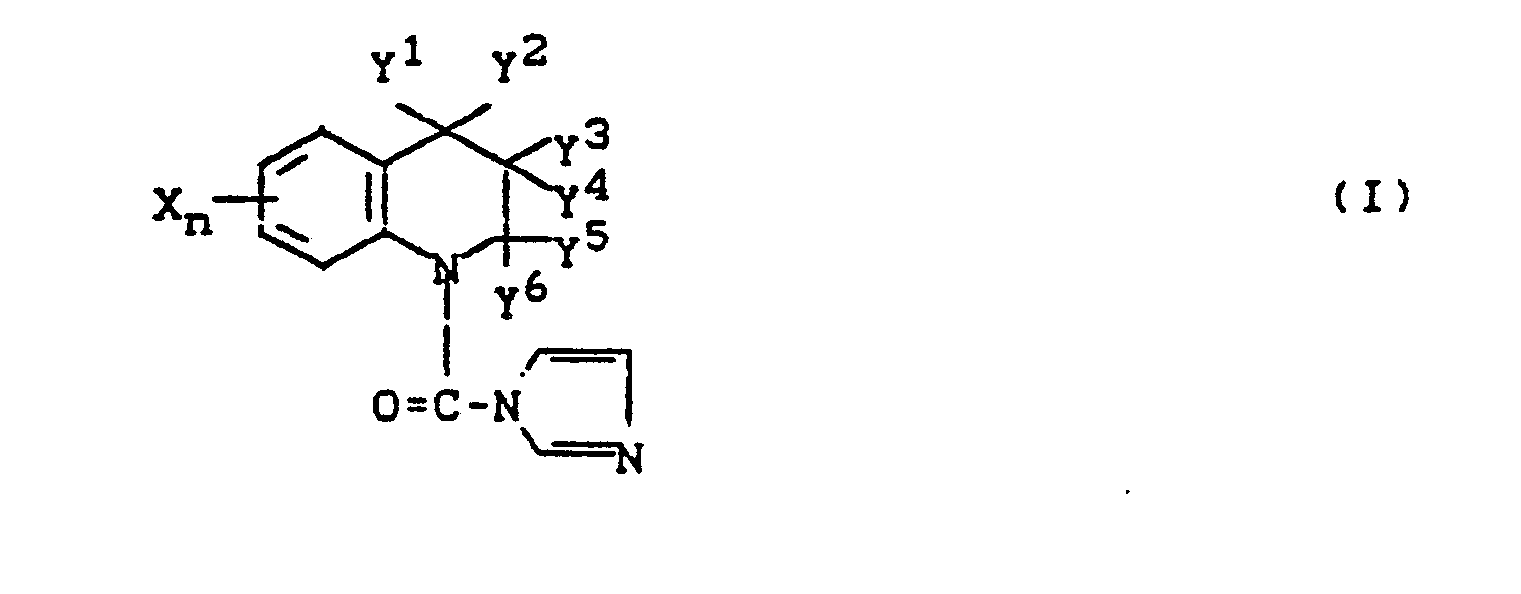
- Es wurden neue Carbamoylimidazole der Formel (I),
-
- n 0, 1, 2 oder 3 ist und
- Y', Y2, Y 3, Y', Ys, und Y6 jeweils Wasserstoff, Niederalkyl, Halogen oder Phenyl sind, wobei Y2 und Y3 zusammen genommen eine Einfachbindung bilden können, so daß in dem heterocyclischen Ring eine Doppelbindung gebildet wird, oder Y4 und Y5 zusammen genommen eine Tetramethylen-Gruppe bilden können, mit der Maßgabe, daß Y', Y2, Y3, Y4, Y5 und Y6 nicht alle gleichzeitig Wasserstoff sind, gefunden.
- In den Definitionenen steht der Begriff "Nieder" jeweils für 1 bis 6 Kohlenstoff-Atome.
- Die Verbindungen der Formel (I)

- X Halogen, Niederalkyl, Niederalkoxy, Niederalkylthio, halogensubstituiertes Niederalkyl, halogensubstituiertes Niederalkoxy, halogensubstituiertes Niederalkylthio, Nitro, Cyano, Niederalkylsulfonyl, Niederalkylsulfinyl, Phenyl, Phenoxy oder Phenylthio ist,
- n 0, 1, 2 oder 3 ist und
- Y1, Y2, Y3, Y4, Y5 und Y6 jeweils Wasserstoff, Niederalkyl, Halogen oder Phenyl sind,
- Tetramethylen-Gruppe bilden können, mit der Maßgabe, daß Y1, Y2, Y3, Y4, Y5 und Y6 nicht alle gleichzeitig Wasserstoff sind, werden durch ein Verfahren erhalten, in dem
- (a) die Verbindungen der Formel (II)

- (b) die Verbindungen der Formel (IV)

- Schließlich wurde gefunden, daß die neuen Carbamoylimidazole hervorragende herbizide Wirkungen und auch fungizide Wirkungen in Landwirtschaft und Gartenbau zeigen.
- Weiterhin gefunden wurden neue Verbindungen der Formel (IV), die Zwischenprodukte in dem Verfahren zur Herstellung der Verbindungen der Formel (I) sind.
- Die Verbindungen der Formel (IV) werden erhalten, wenn die oben bezeichneten Verbindungen der Formel (II) mit Phosgen oder mit Trichloromethylchlorameisensäureester umgesetzt werden.
- Überraschenderweise zeigen die erfindungsgemäßen Carbamoylimidazole gegenüber bekannten Verbindungen des Standes der Technik eine im wesentlichen stark überlegene herbizide Wirkung, insbesondere eine selektive herbizide Wirkung gegen Reisfeld-Unkräuter und auch eine fungizide Wirkung auf dem Gebiet von Landwirtschaft und Gartenbau.
- In den oben angeführten Definitonen der Formeln (I), (II), und (IV) steht der Begriff "Nieder" jeweils für 1 bis 6 Kohlenstoff-Atome.
- Die Formel (I) gibt eine allgemeine Definition der Carbamoylimidazole gemäß der Erfindung. Bevorzugte Verbindungen der Formel (I) sind diejenigen, in denen
- X Fluor, Chlor, Brom, Alkyl mit 1 bis 4 Kohlenstoff-Atomen, Alkoxy mit 1 bis 4 Kohlenstoff-Atomen, Alkylthio mit 1 bis 4 Kohlenstoff-Atomen, fluor-und/oder chlorsubstituiertes Alkyl mit 1 bis 4 Kohlenstoff-Atomen, fluor-und/oder chlorsubstituiertes Alkoxy mit 1 bis 4 Kohlenstoff-Atomen, fluor-und/oder chlorsubstituiertes Alkylthio mit 1 bis 4 Kohlenstoff-Atomen, Nitro, Cyano, Alkylsulfonyl mit 1 bis 4 Kohlenstoff-Atomen, halogensubstituiertes Alkylsulfonyl mit 1 bis 4 Kohlenstoff-Atomen, Alkylsulfinyl mit 1 bis 4 Kohlenstoff-Atomen, Phenyl, Phenoxy, oder Phenylthio ist,
- Y1, Y2, Y3, Y4, Y5 und Y6 jeweils Wasserstoff, Alkyl mit 1 bis 4 Kohlenstoff-Atomen, Chlor oder Phenyl sind,
- Besonders bevorzugte Verbindungen der allgemeinen Formel (I) sind diejenigen, in denen
- X Fluor, Chlor, Methyl, Ethyl, Propyl, Isopropyl, Methoxy, Ethoxy, Methylthio, Ethylthio, Trifluoromethyl, Trifluoromethoxy, Trifluoromethylthio oder Trifluoromethylsulfonyl sind, n 0, 1 oder 2 ist,
- Y1, Y2 und Y3 jeweils Wasserstoff sind und
- Y4, Y5 und Y6 jeweils Wasserstoff, Methyl oder Phenyl sind, mit der Maßgabe, daß Y1, Y2, Y3, Y4, Y5 und Y6 nicht alle gleichzeitig Wasserstoff sind.
- Eine andere Gruppe besonders bevorzugter Verbindungen der Formel (I) sind diejenigen, in denen
- n 0, 1 oder 2 ist,
- Y1, Y2, Y3 und Y6 jeweils Wasserstoff sind und
- Y4 und Y5 zusammen eine Tetramethylen-Gruppe bilden, und
- X die oben als besonders bevorzugt angegebenen Bedeutungen hat.
- Am meisten bevorzugte Verbindungen der allgemeinen Formel (I) sind diejenigen, in denen X, Y1, Y2, Y3, Y4, Y5 und Y6 die oben als besonders bevorzugt angegebenen Bedeutungen haben, n 2 ist und zwei Substituenten X in der 7-Stellung und der 8-Stellung gebunden sind.
- Spezielle Beispiele für die Verbindungen der allgemeinen Formel (I) der vorliegenden Erfindung umfassen insbesondere die folgenden Verbindungen:
- [2,7,8-Trimethyl-1 (H),2,3,4-tetrahydrochinolin-1- ylcarbonyl]imidazol,
- [7,8-Dichloro-3-methyl-1 (H),2,3,4-tetrahydrochinolin-1-ylcarbonyl]imidazol,
- [2,2,7,8-Tetramethyl-1 (H),2,3,4-tetrahydrochinolin-1-ylcarbonyl]imidazol,
- [2,2,7,8-Tetramethyl-1 (H),2-dihydrochinolin-1-ylcarbonyl]imidazol,
- [8-Chloro-2,2,7-trimethyl-1 (H),2,3,4-tetrahydrochinolin-1-ylcarbonyl]imidazol,
- [7-Chloro-2,2,8-trimethyl-1 (H),2,3,4-tetrahydrochinolin-1-ylcarbonyl]imidazol,
- [7-Fluoro-2,8-dimethyl-1 (H),2,3,4-tetrahydrochinolin-1-ylcarbonyl]imidazol und
- [2,2,4,7,8-Pentamethyl-1 (H),2-dihydrochinolin-1-ylcarbonyl]imidazol.
- Wenn beispielsweise 2,2,7,8-Tetramethyl-1,2,3,4-tetrahydrochinolin und N,N'-Carbonyldiimidazol als Ausgangssubstanzen eingesetzt werden, läßt sich der Ablauf der Reaktion in dem erfindungsgemäßen Verfahren (a) durch die folgende Gleichung darstellen:

- Wenn beispielsweise 2,7,8-Trimethyl-1,2,3,4-te- trahydrochinolin und Imidazol als Ausgangssubstanzen eingesetzt werden, läßt sich der Ablauf der Reaktion in dem erfindungsgemäßen Verfahren (b) durch die folgende Gleichung darstellen:

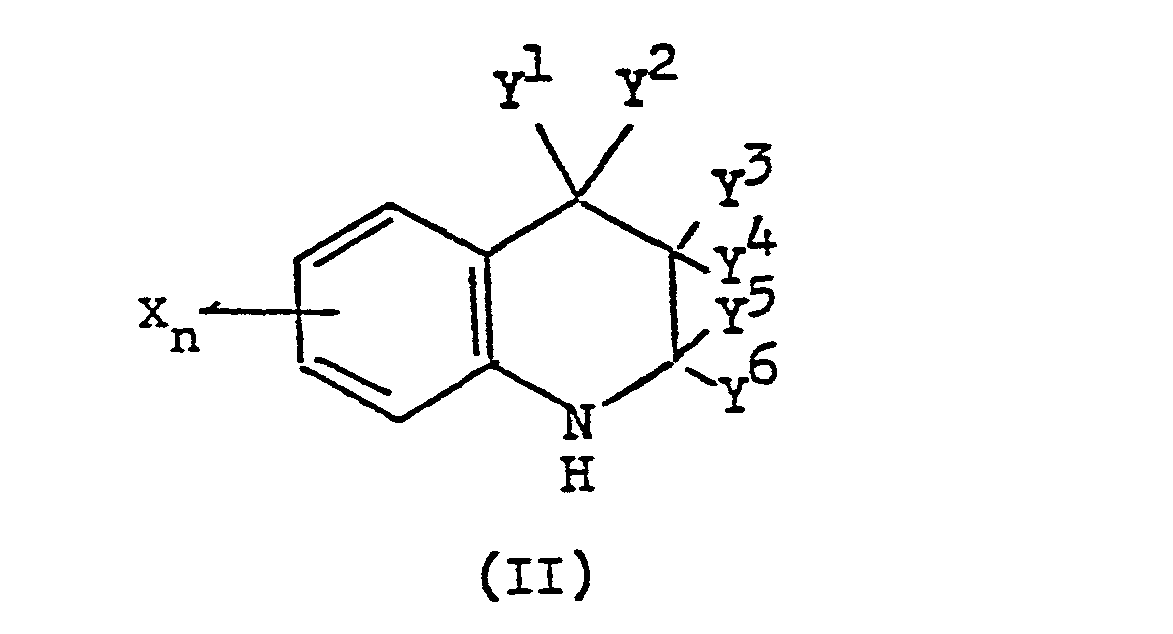
- In dem Verfahren (a) bezeichnet die Formel - (II) Verbindungen, in denen X, n, Y1, Y2, Y3, Y4, Y5 und Y6 die oben angegebenen Bedeutungen haben, und vorzugsweise entsprechen X, n, Y1, Y2, Y3, Y4, Y5 und Y6 den oben als bevorzugt angegebenen Bedeutungen.
- Zu den Verbindungen der Formel (II) zählen solche, die neu sind, sowie auch solche, die bereits vor dem Prioritätsdatum der vorliegenden Anmeldung bekannt waren. Als spezielle Beispiele seien die folgenden Verbindungen aufgeführt:
- 8-Chloro-2-methyl-1,2,3,4-tetrahydrochinolin,
- 8-Fluoro-2-methyl-1,2,3,4-tetrahydrochinolin,
- 2,8-Dimethyl-1,2,3,4-tetrahydrochinolin,
- 8-Ethoxy-2-methyl-1,2,3,4-tetrahydrochinolin,
- 2,7,8-Trimethyl-1,2,3,4-tetrahydrochinolin,
- 7,8-Dichloro-3-methyl-1,2,3,4-tetrahydrochinolin,
- 6,8-Dichloro-4-methyl-1,2,3,4-tetrahydrochinolin,
- 7,8-Dichloro-4-methyl-1,2,3,4-tetrahydrochinolin,
- 2,2,7,8-Tetramethyl-1,2,3,4-tetrahydrochinolin,
- 2,4,7,8-Tetramethyl-1,2,3,4-tetrahydrochinolin,
- 2,2,4,7,8-Pentamethyl-1,2,3,4-tetrahydrochinolin,
- 7,8-Dichloro-1,2-dihydrochinolin,
- 2,2,7,8-Tetramethyl-1,2-dihydrochinolin,
- 2,2,4,7,8-Pentamethyl-1,2-dihydrochinolin,
- 1,2,3,4,4a,9,9a,10-Octahydroacridin,
- 5-Chloro-1,2,3,4,4a,9,9a,10-octahydroacridin,
- 5-Methyl-1,2,3,4,4a,9,9a,10-octahydroacridin,
- 5,6-Dimethyl-1,2,3,4,4a,9,9a,10-octahydroacridin,
- 2-Methyl-1,2,3,4-tetrahydrochinolin,
- 3-Methyl-1,2,3,4-tetrahydrochinolin,
- 4-Methyl-1,2,3,4-tetrahydrochinolin,
- 2-Ethyl-1,2,3,4-tetrahydrochinolin,
- 2-Propyl-1,2,3,4-tetrahydrochinolin,
- 2-Isopropyl-1,2,3,4-tetrahydrochinolin,
- 2,2-Dimethyl-1,2,3,4-tetrahydrochinolin,
- 2,2-Diethyl-1,2,3,4-tetrahydrochinolin,
- 2,2,4-Trimethyl-1,2,3,4-tetrahydrochinolin,
- 8-Chloro-2-ethyl-1,2,3,4-tetrahydrochinolin,
- 6-Chloro-2,2-dimethyl-1,2,3,4-tetrahydrochinolin,
- 8-Chloro-2,2,4-trimethyl-1,2,3,4-tetrahydrochinolin,
- 8-Bromo-2,2-dimethyl-1,2,3,4-tetrahydrochinolin,
- 2-Isopropyl-6-methyl-1,2,3,4-tetrahydrochinolin,
- 2,2,6-Trimethyl-1,2,3,4-tetrahydrochinolin,
- 2,2,8-Trimethyl-1,2,3,4-tetrahydrochinolin,
- 2,2-Dimethyl-8-methoxy-1,2,3,4-tetrahydrochinolin,
- 8-Methoxy-2,2,4-trimethyl-1,2,3,4-tetrahydrochinolin,
- 8-Isopropoxy-2,2,-dimethyl-1,2,3,4-tetrahydrochinolin,
- 2,2-Dimethyl-8-methylthio-1,2,3,4-tetrahydrochinolin,
- 2,2-Dimethyl-8-phenoxy-1,2,3,4-tetrahydrochinolin,
- 2-Methyl-8-phenylthio-1,2,3,4-tetrahydrochinolin,
- 2-Methyl-8-nitro-1,2,3,4-tetrahydrochinolin,
- 2-Methyl-8-trifluoromethyl-1,2,3,4-tetrahydrochinolin,
- 2,2-Dimethyl-8-trifluoromethyl-1,2,3,4-tetrahydrochinolin,
- 8-Cyano-2,2-dimethyl-1,2,3,4-tetrahydrochinolin,
- 6,8-Dichloro-2,2,4-trimethyl-1,2,3,4-tetrahydrochinolin,
- 7,8-Dichloro-2,2,-dimethyl-1,2,3,4-tetrahydrochinolin,
- 7,8-Dichloro-2,2,4-trimethyl-1,2,3,4-tetrahydrochinolin,
- 2,2,6,8-Teframethyl-1,2,3,4-tetrahydrochinolin,
- 7-Chloro-2,8-dimethyl-1,2,3,4-tetrahydrochinolin,
- 7-Chloro-2-ethyl-8-methyl-1,2,3,4-tetrahydrochinolin,
- 8-Chloro-2,2-dimethyl-1,2,3,4-tetrahydrochinolin,
- 7-Chloro-2,2,8-trimethyl-1,2,3,4-tetrahydrochinolin,
- 8-Chloro-2,2,7-trimethyl-1,2,3,4-tetrahydrochinolin,
- 2,2,-Dimethyl-6-fluoro-1,2,3,4-tetrahydrochinolin,
- 2,2-Dimethyl-6-methoxy-1,2,3,4-tetrahydrochinolin,
- 2,2-Dimethyl-6-nitro-1,2,3,4-tetrahydrochinolin,
- 8-Ethyl-2-methyl-1,2,3,4-tetrahydrochinolin,
- 2,8-Dimethyl-7-fluoro-1,2,3,4-tetrahydrochinolin,
- 2,2,-Dimethyl-1,2-dihydrochinolin,
- 2,2,4-Trimethyl-1,2-dihydrochinolin,
- 6-Chloro-2,2-dimethyl-1,2,-dihydrochinolin,
- 2,2,-Dimethyl-6-fluoro-1,2-dihydrochinolin,
- 2,2,6-Trimethyl-1,2-dihydrochinolin,
- 6-Chloro-2,2,4-trimethyl-1,2-dihydrochinolin,
- 4-Chloro-2,2-dimethyl-1,2-dihydrochinolin,
- 4,6-Dichloro-2,2-dimethyl-1,2-dihydrochinolin,
- 4-Chloro-2,2,6-trimethyl,1,2-dihydrochinolin,
- 6,8-Dichloro-4-methyl-1,2-dihydrochinolin,
- 6,8-Dichloro-2,2-dimethyl-1,2-dihydrochinolin,
- 2,2-Dimethyl-6-methoxy-1,2,-dihydrochinolin,
- 2,2-Dimethyl-6-trifluoromethyl-1,2-dihydrochinolin,
- 2,2,6,8-Tetramethyl-1,2-dihydrochinolin,
- 7,8-Dichloro-2,2-dimethyl-1,2-dihydrochinolin,
- 7-Chloro-2,2,8-trimethyl-1,2-dihydrochinolin,
- 7-Chloro-1,2,3,4,4a,9,9a,10-octahydroacridin,
- 7-Methyl-1,2,3,4,4a,9,9a,10-octahydroacridin,
- 7-Methoxy-1,2,3,4,4a,9,9a,10-octahydroacridin,
- 5-Trifluoromethyl-1,2,3,4,4a,9,9a,10- octahydroacridin,
- 7-Trifluoromethyl-1,2,3,4,4a,9,9a,10- octahydroacridin,
- 6-Chloro-5-methyl-1,2,3,4,4a,9,9a,10- octahydroacridin,
- 5,6-Dichloro-1,2,3,4,4a,9,9a,10-octahydroacridin,
- 5,7-Dichloro-1,2,3,4,4a,9,9a,10-octahydroacridin,
- 4-Chloro-2,2,7,8-tetramethyl-1,2-dihydrochinolin,
- 2,2-Dimethyl-4,7,8-trichloro-1,2-dihydrochinolin,
- 4,6-Dichloro-2,2-dimethyl-1,2-dihydrochinolin,
- 2,3,7,8-Tetramethyl-1,2,3,4-tetrahydrochinolin,
- 7,8-Dimethyl-2-ethyl-1,2,3,4-tetrahydrochinolin,
- 7,8-Dimethyl-2-isopropyl-1,2,3,4-tetrahydrochinolin,
- 8-Chloro-2,2-dimethyl-1,2-dihydrochinolin,
- 6-Chloro-2,2,8-trimethyl-1,2-dihydrochinolin,
- 6-Ethoxy-2,2-dimethyl-1,2-dihydrochinolin,
- 6-Ethoxy-2,2,4-trimethyl-1,2-dihydrochinolin,
- 6,8-Dichloro-2,2-dimethyl-1,2,3,4-tetrahydrochinolin,
- 6-Chloro-2,2,8-trimethyl-1,2,3,4-tetrahydrochinolin,
- 6-Ethoxy-2,2,-dimethyl-1,2,3,4-tetrahydrochinolin und
- 6-Ethoxy-2,2,4-trimethyl-1,2,3,4-tetrahydrochinolin.
- Von den Verbindungen der allgemeinen Formel (II) können die 1,2,3,4-Tetrahydrochinoline in einfacher Weise durch Reduktion der entsprechenden Chinoline mittels üblicher Arbeitsweisen erhalten werden, wie sie beispielsweise in US-PS 2 786 845 und US-PS 2 707 681 offenbart sind. Praktisch sämtliche der entsprechenden substituierten Chinoline, die zur Gewinnung der 1,2,3,4-Tetrahydrochinoline eingesetzt werden, können entweder mit Hilfe der Skraup-Reaktion (vgl. Org. Reactions, Band 7, S. 59-98, und J. Org. Chem. 8, S. 544) oder der Doebner-Miller-Reaktion (vgl. Can. J. Chem. 56, S. 632) synthetisiert werden. Beispielsweise kann 2,7,8-Trimethylchinolin aus 2,3-Dimethylanilin und Aldehyd synthetisiert werden, und 8-Chloro-3,7-dimethylchinolin kann aus 2-Chloro-3-methylanilin und a-Methylacrolein synthetisiert werden.
- Auf diese Weise kann durch Kombination eines geeigneten Kondensationsmittels mit einem substituierten Anilin ein Chinolin mit Substituenten hergestellt werden, und durch Reduzieren des erhaltenen Produkts läßt sich das entsprechende 1,2,3,4-Tetrahydrochinolin gewinnen.
- Von den Verbindungen der allgemeinen Formel (11) können die 1,2-Dihydrochinoline durch Cyclisieren der entsprechenden N-2-Propinyl-substituierten Aniline (J. Medicinal Chem. 16, S. 251) erhalten werden.
- Andererseits lassen sich die 2,2,4-Trimethyl-1,2-dihydrochinoline beispielsweise durch Kondensieren eines substitutierten Anilins mit der doppelten Stoffmenge Aceton erhalten (J. Medicinal Chem. 16, S. 251, und J. Org. Chem. 26, S. 1287).
- Weiterhin können die 1,2-Dihydrochinoline auch mit Hilfe der Doebner-Miller-Reakton (Can. J. Chem. 56, S.- 632) synthetisiert werden. Die 4-Chloro-1,2-dihydrochinoline können auch mit Hilfe des in der oben genannten Literaturstelle J. Medicinal Chem. 16 , S. 251, offenbarten Verfahrens hergestellt werden. Die 1,2,3,4-Tetrahydrochinotine können auch durch Reduktion dieser 1,2-Dihydrochinoline gewonnen werden.
- Die 1,2,3,4,4a,9,9a,10-0ctahydroacridine können durch Reduzieren der entsprechenden 1,2,3,4-Tetrahydroacridine synthetisiert werden [J. Chem. Soc. 1963 , S. 330].
- In dem Verfahren (a) ist N,N'-Carbonyldiimidazol der Formel (III) eine bekannte Verbindung, die in Beilstein, Band 23, II, Seite 35 offenbart ist.
- In dem Verfahren (b) bezeichnet die Formel - (IV) Verbindungen, in denen X, n, Y1, Y2, Y3, Y4, Y5 und Y6 die oben angegebenen Bedeutungen haben, und vorzugsweise entsprechen X, n, Y1, Y2, Y3, Y4, Ys, und Y5 den oben als bevorzugt angegebenen Bedeutungen.
- Die Verbindungen der Formel (IV) sind neue Verbindungen, über die vor dem Prioritätsdatum der vorliegenden Anmeldung in bekannten Veröffentlichungen noch nicht berichtet worden ist. Als spezielle Beispiele seien die folgenden Verbindungen aufgeführt:
- 8-Chloro-2-methyl-1 (H),2,3,4-tetrahydrochinolin-1- ylcarbonylchlorid,
- 8-Fluoro-2-methyl-1 (H),2,3,4-tetrahydrochinolin-1- ylcarbonylchlorid,
- 2,8-Dimethyl-1 (H),2,3,4-tetrahydrochinolin-1- ylcarbonylchlorid,
- 8-Ethoxy-2-methyl-1 (H),2,3,4-tetrahydrochinolin-1- ylcarbonylchlorid,
- 2,7,8-Trimethyl-1 (H),2,3,4-tetrahydrochinolin-1- ylcarbonylchlorid,
- 7,8-Dichloro-3-methyl-1 (H),2,3,4-tetrahydrochinolin-1-ylcarbonylchlorid,
- 6,8-Dichloro-4-methyl-1 (H),2,3,4-tetrahydrochinolin-1-ylcarbonylchlorid,
- 7,8-Dichloro-4-methyl-1 (H),2,3,4-tetrahydrochinolin,-1-ylcarbonylchlorid,
- 2,2,7,8-Tetramethyl-1 (H),2,3,4-tetrahydrochinolin-1- ylcarbonylchlorid,
- 2,4,7,8-Tetramethyl-1 (H),2,3,4-tetrahydrochinolin-1- ylcarbonylchlorid,
- 2,2,4,7,8-Pentamethyl-1 (H),2,3,4-tetrahydrochinolin-1-ylcarbonylchlorid,
- 7,8-Dichloro-1 (H),2-dihydrochinolin-1- ylcarbonylchlorid,
- 2,2,7,8-Tetramethyl-1(H),2-dihydrochinolin-1- ylcarbonylchlorid,
- 2,2,4,7,8-Pentamethyl-1 (H),2-dihydrochinolin-1- ylcarbonylchlorid,
- 1,2,3,4,4a,9,9a,10(H)-Octahydroacridin-10- ylcarbonylchlorid,
- 5-Chloro-1,2,3,4,4a,9,9a,10(H)-octahydroacridin-10- ylcarbonylchlorid,
- 5-Meihyl-1,2,3,4,4a,9,9a,10(H)-octahydroacridin-10- ylcarbonylchlorid,
- 5,6-Dimethyl-1,2,3,4,4a,9,9a,10(H)-octahydroacridin-10-ylcarbonylchlorid,
- 2-Methyl-1 (H),2,3,4-tetrahydrochinolin-1- ylcarbonylclorid,
- 3-Methyl-1 (H),2,3,4-tetrahydrochinolin-1- ylcarbonylchlorid,
- 4-Methyl-1 (H),2,3,4-tetrahydrochinolin-1- ylcarbonylchlorid,
- 2-Ethyl-1(H),2,3,4-tetrahydrochinolin-1- ylcarbonylchlorid,
- 2-Propyl-1 (H),2,3,4-tetrahydrochinolin-1- ylcarbonylchlorid,
- 2-Isopropyl-1(H),2,3,4-tetrahydrochinolin-1- ylcarbonylchlorid,
- 2,2-Dimethyl-1 (H),2,3,4-tetrahydrochinolin-1- ylcarbonylchlorid,
- 2,2-Diethyl-1 (H),2,3,4-tetrahydrochinolin-1- ylcarbonylchlorid,
- 2,2,4-Trimethyl-1(H),2,3,4-tetrahydrochinolin-1- ylcarbonylchlorid,
- 8-Chloro-2-ethyl-1 (H),2,3,4-tetrahydrochinolin-1- ylcarbonylchlorid,
- 6-Chloro-2,2-dimethyl-1(H),2,3,4-tetrahydrochinolin-1-ylcarbonylchlorid,
- 8-Chloro-2,2,4-trimethyl-1(H),2,3,4-tetrahydrochinolin-1-ylcarbonylchlorid,
- 8-Bromo-2,2-dimethyl-1(H),2,3,4-tetrahydrochinolin-1-ylcarbonylchlorid,
- 2-Isopropyl-6-methyl-1(H),2,3,4-tetrahydrochinolin-1-ylcarbonylchlorid,
- 2,2,6-Trimethyl-1(H),2,3,4-tetrahydrochinolin-1- ylcarbonylchlorid,
- 2,2,8-Trimethyl-1(H),2,3,4-tetrahydrochinolin-1- ylcarbonylchlorid,
- 2,2-Dimethyl-8-methoxy-1(H),2,3,4-tetrahydrochinolin-1-ylcarbonylchlorid,
- 8-Methoxy-2,2,4-trimethyl-1 (H),2,3,4-tetrahydrochinolin-1-ylcarbonylchlorid,
- 8-Isopropoxy-2,2-dimethyl-1(H),2,3,4-tetrahydrochinolin-1-ylcarbonylchlorid,
- 2,2-Dimethyl-8-methylthio-1(H),2,3,4-tetrahydrochinolin-1-ylcarbonylchlorid,
- 2,2-Dimethyl-8-phenoxy-1(H),2,3,4-tetrahydrochinolin-1-ylcarbonylchlorid,
- 2-Methyl-8-phenylthio-1(H),2,3,4-tetrahydrochinolin-1-ylcarbonylchlorid,
- 2-Methyl-8-nitro-1(H),2,3,4-tetrahydrochinolin-1- ylcarbonylchlorid,
- 2-Methyl-8-trifluoromethyl-1(H),2,3,4-tetrahydrochinolin-1-ylcarbonylchlorid,
- 2,2-Dimethyl-8-trifluoromethyl-1(H),2,3,4-tetrahydrochinolin-1-ylcarbonylchlorid,
- 8-Cyano-2,2-dimethyl-1(H),2,3,4-tetrahydrochinolin-1-ylcarbonylchlorid,
- 6,8-Dichloro-2,2,4-trimethyl-1 (H),2,3,4-tetrahydrochinolin-1-ylcarbonylchlorid,
- 7,8-Dichloro-2,2-dimethyl-1(H),2,3,4-tetrahydrochinolin-1-ylcarbonylchlorid,
- 7,8-Dichloro-2,2,4-trimethyl-1(H),2,3,4-tetrahydrochinolin-1-ylcarbonylchlorid,
- 2,2,6,8-Tetramethyl-1(H),2,3,4-tetrahydrochinolin-1- ylcarbonylchlorid,
- 7-Chloro-2,8-dimethyl-1(H),2,3,4-tetrahydrochinolin-1-ylcarbonylchlorid,
- 7-Chloro-2-ethyl-8-methyl-1(H),2,3,4-tetrahydrochinolin-1-ylcarbonylchlorid,
- 8-Chloro-2,2-dimethyl-1(H),2,3,4-tetrahydrochinolin-1-ylcarbonylchlorid,
- 7-Chloro-2,2,8-trimethyl-1(H),2,3,4-tetrahydrochinolin-1-ylcarbonylchlorid,
- 8-Chloro-2,2,7-trimethyl-1(H),2,3,4-tetrahydrochinolin-1-ylcarbonylchlorid,
- 2,2-Dimethyl-6-fluoro-1(H),2,3,4-tetrahydrochinolin-1-ylcarbonylchlorid,
- 2,2-Dimethyl-6-methoxy-1(H),2,3,4-tetrahydrochinolin-1-ylcarbonylchlorid,
- 2,2-Dimethyl-6-nitro-1 (H),2,3,4-tetrahydrochinolin-1- ylcarbonylchlorid,
- 8-Ethyl-2-methyl-1 (H),2,3,4-tetrahydrochinolin-1- ylcarbonylchlorid,
- 2,8-Dimethyl-7-fluoro-1(H),2,3,4-tetrahydrochinolin-1-ylcarbonylchlorid,
- 2,2-Dimethyl-1 (H),2-dihydrochinolin-1- ylcarbonylchlorid,
- 2,2,4-Trimethyl-1(H),2-dihydrochinolin-1- ylcarbonylchlorid,
- 6-Chloro-2,2-dimethyl-1 (H),2-dihydrochinolin-1- ylcarbonylchlorid,
- 2,2-Dimethyl-6-fluoro-1(H),2-dihydrochinolin-1- ylcarbonylchlorid,
- 2,2,6-Trimethyl-1 (H),2-dihydrochinolin-1- ylcarbonylchlorid,
- 6-Chloro-2,2,4-trimethyl-1 (H),2-dihydrochinolin-1- ylcarbonylchlorid,
- 4-Chloro-2,2-dimethyl-1(H),2-dihydrochinolin-1- ylcarbonylchlorid,
- 4,6-Dichloro-2,2-dimethyl-1 (H),2-dihydrochinolin-1- ylcarbonylchlorid,
- 4-Chloro-2,2,6-trimethyl-1 (H),2-dihydrochinolin-1- ylcarbonylchlorid,
- 6,8-Dichloro-4-methyl-1 (H),2-dihydrochinolin-1- ylcarbonylchlorid,
- 6,8-Dichloro-2,2-dimethyl-1(H),2-dihydrochinolin-1- ylcarbonylchlorid,
- 2,2-Dimethyl-6-methoxy-1 (H),2-dihydrochinolin-1- ylcarbonylchlorid,
- 2,2-Dimethyl-6-trifluoromethyl-1(H),2-dihydrochinolin-1-ylcarbonylchlorid,
- 2,2,6,8-Tetramethyl-1(H),2-dihydrochinolin-1- ylcarbonylchlorid,
- 7,8-Dichloro-2,2-dimethyl-1 (H),2-dihydrochinolin-1- ylcarbonylchlorid,
- 7-Chloro-2,2,8-trimethyl-1 (H),2-dihydrochinolin-1- ylcarbonylchlorid,
- 7-Chloro-1,2,3,4,4a,9,9a,10(H)-octahydroacridin-10- ylcarbonylchlorid,
- 7-Methyl-,2,3,4,4a,9,9a,10(H)-octahydroacridin-10- ylcarbonylchlorid,
- 7-Methoxy-1,2,3,4,4a,9,9a,10(H)-octahydroacridin-10-ylcarbonylchlorid,
- 5-Trifluoromethyl-1,2,3,4,4a,9,9a,10(H)-octahydroacridin-10-yl-carbonylchlorid,
- 7-Trifluoromethyl-1,2,3,4,4a,9,9a,10(H)-octahydroacridin-10-yl-carbonylchlorid,
- 6-Chloro-5-methyl-1,2,3,4,4a,9,9a,10(H)-octahydroacridin-10-yl-carbonylchlorid,
- 5,6-Dichloro-1,2,3,4,4a,9,9a,10(H)-octahydroacridin-10-yl-carbonylchlorid,
- 5,7-Dichloro-1,2,3,4,4a,9,9a,10(H)-octahydroacridin-10-yl-carbonylchlorid,
- 4-Chloro-2,2,7,8-tetramethyl-1(H),2-dihydrochinolin-1-ylcarbonylchlorid,
- 2,2-Dimethyl-4,7,8-trichloro-1(H),2-dihydrochinolin-1-ylcarbonylchlorid,
- 4,6-Dichloro-2,2-dimethyl-1 (H),2-dihydrochinolin-1- ylcarbonylchlorid,
- 2,3,7,8-Tetramethyl-1 (H),2,3,4-teirahydrochinolin-1- ylcarbonylchlorid,
- 7,8-Dimethyl-2-ethyl-1 (H),2,3,4-tetrahydrochinolin-1 - ylcarbonylchlorid,
- 7,8-Dimethyl-2-isopropyl-1 (H),2,3,4-tetrahydrochinolin-1-ylcarbonylchlorid,
- 8-Chloro-2,2-dimethyl-1 (H),2-dihydrochinolin-1 - ylcarbonylchlorid,
- 6-Chloro-2,2,8-trimethyl-1 (H),2-dihydrochinolin-1- ylcarbonylchlorid,
- 6-Ethoxy-2,2-dimethyl-1(H),2-dihydrochinolin-1- ylcarbonylchlorid,
- 6-Ethoxy-2,2,4-trimethyl-1(H),2-dihydrochinolin-1- ylcarbonylchlorid,
- 6,8-Dichloro-2,2-dimethyl-1(H),2,3,4-tetrahydrochinolin-1-ylcarbonylchlorid,
- 6-Chloro-2,2,8-trimethyl-1 (H),2,3,4-tetrahydrochinolin-1-ylcarbonylchlorid,
- 6-Ethoxy-2,2-dimethyl-1 (H),2,3,4-tetrahydrochinolin-1-ylcarbonylchlorid und
- 6-Ethoxy-2,2,4-trimethyl-1(H),2,3,4-tetrahydrochinolin-1-ylcarbonylchlorid.
- Die Verbindungen der Formel (IV) werden erhalten mittels eines Verfahrens, in dem
- (c) Verbindungen der Formel (II)
- Wenn beispielsweise 2,7,8-Trimethyl-methyl-1,2,3,4-tetrahydrochinolin und Trichloromethylchlorameisensäureester als Ausgangsstoffe eingesetzt werden, läßt sich der Ablauf der Reaktion in dem Verfahren (c) durch die folgende Gleichung darstellen:
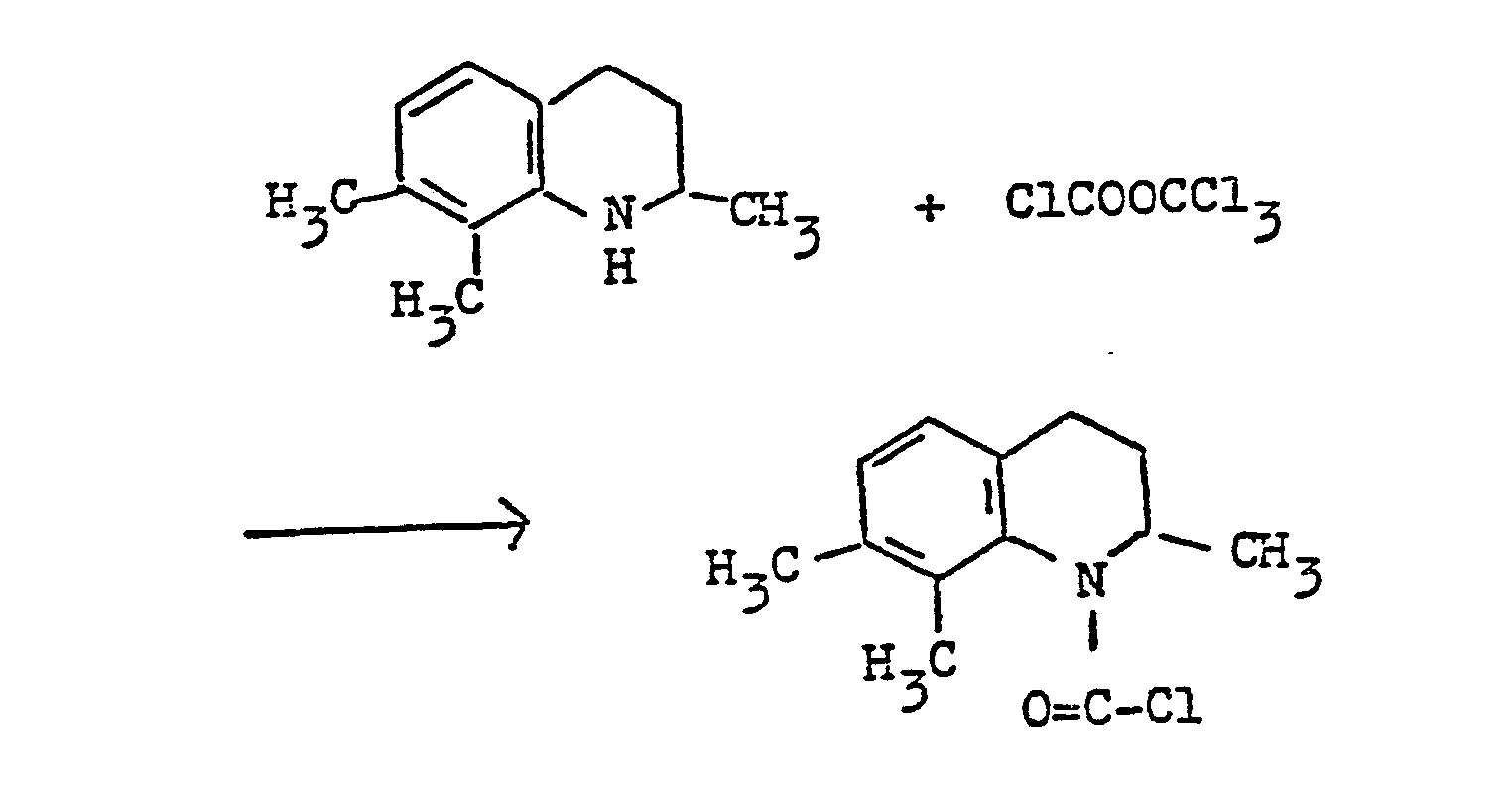
- Die Verbindungen der Formel (11) in dem Verfahren (c) sind die gleichen wie diejenigen, die in dem oben beschriebenen Verfahren (a) eingesetzt werden.
- Bei der Durchführung des Verfahrens (c) können die gleichen inerten organischen Lösungsmittel verwendet werden, wie sie im Folgenden für das Verfahren (a) aufgeführt sind. Wiederum kann die Reaktion beispielsweise bei einer Temperatur im Bereich zwischen etwa 0°C und dem Siedepunkt der Reaktionsmischung und vorzugsweise unter normalem Atmosphärendruck durchgeführt werden.
- Bei der praktischen Durchführung des vorstehenden Verfahrens können die gewünschten Verbindungen der Formel (IV) dadurch hergestellt werden, daß beispielsweise 1 mol der Verbindung der allgemeinen Formel (11) mit 1 bis etwa 10 mol, vorzugsweise etwa 2 bis etwa 5 mol, Phosgen oder mit 1/2 mol bis etwa 10 mol, vorzugsweise 1 mol bis etwa 5 mol, Trichloromethylchlorameisensäureester in einem inerten Lösungsmittel umgesetzt wird, wobei die Temperatur etwa auf Rückflußtemperatur gesteigert wird.
- Als geeignete Verdünnungsmittel bei der Durchführung des vorgenannten Verfahrens (a) lassen sich sämtliche inerten organischen Lösungsmittel erwähnen.
- Beispiele für solche Lösungsmittel oder Verdünnungsmittel umfassen aliphatische, alicyclische und aromatische Kohlenwasserstoffe (die gegebenenfalls chloriert sein können) wie Hexan, Cyclohexan, Petrolether, Ligroin, Benzol, Toluol, Xylol, Methylenchlorid, Chloroform, Kohlenstofftetrachlorid, Ethylenchlorid, Trichloroethylen und Chlorbenzol; Ether wie Diethylether, Methylethylether, Di-isopropylether, Dibutylether, Propylenoxid, Dioxan und Tetrahydrofuran; Ketone wie Aceton, Methylethylketon, Methylisopropylketon und Methylisobutylketon; Nitrile wie Acetonitril, Propionitril und Acrylnitril; Ester wie Ethylacetat und Amylacetat; Säureamide wie Dimethylformamid und Dimethylacetamid; Sulfone und Sulfoxide wie Dimethylsulfoxid und Sulfolan; sowie Basen wie Pyridin.
- Das Verfahren (a) kann innerhalb eines weiten Temperatur-Bereichs durchgeführt werden.
- Beispielsweise kann die Temperatur im Bereich von etwa -20°C und dem Siedepunkt der Mischung liegen, wobei ein Bereich von etwa 0°C bis etwa 100°C bevorzugt wird. Zweckmäßigerweise wird die Reaktion unter normalem atmosphärischen Druck durchgeführt, jedoch ist es möglich, das Verfahren unter erhöhtem oder vermindertem Druck durchzuführen.
- Bei der Durchführung des Verfahrens (a) kann die gewünschte neue Verbindung der Formel (I) dadurch erhalten werden, daß in einem inerten Lösungsmittel etwa 1 bis etwa 2 mol, vorzugsweise 1 bis etwa 1,2 mol, N,N'-Carbonyldiimidazol der Formel (111) mit 1 mol der Verbindung der Formel (11) umgesetzt wird.
- Bei der praktischen Durchführung des Verfahrens (b) werden zweckmäßigerweise als Verdünnungsmittel die gleichen inerten organischen Lösungsmittel verwendet, wie sie oben beispielhaft für das Verfahren (a) genannt sind. Das Verfahren (b) kann weiterhin in Gegenwart eines säurebindenden Mittels durchgeführt werden. Als säurebindende Mittel erwähnt seien die gewöhnlich verwendeten Hydroxide, Carbonate, Hydrogencarbonate und Alkoholate von Alkalimetallen sowie tertiäre Amine wie Triethylamin, Diethylanilin und Pyridin.
- Das Verfahren (b) kann in einem weiten Temperaturbereich durchgeführt werden. Beispielsweise kann es bei einer Temperatur im Bereich von etwa 0°C und dem Siedepunkt der Reaktionsmischung, vorzugsweise von etwa 50°C bis etwa 100°C, durchgeführt werden.
- Weiterhin wird die Reaktion vorzugsweise unter normalem Atmosphärendruck durchgeführt, jedoch kann sie auch unter erhöhtem oder vermindertem Druck durchgeführt werden.
- Bei der Durchführung des Verfahrens (b) kann die gewünschte neue Verbindung der Formel (I) dadurch erhalten werden, daß z.B. 1 mol der Verbindung der allgemeinen Formel (IV) mit etwa 1 mol bis etwa 5 mol, vorzugsweise etwa 1,1 bis etwa 3 mol Imidazol der Formel (V) in einem inerten Lösungsmittel umgesetzt wird.
- Die Verbindungen der Formel (1) gemäß der vorliegenden Erfindung zeigen starke herbizide Aktivität. Demgemäß können diese Verbindungen zur Unkrautbekämpfung verwendet werden. Bei Verwendung als Mittel zur Bodenbehandlung vor dem Auflaufen oder als Mittel zur Behandlung von Laub und Boden zeigen sich auffällige selektive Bekämpfungs-Aktivitäten.
- Die Verbindungen der Formel (I) der vorliegenden Erfindung zeichnen sich nicht nur in bezug auf ihre Sicherheit aus, sondem sie haben außerdem eine überragende herbizide Wirkung mit einem breiten herbiziden Spektrum.
- Beispielsweise sind die Verbindungen dadurch gekennzeichnet, daß sie ihre Bekämpfungswirkung gegen die nachstehend aufgeführten Reisfeld-Unkräuter entfalten, während sie den Reispflanzen keinerlei Schaden zufügen.
-

-

- Weiterhin zeigen die Verbindungen der vorliegenden Erfindung herbizide Aktivität gegen die folgenden, auf höher gelegenen Anbauflächen wachsenden Unkräuter.
-

-

- Die im Vorstehenden angegebenen Pflanzenklassen sind jedoch nur typische Beispiele für die jeweils mit der lateinischen wissenschaftlichen Bezeichnung genannte Gattung.
- Die Einsetzbarkeit der Wirkstoffe gemäß der vorliegenden Erfindung ist jedoch in keiner Weise auf diese Gattungen beschränkt sondern erstreckt sich gleicher Weise auch auf andere Pflanzen.
- In Abhängigkeit von den Konzentrationen eignen sich die Verbindungen zur totalen Bekämpfung von Unkräutern, beispielsweise auf Industriegelände und Bahnkörpem sowie auf Wegen und Plätzen mit oder ohne Baumbestand. Ebenso können die Verbindungen auch zur Unkrautbekämpfung in perennierenden Kulturen, beispielsweise Aufforstungen, Zierbaumpflanzungen, Obstgärten, Weinbergen und -gärten, Zitrushainen, Nußbaumpflanzungen, Bananenplantagen, Kaffeeplantagen, Teeplantagen, Gummiplantagen, Ölpalmenplantagen, Kakaoplantagen, Weichfruchtplantagen und Hopfenfeldem, sowie zur selektiven Unkrautbekämpfung in Jahreskulturen verwendet werden.
- Die Wirkstoffe der Formel (I) zeigen außerdem eine ausgezeichnete fungizide Aktivität und können zur Bekämpfung unerwünschter Pflanzenpathogene eingesetzt werden.
- Wenn die Wirkstoffe der vorliegenden Erfindung als Fungizide für Landwirtschaft und Gartenbau eingesetzt werden, sind sie wirksam gegen verschiedene Pflanzenkrankheiten, die beispielsweise durch Plasmodiophoromycetes, Oomycetes, Chytridiomycetes, Zygomycetes, Ascomycetes, Basidiomycetes und Deuteromycetes verursacht werden.
- Zu den Pflanzenkrankheiten, gegen die die Verbindungen der vorliegenden Erfindung mit Wirkamkeit eingesetzt werden, zählen beispielsweise Pyricularia oryzae bei Reis, Ophiobolus miyabebnus bei Reis, Altemaria brassicae bei Kreuzblütlem, Altemaria mali bei Äpfeln, Altemaria kukuchiana bei Birnen, Phytophthora infestans bei verschiedenen Nutzpflanzen, Colletotrichum lagenarium bei verschiedenen Gurken-und Melonen-Species sowie Botrytis cinerea bei verschiedenen Nutzpflanzen. Weiterhin zu erwähnen ist Xanthomonas oryzae, eine wichtige bakterielle Erkrankung.
- Die gute Tolerierung der Wirkstoffe durch die Pflanzen bei den zur Bekämpfung der Pflanzenerkrankungen erforderlichen Konzentrationen erlaubt die Behandlung der oberirdischen Pflanzenteile, der Teile der vegetativen Fortpflanzung und der Samen sowie des Bodens.
- Die Wirkstoffe können in gebräuchliche Formulierungen überführt werden, etwa Lösungen, Emulsionen, Suspensionen, Pulver, Schäume, Pasten, Granulat, Aerosol, mit der aktiven Verbindung imprägnierte natürliche oder synthetische Stoffe, sehr feine Kapseln in polymeren Substanzen, Überzugsmassen zur Verwendung auf Saatgut - (Beizmittel) sowie Formulierungen für den Einsatz mit Verbrennungseinrichtungen wei Räucherpatronen, Räucherdosen und Räucherschlangen sowie für die kalte Vemebelung und die warme Vemebelung nach dem Ultra-Low-Volume-Verfahren.
- Diese Formulierungen können in bekannter Weise hergestellt werden, beispielsweise durch Vermischen der Wirkstoffe mit Streckmitteln, das heißt mit flüssigen oder verflüssigten gasförmigen oder festen Verdünnungsmitteln oder Trägem, gegebenenfalls unter Verwendung grenzflächenaktiver Mittel, das heißt von Emulgatoren und/oder Dispergiermitteln und/oder - schaumbildenden Mitteln. Bei Verwendung von Wasser als Streckmittel können organische Lösungsmittel beispielsweise als Hilfslösungsmittel verwendet werden.
- Als flüssige Lösungsmittel, Verdünnungsmittel oder Träger hauptsächlich geeignet sind aromatische Kohlenwasserstoffe wie Xylol, Toluol oder Alkylnaphthaline, chlorierte aromatische oder chlorierte aliphatische Kohlenwasserstoffe wie Chlorbenzole, Chloroethylene oder Methylenchlorid, aliphatische Kohlenwasserstoffe wie Cyclohexan oder Paraffine, beispielsweise Mineralöl-Fraktionen, Alkohole wie Butanol oder Glycol sowie deren Ether und Ester, Ketone wie Aceton, Methylethylketon, Methylisobutylketon oder Cyclohexanon oder stark polare Lösungsmittel wie Dimethylformamid und Dimethylsulfoxid sowie auch Wasser.
- Unter verflüssigten gasförmigen Verdünnungsmitteln oder Trägern sind Flüssigkeiten zu verstehen, die bei normaler Temperatur und normalem Druck gasförmig wären, beispielsweise Aerosol-Treibmittel wie halogenierte Kohlenwasserstoffe und ebenso auch Butan, Propan, Stickstoff und Kohlenstoffdioxid.
- Als feste Träger verwendbar sind gemahlene natürliche Minerale wie Kaoline, Tone, Talkum, Kreide, Quarz, Attapulgit, Montmorillonit oder Diatomeenerde und gemahlene synthetische Minerale wie hochdisperse Kieselsäure, Aluminiumoxid und Silicate. Als feste Träger für Granulat können zerkleinerte und fraktionierte Natursteinmaterialien verwendet werden, etwa Calcit, Marmor, Bimsstein, Sepiolith und Dolomit sowie synthetisches Granulat aus anorganischen und organischen Mehlen und Granulat aus organischem Material wie Sägemehl, Kokosnußschalen, Maiskolben und Tabakstengel.
- Als emulgierende und/oder schaumbildende Mittel können nicht-ionische und anionische Emulgatoren wie Polyoxyethylenfettsäureester, Polyoxyethylenfettalkoholether, beispielsweise Alkylarylpolyglycol-Ether, Alkylsulfonate, Alkylsulfate, Arylsulfonate sowie Albumin-Hydrolyseprodukte verwendet werden. Zu Dispergiermitteln zählen beispielsweise Ligninsulfit-Ablaugen und Methylcellulose.
- Haftmittel wie Carboxymethylcellulose und natürliche und synthetische Polymere in Form von Pulvern, Granulat oder Latices wie Gummi arabicum, Polyvinylalkohol und Polyvinylacetat können bei der Formulierung verwendet werden.
- Es ist auch möglich, farbgebende Mittel, etwa anorganische Pigmente wie beispielsweise Eisenoxid, Titanoxid, und Preußisch Blau und organische Farbstoffe wie Alizarin-Farbstoffe, Azo-Farbstoffe oder metallphthalocyanin-Farbstoffe, swoie SpurenNährstoffe wie Salze von Eisen, Mangan, Bor, Kupfer, Cobalt, Molybdän und Zink zu verwenden.
- Die Formulierungen enthalten im allgemeinen 0,1 bis 95 Gew.-%, vorzugsweise 0,5 bis 90 Gew.- % der aktiven Verbindung.
- Die aktiven Verbindungen gemäß der vorliegenden Erfindung können in ihren oben beschriebenen Formulierungen oder ihren verschiedenen Anwendungsformen gemeinsam mit anderen aktiven Verbindungen vorliegen, etwa mit Germiziden (Fungiziden und Bakteriziden), Insektiziden, Akariziden, Nematiziden, Herbiziden, vogelabweisenden Mitteln, Wachstumsregulatoren, Düngemitteln und/oder Mitteln zur Bodenverbesserung. Solche Mischungen können zu gebrauchsfertigen Präparaten formuliert werden oder im Tank vermischt werden.
- Die aktiven Verbindungen gemäß der vorliegenden Erfindung können direkt als solche eingesetzt werden, oder sie können in Form solcher Präparate wie Präparaten zum Flüssigversprühen, Emulsionen, Suspensionen, als Stäubemittel, Paste oder Granulat angewandt werden. Oder aber sie können nach wieterer Verdünnung verwendet werden.
- Wenn die aktive Verbindung als Herbizid eingesetzt werden soll, kann sie mit Hilfe solcher Arbeitsgänge wie Bewässern, Spritzen, Zerstäuben oder Streuen von Granulat aufgebracht werden. Wenn sie andererseits als Fungizid in der Landwirtschaft bzw. im Gartenbau eingesetzt werden soll, kann sie mittels solcher Arbeitsgänge wie Bewässern, Spritzen, Zerstäuben, Vernebeln, Verdampfen, Gießen, Suspensionsbildung, Beschichten, Stäuben, Staubdüngung, Naßdüngung, Naßbedecken, Pastenbedecken, und "Gewandbedecken" ("robe covering") zur Anwendung gebracht werden.
- Beim Einsatz als Herbizid können die Wirkstoffe gemäß der vorliegenden Erfindung entweder vor oder nach der Keimung der Pflanzen angewandt werden. Es ist auch möglich, sie vor der Aussaat in den Boden einzuarbeiten.
- Die Konzentration der Wirkstoffe kann innerhalb eines breiten Bereichs variieren. Dieser hängt grundsätzlich von den gewünschten Ergebnissen ab. Wenn die Verbindung als Herbizid eingesetzt werden soll, wird sie beispielsweise in einer Konzentration von etwa 0,05 bis etwa 5 kg/ha, vorzugsweise von etwa 0,2 bis etwa 3 kg/ha, angewandt.
- Wenn die Verbindung andererseits als land-und gartenwirtschaftliches Fungizid eingesetzt werden soll, wird sie in einer Konzentration von beispielsweise etwa 0,0001 bis etwa 1 Gew.-%, und vorzugsweise von etwa 0,001 bis etwa 0,5 Gew.-%, angewandt.
- Im Fall der Saatgut-Behandlung kann die aktive Verbindung in einer Menge von beispielsweise etwa 0,001 bis etwa 50 g, vozugsweise etwa 0,01 bis 10 g auf 1 kg des Saatguts zu Anwendung gebracht werden.
- Wo der Boden behandelt werden soll, kann die aktive Verbindung auf den gewünschten Wirkungsort beispielsweise in einer Konzentration von etwa 0,00001 bis etwa 0,1 Gew.-%, und insbesondere von etwa 0,00001 bis etwa 0,2 Gew.-%, aufgebracht werden.
- Die folgenden Beispiele erläutern die vorliegende Erfindung im einzelnen. Die Erfindung ist jedoch nicht auf diese Beispiele beschränkt. Herstellungsbeispiele Beispiell
-
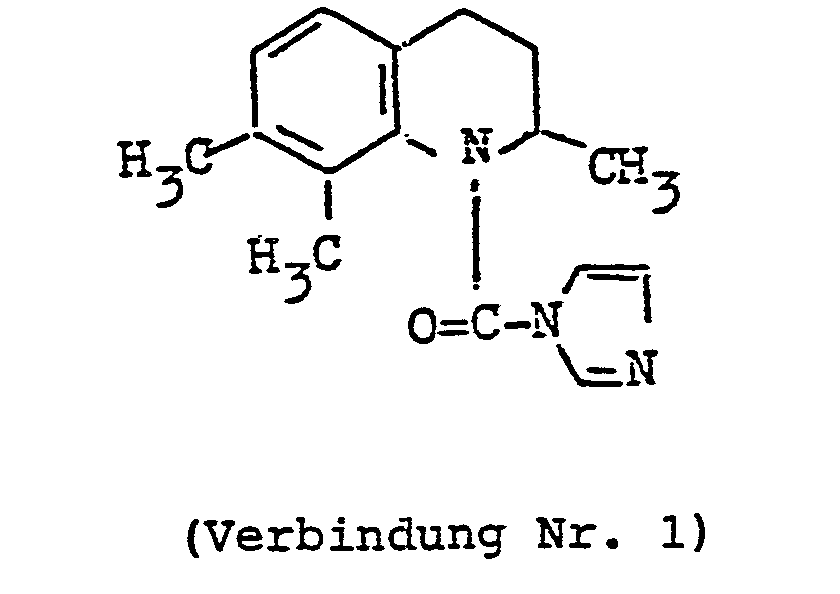
- 2,7,8-Trimethyl-1 (H),2,3,4-tetrahydrochinolin-1- ylcarbonylchlorid (2,4 g) und Imidazol (20 g) wurden in 20 ml Tetrahydrofuran 16 h bei Rückfluß- Temperatur gerührt. Das Tetrahydrofuran und das überschüssige Imidazol wurden unter vermindertem Druck abdestilliert. Der Rückstand wurde durch Zusatz von Wasser kristallisiert. Die erhaltenene Kristalle wurden abfiftriert, wonach 2,2 g des gewünschten 2,7,8-Trimethyl-1 (H),2,3,4-tetrahydrochinolin-1-carbonylimidazols erhalten wurden. Dieses wurde dann aus Diethylether umkristallisiert. Schmp. der Verbindung 86-88°C.
-

- Verbindungen der allgemeinen Formel (I) gemäß der vorliegenden Erfindung, die nach den gleichen Arbeitsweisen, wie sie in den Beispielen 1 und 2 beschrieben sind, synthetisiert wurden, sind in der nachstehenden Tabelle 1 aufgeführt.


- Zusätzlich zu den im Vorstehenden beispielhaft genannten Verbindungen werden andere spezielle Beispiele für die Verbindungen der allgemeinen Formel (I), die nach ähnlichen Arbeitsweisen wie in den vorstehenden Beispielen erhalten werden, im Folgenden aufgeführt.
-
- Nr. 23 2-Ethyl-1 (H),2,3,4-tetrahydrochinolin-1- ylcarbonylimidazol,
- Nr. 24 2-Propyl-1 (H),2,3,4,-tetrahydrochinolin-1-ylcarbonylimidazol,
- Nr. 25 2-Isopropyl-1 (H),2,3,4-tetrahydrochinolin-1-ylcarbonylimidazol, Nr. 26 2,2-Dimethyl-1 (H),2,3,4-tetrahydrochinolin-1-ylcarbonylimidazol, niO 1,5734,
- Nr. 27 2,2-Diethyl-1 (H),2,3,4-tetrahydrochinolin-1-ylcarbonylimidazol, Nr. 28 2,2,4-Trimethyl-1 (H),2,3,4-tetrahydrochinolin-1-ylcarbonylimidazol, n20 D 1,5708,
- Nr. 29 8-Chloro-2-ethyl-1 (H),2,3,4-tetrahydrochinolin-1-ylcarbonylimidazol, Nr. 30 6-Chloro-2,2-dimethyl-1 (H),2,3,4-tetrahydrochinolin-1-ylcarbonylimidazol, Nr. 31 8-Chloro-2,2,4-trimethyl-1 (H),2,3,4-tetrahydrochinolin-1-ylcarbonylimidazol, Nr. 32 8-Bromo-2,2-dimethyl-1 (H),2,3,4-tetrahydrochinolin-1-ylcarbonylimidazol, Nr. 33 2-lsopropyl-6-methyl-1 (H),2,3,4-tetrahydrochinolin-1-ylcarbonylimidazol,
- Nr. 34 2,2,6-Trimethyl-1 (H),2,3,4-tetrahydrochinolin-1-ylcarbonylimidazol, Schmp. 122-125°C,
- Nr. 35 2,2,8-Trimethyl-1 (H),2,3,4-tetrahydrochinolin-1-ylcarbonylimidazol,
- Nr. 36 2,2-Dimethyl-8-methoxy-1 (H),2,3,4-tetrahydrochinolin-1-ylcarbonylimidazol,
- Nr. 37 8-Methoxy-2,2-4-trimethyl-1 (H),2,3,4-tetrahydrochinolin-1-ylcarbonylimidazol,
- Nr. 38 2,2-Dimethyl-8-isopropoxy-1 (H),2,3,4-tetrahydrochinolin-1-ylcarbonylimidazol,
- Nr. 39 2,2-Dimethyl-8-methylthio-1 (H),2,3,4-tetrahydrochinolin-1-ylcarbonylimidazol,
- Nr. 40 2,2-Dimethyl-8-phenoxy-1 (H),2,3,4-tetrahydrochinolin-1-ylcarbonylimidazol,
- Nr. 41 2-Methyl-8-phenylthio-1 (H),2,3,4-tetrahydrochinolin-1-ylcarbonylimidazol,
- Nr. 42 2-Methyl-8-nitro-1 (H),2,3,4-tetrahydrochinolin-1-ylcarbonylimidazol,
- Nr. 43 2-Methyl-8-trifluoromethyl-1 (H),2,3,4-tetrahydrochinolin-1-ylcarbonylimidazol,
- Nr. 44 2,2-Dimethyl-8-trifluoromethyl-1 (H)-,2,3,4-tetrahydrochinolin-1-ylcarbonylimidazol, Nr. 45 8-Cyano-2,2-dimethyl-1 (H),2,3,4-tetrahydrochinolin-1-ylcarbonylimidazol,
- Nr. 46 6,8-Dichloro-2,2,4-trimethyl-1 (H),2,3,4-tetrahydrochinolin-1-ylcarbonylimidazol,
- Nr. 47 7,8-Dichloro-2,2-dimethyl-1 (H),2,3,4-tetrahydrochinolin-1-ylcarbonylimidazol,
- Nr. 48 7,8-Dichloro-2,2,4-trimethyl-1 (H),2,3,4-tetrahydrochinolin-1-ylcarbonylimidazol,
- Nr. 49 2,2,6,8-Tetramethyl-1 (H),2,3,4-tetrahydrochinolin-1-ylcarbonylimidazol,
- Nr. 50 7-Chloro-2,8-dimethyl-1 (H),2,3,4-tetrahydrochinolin-1-ylcarbonylimidazol, Nr. 51 7-Chloro-2-ethyl-8-methyl-1 (H),2,3,4-tetrahydrochinolin-1-ylcarbonylimidazol, Nr. 52 8-Chloro-2,7-dimethyl-1 (H),2,3,4-tetrahydrochinolin-1-ylcarbonylimidazol, Nr. 53 7-Chloro-2,2,8-trimethyl-1 (H),2,3,4-tetrahydrochinolin-1-ylcarbonylimidazol, n20 D 1,5687,
- Nr. 54 8-Chloro-2,2,7-trimethyl-1 (H),2,3,4-tetrahydrochinolin-1-ylcarbonylimidazol, Nr. 55 2,2-Dimethyl-6-fluoro-1 (H),2,3,4-tetrahydrochinolin-1-ylcarbonylimidazol, Nr. 56 2,2-Dimethyl-6-methoxy-1 (H),2,3,4-tetrahydrochinolin-1-ylcarbonylimidazol, Nr. 57 2,2-Dimethyl-6-nitro-1 (H),2,3,4-tetrahydrochinolin-1-ylcarbonylimidazol, Nr. 58 8-Ethoxy-2-methyl-1 (H),2,3,4-tetrahydrochinolin-1-ylcarbonylimidazol, Nr. 59 2,8-Dimethyl-7-fluoro-1 (H),2,3,4-tetrahydrochinolin-1-ylcarbonylimidazol, Nr. 60 2,2-Dimethyl-1 (H),2-dihydrochinolin-1- ylcarbonylimidazol,
- Nr. 61 2,2,4-Trimethyl-1 (H),2-dihydrochinolin-1-ylcarbonylimidazol,
- Nr. 62 6-Chloro-2,2-dimethyl-1 (H),2-dihydrochinolinl-ylcarbonylimidazol, n30 D 1,6004,
- Nr. 63 2,2-Dimethyl-6-fluoro-1 (H),2-dihydrochinolin-1-ylcarbonylimidazol,
- Nr. 64 2,2,6-Trimethyl-1 (H),2-dihydrochinolin-1-ylcarbonylimidazol, n20 D 1,5908, Nr. 65 6-Chloro-2,2,4-trimethyl-1 (H),2-dihydrochinolin-1-ylcarbonylimidazol,
- Nr. 66 4-Chloro-2,2-dimethyl-1 (H),2-dihydrochinolin-1-ylcarbonylimidazol,
- Nr. 67 4,6-Dichloro-2,2-dimethyl-1 (H),2-dihydrochinolin-1-ylcarbonylimidazol,
- Nr. 68 4-Chloro-2,2,6-trimethyl-1 (H),2-dihydrochinolin-1-ylcarbonylimidazol,
- Nr. 69 6,8-Dichloro-4-methyl-1 (H),2-dihydrochinolin-1-ylcarbonylimidazol,
- Nr. 70 6,8-Dichloro-2,2-dimethyl-1 (H),2-dihydrochinolin-1-ylcarbonylimidazol,
- Nr. 71 2,2-Dimethyl-6-methoxy-1 (H),2-dihydrochinolin-1-ylcarbonylimidazol,
- Nr. 72 2,2-Dimethyl-6-trifluoromethyl-1 (H),2-dihydrochinolin-1-ylcarbonylimidazol,
- Nr. 73 2,2,6,8-Tetramethyl-1(H),2-dihydrochinolin-1-ylcarbonylimidazol,
- Nr. 74 7,8-Dichloro-2,2-dimethyl-1 (H),2-dihydrochinolin-1-ylcarbonylimidazol,
- Nr. 75 7-Chloro-2,2,8-trimethyl-1 (H),2-dihydrochinolin-1-ylcarbonylimidazol,
- Nr. 76 7-Chloro-1,2,3,4,4a,9,9a,10 (H)-octahydroacridin-10-ylcarbonylimidazol,
- Nr. 77 7-Methyl-1,2,3,4,4a,9,9a,10 (H)-octahydroacridin-10-ylcarbonylimidazol,
- Nr. 78 7-Methoxy-1,2,3,4,4a,9,9a,10 (H)-octahydroacridin-10-ylcarbonylimidazol,
- Nr. 79 5-Trifluoromethyl-1,2,3,4,4a,9,9a,10 (H)-octahydroacridin-10-ylcarbonylimidazol,
- Nr. 80 7-Trifluoromethyl-1,2,3,4,4a,9,9a,10 (H)-octahydroacridin-10-ylcarbonylimidazol,
- Nr. 81 6-Chloro-5-methyl-1,2,3,4,4a,9,9a,10
- (H)-octahydroacridin-10-ylcarbonylimidazol, Nr. 82 5,6-Dichloro-1,2,3,4,4a,9,9a,10 (H)-octahydroacridin-10-ylcarbonylimidazol,
- Nr. 83 5,7-Dichloro-1,2,3,4,4a,9,9a,10 (H)-octahydroacridin-10-ylcarbonylimidazol,
- Nr. 84 4-Chloro-2,2,7,8-tetramethyl-1 (H)2-dihydrochinolin-1-ylcarbonylimidazol,
- Nr. 85 2,2-Dimethyl-4,7,8-trichloro-1 (H)2-dihydrochinolin-1-ylcarbonylimidazol,
- Nr. 86 4,6-Dichloro-2,2-dimethyl-1 (H)2-dihydrochinolin-1-ylcarbonylimidazol,
- Nr. 87 4-Chloro-1 (H),2-dihydrochinolin-1-ylcarbonylimidazol,
- Nr. 88 7,8-Dimethyl-2-ethyl-1 (H),2,3,4-tetrahydrochinolin-1-ylcarbonylimidazol,
- Nr. 89 7,8-Dimethyl-2-isopropyl-1 (H),2,3,4-tetrahydrochinolin-1-ylcarbonylimidazol,
- Nr. 90 2,3,7,8-Tetramethyl-1 (H),2,3,4-tetrahydrochinolin-1-ylcarbonylimidazol,
- n20 D 1,5684,
- Nr. 91 8-Chloro-2,2-dimethyl-1 (H),2-dihydrochinolin-1-ylcarbonylimidazol,
- Nr. 92 6-Chloro-2,2,8-trimethyl-1 (H),2-dihydrochinolin-1-ylcarbonylimidazol,
- Nr. 93 6-Ethoxy-2,2-dimethyl-1 (H)2-dihydrochinolin-1-ylcarbonylimidazol,
- Nr. 94 6-Ethoxy-2,2,4-trimethyl-1 (H),2-dihydrochinolin-1-ylcarbonylimidazol,
- Nr. 95 8-Chloro-2,2-dimethyl-1 (H),2,3,4-tetrahydrochinolin-1-ylcarbonylimidazol,
- Nr. 96 6,8-Dichloro-2,2-dimethyl-1 (H),2,3,4-tetrahydrochinolin-1-ylcarbonylimidazol,
- Nr. 97 6-Chloro-2,2,8-trimethyl-1 (H),2,3,4-tetrahydrochinolin-1-ylcarbonylimidazol,
- Nr. 98 6-Ethoxy-2,2-dimethyl-1 (H),2,3,4-tetrahydrochinolin-1-ylcarbonylimidazol
- Nr. 99 6-Ethoxy-2,2,4-trimethyl-1 (H),2,3,4-tetrahydrochinolin-1-ylcarbonylimidazol, Schmp. 91-95°C.
- No.100 6-Brom-2,2-dimethyl-1 (H),2,3,4-tetra- hydrochinolin 1-ylcarbonylimidazol
- No.101 2,2-Dimethyl-6-isopropyl-1 (H),2,3,4-tetrahydrochinolin-1-ylcarbonylimidazol
- No.102 2,2-Dimethyl-6-trifluoromethyl-1 (H)-,2,3,4-tetrahydrochinolin-1-ylcarbonylimidazol
- No.103 2,2-Dimethyl-6-trifluoromethoxy-1 (H)-,2,3,4-tetrahydrochinolin-1-ylcarbonylimidazol
- No.104 2,2-Dimethyl-6-trifluoromethylthio-1(H),2,3,4-tetrahydrochinolin-1-ylcarbonylimidazol
- No.105 6-Chlor-2-methyl-1 (H),2,3,4-tetrahy- drochinolin 1-ylcarbonylimidazol
- No.106 2,6-Dimethyl-1 (H),2,3,4-tetrahydrochinolin-1-yl carbonylimidazol
- No.107 2-Methyl-6-trifluoromethyl-1 (H),2,3,4-tetrahydrochinolin-1-ylcarbonylimidazol
- No.108 2-lsopropyl-6-trifluoromethyl-1 (H)-,2,3,4-tetrahydrochinolin-1-ylcarbonylimidazol
- No.109 2,6-Dimethyl-2-isopropyl-1 (H),2,3,4-tetrahydrochinolin-1-ylcarbonylimidazol
- No.110 6-Chlor-2-isopropyl-2-methyl-1 (H)-,2,3,4-tetrahydrochinolin-1-ylcarbonylimidazol
- No.111 6-Chlor-2,2,4-trimethyl-1 (H),2,3,4-tetrahydrochinolin-1-ylcarbonylimidazol
- No.112 2,2,4,6-Tetramethyl-1 (H),2,3,4-tetra- hydro chinolin-1-ylcarbonylimidazol
- No.113 6-Fluor-2,2,4-trimethyl-1 (H),2,3,4-tetrahydrochinolin-1-ylcarbonylimidazol
- No.114 6-Brom-2,2,4-trimethyl-1 (H),2,3,4-te- trahydro chinolin-1-ylcarbonylimidazol
- No.115 6-Trifluormethyl-2,2,4-trimethyl-1 (H)-,2,3,4-tetrahydrochinolin-1-ylcarbonylimidazol
- No.116 6-Trifluormethoxy-2,2,4-trimethyl-1 (H)-,2,3,4-tetrahydrochinolin-1-ylcarbonylimidazol
- No.117 2,2,6,7-Tetramethyl-1 (H),2,3,4-tetra- hydro chinolin-1-ylcarbonylimidazol
- No.118 6,7-Dichlor-2,2-dimethyl-1 (H),2,3,4-tetrahydrochinolin-1-ylcarbonylimidazol
- No.119 7-Chlor-2,2,8-trimethyl-1 (H),2-dihydro chinolin-1-ylcarbonylimidazol
- No.120 6-Brom-2,2-dimethyl-1 (H),2-dihydro chinolin-1-ylcarbonylimidazol
- No.121 2,2-Dimethyl-6-isopropyl-1 (H),2-dihydro chinolin-1-ylcarbonylimidazol
- No.122 2,2-Dimethyl-6-methylthio-1 (H),2-dihydro chinolin-1-ylcarbonylimidazol
- No.123 2,2-Dimethyl-6-trifluoromethoxy-1 (H)-,2-dihydrochinolin-1-ylcarbonylimidazol
- No.124 6-Difluor-methoxy-2,2-dimethyl-1 (H),2-dihydro chinolin-1-ylcarbonylimidazol
- No.125 6-Chlor-2-methyl-1 (H),2-dihydro chinolin-1-ylcarbonylimidazol
- No.126 2,6-Dimethyl-1 (H),2-dihydrochinolin-1- ylcarbonylimidazol
- No.127 2-Methyl-6-trifluoromethyl-1 (H),2-dihydro chinolin-1-ylcarbonylimidazol
- No.128 6-lsopropyl-2-methyl-1 (H),2-dihydro chinolin-1-ylcarbonylimidazol
- No.129 2,6-Diisopropyl-1 (H),2-dihydrochinolin-1-ylcarbonylimidazol
- No.130 2,6-Dimethyl-2-isopropyl-1 (H),2-dihydro chinolin-1-ylcarbonylimidazol
- No.131 6-chloro-2-isopropyl-2-methyl-1 (H),2-dihydrochinolin-1-ylcarbonylimidazol
- No.132 2-Isopropyl-2-methyl-6-trifluoromethyl-1 (H),2-dihydrochinolin-1-ylcarbonylimidazol No.133 2,2,4,6-Tetramethyl-1 (H),2-dihydrochinolin-1-ylcarbonylimidazol
- No.134 6-flucro-2,2,4-trimethyl-1 (H),2-dihydrochinolin-1-ylcarbonylimidazol
- No.135 6-bromo-2,2,4-trimethyl-1 (H),2-dihydrochinolin-1-ylcarbonylimidazol
- No.136 6-trifluoromethyl-2,2,4-trimethyl-1 (H)-,2-dihydrochinolin-1-ylcarbonylimidazol
- No.137 6-trifluoromethoxy-2,2,4-trimethyl-1(H),2-dihydrochinolin-1-ylcarbonylimidazol
- No.138 6-Isopropyl-2,2,4-trimethyl-1 (H),2-dihydro chinolin-1-ylcarbonylimidazol
- No.139 2,2,6,7-Tetramethyl-1 (H),2-dihydro chinolin-1-ylcarbonylimidazol
- No.140 6,7-Dichlor-2,2-dimethyl-1 (H),2-dihydrochinolin-1-ylcarbonylimidazol
- No.141 2,2,4,6,7-Pentamethyl-1 (H),2-dihydrochinolin-1-ylcarbonylimidazol
-

- Eine Lösung von 20 ml Trichloromethylchlorameisensäureester in 100 ml Ethylacetat wurde auf 50°C bis 60°C (Bad-Temperatur) erwärmt. Zu dieser Lösung wurde dann tropfenweise unter Rühren im Laufe von 30 min eine Lösung von 9 g 2,7,8-Trimethyl-1,2,3,4-tetrahydrochinolin in 20 ml Ethylacetat hinzugefügt. Die Temperatur wurde dann langsam auf Rückfluß-Temperatur gesteigert, und das Rühren wurde 5 h fortgesetzt. Das Lösungsmittel wurde dann auf einem Dampfbad abdestilliert, und der Rückstand wurde im Hochvakuum destilliert, wonach 9 g des gewünschten 2,7,8-Trimethyl-1 (H),2,3,4-tetrahydrochinolin-1-yl- carbonylchlorids erhalten wurden. Sdp. 174-176°C/1.2 mbar (0,9 mmHg).
- Verbindungen der allgemeinen Formel (IV), die nach der gleichen Arbeitsweise, wie sie in dem vorstehenden Beispiel 3 beschrieben ist, synthetisiert wurden, sind in der nachstehenden Tabelle 2 aufgeführt.


- Zusätzlich zu den im Vorstehenden beispielhaft genannten Verbindungen werden andere spezielle Beispiele für die Verbindungen der allgemeinen Formel (IV), die nach ähnlichen Arbeitsweisen wie Beispiel 3 erhalten werden, im Folgenden aufgeführt.
-
- Nr. IV-7 8-Fluoro-2-methyl-1 (H),2,3,4-tetrahydrochinolin-1-ylcarbonylchlorid,
- Nr. IV-9 8-Ethoxy-2-methyl-1 (H),2,3,4-tetrahydrochinolin-1-ylcarbonylchlorid,
- Nr. IV-10 7,8-Dichloro-3-methyl-1 (H),2,3,4-tetrahydrochinolin-1-ylcarbonylchlorid,
- Nr. IV-13 2,2,7,8-Tetramethyl-1 (H),2,3,4-tetrahydrochinolin-1-ylcarbonylchlorid,
- Nr. IV-16 7,8-Dichloro-1 (H),2-dihydrochinolin-1-ylcarbonylchlorid,
- Nr. IV-23 2-Ethyl-1 (H),2,3,4-tetrahydrochinolin-1-ylcarbonylchlorid,
- Nr. IV-24 2-Propyl-1 (H),2,3,4-tetrahydrochinolin-1-ylcarbonylchlorid,
- Nr. IV-25 2-Isopropyl-1 (H),2,3,4-tetrahydrochinolin-1-ylcarbonylchlorid,
- Nr. IV-26 2,2-Dimethyl-1 (H),2,3,4-tetrahydrochinolin-1-ylcarbonylchlorid,
- Nr. IV-27 2,2-Diethyl-1 (H),2,3,4-tetrahydrochinolin-1-ylcarbonylchlorid,
- Nr. IV-28 2,2,4-Trimethyl-1 (H),2,3,4-tetrahydrochinolin-1-ylcarbonylchlorid,
- Nr. IV-29 8-Chloro-2-ethyl-1 (H),2,3,4-tetrahydrochinolin-1-ylcarbonylchlorid,
- Nr. IV-30 6-Chloro-2,2-dimethyl-1 (H),2,3,4-tetrahydrochinolin-1-ylcarbonylchlorid,
- Nr. IV-31 8-Chloro-2,2,4-trimethyl-1 (H),2,3,4-tetrahydrochinolin-1-ylcarbonylchlorid,
- Nr. IV-32 8-Bromo-2,2-dimethyl-1 (H),2,3,4-tetrahydrochinolin-1-ylcarbonylchlorid,
- Nr. IV-33 2-Isopropyl-6-methyl-1 (H),2,3,4-tetrahydrochinolin-1-ylcarbonylchlorid,
- Nr. IV-34 2,2,6-Trimethyl-1 (H),2,3,4-tetrahydrochinolin-1-ylcarbonylchlorid,
- Nr. IV-35 2,2,8-Trimethyl-1 (H),2,3,4-tetrahydrochinolin-1-ylcarbonylchlorid,
- Nr. IV-36 2,2-Dimethyl-8-methoxy-1 (H),2,3,4-tetrahydrochinolin-1-ylcarbonylchlorid,
- Nr. IV-37 8-Methoxy-2,2,4-trimethyl-1 (H)-,2,3,4-tetrahydrochinolin-1-ylcarbonytchlorid,
- Nr. IV-38 2,2-Dimethyl-8-isopropoxy-1 (H)-,2,3,4-tetrahydrochinolin-1-ylcarbonylchlorid,
- Nr. IV-39 2,2-Dimethyl-8-methylthio-1 (H)-,2,3,4-tetrahydrochinolin-1-ylcarbonylchlorid,
- Nr. IV-40 2,2-Dimethyl-8-phenoxy-1 (H),2,3,4-tetrahydrochinolin-1-ylcarbonylchlorid,
- Nr. IV-41 2-Methyl-8-phenylthio-1 (H),2,3,4-tetrahydrochinolin-1-ylcarbonylchlorid,
- Nr. IV-42 2-Methyl-8-nitro-1 (H),2,3,4-tetrahydrochinolin-1-ylcarbonylchlorid,
- Nr. IV-43 2-Methyl-8-trifluoromethyl-1 (H)-,2,3,4-tetrahydrochinofin-1-ylcarbonylchlorid,
- Nr. IV-44 2,2-Dimethyl-8-trifluoromethyl-1 (H)-,2,3,4-tetrahydrochinolin-1-ylcarbonylchlorid,
- Nr. IV-45 8-Cyano-2,2-dimethyl-1 (H),2,3,4-tetrahydrochinolin-1-ylcarbonylchlorid,
- Nr. IV-46 6,8-Dichloro-2,2,4-trimethyl-1 (H)-,2,3,4-tetrahydrochinolin-1-ylcarbonylchlorid,
- Nr. IV-48 7,8-Dichloro-2,2,4-trimethyl-1 (H)-,2,3,4-tetrahydrochinolin-1-ylcarbonylchlorid,
- Nr. IV-49 2,2,6,8-Tetramethyl-1 (H),2,3,4-tetrahydrochinolin-1-ylcarbonylchlorid,
- Nr. IV-50 7-Chloro-2,8-dimethyl-1 (H),2,3,4-tetrahydrochinolin-1-ylcarbonylchlorid,
- Nr. IV-51 7-Chloro-2-ethyl-8-methyl-1 (H)-,2,3,4-tetrahydrochinolin-1-ylcarbonylchlorid,
- Nr. IV-52 8-Chloro-2,7-dimethyl-1 (H),2,3,4-tetrahydrochinolin-1-ylcarbonylchlorid,
- Nr. IV-53 7-Chloro-2,2,8-trimethyl-1 (H),2,3,4-tetrahydrochinolin-1-ylcarbonylchlorid,
- Nr. IV-54 8-Chloro-2,2,7-trimethyl-1 (H),2,3,4-tetrahydrochinolin-1-ylcarbonylchlorid,
- Nr. IV-55 2,2-Dimethyl-6-fluoro-1 (H),2,3,4-tetrahydrochinolin-1-ylcarbonylchlorid,
- Nr. IV-56 2,2-Dimethyl-6-methoxy-1 (H),2,3,4-tetrahydrochinolin-1-ylcarbonylchlorid,
- Nr. IV-57 2,2-Dimethyl-6-nitro-1 (H),2,3,4-tetrahydrochinolin-1-ylcarbonylchlorid,
- Nr. IV-58 8-Ethyl-2-methyl-1 (H),2,3,4-tetrahydrochinolin-1-ylcarbonylchlorid,
- Nr. IV-59 2,8-Dimethyl-7-fluoro-1 (H),2,3,4-tetrahydrochinolin-1-ylcarbonylchforid,
- Nr. IV-60 2,2-Dimethyl-1 (H)2-dihydrochinolin-1-ylcarbonylchlorid,
- Nr. IV-61 2,2,4-Trimethyl-1 (H)2-dihydrochinolin-1-ylcarbonylchlorid,
- Nr. IV-62 6-Chloro-2,2-dimethyl-1 (H),2-dihydrochinolin-1-ylcarbonylchlorid,
- Nr. IV-63 2,2-Dimethyl-6-fluoro-1 (H),2-dihydrochinolin-1-ylcarbonylchlorid,
- Nr. IV-64 2,2,6-Trimethyl-1 (H),2-dihydrochinolin-1-ylcarbonylchlorid,
- Nr. IV-65 6-Chloro-22,4-trimethyl-1 (H)2-dihydrochinolin-1-ylcarbonylchlorid,
- Nr. IV-66 4-Chloro-2,2-dimethyl-1 (H),2-dihydrochinolin-1-ylcarbonylchlorid,
- Nr. IV-67 4,6-Dichloro-2,2-dimethyl-1 (H),2-dihydrochinolin-1-ylcarbonylchlorid,
- Nr. IV-68 4-Chloro-2,2,6-trimethyl-1 (H),2-dihydrochinolin-1-ylcarbonylchlorid,
- Nr. IV-69 6,8-Dichloro-4-methyl-1 (H),2-dihydrochinolin-1-ylcarbonylchlorid,
- Nr. IV-70 6,8-Dichloro-2,2-dimethyl-1 (H),2-dihydrochinolin-1-ylcarbonylchlorid,
- Nr. IV-71 2,2-Dimethyl-6-methoxy-1 (H),2-dihydrochinolin-1-ylcarbonylchlorid,
- Nr. IV-72 2,2-Dimethyl-6-trifluoromethyl-1 (H)-,2-dihydrochinolin-1-ylcarbonylchlorid,
- Nr. IV-73 2,2,6,8-Tetramethyl-1 (H),2-dihydrochinolin-1-ylcarbonylchlorid,
- Nr. IV-74 7,8-Dichloro-2,2-dimethyl-1 (H),2-dihydrochinolin-1-ylcarbonylchlorid,
- Nr. IV-75 7-Chloro-2,2,8-trimethyl-1 (H),2-dihydrochinolin-1-ylcarbonylchlorid,
- Nr. IV-76 7-Chloro-1,2,3,4,4a,9,9a,10 (H)-octahydroacridin-10-yl-carbonylchlorid,
- Nr. IV-77 7-Methyl-1,2,3,4,4a,9,9a,10 (H)-octahydroacridin-10-yl-carbonylchlorid,
- Nr. IV-78 7-Methoxy-1,2,3,4,4a,9,9a,10 (H)-octahydroacridin-10-yl-carbonylchlorid,
- Nr. IV-79 5-Trifluoromethyl-1,2,3,4,4a,9,9a,10 (H)-octahydroacridin-10-yl-carbonylchlorid, Nr. IV-80 7-Trifluoromethyl-1,2,3,4,4a,9,9a,10
- (H)-octahydroacridin-10-yl-carbonylchlorid, Nr. IV-81 6-Chloro-5-methyl-1,2,3,4,4a,9,9a,10
- (H)-octahydroacridin-10-yl-carbonylchlorid, Nr. IV-82 5,6-Dichloro-12,3,4,4a,9,9a,10 (H)-octahydroacridin-10-yl-carbonylchlorid,
- Nr. IV-83 5,7-Dichloro-1,2,3,4,4a,9,9a,10 (H)-octahydroacridin-10-yl-carbonylchlorid,
- Nr. IV-84 4-Chloro-2,2,7,8-tetramethyl-1 (H),2-dihydrochinolin-1-ylcarbonylchlorid,
- Nr. IV-85 2,2-Dimethyl-4,7,8-trichloro-1 (H),2-dihydrochinolin-1-ylcarbonylchlorid,
- Nr. IV-86 4-Chloro-1 (H),2-dihydrochinolin-1-ylcarbonylchlorid,
- Nr. IV-87 2,3,7,8-Tetramethyl-1 (H),2,3,4-tetrahydrochinolin-1-ylcarbonylchlorid,
- Nr. IV-88 7,8-Dimethyl-2-ethyl-1 (H),2,3,4-tetrahydrochinolin-1-ylcarbonylchlorid,
- Nr. IV-89 7,8-Dimethyl-2-isopropyl-1 (H),2,3,4-tetrahydrochinolin-1-ylcarbonylchlorid,
- Nr. IV-90 8-Chloro-2,2-dimethyl-1 (H),2-dihydrochinolin-1-ylcarbonylchlorid,
- Nr. IV-91 6-Chloro-2,2,8-trimethyl-1 (H),2-dihydrochinolin-1-ylcarbonylchlorid,
- Nr. IV-92 6-Ethoxy-2,2-dimethyl-1 (H),2-dihydrochinolin-1-ylcarbonylchlorid,
- Nr. IV-93 6-Ethoxy-2,2,4-trimethyl-1 (H),2-dihydrochinolin-1-ylcarbonylchlorid,
- Nr. IV-94 6,8-Dichloro-2,2-dimethyl-1 (H),2,3,4-tetrahydrochinolin-1-ylcarbonylchlorid,
- Nr. IV-95 6-Chloro-2,2,8-trimethyl-1 (H),2,3,4-tetrahydrochinolin-1-ylcarbonylchlorid,
- Nr. IV-96 6-Ethoxy-2,2-dimethyl-1 (H),2,3,4-tetrahydrochinolin-1-ylcarbonylchlorid und
- Nr. IV-97 6-Ethoxy-2,2,4-trimethyl-1 (H),2,3,4-tetrahydrochinolin-1-ylcarbonylchlorid,
- No.IV-98 6-Bromo-2,2-dimethyl-1 (H),2,3,4-tetrahydrochinolin-1--ylcarbonylchlorid
- No.IV-99 2,2-Dimethyl-6-isopropyl-1 (H),2,3,4-tetrahydrochinolin-1-ylcarbonylchlorid
- No.IV-100 2,2-Dimethyl-6-trifluoromethyl-1 (H)-,2,3,4-tetrahydrochinolin-1-ylcarbonylchlorid
- No.IV-101 2,2-Dimethyl-6-trifluoromethoxy-1
- (H),2,3,4-tetrahydrochinolin-1-ylcarbonylchlorid No.IV-102 2,2-Dimethyl-6-trifluoromethylthio-1
- (H),2,3,4-tetrahydrochinolin-1-ylcarbonylchlorid No.IV-103 6-Chloro-2-methyl-1 (H),2,3,4-tetrahydrochinolin-1-ylcarbonylchlorid
- No.IV-104 2,6-Dimethyl-1 (H),2,3,4-tetrahydrochinolin-1-ylcarbonylchlorid
- No.IV-105 2-Methyl-6-trifluoromethyl-1 (H)-,2,3,4-tetrahydrochinolin-1-ylcarbonylchlorid
- No.IV-106 2-Isopropyl-6-trifluoromethyl-1 (H)-,2,3,4-tetrahydrochinolin-1-ylcarbonylchlorid
- No.IV-107 2,6-Dimethyl-2-isopropyl-1 (H),2,3,4-tetrahydrochinolin-1-ylcarbonylchlorid
- No.IV-108 6-Chlor-2-isopropyl-2-methyl-1 (H)-,2,3,4-tetrahydrochinolin-1-ylcarbonylchlorid No.IV-109 6-Chlor-2,2,4-trimethyl-1 (H),2,3,4-tetrahydrochinolin-1-ylcarbonylchlorid
- No.IV-110 2,2,4,6-Tetramethyl-1 (H),2,3,4-tetrahydrochinolin-1-ylcarbonylchlorid
- No.IV-111 6-Fluor-2,2,4-trimethyl-1 (H),2,3,4-tetrahydrochinolin-1-ylcarbonylchlorid
- No.IV-112 6-Brom-2,2,4-trimethyl-1 (H),2,3,4-tetrahydrochinolin-1-ylcarbonylchlorid
- No.IV-113 6-Trifluoromethyl-2,2,4-trimethyl-1
- (H),2,3,4-tetrahydrochinolin-1-ylcarbonylchlorid No.IV-114 6-Difluoromethoxy-2,2,4-trimethyl-1
- (H),2,3,4-tetrahydrochinolin-1-ylcarbonylchlorid No.IV-115 2,2,6,7-Tetramethyl-1 (H),2,3,4-tetrahydrochinolin-1-ylcarbonylchlorid
- No.IV-116 6,7-Dichloro-2,2-dimethyl-1 (H)-,2,3,4-tetrahydrochinolin-1-ylcarbonylchlorid
- No.IV-117 7-Chlor-2,2,8-trimethyl-1 (H),2-dihydro chinolin-1-ylcarbonylchlorid
- No.IV-118 6-Brom-2,2-dimethyl-1 (H),2-dihydro chinolin-1-ylcarbonylchlorid
- No.IV-119 2,2-Dimethyl-6-isopropyl-1 (H),2-dihydro chinolin-1-ylcarbonylchlorid
- No.IV-120 2,2-Dimethyl-6-methylthio-1 (H),2-dihydro chinolin-1-ylcarbonylchlorid
- No.IV-121 2,2-Dimethyl-6-trifluoromethoxy-1
- (H),2-dihydrochinolin-1-ylcarbonylchlorid
- No.IV-122 6-Difluoromethoxy-2,2-dimethyl-1-(H),2-dihydrochinolin-1-ylcarbonylchlorid
- No.IV-123 6-Chlor-2-methyl-1 (H),2-dihydro chinolin-1-ylcarbonylchlorid
- No.IV-124 2,6-Dimethyl-1 (H),2-dihydro chinolin-1-ylcarbonylchlorid
- No.IV-125 2-Methyl-6-trifluoromethyl-1 (H),2-dihydro chinolin-1-ylcarbonylchlorid
- No.IV-126 6-Isopropyl-2-methyl-1 (H),2-dihydro chinolin-1-ylcarbonylchlorid
- No.IV-127 2,6-Diisopropyl-1 (H),2-dihydro chinolin-1-ylcarbonylchlorid
- No.IV-128 2,6-Dimethyl-2-isopropyl-1 (H),2-dihydrochinolin-1-ylcarbonylchlorid
- No.IV-129 6-Chlor-2-isopropyl-2-methyl-1 (H)-,2-dihydrochinolin-1-ylcarbonylchlorid
- No.IV-130 2-Isopropyl-2-methyl-6-trifluoromethyl-1 (H),2-dihydrochinolin-1-ylcarbonylchlorid
- No.IV-131 2,2,4,6-Tetramethyl-1 (H),2-dihydro chinolin-1-ylcarbonylchlorid
- No.IV-132 6-Fluor-2,2,4-trimethyl-1 (H),2-dihydro chinolin-1-ylcarbonylchlorid
- No.IV-133 6-Brom-2,2,4-trimethyl-1 (H),2-dihydro chinolin-1-ylcarbonylchlorid
- No.IV-134 6-Trifluormethyl-2,2,4-trimethyl-1-(H),2-dihydrochinolin-1-ylcarbonylchlorid
- No.IV-135 6-Trifluor methoxy-2,2,4-trimethyl-1
- (H),2-dihydrochinolin-1-ylcarbonylchlorid No.IV-136 6-Isopropyl-2,2,4-trimethyl-1 (H),2-dihydro chinolin-1-ylcarbonylchlorid
- No.IV-137 2,2,6,7-Tetramethyl-1 (H),2-dihydro chinolin-ylcarbonylchlorid
- No.IV-138 6,7-Dichlor-2,2-dimethyl-1 (H),2-dihydrochinolin 1-ylcarbonylchlorid
- No.IV-139 2,2,4,6,7-Pentamethyl-1 (H),2-dihydrochinolin-1-ylcarbonylchlorid
- Kontroll-Verbindung Z-1

- Test zur Bestimmung der Wirksamkeit gegen Reisfeld-Unkräuter bei Behandlung von Stengeln, Blättern und Boden im überfluteten Zustand
- Herstellung der aktiven Verbindung: Träger: 5 Gew.-Teile Aceton
- Die aktive Verbindung wird als Emulsion durch Vermischen von 1 Gew.-Teil der aktiven Verbindung mit den oben angegebenen Mengen Träger und Emulgator erhalten. Die vorgeschriebene Dosis der Mischung der aktiven Verbindung wird dann durch Verdünnen mit Wasser eingestellt.
- Wagner-Töpfe (2 dm2) wurden mit wasserhaltigem Reis-Kulturboden gefüllt, und zwei Reis-Setzlinge (Varietät: Kinmaze) im 2-bis 3-Blattstadium wurden in jeden Topf umgepflanzt. In die Töpfe wurden Samen von Echinochloa crus-galli, Cyperus microiria, Monochoria vaginalis, Scirpus juncoides und breitblättrigen Unkräutern, kleine Stücke von Eleocharis acicularis und Knollen von Cyperus serotinus eingesät bzw. eingesetzt. Die Erde in den Töpfen wurde dann in feuchtem Zustand gehalten. Als Echinochloa crus-galli etwa bis zum 2-Blatt- Stadium gewachsen war (etwa 7 bis 9 Tage nach der Einsaat), wurden die Töpfe mit Wasser bis zu einer Tiefe von etwa 6 cm gefüllt, und eine vorher festgelegte Menge der Verbindung der vorliegenden Erfindung wurde in Form einer Emulsion mittels einer Pipette zur Behandlung jedes Topfes zugegeben. Nach der Behandlung wurde das Wasser im Laufe von zwei Tagen mit einer Geschwindigkeit von 2 bis 3 cm pro Tag aus den Töpfen heraussickem gelassen. Danach wurde die Wassertiefe in den Töpfen bei etwa 3 cm gehalten. In der vierten Woche nach der Behandlung mit der Chemikalie wurden die herbizide Wirkung und der Grad der Phytotoxizität mit Hilfe einer Skala von 0 bis 5 nach dem folgenden Maßstab bewertet.
-

- Die Testergebnisse sind in Tabelle 3 aufgeführt, wobei als typische Beispiele die folgenden Unkräuter benutzt wurden, die der Kürze wegen mit A, B, C, D, E, F und G wie nachstehend angegeben bezeichnet wurden.
-
- A: Echinochloa crus-galli
- B: Eleocharis acicularis
- C: Cyperus microiria
- D: Scirpus juncoides
- E: Monochoria vaginalis
- F: Breitblättrige Unkräuter (Lindernia procumbens, Rotala indica, Elatine triandra etc.)
- G: Cyperus serotinus

- Test zur Bestimmung der Wirksamkeit der Bekämpfung von Botrytis cinerea bei Buschbohnen.
- Herstellung der Test-Chemikalie
- Zu testende Verbindung: 30 Teile Organisches Lösungsmittel (Xyloi): 55 Teile Emulgator: Polyoxyethylenalkylphenylether 8 Teile Calciumalkylbenzolsulfonat 7 Teile
- Die vorgeschriebene Dosis der wie vorstehend erhaltenen Emulsion wird dann durch Verdünnen mit Wasser eingestellt.
- In unlasierten 9 cm-Töpfen angezogene Buschbohnen (Sorte: Shin-edogawa) im Stadium der ersten Blatt-Bildung wurden mit den Test-Verbindungen in Form einer Emulsion unter Verwendung einer Spritzpistole besprüht. Einen Tag nach dem Aufbringen der Emulsion wurde eine pathogenhaltige Agar-Scheibe, die vorher durch 2-tägiges Kultivieren von Botrytis cinerea in einem PDA-Medium bei 20°C und anschließendes Ausstanzen der Spitze der Kolonie mit einem Korkbohrer von 5 mm Durchmesser hergestellt worden war, in die Mitte eines Blattes gelegt und dort belassen, während das Blatt in einer Feuchtigkeitskammer bei 20°C gehalten wurde. Zwei Tage nach der Inokulierung wurde der Durchmesser einer Läsion gemessen, und die Bekämpfungswirkung wurde berechnet.
-

- In diesem Test zeigten die Verbindungen Nr. 13, 14 und 17 beispielsweise einen Bekämpfungs- Index von 100 % bei einer Konzentration der aktiven Komponente von 500 ppm, während der Bekämpfungs-Index der Kontroll-Verbindung Z-1 0 betrug.
- Test zur Bestimmung der Wirksamkeit der Bekämpfung der Braunfäule der Tomate:
- Jede der Test-Verbindungen in Form einer Emulsion, die gemäß Beispiel 5 hergestellt worden war, wurde auf in unglasierten 9 cm-Töpfen gezogene Tomaten (Sorte: "Kurihara") mit einer Sprühpistole aufgesprüht. Einen Tag später wurden die Pflanzen mit einer Sporen-Suspension des bezeichneten Pathogens inokuliert, und die Töpfe wurden über Nacht in einem Raum mit einer konstanten Temperatur von 22°C und einer Luftfeuchtigkeit oberhalb von 90 % stehen gelassen. Fünf Tage später wurde der Grad der Erkrankung durch das Verhältnis der Läsionen zeigenden Flächen bestimmt, und. der Bekämpfungsindex wurde berechnet.

- Die Verbindungen Nr. 2 und 11 zeigten eine Bekämpfungs-Wirkung von 100 % bei einer Konzentration der aktiven Komponente von 500 ppm, während die oben bezeichnete Kontroll-Verbindung Z-1 einen Bekämpfungs-Wert von 0 % zeigte.
- Test zur Bestimmung der Wirksamkeit gegen Cochliobolus miyabeanus bei Besprühen des Stengel und Blätter der Pflanze:
- Reispflanzen (Sorte: Kusabue) wurden in unglasierten Töpfen mit einem Durchmesser von 12 cm gezogen, und im 3-bis 4-Blatt-Stadium wurde eine Test-Verbindung, die nach Beispiel 5 hergestellt und auf die vorgeschriebene Konzentration verdünnt worden war, in einer Menge von 50 ml pro jeweils drei Töpfe aufgesprüht. Am nächsten Tag wurden die Töpfe durch zweimaliges Besprühen mit einer Suspension künstlich kultivierter Sporen von Cochliobolus miyabeanus inokuliert. Die Töpfe wurden dann zur Induzierung der Infektion in einer feuchten Kammer mit einer relativen Luftfeuchtigkeit von 100% und einer Temperatur von 25°C gehalten. Sieben Tage nach der Inokulierung wurde der Grad der Erkrankung pro Topf entsprechend der nachstehenden Skala von 0 bis 5 bewertet, und der Bekämpfungs-Index wurde berechnet.


- In diesem Test bildeten jeweils drei Töpfe eine Parzelle. Die Verbindungen Nr. 6, 7, 13, 17 und 20 zeigten einen Bekämpfungs-Index von 100 % bei einer Konzentration der aktiven Komponente von 500 ppm, während der Bekämpfungs-Index der oben bezeichneten Kontroll-Verbindung Z-1 0 betrug.


Claims (9)





Applications Claiming Priority (2)
| Application Number | Priority Date | Filing Date | Title |
|---|---|---|---|
| JP60066636A JPS61227506A (ja) | 1985-04-01 | 1985-04-01 | カルバモイルイミダゾ−ル類、その中間体、それらの製法並びに除草剤又は農園芸用殺菌剤 |
| JP66636/85 | 1985-04-01 |
Publications (2)
| Publication Number | Publication Date |
|---|---|
| EP0198264A2 true EP0198264A2 (de) | 1986-10-22 |
| EP0198264A3 EP0198264A3 (de) | 1987-08-19 |
Family
ID=13321578
Family Applications (1)
| Application Number | Title | Priority Date | Filing Date |
|---|---|---|---|
| EP86103814A Withdrawn EP0198264A3 (de) | 1985-04-01 | 1986-03-20 | Carbamoylimidazole |
Country Status (10)
| Country | Link |
|---|---|
| EP (1) | EP0198264A3 (de) |
| JP (1) | JPS61227506A (de) |
| KR (1) | KR860008166A (de) |
| AU (1) | AU5423286A (de) |
| BR (1) | BR8601429A (de) |
| DK (1) | DK142686A (de) |
| ES (1) | ES8800199A1 (de) |
| HU (1) | HUT42269A (de) |
| IL (1) | IL78304A0 (de) |
| ZA (1) | ZA862324B (de) |
Cited By (7)
| Publication number | Priority date | Publication date | Assignee | Title |
|---|---|---|---|---|
| EP0270074A3 (de) * | 1986-12-03 | 1989-07-26 | Hoechst Aktiengesellschaft | Carbamoylimidazol-Derivate, Verfahren zu ihrer Herstellung und ihre Verwendung als Fungizide |
| EP0994856A4 (de) * | 1997-07-02 | 2000-12-06 | Bristol Myers Squibb Co | Inhibitoren der farnesyl-proteintransferase |
| US7749995B2 (en) | 2006-05-11 | 2010-07-06 | Janssen Pharmaceutica Nv | 3,4-dihydro-2h-benzo[1,4]oxazine and thiazine derivatives as CETP inhibitors |
| US7928238B2 (en) | 2006-05-11 | 2011-04-19 | Janssen Pharmaceutica Nv | 1,2,3,4-tetrahydro-quinoline derivatives as CETP inhibitors |
| US7947713B2 (en) | 2000-10-30 | 2011-05-24 | Janssen Pharmaceutica N.V. | Tripeptidyl peptidase inhibitors |
| US9388161B2 (en) | 2013-11-18 | 2016-07-12 | Forma Therapeutics, Inc. | Tetrahydroquinoline compositions as BET bromodomain inhibitors |
| US10377769B2 (en) | 2013-11-18 | 2019-08-13 | Forma Therapeutics, Inc. | Benzopiperazine compositions as BET bromodomain inhibitors |
Families Citing this family (4)
| Publication number | Priority date | Publication date | Assignee | Title |
|---|---|---|---|---|
| JPS60222479A (ja) * | 1984-04-20 | 1985-11-07 | Nippon Tokushu Noyaku Seizo Kk | テトラヒドロキノリン―1―イルカルボニルイミダゾール誘導体、その製法並びに除草又は農園芸用殺菌剤 |
| JPS6160682A (ja) * | 1984-08-30 | 1986-03-28 | Nippon Tokushu Noyaku Seizo Kk | テトラヒドロキノリン−1−イルカルボニルイミダゾ−ル誘導体、その中間体、それらの製法並びに除草又は農園芸用殺菌剤 |
| KR20020012116A (ko) * | 2000-08-05 | 2002-02-15 | 주정호 | 항암제로서 유용한 이미다졸릴우레아 유도체 및 그의제조방법 |
| CN105330644B (zh) * | 2015-11-18 | 2017-12-19 | 中国农业大学 | (1,2,3,4‑四氢喹啉‑1‑基)(取代吡唑基)甲酮类化合物及其应用 |
Family Cites Families (7)
| Publication number | Priority date | Publication date | Assignee | Title |
|---|---|---|---|---|
| US3308131A (en) * | 1962-12-06 | 1967-03-07 | Du Pont | Tertiary carbamyl triazoles |
| CH426821A (de) * | 1964-03-25 | 1966-12-31 | Siegfried Ag | Verfahren zur Herstellung neuer, basisch substituierter 5,5-Dialkylacridane |
| GB1154722A (en) * | 1965-07-08 | 1969-06-11 | Boots Pure Drug Co Ltd | 2,4,5-Tribromoimidazole Derivatives and Compositions thereof |
| US3830918A (en) * | 1972-05-17 | 1974-08-20 | Siegfried Ag | Method of treating parkinsonism and parkinsonoid syndromes |
| DE2408813A1 (de) * | 1974-02-23 | 1975-09-04 | Agfa Gevaert Ag | N-carbamoyloxypyridiniumsalze und verfahren zur herstellung derselben |
| JPS60222479A (ja) * | 1984-04-20 | 1985-11-07 | Nippon Tokushu Noyaku Seizo Kk | テトラヒドロキノリン―1―イルカルボニルイミダゾール誘導体、その製法並びに除草又は農園芸用殺菌剤 |
| JPS6160682A (ja) * | 1984-08-30 | 1986-03-28 | Nippon Tokushu Noyaku Seizo Kk | テトラヒドロキノリン−1−イルカルボニルイミダゾ−ル誘導体、その中間体、それらの製法並びに除草又は農園芸用殺菌剤 |
-
1985
- 1985-04-01 JP JP60066636A patent/JPS61227506A/ja active Pending
-
1986
- 1986-02-28 AU AU54232/86A patent/AU5423286A/en not_active Abandoned
- 1986-03-20 EP EP86103814A patent/EP0198264A3/de not_active Withdrawn
- 1986-03-26 DK DK142686A patent/DK142686A/da not_active Application Discontinuation
- 1986-03-27 ZA ZA862324A patent/ZA862324B/xx unknown
- 1986-03-28 IL IL78304A patent/IL78304A0/xx unknown
- 1986-03-28 HU HU861318A patent/HUT42269A/hu unknown
- 1986-03-28 KR KR1019860002337A patent/KR860008166A/ko not_active Withdrawn
- 1986-04-01 BR BR8601429A patent/BR8601429A/pt unknown
- 1986-04-01 ES ES553569A patent/ES8800199A1/es not_active Expired
Cited By (16)
| Publication number | Priority date | Publication date | Assignee | Title |
|---|---|---|---|---|
| EP0270074A3 (de) * | 1986-12-03 | 1989-07-26 | Hoechst Aktiengesellschaft | Carbamoylimidazol-Derivate, Verfahren zu ihrer Herstellung und ihre Verwendung als Fungizide |
| EP0994856A4 (de) * | 1997-07-02 | 2000-12-06 | Bristol Myers Squibb Co | Inhibitoren der farnesyl-proteintransferase |
| US6387926B1 (en) * | 1997-07-02 | 2002-05-14 | Bristol-Myers Squibb Company | Inhibitors of farnesyl protein transferase |
| US6602883B1 (en) | 1997-07-02 | 2003-08-05 | Bristol-Myers Squibb Company | Inhibitors of farnesyl protein transferase |
| US7947713B2 (en) | 2000-10-30 | 2011-05-24 | Janssen Pharmaceutica N.V. | Tripeptidyl peptidase inhibitors |
| US8247432B2 (en) | 2000-10-30 | 2012-08-21 | Janssen Pharmaceutica N.V. | Tripeptidyl peptidase inhibitors |
| US7749995B2 (en) | 2006-05-11 | 2010-07-06 | Janssen Pharmaceutica Nv | 3,4-dihydro-2h-benzo[1,4]oxazine and thiazine derivatives as CETP inhibitors |
| US8012963B2 (en) | 2006-05-11 | 2011-09-06 | Janssen Pharmaceutica N.V. | 3,4-dihydro-2H-benzo[1,4]oxazine and thiazine derivatives as CETP inhibitors |
| US7928238B2 (en) | 2006-05-11 | 2011-04-19 | Janssen Pharmaceutica Nv | 1,2,3,4-tetrahydro-quinoline derivatives as CETP inhibitors |
| US9388161B2 (en) | 2013-11-18 | 2016-07-12 | Forma Therapeutics, Inc. | Tetrahydroquinoline compositions as BET bromodomain inhibitors |
| US10336722B2 (en) | 2013-11-18 | 2019-07-02 | Forma Therapeutics, Inc. | Tetrahydroquinoline compositions as BET bromodomain inhibitors |
| US10377769B2 (en) | 2013-11-18 | 2019-08-13 | Forma Therapeutics, Inc. | Benzopiperazine compositions as BET bromodomain inhibitors |
| US10611750B2 (en) | 2013-11-18 | 2020-04-07 | Forma Therapeutics, Inc. | Tetrahydroquinoline compositions as bet bromodomain inhibitors |
| US10703764B2 (en) | 2013-11-18 | 2020-07-07 | Forma Therapeutics, Inc. | Benzopiperazine compositions as BET bromodomain inhibitors |
| US11084831B1 (en) | 2013-11-18 | 2021-08-10 | Forma Therapeutics, Inc. | Benzopiperazine compositions as BET bromodomain inhibitors |
| US11111229B2 (en) | 2013-11-18 | 2021-09-07 | Forma Therapeutics, Inc. | Tetrahydroquinoline compositions as BET bromodomain inhibitors |
Also Published As
| Publication number | Publication date |
|---|---|
| ES8800199A1 (es) | 1987-10-16 |
| DK142686A (da) | 1986-10-02 |
| HUT42269A (en) | 1987-07-28 |
| EP0198264A3 (de) | 1987-08-19 |
| ZA862324B (en) | 1986-11-26 |
| AU5423286A (en) | 1986-10-09 |
| BR8601429A (pt) | 1986-12-09 |
| DK142686D0 (da) | 1986-03-26 |
| IL78304A0 (en) | 1986-07-31 |
| ES553569A0 (es) | 1987-10-16 |
| KR860008166A (ko) | 1986-11-12 |
| JPS61227506A (ja) | 1986-10-09 |
Similar Documents
| Publication | Publication Date | Title |
|---|---|---|
| EP2220938B1 (de) | Synergistische fungizide Wirkstoffkombinationen | |
| CH647510A5 (de) | Phenoxyfettsaeurederivate vom typ heterocyclischer aether. | |
| DE3013162A1 (de) | N-substituierte tetrahydrophthalimide und herbizide mittel mit einem gehalt derselben | |
| DE1695786A1 (de) | Biocide Mittel | |
| EP0198264A2 (de) | Carbamoylimidazole | |
| EP0074595B1 (de) | Substituierte Phenylsulfonylharnstoff- Derivate, Verfahren und neue Zwischenprodukte zu ihrer Herstellung und ihre Verwendung als Herbizide | |
| EP0155911A1 (de) | Purinderivate zur Regulierung des Pflanzenwachstums | |
| EP0158954A2 (de) | Tetrahydrochinolin-1-ylcarbonylimidazol-Derivate, Zwischenprodukte für diese, Verfahren zur ihrer Herstellung und Herbizide oder Fungizide für Landwirtschaft und Gartenbau | |
| DE2615878C2 (de) | Polycyclische stickstoffhaltige Verbindungen | |
| EP0173208A1 (de) | Tetrahydrochinolin-1-ylcarbonylimidazol-Derivate | |
| DE2943703A1 (de) | 6h-1,2,4,6-thiatriazin-1,1-dioxide, herbizide, die diese verbindungen enthalten, ihre anwendung als herbizide und verfahren zu ihrer herstellung | |
| EP0017994A2 (de) | Cyclobutandicarbonsäureimide, Verfahren zu deren Herstellung und deren Verwendung als Fungizid; Zwischenprodukte | |
| EP0349832A2 (de) | Triazolo[1,2-a]pyridazinderivate, Verfahren und Zwischenprodukte zu ihrer Herstellung und diese enthaltende Herbizidmittel | |
| DE1955749A1 (de) | Amidophenylguanidine,Verfahren zu ihrer Herstellung und ihre fungizide Verwendung | |
| EP0093908A1 (de) | Heteroarylthiovinyl-Verbindungen, ein Verfahren zu ihrer Herstellung und ihre Verwendung als Schädlingsbekämpfungsmittel | |
| EP0154273B1 (de) | Fungizide Mittel | |
| DE3102907A1 (de) | "benzoxazolonderivate, verfahren zur herstellung derselben sowie zubereitungen, die diese derivate enthalten" | |
| EP0002455B1 (de) | Acyloxyamide, Verfahren zu ihrer Herstellung sowie ihre Verwendung als Pflanzenwachstumsregulatoren | |
| EP0092517B1 (de) | Neue Oximäther, Verfahren zu ihrer Herstellung, Mittel die die neuen Oximäther enthalten und ihre Verwendung | |
| DE2539396B2 (de) | Pestizide | |
| EP0351676A2 (de) | Benzothiazolone | |
| EP0014887B1 (de) | Spiro-Derivate von 3-(3,5-Dihalogenphenyl)-oxazolidin-2-thion-4-onen, Verfahren zu ihrer Herstellung sowie ihre Verwendung als Fungizide | |
| DE2513652A1 (de) | 6,8-dichlor-3-methyl-4-chromonoxim, verfahren zur herstellung desselben und fungizide mittel | |
| EP0001623A1 (de) | Aryl-thiocarbonsäure-thiocyanmethylester, ihre Herstellung und ihre Verwendung als Pestizide, sowie sie enthaltende Mittel | |
| EP0154806A2 (de) | Substituierte Oxirane |
Legal Events
| Date | Code | Title | Description |
|---|---|---|---|
| PUAI | Public reference made under article 153(3) epc to a published international application that has entered the european phase |
Free format text: ORIGINAL CODE: 0009012 |
|
| 17P | Request for examination filed |
Effective date: 19860320 |
|
| AK | Designated contracting states |
Kind code of ref document: A2 Designated state(s): AT BE CH DE FR GB IT LI NL |
|
| PUAL | Search report despatched |
Free format text: ORIGINAL CODE: 0009013 |
|
| AK | Designated contracting states |
Kind code of ref document: A3 Designated state(s): AT BE CH DE FR GB IT LI NL |
|
| STAA | Information on the status of an ep patent application or granted ep patent |
Free format text: STATUS: THE APPLICATION HAS BEEN WITHDRAWN |
|
| 18W | Application withdrawn |
Withdrawal date: 19880111 |
|
| RIN1 | Information on inventor provided before grant (corrected) |
Inventor name: SHIOKAWA, KOZO Inventor name: GOTO, TOSHIO Inventor name: MORIYA, KOICHI Inventor name: KAGABU, SHINZO Inventor name: KURAHASHI, YOSHIO Inventor name: KAMOCHI, ATSUMI Inventor name: HAYAKAWA, HIDENORI |