EP0198084A1 - Process for producing thin magnetic steel plate having high permeability - Google Patents
Process for producing thin magnetic steel plate having high permeability Download PDFInfo
- Publication number
- EP0198084A1 EP0198084A1 EP85904865A EP85904865A EP0198084A1 EP 0198084 A1 EP0198084 A1 EP 0198084A1 EP 85904865 A EP85904865 A EP 85904865A EP 85904865 A EP85904865 A EP 85904865A EP 0198084 A1 EP0198084 A1 EP 0198084A1
- Authority
- EP
- European Patent Office
- Prior art keywords
- sicl
- atmosphere
- thin steel
- treatment
- penetrating
- Prior art date
- Legal status (The legal status is an assumption and is not a legal conclusion. Google has not performed a legal analysis and makes no representation as to the accuracy of the status listed.)
- Granted
Links
Images




Classifications
-
- C—CHEMISTRY; METALLURGY
- C21—METALLURGY OF IRON
- C21D—MODIFYING THE PHYSICAL STRUCTURE OF FERROUS METALS; GENERAL DEVICES FOR HEAT TREATMENT OF FERROUS OR NON-FERROUS METALS OR ALLOYS; MAKING METAL MALLEABLE, e.g. BY DECARBURISATION OR TEMPERING
- C21D8/00—Modifying the physical properties of ferrous metals or ferrous alloys by deformation combined with, or followed by, heat treatment
- C21D8/12—Modifying the physical properties of ferrous metals or ferrous alloys by deformation combined with, or followed by, heat treatment during manufacturing of articles with special electromagnetic properties
-
- H—ELECTRICITY
- H01—ELECTRIC ELEMENTS
- H01F—MAGNETS; INDUCTANCES; TRANSFORMERS; SELECTION OF MATERIALS FOR THEIR MAGNETIC PROPERTIES
- H01F1/00—Magnets or magnetic bodies characterised by the magnetic materials therefor; Selection of materials for their magnetic properties
- H01F1/01—Magnets or magnetic bodies characterised by the magnetic materials therefor; Selection of materials for their magnetic properties of inorganic materials
- H01F1/03—Magnets or magnetic bodies characterised by the magnetic materials therefor; Selection of materials for their magnetic properties of inorganic materials characterised by their coercivity
- H01F1/12—Magnets or magnetic bodies characterised by the magnetic materials therefor; Selection of materials for their magnetic properties of inorganic materials characterised by their coercivity of soft-magnetic materials
- H01F1/14—Magnets or magnetic bodies characterised by the magnetic materials therefor; Selection of materials for their magnetic properties of inorganic materials characterised by their coercivity of soft-magnetic materials metals or alloys
- H01F1/147—Alloys characterised by their composition
- H01F1/14766—Fe-Si based alloys
- H01F1/14775—Fe-Si based alloys in the form of sheets
- H01F1/14783—Fe-Si based alloys in the form of sheets with insulating coating
-
- C—CHEMISTRY; METALLURGY
- C21—METALLURGY OF IRON
- C21D—MODIFYING THE PHYSICAL STRUCTURE OF FERROUS METALS; GENERAL DEVICES FOR HEAT TREATMENT OF FERROUS OR NON-FERROUS METALS OR ALLOYS; MAKING METAL MALLEABLE, e.g. BY DECARBURISATION OR TEMPERING
- C21D8/00—Modifying the physical properties of ferrous metals or ferrous alloys by deformation combined with, or followed by, heat treatment
- C21D8/12—Modifying the physical properties of ferrous metals or ferrous alloys by deformation combined with, or followed by, heat treatment during manufacturing of articles with special electromagnetic properties
- C21D8/1244—Modifying the physical properties of ferrous metals or ferrous alloys by deformation combined with, or followed by, heat treatment during manufacturing of articles with special electromagnetic properties characterised by the heat treatment
- C21D8/1255—Modifying the physical properties of ferrous metals or ferrous alloys by deformation combined with, or followed by, heat treatment during manufacturing of articles with special electromagnetic properties characterised by the heat treatment with diffusion of elements, e.g. decarburising, nitriding
-
- C—CHEMISTRY; METALLURGY
- C23—COATING METALLIC MATERIAL; COATING MATERIAL WITH METALLIC MATERIAL; CHEMICAL SURFACE TREATMENT; DIFFUSION TREATMENT OF METALLIC MATERIAL; COATING BY VACUUM EVAPORATION, BY SPUTTERING, BY ION IMPLANTATION OR BY CHEMICAL VAPOUR DEPOSITION, IN GENERAL; INHIBITING CORROSION OF METALLIC MATERIAL OR INCRUSTATION IN GENERAL
- C23C—COATING METALLIC MATERIAL; COATING MATERIAL WITH METALLIC MATERIAL; SURFACE TREATMENT OF METALLIC MATERIAL BY DIFFUSION INTO THE SURFACE, BY CHEMICAL CONVERSION OR SUBSTITUTION; COATING BY VACUUM EVAPORATION, BY SPUTTERING, BY ION IMPLANTATION OR BY CHEMICAL VAPOUR DEPOSITION, IN GENERAL
- C23C10/00—Solid state diffusion of only metal elements or silicon into metallic material surfaces
- C23C10/06—Solid state diffusion of only metal elements or silicon into metallic material surfaces using gases
- C23C10/08—Solid state diffusion of only metal elements or silicon into metallic material surfaces using gases only one element being diffused
-
- H—ELECTRICITY
- H01—ELECTRIC ELEMENTS
- H01F—MAGNETS; INDUCTANCES; TRANSFORMERS; SELECTION OF MATERIALS FOR THEIR MAGNETIC PROPERTIES
- H01F1/00—Magnets or magnetic bodies characterised by the magnetic materials therefor; Selection of materials for their magnetic properties
- H01F1/01—Magnets or magnetic bodies characterised by the magnetic materials therefor; Selection of materials for their magnetic properties of inorganic materials
- H01F1/03—Magnets or magnetic bodies characterised by the magnetic materials therefor; Selection of materials for their magnetic properties of inorganic materials characterised by their coercivity
- H01F1/12—Magnets or magnetic bodies characterised by the magnetic materials therefor; Selection of materials for their magnetic properties of inorganic materials characterised by their coercivity of soft-magnetic materials
- H01F1/14—Magnets or magnetic bodies characterised by the magnetic materials therefor; Selection of materials for their magnetic properties of inorganic materials characterised by their coercivity of soft-magnetic materials metals or alloys
- H01F1/147—Alloys characterised by their composition
- H01F1/14766—Fe-Si based alloys
- H01F1/14775—Fe-Si based alloys in the form of sheets
Definitions
- This invention relates to a method for producing thin steel sheets of high magnetic permeability, and is to produce thin steel sheets of high Si magnetism without internal defects by diffusing and penetrating Si into low Si thin steel sheets.
- Fe-Si alloy and Fe-Si-Al alloy there are Fe-6.5%Si alloy and Fe-9.6%Si-5.4%Al alloy (sendust) which have very high magnetic permeability and excellent soft magnetic characteristics.
- the sendust has been applied to electronic instrumentalities such as dust cores, magnetic heads and others since its invention in 1973.
- the magnetic head a high coercive field strength of recording media has advanced nowadays, accompanying with high density of magnetic recording media, and the sendust of high saturated magnetization has been interesting since this material is more suitable to the reccrdingthan ferrite headsused conventionally.
- Fe-6.5%Si alloy has high saturation flux density, this material is considered to be applied to iron cores of transformers, or other electric, electronic instrumentalities.
- the above mentioned process (1) is made possible by super slow strain rate at the temperature of more than 1000°C, however it would invite much difficulties in practising such a condition industrially.
- the attempt (2) more or less improves the workability by adding the elements, but the material is brittle, and an application to the thin sheet is difficult and the added elements deteriorate the magnetism.
- the process (3) directly casts the molten metal into the thin shape, and is very useful to the brittle material in regard to production of the thin sheets without the rolling process.
- the control (4) comprises, melting low Si or low Al steel, rolling it in thin shape, enriching Si or Al by penetration from the surface thereof, and finally producing high Si thin steel sheets.
- the present invention has been realized to improve shortcomings of the conventional techniques, and is to provide a producing method, where a composition control process after rolling is improved for providing a desired content of Si in a short period of time and checking generation of boids.
- the desired Si content was accomplished by the Si penetrating treatment, and subsequently thin sheets of high Si having very high magnetic permeability could be produced.
- the inventors made tests and studies, and found the best range where the boids were not generated with regard to the heat-. ing rate and the Si penetrating temperatures in the atmosphere bearing SiCl 4 , and further found the best range with respect to partial pressure of Si compounds in said atmosphere.
- thin steel sheets are at first produced through an ordinary process.
- kinds of magnetic thin sheets of high magnetic permeability available by the invention include 3 - 6.5%Si-Fe alloy and sendust alloy,,and it is preferable to determine as mentioned under the composition of the thin steel sheets for Si penetration.
- Fig. 1 shows the relationship between the Si penetrating temperature and the number of generated boids. As is seen from this graph, the number of the boids is almost zero above 1100°C after a diffusion treatment (later mentioned). Therefore, the lower limit is 1100°C. On the other hand, Fe 3 Si to be formed in the Si penetrating layer will be molten away above 1200°C, and this temperature is an upper limit. High temperature as possible is advantageous for checking the boids.
- the cross section of the test piece having thickness of 0.4mm was measured over the width of 2.4mm, and the boid number was counted (same also in Figs.2 and 5) .
- the invention limits the heating rate to more than 50°C/min, coming to said penetrating temperatures in the SiCl 4 atmosphere at the temperature of more than 1000°C.
- the reason for limiting the heating rate is for avoiding generation of kirkendall boids by the Si penetration at the temperature between 1000°C and the determined temperature during heating.
- Fig. 2 shows the relationship between said heating rate and the boid number. The higher is the heating rate, the more the boid number decreases, and since the boids almost fade away, this rate is determined as the lower limit.
- Said heating rate is, to the end, in the SiCl 4 atmosphere at the temperature of more than 1000°C, and not a few ways are available for providing the heating rate of more than 50°C/min.
- the most ordinary manner is to place the thin steel sheet made by the ordinary process as at the room temperature into the heating furnace of the SiCl 4 atmosphere, and heat it to the determined penetrating temperature.
- the thin steel sheet is in advance heated to the set temperature of 1100 to 1200°C in the furnace of an inert gas atmosphere, and SiCl 4 steam is introduced into said furnace.
- the heating rate can be made infinite.
- a compromise manner thereof may be assumed variously as preheating the thin steel sheet more than 1000°C, introducing it in the heating furnace of the atmosphere of SiCl 4 , and heating to the set temperature.
- the inventors through many tests and studies, found that the partial pressure of Si compound was large factor concerning the speed of Si penetration from the outer atmosphere, and the higher is the partial pressure of Si compound, the faster is the speed of the Si penetration, while the higher is the partial pressure, the more increases the boid number, on the other hand.
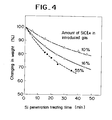
- Fig. 4 shows weight changes of the thin steels when the amounts of SiCl 4 in the introduced gas were changed 10%, 16% and 55% for changing the partial pressure of SiCl 4 .
- the weight change is a parameter which shows the degree of the Si penetration, according to which the larger is the weight change, the more is the Si penetration. This phenomenon is assumed to depend upon the reaction of 5Fe + SiCl 4 ⁇ Fe 3 Si + 2FeCl 2 where FeCl 2 is out of the solid. It is seen from Fig. 4 that the higher is Si partial pressure, the faster is the speed of Si penetration.
- Fig. 5 is the relationship between the amount of SiCl 4 and the amount of boid after the Si penetration treatment and the diffusion treatment, and clearly shows that when Si partial pressure becomes higher, the boid amount increases.
- the amount of SiC1 4 in the atmosphere is not more than. 25%. That is, as seen from Fig. 5,, the boids are not generated when SiCl 4 is less than 25%.
- Fig. 6 shows that the lowering of the coercive field strength is saturated at less than 25%SiCl 4 . From these two viewpoints, it is preferable to limit the amount of SiCl . not more than 25% in the atmosphere of Si penetrating treatment.
- a limitation is not especially made to the time of Si penetrating treatment, and it may be appropriately determined in view of the amount of Si in the product, Si content in the atmosphere bearing SiCl 4 , the penetration treating temperature, Si content in the starting steel sheet, and others.
- the diffusion treatment may be continuously carried out by switching the atmosphere to an inert gas, instead of cooling the base sheet, otherwise it may be done after the base sheet has been once cooled to the room temperature.
- the cooling should be carried out in the inert atmosphere or in the SiCl 4 atmosphere for avoiding oxidation.
- the diffusion treatment is carried out at a determined temperature in relation with the treating time, and it is done in the inert atmosphere for avoiding oxidation.
- the diffusion treating time is appropriately selected in response to said treating temperature, thickness and Si content of an objective product.
- the soft magnetism may be improved by igniting the magnetic field in the course of cooling during the diffusion treatment.
- This manner has an advantage that the heating treatment is performed at the same as the diffusion treatment without requiring an independent heating treatment with respect to the cooling in the magnetic field, thereby to improve the magnetism.
- a condition of cooling in the magnetic field is to cool the magnetic field of more than lG at the cooling rate of not more than 30°C/sec from the temperature of more than 800°C. The cooling effect of the magnetic field could not be expected in the outside of said range.
- Alloy of the chemical composition shown under was subjected to the hot and cold rollings so as to produce a thin sheet of 0.40mm thickness as a base sheet.
- This base sheet was performed with Si penetrating treatment through the device shown in Fig. 7, where the numeral 1 is a round bottom flask filled with SiCl 4 , the numeral 2 is a thermostat bath, 3 is a furnace, and (X) is a test piece.
- SiCl 4 in the introducing gas was changed by controlling the temperature of the thermostat bath 2 of a SiC1 4 vaporizer.
- the conditions of the penetrating treatment each depended upon the condition where Si penetrated up to 9.6%
- the furnace 3 for the Si penetrating treatment had a heating element of silicon carbide.
- a core tube of the furnace was made of ceramics and 40mm in inner diameter.
- a carrier gas of SiCl 4 was Ar and its flow amount was 0.5x/min.
- Figs.8 and 9 are the photographs of structure in cross section of the test pieces A to D after Si penetrating treatment and after the diffusion treatment in the inert atmosphere at the temperature of 1200°C for one hour. It is seen that the more is SiCl 4 in the introducing gas, the more distinguished is the generation of the boids after Si penetrating treatment as well as after the diffusion treatment.
- test piece D has large and many residual boids, while the test pieces A to C show scarecely boids.
- Si thin steel sheet was produced from the base sheet (thickness: 0.4mm) of the under shown chemical composition.
- the penetrating treatments were performed by variously changing the conditions as under.
- test pieces were undertaken with the diffusion treatment of 1200°C x 3hr in the Ar flow, and thereafter formed into rings of 10mm inner diameter and 20mm outer diameter by an electric discharging process, and coiled with 30 turns of a primary windings and 40 turns of a secondary windings for carrying out DC magnetism measurement.
- the results are shown in Table 5.
- test pieces A and B show the magnetic characteristics more satisfactory than the test pieces C and D of the comparative processes.
- the base sheet of Fe-3%Si thin steel of the same chemical composition as EXAMPLE 2 were undertaken with the Si penetrating treatment and the diffusion treatment under the following conditions for producing Fe-6.5%Si thin sheet.
- SiCl 4 25% Penetration treating condition: 1190°C x 6min Heating rate: 300°C/min Diffusion treatment: 1200°C x 3hr in Ar Cooling conditions: Cooling from not more than 1200°C to 800°C at 50°C/min and cooling from not more than 800°C to the following 10°C/min by the DC magnetic field of 80e.
- Fe-6.5Si thin steels were produced from Si steel of grain oriented property (thickness: 0.30mm) prepared by GOSS process.
- the chemical composition of the steel and the Si penetrating treatment conditions are shown in Tables 6 and 7.
- test pieces were undertaken with the diffusion treatment of 1200°C x 2hr in Ar flow, and iron loss was sought at ignition of 50Hz and 17 KG by a single magnetic tester.
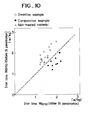
- Fig.10 shows iron loss value W17/50 before and after the penetrating treatments.
- the test pieces by the invention show satisfactory magnetic characteristics than the comparative examples.
Landscapes
- Chemical & Material Sciences (AREA)
- Engineering & Computer Science (AREA)
- Physics & Mathematics (AREA)
- Electromagnetism (AREA)
- Materials Engineering (AREA)
- Organic Chemistry (AREA)
- Metallurgy (AREA)
- Mechanical Engineering (AREA)
- Dispersion Chemistry (AREA)
- Power Engineering (AREA)
- Crystallography & Structural Chemistry (AREA)
- Thermal Sciences (AREA)
- Manufacturing & Machinery (AREA)
- Chemical Kinetics & Catalysis (AREA)
- Soft Magnetic Materials (AREA)
- Solid-Phase Diffusion Into Metallic Material Surfaces (AREA)
Abstract
Description
- This invention relates to a method for producing thin steel sheets of high magnetic permeability, and is to produce thin steel sheets of high Si magnetism without internal defects by diffusing and penetrating Si into low Si thin steel sheets.
- In Fe-Si alloy and Fe-Si-Al alloy, there are Fe-6.5%Si alloy and Fe-9.6%Si-5.4%Al alloy (sendust) which have very high magnetic permeability and excellent soft magnetic characteristics. Especially, the sendust has been applied to electronic instrumentalities such as dust cores, magnetic heads and others since its invention in 1973. With respect to the magnetic head, a high coercive field strength of recording media has advanced nowadays, accompanying with high density of magnetic recording media, and the sendust of high saturated magnetization has been interesting since this material is more suitable to the reccrdingthan ferrite headsused conventionally. Since Fe-6.5%Si alloy has high saturation flux density, this material is considered to be applied to iron cores of transformers, or other electric, electronic instrumentalities.
- A problem when these high Si alloys excellent in the soft magnetic characteristics are used for electronic parts, is that they could not be rolled in thin shape, since they have brittleness. Therefore, the sendust is sliced after forging to produce thin pieces for the magnetic heads, which is, however, a process very inferior in efficiency in the production of the heads. Besides, the sendust is easily caused with cracks or pinholes during solidification after casting, and those defects should be removed for which, however, a process is required.
- For solving the problems involved with the above mentioned manufacturing process, the under mentioned processes have been proposed.
- 1) Rolling and deforming in hot work
- 2) Improvement of workability by addition of elements
- 3) Direct production by rapid solidification
- 4) Composition control after rolling
- The above mentioned process (1) is made possible by super slow strain rate at the temperature of more than 1000°C, however it would invite much difficulties in practising such a condition industrially. The attempt (2) more or less improves the workability by adding the elements, but the material is brittle, and an application to the thin sheet is difficult and the added elements deteriorate the magnetism. The process (3) directly casts the molten metal into the thin shape, and is very useful to the brittle material in regard to production of the thin sheets without the rolling process. The control (4) comprises, melting low Si or low Al steel, rolling it in thin shape, enriching Si or Al by penetration from the surface thereof, and finally producing high Si thin steel sheets.
- However, since conventinally proposed penetrating processes take penetration treating time as long as more than 30 minutes and temperatures as high as about 1230°C, the shapes after the penetrating treatment are undesirable. Further, the most fatal phenomenon in the prior art to the production of the high magnetic permeable materials is to generate large boids called kirkendall boid in. accompany with the penetration, which remain in spite of the sintering treatment, so that the magnetic permeability is considerably declined. The reason why a process of producing high Si thin steel sheet by the Si penetration has not yet been realized, is difficult in removing the boids.
- The present invention has been realized to improve shortcomings of the conventional techniques, and is to provide a producing method, where a composition control process after rolling is improved for providing a desired content of Si in a short period of time and checking generation of boids.
- The inventors studied in detail the Si penetrating conditions in the prior art, and found a condition which accelerated the Si penetrating speed, and did not allow boids residual after the Si penetrating treatment and the diffusion treatment. The desired Si content was accomplished by the Si penetrating treatment, and subsequently thin sheets of high Si having very high magnetic permeability could be produced.
- The inventors made tests and studies, and found the best range where the boids were not generated with regard to the heat-. ing rate and the Si penetrating temperatures in the atmosphere bearing SiCl4, and further found the best range with respect to partial pressure of Si compounds in said atmosphere.
- In the invention, thin steel sheets (thickness: 10mm to 10,&m) are at first produced through an ordinary process. Kinds of magnetic thin sheets of high magnetic permeability available by the invention include 3 - 6.5%Si-Fe alloy and sendust alloy,,and it is preferable to determine as mentioned under the composition of the thin steel sheets for Si penetration.
- 1) In a case of 3 - 6.5%Si-Fe alloy C: not more than 0.01%; Si: 0 - 4.0%; Mn: not more than 2%; and inavoidable impurities being preferably as little as possible
- 2) In a case of sendust alloy C: not more than 0.01%; Si: not more than 4%; Al: 3 - 8% Ni: not more than 4%; Mn: not more than 2%; elements increasing corrosion resistance such as Cr, Ti and others: not more than 5%; and inavoidable impurities being preferably as little as possible.
- These thin steel sheets are placed in the atmosphere bearing SiCl4 for penetrating treatment. This treating condition is, in the invention, limited to the Si penetrating temperatures between 1100°C and 1200°C (temperature of the sheet). Fig. 1 shows the relationship between the Si penetrating temperature and the number of generated boids. As is seen from this graph, the number of the boids is almost zero above 1100°C after a diffusion treatment (later mentioned). Therefore, the lower limit is 1100°C. On the other hand, Fe3Si to be formed in the Si penetrating layer will be molten away above 1200°C, and this temperature is an upper limit. High temperature as possible is advantageous for checking the boids.
- With respect to the number of the boids of the graph in Fig. 1, the cross section of the test piece having thickness of 0.4mm was measured over the width of 2.4mm, and the boid number was counted (same also in Figs.2 and 5) .
- The invention limits the heating rate to more than 50°C/min, coming to said penetrating temperatures in the SiCl4 atmosphere at the temperature of more than 1000°C. The reason for limiting the heating rate is for avoiding generation of kirkendall boids by the Si penetration at the temperature between 1000°C and the determined temperature during heating. Fig. 2 shows the relationship between said heating rate and the boid number. The higher is the heating rate, the more the boid number decreases, and since the boids almost fade away, this rate is determined as the lower limit.
- Said heating rate is, to the end, in the SiCl4 atmosphere at the temperature of more than 1000°C, and not a few ways are available for providing the heating rate of more than 50°C/min.
- For example, the most ordinary manner is to place the thin steel sheet made by the ordinary process as at the room temperature into the heating furnace of the SiCl4 atmosphere, and heat it to the determined penetrating temperature.
- If it is difficult to obtain the heating rate of more than 50°C/min by the above mentioned manner, it is possible that the thin steel sheet is in advance heated to the set temperature of 1100 to 1200°C in the furnace of an inert gas atmosphere, and SiCl4 steam is introduced into said furnace. In this case, since the heating is not performed in the atmosphere of SiCl4 at the temperature between more than 1000°C and not more than 1100°C, the heating rate can be made infinite.
- A compromise manner thereof may be assumed variously as preheating the thin steel sheet more than 1000°C, introducing it in the heating furnace of the atmosphere of SiCl4, and heating to the set temperature.
- When the steel sheet is preheated, oxidation should be avoided as possible as could. Because the oxidation of the thin steel accelerates forming of Fe-Si oxides of low melting point during Si penetration, and obstacles the intention of the invention.
- When the Fe-5.5%Al thin steels (thickness: 0.40mm) were undertaken with the Si penetrating treatment in the SiCl4 atmosphere at the temperature of 1190°C for 30 minutes, the heating rates up to 1190°C from 1000°C were 10°C/min, 50°C/min and 300°C/min, respectively. Fig. 3 shows respective structures in cross section after Si penetration. Apparently, it is seen that the generation of the boids (black part in centers of the photograph) is checked in the higher heating rate.
- The inventors, through many tests and studies, found that the partial pressure of Si compound was large factor concerning the speed of Si penetration from the outer atmosphere, and the higher is the partial pressure of Si compound, the faster is the speed of the Si penetration, while the higher is the partial pressure, the more increases the boid number, on the other hand.
- Fe-5.4%Al steels were treated in the SiCl4 atmosphere, and Fig. 4 shows weight changes of the thin steels when the amounts of SiCl4 in the introduced gas were changed 10%, 16% and 55% for changing the partial pressure of SiCl4. The weight change is a parameter which shows the degree of the Si penetration, according to which the larger is the weight change, the more is the Si penetration. This phenomenon is assumed to depend upon the reaction of 5Fe + SiCl4 → Fe3Si + 2FeCl2 where FeCl 2is out of the solid. It is seen from Fig. 4 that the higher is Si partial pressure, the faster is the speed of Si penetration.
- However,. with respect to the boid amount, it is recognized that when Si partial pressure becomes higher, the boid amount increases. Fig. 5 is the relationship between the amount of SiCl4 and the amount of boid after the Si penetration treatment and the diffusion treatment, and clearly shows that when Si partial pressure becomes higher, the boid amount increases.
- This reason is not cleared, but would be assumed as follows. When the amount of SiCl4 in the introducing gas is made less, the amount of Si decreases which penetrates from the outside per the unit time and the unit surface area , and this fact shows that the amount of Si atoms also decreases which penetrate into the interior through kirkendall surface, and porosities, that is, generation of kirkendall boids decreases. Under such circumstances, since the diffusionsof Fe and Si atoms which are caused by thermal activity of test pieces, progress in order together with the Si penetration, said diffusions are easily absorbed or extinguished by dislocations or the like in the interior, before the generated kirkendall boids gather and turn out stable boids. Therefore, if the Si penetrating speed is lowered, the boids are checked from residual.
- The inventors studied the Si partial pressure and the magnetic permeable characteristics of the products and found that, as shown in Fig. 6, the less is the amount of SiCl4, the lower is the coercive field strength.
- By this finding, it is preferable that the amount of SiC14 in the atmosphere is not more than. 25%. That is, as seen from Fig. 5,, the boids are not generated when SiCl4 is less than 25%. Fig. 6 shows that the lowering of the coercive field strength is saturated at less than 25%SiCl4. From these two viewpoints, it is preferable to limit the amount of SiCl. not more than 25% in the atmosphere of Si penetrating treatment.
- A limitation is not especially made to the time of Si penetrating treatment, and it may be appropriately determined in view of the amount of Si in the product, Si content in the atmosphere bearing SiCl4, the penetration treating temperature, Si content in the starting steel sheet, and others.
- After Si has been penetrated at a desired amount by the above treatment, the chemical elements are uniformalized by the diffusion treatment. The diffusion treatment may be continuously carried out by switching the atmosphere to an inert gas, instead of cooling the base sheet, otherwise it may be done after the base sheet has been once cooled to the room temperature.
- When the base sheet is once cooled to the room temperature, the cooling should be carried out in the inert atmosphere or in the SiCl4 atmosphere for avoiding oxidation. When cooling in the SiCl4 atmosphere, it is necessary to shorten the passing time of the temperature range of more than 1000°C (especially 1000 to 1100°C), as similarly in the heating, for controlling the generation of the boids, and the cooling rate at the temperature of more than 1000°C should be more than 50°C/min.
- The diffusion treatment is carried out at a determined temperature in relation with the treating time, and it is done in the inert atmosphere for avoiding oxidation. The diffusion treating time is appropriately selected in response to said treating temperature, thickness and Si content of an objective product.
- If the material produced by the invention shows effect of magnetic annealing (e.g., Fe-6.5%Si, or Fe-Si-Al-Ni alloys), the soft magnetism may be improved by igniting the magnetic field in the course of cooling during the diffusion treatment. This manner has an advantage that the heating treatment is performed at the same as the diffusion treatment without requiring an independent heating treatment with respect to the cooling in the magnetic field, thereby to improve the magnetism. A condition of cooling in the magnetic field is to cool the magnetic field of more than lG at the cooling rate of not more than 30°C/sec from the temperature of more than 800°C. The cooling effect of the magnetic field could not be expected in the outside of said range.
-
- Fig. 1 is a graph showing the relationship between Si penetrating temperature and the number of boids;
- Fig. 2 is a graph showing the relationship between the heating rate and the number of boids;
- Fig. 3 is microscopic photographs of metal structures in cross section, showing differences in generation of the boids by the cooling rates;
- Fig. 4 is a graph showing the relationship between time for Si penetrating treatment and weight change of the steel sheet, where the amount of SiCl4 is a parameter;
- Fig. 5 is a graph showing the relationship between the amount of SiC14 and the number of the boids;
- Fig. 6 is a graph showing the relationship between the amount of SiCl4 and the coercive force;
- Fig. 7 is an arrangement for practising the invention;
- Figs.8 and 9 are microscopic photographs of metal structures in cross section; and
- Fig.10 is a graph showing iron loss W17/50 before and after the penetrating treatment.
- Alloy of the chemical composition shown under was subjected to the hot and cold rollings so as to produce a thin sheet of 0.40mm thickness as a base sheet.

- This base sheet was performed with Si penetrating treatment through the device shown in Fig. 7, where the
numeral 1 is a round bottom flask filled with SiCl4, thenumeral 2 is a thermostat bath, 3 is a furnace, and (X) is a test piece.
- SiCl4 in the introducing gas was changed by controlling the temperature of the
thermostat bath 2 of a SiC14 vaporizer. The conditions of the penetrating treatment each depended upon the condition where Si penetrated up to 9.6% - The
furnace 3 for the Si penetrating treatment had a heating element of silicon carbide. A core tube of the furnace was made of ceramics and 40mm in inner diameter. A carrier gas of SiCl4 was Ar and its flow amount was 0.5x/min. - When the test pieces subjected to the Si penetrating treatment were chemically analyzed, it was found that each of them contained the objective Si content (9.6%).
- Figs.8 and 9 are the photographs of structure in cross section of the test pieces A to D after Si penetrating treatment and after the diffusion treatment in the inert atmosphere at the temperature of 1200°C for one hour. It is seen that the more is SiCl4 in the introducing gas, the more distinguished is the generation of the boids after Si penetrating treatment as well as after the diffusion treatment.
- In the structures after the diffusion treatment, the test piece D has large and many residual boids, while the test pieces A to C show scarecely boids.
- Fe-6.5%.Si thin steel sheet was produced from the base sheet (thickness: 0.4mm) of the under shown chemical composition.

- The penetrating treatments were performed by variously changing the conditions as under.

- Subsequently to these test pieces, the test pieces were undertaken with the diffusion treatment of 1200°C x 3hr in the Ar flow, and thereafter formed into rings of 10mm inner diameter and 20mm outer diameter by an electric discharging process, and coiled with 30 turns of a primary windings and 40 turns of a secondary windings for carrying out DC magnetism measurement. The results are shown in Table 5.

- From the above, it is seen that the test pieces A and B show the magnetic characteristics more satisfactory than the test pieces C and D of the comparative processes.
- The base sheet of Fe-3%Si thin steel of the same chemical composition as EXAMPLE 2 were undertaken with the Si penetrating treatment and the diffusion treatment under the following conditions for producing Fe-6.5%Si thin sheet.
- SiCl4: 25% Penetration treating condition: 1190°C x 6min Heating rate: 300°C/min Diffusion treatment: 1200°C x 3hr in Ar Cooling conditions: Cooling from not more than 1200°C to 800°C at 50°C/min and cooling from not more than 800°C to the following 10°C/min by the DC magnetic field of 80e.
- When the magnetic characteristics were measured in the above treated materials, they showed preferable values of the maximum magnetic permeability of 38000.
- Fe-6.5Si thin steels were produced from Si steel of grain oriented property (thickness: 0.30mm) prepared by GOSS process. The chemical composition of the steel and the Si penetrating treatment conditions are shown in Tables 6 and 7.


- Subsequently to each of the test pieces, the test pieces were undertaken with the diffusion treatment of 1200°C x 2hr in Ar flow, and iron loss was sought at ignition of 50Hz and 17 KG by a single magnetic tester. Fig.10 shows iron loss value W17/50 before and after the penetrating treatments. The test pieces by the invention show satisfactory magnetic characteristics than the comparative examples.
Claims (9)
Applications Claiming Priority (4)
| Application Number | Priority Date | Filing Date | Title |
|---|---|---|---|
| JP59201597A JPS6180806A (en) | 1984-09-28 | 1984-09-28 | Manufacturing method of high permeability magnetic thin steel sheet |
| JP201597/84 | 1984-09-28 | ||
| JP59250568A JPS61129803A (en) | 1984-11-29 | 1984-11-29 | Method for manufacturing high permeability magnetic thin steel sheet without internal defects |
| JP250568/84 | 1984-11-29 |
Publications (3)
| Publication Number | Publication Date |
|---|---|
| EP0198084A1 true EP0198084A1 (en) | 1986-10-22 |
| EP0198084A4 EP0198084A4 (en) | 1989-01-19 |
| EP0198084B1 EP0198084B1 (en) | 1992-03-18 |
Family
ID=26512882
Family Applications (1)
| Application Number | Title | Priority Date | Filing Date |
|---|---|---|---|
| EP85904865A Expired - Lifetime EP0198084B1 (en) | 1984-09-28 | 1985-09-26 | Process for producing thin magnetic steel plate having high permeability |
Country Status (5)
| Country | Link |
|---|---|
| US (1) | US4832762A (en) |
| EP (1) | EP0198084B1 (en) |
| KR (1) | KR950013285B1 (en) |
| DE (1) | DE3585686D1 (en) |
| WO (1) | WO1986002105A1 (en) |
Cited By (1)
| Publication number | Priority date | Publication date | Assignee | Title |
|---|---|---|---|---|
| EP0987341A4 (en) * | 1998-03-12 | 2006-04-05 | Jfe Steel Corp | Silicon steel sheet and method for producing the same |
Families Citing this family (3)
| Publication number | Priority date | Publication date | Assignee | Title |
|---|---|---|---|---|
| JP3275712B2 (en) | 1995-10-06 | 2002-04-22 | 日本鋼管株式会社 | High silicon steel sheet excellent in workability and method for producing the same |
| JPH10287921A (en) * | 1997-04-15 | 1998-10-27 | Kawasaki Steel Corp | Heat treatment method for steel in a magnetic field |
| PL2495345T3 (en) * | 2009-10-28 | 2020-12-28 | Nippon Steel Corporation | Ferrous metal sheet and manufacturing method therefor |
Family Cites Families (15)
| Publication number | Priority date | Publication date | Assignee | Title |
|---|---|---|---|---|
| GB309393A (en) * | 1928-01-09 | 1929-04-09 | Gen Electric Co Ltd | An improved process for coating metals |
| FR1042076A (en) * | 1950-09-15 | 1953-10-28 | Union Chimique Belge Sa | Process for making the steel surface hard and corrosion resistant |
| DE1237154B (en) * | 1961-11-29 | 1967-03-23 | Licentia Gmbh | Process for the production of hot and cold rolled Fe-Si electrical steel sheets |
| DE1284809B (en) * | 1963-12-18 | 1968-12-05 | Licentia Gmbh | Procedure and arrangement for changing the diffusion profile |
| GB1083290A (en) * | 1964-12-18 | 1967-09-13 | Licentia Gmbh | Method of improving the magnetic properties of silicon steel electrical sheets |
| GB1128609A (en) * | 1964-12-31 | 1968-09-25 | Allegheny Ludlum Steel | Improvements in or relating to silicon steel |
| FR1525034A (en) * | 1966-08-09 | 1968-05-17 | Loire Atel Forges | Improvements to processes for improving the magnetic properties of steels for magnetic uses, and products obtained by these processes |
| US3423253A (en) * | 1968-02-23 | 1969-01-21 | Allegheny Ludlum Steel | Method of increasing the silicon content of wrought grain oriented silicon steel |
| FR2018029A1 (en) * | 1968-09-13 | 1970-05-29 | Allegheny Ludlum Steel | Augmenting the silicon contact of steel by treat - ment with silicon tetrachloride in the gas phase |
| US3634148A (en) * | 1969-02-13 | 1972-01-11 | Bethlehem Steel Corp | Method for producing nonoriented silicon electrical sheet steel |
| JPS4965944A (en) * | 1972-10-31 | 1974-06-26 | ||
| JPS5342019B2 (en) * | 1974-03-08 | 1978-11-08 | ||
| US4073668A (en) * | 1976-09-15 | 1978-02-14 | Bethlehem Steel Corporation | Method of producing silicon steel strip |
| GB1559733A (en) * | 1977-01-31 | 1980-01-23 | Nat Res Dev | Diffusing an element into a metal |
| JPS5449934A (en) * | 1977-09-29 | 1979-04-19 | Pioneer Electronic Corp | Sendust alloy plate and method of making same |
-
1985
- 1985-09-26 EP EP85904865A patent/EP0198084B1/en not_active Expired - Lifetime
- 1985-09-26 KR KR1019860700166A patent/KR950013285B1/en not_active Expired - Lifetime
- 1985-09-26 DE DE8585904865T patent/DE3585686D1/en not_active Expired - Lifetime
- 1985-09-26 US US06/845,873 patent/US4832762A/en not_active Expired - Lifetime
- 1985-09-26 WO PCT/JP1985/000535 patent/WO1986002105A1/en not_active Ceased
Cited By (1)
| Publication number | Priority date | Publication date | Assignee | Title |
|---|---|---|---|---|
| EP0987341A4 (en) * | 1998-03-12 | 2006-04-05 | Jfe Steel Corp | Silicon steel sheet and method for producing the same |
Also Published As
| Publication number | Publication date |
|---|---|
| KR950013285B1 (en) | 1995-11-02 |
| DE3585686D1 (en) | 1992-04-23 |
| US4832762A (en) | 1989-05-23 |
| KR880700090A (en) | 1988-02-15 |
| EP0198084B1 (en) | 1992-03-18 |
| WO1986002105A1 (en) | 1986-04-10 |
| EP0198084A4 (en) | 1989-01-19 |
Similar Documents
| Publication | Publication Date | Title |
|---|---|---|
| EP2025767B2 (en) | Process for producing grain-oriented electrical steel sheet with high magnetic flux density | |
| US4898627A (en) | Ultra-rapid annealing of nonoriented electrical steel | |
| JPS6256225B2 (en) | ||
| US3892605A (en) | Method of producing primary recrystallized textured iron alloy member having an open gamma loop | |
| US3180767A (en) | Process for making a decarburized low carbon, low alloy ferrous material for magnetic uses | |
| EP0307905B1 (en) | Method for producing grainoriented electrical steel sheet with very high magnetic flux density | |
| EP0202336B1 (en) | Process for producing a thin plate of a high ferrosilicon alloy | |
| EP0198084B1 (en) | Process for producing thin magnetic steel plate having high permeability | |
| US5669989A (en) | Ni-Fe magnetic alloy and method for producing thereof | |
| JPH07252532A (en) | Method for producing unidirectional electrical steel sheet with excellent magnetic properties | |
| US3908432A (en) | Process for producing a high magnetic flux density grain-oriented electrical steel sheet | |
| JPH0717953B2 (en) | Manufacturing method of grain-oriented electrical steel sheet with excellent magnetic properties | |
| US2717223A (en) | Process for producing ductile magnetic cobalt-iron alloy members | |
| CA1082952A (en) | Silicon steel and processing therefore | |
| JP2002294416A (en) | Low iron loss grain-oriented electrical steel sheet and its manufacturing method and manufacturing apparatus | |
| US4078952A (en) | Controlling the manganese to sulfur ratio during the processing for high permeability silicon steel | |
| JP3480072B2 (en) | Method for producing silicon steel sheet with excellent magnetic properties | |
| JPS6332851B2 (en) | ||
| US3201293A (en) | Coated silicon iron sheet stock | |
| JP2760208B2 (en) | Method for producing silicon steel sheet having high magnetic flux density | |
| US4878959A (en) | Method of producing grain-oriented silicon steel with small boron additions | |
| JP3019656B2 (en) | Heat treatment method of high silicon steel sheet in magnetic field | |
| JPS5915966B2 (en) | Method for manufacturing non-oriented silicon steel sheet with excellent magnetic properties | |
| JPH04346621A (en) | Manufacture of nonoriented magnetic steel sheet excellent in magnetic characteristic and surface appearance | |
| Stephenson | The effects of decarburization annealing on the microstructure and magnetic properties of semiprocessed motor lamination steels |
Legal Events
| Date | Code | Title | Description |
|---|---|---|---|
| PUAI | Public reference made under article 153(3) epc to a published international application that has entered the european phase |
Free format text: ORIGINAL CODE: 0009012 |
|
| 17P | Request for examination filed |
Effective date: 19860528 |
|
| AK | Designated contracting states |
Kind code of ref document: A1 Designated state(s): BE DE FR GB |
|
| A4 | Supplementary search report drawn up and despatched |
Effective date: 19890119 |
|
| 17Q | First examination report despatched |
Effective date: 19900511 |
|
| GRAA | (expected) grant |
Free format text: ORIGINAL CODE: 0009210 |
|
| AK | Designated contracting states |
Kind code of ref document: B1 Designated state(s): BE DE FR GB |
|
| REF | Corresponds to: |
Ref document number: 3585686 Country of ref document: DE Date of ref document: 19920423 |
|
| ET | Fr: translation filed | ||
| PLBE | No opposition filed within time limit |
Free format text: ORIGINAL CODE: 0009261 |
|
| STAA | Information on the status of an ep patent application or granted ep patent |
Free format text: STATUS: NO OPPOSITION FILED WITHIN TIME LIMIT |
|
| 26N | No opposition filed | ||
| REG | Reference to a national code |
Ref country code: GB Ref legal event code: IF02 |
|
| BECH | Be: change of holder |
Owner name: *JFE STEEL CORP. Effective date: 20040504 |
|
| PGFP | Annual fee paid to national office [announced via postgrant information from national office to epo] |
Ref country code: FR Payment date: 20040908 Year of fee payment: 20 |
|
| PGFP | Annual fee paid to national office [announced via postgrant information from national office to epo] |
Ref country code: GB Payment date: 20040922 Year of fee payment: 20 |
|
| PGFP | Annual fee paid to national office [announced via postgrant information from national office to epo] |
Ref country code: DE Payment date: 20040923 Year of fee payment: 20 |
|
| REG | Reference to a national code |
Ref country code: FR Ref legal event code: TP |
|
| PGFP | Annual fee paid to national office [announced via postgrant information from national office to epo] |
Ref country code: BE Payment date: 20041122 Year of fee payment: 20 |
|
| PG25 | Lapsed in a contracting state [announced via postgrant information from national office to epo] |
Ref country code: GB Free format text: LAPSE BECAUSE OF EXPIRATION OF PROTECTION Effective date: 20050925 |
|
| BE20 | Be: patent expired |
Owner name: *JFE STEEL CORP. Effective date: 20050926 |
|
| REG | Reference to a national code |
Ref country code: GB Ref legal event code: PE20 |
|
| BE20 | Be: patent expired |
Owner name: *JFE STEEL CORP. Effective date: 20050926 |