EP0196458A2 - Polyätherpolyester - Google Patents
Polyätherpolyester Download PDFInfo
- Publication number
- EP0196458A2 EP0196458A2 EP86102513A EP86102513A EP0196458A2 EP 0196458 A2 EP0196458 A2 EP 0196458A2 EP 86102513 A EP86102513 A EP 86102513A EP 86102513 A EP86102513 A EP 86102513A EP 0196458 A2 EP0196458 A2 EP 0196458A2
- Authority
- EP
- European Patent Office
- Prior art keywords
- alcohols
- ring opening
- fatty acid
- epoxidized fatty
- polyether polyester
- Prior art date
- Legal status (The legal status is an assumption and is not a legal conclusion. Google has not performed a legal analysis and makes no representation as to the accuracy of the status listed.)
- Withdrawn
Links
- 229920000728 polyester Polymers 0.000 title claims abstract description 26
- 229920000570 polyether Polymers 0.000 title claims description 25
- 239000004721 Polyphenylene oxide Substances 0.000 title claims description 24
- 235000014113 dietary fatty acids Nutrition 0.000 claims abstract description 52
- 229930195729 fatty acid Natural products 0.000 claims abstract description 52
- 239000000194 fatty acid Substances 0.000 claims abstract description 52
- 238000007142 ring opening reaction Methods 0.000 claims abstract description 40
- 150000001298 alcohols Chemical class 0.000 claims abstract description 24
- 150000004665 fatty acids Chemical class 0.000 claims abstract description 23
- 239000000020 Nitrocellulose Substances 0.000 claims abstract description 14
- 229920001220 nitrocellulos Polymers 0.000 claims abstract description 14
- 239000010985 leather Substances 0.000 claims abstract description 12
- 239000004014 plasticizer Substances 0.000 claims abstract description 10
- -1 fatty acid esters Chemical class 0.000 claims description 40
- 150000002191 fatty alcohols Chemical class 0.000 claims description 32
- LYCAIKOWRPUZTN-UHFFFAOYSA-N Ethylene glycol Chemical compound OCCO LYCAIKOWRPUZTN-UHFFFAOYSA-N 0.000 claims description 23
- PEDCQBHIVMGVHV-UHFFFAOYSA-N Glycerine Chemical compound OCC(O)CO PEDCQBHIVMGVHV-UHFFFAOYSA-N 0.000 claims description 16
- 125000002887 hydroxy group Chemical group [H]O* 0.000 claims description 11
- 125000004432 carbon atom Chemical group C* 0.000 claims description 10
- 150000001991 dicarboxylic acids Chemical class 0.000 claims description 10
- 239000004922 lacquer Substances 0.000 claims description 8
- 150000003138 primary alcohols Chemical class 0.000 claims description 7
- 229910052757 nitrogen Inorganic materials 0.000 claims description 6
- 238000006116 polymerization reaction Methods 0.000 claims description 5
- RTZKZFJDLAIYFH-UHFFFAOYSA-N ether Substances CCOCC RTZKZFJDLAIYFH-UHFFFAOYSA-N 0.000 claims description 4
- SLCVBVWXLSEKPL-UHFFFAOYSA-N neopentyl glycol Chemical compound OCC(C)(C)CO SLCVBVWXLSEKPL-UHFFFAOYSA-N 0.000 claims description 3
- 125000003158 alcohol group Chemical group 0.000 claims description 2
- 125000003118 aryl group Chemical group 0.000 claims description 2
- 230000032050 esterification Effects 0.000 claims description 2
- 238000005886 esterification reaction Methods 0.000 claims description 2
- 125000005842 heteroatom Chemical group 0.000 claims description 2
- 229910052717 sulfur Inorganic materials 0.000 claims description 2
- 238000000576 coating method Methods 0.000 abstract description 3
- 239000000047 product Substances 0.000 description 36
- 238000006243 chemical reaction Methods 0.000 description 17
- 239000002253 acid Substances 0.000 description 14
- IJGRMHOSHXDMSA-UHFFFAOYSA-N Atomic nitrogen Chemical compound N#N IJGRMHOSHXDMSA-UHFFFAOYSA-N 0.000 description 10
- WNLRTRBMVRJNCN-UHFFFAOYSA-N adipic acid Chemical compound OC(=O)CCCCC(O)=O WNLRTRBMVRJNCN-UHFFFAOYSA-N 0.000 description 8
- 238000000034 method Methods 0.000 description 8
- 239000000203 mixture Substances 0.000 description 8
- XLYOFNOQVPJJNP-UHFFFAOYSA-N water Substances O XLYOFNOQVPJJNP-UHFFFAOYSA-N 0.000 description 8
- OKKJLVBELUTLKV-UHFFFAOYSA-N Methanol Chemical compound OC OKKJLVBELUTLKV-UHFFFAOYSA-N 0.000 description 6
- 239000007795 chemical reaction product Substances 0.000 description 6
- LFQSCWFLJHTTHZ-UHFFFAOYSA-N Ethanol Chemical compound CCO LFQSCWFLJHTTHZ-UHFFFAOYSA-N 0.000 description 5
- CTQNGGLPUBDAKN-UHFFFAOYSA-N O-Xylene Chemical compound CC1=CC=CC=C1C CTQNGGLPUBDAKN-UHFFFAOYSA-N 0.000 description 5
- MTHSVFCYNBDYFN-UHFFFAOYSA-N diethylene glycol Chemical compound OCCOCCO MTHSVFCYNBDYFN-UHFFFAOYSA-N 0.000 description 5
- CAMHHLOGFDZBBG-UHFFFAOYSA-N epoxidized methyl oleate Natural products CCCCCCCCC1OC1CCCCCCCC(=O)OC CAMHHLOGFDZBBG-UHFFFAOYSA-N 0.000 description 5
- 235000011187 glycerol Nutrition 0.000 description 5
- LRHPLDYGYMQRHN-UHFFFAOYSA-N N-Butanol Chemical compound CCCCO LRHPLDYGYMQRHN-UHFFFAOYSA-N 0.000 description 4
- ATJFFYVFTNAWJD-UHFFFAOYSA-N Tin Chemical compound [Sn] ATJFFYVFTNAWJD-UHFFFAOYSA-N 0.000 description 4
- 239000003054 catalyst Substances 0.000 description 4
- 150000001875 compounds Chemical class 0.000 description 4
- 239000006185 dispersion Substances 0.000 description 4
- 238000001035 drying Methods 0.000 description 4
- 239000000428 dust Substances 0.000 description 4
- 150000002148 esters Chemical class 0.000 description 4
- 239000003921 oil Substances 0.000 description 4
- 238000002360 preparation method Methods 0.000 description 4
- 230000035484 reaction time Effects 0.000 description 4
- 239000000243 solution Substances 0.000 description 4
- 239000004593 Epoxy Substances 0.000 description 3
- XEKOWRVHYACXOJ-UHFFFAOYSA-N Ethyl acetate Chemical compound CCOC(C)=O XEKOWRVHYACXOJ-UHFFFAOYSA-N 0.000 description 3
- 239000001361 adipic acid Substances 0.000 description 3
- 235000011037 adipic acid Nutrition 0.000 description 3
- DKPFZGUDAPQIHT-UHFFFAOYSA-N butyl acetate Chemical compound CCCCOC(C)=O DKPFZGUDAPQIHT-UHFFFAOYSA-N 0.000 description 3
- 150000001735 carboxylic acids Chemical class 0.000 description 3
- 238000009833 condensation Methods 0.000 description 3
- 238000006735 epoxidation reaction Methods 0.000 description 3
- 150000002440 hydroxy compounds Chemical class 0.000 description 3
- 125000002496 methyl group Chemical group [H]C([H])([H])* 0.000 description 3
- 239000002994 raw material Substances 0.000 description 3
- 238000007127 saponification reaction Methods 0.000 description 3
- 239000007921 spray Substances 0.000 description 3
- 239000008096 xylene Substances 0.000 description 3
- ZCYVEMRRCGMTRW-UHFFFAOYSA-N 7553-56-2 Chemical compound [I] ZCYVEMRRCGMTRW-UHFFFAOYSA-N 0.000 description 2
- VZCYOOQTPOCHFL-OWOJBTEDSA-N Fumaric acid Chemical compound OC(=O)\C=C\C(O)=O VZCYOOQTPOCHFL-OWOJBTEDSA-N 0.000 description 2
- KFSLWBXXFJQRDL-UHFFFAOYSA-N Peracetic acid Chemical compound CC(=O)OO KFSLWBXXFJQRDL-UHFFFAOYSA-N 0.000 description 2
- NBIIXXVUZAFLBC-UHFFFAOYSA-N Phosphoric acid Chemical compound OP(O)(O)=O NBIIXXVUZAFLBC-UHFFFAOYSA-N 0.000 description 2
- WQDUMFSSJAZKTM-UHFFFAOYSA-N Sodium methoxide Chemical compound [Na+].[O-]C WQDUMFSSJAZKTM-UHFFFAOYSA-N 0.000 description 2
- QAOWNCQODCNURD-UHFFFAOYSA-N Sulfuric acid Chemical compound OS(O)(=O)=O QAOWNCQODCNURD-UHFFFAOYSA-N 0.000 description 2
- 230000002378 acidificating effect Effects 0.000 description 2
- 150000007513 acids Chemical class 0.000 description 2
- WERYXYBDKMZEQL-UHFFFAOYSA-N butane-1,4-diol Chemical compound OCCCCO WERYXYBDKMZEQL-UHFFFAOYSA-N 0.000 description 2
- 239000005018 casein Substances 0.000 description 2
- BECPQYXYKAMYBN-UHFFFAOYSA-N casein, tech. Chemical compound NCCCCC(C(O)=O)N=C(O)C(CC(O)=O)N=C(O)C(CCC(O)=N)N=C(O)C(CC(C)C)N=C(O)C(CCC(O)=O)N=C(O)C(CC(O)=O)N=C(O)C(CCC(O)=O)N=C(O)C(C(C)O)N=C(O)C(CCC(O)=N)N=C(O)C(CCC(O)=N)N=C(O)C(CCC(O)=N)N=C(O)C(CCC(O)=O)N=C(O)C(CCC(O)=O)N=C(O)C(COP(O)(O)=O)N=C(O)C(CCC(O)=N)N=C(O)C(N)CC1=CC=CC=C1 BECPQYXYKAMYBN-UHFFFAOYSA-N 0.000 description 2
- 235000021240 caseins Nutrition 0.000 description 2
- 239000003795 chemical substances by application Substances 0.000 description 2
- 238000001816 cooling Methods 0.000 description 2
- 125000003700 epoxy group Chemical group 0.000 description 2
- 125000004185 ester group Chemical group 0.000 description 2
- 125000001495 ethyl group Chemical group [H]C([H])([H])C([H])([H])* 0.000 description 2
- FUZZWVXGSFPDMH-UHFFFAOYSA-N hexanoic acid Chemical compound CCCCCC(O)=O FUZZWVXGSFPDMH-UHFFFAOYSA-N 0.000 description 2
- 229910052740 iodine Inorganic materials 0.000 description 2
- 239000011630 iodine Substances 0.000 description 2
- 235000019198 oils Nutrition 0.000 description 2
- 239000003973 paint Substances 0.000 description 2
- 229920000058 polyacrylate Polymers 0.000 description 2
- 125000001436 propyl group Chemical group [H]C([*])([H])C([H])([H])C([H])([H])[H] 0.000 description 2
- CXMXRPHRNRROMY-UHFFFAOYSA-N sebacic acid Chemical compound OC(=O)CCCCCCCCC(O)=O CXMXRPHRNRROMY-UHFFFAOYSA-N 0.000 description 2
- 238000003756 stirring Methods 0.000 description 2
- VZCYOOQTPOCHFL-UHFFFAOYSA-N trans-butenedioic acid Natural products OC(=O)C=CC(O)=O VZCYOOQTPOCHFL-UHFFFAOYSA-N 0.000 description 2
- 150000003626 triacylglycerols Chemical class 0.000 description 2
- 235000021122 unsaturated fatty acids Nutrition 0.000 description 2
- 239000002966 varnish Substances 0.000 description 2
- DNIAPMSPPWPWGF-VKHMYHEASA-N (+)-propylene glycol Chemical compound C[C@H](O)CO DNIAPMSPPWPWGF-VKHMYHEASA-N 0.000 description 1
- ALSTYHKOOCGGFT-KTKRTIGZSA-N (9Z)-octadecen-1-ol Chemical compound CCCCCCCC\C=C/CCCCCCCCO ALSTYHKOOCGGFT-KTKRTIGZSA-N 0.000 description 1
- YPFDHNVEDLHUCE-UHFFFAOYSA-N 1,3-propanediol Substances OCCCO YPFDHNVEDLHUCE-UHFFFAOYSA-N 0.000 description 1
- LBLYYCQCTBFVLH-UHFFFAOYSA-N 2-Methylbenzenesulfonic acid Chemical compound CC1=CC=CC=C1S(O)(=O)=O LBLYYCQCTBFVLH-UHFFFAOYSA-N 0.000 description 1
- KZMAWJRXKGLWGS-UHFFFAOYSA-N 2-chloro-n-[4-(4-methoxyphenyl)-1,3-thiazol-2-yl]-n-(3-methoxypropyl)acetamide Chemical compound S1C(N(C(=O)CCl)CCCOC)=NC(C=2C=CC(OC)=CC=2)=C1 KZMAWJRXKGLWGS-UHFFFAOYSA-N 0.000 description 1
- CDIJNTMPAAQIRZ-UHFFFAOYSA-N 3-methyl-2-oxooctadecanoic acid Chemical compound CCCCCCCCCCCCCCCC(C)C(=O)C(O)=O CDIJNTMPAAQIRZ-UHFFFAOYSA-N 0.000 description 1
- 235000013162 Cocos nucifera Nutrition 0.000 description 1
- 244000060011 Cocos nucifera Species 0.000 description 1
- MQIUGAXCHLFZKX-UHFFFAOYSA-N Di-n-octyl phthalate Natural products CCCCCCCCOC(=O)C1=CC=CC=C1C(=O)OCCCCCCCC MQIUGAXCHLFZKX-UHFFFAOYSA-N 0.000 description 1
- IAYPIBMASNFSPL-UHFFFAOYSA-N Ethylene oxide Chemical compound C1CO1 IAYPIBMASNFSPL-UHFFFAOYSA-N 0.000 description 1
- 235000019482 Palm oil Nutrition 0.000 description 1
- 235000019483 Peanut oil Nutrition 0.000 description 1
- LGRFSURHDFAFJT-UHFFFAOYSA-N Phthalic anhydride Natural products C1=CC=C2C(=O)OC(=O)C2=C1 LGRFSURHDFAFJT-UHFFFAOYSA-N 0.000 description 1
- OFOBLEOULBTSOW-UHFFFAOYSA-N Propanedioic acid Natural products OC(=O)CC(O)=O OFOBLEOULBTSOW-UHFFFAOYSA-N 0.000 description 1
- KDYFGRWQOYBRFD-UHFFFAOYSA-N Succinic acid Natural products OC(=O)CCC(O)=O KDYFGRWQOYBRFD-UHFFFAOYSA-N 0.000 description 1
- NINIDFKCEFEMDL-UHFFFAOYSA-N Sulfur Chemical compound [S] NINIDFKCEFEMDL-UHFFFAOYSA-N 0.000 description 1
- 235000019486 Sunflower oil Nutrition 0.000 description 1
- 150000008065 acid anhydrides Chemical class 0.000 description 1
- 229920000180 alkyd Polymers 0.000 description 1
- 229910000147 aluminium phosphate Inorganic materials 0.000 description 1
- 229940053200 antiepileptics fatty acid derivative Drugs 0.000 description 1
- 125000004429 atom Chemical group 0.000 description 1
- 235000015278 beef Nutrition 0.000 description 1
- BJQHLKABXJIVAM-UHFFFAOYSA-N bis(2-ethylhexyl) phthalate Chemical compound CCCCC(CC)COC(=O)C1=CC=CC=C1C(=O)OCC(CC)CCCC BJQHLKABXJIVAM-UHFFFAOYSA-N 0.000 description 1
- 238000009835 boiling Methods 0.000 description 1
- KDYFGRWQOYBRFD-NUQCWPJISA-N butanedioic acid Chemical compound O[14C](=O)CC[14C](O)=O KDYFGRWQOYBRFD-NUQCWPJISA-N 0.000 description 1
- JHIWVOJDXOSYLW-UHFFFAOYSA-N butyl 2,2-difluorocyclopropane-1-carboxylate Chemical compound CCCCOC(=O)C1CC1(F)F JHIWVOJDXOSYLW-UHFFFAOYSA-N 0.000 description 1
- 125000003178 carboxy group Chemical group [H]OC(*)=O 0.000 description 1
- 239000004359 castor oil Substances 0.000 description 1
- 235000019438 castor oil Nutrition 0.000 description 1
- 230000003197 catalytic effect Effects 0.000 description 1
- 238000006555 catalytic reaction Methods 0.000 description 1
- 238000003776 cleavage reaction Methods 0.000 description 1
- 239000011248 coating agent Substances 0.000 description 1
- 230000005494 condensation Effects 0.000 description 1
- 239000007859 condensation product Substances 0.000 description 1
- 235000012343 cottonseed oil Nutrition 0.000 description 1
- 239000002385 cottonseed oil Substances 0.000 description 1
- 150000001923 cyclic compounds Chemical class 0.000 description 1
- IFDVQVHZEKPUSC-UHFFFAOYSA-N cyclohex-3-ene-1,2-dicarboxylic acid Chemical compound OC(=O)C1CCC=CC1C(O)=O IFDVQVHZEKPUSC-UHFFFAOYSA-N 0.000 description 1
- 150000001983 dialkylethers Chemical group 0.000 description 1
- 150000005690 diesters Chemical class 0.000 description 1
- 239000002270 dispersing agent Substances 0.000 description 1
- 238000004821 distillation Methods 0.000 description 1
- 230000000694 effects Effects 0.000 description 1
- 125000001033 ether group Chemical group 0.000 description 1
- 230000002349 favourable effect Effects 0.000 description 1
- 239000001530 fumaric acid Substances 0.000 description 1
- 239000011521 glass Substances 0.000 description 1
- ZEMPKEQAKRGZGQ-XOQCFJPHSA-N glycerol triricinoleate Natural products CCCCCC[C@@H](O)CC=CCCCCCCCC(=O)OC[C@@H](COC(=O)CCCCCCCC=CC[C@@H](O)CCCCCC)OC(=O)CCCCCCCC=CC[C@H](O)CCCCCC ZEMPKEQAKRGZGQ-XOQCFJPHSA-N 0.000 description 1
- XXMIOPMDWAUFGU-UHFFFAOYSA-N hexane-1,6-diol Chemical compound OCCCCCCO XXMIOPMDWAUFGU-UHFFFAOYSA-N 0.000 description 1
- WGCNASOHLSPBMP-UHFFFAOYSA-N hydroxyacetaldehyde Natural products OCC=O WGCNASOHLSPBMP-UHFFFAOYSA-N 0.000 description 1
- 239000000944 linseed oil Substances 0.000 description 1
- 235000021388 linseed oil Nutrition 0.000 description 1
- 239000000314 lubricant Substances 0.000 description 1
- VZCYOOQTPOCHFL-UPHRSURJSA-N maleic acid Chemical compound OC(=O)\C=C/C(O)=O VZCYOOQTPOCHFL-UPHRSURJSA-N 0.000 description 1
- 239000011976 maleic acid Substances 0.000 description 1
- 238000004519 manufacturing process Methods 0.000 description 1
- 238000002156 mixing Methods 0.000 description 1
- 235000021281 monounsaturated fatty acids Nutrition 0.000 description 1
- 235000014593 oils and fats Nutrition 0.000 description 1
- 229940055577 oleyl alcohol Drugs 0.000 description 1
- XMLQWXUVTXCDDL-UHFFFAOYSA-N oleyl alcohol Natural products CCCCCCC=CCCCCCCCCCCO XMLQWXUVTXCDDL-UHFFFAOYSA-N 0.000 description 1
- 239000002540 palm oil Substances 0.000 description 1
- 239000000312 peanut oil Substances 0.000 description 1
- 150000004965 peroxy acids Chemical class 0.000 description 1
- 150000003022 phthalic acids Chemical class 0.000 description 1
- 229920001223 polyethylene glycol Polymers 0.000 description 1
- 229920000642 polymer Polymers 0.000 description 1
- 229920005862 polyol Polymers 0.000 description 1
- 150000003077 polyols Chemical class 0.000 description 1
- 229920002635 polyurethane Polymers 0.000 description 1
- 239000004814 polyurethane Substances 0.000 description 1
- 239000000843 powder Substances 0.000 description 1
- 239000010499 rapseed oil Substances 0.000 description 1
- 239000000376 reactant Substances 0.000 description 1
- 239000011541 reaction mixture Substances 0.000 description 1
- 238000010992 reflux Methods 0.000 description 1
- 229920005989 resin Polymers 0.000 description 1
- 239000011347 resin Substances 0.000 description 1
- 230000000717 retained effect Effects 0.000 description 1
- 229920006395 saturated elastomer Polymers 0.000 description 1
- 230000007017 scission Effects 0.000 description 1
- 239000002904 solvent Substances 0.000 description 1
- 239000011877 solvent mixture Substances 0.000 description 1
- 239000003549 soybean oil Substances 0.000 description 1
- 235000012424 soybean oil Nutrition 0.000 description 1
- 238000005507 spraying Methods 0.000 description 1
- 239000011593 sulfur Substances 0.000 description 1
- 239000002600 sunflower oil Substances 0.000 description 1
- 239000003760 tallow Substances 0.000 description 1
- UWHCKJMYHZGTIT-UHFFFAOYSA-N tetraethylene glycol Chemical compound OCCOCCOCCOCCO UWHCKJMYHZGTIT-UHFFFAOYSA-N 0.000 description 1
- UFDHBDMSHIXOKF-UHFFFAOYSA-N tetrahydrophthalic acid Natural products OC(=O)C1=C(C(O)=O)CCCC1 UFDHBDMSHIXOKF-UHFFFAOYSA-N 0.000 description 1
- 238000005809 transesterification reaction Methods 0.000 description 1
- 150000003628 tricarboxylic acids Chemical class 0.000 description 1
- ZIBGPFATKBEMQZ-UHFFFAOYSA-N triethylene glycol Chemical compound OCCOCCOCCO ZIBGPFATKBEMQZ-UHFFFAOYSA-N 0.000 description 1
- 150000004072 triols Chemical class 0.000 description 1
- 150000004670 unsaturated fatty acids Chemical class 0.000 description 1
- 238000005292 vacuum distillation Methods 0.000 description 1
- 235000015112 vegetable and seed oil Nutrition 0.000 description 1
- 235000019871 vegetable fat Nutrition 0.000 description 1
- 230000000007 visual effect Effects 0.000 description 1
Classifications
-
- C—CHEMISTRY; METALLURGY
- C14—SKINS; HIDES; PELTS; LEATHER
- C14C—CHEMICAL TREATMENT OF HIDES, SKINS OR LEATHER, e.g. TANNING, IMPREGNATING, FINISHING; APPARATUS THEREFOR; COMPOSITIONS FOR TANNING
- C14C11/00—Surface finishing of leather
- C14C11/003—Surface finishing of leather using macromolecular compounds
-
- C—CHEMISTRY; METALLURGY
- C08—ORGANIC MACROMOLECULAR COMPOUNDS; THEIR PREPARATION OR CHEMICAL WORKING-UP; COMPOSITIONS BASED THEREON
- C08G—MACROMOLECULAR COMPOUNDS OBTAINED OTHERWISE THAN BY REACTIONS ONLY INVOLVING UNSATURATED CARBON-TO-CARBON BONDS
- C08G18/00—Polymeric products of isocyanates or isothiocyanates
- C08G18/06—Polymeric products of isocyanates or isothiocyanates with compounds having active hydrogen
- C08G18/28—Polymeric products of isocyanates or isothiocyanates with compounds having active hydrogen characterised by the compounds used containing active hydrogen
- C08G18/30—Low-molecular-weight compounds
- C08G18/32—Polyhydroxy compounds; Polyamines; Hydroxyamines
- C08G18/3203—Polyhydroxy compounds
- C08G18/3221—Polyhydroxy compounds hydroxylated esters of carboxylic acids other than higher fatty acids
-
- C—CHEMISTRY; METALLURGY
- C08—ORGANIC MACROMOLECULAR COMPOUNDS; THEIR PREPARATION OR CHEMICAL WORKING-UP; COMPOSITIONS BASED THEREON
- C08G—MACROMOLECULAR COMPOUNDS OBTAINED OTHERWISE THAN BY REACTIONS ONLY INVOLVING UNSATURATED CARBON-TO-CARBON BONDS
- C08G18/00—Polymeric products of isocyanates or isothiocyanates
- C08G18/06—Polymeric products of isocyanates or isothiocyanates with compounds having active hydrogen
- C08G18/28—Polymeric products of isocyanates or isothiocyanates with compounds having active hydrogen characterised by the compounds used containing active hydrogen
- C08G18/40—High-molecular-weight compounds
- C08G18/42—Polycondensates having carboxylic or carbonic ester groups in the main chain
- C08G18/4244—Polycondensates having carboxylic or carbonic ester groups in the main chain containing oxygen in the form of ether groups
-
- C—CHEMISTRY; METALLURGY
- C08—ORGANIC MACROMOLECULAR COMPOUNDS; THEIR PREPARATION OR CHEMICAL WORKING-UP; COMPOSITIONS BASED THEREON
- C08G—MACROMOLECULAR COMPOUNDS OBTAINED OTHERWISE THAN BY REACTIONS ONLY INVOLVING UNSATURATED CARBON-TO-CARBON BONDS
- C08G63/00—Macromolecular compounds obtained by reactions forming a carboxylic ester link in the main chain of the macromolecule
- C08G63/02—Polyesters derived from hydroxycarboxylic acids or from polycarboxylic acids and polyhydroxy compounds
- C08G63/12—Polyesters derived from hydroxycarboxylic acids or from polycarboxylic acids and polyhydroxy compounds derived from polycarboxylic acids and polyhydroxy compounds
- C08G63/40—Polyesters derived from ester-forming derivatives of polycarboxylic acids or of polyhydroxy compounds, other than from esters thereof
- C08G63/42—Cyclic ethers; Cyclic carbonates; Cyclic sulfites; Cyclic orthoesters
-
- C—CHEMISTRY; METALLURGY
- C08—ORGANIC MACROMOLECULAR COMPOUNDS; THEIR PREPARATION OR CHEMICAL WORKING-UP; COMPOSITIONS BASED THEREON
- C08G—MACROMOLECULAR COMPOUNDS OBTAINED OTHERWISE THAN BY REACTIONS ONLY INVOLVING UNSATURATED CARBON-TO-CARBON BONDS
- C08G63/00—Macromolecular compounds obtained by reactions forming a carboxylic ester link in the main chain of the macromolecule
- C08G63/66—Polyesters containing oxygen in the form of ether groups
-
- C—CHEMISTRY; METALLURGY
- C09—DYES; PAINTS; POLISHES; NATURAL RESINS; ADHESIVES; COMPOSITIONS NOT OTHERWISE PROVIDED FOR; APPLICATIONS OF MATERIALS NOT OTHERWISE PROVIDED FOR
- C09D—COATING COMPOSITIONS, e.g. PAINTS, VARNISHES OR LACQUERS; FILLING PASTES; CHEMICAL PAINT OR INK REMOVERS; INKS; CORRECTING FLUIDS; WOODSTAINS; PASTES OR SOLIDS FOR COLOURING OR PRINTING; USE OF MATERIALS THEREFOR
- C09D101/00—Coating compositions based on cellulose, modified cellulose, or cellulose derivatives
- C09D101/08—Cellulose derivatives
- C09D101/16—Esters of inorganic acids
- C09D101/18—Cellulose nitrate
Definitions
- the invention relates to new polyether polyesters which can be prepared by reacting epoxidized fatty acid esters or epoxidized fatty alcohols with difunctional aliphatic alcohols with ring opening and subsequent condensation of the reaction products with difunctional alcohols, d i functional carboxylic acids or with themselves.
- the products are particularly suitable as plasticizers for nitrocellulose bags.
- oils and fats triglycerides of fatty acids or fatty acid mixtures which at least partially contain olefinically unsaturated double bonds
- fatty alcohols which are obtainable therefrom by reducing the ester group while maintaining the number and position of the double bonds, epoxidation subject and thereby convert one or all double bonds in the molecule into epoxy rings.
- a suitable method is e.g. by Thomas W. Findley et al. in J. Am. Chem. Soc. 67, 413 (1945).
- the ring-opened fatty alcohols or fatty alcohol esters can be used as such for a number of applications.
- DE-A-3318596 describes subjecting the reaction products of epoxidized fatty acid esters with polyfunctional alcohols to saponification after the ring opening and using the carboxylic acids thus obtained as dispersants.
- the inventors have set themselves the task of providing special polyether polyesters based on the ring opening products of epoxidized fatty acid derivatives with difunctional aliphatic alcohols, which can be used as plasticizers for notrocellulose lacquers and thereby impart particularly favorable properties to the leather treated with such a nitrocellulose lacquer .
- the plasticizers are said to improve the mechanical resistance of the leather (behavior in the event of buckling, fastness to rubbing, wet and dry) compared to standard products such as dioctyl phthalate.
- the invention thus relates to polyether polyesters based on ring opening products of epoxidized fatty acids, fatty acid esters or fatty alcohols and multifunctional components, characterized in that they are esterification products of
- dicarboxylic acids are always used when using the ring opening products of fatty alcohols.
- the polyether polyesters according to the invention are thus condensation products of the named ring opening products on the one hand and chain formers on the other.
- Suitable ring opening products are obtained by starting from unsaturated fatty acid esters or unsaturated fatty acids.
- Suitable raw materials are fatty acid esters or fatty alcohols with iodine numbers between 50 and 150.
- fatty acid esters or fatty acids from animal or vegetable fats and oils can be used.
- fatty acid esters or the corresponding fatty alcohols which correspond to them in number and position of the double bonds, are epoxidized by known methods, for example with the aid of peracids such as per-acetic acid.
- the epoxidation of monounsaturated fatty acid esters or fatty alcohols can be carried out with high conversion, for example from 80 to 100 mole percent.
- the first double bond is predominantly epoxidized quantitatively.
- the epoxidation of further double bonds usually requires drastic reaction conditions.
- epoxidized fatty acid esters or fatty alcohols which have 30 to 100 mol percent epoxy groups, preferably 70 to 95 mol epoxy groups, based on the double bonds originally present.
- the epoxidized fatty alcohols or fatty acid esters are then subjected to the catalytic ring opening with difunctional alcohols. Both acids and bases can be catalyzed, with acidic catalysis generally being preferred. Suitable acidic catalysts are acids such as sulfuric acid, phosphoric acid or toluenesulfonic acid. The reaction is carried out at temperatures between 50 and 130 ° C, preferably between 70 and 100 ° C
- Ring opening products used in the polyether polymer according to the invention contain molecules of different structure depending on the amount of the reactants used and the type of metering.
- the addition of the epoxidized fatty acid esters or fatty alcohols to an excess of difunctional alcohol primarily results in the 1: 1 adduct.
- the 1: 1 adduct is a dialkyl ether, one of which has an alkyl radical from the epoxidized fatty acid ester or fatty alcohol and has a secondary hydroxyl group in addition to the ether group.
- the other alkyl radical comes from the difunctional hydroxy compound. It carries a terminal hydroxyl group.
- the epoxy ring of another molecule, epoxidized fatty alcohol or epoxidized fatty acid ester can be converted into another molecule 1 on the one hand by reaction with the difunctional hydroxy compound (the difunctional alcohol): 1 adduct can be opened, on the other hand, however, a reaction with a hydroxyl group of the 1: 1 adduct can take place to form a 2: 1 adduct.
- the 2: 1 adducts contain 2 molecule residues per molecule of the difunctional alcohol, which arise from the epoxidized fatty alcohol or the epoxidized fatty acid ester.
- epoxidized fatty alcohols if the alcohol group of the fatty alcohol reacts with an epoxy ring of another fatty alcohol molecule.
- transesterification can also take place under the chosen reaction conditions, so that the epoxidized fatty alcohol ester is transesterified to a half ester or diester of the difunctional alcohol used.
- Linear or branched primary alcohols having 2 to 10, preferably 2 to 6, carbon atoms and up to 3 ether oxygen atoms are preferably used as difunctional alcohols for ring opening of the epoxidized fatty acid esters or fatty alcohols.
- difunctional alcohols for example, are ethylene glycol, di- and triethylene glycol, 1, 3-propanediol, 1,4-butanediol, neopentyl glycol, 1,6-hexanediol.
- Adducts of ethylene oxide with primary difunctional alcohols are also suitable, provided that they have no more than 10 and preferably no more than 6 C atoms.
- both epoxidized fatty acid esters and epoxidized fatty alcohols contain more or less large amounts of saturated and thus monofunctional compounds.
- the monofunctional compounds may have been brought into the reaction during the ring opening reaction or else may have been retained and then act as chain terminators in the preparation of the polyether polyesters from the ring opening products.
- the epoxidized fatty alcohols or epoxidized fatty acid esters are used in addition to or instead of the difunctional alcohols with diprimary alcohols which also contain further secondary hydroxyl groups, e.g. subjected to ring opening with glycerin.
- diprimary alcohols which also contain further secondary hydroxyl groups
- methyl, ethyl or propyl esters of epoxidized fatty acids or epoxidized fatty alcohols can be reacted with glycerol in such a way that the primary OH groups bring about the ring opening, whereas the secondary OH group at least predominantly does not take part in the reaction.
- the reaction conditions required for this are the same as for the ring opening by ethylene glycol.
- the ring opening products are reacted with dicarboxylic acids as chain formers to form the polyether polyesters according to the invention.
- Aromatic and aliphatic dicarboxylic acids are suitable here.
- Dicarboxylic acids with 3 to 10 carbon atoms for example glutalic acid, succinic acid, adipic acid, sebacic acid or olefinically unsaturated dicarboxylic acids, such as maleic acid, fumaric acid, tetrahydrophthalic acid, or aromatic carboxylic acids, such as the isomeric phthalic acids, are preferred.
- the dicarboxylic acids can be used as such in the preparation of the polyether polyesters. However, their reactive derivatives, for example acid anhydrides, can also be used.
- the ring-opening products are also reacted with difunctional alcohols, in particular with difunctional diprimary alcohols, in addition to dicarboxylic acids.
- Linear alcohols are preferred here, but branched or cyclic compounds can also be used. It is further preferred to use alcohols having 2 to 20 carbon atoms and up to 3 ether oxygen atoms, it also being possible for other heteroatoms to be present in the molecule, such as nitrogen or sulfur.
- the alcohols used in the ring opening of the epoxidized fatty acid esters or fatty alcohols, including glycerol, are suitable alcohols.
- fatty acid diethanolamides can also be used successfully.
- Preferred diethanolamides are derived from fatty acids with 8 to 22 carbon atoms, in particular from shorter chain fatty acids, e.g. Coconut fatty acid.
- the polyether polyesters are composed of the difunctional primary alcohols and the ring opening products of epoxidized fatty acid esters or epoxidized fatty acids. They therefore contain no other dicarboxylic acids.
- the polyether polyesters are self-condensates.
- the 1: 1 adducts of diprimary alcohols and epoxidized fatty acid esters can be subjected to self-condensation since they contain both carboxyl and hydroxyl functions.
- the 2: 1 products from 2 parts of epoxidized fatty acid esters and 1 part of diprimeric alcohol can also be polycondensed under drastic conditions.
- the structure of the polyether polyesters according to the invention can be varied by the molar ratio of ring opening products to chain formers.
- the molar ratio of ring opening products to chain formers can be between 0.5: 1 and 1: 0.5. In many cases it is desirable. worth using chain formers and ring opening products in equimolar amounts. If self-condensable raw materials are used, the proportion of chain formers can also be varied in the range between 1: 0.5 and 1: 0.
- the polyether polyesters according to the invention have a relatively low degree of polymerization.
- the degree of polymerization here means the number of ring opening product units, based on an average polyether polyester molecule.
- the degree of polymerization can be between 2 and 50, preferably between 3 and 10. In order to achieve higher degrees of polymerization, one starts with ring opening products, which in turn contain fewer monofunctional components, and adds the chain former in strictly equimolar amounts.
- the polyether polyesters according to the invention have a plasticizing effect on other polymers. They are particularly suitable as plasticizers for nitrocellulose lacquers and for other areas of application of polyester plasticizers. Further applications relate to the use as lubricants and release agents for PVC or as leveling agents for powder coatings. In addition, the products can be used as polyols in the manufacture of polyurethane.
- the mixture was kept at 210 ° C. in a nitrogen stream for 7 h. 15 ml of condensate were separated off. The mixture was then cooled to approx. 100 ° C. and further volatile components were separated off in a vacuum of approx. 50 hPa for 1 h. After decanting from the catalyst, a yellow oil with an acid number of 1.1 and an OH number of 1 73 was obtained.
- the reaction temperature in the bottom was 200 ° C, the reaction time 2 h. Gelling was observed at reaction times longer than 3 h.
- the reaction product had an oily consistency; OH number 31, acid number 12.
- the reaction temperature was 195 ° C, the reaction time 2 h. 14 ml of water of reaction were obtained.
- the product had an oily consistency, an OH number of 68 and an acid number of 15.
- the bottom temperature was 210 ° C, the reaction time 2 h. 59 g of methanol were obtained as a cleavage product.
- the product had an oily consistency and an OH number of 196.
- the reaction was carried out at 150 ° C under nitrogen for 4 h.
- the product had an acid number of 145.
- the reaction was carried out under nitrogen for 4 h at 140 ° C. with stirring. Methanol distilled off. The mixture was then cooled to 100 ° C. and stirred in a vacuum (30 hPa) at 140 ° C. for a further 3 h. After cooling, the product was washed free of catalyst with water and dried. It had an oily consistency and an OH number of 119.
- nitrocellulose lacquers thus produced were diluted for the purpose of application with a mixture of ethyl acetate / butyl acetate (1: 1) in a ratio of 1 part of lacquer and 2 parts of solvent mixture.
- the cowhide to be treated receives 2 orders using an air spray gun. After drying, the leather is ironed at 80 ° C and 1 00 bar. Then the top color is applied with the same fleet.
- nitrocellulose lacquers described according to the invention were applied by spraying twice. After drying the leather at 90 ° C and 1 bar 00 was pressed.
- Color liquor 250 g polyacrylate dispersion
- the upholstery leather to be treated receives 2 orders using an air spray gun. After drying, the leather is ironed at 80 ° C and 5 0 bar.
- nitrocellulose lacquers described according to the invention were applied by spray application. After drying, the leather was ironed at 80 ° C and 50 bar
- the test was carried out in one mill barrel.
- the leather surface was assessed with the aid of a microscope (50-fold magnification).
- the nitrocellulose varnishes were also applied to glass. Appearance and hardness were assessed. The pendulum hardness according to König - (DIN 53 157) was used to assess the hardness.
Landscapes
- Chemical & Material Sciences (AREA)
- Organic Chemistry (AREA)
- Chemical Kinetics & Catalysis (AREA)
- Polymers & Plastics (AREA)
- Health & Medical Sciences (AREA)
- Medicinal Chemistry (AREA)
- General Chemical & Material Sciences (AREA)
- Life Sciences & Earth Sciences (AREA)
- Engineering & Computer Science (AREA)
- Materials Engineering (AREA)
- Wood Science & Technology (AREA)
- Polyesters Or Polycarbonates (AREA)
- Compositions Of Macromolecular Compounds (AREA)
Abstract
Description
- Die Erfindung betrifft neue Polyetherpolyester, die durch Umsetzung epoxidierter Fettsäureester oder epoxidierter Fettalkohole mit difunktionellen aliphatischen Alkoholen unter Ringöffnung und anschließende Kondensation der Reaktionsprodukte mit difunktionellen Alkoholen, difunktionellen Carbonsäuren oder mit sich selbst hergestellt werden können. Die Produkte eignen sich insbesondere als Weichmacher für Nitrocellufosetacke.
- Es ist seit langem bekannt, natürlich vorkommende Öle und Fette (Triglyceride von Fettsäuren bzw. Fettsäuregemischen, die wenigstens anteilsweise olefinisch ungesättigte Doppelbindungen enthalten) oder auch Fettalkohole, die daraus durch Reduktion der Estergruppe unter Erhalt der Anzahl und Lage der Doppelbindungen zugänglich sind, der Epoxidation zu unterwerfen und dabei eine oder sämtliche Doppelbindungen im Molekül in Epoxidringe zu überführen. Ein dazu geeignetes Verfahren wird z.B. von Thomas W. Findley et al. in J. Am. Chem. Soc. 67. 413 (1945) beschrieben.
- Weiterhin ist es bekannt, epoxidierte Fettsäureester oder epoxidierte Fettalkohole mit ein-oder mehr funktionellen Alkoholen der Ringöffnung zu unterziehen. Ein entsprechendes Verfahren wird beispielsweise von A. Bilyk et al. im J. Am. Oil Chem.- Soc. 51, 119 (1974) zur Umsetzung der Ester beschrieben. Die Umsetzung von Fettalkoholen ist Gegenstand der DE-A-3246611.
- Die ringgeöffneten Fettalkohole bzw. Fettalkoholester können als solche für eine Reihe von Anwendungen eingesetzt werden. So beschreibt beispielsweise die DE-A-3318596,die Umsetzungsprodukte epoxidierter Fettsäureester mit mehrfunktionellen Alkoholen nach der Ringöffnung einer Verseifung zu unterziehen und die so erhaltenen Carbonsäuren als Dispergatoren einzusetzen. Schließlich ist es aus der DE-A-3246618 bekannt, die Ringöffnungsprodukte mit mono-, di-und trifunktionellen Komponenten, wie beispielsweise Fettsäuren, Tricarbonsäuren und anderen üblichen Alkydharzrohstoffen zu Lackharzen zu kondensieren.
- Vor dem Hintergrund dieses Standes der Technik haben sich die Erfinder die Aufgabe gestellt, spezielle Polyetherpolyester auf Basis der Ringöffnungsprodukte epoxidierter Fettsäurederivate mit difunktionellen aliphatischen Alkoholen bereitzustellen, die als Weichmacher für Nrtrocelluloselacke eingesetzt werden können und dabei dem mit einem solchen Nitrocelluloselack behandelten Leder besonders günstige Eigenschaften verleihen. So sollen die Weichmacher insbesondere die mechanische Beständigkeit des Leders (Verhalten bei Knickungen, Reibechtheit naß und trocken) gegenüber Standardprodukten wie Dioctylphthalat verbessern.
- Gegenstand der Erfindung sind somit Polyetherpolyester auf Basis von Ringöffnungsprodukten epoxidierter Fettsäuren, Fettsäureestern oder Fettalkoholen und mehrfunktionellen Komponenten, dadurch gekennzeichnet, daß sie Veresterungsprodukte darstellen von
- epoxidierten Fettsäuren und/oder epoxidierten Fettsäureestem oder epoxidierten Fettalkoholen einerseits und
- wobei bei Einsatz der Ringöffnungsprodukte von Fettalkoholen stets Dicarbonsäuren mit eingesetzt werden.
- Die erfindungsgemäßen Polyetherpolyester sind somit Kondensationsprodukte von den benannten Ringöffnungsprodukten einerseits und Kettenbildnem andererseits.
- Die erfindungsgemäßen Ringöffnungsprodukte von epoxidierten Fettsäureestem, epoxidierten Fettsäuren und epoxidierten Fettalkoholen werden im folgenden über ihre Herstellung beschrieben, wenngleich diese hier nicht beansprucht wird. Geeignete Ringöffnungsprodukte erhält man, indem man von ungesättigten Fettsäureestern oder ungesättigten Fettsäuren ausgeht Geeignete Rohstoffe sind Fettsäureester oder Fettalkohole mit lodzahlen zwischen 50 und 150. So können Fettsäureester oder Fettsäuren aus tierischen oder pflanzlichen Fetten und Ölen eingesetzt werden. Geordnet nach steigender Anfangsiodzahl sind das beispielsweise die folgenden: Rindertalg, Palmöl, Schmalz, Ricinusöl, Erdnußöl, Rüböl, BaumwollsaatöF, Sojabohnenöl, Tranöl, Sonnenblumenöl, Leinöl. Die Fettsäureester oder die korrespondierenden Fettalkohofe, die in Anzahl und Lage der Doppelbindungen mit ihnen übereinstimmen, werden nach bekannten Verfahren, etwa unter Zuhilfenahme von Persäuren -wie Per-Essigsäure -epoxidiert. Die Epoxidation einfach ungesäittigter Fettsäureester oder Fettalkohole läßt sich mit hohem Umsatz, etwa von 80 bis 100 Molprozent, durchführen. Bei mehrfach ungesättigten Estern bzw. Alkoholen wird vorwiegend die erste Doppelbindung quantitativ epoxidiert. Die Epoxidation weiterer Doppelbindungen erfordert meist drastische Reaktionsbedingungen. Zur Herstellung der erfindungsgemäßen Ringöffnungsprodukte werden epoxidierte Fettsäureester oder Fettalkohole verwendet, die 30 bis 100 Molprozent Epoxidgruppen, vorzugsweise 70 bis 95 Mol Epoxidgruppen, bezogen auf ursprünglich vorhandene Doppelbindungen, aufweisen.
- Die epoxidierten Fettalkohole oder Fettsäureester werden sodann der katalytischen Ringöffnung mit difunktionellen Alkoholen unterworfen. Dabei kann sowohl mit Säuren als auch mit Basen katalysiert werden, wobei der sauren Katalyse im allgemeinen der Vorzug gegeben wird. Geeignete saure Katalysatoren sind Säuren wie Schwefelsäure, Phosphorsäure oder Toluolsulfonsäure. Die Reaktion wird bei Temperaturen zwischen 50 und 130°C, vorzugsweise zwischen 70 und 100°C durchgeführt
- In den erfindungsgemäßen Polyetherpofyestem eingesetzte Ringöffnungsprodukte enthalten je nach Menge der eingesetzten Reaktanten und nach Art der Zudosierung Moleküle unterschiedlicher Struktur. So entsteht bei der Zugabe der epoxidierten Fettsäureester oder Fettalkohole zu einem Überschuß von difunktionellem Alkohol in erster Linie das 1:1-Addukt. Das 1:1-Addukt ist ein Dialkylether, dessen einer Alkylrest dem epoxidierten Fettsäureester bzw. Fettalkohol entstammt und in Beiastellung zur Ethergruppe eine sekundäre Hydroxylgruppe aufweist Der andere Alkylrest entstammt der difunktionellen Hydroxyverbindung. Er trägt eine endständige Hydroxylgruppe.
- . Befindet sich in einer Reaktionsmischung das entstandene 1:1-Addukt neben unumgesetzter difunktionelier Hydroxyverbindung, so kann der Epoxidring eines weiteren Moleküls, epoxidierten Fettalkohols oder epoxidierten Fettsäureesters einerseits durch die Umsetzung mit der difunktionellen Hydroxyverbindung (dem difunktionellen Alkohol) zu einem weiteren Molekül-1:1-Addukt geöffnet werden, andererseits kann jedoch auch eine Reaktion mit einer Hydroxylgruppe des 1:l-Addukts zu einem 2:1-Addukt stattfinden. Die 2:1-Addukte enthalten pro Molekül des difunktionellen Alkohols 2 Molekülreste, die aus dem epoxidierten Fettalkohol oder dem epoxidierten Fettsäureester entstehen. Darüberhinaus ist beim Einsatz epoxidierter Fettalkohole auch eine andere Struktur denkbar, wenn die Alkoholgruppe des Fettalkohols mit einem Epoxidring eines anderen Fettalkoholmoleküls reagiert. Beim Einsatz epoxidierter Fettsäureester kann darüberhinaus unter den gewählten Reaktionsbedingungen auch Umesterung stattfinden, so daß der epoxidierte Fettalkoholester zu einem Halbester oder Diester des eingesetzten difunktionalen Alkohols umgeestert wird.
- Zur Herstellung erfindungsgemäß geeigneter Produkte geht man bevorzugt von den Methyl-, Ethyl-oder Propylestern epoxidierter Fettsäuren aus. Einsetzbar sind jedoch auch epoxidierte Triglyceride.
- Als difunktionelle Alkohole zur Ringöffnung der epoxidierten Fettsäureester oder Fettalkohole werden bevorzugt lineare oder verzweigte primäre Alkohole mit 2 bis 10, vorzugsweise 2 bis 6 C-Atomen und bis zu 3 Ethersauerstoffatomen eingesetzt. Bevorzugt sind beispielsweise Ethylenglykol, Di-und Triethylenglykol, 1,3-Propandiol, 1,4-Butandiol, Neopentylglykol, 1,6-Hexandiol. Weiter geeignet sind Addukte von Ethylenoxid an primäre difunktionelle Alkohole, soweit sie nicht mehr als 10 und vorzugsweise nicht mehr als 6 C-Atome aufweisen.
- Zur Herstellung der erfindungsgemäßen Polyetherpolyester haben die folgenden Typen von Ringöffnungsprodukten besondere Bedeutung:
- 1. 1:1-Addukte aus epoxidierten Fettalkoholen und difunktionellen primären Alkoholen. Derartige Produkte stellen Triole dar mit 2 primären und 1 sekundären OH-Gruppe.
- 2. 2:1-Addukte aus epoxidierten Fettsäurealkylestern primärer Alkohole und Alkoholen, die 2 primäre OH-Grup pen enthalten. Hierbei handelt es sich um Produkte mit 2 Estergruppen und 2 sekundären OH-Gruppen.
- 3. Von weiterer Wichtigkeit sind die Verseifungsprodukte der unter 2. genannten Verbindungen zu den freien Carbonsäuren.
- 4. Schließlich sind von Bedeutung die Umsetzungsprodukte 1:1 von epoxidierten Fettsäureestern mit difunktionellen Alkoholen.
- Sowohl epoxidierte Fettsäureester als auch epoxidierte Fettalkohole enthalten auf Grund ihrer natürlichen Herkunft mehr oder minder große Beimengungen an gesättigten und damit monofunktionellen Verbindungen. Der Begriff "funktionell" bezieht sich nicht auf Gruppen ohne lieteroatome, beispielsweise nicht auf C = C Doppelbindungen. Die monofunktionellen Verbindungen können bei der Ringöffnungsreaktion mit zur Reaktion gebracht worden sein oder auch solche erhalten geblieben sein und wirken dann bei der Herstellung der Polyetherpolyester aus den Ringöffnungsprodukten als Kettenabbrecher.
- Nach einer weiteren Ausführungsform der Erfindung werden die epoxidierten Fettalkohole bzw. epoxidierten Fettsäureester neben oder anstelle der difunktionellen Alkohole mit diprimären Alkoholen, die noch weitere sekundäre Hydroxylgruppen enthalten z.B. mit Glycerin der Ringöffnung unterzogen. So können beispielsweise Methyl-, Ethyl-oder Propylester epoxidierter Fettsäuren oder epoxidierte Fettalkohole in der Weise mit Glycerin umgesetzt werden, daß die primären OH-Gruppen die Ringöffnung bewirken, wohingegen die sekundäre OH-Gruppe zumindest überwiegend nicht an der Reaktion teilnimmt. Die dazu nötigen Reaktionsbedingungen stimmen mit denen bei der Ringöffnung durch Ethylenglykol überein.
- Nach einer ersten Ausführungsform der Erfindung werden die Ringöffnungsprodukte mit Dicarbonsäuren als Kettenbildner zu den erfindungsgemäßen Polyetherpolyestern umgesetzt. Hier sind aromatische wie aliphatische Dicarbonsäuren geeignet. Bevorzugt sind Dicarbonsäuren mit 3 bis 10 C-Atomen, beispielsweise Glutalsäure, Bernsteinsäure, Adipinsäure, Sebacinsäure oder olefinisch ungesättigte Dicarbonsäuren, wie Maleinsäure, Fumarsäure, Tetrahydrophthalsäure, oder aromatische Carbonsäuren, wie die isomeren Phthalsäuren. Bei der Herstellung der Polyetherpolyester können die Dicarbonsäuren als solche eingesetzt werden. Es können jedoch auch ihre reaktiven Derivate, beispielsweise Säureanhydride, verwendet werden.
- Nach einer weiteren Ausführungsform der Erfindung werden die Ringöffnungsprodukte außer mit Dicarbonsäuren auch zusätzlich noch mit difunktionellen Alkoholen, insbesondere mit difunktionelien diprimären Alkoholen umgesetzt. Bevorzugt sind hier lineare Alkohole, jedoch können auch verzweigte oder cyklische Verbindungen eingesetzt werden. Es ist weiterhin bevorzugt, Alkohole einzusetzen mit 2 bis 20 C-Atomen und bis zu 3 Ethersauerstoffatomen, wobei auch noch weitere Heteroatome im Molekül vorhanden sein können, wie etwa Stickstoff oder Schwefel. So sind die bei der Ringöffnung der epoxidierten Fettsäureester oder Fettalkohole eingesetzten Alkohole einschließlich Glycerin geeignete Alkohole. Darüberhinaus können mit Erfolg auch Fettsäurediethanolamide eingesetzt werden. Bevorzugte Diethanolamide leiten sich von Fettsäuren mit 8 bis 22 C-Atomen, insbesondere von kürzer kettigen Fettsäuren, z.B. Kokosfettsäure, ab.
- Nach einer weiteren bevorzugten Ausführungsform der Erfindung sind die Polyetherpolyester aufgebaut aus den difunktionellen primären Alkoholen und den Ringöffnungsprodukten epoxidierter Fettsäureester oder epoxidierter Fettsäuren. Sie enthalten somit keine weiteren Dicarbonsäuren.
- Nach einer weiteren bevorzugten Ausführungsform der Erfindung sind die Polyetherpolyester Eigenkondensate. So können beispielsweise die 1:1-Addukte aus diprimären Alkoholen und epoxidierten Fettsäureestern einer Eigenkondensation unterworfen werden, da sie sowohl Carboxyl-als auch Hydroxylfunktionen enthalten. Auch die 2:1-Produkte aus 2 Teilen epoxidierten Fettsäureestern und 1 Teil diprimärer Alkohol können unter drastischen Bedingungen polykondensiert werden.
- Die erfindungsgemäßen Pölyetherpolyester können durch das Einsatzmolverhältnis von Ringöffnungsprodukten zu Kettenbildnern in ihrer Struktur variiert werden. So kann, wenn keine Eigenkondensation beabsichtigt ist, das Molverhältnis Ringöffnungsprodukte zu Kettenbildner zwischen 0,5 : 1 und 1 : 0,5 liegen. In vielen Fällen ist es erstrebens. wert, Kettenbildner und Ringöffnungsprodukte in äquimolaren Mengen einzusetzen. Setzt man eigenkondensierbare Rohstoffe ein, so kann der Anteil der Kettenbildner auch im Bereich zwischen 1 : 0,5 und 1: 0 variiert werden.
- Die erfindungsgemäßen Polyetherpolyester weisen einen relativ niederen Polymerisationsgrad auf. Unter Polymerisationsgrad wird hier die Anzahl der Ringöffnungsprodukteinheiten, bezogen auf ein durchschnittliches Polyetherpolyestermolekül, angesehen. Der Polymerisationsgrad kann zwischen 2 und 50, vorzugsweise zwischen 3 und 10 liegen. Um höhere Polymerisationsgrade zu erreichen, geht man von Ringöffnungsprodukten aus, die ihrerseits weniger monofunktionelle Komponenten enthalten, und setzt den Kettenbildrier in streng äquimolaren Mengen zu.
- Die erfindungsgemäßen Pofyetherpofyester haben gegenüber anderen Polymeren weichmachende Wirkung. Sie eignen sich insbesondere als Weichmacher für Nitrocelluloselacke sowie für andere Einsatzgebiete von Polyesterweichmachem. Weitere Anwendungen betreffen die Verwendung als Gleit-und Trennmittel für PVC oder als Verlaufshilfsmittel für Pulverlacke. Darüberhinaus können die Produkte als Polyole bei der Polyurethanherstellung eingesetzt werden.
- In einer Standard-Laborapparatur mit Wasserabscheider wurden vermischt
- -229 g (0,32 mol) Reaktionsprodukt von 2 mol Epoxystearinsäuremethylester mit 1 mol Glykol verseift zur freien Säure (Säurezahl 155, OH-Zahl 195)
- -90 g Fettsäurediethanolamid (C12/C14-Fettsäure mit ca. 70 % C12-Anteil) OH-Zahl 397
- -1 g 4-Toiuoisuffonsäure
- -300 ml Xylol
- Das Gemisch wurde 4 Stunden unter Rückfluß zum Sieden erhitzt Dabei wurde als Reaktionswasser 1 ml Kondensat azeotrop abgeschieden. Es wurden sodann 100 ml Xylol destillativ abgetrennt und anschließend weitere 4 Stunden am Sieden gehalten, wobei weiteres Reaktionswasser azeotrop abgeschieden wurde (ca. 2 ml). Das Lösungsmittel wurde sodann durch Vakuumdestillation entfernt Erhalten wurde ein gelbes Ö1, Säurezahl 1,5; OH-Zahl 136.
- In einer Standard-Laborapparatur wurden zusammengegeben:
- -274 g (0,38 mol) 2:1-Addukt aus Epoxystearinsäuremethylester und Ethylenglykol zur Säure verseift - (Säurezahl 155)
- -42 g (0,4 mol) Neopentylglykol
- -3 g Zinnstaub
- Die Mischung wurde im Stickstoffstrom 7 h bei 210 °C gehalten. Dabei wurden 15 ml Kondensat abgetrennt Es wurde sodann auf ca. 100 °C abgekühlt und in einem Vakuum von ca. 50 hPa während 1 h weitere flüchtige Komponenten abgetrennt. Nach Abdekantieren vom Katalysator wurde ein gelbes Öl mit Säurezahl 1,1 und OH-Zahl 173 erhalten.
- Das Verfahren von Beispiel 2 wurde wiederholt Eingesetzt wurden
- -385 g (0,6 mol) eines Addukts von 2 mol 9,10-Epoxystearinsäuremethylester an 1 mol Ethylenglykol (Verseifungszahl 173, OH-Zahl 172)
- -73 g (0,5 mol) Adipinsäure
- -3 g Zinnstaub
- Die Reaktionstemperatur im Sumpf betrug 200 °C, die Reaktionszeit 2 h. Bei Reaktionszeiten länger als 3 h wurde Vergelung beobachtet Das Reaktionsprodukt hatte ölige Konsistenz; OH-Zahl 31, Säurezahl 12.
- Verfahren wurde wie in Beispiel 2. Es wurden eingesetzt
- -396 g (0,5 mol) Reaktionsprodukt von 2 mol 9,10-Epoxystearinsäuremethylester mit 1 mol Glycerin (OH-Zahl 213)
- -58,5 g (0,4 mol) Adipinsäure
- -4 g Zinnstaub
- Die Reaktionstemperatur betrug 195 °C, die Reaktionszeit 2 h. Es wurden 14 ml Reaktionswasser gewonnen. Das Produkt hatte ölige Konsistenz, eine OH-Zahl von 68 und eine Säurezahl von 15.
- Verfahren wurde wie in Beispiel 2. Es wurden eingesetzt
- -851 g (1,2 mol) des gleichen Ringöffnungsproduktes wie bei Beispiel 4
- -127 g (1,2 mol) Diethylenglykol
- -1,0 g einer Organozinnverbindung (Swedcat ® 3) - (Hersteller: Swedstab AB)
- Die Sumpftemperatur betrug 210 °C, die Reaktionszeit 2 h. Es wurden 59 g Methanol als Spaltprodukt gewonnen. Das Produkt hatte ölige Konsistenz und eine OH-Zahl von 196.
- In einer Standard-Apparatur wurden zur Reaktion gebracht
- -413 g (1 mol) 1:1-Addukt aus Ethylenglykol und epoxidiertem Oleylalkohol (OH-Zahl 408)
- - 296 g (2 mol) Phthalsäureanhydrid
- Die Reaktion wurde 4 h bei 150 °C unter Stickstoff geführt. Das Produkt hatte eine Säurezahl von 145.
- Nach Abkühlen wurden hinzugegeben:
- -388 g (2 mol) Tetraethylenglykol
- -5 g Zinnstaub
- Es wurde sodann auf 200 °C aufgeheizt und 5 h bei dieser Temperatur unter Stickstoff gerührt. Danach wurde auf 170 °C abgekühlt und in einem Vakuum von ca. 50 hPa 1 h weitergerührt. Nach Abdekantieren vom Katalysator erhielt man ein öliges Produkt mit Säurezahl 4,2 und OH-Zahl 141.
- In einer Standard-Laborapparatur wurden eingesetzt:
- -200 g 1:1-Addukt von Ethylenglykol an 9,10-Epoxystearinsäuremethylester (OH-Zahl 252)
- -2,4 g 25 Gew.-%ige methanolische Natriummethylatlösung
- Unter Stickstoff wurde 4 h bei 140 °C unter Rühren zur Reaktion gebracht. Dabei destillierte Methanol ab. Es wurde sodann auf 100 °C abgekühlt und im Vakuum (30 hPa) weitere 3 h bei 140 °C gerührt. Nach Abkühlen wurde das Produkt mit Wasser katalysatorfrei gewaschen und getrocknet. Es hatte ölige Konsistenz und eine OH-Zahl von 119.
- Ein weichmacherhaltiger Nitrocelluloselack wurde wie folgt hergestellt:
- 23,6 Gewichtsteile einer mit n-Butanol angefeuchteten Nitrocellulose (Viskositätsstufe 1 -20 sec. ASTM-Methode D 1343-56, 15,34 Teile trockene Nitrocellulose-und 8,26 Teile n-Butanoi) wurden mit 36,4 Gewichtsteilen Butylacetat und 40,0 Gewichtsteilen Xylol so lange verrührt, bis eine klare Lösung entstand.
- Zu 88,5 Gewichtsteilen dieser Nitrocelluloselösung wurden jeweils 11,5 Gewichtsteile der erfindungsgemäß aufgeführten Weichmacher hinzugefügt und gut verrührt.
- Die so hergestellten Nitrocellulose-Lacke wurden zum Zwecke der Applikation mit einer Mischung aus Ethylacetat/Butylacetat (1:1) im Verhältnis 1 Teil Lack und 2 Teile Lösemittelmischung verdünnt.
- Ein volinarbiges Rindoberleder wurde wie folgt vorbehandelt:
- Farbflotte: 230 g Polyacrylatdispersion
- 100 g wäßrige Caseinfarbe
- 20 g wäßrige Wachsdispersion
- 300 g Wasser
- Das zu behandelnde Rindoberleder erhält 2 Aufträge mittels Luftspritzpistole. Nach dem Trocknen wird das Leder bei 80 °C und 100 bar gebügelt. Danach erfolgt der obere Deckfarbenauftrag mit gleicher Flotte.
- Als Abschluß wurden die erfindungsgemäß beschriebenen Nitrocellulose-Lacke durch zweimaligen Spritzauftrag aufgebracht. Nach dem Trocknen wurde das Leder bei 90 °C und 100 bar gebügelt.
- Ein Polsterleder wurde wie folgt vorbehandelt
- Farbflotte: 250 g Polyacrylatdispersion
- 100 g wäßrige Caseinfarbe
- 35 g wäßrige Wachsdispersion
- Das zu behandelnde Polsterleder erhält 2 Aufträge mittels Luftspritzpistole, Nach dem Trocknen wird das Leder bei 80 °C und 50 bar gebügelt.
- Als Abschluß wurden die erfindungsgemäß beschriebenen Nitrocellulose-Lacke durch einen Spritzauftrag appliziert. Nach dem Trocknen wurde das Leder bei 80 °C und 50 bar gebügelt
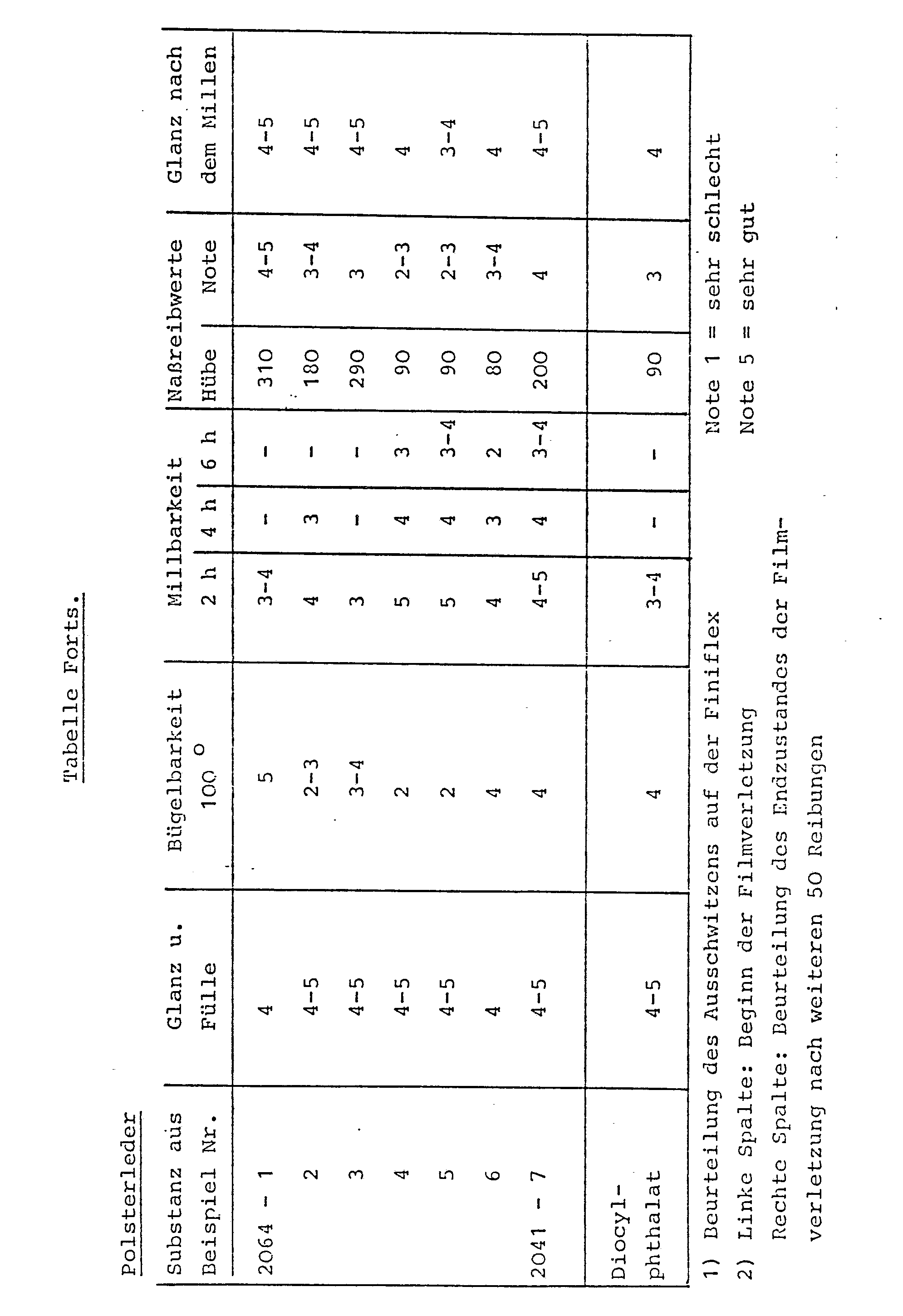
- Durchgeführt mit dem Bally-Flexometer in Anlehnung an DIN 53340
- Durchgeführt mit dem Veslic-Reibtester in Anlehnung an DIN 53339.
- Visuelle Beurteilung
- Hier wurde besonders das Ausschwitzen des Weichmachers beurteilt.
- Geprüft wurde in einem Millfaß. Die Lederoberfläche wurde mit Hilfe eines Mikroskops (50-fache Vergrößerung) beurteilt.
- Weiterhin wurden die Nitrocelluloselacke auf Glas aufgetragen. Dabei wurden Aussehen und Härte beurteilt. Zur Beurteilung der Härte wurde die Pendelhärte nach König - (DIN 53 157) herangezogen.
- Die Ergebnisse sind in Tabelle 1 zusammengestellt.

Claims (10)
Ringöffnungsprodukten aus
epoxidierten Fettsäuren und/oder epoxidierten Fettsäureestem oder epoxidierten Fettalkoholen einerseits und
diprimären Alkoholen andererseits
mit einem Kettenbildner aus
Dicarbonsäuren und/oder
difunktionellen primären Alkoholen
und/oder mit sich selbst,
wobei bei Einsatz der Ringöffnungsprodukte von Fettalkohofen stets Dicarbonsäuren miteingesetzt werden.
Applications Claiming Priority (2)
| Application Number | Priority Date | Filing Date | Title |
|---|---|---|---|
| DE3507505 | 1985-03-04 | ||
| DE19853507505 DE3507505A1 (de) | 1985-03-04 | 1985-03-04 | Polyetherpolyester |
Publications (2)
| Publication Number | Publication Date |
|---|---|
| EP0196458A2 true EP0196458A2 (de) | 1986-10-08 |
| EP0196458A3 EP0196458A3 (de) | 1989-05-03 |
Family
ID=6264085
Family Applications (1)
| Application Number | Title | Priority Date | Filing Date |
|---|---|---|---|
| EP86102513A Withdrawn EP0196458A3 (de) | 1985-03-04 | 1986-02-26 | Polyätherpolyester |
Country Status (2)
| Country | Link |
|---|---|
| EP (1) | EP0196458A3 (de) |
| DE (1) | DE3507505A1 (de) |
Cited By (2)
| Publication number | Priority date | Publication date | Assignee | Title |
|---|---|---|---|---|
| WO1995031493A1 (de) * | 1994-05-13 | 1995-11-23 | Henkel Kommanditgesellschaft Auf Aktien | Polyester auf basis oleochemischer polyole zur herstellung von polyurethan-schaumstoffen |
| WO2005075537A1 (en) * | 2004-02-05 | 2005-08-18 | Dsm Ip Assets B.V. | Block copolyetherester elastomer and preparation thereof |
Families Citing this family (2)
| Publication number | Priority date | Publication date | Assignee | Title |
|---|---|---|---|---|
| DE4120432A1 (de) * | 1991-06-20 | 1992-12-24 | Henkel Kgaa | Dihydroxyfettsaeuren als polyurethanbausteine |
| DE19717042C2 (de) | 1997-04-23 | 1999-07-15 | Daimler Chrysler Ag | Verfahren zum Schalten eines synchronisiergliederfreien Zahnräderwechselgetriebes |
Family Cites Families (1)
| Publication number | Priority date | Publication date | Assignee | Title |
|---|---|---|---|---|
| DE3246618A1 (de) * | 1982-12-16 | 1984-07-05 | Henkel KGaA, 4000 Düsseldorf | Alkydharze, enthaltend ringoeffnungsprodukte epoxidierter fettalkohole oder fettsaeurederivate als hydroxylverbindungen |
-
1985
- 1985-03-04 DE DE19853507505 patent/DE3507505A1/de not_active Withdrawn
-
1986
- 1986-02-26 EP EP86102513A patent/EP0196458A3/de not_active Withdrawn
Cited By (3)
| Publication number | Priority date | Publication date | Assignee | Title |
|---|---|---|---|---|
| WO1995031493A1 (de) * | 1994-05-13 | 1995-11-23 | Henkel Kommanditgesellschaft Auf Aktien | Polyester auf basis oleochemischer polyole zur herstellung von polyurethan-schaumstoffen |
| WO2005075537A1 (en) * | 2004-02-05 | 2005-08-18 | Dsm Ip Assets B.V. | Block copolyetherester elastomer and preparation thereof |
| CN100460440C (zh) * | 2004-02-05 | 2009-02-11 | 帝斯曼知识产权资产管理有限公司 | 嵌段共聚醚酯弹性体及其制备方法 |
Also Published As
| Publication number | Publication date |
|---|---|
| EP0196458A3 (de) | 1989-05-03 |
| DE3507505A1 (de) | 1986-09-04 |
Similar Documents
| Publication | Publication Date | Title |
|---|---|---|
| EP0029145B1 (de) | Verfahren zur Herstellung von verbesserten wässrigen Emulsionen von luft- und ofentrocknenden Alkydharzen | |
| DE2416658C3 (de) | Verfahren zur Herstellung von wasserlöslichen und wasserdispergierbaren Alkydharzen und ihre Verwendung | |
| DE2637955A1 (de) | Niedrigviskose alkydharze und verfahren zu ihrer herstellung | |
| US2469371A (en) | Process of reacting glyceride oils | |
| DE3246618A1 (de) | Alkydharze, enthaltend ringoeffnungsprodukte epoxidierter fettalkohole oder fettsaeurederivate als hydroxylverbindungen | |
| DE1495113B2 (de) | Verfahren zur herstellung von polyesterimiden | |
| EP0196458A2 (de) | Polyätherpolyester | |
| US2495305A (en) | Esters of pentaerythritol dehydration products | |
| EP0113800B1 (de) | Polyol-modifizierte Alkydharze zur Verwendung in Wasserlacken | |
| EP0013397B1 (de) | Verfahren zur Herstellung von ungesättigten, Imidgruppen enthaltenden Polyestern und ihre Verwendung | |
| US2029851A (en) | Product and process of preparing same | |
| DE1801839A1 (de) | Verfahren zur Herstellung von Alkydharzen | |
| US2590911A (en) | Partial esters | |
| DE1495249A1 (de) | Verfahren zur Herstellung von modifizierten Polyaetherharzen | |
| EP0394854A1 (de) | Verfahren zur Herstellung von 2-Alkyl- bzw. Alkenyl-2-oxazolinen aus Fettsäureglyceriden | |
| EP0056155A1 (de) | Wässrige Dispersionen auf Basis von Cellulosenitraten, Polyestern bzw. Alkydharzen und Aminoplastharzen, Verfahren zu ihrer Herstellung und ihre Verwendung zur Herstellung von Überzügen | |
| CH388935A (de) | Verfahren zur Herstellung oberflächenaktiver Stoffe | |
| DE1520669B2 (de) | Verfahren zum herstellen von modifizierten alkydharzen | |
| DE1495221A1 (de) | Verfahren zur Herstellung neuer Alkydharze | |
| DE1520771C3 (de) | Verfahren zur Herstellung von Alkydharzen. Ausscheidung aus: 1520745 | |
| US3222308A (en) | Partially oxidized alkyd resins prepared from complex polybasic acids derived from petroleum fractions | |
| DE1520210A1 (de) | Verfahren zur Herstellung von Kunstharzmassen,insbesondere fuer Einbrennlacke | |
| AT155036B (de) | Verfahren zur Herstellung härtbarer Kunstharze. | |
| DE2214179A1 (de) | ||
| AT275151B (de) | Verfahren zur Herstellung eines filmbildenden wasserlöslichen Alkydharzes |
Legal Events
| Date | Code | Title | Description |
|---|---|---|---|
| PUAI | Public reference made under article 153(3) epc to a published international application that has entered the european phase |
Free format text: ORIGINAL CODE: 0009012 |
|
| AK | Designated contracting states |
Kind code of ref document: A2 Designated state(s): AT BE CH DE FR GB IT LI NL SE |
|
| RBV | Designated contracting states (corrected) |
Designated state(s): BE CH DE FR GB IT LI NL |
|
| PUAL | Search report despatched |
Free format text: ORIGINAL CODE: 0009013 |
|
| AK | Designated contracting states |
Kind code of ref document: A3 Designated state(s): BE CH DE FR GB IT LI NL |
|
| STAA | Information on the status of an ep patent application or granted ep patent |
Free format text: STATUS: THE APPLICATION IS DEEMED TO BE WITHDRAWN |
|
| 18D | Application deemed to be withdrawn |
Effective date: 19891106 |
|
| RIN1 | Information on inventor provided before grant (corrected) |
Inventor name: FRIESE, HANS HERBERT, DR. Inventor name: SCHULZ, HORST Inventor name: FISCHER, HERBERT, DR. Inventor name: ANZINGER, HERMANN, DR. Inventor name: MEFFERT, ALFRED, DR. |