EP0182795B1 - Messfühler zur untersuchung von flüssigkeiten - Google Patents
Messfühler zur untersuchung von flüssigkeiten Download PDFInfo
- Publication number
- EP0182795B1 EP0182795B1 EP85901380A EP85901380A EP0182795B1 EP 0182795 B1 EP0182795 B1 EP 0182795B1 EP 85901380 A EP85901380 A EP 85901380A EP 85901380 A EP85901380 A EP 85901380A EP 0182795 B1 EP0182795 B1 EP 0182795B1
- Authority
- EP
- European Patent Office
- Prior art keywords
- measuring probe
- probe according
- electrodes
- liquid
- diaphragm
- Prior art date
- Legal status (The legal status is an assumption and is not a legal conclusion. Google has not performed a legal analysis and makes no representation as to the accuracy of the status listed.)
- Expired - Lifetime
Links
Images


Classifications
-
- G—PHYSICS
- G01—MEASURING; TESTING
- G01N—INVESTIGATING OR ANALYSING MATERIALS BY DETERMINING THEIR CHEMICAL OR PHYSICAL PROPERTIES
- G01N33/00—Investigating or analysing materials by specific methods not covered by groups G01N1/00 - G01N31/00
- G01N33/26—Oils; Viscous liquids; Paints; Inks
- G01N33/28—Oils, i.e. hydrocarbon liquids
- G01N33/2888—Lubricating oil characteristics, e.g. deterioration
-
- G—PHYSICS
- G01—MEASURING; TESTING
- G01N—INVESTIGATING OR ANALYSING MATERIALS BY DETERMINING THEIR CHEMICAL OR PHYSICAL PROPERTIES
- G01N27/00—Investigating or analysing materials by the use of electric, electrochemical, or magnetic means
- G01N27/02—Investigating or analysing materials by the use of electric, electrochemical, or magnetic means by investigating impedance
- G01N27/22—Investigating or analysing materials by the use of electric, electrochemical, or magnetic means by investigating impedance by investigating capacitance
- G01N27/227—Sensors changing capacitance upon adsorption or absorption of fluid components, e.g. electrolyte-insulator-semiconductor sensors, MOS capacitors
Definitions
- the invention relates to a sensor for examining liquids according to the preamble of claim 1, the use of this sensor and a device for measuring properties of a liquid by means of this sensor.
- pH fluctuations in reactors should usually be investigated using sensors, or physiological pH values in blood samples and the like should also be determined.
- sensors have the advantage that they are independent of turbidity or impurities that affect light transmission and can be used directly in samples.
- a sensor for examining liquids with two electrodes is known for example from DE-B-29 38 434.
- This capacitive measuring sensor has a non-conductive membrane arranged between the electrodes, which is designed so that moisture can penetrate into it.
- the membrane materials specified in claim 2 of DE-B-29 38 434 indicate that the "penetration process" should be a diffusion process. Diffusion processes have the disadvantage, however, that the establishment of an equilibrium between the liquid surrounding the sensor and the "located in the membrane material" takes a very long time, so that changes occurring at short notice can only be recognized late.
- a sensor of this type is therefore only of limited suitability, for example, for examining aging processes in oils.
- liquid in the membrane material may "short-circuit" the electrodes, as these are not insulated from the membrane material.
- Sensors for examining liquids are also known from German laid-open specification 21 55 568 or European laid-open specifications EP-A-0 058 102 and EP-A-0 082 934.
- the electrodes are insulated by an oxide material.
- DE-OS 21 55 568 also describes a sensor designed as a capacitor, in which a plastic film made of water-swelling material serves as the dielectric of the capacitor, the capacity of which is a measure of the concentration of water or components dissolved therein.
- the sensor known from DE-OS 21 55 568 has the disadvantage that plastic membranes which swell in water show different physical properties depending on their storage or their age, so that frequent re-calibration of such sensors is necessary.
- the water-swellable plastics are moreover poorly or not at all usable in aggressive media or in mixtures of water / organic solvents.
- a sensor is also known in which a capacitor with insulated electrodes is used to determine the dielectric constant of a gaseous medium introduced between the capacitor electrodes; the capacitance of the capacitor is also measured as a function of the medium introduced. With this measuring probe it is possible to determine the dew point of the gaseous medium to be examined.
- the coaxial resonator described there requires the liquid to be introduced into the resonator cavity, so that only a discontinuous and not a continuous measurement is possible.
- the construction of such a resonator also requires considerable technical effort - if only because of the seal - so that this is not a robust, versatile probe that can also be used for continuous operation, for example in bioreactors, for measuring engine oils during operation and the like is.
- the known sensors in which a membrane is used, into which the liquid to be examined can penetrate, has in common that the exchange between the liquid which has penetrated into the membrane and that of the sensor surrounding liquid is relatively slow because - as has been recognized according to the invention - the underlying process is a diffusion process.
- the sensor according to the invention is also intended to be suitable for detecting various liquid properties, that is to say it can be used in a variety of ways.
- a device is to be specified which, in conjunction with the sensor according to the invention, allows a quantitative measurement of liquid properties.
- the electrodes have an electrically insulating coating that is liquid-tight.
- the liquid to be examined can thus only penetrate into the membrane, the pores, gaps or interstices with a large surface area, for example for this purpose has in the order of 100 m2 / g, so that there is a space charge layer due to physical adsorption.
- membrane material which does not have any pores in the sense explained above, but which would actually be liquid-tight, but in which a "pore function" is realized by gaps, spaces, etc., which occur during (fixed) Stacking layers of membrane material or by stacking the two insulated electrodes.
- a material which does not have any pores in the sense explained above, but which would actually be liquid-tight, but in which a "pore function" is realized by gaps, spaces, etc., which occur during (fixed) Stacking layers of membrane material or by stacking the two insulated electrodes.
- the membrane in the sense explained above can be omitted, since the gap between the coatings serves as a membrane.
- the complex resistance of the capacitor formed by the electrodes, between which there is a dielectric formed by the coating of one electrode, the membrane and the coating of the other electrode, only by the gaps in the membrane or in the pores or gaps in the membrane of the "existing" liquid changes, but not, for example, through ohmic portions of a continuous galvanic connection, as would result, for example, from a liquid thread between the electrodes.
- the membrane consists of a material that is not chemically attacked by the liquid to be examined, the reproducibility of measurements with the sensor according to the invention is high, so that the change in the complex dielectric constant of the membrane when liquid penetrates into it or the complex Capacitance of the capacitor formed by the electrodes can be used with surprisingly high accuracy to investigate changes in properties of liquids.
- the electrodes consist essentially of a metal and / or transition metal and in particular aluminum, zirconium, titanium, tantalum, tungsten or molybdenum (claim 2), the electrodes being produced from pure titanium or a titanium alloy, for example with a content of up to 6% aluminum and up to 4% vanadium and optionally copper according to claim 8 is particularly preferred.
- the non-conductive membrane which receives the medium to be examined or is in contact with it, exists according to Claim 3 preferably made of aluminum oxide, silicon nitride, [KAl2 (OH) 2] * [AlSi3O10], titanium oxide or polytetrafluoroethylene.
- the coatings can be produced on the electrodes by direct oxidation of the electrode material, for example by anodic oxidation or glow oxidation, in a manner known per se as zirconium oxide, titanium oxide, tantalum oxide, tungsten oxide or molybdenum oxide or aluminum oxide.
- Electrode coatings and membrane can essentially consist of the same base material, possibly with different structures, so that the properties of the coating (liquid-tight) and membrane (not liquid-tight) can be achieved.
- the continuous pores in the non-conductive membrane have a diameter which is approximately between 0.01 and 1 ⁇ m and preferably between 0.05 and 0.2 ⁇ m lies.
- At least one of the electrodes can also be porous and the inner walls of the porous electrode have a non-conductive coating which is essentially liquid-tight.
- a membrane If a membrane is used, its thickness can be between 10 and 100 ⁇ m and preferably between 20 and 40 ⁇ m.
- the membrane consists of non-porous corundum, aluminum hydroxyl silicate, e.g. Mica or gamma-aluminum oxide consists of materials with a layered grid structure in which inclusions can quickly penetrate between the individual grid layers.
- the membrane thickness in this preferred embodiment is between approximately 6 and 100 ⁇ m, preferably 30 to 40 ⁇ m.
- the senor suitable for measurement in aqueous solutions is at least partially enclosed by an ion-selective membrane which, for example, increases the selectivity for hydrogen or hydroxyl ions, potassium, sodium, chloride, calcium or magnesium ions. This also makes it possible to determine these ions.
- the electrodes can be arranged in the manner of a plate capacitor, but it is also possible for one electrode to surround the other electrode in a cylindrical manner, as in the case of a cylindrical capacitor.
- the senor is introduced into the liquid, a variable alternating voltage between 50 Hz and 1 GHz is applied to the electrodes and the dielectric loss factor D and / or the capacitance C are determined as a function of the measurement frequency.
- the measured values obtained in this way are stored in an evaluation unit which, based on the corresponding measured value pairs, dielectric loss factor / frequency or the dependence of the capacitance on the frequency, on the basis of a comparison with reference values stored in the evaluation unit for determining properties of the liquid, such as the viscosity, the pH -Value, the ion content and the like is capable.
- oils or the like such as engine, turbine, pump, transformer and similar oils.
- sensors according to the invention it is possible to continuously examine the properties of an oil in use, with the stored measured values possibly also the controlled addition of additives to oil in use, which have a positive influence on the properties of the oil for its intended use is.
- Oils must be replaced at the latest when their functionality has dropped to an acceptable level. So far, the oil has been replaced without further checking its actual aging after a determined average "maintenance period"; if the oil change is too early, this leads to increased oil costs, and if the oil change is too late, on the other hand, this leads to increased wear of engine parts.
- oil properties can be achieved by adding additives for improving the viscosity and for a sufficient lubricating effect.
- the oil is made alkaline against chemical corrosion. Contamination particles are kept in finely divided form in the oil by detergents or dispersants, so that there is no deposition or accumulation of such particles.
- the alkalinity is reduced by the oxidative degradation (formation of acid groups); on the other hand, the viscosity increases or decreases depending on the operating conditions.
- a check of the functionality of the oil should therefore extend to the three main properties of alkalinity, viscosity and dispersant / detergent additive concentration.
- the measuring probe created according to the invention makes it possible for the first time to continuously monitor the oil properties in an advantageous manner. Surprisingly, it is possible to design the probes according to the invention in such a way that, despite their small dimensions, they provide satisfactory measurements of viscosity and alkalinity.
- the invention assumes that the dielectric values of the oils are frequency-dependent.
- the porous, non-conductive layer between the capacitor electrodes has the effect that the dielectric values at different frequencies show maxima or steps that are typical for a certain oil or oil property. Without the non-conductive porous layer according to the invention between the electrodes for receiving the oil to be measured, the frequency-dependent course of the dielectric values is monotonous, so that no maximum specific to the oil can be seen.
- the capacitance, the dielectric constant and the dielectric loss factor can be measured and evaluated using a computer.
- the embodiment described below relates to the processing of the dielectric loss factor; Of course, valuable information can also be obtained from the other dielectric values.
- Frequency-dependent maxima of the dielectric loss factor when applying AC voltage with frequencies between 50 Hz and 1 GHz are probably due to the fact that the oil-filled pores of the membrane at the operating temperature of approximately 150 ° C represent electrically conductive inhomogeneities in the non-conductive membrane, which lead to a dielectric relaxation behavior, which is known as the Maxwell-Wagner effect.
- Electrically conductive particles embedded in an insulator show periodic polarization when an alternating electric field is applied. As the frequency increases, energy is increasingly used to polarize the particles.
- the relaxation frequency (f R ) is exceeded, the amplitude of the charge carriers becomes smaller. A maximum of the dielectric loss at the relaxation frequency and a step in the dielectric constant are therefore obtained.
- the oil thus represents poorly electrically conductive inhomogeneities in the non-conductive membrane material and therefore shows the Maxwell-Wagner effect.
- the concentration of the charge carriers in the oil depends on the content of acidic, alkaline and salt-like groups or degradation products of the oil as well as the water content.
- all these groups acting as charge carriers initially take part in the forced periodic movement, but gradually drop out with increasing frequency due to their inherent inertia. This takes place at a relaxation frequency characteristic of each charge carrier type with a more or less pronounced maximum in the dielectric loss factor D or a step in the dielectric constant or the capacitance.
- the measuring probe according to the invention can now be used either in the flow-through method (in particular as a cylindrical capacitor) or in the immersion method.
- the membrane When using the sensor according to the invention for pH measurement and / or for measuring the ion activity in a water-containing liquid, it can furthermore be advantageous to design the membrane to absorb hydrogen, hydroxyl and / or other ions.
- the pH sensor according to the invention which essentially only reacts to OH ⁇ and H+, is particularly advantageous since - in contrast to the glass pH measuring probes that have been customary up to now - it is not easily fragile and also at extreme pH values, especially in alkaline. Glass electrodes cannot be used in strongly alkaline solutions.
- Another disadvantage of the known pH sensors is, besides their sensitivity, also that they are relatively voluminous and therefore cannot be used for the smallest measuring volumes.
- the configuration according to the invention in particular in that a resistant membrane is inserted between coated electrodes, makes it possible, for example, to monitor the pH or other ionic activity in galvanic baths, electrolyte baths, bioreactors and the like. In particular, continuous measurement is possible, even at extremely alkaline pH values.
- the sensor according to the invention can also be set up for the measurement of other ions, for example potassium, sodium, chlorine, calcium or magnesium ions, by forming a 15 to 20 ⁇ m-thick capsule of an ion-selective membrane around electrodes, membrane and electrode coatings which allows the ions to be measured to pass selectively.
- ions for example potassium, sodium, chlorine, calcium or magnesium ions
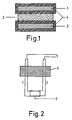
- Fig. 1 shows not to scale and schematically the structure of a sensor according to the invention designed as a plate capacitor.
- the sensor has two electrodes 1 and 2, on which there is an electrically insulating coating 4 and between which a membrane 3 is arranged.
- a signal processing and evaluation unit is connected to the two electrodes 1 and 2 of the sensor and applies an alternating voltage to the electrodes at a variable frequency.
- the evaluation unit determines the capacitance and / or the dielectric loss factor of the capacitor from the complex resistance behavior of the sensor.
- the evaluation can be analog or digital, e.g. with a microcomputer or a universal computer.
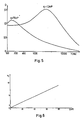
- Fig. 1 shows only the basic structure. An embodiment implemented in practice is shown in FIG.
- the two electrodes are angular; the two angular parts enclose the membrane 3 between them.
- An electrode holder 6 fixes the position of the electrodes 1 and 2 against each other; At the end of the electrodes, supply lines 5 are provided for applying the AC voltage or for connecting the evaluation unit.
- a sensor according to the invention for measuring water-containing solutions and in particular the pH of water-containing solutions and first an embodiment will be described, which is primarily for measurement in industrial oils and in particular for measuring their alkalinity, viscosity and dispersion / Detergent additive concentration is suitable.
- the two electrodes 1 and 2 are made of titanium and have a rutile or titanium aluminum zirconate coating 4.
- the coating 4 is not porous and about 8 to 30 microns thick.
- the membrane 3 between the electrodes is about 10 to 100 microns thick and consists of non-porous corundum or gamma aluminum oxide.
- the sensor according to the invention can have the following dimensions when used as a pH sensor: thickness 0.5 mm, width 5 mm and length: 10 mm.
- the frequency of the AC voltage applied by the signal processing and evaluation unit varies in the range between approximately 50 Hz and 1 GHz and preferably between 100 Hz and 40 KHz, the peak value of the voltage is preferably in the order of 1V.
- ions penetrate into the membrane.
- the dielectric properties of the membrane 3 change in particular due to the penetration of hydrogen and hydroxyl ions, so that the capacitance and the dielectric loss factor are correlated with the pH.
- no ions diffuse into the non-porous coating 4 of the electrodes 1 and 2, so that the electrodes 1 and 2 are further insulated, and the complex resistance of the sensor capacitor is not caused by galvanic bridging, but only by changing the dielectric properties of the membrane 3 is changed. Since the membrane 3 is not chemically attacked by the liquid, which only penetrates into pores or into the material itself (e.g. with mica), the reproducibility is high.
- the evaluation unit stores the measured values in association with the respective measuring frequency and compares the measured values with stored calibration data.
- the pH values can be determined with great accuracy and reproducibility from the comparison of the measurement data with the stored calibration data. The great reproducibility makes it possible to "pre-calibrate" the evaluation unit so that it outputs the pH value directly as the measurement result.
- a 5 to 20 ⁇ m thick ion-selective membrane capsule is placed around the sensor according to the invention, which, for example, selectivity for hydrogen and hydroxyl ions or potassium, sodium , Chlorine or calcium ions increases. This selective disturbance makes it possible to determine these ions separately or separately from other interfering charges in the liquid.
- the electrodes 1 and 2 are plate-shaped as in the embodiments shown in FIGS. 1 and 2.
- the electrodes consist, for example, of pure titanium or a titanium alloy that contains up to 6% aluminum, up to 4% vanadium and possibly traces of copper.
- the electrodes 1 and 2 are in turn provided with a non-conductive coating 4, which can be produced by anodic or glow oxidation of the electrode metal.
- a titanium (di) oxide layer with a thickness between approximately 8 ⁇ m and 20 ⁇ m is formed on the electrodes from titanium by anodic oxidation in aqueous sodium sulfate solution. It is expressly pointed out that the properties of the titanium (di) oxide layer depend on the current density and the voltage during manufacture; the process parameters in the production of the coating 4 on the electrodes are therefore to be set according to the desired properties of the coating.
- the non-conductive porous membrane 3 preferably has a thickness between about 10 microns and 100 microns; the pore diameter should be between 0.01 ⁇ m and 1.0 ⁇ m, preferably between 0.05 and 0.2 ⁇ m.
- Such a membrane can be produced, for example, by completely oxidizing an aluminum foil with a thickness of 10 ⁇ m to 100 ⁇ m in 15% aqueous H2SO4 solution at constant current densities of approx. 10 mA / cm2.
- the layer expediently has pores with a specific surface area of the order of 100 m 2 / g.
- a sensor with the above construction has e.g. following typical dimensions: width: 2mm, length: 25mm, thickness: 0.2mm
- the electrodes can be rectangular so that they form a "plate capacitor", but cylindrical electrodes can also be used.
- Typical dimensions of the cylindrical electrodes are: Inner electrode diameter 1 to 10 mm; this electrode can be solid or a hollow cylinder with a wall thickness of, for example, 0.5 to 3 mm.
- the outer electrode is a hollow cylinder with an inner diameter which is equal to the outer diameter of the inner electrode plus the thickness of the porous layer; their outer diameter is between 2 and 15 mm.
- the length of the active part of the cylindrical electrode is approximately 1 to 5 mm.
- At least one of the two electrodes can advantageously be made porous in such a way that the inner walls of the pores are also coated with metal oxide.
- An AC voltage is applied to the electrodes by an electronic evaluation unit, the frequency of which can be varied between approximately 0.05 kHz and 1 GHz and the peak voltage value of which lies between approximately 1V and 5V.
- D D (f)
- maxima include the relaxation frequencies f R as respective striking values of the measuring frequency f.
- the value of the ratio A determined in this way can also be stored according to the invention by the evaluation unit and compared with previous values of A to indicate the change in alkalinity.
- A (D (400 Hz) -D (100 Hz)) / ⁇ f
- the relative increase in the maximum frequencies ⁇ f / f is a measure of the relative decrease in the viscosity ⁇ / ⁇ .
- this relationship can be provided with a calibration factor and used for evaluating the oil properties, preferably with a computer.
- the dependence of the concentration on the value of a specific maximum of D preferably by adding the additives in question to the oil, is recorded and stored in the evaluation unit.
- the change in the instantaneous value of this maximum to be determined by the evaluation unit compared to its initial value can be displayed as a measure of the change in the concentration.
Landscapes
- Chemical & Material Sciences (AREA)
- Engineering & Computer Science (AREA)
- Health & Medical Sciences (AREA)
- Life Sciences & Earth Sciences (AREA)
- Immunology (AREA)
- Chemical Kinetics & Catalysis (AREA)
- Pathology (AREA)
- Physics & Mathematics (AREA)
- Analytical Chemistry (AREA)
- Biochemistry (AREA)
- General Health & Medical Sciences (AREA)
- General Physics & Mathematics (AREA)
- General Chemical & Material Sciences (AREA)
- Electrochemistry (AREA)
- Power Engineering (AREA)
- Oil, Petroleum & Natural Gas (AREA)
- Food Science & Technology (AREA)
- Medicinal Chemistry (AREA)
- Investigating Or Analyzing Materials By The Use Of Electric Means (AREA)
- Sampling And Sample Adjustment (AREA)
- Inspection Of Paper Currency And Valuable Securities (AREA)
- Protection Of Generators And Motors (AREA)
- Ignition Installations For Internal Combustion Engines (AREA)
- Eye Examination Apparatus (AREA)
- Investigating Or Analysing Biological Materials (AREA)
- Memory System Of A Hierarchy Structure (AREA)
- Investigating Materials By The Use Of Optical Means Adapted For Particular Applications (AREA)
- Measurement Of Radiation (AREA)
- Carbon And Carbon Compounds (AREA)
Priority Applications (1)
| Application Number | Priority Date | Filing Date | Title |
|---|---|---|---|
| AT85901380T ATE78924T1 (de) | 1984-04-06 | 1985-04-09 | Messfuehler zur untersuchung von fluessigkeiten. |
Applications Claiming Priority (2)
| Application Number | Priority Date | Filing Date | Title |
|---|---|---|---|
| DE3413135 | 1984-04-06 | ||
| DE19843413135 DE3413135A1 (de) | 1984-04-06 | 1984-04-06 | Messsonde zur erfassung qualitativer aenderungen von fluessigkeiten |
Publications (2)
| Publication Number | Publication Date |
|---|---|
| EP0182795A1 EP0182795A1 (de) | 1986-06-04 |
| EP0182795B1 true EP0182795B1 (de) | 1992-07-29 |
Family
ID=6232936
Family Applications (1)
| Application Number | Title | Priority Date | Filing Date |
|---|---|---|---|
| EP85901380A Expired - Lifetime EP0182795B1 (de) | 1984-04-06 | 1985-04-09 | Messfühler zur untersuchung von flüssigkeiten |
Country Status (9)
| Country | Link |
|---|---|
| EP (1) | EP0182795B1 (da) |
| JP (1) | JPH0752167B2 (da) |
| AT (1) | ATE78924T1 (da) |
| AU (1) | AU4157185A (da) |
| DE (2) | DE3413135A1 (da) |
| DK (1) | DK167037B1 (da) |
| FI (1) | FI854815A7 (da) |
| NO (1) | NO179386C (da) |
| WO (1) | WO1985004718A1 (da) |
Families Citing this family (13)
| Publication number | Priority date | Publication date | Assignee | Title |
|---|---|---|---|---|
| DE3643389A1 (de) * | 1986-12-19 | 1988-07-07 | Duerrwaechter E Dr Doduco | Verfahren zum erzeugen eines elektrischen sinussignals mit veraenderlicher frequenz |
| DE3812687A1 (de) * | 1988-04-16 | 1989-10-26 | Duerrwaechter E Dr Doduco | Kapazitiver sensor zum bestimmen des niveaus einer fluessigkeit in einem behaelter |
| DE3840961A1 (de) * | 1988-12-05 | 1990-06-07 | Hellige Gmbh | Ionensensitive elektrode und verfahren zur temperaturgangkompensation bei solchen elektroden |
| DE3904142C2 (de) * | 1989-02-11 | 1994-06-16 | Hans Dipl Ing Gluesing | Verfahren und Vorrichtung zur On-line Kontrolle von Motorenölen |
| DE4004192A1 (de) * | 1989-12-04 | 1991-08-22 | Hauber Elektronik Gmbh | Messgeraet zur bestimmung des wassergehalts in bremsfluessigkeiten von kraftfahrzeugen |
| US5488311A (en) * | 1990-05-30 | 1996-01-30 | Japan Electronic Control Systems Co., Ltd. | Apparatus and method for measuring alcohol concentration of liquid blended with alcohol applicable to an automotive vehicle mounted internal combustion engine |
| JP2519116B2 (ja) * | 1990-05-30 | 1996-07-31 | 株式会社ユニシアジェックス | 静電容量式アルコ―ル濃度測定装置 |
| DE4115664A1 (de) * | 1991-05-14 | 1992-11-19 | Werner Maier | Kaeltemitteloelsensor mit externem saeurewarngeraet |
| AU6719000A (en) * | 1999-12-08 | 2001-06-18 | Sensirion Ag | Capacitive sensor |
| DE10025690A1 (de) * | 2000-05-24 | 2001-11-29 | Zahnradfabrik Friedrichshafen | Vorrichtung zur Sensierung des Ölzustands |
| TWI475220B (zh) * | 2012-10-31 | 2015-03-01 | Univ Nat Taiwan | 簡易油品品質檢測裝置及檢測方法 |
| DE102014210122B4 (de) * | 2014-05-27 | 2025-04-30 | Robert Bosch Gmbh | Vorrichtung zum Bestimmen eines Werts einer zu messenden Eigenschaft eines Fluids, Verfahren zum Betreiben einer Vorrichtung zum Bestimmen eines Werts einer zu messenden Eigenschaft eines Fluids |
| JP7132886B2 (ja) * | 2019-05-28 | 2022-09-07 | 株式会社豊田中央研究所 | 腐食侵入水素測定装置および腐食侵入水素評価方法 |
Family Cites Families (5)
| Publication number | Priority date | Publication date | Assignee | Title |
|---|---|---|---|---|
| US3453143A (en) * | 1965-10-13 | 1969-07-01 | Singer General Precision | Method of making a moisture sensitive capacitor |
| DE2938434C2 (de) * | 1979-09-22 | 1981-07-09 | Fraunhofer-Gesellschaft zur Förderung der angewandten Forschung e.V., 8000 München | Kapazitiver Feuchtigkeitsfühler und Verfahren zur Herstellung des Fühlers |
| FR2498329A1 (fr) * | 1981-01-19 | 1982-07-23 | Commissariat Energie Atomique | Hygrometre capacitif a dielectrique mince et son procede de fabrication |
| DE3151630C2 (de) * | 1981-12-28 | 1986-07-03 | Endress U. Hauser Gmbh U. Co, 7867 Maulburg | Feuchtigkeitsfühler und Verfahren zu seiner Herstellung |
| US4571543A (en) * | 1983-03-28 | 1986-02-18 | Southwest Medical Products, Inc. | Specific material detection and measuring device |
-
1984
- 1984-04-06 DE DE19843413135 patent/DE3413135A1/de not_active Withdrawn
-
1985
- 1985-04-09 AU AU41571/85A patent/AU4157185A/en not_active Abandoned
- 1985-04-09 DE DE8585901380T patent/DE3586417D1/de not_active Expired - Lifetime
- 1985-04-09 FI FI854815A patent/FI854815A7/fi not_active Application Discontinuation
- 1985-04-09 JP JP60501665A patent/JPH0752167B2/ja not_active Expired - Lifetime
- 1985-04-09 WO PCT/DE1985/000107 patent/WO1985004718A1/de not_active Ceased
- 1985-04-09 EP EP85901380A patent/EP0182795B1/de not_active Expired - Lifetime
- 1985-04-09 AT AT85901380T patent/ATE78924T1/de not_active IP Right Cessation
- 1985-12-05 NO NO854902A patent/NO179386C/no unknown
- 1985-12-06 DK DK567585A patent/DK167037B1/da not_active IP Right Cessation
Also Published As
| Publication number | Publication date |
|---|---|
| DK567585D0 (da) | 1985-12-06 |
| ATE78924T1 (de) | 1992-08-15 |
| NO179386C (no) | 1996-09-25 |
| AU4157185A (en) | 1985-11-01 |
| FI854815A0 (fi) | 1985-12-04 |
| DK567585A (da) | 1985-12-06 |
| EP0182795A1 (de) | 1986-06-04 |
| WO1985004718A1 (fr) | 1985-10-24 |
| NO179386B (no) | 1996-06-17 |
| DK167037B1 (da) | 1993-08-16 |
| FI854815L (fi) | 1985-12-04 |
| FI854815A7 (fi) | 1985-12-04 |
| DE3586417D1 (de) | 1992-09-03 |
| DE3413135A1 (de) | 1985-10-17 |
| JPH0752167B2 (ja) | 1995-06-05 |
| NO854902L (no) | 1985-12-05 |
| JPS61502836A (ja) | 1986-12-04 |
Similar Documents
| Publication | Publication Date | Title |
|---|---|---|
| DE69326726T2 (de) | Benutzung einer Vorrichtung und Verfahren zur Bestimmung von Wasser und Säure in Gegenwart von Wasser in nichtwässerigen Medien | |
| US5269175A (en) | Sensor for investigating liquids | |
| DE3405431C2 (da) | ||
| DE10036039B4 (de) | Messsonde für potentiometrische Messungen, Verfahren zur Überwachung des Altrungszustandes der Messonde und ihre Verwendung | |
| DE2548405A1 (de) | Miniatursonde | |
| DE2501812A1 (de) | Gleichstromsystem zur leitfaehigkeitsmessung | |
| DE102008044312A1 (de) | Erfassungsvorrichtung zum Erfassen einer in einem Kraftstoffgemisch enthaltenen Komponentendichte | |
| WO1985004718A1 (fr) | Detecteur pour l'analyse de liquides | |
| DE102013109105A1 (de) | Messanordnung | |
| DE102018128885A1 (de) | Glaselektrode | |
| DE4223228C2 (de) | Verfahren zur Bestimmung von Persäuren | |
| DE3136248C2 (de) | Verfahren zur Zustandsprüfung von polarographischen Meßelektroden sowie Einrichtung zur Durchführung des Verfahrens | |
| CH627278A5 (da) | ||
| DE69420298T2 (de) | Verfahren zur Überwachung von wesentlichen Bestandteilen in Plattierungsbädern | |
| DE2349579A1 (de) | Potentiometrischer sauerstoff-sensor | |
| CH662428A5 (de) | Kapazitives messelement zur oszillometrischen messung von stroemenden loesungen sowie verfahren zur bestimmung der abmessungen des messelementes. | |
| DE19828093C2 (de) | Einrichtung zum Messen physikalischer Größen von ein- oder mehrkomponentigen Flüssigkeiten | |
| DE19533059A1 (de) | Bezugselektrode für elektrochemische Messungen und Verfahren zu deren Herstellung | |
| EP0780685A1 (de) | Amperometrischer Zweielektrodensensor, insbesondere für Wasserstoffperoxid | |
| DE3787321T2 (de) | Elektrochemischer Fühler zur Messung der Korrrosion in einer metallischen Einrichtung. | |
| DE602005005504T2 (de) | Coulometrischer Wasserdampfsensor | |
| DE4309411A1 (de) | Elektrisches oder optisches Kabel mit einem Feuchtigkeitssensor | |
| DE102018208482B4 (de) | Potentiometrische Messkette und Verfahren zur pH-Wert-Bestimmung | |
| DE102017112578A1 (de) | Sensor und Verfahren zur Analyse von in einem elektrisch nichtleitenden Medium enthaltenen elektroaktiven Bestandteilen | |
| DE3422394A1 (de) | Fluessigkeitsverlustanzeiger |
Legal Events
| Date | Code | Title | Description |
|---|---|---|---|
| PUAI | Public reference made under article 153(3) epc to a published international application that has entered the european phase |
Free format text: ORIGINAL CODE: 0009012 |
|
| AK | Designated contracting states |
Kind code of ref document: A1 Designated state(s): AT BE CH DE FR GB IT LI LU NL SE |
|
| 17P | Request for examination filed |
Effective date: 19860424 |
|
| RBV | Designated contracting states (corrected) |
Designated state(s): AT BE CH DE FR GB LI LU NL SE |
|
| 17Q | First examination report despatched |
Effective date: 19890615 |
|
| GRAA | (expected) grant |
Free format text: ORIGINAL CODE: 0009210 |
|
| AK | Designated contracting states |
Kind code of ref document: B1 Designated state(s): AT BE CH DE FR GB LI LU NL SE |
|
| REF | Corresponds to: |
Ref document number: 78924 Country of ref document: AT Date of ref document: 19920815 Kind code of ref document: T |
|
| REF | Corresponds to: |
Ref document number: 3586417 Country of ref document: DE Date of ref document: 19920903 |
|
| ET | Fr: translation filed | ||
| GBT | Gb: translation of ep patent filed (gb section 77(6)(a)/1977) | ||
| PLBE | No opposition filed within time limit |
Free format text: ORIGINAL CODE: 0009261 |
|
| STAA | Information on the status of an ep patent application or granted ep patent |
Free format text: STATUS: NO OPPOSITION FILED WITHIN TIME LIMIT |
|
| 26N | No opposition filed | ||
| EPTA | Lu: last paid annual fee | ||
| EAL | Se: european patent in force in sweden |
Ref document number: 85901380.7 |
|
| PGFP | Annual fee paid to national office [announced via postgrant information from national office to epo] |
Ref country code: FR Payment date: 19960416 Year of fee payment: 12 |
|
| PGFP | Annual fee paid to national office [announced via postgrant information from national office to epo] |
Ref country code: SE Payment date: 19960419 Year of fee payment: 12 |
|
| PGFP | Annual fee paid to national office [announced via postgrant information from national office to epo] |
Ref country code: BE Payment date: 19960422 Year of fee payment: 12 Ref country code: AT Payment date: 19960422 Year of fee payment: 12 |
|
| PGFP | Annual fee paid to national office [announced via postgrant information from national office to epo] |
Ref country code: CH Payment date: 19960426 Year of fee payment: 12 |
|
| PGFP | Annual fee paid to national office [announced via postgrant information from national office to epo] |
Ref country code: NL Payment date: 19960430 Year of fee payment: 12 |
|
| PGFP | Annual fee paid to national office [announced via postgrant information from national office to epo] |
Ref country code: LU Payment date: 19960501 Year of fee payment: 12 |
|
| PGFP | Annual fee paid to national office [announced via postgrant information from national office to epo] |
Ref country code: DE Payment date: 19960502 Year of fee payment: 12 |
|
| PGFP | Annual fee paid to national office [announced via postgrant information from national office to epo] |
Ref country code: GB Payment date: 19970318 Year of fee payment: 13 |
|
| PG25 | Lapsed in a contracting state [announced via postgrant information from national office to epo] |
Ref country code: LU Free format text: LAPSE BECAUSE OF NON-PAYMENT OF DUE FEES Effective date: 19970409 Ref country code: AT Effective date: 19970409 |
|
| PG25 | Lapsed in a contracting state [announced via postgrant information from national office to epo] |
Ref country code: SE Effective date: 19970410 |
|
| PG25 | Lapsed in a contracting state [announced via postgrant information from national office to epo] |
Ref country code: LI Free format text: LAPSE BECAUSE OF NON-PAYMENT OF DUE FEES Effective date: 19970430 Ref country code: CH Free format text: LAPSE BECAUSE OF NON-PAYMENT OF DUE FEES Effective date: 19970430 Ref country code: BE Effective date: 19970430 |
|
| BERE | Be: lapsed |
Owner name: FRAUNHOFER-GESELLSCHAFT ZUR FORDERUNG DER ANGEWAN Effective date: 19970430 |
|
| PG25 | Lapsed in a contracting state [announced via postgrant information from national office to epo] |
Ref country code: NL Effective date: 19971101 |
|
| REG | Reference to a national code |
Ref country code: CH Ref legal event code: PL |
|
| PG25 | Lapsed in a contracting state [announced via postgrant information from national office to epo] |
Ref country code: FR Free format text: LAPSE BECAUSE OF NON-PAYMENT OF DUE FEES Effective date: 19971231 |
|
| PG25 | Lapsed in a contracting state [announced via postgrant information from national office to epo] |
Ref country code: DE Free format text: LAPSE BECAUSE OF NON-PAYMENT OF DUE FEES Effective date: 19980101 |
|
| NLV4 | Nl: lapsed or anulled due to non-payment of the annual fee |
Effective date: 19971101 |
|
| EUG | Se: european patent has lapsed |
Ref document number: 85901380.7 |
|
| REG | Reference to a national code |
Ref country code: FR Ref legal event code: ST |
|
| PG25 | Lapsed in a contracting state [announced via postgrant information from national office to epo] |
Ref country code: GB Free format text: LAPSE BECAUSE OF NON-PAYMENT OF DUE FEES Effective date: 19980409 |
|
| GBPC | Gb: european patent ceased through non-payment of renewal fee |
Effective date: 19980409 |