EP0181196A2 - Abnehmbarer auf Berührung ansprechender Eingabeschirm - Google Patents
Abnehmbarer auf Berührung ansprechender Eingabeschirm Download PDFInfo
- Publication number
- EP0181196A2 EP0181196A2 EP85308045A EP85308045A EP0181196A2 EP 0181196 A2 EP0181196 A2 EP 0181196A2 EP 85308045 A EP85308045 A EP 85308045A EP 85308045 A EP85308045 A EP 85308045A EP 0181196 A2 EP0181196 A2 EP 0181196A2
- Authority
- EP
- European Patent Office
- Prior art keywords
- page
- touchscreen
- book
- touchpad
- active area
- Prior art date
- Legal status (The legal status is an assumption and is not a legal conclusion. Google has not performed a legal analysis and makes no representation as to the accuracy of the status listed.)
- Withdrawn
Links
Images



Classifications
-
- G—PHYSICS
- G06—COMPUTING OR CALCULATING; COUNTING
- G06F—ELECTRIC DIGITAL DATA PROCESSING
- G06F3/00—Input arrangements for transferring data to be processed into a form capable of being handled by the computer; Output arrangements for transferring data from processing unit to output unit, e.g. interface arrangements
- G06F3/01—Input arrangements or combined input and output arrangements for interaction between user and computer
- G06F3/03—Arrangements for converting the position or the displacement of a member into a coded form
- G06F3/041—Digitisers, e.g. for touch screens or touch pads, characterised by the transducing means
- G06F3/045—Digitisers, e.g. for touch screens or touch pads, characterised by the transducing means using resistive elements, e.g. a single continuous surface or two parallel surfaces put in contact
Definitions
- This invention relates generally to touch-sensitive devices for providing i put to digital computer systems, and more particularly to touchscreens and touchpads which are adapted for multi-purpose use, especially for use in conjunction with a printed book.
- Touchscreen devices of many kinds are known in the prior art. These are commonly used to provide touch-sensitive input to digital computer systems.
- the touchscreen is placed over the display monitor so that locations on the touchscreen can be touched which are associated with information presented on the underlying display monitor.
- Typical prior art references describe touchscreens which either contain no mechanism for attachment to the display monitor, or which include a mechanism which more or less permanently affixes the touchscreen to the face of the display monitor.
- Typical devices of the former kind are illustrated in U.S. Patent 3,911,215 and U.S. Patent 4,220,815.
- the term "touchscreen” will be used to mean those touch-sensitive devices of the type which are attachable to a display monitor.
- touchpad devices which also provide touch-sensitive input to digital computer systems. These devices, however, are not associated with a display monitor, but are responsive to touch at random positions or at positions associated with the information on a "template"'which is placed over the touchpad.
- a "template"' which is placed over the touchpad.
- Such a device is exemplified by the Koala Pad manufactured by Koala Technologies Corporation, in Santa Clara, California.
- Such touchpads are not usually associated with display monitors, as described above in connection with touchscreens; for example, most touchpads are not constructed from transparent materials, nor are they constructed to be attachable to a display monitor.
- the present invention provides multi-purpose touchscreens and touchpads which may be utilized in the customary manner associated with such devices, but which are configured also for use in other non-traditional modes.
- a touchscreen is configured for use attached to a display monitor, and also for use on a stand-alone basis as a touchpad.
- a touchscreen or touchpad is configured to facilitate use of the device in conjunction with information presented on the pages of a printed book.
- the active area of the touchscreen or touchpad is surrounded with a three-sided U-shaped frame which facilitiates insertion and alignment of the device into a printed book, enabling the user to interact with the printed and graphic information in the book by touching the touchscree or touchpad appropriately.
- conductive elements are deposited onto the touchpad or touchscreen in such manner as to insure long-life of the active area and the conductive elements.
- FIG. 1 there is shown a device 10 which can function as a touchscreen or a touchpad, as those terms are commonly known in the art.
- touchscreen will be taken to mean a touch-sensitive device which is attachable to and used in conjunction with a display monitor.
- touchpad will mean a touch-sensitive device which is not attachable to a display monitor, but which is used on a stand-alone basis.
- device 10 includes an active area 11 which may be a pair of transparent conducting plates, each of which includes a transparent substrate with. a material such as Indium Tin Oxide (ITO) deposited thereon.
- ITO Indium Tin Oxide
- the plates are separated from each other by rows of transparent insulating spacers 13 fabricated from plastic or epoxy so that contact between the plates only occurs at points subjected to pressure caused by the touch of a user.
- the contact point is detected by external circuitry well known to those skilled in the art; for example, a device of this general type is described in U.S. Patent Number 3,911,215 issued to Hurst and Colwell. Note that if the device is to be used only as a touchpad and not as a touchscreen, then the materials of active area 11 need not be transparent. Other types of touchscreens and touchpads are also know in the art, and could be -employed in the present invention.
- an LED (light emitting diode) based device such as the touchscreen on the Model 150 personal computer manufactured by the Hewlett-Packard Company
- a capacitive based device such as the Model TK 1000 manufactured by Interaction Systems, Inc., of Newtonville, Massachusetts.
- active area 11 is surrounded on three sides by a frame 15, which may be of molded plastic or other suitable material.
- a bottom portion 17 of frame 15 is hollow, so that external circuit elements may be contained therein.
- device 10 In operation as a touchscreen, device 10 is placed over a display monitor, such as a television screen or a CR'r monitor of the type associated with a digital computer system.
- the touchscreen is attached to the display monitor in a manner which facilitates easy attachment and easy removal.
- a pair of Velcro pads 19 and 21 are affixed to frame 15. These pads are preferably of the "loop" type so that they will not attach to the user's clothing when the touchscreen is being handled.
- a corresponding pair of Velcro pads, preferably of the "hook” type is affixed to the display monitor, so that when frame 15 is positioned over the display monitor, the Velcro pads on the monitor engage pads 19 and 21, thereby holding the touchscreen in place.
- pads 19 and 21 are simply and quickly disengaged from the corresponding pads on the display monitor.
- the device may now be used on a stand-alone basis as a touchpad, or in conjunction with other items such as templates or books.
- Velcro pads 19 and 21 are the preferred form of attachment of the touchscreen because they can be quickly engaged and disengaged and they permit attachment to a wide variety of shapes and sizes.
- other forms of attachment may also be employed.
- brackets may be affixed to the display monitor, and the touchscreen hung from the brackets, or alternatively, the touchscreen may be simply clamped to a post on the display monitor to provide the desired quick release. All of these quick-engagement and disengagement devices are distinct from prior art attachable touchscreens, which typically required that a front panel, or bezel of the display monitor be removed and replaced to attach the touchscreen.
- FIG. 1 shows yet an additional advantage over prior art touchscreens and touchpads.
- This feature is illustrated in Figure 2, which shows a printed book 23 such as a textbook.
- Touchscreen (or touchpad) 10 is positioned above and adjacent to an open page of book 23 so that printed information on the page can be viewed through the active area of the touchscreen.
- Figure 2 shows that the U-shaped structure of frame 15 facilitates the use of the touchscreen with book 23. More particularly, to insure that active area 11 will lie flat on the open book, as well as to provide maximum overlap of the touchscreen with the open page, an edge 25 of active area 11 is not protected by frame 15, but is left exposed. It should be noted, however, that for aesthetic reasons, it may be desirable in some instances to extend frame 15 partially or even completely onto the fourth side, although it should generally be much thinner there to avoid interferring with use of the touchscreen when placed adjacent the page of a book.
- FIG. 2 Also illustrated in Figure . 2 is a scheme for identifying page numbers. More particularly, a symbol 41 is shown in the upper left hand corner of the open page of book 23. In this case, the symbol is shown as a "happy face" which would be appropriate for subject matter directed toward children. However, it is not the contents of the symbol which is important, but rather only the location of the symbol on the page. Thus when a user touches symbol 41 through the touchpad, the location of that symbol is inputted to the digital computer, which interprets that location as a certain page number, say page 1. On other pages, the happy face symbol-will appear at different locations such as those illustrated by symbols 43 and 45 which may represent e.g., pages 2 and 60 respectively.
- symbols 43 and 45 which may represent e.g., pages 2 and 60 respectively.
- the user need only touch the symbol on any page prior to using that page to inform the digital computer of the relevant page number.
- This example illustrates that the user need have no knowledge of the page number himself, but need only remember to touch the symbol, which can even be responsive to a prompt from the system.
- the preferred embodiment of the invention utilizes small posts 27 and 29 extending perpendicularly to active area 11 near edge 25. These are inserted into corresponding holes 37 and 39 at the inner edge of the pages of book 23. As shown in more detail in Figure 3, posts 27 and 29 extend downwardly from active area 11 a sufficient height to insure that the device will not move when the posts are inserted into holes 37 and 39; a height of about 0.1" is appropriate. Additional posts 31 and 33 are shown extending from the opposite side of active area 11 which enable the device to be used in a mode of operation in which the book page is positioned on top of the touch-sensitive device, so that the user applies pressure to the device through the book page (or pages). Note that if only this mode of operation is desired, it is not necessary that active area 11 be transparent.
- touch-sensitive device can be aligned with the book by having the user touch two points on active area 11 associated with two corresponding alignment markers on the open book page.
- This alignment method may be used in lieu of the post configuration described above, or alternatively can be used in conjunction with the post configuration to insure good alignment. If page numbers are identified by symbols such as the happy faces described, then these symbols can also serve as some or all of the alignment markers.
- a user can touch the touchscreen at positions associated with the information printed on the open page of book 23.
- This makes it possible for the user to quickly and directly input information into a computer system based on the user's response to the printed or graphic material in the book.
- the uses of such a system are manifold; for example, the book may contain tutorial course materials associated with other materials presented on the display of a computer system using software associated with the book.
- the touchscreen of the present invention thereby makes possible the smooth integration of the book materials and the software materials via the user interaction with the touchscreen. This integrates the best features of the book, i.e., high quality text and graphics with the capability of a computer to interact with the user.
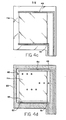
- FIGS 4a through 4d and Figure 5 are shown a pair of components (bottom and top components respectively) which include transparent conducting materials making up active area 11 and other supporting features of a preferred embodiment of the present device.
- Figures 4a through 4c show the bottom component in more detail.
- transparent substrate element 47 e.g., of polyester.
- Figure 4b shows a film of transparent conducting material lla, such as the ITO deposited on substrate 47 as described above having top and bottom edges 57 and 59.
- Conducting elements 49 and 51 serve as the "y-axis" connections to conducting film lla.
- FIG 4d there is shown a spacer element 53 of a non-conducting material such as a non-conducting epoxy, which serves to space conducting film lla and conductors 49 and 51 away from corresponding elements on a top component ( Figure 5).
- a spacer element 53 of a non-conducting material such as a non-conducting epoxy
- Figure 5 it was common for an edge of the spacer to overlap conducting film lla as shown by dotted line 55.
- conducting film lla tended to form minute cracks under edge 55 causing unreliable performance.
- this problem is eliminated by proper positioning of the spacer edge.
- the bottom edge 57 is located in a region above conductor 51, rather than on the transparent conducting film (as was edge 55 in the prior art). Any minute cracks which might appear under edge 57 are therefore electrically nullified by conduction of current through conductor 51 in the cracked regions.
- Figure 4d also shows a few exemplary -"spacer dots" 60.
- a grid of spacer dots of like material and thickness is overlayed onto conducting film lla and substrate 47 along with the overlaying of spacer 53.
- Figure 5 shows the construction of the top component of the device including a conducting film llb on a substrate 61.
- a pair of conducting elements 63 and 65 serve as the x-axis connections to conducting film llb.
- spacer 53 and spacer dots 60 electrically isolate conducting film lla and llb, except where these films are brought together by the pressure of user touch.
- either the x or y conducting elements could be affixed to either the top or bottom components of the device.
- Velcro has been referred to, other textile-like materials which can be attached to each other by interengagement of their surface features, and detached again, could be employed.
Landscapes
- Engineering & Computer Science (AREA)
- General Engineering & Computer Science (AREA)
- Theoretical Computer Science (AREA)
- Human Computer Interaction (AREA)
- Physics & Mathematics (AREA)
- General Physics & Mathematics (AREA)
- Position Input By Displaying (AREA)
Applications Claiming Priority (2)
| Application Number | Priority Date | Filing Date | Title |
|---|---|---|---|
| US66860984A | 1984-11-06 | 1984-11-06 | |
| US668609 | 1984-11-06 |
Publications (2)
| Publication Number | Publication Date |
|---|---|
| EP0181196A2 true EP0181196A2 (de) | 1986-05-14 |
| EP0181196A3 EP0181196A3 (de) | 1987-09-02 |
Family
ID=24683044
Family Applications (1)
| Application Number | Title | Priority Date | Filing Date |
|---|---|---|---|
| EP85308045A Withdrawn EP0181196A3 (de) | 1984-11-06 | 1985-11-05 | Abnehmbarer auf Berührung ansprechender Eingabeschirm |
Country Status (2)
| Country | Link |
|---|---|
| EP (1) | EP0181196A3 (de) |
| JP (1) | JPS61115123A (de) |
Cited By (9)
| Publication number | Priority date | Publication date | Assignee | Title |
|---|---|---|---|---|
| GB2328128A (en) * | 1997-08-06 | 1999-02-10 | Nec Corp | Portable terminal with detachable touch panel |
| US6412889B1 (en) | 2000-03-29 | 2002-07-02 | Stomp, Inc. | Organizer for computer monitor |
| WO2005057394A1 (fr) * | 2003-12-09 | 2005-06-23 | Jean-Baptiste Chaumette | Dispositif d’ecran tactile |
| US7109977B2 (en) * | 2003-10-05 | 2006-09-19 | T2D, Inc. | Slipcover touch input apparatus for displays of computing devices |
| US7751671B1 (en) | 2009-03-25 | 2010-07-06 | Next Holdings Limited | Optical touchscreens comprising removably connected optical members |
| CN103434289A (zh) * | 2013-08-27 | 2013-12-11 | 江西合力泰科技股份有限公司 | 一种防止玻璃盖板脏污的印刷工艺 |
| US8800872B2 (en) | 2011-12-19 | 2014-08-12 | Toshiba Global Commerce Solutions Holdings Corporation | Multi-mode computing systems for point of sale transactions |
| US9261988B2 (en) | 2009-11-27 | 2016-02-16 | Audi Ag | Operator control apparatus in a motor vehicle |
| US9846505B2 (en) | 2015-01-07 | 2017-12-19 | Honeywell International Inc. | Customizable user interface |
Families Citing this family (9)
| Publication number | Priority date | Publication date | Assignee | Title |
|---|---|---|---|---|
| US8508508B2 (en) | 2003-02-14 | 2013-08-13 | Next Holdings Limited | Touch screen signal processing with single-point calibration |
| US8456447B2 (en) | 2003-02-14 | 2013-06-04 | Next Holdings Limited | Touch screen signal processing |
| US7629967B2 (en) | 2003-02-14 | 2009-12-08 | Next Holdings Limited | Touch screen signal processing |
| US7538759B2 (en) | 2004-05-07 | 2009-05-26 | Next Holdings Limited | Touch panel display system with illumination and detection provided from a single edge |
| US8115753B2 (en) | 2007-04-11 | 2012-02-14 | Next Holdings Limited | Touch screen system with hover and click input methods |
| CN101802760B (zh) | 2007-08-30 | 2013-03-20 | 奈克斯特控股有限公司 | 具有改进照明的光学触摸屏 |
| US8384693B2 (en) | 2007-08-30 | 2013-02-26 | Next Holdings Limited | Low profile touch panel systems |
| US8405636B2 (en) | 2008-01-07 | 2013-03-26 | Next Holdings Limited | Optical position sensing system and optical position sensor assembly |
| JP5204602B2 (ja) * | 2008-09-29 | 2013-06-05 | グンゼ株式会社 | 抵抗膜式タッチパネル |
Family Cites Families (8)
| Publication number | Priority date | Publication date | Assignee | Title |
|---|---|---|---|---|
| JPS5629734A (en) * | 1979-06-21 | 1981-03-25 | Anritsu Corp | Input device for multi-item information |
| US4348660A (en) * | 1980-09-09 | 1982-09-07 | Sheldon Industries Inc. | Automatically relegendable keyboard |
| DE3036948A1 (de) * | 1980-09-30 | 1982-05-13 | Siemens Ag | System zur uebertragung von koordinaten ausgewaehlter punkte von bild- und/oder textvorlagen |
| JPS57157337A (en) * | 1981-03-25 | 1982-09-28 | Nippon Telegr & Teleph Corp <Ntt> | Information input tablet |
| JPS57157338A (en) * | 1981-03-25 | 1982-09-28 | Nippon Telegr & Teleph Corp <Ntt> | Position detecting method for item sheet for tablet |
| JPS5840789B2 (ja) * | 1981-04-06 | 1983-09-07 | 日本電信電話株式会社 | 入力位置検出方式 |
| GB2130410A (en) * | 1982-09-28 | 1984-05-31 | Cole Electronics Limited | Data input apparatus |
| JPS5992937U (ja) * | 1982-12-13 | 1984-06-23 | アルプス電気株式会社 | 入力装置 |
-
1985
- 1985-10-24 JP JP60236544A patent/JPS61115123A/ja active Pending
- 1985-11-05 EP EP85308045A patent/EP0181196A3/de not_active Withdrawn
Cited By (15)
| Publication number | Priority date | Publication date | Assignee | Title |
|---|---|---|---|---|
| GB2328128A (en) * | 1997-08-06 | 1999-02-10 | Nec Corp | Portable terminal with detachable touch panel |
| US6118436A (en) * | 1997-08-06 | 2000-09-12 | Nec Corporation | Portable terminal apparatus having handwritten data input means |
| GB2328128B (en) * | 1997-08-06 | 2002-04-10 | Nec Corp | Portable terminal apparatus |
| US6412889B1 (en) | 2000-03-29 | 2002-07-02 | Stomp, Inc. | Organizer for computer monitor |
| US7109977B2 (en) * | 2003-10-05 | 2006-09-19 | T2D, Inc. | Slipcover touch input apparatus for displays of computing devices |
| WO2005057394A1 (fr) * | 2003-12-09 | 2005-06-23 | Jean-Baptiste Chaumette | Dispositif d’ecran tactile |
| US7751671B1 (en) | 2009-03-25 | 2010-07-06 | Next Holdings Limited | Optical touchscreens comprising removably connected optical members |
| US9261988B2 (en) | 2009-11-27 | 2016-02-16 | Audi Ag | Operator control apparatus in a motor vehicle |
| EP2504746B1 (de) * | 2009-11-27 | 2017-10-25 | Audi AG | Bedienvorrichtung in einem kraftfahrzeug |
| US8800872B2 (en) | 2011-12-19 | 2014-08-12 | Toshiba Global Commerce Solutions Holdings Corporation | Multi-mode computing systems for point of sale transactions |
| CN103434289A (zh) * | 2013-08-27 | 2013-12-11 | 江西合力泰科技股份有限公司 | 一种防止玻璃盖板脏污的印刷工艺 |
| CN103434289B (zh) * | 2013-08-27 | 2016-07-27 | 江西合力泰科技有限公司 | 一种防止玻璃盖板脏污的印刷工艺 |
| US9846505B2 (en) | 2015-01-07 | 2017-12-19 | Honeywell International Inc. | Customizable user interface |
| US10042473B2 (en) | 2015-01-07 | 2018-08-07 | Honeywell International Inc. | Customizable user interface |
| US11112899B2 (en) | 2015-01-07 | 2021-09-07 | Honeywell International Inc. | Customizable user interface |
Also Published As
| Publication number | Publication date |
|---|---|
| JPS61115123A (ja) | 1986-06-02 |
| EP0181196A3 (de) | 1987-09-02 |
Similar Documents
| Publication | Publication Date | Title |
|---|---|---|
| EP0181196A2 (de) | Abnehmbarer auf Berührung ansprechender Eingabeschirm | |
| CN103150068B (zh) | 触摸屏层叠 | |
| TW581917B (en) | The touch panel, method for manufacturing the same, and screen input type display unit using the same | |
| EP0610262B1 (de) | Transparent-digitalisierer mit leitendem transparentem gitter | |
| US6483498B1 (en) | Liquid crystal display with integrated resistive touch sensor | |
| US6825890B2 (en) | Transparent coordinate input device and liquid crystal display device incorporating the same | |
| TW464785B (en) | Input device, liquid crystal device, and electronic equipment using the liquid crystal device | |
| EP1347364A1 (de) | Berührungstafel und elektronisches gerät, das die berührungstafel verwendet | |
| US20100315373A1 (en) | Single or multitouch-capable touchscreens or touchpads comprising an array of pressure sensors and the production of such sensors | |
| JP2010009456A (ja) | 静電容量型タッチパネル | |
| CN109814758A (zh) | 触控基板、触控驱动方法和电子装置 | |
| CN217112957U (zh) | 一种显示面板及电子设备 | |
| US20100053032A1 (en) | Touch detecting circuit for bistable electronic display | |
| CN205721716U (zh) | 适用于多种笔触控的触控传感器 | |
| JPH0962448A (ja) | 画面入力装置 | |
| JPH07160423A (ja) | 表示入力装置 | |
| JPS58161224A (ja) | 透明キ−ボ−ド | |
| CN207115259U (zh) | 终端 | |
| JP2001092594A (ja) | ディスプレイ装置、タッチセンサ、タッチセンサ式液晶表示装置およびディスプレイ装置のフレーム | |
| CN222213138U (zh) | 一种带按键触控功能的Incell显示模组 | |
| CN209606957U (zh) | 触控显示屏及电子设备 | |
| CN207704413U (zh) | 一种带按键控制的智能设备 | |
| JPS61245184A (ja) | 座標読み取り装置用入力盤機構を備えた液晶表示素子 | |
| KR19980046013A (ko) | 터치 패널 엘씨디 | |
| KR20170064370A (ko) | 표시장치 |
Legal Events
| Date | Code | Title | Description |
|---|---|---|---|
| PUAI | Public reference made under article 153(3) epc to a published international application that has entered the european phase |
Free format text: ORIGINAL CODE: 0009012 |
|
| AK | Designated contracting states |
Kind code of ref document: A2 Designated state(s): DE FR GB IT |
|
| PUAL | Search report despatched |
Free format text: ORIGINAL CODE: 0009013 |
|
| AK | Designated contracting states |
Kind code of ref document: A3 Designated state(s): DE FR GB IT |
|
| STAA | Information on the status of an ep patent application or granted ep patent |
Free format text: STATUS: THE APPLICATION IS DEEMED TO BE WITHDRAWN |
|
| 18D | Application deemed to be withdrawn |
Effective date: 19880303 |