EP0179378B1 - Chromogene 4,4-Diaryl-2-oxo-benzo-3,1-oxazine, ihre Herstellung und Verwendung - Google Patents
Chromogene 4,4-Diaryl-2-oxo-benzo-3,1-oxazine, ihre Herstellung und Verwendung Download PDFInfo
- Publication number
- EP0179378B1 EP0179378B1 EP85112987A EP85112987A EP0179378B1 EP 0179378 B1 EP0179378 B1 EP 0179378B1 EP 85112987 A EP85112987 A EP 85112987A EP 85112987 A EP85112987 A EP 85112987A EP 0179378 B1 EP0179378 B1 EP 0179378B1
- Authority
- EP
- European Patent Office
- Prior art keywords
- alkyl
- alkoxy
- phenyl
- substituted
- chlorine
- Prior art date
- Legal status (The legal status is an assumption and is not a legal conclusion. Google has not performed a legal analysis and makes no representation as to the accuracy of the status listed.)
- Expired
Links
- 238000002360 preparation method Methods 0.000 title description 3
- -1 5-pyrimidyl Chemical group 0.000 claims description 50
- 125000001997 phenyl group Chemical class [H]C1=C([H])C([H])=C(*)C([H])=C1[H] 0.000 claims description 33
- 229910052739 hydrogen Inorganic materials 0.000 claims description 24
- 239000001257 hydrogen Substances 0.000 claims description 24
- 239000000460 chlorine Substances 0.000 claims description 23
- 229910052801 chlorine Inorganic materials 0.000 claims description 23
- ZAMOUSCENKQFHK-UHFFFAOYSA-N Chlorine atom Chemical compound [Cl] ZAMOUSCENKQFHK-UHFFFAOYSA-N 0.000 claims description 21
- 125000001797 benzyl group Chemical group [H]C1=C([H])C([H])=C(C([H])=C1[H])C([H])([H])* 0.000 claims description 21
- 125000001309 chloro group Chemical group Cl* 0.000 claims description 15
- 239000000975 dye Substances 0.000 claims description 15
- 150000001875 compounds Chemical class 0.000 claims description 13
- 229910052736 halogen Inorganic materials 0.000 claims description 13
- 150000002367 halogens Chemical class 0.000 claims description 13
- 239000000463 material Substances 0.000 claims description 13
- YGYAWVDWMABLBF-UHFFFAOYSA-N Phosgene Chemical compound ClC(Cl)=O YGYAWVDWMABLBF-UHFFFAOYSA-N 0.000 claims description 10
- 125000000113 cyclohexyl group Chemical group [H]C1([H])C([H])([H])C([H])([H])C([H])(*)C([H])([H])C1([H])[H] 0.000 claims description 10
- 125000004093 cyano group Chemical group *C#N 0.000 claims description 9
- 150000001450 anions Chemical class 0.000 claims description 8
- YNAVUWVOSKDBBP-UHFFFAOYSA-N Morpholine Chemical compound C1COCCN1 YNAVUWVOSKDBBP-UHFFFAOYSA-N 0.000 claims description 5
- NQRYJNQNLNOLGT-UHFFFAOYSA-N Piperidine Chemical compound C1CCNCC1 NQRYJNQNLNOLGT-UHFFFAOYSA-N 0.000 claims description 5
- QPJDMGCKMHUXFD-UHFFFAOYSA-N cyanogen chloride Chemical group ClC#N QPJDMGCKMHUXFD-UHFFFAOYSA-N 0.000 claims description 5
- 238000004519 manufacturing process Methods 0.000 claims description 5
- 125000001424 substituent group Chemical group 0.000 claims description 5
- 125000000051 benzyloxy group Chemical group [H]C1=C([H])C([H])=C(C([H])=C1[H])C([H])([H])O* 0.000 claims description 4
- 239000003593 chromogenic compound Substances 0.000 claims description 4
- 125000002887 hydroxy group Chemical group [H]O* 0.000 claims description 4
- 125000004642 (C1-C12) alkoxy group Chemical group 0.000 claims description 3
- 125000006702 (C1-C18) alkyl group Chemical group 0.000 claims description 3
- 125000004178 (C1-C4) alkyl group Chemical group 0.000 claims description 3
- 125000000339 4-pyridyl group Chemical group N1=C([H])C([H])=C([*])C([H])=C1[H] 0.000 claims description 3
- 125000006539 C12 alkyl group Chemical group [H]C([H])([H])C([H])([H])C([H])([H])C([H])([H])C([H])([H])C([H])([H])C([H])([H])C([H])([H])C([H])([H])C([H])([H])C([H])([H])C([H])([H])* 0.000 claims description 3
- 125000000043 benzamido group Chemical class [H]N([*])C(=O)C1=C([H])C([H])=C([H])C([H])=C1[H] 0.000 claims description 3
- 125000004122 cyclic group Chemical group 0.000 claims description 3
- 125000002924 primary amino group Chemical group [H]N([H])* 0.000 claims description 3
- 125000002755 pyrazolinyl group Chemical group 0.000 claims description 3
- 229920006395 saturated elastomer Polymers 0.000 claims description 3
- 125000004400 (C1-C12) alkyl group Chemical group 0.000 claims description 2
- 125000004105 2-pyridyl group Chemical group N1=C([*])C([H])=C([H])C([H])=C1[H] 0.000 claims description 2
- 125000004939 6-pyridyl group Chemical group N1=CC=CC=C1* 0.000 claims description 2
- 125000004573 morpholin-4-yl group Chemical group N1(CCOCC1)* 0.000 claims description 2
- 125000002347 octyl group Chemical group [H]C([*])([H])C([H])([H])C([H])([H])C([H])([H])C([H])([H])C([H])([H])C([H])([H])C([H])([H])[H] 0.000 claims description 2
- 125000004193 piperazinyl group Chemical group 0.000 claims description 2
- 125000004435 hydrogen atom Chemical class [H]* 0.000 claims 12
- LJQLQCAXBUHEAZ-UWTATZPHSA-N 3-phospho-D-glyceroyl dihydrogen phosphate Chemical compound OP(=O)(O)OC[C@@H](O)C(=O)OP(O)(O)=O LJQLQCAXBUHEAZ-UWTATZPHSA-N 0.000 claims 1
- 239000012736 aqueous medium Substances 0.000 claims 1
- 230000004927 fusion Effects 0.000 claims 1
- 239000000376 reactant Substances 0.000 claims 1
- OKKJLVBELUTLKV-UHFFFAOYSA-N Methanol Chemical compound OC OKKJLVBELUTLKV-UHFFFAOYSA-N 0.000 description 31
- QTBSBXVTEAMEQO-UHFFFAOYSA-N Acetic acid Chemical compound CC(O)=O QTBSBXVTEAMEQO-UHFFFAOYSA-N 0.000 description 27
- YXFVVABEGXRONW-UHFFFAOYSA-N Toluene Chemical compound CC1=CC=CC=C1 YXFVVABEGXRONW-UHFFFAOYSA-N 0.000 description 26
- HEMHJVSKTPXQMS-UHFFFAOYSA-M Sodium hydroxide Chemical compound [OH-].[Na+] HEMHJVSKTPXQMS-UHFFFAOYSA-M 0.000 description 21
- LFQSCWFLJHTTHZ-UHFFFAOYSA-N Ethanol Chemical compound CCO LFQSCWFLJHTTHZ-UHFFFAOYSA-N 0.000 description 20
- XHXFXVLFKHQFAL-UHFFFAOYSA-N phosphoryl trichloride Chemical compound ClP(Cl)(Cl)=O XHXFXVLFKHQFAL-UHFFFAOYSA-N 0.000 description 20
- DLYUQMMRRRQYAE-UHFFFAOYSA-N tetraphosphorus decaoxide Chemical compound O1P(O2)(=O)OP3(=O)OP1(=O)OP2(=O)O3 DLYUQMMRRRQYAE-UHFFFAOYSA-N 0.000 description 15
- XLYOFNOQVPJJNP-UHFFFAOYSA-N water Substances O XLYOFNOQVPJJNP-UHFFFAOYSA-N 0.000 description 14
- UFHFLCQGNIYNRP-UHFFFAOYSA-N Hydrogen Chemical compound [H][H] UFHFLCQGNIYNRP-UHFFFAOYSA-N 0.000 description 12
- 150000002431 hydrogen Chemical class 0.000 description 12
- 239000000203 mixture Substances 0.000 description 12
- 239000000047 product Substances 0.000 description 12
- 229960000583 acetic acid Drugs 0.000 description 11
- XTHFKEDIFFGKHM-UHFFFAOYSA-N Dimethoxyethane Chemical compound COCCOC XTHFKEDIFFGKHM-UHFFFAOYSA-N 0.000 description 10
- JUJWROOIHBZHMG-UHFFFAOYSA-N Pyridine Chemical compound C1=CC=NC=C1 JUJWROOIHBZHMG-UHFFFAOYSA-N 0.000 description 10
- 239000000370 acceptor Substances 0.000 description 9
- 239000011230 binding agent Substances 0.000 description 9
- KFZMGEQAYNKOFK-UHFFFAOYSA-N Isopropanol Chemical compound CC(C)O KFZMGEQAYNKOFK-UHFFFAOYSA-N 0.000 description 7
- CDBYLPFSWZWCQE-UHFFFAOYSA-L Sodium Carbonate Chemical compound [Na+].[Na+].[O-]C([O-])=O CDBYLPFSWZWCQE-UHFFFAOYSA-L 0.000 description 7
- MVPPADPHJFYWMZ-UHFFFAOYSA-N chlorobenzene Chemical compound ClC1=CC=CC=C1 MVPPADPHJFYWMZ-UHFFFAOYSA-N 0.000 description 7
- 239000005457 ice water Substances 0.000 description 7
- CSCPPACGZOOCGX-UHFFFAOYSA-N Acetone Chemical compound CC(C)=O CSCPPACGZOOCGX-UHFFFAOYSA-N 0.000 description 6
- WEVYAHXRMPXWCK-UHFFFAOYSA-N Acetonitrile Chemical compound CC#N WEVYAHXRMPXWCK-UHFFFAOYSA-N 0.000 description 6
- HEDRZPFGACZZDS-UHFFFAOYSA-N Chloroform Chemical compound ClC(Cl)Cl HEDRZPFGACZZDS-UHFFFAOYSA-N 0.000 description 6
- 239000012362 glacial acetic acid Substances 0.000 description 6
- VTYYLEPIZMXCLO-UHFFFAOYSA-L Calcium carbonate Chemical compound [Ca+2].[O-]C([O-])=O VTYYLEPIZMXCLO-UHFFFAOYSA-L 0.000 description 5
- 238000010521 absorption reaction Methods 0.000 description 5
- IHQFGRDHHZAXGU-UHFFFAOYSA-N ethyl n-[3-(dimethylamino)phenyl]carbamate Chemical compound CCOC(=O)NC1=CC=CC(N(C)C)=C1 IHQFGRDHHZAXGU-UHFFFAOYSA-N 0.000 description 5
- 239000002904 solvent Substances 0.000 description 5
- VZGDMQKNWNREIO-UHFFFAOYSA-N tetrachloromethane Chemical compound ClC(Cl)(Cl)Cl VZGDMQKNWNREIO-UHFFFAOYSA-N 0.000 description 5
- QPFMBZIOSGYJDE-UHFFFAOYSA-N 1,1,2,2-tetrachloroethane Chemical compound ClC(Cl)C(Cl)Cl QPFMBZIOSGYJDE-UHFFFAOYSA-N 0.000 description 4
- ZWEHNKRNPOVVGH-UHFFFAOYSA-N 2-Butanone Chemical compound CCC(C)=O ZWEHNKRNPOVVGH-UHFFFAOYSA-N 0.000 description 4
- VEXZGXHMUGYJMC-UHFFFAOYSA-N Hydrochloric acid Chemical compound Cl VEXZGXHMUGYJMC-UHFFFAOYSA-N 0.000 description 4
- 239000004372 Polyvinyl alcohol Substances 0.000 description 4
- FAPWRFPIFSIZLT-UHFFFAOYSA-M Sodium chloride Chemical compound [Na+].[Cl-] FAPWRFPIFSIZLT-UHFFFAOYSA-M 0.000 description 4
- ZMANZCXQSJIPKH-UHFFFAOYSA-N Triethylamine Chemical compound CCN(CC)CC ZMANZCXQSJIPKH-UHFFFAOYSA-N 0.000 description 4
- 150000001298 alcohols Chemical class 0.000 description 4
- XBDQKXXYIPTUBI-UHFFFAOYSA-N dimethylselenoniopropionate Natural products CCC(O)=O XBDQKXXYIPTUBI-UHFFFAOYSA-N 0.000 description 4
- 239000012442 inert solvent Substances 0.000 description 4
- 238000000034 method Methods 0.000 description 4
- 230000003647 oxidation Effects 0.000 description 4
- 238000007254 oxidation reaction Methods 0.000 description 4
- 229920002451 polyvinyl alcohol Polymers 0.000 description 4
- UMJSCPRVCHMLSP-UHFFFAOYSA-N pyridine Natural products COC1=CC=CN=C1 UMJSCPRVCHMLSP-UHFFFAOYSA-N 0.000 description 4
- 150000003254 radicals Chemical class 0.000 description 4
- 239000000243 solution Substances 0.000 description 4
- 0 *c1ccc(C(c2ccc(*)cc2)c2ccc(*)cc2N(*)C(O*)=O)cc1 Chemical compound *c1ccc(C(c2ccc(*)cc2)c2ccc(*)cc2N(*)C(O*)=O)cc1 0.000 description 3
- SCYULBFZEHDVBN-UHFFFAOYSA-N 1,1-Dichloroethane Chemical compound CC(Cl)Cl SCYULBFZEHDVBN-UHFFFAOYSA-N 0.000 description 3
- OCJBOOLMMGQPQU-UHFFFAOYSA-N 1,4-dichlorobenzene Chemical compound ClC1=CC=C(Cl)C=C1 OCJBOOLMMGQPQU-UHFFFAOYSA-N 0.000 description 3
- ZMXDDKWLCZADIW-UHFFFAOYSA-N N,N-Dimethylformamide Chemical compound CN(C)C=O ZMXDDKWLCZADIW-UHFFFAOYSA-N 0.000 description 3
- CTQNGGLPUBDAKN-UHFFFAOYSA-N O-Xylene Chemical compound CC1=CC=CC=C1C CTQNGGLPUBDAKN-UHFFFAOYSA-N 0.000 description 3
- 239000002253 acid Substances 0.000 description 3
- 230000002378 acidificating effect Effects 0.000 description 3
- 239000003125 aqueous solvent Substances 0.000 description 3
- 238000009835 boiling Methods 0.000 description 3
- 235000010216 calcium carbonate Nutrition 0.000 description 3
- 238000006243 chemical reaction Methods 0.000 description 3
- 238000002425 crystallisation Methods 0.000 description 3
- 230000008025 crystallization Effects 0.000 description 3
- 229940117389 dichlorobenzene Drugs 0.000 description 3
- 150000002576 ketones Chemical class 0.000 description 3
- 239000003094 microcapsule Substances 0.000 description 3
- 239000012074 organic phase Substances 0.000 description 3
- 239000003960 organic solvent Substances 0.000 description 3
- 239000002245 particle Substances 0.000 description 3
- 239000003444 phase transfer catalyst Substances 0.000 description 3
- BWHMMNNQKKPAPP-UHFFFAOYSA-L potassium carbonate Chemical compound [K+].[K+].[O-]C([O-])=O BWHMMNNQKKPAPP-UHFFFAOYSA-L 0.000 description 3
- 229910000029 sodium carbonate Inorganic materials 0.000 description 3
- SYBYTAAJFKOIEJ-UHFFFAOYSA-N 3-Methylbutan-2-one Chemical compound CC(C)C(C)=O SYBYTAAJFKOIEJ-UHFFFAOYSA-N 0.000 description 2
- VVBLNCFGVYUYGU-UHFFFAOYSA-N 4,4'-Bis(dimethylamino)benzophenone Chemical compound C1=CC(N(C)C)=CC=C1C(=O)C1=CC=C(N(C)C)C=C1 VVBLNCFGVYUYGU-UHFFFAOYSA-N 0.000 description 2
- YEJRWHAVMIAJKC-UHFFFAOYSA-N 4-Butyrolactone Chemical compound O=C1CCCO1 YEJRWHAVMIAJKC-UHFFFAOYSA-N 0.000 description 2
- ODINCKMPIJJUCX-UHFFFAOYSA-N Calcium oxide Chemical compound [Ca]=O ODINCKMPIJJUCX-UHFFFAOYSA-N 0.000 description 2
- IAZDPXIOMUYVGZ-UHFFFAOYSA-N Dimethylsulphoxide Chemical compound CS(C)=O IAZDPXIOMUYVGZ-UHFFFAOYSA-N 0.000 description 2
- 108010010803 Gelatin Proteins 0.000 description 2
- MHAJPDPJQMAIIY-UHFFFAOYSA-N Hydrogen peroxide Chemical compound OO MHAJPDPJQMAIIY-UHFFFAOYSA-N 0.000 description 2
- SECXISVLQFMRJM-UHFFFAOYSA-N N-Methylpyrrolidone Chemical compound CN1CCCC1=O SECXISVLQFMRJM-UHFFFAOYSA-N 0.000 description 2
- NBIIXXVUZAFLBC-UHFFFAOYSA-N Phosphoric acid Chemical compound OP(O)(O)=O NBIIXXVUZAFLBC-UHFFFAOYSA-N 0.000 description 2
- 229920002472 Starch Polymers 0.000 description 2
- QAOWNCQODCNURD-UHFFFAOYSA-N Sulfuric acid Chemical compound OS(O)(=O)=O QAOWNCQODCNURD-UHFFFAOYSA-N 0.000 description 2
- GWEVSGVZZGPLCZ-UHFFFAOYSA-N Titan oxide Chemical compound O=[Ti]=O GWEVSGVZZGPLCZ-UHFFFAOYSA-N 0.000 description 2
- ARNIZPSLPHFDED-UHFFFAOYSA-N [4-(dimethylamino)phenyl]-(4-methoxyphenyl)methanone Chemical compound C1=CC(OC)=CC=C1C(=O)C1=CC=C(N(C)C)C=C1 ARNIZPSLPHFDED-UHFFFAOYSA-N 0.000 description 2
- 150000007513 acids Chemical class 0.000 description 2
- 125000004453 alkoxycarbonyl group Chemical group 0.000 description 2
- 125000000217 alkyl group Chemical group 0.000 description 2
- 150000001412 amines Chemical class 0.000 description 2
- 229910000019 calcium carbonate Inorganic materials 0.000 description 2
- 239000003153 chemical reaction reagent Substances 0.000 description 2
- 238000001816 cooling Methods 0.000 description 2
- DOIRQSBPFJWKBE-UHFFFAOYSA-N dibutyl phthalate Chemical class CCCCOC(=O)C1=CC=CC=C1C(=O)OCCCC DOIRQSBPFJWKBE-UHFFFAOYSA-N 0.000 description 2
- IEJIGPNLZYLLBP-UHFFFAOYSA-N dimethyl carbonate Chemical compound COC(=O)OC IEJIGPNLZYLLBP-UHFFFAOYSA-N 0.000 description 2
- ROORDVPLFPIABK-UHFFFAOYSA-N diphenyl carbonate Chemical compound C=1C=CC=CC=1OC(=O)OC1=CC=CC=C1 ROORDVPLFPIABK-UHFFFAOYSA-N 0.000 description 2
- RIFGWPKJUGCATF-UHFFFAOYSA-N ethyl chloroformate Chemical compound CCOC(Cl)=O RIFGWPKJUGCATF-UHFFFAOYSA-N 0.000 description 2
- 229920000159 gelatin Polymers 0.000 description 2
- 239000008273 gelatin Substances 0.000 description 2
- 235000019322 gelatine Nutrition 0.000 description 2
- 235000011852 gelatine desserts Nutrition 0.000 description 2
- AXZKOIWUVFPNLO-UHFFFAOYSA-N magnesium;oxygen(2-) Chemical compound [O-2].[Mg+2] AXZKOIWUVFPNLO-UHFFFAOYSA-N 0.000 description 2
- 150000002736 metal compounds Chemical class 0.000 description 2
- 125000000449 nitro group Chemical class [O-][N+](*)=O 0.000 description 2
- LQNUZADURLCDLV-UHFFFAOYSA-N nitrobenzene Chemical compound [O-][N+](=O)C1=CC=CC=C1 LQNUZADURLCDLV-UHFFFAOYSA-N 0.000 description 2
- CTSLXHKWHWQRSH-UHFFFAOYSA-N oxalyl chloride Chemical compound ClC(=O)C(Cl)=O CTSLXHKWHWQRSH-UHFFFAOYSA-N 0.000 description 2
- 239000012071 phase Substances 0.000 description 2
- AHWALFGBDFAJAI-UHFFFAOYSA-N phenyl carbonochloridate Chemical compound ClC(=O)OC1=CC=CC=C1 AHWALFGBDFAJAI-UHFFFAOYSA-N 0.000 description 2
- 239000003880 polar aprotic solvent Substances 0.000 description 2
- 235000019260 propionic acid Nutrition 0.000 description 2
- IUVKMZGDUIUOCP-BTNSXGMBSA-N quinbolone Chemical compound O([C@H]1CC[C@H]2[C@H]3[C@@H]([C@]4(C=CC(=O)C=C4CC3)C)CC[C@@]21C)C1=CCCC1 IUVKMZGDUIUOCP-BTNSXGMBSA-N 0.000 description 2
- 150000004053 quinones Chemical class 0.000 description 2
- 239000011780 sodium chloride Substances 0.000 description 2
- 239000008107 starch Substances 0.000 description 2
- 235000019698 starch Nutrition 0.000 description 2
- HXJUTPCZVOIRIF-UHFFFAOYSA-N sulfolane Chemical compound O=S1(=O)CCCC1 HXJUTPCZVOIRIF-UHFFFAOYSA-N 0.000 description 2
- 239000000725 suspension Substances 0.000 description 2
- UGNWTBMOAKPKBL-UHFFFAOYSA-N tetrachloro-1,4-benzoquinone Chemical compound ClC1=C(Cl)C(=O)C(Cl)=C(Cl)C1=O UGNWTBMOAKPKBL-UHFFFAOYSA-N 0.000 description 2
- FYSNRJHAOHDILO-UHFFFAOYSA-N thionyl chloride Chemical compound ClS(Cl)=O FYSNRJHAOHDILO-UHFFFAOYSA-N 0.000 description 2
- 239000008096 xylene Substances 0.000 description 2
- JIAARYAFYJHUJI-UHFFFAOYSA-L zinc dichloride Chemical compound [Cl-].[Cl-].[Zn+2] JIAARYAFYJHUJI-UHFFFAOYSA-L 0.000 description 2
- VFTDVICZBGDMMB-UHFFFAOYSA-N (2,4-dimethoxyphenyl)-(4-methoxyphenyl)methanone Chemical compound C1=CC(OC)=CC=C1C(=O)C1=CC=C(OC)C=C1OC VFTDVICZBGDMMB-UHFFFAOYSA-N 0.000 description 1
- WSLDOOZREJYCGB-UHFFFAOYSA-N 1,2-Dichloroethane Chemical compound ClCCCl WSLDOOZREJYCGB-UHFFFAOYSA-N 0.000 description 1
- IAUKWGFWINVWKS-UHFFFAOYSA-N 1,2-di(propan-2-yl)naphthalene Chemical compound C1=CC=CC2=C(C(C)C)C(C(C)C)=CC=C21 IAUKWGFWINVWKS-UHFFFAOYSA-N 0.000 description 1
- RFFLAFLAYFXFSW-UHFFFAOYSA-N 1,2-dichlorobenzene Chemical compound ClC1=CC=CC=C1Cl RFFLAFLAYFXFSW-UHFFFAOYSA-N 0.000 description 1
- YJTKZCDBKVTVBY-UHFFFAOYSA-N 1,3-Diphenylbenzene Chemical group C1=CC=CC=C1C1=CC=CC(C=2C=CC=CC=2)=C1 YJTKZCDBKVTVBY-UHFFFAOYSA-N 0.000 description 1
- HIAGSPVAYSSKHL-UHFFFAOYSA-N 1-methyl-9h-carbazole Chemical class N1C2=CC=CC=C2C2=C1C(C)=CC=C2 HIAGSPVAYSSKHL-UHFFFAOYSA-N 0.000 description 1
- VEEYNMFORWXFOZ-UHFFFAOYSA-N 1-phenyl-3-(2,2,2-trichloro-1-hydroxyethyl)urea Chemical compound ClC(Cl)(Cl)C(O)NC(=O)NC1=CC=CC=C1 VEEYNMFORWXFOZ-UHFFFAOYSA-N 0.000 description 1
- HZNVUJQVZSTENZ-UHFFFAOYSA-N 2,3-dichloro-5,6-dicyano-1,4-benzoquinone Chemical compound ClC1=C(Cl)C(=O)C(C#N)=C(C#N)C1=O HZNVUJQVZSTENZ-UHFFFAOYSA-N 0.000 description 1
- XNWFRZJHXBZDAG-UHFFFAOYSA-N 2-METHOXYETHANOL Chemical compound COCCO XNWFRZJHXBZDAG-UHFFFAOYSA-N 0.000 description 1
- FXSFKECPPGDGBN-UHFFFAOYSA-N 3,3-bis(1h-indol-2-yl)-2-benzofuran-1-one Chemical class C12=CC=CC=C2C(=O)OC1(C=1NC2=CC=CC=C2C=1)C1=CC2=CC=CC=C2N1 FXSFKECPPGDGBN-UHFFFAOYSA-N 0.000 description 1
- GBHOCQOMJNPVPW-UHFFFAOYSA-N 3,3-bis(2-aminophenyl)-2-benzofuran-1-one Chemical class NC1=CC=CC=C1C1(C=2C(=CC=CC=2)N)C2=CC=CC=C2C(=O)O1 GBHOCQOMJNPVPW-UHFFFAOYSA-N 0.000 description 1
- PVQXTQNDUBGSDS-UHFFFAOYSA-N 4,4-diphenyl-1h-3,1-benzoxazin-2-one Chemical class O1C(=O)NC2=CC=CC=C2C1(C=1C=CC=CC=1)C1=CC=CC=C1 PVQXTQNDUBGSDS-UHFFFAOYSA-N 0.000 description 1
- PNVQATCXDOQFEJ-UHFFFAOYSA-N 4,4-diphenyl-3h-1,3-benzoxazin-2-one Chemical class C12=CC=CC=C2OC(=O)NC1(C=1C=CC=CC=1)C1=CC=CC=C1 PNVQATCXDOQFEJ-UHFFFAOYSA-N 0.000 description 1
- 239000005995 Aluminium silicate Substances 0.000 description 1
- WKBOTKDWSSQWDR-UHFFFAOYSA-N Bromine atom Chemical compound [Br] WKBOTKDWSSQWDR-UHFFFAOYSA-N 0.000 description 1
- DKPFZGUDAPQIHT-UHFFFAOYSA-N Butyl acetate Natural products CCCCOC(C)=O DKPFZGUDAPQIHT-UHFFFAOYSA-N 0.000 description 1
- BVKZGUZCCUSVTD-UHFFFAOYSA-L Carbonate Chemical compound [O-]C([O-])=O BVKZGUZCCUSVTD-UHFFFAOYSA-L 0.000 description 1
- 229920002134 Carboxymethyl cellulose Polymers 0.000 description 1
- XEKOWRVHYACXOJ-UHFFFAOYSA-N Ethyl acetate Natural products CCOC(C)=O XEKOWRVHYACXOJ-UHFFFAOYSA-N 0.000 description 1
- PIICEJLVQHRZGT-UHFFFAOYSA-N Ethylenediamine Chemical compound NCCN PIICEJLVQHRZGT-UHFFFAOYSA-N 0.000 description 1
- 229920000084 Gum arabic Polymers 0.000 description 1
- 229920000663 Hydroxyethyl cellulose Polymers 0.000 description 1
- 239000004354 Hydroxyethyl cellulose Substances 0.000 description 1
- PHSPJQZRQAJPPF-UHFFFAOYSA-N N-alpha-Methylhistamine Chemical compound CNCCC1=CN=CN1 PHSPJQZRQAJPPF-UHFFFAOYSA-N 0.000 description 1
- 229920001131 Pulp (paper) Polymers 0.000 description 1
- 241000978776 Senegalia senegal Species 0.000 description 1
- VMHLLURERBWHNL-UHFFFAOYSA-M Sodium acetate Chemical compound [Na+].CC([O-])=O VMHLLURERBWHNL-UHFFFAOYSA-M 0.000 description 1
- 229920002125 Sokalan® Polymers 0.000 description 1
- VNVUKCWITSXQEM-UHFFFAOYSA-N [4-(diethylamino)phenyl]-(2-methoxyphenyl)methanone Chemical compound C1=CC(N(CC)CC)=CC=C1C(=O)C1=CC=CC=C1OC VNVUKCWITSXQEM-UHFFFAOYSA-N 0.000 description 1
- IKKCBVOOPXKZRC-UHFFFAOYSA-N [4-(diethylamino)phenyl]-(3-methylphenyl)methanone Chemical compound C1=CC(N(CC)CC)=CC=C1C(=O)C1=CC=CC(C)=C1 IKKCBVOOPXKZRC-UHFFFAOYSA-N 0.000 description 1
- 239000000205 acacia gum Substances 0.000 description 1
- 235000010489 acacia gum Nutrition 0.000 description 1
- 230000004913 activation Effects 0.000 description 1
- 239000000654 additive Substances 0.000 description 1
- 150000001338 aliphatic hydrocarbons Chemical class 0.000 description 1
- 229910000147 aluminium phosphate Inorganic materials 0.000 description 1
- 235000012211 aluminium silicate Nutrition 0.000 description 1
- 150000001408 amides Chemical class 0.000 description 1
- 125000003277 amino group Chemical group 0.000 description 1
- 238000010719 annulation reaction Methods 0.000 description 1
- 239000007864 aqueous solution Substances 0.000 description 1
- QVGXLLKOCUKJST-UHFFFAOYSA-N atomic oxygen Chemical compound [O] QVGXLLKOCUKJST-UHFFFAOYSA-N 0.000 description 1
- SVPXDRXYRYOSEX-UHFFFAOYSA-N bentoquatam Chemical class O.O=[Si]=O.O=[Al]O[Al]=O SVPXDRXYRYOSEX-UHFFFAOYSA-N 0.000 description 1
- 230000015572 biosynthetic process Effects 0.000 description 1
- IISBACLAFKSPIT-UHFFFAOYSA-N bisphenol A Chemical compound C=1C=C(O)C=CC=1C(C)(C)C1=CC=C(O)C=C1 IISBACLAFKSPIT-UHFFFAOYSA-N 0.000 description 1
- KGBXLFKZBHKPEV-UHFFFAOYSA-N boric acid Chemical compound OB(O)O KGBXLFKZBHKPEV-UHFFFAOYSA-N 0.000 description 1
- 239000004327 boric acid Substances 0.000 description 1
- GDTBXPJZTBHREO-UHFFFAOYSA-N bromine Substances BrBr GDTBXPJZTBHREO-UHFFFAOYSA-N 0.000 description 1
- 229910052794 bromium Inorganic materials 0.000 description 1
- BRPQOXSCLDDYGP-UHFFFAOYSA-N calcium oxide Chemical compound [O-2].[Ca+2] BRPQOXSCLDDYGP-UHFFFAOYSA-N 0.000 description 1
- 239000000292 calcium oxide Substances 0.000 description 1
- 150000004649 carbonic acid derivatives Chemical class 0.000 description 1
- 239000001768 carboxy methyl cellulose Substances 0.000 description 1
- 235000010948 carboxy methyl cellulose Nutrition 0.000 description 1
- 150000001735 carboxylic acids Chemical class 0.000 description 1
- 239000008112 carboxymethyl-cellulose Substances 0.000 description 1
- ZCDOYSPFYFSLEW-UHFFFAOYSA-N chromate(2-) Chemical class [O-][Cr]([O-])(=O)=O ZCDOYSPFYFSLEW-UHFFFAOYSA-N 0.000 description 1
- 238000005354 coacervation Methods 0.000 description 1
- 238000000576 coating method Methods 0.000 description 1
- 238000009833 condensation Methods 0.000 description 1
- 230000005494 condensation Effects 0.000 description 1
- 239000006185 dispersion Substances 0.000 description 1
- 150000002148 esters Chemical class 0.000 description 1
- 125000001495 ethyl group Chemical group [H]C([H])([H])C([H])([H])* 0.000 description 1
- YYUYLKXLGOXNKG-UHFFFAOYSA-N ethyl n-(3-methoxy-4-methylphenyl)carbamate Chemical compound CCOC(=O)NC1=CC=C(C)C(OC)=C1 YYUYLKXLGOXNKG-UHFFFAOYSA-N 0.000 description 1
- CHUOHMVUJHKKRP-UHFFFAOYSA-N ethyl n-(dimethylamino)-n-phenylcarbamate Chemical compound CCOC(=O)N(N(C)C)C1=CC=CC=C1 CHUOHMVUJHKKRP-UHFFFAOYSA-N 0.000 description 1
- 239000006260 foam Substances 0.000 description 1
- FUZZWVXGSFPDMH-UHFFFAOYSA-N hexanoic acid Chemical compound CCCCCC(O)=O FUZZWVXGSFPDMH-UHFFFAOYSA-N 0.000 description 1
- 229920001477 hydrophilic polymer Polymers 0.000 description 1
- 235000019447 hydroxyethyl cellulose Nutrition 0.000 description 1
- 238000003384 imaging method Methods 0.000 description 1
- 238000002955 isolation Methods 0.000 description 1
- NLYAJNPCOHFWQQ-UHFFFAOYSA-N kaolin Chemical compound O.O.O=[Al]O[Si](=O)O[Si](=O)O[Al]=O NLYAJNPCOHFWQQ-UHFFFAOYSA-N 0.000 description 1
- 239000003350 kerosene Substances 0.000 description 1
- 239000000395 magnesium oxide Substances 0.000 description 1
- CPLXHLVBOLITMK-UHFFFAOYSA-N magnesium oxide Inorganic materials [Mg]=O CPLXHLVBOLITMK-UHFFFAOYSA-N 0.000 description 1
- 239000000155 melt Substances 0.000 description 1
- 229910052751 metal Inorganic materials 0.000 description 1
- 239000002184 metal Substances 0.000 description 1
- 229910044991 metal oxide Inorganic materials 0.000 description 1
- 150000004706 metal oxides Chemical class 0.000 description 1
- 229920000609 methyl cellulose Polymers 0.000 description 1
- 239000001923 methylcellulose Substances 0.000 description 1
- 235000010981 methylcellulose Nutrition 0.000 description 1
- HKUFIYBZNQSHQS-UHFFFAOYSA-N n-octadecyloctadecan-1-amine Chemical compound CCCCCCCCCCCCCCCCCCNCCCCCCCCCCCCCCCCCC HKUFIYBZNQSHQS-UHFFFAOYSA-N 0.000 description 1
- 150000002790 naphthalenes Chemical class 0.000 description 1
- LYRFLYHAGKPMFH-UHFFFAOYSA-N octadecanamide Chemical compound CCCCCCCCCCCCCCCCCC(N)=O LYRFLYHAGKPMFH-UHFFFAOYSA-N 0.000 description 1
- 229920000620 organic polymer Polymers 0.000 description 1
- 229910052760 oxygen Inorganic materials 0.000 description 1
- 239000001301 oxygen Substances 0.000 description 1
- ISWSIDIOOBJBQZ-UHFFFAOYSA-N phenol group Chemical group C1(=CC=CC=C1)O ISWSIDIOOBJBQZ-UHFFFAOYSA-N 0.000 description 1
- 229920001568 phenolic resin Polymers 0.000 description 1
- 239000005011 phenolic resin Substances 0.000 description 1
- 150000002989 phenols Chemical class 0.000 description 1
- 125000001484 phenothiazinyl group Chemical class C1(=CC=CC=2SC3=CC=CC=C3NC12)* 0.000 description 1
- 150000002991 phenoxazines Chemical class 0.000 description 1
- UHZYTMXLRWXGPK-UHFFFAOYSA-N phosphorus pentachloride Chemical compound ClP(Cl)(Cl)(Cl)Cl UHZYTMXLRWXGPK-UHFFFAOYSA-N 0.000 description 1
- FAIAAWCVCHQXDN-UHFFFAOYSA-N phosphorus trichloride Chemical compound ClP(Cl)Cl FAIAAWCVCHQXDN-UHFFFAOYSA-N 0.000 description 1
- 239000000049 pigment Substances 0.000 description 1
- 229920002401 polyacrylamide Polymers 0.000 description 1
- 239000004584 polyacrylic acid Substances 0.000 description 1
- 229920002689 polyvinyl acetate Polymers 0.000 description 1
- 239000011118 polyvinyl acetate Substances 0.000 description 1
- 229920000036 polyvinylpyrrolidone Polymers 0.000 description 1
- 239000001267 polyvinylpyrrolidone Substances 0.000 description 1
- 235000013855 polyvinylpyrrolidone Nutrition 0.000 description 1
- 229910000027 potassium carbonate Inorganic materials 0.000 description 1
- 239000002244 precipitate Substances 0.000 description 1
- 230000002028 premature Effects 0.000 description 1
- 239000012429 reaction media Substances 0.000 description 1
- 150000003839 salts Chemical class 0.000 description 1
- 230000035945 sensitivity Effects 0.000 description 1
- 239000011734 sodium Substances 0.000 description 1
- 239000001632 sodium acetate Substances 0.000 description 1
- 235000017281 sodium acetate Nutrition 0.000 description 1
- 238000003756 stirring Methods 0.000 description 1
- 238000000859 sublimation Methods 0.000 description 1
- 230000008022 sublimation Effects 0.000 description 1
- 239000000126 substance Substances 0.000 description 1
- 239000000758 substrate Substances 0.000 description 1
- YBBRCQOCSYXUOC-UHFFFAOYSA-N sulfuryl dichloride Chemical compound ClS(Cl)(=O)=O YBBRCQOCSYXUOC-UHFFFAOYSA-N 0.000 description 1
- 238000007651 thermal printing Methods 0.000 description 1
- 239000004408 titanium dioxide Substances 0.000 description 1
- 238000010626 work up procedure Methods 0.000 description 1
- 239000011592 zinc chloride Substances 0.000 description 1
- 235000005074 zinc chloride Nutrition 0.000 description 1
Classifications
-
- C—CHEMISTRY; METALLURGY
- C07—ORGANIC CHEMISTRY
- C07D—HETEROCYCLIC COMPOUNDS
- C07D265/00—Heterocyclic compounds containing six-membered rings having one nitrogen atom and one oxygen atom as the only ring hetero atoms
- C07D265/04—1,3-Oxazines; Hydrogenated 1,3-oxazines
- C07D265/12—1,3-Oxazines; Hydrogenated 1,3-oxazines condensed with carbocyclic rings or ring systems
- C07D265/14—1,3-Oxazines; Hydrogenated 1,3-oxazines condensed with carbocyclic rings or ring systems condensed with one six-membered ring
- C07D265/18—1,3-Oxazines; Hydrogenated 1,3-oxazines condensed with carbocyclic rings or ring systems condensed with one six-membered ring with hetero atoms directly attached in position 2
-
- B—PERFORMING OPERATIONS; TRANSPORTING
- B41—PRINTING; LINING MACHINES; TYPEWRITERS; STAMPS
- B41M—PRINTING, DUPLICATING, MARKING, OR COPYING PROCESSES; COLOUR PRINTING
- B41M5/00—Duplicating or marking methods; Sheet materials for use therein
- B41M5/124—Duplicating or marking methods; Sheet materials for use therein using pressure to make a masked colour visible, e.g. to make a coloured support visible, to create an opaque or transparent pattern, or to form colour by uniting colour-forming components
- B41M5/132—Chemical colour-forming components; Additives or binders therefor
- B41M5/136—Organic colour formers, e.g. leuco dyes
-
- C—CHEMISTRY; METALLURGY
- C07—ORGANIC CHEMISTRY
- C07D—HETEROCYCLIC COMPOUNDS
- C07D413/00—Heterocyclic compounds containing two or more hetero rings, at least one ring having nitrogen and oxygen atoms as the only ring hetero atoms
- C07D413/02—Heterocyclic compounds containing two or more hetero rings, at least one ring having nitrogen and oxygen atoms as the only ring hetero atoms containing two hetero rings
- C07D413/04—Heterocyclic compounds containing two or more hetero rings, at least one ring having nitrogen and oxygen atoms as the only ring hetero atoms containing two hetero rings directly linked by a ring-member-to-ring-member bond
-
- C—CHEMISTRY; METALLURGY
- C09—DYES; PAINTS; POLISHES; NATURAL RESINS; ADHESIVES; COMPOSITIONS NOT OTHERWISE PROVIDED FOR; APPLICATIONS OF MATERIALS NOT OTHERWISE PROVIDED FOR
- C09B—ORGANIC DYES OR CLOSELY-RELATED COMPOUNDS FOR PRODUCING DYES, e.g. PIGMENTS; MORDANTS; LAKES
- C09B11/00—Diaryl- or thriarylmethane dyes
- C09B11/04—Diaryl- or thriarylmethane dyes derived from triarylmethanes, i.e. central C-atom is substituted by amino, cyano, alkyl
Definitions
- NY 4 Y 5 is a pyrrolo, pyrrolidino, piperidino, pipecolino, morpholino, pyrazolo or pyrazolino radical which is optionally substituted by chlorine, C 1 -C 18 -alkyl, amino-C 1 -C 4 -alkyl or phenyl , their production and their use in printable and thermoreactive recording materials.
- Halogen is to be understood in particular as chlorine and bromine.
- the color formers listed above are prepared by reacting dyes of the formula IV in a customary manner in aqueous and / or non-aqueous alkaline medium, optionally with the addition of a phase transfer catalyst as solubilizer at temperatures between 0 ° C. and the boiling point of the reaction medium in question.
- the reaction is usually carried out with water-removing reagents with or without these conditions inert solvents at temperatures between 0 ° C and the boiling point of the respective medium. Then, after removal of the inert solvents, it is possibly carried out on water or an alcohol, for example.
- Water-releasing reagents are, for example, phosphorus oxychloride, phosphorus pentachloride, diphosphorus pentoxide, phosgene, phosphorus trichloride, phosphorus tribromide, sulfuryl chloride, thionyl chloride, oxalyl chloride or mixtures thereof.
- Phosphorus oxychloride and phosphorus oxychloride / diphosphorus pentoxide are preferably used.
- Suitable inert solvents are, for example, toluene, chlorobenzene, dichlorobenzene, nitrobenzene, chlorinated aliphatic hydrocarbons, such as 1,2-dichloroethane.
- This oxidation can be carried out in a known manner with higher-quality metal compounds such as Pb0 2 , Mn0 2 , permanganates Cr0 3 , chromates, dichromates, Ni0 2 , K 3 [Fe (CN) 6], with quinones such as chloranil, tetrachloro-quinone, Dichlorodicyanoquinone, or in another literature known way such.
- metal compounds such as Pb0 2 , Mn0 2 , permanganates Cr0 3 , chromates, dichromates, Ni0 2 , K 3 [Fe (CN) 6], with quinones such as chloranil, tetrachloro-quinone, Dichlorodicyanoquinone, or in another literature known way such.
- the reaction is advantageously carried out in aqueous and / or non-aqueous alkaline medium at temperatures between -10 ° C and + 40 ° C.
- a base e.g. B. sodium carbonate or sodium hydroxide and optionally the addition of a phase transfer catalyst useful as a solubilizer.
- non-aqueous solvents toluene, xylene, chlorobenzene, dichlorobenzene, pyridine, ethylene glycol dimethyl ether, chloroform, carbon tetrachloride, dichloroethane, tetrachloroethane or alcohols, e.g. B. methanol, ethanol, i-propanol.
- the oxidation with higher quality metal compounds usually takes place in an acidic medium or in organic solvents such as alcohols.
- Suitable acids are, for example, hydrochloric acid, sulfuric acid, phosphoric acid, acetic acid, propionic acid or mixtures with one another and / or mixtures with water.
- a preferred mixture is hydrochloric acid, acetic acid and water.
- the oxidation with quinones usually takes place in organic solvents, such as alcohols - e.g. B. methanol, ethanol, isopropanol; Ketones - e.g. B. acetone, butanone; Esters e.g. B. ethyl or butyl acetate; Carboxylic acids - e.g. B. acetic acid, propionic acid or polar aprotic solvents such as N-methylpyrrolidone, dimethylformamide, y-butyrofactone, acetonitrile, sulfolane or in mixtures thereof at temperatures between 0 ° C and the boiling point of the medium, preferably 20-70 ° C.
- organic solvents such as alcohols - e.g. B. methanol, ethanol, isopropanol; Ketones - e.g. B. acetone, butanone; Esters e.g. B. ethyl or but
- the reaction is advantageously carried out in aqueous and / or non-aqueous alkaline medium at temperatures between -10 ° C and + 40 ° C.
- a base e.g. B. sodium carbonate or sodium hydroxide and optionally the addition of a phase transfer catalyst useful as a solubilizer.
- the compounds of the formula (I) are normally colorless or at most weakly colored.
- color formers e.g. B. 3,3-bis (aminophenyl) phthalides, 3,3-bis (indolyl) phthalides, 3-amino-fluoranes, 2,6-diamino-fluorans, leucoauramines, spiropyrans, spirodipyrans, chromenoindoles, phenoxazines, Phenothiazines, carbazolylmethanes or other triarylmethane leuco dyes.
- B 3,3-bis (aminophenyl) phthalides, 3,3-bis (indolyl) phthalides, 3-amino-fluoranes, 2,6-diamino-fluorans, leucoauramines, spiropyrans, spirodipyrans, chromenoindoles, phenoxazines, Phenothiazines, carbazolylmethanes or other triarylmethane leuco dyes.
- the compounds of formula (I) show good color intensity and light fastness both on phenolic substrates and especially on activated clays. They are particularly suitable as color formers for use in a heat-sensitive or pressure-sensitive recording material, which can be both copying and registration material. Their development speed differs depending on the substituents. A slow development speed leads to a reduced sensitivity of the recording materials to unintentional premature development.
- a pressure-sensitive material consists, for example, of at least 1 pair of sheets which contain at least one color former of the formula I, dissolved or dispersed in a non-volatile organic solvent, and an electron acceptor as developer.
- Typical examples of such developers are inorganic substances such as clays, metal salts or metal oxides or organic polymers such as phenolic resins.
- the developers can also be used in a mixture with other per se unreactive or less reactive pigments.
- the color former provides a colored marking at the points where it comes into contact with the electron acceptor.
- these are usually separated from the electron acceptor. This can expediently be achieved by incorporating the color formers into foam, sponge or honeycomb structures.
- the color formers are enclosed in microcapsules, which are usually let it break by pressure. Methods for producing such microcapsules are known.
- non-volatile solvents such as B. partially hydrogenated terphenyl, alkylated naphthalenes or dibutyl phthalate.
- An arrangement is preferred in which the encapsulated color former is present in the form of a layer on the back of a transfer sheet and the electron acceptor in the form of a layer on the front of a receiver sheet.
- microcapsules containing the color former and the developer are in or on the same sheet in the form of one or more individual layers or in the paper pulp.
- the compounds of formula 1 can preferably also be used as color formers in a thermoreactive recording material.
- This usually contains at least one layer support, a color former, an electron acceptor and optionally also a binder.
- Thermoreactive recording systems include e.g. B. heat sensitive recording and copying materials and papers. These systems are used, for example, to record information, e.g. B. in electronic computers, remote printers, teleprinters or in recording devices and measuring instruments, such as. B. electrocardiograph used.
- the imaging (marking) can also be done manually with a heated spring.
- Another device for producing markings by means of heat is laser beams.
- thermoreactive recording material can be constructed such that the color former is dissolved or dispersed in a binder layer and the developer is dissolved or dispersed in the binder in a second layer. Another possibility is that both the color former and the developer are dispersed in one layer.
- the binder is softened by heat in specific areas and at those places where heat is applied the color former comes into contact with the electron acceptor and the desired color develops immediately.
- Suitable developers are the same electron acceptors as are used in pressure-sensitive papers, preferably phenolic compounds, as described for example in DE-PS-1 251 348, as well as boric acid and organic, preferably aliphatic dicarboxylic acids.
- Fusible, film-forming binders are preferably used to produce the thermoreactive recording material. These binders are normally water soluble, while the 4,4-diaryl-2-oxo-benzo-3,1-oxazines and the developer are sparingly soluble or insoluble in water. The binder should be able to disperse and fix the color former and developer at room temperature.
- Water-soluble or at least water-swellable binders are e.g. B. hydrophilic polymers such as polyvinyl alcohol, polyacrylic acid, hydroxyethyl cellulose, methyl cellulose, carboxymethyl cellulose, polyacrylamide, polyvinyl pyrrolidone, gelatin and starch.
- thermoreactive layers can contain further additives: to improve the degree of whiteness, to make it easier to print on the papers, to prevent the heated nib from sticking and for the formation of color only within a limited temperature range.
- No. 4,474,050 discloses 4,4-diphenyl-2-oxo-benzo-1,3-oxazines which are isomers of the chromogenic compounds according to the invention.
- a solution of 3 g of the color former from Example 18 in 80 g of diisopropylnaphthalene and 17 g of kerosene is microencapsulated in a manner known per se with gelatin and gum arabic by coacervation, mixed with starch solution and spread on a sheet of paper.
- a second sheet of paper is coated on the front with acid-activated bentonite as a color developer.
- the first sheet and the sheet coated with color developer are placed one on top of the other with the coatings. Writing by hand or with the typewriter on the first sheet exerts pressure, and an intense blue-green copy that is excellent in lightfastness develops on the sheet coated with the developer.
- Example 11 1 g of the color images of Example 11 is dissolved in 17 g of toluene. 12 g of polyvinyl acetate, 8 g of calcium carbonate and 2 g of titanium dioxide are added to this solution with stirring. The suspension obtained is diluted 1/1 with toluene in the weight ratio and spread onto a sheet of paper using a 10 ⁇ m doctor blade. A second sheet of paper is placed on this sheet of paper, the underside of which is coated with a mixture consisting of 1 part of an amide wax, 1 part of a stearic wax and 1 part of zinc chloride at an application weight of 3 g / m 2. Writing by hand or with the typewriter on the top sheet exerts pressure and an intense and lightfast green color develops on the sheet coated with the color former.
Landscapes
- Chemical & Material Sciences (AREA)
- Organic Chemistry (AREA)
- Chemical Kinetics & Catalysis (AREA)
- General Chemical & Material Sciences (AREA)
- Heat Sensitive Colour Forming Recording (AREA)
- Color Printing (AREA)
Description
- Gegenstand der Erfindung sind chromogene 4,4-Diaryl-2-oxo-benzo-3,1-oxazine der allgemeinen Formel

- X4, X6 und X7 unabhängig voneinander Wasserstoff, Halogen, C1 - bis C18-Alkyl , gegebenenfalls durch Chlor und/oder Ci- bis C 12-Alkyl substituiertes Phenyl, C1- bis C12-Alkylcarbonylamino, gegebenenfalls durch Chlor und/oder Ci- bis C12-Alkyl substituiertes Benzoylamino, NY4Y5, OY6 oder SY6, 2- oder 4-Pyridyl, 2-, 4- oder 5-Pyrimidyl, Pyrazolinyl, 3-Indolyl oder 4-Piperidyl, die durch C1- bis C4-Alkyl oder Phenyl substituiert sein können, wobei Phenyl seinerseits durch Amino, C1- bis C12-Mono- oder -Dialkylamino, Halogen, Ci- bis C12-Alkoxy oder C1-C12-Alkyl substituiert sein kann,
- X4, X6 oder X7 für NY4Y5 steht,
- R2 Wasserstoff, Ci- bis C4-Alkyl, Cyclohexyl oder gegebenenfalls durch Chlor und/oder C1- bis C4-Alkyl substituierte Benzyl - oder Phenylreste,
- Y4, Y und Y6 unabhängig voneinander Wasserstoff, C1-C18-Alkyl, das durch Chlor, Cyano, C1- bis C12-Alkoxycarbonyl oder C1- bis C12-Alkoxy substituiert sein kann, Cyclohexyl, Phenyl oder Benzyl die durch Chlor, Hydroxy, C1- bis C12-Alkyl oder C1- bis C12-Alkoxy substituiert sein können, oder Glieder die zusammen mit N oder 0, an das sie gebunden sind, und mit einem der Ringe A, B oder C zur Vervollständigung eines Ringsystems der folgenden Formeln


- NY4Y5 einen gegebenenfalls durch Chlor, C1 - bis C18-Alkyl, Amino-C1-C4-Alkyl oder Phenyl substituierten Pyrrolo-, Pyrrolidino-, Piperidino-, Pipecolino-, Morpholino-, Pyrazolo- oder Pyrazolinorest bedeuten, ihre Herstellung und ihre Verwendung in druckkopierfähigen und thermoreaktiven Aufzeichnungsmaterialien.
- Unter Halogen ist im besonderen Chlor und Brom zu verstehen.
- Bevorzugt sind Verbindungen der Formel

- X10, X11 oder X12 NY7Y7' und die übrigen unabhängig voneinander NY7Y7, Wasserstoff, Halogen, C1- bis C18-Alkyl, C1- bis C12-Alkoxy, Benzyloxy, Methyl- oder Ethylmercapto, Phenyl oder Pyrazolino, das durch C1- bis C4-Alkyl oder Phenyl substituiert sein kann,
- X9 Wasserstoff, C1- bis C4-Alkyl, C1- bis C4-Alkoxy, Benzyloxy, Methyl- oder Ethylmercapto,
- Y7 und Y7 unabhängig voneinander Wasserstoff, C1- bis C18-Alkyl, das durch Cyan, Chlor, Ci- bis Cs-Alkoxy oder C1- bis C3-Alkoxycarbonyl substituiert sein kann oder dessen Substituenten zu einem Piperidin-, Morpholin-, Piperazinring geschlossen sein können, Benzyl oder Phenyl, die durch Chlor, Hydroxy, C1- bis C4-Alkyl , C1- bis C4-Alkoxy, Cyan oder C1- bis C4-Alkoxycarbonyl substituiert sein können, bedeuten, und
- R4 und R5 unabhängig voneinander für Wasserstoff, C1- bis C4-Alkyl Cyclohexyl, Benzyl oder Phenyl stehen.
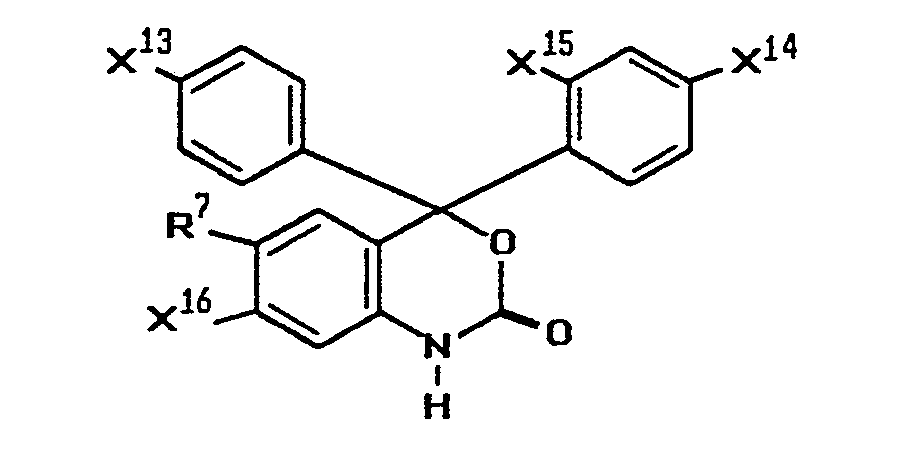
- Ebenfalls bevorzugt sind Verbindungen der allgemeinen Formel

- R7 Wasserstoff, C1- bis C4-Alkyl oder Benzyl bedeutet, wenigstens einer der Reste
- X13, X14 oder X16 für NY9Y9' steht und die übrigen unabhängig voneinander Wasserstoff, NY9Y9', Halogen, Ci-C18-Alkyl, C1-C12-Alkoxy, Benzyloxy, Methylmercapto oder Ethylmercapto, Phenyl oder Pyrazolino, das durch C1- bis C4-AI- kylgruppen oder Phenylgruppen weiter substituiert sein kann,
- X1 Wasserstoff, C1- bis C3-Alkoxy, Methylmercapto oder Ethylmercapto,
- Y9 und Y9' unabhängig voneinander Wasserstoff, C1- bis C18-Alkyl, das durch Cyano, Chlor, C1- bis Cs-Alkoxy oder C1- bis Ca-Alkoxycarbonyl substituiert sein kann, oder Benzyl, das durch Chlor, C1- bis C4-Alkyl oder C1- bis C4-Alkoxy, substituiert sein kann, oder
- Y9' einen Rest der Formel

- RB und R9 unabhängig voneinander Chlor, Ci- bis C4-Alkyl, Ci- bis C4-Alkoxy, Phenyloxy, Benzyloxy, Cyano, Pyrrolidino, Piperidino, Morpholino, Piperazino, Pyrazolino oder Imidazolino bedeuten.
- Ein weiterer Gegenstand der Erfindung sind Verbindungen der allgemeinen Formel

- X4, X6, X7, R2, A, B und C die oben angegebene Bedeutung haben,
- A- ein Anion bedeutet und
- R10 für C1-C4-Alkyl oder Phenyl steht.
- Die Herstellung der oben aufgeführten Farbbildner erfolgt dadurch, daß man Farbstoffe der Formel IV auf übliche Weise in wäßrigem und/oder nicht-wäßrigem alkalischem Medium gegebenenfalls unter Zusatz eines Phasentransferkatalysators als Lösungsvermittler bei Temperaturen zwischen 0°C und dem Siedepunkt des betreffenden Reaktionsmediums umsetzt.
- Anschließend wird evtl. nach Entfernen des nichtwäßrigen Lösungsmittels, auf beispielsweise Wasser oder einen Alkohol ausgetragen. Das abgeschiedene Produkt wird abgesaugt und mit Wasser einige Stunden nachgerührt.
- Die Farbstoffe der Formel (IV) erhält man vorzugsweise durch Kondensation eines entsprechend substituierten Phenylcarbaminsäureesters der Formel


- X4, X6, X7, R2, R10, A, B und C die oben angegebene Bedeutung besitzen.
- Insbesondere handelt es sich bei den Verbindungen (V) um solche, bei denen
- X6 ein Elektronendonorsubstituent ist, wie NY4Y5, OY6 oder SY6, worin
- Y4 bis Y5 die oben angegebene Bedeutung haben und der Ring B nicht durch starke Elektronenakzeptorgruppen wie Nitro, Cyano oder Alkoxycarbonyl desaktiviert ist.
- Die Umsetzung erfolgt üblicherweise mit wasserabspaftenden Reagenzien ohne oder auch mit unter diesen Bedingungen inerten Lösungsmitteln bei Temperaturen zwischen 0°C und dem Siedepunkt des jeweiligen Mediums. Anschlie-βend wird evtl. nach Entfernen der inerten Lösungsmittel auf beispielsweise Wasser oder einen Alkohol ausgetragen.
- Wasserabspaltende Reagenzien sind beispielsweise Phosphoroxychlorid, Phosphorpentachlorid Diphosphorpentoxid Phosgen, Phosphortrichlorid, Phosphortribromid, Sulfurylchlorid, Thionylchlorid, Oxalylchlorid oder Mischungen hiervon. Vorzugsweise werden Phosphoroxychlorid und Phosphoroxychlorid/Diphosphorpentoxid eingesetzt.
- Geeignete inerte Lösungsmittel sind beispielsweise Toluol, Chlorbenzol, Dichlorbenzol, Nitrobenzol, chlorierte aliphatische Kohlenwasserstoffe, wie 1,2-Dichlor-ethan.
- Die Herstellung der Farbstoffe der Formel (IV) kann auch durch Oxidation von Leukoverbindungen der Formel

- X4, X6, X7, X2, R10, A, B und C die oben angegebene Bedeutung haben, erfolgen.
- Diese Oxidation kann auf bekannte Weise mit höherwertigen Metallverbindungen, wie Pb02, Mn02, Permanganaten Cr03, Chromaten, Dichromaten, Ni02, K3 [Fe(CN)6], mit Chinonen, wie Chloranil, Tetrachlor-o-chinon, Dichlordicyanochinon, oder auf eine andere literaturbekannte Weise, wie z. B. mit Sauerstoff, Luft, Perboraten oder Wasserstoffperoxid, erfolgen.
- Die Aufarbeitung, Isolierung und evtl. Nachbehandlung erfolgt auf analoge Weise wie oben beschrieben.

- X4, X6, X7, R2, A, B und C die oben aufgeführte Bedeutung haben und
- A- ein Anion bedeutet,
- mit Phosgen oder seinen Derivaten umsetzt.
- Als Derivate des Phosgens seien besonders genannt: Chlorameisensäureethylester Chlorameisensäurephenylester, Dimethylcarbonat, Diphenylcarbonat.
- Die Umsetzung erfolgt zweckmäßigerweise in wäßrigem und/oder nichtwäßrigem alkalischem Medium bei Temperaturen zwischen -10°C und +40°C. Unter Umständen ist der Zusatz einer Base, z. B. Natriumcarbonat oder Natriumhydroxid und gegebenenfalls der Zusatz eines Phasentransferkatalysators als Lösungsvermittler sinnvoll.
- Als nichtwäßrige Lösungsmittel seien besonders genannt: Toluol, Xylol, Chlorbenzol, Dichlorbenzol, Pyridin Ethylenglykoldimethylether, Chloroform, Tetrachlorkohlenstoff, Dichlorethan, Tetrachlorethan oder Alkohole, z. B. Methanol, Ethanol, i-Propanol.
- Die Oxidation mit höherwertigen Metallverbindungen erfolgt üblicherweise in saurem Medium oder in organischen Lösungsmitteln, wie Alkoholen- z. B. Ethanol, Isopropanol, Ethylenglykolmonomethylether; Ketonen - z. B. Aceton, Butanon oder Methylisopropylketon oder polaren aprotischen Lösungsmitteln, z. B. N-Methyl-pyrrolidon, γ-Butyrolacton, Acetonitril, Dimethylsulfoxid oder Sulfolan oder in Mischungen solcher Lösungsmittel mit Säuren bei Temperaturen zwischen 0°C und 60°C, vorzugsweise 10 - 40°C.
- Geeignete Säuren sind beispielsweise Salzsäure, Schwefelsäure, Phosphorsäure, Essigsäure, Propionsäure oder Mischungen untereinander und/oder Mischungen mit Wasser. Eine bevorzugte Mischung ist Salzsäure, Essigsäure und Wasser.
- Die Oxidation mit Chinonen erfolgt üblicherweise in organischen Lösungsmitteln, wie Alkoholen - z. B. Methanol, Ethanol, Isopropanol; Ketonen - z. B. Aceton, Butanon; Estern z. B. Essigsäureethyl- oder -butylester; Carbonsäuren - z. B. Essigsäure, Propionsäure oder polaren aprotischen Lösungsmitteln, wie N-Methylpyrrolidon, Dimethylformamid, y-Butyrofacton, Acetonitril, Sulfolan oder aber in Mischungen hiervon bei Temperaturen zwischen 0°C und dem Siedepunkt des Mediums, vorzugsweise 20 - 70°C.
- Ein weiteres Verfahren zur Herstellung der erfindungsgemäßen Verbindungen besteht darin, daß man Farbstoffe der allgemeinen Formel

- X4, Xs, X7, R2, A, B und C die oben aufgeführte Bedeutung haben und
- A- ein Anion bedeutet,
- mit Phosgen oder seinen Derivaten umsetzt.
- Als Derivate des Phosgens seien besonders genannt:
- Chlorameisensäureethylester, Chlorameisensäurephenylester, Dimethylcarbonat, Diphenylcarbonat.
- Die Umsetzung erfolgt zweckmäßigerweise in wäßrigem und/oder nichtwäßrigem alkalischem Medium bei Temperaturen zwischen -10°C und +40°C. Unter Umständen ist der Zusatz einer Base, z. B. Natriumcarbonat oder Natriumhydroxid und gegebenenfalls der Zusatz eines Phasentransferkatalysators als Lösungsvermittler sinnvoll.
- Als nichtwäßrige Lösungsmittel seien besonders genannt:
- Toluol, Xylol, Chlorbenzol, Dichlorbenzol, Pyridin, Ethylenglykoldimethylether, Chloroform, Tetrachlorkohlenstoff, Dichlorethan, Tetrachlorethan oder Alkohole, z. B. Methanol, Ethanol, i-Propanol.
- Als Basen sind bevorzugt zu nennen:
- Carbonate, wie z. B. Natriumcarbonat, Kaliumcarbonat, Calciumcarbonat; Oxide wie z. B. Magnesiumoxid oder Calciumoxid; Amine, wie z. B. Triethylamin, Pyridin.
- Die Aufarbeitung der Produkte erfolgt gegebenenfalls nach Entfernen des inerten Lösungsmittels wie oben beschrieben.
- Die Verbindungen der Formel (I) sind normalerweise farblos oder höchstens schwach gefärbt.
- Wenn diese Farbbildner mit einem vorzugsweise sauren Entwickler, d. h. einem Elektronenakzeptor, in Kontakt gebracht werden, so ergeben sich intensive rote, blaue, grüne oder schwarze Farbtöne, die ausgezeichnete Echtheiten aufweisen.
- Sie sind auch wertvoll im Gemisch mit einem oder mehreren anderen bekannten Farbbildnern, z. B. 3,3-Bis-(aminophenyl)-phthaliden, 3,3-Bis-(indolyl)-phthaliden, 3-Amino-fluoranen, 2,6-Diamino-fluoranen, Leukoauraminen, Spiropyranen, Spirodipyranen, Chromenoindolen, Phenoxazinen, Phenothiazinen, Carbazolylmethanen oder weiteren Triarylmethanleukofarbstoffen.
- Die Verbindungen der Formel (I) zeigen sowohl auf phenolischen Unterlagen wie auch besonders auf aktivierten Tonen eine gute Farbintensität und Lichtechtheit. Sie eignen sich vor allem als Farbbildner für die Verwendung in einem wärmeempfindlichen oder druckempfindlichen Aufzeichnungsmaterial, das sowohl Kopierals auch Registriermaterial sein kann. Ihre Entwicklungsgeschwindigkeft ist in Anhängigkeit von den Substituenten unterschiedlich. Eine geringe Entwicklungsgeschwindigkeit führt zu einer reduzierten Empfindlichkeit der Aufzeichnungsmaterialien gegenüber unbeabsichtigter vorzeitiger Entwicklung.
- Insbesondere beim Thermodruck-Verfahren sind mit den erfindungsgemäßen Farbbildnern Schriftbilder extrem hoher Echtheiten und hoher Unempfindlichkeit gegen den Einfluß sowohl saurer als auch basischer Medien erhältlich.
- Ein druckempfindliches Material besteht beispielsweise aus mindestens 1 Paar von Blättern, die mindestens einen Farbbildner der Formel I, gelöst oder dispergiert in einem nichtflüchtigen organischen Lösungsmittel, und einen Elektronenakzeptor als Entwickler enthalten.
- Typische Beispiele für solche Entwickler sind anorganische Stoffe wie Tone, Metallsalze oder -oxide oder organische Polymerisate wie Phenolharze.
- Die Entwickler können zusätzlich auch im Gemisch mit anderen an sich unreaktiven oder wenig reaktiven Pigmenten eingesetzt werden.
- Der Farbbildner liefert an den Punkten, an denen er mit dem Elektronenakzeptor in Kontakt kommt, eine gefärbte Markierung. Um eine frühzeitige Aktivierung der in dem druckempfindlichen Aufzeichnungsmaterial vorhandenen Farbbildner zu verhindern, werden diese in der Regel von dem Elektronenakzeptor getrennt. Dies kann zweckmäßig erzielt werden, indem man die Farbbildner in schaum-, schwamm- oder bienenwabenartigen Strukturen einarbeitet. Vorzugsweise sind die Farbbildner in Mikrokapseln eingeschlossen, die sich in der Regel durch Druck zerbrechen lassen. Verfahren zur Herstellung derartiger Mikrokapseln sind bekannt.
- Als nichtflüchtige Lösungsmittel sind z. B. partiell hydriertes Terphenyl, alkylierte Naphthaline oder Dibutylphthalat geeignet.
- Bevorzugt wird eine Anordnung, bei der der eingekapselte Farbbildner in Form einer Schicht auf der Rückseite eines Übertragungsblattes und der Elektronenakzeptor in Form einer Schicht auf der Vorderseite eines Empfangsblattes vorhanden sind.
- Eine andere Anordnung der Bestandteile besteht darin, daß die den Farbbildner enthaltenden Mikrokapseln und der Entwickler in oder auf dem gleichen Blatt in Form einer oder mehrerer Einzelschichten oder in der Papierpulpe vorliegen.
- Die Verbindungen der Formel 1 können vorzugsweise auch als Farbbildner in einem thermoreaktiven Aufzeichnungsmaterial verwendet werden. Dieses enthält in der Regel mindestens einen Schichtträger, einen Farbbildner, einen Elektronenakzeptor und gegebenenfalls auch ein Bindemittel.
- Thermoreaktive Aufzeichnungssysteme umfassen z. B. wärmeempfindliche Aufzeichnungs und Kopiermaterialien und -papiere. Diese Systeme werden beispielsweise zum Aufzeichnen von Informationen, z. B. in elektronischen Rechnern, Ferndruckern, Fernschreibern oder in Aufzeichnungsgeräten und Meßinstrumenten, wie z. B. Elektrokardiographen, verwendet. Die Bilderzeugung (Markierung) kann auch manuell mit einer erhitzten Feder erfolgen. Eine weitere Einrichtung der Erzeugung von Markierungen mittels Wärme sind Laserstrahlen.
- Das thermoreaktive Aufzeichnungsmaterial kann so aufgebaut sein, daß der Farbbildner in einer Bindemittelschicht gelöst oder dispergiert ist und in einer zweiten Schicht der Entwickler in dem Bindemittel gelöst oder dispergiert ist. Eine andere Möglichkeit besteht darin, daß sowohl der Farbbildner als auch der Entwickler in einer Schicht dispergiert sind. Das Bindemittel wird in spezifischen Bereichen mittels Wärme erweicht und an diesen Stellen, an denen Wärme angewendet wird, kommt der Farbbildner mit dem Elektronenakzeptor in Kontakt, und es entwickelt sich sofort die erwünschte Farbe.
- Als Entwickler eignen sich die gleichen Elektronenakzeptoren wie sie in druckempfindlichen Papieren verwendet werden, vorzugsweise phenolische Verbindungen, wie sie beispielsweise in der DE-PS-1 251 348 beschrieben sind, sowie Borsäure und organische, vorzugsweise aliphatische Dicarbonsäuren.
- Vorzugsweise werden zur Herstellung des thermoreaktiven Aufzeichnungsmaterials schmelzbare, filmbildende Bindemittel verwendet. Diese Bindemittel sind normalerweise wasserlöslich, während die 4,4-Diaryl-2-oxo-benzo-3,1-oxazine und der Entwickler in Wasser schwerlöslich oder unlöslich sind. Das Bindemittel sollte in der Lage sein, den Farbbildner und den Entwickler bei Raumtemperatur zu dispergieren und zu fixieren.
- Bei Einwirkung von Wärme erweicht oder schmilzt das Bindemittel, so daß der Farbbildner mit dem Entwickler in Kontakt kommt und sich eine Farbe bilden kann. Wasserlösliche oder mindestens in Wasser quellbare Bindemittel sind z. B. hydrophile Polymerisate, wie Polyvinylalkohol, Polyacrylsäure, Hydroxyethylcellulose Methylcellulose, Carboxymethylcellulose, Polyacrylamid, Polyvinylpyrrolidon, Gelatine und Stärke.
- Die thermoreaktiven Schichten können weitere Zusätze enthalten: zur Verbesserung des Weißgrades, zur Erleichterung des Bedruckens der Papiere, zur Verhinderung des Festklebens der erhitzten Feder und zur Farbbildung nur innerhalb eines begrenzten Temperaturbereiches.
- Die beschriebenen Verfahren und Zubereitungen sind beispielsweise aus den US-Patentschriften 2 948 753, 3 096 189 und 3 193 404 und aus den deutschen Offenlegungsschriften 2 555 080 und 2 700 937 bekannt. Aus C. A. 101 : 55014s (1984) sind aminogruppenfreie 4,4-Diphenyl-2-oxo-benzo-3,1-oxazine bekannt.
- Aus der US-A-4 074 050 sind 4,4-Diphenyl-2-oxo-benzo-1,3-oxazine bekannt, die Isomere der erfindungsgemäßen chromogenen Verbindungen darstellen.
- 26,8 g Michlers Keton, 10,8 g 3-Dimethylaminophenylcarbaminsäureethylester, 76,5 g Phosphoroxychlorid und 28,2 g Diphosphorpentoxid werden 48 h bei Raumtemperatur verrührt. Anschließend wird auf 500 g Eiswasser ausgetragen, die wäßrige Lösung vom ausgefallenen Öl. abgegossen, in 100 ml Eisessig gelöst, mit 500 ml Wasser verdünnt und unter Kühlung mit NaOH als Carbinolbase gefällt. Diese Carbinolbase wird in 750 ml Dimethoxyethan gelöst, mit 15 ml konz. NaOH versetzt und 5 h bei Raumtemperatur verrührt. Die organische Phase wird abgetrennt, im Vakuum eingedampft und der Rückstand mit Methanol bis zur Kristallisation verrührt. Man erhält 35 g Produkt der Formel

- In analoger Weise wurden folgende Beispiele hergestellt:


- 25,5 g 4-Dimethylamino-4'-methoxy-benzophenon, 20,8 g 3-Dimethylaminophenylcarbaminsäureethylester, 76,5 g Phosphoroxychlorid und 28,2 g Phosphorpentoxid werden 48 h bei Raumtemperatur verrührt. Man trägt auf 500 g Eiswasser aus, dekantiert von dem ausgeschiedenen Farbstofföl, löst in 100 ml Eisessig, verdünnt mit 500 ml Wasser und fällt unter Kühlung mit NaOH die Carbinolbase aus. Diese wird in 300 ml Dimethoxyethan gelöst, mit 8 ml konz. NaOH versetzt und 5 h bei Raumtemperatur verrührt. Die abgetrennte organische Phase wird im Vakuum eingedampft und mit 100 ml Methanol bis zur Kristallisation verrührt. Man erhält 30 g Produkt der Formel

- In analoger Weise wurden hergestellt:


- 20,8 g 3-Dimethylaminophenylcarbaminsäureethylester, 27,2 g 2,4,4'-Trimethoxybenzophenon, 76,5 g Phosphoroxychlorid und 28,2 g Phosphorpentoxid werden 48 h bei Raumtemperatur und 2 h bei 40°C verrührt. Anschließend wird auf 700 g Eiswasser ausgetragen, mit NaCI ausgesalzen, vom abgeschiedenen Farbstofföl dekantiert; das Öl wird in 300 ml Toluol gelöst und mit 300 ml gesättigter wäßriger NaHC03-Lösung verrührt, bis es in der Toluolphase gelöst ist. Die Toluolphase wird abgetrennt und eingedampft. Der verbleibende Rückstand wird in 750 ml Dimethoxyethan gelöst und mit 8 ml konz. NaOH 5 h bei Raumtemperatur verrührt. Die organische Phase wird abgetrennt, im Vakuum eingedampft und mit 100 ml Ethanol zur Kristallisation gerührt. Man erhält 40 g Produkt der Formel

- Es bildet in Essigsäure einen Farbstoff mit einer max. Absorption bei λmax = 573 nm.
- 36,7 g 4-Diethylamino-3'-methyl-benzophenon, 20,8 g Dimethylaminophenylcarbaminsäureethylester, 76,5 g Phosphoroxychlorid und 28,2 g Phosphorpentoxid werden 48 h bei Raumtemperatur verrührt. Man trägt auf 500 ml Eiswasser aus und arbeitet wie in Beispiel 5 beschrieben auf. Man erhält 35,2 g eines farblosen Produktes der Formel

- 28,3 g 2-Methoxy-4'-diethylamino-benzophenon, 20,8 g 3-Dimethylaminophenylcarbaminsäureethylester, 76,5 g Phosphoroxychlorid und 28,2 g Phosphorpentoxid werden 48 h bei Raumtemperatur verrührt. Man trägt auf 500 g Eiswasser aus, puffert mit Natriumacetat auf pH 6 bis 7 und fällt den Farbstoff durch Zusatz von NaCI aus. Das abgeschiedene ÖI wird wie in Beispiel 5 beschrieben aufgearbeitet. Man erhält 32 g eines farblosen Produktes der Formel

- Das Produkt bildet in Eisessig einen Farbstoff mit einer maximalen Intensität bei λmax = 644 nm.
- 36,1 g 4-Methoxy-4'-(N-methyl-N-4-ethoxy-phenyl)-aminobenzophenon, 28,8 g 3-Dimethylaminophenylcarbaminsäureethylester, 76,5 g Phosphoroxychlorid und 28,1 g Phosphorpentoxid werden 48 h bei Raumtemperatur verrührt, auf 300 g Eiswasser ausgetragen und wie in Beispiel 5 beschrieben aufgearbeitet. Man erhält 43 g Produkt der Formel
-

- In analoger Weise wurden folgende Beispiele hergestellt:


- 9,45 g der Carbinolbase des Farbstoffes der Formel
-

- 9,45 g der in Beispiel 24 als Ausgangsprodukt eingesetzten Carbinolbase werden in 50 ml Pyridin gelöst, auf 0°C gekühlt und mit Phosgen versetzt. Man rührt 12 h bei Raumtemperatur nach, trägt auf 500 ml Wasser aus und saugt ab. Ausbeute: 6,5 g Farbbildner gemäß Beispiel 19.
- 25,5 g 4-Dimethylamino-4'-methoxy-benzophenon, 20,9 g 3-Methoxy-4-methyl-phenylcarbaminsäureethylester, 76,5 g Phosphoroxychlorid und 28,2 g Phosphorpentoxid werden 48 h bei Raumtemperatur verrührt. Man trägt auf 500 ml Eiswasser aus und arbeitet wie in Beispiel 5 beschrieben auf. Man erhäft 33 g des Farbbildners der Formel

- In analoger Weise wurden hergestellt:


- Eine Lösung von 3 g des Farbbildners aus Beispiel 18 in 80 g Diisopropylnaphthalin und 17 g Kerosin wird auf an sich bekannte Weise mit Gelatine und Gummiarabicum durch Koazervation mikroverkapselt, mit Stärkelösung vermischt und auf ein Blatt Papier gestrichen. Ein zweites Blatt Papier wird auf der Frontseite mit säureaktiviertem Bentonit als Farbentwickler beschichtet. Das erste Blatt und das mit Farbentwickler beschichtete Blatt werden mit den Beschichtungen benachbart aufeinandergelegt. Durch Schreiben mit der Hand oder mit der Schreibmaschine auf dem ersten Blatt wird Druck ausgeübt, und es entwickelt sich auf dem mit dem Entwickler beschichteten Blatt eine intensive blau-grüne Kopie, die ausgezeichnet lichtecht ist.
- 1 g der Farbbilderns des Beispiels 11 wird in 17 g Toluol gelöst. Zu dieser Lösung gibt man unter Rühren 12 g Polyvinylacetat, 8 g Calciumcarbonat und 2 g Titandioxid. Die erhaltene Suspension wird im Gewichtsverhältnis 1/1 mit Toluol verdünnt und mit einem 10 µm Rakel auf ein Blatt Papier gestrichen. Auf dieses Blatt Papier wird ein zweites Blatt Papier gelegt, dessen Unterseite bei einem Auftragsgewicht von 3 g/m mit einer Mischung - bestehend aus 1 Teil eines Amidwachses, 1 Teil eines Stearinwachses und 1 Teil Zinkchlorid - beschichtet ist. Durch Schreiben mit der Hand oder mit der Schreibmaschine auf dem oberen Blatt wird Druck ausgeübt, und es entwickelt sich auf dem mit dem Farbbildner beschichteten Blatt eine intensive und lichtechte grüne Farbe.
- In einer Kugelmühle werden 32 g 4,4'-lsopropyliden-diphenol (Bisphenol A), 3,8 g Distearylamid des Ethylendiamins, 89 g Kaolin, 20 g eines zu 88 % hydrolysierten Polyvinylalkohols und 55 ml Wasser gemahlen, bis die Teilchengröße ca. 5 µm beträgt. In einer 2. Kugelmühle werden 6 g der Verbindung des Beispiels 19,3 g eines zu 88 % hydrolysierten Polyvinylalkohols und 60 ml Wasser zu einer Teilchengröße von ca. 3 um gemahlen. Die beiden Dispersionen werden zusammengegeben und mit einem Trockenauftragsgewicht von 5,5 g/m auf ein Papier gestrichen. Durch Berühren des Papiers mit einem erhitzten Kugelschreiber wird eine intensive grünschwarze Farbe erhalten, die eine gute Licht- und Sublimierechtheit hat.
- In einer Kugelmühle werden 2,7 g der Verbindung des Beispiels 23, 24 g N-Phenyl-N'-(1-hydroxy-2,2,2-trichlor-ethyl)-harnstoff, 16 g Stearinsäureamid, 59 g eines zu 88 % hydrolysierten Polyvinylalkohols und 58 ml Wasser gemahlen, bis die Teilchengröße 2 - 5 µm beträgt. Diese Suspension wird bei einem Trockenauftragsgewicht von 5,5 g/m2 auf ein Blatt Papier gestrichen. Durch Berührung des Papiers mit einem erhitzten Kugelschreiber wird eine intensive und lichtechte schwarze Farbe erhalten.
wobei wenigstens einer der Reste
die gestrichelte Linie die weitere Anellierung im Fall von Ring B bedeutet, Y für Wasserstoff, gegebenenfalls durch Chlor, Cyano, C1- bis C4-Alkoxycarbönyl oder Ci- bis C4-Alkoxy substituiertes C1- bis C8-Alkyl, Cyclohexyl oder Phenyl oder Benzyl, die durch Chlor, C1- bis C4-Alkyl oder C1- bis C4-Alkoxy substituiert sein können, steht, der gesättigte Ringteil bis zu 4 Reste aus der Gruppe Chlor, C1- bis C4-Alkyl, C1- bis C4-Alkoxy und Phenyl tragen kann,
die Ringe A, B, C durch Chlor, C1- bis C4-Alkyl, C1- bis C4-Alkoxy und/oder C1- bis C12-Alkanoylamino substituiert sein können, oder
Claims (9)

wobei wenigstens einer der Reste
substituiert sein können, oder Glieder, die zusammen mit N oder O, an das sie gebunden sind, und mit einem der Ringe A, B oder C zur Vervollständigung eines Ringsystems der folgenden Formeln



der gesättigte Ringteil bis zu 4 Reste aus der Gruppe Chlor, C1- bis C4-Alkyl, C1- bis C4-Alkoxy und Phenyl tragen kann,
die Ringe A, B, C durch Chlor, C1- bis C4-Alkyl, C1- bis C4-Alkoxy und/oder C1- bis C12-Alkanoylamino substituiert sein können, oder



Applications Claiming Priority (2)
| Application Number | Priority Date | Filing Date | Title |
|---|---|---|---|
| DE3439281 | 1984-10-26 | ||
| DE19843439281 DE3439281A1 (de) | 1984-10-26 | 1984-10-26 | Chromogene 4,4-diaryl-2-oxo-benzo-3,1-oxazine, ihre herstellung und verwendung |
Publications (2)
| Publication Number | Publication Date |
|---|---|
| EP0179378A1 EP0179378A1 (de) | 1986-04-30 |
| EP0179378B1 true EP0179378B1 (de) | 1989-12-06 |
Family
ID=6248856
Family Applications (1)
| Application Number | Title | Priority Date | Filing Date |
|---|---|---|---|
| EP85112987A Expired EP0179378B1 (de) | 1984-10-26 | 1985-10-14 | Chromogene 4,4-Diaryl-2-oxo-benzo-3,1-oxazine, ihre Herstellung und Verwendung |
Country Status (4)
| Country | Link |
|---|---|
| US (1) | US4727140A (de) |
| EP (1) | EP0179378B1 (de) |
| JP (1) | JPS61103961A (de) |
| DE (2) | DE3439281A1 (de) |
Families Citing this family (5)
| Publication number | Priority date | Publication date | Assignee | Title |
|---|---|---|---|---|
| DE3622262A1 (de) * | 1986-07-02 | 1988-01-07 | Bayer Ag | Chromogene 3,1-benzoxazine |
| JPH0788105B2 (ja) * | 1987-04-07 | 1995-09-27 | 富士写真フイルム株式会社 | 記録材料 |
| WO1989005335A1 (fr) * | 1987-12-02 | 1989-06-15 | Japan Capsular Products Inc | Substance photochromique microencapsulee, procede de production et preparation d'encre a base aqueuse preparee a partir de cette substance |
| FR2862530A1 (fr) * | 2003-11-21 | 2005-05-27 | Oreal | Composition pour la colorisation des fibres keratiniques comprenant un colorant ou un precurseur de colorant |
| US8933261B2 (en) * | 2013-03-14 | 2015-01-13 | Andrei POLUKHTIN | Benzophenone-based chromophoric crosslinkers and reagents for incorporation of biotin or other haptens into macromolecules |
Family Cites Families (2)
| Publication number | Priority date | Publication date | Assignee | Title |
|---|---|---|---|---|
| US4074050A (en) * | 1974-07-08 | 1978-02-14 | Hodogaya Chemical Co., Ltd. | Diphenyl-1,3-benzoxazine-2-ones |
| DE3217012A1 (de) * | 1982-05-06 | 1983-11-10 | Dr. Karl Thomae Gmbh, 7950 Biberach | Benzoxazin-2-one, deren herstellung und diese verbindungen enthaltende arzneimittel |
-
1984
- 1984-10-26 DE DE19843439281 patent/DE3439281A1/de not_active Withdrawn
-
1985
- 1985-10-14 DE DE8585112987T patent/DE3574589D1/de not_active Expired - Lifetime
- 1985-10-14 EP EP85112987A patent/EP0179378B1/de not_active Expired
- 1985-10-21 US US06/789,802 patent/US4727140A/en not_active Expired - Fee Related
- 1985-10-24 JP JP60236531A patent/JPS61103961A/ja active Pending
Also Published As
| Publication number | Publication date |
|---|---|
| US4727140A (en) | 1988-02-23 |
| EP0179378A1 (de) | 1986-04-30 |
| DE3439281A1 (de) | 1986-04-30 |
| DE3574589D1 (de) | 1990-01-11 |
| JPS61103961A (ja) | 1986-05-22 |
Similar Documents
| Publication | Publication Date | Title |
|---|---|---|
| EP0187329B1 (de) | Chromogene 3,1-Benzoxazine | |
| DE2747526C3 (de) | Druck- oder wärmeempfindliches Aufzeichnungsmaterial | |
| EP0033716B1 (de) | Chromogene Chinazolinverbindungen, Verfahren zu ihrer Herstellung und ihre Verwendung als Farbbildner in druckempfindlichen oder wärmeempfindlichen Aufzeichnungsmaterialien | |
| EP0164018B1 (de) | Chromogene 4,4-Diaryl-dihydrochinazolone, ihre Herstellung und Verwendung | |
| DE2422899A1 (de) | Diamino-substituierte fluoranverbindungen, verfahren zu ihrer herstellung und ihre verwendung als farbbildner in einem druckempfindlichen oder thermoreaktiven aufzeichnungsmaterial | |
| EP0254858B1 (de) | Chromogene 3,1.Benzoxazine | |
| EP0179378B1 (de) | Chromogene 4,4-Diaryl-2-oxo-benzo-3,1-oxazine, ihre Herstellung und Verwendung | |
| DE2700937A1 (de) | 3-indolyl-3-bis-aminophenyl- phthalidverbindungen | |
| EP0001248B1 (de) | Benzopyranothiazole, ihre Herstellung und ihre Verwendung in druck- oder wärmeempfindlichem Aufzeichnungsmaterial | |
| DE2644812A1 (de) | Druck- oder waermeempfindliches aufzeichnungsmaterial | |
| DE2824693C2 (de) | Druck- oder wärmeempfindliches Aufzeichnungsmaterial | |
| EP0003726B1 (de) | Substituierte Diaminophthalide, Verfahren zu ihrer Herstellung und ihre Verwendung als Farbbildner in druckempfindlichen oder wärmeempfindlichen Aufzeichnungsmaterialien | |
| EP0109930B1 (de) | Chromogene Bis-Chinazolinverbindungen, Verfahren zu ihrer Herstellung und ihre Verwendung als Farbbildner in druckempfindlichen oder wärmeempfindlichen Aufzeichnungsmaterialien | |
| DE3314195C2 (de) | ||
| EP0091402B1 (de) | Chromenoazaidolizine, Verfahren zu ihrer Herstellung und ihre Verwendung in druck- oder wärmeempfindlichen Aufzeichnungsmaterialien | |
| DE2919421A1 (de) | Halogen- und aminosubstituierte phthalide | |
| EP0180813B1 (de) | Chromogene 4,4-Diaryl-dihydrochinazolone, ihre Herstellung und Verwendung | |
| EP0241795B1 (de) | Benzimidazolo-chinazoline | |
| EP0205069A2 (de) | 2,2-Diaryl-chromenothiazole, ihre Herstellung und ihre Verwendung in Aufzeichnungsmaterialien | |
| EP0135469B1 (de) | Chromogene Chinazolinverbindungen | |
| DE2555080A1 (de) | Druck- oder waermeempfindliches aufzeichnungsmaterial | |
| EP0331636A1 (de) | 2-Aralkylamino-Fluoranverbindungen, Verfahren zu deren Herstellung und deren Verwendung in Aufzeichnungsmaterialien | |
| DE3247059A1 (de) | Chromogene dihydrofuropyridinone | |
| CH634259A5 (en) | Pressure- or heat-sensitive recording material |
Legal Events
| Date | Code | Title | Description |
|---|---|---|---|
| PUAI | Public reference made under article 153(3) epc to a published international application that has entered the european phase |
Free format text: ORIGINAL CODE: 0009012 |
|
| 17P | Request for examination filed |
Effective date: 19851014 |
|
| AK | Designated contracting states |
Kind code of ref document: A1 Designated state(s): CH DE FR GB LI |
|
| 17Q | First examination report despatched |
Effective date: 19871021 |
|
| GRAA | (expected) grant |
Free format text: ORIGINAL CODE: 0009210 |
|
| AK | Designated contracting states |
Kind code of ref document: B1 Designated state(s): CH DE FR GB LI |
|
| PG25 | Lapsed in a contracting state [announced via postgrant information from national office to epo] |
Ref country code: GB Effective date: 19891206 Ref country code: FR Free format text: THE PATENT HAS BEEN ANNULLED BY A DECISION OF A NATIONAL AUTHORITY Effective date: 19891206 |
|
| REF | Corresponds to: |
Ref document number: 3574589 Country of ref document: DE Date of ref document: 19900111 |
|
| EN | Fr: translation not filed | ||
| GBV | Gb: ep patent (uk) treated as always having been void in accordance with gb section 77(7)/1977 [no translation filed] | ||
| PLBE | No opposition filed within time limit |
Free format text: ORIGINAL CODE: 0009261 |
|
| STAA | Information on the status of an ep patent application or granted ep patent |
Free format text: STATUS: NO OPPOSITION FILED WITHIN TIME LIMIT |
|
| 26N | No opposition filed | ||
| PGFP | Annual fee paid to national office [announced via postgrant information from national office to epo] |
Ref country code: DE Payment date: 19930913 Year of fee payment: 9 |
|
| PGFP | Annual fee paid to national office [announced via postgrant information from national office to epo] |
Ref country code: CH Payment date: 19931028 Year of fee payment: 9 |
|
| PG25 | Lapsed in a contracting state [announced via postgrant information from national office to epo] |
Ref country code: LI Effective date: 19941031 Ref country code: CH Effective date: 19941031 |
|
| REG | Reference to a national code |
Ref country code: CH Ref legal event code: PL |
|
| PG25 | Lapsed in a contracting state [announced via postgrant information from national office to epo] |
Ref country code: DE Effective date: 19950701 |