EP0177181B1 - Durchsichtige nicht glasartige, keramische Partikel - Google Patents
Durchsichtige nicht glasartige, keramische Partikel Download PDFInfo
- Publication number
- EP0177181B1 EP0177181B1 EP85306207A EP85306207A EP0177181B1 EP 0177181 B1 EP0177181 B1 EP 0177181B1 EP 85306207 A EP85306207 A EP 85306207A EP 85306207 A EP85306207 A EP 85306207A EP 0177181 B1 EP0177181 B1 EP 0177181B1
- Authority
- EP
- European Patent Office
- Prior art keywords
- microspheres
- transparent
- particles
- ceramic
- sol
- Prior art date
- Legal status (The legal status is an assumption and is not a legal conclusion. Google has not performed a legal analysis and makes no representation as to the accuracy of the status listed.)
- Expired - Lifetime
Links
- 239000000919 ceramic Substances 0.000 title claims abstract description 53
- 239000004005 microsphere Substances 0.000 claims abstract description 121
- GWEVSGVZZGPLCZ-UHFFFAOYSA-N Titan oxide Chemical compound O=[Ti]=O GWEVSGVZZGPLCZ-UHFFFAOYSA-N 0.000 claims abstract description 54
- 239000002245 particle Substances 0.000 claims abstract description 45
- 239000000463 material Substances 0.000 claims abstract description 29
- 239000000203 mixture Substances 0.000 claims abstract description 29
- 238000000034 method Methods 0.000 claims abstract description 23
- 238000001879 gelation Methods 0.000 claims abstract description 17
- QTBSBXVTEAMEQO-UHFFFAOYSA-N Acetic acid Chemical compound CC(O)=O QTBSBXVTEAMEQO-UHFFFAOYSA-N 0.000 claims abstract description 16
- 239000007787 solid Substances 0.000 claims abstract description 16
- 150000004706 metal oxides Chemical class 0.000 claims abstract description 14
- 239000000126 substance Substances 0.000 claims abstract description 14
- 229910044991 metal oxide Inorganic materials 0.000 claims abstract description 13
- USFZMSVCRYTOJT-UHFFFAOYSA-N Ammonium acetate Chemical compound N.CC(O)=O USFZMSVCRYTOJT-UHFFFAOYSA-N 0.000 claims abstract description 10
- 239000005695 Ammonium acetate Substances 0.000 claims abstract description 10
- 235000019257 ammonium acetate Nutrition 0.000 claims abstract description 10
- 229940043376 ammonium acetate Drugs 0.000 claims abstract description 10
- 238000002156 mixing Methods 0.000 claims abstract description 4
- VYPSYNLAJGMNEJ-UHFFFAOYSA-N Silicium dioxide Chemical compound O=[Si]=O VYPSYNLAJGMNEJ-UHFFFAOYSA-N 0.000 claims description 75
- MCMNRKCIXSYSNV-UHFFFAOYSA-N Zirconium dioxide Chemical group O=[Zr]=O MCMNRKCIXSYSNV-UHFFFAOYSA-N 0.000 claims description 70
- 239000000377 silicon dioxide Substances 0.000 claims description 24
- 230000008569 process Effects 0.000 claims description 14
- 229910052782 aluminium Inorganic materials 0.000 claims description 9
- XAGFODPZIPBFFR-UHFFFAOYSA-N aluminium Chemical compound [Al] XAGFODPZIPBFFR-UHFFFAOYSA-N 0.000 claims description 9
- 238000010304 firing Methods 0.000 claims description 8
- 239000011230 binding agent Substances 0.000 claims description 7
- 239000008119 colloidal silica Substances 0.000 claims description 6
- 239000012530 fluid Substances 0.000 claims description 6
- 239000007863 gel particle Substances 0.000 claims description 6
- 239000003349 gelling agent Substances 0.000 claims description 6
- -1 transparent Substances 0.000 claims description 6
- QCWXUUIWCKQGHC-UHFFFAOYSA-N Zirconium Chemical compound [Zr] QCWXUUIWCKQGHC-UHFFFAOYSA-N 0.000 claims description 4
- 238000001035 drying Methods 0.000 claims description 4
- 230000003287 optical effect Effects 0.000 claims description 4
- 239000002356 single layer Substances 0.000 claims description 4
- 229910052726 zirconium Inorganic materials 0.000 claims description 4
- XUIMIQQOPSSXEZ-UHFFFAOYSA-N Silicon Chemical compound [Si] XUIMIQQOPSSXEZ-UHFFFAOYSA-N 0.000 claims description 3
- 239000003795 chemical substances by application Substances 0.000 claims description 3
- 229910052710 silicon Inorganic materials 0.000 claims description 3
- 239000010703 silicon Substances 0.000 claims description 3
- ZSLUVFAKFWKJRC-IGMARMGPSA-N 232Th Chemical compound [232Th] ZSLUVFAKFWKJRC-IGMARMGPSA-N 0.000 claims description 2
- 229910052776 Thorium Inorganic materials 0.000 claims description 2
- ATJFFYVFTNAWJD-UHFFFAOYSA-N Tin Chemical compound [Sn] ATJFFYVFTNAWJD-UHFFFAOYSA-N 0.000 claims description 2
- 230000002829 reductive effect Effects 0.000 claims description 2
- 229910052718 tin Inorganic materials 0.000 claims description 2
- 239000004408 titanium dioxide Substances 0.000 claims description 2
- 229910052727 yttrium Inorganic materials 0.000 claims description 2
- VWQVUPCCIRVNHF-UHFFFAOYSA-N yttrium atom Chemical compound [Y] VWQVUPCCIRVNHF-UHFFFAOYSA-N 0.000 claims description 2
- 238000000227 grinding Methods 0.000 claims 1
- YIWUKEYIRIRTPP-UHFFFAOYSA-N 2-ethylhexan-1-ol Chemical compound CCCCC(CC)CO YIWUKEYIRIRTPP-UHFFFAOYSA-N 0.000 abstract description 12
- 229960000583 acetic acid Drugs 0.000 abstract description 6
- 239000012362 glacial acetic acid Substances 0.000 abstract description 5
- 230000015572 biosynthetic process Effects 0.000 abstract description 4
- 101100379080 Emericella variicolor andB gene Proteins 0.000 abstract 1
- XLYOFNOQVPJJNP-UHFFFAOYSA-N water Substances O XLYOFNOQVPJJNP-UHFFFAOYSA-N 0.000 description 17
- 239000010410 layer Substances 0.000 description 16
- 239000011324 bead Substances 0.000 description 14
- 239000004576 sand Substances 0.000 description 13
- 239000011521 glass Substances 0.000 description 12
- 238000013019 agitation Methods 0.000 description 11
- 239000000499 gel Substances 0.000 description 11
- RMAQACBXLXPBSY-UHFFFAOYSA-N silicic acid Chemical compound O[Si](O)(O)O RMAQACBXLXPBSY-UHFFFAOYSA-N 0.000 description 7
- 229910052681 coesite Inorganic materials 0.000 description 6
- 229910052906 cristobalite Inorganic materials 0.000 description 6
- 239000006185 dispersion Substances 0.000 description 6
- 238000005259 measurement Methods 0.000 description 6
- 229910052751 metal Inorganic materials 0.000 description 6
- 239000002184 metal Substances 0.000 description 6
- 235000012239 silicon dioxide Nutrition 0.000 description 6
- 238000003980 solgel method Methods 0.000 description 6
- 229910052682 stishovite Inorganic materials 0.000 description 6
- 229910052905 tridymite Inorganic materials 0.000 description 6
- 229910002651 NO3 Inorganic materials 0.000 description 5
- NHNBFGGVMKEFGY-UHFFFAOYSA-N Nitrate Chemical compound [O-][N+]([O-])=O NHNBFGGVMKEFGY-UHFFFAOYSA-N 0.000 description 5
- 239000000084 colloidal system Substances 0.000 description 5
- 238000004519 manufacturing process Methods 0.000 description 5
- 238000002310 reflectometry Methods 0.000 description 5
- 238000012360 testing method Methods 0.000 description 5
- 239000011248 coating agent Substances 0.000 description 4
- 238000000576 coating method Methods 0.000 description 4
- 229920005989 resin Polymers 0.000 description 4
- 239000011347 resin Substances 0.000 description 4
- 150000003839 salts Chemical class 0.000 description 4
- XREXPQGDOPQPAH-QKUPJAQQSA-K trisodium;[(z)-18-[1,3-bis[[(z)-12-sulfonatooxyoctadec-9-enoyl]oxy]propan-2-yloxy]-18-oxooctadec-9-en-7-yl] sulfate Chemical compound [Na+].[Na+].[Na+].CCCCCCC(OS([O-])(=O)=O)C\C=C/CCCCCCCC(=O)OCC(OC(=O)CCCCCCC\C=C/CC(CCCCCC)OS([O-])(=O)=O)COC(=O)CCCCCCC\C=C/CC(CCCCCC)OS([O-])(=O)=O XREXPQGDOPQPAH-QKUPJAQQSA-K 0.000 description 4
- 150000003755 zirconium compounds Chemical class 0.000 description 4
- ZWEHNKRNPOVVGH-UHFFFAOYSA-N 2-Butanone Chemical compound CCC(C)=O ZWEHNKRNPOVVGH-UHFFFAOYSA-N 0.000 description 3
- LFQSCWFLJHTTHZ-UHFFFAOYSA-N Ethanol Chemical compound CCO LFQSCWFLJHTTHZ-UHFFFAOYSA-N 0.000 description 3
- VEXZGXHMUGYJMC-UHFFFAOYSA-N Hydrochloric acid Chemical compound Cl VEXZGXHMUGYJMC-UHFFFAOYSA-N 0.000 description 3
- YXFVVABEGXRONW-UHFFFAOYSA-N Toluene Chemical compound CC1=CC=CC=C1 YXFVVABEGXRONW-UHFFFAOYSA-N 0.000 description 3
- 239000002253 acid Substances 0.000 description 3
- 239000000853 adhesive Substances 0.000 description 3
- 230000001070 adhesive effect Effects 0.000 description 3
- 239000003086 colorant Substances 0.000 description 3
- RKTYLMNFRDHKIL-UHFFFAOYSA-N copper;5,10,15,20-tetraphenylporphyrin-22,24-diide Chemical compound [Cu+2].C1=CC(C(=C2C=CC([N-]2)=C(C=2C=CC=CC=2)C=2C=CC(N=2)=C(C=2C=CC=CC=2)C2=CC=C3[N-]2)C=2C=CC=CC=2)=NC1=C3C1=CC=CC=C1 RKTYLMNFRDHKIL-UHFFFAOYSA-N 0.000 description 3
- 230000000694 effects Effects 0.000 description 3
- 239000011159 matrix material Substances 0.000 description 3
- VLKZOEOYAKHREP-UHFFFAOYSA-N n-Hexane Chemical compound CCCCCC VLKZOEOYAKHREP-UHFFFAOYSA-N 0.000 description 3
- 239000003921 oil Substances 0.000 description 3
- 239000000047 product Substances 0.000 description 3
- 230000000717 retained effect Effects 0.000 description 3
- 239000002904 solvent Substances 0.000 description 3
- 229920002554 vinyl polymer Polymers 0.000 description 3
- IJGRMHOSHXDMSA-UHFFFAOYSA-N Atomic nitrogen Chemical compound N#N IJGRMHOSHXDMSA-UHFFFAOYSA-N 0.000 description 2
- XTEGARKTQYYJKE-UHFFFAOYSA-M Chlorate Chemical compound [O-]Cl(=O)=O XTEGARKTQYYJKE-UHFFFAOYSA-M 0.000 description 2
- VEXZGXHMUGYJMC-UHFFFAOYSA-M Chloride anion Chemical compound [Cl-] VEXZGXHMUGYJMC-UHFFFAOYSA-M 0.000 description 2
- 239000004593 Epoxy Substances 0.000 description 2
- LRHPLDYGYMQRHN-UHFFFAOYSA-N N-Butanol Chemical compound CCCCO LRHPLDYGYMQRHN-UHFFFAOYSA-N 0.000 description 2
- RTAQQCXQSZGOHL-UHFFFAOYSA-N Titanium Chemical compound [Ti] RTAQQCXQSZGOHL-UHFFFAOYSA-N 0.000 description 2
- 235000011054 acetic acid Nutrition 0.000 description 2
- PNEYBMLMFCGWSK-UHFFFAOYSA-N aluminium oxide Inorganic materials [O-2].[O-2].[O-2].[Al+3].[Al+3] PNEYBMLMFCGWSK-UHFFFAOYSA-N 0.000 description 2
- 238000004458 analytical method Methods 0.000 description 2
- 238000000149 argon plasma sintering Methods 0.000 description 2
- 239000012298 atmosphere Substances 0.000 description 2
- 230000008901 benefit Effects 0.000 description 2
- WMWLMWRWZQELOS-UHFFFAOYSA-N bismuth(iii) oxide Chemical compound O=[Bi]O[Bi]=O WMWLMWRWZQELOS-UHFFFAOYSA-N 0.000 description 2
- 238000001246 colloidal dispersion Methods 0.000 description 2
- 229910052593 corundum Inorganic materials 0.000 description 2
- 239000013078 crystal Substances 0.000 description 2
- 230000002950 deficient Effects 0.000 description 2
- 238000001914 filtration Methods 0.000 description 2
- 230000003116 impacting effect Effects 0.000 description 2
- 150000002500 ions Chemical group 0.000 description 2
- VCJMYUPGQJHHFU-UHFFFAOYSA-N iron(3+);trinitrate Chemical compound [Fe+3].[O-][N+]([O-])=O.[O-][N+]([O-])=O.[O-][N+]([O-])=O VCJMYUPGQJHHFU-UHFFFAOYSA-N 0.000 description 2
- 239000007788 liquid Substances 0.000 description 2
- 239000000155 melt Substances 0.000 description 2
- 150000002736 metal compounds Chemical class 0.000 description 2
- 150000002739 metals Chemical class 0.000 description 2
- 230000004048 modification Effects 0.000 description 2
- 238000012986 modification Methods 0.000 description 2
- 150000007524 organic acids Chemical class 0.000 description 2
- 239000000049 pigment Substances 0.000 description 2
- 229920000642 polymer Polymers 0.000 description 2
- 239000004814 polyurethane Substances 0.000 description 2
- 239000002243 precursor Substances 0.000 description 2
- 238000012545 processing Methods 0.000 description 2
- 239000002994 raw material Substances 0.000 description 2
- 239000007858 starting material Substances 0.000 description 2
- 238000003756 stirring Methods 0.000 description 2
- VZGDMQKNWNREIO-UHFFFAOYSA-N tetrachloromethane Chemical compound ClC(Cl)(Cl)Cl VZGDMQKNWNREIO-UHFFFAOYSA-N 0.000 description 2
- XOLBLPGZBRYERU-UHFFFAOYSA-N tin dioxide Chemical compound O=[Sn]=O XOLBLPGZBRYERU-UHFFFAOYSA-N 0.000 description 2
- 239000010936 titanium Substances 0.000 description 2
- 229910052719 titanium Inorganic materials 0.000 description 2
- VXUYXOFXAQZZMF-UHFFFAOYSA-N titanium(IV) isopropoxide Chemical compound CC(C)O[Ti](OC(C)C)(OC(C)C)OC(C)C VXUYXOFXAQZZMF-UHFFFAOYSA-N 0.000 description 2
- 125000000391 vinyl group Chemical group [H]C([*])=C([H])[H] 0.000 description 2
- 229910001845 yogo sapphire Inorganic materials 0.000 description 2
- 150000003754 zirconium Chemical class 0.000 description 2
- UOCLXMDMGBRAIB-UHFFFAOYSA-N 1,1,1-trichloroethane Chemical compound CC(Cl)(Cl)Cl UOCLXMDMGBRAIB-UHFFFAOYSA-N 0.000 description 1
- SCYULBFZEHDVBN-UHFFFAOYSA-N 1,1-Dichloroethane Chemical compound CC(Cl)Cl SCYULBFZEHDVBN-UHFFFAOYSA-N 0.000 description 1
- NWUYHJFMYQTDRP-UHFFFAOYSA-N 1,2-bis(ethenyl)benzene;1-ethenyl-2-ethylbenzene;styrene Chemical compound C=CC1=CC=CC=C1.CCC1=CC=CC=C1C=C.C=CC1=CC=CC=C1C=C NWUYHJFMYQTDRP-UHFFFAOYSA-N 0.000 description 1
- 150000000369 2-ethylhexanols Chemical class 0.000 description 1
- RZVAJINKPMORJF-UHFFFAOYSA-N Acetaminophen Chemical compound CC(=O)NC1=CC=C(O)C=C1 RZVAJINKPMORJF-UHFFFAOYSA-N 0.000 description 1
- ZOXJGFHDIHLPTG-UHFFFAOYSA-N Boron Chemical compound [B] ZOXJGFHDIHLPTG-UHFFFAOYSA-N 0.000 description 1
- OYPRJOBELJOOCE-UHFFFAOYSA-N Calcium Chemical compound [Ca] OYPRJOBELJOOCE-UHFFFAOYSA-N 0.000 description 1
- 239000004821 Contact adhesive Substances 0.000 description 1
- FYYHWMGAXLPEAU-UHFFFAOYSA-N Magnesium Chemical compound [Mg] FYYHWMGAXLPEAU-UHFFFAOYSA-N 0.000 description 1
- KKCBUQHMOMHUOY-UHFFFAOYSA-N Na2O Inorganic materials [O-2].[Na+].[Na+] KKCBUQHMOMHUOY-UHFFFAOYSA-N 0.000 description 1
- 229920000459 Nitrile rubber Polymers 0.000 description 1
- 229910019142 PO4 Inorganic materials 0.000 description 1
- 239000004698 Polyethylene Substances 0.000 description 1
- 239000006087 Silane Coupling Agent Substances 0.000 description 1
- CDBYLPFSWZWCQE-UHFFFAOYSA-L Sodium Carbonate Chemical compound [Na+].[Na+].[O-]C([O-])=O CDBYLPFSWZWCQE-UHFFFAOYSA-L 0.000 description 1
- 229910004369 ThO2 Inorganic materials 0.000 description 1
- HCHKCACWOHOZIP-UHFFFAOYSA-N Zinc Chemical compound [Zn] HCHKCACWOHOZIP-UHFFFAOYSA-N 0.000 description 1
- 239000003082 abrasive agent Substances 0.000 description 1
- 238000010521 absorption reaction Methods 0.000 description 1
- 125000002015 acyclic group Chemical class 0.000 description 1
- 239000000654 additive Substances 0.000 description 1
- 125000001931 aliphatic group Chemical class 0.000 description 1
- 229920000180 alkyd Polymers 0.000 description 1
- 230000004075 alteration Effects 0.000 description 1
- 150000001413 amino acids Chemical class 0.000 description 1
- 239000003957 anion exchange resin Substances 0.000 description 1
- 150000001449 anionic compounds Chemical class 0.000 description 1
- 229910052787 antimony Inorganic materials 0.000 description 1
- WATWJIUSRGPENY-UHFFFAOYSA-N antimony atom Chemical compound [Sb] WATWJIUSRGPENY-UHFFFAOYSA-N 0.000 description 1
- LJCFOYOSGPHIOO-UHFFFAOYSA-N antimony pentoxide Inorganic materials O=[Sb](=O)O[Sb](=O)=O LJCFOYOSGPHIOO-UHFFFAOYSA-N 0.000 description 1
- 239000012736 aqueous medium Substances 0.000 description 1
- 239000003849 aromatic solvent Substances 0.000 description 1
- 239000005391 art glass Substances 0.000 description 1
- QVGXLLKOCUKJST-UHFFFAOYSA-N atomic oxygen Chemical compound [O] QVGXLLKOCUKJST-UHFFFAOYSA-N 0.000 description 1
- 229910052788 barium Inorganic materials 0.000 description 1
- DSAJWYNOEDNPEQ-UHFFFAOYSA-N barium atom Chemical compound [Ba] DSAJWYNOEDNPEQ-UHFFFAOYSA-N 0.000 description 1
- 229910052790 beryllium Inorganic materials 0.000 description 1
- ATBAMAFKBVZNFJ-UHFFFAOYSA-N beryllium atom Chemical compound [Be] ATBAMAFKBVZNFJ-UHFFFAOYSA-N 0.000 description 1
- 229910052797 bismuth Inorganic materials 0.000 description 1
- JCXGWMGPZLAOME-UHFFFAOYSA-N bismuth atom Chemical compound [Bi] JCXGWMGPZLAOME-UHFFFAOYSA-N 0.000 description 1
- 229910052796 boron Inorganic materials 0.000 description 1
- 150000001642 boronic acid derivatives Chemical class 0.000 description 1
- NTXGQCSETZTARF-UHFFFAOYSA-N buta-1,3-diene;prop-2-enenitrile Chemical compound C=CC=C.C=CC#N NTXGQCSETZTARF-UHFFFAOYSA-N 0.000 description 1
- MPFUOCVWJGGDQN-UHFFFAOYSA-N butan-1-ol;1,2-xylene Chemical compound CCCCO.CC1=CC=CC=C1C MPFUOCVWJGGDQN-UHFFFAOYSA-N 0.000 description 1
- 229910052791 calcium Inorganic materials 0.000 description 1
- 239000011575 calcium Substances 0.000 description 1
- 239000006229 carbon black Substances 0.000 description 1
- 150000004649 carbonic acid derivatives Chemical class 0.000 description 1
- 229910010293 ceramic material Inorganic materials 0.000 description 1
- 229920001429 chelating resin Polymers 0.000 description 1
- 235000015165 citric acid Nutrition 0.000 description 1
- 239000008199 coating composition Substances 0.000 description 1
- 238000002485 combustion reaction Methods 0.000 description 1
- 150000001875 compounds Chemical class 0.000 description 1
- 238000010276 construction Methods 0.000 description 1
- 238000001816 cooling Methods 0.000 description 1
- 238000005336 cracking Methods 0.000 description 1
- 239000002178 crystalline material Substances 0.000 description 1
- 230000003247 decreasing effect Effects 0.000 description 1
- 238000001739 density measurement Methods 0.000 description 1
- 229920001971 elastomer Polymers 0.000 description 1
- 239000000806 elastomer Substances 0.000 description 1
- 238000005265 energy consumption Methods 0.000 description 1
- 125000003700 epoxy group Chemical group 0.000 description 1
- 238000001704 evaporation Methods 0.000 description 1
- 230000008020 evaporation Effects 0.000 description 1
- 239000000945 filler Substances 0.000 description 1
- 239000011888 foil Substances 0.000 description 1
- 235000019253 formic acid Nutrition 0.000 description 1
- 239000007789 gas Substances 0.000 description 1
- 238000007496 glass forming Methods 0.000 description 1
- 229940093915 gynecological organic acid Drugs 0.000 description 1
- 150000004820 halides Chemical class 0.000 description 1
- 238000007542 hardness measurement Methods 0.000 description 1
- 238000010438 heat treatment Methods 0.000 description 1
- 229930195733 hydrocarbon Natural products 0.000 description 1
- 150000002430 hydrocarbons Chemical class 0.000 description 1
- 150000001261 hydroxy acids Chemical class 0.000 description 1
- 239000012535 impurity Substances 0.000 description 1
- 239000004615 ingredient Substances 0.000 description 1
- 229910001412 inorganic anion Inorganic materials 0.000 description 1
- 230000003993 interaction Effects 0.000 description 1
- 239000003456 ion exchange resin Substances 0.000 description 1
- 229920003303 ion-exchange polymer Polymers 0.000 description 1
- 230000001788 irregular Effects 0.000 description 1
- 150000004715 keto acids Chemical class 0.000 description 1
- JVTAAEKCZFNVCJ-UHFFFAOYSA-N lactic acid Chemical class CC(O)C(O)=O JVTAAEKCZFNVCJ-UHFFFAOYSA-N 0.000 description 1
- 235000014655 lactic acid Nutrition 0.000 description 1
- 239000011133 lead Substances 0.000 description 1
- MOUPNEIJQCETIW-UHFFFAOYSA-N lead chromate Chemical compound [Pb+2].[O-][Cr]([O-])(=O)=O MOUPNEIJQCETIW-UHFFFAOYSA-N 0.000 description 1
- 229910052749 magnesium Inorganic materials 0.000 description 1
- 239000011777 magnesium Substances 0.000 description 1
- 230000014759 maintenance of location Effects 0.000 description 1
- 230000007246 mechanism Effects 0.000 description 1
- 239000012702 metal oxide precursor Substances 0.000 description 1
- 239000003094 microcapsule Substances 0.000 description 1
- 150000007522 mineralic acids Chemical class 0.000 description 1
- 150000002823 nitrates Chemical class 0.000 description 1
- 229910052757 nitrogen Inorganic materials 0.000 description 1
- 235000005985 organic acids Nutrition 0.000 description 1
- 239000011368 organic material Substances 0.000 description 1
- 235000006408 oxalic acid Nutrition 0.000 description 1
- 230000001590 oxidative effect Effects 0.000 description 1
- CMOAHYOGLLEOGO-UHFFFAOYSA-N oxozirconium;dihydrochloride Chemical compound Cl.Cl.[Zr]=O CMOAHYOGLLEOGO-UHFFFAOYSA-N 0.000 description 1
- 239000001301 oxygen Substances 0.000 description 1
- 229910052760 oxygen Inorganic materials 0.000 description 1
- RVTZCBVAJQQJTK-UHFFFAOYSA-N oxygen(2-);zirconium(4+) Chemical compound [O-2].[O-2].[Zr+4] RVTZCBVAJQQJTK-UHFFFAOYSA-N 0.000 description 1
- LYTNHSCLZRMKON-UHFFFAOYSA-L oxygen(2-);zirconium(4+);diacetate Chemical class [O-2].[Zr+4].CC([O-])=O.CC([O-])=O LYTNHSCLZRMKON-UHFFFAOYSA-L 0.000 description 1
- 239000003973 paint Substances 0.000 description 1
- 235000021317 phosphate Nutrition 0.000 description 1
- 150000003013 phosphoric acid derivatives Chemical class 0.000 description 1
- 229920002587 poly(1,3-butadiene) polymer Polymers 0.000 description 1
- 229920001084 poly(chloroprene) Polymers 0.000 description 1
- 229920002037 poly(vinyl butyral) polymer Polymers 0.000 description 1
- 229920000647 polyepoxide Polymers 0.000 description 1
- 229920000728 polyester Polymers 0.000 description 1
- 229920000573 polyethylene Polymers 0.000 description 1
- 229920002635 polyurethane Polymers 0.000 description 1
- 229920003225 polyurethane elastomer Polymers 0.000 description 1
- 239000002244 precipitate Substances 0.000 description 1
- 238000002360 preparation method Methods 0.000 description 1
- 239000011164 primary particle Substances 0.000 description 1
- 239000005297 pyrex Substances 0.000 description 1
- 239000011819 refractory material Substances 0.000 description 1
- 239000012744 reinforcing agent Substances 0.000 description 1
- 230000002441 reversible effect Effects 0.000 description 1
- 229910052594 sapphire Inorganic materials 0.000 description 1
- 239000010980 sapphire Substances 0.000 description 1
- 229920006395 saturated elastomer Polymers 0.000 description 1
- 238000006748 scratching Methods 0.000 description 1
- 230000002393 scratching effect Effects 0.000 description 1
- 238000001179 sorption measurement Methods 0.000 description 1
- 239000012798 spherical particle Substances 0.000 description 1
- 229910002076 stabilized zirconia Inorganic materials 0.000 description 1
- 229910052712 strontium Inorganic materials 0.000 description 1
- CIOAGBVUUVVLOB-UHFFFAOYSA-N strontium atom Chemical compound [Sr] CIOAGBVUUVVLOB-UHFFFAOYSA-N 0.000 description 1
- 150000003467 sulfuric acid derivatives Chemical class 0.000 description 1
- 239000000725 suspension Substances 0.000 description 1
- 229910052715 tantalum Inorganic materials 0.000 description 1
- GUVRBAGPIYLISA-UHFFFAOYSA-N tantalum atom Chemical compound [Ta] GUVRBAGPIYLISA-UHFFFAOYSA-N 0.000 description 1
- PBCFLUZVCVVTBY-UHFFFAOYSA-N tantalum pentoxide Inorganic materials O=[Ta](=O)O[Ta](=O)=O PBCFLUZVCVVTBY-UHFFFAOYSA-N 0.000 description 1
- 235000002906 tartaric acid Nutrition 0.000 description 1
- 229920001169 thermoplastic Polymers 0.000 description 1
- 239000004416 thermosoftening plastic Substances 0.000 description 1
- ZCUFMDLYAMJYST-UHFFFAOYSA-N thorium dioxide Chemical compound O=[Th]=O ZCUFMDLYAMJYST-UHFFFAOYSA-N 0.000 description 1
- 238000002834 transmittance Methods 0.000 description 1
- 239000012780 transparent material Substances 0.000 description 1
- UONOETXJSWQNOL-UHFFFAOYSA-N tungsten carbide Chemical compound [W+]#[C-] UONOETXJSWQNOL-UHFFFAOYSA-N 0.000 description 1
- 238000007740 vapor deposition Methods 0.000 description 1
- 239000003039 volatile agent Substances 0.000 description 1
- 230000003313 weakening effect Effects 0.000 description 1
- 239000000080 wetting agent Substances 0.000 description 1
- RUDFQVOCFDJEEF-UHFFFAOYSA-N yttrium(III) oxide Inorganic materials [O-2].[O-2].[O-2].[Y+3].[Y+3] RUDFQVOCFDJEEF-UHFFFAOYSA-N 0.000 description 1
- 229910052725 zinc Inorganic materials 0.000 description 1
- 239000011701 zinc Substances 0.000 description 1
- 229910001928 zirconium oxide Inorganic materials 0.000 description 1
- ZXAUZSQITFJWPS-UHFFFAOYSA-J zirconium(4+);disulfate Chemical compound [Zr+4].[O-]S([O-])(=O)=O.[O-]S([O-])(=O)=O ZXAUZSQITFJWPS-UHFFFAOYSA-J 0.000 description 1
Images
Classifications
-
- B—PERFORMING OPERATIONS; TRANSPORTING
- B82—NANOTECHNOLOGY
- B82Y—SPECIFIC USES OR APPLICATIONS OF NANOSTRUCTURES; MEASUREMENT OR ANALYSIS OF NANOSTRUCTURES; MANUFACTURE OR TREATMENT OF NANOSTRUCTURES
- B82Y30/00—Nanotechnology for materials or surface science, e.g. nanocomposites
-
- C—CHEMISTRY; METALLURGY
- C04—CEMENTS; CONCRETE; ARTIFICIAL STONE; CERAMICS; REFRACTORIES
- C04B—LIME, MAGNESIA; SLAG; CEMENTS; COMPOSITIONS THEREOF, e.g. MORTARS, CONCRETE OR LIKE BUILDING MATERIALS; ARTIFICIAL STONE; CERAMICS; REFRACTORIES; TREATMENT OF NATURAL STONE
- C04B35/00—Shaped ceramic products characterised by their composition; Ceramics compositions; Processing powders of inorganic compounds preparatory to the manufacturing of ceramic products
- C04B35/01—Shaped ceramic products characterised by their composition; Ceramics compositions; Processing powders of inorganic compounds preparatory to the manufacturing of ceramic products based on oxide ceramics
- C04B35/48—Shaped ceramic products characterised by their composition; Ceramics compositions; Processing powders of inorganic compounds preparatory to the manufacturing of ceramic products based on oxide ceramics based on zirconium or hafnium oxides, zirconates, zircon or hafnates
-
- C—CHEMISTRY; METALLURGY
- C01—INORGANIC CHEMISTRY
- C01B—NON-METALLIC ELEMENTS; COMPOUNDS THEREOF; METALLOIDS OR COMPOUNDS THEREOF NOT COVERED BY SUBCLASS C01C
- C01B13/00—Oxygen; Ozone; Oxides or hydroxides in general
- C01B13/14—Methods for preparing oxides or hydroxides in general
- C01B13/32—Methods for preparing oxides or hydroxides in general by oxidation or hydrolysis of elements or compounds in the liquid or solid state or in non-aqueous solution, e.g. sol-gel process
-
- C—CHEMISTRY; METALLURGY
- C01—INORGANIC CHEMISTRY
- C01B—NON-METALLIC ELEMENTS; COMPOUNDS THEREOF; METALLOIDS OR COMPOUNDS THEREOF NOT COVERED BY SUBCLASS C01C
- C01B33/00—Silicon; Compounds thereof
- C01B33/113—Silicon oxides; Hydrates thereof
- C01B33/12—Silica; Hydrates thereof, e.g. lepidoic silicic acid
- C01B33/16—Preparation of silica xerogels
-
- C—CHEMISTRY; METALLURGY
- C01—INORGANIC CHEMISTRY
- C01G—COMPOUNDS CONTAINING METALS NOT COVERED BY SUBCLASSES C01D OR C01F
- C01G23/00—Compounds of titanium
- C01G23/04—Oxides; Hydroxides
- C01G23/047—Titanium dioxide
-
- C—CHEMISTRY; METALLURGY
- C01—INORGANIC CHEMISTRY
- C01G—COMPOUNDS CONTAINING METALS NOT COVERED BY SUBCLASSES C01D OR C01F
- C01G25/00—Compounds of zirconium
- C01G25/02—Oxides
-
- C—CHEMISTRY; METALLURGY
- C04—CEMENTS; CONCRETE; ARTIFICIAL STONE; CERAMICS; REFRACTORIES
- C04B—LIME, MAGNESIA; SLAG; CEMENTS; COMPOSITIONS THEREOF, e.g. MORTARS, CONCRETE OR LIKE BUILDING MATERIALS; ARTIFICIAL STONE; CERAMICS; REFRACTORIES; TREATMENT OF NATURAL STONE
- C04B35/00—Shaped ceramic products characterised by their composition; Ceramics compositions; Processing powders of inorganic compounds preparatory to the manufacturing of ceramic products
- C04B35/01—Shaped ceramic products characterised by their composition; Ceramics compositions; Processing powders of inorganic compounds preparatory to the manufacturing of ceramic products based on oxide ceramics
- C04B35/14—Shaped ceramic products characterised by their composition; Ceramics compositions; Processing powders of inorganic compounds preparatory to the manufacturing of ceramic products based on oxide ceramics based on silica
-
- C—CHEMISTRY; METALLURGY
- C04—CEMENTS; CONCRETE; ARTIFICIAL STONE; CERAMICS; REFRACTORIES
- C04B—LIME, MAGNESIA; SLAG; CEMENTS; COMPOSITIONS THEREOF, e.g. MORTARS, CONCRETE OR LIKE BUILDING MATERIALS; ARTIFICIAL STONE; CERAMICS; REFRACTORIES; TREATMENT OF NATURAL STONE
- C04B35/00—Shaped ceramic products characterised by their composition; Ceramics compositions; Processing powders of inorganic compounds preparatory to the manufacturing of ceramic products
- C04B35/01—Shaped ceramic products characterised by their composition; Ceramics compositions; Processing powders of inorganic compounds preparatory to the manufacturing of ceramic products based on oxide ceramics
- C04B35/46—Shaped ceramic products characterised by their composition; Ceramics compositions; Processing powders of inorganic compounds preparatory to the manufacturing of ceramic products based on oxide ceramics based on titanium oxides or titanates
-
- C—CHEMISTRY; METALLURGY
- C04—CEMENTS; CONCRETE; ARTIFICIAL STONE; CERAMICS; REFRACTORIES
- C04B—LIME, MAGNESIA; SLAG; CEMENTS; COMPOSITIONS THEREOF, e.g. MORTARS, CONCRETE OR LIKE BUILDING MATERIALS; ARTIFICIAL STONE; CERAMICS; REFRACTORIES; TREATMENT OF NATURAL STONE
- C04B35/00—Shaped ceramic products characterised by their composition; Ceramics compositions; Processing powders of inorganic compounds preparatory to the manufacturing of ceramic products
- C04B35/01—Shaped ceramic products characterised by their composition; Ceramics compositions; Processing powders of inorganic compounds preparatory to the manufacturing of ceramic products based on oxide ceramics
- C04B35/48—Shaped ceramic products characterised by their composition; Ceramics compositions; Processing powders of inorganic compounds preparatory to the manufacturing of ceramic products based on oxide ceramics based on zirconium or hafnium oxides, zirconates, zircon or hafnates
- C04B35/481—Shaped ceramic products characterised by their composition; Ceramics compositions; Processing powders of inorganic compounds preparatory to the manufacturing of ceramic products based on oxide ceramics based on zirconium or hafnium oxides, zirconates, zircon or hafnates containing silicon, e.g. zircon
-
- C—CHEMISTRY; METALLURGY
- C04—CEMENTS; CONCRETE; ARTIFICIAL STONE; CERAMICS; REFRACTORIES
- C04B—LIME, MAGNESIA; SLAG; CEMENTS; COMPOSITIONS THEREOF, e.g. MORTARS, CONCRETE OR LIKE BUILDING MATERIALS; ARTIFICIAL STONE; CERAMICS; REFRACTORIES; TREATMENT OF NATURAL STONE
- C04B35/00—Shaped ceramic products characterised by their composition; Ceramics compositions; Processing powders of inorganic compounds preparatory to the manufacturing of ceramic products
- C04B35/01—Shaped ceramic products characterised by their composition; Ceramics compositions; Processing powders of inorganic compounds preparatory to the manufacturing of ceramic products based on oxide ceramics
- C04B35/48—Shaped ceramic products characterised by their composition; Ceramics compositions; Processing powders of inorganic compounds preparatory to the manufacturing of ceramic products based on oxide ceramics based on zirconium or hafnium oxides, zirconates, zircon or hafnates
- C04B35/49—Shaped ceramic products characterised by their composition; Ceramics compositions; Processing powders of inorganic compounds preparatory to the manufacturing of ceramic products based on oxide ceramics based on zirconium or hafnium oxides, zirconates, zircon or hafnates containing also titanium oxides or titanates
-
- C—CHEMISTRY; METALLURGY
- C04—CEMENTS; CONCRETE; ARTIFICIAL STONE; CERAMICS; REFRACTORIES
- C04B—LIME, MAGNESIA; SLAG; CEMENTS; COMPOSITIONS THEREOF, e.g. MORTARS, CONCRETE OR LIKE BUILDING MATERIALS; ARTIFICIAL STONE; CERAMICS; REFRACTORIES; TREATMENT OF NATURAL STONE
- C04B35/00—Shaped ceramic products characterised by their composition; Ceramics compositions; Processing powders of inorganic compounds preparatory to the manufacturing of ceramic products
- C04B35/622—Forming processes; Processing powders of inorganic compounds preparatory to the manufacturing of ceramic products
- C04B35/624—Sol-gel processing
-
- C—CHEMISTRY; METALLURGY
- C09—DYES; PAINTS; POLISHES; NATURAL RESINS; ADHESIVES; COMPOSITIONS NOT OTHERWISE PROVIDED FOR; APPLICATIONS OF MATERIALS NOT OTHERWISE PROVIDED FOR
- C09C—TREATMENT OF INORGANIC MATERIALS, OTHER THAN FIBROUS FILLERS, TO ENHANCE THEIR PIGMENTING OR FILLING PROPERTIES ; PREPARATION OF CARBON BLACK ; PREPARATION OF INORGANIC MATERIALS WHICH ARE NO SINGLE CHEMICAL COMPOUNDS AND WHICH ARE MAINLY USED AS PIGMENTS OR FILLERS
- C09C1/00—Treatment of specific inorganic materials other than fibrous fillers; Preparation of carbon black
- C09C1/0009—Pigments for ceramics
-
- C—CHEMISTRY; METALLURGY
- C09—DYES; PAINTS; POLISHES; NATURAL RESINS; ADHESIVES; COMPOSITIONS NOT OTHERWISE PROVIDED FOR; APPLICATIONS OF MATERIALS NOT OTHERWISE PROVIDED FOR
- C09C—TREATMENT OF INORGANIC MATERIALS, OTHER THAN FIBROUS FILLERS, TO ENHANCE THEIR PIGMENTING OR FILLING PROPERTIES ; PREPARATION OF CARBON BLACK ; PREPARATION OF INORGANIC MATERIALS WHICH ARE NO SINGLE CHEMICAL COMPOUNDS AND WHICH ARE MAINLY USED AS PIGMENTS OR FILLERS
- C09C1/00—Treatment of specific inorganic materials other than fibrous fillers; Preparation of carbon black
- C09C1/0009—Pigments for ceramics
- C09C1/0012—Pigments for ceramics containing zirconium and silicon
-
- E—FIXED CONSTRUCTIONS
- E01—CONSTRUCTION OF ROADS, RAILWAYS, OR BRIDGES
- E01F—ADDITIONAL WORK, SUCH AS EQUIPPING ROADS OR THE CONSTRUCTION OF PLATFORMS, HELICOPTER LANDING STAGES, SIGNS, SNOW FENCES, OR THE LIKE
- E01F9/00—Arrangement of road signs or traffic signals; Arrangements for enforcing caution
- E01F9/50—Road surface markings; Kerbs or road edgings, specially adapted for alerting road users
- E01F9/506—Road surface markings; Kerbs or road edgings, specially adapted for alerting road users characterised by the road surface marking material, e.g. comprising additives for improving friction or reflectivity; Methods of forming, installing or applying markings in, on or to road surfaces
- E01F9/524—Reflecting elements specially adapted for incorporation in or application to road surface markings
-
- C—CHEMISTRY; METALLURGY
- C01—INORGANIC CHEMISTRY
- C01P—INDEXING SCHEME RELATING TO STRUCTURAL AND PHYSICAL ASPECTS OF SOLID INORGANIC COMPOUNDS
- C01P2004/00—Particle morphology
- C01P2004/30—Particle morphology extending in three dimensions
- C01P2004/32—Spheres
-
- C—CHEMISTRY; METALLURGY
- C01—INORGANIC CHEMISTRY
- C01P—INDEXING SCHEME RELATING TO STRUCTURAL AND PHYSICAL ASPECTS OF SOLID INORGANIC COMPOUNDS
- C01P2004/00—Particle morphology
- C01P2004/51—Particles with a specific particle size distribution
-
- C—CHEMISTRY; METALLURGY
- C01—INORGANIC CHEMISTRY
- C01P—INDEXING SCHEME RELATING TO STRUCTURAL AND PHYSICAL ASPECTS OF SOLID INORGANIC COMPOUNDS
- C01P2004/00—Particle morphology
- C01P2004/60—Particles characterised by their size
- C01P2004/61—Micrometer sized, i.e. from 1-100 micrometer
-
- C—CHEMISTRY; METALLURGY
- C01—INORGANIC CHEMISTRY
- C01P—INDEXING SCHEME RELATING TO STRUCTURAL AND PHYSICAL ASPECTS OF SOLID INORGANIC COMPOUNDS
- C01P2004/00—Particle morphology
- C01P2004/60—Particles characterised by their size
- C01P2004/64—Nanometer sized, i.e. from 1-100 nanometer
-
- C—CHEMISTRY; METALLURGY
- C01—INORGANIC CHEMISTRY
- C01P—INDEXING SCHEME RELATING TO STRUCTURAL AND PHYSICAL ASPECTS OF SOLID INORGANIC COMPOUNDS
- C01P2004/00—Particle morphology
- C01P2004/80—Particles consisting of a mixture of two or more inorganic phases
- C01P2004/82—Particles consisting of a mixture of two or more inorganic phases two phases having the same anion, e.g. both oxidic phases
-
- C—CHEMISTRY; METALLURGY
- C01—INORGANIC CHEMISTRY
- C01P—INDEXING SCHEME RELATING TO STRUCTURAL AND PHYSICAL ASPECTS OF SOLID INORGANIC COMPOUNDS
- C01P2006/00—Physical properties of inorganic compounds
- C01P2006/21—Attrition-index or crushing strength of granulates
-
- C—CHEMISTRY; METALLURGY
- C01—INORGANIC CHEMISTRY
- C01P—INDEXING SCHEME RELATING TO STRUCTURAL AND PHYSICAL ASPECTS OF SOLID INORGANIC COMPOUNDS
- C01P2006/00—Physical properties of inorganic compounds
- C01P2006/60—Optical properties, e.g. expressed in CIELAB-values
-
- Y—GENERAL TAGGING OF NEW TECHNOLOGICAL DEVELOPMENTS; GENERAL TAGGING OF CROSS-SECTIONAL TECHNOLOGIES SPANNING OVER SEVERAL SECTIONS OF THE IPC; TECHNICAL SUBJECTS COVERED BY FORMER USPC CROSS-REFERENCE ART COLLECTIONS [XRACs] AND DIGESTS
- Y10—TECHNICAL SUBJECTS COVERED BY FORMER USPC
- Y10T—TECHNICAL SUBJECTS COVERED BY FORMER US CLASSIFICATION
- Y10T428/00—Stock material or miscellaneous articles
- Y10T428/24—Structurally defined web or sheet [e.g., overall dimension, etc.]
- Y10T428/24355—Continuous and nonuniform or irregular surface on layer or component [e.g., roofing, etc.]
- Y10T428/24372—Particulate matter
-
- Y—GENERAL TAGGING OF NEW TECHNOLOGICAL DEVELOPMENTS; GENERAL TAGGING OF CROSS-SECTIONAL TECHNOLOGIES SPANNING OVER SEVERAL SECTIONS OF THE IPC; TECHNICAL SUBJECTS COVERED BY FORMER USPC CROSS-REFERENCE ART COLLECTIONS [XRACs] AND DIGESTS
- Y10—TECHNICAL SUBJECTS COVERED BY FORMER USPC
- Y10T—TECHNICAL SUBJECTS COVERED BY FORMER US CLASSIFICATION
- Y10T428/00—Stock material or miscellaneous articles
- Y10T428/24—Structurally defined web or sheet [e.g., overall dimension, etc.]
- Y10T428/24355—Continuous and nonuniform or irregular surface on layer or component [e.g., roofing, etc.]
- Y10T428/24372—Particulate matter
- Y10T428/24413—Metal or metal compound
-
- Y—GENERAL TAGGING OF NEW TECHNOLOGICAL DEVELOPMENTS; GENERAL TAGGING OF CROSS-SECTIONAL TECHNOLOGIES SPANNING OVER SEVERAL SECTIONS OF THE IPC; TECHNICAL SUBJECTS COVERED BY FORMER USPC CROSS-REFERENCE ART COLLECTIONS [XRACs] AND DIGESTS
- Y10—TECHNICAL SUBJECTS COVERED BY FORMER USPC
- Y10T—TECHNICAL SUBJECTS COVERED BY FORMER US CLASSIFICATION
- Y10T428/00—Stock material or miscellaneous articles
- Y10T428/24—Structurally defined web or sheet [e.g., overall dimension, etc.]
- Y10T428/24355—Continuous and nonuniform or irregular surface on layer or component [e.g., roofing, etc.]
- Y10T428/24372—Particulate matter
- Y10T428/24421—Silicon containing
-
- Y—GENERAL TAGGING OF NEW TECHNOLOGICAL DEVELOPMENTS; GENERAL TAGGING OF CROSS-SECTIONAL TECHNOLOGIES SPANNING OVER SEVERAL SECTIONS OF THE IPC; TECHNICAL SUBJECTS COVERED BY FORMER USPC CROSS-REFERENCE ART COLLECTIONS [XRACs] AND DIGESTS
- Y10—TECHNICAL SUBJECTS COVERED BY FORMER USPC
- Y10T—TECHNICAL SUBJECTS COVERED BY FORMER US CLASSIFICATION
- Y10T428/00—Stock material or miscellaneous articles
- Y10T428/24—Structurally defined web or sheet [e.g., overall dimension, etc.]
- Y10T428/24355—Continuous and nonuniform or irregular surface on layer or component [e.g., roofing, etc.]
- Y10T428/24372—Particulate matter
- Y10T428/24421—Silicon containing
- Y10T428/2443—Sand, clay, or crushed rock or slate
-
- Y—GENERAL TAGGING OF NEW TECHNOLOGICAL DEVELOPMENTS; GENERAL TAGGING OF CROSS-SECTIONAL TECHNOLOGIES SPANNING OVER SEVERAL SECTIONS OF THE IPC; TECHNICAL SUBJECTS COVERED BY FORMER USPC CROSS-REFERENCE ART COLLECTIONS [XRACs] AND DIGESTS
- Y10—TECHNICAL SUBJECTS COVERED BY FORMER USPC
- Y10T—TECHNICAL SUBJECTS COVERED BY FORMER US CLASSIFICATION
- Y10T428/00—Stock material or miscellaneous articles
- Y10T428/25—Web or sheet containing structurally defined element or component and including a second component containing structurally defined particles
- Y10T428/252—Glass or ceramic [i.e., fired or glazed clay, cement, etc.] [porcelain, quartz, etc.]
-
- Y—GENERAL TAGGING OF NEW TECHNOLOGICAL DEVELOPMENTS; GENERAL TAGGING OF CROSS-SECTIONAL TECHNOLOGIES SPANNING OVER SEVERAL SECTIONS OF THE IPC; TECHNICAL SUBJECTS COVERED BY FORMER USPC CROSS-REFERENCE ART COLLECTIONS [XRACs] AND DIGESTS
- Y10—TECHNICAL SUBJECTS COVERED BY FORMER USPC
- Y10T—TECHNICAL SUBJECTS COVERED BY FORMER US CLASSIFICATION
- Y10T428/00—Stock material or miscellaneous articles
- Y10T428/25—Web or sheet containing structurally defined element or component and including a second component containing structurally defined particles
- Y10T428/256—Heavy metal or aluminum or compound thereof
-
- Y—GENERAL TAGGING OF NEW TECHNOLOGICAL DEVELOPMENTS; GENERAL TAGGING OF CROSS-SECTIONAL TECHNOLOGIES SPANNING OVER SEVERAL SECTIONS OF THE IPC; TECHNICAL SUBJECTS COVERED BY FORMER USPC CROSS-REFERENCE ART COLLECTIONS [XRACs] AND DIGESTS
- Y10—TECHNICAL SUBJECTS COVERED BY FORMER USPC
- Y10T—TECHNICAL SUBJECTS COVERED BY FORMER US CLASSIFICATION
- Y10T428/00—Stock material or miscellaneous articles
- Y10T428/25—Web or sheet containing structurally defined element or component and including a second component containing structurally defined particles
- Y10T428/256—Heavy metal or aluminum or compound thereof
- Y10T428/257—Iron oxide or aluminum oxide
-
- Y—GENERAL TAGGING OF NEW TECHNOLOGICAL DEVELOPMENTS; GENERAL TAGGING OF CROSS-SECTIONAL TECHNOLOGIES SPANNING OVER SEVERAL SECTIONS OF THE IPC; TECHNICAL SUBJECTS COVERED BY FORMER USPC CROSS-REFERENCE ART COLLECTIONS [XRACs] AND DIGESTS
- Y10—TECHNICAL SUBJECTS COVERED BY FORMER USPC
- Y10T—TECHNICAL SUBJECTS COVERED BY FORMER US CLASSIFICATION
- Y10T428/00—Stock material or miscellaneous articles
- Y10T428/29—Coated or structually defined flake, particle, cell, strand, strand portion, rod, filament, macroscopic fiber or mass thereof
- Y10T428/2982—Particulate matter [e.g., sphere, flake, etc.]
-
- Y—GENERAL TAGGING OF NEW TECHNOLOGICAL DEVELOPMENTS; GENERAL TAGGING OF CROSS-SECTIONAL TECHNOLOGIES SPANNING OVER SEVERAL SECTIONS OF THE IPC; TECHNICAL SUBJECTS COVERED BY FORMER USPC CROSS-REFERENCE ART COLLECTIONS [XRACs] AND DIGESTS
- Y10—TECHNICAL SUBJECTS COVERED BY FORMER USPC
- Y10T—TECHNICAL SUBJECTS COVERED BY FORMER US CLASSIFICATION
- Y10T428/00—Stock material or miscellaneous articles
- Y10T428/31—Surface property or characteristic of web, sheet or block
Definitions
- the pavement marking industry has long desired transparent microspheres that would be useful as brighter and more durable retroreflective elements in pavement markings.
- the transparent microspheres now most widely used for pavement markings are made of certain glasses, which are amorphous vitreous materials generally of the soda-lime-silicate type which, although having acceptable durability, have a refractive index of only about 1.5, which greatly limits their retroreflective brightness.
- microspheres are ceramic microspheres made by sol-gel processes from silica and zirconium compounds.
- a sol-gel process is one which converts a colloidal dispersion, sol, aquasol or hydrosol of a metal oxide (or precursor thereof) to a gel, which is a form of colloid which restrains the mobility of the components.
- the gelling step is often followed by drying and then firing to obtain a ceramic material.
- microspheres taught in U.S. Patent No. 3,709,706 have good durability, they have diameters smaller than desirable in certain pavement marking applications.
- Microspheres used in pavement markings generally average between about 150 and 1000 micrometers in diameter, in order to assure that the light-gathering portion of the microsphere protruding from the pavement marking is not obscured by road dirt.
- the prior art does not teach how to make ceramic microspheres which are both transparent and large enough for these pavement marking applications.
- the present invention provides new large, fully dense, transparent, solid ceramic particles, beads or microspheres which can be made with sufficient clarity, index of refraction, and other properties to make them useful as superior lens elements in retroreflective pavement markings.
- the new ceramic microspheres offer a combination of retroreflective brightness and durability that, insofar as is known, has not before been available in a pavement marking lens element.
- These new particles may be summarized as: fully dense, solid, transparent, non-vitreous, ceramic microspheres useful as lens elements in retroreflective pavement markings having at least one specified oxide phase, and an average particle size (minimum particle dimension) of more than 125 micrometers.
- solid means a solid which is not hollow, i.e. lacking any substantial cavities within the microspheres such as described in U.S. Patent 4,349,456 on ceramic metal oxide microcapsules.
- non-vitreous for purposes of this description, means that the ceramic has not been derived from a melt or mixture of raw materials brought to the liquid state at high temperature. This term is used for the purpose of distinguishing the inventive ceramic microspheres over glass beads which are made by a melt process.
- the term transparent for purposes of this discussion means that the ceramic microspheres when viewed under an optical microscope (e.g., at 100X) have the property of transmitting rays of visible light so that bodies beneath the microspheres, such as bodies of the same nature as the microspheres can be clearly seen through the microspheres, when both are immersed in oil of approximately the same refractive index as the microspheres.
- oil should have a refractive index approximating that of the microspheres, it should not be so close that the microspheres seem to disappear (as they would in the case of a perfect index match).
- the outline, periphery or edges of bodies beneath the microspheres are clearly discernible.
- microspheres described herein may be truly spherical but may also be oblate or prolate.
- the preferred ceramic microspheres are also generally characterized by: an average hardness greater than sand, which is an abrasive material often found on roads; toughness, crush resistance, sphericity and retroreflectivity as great or greater than those of conventional glass beads having a similar size and a refractive index of about 1.5; and an index of refraction of between about 1.4 and 2.6.
- the inventive microspheres also have fewer internal imperfections and inclusions than conventional glass beads of a similar size.
- the present invention also provides sol-gel processes for making the inventive ceramic microspheres.
- One improved sol-gel process is a chemical gelation process (as distinguished from a dehydrative gelation process) in which gelation of a sol is induced by chemical disruption of the stability of the sol.
- a chemical gelation process as distinguished from a dehydrative gelation process
- this often entails adjusting the pH to an unstable regime by the addition of a gelling agent.
- the composition Prior to gelation, which may take from a few seconds to several minutes, the composition can be added to a particle forming fluid under agitation to form spheres.
- the size of the spheres can be controlled by the degree of agitation.
- the resulting solid, gelled microspheres are then recovered, dried and fired in an air atmosphere to convert them into the aforesaid ceramic microspheres.
- the following list exemplifies the metals which form oxides useful in making the ceramic microspheres of this invention: aluminum, silicon, thorium, tin, titanium, yttrium, zirconium and mixtures of these oxides with each other and with other additives.
- the formulas for these oxides are exemplified by: Al2O3, SiO2, ThO2, SnO2, TiO2, Y2O3 and ZrO2. Of these, the oxides of zirconium, silicon and titanium are preferred.
- oxides can serve as useful materials in admixture with the above mentioned oxides: antimony, barium, beryllium, bismuth, boron, calcium, lead, magnesium, strontium, tantalum, zinc, and mixtures of the foregoing.
- oxides are for the most part colorless or only weakly colored and are exemplified by BaO, BeO, Bi2O3, B2O3, CaO, PbO, Sb2O5, SrO, Ta2O5, MgO, and ZnO.
- All of these oxides can be furnished in the form of aqueous sols or solutions of metal oxide precursors that are stable in a normal air environment, e.g., 23°C and 50% relative humidity. More information on such metal oxides appears in U.S. Patent 4,349,456 Column 3, line 32 - Column 4, line 5.
- inventive ceramic articles which are made with a silica sol have an amorphous silica phase. Most other metal oxides form a polycrystalline or microcrystalline phase. There are many useful combinations of a polycrystalline metal oxide phase with an amorphous phase such as silica.
- microspheres of the invention are desired because it makes the microspheres more tough and resistant to fracture. In contrast to the straight line fractures that can occur in a continuous glassy structure, fracture in a microsphere of the invention typically proceeds in a tortuous path along the boundaries between the grains, which requires greater energy.
- An important advantage of microspheres of the invention is their superior toughness.
- grain will be used hereinafter as a term generic to crystallites in crystalline materials and to domains or colloidal particles in amorphous materials.
- the size of grains in the microspheres be no larger than 100 nanometers (1000 angstroms) (crystallites preferably 5-40 nanometers (50-400 anstroms) to minimize the effect of grain boundaries on light transmittance and also to minimize the effect of larger areas on light scattering especially with large differences in refractive index between different phases (e.g. ZrO2 and SiO2).
- crystallites of a light transmissive material preferably have a size less than one quarter of the transmitted light.
- microspheres 100 nanometers (1000 Angstroms) is well below one quarter of the average wavelength of visible light which is about 550 nanometers (5500 angstroms).
- zirconia-silica microspheres of the invention From X-ray analyses of zirconia-silica microspheres of the invention, it appears that the zirconia initially crystallizes in a predominantly pseudo-cubic form which then converts to tetragonal zirconia between about 910 and 1000°C.
- the microspheres become slightly more crystalline between 1000 and 1100°C., and it is within this temperature range, when the zirconia is mainly in the tetragonal form, that optimum hardness is achieved.
- the microspheres are fired to higher temperatures (above 1100°C) the cooled samples are found to contain increasing amounts of the monoclinic modification, and these microspheres display a loss of clarity and hardness. Also, crystallite size increases with higher temperature and longer firing times.
- zirconia-silica microspheres there has been found a relatively thin (e.g. about 10 micrometers thick on a 200 micrometer diameter microsphere) continuous uniform zirconia rich layer at the surface of the microsphere.
- Zirconia content at the surface has been found to be up to about 40 mole percent higher than its proportion in the center region, and silica content has been found substantially lower in the exterior region than the average silica content for the entire bead.
- Silica-containing compositions of this invention can be formed from a two phase system comprising an aqueous colloidal dispersion of silica (i.e., a sol or aquasol) and an oxygen containing metal compound which can be calcined to the metal oxide.
- the colloidal silica is typically in a concentration of about 1 to 50 weight percent in the silica sol.
- a number of colloidal silica sols are available commercially having different colloid sizes, see Surface & Colloid Science , Vol. 6, ed. Matijevic, E., Wiley Interscience, 1973.
- Preferred silicas are those which are supplied as a dispersion of amorphous silica in an aqueous medium (such as the Nalcoag Colloidal silicas made by Nalco Chemical Company) and those which are low in soda concentration and can be acidified by admixture with a suitable acid (e.g. Ludox LS colloidal silica made by E. I. DuPont de Nemours & Co.).
- a suitable acid e.g. Ludox LS colloidal silica made by E. I. DuPont de Nemours & Co.
- the zirconium compounds useful in making zirconia-silica sol gel ceramics can be organic or inorganic acid water-soluble salts, such as the zirconium salts of aliphatic or acyclic mono or di-carboxylic acids (e.g. formic, acetic, oxalic, citric, tartaric, and lactic acids). Zirconyl acetate compounds are particularly useful.
- acid deficient inorganic salts of zirconium are useful (e.g. nitrate, chloride, chlorate or sulfate salts).
- Colloidal zirconia sols are commercially available, for example nitrate stabilized (0.83 moles nitrate per mole of zirconia marketed by Nyacol, Inc. of Ashland, Massachusetts).
- Useful inorganic zirconium compounds are zirconium sulfate and zirconium oxychloride. See U.S. patent 3,709,706 Column 4 line 61 - Column 5 line 5 for further details on zirconia sources.
- the other metal oxides mentioned earlier can be supplied as water soluble salts such as nitrates, sulfates, halides, oxyhalides, phosphates, borates, carbonates, or salts of organic acids (mono- or di-carboxylic acids, oxoacids, hydroxy acids, amino acids or mixtures thereof).
- the two major raw materials are usually present in amounts sufficient to provide equivalent ZrO2/SiO2 mole ratio in an aqueous dispersion in the range of about 10:1 to 1:10, preferable 5:1 to 1:5.
- ZrO2 index of refraction
- the refractive index of the resulting microspheres increases, thus allowing an adjustment of refractive index to suit different purposes.
- the refractive index difference between the two phases may impart a slight translucency.
- the dispersion can be prepared by admixing a silica aquasol with an aqueous metal oxide solution under agitation.
- reverse order of addition i.e. adding the metal oxide solution to the silica aquasol under agitation
- the mixture is agitated in order to obtain a uniform dispersion without forming a floc or precipitate and may be filtered to remove extraneous material.
- the aqueous mixture of colloidal silica suspension and zirconium compound will generally be relatively dilute (e.g. 15 to 30 weight percent solids).
- Gelling may be by a number of techniques, some of which are described hereinafter. After the microspheres have been gelled and formed, they are collected (e.g. by filtration) and fired or exposed to high temperatures in an oxidizing (e.g. air) atmosphere. Firing may be done at temperatures ranging between 500 and 1200°C except in the case of zirconia ceramics, where most of the zirconia component is in the tetragonal form and thus higher temperatures (950-1100°C) are used. In the case of titania, temperatures no higher than about 650°C are preferred. Above that temperature some of the titania may convert to the rutile crystal form which results in translucency. The lower temperatures yield the anatase form.
- the addition of other metal oxides to the titania may alter the preferred firing temperature which can be determined experimentally. In general, higher firing temperatures also help to achieve microspheres which are fully dense. In the firing process, the unfired ceramic microspheres should be loosely packed in order to obtain a uniform, free flowing fired product.
- sol gelation is chemical gelation, one method of which comprises adding to the specified oxide sol a gelling agent which alters the pH of the sol and induces gelation by a variety of chemical mechanisms.
- a colloidal zirconia preferably stabilized with an inorganic anion or an acid deficient zirconium salt (preferably inorganic) as the zirconia source and a silica sol as a silica source. These may be mixed and concentrated to obtain a mixed system of the desired viscosity.
- the sol mixture can be induced to gel by raising its pH, for example by adding ammonium acetate.
- the chemical gelation process enables the formation of a mass of discrete, solid, transparent, non-vitreous, fully dense ceramic microspheres, having an average diameter of more than 200 micrometers.
- the term formed mass means a mass of microspheres yielded by one batch of the manufacturing process or a random sample taken from a continuous manufacturing process which process (in either case, batch or continuous) does not include a size classification step to eliminate a major portion of the formed microspheres.
- these microspheres are filled with zirconia crystallites, no larger then 100 nanometers (1000 angstroms) in size, as a polycrystalline phase comingled throughout the spheres with the amorphous silica phase.
- a chemical gelation technique should use a gelling agent which: (1) can be thoroughly mixed with the sol system without producing localized gelation; (2) gives sufficient working time to allow for the formation of spheres prior to the onset of gelation; and (3) leaves no appreciable residue upon combustion which might opacify or degrade the microspheres.
- the quantity of gelling agent to be used is found empirically, one method being to add gelling agent to the sol in small incremental amounts until gelation occurs within the desired time.
- Some usable particle forming fluids are: hydrocarbons such as hexane and toluene, dichloroethane, carbon tetrachloride, 2-ethylhexanol, n-butanol, and trichloroethane. Oils are also useful in this process.
- the appropriate forming fluid for a particular sol-gel system is found by experimentation. Generally, it is preferred that the volume of sol be 1 to 10 percent of the volume of forming fluid used.
- Ammonium acetate solutions have been successfully used in a chemical gelation process for controllably gelling titania sols yielding titania ceramic microspheres greater than 200 micrometers in diameter.
- the addition of small controlled amounts of glacial acetic acid to titania sols prior to the addition of ammonium acetate produces a material which can be readily and controllably gelled with a high degree of homogeneity.
- the quantity of acetic acid is roughly on a 1:1 mole ratio to the chloride ion present in the titania sol (see next paragraph for titania sol formation). This, in turn, has resulted in the ability to generate large reflective spherical particles.
- Crush resistance of the inventive microspheres has also been measured on an apparatus the major feature of which is two parallel plates made of very hard, non-deforming material (e.g., sapphire or tungsten carbide). A single microsphere of known diameter is placed on the lower plate and the upper plate lowered until the microsphere fails. Crush resistance is the force exerted on the microsphere at failure divided by the cross-sectional area of the microspheres ( r2). Ten microspheres of a given composition are tested and the average result is reported as the crush resistance for the composition. Crush resistance of the inventive microspheres has been measured at about 1200-1600 mega-Pascals (175,000-230,000 psi). Glasses typically have a crush resistance of about 350-525 megaPascals (50,000 to 75,000 psi).
- very hard, non-deforming material e.g., sapphire or tungsten carbide
- Transparent, hard spheres were recovered and observed to be up to about 1 mm. in diameter. These particles were dried at room temperature and at 90°C. After heating to 500°C, the particles were observed to be very clear to somewhat transluscent, depending on size and were up to 500 micrometers in diameter.
- a portion of the microspheres made in this example was heated to 550°C for fifteen minutes and cooled. When placed in a shallow aluminum pan and covered with water, these particles were observed to shine brightly when viewed with a flashlight beam from a side angle.
- a second sample of these microspheres were mounted on a white vinyl tape surface, and when this surface was coated with water, the particles were observed to shine brightly when viewed with a flashlight beam from a wide range of viewing angles.
- Another sample heated to 625°C for 30 minutes was found to have a hardness of 5252-8232 mPa (6370 mPa average) (536 to 840 Knoop (650 average)). Surface area measurements showed the sample to be close to fully dense.
- a sample of the gelled microspheres was placed in a Pyrex dish and placed in a box furnace, and the temperature was raised from room temperature to 400°C over two hours. The 400°C temperature was maintained for 30 minutes after which the dish was removed and cooled. The fired beads were very clear.
- a sample of the spheres was then placed in a crucible and heated to 620°C in a box furnace. After 20 minutes at 620°C, the crucible was removed and cooled. Examination of the particles under the microscope at 80X magnification showed that they were transparent with a large proportion between 200 and 350 micrometers in diameter.
- a stable, ion-exchanged zirconia sol was prepared by mixing a nitrate stabilized zirconia sol (as used in Example II) with an ion exchange resin (as described in Example II) in a ratio of about 100 g of sol to 15 g resin. To about 21 g of the resulting stable zirconia sol were added about seven grams of silica sol (Ludox LS), and then about 2.5 g of a 50% aqueous ammonium acetate solution were added to the sol with agitation.
- silica sol Lidox LS
- the resulting mixture (having a ZrO2:SiO2 mole ratio of about 1:1) was immediately added to 500 ml of 2-ethylhexanol under agitation in a 600 ml beaker. After stirring for about 5 minutes, the mixture was filtered to separate the gel particles from the alcohol. Very transparent, rigid gelled spheres up to and exceeding 1 mm in diameter were recovered. These particles were dried and subsequently fired to 1000°C. Intact, transparent to slightly translucent spheres up to and over 500 micrometers in diameter were obtained. A micro-hardness test performed on the microspheres which had been fired at 1000°C measured about 8173 mPa to 9849 mPa (834 to 1005 Knoop).
- microspheres from this example were mounted on an adhesive-coated white vinyl strip. When observed in a flashlight beam, the particles reflected brilliantly from a wide range of viewing angles. Other mixtures of zirconia sols and silica sols were made as in this example to yield microspheres with indices of refraction up to 1.91.
- the gelled particles were removed by filtration. After drying at 90°C a sample of the particles was placed in an electric furnace at 1000°C and that temperature maintained for 30 minutes. Upon cooling, the particles were examined under a microscope. They were very clear and ranged in size from about 60 to 1000 micrometers in diameter. A few of the particles had crystallized and become opaque. The transparent microspheres produced were measured at an average hardness of 7115 mPa (726 Knoop) and were observed to reflect tight brightly in a flashlight beam. Surface area measurements of these particles showed them to be substantially fully dense.
- the aqueous dispersions which are used to form the ceramics of this invention can contain various other water-soluble metal compounds which will impart internal color to the finished ceramic without sacrificing clarity.
- the adding of colorants to the inventive ceramics may be done in accordance with the teaching of U.S. Patent No. 3,795,524 found in Col. 4, line 72-Col. 5, line 27.
- Colorants such as ferric nitrate (for red or orange) may be added to the dispersion in an amount of about 1 to 5 weight percent of the total metal oxide present.
- Color can also be imparted by the interaction of two colorless compounds under certain processing conditions (e.g., TiO2 and ZrO2 may interact to produce a yellow color).
- the transparent, ceramic microspheres of this invention are quite useful in pavement marking sheet materials (i.e. sheeting to be applied to road surfaces).
- the microspheres of this invention can also be incorporated into coating compositions which generally comprise a film-forming material in which a multiplicity of the microspheres are dispersed (e.g., see Palmquist U.S. Patent No. 2,963,378).
- the microspheres may also be used in drop-on applications for such purposes as highway lane striping in which the beads are simply dropped onto wet paint or hot thermoplastic and adhered thereto.
- One type of retroreflective sheet material useful for traffic signs comprises a polymeric binder film in which a monolayer of the inventive microspheres are embedded to about half their diameter or more.
- the microspheres are in optical connection with a reflecting means, such as an aluminum coating on their embedded surfaces.
- This sheet material is a prefabricated strip adapted to be laid on and secured to pavement for such purposes as lane dividing lines and comprises:
- the pavement marking sheet construction may also include an adhesive (e.g., pressure sensitive, heat or solvent activated, or contact adhesive) on the bottom of the base sheet.
- an adhesive e.g., pressure sensitive, heat or solvent activated, or contact adhesive
- the base sheet may be made of an elastomer such as acrylonitrile-butadiene polymer, polyurethane, or neoprene rubber.
- the top layer in which the transparent microspheres are embedded may typically be a polymer such as vinyl polymers polyurethanes, epoxies, and polyesters.
- the microsphere lenses may alternatively be completely embedded in a layer of the pavement marking sheet.
- Another patent describing such pavement marking sheet material is U.S. Patent No. 4,117,192.
- Pavement marking sheets may be made by processes known in the art (see e.g. U.S.Patent 4,248,932), one example comprising the steps of: i) coating onto a base sheet of soft aluminum (50 micrometers thick) a mixture of resins (e.g., epoxy and acrylonitrile butadiene elastomer mixture), pigment (TiO2) and solvent (e.g., methylethylketone) to form the support film; ii) dropping onto the wet surface of the support film ingredients a multiplicity of the sol gel microspheres (160 microns and larger in diameter) of this invention; and curing the support film at 150°C for about 10 minutes. A layer of adhesive is then usually coated on the bottom of the base sheet.
- resins e.g., epoxy and acrylonitrile butadiene elastomer mixture
- pigment TiO2
- solvent e.g., methylethylketone
- microspheres may be treated with an agent which improves adhesion between them and the top layer, or such an agent may be included in the top layer where it contacts the microspheres.
- Silane coupling agents are useful for this purpose.
- a specular reflective means is provided by a layer of metal (e.g. aluminum) vapor-deposited on the microspberes.
- a dielectric reflector which comprises one or more layers of a transparent material behind the microspheres, each layer having a refractive index of about 0.3 higher or lower than that of the adjacent layer or beads and each layer having an optical thickness corresponding to an odd numbered multiple of about 1/4 wavelength of light in the visible range. More detail on such dielectric reflectors is found in U.S. Patent 3,700,305.
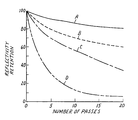
- Pavement marking sheet materials of this invention have been tested in a sand blast test.
- This test utilizes an apparatus comprised of a channel about 156 mm wide and 508 mm long in which is mounted a flat metal (e.g. aluminum) plate about 152 mm wide.
- the pavement marking sheet material sample being tested is adhered to the metal plate which is moved down the channel by engagement with an electric motor having a speed control.
- a commercial compressed air sand blast gun having a compressed air supply at 69 kPa (10 psig.) and using common sand blast sand (e.g., 70% 250/425 micrometer particle size) is directed toward a portion of the channel which must be passed by the sample.
- Reflective brightness or retroreflectivity is recorded in units of millicandela/foot candle/square foot (mcd/fc/ft2) as measured by a photometer. All measurements were made with incident light at an angle of 86.5° from normal to the sample surface and with a divergence, angle between the light source and the photocell, of 1.0°.
- the inventive zirconia/silica sol gel ceramic tested had a mole ratio of ZrO2:SiO2 of about 1:1 and an index of refraction of about 1.76-1.77.
- the above table shows that, in addition to retaining more of its retroreflectivity, the pavement marking sheet made with the inventive microspheres had a higher absolute retroreflectivity after only five passes of the sand blaster than any of the control samples, and continued to have superior retroreflectivity after 20 passes.
Landscapes
- Chemical & Material Sciences (AREA)
- Engineering & Computer Science (AREA)
- Organic Chemistry (AREA)
- Ceramic Engineering (AREA)
- Manufacturing & Machinery (AREA)
- Materials Engineering (AREA)
- Structural Engineering (AREA)
- Inorganic Chemistry (AREA)
- Composite Materials (AREA)
- Dispersion Chemistry (AREA)
- Nanotechnology (AREA)
- Crystallography & Structural Chemistry (AREA)
- Physics & Mathematics (AREA)
- Geology (AREA)
- Condensed Matter Physics & Semiconductors (AREA)
- General Physics & Mathematics (AREA)
- General Life Sciences & Earth Sciences (AREA)
- Environmental & Geological Engineering (AREA)
- Life Sciences & Earth Sciences (AREA)
- Architecture (AREA)
- Civil Engineering (AREA)
- Optical Elements Other Than Lenses (AREA)
- Glass Compositions (AREA)
- Road Signs Or Road Markings (AREA)
- Inorganic Compounds Of Heavy Metals (AREA)
- Compositions Of Oxide Ceramics (AREA)
- Colloid Chemistry (AREA)
- Illuminated Signs And Luminous Advertising (AREA)
- Inorganic Insulating Materials (AREA)
- Laminated Bodies (AREA)
- Silicon Compounds (AREA)
- Finish Polishing, Edge Sharpening, And Grinding By Specific Grinding Devices (AREA)
- Manufacture Of Macromolecular Shaped Articles (AREA)
Claims (15)
- Feste, transparente, nichtglasartige, vollständig dichte keramische Mikrokügelchen hauptsächlich umfassend mindestens ein Oxid, das ausgewählt wird aus Oxiden von Silicium, Aluminium, Thorium, Zinn, Yttrium, Zirconium und deren Mischungen, und mit einer mittleren Teilchengröße von mehr als 125 Mikrometer, wobei die Mikrokügelchen als Linsenelemente verwendbar sind.
- Feste, transparente, keramische Mikrokügelchen nach Anspruch 1, ferner gekennzeichnet durch eine mittlere Teilchengröße von nicht mehr als 100 Nanometer (1.000 Å).
- Transparente, keramische Mikrokügelchen nach einem der vorstehenden Ansprüche, ferner gekennzeichnet durch eine mittlere Härte von mehr als 3920 MPa (400 Knoop).
- Transparente, nichtglasartige, keramische Mikrokügelchen nach einem der vorstehenden Ansprüche, bei welchem das Metalloxid Zirconiumdioxid ist.
- Transparente, keramische Mikrokügelchen, nach einem der vorstehenden Ansprüche 1, 2 oder 3, umfassend mindestens eine polykristalline und mindestens eine amorphe Phase.
- Transparente, keramische Mikrokügelchen nach Anspruch 5, bei welchen die amorphe Phase Siliciumdioxid umfaßt.
- Transparente, keramische Mikrokügelchen nach Anspruch 6, bei welchen die polykristalline Phase Zirconiumdioxid umfaßt.
- Folienmaterial, umfassend einen polymeren Bindemittelfilm, in dem eine Vielzahl fester, transparenter, keramischer Mikrokügelchen eingebettet ist, nach einem der vorstehenden Ansprüche.
- Fahrbahnmarkierungs-Folienmaterial, umfassend:a. eine auf der Fahrbahnoberfläche klebfähige Basisfolie undb. auf die eine Seite der Basisfolie aufgeklebtes Folienmaterial nach Anspruch 8.
- Retroreflektierendes Folienmaterial, umfassend einen polymeren Bindemittelfilm, in welchem eine Monoschicht der Mikrokügelchen nach einem der Ansprüche 1, 2, 3, 4, 5, 6 und 7 eingebettet ist und welche die Mikrokügelchen mit einem reflektierenden Mittel in optischer Verbindung sind.
- Schleifmittel, umfassend die festen, nichtglasartigen keramischen Mikrokügelchen nach Anspruch 5 mit verringerter Größe.
- Feste, transparente, nichtglasartige, vollständig dichte keramische Mikrokügelchen, die polykristallines Titandioxid umfasen und eine mittlere Teilchengröße von mehr als 200 Mikrometer haben, wobei die Mikrokügelchen als Linsenelemente verwendbar sind.
- Chemischer Gelbildungsprozeß zur Herstellung fester, vollständig dichter, transparenter, nichtglasartiger keramischer Partikel, umfassend die Schritte:i) Mischen eines Sols, umfassend einen Ausgangsstoff von einem Oxid, das aus der Gruppe ausgewählt wird, bestehend aus Titanoxid, Siliciumdioxid, Zirconiumdioxid und Mischungen davon mit einem Gelbildungsmittel, das Ammoniumacetat aufweist;ii) Zusetzen der Zusammensetzung von Schritt i) zu einem formbilldenden Fluid, in welchem sich Teilchen formen;iii) Abtrennen der Gelteilchen von dem Mittel zur Formung;iv) Trocknen der Gelteilchen aus Schritt iii);v) Brennen der Teilchen bei Temperaturen zwischen etwa 500 und 1.200 °C, 950 bis 1.100 °C im Falle von Teilchen, die mindestens 97 % Zirconiumdioxid umfassen, um gebrannte keramische Partikel zu bilden;vi) Abkühlenlassen der gebrannten, transparenten keramischen Partikel von Schritt v).
- Chemischer Gelbildungsprozeß nach Anspruch 13, bei welchem das Metalloxid Titanoxid ist und das ferner das Mischen des Titanoxidsols mit Essigsäure vor Schritt i) umfaßt.
- Chemischer Gelbildungsprozeß nach einem der Ansprüche 13 oder 14, der ferner Zusetzen eines kolloialen Silicasols zu dem Sol von Schritt i) umfaßt.
Priority Applications (1)
| Application Number | Priority Date | Filing Date | Title |
|---|---|---|---|
| AT85306207T ATE85788T1 (de) | 1984-09-24 | 1985-09-02 | Durchsichtige nicht glasartige, keramische partikel. |
Applications Claiming Priority (2)
| Application Number | Priority Date | Filing Date | Title |
|---|---|---|---|
| US06/653,779 US4564556A (en) | 1984-09-24 | 1984-09-24 | Transparent non-vitreous ceramic particulate |
| US653779 | 1984-09-24 |
Publications (3)
| Publication Number | Publication Date |
|---|---|
| EP0177181A2 EP0177181A2 (de) | 1986-04-09 |
| EP0177181A3 EP0177181A3 (en) | 1989-05-10 |
| EP0177181B1 true EP0177181B1 (de) | 1993-02-17 |
Family
ID=24622274
Family Applications (1)
| Application Number | Title | Priority Date | Filing Date |
|---|---|---|---|
| EP85306207A Expired - Lifetime EP0177181B1 (de) | 1984-09-24 | 1985-09-02 | Durchsichtige nicht glasartige, keramische Partikel |
Country Status (12)
| Country | Link |
|---|---|
| US (1) | US4564556A (de) |
| EP (1) | EP0177181B1 (de) |
| JP (1) | JPH0721561B2 (de) |
| KR (1) | KR930006570B1 (de) |
| CN (1) | CN1015448B (de) |
| AT (1) | ATE85788T1 (de) |
| AU (1) | AU569167B2 (de) |
| BR (1) | BR8504371A (de) |
| CA (1) | CA1269216A (de) |
| DE (1) | DE3587099T2 (de) |
| HK (1) | HK16695A (de) |
| MX (1) | MX165318B (de) |
Families Citing this family (129)
| Publication number | Priority date | Publication date | Assignee | Title |
|---|---|---|---|---|
| US5041321A (en) * | 1984-11-02 | 1991-08-20 | The Boeing Company | Fiberformed ceramic insulation and method |
| JPH0745723B2 (ja) * | 1984-10-22 | 1995-05-17 | アトム化学塗料株式会社 | 高輝度路面標示用シ−ト材 |
| US5310592A (en) * | 1984-11-02 | 1994-05-10 | The Boeing Company | Fibrous ceramic aerobrake |
| AU581288B2 (en) * | 1985-03-01 | 1989-02-16 | Minnesota Mining And Manufacturing Company | Flat transparent top coat for retroreflective coating |
| GB8514815D0 (en) * | 1985-06-12 | 1985-07-17 | Robinson E | Porous inorganic materials |
| GB8515744D0 (en) * | 1985-06-21 | 1985-07-24 | Glaverbel | Vitreous beads |
| US4772511A (en) * | 1985-11-22 | 1988-09-20 | Minnesota Mining And Manufacturing Company | Transparent non-vitreous zirconia microspheres |
| CA1308845C (en) * | 1986-01-13 | 1992-10-13 | Roger W. Lange | Pavement markings containing transparent non-vitreous ceramic microspheres |
| JPS62211403A (ja) * | 1986-03-11 | 1987-09-17 | アトム化学塗料株式会社 | 全天候型路面標示用シ−ト材 |
| JP2594548B2 (ja) * | 1986-07-18 | 1997-03-26 | 日本電気株式会社 | 偏光ビームスプリツタ |
| US4837069A (en) * | 1987-01-07 | 1989-06-06 | Minnesota Mining And Manufacturing Company | Transparent alumina microspheres |
| US4844976A (en) * | 1987-03-09 | 1989-07-04 | Minnesota Mining And Manufacturing Company | Retroreflective sheet coated with silica layer |
| US4988555A (en) * | 1988-06-09 | 1991-01-29 | Minnesota Mining And Manufacturing Company | Patterned pavement marking |
| US5094902A (en) * | 1988-09-07 | 1992-03-10 | Minnesota Mining And Manufacturing Company | Skid-resistant surface marking material |
| US4937127A (en) * | 1988-09-07 | 1990-06-26 | Minnesota Mining And Manufacturing Company | Skid-resistant pavement markings |
| US5124178A (en) * | 1988-09-07 | 1992-06-23 | Minnesota Mining And Manufacturing Company | Skid-resistant surface marking material |
| US5053253A (en) * | 1988-09-07 | 1991-10-01 | Minnesota Mining And Manufacturing Company | Skid-resistant pavement markings |
| DE3840196C1 (de) * | 1988-11-29 | 1990-04-12 | Bayer Ag, 5090 Leverkusen, De | |
| US5352645A (en) * | 1989-04-14 | 1994-10-04 | E. I. Du Pont De Nemours And Company | Silica microspheres, method of improving attrition resistance and use |
| US5077117A (en) * | 1990-04-05 | 1991-12-31 | Minnesota Mining And Manufacturing Company | Pavement marking material with rupturing top layer |
| NO920755L (no) * | 1991-03-01 | 1992-09-02 | Osaka Gas Co Ltd | Fremgangsmaate til maaling av fluidstroemning |
| US5268337A (en) * | 1991-11-18 | 1993-12-07 | The Johns Hopkins University | Ceramic oxide powders and the formation thereof |
| US5650130A (en) * | 1991-11-18 | 1997-07-22 | The Johns Hopkins University | Counterflow diffusion flame synthesis of ceramic oxide powders |
| WO1993018233A1 (de) * | 1992-03-06 | 1993-09-16 | Plastiroute S.A. | Reflexkörper aus durchsichtigem material zum aufbringen auf verkehrsflächen oder verkehrsleitflächen |
| EP0603818B1 (de) * | 1992-12-22 | 1996-07-31 | Eastman Kodak Company | Verfahren zur Herstellung von Gegenständen aus Zirkoniumoxid mit tetragonalen Kernen und monoclinen Umhüllungen |
| US5480582A (en) * | 1993-06-30 | 1996-01-02 | Pope; Edward J. A. | Process for synthesizing amorphous silica microspheres with fluorescence behavior |
| JP4134159B2 (ja) * | 1994-05-18 | 2008-08-13 | 大日本印刷株式会社 | 防眩性フィルム |
| US5417515A (en) * | 1994-05-20 | 1995-05-23 | Minnesota Mining And Manufacturing Company | Retroreflective article with dual reflector |
| CA2147711C (en) | 1994-05-20 | 2005-08-16 | James H. C. Harper | Retroreflective article with non-continuous top coat |
| US5750191A (en) * | 1994-05-20 | 1998-05-12 | Minnesota Mining And Manufacturing Company | Retroreflective elements |
| CA2147791A1 (en) | 1994-05-20 | 1995-11-21 | Kathleen A. Hachey | Retroreflective articles containing low levels of pigments |
| CA2147821C (en) * | 1994-05-20 | 2006-04-11 | Thomas P. Hedblom | Patterned pavement markings with upright retroreflectors |
| US5593246A (en) * | 1994-08-26 | 1997-01-14 | Minnesota Mining And Manufacturing Company | Patterned chalk-resistant pavement marking and method of making |
| US5674616A (en) * | 1995-02-06 | 1997-10-07 | Conversion Technologies International, Inc. | Glass beads having improved fracture toughness |
| US5576097A (en) * | 1995-04-24 | 1996-11-19 | Brite-Line Industries, Inc. | High brightness durable retro-reflecting microspheres and method of making the same |
| US6451408B1 (en) | 1995-06-29 | 2002-09-17 | 3M Innovative Properties Company | Retroreflective article |
| US6703108B1 (en) | 1995-06-29 | 2004-03-09 | 3M Innovative Properties Company | Wet retroreflective marking material |
| US5676488A (en) * | 1995-06-29 | 1997-10-14 | Minnesota Mining And Manufacturing Company | Pavement marking with multiple topcoats |
| JP3717938B2 (ja) * | 1995-06-29 | 2005-11-16 | ミネソタ マイニング アンド マニュファクチャリング カンパニー | 湿潤再帰反射性標識材料 |
| US5631064A (en) * | 1995-09-15 | 1997-05-20 | Minnesota Mining And Manufacturing Company | Retroreflective transfer sheet and applique |
| US5674605A (en) * | 1995-09-15 | 1997-10-07 | Minnesota Mining And Manufacturing Company | Retroreflective transfer sheet and applique |
| US5911975A (en) * | 1995-10-13 | 1999-06-15 | Colgate-Palmolive Company | Antiperspirant and deodorant compositions containing poly(ethenylformamide) thickening agent |
| AU5169396A (en) * | 1996-02-05 | 1997-08-22 | Minnesota Mining And Manufacturing Company | Layered retroreflective elements |
| US5774265A (en) * | 1996-02-05 | 1998-06-30 | Minnesota Mining And Manufacturing Company | Durable retroreflective elements |
| US6303058B1 (en) | 1996-06-27 | 2001-10-16 | 3M Innovative Properties Company | Method of making profiled retroreflective marking material |
| US5723181A (en) * | 1996-09-06 | 1998-03-03 | E. I. Du Pont De Nemours And Company | Colloidal silica/zirconyl salt compositions as hydrophilizing coatings |
| US5777791A (en) * | 1996-11-26 | 1998-07-07 | Minnesota Mining And Manufacturing Company | Wet retroreflective pavement marking articles |
| JP3993269B2 (ja) | 1997-04-18 | 2007-10-17 | スリーエム カンパニー | 透明ビーズおよびその製造方法 |
| WO1998047830A1 (en) | 1997-04-18 | 1998-10-29 | Minnesota Mining And Manufacturing Company | Transparent beads and their production method |
| WO1999004099A1 (en) | 1997-07-16 | 1999-01-28 | Minnesota Mining And Manufacturing Company | Pavement marking having raised protuberances and method of making |
| US5941655A (en) * | 1997-07-16 | 1999-08-24 | 3M Innovative Properties Company | Direction-indicating pavement marking having raised protuberances and method of making |
| US6228340B1 (en) | 1997-08-25 | 2001-05-08 | The Regents Of The University Of California | Method for the production of macroporous ceramics |
| KR100443451B1 (ko) * | 1997-09-02 | 2004-08-09 | 이시하라 산교 가부시끼가이샤 | 중공상 미분말, 상기 중공상 미분말을 분쇄하여 이루어진박편상 티탄 산화물 분말 및 그것들의 제조 방법 |
| US5942280A (en) * | 1997-09-16 | 1999-08-24 | 3M Innovative Properties Company | Method of making retroreflective elements |
| US5929160A (en) * | 1997-09-25 | 1999-07-27 | Minnesota Mining And Manufacturing Company | Method for reducing water uptake in silyl terminated sulfopoly(ester-urethanes) |
| WO1999025928A1 (en) | 1997-11-19 | 1999-05-27 | Minnesota Mining And Manufacturing Company | Wear resistant pavement marking |
| US5959775A (en) * | 1997-12-23 | 1999-09-28 | 3M Innovative Properties Company | Urethane/acrylate bead bond for retroreflective articles |
| US6217252B1 (en) | 1998-08-11 | 2001-04-17 | 3M Innovative Properties Company | Wear-resistant transportation surface marking method and materials |
| US6247818B1 (en) | 1998-10-20 | 2001-06-19 | 3M Innovative Properties Company | Method for making retroreflective elements having enhanced retroreflectivity under dry and/or wet conditions |
| US6365262B1 (en) | 1998-10-20 | 2002-04-02 | 3M Innovative Properties Company | Pavement marking articles having enhanced retroreflectivity under dry or wet conditions and method for making same |
| US6245700B1 (en) | 1999-07-27 | 2001-06-12 | 3M Innovative Properties Company | Transparent microspheres |
| US6696126B1 (en) | 1999-08-12 | 2004-02-24 | The United States Of America As Represented By The Secretary Of The Navy | Visual-tactile signage |
| US6966660B1 (en) | 1999-10-15 | 2005-11-22 | 3M Innovative Properties Company | Article exhibiting dry and wet retroreflectivity |
| WO2001030873A1 (en) * | 1999-10-27 | 2001-05-03 | 3M Innovative Properties Company | Fluorochemical sulfonamide surfactants |
| US6735789B2 (en) | 2000-07-31 | 2004-05-18 | Southern Mills, Inc. | Reflective printing on flame resistant fabrics |
| WO2002013978A2 (en) | 2000-08-16 | 2002-02-21 | Daniel Mushett | Process for forming a reflective surface |
| US20040191481A1 (en) * | 2001-05-31 | 2004-09-30 | Volker Erb | Reflective sheet treated with fluorosilane |
| US6841223B2 (en) | 2001-08-14 | 2005-01-11 | 3M Innovative Properties Company | Composite pavement markings |
| US20030123930A1 (en) | 2001-12-31 | 2003-07-03 | Jacobs Gregory F. | Matrix element magnetic pavement marker and method of making same |
| US20030123931A1 (en) | 2001-12-31 | 2003-07-03 | Khieu Sithya S. | Matrix element pavement marker and method of making same |
| US20030136859A1 (en) | 2002-01-18 | 2003-07-24 | 3M Innovative Properties Company | Method of applying two-component pavement markings and apparatus |
| US7036944B2 (en) | 2002-04-11 | 2006-05-02 | 3M Innovative Properties Company | Retrochromic articles |
| US6978896B2 (en) * | 2002-04-11 | 2005-12-27 | 3M Innovative Properties Company | Method of making retrochromic beads and kit thereof |
| US20040259713A1 (en) * | 2003-06-11 | 2004-12-23 | 3M Innovative Properties Company | Microspheres comprising titania and bismuth oxide |
| MXPA06004844A (es) | 2003-11-06 | 2006-07-06 | 3M Innovative Properties Co | Elementos retrorreflejantes que comprenden un nucleo de resina pegado y marcaciones de pavimento. |
| US7247386B2 (en) | 2003-12-23 | 2007-07-24 | 3M Innovative Properties Company | Composition of an oligomeric fluorosilane and surface treatment of retroreflective sheet |
| EP1700142A1 (de) * | 2003-12-30 | 2006-09-13 | 3M Innovative Properties Company | Farbverschiebungs-retroreflektor und herstellungsverfahren dafür |
| CA2553801A1 (en) | 2004-01-21 | 2005-08-11 | 3M Innovative Properties Company | Retroreflective elements and articles |
| US20060040575A1 (en) * | 2004-08-18 | 2006-02-23 | Kelleher Karen A | Reflective printing on flame resistant fabrics |
| US7252396B2 (en) * | 2004-11-16 | 2007-08-07 | 3M Innovative Properties Company | Retroreflective article having at least one valve and method of making same |
| JP4704175B2 (ja) * | 2005-10-05 | 2011-06-15 | 住友大阪セメント株式会社 | 光学レンズ用組成物及び光学レンズ並びに光学部品 |
| US7513941B2 (en) | 2005-11-14 | 2009-04-07 | 3M Innovative Properties Company | Pavement marking, reflective elements, and methods of making micospheres |
| US8701441B2 (en) | 2006-08-21 | 2014-04-22 | 3M Innovative Properties Company | Method of making inorganic, metal oxide spheres using microstructured molds |
| CN101568858B (zh) * | 2006-12-27 | 2012-07-25 | 花王株式会社 | 光扩散性部件 |
| US8038865B2 (en) * | 2007-05-11 | 2011-10-18 | Ppg Industries, Ohio Inc. | Diaphragm for electrolytic cell |
| US20080280034A1 (en) * | 2007-05-11 | 2008-11-13 | 3M Innovative Properties Company | Pavement marking and reflective elements having microspheres comprising lanthanum oxide and aluminum oxide with zirconia, titania, or mixtures thereof |
| WO2008151665A1 (en) * | 2007-06-13 | 2008-12-18 | Degussa Novara Technology S.P.A. | Sol-gel process |
| US8053382B2 (en) * | 2007-10-02 | 2011-11-08 | Hitachi, Ltd. | Optical glass |
| CN101946191A (zh) * | 2007-12-21 | 2011-01-12 | 3M创新有限公司 | 衣服、纤维和细丝形式的回射制品 |
| WO2009105142A2 (en) * | 2007-12-21 | 2009-08-27 | 3M Innovative Properties Company | Retroreflective security articles |
| JP2011508265A (ja) * | 2007-12-21 | 2011-03-10 | スリーエム イノベイティブ プロパティズ カンパニー | 球形コア及び2つの同心光学干渉層を含む、再帰反射性物品及び再帰反射素子 |
| US20090291292A1 (en) * | 2008-05-22 | 2009-11-26 | 3M Innovative Properties Company | Optically active elements including multiple bead layers |
| DE102008029723B3 (de) * | 2008-06-24 | 2009-11-12 | Flooring Technologies Ltd. | Verfahren zur Herstellung von Holzwerkstoffplatten mit kratzfesten Oberflächen |
| EP2467342B1 (de) | 2009-08-21 | 2016-02-10 | 3M Innovative Properties Company | Strassenmarkierungen, reflektierende elemente und verfahren zur herstellung von mikrokügelchen |
| US20110233484A1 (en) * | 2009-09-28 | 2011-09-29 | E. I. Du Pont De Nemours And Company | Glass-crystalline particles including a glass component and a crystalline component |
| US8685290B2 (en) * | 2009-09-28 | 2014-04-01 | E I Du Pont Nemours And Company | Glass-crystalline particle powders including a glass component and a crystalline component |
| WO2011038314A1 (en) * | 2009-09-28 | 2011-03-31 | E. I. Du Pont De Nemours And Company | Methods of making glass-crystalline particles including a glass component and a crystalline component |
| BR112012028904A2 (pt) | 2010-05-25 | 2016-07-26 | 3M Innovative Properties Co | artigo retrorrefletivo de lentes expostas |
| CN103842591B (zh) | 2011-09-01 | 2016-03-16 | 3M创新有限公司 | 道路标记材料和方法 |
| CN102515777B (zh) * | 2011-11-25 | 2013-05-01 | 东北大学 | 一种光学透明陶瓷微球及其制备方法 |
| WO2013180740A1 (en) | 2012-05-29 | 2013-12-05 | 3M Innovative Properties Company | Pavement marking compositions |
| CN103792603B (zh) | 2012-10-26 | 2016-07-06 | 3M创新有限公司 | 回归反射材料及制品 |
| CN103792604B (zh) | 2012-10-26 | 2016-12-21 | 3M创新有限公司 | 回归反射制品和附饰物 |
| US9932476B2 (en) | 2012-10-29 | 2018-04-03 | 3M Innovative Properties Company | Pavement marking compositions |
| BR112015015056A2 (pt) | 2012-12-21 | 2017-07-11 | 3M Innovative Properties Co | sistemas e métodos para determinar a limpeza de uma superfície |
| CN105814462B (zh) | 2013-10-24 | 2019-02-22 | 3M创新有限公司 | 具有防沾污性质的回射制品 |
| EP3100084B1 (de) | 2014-01-31 | 2023-11-01 | 3M Innovative Properties Company | Farbige rückstrahlende artikel |
| EP3126414B1 (de) | 2014-04-04 | 2018-06-06 | 3M Innovative Properties Company | Primerzusammensetzung für die bearbeitung von nassen oder feuchten oberflächen |
| EP3149070A1 (de) | 2014-04-29 | 2017-04-05 | 3M Innovative Properties Company | Copolymere aus poly ethylen-co-acrylsäure) und polydiorganosiloxanen |
| WO2015167947A1 (en) | 2014-04-30 | 2015-11-05 | 3M Innovative Properties Company | Stain resistant retroreflective articles |
| EP3140684A1 (de) | 2014-05-09 | 2017-03-15 | 3M Innovative Properties Company | Farbige rückstrahlende artikel |
| EP3140683B1 (de) | 2014-05-09 | 2025-10-29 | 3M Innovative Properties Company | Rückstrahlende artikel |
| CN106459352B (zh) | 2014-06-16 | 2020-01-14 | 3M创新有限公司 | 具有耐洗性珠粘结层的回射制品 |
| EP3177576B1 (de) | 2014-08-08 | 2023-09-27 | 3M Innovative Properties Company | Rückstrahlende elemente mit teilchen |
| EP3191879A1 (de) | 2014-09-10 | 2017-07-19 | 3M Innovative Properties Company | Rückstrahlende artikel mit freiliegender linse und selbstassembliertem dielektrischen spiegel |
| WO2016053734A1 (en) | 2014-09-30 | 2016-04-07 | 3M Innovative Properties Company | Retroreflective colored articles |
| CN107111018A (zh) | 2014-12-30 | 2017-08-29 | 3M创新有限公司 | 防污回射制品 |
| US10889947B2 (en) | 2015-06-18 | 2021-01-12 | 3M Innovative Properties Company | Thermoplastic pavement marking tapes |
| JP6899379B2 (ja) | 2015-09-11 | 2021-07-07 | スリーエム イノベイティブ プロパティズ カンパニー | イオン性コポリマーコアを含む耐久性のある再帰反射素子 |
| US10858496B2 (en) | 2015-09-11 | 2020-12-08 | 3M Innovative Properties Company | Durable retroreflective elements with a blend of beads |
| US11390059B2 (en) | 2015-12-18 | 2022-07-19 | 3M Innovative Properties Company | Decorative article featuring a microscopic periodic pattern and methods of making the same |
| JP6972006B2 (ja) | 2016-03-30 | 2021-11-24 | スリーエム イノベイティブ プロパティズ カンパニー | ランダムに分散された微小球の所定のパターンを主とする物品及びその製造方法 |
| WO2019003158A1 (en) | 2017-06-30 | 2019-01-03 | 3M Innovative Properties Company | ARTICLES HAVING ADHESIVE LAYERS COMPRISING URETHANE ACRYLATE POLYMERS OR ACRYLATE COPOLYMER |
| US20210087116A1 (en) * | 2017-07-28 | 2021-03-25 | 3M Innovative Properties Company | Nanocrystalline ceramic oxide beads |
| CA3072517C (en) | 2017-09-26 | 2024-04-16 | Delta Faucet Company | Aqueous gelcasting method for ceramic products |
| US11415731B2 (en) | 2017-10-27 | 2022-08-16 | 3M Innovative Properties Company | Retroreflective article comprising retroreflective elements comprising primary reflective layers and secondary reflective layers |
| WO2019084295A1 (en) | 2017-10-27 | 2019-05-02 | 3M Innovative Properties Company | RETROREFLECTIVE ARTICLE COMPRISING LOCALLY LAMINATED REFLECTIVE LAYERS |
| CN111263902A (zh) | 2017-10-27 | 2020-06-09 | 3M创新有限公司 | 包括嵌入反射层的回射制品 |
| US20250257248A1 (en) | 2022-06-29 | 2025-08-14 | 3M Innovative Properties Company | Curable adhesive and articles for bonding pavement and concrete |
Family Cites Families (28)
| Publication number | Priority date | Publication date | Assignee | Title |
|---|---|---|---|---|
| US2354018A (en) * | 1940-08-03 | 1944-07-18 | Minnesota Mining & Mfg | Light reflector sheet |
| US2326634A (en) * | 1941-12-26 | 1943-08-10 | Minnesota Mining & Mfg | Reflex light reflector |
| US2467089A (en) * | 1944-03-16 | 1949-04-12 | Socony Vacuum Oil Co Inc | Preparation of zirconia gel |
| US2963378A (en) * | 1955-04-25 | 1960-12-06 | Minnesota Mining & Mfg | Ass beads hemispherically reflectorled with metallic coating and compositions thereof |
| US3026177A (en) * | 1961-04-25 | 1962-03-20 | Gen Electric | Process for producing transparent polycrystalline alumina |
| US3313602A (en) * | 1964-09-23 | 1967-04-11 | Grace W R & Co | Method for making metal oxide microspheres |
| US3442821A (en) * | 1966-09-29 | 1969-05-06 | Universal Oil Prod Co | Manufacture of spheroidal silica-alumina particles |
| US3525597A (en) * | 1968-11-13 | 1970-08-25 | Us Air Force | Transparent zirconia and process for making same |
| US3709706A (en) * | 1969-05-16 | 1973-01-09 | Minnesota Mining & Mfg | Refractory fibers and other articles of zirconia and silica mixtures |
| US3714071A (en) * | 1970-03-18 | 1973-01-30 | Universal Oil Prod Co | Low density alumina spheres of improved strength at high temperature |
| US3700305A (en) * | 1970-12-14 | 1972-10-24 | Minnesota Mining & Mfg | Retroreflective microspheres having a dielectric mirror on a portion of their surface and retroreflective constructions containing such microspheres |
| DE2103243C3 (de) * | 1971-01-25 | 1979-01-11 | Basf Ag, 6700 Ludwigshafen | Verfahren und Vorrichtung zur Herstellung von weitgehend kugelförmigen, Kieselsäure enthaltenden Hydrogelen |
| US3795524A (en) * | 1971-03-01 | 1974-03-05 | Minnesota Mining & Mfg | Aluminum borate and aluminum borosilicate articles |
| CA963605A (en) * | 1971-06-23 | 1975-03-04 | Ellsworth G. Acker | Loosely aggregated 200-500 millimicron silica |
| US3941719A (en) * | 1972-08-17 | 1976-03-02 | Owens-Illinois, Inc. | Transparent activated nonparticulate alumina and method of preparing same |
| US4166147A (en) * | 1973-04-16 | 1979-08-28 | Minnesota Mining And Manufacturing Company | Shaped and fired articles of tio2 |
| US3900605A (en) * | 1973-09-05 | 1975-08-19 | Jr Robert W Norris | Method of forming traffic markers having short track-free times |
| JPS547506B2 (de) * | 1974-08-08 | 1979-04-07 | ||
| US4025159A (en) * | 1976-02-17 | 1977-05-24 | Minnesota Mining And Manufacturing Company | Cellular retroreflective sheeting |
| US4117192A (en) * | 1976-02-17 | 1978-09-26 | Minnesota Mining And Manufacturing Company | Deformable retroreflective pavement-marking sheet material |
| US4349456A (en) * | 1976-04-22 | 1982-09-14 | Minnesota Mining And Manufacturing Company | Non-vitreous ceramic metal oxide microcapsules and process for making same |
| US4148864A (en) * | 1976-05-05 | 1979-04-10 | Mittex Aktiengesellschaft | Silica gel of improved properties and process of making same |
| GB1525037A (en) * | 1976-07-06 | 1978-09-20 | Inst Vysokikh Temperatur Akade | Manufacture of heat-resistant materials |
| US4367919A (en) * | 1977-08-01 | 1983-01-11 | Minnesota Mining And Manufacturing Company | Durable glass elements |
| CS196794B1 (en) * | 1977-09-23 | 1980-04-30 | Dusan Berek | Method of preparation of spherical microelements |
| US4248932A (en) * | 1979-06-14 | 1981-02-03 | Minnesota Mining And Manufacturing Company | Extended-life pavement-marking sheet material |
| US4314827A (en) * | 1979-06-29 | 1982-02-09 | Minnesota Mining And Manufacturing Company | Non-fused aluminum oxide-based abrasive mineral |
| JPS60147332A (ja) * | 1984-01-13 | 1985-08-03 | 西武ポリマ化成株式會社 | 耐久性路面標示用シ−ト材 |
-
1984
- 1984-09-24 US US06/653,779 patent/US4564556A/en not_active Expired - Lifetime
-
1985
- 1985-07-17 CA CA000486948A patent/CA1269216A/en not_active Expired - Lifetime
- 1985-07-31 AU AU45661/85A patent/AU569167B2/en not_active Ceased
- 1985-09-02 EP EP85306207A patent/EP0177181B1/de not_active Expired - Lifetime
- 1985-09-02 AT AT85306207T patent/ATE85788T1/de active
- 1985-09-02 MX MX206490A patent/MX165318B/es unknown
- 1985-09-02 DE DE8585306207T patent/DE3587099T2/de not_active Expired - Fee Related
- 1985-09-05 CN CN85106679A patent/CN1015448B/zh not_active Expired
- 1985-09-10 BR BR8504371A patent/BR8504371A/pt not_active IP Right Cessation
- 1985-09-19 JP JP60205508A patent/JPH0721561B2/ja not_active Expired - Lifetime
- 1985-09-24 KR KR1019850007001A patent/KR930006570B1/ko not_active Expired - Fee Related
-
1995
- 1995-02-06 HK HK16695A patent/HK16695A/en not_active IP Right Cessation
Non-Patent Citations (2)
| Title |
|---|
| CHEMICAL ABSTRACTS, vol. 90, No. 22, 28th May 1979, abstracts no. 173 227r; V. Urbanek et al.: "Preparation of microspheres with high refractive indexes by a sol-gel method" & NUKLEON 1978, vol. 1, pages 9-11 * |
| Translation of ""Preparation of microspheres with high refractive indexes by a sol gel method" & NUKLEON 1978, vol. 1, pages 9-11" * |
Also Published As
| Publication number | Publication date |
|---|---|
| KR930006570B1 (ko) | 1993-07-21 |
| CN85106679A (zh) | 1987-03-25 |
| JPS6186703A (ja) | 1986-05-02 |
| HK16695A (en) | 1995-02-10 |
| MX165318B (es) | 1992-11-04 |
| ATE85788T1 (de) | 1993-03-15 |
| EP0177181A2 (de) | 1986-04-09 |
| CA1269216C (en) | 1990-05-22 |
| US4564556A (en) | 1986-01-14 |
| DE3587099T2 (de) | 1993-07-15 |
| AU569167B2 (en) | 1988-01-21 |
| KR860002438A (ko) | 1986-04-26 |
| DE3587099D1 (de) | 1993-03-25 |
| BR8504371A (pt) | 1986-07-08 |
| AU4566185A (en) | 1986-04-10 |
| CN1015448B (zh) | 1992-02-12 |
| JPH0721561B2 (ja) | 1995-03-08 |
| CA1269216A (en) | 1990-05-22 |
| EP0177181A3 (en) | 1989-05-10 |
Similar Documents
| Publication | Publication Date | Title |
|---|---|---|
| EP0177181B1 (de) | Durchsichtige nicht glasartige, keramische Partikel | |
| US4772511A (en) | Transparent non-vitreous zirconia microspheres | |
| EP0232980B1 (de) | Keramische, nicht-glasige, transparente Mikrokugeln enthaltende Fahrbahnmarkierung | |
| US4837069A (en) | Transparent alumina microspheres | |
| US5774265A (en) | Durable retroreflective elements | |
| JP4868673B2 (ja) | 透明微小球 | |
| US5917652A (en) | Durable retroreflective elements | |
| KR20010024025A (ko) | 역반사 부재의 제조 방법 | |
| WO2003038191A2 (en) | Reflective elements comprising reinforcement particles dispersed within a core | |
| CA1274658A (en) | Solid, transparent, non-vitreous, ceramic microspheres | |
| CN1031701C (zh) | 含有透明非玻化氧化锆微球体的板材 | |
| CN1045407A (zh) | 含有透明的非玻化陶瓷微球体的路标 | |
| MXPA00002621A (en) | Method of making retroreflective elements |
Legal Events
| Date | Code | Title | Description |
|---|---|---|---|
| PUAI | Public reference made under article 153(3) epc to a published international application that has entered the european phase |
Free format text: ORIGINAL CODE: 0009012 |
|
| AK | Designated contracting states |
Kind code of ref document: A2 Designated state(s): AT DE FR GB IT NL SE |
|
| PUAL | Search report despatched |
Free format text: ORIGINAL CODE: 0009013 |
|
| AK | Designated contracting states |
Kind code of ref document: A3 Designated state(s): AT DE FR GB IT NL SE |
|
| 17P | Request for examination filed |
Effective date: 19891102 |
|
| 17Q | First examination report despatched |
Effective date: 19900927 |
|
| GRAA | (expected) grant |
Free format text: ORIGINAL CODE: 0009210 |
|
| ITF | It: translation for a ep patent filed | ||
| AK | Designated contracting states |
Kind code of ref document: B1 Designated state(s): AT DE FR GB IT NL SE |
|
| REF | Corresponds to: |
Ref document number: 85788 Country of ref document: AT Date of ref document: 19930315 Kind code of ref document: T |
|
| REF | Corresponds to: |
Ref document number: 3587099 Country of ref document: DE Date of ref document: 19930325 |
|
| ET | Fr: translation filed | ||
| PLBE | No opposition filed within time limit |
Free format text: ORIGINAL CODE: 0009261 |
|
| STAA | Information on the status of an ep patent application or granted ep patent |
Free format text: STATUS: NO OPPOSITION FILED WITHIN TIME LIMIT |
|
| 26N | No opposition filed | ||
| EAL | Se: european patent in force in sweden |
Ref document number: 85306207.3 |
|
| PGFP | Annual fee paid to national office [announced via postgrant information from national office to epo] |
Ref country code: SE Payment date: 19970821 Year of fee payment: 13 |
|
| PG25 | Lapsed in a contracting state [announced via postgrant information from national office to epo] |
Ref country code: SE Free format text: LAPSE BECAUSE OF NON-PAYMENT OF DUE FEES Effective date: 19980903 |
|
| EUG | Se: european patent has lapsed |
Ref document number: 85306207.3 |
|
| PGFP | Annual fee paid to national office [announced via postgrant information from national office to epo] |
Ref country code: NL Payment date: 19990823 Year of fee payment: 15 |
|
| PGFP | Annual fee paid to national office [announced via postgrant information from national office to epo] |
Ref country code: AT Payment date: 20000824 Year of fee payment: 16 |
|
| PGFP | Annual fee paid to national office [announced via postgrant information from national office to epo] |
Ref country code: GB Payment date: 20000825 Year of fee payment: 16 |
|
| PGFP | Annual fee paid to national office [announced via postgrant information from national office to epo] |
Ref country code: DE Payment date: 20000828 Year of fee payment: 16 |
|
| PG25 | Lapsed in a contracting state [announced via postgrant information from national office to epo] |
Ref country code: NL Free format text: LAPSE BECAUSE OF NON-PAYMENT OF DUE FEES Effective date: 20010401 |
|
| NLV4 | Nl: lapsed or anulled due to non-payment of the annual fee |
Effective date: 20010401 |
|
| PG25 | Lapsed in a contracting state [announced via postgrant information from national office to epo] |
Ref country code: GB Free format text: LAPSE BECAUSE OF NON-PAYMENT OF DUE FEES Effective date: 20010902 Ref country code: AT Free format text: LAPSE BECAUSE OF NON-PAYMENT OF DUE FEES Effective date: 20010902 |
|
| PG25 | Lapsed in a contracting state [announced via postgrant information from national office to epo] |
Ref country code: DE Free format text: LAPSE BECAUSE OF NON-PAYMENT OF DUE FEES Effective date: 20020601 |
|
| PGFP | Annual fee paid to national office [announced via postgrant information from national office to epo] |
Ref country code: FR Payment date: 20040920 Year of fee payment: 20 |