EP0176902A2 - Mischkristallpigmente auf der Basis von Perylentetracarbonsäurediimiden, Verfahren zu ihrer Herstellung und ihre Verwendung - Google Patents
Mischkristallpigmente auf der Basis von Perylentetracarbonsäurediimiden, Verfahren zu ihrer Herstellung und ihre Verwendung Download PDFInfo
- Publication number
- EP0176902A2 EP0176902A2 EP85111995A EP85111995A EP0176902A2 EP 0176902 A2 EP0176902 A2 EP 0176902A2 EP 85111995 A EP85111995 A EP 85111995A EP 85111995 A EP85111995 A EP 85111995A EP 0176902 A2 EP0176902 A2 EP 0176902A2
- Authority
- EP
- European Patent Office
- Prior art keywords
- formula
- diimide
- mole percent
- tetracarboxylic acid
- perylene tetracarboxylic
- Prior art date
- Legal status (The legal status is an assumption and is not a legal conclusion. Google has not performed a legal analysis and makes no representation as to the accuracy of the status listed.)
- Granted
Links
- 239000000049 pigment Substances 0.000 title claims abstract description 33
- 239000013078 crystal Substances 0.000 title claims abstract description 30
- FVDOBFPYBSDRKH-UHFFFAOYSA-N perylene-3,4,9,10-tetracarboxylic acid Chemical compound C=12C3=CC=C(C(O)=O)C2=C(C(O)=O)C=CC=1C1=CC=C(C(O)=O)C2=C1C3=CC=C2C(=O)O FVDOBFPYBSDRKH-UHFFFAOYSA-N 0.000 title claims abstract description 12
- 238000004519 manufacturing process Methods 0.000 title description 2
- RAABOESOVLLHRU-UHFFFAOYSA-N diazene Chemical compound N=N RAABOESOVLLHRU-UHFFFAOYSA-N 0.000 claims abstract description 12
- 229910000071 diazene Inorganic materials 0.000 claims abstract description 12
- 238000012986 modification Methods 0.000 claims abstract description 12
- RPQOZSKWYNULKS-UHFFFAOYSA-N 1,2-dicarbamoylperylene-3,4-dicarboxylic acid Chemical compound C1=C(C(O)=O)C2=C(C(O)=O)C(C(=N)O)=C(C(O)=N)C(C=3C4=C5C=CC=C4C=CC=3)=C2C5=C1 RPQOZSKWYNULKS-UHFFFAOYSA-N 0.000 claims abstract description 8
- 238000000034 method Methods 0.000 claims abstract description 7
- 238000004043 dyeing Methods 0.000 claims abstract description 5
- 229920000620 organic polymer Polymers 0.000 claims abstract description 5
- 238000002360 preparation method Methods 0.000 claims abstract description 4
- MKARNSWMMBGSHX-UHFFFAOYSA-N 3,5-dimethylaniline Chemical compound CC1=CC(C)=CC(N)=C1 MKARNSWMMBGSHX-UHFFFAOYSA-N 0.000 claims description 12
- 239000000203 mixture Substances 0.000 claims description 10
- CLYVDMAATCIVBF-UHFFFAOYSA-N pigment red 224 Chemical compound C=12C3=CC=C(C(OC4=O)=O)C2=C4C=CC=1C1=CC=C2C(=O)OC(=O)C4=CC=C3C1=C42 CLYVDMAATCIVBF-UHFFFAOYSA-N 0.000 claims description 6
- -1 polypropylene Polymers 0.000 description 9
- 150000001875 compounds Chemical class 0.000 description 8
- 238000000227 grinding Methods 0.000 description 8
- 239000004793 Polystyrene Substances 0.000 description 7
- 238000002844 melting Methods 0.000 description 7
- OKKJLVBELUTLKV-UHFFFAOYSA-N Methanol Chemical compound OC OKKJLVBELUTLKV-UHFFFAOYSA-N 0.000 description 6
- JIAARYAFYJHUJI-UHFFFAOYSA-L zinc dichloride Chemical compound [Cl-].[Cl-].[Zn+2] JIAARYAFYJHUJI-UHFFFAOYSA-L 0.000 description 6
- 238000010586 diagram Methods 0.000 description 5
- 239000004033 plastic Substances 0.000 description 5
- 229920003023 plastic Polymers 0.000 description 5
- 239000004743 Polypropylene Substances 0.000 description 4
- SMWDFEZZVXVKRB-UHFFFAOYSA-N Quinoline Chemical compound N1=CC=CC2=CC=CC=C21 SMWDFEZZVXVKRB-UHFFFAOYSA-N 0.000 description 4
- 238000002441 X-ray diffraction Methods 0.000 description 4
- 238000006243 chemical reaction Methods 0.000 description 4
- 239000007859 condensation product Substances 0.000 description 4
- 230000004048 modification Effects 0.000 description 4
- 229920000642 polymer Polymers 0.000 description 4
- 229920001155 polypropylene Polymers 0.000 description 4
- 239000004698 Polyethylene Substances 0.000 description 3
- 229910052593 corundum Inorganic materials 0.000 description 3
- 239000010431 corundum Substances 0.000 description 3
- 125000002080 perylenyl group Chemical group C1(=CC=C2C=CC=C3C4=CC=CC5=CC=CC(C1=C23)=C45)* 0.000 description 3
- CSHWQDPOILHKBI-UHFFFAOYSA-N peryrene Natural products C1=CC(C2=CC=CC=3C2=C2C=CC=3)=C3C2=CC=CC3=C1 CSHWQDPOILHKBI-UHFFFAOYSA-N 0.000 description 3
- 229920000573 polyethylene Polymers 0.000 description 3
- 150000003839 salts Chemical class 0.000 description 3
- 239000011592 zinc chloride Substances 0.000 description 3
- 235000005074 zinc chloride Nutrition 0.000 description 3
- PMZURENOXWZQFD-UHFFFAOYSA-L Sodium Sulfate Chemical compound [Na+].[Na+].[O-]S([O-])(=O)=O PMZURENOXWZQFD-UHFFFAOYSA-L 0.000 description 2
- FAPWRFPIFSIZLT-UHFFFAOYSA-M Sodium chloride Chemical compound [Na+].[Cl-] FAPWRFPIFSIZLT-UHFFFAOYSA-M 0.000 description 2
- 229910000831 Steel Inorganic materials 0.000 description 2
- 239000002253 acid Substances 0.000 description 2
- 238000009835 boiling Methods 0.000 description 2
- 239000007795 chemical reaction product Substances 0.000 description 2
- 238000004040 coloring Methods 0.000 description 2
- 238000009833 condensation Methods 0.000 description 2
- 230000005494 condensation Effects 0.000 description 2
- LQNUZADURLCDLV-UHFFFAOYSA-N nitrobenzene Chemical compound [O-][N+](=O)C1=CC=CC=C1 LQNUZADURLCDLV-UHFFFAOYSA-N 0.000 description 2
- 229920000098 polyolefin Polymers 0.000 description 2
- 239000000843 powder Substances 0.000 description 2
- 229910052938 sodium sulfate Inorganic materials 0.000 description 2
- 235000011152 sodium sulphate Nutrition 0.000 description 2
- 239000006104 solid solution Substances 0.000 description 2
- 239000010959 steel Substances 0.000 description 2
- XLYOFNOQVPJJNP-UHFFFAOYSA-N water Substances O XLYOFNOQVPJJNP-UHFFFAOYSA-N 0.000 description 2
- RELMFMZEBKVZJC-UHFFFAOYSA-N 1,2,3-trichlorobenzene Chemical compound ClC1=CC=CC(Cl)=C1Cl RELMFMZEBKVZJC-UHFFFAOYSA-N 0.000 description 1
- RYGMFSIKBFXOCR-UHFFFAOYSA-N Copper Chemical compound [Cu] RYGMFSIKBFXOCR-UHFFFAOYSA-N 0.000 description 1
- LFQSCWFLJHTTHZ-UHFFFAOYSA-N Ethanol Chemical compound CCO LFQSCWFLJHTTHZ-UHFFFAOYSA-N 0.000 description 1
- VEXZGXHMUGYJMC-UHFFFAOYSA-N Hydrochloric acid Chemical compound Cl VEXZGXHMUGYJMC-UHFFFAOYSA-N 0.000 description 1
- SECXISVLQFMRJM-UHFFFAOYSA-N N-Methylpyrrolidone Chemical compound CN1CCCC1=O SECXISVLQFMRJM-UHFFFAOYSA-N 0.000 description 1
- 239000004952 Polyamide Substances 0.000 description 1
- ZOIORXHNWRGPMV-UHFFFAOYSA-N acetic acid;zinc Chemical compound [Zn].CC(O)=O.CC(O)=O ZOIORXHNWRGPMV-UHFFFAOYSA-N 0.000 description 1
- DIZPMCHEQGEION-UHFFFAOYSA-H aluminium sulfate (anhydrous) Chemical compound [Al+3].[Al+3].[O-]S([O-])(=O)=O.[O-]S([O-])(=O)=O.[O-]S([O-])(=O)=O DIZPMCHEQGEION-UHFFFAOYSA-H 0.000 description 1
- 239000011805 ball Substances 0.000 description 1
- 239000001030 cadmium pigment Substances 0.000 description 1
- 239000003086 colorant Substances 0.000 description 1
- 230000000052 comparative effect Effects 0.000 description 1
- 238000006482 condensation reaction Methods 0.000 description 1
- 229910052802 copper Inorganic materials 0.000 description 1
- 239000010949 copper Substances 0.000 description 1
- 238000010790 dilution Methods 0.000 description 1
- 239000012895 dilution Substances 0.000 description 1
- 238000000605 extraction Methods 0.000 description 1
- 238000001914 filtration Methods 0.000 description 1
- 239000008187 granular material Substances 0.000 description 1
- 238000001746 injection moulding Methods 0.000 description 1
- 229910052500 inorganic mineral Inorganic materials 0.000 description 1
- 239000000463 material Substances 0.000 description 1
- 239000011707 mineral Substances 0.000 description 1
- 235000010755 mineral Nutrition 0.000 description 1
- 239000012860 organic pigment Substances 0.000 description 1
- 239000003973 paint Substances 0.000 description 1
- 150000002989 phenols Chemical class 0.000 description 1
- 230000000485 pigmenting effect Effects 0.000 description 1
- 229920002647 polyamide Polymers 0.000 description 1
- 229920002223 polystyrene Polymers 0.000 description 1
- 229920000915 polyvinyl chloride Polymers 0.000 description 1
- 239000004800 polyvinyl chloride Substances 0.000 description 1
- 239000000047 product Substances 0.000 description 1
- 230000005855 radiation Effects 0.000 description 1
- 239000000376 reactant Substances 0.000 description 1
- 239000011780 sodium chloride Substances 0.000 description 1
- 239000002904 solvent Substances 0.000 description 1
- 239000007858 starting material Substances 0.000 description 1
- 239000000126 substance Substances 0.000 description 1
- 239000000725 suspension Substances 0.000 description 1
- 229920001059 synthetic polymer Polymers 0.000 description 1
- 239000011701 zinc Substances 0.000 description 1
- 229910052725 zinc Inorganic materials 0.000 description 1
- 239000004246 zinc acetate Substances 0.000 description 1
- NWONKYPBYAMBJT-UHFFFAOYSA-L zinc sulfate Chemical compound [Zn+2].[O-]S([O-])(=O)=O NWONKYPBYAMBJT-UHFFFAOYSA-L 0.000 description 1
Images
Classifications
-
- C—CHEMISTRY; METALLURGY
- C09—DYES; PAINTS; POLISHES; NATURAL RESINS; ADHESIVES; COMPOSITIONS NOT OTHERWISE PROVIDED FOR; APPLICATIONS OF MATERIALS NOT OTHERWISE PROVIDED FOR
- C09B—ORGANIC DYES OR CLOSELY-RELATED COMPOUNDS FOR PRODUCING DYES, e.g. PIGMENTS; MORDANTS; LAKES
- C09B5/00—Dyes with an anthracene nucleus condensed with one or more heterocyclic rings with or without carbocyclic rings
- C09B5/62—Cyclic imides or amidines of peri-dicarboxylic acids of the anthracene, benzanthrene, or perylene series
-
- C—CHEMISTRY; METALLURGY
- C09—DYES; PAINTS; POLISHES; NATURAL RESINS; ADHESIVES; COMPOSITIONS NOT OTHERWISE PROVIDED FOR; APPLICATIONS OF MATERIALS NOT OTHERWISE PROVIDED FOR
- C09B—ORGANIC DYES OR CLOSELY-RELATED COMPOUNDS FOR PRODUCING DYES, e.g. PIGMENTS; MORDANTS; LAKES
- C09B67/00—Influencing the physical, e.g. the dyeing or printing properties of dyestuffs without chemical reactions, e.g. by treating with solvents grinding or grinding assistants, coating of pigments or dyes; Process features in the making of dyestuff preparations; Dyestuff preparations of a special physical nature, e.g. tablets, films
- C09B67/0033—Blends of pigments; Mixtured crystals; Solid solutions
- C09B67/0034—Mixtures of two or more pigments or dyes of the same type
Definitions
- the present invention relates to new mixed crystal pigments based on perylene tetracarboxylic acid diimides in the crystal lattice of the a-modification of the perylene tetracarboxylic acid bis-3 ', 5'-dimethylphenylimide, processes for their preparation and their use for dyeing organic polymers.
- pigments For use in high-melting plastics, pigments should not only have high light and weather fastness, but also withstand the temperatures that occur during processing without changing the color impression, i.e. also have sufficient thermal stability.
- organic colorants there is increasing interest in organic colorants as an alternative to the cadmium pigments that have been predominantly used up to now.
- the perylene pigment of the formula (1) has long been used to achieve clear shades of red. proven to be particularly suitable for the controversial application.
- This compound which is obtainable according to DE-PS 1 067 157 (US Pat. No. 2 905 685), which in this case is described in Japanese Patent Application J 51007-025 and in EP-PS 023 191 (US Pat. No. 4 404 385) as a -Modification called crystal phase results, after conversion into a finely divided pigment form, for example by conventional grinding in a vibratory or roller mill, results in a pure red color of high color strength and good thermal resistance.
- plastics processors have long expressed a desire for a significantly yellow, bright red with a corresponding level of authenticity.
- the invention relates to new Perylentetracarboneäurediimid mix-crystal pigments in the crystal lattice of the ⁇ -modification of perylenetetracarboxylic acid bis-3 ', 5'-di- methylphenylimids of formula (1) consisting of 99-70 mole percent of the symmetrical diimide of the formula (1) and correspondingly 1-30 mol percent of the asymmetrically substituted diimide of the formula (2)
- the perylene tetracarboxylic acid diimide mixed crystal pigments obtainable in this way, after conversion into a finely divided pigment form by customary finishing methods, for example by grinding, in high-melting polymers, in particular in polyethylene and polypropylene, give colorations which, compared to the pure pigment of the formula (1) mentioned, both result in a significantly improved thermal Stability as well as the desired yellow shade.
- the strength of the yellow shift can be controlled by varying the proportion of the component of formula (2) in the mixed crystal.
- the monoanhydride of the formula (3) is preferably used in an amount of 5-15 mole percent. Since the reaction is practically quantitative, the preferred proportion of the asymmetrically substituted diimide of the formula (2) is in the mixed phase of the two components of formulas (1) and (2) also between 5 and 15 mole percent.
- the starting compound of formula (3) can be obtained according to the information in German patent application P 33 09 060.2 (European patent application 84 102 555.4).
- the mixed condensation reaction can be carried out in a known manner, for example according to the specifications of DE-PS 1 105 085 (GB-PS 897 707), DE-AS 1 094 897 or DE-OS 1 807 729, by increasing the mixture of the reactants at an elevated temperature Temperature of about 150 - 220 "C, optionally in the presence of a condensation accelerator, such as zinc chloride, zinc carboxylate, or a mineral acid, in a high-boiling solvent, such as di- or trichlorobenzene, nitrobenzene, N-methylpyrrolidone, quinoline, phenols or in excess of 3,5-Dimethylaniline,
- a condensation accelerator such as zinc chloride, zinc carboxylate, or a mineral acid
- a high-boiling solvent such as di- or trichlorobenzene, nitrobenzen
- the dry crude pigment obtained can be ground in the presence of grinding aids by customary grinding methods, for example in a vibratory or roller mill.
- Grinding aids can be water-soluble salts, such as sodium sulfate, aluminum sulfate or sodium chloride, which are separated from the pigment in a known manner by aqueous salt extraction after the grinding has ended.
- the new mixed crystal pigments obtainable according to the invention are suitable for coloring paints, plastics, such as polyvinyl chloride, polystyrene, polyamide, and particularly advantageously for pigmenting high-melting polymers, such as polyethylene and polypropylene, and for spin-dyeing polypropylene.
- the perylene pigment of formula (1) obtainable, for example, according to DE-PS 1 067 157 (US Pat. No. 2 905 685) with the same crystal modification - after corresponding conversion into a finely divided, transparent pigment form - in high-melting organic polymers, especially in Polyolefins, with at least an equal color strength and a yellow shade, a significantly higher heat stability.
- the opaque pigment forms of bisxylidide of the formula (1) known from DE-AS 2 832 761 (US Pat. No. 4,262,851) and EP-PS 042 819 (US Pat. No. 4,404,386) are substantially more yellow , purer shade in color strength.
- a mixture of 52.9 g of perylene tetracarboxylic acid dianhydride and 7.7 g of perylene tetracarboxylic acid monoanhydride mono-4'-ethoxyphenylimide is in a mixture of 190 g of 3,5-dimethylaniline and 440 g of quinoline after the addition of 3.0 g of anhydrous zinc chloride for 8 hours while continuously distilling off the water formed stirred at 180-185'C. It is suctioned off at 100 ° C., the reaction product is washed with methanol, dilute hydrochloric acid and then acid-free with water and dried.
- the mixed condensation product obtained in a yield of 88.9 g (98.8% of theory) and crystallized uniformly in red needles consists of approximately 90 mol percent of the component of the formula (1) and approximately 10 mol percent of the component of the formula (2) .
- the X-ray diffraction diagram see FIG. 2 in the appendix
- a mixture of 41.2 g of perylene tetracarboxylic acid dianhydride and 23.0 g of perylene tetracarboxylic acid monoanhydride mono-4'-ethoxyphenylimide is used instead of a mixture 52.9 g or 7.7 g of the compounds mentioned and the procedure is otherwise as described in Example 1, the corresponding uniform crystalline yellowish red mixed condensation product is obtained in a yield of 89.9 g (99.4% of theory) in the form of mixed crystals of the a modification of the pure compound of the formula (1) (cf. FIG. 3 in the appendix). It consists of approximately 70 mole percent of the component of formula (1) and approximately 30 mole percent of the component of formula (2).
- a suspension of 37.2 g of perylene tetracarboxylic acid dianhydride, 2.6 g of perylene tetracarboxylic acid monoanhydride mono-4'-ethoxyphenylimide, 2.2 g of crystalline zinc acetate and 200 g of 3,5-dimethylaniline is stirred at 180 ° C. for 6 hours.
- the mixed condensation product obtained in a yield of 59.1 g (99.5% of theory) and composed of approximately 95 mol percent of the component of the formula (1) and approximately 5 mol percent of the component of the formula (2) likewise forms mixed crystals in the a modification of the component of formula (1).
Landscapes
- Chemical & Material Sciences (AREA)
- Organic Chemistry (AREA)
- Chemical Kinetics & Catalysis (AREA)
- Compositions Of Macromolecular Compounds (AREA)
- Nitrogen Condensed Heterocyclic Rings (AREA)
- Developing Agents For Electrophotography (AREA)
Abstract
Description
- Die vorliegende Erfindung betrifft neue Mischkristallpigmente auf der Basis von Perylentetracarbonsäurediimiden im Kristallgitter der a-Modifikation des Perylentetracar- bonsäure-bis-3',5'-dimethylphenylimids, Verfahren zu ihrer Herstellung und ihre Verwendung zum Färben von organischen Polymeren.
- Für den Einsatz in hochschmelzenden Kunststoffen sollen Pigmente nicht nur hohe Licht- und Wetterechtheiten aufweisen, sondern auch den bei der Verarbeitung auftretenden Temperaturen ohne Veränderung des Farbeindrucks widerstehen, d.h. auch eine ausreichende thermische Stabilität besitzen. Für dieses Einsatzgebiet besteht als Alternative zu den bislang überwiegend verwendeten Cadmium-Pigmenten in zunehmendem Maße Interesse für organische Farbmittel.
- Die Palette an verfügbaren organischen Pigmenten für hochschmelzende synthetische Polymere, insbesondere Polyolefine, ist wegen der hohen Anforderung an die thermische Beständigkeit lückenhaft.
- Zur Erzielung klarer Rottöne hat sich seit langem das Perylenpigment der Formel (1)

- Der vermehrte Einsatz von hochschmelzenden Polymeren wie Polypropylen sowie der Trend zu höheren Produktionsgeschwindigkeiten bei Kunststoffartikeln führten in den letzen Jahren zu einer Verschärfung der Hitzebelastung und damit auch zur Forderung nach einer weiteren Steigerung der Hitzebeständigkeit dieses Pigmentes.
- Außerdem wird von vielen Kunststoffverarbeitern seit längerem der Wunsch nach einem deutlich gelberen, farbstarken Rot mit entsprechendem Echtheitsniveau geäußert.
- Mit dem seit langem bekannten Perylentetracarbonsäure-bis-4'-ethoxyphenylimid der Formel (4)

- Gegenstand der Erfindung sind neue Perylentetracarboneäurediimid-Mischkristallpigmente im Kristallgitter der α-Modifikation des Perylentetracarbonsäure-bis-3',5'-di- methylphenylimids der Formel (1), bestehend aus 99 - 70 Molprozent des symmetrischen Diimids der Formel (1) und entsprechend 1- 30Molprozent des asymmetrisch substituierten Diimids der Formel (2)

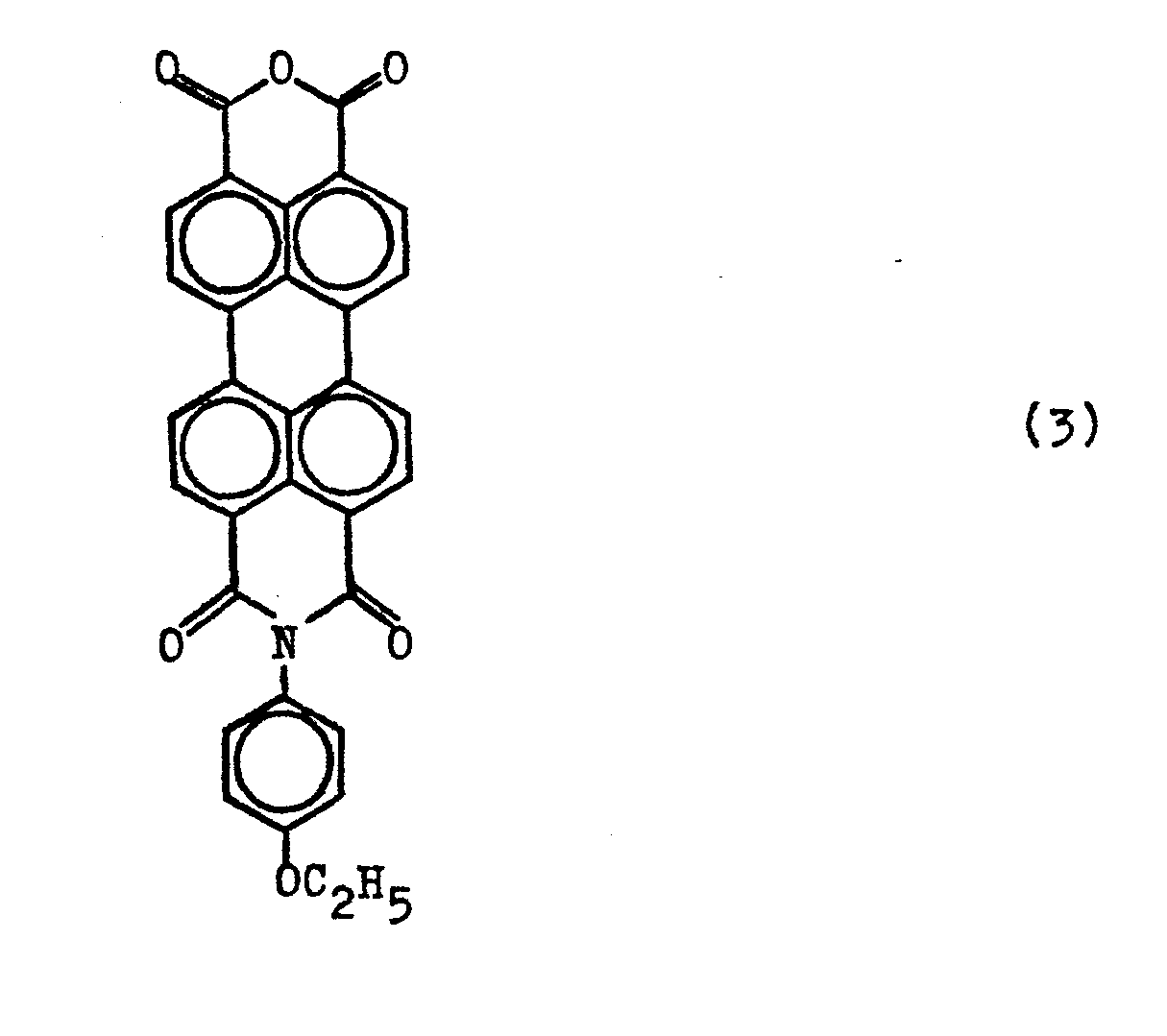
- Verfahren zu ihrer Herstellung, indem man ein Gemisch aus 99-70 Molprozent Perylentetracarbonsäuredianhydrid und entsprechend 1-30 Molprozent des Perylentetracarbonsäuremonoanhydrid-mono-phenetidids der Formel (3)
- Die so erhältlichen Perylentetracarbonsäurediimid-Mischkristallpigmente ergeben nach Überführung in eine feinteilige Pigmentform nach üblichen Finish-Methoden beispielsweise durch Vermahlen, in hochschmelzenden Polymeren, insbesondere in Polyethylen und Polypropylen, Ausfärbungen, die gegenüber dem reinen Pigment der genannten Formel (1) sowohl eine deutlich verbesserte thermische Stabilität als auch den erwünschten gelberen Farbton aufweisen. Die Stärke der Gelbverschiebung läßt sich durch Variation des Anteils der Komponente der Formel (2) im Mischkristall steuern.
- Die neuen Perylentetracarbonsäurediimid-Mischkristallpigmente, die aus den Verbindungen der genannten Formeln .(1 ) und (2) im vorstehend genannten Molverhältnis bestehen, bilden Mischkristalle, die im gleichen Kristallgitter wie die a-Modifikation der Verbindung der genannten Formel (1) kristallisieren.
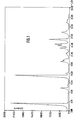
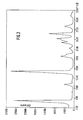
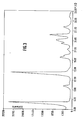
- Im Anhang sind zum Vergleich die Röntgenbeugungsdiagramme des Kristallgitters zweier typischer erfindungsgemäß erhältlicher Mischkristalle (FIGUR 2 und 3) und der a-Modifikation der Verbindung der genannten Formel (1) (FIGUR 1) wiedergegeben. Wie ersichtlich, handelt es sich um übereinstimmende Diagramme, woraus folgt, daß auch die Kristallgitter übereinstimmend sind.
- Für die erfindungsgemäße Mischkondensation wird das Monoanhydrid der Formel (3) vorzugsweise in einer Menge von 5-15 Molprozent eingesetzt. Da die Reaktion praktisch quantitativ verläuft, liegt somit der bevorzugte Anteil an dem asymmetrisch substituierten Diimid der Formel (2) in der Mischphase der beiden Komponenten der Formeln (1) und (2) ebenfalls zwischen 5 und 15 Molprozent.
- Die Ausgangsverbindung der Formel (3) kann nach den Angaben der Deutschen Patentanmeldung P 33 09 060.2 (Europäische Patentanmeldung 84 102 555.4) erhalten werden. Die Mischkondensationsreaktion kann in bekannter Weise, beispielsweise gemäß den Angaben der DE-PS 1 105 085 (GB-PS 897 707), DE-AS 1 094 897 oder DE-OS 1 807 729 durchgeführt werden, indem man das Gemisch der Reaktanden bei erhöhter Temperatur von etwa 150 - 220"C, gegebenenfalls in Gegenwart eines Kondensationsbeschleunigers, wie Zinkchlorid, Zinkcarboxylat, oder einer Mineralsäure, in einem hochsiedenden Lösungsmittel, wie beispielsweise Di- oder Trichlorbenzol, Nitrobenzol, N-Methylpyrrolidon, Chinolin, Phenolen oder auch im Überschuß von 3,5-Dimethylanilin, umsetzt. Die Reaktionsprodukte können in üblicher Weise durch Filtration, gegebenenfalls nach vorherigem Verdünnen mit einem niedrigsiedenden Alkohol, wie Methanol, abgetrennt werden.
- Zur Überführung in eine feinteilige, transparent färbende Pigmentform kann das erhaltene trockene Rohpigment nach üblichen Mahlverfahren, beispielsweise in einer Schwing-oder Rollmühle, in Gegenwart von Mahlhilfsmitteln gemahlen werden. Als Mahlkörper dienen hierbei im allgemeinen Stahl- oder Korundkugeln oder Stahl- oder Korundcylpebs. Mahlhilfsmittel können wasserlösliche Salze, wie Natriumsulfat, Aluminiumsulfat oder Natriumchlorid, sein, die nach beendeter Mahlung in bekannter Weise durch wäßrigen Salzauszug vom Pigment abgetrennt werden.
- Mischkristallpigmente der Perylentetracarbonsäurediimidreihe sind bereits bekannt. In der US-PS 3 554776 werden Pigmente, bestehend aus einer festen Lösung von mindestens zwei Perylentetracarbonsäurediimiden beansprucht. Bei den diesen Pigmenten zugrundeliegenden Verbindungen handelt es sich um symmetrische N,N'-substituierte Perylentetracarbonsäurediimide. Demgegenüber unterscheiden sich die erfindungsgemäßen Mischkristalle, bei denen die eine Komponente der genannten Formel (2) ein definiertes asymmetrisch substituiertes Diimid darstellt, durch ihre andersartige chemische Zusammensetzung. Entsprechendes gilt auch für die aus der DE-OS 2 009 073 (Canadische Patentschrift 912 757) bekanntgewordenen festen Lösungen von Perylentetracabonsäurediimid-Pigmenten. Auch bei diesen Pigmenten handelt es sich um Mischungen, die aus symmetrisch N,N'-substituierten Perylentetracarbonsäurediimiden zusammengesetzt sind.
- Die neuen erfindungsgemäß erhältlichen Mischkristallpigmente eignen sich zum Einfärben von Lacken, Kunststoffen, wie Polyvinylchlorid, Polystrol, Polyamid, und besondes vorteilhaft zum Pigmentieren von hoch schmelzenden Polymeren, wie Polyethylen und Polypropylen, sowie für die Spinnfärbung von Polypropylen. Sie weisen gegenüber dem beispielsweise gemäß der DE-PS 1 067 157 (US-PS 2 905 685) erhältlichen Perylenpigment der genannten Formel (1) bei gleicher Kristallmodifikation - nach entsprechender Überführung in eine feinteilige, transparente Pigmentform - in hochschmelzenden organischen Polymeren, insbesondere in Polyolefinen, bei mindestens ebenbürtiger Farbstärke und gelberem Farbton eine deutlich höhere Hitzestabilität auf.
- Den aus der DE-AS 2 832 761 (US-PS 4 262 851) und der EP-PS 042 819 (US-PS 4 404 386) bekannten, deckend färbenden Pigmentformen des Bisxylidids der genannten Formel (1) sind sie bei wesentlich gelberem, reinerem Farbton in der Farbstärke überlegen.
- In den nachfolgenden Beispielen beziehen sich die Prozentangaben, sofern nicht anders vermerkt, auf das Gewicht. Die Röntbeugungsdiagramme wurden mit einem rechnergesteuerten Pulverdiffraktometer D 500 der Firma SIEMENS mit Kupfer-Ka-Strahlung aufgenommen.
- Ein Gemisch aus 52,9 g Perylentetracarbonsäuredianhydrid und 7.7 g Perylentetracarbonsäuremonoanhydridmono-4'- ethoxyphenylimid wird in einer Mischung aus 190 g 3,5-Dimethylanilin und 440 g Chinolin nach Zusatz von 3,0 g wasserfreiem Zinkchlorid 8 Stunden unter kontinuierlichem Abdestillieren des entstandenen Wassers bei 180-185'C gerührt. Man saugt bei 100*C ab, wäscht das Reaktionsprodukt mit Methanol, verdünnter Salzsäure und anschließend mit Wasser säurefrei und trocknet. Das in einer Ausbeute von 88,9 g (98,8 % der Theorie) erhaltene, einheitlich in roten Nadeln auskristallisierte Mischkondensationsprodukt besteht aus ca. 90 Molprozent der Komponente der Formel (1) und ca. 10 Molprozent der Komponente der Formel (2). Es entspricht gemäß Röntgenbeugungsdiagramm (vgl. FIGUR 2 im Anhang) der a-Modifikation der Komponente der Formel (1) (vgl. FIGUR 1 im Anhang).
- Zur Überführung in eine feinteilige Pigmentform werden 30 g Mischkondensationsprodukt mit 150 g Natriumsulfat wasserfrei in einem 1 1 Kunststoffmahlbehälter mit 1400 g Korundkugeln (Durchmesser 12 mm) auf einem Vibratom-Schwingtisch 6 Stunden vermahlen und das Mahlgut nach einem wäßrigen Salzauszug getrocknet und in einer IK-Schlagkreuzmühle (der Firma JANKE und KUNKEL) aufgemahlen. (In gleicher Weise werden auch die nach den folgenden Beispielen erhaltenen Produkte zerkleinert.)
- Setzt man eine Mischung aus 41,2 g Perylenetracarbonsäuredianhydrid und 23,0 g Perylentetracarbonsäuremonoanhydrid- mono-4'-ethoxyphenylimid anstelle einer Mischung aus 52,9 g bzw. 7,7 g der genannten Verbindungen ein und verfährt im übrigen wie in Beispiel 1 beschrieben, so erhält man in einer Ausbeute von 89,9 g (99,4 % der Theorie) das entsprechende einheitliche kristalline gelbstichig rote Mischkondensationsprodukt in Form von Mischkristallen der a-Modifikation der reinen Verbindung der Formel (1) (vgl. FIGUR 3 im Anhang). Es besteht aus ca. 70 Molprozent der Komponente der Formel (1) und ca. 30 Molprozent der Komponente der Formel (2).
- Eine Suspension von 37,2 g Perylentetracarbonsäuredianhydrid, 2,6 g Perylentetracarbonsäuremonoanhydridmono-4'- ethoxyphenylimid, 2,2 g kristallinem Zinkacetat und 200 g 3,5-Dimethylanilin wird 6 Stunden bei 180°C gerührt. Das in einer Ausbeute von 59,1 g (99,5 % der Theorie) erhaltene, aus ca. 95 Molprozent der Komponente der Formel (1) und ca. 5 Molprozent der Komponente der Formel (2) zusammengesetzte Mischkondensationsprodukt bildet ebenfalls Mischkristalle in der a-Modifikation der Komponente der Formel (1).
- 62,0 g Perylentetracarbonsäuredianhydrid werden in 210 g 3,5-Dimethylanilin in Gegenwart von 3,2 g wasserfreiem Zinkchlorid 8 Stunden bei 185°C gerührt. Das entstandene Bisxylidid der Formel (1) wird in üblicher Weise isoliert. Die Ausbeute beträgt 92,5 g (97,9 % der Theorie). Die Reflexionswinkel im Röntgenbeugungsdiagramm (vgl. FIGUR 1 im Anhang) stimmen mit den aus der obengenannten japanischen Patentanmeldung bekanntgewordenen Winkeldaten der als a-Modifikation bezeichneten Kristallphase dieser Verbindung überein.
- 0,75 g des zu prüfungen Pigments und 500 g Polyethylen ((R)Hostalen GC 7260 Pulver) werden in einem Collin-Schnellmischer bei Raumtemperatur 1 Minute bei 2000 Umdrehungen pro Minute gemischt. Nach Zugabe von 7,14 g (R)Remafin-Weiß RCL-AE 30 (≅ 1 % Ti02) wird die Mischung auf einem Extruder (Weber ET 20) in 2 Passagen bei 180°C extrudiert. Das erhaltene Granulat wird anschließend auf einer Spritzgießmaschine (Aarburg Allrounder 221 E/170 P) bei Prüftemperaturen von 200 - 300°C in Intervallen von jeweils 20°C und einer Verweildauer von 5 Minuten zu Platten verspritzt.
-

- Die in der vorstehenden Tabelle niedergelegten Ergebnisse zeigen die überlegene Hitzebeständigkeit sowie den deutlich gelberen Farbton der erfindungsgemäßen Mischkristallpigmente gegenüber dem reinen Perylenpigment der Formel (1).
Claims (4)


Applications Claiming Priority (2)
| Application Number | Priority Date | Filing Date | Title |
|---|---|---|---|
| DE3436208 | 1984-10-03 | ||
| DE19843436208 DE3436208A1 (de) | 1984-10-03 | 1984-10-03 | Mischkristallpigmente auf der basis von perylentetracarbonsaeurediimiden, verfahren zu ihrer herstellung und ihre verwendung |
Publications (3)
| Publication Number | Publication Date |
|---|---|
| EP0176902A2 true EP0176902A2 (de) | 1986-04-09 |
| EP0176902A3 EP0176902A3 (en) | 1989-10-25 |
| EP0176902B1 EP0176902B1 (de) | 1991-04-10 |
Family
ID=6246962
Family Applications (1)
| Application Number | Title | Priority Date | Filing Date |
|---|---|---|---|
| EP85111995A Expired - Lifetime EP0176902B1 (de) | 1984-10-03 | 1985-09-21 | Mischkristallpigmente auf der Basis von Perylentetracarbonsäurediimiden, Verfahren zu ihrer Herstellung und ihre Verwendung |
Country Status (4)
| Country | Link |
|---|---|
| US (1) | US5154770A (de) |
| EP (1) | EP0176902B1 (de) |
| JP (1) | JPS6191266A (de) |
| DE (2) | DE3436208A1 (de) |
Families Citing this family (10)
| Publication number | Priority date | Publication date | Assignee | Title |
|---|---|---|---|---|
| EP0654506B1 (de) * | 1993-11-22 | 2000-05-17 | Ciba SC Holding AG | Verfahren zur Herstellung synergistischer Pigmentgemische |
| JPH10509610A (ja) * | 1994-11-09 | 1998-09-22 | クリ・ハークチ,ワリド | 創傷修復用包帯およびそれらの保存法 |
| DE19709798A1 (de) * | 1997-03-10 | 1998-09-17 | Clariant Gmbh | Pigmentzubereitungen und Verfahren zu ihrer Herstellung |
| JP2003041144A (ja) * | 2001-07-27 | 2003-02-13 | Yokohama Tlo Co Ltd | 黒色ペリレン系顔料およびその製造方法 |
| JP2003041145A (ja) * | 2001-07-27 | 2003-02-13 | Yokohama Tlo Co Ltd | 黒色ペリレン系顔料およびその製造方法 |
| GB0312067D0 (en) * | 2003-05-24 | 2003-07-02 | Avecia Ltd | Inks |
| US9287419B2 (en) | 2011-01-05 | 2016-03-15 | Nitto Denko Corporation | Wavelength conversion perylene diester chromophores and luminescent films |
| WO2013049062A2 (en) | 2011-09-26 | 2013-04-04 | Nitto Denko Corporation | Highly-fluorescent and photo-stable chromophores for enhanced solar harvesting efficiency |
| WO2013052381A2 (en) | 2011-10-05 | 2013-04-11 | Nitto Denko Corporation | Wavelength conversion film having pressure sensitive adhesive layer to enhance solar harvesting efficiency |
| US9204598B2 (en) | 2013-05-27 | 2015-12-08 | Saudi Basic Indsutries Corporation | Solar energy funneling using thermoplastics for agricultural applications |
Family Cites Families (17)
| Publication number | Priority date | Publication date | Assignee | Title |
|---|---|---|---|---|
| CA912757A (en) * | 1972-10-24 | R. Ruby Philip | 3,4,9,10-perylenetetracarboxylic acid diimide pigments | |
| DE1067157B (de) * | 1956-03-22 | 1959-10-15 | Farbwerke Hoechst Aktiengesellschaft vormals Meister Lucius &. Brumng, Frankfurt/M | Verfahren zur Herstellung eines Farbstoffes |
| US2905685A (en) * | 1956-03-22 | 1959-09-22 | Hoechst Ag | New dyestuff of the perylene tetracarboxylic acid series |
| US2905686A (en) * | 1956-05-04 | 1959-09-22 | Hoechst Ag | New dyestuffs of the perylene tetracarboxylic acid series |
| DE1113773B (de) * | 1956-11-20 | 1961-09-14 | Hoechst Ag | Verfahren zur Herstellung eines Farbstoffes |
| GB837326A (en) * | 1958-12-13 | 1960-06-09 | Hoechst Ag | New dyestuff of the perylene tetracarboxylic acid series |
| DE1094897B (de) * | 1959-07-31 | 1960-12-15 | Basf Ag | Verfahren zur Herstellung eines Pigmentfarbstoffs |
| US3554776A (en) * | 1967-11-24 | 1971-01-12 | Allied Chem | Novel perylenetetracarboxylic diimide compositions |
| DE1807729A1 (de) * | 1968-11-08 | 1970-06-18 | Basf Ag | Farbstoff der Perylentetracorbonsaeurediimidreihe |
| NL7001362A (de) * | 1969-02-28 | 1970-09-01 | ||
| JPS517025A (en) * | 1974-07-09 | 1976-01-21 | Mitsubishi Chem Ind | Beetaa ketsushosoperirenganryono seizoho |
| CH620703A5 (en) * | 1975-10-11 | 1980-12-15 | Basf Ag | Process for the preparation of novel perylene-3,4,9,10-dicarboximide pigment forms and their use |
| DE2832761B1 (de) * | 1978-07-26 | 1979-10-31 | Basf Ag | Verfahren zur UEberfuehrung von rohen und/oder grobkristallisierten Perylen-tetracarbonsaeurediimiden in eine Pigmentform |
| JPS5611956A (en) * | 1979-07-04 | 1981-02-05 | Ciba Geigy Ag | Perylenetetracarboxylic aciddbiss*3*55 dimethylphenyl*imide* its manufacture and method of coloring high molecular organic material therewith |
| US4404385A (en) * | 1979-07-04 | 1983-09-13 | Ciba-Geigy Corporation | Novel modification of perylenetetracarboxylic acid-bis-(3,5-dimethylphenyl)imide |
| DE3309060A1 (de) * | 1983-03-14 | 1984-09-20 | Hoechst Ag, 6230 Frankfurt | Perylen-3,4,9,10-tetracarbonsaeure-monoanhydrid-monoimid- und -monoimidazolid-verbindungen, verfahren zu ihrer herstellung und ihre verwendung |
| DE3436206A1 (de) * | 1984-10-03 | 1986-04-03 | Hoechst Ag, 6230 Frankfurt | Verfahren zur herstellung von mischkristallpigmenten auf der basis von perylentetracarbonsaeurediimiden und deren verwendung |
-
1984
- 1984-10-03 DE DE19843436208 patent/DE3436208A1/de not_active Withdrawn
-
1985
- 1985-09-21 EP EP85111995A patent/EP0176902B1/de not_active Expired - Lifetime
- 1985-09-21 DE DE8585111995T patent/DE3582464D1/de not_active Expired - Fee Related
- 1985-10-02 JP JP60218169A patent/JPS6191266A/ja active Pending
-
1990
- 1990-09-19 US US07/587,158 patent/US5154770A/en not_active Expired - Fee Related
Also Published As
| Publication number | Publication date |
|---|---|
| DE3582464D1 (de) | 1991-05-16 |
| EP0176902B1 (de) | 1991-04-10 |
| EP0176902A3 (en) | 1989-10-25 |
| US5154770A (en) | 1992-10-13 |
| DE3436208A1 (de) | 1986-04-10 |
| JPS6191266A (ja) | 1986-05-09 |
Similar Documents
| Publication | Publication Date | Title |
|---|---|---|
| DE2905114B1 (de) | Pigmentzubereitungen | |
| CH417815A (de) | Chinacridonpigment und Verfahren zu seiner Herstellung | |
| EP0190999A2 (de) | Verfahren zur Herstellung farbstarker Pigmente | |
| EP0176902B1 (de) | Mischkristallpigmente auf der Basis von Perylentetracarbonsäurediimiden, Verfahren zu ihrer Herstellung und ihre Verwendung | |
| EP0176900B1 (de) | Verfahren zur Herstellung von Mischkristallpigmenten auf der Basis von Perylentetracarbonsäurediimiden und deren Verwendung | |
| EP0035218B1 (de) | Perylen-3,4,9,10-tetracarbonsäure-monoanhydrid-monoalkalisalze, Verfahren zu ihrer Herstellung und ihre Verwendung | |
| DE2832761B1 (de) | Verfahren zur UEberfuehrung von rohen und/oder grobkristallisierten Perylen-tetracarbonsaeurediimiden in eine Pigmentform | |
| DE69416219T2 (de) | Herstellung von pigmentärem 2,9-Dichlorchinacridon | |
| EP0176899B1 (de) | Mischkristallpigmente auf der Basis von Perylentetracarbonsäurediimiden, Verfahren zu ihrer Herstellung und ihre Verwendung | |
| DE69222262T2 (de) | Neue feste Lösungen von Kupferphthalocyaninverbindungen | |
| EP0009720B1 (de) | Chinacridon-Gemische, Verfahren zu ihrer Herstellung und ihre Verwendung als Pigmente | |
| EP1288192B1 (de) | Verfahren zur Herstellung von 1-Amino-4-hydroxyanthrachinonen | |
| DE3631678C2 (de) | ||
| DE2256485A1 (de) | Rekristallisationsbestaendige kupferphthalocyaninpigmente | |
| DE2058577C3 (de) | Kristallines Perylentetracarbonsäuredibenzoylhydrazid, Verfahren zu seiner Herstellung und dessen Verwendung als Pigment | |
| DE2421804C2 (de) | Verfahren zur Herstellung von farbstarken Kupferphthalocyaninpigmenten der α-Modifikation und deren Verwendung | |
| DE2638528C3 (de) | Chinolinderivate, Verfahren zu ihrer Herstellung und Verwendung derselben | |
| DE1217333B (de) | Farbpigmente | |
| DE1807729A1 (de) | Farbstoff der Perylentetracorbonsaeurediimidreihe | |
| CH632290A5 (de) | Verfahren zur herstellung eines 3,4,9,10-perylentetracarbonsaeure-dianhydrid-pigmentes. | |
| DE2726682C3 (de) | Verfahren zur direkten Herstellung von Perylen-S^AlO-tetracarbonsäure-NJS'-dimethylimid in Pigmentform | |
| DE1122192B (de) | Verfahren zur Herstellung von 4,9-Dinitrochin-(3,2-a)-acridin-13, 14(5,8)-dion | |
| DE2435219C2 (de) | Chinacridon-Pigmente und Verfahren zu ihrer Herstellung | |
| DE2500213A1 (de) | Verfahren zum faerben einer waermehaertbaren kunststoffzubereitung | |
| DE1619619C3 (de) | Verfahren zur Herstellung von linearen Chinacridon-Pigmenten mit geringer Korngröße |
Legal Events
| Date | Code | Title | Description |
|---|---|---|---|
| PUAI | Public reference made under article 153(3) epc to a published international application that has entered the european phase |
Free format text: ORIGINAL CODE: 0009012 |
|
| AK | Designated contracting states |
Kind code of ref document: A2 Designated state(s): CH DE FR GB IT LI |
|
| PUAL | Search report despatched |
Free format text: ORIGINAL CODE: 0009013 |
|
| AK | Designated contracting states |
Kind code of ref document: A3 Designated state(s): CH DE FR GB IT LI |
|
| 17P | Request for examination filed |
Effective date: 19891129 |
|
| 17Q | First examination report despatched |
Effective date: 19900824 |
|
| GRAA | (expected) grant |
Free format text: ORIGINAL CODE: 0009210 |
|
| AK | Designated contracting states |
Kind code of ref document: B1 Designated state(s): CH DE FR GB IT LI |
|
| ITF | It: translation for a ep patent filed | ||
| REF | Corresponds to: |
Ref document number: 3582464 Country of ref document: DE Date of ref document: 19910516 |
|
| ET | Fr: translation filed | ||
| GBT | Gb: translation of ep patent filed (gb section 77(6)(a)/1977) | ||
| PLBE | No opposition filed within time limit |
Free format text: ORIGINAL CODE: 0009261 |
|
| STAA | Information on the status of an ep patent application or granted ep patent |
Free format text: STATUS: NO OPPOSITION FILED WITHIN TIME LIMIT |
|
| 26N | No opposition filed | ||
| PGFP | Annual fee paid to national office [announced via postgrant information from national office to epo] |
Ref country code: FR Payment date: 19920811 Year of fee payment: 8 |
|
| PGFP | Annual fee paid to national office [announced via postgrant information from national office to epo] |
Ref country code: CH Payment date: 19920813 Year of fee payment: 8 |
|
| PGFP | Annual fee paid to national office [announced via postgrant information from national office to epo] |
Ref country code: GB Payment date: 19920817 Year of fee payment: 8 |
|
| PGFP | Annual fee paid to national office [announced via postgrant information from national office to epo] |
Ref country code: DE Payment date: 19921114 Year of fee payment: 8 |
|
| PG25 | Lapsed in a contracting state [announced via postgrant information from national office to epo] |
Ref country code: GB Effective date: 19930921 |
|
| PG25 | Lapsed in a contracting state [announced via postgrant information from national office to epo] |
Ref country code: LI Effective date: 19930930 Ref country code: CH Effective date: 19930930 |
|
| GBPC | Gb: european patent ceased through non-payment of renewal fee |
Effective date: 19930921 |
|
| PG25 | Lapsed in a contracting state [announced via postgrant information from national office to epo] |
Ref country code: FR Free format text: LAPSE BECAUSE OF NON-PAYMENT OF DUE FEES Effective date: 19940531 |
|
| REG | Reference to a national code |
Ref country code: CH Ref legal event code: PL |
|
| PG25 | Lapsed in a contracting state [announced via postgrant information from national office to epo] |
Ref country code: DE Effective date: 19940601 |
|
| REG | Reference to a national code |
Ref country code: FR Ref legal event code: ST |