EP0175271B1 - Bisazofarbstoffe und ihre Verwendung in flüssigkristallinen Materialien oder zum Färben von synthetischen Polymeren oder Fasern - Google Patents
Bisazofarbstoffe und ihre Verwendung in flüssigkristallinen Materialien oder zum Färben von synthetischen Polymeren oder Fasern Download PDFInfo
- Publication number
- EP0175271B1 EP0175271B1 EP85111479A EP85111479A EP0175271B1 EP 0175271 B1 EP0175271 B1 EP 0175271B1 EP 85111479 A EP85111479 A EP 85111479A EP 85111479 A EP85111479 A EP 85111479A EP 0175271 B1 EP0175271 B1 EP 0175271B1
- Authority
- EP
- European Patent Office
- Prior art keywords
- formula
- liquid crystal
- benzyl
- dyes
- synthetic polymers
- Prior art date
- Legal status (The legal status is an assumption and is not a legal conclusion. Google has not performed a legal analysis and makes no representation as to the accuracy of the status listed.)
- Expired - Lifetime
Links
- 125000000664 diazo group Chemical group [N-]=[N+]=[*] 0.000 title claims description 4
- 238000004043 dyeing Methods 0.000 title claims 2
- 229920002994 synthetic fiber Polymers 0.000 title claims 2
- 229920001059 synthetic polymer Polymers 0.000 title claims 2
- 239000000975 dye Substances 0.000 title description 20
- 239000004973 liquid crystal related substance Substances 0.000 title description 10
- 239000000463 material Substances 0.000 title 1
- -1 4-cyclohexylbenzyl Chemical group 0.000 claims description 18
- 150000001875 compounds Chemical class 0.000 claims description 8
- 125000001797 benzyl group Chemical group [H]C1=C([H])C([H])=C(C([H])=C1[H])C([H])([H])* 0.000 claims description 7
- 125000000094 2-phenylethyl group Chemical group [H]C1=C([H])C([H])=C(C([H])=C1[H])C([H])([H])C([H])([H])* 0.000 claims description 5
- 125000000113 cyclohexyl group Chemical group [H]C1([H])C([H])([H])C([H])([H])C([H])(*)C([H])([H])C1([H])[H] 0.000 claims description 5
- 125000002496 methyl group Chemical group [H]C([H])([H])* 0.000 claims description 4
- YGTAZGSLCXNBQL-UHFFFAOYSA-N 1,2,4-thiadiazole Chemical group C=1N=CSN=1 YGTAZGSLCXNBQL-UHFFFAOYSA-N 0.000 claims description 2
- 125000004414 alkyl thio group Chemical group 0.000 claims description 2
- 125000003710 aryl alkyl group Chemical group 0.000 claims description 2
- 125000004659 aryl alkyl thio group Chemical group 0.000 claims description 2
- 125000003118 aryl group Chemical group 0.000 claims description 2
- 239000002178 crystalline material Substances 0.000 claims description 2
- 125000000753 cycloalkyl group Chemical group 0.000 claims description 2
- 125000005366 cycloalkylthio group Chemical group 0.000 claims description 2
- 239000001257 hydrogen Substances 0.000 claims description 2
- 229910052739 hydrogen Inorganic materials 0.000 claims description 2
- 125000004435 hydrogen atom Chemical class [H]* 0.000 claims description 2
- 125000000956 methoxy group Chemical group [H]C([H])([H])O* 0.000 claims description 2
- 125000004573 morpholin-4-yl group Chemical group N1(CCOCC1)* 0.000 claims description 2
- 125000000547 substituted alkyl group Chemical group 0.000 claims description 2
- 125000006686 (C1-C24) alkyl group Chemical group 0.000 claims 1
- 239000000835 fiber Substances 0.000 claims 1
- YXFVVABEGXRONW-UHFFFAOYSA-N Toluene Chemical compound CC1=CC=CC=C1 YXFVVABEGXRONW-UHFFFAOYSA-N 0.000 description 12
- 239000000203 mixture Substances 0.000 description 11
- 239000000243 solution Substances 0.000 description 7
- QTBSBXVTEAMEQO-UHFFFAOYSA-N Acetic acid Chemical compound CC(O)=O QTBSBXVTEAMEQO-UHFFFAOYSA-N 0.000 description 6
- XEKOWRVHYACXOJ-UHFFFAOYSA-N Ethyl acetate Chemical compound CCOC(C)=O XEKOWRVHYACXOJ-UHFFFAOYSA-N 0.000 description 6
- VEXZGXHMUGYJMC-UHFFFAOYSA-N Hydrochloric acid Chemical compound Cl VEXZGXHMUGYJMC-UHFFFAOYSA-N 0.000 description 5
- 230000008033 biological extinction Effects 0.000 description 4
- XBDQKXXYIPTUBI-UHFFFAOYSA-N dimethylselenoniopropionate Natural products CCC(O)=O XBDQKXXYIPTUBI-UHFFFAOYSA-N 0.000 description 4
- 238000004519 manufacturing process Methods 0.000 description 4
- XLYOFNOQVPJJNP-UHFFFAOYSA-N water Substances O XLYOFNOQVPJJNP-UHFFFAOYSA-N 0.000 description 4
- 125000006539 C12 alkyl group Chemical group [H]C([H])([H])C([H])([H])C([H])([H])C([H])([H])C([H])([H])C([H])([H])C([H])([H])C([H])([H])C([H])([H])C([H])([H])C([H])([H])C([H])([H])* 0.000 description 3
- OKKJLVBELUTLKV-UHFFFAOYSA-N Methanol Chemical compound OC OKKJLVBELUTLKV-UHFFFAOYSA-N 0.000 description 3
- VYPSYNLAJGMNEJ-UHFFFAOYSA-N Silicium dioxide Chemical compound O=[Si]=O VYPSYNLAJGMNEJ-UHFFFAOYSA-N 0.000 description 3
- 229960000583 acetic acid Drugs 0.000 description 3
- 239000012362 glacial acetic acid Substances 0.000 description 3
- 238000005259 measurement Methods 0.000 description 3
- RXQNKKRGJJRMKD-UHFFFAOYSA-N 5-bromo-2-methylaniline Chemical compound CC1=CC=C(Br)C=C1N RXQNKKRGJJRMKD-UHFFFAOYSA-N 0.000 description 2
- IJGRMHOSHXDMSA-UHFFFAOYSA-N Atomic nitrogen Chemical compound N#N IJGRMHOSHXDMSA-UHFFFAOYSA-N 0.000 description 2
- YMWUJEATGCHHMB-UHFFFAOYSA-N Dichloromethane Chemical compound ClCCl YMWUJEATGCHHMB-UHFFFAOYSA-N 0.000 description 2
- SNRUBQQJIBEYMU-UHFFFAOYSA-N Dodecane Natural products CCCCCCCCCCCC SNRUBQQJIBEYMU-UHFFFAOYSA-N 0.000 description 2
- LFQSCWFLJHTTHZ-UHFFFAOYSA-N Ethanol Chemical compound CCO LFQSCWFLJHTTHZ-UHFFFAOYSA-N 0.000 description 2
- VMHLLURERBWHNL-UHFFFAOYSA-M Sodium acetate Chemical compound [Na+].CC([O-])=O VMHLLURERBWHNL-UHFFFAOYSA-M 0.000 description 2
- 239000001045 blue dye Substances 0.000 description 2
- 125000000484 butyl group Chemical group [H]C([*])([H])C([H])([H])C([H])([H])C([H])([H])[H] 0.000 description 2
- 238000004587 chromatography analysis Methods 0.000 description 2
- 238000001816 cooling Methods 0.000 description 2
- 230000008878 coupling Effects 0.000 description 2
- 238000010168 coupling process Methods 0.000 description 2
- 238000005859 coupling reaction Methods 0.000 description 2
- 239000012954 diazonium Substances 0.000 description 2
- 150000001989 diazonium salts Chemical class 0.000 description 2
- 125000003438 dodecyl group Chemical group [H]C([H])([H])C([H])([H])C([H])([H])C([H])([H])C([H])([H])C([H])([H])C([H])([H])C([H])([H])C([H])([H])C([H])([H])C([H])([H])C([H])([H])* 0.000 description 2
- 239000003480 eluent Substances 0.000 description 2
- 125000001495 ethyl group Chemical group [H]C([H])([H])C([H])([H])* 0.000 description 2
- ZXEKIIBDNHEJCQ-UHFFFAOYSA-N isobutanol Chemical compound CC(C)CO ZXEKIIBDNHEJCQ-UHFFFAOYSA-N 0.000 description 2
- 239000011159 matrix material Substances 0.000 description 2
- NYGZLYXAPMMJTE-UHFFFAOYSA-M metanil yellow Chemical group [Na+].[O-]S(=O)(=O)C1=CC=CC(N=NC=2C=CC(NC=3C=CC=CC=3)=CC=2)=C1 NYGZLYXAPMMJTE-UHFFFAOYSA-M 0.000 description 2
- 125000001997 phenyl group Chemical group [H]C1=C([H])C([H])=C(*)C([H])=C1[H] 0.000 description 2
- 125000000286 phenylethyl group Chemical group [H]C1=C([H])C([H])=C(C([H])=C1[H])C([H])([H])C([H])([H])* 0.000 description 2
- 235000019260 propionic acid Nutrition 0.000 description 2
- 125000001436 propyl group Chemical group [H]C([*])([H])C([H])([H])C([H])([H])[H] 0.000 description 2
- IUVKMZGDUIUOCP-BTNSXGMBSA-N quinbolone Chemical compound O([C@H]1CC[C@H]2[C@H]3[C@@H]([C@]4(C=CC(=O)C=C4CC3)C)CC[C@@]21C)C1=CCCC1 IUVKMZGDUIUOCP-BTNSXGMBSA-N 0.000 description 2
- 150000003254 radicals Chemical class 0.000 description 2
- 239000000741 silica gel Substances 0.000 description 2
- 229910002027 silica gel Inorganic materials 0.000 description 2
- 239000001632 sodium acetate Substances 0.000 description 2
- 235000017281 sodium acetate Nutrition 0.000 description 2
- LPXPTNMVRIOKMN-UHFFFAOYSA-M sodium nitrite Chemical compound [Na+].[O-]N=O LPXPTNMVRIOKMN-UHFFFAOYSA-M 0.000 description 2
- PWDUSMIDLAJXPJ-UHFFFAOYSA-N 2,3-dihydro-1h-perimidine Chemical class C1=CC(NCN2)=C3C2=CC=CC3=C1 PWDUSMIDLAJXPJ-UHFFFAOYSA-N 0.000 description 1
- MBZZEMJUAAERNP-UHFFFAOYSA-N 3-octyl-1,2,4-thiadiazol-5-amine Chemical compound CCCCCCCCC1=NSC(N)=N1 MBZZEMJUAAERNP-UHFFFAOYSA-N 0.000 description 1
- WKBOTKDWSSQWDR-UHFFFAOYSA-N Bromine atom Chemical compound [Br] WKBOTKDWSSQWDR-UHFFFAOYSA-N 0.000 description 1
- 0 C[C@]1*C(*C(CC=*)[U]C)CC1 Chemical compound C[C@]1*C(*C(CC=*)[U]C)CC1 0.000 description 1
- ZAMOUSCENKQFHK-UHFFFAOYSA-N Chlorine atom Chemical compound [Cl] ZAMOUSCENKQFHK-UHFFFAOYSA-N 0.000 description 1
- XDTMQSROBMDMFD-UHFFFAOYSA-N Cyclohexane Chemical compound C1CCCCC1 XDTMQSROBMDMFD-UHFFFAOYSA-N 0.000 description 1
- 239000004642 Polyimide Substances 0.000 description 1
- 101000650578 Salmonella phage P22 Regulatory protein C3 Proteins 0.000 description 1
- 101001040920 Triticum aestivum Alpha-amylase inhibitor 0.28 Proteins 0.000 description 1
- 125000000217 alkyl group Chemical group 0.000 description 1
- 150000004056 anthraquinones Chemical class 0.000 description 1
- 239000000987 azo dye Substances 0.000 description 1
- 238000009835 boiling Methods 0.000 description 1
- GDTBXPJZTBHREO-UHFFFAOYSA-N bromine Substances BrBr GDTBXPJZTBHREO-UHFFFAOYSA-N 0.000 description 1
- 229910052794 bromium Inorganic materials 0.000 description 1
- 239000000460 chlorine Substances 0.000 description 1
- 229910052801 chlorine Inorganic materials 0.000 description 1
- IOJUPLGTWVMSFF-UHFFFAOYSA-N cyclobenzothiazole Natural products C1=CC=C2SC=NC2=C1 IOJUPLGTWVMSFF-UHFFFAOYSA-N 0.000 description 1
- 238000006193 diazotization reaction Methods 0.000 description 1
- 230000005684 electric field Effects 0.000 description 1
- 238000000921 elemental analysis Methods 0.000 description 1
- 239000012065 filter cake Substances 0.000 description 1
- 125000004051 hexyl group Chemical group [H]C([H])([H])C([H])([H])C([H])([H])C([H])([H])C([H])([H])C([H])([H])* 0.000 description 1
- 238000004128 high performance liquid chromatography Methods 0.000 description 1
- 125000002887 hydroxy group Chemical group [H]O* 0.000 description 1
- 239000005457 ice water Substances 0.000 description 1
- 239000004922 lacquer Substances 0.000 description 1
- 238000000034 method Methods 0.000 description 1
- HRDXJKGNWSUIBT-UHFFFAOYSA-N methoxybenzene Chemical group [CH2]OC1=CC=CC=C1 HRDXJKGNWSUIBT-UHFFFAOYSA-N 0.000 description 1
- YLRCMGYQFGOZLP-UHFFFAOYSA-N n-butyl-n-methylaniline Chemical compound CCCCN(C)C1=CC=CC=C1 YLRCMGYQFGOZLP-UHFFFAOYSA-N 0.000 description 1
- 229910052757 nitrogen Inorganic materials 0.000 description 1
- 125000001400 nonyl group Chemical group [H]C([*])([H])C([H])([H])C([H])([H])C([H])([H])C([H])([H])C([H])([H])C([H])([H])C([H])([H])C([H])([H])[H] 0.000 description 1
- 125000002347 octyl group Chemical group [H]C([*])([H])C([H])([H])C([H])([H])C([H])([H])C([H])([H])C([H])([H])C([H])([H])C([H])([H])[H] 0.000 description 1
- 125000000006 phenylethylthio group Chemical group [H]C1=C([H])C([H])=C(C([H])=C1[H])C([H])([H])C([H])([H])S* 0.000 description 1
- 229920001721 polyimide Polymers 0.000 description 1
- 239000002244 precipitate Substances 0.000 description 1
- 230000001681 protective effect Effects 0.000 description 1
- 238000001953 recrystallisation Methods 0.000 description 1
- 229920006395 saturated elastomer Polymers 0.000 description 1
- 239000012047 saturated solution Substances 0.000 description 1
- 125000002914 sec-butyl group Chemical group [H]C([H])([H])C([H])([H])C([H])(*)C([H])([H])[H] 0.000 description 1
- 235000010288 sodium nitrite Nutrition 0.000 description 1
- AJSINQAAKNYUDA-UHFFFAOYSA-M sodium;anilinomethanesulfonate Chemical compound [Na+].[O-]S(=O)(=O)CNC1=CC=CC=C1 AJSINQAAKNYUDA-UHFFFAOYSA-M 0.000 description 1
- 125000001424 substituent group Chemical group 0.000 description 1
- IIACRCGMVDHOTQ-UHFFFAOYSA-N sulfamic acid Chemical compound NS(O)(=O)=O IIACRCGMVDHOTQ-UHFFFAOYSA-N 0.000 description 1
- 238000004809 thin layer chromatography Methods 0.000 description 1
- 238000010792 warming Methods 0.000 description 1
Images

Classifications
-
- C—CHEMISTRY; METALLURGY
- C09—DYES; PAINTS; POLISHES; NATURAL RESINS; ADHESIVES; COMPOSITIONS NOT OTHERWISE PROVIDED FOR; APPLICATIONS OF MATERIALS NOT OTHERWISE PROVIDED FOR
- C09B—ORGANIC DYES OR CLOSELY-RELATED COMPOUNDS FOR PRODUCING DYES, e.g. PIGMENTS; MORDANTS; LAKES
- C09B31/00—Disazo and polyazo dyes of the type A->B->C, A->B->C->D, or the like, prepared by diazotising and coupling
- C09B31/02—Disazo dyes
- C09B31/12—Disazo dyes from other coupling components "C"
- C09B31/14—Heterocyclic components
-
- C—CHEMISTRY; METALLURGY
- C09—DYES; PAINTS; POLISHES; NATURAL RESINS; ADHESIVES; COMPOSITIONS NOT OTHERWISE PROVIDED FOR; APPLICATIONS OF MATERIALS NOT OTHERWISE PROVIDED FOR
- C09B—ORGANIC DYES OR CLOSELY-RELATED COMPOUNDS FOR PRODUCING DYES, e.g. PIGMENTS; MORDANTS; LAKES
- C09B31/00—Disazo and polyazo dyes of the type A->B->C, A->B->C->D, or the like, prepared by diazotising and coupling
- C09B31/02—Disazo dyes
- C09B31/04—Disazo dyes from a coupling component "C" containing a directive amino group
-
- C—CHEMISTRY; METALLURGY
- C09—DYES; PAINTS; POLISHES; NATURAL RESINS; ADHESIVES; COMPOSITIONS NOT OTHERWISE PROVIDED FOR; APPLICATIONS OF MATERIALS NOT OTHERWISE PROVIDED FOR
- C09B—ORGANIC DYES OR CLOSELY-RELATED COMPOUNDS FOR PRODUCING DYES, e.g. PIGMENTS; MORDANTS; LAKES
- C09B31/00—Disazo and polyazo dyes of the type A->B->C, A->B->C->D, or the like, prepared by diazotising and coupling
- C09B31/02—Disazo dyes
- C09B31/06—Disazo dyes from a coupling component "C" containing a directive hydroxyl group
-
- C—CHEMISTRY; METALLURGY
- C09—DYES; PAINTS; POLISHES; NATURAL RESINS; ADHESIVES; COMPOSITIONS NOT OTHERWISE PROVIDED FOR; APPLICATIONS OF MATERIALS NOT OTHERWISE PROVIDED FOR
- C09K—MATERIALS FOR MISCELLANEOUS APPLICATIONS, NOT PROVIDED FOR ELSEWHERE
- C09K19/00—Liquid crystal materials
- C09K19/52—Liquid crystal materials characterised by components which are not liquid crystals, e.g. additives with special physical aspect: solvents, solid particles
- C09K19/60—Pleochroic dyes
- C09K19/601—Azoic
-
- Y—GENERAL TAGGING OF NEW TECHNOLOGICAL DEVELOPMENTS; GENERAL TAGGING OF CROSS-SECTIONAL TECHNOLOGIES SPANNING OVER SEVERAL SECTIONS OF THE IPC; TECHNICAL SUBJECTS COVERED BY FORMER USPC CROSS-REFERENCE ART COLLECTIONS [XRACs] AND DIGESTS
- Y10—TECHNICAL SUBJECTS COVERED BY FORMER USPC
- Y10S—TECHNICAL SUBJECTS COVERED BY FORMER USPC CROSS-REFERENCE ART COLLECTIONS [XRACs] AND DIGESTS
- Y10S534/00—Organic compounds -- part of the class 532-570 series
- Y10S534/02—Azo compounds containing chains of eight or more carbon atoms not provided for elsewhere in this class
Definitions
- the invention relates to disazo dyes of the formula I containing 1,2,4-thiadiazole rings optionally substituted alkyl, aralkyl, cycloalkyl, aryl, alkylthio, aralkylthio or cycloalkylthio, B2 and B3 independently of one another are hydrogen, methoxy or methyl and Y is a radical of the formula mean, where B2 and B3 each have the meaning given above and B4 and B5 independently of one another for C1- to C24-alkyl, 2-phenylethyl, optionally substituted benzyl or cyclohexyl or B4 and B5 together with the nitrogen for pyrrolidino, piperidino or morpholino and B6 for C1 to C24 alkyl, cyclohexyl, 2-phenylethyl, benzyl, 4- (C1- to C24-alkyl) -benzyl, 4-cyclohexyl-benzyl or 4- (4
- B4 and B5 are for example methyl, ethyl, propyl, butyl, hexyl, dodecyl, cyclohexyl, 2-phenylethyl, phenylmethyl or 4-butylphenylmethyl.
- B1 are e.g. Phenyl, phenylmethyl, phenylethyl, phenoxymethyl, phenoxyethyl, phenylmethylthio or phenylethylthio, the said radicals optionally being C1- to C24-alkyl, C1- to C24-alkoxy, C1- to C24-alkoxycarbonyl, C1- to C24-acyloxy, C5- to C7-cycloalkyl, 4- (C1- to C12-alkylcyclohexyl), phenyl, chlorine or bromine can be substituted, C5- to C7-cycloalkyl or optionally by hydroxy, C1- to C24-alkoxy, C1- to C24-alkoxycarbonyl, C1 to C24 AlXyl or DialXylcarbaoyl, C1 to C24 acyloxy substituted C1 to C2 alkyl or C1 to C24 alkylthio.
- rest B1 are, for example: 4- (C1- to C12-AlXyl) -phenyl, 4-cyclohexylphenyl, 4- (4'-C1- to C7-alkylcyclohexyl) -phenyl, 4- (C1- to C12- Alkyl) phenylmethyl, 4- (C1 to C12 alkyl) phenylethyl, 4- (C1 to C12 AlXyl) phenylmethylthio, 4- (C1 to C12 alkoxy) phenylmethylthio, 4- (C1- bis C12-alkoxycarbonyl) -phenylmethylthio, 4- (C1- to C12-alkanoyloxy) -phenylmethylthio, 4-cyclohexyl-phenylmethylthio, 4- (4'-C1 to C7-alkylcyciohexyl) -phenylmethylthio or 4- (C1 to C12
- Preferred substituents B1 are, for example: Methyl, ethyl, propyl, butyl, 2-butyl, 3-heptyl, octyl, nonyl, dodecyl, methylthio, ethylthio, propylthio, butylthio, iso-butylthio, tert.-butylthio, pentylthio, 2-methylbutylthio, hexylthio, 2-ethylhexylthio , Octylthio, nonylthio, iso-nonylthio, dodecylthio, phenylmethylthio, 4- (C1 to C12-alkyl) -phenylmethylthio, 4-cyclohexylphenylmethylthio, 4- (C1- to C7-alkylcyclohexyl) -phenylmethylthio, 4- (C1- to C1 -Alky
- the compounds of the formula I are particularly suitable as pleochroic dyes in electro-optical liquid crystal displays of the guest-host type and for the production of colored polarizing films.
- Liquid-crystalline materials which contain pleochroic dyes are used in displays.
- the basics of the use according to the invention are known and e.g. in H. Relker u. R. Hatz, Handbook of Liquid Crystals pp. 611 ff (1980), R. J. Cox, Mol. Cryst. Liq. Cryst. Vol. 55, pp. 51 ff (1979), L. Pauls u. G. Schwarz, Elektronik 14, p. 66 ff (1982). Further literature which describes the use according to the invention in detail can be found in the publications mentioned.
- Dyes for liquid crystal mixtures have to meet several requirements. See e.g. J. Constant et. al., J. Phys. D: Appl. Phys. Vol 11, pp. 479 ff (1978), F. Jones et al. T. J. Reeve, Mol. Cryst. Liq. Cryst. Vol 60, pp. 99 ff (1980), EP 43904, EP 55838, EP 65869.
- Violet and blue dyes that meet these requirements are found predominantly in the class of anthraquinones. See, for example, EP-A-56492, EP-A-91225, DE-A-3028593, EP-A-54217 or DE-A-2902177.
- Previously known azo dyes in particular violet and blue, generally have the disadvantage that the degree of order, the solubility and the light stability are insufficient (see, for example, G.W. Gray, Chimia. 34, pp. 47 ff (1980)).
- dichroic liquid crystal compositions which contain trisazo dyes.
- a dye is also listed which has a derivative of dihydroperimidine as the heterocyclic radical.
- EP-A-84 208 describes asymmetric dichroic polyazo dyes. However, it has been shown that such a disazo dye which contains a benzothiazole radical has disadvantages in solubility and in light fastness.
- the violet and blue dyes according to the invention with a very good degree of order, also have high solubilities and often sufficient light stabilities in the respective liquid crystal matrix (e.g. ZLI 1840, ZLI 1957/5, ZLI 2452, ZLI 2585 from Merck).
- dichroic dyes for the production of polarizing films is e.g. by R. Mizoguchi, et. al. in Displays, Vol. 4, pp. 201 ff (1983), there is also further literature.
- the compounds of the formula II are prepared by known methods (see, for example, J. Goerdeler, Chem. Ber. 87 , 57 (1954), J. Goerdeler, A. Huppertz and K. Wember, Chem. Ber. 87 , 69 ( 1954), J. Goerdeler and F. Bechlars, Chem. Ber. 88 , 843 (1955), J. Goerdeler and M. Willig, Chem. Ber. 88 , 1071 (1955), J. Goerdeler, J. 0hm and 0. Tegtmeyer, Chem. Ber. 89 , 1535 (1956), J. Goerdeler and P. Linden, Chem. Ber. 89 , 2742 (1956).
- the dyes can be purified by chromatography on silica gel with e.g. Toluene / ethyl acetate mixtures are carried out as eluents. Then the dyes are e.g. recrystallized from toluene. The purity is checked by thin layer chromatography, HPLC and elemental analysis.
- the diazonium salt solution is then added, with ice cooling, to a solution of 6.3 parts of sodium anilinomethanesulfonate, 1 part of amidosulfonic acid and 100 parts of water.
- the mixture is left at room temp. come, then stirred for a further 3 h and sucks off the precipitate formed.
- the moist filter cake is concentrated in 100 parts of ethanol and 30 parts.
- Hydrochloric acid added and the mixture heated to boiling for 0.5 h. After cooling, the monoazo dye of the formula obtained as hydrochloride suctioned off, with water, then with a conc. aqueous sodium acetate solution and then washed again with water.
- the well-sucked suction filter is taken up in 70 parts of glacial acetic acid and 30 parts of propionic acid, then first 9 parts of a 23% aqueous sodium nitrite solution and then 10 parts of conc. Added hydrochloric acid and the mixture was stirred at 5 ° C. for 4 h.
- the diazonium salt solution is then added to a mixture of 4.8 parts of N-butyl-N-methylaniline, 50 parts of isobutanol, 100 parts of a saturated aqueous sodium acetate solution and 200 parts of ice water. After warming to room temperature, the resulting dye is suctioned off, washed with methanol and then with water and dried.
- Table 1 summarizes the degree of order S measured at room temperature, the solubility L likewise determined at room temperature and the liquid crystal mixtures from Merck used for examples 1 , 4, 6, 9, 12 and 15.
- the degree of order S was according to the known equation determined in commercially available measuring cells with homogeneous edge orientation (polyimide).
- the dichroic ratio CR was determined by measuring the extinctions E “(measurement with light polarized parallel to the preferred direction of the nematic phase) and E ⁇ (measurement with light polarized perpendicular to the preferred direction of the nematic phase) according to the relationship determined, the dye concentration being chosen such that E "was between 1 and 2.
- the measurements were carried out on a spectrophotometer from Beckmann Acta CIII.
- the solubility was determined as follows.
- the light stability of the dyes in the respective liquid crystal was determined by rapid exposure of the solution in the measuring cell in a sun test (from Hanau) at 25 ° C.
- the dyes showed good photostability, especially when using a UV protective lacquer.
Landscapes
- Chemical & Material Sciences (AREA)
- Organic Chemistry (AREA)
- Crystallography & Structural Chemistry (AREA)
- Engineering & Computer Science (AREA)
- Materials Engineering (AREA)
- Liquid Crystal (AREA)
- Liquid Crystal Substances (AREA)
- Plural Heterocyclic Compounds (AREA)
Description
- Die Erfindung betrifft 1,2,4-Thiadiazolringe enthaltende Disazofarbstoffe der Formel I

B² und B³ unabhängig voneinander Wasserstoff, Methoxy oder Methyl und Y einen Rest der Formel
und B⁶ für C₁- bis C₂₄-Alkyl, Cyclohexyl, 2-Phenylethyl, Benzyl, 4-(C₁- bis C₂₄-A1kyl)-benzyl, 4-Cyclohexyl-benzyl oder 4-(4'-C₁- bis C₁₂-Alkylcyclohexyl)-benzyl stehen. - Reste B⁴ und B⁵ sind z.B- Methyl, Ethyl, Propyl, Butyl, Hexyl, Dodecyl, Cyclohexyl, 2-Phenylethyl, Phenylmethyl oder 4-Butylphenylmethyl.
- Reste B¹ sind z.B. Phenyl, Phenylmethyl, Phenylethyl, Phenoxymethyl, Phenoxyethyl, Phenylmethylthio oder Phenylethylthio, wobei die genannten Reste gegebenenfalls durch C₁- bis C₂₄-Alkyl, C₁- bis C₂₄-Alkoxy, C₁- bis C₂₄-Alkoxycarbonyl, C₁- bis C₂₄-Acyloxy, C₅-bis C₇-Cycloalkyl, 4-(C₁- bis C₁₂-Alkylcyclohexyl), Phenyl, Chlor oder Brom substituiert sein können, C₅- bis C₇-Cycloalkyl oder gegebenenfalls durch Hydroxy, C₁- bis C₂₄-Alkoxy, C₁- bis C₂₄-Alkoxycarbonyl, C₁- bis C₂₄-AlXyl oder DialXylcarbaoyl, C₁- bis C₂₄-Acyloxy substituiertes C₁-bis C₂-Alkyl oder C₁- bis C₂₄-Alkylthio.
- Rest B¹ sind neben den bereits genannten z.B.: 4-(C₁- bis C₁₂-AlXyl)-phenyl, 4-Cyclohexylphenyl, 4-(4'-C₁- bis C₇-Alkylcyclohexyl)-phenyl, 4-(C₁- bis C₁₂-Alkyl)-phenylmethyl, 4-(C₁- bis C₁₂-Alkyl)-phenylethyl, 4-(C₁- bis C₁₂-AlXyl)-phenylmethylthio, 4-(C₁- bis C₁₂-Alkoxy)-phenylmethylthio, 4-(C₁- bis C₁₂-Alkoxycarbonyl)-phenylmethylthio, 4-(C₁- bis C₁₂-Alkanoyloxy)-phenylmethylthio, 4-Cyclohexyl-phenylmethylthio, 4-(4'-C₁ bis C₇-Alkylcyciohexyl)-phenylmethylthio oder 4-(C₁- bis C₁₂-Alkyl -phenylethylthio.
- Bevorzugte Substituenten B¹ sind z.B.:
Methyl, Ethyl, propyl, Butyl, 2-Butyl, 3-Heptyl, Octyl, Nonyl, Dodecyl, Methylthio, Ethylthio, Propylthio, Butylthio, iso-Butylthio, tert.-Butylthio, Pentylthio, 2-Methylbutylthio, Hexylthio, 2-Ethylhexylthio, Octylthio, Nonylthio, iso-Nonylthio, Dodecylthio, Phenylmethylthio, 4-(C₁-bis C₁₂-Alkyl)-phenylmethylthio, 4-Cyclohexylphenylmethylthio, 4-(C₁- bis C₇-Alkylcyclohexyl)-phenylmethylthio, 4-(C₁- bis C₁₂-Alkyl)-phenyl oder 4-(4'C₁- bis C₇-Alkylcyclohexyl)-phenyl. - Der Verbindungen der Formel I eignen sich insbesondere als pleochroitische Farbstoffe in elextrooptischen Flüssigkristallanzeigen vom Guest-Host-Typ und zur Herstellung farbiger Polarisationsfolien.
- Flüssigkristalline Materialien, welche pleochroitische Farbstoffe enthalten, finden Verwendung in Displays. Die Grundlagen der erfindungsgemäßen Verwendung sind bekannt und z.B. in H. Relker u. R. Hatz, Handbook of Liquid Crystals S. 611 ff (1980), R. J. Cox, Mol. Cryst. Liq. Cryst. Vol. 55, S. 51 ff (1979), L. Pauls u. G. Schwarz, Elektronik 14, S. 66 ff (1982) beschrieben. Weitere Literatur, welche die erfindungsgemäße Verwendung detailliert beschreibt, finden sich in den genannten Veröffentlichungen.
- Farbstoffe für Flüssigkristallmischungen müssen mehrere Anforderungen erfüllen. Siehe z.B. J. Constant et. al., J. Phys. D: Appl. Phys. Vol 11, S. 479 ff (1978), F. Jones u. T. J. Reeve, Mol. Cryst. Liq. Cryst. Vol 60, S. 99 ff (1980), EP 43904, EP 55838, EP 65869. Sie dürfen im elektrischen Feld nicht ionisieren, müssen einen möglichst hohen molaren Extinktionskoeffizienten ε und eine gute Löslichkeit in der verwendeten Flüssigkristallmatrix besitzen, müssen chemisch und insbesondere photochemisch stabil sein und zur Erzielung eines guten Kontrastes des "Guest-Host"-Displays einen Ordnungsgrad S möglichst größer 0,75 in der jeweiligen nematischen Phase aufweisen.
- Violette und blaue Farbstoffe, die diesen Anforderungen gerecht werden, finden sich überwiegend in der Klasse der Anthrachinone. Siehe z.B. EP-A-56492, EP-A- 91225, DE-A- 3028593, EP-A- 54217 oder DE-A- 2902177.
- Bisher bekannte Azofarbstoffe, insbesondere violette und blaue, haben in der Regel den Nachteil, daß der Ordnungsgrad, die Löslichkeit und die Lichtstabilität ungenügend sind (siehe z.B. G.W. Gray, Chimia. 34, S. 47 ff (1980)).
- Aus der US-A-4 128 497 sind dichroitische Flüssigkristallkompositionen bekannt, die Trisazofarbstoffe enthalten. Dabei ist auch ein Farbstoff aufgeführt, der als heterocyclischen Rest ein Derivat von Dihydroperimidin aufweist.
- Die EP-A-84 208 beschreibt asymmetrische dichroitische Polyazofarbstoffe. Es hat sich jedoch gezeigt, daß ein solcher Disazofarbstoff, der einen Benzthiazolrest enthält, Nachteile in der Löslichkeit und in der Lichtechtheit aufweist.
- Überraschenderweise haben die erfindungsgemäßen violetten und blauen Farbstoffe bei sehr gutem Ordnungsgrad auch hohe Löslichkeiten und oft ausreichende Lichtstabilitäten in der jeweiligen Flüssigkristallmatrix (z.B. ZLI 1840, ZLI 1957/5, ZLI 2452, ZLI 2585 der Fa. Merck).
- Die Verwendung dichroitischer Farbstoffe zur Herstellung von Polarisationsfolien wird z.B. von R. Mizoguchi, et. al. in Displays, Vol. 4, S. 201 ff (1983) beschrieben, dort findet sich auch noch weitere Literatur.
- Zur Herstellung der Verbindungen der Formel I kann man Verbindungen der Formel II


- Durch Diazotierung der Monoazo-Verbindungen und anschließende Kupplung mit Verbindungen der Formel HY erhält man die Verbindungen der Formel I.
- Die Herstellung der Verbindungen der Formel II erfolgt nach bekannten Methoden (siehe z.B. J. Goerdeler, Chem. Ber. 87, 57 (1954), J. Goerdeler, A. Huppertz u. K. Wember, Chem. Ber. 87, 69 (1954), J. Goerdeler u. F. Bechlars, Chem. Ber. 88, 843 (1955), J. Goerdeler u. M. Willig, Chem. Ber. 88, 1071 (1955), J. Goerdeler, J. 0hm u. 0. Tegtmeyer, Chem. Ber. 89, 1535 (1956), J. Goerdeler u. P. Linden, Chem. Ber. 89, 2742 (1956).
- Die Reinigung der Farbstoffe kann durch Chromatographie über Kieselgel mit z.B. Toluol/Essigester-Gemischen als Laufmittel durchgeführt werden. Anschließend werden die Farbstoffe z.B. aus Toluol umkristallisiert. Die Reinheitskontrolle erfolgt durch Dünnschichtchromatographie, HPLC und Elementaranalyse.
- Eine repräsentative Herstellungsmethode für die Farbstoffe der Formel I ist in dem folgenden Beispiel 1 beschrieben. Die Angaben über Teile und Prozente beziehen sich, sofern nicht anders vermerkt, auf das Gewicht.
-

- Zu einem Gemisch aus 7,4 Teilen 3-Octyl-5-amino-1,2,4-thiadiazol (Herst. wie von J. Goerdeler in Chem. Ber. 89, 2742 (1956) beschrieben), 70 Teilen Eisessig und 30 Teilen Propionsäure gibt man bei 5 °C 10,8 Teile Nitrosylschwefelsäure (36 %ig) und rührt die Mischung noch 3 h bei 5 °C.
- Anschließend wird die Diazoniumsalzlösung unter Eiskühlung zu einer Lösung von 6,3 Teilen Natrium-anilinomethansulfonat, 1 Teil Amidosulfonsäure und 100 Teilen Wasser gegeben. Man läßt die Mischung auf Raumtemp. kommen, rührt dann noch 3 h und saugt den entstandenen Niederschlag ab. Das feuchte Nutschgut wird in 100 Teilen Ethanol und 30 Teilen konz. Salzsäure aufgenommen und die Mischung 0,5 h zum Sieden erhitzt. Nach dem Abkühlen wird der als Hydrochlorid anfallende Monoazofarbstoff der Formel

Schmp.: 122 °C, ℓ max
(CH₂Cl₂)
: 565 nm


- In Tabelle 1 sind für die Beispiele 1,4,6,9,12 und 15 der bei Raumtemperatur gemessene Ordnungsgrad S, die ebenfalls bei Raumtemperatur bestimmte Löslichkeit L und die verwendeten Flüssigkristallmischungen der Fa. Merck zusammengefaßt.
- In Tabelle 2 sind für einige der Beispiele 21 - 40 die bei Raumtemperatur in ZLI 2452 gemessenen Werte für den Ordnungsgrad und die Löslichkeit zusammengefaßt.
-

- Der Ordnungsgrad S wurde nach der bekannten Gleichung


- In Fiaur 1 sind die Extinktionen E" und E∸ für die Verbindung des Beispiels 15 in ZL1 1957/5 dargestellt.
- Die Löslichkeit wurde wie folgt bestimmt.
- 50 mg des jeweiligen Farbstoffs wurde 1 Woche bei Raumtemperatur in 1 ml Flüssigkristall eingerührt, die gesättigte Lösung vom Rückstand abzentrifugiert und die Löslichkeit durch Extinktionsvergleich ermittelt.
- Die Bestimmung der Lichtstabilität der Farbstoffe im jeweiligen Flüssigkristall erfolgte durch Schnellbelichtung der Lösung in der Meßzelle im Suntest (Fa. Hanau) bei 25 °C. Die Farbstoffe zeigten, insbesondere bei Verwendung eines UV-Schutzlackes, eine gute Photostabilität.
Claims (2)
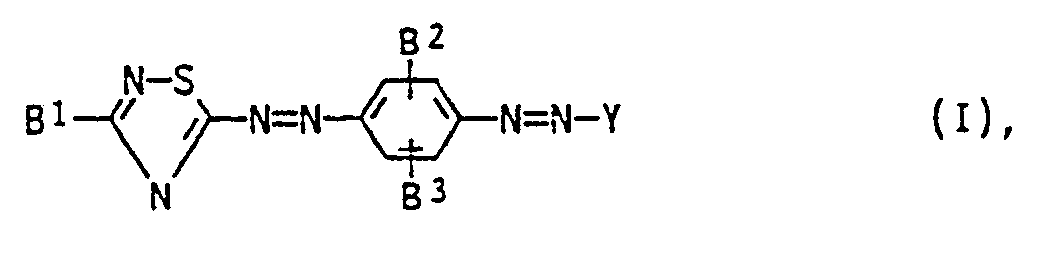
B¹ gegebenenfalls substituiertes Alkyl, Aralkyl, Cycloalkyl, Aryl, Alkylthio, Aralkylthio oder Cycloalkylthio, B² und B³ unabhängig voneinander Wasserstoff, Methoxy oder Methyl und Y einen Rest der Formel

und B⁶ für C₁- bis C₂₄-Alkyl, Cyclohexyl, 2-Phenylethyl, Benzyl, 4-(c₁- bis C₂₄-Alkyl)-benzyl, 4-Cyclohexyl-benzyl oder 4-(4'-C₁- bis C₁₂-Alkylcyclohexyl)-benzyl stehen.
Applications Claiming Priority (2)
| Application Number | Priority Date | Filing Date | Title |
|---|---|---|---|
| DE19843433927 DE3433927A1 (de) | 1984-09-15 | 1984-09-15 | Bisazofarbstoffe und ihre verwendung in fluessigkristallinen materialien oder zum faerben von synthetischen polymeren und fasern |
| DE3433927 | 1984-09-15 |
Publications (3)
| Publication Number | Publication Date |
|---|---|
| EP0175271A2 EP0175271A2 (de) | 1986-03-26 |
| EP0175271A3 EP0175271A3 (en) | 1987-12-16 |
| EP0175271B1 true EP0175271B1 (de) | 1991-03-06 |
Family
ID=6245486
Family Applications (1)
| Application Number | Title | Priority Date | Filing Date |
|---|---|---|---|
| EP85111479A Expired - Lifetime EP0175271B1 (de) | 1984-09-15 | 1985-09-11 | Bisazofarbstoffe und ihre Verwendung in flüssigkristallinen Materialien oder zum Färben von synthetischen Polymeren oder Fasern |
Country Status (4)
| Country | Link |
|---|---|
| US (1) | US4681699A (de) |
| EP (1) | EP0175271B1 (de) |
| JP (1) | JPS6173768A (de) |
| DE (2) | DE3433927A1 (de) |
Families Citing this family (3)
| Publication number | Priority date | Publication date | Assignee | Title |
|---|---|---|---|---|
| DE3934190A1 (de) * | 1989-10-13 | 1991-04-18 | Basf Ag | Malonsaeurefarbstoffe und deren polykondensationsprodukte |
| EP1706464A4 (de) * | 2003-12-19 | 2008-01-16 | Fujifilm Corp | Tinte für tintenkombination, verfahren zur herstellung von tinte für tintenkombination, tintenkombination für den tintenstrahldruck sowie tintenstrahldruckverfahren |
| JP2005187786A (ja) * | 2003-12-26 | 2005-07-14 | Fuji Photo Film Co Ltd | アゾ染料、画像形成用着色組成物、インク、インクジェット記録方法、感熱記録材料、カラートナーおよびカラーフイルター |
Citations (2)
| Publication number | Priority date | Publication date | Assignee | Title |
|---|---|---|---|---|
| US4128498A (en) * | 1977-03-28 | 1978-12-05 | Dai Nippon Toryo Co., Ltd. | Chlorosilicate phosphor |
| EP0084208A2 (de) * | 1982-01-06 | 1983-07-27 | Minnesota Mining And Manufacturing Company | Asymetrische dichroitische Farbstoffmolekule enthaltend Polyarylazo-bindeglieder und substituierte Arylthiazolsubstituenten |
Family Cites Families (5)
| Publication number | Priority date | Publication date | Assignee | Title |
|---|---|---|---|---|
| US3221005A (en) * | 1962-08-30 | 1965-11-30 | Eastman Kodak Co | Azo dyes from 5-amino-1,2,4-thiadiazoles |
| US3221006A (en) * | 1962-11-13 | 1965-11-30 | Eastman Kodak Co | 5-amino-3-substituted-1,2,4-thiadiazole azo compounds |
| CH508014A (de) * | 1969-02-19 | 1971-05-31 | Ciba Geigy Ag | Verfahren zur Herstellung von Azofarbstoffen und deren Anwendung |
| FR2225484B1 (de) * | 1973-04-13 | 1978-03-03 | Pechiney Ugine Kuhlmann | |
| DE3566901D1 (en) * | 1984-04-07 | 1989-01-26 | Merck Patent Gmbh | Liquid crystal phase |
-
1984
- 1984-09-15 DE DE19843433927 patent/DE3433927A1/de not_active Withdrawn
-
1985
- 1985-09-11 DE DE8585111479T patent/DE3581989D1/de not_active Expired - Lifetime
- 1985-09-11 JP JP60199637A patent/JPS6173768A/ja active Pending
- 1985-09-11 EP EP85111479A patent/EP0175271B1/de not_active Expired - Lifetime
- 1985-09-16 US US06/776,461 patent/US4681699A/en not_active Expired - Fee Related
Patent Citations (2)
| Publication number | Priority date | Publication date | Assignee | Title |
|---|---|---|---|---|
| US4128498A (en) * | 1977-03-28 | 1978-12-05 | Dai Nippon Toryo Co., Ltd. | Chlorosilicate phosphor |
| EP0084208A2 (de) * | 1982-01-06 | 1983-07-27 | Minnesota Mining And Manufacturing Company | Asymetrische dichroitische Farbstoffmolekule enthaltend Polyarylazo-bindeglieder und substituierte Arylthiazolsubstituenten |
Also Published As
| Publication number | Publication date |
|---|---|
| DE3581989D1 (de) | 1991-04-11 |
| EP0175271A2 (de) | 1986-03-26 |
| JPS6173768A (ja) | 1986-04-15 |
| DE3433927A1 (de) | 1986-03-27 |
| EP0175271A3 (en) | 1987-12-16 |
| US4681699A (en) | 1987-07-21 |
Similar Documents
| Publication | Publication Date | Title |
|---|---|---|
| EP0155507B1 (de) | Azofarbstoffe und flüssigkristalline Materialien enthaltend diese Farbstoffe | |
| EP0067354B1 (de) | Flüssigkristallines Material enthaltend Azofarbstoffe | |
| EP0069257B1 (de) | Flüssigkristallines Dielektrikum und elektrooptisches Anzeigeelement | |
| EP0054217A1 (de) | Anthrachinonfarbstoffe, Verfahren zu ihrer Herstellung, ihre Verwendung sowie flüssigkristalline Materialien enthaltend Anthrachinonfarbstoffe | |
| GB2061994A (en) | Dye-containing liquid crystal compositions | |
| DE3014933A1 (de) | Fluessigkristalline materialien enthaltend anthrachinonfarbstoffe | |
| DE3036853C2 (de) | Zusammensetzung auf Flüssigkristallbasis für elektrooptische Vorrichtungen | |
| EP0093367B1 (de) | Anthrachinonfarbstoffe, ihre Herstellung und Verwendung sowie dichroitisches Material enthaltend diese Anthrachinonfarbstoffe | |
| EP0111779B1 (de) | Azofarbstoffe und flüssigkristallines Material enthaltend Azofarbstoffe | |
| DE3137298A1 (de) | Anthrachinonfarbstoffe | |
| EP0111197B1 (de) | Anthrachinonfarbstoffe, ihre Herstellung und Verwendung sowie dichroitisches Material enthaltend Anthrachinonfarbstoffe | |
| EP0144020B1 (de) | Azofarbstoffe und flüssigkristalline Materialien enthaltend diese Farbstoffe | |
| DE19618586B4 (de) | Monoazo-Dispersionsfarbstoffe | |
| EP0175271A2 (de) | Bisazofarbstoffe und ihre Verwendung in flüssigkristallinen Materialien oder zum Färben von synthetischen Polymeren oder Fasern | |
| EP0103095B1 (de) | Dichroitisches Material, enthaltend Anthrachinonfarbstoffe | |
| DE3529988A1 (de) | Trisazofarbstoffe und deren verwendung in fluessigkristallinen materialien | |
| DE3536267A1 (de) | Azofarbstoffe sowie fluessigkristallines material enthaltend azofarbstoffe | |
| EP0134471B1 (de) | Azofarbstoffe und flüssigkristalline Materialien enthaltend diese Farbstoffe | |
| DE2715135C2 (de) | Azofarbstoffe | |
| EP0268154A2 (de) | Trisazofarbstoffe | |
| DE3342578A1 (de) | Azofarbstoffe und fluessigkristalline materialien, enthaltend diese farbstoffe | |
| EP0198206A1 (de) | Azofarbstoffe | |
| DE2010491C3 (de) | In Wasser lösliche Azofarbstoffe und ihre Verwendung | |
| DE4121754A1 (de) | Azo-dispersionsfarbstoffe | |
| DE1816511A1 (de) | Wasserunloesliche Monoazofarbstoffe und Verfahren zu ihrer Herstellung |
Legal Events
| Date | Code | Title | Description |
|---|---|---|---|
| PUAI | Public reference made under article 153(3) epc to a published international application that has entered the european phase |
Free format text: ORIGINAL CODE: 0009012 |
|
| AK | Designated contracting states |
Kind code of ref document: A2 Designated state(s): CH DE FR GB IT LI |
|
| PUAL | Search report despatched |
Free format text: ORIGINAL CODE: 0009013 |
|
| AK | Designated contracting states |
Kind code of ref document: A3 Designated state(s): CH DE FR GB IT LI |
|
| 17P | Request for examination filed |
Effective date: 19871110 |
|
| 17Q | First examination report despatched |
Effective date: 19880817 |
|
| GRAA | (expected) grant |
Free format text: ORIGINAL CODE: 0009210 |
|
| AK | Designated contracting states |
Kind code of ref document: B1 Designated state(s): CH DE FR GB IT LI |
|
| ITF | It: translation for a ep patent filed | ||
| REF | Corresponds to: |
Ref document number: 3581989 Country of ref document: DE Date of ref document: 19910411 |
|
| GBT | Gb: translation of ep patent filed (gb section 77(6)(a)/1977) | ||
| ET | Fr: translation filed | ||
| PGFP | Annual fee paid to national office [announced via postgrant information from national office to epo] |
Ref country code: GB Payment date: 19910805 Year of fee payment: 7 |
|
| PGFP | Annual fee paid to national office [announced via postgrant information from national office to epo] |
Ref country code: FR Payment date: 19910807 Year of fee payment: 7 |
|
| PGFP | Annual fee paid to national office [announced via postgrant information from national office to epo] |
Ref country code: CH Payment date: 19910808 Year of fee payment: 7 |
|
| PGFP | Annual fee paid to national office [announced via postgrant information from national office to epo] |
Ref country code: DE Payment date: 19910921 Year of fee payment: 7 |
|
| PLBE | No opposition filed within time limit |
Free format text: ORIGINAL CODE: 0009261 |
|
| STAA | Information on the status of an ep patent application or granted ep patent |
Free format text: STATUS: NO OPPOSITION FILED WITHIN TIME LIMIT |
|
| 26N | No opposition filed | ||
| PG25 | Lapsed in a contracting state [announced via postgrant information from national office to epo] |
Ref country code: GB Effective date: 19920911 |
|
| PG25 | Lapsed in a contracting state [announced via postgrant information from national office to epo] |
Ref country code: DE Effective date: 19920921 |
|
| PG25 | Lapsed in a contracting state [announced via postgrant information from national office to epo] |
Ref country code: LI Effective date: 19920930 Ref country code: CH Effective date: 19920930 |
|
| GBPC | Gb: european patent ceased through non-payment of renewal fee |
Effective date: 19920911 |
|
| PG25 | Lapsed in a contracting state [announced via postgrant information from national office to epo] |
Ref country code: FR Effective date: 19930528 |
|
| REG | Reference to a national code |
Ref country code: CH Ref legal event code: PL |
|
| REG | Reference to a national code |
Ref country code: FR Ref legal event code: ST |