EP0174643B2 - Verfahren und Vorrichtung zur kontinuierlichen Beschichtung von Kunststoff-Bodenbelägen mit strukturierter Oberfläche - Google Patents
Verfahren und Vorrichtung zur kontinuierlichen Beschichtung von Kunststoff-Bodenbelägen mit strukturierter Oberfläche Download PDFInfo
- Publication number
- EP0174643B2 EP0174643B2 EP85111462A EP85111462A EP0174643B2 EP 0174643 B2 EP0174643 B2 EP 0174643B2 EP 85111462 A EP85111462 A EP 85111462A EP 85111462 A EP85111462 A EP 85111462A EP 0174643 B2 EP0174643 B2 EP 0174643B2
- Authority
- EP
- European Patent Office
- Prior art keywords
- floor covering
- coating
- roller
- coating agent
- floor
- Prior art date
- Legal status (The legal status is an assumption and is not a legal conclusion. Google has not performed a legal analysis and makes no representation as to the accuracy of the status listed.)
- Expired - Lifetime
Links
- 239000011248 coating agent Substances 0.000 title claims abstract description 44
- 238000000576 coating method Methods 0.000 title claims abstract description 25
- 238000000034 method Methods 0.000 title claims abstract description 15
- 239000006185 dispersion Substances 0.000 claims abstract description 9
- 238000004519 manufacturing process Methods 0.000 claims abstract description 6
- 239000004014 plasticizer Substances 0.000 claims abstract description 6
- 230000005855 radiation Effects 0.000 claims abstract description 5
- 150000001252 acrylic acid derivatives Chemical class 0.000 claims abstract description 4
- 239000002904 solvent Substances 0.000 claims abstract description 4
- NIXOWILDQLNWCW-UHFFFAOYSA-M Acrylate Chemical compound [O-]C(=O)C=C NIXOWILDQLNWCW-UHFFFAOYSA-M 0.000 claims abstract description 3
- 229920002635 polyurethane Polymers 0.000 claims abstract description 3
- 239000004814 polyurethane Substances 0.000 claims abstract description 3
- 238000007664 blowing Methods 0.000 claims abstract 2
- 229920000642 polymer Polymers 0.000 claims abstract 2
- 239000011347 resin Substances 0.000 claims abstract 2
- 229920005989 resin Polymers 0.000 claims abstract 2
- 238000010438 heat treatment Methods 0.000 claims description 5
- 229920001971 elastomer Polymers 0.000 claims description 3
- 239000005060 rubber Substances 0.000 claims description 3
- 238000009408 flooring Methods 0.000 description 8
- 229920003023 plastic Polymers 0.000 description 7
- 239000004033 plastic Substances 0.000 description 6
- 238000013461 design Methods 0.000 description 4
- 230000000694 effects Effects 0.000 description 2
- 239000000463 material Substances 0.000 description 2
- 229920003229 poly(methyl methacrylate) Polymers 0.000 description 2
- 239000004926 polymethyl methacrylate Substances 0.000 description 2
- 239000000758 substrate Substances 0.000 description 2
- 229920001944 Plastisol Polymers 0.000 description 1
- 239000002202 Polyethylene glycol Substances 0.000 description 1
- 229910000831 Steel Inorganic materials 0.000 description 1
- 238000010073 coating (rubber) Methods 0.000 description 1
- 230000001427 coherent effect Effects 0.000 description 1
- 150000001875 compounds Chemical class 0.000 description 1
- 238000007796 conventional method Methods 0.000 description 1
- 239000004815 dispersion polymer Substances 0.000 description 1
- 230000009969 flowable effect Effects 0.000 description 1
- 230000002427 irreversible effect Effects 0.000 description 1
- 238000012423 maintenance Methods 0.000 description 1
- 238000013508 migration Methods 0.000 description 1
- 230000005012 migration Effects 0.000 description 1
- 239000000203 mixture Substances 0.000 description 1
- 239000000049 pigment Substances 0.000 description 1
- 239000004999 plastisol Substances 0.000 description 1
- 229920001223 polyethylene glycol Polymers 0.000 description 1
- 230000002028 premature Effects 0.000 description 1
- 230000001681 protective effect Effects 0.000 description 1
- 230000000717 retained effect Effects 0.000 description 1
- 230000003678 scratch resistant effect Effects 0.000 description 1
- 239000010959 steel Substances 0.000 description 1
- 229920001169 thermoplastic Polymers 0.000 description 1
- 229920002554 vinyl polymer Polymers 0.000 description 1
Images
Classifications
-
- D—TEXTILES; PAPER
- D06—TREATMENT OF TEXTILES OR THE LIKE; LAUNDERING; FLEXIBLE MATERIALS NOT OTHERWISE PROVIDED FOR
- D06N—WALL, FLOOR, OR LIKE COVERING MATERIALS, e.g. LINOLEUM, OILCLOTH, ARTIFICIAL LEATHER, ROOFING FELT, CONSISTING OF A FIBROUS WEB COATED WITH A LAYER OF MACROMOLECULAR MATERIAL; FLEXIBLE SHEET MATERIAL NOT OTHERWISE PROVIDED FOR
- D06N3/00—Artificial leather, oilcloth or other material obtained by covering fibrous webs with macromolecular material, e.g. resins, rubber or derivatives thereof
- D06N3/04—Artificial leather, oilcloth or other material obtained by covering fibrous webs with macromolecular material, e.g. resins, rubber or derivatives thereof with macromolecular compounds obtained by reactions only involving carbon-to-carbon unsaturated bonds
- D06N3/06—Artificial leather, oilcloth or other material obtained by covering fibrous webs with macromolecular material, e.g. resins, rubber or derivatives thereof with macromolecular compounds obtained by reactions only involving carbon-to-carbon unsaturated bonds with polyvinylchloride or its copolymerisation products
- D06N3/08—Artificial leather, oilcloth or other material obtained by covering fibrous webs with macromolecular material, e.g. resins, rubber or derivatives thereof with macromolecular compounds obtained by reactions only involving carbon-to-carbon unsaturated bonds with polyvinylchloride or its copolymerisation products with a finishing layer consisting of polyacrylates, polyamides or polyurethanes or polyester
Definitions
- the invention relates to a method and a device for the continuous coating of plastic floor coverings with a structured surface, in particular of structured PVC floor coverings, with a surface finish.
- Plastic floor coverings with a structured surface are used to a large extent today as floor surfaces, above all because of their diverse decorative surface design and their extensive resistance to wear and tear.
- PVC floor coverings are used to a large extent today as floor surfaces, above all because of their diverse decorative surface design and their extensive resistance to wear and tear.
- Such effective initial maintenance of the installed flooring is, however, only very rarely carried out on site by the supplier.
- the cases in which the buyer does such initial care in the "Do it your self" process after the floor covering has been laid are also exceptional. If such initial care is carried out at all, it is very often inadequate. incorrect or done too late. and above all, it is carried out without an adhesion-enhancing heat.
- WO 82/02 681 describes a process for the production of a decorative film material by printing a polyvinyl film with a plurality of pigment-based plastisols, a transparent plastic layer being knife-coated onto the decorative pattern layer after the last printing process and before hardening, and then the entire layer structure is dried in an oven.
- the literature reference does not show that the surface of the base material is even.
- the invention is based on the object of creating a method and a device of the type mentioned at the beginning. with which it is possible in a simple and inexpensive way to produce a floor covering that is already professionally provided with a uniform anti-soiling finish on the surface with a layer thickness of 1-50 ⁇ m, as a result of which the above-mentioned difficulties and phenomena no longer occur at the end customer of the floor covering can.
- the coating of the floor covering surface in a fresh, wettable state is intended to achieve particularly good adhesion and particularly good durability of the protective film, which is otherwise not possible with the conventional methods.
- This object is achieved in that the coating of the surface of the floor covering in the factory. subsequent to the manufacture of the flooring.
- a polymer dispersion based on pure acrylates in conjunction with corresponding temporary and permanent plasticizers or as a solvent-containing coating agent is applied to the floor covering by means of a roller system as an aqueous coating agent, or an organosol based on acrylate or polyurethane.
- the surface design of the coating applied to the structured flooring is uneven. which is why the applied coating is first blown using a gas stream, e.g. B. air is evened out to get a uniform layer thickness of the order on the finished flooring. Then the still moist coating on the floor covering is dried, hardened and fixed by means of thermal radiation.
- a gas stream e.g. B. air
- the method according to the invention is suitable for coating endless floor coverings with a surface finish with a web width of the floor covering of more than 4 meters.
- the throughput speed of the floor covering can be 1 to 80 m / min.
- a throughput speed of 10 to 30 m / min has proven to be particularly suitable.
- the layer thickness of the application on the structured flooring is even and adjustable from about 1 to 50 ⁇ m. With a layer thickness of 3 to 20 ⁇ m, the desired effect is already fully achieved in most cases.
- a device for performing the invention The method is characterized by the features of claim 3.
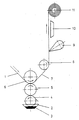
- 1 denotes the structured floor covering web to be tapered from the production process.
- a trough 2 contains the aqueous and / or solvent-containing coating agent 3.
- a roller 4 is immersed and takes a corresponding proportion of the coating agent with it.
- the coating agent entrained by the roller 4 is then transferred to the surface of an application roller 5 rotating in the opposite direction of rotation.
- the structured floor covering is pressed against this application roller 5 by a deflecting roller 6 and the coating agent is accordingly applied to the surface of the floor covering.
- d. H. to accomplish.
- the coating film is applied to the entire surface of the structured floor covering, in particular also to the lower lying areas, it has proven to be advantageous that the application roller 5 has a closed, smooth rubber surface.
- the coated floor covering 7 is guided past a nozzle 9 by means of a further deflecting roller 8 in order to homogenize the application layer, by means of which a gas stream, e.g. B. air, the surface of the application layer blows, whereby a flat surface of the coating is formed.
- a gas stream e.g. B. air
- the coated floor covering with its still flowable application layer is then guided past a heating device 10 and the applied layer is dried, hardened and fixed.
- a heating device a heat radiation source, for. B. uses an IR radiator field.
- This process not only dries the coating applied to the top of the floor covering as anti-soiling equipment. but the effect of heat also ensures good adhesion between the floor covering and the coating.
- a 4.08 meter wide track of a chemically shaped one. structured CV flooring is fed to an impression roller at a throughput speed of 20 m / min.
- This dispersion is about 20% by weight of polymethyl methacrylate and is pumped around with the corresponding dispersion located in a storage container.
- dispersion By means of a rotating steel roller immersed in the dispersion, dispersion is continuously taken out of the tub and transferred to an application roller which has a rubber coating.
- the surface of the CV floor covering is covered with a thinner, coherent, endless. coated on the structured surface of the covering.
- the CV floor covering coated in this way is then guided past an air nozzle via a deflection roller. which blows the still wet application with an air flow of around 40 ° C and smoothes the application.
- the uniform dispersion film is then passed onto the CV floor covering by an IR radiator field, which has an output of 2 x 8,000 Kcal / m2 (2 x 33,500 KJ / m2), and the dispersion film is dried in the process. hardened and fixed on the surface of the CV flooring. After the last process, the coating has a thickness of approximately 6 ⁇ m, which corresponds to an application weight of approximately 30 g / m 2 of coating film.
- the CV floor covering which is equipped with the anti-soiling equipment, is then rolled up on a supply roll.
- a floor covering in particular a structured PVC floor covering, which is provided with anti-soiling equipment immediately after the production process, with good adhesion between the floor covering and the coating being achieved.
- a uniform coating of the floor covering is achieved. the deeper areas of the structuring also being provided with the coating agent. The design is not affected and the degree of gloss or matt of the surface of the floor covering due to the covering can, if necessary, also be retained.
Landscapes
- Chemical & Material Sciences (AREA)
- Chemical Kinetics & Catalysis (AREA)
- Engineering & Computer Science (AREA)
- Textile Engineering (AREA)
- Floor Finish (AREA)
- Application Of Or Painting With Fluid Materials (AREA)
- Synthetic Leather, Interior Materials Or Flexible Sheet Materials (AREA)
- Shaping Of Tube Ends By Bending Or Straightening (AREA)
Description
- Die Erfindung betrifft ein Verfahren und eine Vorrichtung zur kontinuierlichen Beschichtung von Kunststoff-Bodenbelägen mit strukturierter Oberfläche, insbesondere von strukturierten PVC-Bodenbelägen, mit einer Öberflächenausrüstung.
- Kunststoff-Bodenbeläge mit strukturierter Oberfläche, insbesondere sogenannte chemisch geprägte PVC-Bodenbeläge, finden heute in groBem Umfang Verwendung als Fußbodenoberflächen, vor allem wegen ihrer verschiedenartigen dekorativen Oberflächengestaltung und ihrer weitgehenden Beständigkeit gegen Abnützung. Um ein gepflegtes Aussehen nach der Verlegung für einen längeren Zeitraum zu erhalten, ist aber eine Pflege der Oberflache dieser Bodenbeläge notwendig. Eine solche wirksame Erstpflege des verlegten Bodenbelages wird jedoch bei der Verlegung durch den Lieferanten an Ort und Stelle nur sehr selten vorgenommen. Auch die Fälle, in denen der Käufer im "Do it your self "-Verfahren nach erfolgter Verlegung des Bodenbelages eine solche Erstpflege vornimmt, sind die Ausnahme. Wenn eine solche Erstpflege überhaupt durchgeführt wird, ist diese sehr häufig unzureichend. fehlerhaft oder wird zu spät vorgenommen. und sie wird vor allen Dingen auch ohne eine haftverbessernde Wärmeeinwirkung vorgenommen. Dadurch kommt es bei solchen strukturierten Bodenbelägen. insbesondere wenn diese eine helle Farbstellung aufweisen, zur irreversiblen, vorzeitigen Anschmutzungen. Es entstehen Gehzonen. Gummiabsatzmarkierungen usw., die dann später nicht mehr zu entfernen sind. Außerdem haben chemisch geprägte PVC-Bodenbeläge die Eigenschaft. daß der stets enthaltene Weichmacher innerhalb von Tagen und wochen durch Migration einen Weichmacherfilm auf der Bodenbelagsoberfläche ausbildet. der besonders schmutzanfällig ist und zudem wie eine Trennschicht gegenüber dem später üblicherweise vom Endverbraucher aufgebrachten Pflegemittel wirkt.
- Aus der DE-B-28 40 581 ist es bekannt. einen aus thermoplastischen Kunststoffen bestehenden strukturierten Bodenbelag mit einer durchsichtigen, widerstandsfähigen und kratzfesten Trittschicht aus einem photopolymerisierbaren Kunststoff zu versehen. Der Kunststoff wird dabei vorhangartig freifließend auf ein Substrat aufgebracht, wobei unter der Beschichtungsmasse Luftblasen eingeschlossen werden.
- Um dies zu vermeiden, müssen daher in einem vorhergehenden. technisch aufwendigen Arbeitsschritt vor dem Auftragen des Kunststoffes wenigstens die Vertiefungen des Substrates mit einer Mischung aus einem ungesättigten Acrylat benetzt werden. Eine Vergleichmäßigung des aufgetragenen Kunststoffes kann so nicht durchgeführt werden.
- In der WO 82/02 681 wird ein Verfahren zur Herstellung eins dekorativen Folienmaterials durch Bedrucken einer Polyvinyl-Folie mit einer Mehrzahl von pigmentienten Plastisolen beschrieben, wobei nach dem letzten Druckvorgang und vor dem Harten eine durchsichtige Kunststoffschicht auf die dekorative Musterschicht aufgerakelt wird, worauf dann das gesamte Schichtgebilde in einem Ofen getrocknet wird. Eine Vergleichmäßigung der Oberfläche des Grundmaterials ist der Literaturstelle nicht zu entnehmen.
- Der Erfindung liegt nun die Aufgabe zu Grunde, ein Verfahren und eine Vorrichtung der Eingangs genannten Art zu schaffen. mit denen es auf einfache und kostengünstige Weise möglich ist, einen Bodenbelag herzustellen, der bereits fachgerecht mit einer gleichmäßigen Antischmutzausrüstung an der Oberfläche mit einer Schichtdicke von 1-50 µm versehen ist, wodurch die oben genannten Schwierigkeiten und Erscheinungen beim Endabnehmer des Bodenbelages nicht mehr auftreten können. Zusätzlich sollen durch die Beschichtung der Bodenbelagsoberfläche in einem frischen benetzungsfähigen Zustand eine besonders gute Adhäsion und eine besonders gute Dauerhaftigkeit des Schutzfilmes erzielt werden, wie sie sonst mit den herkömmlichen Methoden nicht erreicht wird.
- Diese Aufgabe wird erfindungsgemäß dadurch gelöst, daß die Beschichtung der Oberfläche des Bodenbelages gleich werksseitig. anschließend an die Herstellung des Bodenbelages vorgenommen wird. Dazu wird auf den Bodenbelag mittels eines Walzensystems gemäß Anspruch 3 als wäßriges Beschichtungsmittel eine Polymerdispersion auf der Basis von Reinacrylaten in Verbindung mit entsprechenden temporär und permanent wirkenden Weichmachern oder als lösungsmittelhaltiges Beschichtungsmittel ein Organosol auf Basis von Acrylat oder Polyurethan aufgebracht.
- Die auf den strukturierten Bodenbelag aufgebrachte Beschichtung ist dabei in ihrer Oberflächengestaltung ungleichmäßig. weshalb die aufgetragene Beschichtung zunächst durch Anblasen mittels eines Gasstromes, z. B. Luft vergleichmäßigt wird, um auf den fertigen Bodenbelag eine gleichmäßige Schichtdicke des Auftrags zu erhalten. Anschließend wird die auf dem Bodenbelag befindliche noch feuchte Beschichtung mittels einer Wärmestrahlung getrocknet, gehärtet und fixiert.
- Das erfindungsgemäße Verfahren ist dabei geeignet für Beschichtung von endlosen Bodenbelägen mit einer Oberflächenausrüstung mit einer Bahnbreite des Bodenbelages bis über 4 Meter. Die Durchlaufgeschwindigkeit des Bodenbelages kann dabei 1 bis 80 m/min betragen. Als besonders geeignet hat sich eine Durchlaufgeschwindigkeit von 10 bis 30 m/min herherausgestellt.
- Die Schichtdicke des Auftrages auf dem strukturierten Bodenbelag ist dabei gleichmäßig und von etwa 1 bis 50 µm einstellbar. Mit einer Schichtdicke des Auftrages von 3 bis 20 µm wird bereits in den meisten Fallen der angestrebte Effekt voll erreicht.
- Eine Vorrichtung zur Durchführung des erfindungsgemäßen Verfahrens ist durch die Merkmale des Anspruches 3 gekennzeichnet.
- Weitere zweckmäßige Ausbildungen der Vorrichtung enthalten die Ansprüche 4-7.
- Die Erfindung wird anhand einer Schema-Zeichnung weiter veranschaulicht:
- In dieser Zeichnung ist mit 1 die von dem Produktionsvorgang zulaufende strukturierte Bodenbelagsbahn bezeichnet. Eine Wanne 2 enthalt das wässrige und/oder lösungsmittelhaltige Beschichtungsmittel 3. in das eine Walze 4 eintaucht und einen entsprechenden Anteil des Beschichtungsmittels mitnimmt. Das von der Walze 4 mitgenommene Beschichtungsmittel wird dann auf die Oberfläche einer im entgegengesetzten Drehsinn umlaufenden Auftragswalze 5 übertragen. Gegen diese Auftragswalze 5 wird durch eine Umlenkwalze 6 der strukturierte Bodenbelag angedrückt und dementsprechend auf die Oberfläche des Bodenbelages das Beschichtungsmittel aufgebracht. Um einen guten Auftrag des Beschichtungsmittels auf die Oberfläche des Bodenbelages zu gewährleisten, d. h. zu bewerkstelligen. daß der Beschichtungsfilm auf die gesamte Oberfläche des strukturierten Bodenbelages, insbesondere auch auf die tiefer liegenden Flächen aufgetragen wird, hat es sich dabei als vorteilhaft herausgestellt, daß die Auftragswalze 5 eine geschlossene glatte Oberfläche aus Gummi aufweist. Nach dem Auftrag des Beschichtungsmittels auf den strukturierten Bodenbelag wird der beschichtete Bodenbelag 7 über eine weitere Umlenkwalze 8 zur Vergleichmäßigung der Auftragsschicht an einer Düse 9 vorbeigeführt, mittels derer ein Gasstrom, z. B. Luft, die Oberfläche der Auftragsschicht anbläst, wodurch sich eine ebene Oberfläche der Beschichtung ausbildet.
- Anschließend wird der beschichtete Bodenbelag mit seiner noch fließbaren Auftragsschicht an einer Heizeinrichtung 10 vorbeigeführt und die aufgetragene Schicht getrocknet, gehärtet und fixiert. Als Heizeinrichtung wird eine Wärmestrahlungsquelle, z. B. ein IR-Strahlerfeld verwendet.
- Durch diesen Vorgang wird die als Antischmutzausrüstung auf die Oberseite des Bodenbelags aufgebrachte Beschichtung nicht nur getrocknet. sondern durch die Wärmeeinwirkung wird auch eine gute Haftung zwischen dem Bodenbelag und der Beschichtung erreicht.
- Eine 4.08 Meter breite Bahn eines chemisch geprägten. strukturierten CV-Bodenbelages wird einem Presseur zugeführt, mit einer Durchlaufgeschwindigkeit von 20 m/min. In einer Wanne befindet sich eine wässrige Dispersion aus Polymethylmethacrylat und Polyäthylenglykol als Weichmacher.
- Diese Dispersion ist etwa 20-gewichtsprozentig an Polymethylmethacrylat und wird mit der in einem Vorratsbehälter befindlichen entsprechenden Dispersion umgepumpt.
- Mittels einer umlaufenden, in die Dispersion eintauchenden Stahlwalze wird laufend Dispersion aus der Wanne mitgenommen und auf eine Auftragswalze übertragen die eine Gummiummantelung besitzt.
- Bei dem Durchlauf des CV-Bodenbelages zwischen der Umlenkwalze und der Auftragswalze wird die Oberfläche des CV-Bodenbelages mit einem dünner zusammenhängenden, endlosen. der strukturierten Oberfläche des Belages anliegenden Dispersionsfilm beschichtet. Anschließend wird der so beschichtete CV-Bodenbelag über eine Umlenkwalze an einer Luftdüse vorbeigeführt. die mit einem etwa 40 °C warmen Luftstrom den noch nassen Auftrag anbläst und den Auftrag vergleichmäßigt. Darauf wird der vergleichmäßigte Dispersionsfilm auf den CV-Bodenbelag an einem IR-Strahlerfeld vorbeigeführt, das eine Leistung von 2 x 8 000 Kcal/m² (2 x 33 500 KJ/m²) besitzt, und dabei der Dispersionsfilm getrocknet. gehärtet und auf die Oberfläche des CV-Bodenbelages fixiert. Die Beschichtung weist nach dem letzten Vorgang eine Stärke von etwa 6 µm auf, was einem Auftragsgewicht von ungefähr 30 g/m² an Beschichtungsfilm entspricht.
- Darauf wird der mit der Antischmutzausrüstung versehene CV-Bodenbelag auf einer Vorratswaize aufgerollt.
- Die mit der Erfindung erzielten Vorteile bestehen, insbesondere darin, daß ein Bodenbelag. insbesondere ein strukturiener PVC-Bodenbelag, gleich anschließend an den Produktionsvorgang mit einer Antischmutzausrüstung versehen wird, wobei eine gute Haftung zwischen dem Bodenbelag und der Beschichtung erreicht wird. Es wird dabei eine gleichmäßige Beschichtung des Bodenbelages erzielt. wobei auch die tieferliegenden Bereiche der Strukturierung mit dem Beschichtungsmittel versehen werden. Das Dessin wird nicht beeinträchtigt und die belagsbedingten Glanz- bzw. Mattgrade der Oberfläche des Bodenbelages können, wenn erforderlich, dabei ebenfalls erhalten bleiben.
Claims (7)
- Verfahren zur kontinuierlichen Beschichtung von Kunststoff-Bodenbelägen mit strukturierter Oberfläche, insbesondere von strukturierten PVC-Bodenbelägen, mit einer Oberflächenausrüstung 1-50 µm dadurch gekennzeichnet, daß die Beschichtung der Oberfläche der Bodenbelages werksseitig anschließend an die Herstellung des Bodenbelages erfolgt, auf den Bodenbelag mittels eines Walzensystems gemäß Anspruch 3 als wässrige Beschichtungsmittel Polymerdispersionen auf der Basis von Reinacrylaten in Verbindung mit einem Weichmacher aufgebraucht werden oder als lösungsmittelhaltige Beschichtungsmittel Organosole auf der Basis von Acrylat oder Polyurethan aufgebracht werden, darauf eine Vergleichmäßigung des auf den Bodenbelag aufgetragenen Beschichtungsmittels durch Anblasen mittels eines Gasstromes erfolgt. anschließend die so aufgetragene vergleichmäßigte Beschichtung mittels Wärmestrahlung getrocknet, dabei gehärtet und fixiert wird, worauf der beschichtete Bodenbelag auf eine Vorratsrolle aufgerollt wird.
- Verfahren nach Anspruch 1, dadurch ge kennzeichnet, daß der Auftrag des Beschichtungsmittels auf den mit einer Geschwindigkeit von 1 bis 80 m/min, vorzugsweise 10 bis 30 m/min, durchlaufenden Bodenbelag erfolgt.
- Vorrichtung zur Durchführung des Verfahrens nach einem der Ansprüche 1 oder 2, dadurch gekennzeichnet. daß sie besteht aus einer Wanne (2), die das Beschichtungsmittel (3) enthält, einer Walze (4), die aus der Wanne (2) das Beschichtungsmittel (3) aufnimmt, einer Auftragswalze (5), die von der Walze (4) das Beschichtungsmittel (3) übernimmt und auf die Oberfläche des Bodenbelages (1) aufbringt, einer Umlenkwalze (6), die den Bodenbelag (1) gegen die Auftragswalze (5) andrückt, einer weiteren Umlenkwalze (8), über die der beschichtete Bodenbelag (7) geführt wird. einer Anblasvorrichtung (9), mittels derer die Oberfläche der Beschichtung auf dem Bodenbelag vergleichmäßigt wird, einer Heizeinrichtung (10). mittels derer die Beschichtung auf dem Bodenbelag getrocknet, gehärtet und fixiert wird und einer Aufrollwalze (11), auf die der beschichtete Bodenbelag aufgerollt wird.
- Vorrichtung nach Anspruch 3, dadurch gekennzeichnet, daß die Auftragswalze (5) eine aus Gummi bestehende. geschlossene, glatte Oberfläche aufweist.
- Vorrichtung nach einem der Ansprüche 3 oder 4, dadurch gekennzeichnet, daß als Anblasvorrichtung (9) eine Gasdüse vorhanden ist.
- Vorrichtung nach einem der Anspruche 3 bis 5, dadurch gekennzeichnet, daß als Heizeinrichtung (10) eine Warmluftdüse angeordnet ist.
- Vorrichtung nach einem der Ansprüche 3 bis 5, dadurch gekennzeichnet, daß als Heizeinrichtung (10) ein IR-Strahlerfeld benutzt wird.
Priority Applications (1)
| Application Number | Priority Date | Filing Date | Title |
|---|---|---|---|
| AT85111462T ATE39955T1 (de) | 1984-09-12 | 1985-09-11 | Verfahren und vorrichtung zur kontinuierlichen beschichtung von kunststoff-bodenbelaegen mit strukturierter oberflaeche. |
Applications Claiming Priority (2)
| Application Number | Priority Date | Filing Date | Title |
|---|---|---|---|
| DE19843433382 DE3433382A1 (de) | 1984-09-12 | 1984-09-12 | Verfahren und vorrichtung zur kontinuierlichen beschichtung von kunststoff-bodenbelaegen mit strukturierter oberflaeche |
| DE3433382 | 1984-09-12 |
Publications (3)
| Publication Number | Publication Date |
|---|---|
| EP0174643A1 EP0174643A1 (de) | 1986-03-19 |
| EP0174643B1 EP0174643B1 (de) | 1989-01-11 |
| EP0174643B2 true EP0174643B2 (de) | 1994-02-09 |
Family
ID=6245161
Family Applications (1)
| Application Number | Title | Priority Date | Filing Date |
|---|---|---|---|
| EP85111462A Expired - Lifetime EP0174643B2 (de) | 1984-09-12 | 1985-09-11 | Verfahren und Vorrichtung zur kontinuierlichen Beschichtung von Kunststoff-Bodenbelägen mit strukturierter Oberfläche |
Country Status (3)
| Country | Link |
|---|---|
| EP (1) | EP0174643B2 (de) |
| AT (1) | ATE39955T1 (de) |
| DE (2) | DE3433382A1 (de) |
Families Citing this family (2)
| Publication number | Priority date | Publication date | Assignee | Title |
|---|---|---|---|---|
| DE3816710A1 (de) * | 1988-05-17 | 1989-11-23 | Pegulan Werke Ag | Verwendung von acrylat-plastisolen zur herstellung von laufschichten fuer pvc-bodenbelaege |
| CA2371246C (en) | 1999-04-28 | 2008-12-02 | Ecolab Inc. | Polymer surface coating made by coalescing polymer particulate with a coalescing agent |
Family Cites Families (6)
| Publication number | Priority date | Publication date | Assignee | Title |
|---|---|---|---|---|
| GB1404616A (en) * | 1972-11-27 | 1975-09-03 | Wiggins Teape Research Dev Ltd | Apparatus for applying a coating to a web of material |
| US4008349A (en) * | 1974-08-28 | 1977-02-15 | Congoleum Corporation | Method for continuously applying a uniform resinous coating by passing the substrate through a free hanging loop containing the coating composition |
| US4150169A (en) * | 1977-12-27 | 1979-04-17 | Armstrong Cork Company | Method for manufacturing an embossed vinyl surface covering having a clear photopolymerized coating |
| US4355065A (en) * | 1980-04-28 | 1982-10-19 | Milliken Research Corporation | Soil-resistant textile materials |
| US4321884A (en) * | 1981-01-22 | 1982-03-30 | National Steel Corporation | Coating thickness control nozzle |
| US4379185A (en) * | 1981-02-13 | 1983-04-05 | American Biltrite, Inc. | Method for manufacture of inlaid vinyl-flooring |
-
1984
- 1984-09-12 DE DE19843433382 patent/DE3433382A1/de not_active Withdrawn
-
1985
- 1985-09-11 AT AT85111462T patent/ATE39955T1/de not_active IP Right Cessation
- 1985-09-11 DE DE8585111462T patent/DE3567491D1/de not_active Expired
- 1985-09-11 EP EP85111462A patent/EP0174643B2/de not_active Expired - Lifetime
Also Published As
| Publication number | Publication date |
|---|---|
| EP0174643A1 (de) | 1986-03-19 |
| ATE39955T1 (de) | 1989-01-15 |
| EP0174643B1 (de) | 1989-01-11 |
| DE3433382A1 (de) | 1986-03-20 |
| DE3567491D1 (en) | 1989-02-16 |
Similar Documents
| Publication | Publication Date | Title |
|---|---|---|
| DE68922490T2 (de) | Trocknungsverfahren. | |
| DE60007560T2 (de) | Herstellungsverfahren für wand- und bodenbeläge, die einen differentierten glanz zeigen | |
| DE3151785C2 (de) | Fußbodenbelag | |
| DE2625052C3 (de) | Verfahren zur Herstellung von flächigem Material mit dreidimensionalem Muster zur dekorativen Flächenbekleidung | |
| DE2447989B2 (de) | Blattmaterial mit Reib- und Lauffläche und Verfahren zur Herstellung ' desselben | |
| DE1769981C3 (de) | ||
| DE2626171A1 (de) | Belagmaterial und verfahren zu dessen herstellung | |
| DE3720776A1 (de) | Ledermaterial sowie verfahren und vorrichtung zu seiner herstellung | |
| DE1928492B2 (de) | Verfahren zur Erzeugung eines festverankerten Farbüberzuges auf thermoplastischen Gegenständen mit planarer Oberfläche | |
| DE2607695B2 (de) | Verfahren zum praegen einer dekorativen materialbahn und dekoratives bahnmaterial | |
| DE3334077A1 (de) | Verfahren und vorrichtung zum bedrucken eines drucktraegers | |
| DE2045878C3 (de) | Verfahren zur Herstellung von dekorativen Oberflächenüberzügen | |
| EP0174643B1 (de) | Verfahren und Vorrichtung zur kontinuierlichen Beschichtung von Kunststoff-Bodenbelägen mit strukturierter Oberfläche | |
| DE2840581C3 (de) | Verfahren zum Herstellen eines strukturierten Bodenbelages | |
| DE60100942T2 (de) | Verfahren zur herstellung eines rutschfesten fussbodenbelages und so hergestellter fussbodenbelag | |
| CH458273A (de) | Verfahren zur Herstellung eines schaumstofflaminierten Textilmaterials mit Prägemuster | |
| EP0331214A2 (de) | Mit einer Zurichtung versehenes Spaltleder oder Lederfaserwerkstoff | |
| DE2649864A1 (de) | Verfahren und vorrichtung zur herstellung einer dekorativen bahn | |
| DE60302357T2 (de) | Bodenbelag mit textilrücken | |
| WO1980001178A1 (fr) | Produit plat presentant une structure en relief et un motif presse, et procede pour sa fabrication | |
| DE2625051B2 (de) | Verfahren zur Herstellung von flächigem Material mit dreidimensionalem Muster zur dekorativen Flächenbekleidung | |
| DE10001148A1 (de) | Flächengebilde mit strukturierter Oberfläche und Verfahren zu dessen Herstellung | |
| DE19908235C2 (de) | Dekorative Wand-, Decken- oder Fassadenbeschichtung mit strukturierter, aufgerauhter Oberfläche und Verfahren zu deren Herstellung | |
| DE3617163A1 (de) | Verfahren zur herstellung einer gemusterten beflockten bahn mit textilaehnlichem aussehen | |
| DE69516104T2 (de) | Verfahren zur Herstellung von Folien |
Legal Events
| Date | Code | Title | Description |
|---|---|---|---|
| PUAI | Public reference made under article 153(3) epc to a published international application that has entered the european phase |
Free format text: ORIGINAL CODE: 0009012 |
|
| AK | Designated contracting states |
Kind code of ref document: A1 Designated state(s): AT BE CH DE FR GB IT LI LU NL SE |
|
| 17P | Request for examination filed |
Effective date: 19860507 |
|
| ITCL | It: translation for ep claims filed |
Representative=s name: ING. C. GREGORJ S.P.A. |
|
| TCNL | Nl: translation of patent claims filed | ||
| EL | Fr: translation of claims filed | ||
| 17Q | First examination report despatched |
Effective date: 19870601 |
|
| GRAA | (expected) grant |
Free format text: ORIGINAL CODE: 0009210 |
|
| AK | Designated contracting states |
Kind code of ref document: B1 Designated state(s): AT BE CH DE FR GB IT LI LU NL SE |
|
| PG25 | Lapsed in a contracting state [announced via postgrant information from national office to epo] |
Ref country code: SE Effective date: 19890111 Ref country code: IT Free format text: LAPSE BECAUSE OF FAILURE TO SUBMIT A TRANSLATION OF THE DESCRIPTION OR TO PAY THE FEE WITHIN THE PRESCRIBED TIME-LIMIT;WARNING: LAPSES OF ITALIAN PATENTS WITH EFFECTIVE DATE BEFORE 2007 MAY HAVE OCCURRED AT ANY TIME BEFORE 2007. THE CORRECT EFFECTIVE DATE MAY BE DIFFERENT FROM THE ONE RECORDED. Effective date: 19890111 |
|
| REF | Corresponds to: |
Ref document number: 39955 Country of ref document: AT Date of ref document: 19890115 Kind code of ref document: T |
|
| REF | Corresponds to: |
Ref document number: 3567491 Country of ref document: DE Date of ref document: 19890216 |
|
| GBT | Gb: translation of ep patent filed (gb section 77(6)(a)/1977) | ||
| ET | Fr: translation filed | ||
| PG25 | Lapsed in a contracting state [announced via postgrant information from national office to epo] |
Ref country code: AT Effective date: 19890911 |
|
| PG25 | Lapsed in a contracting state [announced via postgrant information from national office to epo] |
Ref country code: LI Effective date: 19890930 Ref country code: CH Effective date: 19890930 |
|
| PLBI | Opposition filed |
Free format text: ORIGINAL CODE: 0009260 |
|
| 26 | Opposition filed |
Opponent name: SOMMER S.A. Effective date: 19891011 |
|
| NLR1 | Nl: opposition has been filed with the epo |
Opponent name: SOMMER S.A. |
|
| REG | Reference to a national code |
Ref country code: CH Ref legal event code: PL |
|
| PLAB | Opposition data, opponent's data or that of the opponent's representative modified |
Free format text: ORIGINAL CODE: 0009299OPPO |
|
| R26 | Opposition filed (corrected) |
Opponent name: SOMMER S.A. Effective date: 19891011 |
|
| RAP2 | Party data changed (patent owner data changed or rights of a patent transferred) |
Owner name: TARKETT PEGULAN AKTIENGESELLSCHAFT |
|
| NLT2 | Nl: modifications (of names), taken from the european patent patent bulletin |
Owner name: TARKETT PEGULAN AKTIENGESELLSCHAFT TE FRANKENTHAL, |
|
| EPTA | Lu: last paid annual fee | ||
| PUAH | Patent maintained in amended form |
Free format text: ORIGINAL CODE: 0009272 |
|
| STAA | Information on the status of an ep patent application or granted ep patent |
Free format text: STATUS: PATENT MAINTAINED AS AMENDED |
|
| 27A | Patent maintained in amended form |
Effective date: 19940209 |
|
| AK | Designated contracting states |
Kind code of ref document: B2 Designated state(s): AT BE CH DE FR GB IT LI LU NL SE |
|
| ET3 | Fr: translation filed ** decision concerning opposition | ||
| NLR2 | Nl: decision of opposition | ||
| GBTA | Gb: translation of amended ep patent filed (gb section 77(6)(b)/1977) |
Effective date: 19940413 |
|
| NLR3 | Nl: receipt of modified translations in the netherlands language after an opposition procedure | ||
| REG | Reference to a national code |
Ref country code: GB Ref legal event code: IF02 |
|
| PGFP | Annual fee paid to national office [announced via postgrant information from national office to epo] |
Ref country code: NL Payment date: 20030825 Year of fee payment: 19 |
|
| PGFP | Annual fee paid to national office [announced via postgrant information from national office to epo] |
Ref country code: GB Payment date: 20030902 Year of fee payment: 19 |
|
| PGFP | Annual fee paid to national office [announced via postgrant information from national office to epo] |
Ref country code: FR Payment date: 20030918 Year of fee payment: 19 |
|
| PGFP | Annual fee paid to national office [announced via postgrant information from national office to epo] |
Ref country code: LU Payment date: 20030929 Year of fee payment: 19 |
|
| PGFP | Annual fee paid to national office [announced via postgrant information from national office to epo] |
Ref country code: BE Payment date: 20031016 Year of fee payment: 19 |
|
| PGFP | Annual fee paid to national office [announced via postgrant information from national office to epo] |
Ref country code: DE Payment date: 20031031 Year of fee payment: 19 |
|
| PG25 | Lapsed in a contracting state [announced via postgrant information from national office to epo] |
Ref country code: LU Free format text: LAPSE BECAUSE OF NON-PAYMENT OF DUE FEES Effective date: 20040911 Ref country code: GB Free format text: LAPSE BECAUSE OF NON-PAYMENT OF DUE FEES Effective date: 20040911 |
|
| PG25 | Lapsed in a contracting state [announced via postgrant information from national office to epo] |
Ref country code: BE Free format text: LAPSE BECAUSE OF NON-PAYMENT OF DUE FEES Effective date: 20040930 |
|
| BERE | Be: lapsed |
Owner name: *TARKETT PEGULAN A.G. Effective date: 20040930 |
|
| PG25 | Lapsed in a contracting state [announced via postgrant information from national office to epo] |
Ref country code: NL Free format text: LAPSE BECAUSE OF NON-PAYMENT OF DUE FEES Effective date: 20050401 Ref country code: DE Free format text: LAPSE BECAUSE OF NON-PAYMENT OF DUE FEES Effective date: 20050401 |
|
| GBPC | Gb: european patent ceased through non-payment of renewal fee |
Effective date: 20040911 |
|
| PG25 | Lapsed in a contracting state [announced via postgrant information from national office to epo] |
Ref country code: FR Free format text: LAPSE BECAUSE OF NON-PAYMENT OF DUE FEES Effective date: 20050531 |
|
| NLV4 | Nl: lapsed or anulled due to non-payment of the annual fee |
Effective date: 20050401 |
|
| REG | Reference to a national code |
Ref country code: FR Ref legal event code: ST |
|
| APAH | Appeal reference modified |
Free format text: ORIGINAL CODE: EPIDOSCREFNO |
|
| BERE | Be: lapsed |
Owner name: *TARKETT PEGULAN A.G. Effective date: 20040930 |