EP0173004B1 - Vibration isolator - Google Patents
Vibration isolator Download PDFInfo
- Publication number
- EP0173004B1 EP0173004B1 EP85106945A EP85106945A EP0173004B1 EP 0173004 B1 EP0173004 B1 EP 0173004B1 EP 85106945 A EP85106945 A EP 85106945A EP 85106945 A EP85106945 A EP 85106945A EP 0173004 B1 EP0173004 B1 EP 0173004B1
- Authority
- EP
- European Patent Office
- Prior art keywords
- vibration isolator
- polyol
- functional groups
- molecular weight
- average molecular
- Prior art date
- Legal status (The legal status is an assumption and is not a legal conclusion. Google has not performed a legal analysis and makes no representation as to the accuracy of the status listed.)
- Expired
Links
- 229920005862 polyol Polymers 0.000 claims description 83
- 150000003077 polyols Chemical class 0.000 claims description 83
- 125000000524 functional group Chemical group 0.000 claims description 38
- 229920006311 Urethane elastomer Polymers 0.000 claims description 36
- 239000007788 liquid Substances 0.000 claims description 36
- 239000005062 Polybutadiene Substances 0.000 claims description 23
- 229920002857 polybutadiene Polymers 0.000 claims description 23
- 230000006835 compression Effects 0.000 claims description 21
- 238000007906 compression Methods 0.000 claims description 21
- 229920002554 vinyl polymer Polymers 0.000 claims description 18
- 125000000391 vinyl group Chemical group [H]C([*])=C([H])[H] 0.000 claims description 17
- KAKZBPTYRLMSJV-UHFFFAOYSA-N Butadiene Chemical compound C=CC=C KAKZBPTYRLMSJV-UHFFFAOYSA-N 0.000 claims description 16
- 239000004970 Chain extender Substances 0.000 claims description 16
- 239000004721 Polyphenylene oxide Substances 0.000 claims description 14
- 229920000570 polyether Polymers 0.000 claims description 14
- 239000006260 foam Substances 0.000 claims description 13
- LYCAIKOWRPUZTN-UHFFFAOYSA-N Ethylene glycol Chemical compound OCCO LYCAIKOWRPUZTN-UHFFFAOYSA-N 0.000 claims description 12
- PEDCQBHIVMGVHV-UHFFFAOYSA-N Glycerine Chemical compound OCC(O)CO PEDCQBHIVMGVHV-UHFFFAOYSA-N 0.000 claims description 12
- DNIAPMSPPWPWGF-UHFFFAOYSA-N Propylene glycol Chemical compound CC(O)CO DNIAPMSPPWPWGF-UHFFFAOYSA-N 0.000 claims description 12
- PPBRXRYQALVLMV-UHFFFAOYSA-N Styrene Chemical compound C=CC1=CC=CC=C1 PPBRXRYQALVLMV-UHFFFAOYSA-N 0.000 claims description 12
- 239000000178 monomer Substances 0.000 claims description 11
- 239000005056 polyisocyanate Substances 0.000 claims description 10
- 229920001228 polyisocyanate Polymers 0.000 claims description 10
- 125000002887 hydroxy group Chemical group [H]O* 0.000 claims description 9
- IAYPIBMASNFSPL-UHFFFAOYSA-N Ethylene oxide Chemical compound C1CO1 IAYPIBMASNFSPL-UHFFFAOYSA-N 0.000 claims description 8
- GOOHAUXETOMSMM-UHFFFAOYSA-N Propylene oxide Chemical compound CC1CO1 GOOHAUXETOMSMM-UHFFFAOYSA-N 0.000 claims description 8
- 239000004604 Blowing Agent Substances 0.000 claims description 6
- 239000003054 catalyst Substances 0.000 claims description 6
- 235000011187 glycerol Nutrition 0.000 claims description 6
- NLHHRLWOUZZQLW-UHFFFAOYSA-N Acrylonitrile Chemical compound C=CC#N NLHHRLWOUZZQLW-UHFFFAOYSA-N 0.000 claims description 5
- 229920001577 copolymer Polymers 0.000 claims description 5
- RTZKZFJDLAIYFH-UHFFFAOYSA-N ether Substances CCOCC RTZKZFJDLAIYFH-UHFFFAOYSA-N 0.000 claims description 5
- VXNZUUAINFGPBY-UHFFFAOYSA-N 1-Butene Chemical compound CCC=C VXNZUUAINFGPBY-UHFFFAOYSA-N 0.000 claims description 4
- RYPKRALMXUUNKS-UHFFFAOYSA-N 2-Hexene Natural products CCCC=CC RYPKRALMXUUNKS-UHFFFAOYSA-N 0.000 claims description 4
- QIGBRXMKCJKVMJ-UHFFFAOYSA-N Hydroquinone Chemical compound OC1=CC=C(O)C=C1 QIGBRXMKCJKVMJ-UHFFFAOYSA-N 0.000 claims description 4
- PIICEJLVQHRZGT-UHFFFAOYSA-N Ethylenediamine Chemical compound NCCN PIICEJLVQHRZGT-UHFFFAOYSA-N 0.000 claims description 3
- WGCNASOHLSPBMP-UHFFFAOYSA-N hydroxyacetaldehyde Natural products OCC=O WGCNASOHLSPBMP-UHFFFAOYSA-N 0.000 claims description 3
- 229920002587 poly(1,3-butadiene) polymer Polymers 0.000 claims description 3
- -1 vinyJtoluene Chemical compound 0.000 claims description 3
- PRBHEGAFLDMLAL-GQCTYLIASA-N (4e)-hexa-1,4-diene Chemical compound C\C=C\CC=C PRBHEGAFLDMLAL-GQCTYLIASA-N 0.000 claims description 2
- QMMOXUPEWRXHJS-HYXAFXHYSA-N (z)-pent-2-ene Chemical compound CC\C=C/C QMMOXUPEWRXHJS-HYXAFXHYSA-N 0.000 claims description 2
- SMZOUWXMTYCWNB-UHFFFAOYSA-N 2-(2-methoxy-5-methylphenyl)ethanamine Chemical compound COC1=CC=C(C)C=C1CCN SMZOUWXMTYCWNB-UHFFFAOYSA-N 0.000 claims description 2
- OEPOKWHJYJXUGD-UHFFFAOYSA-N 2-(3-phenylmethoxyphenyl)-1,3-thiazole-4-carbaldehyde Chemical compound O=CC1=CSC(C=2C=C(OCC=3C=CC=CC=3)C=CC=2)=N1 OEPOKWHJYJXUGD-UHFFFAOYSA-N 0.000 claims description 2
- NIXOWILDQLNWCW-UHFFFAOYSA-N 2-Propenoic acid Natural products OC(=O)C=C NIXOWILDQLNWCW-UHFFFAOYSA-N 0.000 claims description 2
- 239000005057 Hexamethylene diisocyanate Substances 0.000 claims description 2
- CERQOIWHTDAKMF-UHFFFAOYSA-N Methacrylic acid Chemical compound CC(=C)C(O)=O CERQOIWHTDAKMF-UHFFFAOYSA-N 0.000 claims description 2
- NSOXQYCFHDMMGV-UHFFFAOYSA-N Tetrakis(2-hydroxypropyl)ethylenediamine Chemical compound CC(O)CN(CC(C)O)CCN(CC(C)O)CC(C)O NSOXQYCFHDMMGV-UHFFFAOYSA-N 0.000 claims description 2
- GSEJCLTVZPLZKY-UHFFFAOYSA-N Triethanolamine Chemical compound OCCN(CCO)CCO GSEJCLTVZPLZKY-UHFFFAOYSA-N 0.000 claims description 2
- XTXRWKRVRITETP-UHFFFAOYSA-N Vinyl acetate Chemical compound CC(=O)OC=C XTXRWKRVRITETP-UHFFFAOYSA-N 0.000 claims description 2
- BZHJMEDXRYGGRV-UHFFFAOYSA-N Vinyl chloride Chemical compound ClC=C BZHJMEDXRYGGRV-UHFFFAOYSA-N 0.000 claims description 2
- 125000005907 alkyl ester group Chemical group 0.000 claims description 2
- CDQSJQSWAWPGKG-UHFFFAOYSA-N butane-1,1-diol Chemical compound CCCC(O)O CDQSJQSWAWPGKG-UHFFFAOYSA-N 0.000 claims description 2
- RRAMGCGOFNQTLD-UHFFFAOYSA-N hexamethylene diisocyanate Chemical compound O=C=NCCCCCCN=C=O RRAMGCGOFNQTLD-UHFFFAOYSA-N 0.000 claims description 2
- WXZMFSXDPGVJKK-UHFFFAOYSA-N pentaerythritol Chemical compound OCC(CO)(CO)CO WXZMFSXDPGVJKK-UHFFFAOYSA-N 0.000 claims description 2
- ULWHHBHJGPPBCO-UHFFFAOYSA-N propane-1,1-diol Chemical compound CCC(O)O ULWHHBHJGPPBCO-UHFFFAOYSA-N 0.000 claims description 2
- NOVIQYKXHJCHMH-UHFFFAOYSA-N n,n'-bis(1,6-dichlorocyclohexa-2,4-dien-1-yl)methanediamine Chemical compound ClC1C=CC=CC1(Cl)NCNC1(Cl)C(Cl)C=CC=C1 NOVIQYKXHJCHMH-UHFFFAOYSA-N 0.000 claims 1
- 239000002585 base Substances 0.000 description 22
- 238000012360 testing method Methods 0.000 description 12
- 229920001971 elastomer Polymers 0.000 description 11
- 230000005540 biological transmission Effects 0.000 description 8
- 239000000806 elastomer Substances 0.000 description 8
- 239000003513 alkali Substances 0.000 description 7
- 238000005187 foaming Methods 0.000 description 7
- 230000001133 acceleration Effects 0.000 description 6
- 238000013016 damping Methods 0.000 description 6
- 230000000694 effects Effects 0.000 description 6
- 238000000034 method Methods 0.000 description 6
- 230000005484 gravity Effects 0.000 description 4
- 229910052739 hydrogen Inorganic materials 0.000 description 4
- 239000001257 hydrogen Substances 0.000 description 4
- 238000004519 manufacturing process Methods 0.000 description 4
- 238000005259 measurement Methods 0.000 description 4
- 239000000203 mixture Substances 0.000 description 4
- 230000000704 physical effect Effects 0.000 description 4
- 230000000379 polymerizing effect Effects 0.000 description 4
- 230000002265 prevention Effects 0.000 description 4
- XLYOFNOQVPJJNP-UHFFFAOYSA-N water Substances O XLYOFNOQVPJJNP-UHFFFAOYSA-N 0.000 description 4
- YMWUJEATGCHHMB-UHFFFAOYSA-N Dichloromethane Chemical compound ClCCl YMWUJEATGCHHMB-UHFFFAOYSA-N 0.000 description 3
- UFHFLCQGNIYNRP-UHFFFAOYSA-N Hydrogen Chemical compound [H][H] UFHFLCQGNIYNRP-UHFFFAOYSA-N 0.000 description 3
- SJRJJKPEHAURKC-UHFFFAOYSA-N N-Methylmorpholine Chemical compound CN1CCOCC1 SJRJJKPEHAURKC-UHFFFAOYSA-N 0.000 description 3
- KWYUFKZDYYNOTN-UHFFFAOYSA-M Potassium hydroxide Chemical compound [OH-].[K+] KWYUFKZDYYNOTN-UHFFFAOYSA-M 0.000 description 3
- HEMHJVSKTPXQMS-UHFFFAOYSA-M Sodium hydroxide Chemical compound [OH-].[Na+] HEMHJVSKTPXQMS-UHFFFAOYSA-M 0.000 description 3
- 150000001875 compounds Chemical class 0.000 description 3
- 238000002955 isolation Methods 0.000 description 3
- 239000005060 rubber Substances 0.000 description 3
- 150000005846 sugar alcohols Polymers 0.000 description 3
- OZAIFHULBGXAKX-UHFFFAOYSA-N 2-(2-cyanopropan-2-yldiazenyl)-2-methylpropanenitrile Chemical compound N#CC(C)(C)N=NC(C)(C)C#N OZAIFHULBGXAKX-UHFFFAOYSA-N 0.000 description 2
- JOYRKODLDBILNP-UHFFFAOYSA-N Ethyl urethane Chemical compound CCOC(N)=O JOYRKODLDBILNP-UHFFFAOYSA-N 0.000 description 2
- 244000043261 Hevea brasiliensis Species 0.000 description 2
- MHAJPDPJQMAIIY-UHFFFAOYSA-N Hydrogen peroxide Chemical compound OO MHAJPDPJQMAIIY-UHFFFAOYSA-N 0.000 description 2
- 239000010426 asphalt Substances 0.000 description 2
- 238000006243 chemical reaction Methods 0.000 description 2
- 230000006866 deterioration Effects 0.000 description 2
- 238000006073 displacement reaction Methods 0.000 description 2
- 238000002156 mixing Methods 0.000 description 2
- 229920003052 natural elastomer Polymers 0.000 description 2
- 229920001194 natural rubber Polymers 0.000 description 2
- 229920003023 plastic Polymers 0.000 description 2
- 239000004033 plastic Substances 0.000 description 2
- 239000002685 polymerization catalyst Substances 0.000 description 2
- 239000003505 polymerization initiator Substances 0.000 description 2
- 229920003225 polyurethane elastomer Polymers 0.000 description 2
- 238000002360 preparation method Methods 0.000 description 2
- 238000010526 radical polymerization reaction Methods 0.000 description 2
- 230000002195 synergetic effect Effects 0.000 description 2
- 229920003051 synthetic elastomer Polymers 0.000 description 2
- 239000005061 synthetic rubber Substances 0.000 description 2
- IMNIMPAHZVJRPE-UHFFFAOYSA-N triethylenediamine Chemical compound C1CN2CCN1CC2 IMNIMPAHZVJRPE-UHFFFAOYSA-N 0.000 description 2
- WADSJYLPJPTMLN-UHFFFAOYSA-N 3-(cycloundecen-1-yl)-1,2-diazacycloundec-2-ene Chemical compound C1CCCCCCCCC=C1C1=NNCCCCCCCC1 WADSJYLPJPTMLN-UHFFFAOYSA-N 0.000 description 1
- UPMLOUAZCHDJJD-UHFFFAOYSA-N 4,4'-Diphenylmethane Diisocyanate Chemical compound C1=CC(N=C=O)=CC=C1CC1=CC=C(N=C=O)C=C1 UPMLOUAZCHDJJD-UHFFFAOYSA-N 0.000 description 1
- IBOFVQJTBBUKMU-UHFFFAOYSA-N 4,4'-methylene-bis-(2-chloroaniline) Chemical compound C1=C(Cl)C(N)=CC=C1CC1=CC=C(N)C(Cl)=C1 IBOFVQJTBBUKMU-UHFFFAOYSA-N 0.000 description 1
- ZCYVEMRRCGMTRW-UHFFFAOYSA-N 7553-56-2 Chemical compound [I] ZCYVEMRRCGMTRW-UHFFFAOYSA-N 0.000 description 1
- 229920001730 Moisture cure polyurethane Polymers 0.000 description 1
- UEEJHVSXFDXPFK-UHFFFAOYSA-N N-dimethylaminoethanol Chemical compound CN(C)CCO UEEJHVSXFDXPFK-UHFFFAOYSA-N 0.000 description 1
- ATJFFYVFTNAWJD-UHFFFAOYSA-N Tin Chemical compound [Sn] ATJFFYVFTNAWJD-UHFFFAOYSA-N 0.000 description 1
- ZJCCRDAZUWHFQH-UHFFFAOYSA-N Trimethylolpropane Chemical compound CCC(CO)(CO)CO ZJCCRDAZUWHFQH-UHFFFAOYSA-N 0.000 description 1
- UKLDJPRMSDWDSL-UHFFFAOYSA-L [dibutyl(dodecanoyloxy)stannyl] dodecanoate Chemical compound CCCCCCCCCCCC(=O)O[Sn](CCCC)(CCCC)OC(=O)CCCCCCCCCCC UKLDJPRMSDWDSL-UHFFFAOYSA-L 0.000 description 1
- 238000010521 absorption reaction Methods 0.000 description 1
- 239000000853 adhesive Substances 0.000 description 1
- 230000001070 adhesive effect Effects 0.000 description 1
- 230000002411 adverse Effects 0.000 description 1
- 230000032683 aging Effects 0.000 description 1
- 238000004378 air conditioning Methods 0.000 description 1
- 125000001931 aliphatic group Chemical group 0.000 description 1
- 150000001336 alkenes Chemical class 0.000 description 1
- 125000002947 alkylene group Chemical group 0.000 description 1
- 150000001412 amines Chemical class 0.000 description 1
- 239000007864 aqueous solution Substances 0.000 description 1
- 230000015572 biosynthetic process Effects 0.000 description 1
- 239000004202 carbamide Substances 0.000 description 1
- 239000006229 carbon black Substances 0.000 description 1
- 150000001735 carboxylic acids Chemical class 0.000 description 1
- 230000015556 catabolic process Effects 0.000 description 1
- 230000001413 cellular effect Effects 0.000 description 1
- YACLQRRMGMJLJV-UHFFFAOYSA-N chloroprene Chemical compound ClC(=C)C=C YACLQRRMGMJLJV-UHFFFAOYSA-N 0.000 description 1
- 238000009833 condensation Methods 0.000 description 1
- 230000005494 condensation Effects 0.000 description 1
- 230000001276 controlling effect Effects 0.000 description 1
- 238000006731 degradation reaction Methods 0.000 description 1
- 150000002009 diols Chemical class 0.000 description 1
- ZZTCPWRAHWXWCH-UHFFFAOYSA-N diphenylmethanediamine Chemical compound C=1C=CC=CC=1C(N)(N)C1=CC=CC=C1 ZZTCPWRAHWXWCH-UHFFFAOYSA-N 0.000 description 1
- 239000012153 distilled water Substances 0.000 description 1
- 230000005489 elastic deformation Effects 0.000 description 1
- 238000002474 experimental method Methods 0.000 description 1
- 150000008282 halocarbons Chemical class 0.000 description 1
- 238000010438 heat treatment Methods 0.000 description 1
- 125000004435 hydrogen atom Chemical group [H]* 0.000 description 1
- 230000001771 impaired effect Effects 0.000 description 1
- 238000011065 in-situ storage Methods 0.000 description 1
- 238000003780 insertion Methods 0.000 description 1
- 230000037431 insertion Effects 0.000 description 1
- 238000009434 installation Methods 0.000 description 1
- 229910052740 iodine Inorganic materials 0.000 description 1
- 239000011630 iodine Substances 0.000 description 1
- 238000005342 ion exchange Methods 0.000 description 1
- 239000012948 isocyanate Substances 0.000 description 1
- 150000002513 isocyanates Chemical class 0.000 description 1
- 230000033001 locomotion Effects 0.000 description 1
- 239000000463 material Substances 0.000 description 1
- 239000002184 metal Substances 0.000 description 1
- 229910052751 metal Inorganic materials 0.000 description 1
- 150000002736 metal compounds Chemical class 0.000 description 1
- 150000002739 metals Chemical class 0.000 description 1
- WWZKQHOCKIZLMA-UHFFFAOYSA-N octanoic acid Chemical compound CCCCCCCC(O)=O WWZKQHOCKIZLMA-UHFFFAOYSA-N 0.000 description 1
- 210000000056 organ Anatomy 0.000 description 1
- 230000002093 peripheral effect Effects 0.000 description 1
- 239000000049 pigment Substances 0.000 description 1
- 229920001084 poly(chloroprene) Polymers 0.000 description 1
- 229920001296 polysiloxane Polymers 0.000 description 1
- 235000011118 potassium hydroxide Nutrition 0.000 description 1
- 239000002243 precursor Substances 0.000 description 1
- HJWLCRVIBGQPNF-UHFFFAOYSA-N prop-2-enylbenzene Chemical compound C=CCC1=CC=CC=C1 HJWLCRVIBGQPNF-UHFFFAOYSA-N 0.000 description 1
- 238000007342 radical addition reaction Methods 0.000 description 1
- 230000001105 regulatory effect Effects 0.000 description 1
- 238000009877 rendering Methods 0.000 description 1
- 230000003252 repetitive effect Effects 0.000 description 1
- 238000011160 research Methods 0.000 description 1
- 230000000452 restraining effect Effects 0.000 description 1
- 235000011121 sodium hydroxide Nutrition 0.000 description 1
- 239000003381 stabilizer Substances 0.000 description 1
- 230000003068 static effect Effects 0.000 description 1
- 230000035882 stress Effects 0.000 description 1
- 239000004094 surface-active agent Substances 0.000 description 1
- 238000009864 tensile test Methods 0.000 description 1
- 238000010998 test method Methods 0.000 description 1
- DVKJHBMWWAPEIU-UHFFFAOYSA-N toluene 2,4-diisocyanate Chemical compound CC1=CC=C(N=C=O)C=C1N=C=O DVKJHBMWWAPEIU-UHFFFAOYSA-N 0.000 description 1
- CYRMSUTZVYGINF-UHFFFAOYSA-N trichlorofluoromethane Chemical compound FC(Cl)(Cl)Cl CYRMSUTZVYGINF-UHFFFAOYSA-N 0.000 description 1
- 229940029284 trichlorofluoromethane Drugs 0.000 description 1
- 239000011800 void material Substances 0.000 description 1
Images


Classifications
-
- F—MECHANICAL ENGINEERING; LIGHTING; HEATING; WEAPONS; BLASTING
- F16—ENGINEERING ELEMENTS AND UNITS; GENERAL MEASURES FOR PRODUCING AND MAINTAINING EFFECTIVE FUNCTIONING OF MACHINES OR INSTALLATIONS; THERMAL INSULATION IN GENERAL
- F16F—SPRINGS; SHOCK-ABSORBERS; MEANS FOR DAMPING VIBRATION
- F16F1/00—Springs
- F16F1/36—Springs made of rubber or other material having high internal friction, e.g. thermoplastic elastomers
- F16F1/37—Springs made of rubber or other material having high internal friction, e.g. thermoplastic elastomers of foam-like material, i.e. microcellular material, e.g. sponge rubber
-
- C—CHEMISTRY; METALLURGY
- C08—ORGANIC MACROMOLECULAR COMPOUNDS; THEIR PREPARATION OR CHEMICAL WORKING-UP; COMPOSITIONS BASED THEREON
- C08G—MACROMOLECULAR COMPOUNDS OBTAINED OTHERWISE THAN BY REACTIONS ONLY INVOLVING UNSATURATED CARBON-TO-CARBON BONDS
- C08G18/00—Polymeric products of isocyanates or isothiocyanates
- C08G18/06—Polymeric products of isocyanates or isothiocyanates with compounds having active hydrogen
- C08G18/08—Processes
- C08G18/10—Prepolymer processes involving reaction of isocyanates or isothiocyanates with compounds having active hydrogen in a first reaction step
-
- C—CHEMISTRY; METALLURGY
- C08—ORGANIC MACROMOLECULAR COMPOUNDS; THEIR PREPARATION OR CHEMICAL WORKING-UP; COMPOSITIONS BASED THEREON
- C08G—MACROMOLECULAR COMPOUNDS OBTAINED OTHERWISE THAN BY REACTIONS ONLY INVOLVING UNSATURATED CARBON-TO-CARBON BONDS
- C08G18/00—Polymeric products of isocyanates or isothiocyanates
- C08G18/06—Polymeric products of isocyanates or isothiocyanates with compounds having active hydrogen
- C08G18/28—Polymeric products of isocyanates or isothiocyanates with compounds having active hydrogen characterised by the compounds used containing active hydrogen
- C08G18/40—High-molecular-weight compounds
- C08G18/4009—Two or more macromolecular compounds not provided for in one single group of groups C08G18/42 - C08G18/64
- C08G18/4072—Mixtures of compounds of group C08G18/63 with other macromolecular compounds
-
- C—CHEMISTRY; METALLURGY
- C08—ORGANIC MACROMOLECULAR COMPOUNDS; THEIR PREPARATION OR CHEMICAL WORKING-UP; COMPOSITIONS BASED THEREON
- C08G—MACROMOLECULAR COMPOUNDS OBTAINED OTHERWISE THAN BY REACTIONS ONLY INVOLVING UNSATURATED CARBON-TO-CARBON BONDS
- C08G18/00—Polymeric products of isocyanates or isothiocyanates
- C08G18/06—Polymeric products of isocyanates or isothiocyanates with compounds having active hydrogen
- C08G18/28—Polymeric products of isocyanates or isothiocyanates with compounds having active hydrogen characterised by the compounds used containing active hydrogen
- C08G18/65—Low-molecular-weight compounds having active hydrogen with high-molecular-weight compounds having active hydrogen
- C08G18/6552—Compounds of group C08G18/63
- C08G18/6558—Compounds of group C08G18/63 with compounds of group C08G18/32 or polyamines of C08G18/38
-
- C—CHEMISTRY; METALLURGY
- C08—ORGANIC MACROMOLECULAR COMPOUNDS; THEIR PREPARATION OR CHEMICAL WORKING-UP; COMPOSITIONS BASED THEREON
- C08G—MACROMOLECULAR COMPOUNDS OBTAINED OTHERWISE THAN BY REACTIONS ONLY INVOLVING UNSATURATED CARBON-TO-CARBON BONDS
- C08G18/00—Polymeric products of isocyanates or isothiocyanates
- C08G18/06—Polymeric products of isocyanates or isothiocyanates with compounds having active hydrogen
- C08G18/28—Polymeric products of isocyanates or isothiocyanates with compounds having active hydrogen characterised by the compounds used containing active hydrogen
- C08G18/65—Low-molecular-weight compounds having active hydrogen with high-molecular-weight compounds having active hydrogen
- C08G18/6576—Compounds of group C08G18/69
- C08G18/6582—Compounds of group C08G18/69 with compounds of group C08G18/32 or polyamines of C08G18/38
-
- C—CHEMISTRY; METALLURGY
- C08—ORGANIC MACROMOLECULAR COMPOUNDS; THEIR PREPARATION OR CHEMICAL WORKING-UP; COMPOSITIONS BASED THEREON
- C08G—MACROMOLECULAR COMPOUNDS OBTAINED OTHERWISE THAN BY REACTIONS ONLY INVOLVING UNSATURATED CARBON-TO-CARBON BONDS
- C08G18/00—Polymeric products of isocyanates or isothiocyanates
- C08G18/06—Polymeric products of isocyanates or isothiocyanates with compounds having active hydrogen
- C08G18/28—Polymeric products of isocyanates or isothiocyanates with compounds having active hydrogen characterised by the compounds used containing active hydrogen
- C08G18/67—Unsaturated compounds having active hydrogen
- C08G18/69—Polymers of conjugated dienes
- C08G18/698—Mixtures with compounds of group C08G18/40
-
- C—CHEMISTRY; METALLURGY
- C08—ORGANIC MACROMOLECULAR COMPOUNDS; THEIR PREPARATION OR CHEMICAL WORKING-UP; COMPOSITIONS BASED THEREON
- C08G—MACROMOLECULAR COMPOUNDS OBTAINED OTHERWISE THAN BY REACTIONS ONLY INVOLVING UNSATURATED CARBON-TO-CARBON BONDS
- C08G2350/00—Acoustic or vibration damping material
-
- Y—GENERAL TAGGING OF NEW TECHNOLOGICAL DEVELOPMENTS; GENERAL TAGGING OF CROSS-SECTIONAL TECHNOLOGIES SPANNING OVER SEVERAL SECTIONS OF THE IPC; TECHNICAL SUBJECTS COVERED BY FORMER USPC CROSS-REFERENCE ART COLLECTIONS [XRACs] AND DIGESTS
- Y10—TECHNICAL SUBJECTS COVERED BY FORMER USPC
- Y10S—TECHNICAL SUBJECTS COVERED BY FORMER USPC CROSS-REFERENCE ART COLLECTIONS [XRACs] AND DIGESTS
- Y10S260/00—Chemistry of carbon compounds
- Y10S260/46—Vibration dampening composition
-
- Y—GENERAL TAGGING OF NEW TECHNOLOGICAL DEVELOPMENTS; GENERAL TAGGING OF CROSS-SECTIONAL TECHNOLOGIES SPANNING OVER SEVERAL SECTIONS OF THE IPC; TECHNICAL SUBJECTS COVERED BY FORMER USPC CROSS-REFERENCE ART COLLECTIONS [XRACs] AND DIGESTS
- Y10—TECHNICAL SUBJECTS COVERED BY FORMER USPC
- Y10S—TECHNICAL SUBJECTS COVERED BY FORMER USPC CROSS-REFERENCE ART COLLECTIONS [XRACs] AND DIGESTS
- Y10S521/00—Synthetic resins or natural rubbers -- part of the class 520 series
- Y10S521/914—Polyurethane cellular product formed from a polyol which has been derived from at least two 1,2 epoxides as reactants
Definitions
- This invention relates to a vibration isolator that is effective in damping vibration or preventing the transmission of vibration, and particularly to a vibration isolator consisting of a low foam urethane elastomer which can be effectively used in damping vibrations that are set up under high loads or in isolating the transmission of vibration from the vibration source to the members that support said source.
- vibration isolators for damping or isolating vibration, particularly those mainly composed of natural rubber and synthetic rubbers.
- a rubber vibration isolator is frequently used to prevent the transmission of the rotary and reciprocating motions of, for example, compressors, presses, etc. to their supporting beds.
- These vibration isolators are designed to achieve the isolating effect by transmitting the vibratory energy from the vibration-producing source to a rubbery elastic member where the isolation of the transmission of vibration is achieved by the deformation of said elastic member and internal loss.
- the prevention of vibration or its transmission can be achieved by insertion of a vibration isolator (rubber vibration isolator) between the source of vibration and its supporting members, when the displacement by the vibration between said source and its supporting members takes place only in uniaxial direction, e.g., the direction of acceleration of gravity.
- a vibration isolator rubber vibration isolator
- the vibration of the vibratory source usually occurs in two or more axial directions, for example in triaxial directions with the direction of acceleration of gravity as one of the axes, and thus a vibratory source that is supported on a vibration isolator is in an extremely instable state as a result of the vibratory accelerations in directions other than the direction of acceleration of gravity.
- the vibration isolator at the bottom of the base supports the load consisting of the vibratory source and the base, and the vibration isolator at the sides of the base and in contact with the sides of the recess counters the thrusting force of the vibration in the horizontal direction.
- the conventional vibration isolator also has the drawback that there is a change in its properties at the time of compression as a result of a change of its geometrical configuration.
- the spring constnat per unit area is 13 kg/cm between the strains 4%-10%, as hereinbefore indicated.
- the spring constant per unit area shows a value of 24 kg/cm, and the rise corresponds to 1.8 times.
- a vibration isolator composed of a foamed urethane elastomer having urethane bonds and a bulk density of 0.4-0.75 g/cm 3 which is prepared from the starting foamable liquid of urethane elastomer composed substantially of
- the polyol polyether (a) to be used as one of the polyol components in the preparation of the urethane elastomer of the present invention has an average number of functional groups of 2.5 ⁇ 4.5, and a number average molecular weight of 2000-8500.
- the average number of functional groups in the employed polyether polyol is less than 2.5, the foamed urethane elastomer obtained therefrom shows increased permanent compression set.
- the average number of functional groups exceeds 4.5, the resulting elastomer shows a tendency to become harder, and furthermore the possibility of its rupture increases when it is exposed to the vibratory compression.
- the preferred average number of functional groups is 2.5-4.5, particularly 2.8-4.0.
- the number average molecular weight of the polyether polyol (a) is less than 2,000, a foamed urethane elastomer having a high vibration energy-absorbing characteristics can hardly be obtained. Conversely, when it exceeds 8,500, the resulting urethane elastomer shows deterioration in its elastic properties, tends to produce plastic deformation, and shows a strong tendency particularly for increased permanent compression set. Thus it is desirable for the polyether polyol to be used in the present invention to have the number average molecular weight normally ranging from 2000-8500, particularly 3000 ⁇ 6500.
- polyether polyol (a) those normally used in the preparation of urethane elastomers can be optionally used. More specifically, such polyether polyols obtained by addition-polymerizing C 2- C 4 lower alkylene oxides, such as ethylene oxide, propylene oxide, etc. to C 2 -C 6 aliphatic polyhydric alcohols such as glycerin, trimethylolpropane, etc. or to active hydrogen-containing compounds having active hydrogen atoms such as ethylenediamine, diaminodiphenylmethane, etc. may be named.
- C 2- C 4 lower alkylene oxides such as ethylene oxide, propylene oxide, etc.
- C 2 -C 6 aliphatic polyhydric alcohols such as glycerin, trimethylolpropane, etc.
- active hydrogen-containing compounds having active hydrogen atoms such as ethylenediamine, diaminodiphenylmethane, etc.
- One of the characteristic features of the present invention resides in that, in combination with the above polyether polyol (a), a vinyl monomer-grafted polyol (b) having an average number of functional groups of 2.5 ⁇ 4.0 and the graft ratio of 4-20% by weight, and a liquid polybutadiene polyol (c) having an average number of functional groups of 2.0-3.0, a number average molecular weight of 2000-7000, and hydroxyl terminal group(s), are used as the polyol component for composing the foamed urethane elastomer.
- the "vinyl monomer-grafted polyols" to be used in the present invention (hereinafter may be referred to as the graft polyols) (b) signifies modified polyols prepared by in situ radical polymerization of vinyl monomers in the presence of ordinary polyols, which per se are known as the polyol component for producing high elasticity urethane foams (e.g., Japanese Patent No. 447628, U.S. Patent No. 3033841, U.K. Patent No. 874130, German Patents Nos. 1077430, 1105179, 1081917, and 1111394, Laid-open Japanese Patent Publication No. 93729/81).
- graft polyols particularly those specific graft polyols having an average number of functional groups of 2.5-40 and a graft ratio of 4-20% by weight are used.
- the average number of functional groups of the graft polyol employed is less than 2.5, the resulting low foam urethane elastomer shows excessively great permanent compression set, and therefore is not appropriate. Conversely, when it exceeds 4.0, the product urethane elastomer shows a tendency to be hardened.
- the preferred range of the average number of functional groups of the graft polyol is 3.0-3.8. Again, when the graft ratio of the graft polyol is less than 4% by weight, permanent compression set is aggravated. Conversely, when it exceeds 20% by weight, the viscosity of the liquid rises to markedly deteriorate the moldability.
- graft ratio of graft polyol ranges 4-20% by weight, particularly 5-17% by weight.
- graft ratio used herein means, of the total vinyl monomer added, the ratio of the vinyl monomer graft polymerized to the polyol, to the weight of said polyol.
- polyols to serve as the trunks of such graft polyols (b) those having a number average molecular weight of 2500-8500, preferably 4000-7000, and a hydroxyl value of 20-67, preferably 24-42, are advantageously used.
- polyalkyleneether glycol having a number average molecular weight of 4800, which is obtained by addition polymerizing ethylene oxide and/or propylene oxide to glycerin, may be used.
- vinyl monomers to be grafted to these polyols the following may be named for example: olefins such as styrene, vinyltoluene, 1-butene, 2-hexene, 1,4-hexadiene, 1,3-butadiene and 3-pentene; vinyl halides such as vinyl chloride and vinylidene chloride; ethylenic unsaturated carboxylic acids, such as acrylic acid and methacrylic acid, or their derivatives (e.g., alkyl esters); vinyl acetate; acrylonitrile; etc. They may be used either singly or in combination of more than one kind of the monomers.
- olefins such as styrene, vinyltoluene, 1-butene, 2-hexene, 1,4-hexadiene, 1,3-butadiene and 3-pentene
- vinyl halides such as vinyl chloride and vinylidene chloride
- the grafting of the above vinyl monomer or monomers to the above polyol can be achieved by radical polymerizing the vinyl monomer(s) in the presence of the polyol according to the method known per se.
- the useful radical polymerization catalyst for example peroxide-type, azo-type or redox-type polymerization initiators or metal compound catalysts, etc., may be named.
- graft polyols can normally have the number average molecular weight of 2500-8500, preferably 4000-7000.
- graft polyols for the present invention for example, that obtained by graft polymerizing acrylonitrile and styrene to the polypropyleneether glycol having a number average molecular weight of about 5100 and an average number of functional groups of about 3, in an autoclave at 120°C for 8 hours, using as the polymerization initiator azobisisobutyronitrile, may be named.
- Liquid polybutadiene polyol (c) to be used in combination with above graft polyol signifies liquid butadiene homopolymers or copolymers having terminal reactive hydroxyl group(s), particularly allyl-type primary hydroxyl group(s), which per se have been known (e.g., see U.S. Patents Nos. 3427366 and 3674743).
- They can be prepared by, for example, radical addition polymerizing 1,3-butadiene alone or 1,3-butadiene and no more than 75% by weight of the total monomer of C 2 -C 12 ethylenically unsaturated monomers such as styrene, acrylonitrile, etc., in the presence of hydrogen peroxide as the polymerization catalyst.
- liquid polybutadiene polyols particularly those having an average number of functional groups of 2.0-3.0 and a number average molecular weight of 2000-7000 are used.
- the average number of functional groups in the liquid polybutadiene polyol employed is less than 2.0, product of high spring constant is difficult to be obtained.
- the product furthermore shows a tendency to have larger permanent compression set.
- the miscibility thereof with the polyol (a) and graft polyol (b) to be used as mixed therewith is impaired, adversely affecting the stable production of the product and rendering the product non-uniform.
- it exceeds 3.0 the product lacks elasticity, becomes brittle, is void of improvement in waterproofness and alkali resistance, and shows markedly deteriorated fatigue resistance.
- the convenient average number of functional groups of the liquid polybutadiene polyol is within the range of 2.0-3.0, particularly that of 2.1-2.8 being the optimum.
- the number average molecular weight of the liquid polybutadiene polyol is less than 2,000, the strength- and elongation- improving effect used as the norms of waterproofness and alkali resistance is reduced, and the fatigue resistance and permanent compression set show strong tendency for marked deterioration.
- the viscosity of the liquid becomes excessively high, impairing its blendability with polyisocyanate (d).
- the product elastomer exhibits not only low tensile strength, but fails to have a high spring constant, and shows poor closed-cell-forming ability.
- the liquid polybutadiene polyol it is appropriate for the liquid polybutadiene polyol to have a number average molecular weight of 2000-7000, preferably 2400-5000.
- liquid polybutadiene polyol to normally have a hydroxyl content of 0.5-1.0 milliequivalent/gram, and an iodine value of 400-500.
- liquid polybutadiene polyol for example, a hydoxyl-terminated butadiene homopolymer having an average number of functional groups of 2.2-2.4 and a number average molecular weight of about 2,800 (e.g., poly bd R-45 HI manufactured by ARCO Chemical Co.), a hydroxyl-terminated butadiene/styrene copolymer having an average number of functional groups of 2.2-2.4 and a number average molecular weight of about 3,500 (e.g., poly bd CS-15 manufactured by ARCO Chemical Co.), and a hydroxyl-terminated butadiene/acrylonitrile copolymer having an average number of functional groups of 2.5-2.8 and a number average molecular weight of about 4500 (e.g., poly bd CN-15 manufactured by ARCO Chemical Co.) may be named.
- the blend ratio of the above-mentioned three types of polyol components (a), (b) and (c) is variable over a wide range, according to the physical properties required for the ultimately produced urethane elastomer. Normally, it is convenient to select the blend ratio from the below-specified ranges, based on the total weight of the three components (a), (b) and (c).
- the mixing ratio of the graft polyol (b) to the polybutadiene polyol (c), (b)/(c) by weight is normally from 1/0.5 to 1/1.5, preferably from 1/0.8 to 1/1.2.
- the mixing ratio of the polyether polyol (a) to the polybutadiene polyol, (a)/(c) by weight is advantageously within the range of 3/1-15/1, preferably 4/1-10/1.
- the urethane elastomer obtained by the combined use of vinyl monomer-grafted polyol (b) and liquid polybutadiene polyol (c) in accordance with the present invention is found to achieve the novel effects unattainable with conventional elastomers, i.e., it gives a high spring constant, showing no degradation in tensile strength due to decrease in bulk density, even under the conditions of high loads and restricted deformation, and furthermore its permanent compression set is small, and its variations in strength and elongation shown in the waterproofness and alkali resistance tests are small.
- Preferred combination of the graft polyol (b) and the liquid polybutadiene polyol (c) for achieving the high quality closed cells, low variations in strength and elongation in the waterproofness and alkali resistance tests, excellent vibration-absorbing ability and appropriate spring constant and elongation, which are obtained as the novel, synergistic effect of the concurrent use of graft polyol and liquid polybutadiene polyol characteristic to the present invention, is that of the graft polyol having a graft ratio of 10-15%, a number average molecular weight of 5000-7000 and an average number of functional groups of 3.0-3.8, with the liquid polybutadiene polyol having a number average molecular weight of 2500-4800 and an average number of functional groups of 2.2-2.8, at a blend ratio within 1:0.5 to 1:1.5, particularly 1:0.8 to 1:1.2 as the weight ratio ofthe graft polyol to the liquid polybutadiene polyol. Furthermore, the best synergistic effect is obtained when the above
- any of those normally used for the production of urethane elastomers can be used.
- examples are such polyisocyanates as 4,4' - diphenylmethanediisocyanate (M.D.I.), naphthylenediisocyanate, tolylenediisocyanate and hexamethylenediisocyanate, which may be used either alone or in combination.
- the polyisocyanate (d) may also be used in the form of a precursor obtained by advance condensation with aforesaid polyhydric alcohol, i.e., a pre-polymer or a semi-prepolymer.
- the amount of the organic polyisocyanate (d) is variable within the range around stoichiometric equivalent to the total active hydrogen-containing components (polyol components, chain extender, etc.) which are to react with the isocyanate residual groups (-NCO) present in the foamable starting liquid of urethane elastomer, ⁇ 10%, i.e., in terms of NCO index, within the range of 90-110, preferably 95-105.
- the chain extender (e) to be used for the formation of urethane elastomer in the present invention reacts with the organic polyisocyanate (d) to form, by means of a urethane bond or a urea bond, a hard segment that is principally an inter-hydrogen bond. It is thus an important factor controlling the elasticity characteristics of the product urethane elastomer.
- relatively low molecular weight, substantially difunctional active hydrogen-containing compounds are advantageously used as the chain extender.
- chain extender (e) includes C 2- C 10 diols such as ethylene glycol, propylene glycol, propanediol, butanediol, hydroquinone and hydroxyethylquinone ether; and amines such as methylenebis(o - chloroaniline), quadrol, ethylenediamine and triethanolamine. They may be used either alone or in combination.
- the chain extender (e) in the combined use of the chain extender (e) with aforesaid polyol components (a), (b) and (c), it is found appropriate to use the chain extender (e) at a concentration within the range of 0.3x 10- 3 mol/g to 1.5 ⁇ 10 -3 mol/g, based on the total amount of the five components of (a), (b), (c), (d) and (e). At a concentration lower than that, the chain-extending effect is insufficient, and the resulting foamed urethane elastomer generally shows the tendency to have low strength.
- the preferred concentration range of the chain extender is thus from 0.5x10- 3 mol/g to 1.2x10- 3 mol/g.
- any of those normally used in urethanation reaction for example, tertiary amine compounds, organometal compounds, etc. may be used. Specific examples include triethylenediamine, diazabicycloundecene, n - methylmorpholine, N,N - dimethylethanolamine; tin octylate and dibutyl tin laurate.
- the amount of the catalyst is not critical, which is variable over a wide range depending on the desired reaction rate. It needs be suitably adjusted, however, according to the degree of foaming in the urethane elastomer and ambient conditions (temperature, humidity, etc.). Adjustment of the amount of catalyst has been a routine practice in the art, and the selection of suitable amount should be easy.
- foamed urethane elastomers are formed.
- blowing agent (f) to be used for the production of the foamed bodies conventional blowing agents, such as water and halogenated hydrocarbons (e.g., trichlorofluoromethane, methylene chloride, etc.) may be used.
- degree of foaming of the urethane elastomer desired in the present invention is not strictly limited, it is important that the product should be relatively lowly foamed compared with ordinary urethane foams. Normally it is advantageous to achieve the degree of foaming, as expressed in terms of bulk density, ranging from 0.4-0.75 g/cm 3 , preferably 0.55-0.7 g/cm 3.
- the amount of the blowing agent (f) and/or the degree of foaming can be regulated to make the bulk density of the resulting urethane elastomer a value within the above-specified range.
- the starting foamable liquid of urethane elastomer in accordance with the present invention may contain, if required, a foam stabilizer (e.g., silicone surfactant), pigment(s) (e.g., carbon black) etc., as normally practiced in the art.
- a foam stabilizer e.g., silicone surfactant
- pigment(s) e.g., carbon black
- foamable liquid of urethane elastomer as above-described are intimately mixed immediately before the use according to the accepted practice, poured into a suitable mold, foamed and hardened.
- This foaming and hardening can normally be performed at room temperature, but if necessary may be practiced under heating to a temperature up to about 70°C.
- the foaming and hardening terminate within about 1 to 2 hours, and whereupon the elastomer is released from the mold.
- a vibration isolator consisting of a low foam urethane elastomer can be thus obtained.
- Substantially all the foams in the low foam urethane elastomer thus molded are closed cells.
- the desirable physical properties to be exhibited by that elastomer the following may be named. (The methods of measurement of those physical properties will be described later).
- the vibration isolator consisting of the low foam urethane elastomer provided by the present invention exhibits very little changes in spring constant and hardness which are caused by temperature changes, and also excellent weatherability. Therefore, the isolator can be advantageously used outdoors where the fluctuation in temperatures is especially great.
- the vibration isolator of the present invention demonstrates its superior effects when it is intimately adhered to the base supporting the source of vibration, for example by integrally molded and foamed with the concrete block serving as the base.
- the isolator may be molded separately from the base and then intimately adhered to the base, whereby fixing the source of vibration and effectively achieving isolation of the vibration. Namely, it may be adhered to the bottom of base with an adhesive, or molded into a box form into which the base is to be accommodated.
- the base thus provided with the low foam urethane elastomer covering layer which is the vibration isolator of the present invention, may be fitted in a recess on the floor surface on which the source of vibration is to be installed.
- the recess may be formed in advance in the floor surface.
- the base provided with the polyurethane elastomer covering layer may be installed on a flat and smooth floor, and thereafter its sides may be packed with concrete, asphalt, or the like to form the recess. It is also possible to temporarily lift the covered base from the floor level, and to pack its bottom and side portions with concrete, asphalt, or the like.
- a recess may be provided in advance between an uncovered base and the floor surface, and the starting foamable liquid of the urethane elastomer may be poured into said space to be molded and foamed.
- the polyurethane elastomer is integrally molded both with the base and the supporting floor surface, achieving a very strong adhesion.
- the vibration isolator of the present invention can be used in all areas of industry for the purpose of isolating vibration or absorption of sound that accompany vibration.
- conceivable applications are its installation on the bottom of a punch press for stamping out metals or at the underside of a compressor, or for isolating the vibration of air conditioning equipments installed on floor surface.
- the isolator can be conveniently applied to the peripheries or side walls of high load apparatuses such as LPG tanks, for prevention of vibration of such a tank itself or as a precautionary means for earthquakes; or used for prevention of vibration of peripheral pipings caused by the liquid passage or for absorbing the impact of liquid passage.
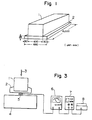
- Example 1 As illustrated in attached Fig. 1, below the bottom plane of a 600 mmx6000 mmx600 mm concrete block (1), a mixture of the liquids A and B specified in Example 1 was poured to form a 25 mm-thick, 660 mm-wide and 6000 mm-long urethane elastomer layer (2). Thus a joint member A for bridge piers was obtained.
- the curves (2) and (3) have an inflection point, and the joint members B and C show plastic deformation as if the air layers in the elastomers were not independent.
- the joint member A having 100% closed cell foaming property performs perfect elastic deformation, as is apparent from the straight line (1).
- (1) through (3) are the data of the members corresponding to those of (1) through (3) of Fig. 2.
- the vibration isolator of Example 1 achieves the quickest attenuation or isolation of the vibration.
- the vibration isolators of Controls 1 and 3 consumed more than three times the time required for the vibration isolator of Example 1 to reduce the acceleration to the level of 0.5 gal.
- the vibration-isolating effect of the isolator of this invention is excellent.
Landscapes
- Chemical & Material Sciences (AREA)
- Health & Medical Sciences (AREA)
- Chemical Kinetics & Catalysis (AREA)
- Medicinal Chemistry (AREA)
- Polymers & Plastics (AREA)
- Organic Chemistry (AREA)
- Engineering & Computer Science (AREA)
- General Engineering & Computer Science (AREA)
- Mechanical Engineering (AREA)
- Polyurethanes Or Polyureas (AREA)
- Springs (AREA)
Applications Claiming Priority (2)
| Application Number | Priority Date | Filing Date | Title |
|---|---|---|---|
| JP157684/84 | 1984-07-30 | ||
| JP15768484A JPS6136315A (ja) | 1984-07-30 | 1984-07-30 | 防振材料 |
Publications (3)
| Publication Number | Publication Date |
|---|---|
| EP0173004A2 EP0173004A2 (en) | 1986-03-05 |
| EP0173004A3 EP0173004A3 (en) | 1986-11-26 |
| EP0173004B1 true EP0173004B1 (en) | 1989-02-22 |
Family
ID=15655123
Family Applications (1)
| Application Number | Title | Priority Date | Filing Date |
|---|---|---|---|
| EP85106945A Expired EP0173004B1 (en) | 1984-07-30 | 1985-06-04 | Vibration isolator |
Country Status (5)
| Country | Link |
|---|---|
| US (1) | US4689357A (enExample) |
| EP (1) | EP0173004B1 (enExample) |
| JP (1) | JPS6136315A (enExample) |
| CA (1) | CA1247298A (enExample) |
| DE (1) | DE3568368D1 (enExample) |
Families Citing this family (31)
| Publication number | Priority date | Publication date | Assignee | Title |
|---|---|---|---|---|
| DE3602669A1 (de) * | 1986-01-31 | 1987-07-30 | Japan National Railway | Federnder ueberzug fuer eine direktverbindungs-schwelle |
| JPS62288623A (ja) * | 1986-06-05 | 1987-12-15 | M D Kasei Kk | ウレタン発泡体の製造方法 |
| US4741951A (en) * | 1987-01-29 | 1988-05-03 | Reeves Bros., Inc. | Method for forming thermoformable polyurethane foam articles |
| JPH01168720A (ja) * | 1987-12-25 | 1989-07-04 | Toyobo Co Ltd | 制振材料用粘弾性樹脂 |
| WO1990004613A1 (fr) * | 1988-10-25 | 1990-05-03 | Asahi Glass Company Ltd. | Mousse de polyurethane elastique et procede de production |
| JPH03244620A (ja) * | 1990-02-23 | 1991-10-31 | Asahi Glass Co Ltd | ポリウレタンフォームの製造方法 |
| US5300535A (en) * | 1988-10-25 | 1994-04-05 | Asahi Glass Company Ltd. | Method for producing polyurethane flexible foam |
| DE3837351C1 (enExample) * | 1988-11-03 | 1989-11-23 | Th. Goldschmidt Ag, 4300 Essen, De | |
| US4933373A (en) * | 1989-04-06 | 1990-06-12 | Minnesota Mining And Manufacturing Company | Abrasive wheels |
| US4950694A (en) * | 1989-06-29 | 1990-08-21 | Union Carbide Chemicals And Plastics Company Inc. | Preparation of polyurethane foams without using inert blowing agents |
| US5013810A (en) * | 1990-02-09 | 1991-05-07 | Mobay Corporation | Impact absorbing media |
| US5093379A (en) * | 1990-04-09 | 1992-03-03 | Polymer Dynamics Technology, Inc. | Heat stable polyurethane foams |
| DE4129666C2 (de) * | 1991-09-06 | 1996-12-12 | Stankiewicz Gmbh | Verfahren zur Herstellung eines viscoelastischen Dämpfungsschaums mit adhäsiver Oberfläche |
| JPH0830345B2 (ja) * | 1992-05-29 | 1996-03-27 | 日清紡績株式会社 | 地中梁変位吸収構造物及びその施工法 |
| US5614566A (en) * | 1993-02-10 | 1997-03-25 | Th. Goldschmidt Ag. | Method for the preparation of rigid foams having urethane and/or isocyanurate groups and being extensively open celled |
| JP2597300B2 (ja) * | 1993-12-15 | 1997-04-02 | 三洋化成工業株式会社 | 軟質ポリウレタンフォームの製造方法 |
| DE4438430A1 (de) * | 1994-10-27 | 1996-05-02 | Hoechst Ag | Reaktive Emulgatoren auf Basis ungesättigter Polyurethane |
| US5510054A (en) * | 1995-06-29 | 1996-04-23 | Dow Italia S.P.A. | Polyurethane elastomer and foam exhibiting improved abrasion resistance |
| DE69806752T2 (de) * | 1997-05-23 | 2003-03-06 | Kraton Polymers Research B.V., Amsterdam | Verfahren zur herstellung von polyurethanschäumen |
| JP4621460B2 (ja) * | 2004-09-07 | 2011-01-26 | 出光サートマー株式会社 | 液状重合体組成物 |
| JP5101092B2 (ja) * | 2006-11-30 | 2012-12-19 | 株式会社イノアックコーポレーション | 車両用ポリウレタン発泡体 |
| CA2674082C (en) | 2006-12-29 | 2015-12-01 | Johnson Controls Technology Company | Polyurethane foam formulation, products and methods |
| DE102007023963B4 (de) * | 2007-05-23 | 2014-01-02 | Abi Anlagentechnik-Baumaschinen-Industriebedarf Maschinenfabrik Und Vertriebsgesellschaft Mbh | Vorrichtung für einen Schwingungserreger |
| US7883071B2 (en) * | 2008-05-21 | 2011-02-08 | Raytheon Company | Methods and apparatus for isolation system |
| JP2010201868A (ja) * | 2009-03-05 | 2010-09-16 | Toyo Tire & Rubber Co Ltd | ウレタン製マウント部材の製造方法、およびウレタン製マウント部材 |
| JPWO2010126098A1 (ja) * | 2009-04-30 | 2012-11-01 | 株式会社クラレ | ポリウレタン系ブロック共重合体 |
| DE102013204991A1 (de) | 2013-03-21 | 2014-09-25 | Evonik Industries Ag | Herstellung von Polyurethanschäumen, die Polyole auf Polyolefinbasis enthalten |
| CN107075078B (zh) * | 2014-08-18 | 2022-01-04 | 巴斯夫欧洲公司 | 用于制备聚氨酯弹性体和热塑性聚氨酯的聚酯改性的聚丁二烯醇 |
| CN112126034B (zh) * | 2019-06-24 | 2022-05-17 | 北京化工大学 | 一种混合软段型聚氨酯阻尼材料及其制备方法 |
| CN116023642B (zh) * | 2022-12-07 | 2025-06-13 | 清远高新华园科技协同创新研究院有限公司 | 一种非离子双键单体及其制备的水性丙烯酸聚合物与应用 |
| CN118530431B (zh) * | 2024-07-25 | 2024-10-11 | 淄博德信联邦化学工业有限公司 | 高性能聚氨酯隔振器及其制备方法 |
Family Cites Families (5)
| Publication number | Priority date | Publication date | Assignee | Title |
|---|---|---|---|---|
| US4190712A (en) * | 1974-06-21 | 1980-02-26 | Mccord Corporation | Low density energy management urethane foam |
| JPS5728415B2 (enExample) * | 1975-02-11 | 1982-06-16 | ||
| US4304872A (en) * | 1979-04-28 | 1981-12-08 | Bp Chemicals Limited | Flexible polyurethane foams having substantial number of cells with internal residual cell surface of 60 to 90 percent |
| US4302552A (en) * | 1980-07-01 | 1981-11-24 | Nisshin Spinning Co., Ltd. | Microcellular polyurethane vibration isolator |
| US4448903A (en) * | 1983-07-25 | 1984-05-15 | Mobay Chemical Corporation | Novel system for the production of polyurethanes |
-
1984
- 1984-07-30 JP JP15768484A patent/JPS6136315A/ja active Granted
-
1985
- 1985-06-04 EP EP85106945A patent/EP0173004B1/en not_active Expired
- 1985-06-04 DE DE8585106945T patent/DE3568368D1/de not_active Expired
- 1985-06-06 CA CA000483287A patent/CA1247298A/en not_active Expired
- 1985-06-06 US US06/741,836 patent/US4689357A/en not_active Expired - Fee Related
Also Published As
| Publication number | Publication date |
|---|---|
| JPH0458493B2 (enExample) | 1992-09-17 |
| JPS6136315A (ja) | 1986-02-21 |
| EP0173004A2 (en) | 1986-03-05 |
| US4689357A (en) | 1987-08-25 |
| CA1247298A (en) | 1988-12-20 |
| DE3568368D1 (en) | 1989-03-30 |
| EP0173004A3 (en) | 1986-11-26 |
Similar Documents
| Publication | Publication Date | Title |
|---|---|---|
| EP0173004B1 (en) | Vibration isolator | |
| US4652495A (en) | Resilient coat for tie of direct-connection type track | |
| US4302552A (en) | Microcellular polyurethane vibration isolator | |
| JP4619923B2 (ja) | 新規な軟質ポリウレタンフォーム | |
| US9670307B2 (en) | Polyurethane article with increased comfort | |
| JP4624560B2 (ja) | 低レジリエンスで低振動数の成形ポリウレタンフォーム | |
| WO1990010657A1 (en) | Polyurethane foam | |
| WO2005052020A1 (ja) | 軟質ポリウレタンフォーム、その製造方法、及びそれを用いた自動車用シート | |
| EP0714929B1 (en) | Waterproof plastic foam | |
| US6420448B1 (en) | Energy absorbing foams | |
| JP3963968B2 (ja) | シーリング材又はコーキング材用防水性樹脂発泡体 | |
| JP2005139455A5 (enExample) | ||
| JP3056630B2 (ja) | 微細セル構造ポリウレタンエラストマー | |
| CA2004392C (en) | Mixtures of poly(alkylene carbonate) polyols and polymers of ethylenically unsaturated esters | |
| JPS5823819A (ja) | 防振材料 | |
| CA1133200A (en) | Vibration isolator | |
| JPH0458494B2 (enExample) | ||
| JP2928088B2 (ja) | 発泡ポリウレタンエラストマー製鉄道用パッド | |
| JPH0665423A (ja) | 振動減衰材料 | |
| CA1283818C (en) | Resilient coat for tie of direct-connection type track | |
| JPH058727B2 (enExample) | ||
| JP2024004402A (ja) | 側溝用衝撃吸収体および側溝 | |
| AU741302B2 (en) | New flexible polyurethane foams | |
| JPS6095001A (ja) | 直結型弾性まくらぎ用弾性被覆材 | |
| JP2020164769A (ja) | 低発泡ウレタン樹脂用組成物及び低発泡ウレタン樹脂 |
Legal Events
| Date | Code | Title | Description |
|---|---|---|---|
| PUAI | Public reference made under article 153(3) epc to a published international application that has entered the european phase |
Free format text: ORIGINAL CODE: 0009012 |
|
| AK | Designated contracting states |
Kind code of ref document: A2 Designated state(s): DE FR GB |
|
| PUAL | Search report despatched |
Free format text: ORIGINAL CODE: 0009013 |
|
| AK | Designated contracting states |
Kind code of ref document: A3 Designated state(s): DE FR GB |
|
| 17P | Request for examination filed |
Effective date: 19870312 |
|
| 17Q | First examination report despatched |
Effective date: 19880428 |
|
| GRAA | (expected) grant |
Free format text: ORIGINAL CODE: 0009210 |
|
| AK | Designated contracting states |
Kind code of ref document: B1 Designated state(s): DE FR GB |
|
| REF | Corresponds to: |
Ref document number: 3568368 Country of ref document: DE Date of ref document: 19890330 |
|
| ET | Fr: translation filed | ||
| PLBE | No opposition filed within time limit |
Free format text: ORIGINAL CODE: 0009261 |
|
| STAA | Information on the status of an ep patent application or granted ep patent |
Free format text: STATUS: NO OPPOSITION FILED WITHIN TIME LIMIT |
|
| 26N | No opposition filed | ||
| PGFP | Annual fee paid to national office [announced via postgrant information from national office to epo] |
Ref country code: DE Payment date: 19940519 Year of fee payment: 10 |
|
| PGFP | Annual fee paid to national office [announced via postgrant information from national office to epo] |
Ref country code: GB Payment date: 19940525 Year of fee payment: 10 |
|
| PGFP | Annual fee paid to national office [announced via postgrant information from national office to epo] |
Ref country code: FR Payment date: 19940620 Year of fee payment: 10 |
|
| PG25 | Lapsed in a contracting state [announced via postgrant information from national office to epo] |
Ref country code: GB Effective date: 19950604 |
|
| GBPC | Gb: european patent ceased through non-payment of renewal fee |
Effective date: 19950604 |
|
| PG25 | Lapsed in a contracting state [announced via postgrant information from national office to epo] |
Ref country code: FR Effective date: 19960229 |
|
| PG25 | Lapsed in a contracting state [announced via postgrant information from national office to epo] |
Ref country code: DE Effective date: 19960301 |
|
| REG | Reference to a national code |
Ref country code: FR Ref legal event code: ST |