EP0169993A2 - 7-(3-Aryl-1-piperazinyl)-sowie 7-(3-Cyclohexyl-1-piperazinyl)-3-chinoloncarbonsäuren - Google Patents
7-(3-Aryl-1-piperazinyl)-sowie 7-(3-Cyclohexyl-1-piperazinyl)-3-chinoloncarbonsäuren Download PDFInfo
- Publication number
- EP0169993A2 EP0169993A2 EP85106252A EP85106252A EP0169993A2 EP 0169993 A2 EP0169993 A2 EP 0169993A2 EP 85106252 A EP85106252 A EP 85106252A EP 85106252 A EP85106252 A EP 85106252A EP 0169993 A2 EP0169993 A2 EP 0169993A2
- Authority
- EP
- European Patent Office
- Prior art keywords
- carbon atoms
- phenyl
- fluorine
- piperazinyl
- oxo
- Prior art date
- Legal status (The legal status is an assumption and is not a legal conclusion. Google has not performed a legal analysis and makes no representation as to the accuracy of the status listed.)
- Granted
Links
- UZZARKCOLCFLJH-UHFFFAOYSA-N CN(CC1)CCN1C(C1)C(I)=CC2=C1NC=C(C(O)=O)C2=O Chemical compound CN(CC1)CCN1C(C1)C(I)=CC2=C1NC=C(C(O)=O)C2=O UZZARKCOLCFLJH-UHFFFAOYSA-N 0.000 description 1
Classifications
-
- C—CHEMISTRY; METALLURGY
- C07—ORGANIC CHEMISTRY
- C07D—HETEROCYCLIC COMPOUNDS
- C07D215/00—Heterocyclic compounds containing quinoline or hydrogenated quinoline ring systems
- C07D215/02—Heterocyclic compounds containing quinoline or hydrogenated quinoline ring systems having no bond between the ring nitrogen atom and a non-ring member or having only hydrogen atoms or carbon atoms directly attached to the ring nitrogen atom
- C07D215/16—Heterocyclic compounds containing quinoline or hydrogenated quinoline ring systems having no bond between the ring nitrogen atom and a non-ring member or having only hydrogen atoms or carbon atoms directly attached to the ring nitrogen atom with hetero atoms or with carbon atoms having three bonds to hetero atoms with at the most one bond to halogen, e.g. ester or nitrile radicals, directly attached to ring carbon atoms
- C07D215/48—Carbon atoms having three bonds to hetero atoms with at the most one bond to halogen
- C07D215/54—Carbon atoms having three bonds to hetero atoms with at the most one bond to halogen attached in position 3
- C07D215/56—Carbon atoms having three bonds to hetero atoms with at the most one bond to halogen attached in position 3 with oxygen atoms in position 4
-
- A—HUMAN NECESSITIES
- A61—MEDICAL OR VETERINARY SCIENCE; HYGIENE
- A61P—SPECIFIC THERAPEUTIC ACTIVITY OF CHEMICAL COMPOUNDS OR MEDICINAL PREPARATIONS
- A61P3/00—Drugs for disorders of the metabolism
-
- A—HUMAN NECESSITIES
- A61—MEDICAL OR VETERINARY SCIENCE; HYGIENE
- A61P—SPECIFIC THERAPEUTIC ACTIVITY OF CHEMICAL COMPOUNDS OR MEDICINAL PREPARATIONS
- A61P31/00—Antiinfectives, i.e. antibiotics, antiseptics, chemotherapeutics
- A61P31/04—Antibacterial agents
-
- C—CHEMISTRY; METALLURGY
- C07—ORGANIC CHEMISTRY
- C07D—HETEROCYCLIC COMPOUNDS
- C07D401/00—Heterocyclic compounds containing two or more hetero rings, having nitrogen atoms as the only ring hetero atoms, at least one ring being a six-membered ring with only one nitrogen atom
- C07D401/02—Heterocyclic compounds containing two or more hetero rings, having nitrogen atoms as the only ring hetero atoms, at least one ring being a six-membered ring with only one nitrogen atom containing two hetero rings
- C07D401/04—Heterocyclic compounds containing two or more hetero rings, having nitrogen atoms as the only ring hetero atoms, at least one ring being a six-membered ring with only one nitrogen atom containing two hetero rings directly linked by a ring-member-to-ring-member bond
-
- C—CHEMISTRY; METALLURGY
- C07—ORGANIC CHEMISTRY
- C07D—HETEROCYCLIC COMPOUNDS
- C07D409/00—Heterocyclic compounds containing two or more hetero rings, at least one ring having sulfur atoms as the only ring hetero atoms
- C07D409/14—Heterocyclic compounds containing two or more hetero rings, at least one ring having sulfur atoms as the only ring hetero atoms containing three or more hetero rings
Definitions
- the present invention relates to new 1-cyclopropyl-1,4-dihydro-4-oxo-3-quinolinecarboxylic acids, processes for their preparation and antibacterial agents and feed additives containing them.
- diethyl malonate (2) is acylated in the presence of magnesium ethylate with the corresponding benzoyl fluoride or chloride (1) to give the aroylmalonic ester (3) (Organicum, 3rd ed. 1964, p. 438).
- the cyclization reaction (6) ⁇ (7) is carried out in a temperature range from about 60 to 300 ° C., preferably 80 to 180 ° C.
- Dioxane, dimethyl sulfoxide, N-methylpyrrolidone, sulfolane, hexamethylphosphoric triamide and preferably N, N-dimethylformamide can be used as diluents.
- reaction of (II) with (III) according to method A is preferably carried out in a diluent such as dimethyl sulfoxide, N, N-dimethylformamide, hexamethylphosphoric trisamide, sulfolane, water, an alcohol such as methanol, ethanol, n-propanol, isopropanol, glycol monomethyl ether or Pyridine made. Mixtures of these diluents can also be used.
- a diluent such as dimethyl sulfoxide, N, N-dimethylformamide, hexamethylphosphoric trisamide, sulfolane, water, an alcohol such as methanol, ethanol, n-propanol, isopropanol, glycol monomethyl ether or Pyridine made.
- a diluent such as dimethyl sulfoxide, N, N-dimethylformamide, hexamethylphosphoric trisamide, sulfolane,
- acid binders can be used as acid binders. These preferably include the alkali metal hydroxides, alkali metal carbonates, organic amines and amidines. The following may be mentioned in particular as particularly suitable: triethylamine, 1,4-diaza-bicycloL2,2,27-octane (DABCO), excess amine (III) or 1,8-diazabicyclo [5,4,0] undec-7-ene (DBU).
- DABCO 1,4-diaza-bicycloL2,2,27-octane
- DBU 1,8-diazabicyclo [5,4,0] undec-7-ene
- reaction temperatures can be varied within a wide range. Generally one works between about 20 and 200 ° C, preferably between 80 and 180 ° C.
- reaction of (IV) with (V) is preferably carried out in a diluent such as dimethyl sulfoxide, dioxane, N, N-dimethylformamide, hexamethylphosphoric acid trisamide, sulfolane, water, an alcohol such as methanol, ethanol, n-propanol, isopropanol, glycol monomethyl ether or pyridine. Mixtures of these diluents can also be used.
- a diluent such as dimethyl sulfoxide, dioxane, N, N-dimethylformamide, hexamethylphosphoric acid trisamide, sulfolane, water, an alcohol such as methanol, ethanol, n-propanol, isopropanol, glycol monomethyl ether or pyridine.
- All customary inorganic and organic acid binders can be used as acid binders. These preferably include the alkali metal hydroxides, alkali metal carbonates, organic amines and amidines. The following may be mentioned as particularly suitable: triethylamine, 1,4-diazabicycloZ2,2,27octane (DABCO) or 1,8-diazabicyclo- [5,4,0] undec-7-ene (DBU).
- DABCO 1,4-diazabicycloZ2,2,27octane
- DBU 1,8-diazabicyclo- [5,4,0] undec-7-ene
- reaction temperatures can be varied within a wide range. Generally one works between about 20 and about 180 ° C, preferably between 40 and 110 ° C.
- the reaction can be carried out at normal pressure, but also at elevated pressure. Generally one works at pressures between about 1 and about 100 bar, preferably between 1 and 10 bar.
- reaction of (I) with (VI) (method C) is carried out in a diluent such as N, N-dimethylformamide, dioxane, tetrahydrofuran, pyridine, water or in mixtures of these diluents.
- a diluent such as N, N-dimethylformamide, dioxane, tetrahydrofuran, pyridine, water or in mixtures of these diluents.
- the reaction temperatures can be varied within a wide range. Generally one works between about 0 ° C and about 140 ° C, preferably between 10 ° and 100 ° C.
- the compounds according to the invention are active against a very broad spectrum of microorganisms. With their help, gram-negative and gram-positive bacteria and bacterial-like microorganisms can be combated and the diseases caused by these pathogens can be prevented, improved and / or cured.
- the compounds according to the invention are particularly effective against bacteria and bacterial-like microorganisms. They are therefore particularly well suited for the prophylaxis and chemotherapy of local and systemic infections in human and veterinary medicine, which are caused by these pathogens.
- the present invention includes pharmaceutical preparations which, in addition to non-toxic, inert pharmaceutically suitable excipients, contain one or more compounds according to the invention or which consist of one or more active compounds according to the invention, and methods for producing these preparations.
- the present invention also includes pharmaceutical preparations in dosage units.
- the preparations in the form of individual parts e.g. Tablets, coated tablets, capsules, pills, suppositories and ampoules are available, the active ingredient content of which corresponds to a fraction or a multiple of a single dose.
- the dosage units can e.g. 1, 2, 3 or 4 single doses or 1/2, 1/3 or 1/4 of a single dose.
- a single dose preferably contains the amount of active ingredient which is administered in one application and which usually corresponds to a whole, a half or a third or a quarter of a daily dose.
- Non-toxic, inert pharmaceutically suitable carriers are to be understood as solid, semi-solid or liquid diluents, fillers and formulation auxiliaries of all kinds.
- glycerin e.g. glycerin, (d) disintegrants, e.g. agar-agar, calcium carbonate and sodium carbonate, (e) solution retarders, e.g. paraffin and (f) absorption accelerators, e.g. quaternary ammonium compounds, (g) wetting agents, eg cetyl alcohol, glycerol monostearate, (h) adsorbents, eg kaolin and bentonite and (i) lubricants, eg talc, calcium and magnesium stearate and solid polyethylene glycols or mixtures of the substances listed under (a) to (i).
- disintegrants e.g. agar-agar, calcium carbonate and sodium carbonate
- solution retarders e.g. paraffin
- absorption accelerators e.g. quaternary ammonium compounds
- wetting agents eg cetyl alcohol, glycerol monostearate
- the tablets, dragées, capsules, pills and granules can be provided with the customary coatings and casings, optionally containing opacifying agents, and can also be composed such that they release the active ingredient (s) only or preferably in a certain part of the intestinal tract, possibly with a delay, where as embedding compounds e.g. Polymer substances and waxes can be used.
- embedding compounds e.g. Polymer substances and waxes can be used.
- the active ingredient (s) can optionally also be in microencapsulated form with one or more of the above-mentioned excipients.
- suppositories can be the customary water-soluble or water-insoluble carriers Contain substances, for example polyethylene glycols, fats, for example K akaofat and higher esters (for example C 14 alcohol with C 16 fatty acid) or mixtures of these substances.
- substances for example polyethylene glycols, fats, for example K akaofat and higher esters (for example C 14 alcohol with C 16 fatty acid) or mixtures of these substances.
- ointments, pastes, creams and gels can contain the usual carriers, e.g. animal and vegetable fats, waxes, paraffins, starch, tragacanth, cellulose derivatives, polyethylene glycols, silicones, bentonites, silicic acid, talc and zinc oxide or mixtures of these substances.
- carriers e.g. animal and vegetable fats, waxes, paraffins, starch, tragacanth, cellulose derivatives, polyethylene glycols, silicones, bentonites, silicic acid, talc and zinc oxide or mixtures of these substances.
- Powders and sprays can contain the usual excipients in addition to the active ingredient (s), e.g. Milk sugar, talc, silica, aluminum hydroxide, calcium silicate and polyamide powder or mixtures of these substances.
- Sprays can also contain the usual propellants, e.g. Chlorofluorocarbons.
- solutions and emulsions can contain the usual carriers such as solvents, solubilizers and emulsifiers, e.g. Water, ethyl alcohol, isopropyl alcohol, ethyl carbonate, ethyl acetate, benzyl alcohol, benzyl benzoate, propylene glycol, 1,3-butylene glycol, dimethylformamide, oils, especially cottonseed oil, peanut oil, corn oil, olive oil, castor oil and sesame oil, glycerin, glycerol formaldehyde, tetrahydrofuran fatty acid, tetrahydrofuran fatty acid, tetrahydrofuran fatty acid, tetrahydrofuran fatty acid, tetrahydrofuran fatty acid, tetrahydrofuran fatty acid, tetrahydrofuran fatty acid, tetrahydrofuran fatty acid, tetrahydrofuran fatty acid,
- solutions and emulsions can also be in sterile and blood isotonic form.
- the formulation forms mentioned can also contain colorants, preservatives and additives which improve the smell and taste, e.g. Peppermint oil and eucalyptus oil and sweeteners, e.g. Saccharin.
- the pharmaceutical preparations listed above can also contain further active pharmaceutical ingredients.
- the pharmaceutical preparations listed above are prepared in a conventional manner by known methods, e.g. by mixing the active substance or substances with the carrier substance or substances.
- the active compounds or the pharmaceutical preparations can be administered locally, orally, parenterally, intraperitoneally and / or rectally, preferably orally or parenterally, such as intravenously or intramuscularly.
- the active compound (s) according to the invention in total amounts of from about 0.5 to about 500, preferably from 1 to 50 mg / kg of body weight per 24 hours, if appropriate in the form multiple doses to achieve the desired results.
- a single dose contains the active ingredient (s) according to the invention, preferably in amounts of about 0.5 to about 250, in particular 1 to 60 mg / kg of body weight.
- the new compounds can be given in the usual concentrations and preparations together with the feed or with feed preparations or with the drinking water. This can prevent, ameliorate and / or cure an infection by gram-negative or gram-positive bacteria and thereby a för growth and an improvement in feed utilization.
- Each tablet contains:
Landscapes
- Chemical & Material Sciences (AREA)
- Organic Chemistry (AREA)
- Health & Medical Sciences (AREA)
- General Health & Medical Sciences (AREA)
- Veterinary Medicine (AREA)
- General Chemical & Material Sciences (AREA)
- Medicinal Chemistry (AREA)
- Nuclear Medicine, Radiotherapy & Molecular Imaging (AREA)
- Chemical Kinetics & Catalysis (AREA)
- Pharmacology & Pharmacy (AREA)
- Life Sciences & Earth Sciences (AREA)
- Animal Behavior & Ethology (AREA)
- Public Health (AREA)
- Communicable Diseases (AREA)
- Oncology (AREA)
- Engineering & Computer Science (AREA)
- Bioinformatics & Cheminformatics (AREA)
- Diabetes (AREA)
- Hematology (AREA)
- Obesity (AREA)
- Pharmaceuticals Containing Other Organic And Inorganic Compounds (AREA)
- Plural Heterocyclic Compounds (AREA)
- Quinoline Compounds (AREA)
- Agricultural Chemicals And Associated Chemicals (AREA)
- Nitrogen Condensed Heterocyclic Rings (AREA)
Abstract
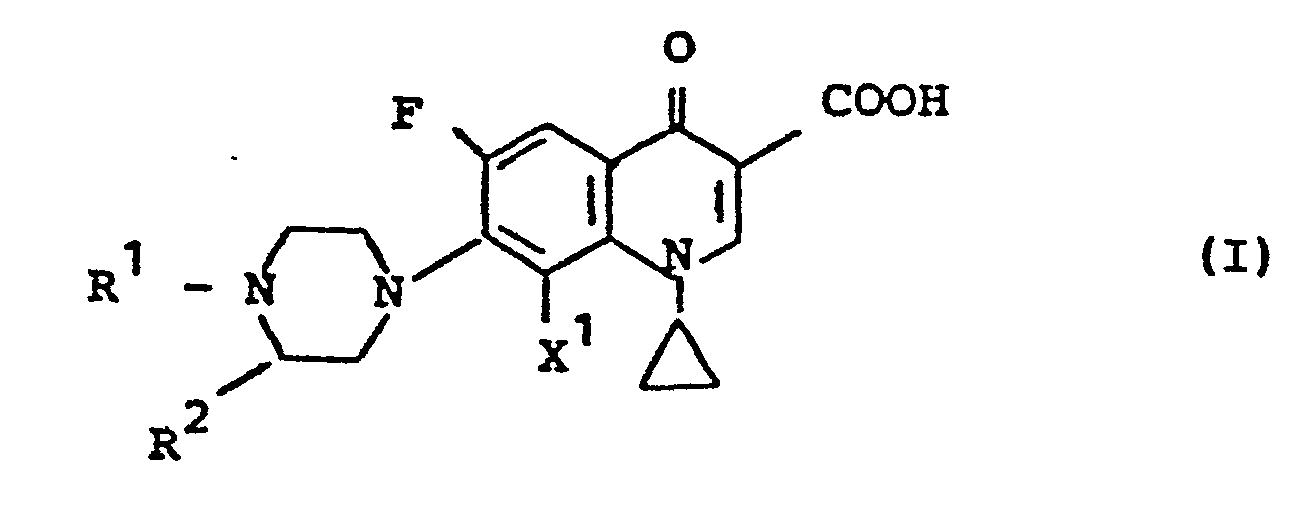
- 1-Cyclopropyl-6-fluor-1,4-dihydro-4-oxo-7-(1-piperazinyl}-3-chinolincarbonsäuren der Formel
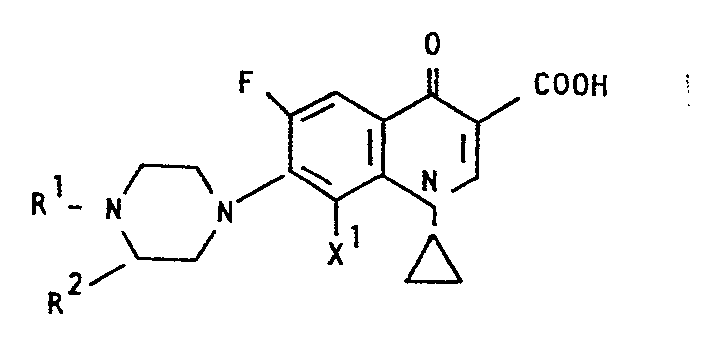
in welcher - R, Wasserstoff, gegebenenfalls substituiertes Alkyl, Oxoalkyl, Phenacyl; Acyl
- R2 gegebenenfalls substituiertes Phenyl und Cyclohexyl, Methylendioxy-phenyl, Methylendioxycyclohexyl, Furyl, Tetrahydrofuryl, Thienyl; und
- X, Wasserstoff oder Fluor haben gute antibakterielle Wirkungen und sollen als Wirkstoffe von Arzneimitteln verwendet werden.
Description
- Die-vorliegende Erfindung betrifft neue 1-Cyclopropyl-1,4-dihydro-4-oxo-3-chinolincarbonsäuren, Verfahren zu ihrer Herstellung sowie diese enthaltende antibakterielle Mittel und Futterzusatzstoffe.
- Es wurde gefunden, daß die neuen 1-Cyclopropyl-6-fluor-1,4-dihydro-4-oxo-7-(1-piperazinyl)-3-chinolin- carbonsäuren der Formel (I)
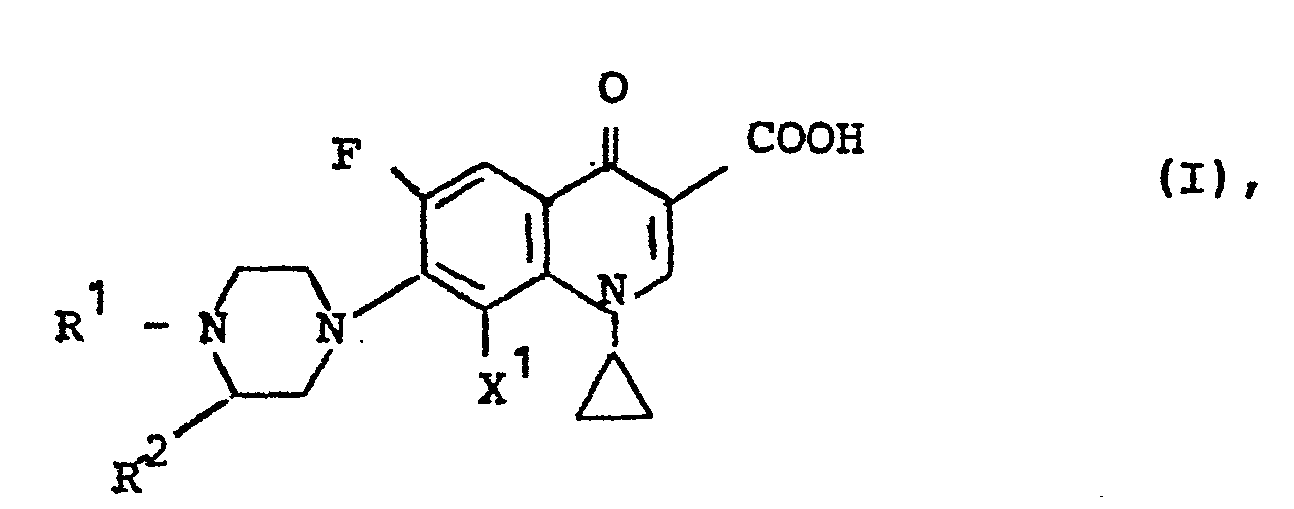
in welcher - R Wasserstoff, gegebenenfalls durch Hydroxy, Methoxy, -Amino, Dimethylamino, Halogen, wie beispielsweise Fluor oder Chlor, Cyano oder Alkoxycarbonyl mit ein oder zwei Kohlenstoffatomen im Alkylteil substituiertes geradkettiges oder verzweigtes Alkyl mit 1 bis 4 Kohlenstoffatomen, Oxoalkyl mit bis zu 4 Kohlenstoffatomen, Phenacyl, Acyl mit 1 bis 4 Kohlenstoffatomen,
- R 2 gegebenenfalls durch Halogen, wie beispielsweise Chlor, Brom oder Fluor, Methyl, Phenyl, Cyano, Hydroxy, Methoxy, Benzyloxy, Amino, Methylamino, Dimethylamino, Piperidino oder Nitro ein-bis dreifach substituiertes Phenyl und Cyclohexyl, Methylendioxy-phenyl, Methylendioxycyclohexyl, Furyl, Tetrahydrofuryl, Thienyl und
- X Wasserstoff oder Fluor
- Bevorzugt sind diejenigen Verbindungen der Formel (I), in denen
- R Wasserstoff, gegebenenfalls durch Hydroxy, Methoxy, Halogen, wie beispielsweise Fluor oder Chlor, Cyano oder Alkoxycarbonyl mit ein oder zwei Kohlenstoffatomen im Alkylteil substituiertes geradkettiges oder verzweigtes Alkyl mit 1 bis 4 Kohlenstoffatomen, Oxoalkyl mit bis zu 4 Kohlenstoffatomen, Phenacyl, Formyl oder Acetyl,
- R 2 gegebenenfalls durch Chlor, Brom, Fluor, Methyl, Phenyl, Cyano, Hydroxy, Methoxy, Benzyloxy, Amino, Piperidino oder Nitro ein-bis dreifach substituiertes Phenyl und Cyclohexyl sowie Thienyl und
- X Wasserstoff oder Fluor bedeutet.
- Besonders bevorzugt sind diejenigen Verbindungen der Formel (I), in denen
- R Wasserstoff, gegebenenfalls durch Hydroxy, Methoxy, Cyano oder Alkoxycarbonyl mit ein oder zwei Kohlenstoffatomen im Alkylteil substituiertes geradkettiges oder verzweigtes Alkyl mit 1 bis 3 Kohlenstoffatomen, Oxoalkyl mit bis zu 4 Kohlenstoffatomen, Phenacyl, Formyl oder Acetyl,
- R 2 gegebenenfalls durch Chlor, Brom, Fluor, Methyl, Phenyl, Hydroxy, Methoxy, Benzyloxy, Amino, Piperidino oder Nitro ein- bis dreifach substituiertes Phenyl und Cyclohexyl sowie Thienyl und
- X1 Wasserstoff oder Fluor bedeutet.
- Weiterhin wurde gefunden, daß man die Verbindungen der Formel (I) erhält, wenn man 1-Cyclopropyl-7-fluor-1,4-dihydro-4-oxo-3-chinolincarbonsäuren der Formel (II)

in welcher - X1 die oben angegebene Bedeutung hat und
- X2 für Halogen, insbesondere Fluor oder Chlor steht,
- mit Piperazinen der Formel (III)

in welcher - R1 und R2 die oben angegebene Bedeutung haben,
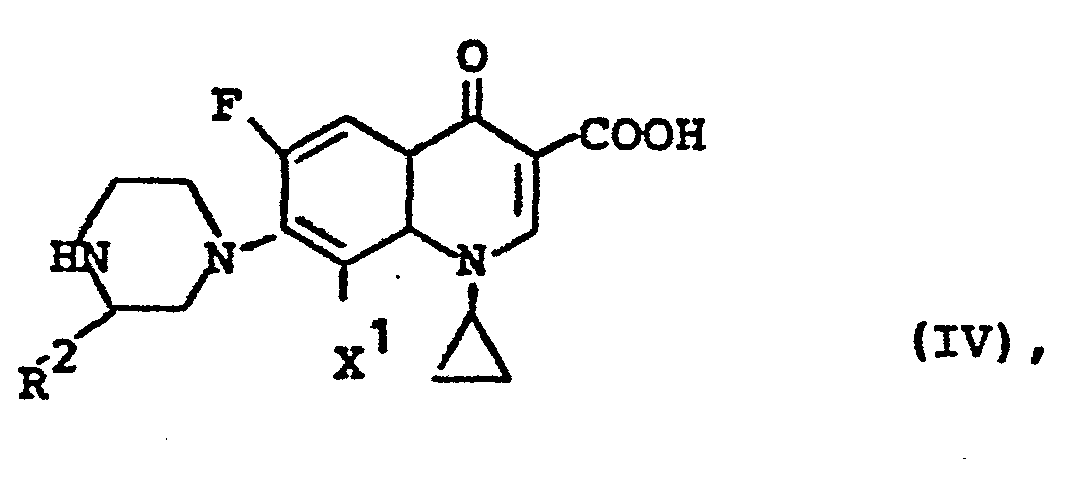
- Die erfindungsgemäßen Verbindungen der Formel (I) können auch erhalten werden, indem man eine 7-(1-Piperazinyl)-3-chinoloncarbonsäure der Formel (IV)

in welcher R 2 und X die oben angegebene Bedeutung haben, mit Verbindungen der Formel (V)
in welcher - R die oben angegebene Bedeutung hat, jedoch nicht Wasserstoff sein kann, und
- X Fluor, Chlor, Brom, Jod, Hydroxy, Acyloxy, Phenoxy oder 4-Nitrophenoxy bedeutet, gegebenenfalls in Gegenwart von Säurebindern umsetzt (Methode B).
- Man erhält die erfindungsgemäßen Verbindungen der Formel (I) auch, wenn man eine 7-(1-Piperazinyl)-3-chinoloncar- bonsäure der Formel (IV) mit einem Michael-Acceptor der Formel (VI)

in der R3 für CN, CH3CO oder COOR4 steht,
wobei R 4 Methyl oder Ethyl bedeutet, umsetzt (Methode C). - Verwendet man bei der Umsetzung nach Methode A 2-Phenyl- piperazin und 1-Cyclopropyl- 6,7,8-trifluor-1,4-dihydro-4-oxo-3-chinolincarbonsäure als Ausgangsstoffe, so kann der Reaktionsablauf durch das folgende Formelschema wiedergegeben werden:

- Verwendet man bei der Umsetzung nach Methode B Ethyljodid und 1-Cyclopropyl-6,8-difluor-1,4-dihydro-4-oxo-7-(3-phenyl-1-piperazinyl)-3-chinolincarbonsäure als Ausgangsstoffe, so kann der Reaktionsablauf durch das folgende Formelschema wiedergegeben werden.

- Verwendet man beispielsweise bei der Umsetzung nach Methode C 1-Cyclopropyl-6-fluor-1,4-dihydro-4-oxo-7-(3-phenyl-1-piperazinyl)-3-chinolincarbonsäure und Methyl-vinyl-keton als Ausgangsverbindungen, so kann der Reaktionsablauf durch das folgende Formelschema wiedergegeben werden:

- Die als Augsgangsverbindungen verwendeten Chinoloncarbonsäuren (II) sind teilweise bekannt (vergleiche DE-OS 3142854 : 7-Chlor-1-cyclopropyl-6-fluor-1,4-dihydro-4-oxo-3-chinolincarbonsäure) oder lassen sich auf folgendem Weg herstellen:

- Danach wird Malonsäurediethylester (2) in Gegenwart von Magnesiumethylat mit dem entsprechenden Benzoylfluorid bzw. -chlorid (1) zum Aroylmalonester (3) acyliert (Organicum, 3. Aufl. 1964 S. 438).
- Durch partielle Verseifung und Decarboxylierung von (3) in wäßrigem Medium mit katalytischen Mengen Schwefelsäure oder p-Toluolsulfonsäure erhält man in guter Ausbeute den Aroylessigsäureethylester (4), der mit Orthoameisensäure-triethylester/Acetanhydrid in den entsprechenden 2-Benzoyl-3-ethoxy-acrylsäureethylester (5) übergeht. Die Umsetzung von (5) mit Cyclopropylamin in einem Lösungsmittel, wie z.B. Methylenchlorid, Alkohol, Chloroform, Cyclohexan oder Toluol führt in leicht exothermer Reaktion zum gewünschten Zwischenprodukt (6).
- Die Cyclisierungsreaktion (6) → (7) wird in einem Temperaturbereich von etwa 60 bis 300°C, bevorzugt 80 bis 180°C durchgeführt.
- Als Verdünnungsmittel können Dioxan, Dimethylsulfoxid, N-Methylpyrrolidon, Sulfolan, Hexamethylphosphorsäuretriamid und bevorzugt N,N-Dimethylformamid verwendet werden.
- Als Säurebinder kommen für diese Reaktionsstufe Kalium- tert.-Butanolat, Butyl-lithium, Lithium-phenyl, Phenylmagnesiumbromid, Natriummethylat, Natriumhydrid, Natiium- oder Kalium-carbonat in Betracht. Wenn Fluorwasserstoff abgespalten werden soll (ZZ=F), haben sich auch Kalium- oder Natrium-fluorid als besonders geeignet erwiesen. Es kann vorteilhaft sein, einen Überschuß von 10 Mol-% an Base einzusetzen.
- Die in dem letzten Schritt erfolgende Esterhydrolyse von (7) unter basischen oder sauren Bedingungen führt zur entsprechenden Cyclopropyl-6-fluor-1,4-dihydro-4-oxo-3-chinolincarbonsäure (II).
- Das als Ausgangsmaterial für diesen Syntheseweg verwendete 2,3,4,5-Tetrafluorbenzoylchlorid (1) (X1=X2=Z2=F, Z1 = Cl) wurde aus der literaturbekannten 2,3,4,5-Tetrafluor-benzoesäure (G.G. Yakobson, V.N. Odinokov und N.N. Vorozhtsov Jr., Zh. Obsh. Khim. 36, 139 (1966)) mit Thionylchlorid auf übliche Weise erhalten. Es besitzt einen Siedepunkt von 75-80°C /17 mbar. Das 2,3,4, 5-Tetrafluorbenzoylfluorid besitzt einen Siedepunkt von 46 bis 47°C/20 mbar (nD: 1,4375).
- Analog wurde das als Ausgangsprodukt verwendete 2,4,5-Trifluorbenzoylfluorid (1) (X 1=H, X2=Z1=Z2=F) aus der literaturbekannten 2,4,5-Trifluorbenzoesäure (I.J. DeGraw, M.Corey u. W.A. Skinner, J. Chem. Eng. Data 13,587 (1968)) hergestellt. Es besitzt einen Siedepunkt von 53-56° /18 mbar (n 20 D: 1,4546).
- Die als Ausgangsstoffe verwendeten 2-substituierten Piperazine (III) sind bekannt oder können nach literaturbekannten Verfahren erhalten werden (zum Beispiel:
- US 4 166 180; J. Med. Chem. 26, 1116 (1983)). Als Beispiele seien genannt:
- 2-Phenylpiperazin, 2-(4-Chlorphenyl)-piperazin, 2-(4-Fluorphenyl)-piperazin, 2-(4-Bromphenyl)-piperazin, 2-(4-Methylphenyl)-piperazin, 2-(4-Biphenylyl)-piperazin, 2-(4-Methoxyphenyl)-piperazin, 2-(4-Benzyloxyphenyl)-piperazin, 2-(4-Hydroxyphenyl)-piperazin, 2-(3-Hydroxyphenyl)-piperazin, 2-(2-Hydroxyphenyl)-piperazin, 2-(4-Nitrophenyl)-piperazin, 2-(3-Nitrophenyl)-piperazin, 2-(4-Aminophenyl)-piperazin, 2-(4-Piperidinophenyl)-piperazin, 2-(3,4-Dimethoxyphenyl)-piperazin, 2-(3i4,S-Trimethoxyphenyl)-piperazin, 2-(3,4-Dimethoxy-6-methyl)-piperazin, 2-(3,4-Methylendioxyphenyl)-piperazin, 2-(4-Cyanophenyl)-piperazin, 2-(2-Thienyl)-piperazin, 2-(2-Furyl)-piperazin. Durch katalytische Hydrierung der 2-Aryl-piperazine werden gemäß einem eigenen Vorschlag vom gleichen Tage (Le A 23 097) die entsprechenden 2-Cyclohexylpiperazine erhalten; zum Beispiel 2-Cyclohexylpiperazin (Schmelzpunkt 82-83°C).
- Die als Ausgangsstoffe verwendeten Verbindungen der Formel (V) sind bekannt. Als Beispiele seien genannt:
- Methyliodid, Methylbromid, Ethyliodid, Ethylbromid, Ethylchlorid, 2-Hydroxyethylchlorid, 3-Hydroxypropylchlorid, 4-Hydroxybutylchlorid, n-Propylbromid, i-Propyliodid, n-Butylbromid, i-Butylbromid, sek.-Butylchlorid, Ameisensäure, Ameisensäureessigsäureanhydrid, Essigsäureanhydrid oder Acetylchlorid.
- Die erfindungsgemäß verwendbaren Verbindungen der Formel (VI) sind bekannt. Als Beispiele seinen genannt:
- Acrylnitril, Methylvinylketon, Acrylsäuremethylester, Acrylsäureethylester.
- Die Umsetzung von (II) mit (III) gemäß Methode A wird vorzugsweise in einem Verdünnungsmittel wie Dimethylsulfoxid, N,N-Dimethylformamid, Hexamethyl-phosphorsäuretrisamid, Sulfolan, Wasser, einem Alkohol wie Methanol, Ethanol, n-Propanol, Isopropanol, Glykolmonomethylether oder Pyridin vorgenommen. Ebenso können Gemische dieser Verdünnungsmittel verwendet werden.
- Als Säurebinder können alle üblichen anorganischen und organischen Säurebindungsmittel verwendet werden. Hierzu gehören vorzugsweise die Alkalihydroxide, Alkalicarbonate, organische Amine und Amidine. Als besonders geeignet seien im einzelnen genannt: Triethylamin, i,4-Diaza-bicycloL2,2,27-octan (DABCO), überschüssiges Amin (III) oder 1,8-Diazabicyclo[5,4,0]undec-7-en (DBU).
- Die Reaktionstemperaturen können in einem größeren Bereich variiert werden. Im allgemeinen arbeitet man zwischen etwa 20 und 200°C, vorzugsweise zwischen 80 und 180°C.
- Die Umsetzung kann bei Normaldruck, aber auch bei erhöhtem Druck durchgeführt werden. Im allgemeinen arbeitet man bei Drucken zwischen etwa 1 und etwa 100 bar, vorzugsweise zwischen 1 und 10 bar.
- Bei der Durchführung des erfindungsgemäßen Verfahrens setzt man auf 1 Mol der Carbonsäure (II) 1 bis 5 Mol, vorzugsweise 1 bis 3 Mol des Piperazins (III) ein.
- Die Umsetzung von (IV) mit (V) wird vorzugsweise in einem Verdünnungsmittel wie Dimethylsulfoxid, Dioxan, N,N-Dimethylformamid, Hexamethyl-phosphorsäure-trisamid, Sulfolan, Wasser, einem Alkohol wie Methanol, Ethanol, n-Propanol, Isopropanol, Glykolmonomethylether oder Pyridin vorgenommen. Ebenso können Gemische dieser Verdünnungsmittel verwendet werden.
- Als Säurebinder können alle üblichen anorganischen und organischen Säurebindungsmittel verwendet werden. Hierzu gehören vorzugsweise die Alkalihydroxide, Alkalicarbonate, organische Amine und Amidine. Als besonders geeignet seien im einzelnen genannt: Triethylamin, 1,4-DiazabicycloZ2,2,27octan (DABCO) oder 1,8-Diazabicyclo-[5,4,0]undec-7-en (DBU).
- Die Reaktionstemperaturen können in einem größeren Bereich variiert werden. Im allgemeinen arbeitet man zwischen etwa 20 und etwa 180°C, vorzugsweise zwischen 40 und 110°C.
- Die Umsetzung kann bei Normaldruck, aber auch bei erhöhtem Druck durchgeführt werden. Im allgemeinen arbeitet man bei Drucken zwischen etwa 1 und etwa 100 bar, vorzugsweise zwischen 1 und 10 bar.
- Bei der Durchführung des erfindungsgemäßen Verfahrens gemäß Methode B setzt man auf 1 Mol der Verbindung (IV) 1 bis 4 Mol, vorzugsweise 1 bis 1,5 Mol der Verbindung (V) ein.
- Die Umsetzung von (I) mit (VI) (Methode C) wird in einem Verdünnungsmittel wie N,N-Dimethylformamid, Dioxan, Tetrahydrofuran, Pyridin, Wasser oder auch in Mischungen dieser Verdünnungsmittel durchgeführt. Die Reaktionstemperaturen können in einem größeren Bereich variiert werden. Im allgemeinen arbeitet man zwischen etwa 0°C und etwa 140°C, vorzugsweise zwischen 10° und 100°C.
- Die Umsetzung kann bei Normaldruck, aber auch bei erhöhtem Druck durchgeführt werden. Im allgemeinen arbeitet man bei Drucken zwischen etwa 1 und etwa 100 bar, vorzugsweise zwischen 1 und 10 bar.
- Bei der Durchführung des erfindungsgemäßen Verfahrens setzt man auf 1 Mol der Verbindung (I) 1 bis 5 Mol, vorzugsweise 1 bis 2 Mol, der Verbindung (VI) ein.
- Als neue Wirkstoffe seien außer den in den Beispielen aufgeführten Verbindungen im einzelnen genannt:
- 1-Cyclopropyl-6-fluor-1,4-dihydro-7-(4-methyl-3-phenyl-1-piperazinyl)-4-oxo-3-chinolincarbonsäure,
- 7-(4-Butyl-3-phenyl-1-piperazinyl)-1-cyclopropyl-6-fluor-1,4-dihydro-4-oxo-3-chinolincarbonsäure,
- 1-Cyclopropyl-6-fluor-1,4-dihydro-7-[4-(2-hydroxyethyl)-3-phenyl-1-piperazinyl]-4-oxo-3-chinolincarbonsäure,
- 1-Cyclopropyl-6-fluor-1,4-dihydro-7-[4-(2-methoxy-ethyl)-3-phenyl-1-piperazinyl7-4-oxo-3-chinolincarbonsäure,
- 7-[4-(2-Amino-ethyl)-3-phenyl-1-piperazinyl]-1-cyclopropyl-6-fluor-1,4-dihydro-4-oxo-3-chinolincarbonsäure,
- 1-Cyclopropyl-6-fluor-1,4-dihydro-7-[4-(2-dimethylaminoethyl)-3-phenyl-1-piperazinyl]-4-oxo-3-chinolincarbonsäure,
- 1-Cyclopropyl-6-fluor-7-[4-(2-fluor-ethyl)-3-phenyl-1-piperazinyl]-1,4-dihydro-4-oxo-3-chinolincarbonsäure,
- 7-[4-(2-Cyano-ethyl)-3-phenyl-1-piperazinyl]-1-cyclopropyl-6-fluor-1,4-dihydro-4-oxo-3-chinolincarbonsäure,
- 1-Cyclopropyl-6-fluor-1,4-dihydro-7-[4-(2-methoxycarbonylethyl)-3-phenyl-1-piperazinyl7-4-oxo-3-chinolincarbonsäure,
- 1-Cyclopropyl-6-fluor-1,4-dihydro-4-oxo-7-(4-phenacyl-3-phenyl-1-piperazinyl]-3-chinolincarbonsäure,
- 1-Cyclopropyl-6-fluor-7-(4-formyl-3-phenyl-1-piperazinyl)-1,4-dihydro-4-oxo-3-chinolincarbonsäure,
- 7-(4-Acetyl-3-phenyl-1-piperazinyl)-1-cyclopropyl-6-fluor-1,4-dihydro-4-oxo-3-chinolincarbonsäure,
- 1-Cyclopropyl-6-fluor-1,4-dihydro-7-[3-(4-methylcyclohexyl)-1-piperazinyl]-4-oxo-3-chinolincarbonsäure,
- 1-Cyclopropyl-6-fluor-1,4-dihydro-7-[3-(3,4,5-trimethoxyphenyl)-1-piperaziny17-4-oxo-3-chinolincarbonsäure,
- 1-Cyclopropyl-6-fluor-1,4-dihydro-7-[3-(3,4-methylendioxy-phenyl)-1-piperazinyl]-4-oxo-3-chinolincarbonsäure,
- 7-[3-(4-Cyano-phenyl)-1-piperazinyl]-1-cyclopropyl-6-fluor-1,_4-dihydro-4-oxo-3-chinolincarbonsäure,
- 7-[3-(3-Amino-phenyl)-1-piperazinyl]-1-cyclopropyl-6-fluor-1,4-dihydro-4-oxo-3-chinolincarbonsäure,
- 1-Cyclopropyl-6-fluor-7-[3-(2-furyl)-1-piperazinyl]-1,4-dihydro-4-oxo-3-chinolincarbonsäure,
- 1-Cyclopropyl-6-fluor-1,4-dihydro-7-[3-(2-tetrahydrofuryl)-1-piperazinyl]-4-oxo-3-chinolincarbonsäure,
- 1-Cyclopropyl-6-fluor-1,4-dihydro-7-[3-(4-hydroxy-cyclohexyl)-1-piperazinyl]-4-oxo-3-chinolincarbonsäure,
- 7-[3-(3-Amino-cyclohexyl)-1-piperazinyl]-1-cyclopropyl-6-fluor-1,4-dihydro-4-oxo-3-chinolincarbonsäure,
- 1-Cyclopropyl-7-(4-ethyl-3-phenyl-1-piperazinyl)-6,8-difluor-1,4-dihydro-4-oxo-3-chinolincarbonsäure,
- 1-Cyclopropyl-6,8-difluor-7-[3-(4-fluorphenyl)-4-(3-oxo- butyl)-1-piperazinyl-1,4-dihydro-4-oxo-3-chinolincarbonsäure,
- 1-Cyclopropyl-6,8-difluor-7-[4-formyl-3-(2-thienyl)-1-piperaziny!7-1,4-dihydro-4-oxo-3-chinolincarbonsäure.
- Die erfindungsgemäßen Verbindungen zeigen bei geringer Toxizität ein breites antibakterielles Spektrum gegen gram-positive und gram-negative Keime, insbesondere gegen Enterobakteriaceen; vor allem auch gegen solche, die resistent sind gegen verschiedene Antibiotika, wie z.B. Penicilline, Cephalosporine, Aminoglykoside, Sulfonamide, Tetracycline.
- Diese wertvollen Eigenschaften ermöglichen ihre Verwendung als chemotherapeutische Wirkstoffe in der Medizin sowie als Stoffe zur Konservierung von anorganischen und organischen Materialien, insbesondere von organischen Materialien aller Art, z.B. Polymeren, Schmiermitteln, Farben, Fasern, Leder, Papier und Holz, von Lebensmitteln und von Wasser.
- Die erfindungsgemäßen Verbindungen sind gegen ein sehr breites Spektrum von Mikroorganismen wirksam. Mit ihrer Hilfe können gram-negative und gram-positive Bakterien und bakterienähnliche Mikroorganismen bekämpft sowie die durch diese Erreger hervorgerufenen Erkrankungen verhindert, gebessert und/oder geheilt werden.
- Besonders wirksam sind die erfindungsgemäßen Verbindungen gegen Bakterien und bakterienähnliche Mikroorganismen. Sie sind daher besonders gut zur Prophylaxe und Chemotherapie von lokalen und systemischen Infektionen in der Human- und Tiermedizin geeignet, die durch diese Erreger hervorgerufen werden.
- Beispielsweise können lokale und/oder systemische Erkrankungen behandelt und/oder verhindert werden, die durch die folgenden Erreger oder durch Mischungen der folgenden Erreger verursacht werden:
- Micrococcaceae, wie Staphylokokken, z.B. Staph.aureus, Staph. Epidermidis, (Staph. = Staphylococcus);
- Lactobacteriaceae, wie Streptokokken, z.B. Streptococcus pyogenes, d- bzw. B-hämolysierende Streptokokken, nicht δ-hämolysierende Streptokokken, Enterokokken und Diplococcus pneumoniae (Pneumokokken) Enterobacteriaceae, wie Escherichiae-Bakterien der Coli-Gruppe: Escherichia-Bakterien, z.B. Escherichia colir Enterobacter-Bakterien, z.B. E. aerogenes, E. cloacae, (E. = Enterobacter), Klebsiella-Bakterien, z.B. K. pneumoniae, (K. = Klebsiella) Serratia, z.B. Serratia marcescens, Proteae-Bakterien der Proteus-Gruppe: Proteus, z.B. Pr. vulgaris, Pr.morganii, Pr.rettgeri, Pr.mirabilis (Pr. = Proteus); Pseudomonadaceae, wie Pseudomonas-Bakterien, z.B. Ps. aeruginosa (Ps. = Pseudomonas); Bacteroidaceae, wie Bacteroides-Bakterien, z.B. Bacteroides fragilis ; Mykoplasmen, z.B. Mykoplasma pneumonia; außerdem Mykobakterien, z.B. Mycobacterium tuberculosis, Mycobacterium leprae und atypische Mycobakterien.
- Die obige Aufzählung von Erregern ist lediglich beispielhaft und keineswegs beschränkend aufzufassen.
- Als Krankheiten, die durch die erfindungsgemäßen Verbindungen verhindert, gebessert und/oder geheilt werden können, seien beispielsweise genannt:
- Otitis; Pharyngitis; Pneumonie; Peritonitis; Pyelonephritis; Cystitis; Endocarditis; Systeminfektionen; Bronchitis; Arthritis; lokale Infektionen, septische Erkrankungen.
- Zur vorliegenden Erfindung gehören pharmazeutische Zubereitungen, die neben nicht-toxischen, inerten pharmazeutisch geeigneten Trägerstoffen einen oder mehrere erfindungsgemäße Verbindungen enthalten oder die aus einem oder mehreren erfindungsgemäßen Wirkstoffen bestehen, sowie Verfahren zur Herstellung dieser Zubereitungen.
- Zur vorliegenden Erfindung gehören auch pharmazeutische Zubereitungen in Dosierungseinheiten. Dies bedeutet, daß die Zubereitungen in Form einzelner Teile, z.B. Tabletten, Dragees, Kapseln, Pillen, Suppositorien und Ampullen vorliegen, deren Wirkstoffgehalt einem Bruchteil oder einem Vielfachen einer Einzeldosis entsprechen. Die Dosierungseinheiten können z.B. 1, 2, 3 oder 4 Einzeldosen oder 1/2, 1/3 oder 1/4 einer Einzeldosis enthalten. Eine Einzeldosis enthält vorzugsweise die Menge Wirkstoff, die bei einer Applikation verabreicht wird und die gewöhnlich einer ganzen, einer halben oder einem Drittel oder einem Viertel einer Tagesdosis entspricht.
- Unter nicht-toxischen, inerten pharmazeutisch geeigneten Trägerstoffen sind feste, halbfeste oder flüssige Verdünnungsmittel, Füllstoffe und Formulierungshilfsmittel jeder Art zu verstehen.
- Als bevorzugte pharmazeutische Zubereitungen seien Tabletten, Dragees, Kapseln, Pillen, Granulate, Suppositorien, Lösungen, Suspensionen und Emulsionen, Pasten, Salben, Gele, Cremes, Lotions, Puder und Sprays genannt. Tabletten, Dragees, Kapseln, Pillen und Granulate können den oder die Wirkstoffe neben den üblichen Trägerstoffen enthalten, wie (a) Füll- und Streckmittel, z.B. Stärken, Milchzucker, Rohrzucker, Glukose, Mannit und Kieselsäure, (b) Bindemittel, z.B. Carboxymethylcellulose, Alginate, Gelatine, Polyvinylpyrrolidon, (c) Feuchthaltemittel, z.B. Glycerin, (d) Sprengmittel, z.B. Agar-Agar, Calciumcarbonat und Natriumcarbonat, (e) Lösungsverzögerer, z.B. Paraffin und (f) Resorptionsbeschleuniger, z.B. quarternäre Ammoniumverbindungen, (g) Netzmittel, z.B. Cetylalkohol, Glycerinmonostearat, (h) Adsorptionsmittel, z.B. Kaolin und Bentonit und (i) Gleitmittel, z.B. Talkum, Calcium- und Magnesiumstearat und feste Polyethylenglykole oder Gemische der unter (a) bis (i) aufgeführten Stoffe.
- Die Tabletten, Dragees, Kapseln, Pillen und Granulate können mit den üblichen, gegebenenfalls Opakisierungsmittel enthaltenden, Überzügen und Hüllen versehen sein und auch so zusammengesetzt sein, daß sie den oder die Wirkstoffe nur oder bevorzugt in einem bestimmten Teil des Intestinaltraktes gegebenenfalls verzögert abgeben, wobei als Einbettungsmassen z.B. Polymersubstanzen und Wachse verwendet werden können.
- Der oder die Wirkstoffe können gegebenenfalls mit einem oder mehreren der oben angegebenen Trägerstoffe auch in mikroverkapselter Form vorliegen.
- Suppositorien können neben dem oder den Wirkstoffen die üblichen wasserlöslichen oder wasserunlöslichen Trägerstoffe enthalten, z.B. Polyethylenglykole, Fette, z.B. Kakaofett und höhere Ester (z.B. C14-Alkohol mit_C16-Fettsäure) oder Gemische dieser Stoffe.
- Salben, Pasten, Cremes und Gele können neben dem oder den Wirkstoffen die üblichen Trägerstoffe enthalten, z.B. tierische und pflanzliche Fette, Wachse, Paraffine, Stärke, Tragant, Cellulosederivate, Polyethylenglykole, Silikone, Bentonite, Kieselsäure, Talkum und Zinkoxid oder Gemische dieser Stoffe.
- Puder und Sprays können neben dem oder den Wirkstoffen die üblichen Trägerstoffe enthalten, z.B. Milchzucker, Talkum, Kieselsäure, Aluminiumhydroxid, Calciumsilikat und Polyamidpulver oder Gemische dieser Stoffe. Sprays können zusätzlich die üblichen Treibmittel, z.B. Chlorfluorkohlenwasserstoffe, enthalten.
- Lösungen und Emulsionen können neben dem oder den Wirkstoffen die üblichen Trägerstoffe wie Lösungsmittel, Lösungsvermittler und Emulgatoren, z.B. Wasser, Ethylalkohol, Isopropylalkohol, Ethylcarbonat, Ethylacetat, Benzylalkohol, Benzylbenzoat, Propylenglykol, 1,3-Butylenglykol, Dimethylformamid, Öle, insbesondere Baumwollsaatöl, Erdnußöl, Maiskeimöl, Olivenöl, Ricinusöl und Sesamöl, Glycerin, Glycerinformal, Tetrahydrofurfurylalkohol, Polyethylenglykole und Fettsäureester des Sorbitans oder Gemische dieser Stoffe enthalten.
- Zur parenteralen Applikation können die Lösungen und Emulsionen auch in steriler und blutisotonischer Form vorliegen.
- Suspensionen können neben dem oder den Wirkstoffen die üblichen Trägerstoffe wie flüssige Verdünnungsmittel, z.B. Wasser, Ethylalkohol, Propylenglykol, Suspendiermittel, z.B. ethoxylierte Isostearylalkohole, Polyoxyethylensorbit- und Sorbitan-Ester, mikrokristalline Cellulose, Aluminiummetahydroxid, Bentonit, Agar-Agar und Tragant oder Gemische dieser Stoffe enthalten.
- Die genannten Formulierungsformen können auch Färbemittel, Konservierungsstoffe sowie geruchs- und geschmacksverbessernde Zusätze, z.B. Pfefferminzöl und Eukalyptusöl und Süßmittel, z.B. Saccharin, enthalten.
- Die therapeutisch wirksamen Verbindungen sollen in den oben aufgeführten pharmazeutischen Zubereitungen vorzugsweise in einer Konzentration von etwa 0,1 bis 99,5, vorzugsweise von etwa 0,5 bis 95 Gew.-%, der Gesamtmischung vorhanden sein.
- Die oben aufgeführten pharmazeutischen Zubereitungen können außer den erfindungsgemäßen Verbindungen auch weitere pharmazeutische Wirkstoffe enthalten.
- Die Herstellung der oben aufgeführten pharmazeutischen Zubereitungen erfolgt in üblicher Weise nach bekannten Methoden, z.B. durch Mischen des oder der Wirkstoffe mit dem oder den Trägerstoffen.
- Die Wirkstoffe oder die pharmazeutischen Zubereitungen können lokal, oral, parenteral, intraperitoneal und/ oder rectal, vorzugsweise oral oder parenteral wie intravenös oder intramuskulär appliziert werden. Im allgemeinen hat es sich sowohl in der Human- als auch in der Veterinärmedizin als vorteilhaft erwiesen, den oder die erfindungsgemäßen Wirkstoffe in Gesamtmengen von etwa 0,5 bis etwa 500, vorzugsweise 1 bis 50 mg/kg Körpergewicht je 24 Stunden, gegebenenfalls in Form mehrerer Einzelgaben, zur Erzielung der gewünschten Ergebnisse zu verabreichen. Eine Einzelgabe enthält den oder die erfindungsgemäßen Wirkstoffe, vorzugsweise in Mengen von etwa 0,5 bis etwa 250, insbesondere 1 bis 60 mg/kg Körpergewicht. Es kann jedoch erforderlich sein, von den genannten Dosierungen abzuweichen, und zwar in Abhängigkeit von der Art und dem Körpergewicht des zu behandelnden Objekts, der Art und der Schwere der Erkrankung, der Art der Zubereitung und der Applikation des Arzneimittels sowie dem Zeitraum bzw. Intervall, innerhalb welchem die Verabreichung erfolgt.
- So kann es in einigen Fällen ausreichend sein, mit weniger als der obengenannten Menge Wirkstoff auszukommen, während in anderen Fällen die oben angeführte Wirkstoffmenge überschritten werden muß. Die Festlegung der jeweils erforderlichen optimalen Dosierung und Applikationsart der Wirkstoffe kann durch jeden Fachmann aufgrund seines Fachwissens leicht erfolgen.
- Die neuen Verbindungen können in den üblichen Konzentrationen und Zubereitungen zusammen mit dem Futter bzw. mit Futterzubereitungen oder mit dem Trinkwasser gegeben werden. Dadurch kann eine Infektion durch gram-negative oder gram-positive Bakterien verhindert, gebessert und/oder geheilt werden und dadurch eine Förderung des Wachstums und eine Verbesserung der Verwertung des Futters erreicht werden.
- Die erfindungsgemäßen Verbindungen sind ebenfalls zur Vorbeugung und Behandlung von bakteriellen Infektionen bei Fischen geeignet.
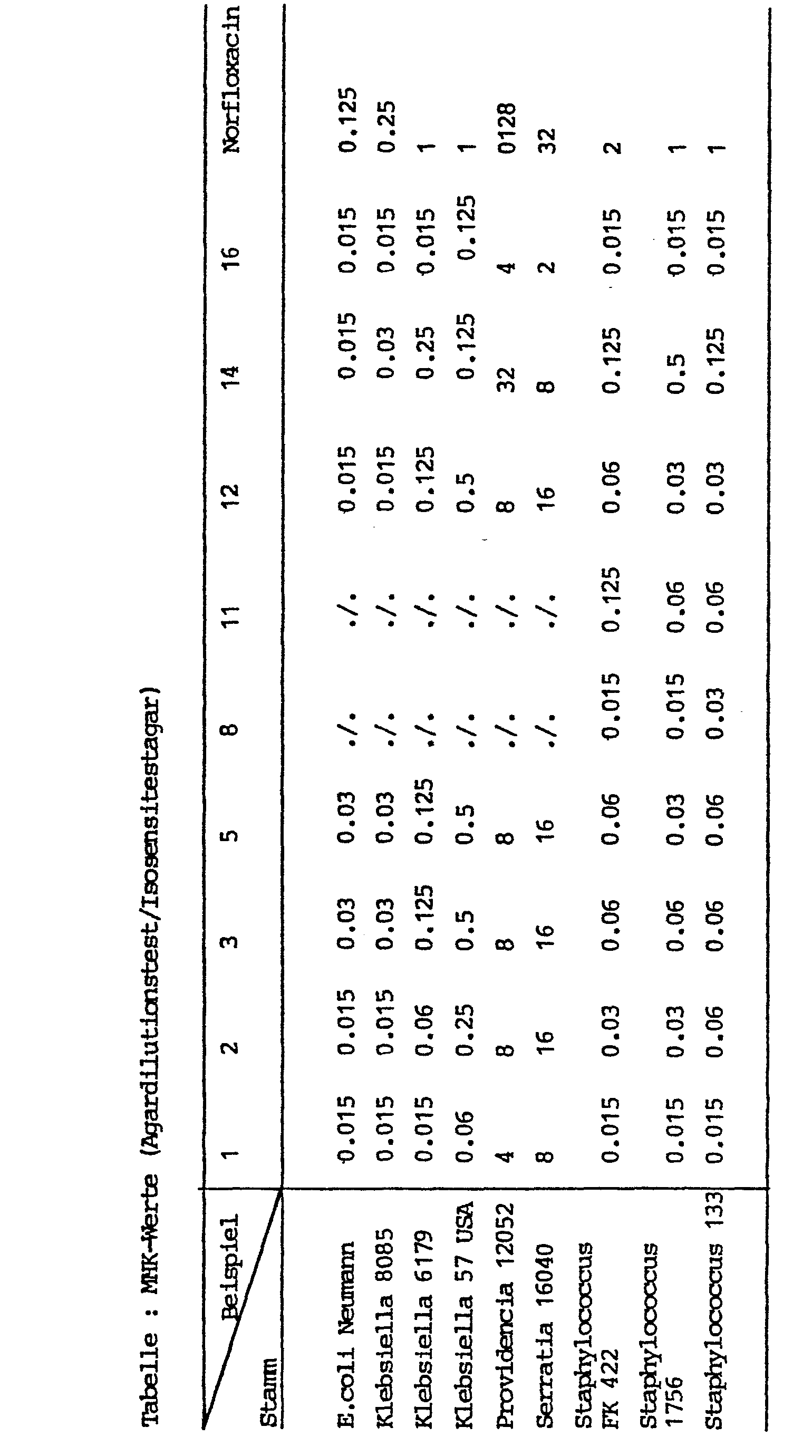
- Aus J. Med. Chem. 23, 1358 (1980) ist bereits bekannt, daß 1-Ethyl-6-fluor-1,4-dihydro-4-oxo-7-(1-piperazinyl)-3-chinolincarbonsäure (Norfloxacin) antibakterielle Eigenschaften besitzt. Die erfindungsgemäßen Verbindungen sind jedoch dem Norfloxacin überlegen, wie aus der nachstehenden Tabelle, in der die MHK-Werte einiger der erfindungsgemäßen Verbindungen und des Norfloxacins angegeben sind, hervorgeht.
-

- 24,3 g Magnesiumspäne werden in 50 ml wasserfreiem Ethanol suspendiert. Man versetzt mit 5 ml Tetrachlorkohlenstoff und tropft, wenn die Reaktion in Gang gekommen ist, ein Gemisch von 160 g Malonsäurediethylester, 100 ml abs. Ethanol und 400 ml wasserfreiem Toluol bei 50-60°C zu. Dann wird noch 1 Stunde auf 50-60°C erhitzt, mit Trockeneis/Aceton auf -5°C bis -10°C gekühlt und bei dieser Temperatur eine Lösung von 212,5 g 2,3,4,5-Tetrafluorbenzoylchlorid in 80 ml abs. Toluol langsam zugetropft. Man rührt 1 Stunde bei 0 bis -5°C, läßt über Nacht auf Raumtemperatur kommen und läßt unter Eiskühlung ein Gemisch von 400 ml Eiswasser und 25 ml konz. Schwefelsäure zulaufen. Die Phasen werden getrennt und zweimal mit Toluol nachextrahiert. Die vereinigten Toluollösungen werden mit gesättigter NaCl-Lösung gewaschen, mit Na2S04 getrocknet und das Lösungsmittel im Vakuum abgezogen. Man erhält 335 g 2,3,4,5-Tetra-fluorbenzoyl-malonsäurediethylester als Rohprodukt.
- Eine Emulsion von 284,8 g rohem 2,3,4,5-Tetrafluorbenzoyl-malonsäurediethylester in 300 ml Wasser wird mit 0,3 g p-Toluolsulfonsäure versetzt. Man erhitzt unter gutem Rühren 5 Stunden zum Sieden, extrahiert die erkaltete Emulsion mehrmals mit Methylenchlorid, wäscht die vereinigten Methylenchlorid-Lösungen einmal mit gesättigter NaCl-Lösung, trocknet mit Na2SO4 und destilliert das Lösungsmittel im Vakuum ab. Die Fraktionierung des Rückstandes im Hochvakuum liefert 160,2 g 2,3,4,5-Tetrafluorbenzoyl-essigsäureethylester vom Siedepunkt 100-110°C/D,09-0,1 mbar. Schmelzpunkt 47-49°C.
- Ein Gemisch von 110,7 g 2,3,4,5-Tetrafluorbenzoyl-essigsäureethylester 93,5 Orthoameisensäureethylester und 107 g Essigsäureanhydrid wird 2 Stunden auf 150°C erhitzt. Dann werden im Wasserstrahlvakuum und zuletzt im Hochvakuum bei einer Badtemperatur von ~720°C die flüchtigen Bestandteile abdestilliert. Zurück bleiben 123,9 g roher 2-(2,3,4,5-Tetrafluorbenzoyl)-3-ethoxy- acrylsäureethylester. Er ist genügend rein für die weiteren Umsetzungen.
- Eine Lösung von 123,9 g 2-(2,3,4,5-Tetrafluorbenzoyl)-3-ethoxyacrylsäureethylester in 250 ml Ethanol wird unter Eiskühlung und Rühren tropfenweise mit 23,2 g Cyclopropylamin versetzt. Wenn die exotherme Reaktion abgeklungen ist, wird noch 1 Stunde bei Raumtemperatur gerührt, das Lösungsmittel im Vakuum abgezogen und der Rückstand aus Cyclohexan/Petrolether umkristallisiert. Man erhält 115 g 2-(2,3,4,5-Tetrafluorbenzoyl)-3-cyclopropyl- amino-acrylsäureethylester vom Schmelzpunkt 63-65°C.
- Eine Lösung von 107,8 g 2-(2,3,4,5-Tetrafluorbenzoyl)-3-cyclopropylamino-acrylsäureethylester in 400 ml wasserfreiem Dimethylformamid wird mit 21,2 g Natrium-fluorid versetzt. Dann wird 2 Stunden unter Rückfluß gerührt und das Reaktionsgemisch heiß auf Eis gegossen. Der Niederschlag wird abgesaugt, mit Wasser gut gewaschen und im Vakuum über Calciumchlorid bei 100°C getrocknet. Man erhält 91,2 g 1-Cyclopropyl-6,7,8-trifluor-1,4-dihydro-4-oxo-3-chinolincarbonsäureethyl- ester vom Schmelzpunkt 167-168°C.
- Ein Gemisch von 94 g 1-Cyclopropyl-6,7,8-trifluor-1,4-dihydro-4-oxo-3-chinolincarbonsäureethylester, 600 ml Eisessig, 450 ml Wasser und 70 ml konz. Schwefelsäure wird 1,5 Stunden auf Rückfluß erhitzt. Dann gießt man die heiße Suspension auf Eis, saugt den Niederschlag ab, wäscht gut mit Wasser nach und trocknet im Vakuum bei 100°C. Man erhält auf diese Weise 88,9 g reine 1-Cyclopropyl-6,7,8-trifluor-1,4-dihydro-4-oxo-3-chinolincarbonsäure II (X1=X2=F) vom Schmelzpunkt 228-230°C (Z).
-

- Ausgehend von 2,4,5-Trifluorbenzoylfluorid verfährt man analog Beispiel A, wobei folgende Stufen durchlaufen werden: 2,4,5-Trifluorbenzoyl-essigsäurediethylester (Siedepunkt: 92-95°/0,5 mbar; Schmelzpunkt: 53-55°) → 2-(2,4,5-Trifluorbenzoyl)-3-ethoxy-acrylsäureethylester (Öl) → 2-(2,4,5-Trifluorbenzoyl)-3-cyclopropylaminoacrylsäureethylester (Öl) - → 1-Cyclopropyl-6,7-difluor-1,4-dihydro-4-oxo-3-chinolincarbonsäureethylester (Schmelzpunkt: 230 - 233°) → 1-Cyclopropyl-6,7-difluor-1,4-dihydro-4-oxo-3-chinolincarbonsäure (Schmelzpunkt: 302-303° unter Zersetzung).
-

- Eine Mischung aus 2,8 g (0,01 mol) 7-Chlor-1-cyclopropyl-6-fluor-1,4-dihydro-4-oxo-3-chinolincarbonsäure, 1,8 g (0,011 mol) 2-Phenyl-piperazin und 2,2 g (0,02 mol) 1,4-DiazabicycloZ2,2,27octan in 6 ml Dimethylsulfoxid wird 4 Stunden auf 140°C erhitzt. Die Lösung wird im Hochvakuum eingeengt, der Rückstand mit 20 ml Wasser verrührt und mit 2n Salzsäure auf pH 7 eingestellt. Der Niederschlag wird abgesaugt, mit Wasser und Methanol gewaschen und in 30 ml Methanol aufgekocht. Man erhält 1,3 g (32 % der Theorie) 1-Cyclopropyl-6-fluor-1,4-dihydro-4-oxo-7-(3-phenyl-1-piperazinyl)-3-chinolincarbonsäure vom Schmelzpunkt 218-220° (unter Zersetzung) (umkristallisert aus Glykolmonomethylether).
- Dasselbe Produkt wird erhalten, wenn man entsprechend 1-Cyclopropyl-6,7-difluor-1,4-dihydro-4-oxo-3-chinolincarbonsäure mit 2-Phenyl-piperazin umsetzt.
- Analog Beispiel 1 werden unter Verwendung der entsprechenden Piperazine die folgenden Verbindungen erhalten:


-

- 2,5 g(4,9 mmol) des Produktes aus Beispiel 6 in 30 ml Ethanol werden mit 60 ml 48 %iger Bromwasserstoffsäure versetzt und 1 Stunde bei 55° gerührt. Die Mischung wird im Vakuum eingeengt, der Rückstand mit 50 ml Wasser verrührt, der Niederschlag abgesaugt und mit Methanol gewaschen. Man erhält 1,5 g (66 % der Theorie) 1-Cyclopropyl-6-fluor-1,4-dihydro-7-[3-(4-hydroxy-phenyl)-1-piperazinyl]-4-oxo-3-chinolincarbonsäure-Hydrobromid vom Schmelzpunkt 295-298° (unter Zersetzung).
-

- 2,8 g (0,01 mol) 1-Cyclopropyl-6,7,8-trifluor-1,4-dihydro-4-oxo-3-chinolincarbonsäure (Beispiel A) werden mit 1,8 g(0,011 mol) 2-(2-Thienyl)-piperazin und 2,2 g(0,02 mol) 1,4-Diazabicyclo-[2,2,2]-octan in 6 ml DMSO 2 Stunden auf 140°C erhitzt. Die Mischung wird -im Hochvakuum eingeengt, der Rückstand mit 20 ml Wasser verrührt, der Niederschlag abgesaugt und in 20 ml Methanol aufgekocht. Es werden 2,4 g (56 % der Theorie) 1-Cyclopropyl-6,8-difluor-1,4-dihydro-4-oxo-7-[3-(2-thienyl)-1-piperazinyl]-3-chinolincarbonsäure vom Schmelzpunkt 252-254°C (unter Zersetzung) erhalten. Nach der Umkristallisation aus Glykolmonomethylether bleibt der Schmelzpunkt unverändert.
- Analog Beispiel 15 werden die folgenden Verbindungen erhalten ;


-

- 1,1 g (2,7 mmol) des Produktes aus Beispiel 1 werden in 10 ml Dimethylformamid mit 0,6 g Triethylamin und 0,9 g Ethyljodid 3 Stunden auf 80° erhitzt. Das Reaktionsgemisch wird im Vakuum eingeengt, der Rückstand mit 10 ml Wasser verrührt und aus Glykolmonomethylether umkristallisiert. Man erhält 0,75 g (49 % der Theorie) 1-Cyclopropyl-7-(4-ethyl-3-phenyl-1-piperazinyl)-6-fluor-1,4-dihydro-4-oxo-3-chinolincarbonsäure-Hydro- jodid vom Schmelzpunkt 240-243° (unter Zersetzung).
-

-

- 0,8 g(1,9 mmol) der Verbindung aus Beispiel 16 werden in 6 ml Dimethylformamid mit 0,6 ml 98-100%iger Ameisensäure 8 Stunden unter Rückfluß erhitzt. Das Reaktionsgemisch wird im Vakuum eingeengt, mit 20 ml Wasser verrührt und mit 5 %iger NatriumhydrogencarbonatLösung auf pH5 eingestellt. Der ausgefallene Niederschlag wird abgesaugt, mit Wasser und Methanol gewaschen und aus Glykolmonomethylether umkristallisiert. Man isoliert 0,6 g (70 % der Theorie) 1-Cyclopropyl-6,8-difluor-7-(4-formyl-3-phenyl-1-piperazinyl)-1,4-dihydro-4-oxo-3-chinolincarbonsäure vom Schmelzpunkt 242-245° (unter Zersetzung).
- Jede Tablette enthält:

- Die Lackhülle enthält:

bedeutet, und deren pharmazeutisch verwendbaren Hydrate, Säureadditionssalze, Alkali- und Erdalkalisalze eine hohe antibakterielle Wirkung aufweisen.
gegebenenfalls in Gegenwart von Säurebindern umsetzt (Methode A).
Claims (8)
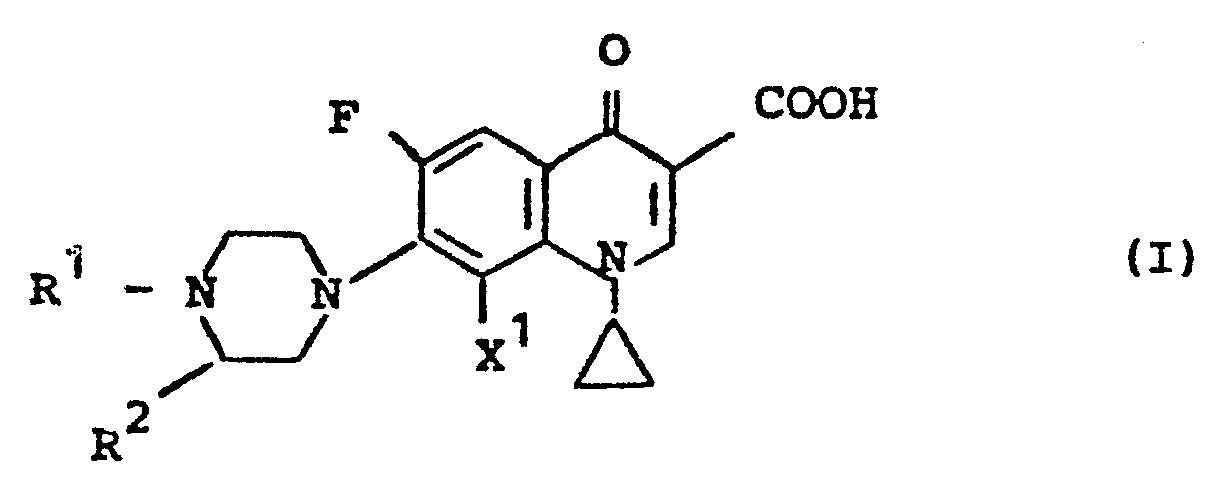
in welcher
bedeutet, und deren pharmazeutisch verwendbaren Hydrate, Säureadditionssalze, Alkali- und Erdalkalisalze.
in welcher
bedeutet, und deren pharmazeutisch verwendbaren Hydrate, Säureadditionassalze, Alkali- und Erdalkalisalze, dadurch gekennzeichnet, daß man entweder

in welcher X die oben angegebene Bedeutung hat und X2 für Halogen, insbesondere Fluor oder Chlor steht,

in welcher R1 und R2 die oben angegebene Bedeutung haben, gegebenenfalls in Gegenwart von Säurebindern umsetzt,
oder

in welcher R1 die oben angegebene Bedeutung hat, jedoch nicht Wasserstoff sein kann, und
oder

in der R3 für CN, CH3CO oder COOR4 steht, wobei R4 Methyl oder Ethyl bedeutet,
umsetzt. -

in welcher
bedeutet, und deren pharmazeutisch verwendbaren Hydrate, Säureadditionssalze, Alkali- und Erdalkalisalze.

in welcher
bedeutet, und deren pharmazeutisch verwendbaren Hydrate, Säureadditionssalze, Alkali- und Erdalkalisalze, mit inerten, nichtionischen- pharmazeutisch geeigneten Trägerstoffen vermischt.

in welcher
Verwendung von 1-Cyclopropyl-6-fluor-1,4-dihydro-4-oxo-7-(1-piperazinyl)-3-chinolincarbonsäuren bei der Herstellung von Arzneimitteln.
Priority Applications (1)
| Application Number | Priority Date | Filing Date | Title |
|---|---|---|---|
| AT85106252T ATE39488T1 (de) | 1984-06-04 | 1985-05-22 | 7-(3-aryl-1-piperazinyl)-sowie 7-(3-cyclohexyl-1-piperazinyl)-3-chinoloncarbon aeuren. |
Applications Claiming Priority (2)
| Application Number | Priority Date | Filing Date | Title |
|---|---|---|---|
| DE19843420798 DE3420798A1 (de) | 1984-06-04 | 1984-06-04 | 7-(3-aryl-l-piperazinyl)- sowie 7-(3-cyclohexyl-l-piperazinyl)-3-chinoloncarbonsaeuren |
| DE3420798 | 1984-06-04 |
Publications (3)
| Publication Number | Publication Date |
|---|---|
| EP0169993A2 true EP0169993A2 (de) | 1986-02-05 |
| EP0169993A3 EP0169993A3 (en) | 1986-03-26 |
| EP0169993B1 EP0169993B1 (de) | 1988-12-28 |
Family
ID=6237597
Family Applications (1)
| Application Number | Title | Priority Date | Filing Date |
|---|---|---|---|
| EP85106252A Expired EP0169993B1 (de) | 1984-06-04 | 1985-05-22 | 7-(3-Aryl-1-piperazinyl)-sowie 7-(3-Cyclohexyl-1-piperazinyl)-3-chinoloncarbonsäuren |
Country Status (21)
| Country | Link |
|---|---|
| US (1) | US4599334A (de) |
| EP (1) | EP0169993B1 (de) |
| JP (2) | JPS611683A (de) |
| KR (1) | KR920000759B1 (de) |
| AT (1) | ATE39488T1 (de) |
| AU (1) | AU571333B2 (de) |
| CA (1) | CA1248954A (de) |
| DD (1) | DD240016A5 (de) |
| DE (2) | DE3420798A1 (de) |
| DK (1) | DK162527C (de) |
| ES (3) | ES8607294A1 (de) |
| FI (1) | FI82041C (de) |
| GR (1) | GR851314B (de) |
| HU (1) | HU194866B (de) |
| IE (1) | IE57814B1 (de) |
| IL (1) | IL75370A (de) |
| NO (1) | NO165105C (de) |
| NZ (1) | NZ212271A (de) |
| PH (1) | PH22492A (de) |
| PT (1) | PT80580B (de) |
| ZA (1) | ZA854168B (de) |
Cited By (7)
| Publication number | Priority date | Publication date | Assignee | Title |
|---|---|---|---|---|
| EP0239992A1 (de) * | 1986-04-01 | 1987-10-07 | Warner-Lambert Company | Verfahren zur Herstellung von 2,3,4,5-Tetrafluorbenzoylacetaten |
| FR2653663A1 (en) * | 1989-10-30 | 1991-05-03 | Bellon Labor Sa Roger | Novel benzo[1,8]naphthyridine derivatives, their preparation and compositions containing them |
| EP0431991A1 (de) * | 1989-10-30 | 1991-06-12 | Société anonyme dite: LABORATOIRE ROGER BELLON | 1,8-Benzonaphthyridinderivate, ihre Herstellung und diese enthaltende Zusammensetzungen |
| FR2664595A1 (fr) * | 1990-07-10 | 1992-01-17 | Bellon Labor Sa Roger | Nouveaux derives de benzonaphtyridine-1,8, leur preparation et les compositions qui les contiennent. |
| EP0375658B1 (de) * | 1985-10-29 | 1994-08-03 | Dainippon Pharmaceutical Co., Ltd. | Chinolin-Derivate und Verfahren zu deren Herstellung |
| EP1236718A1 (de) * | 2001-02-23 | 2002-09-04 | Bayer Ag | Verbessertes Verfahren zur Herstellung von Fluorchinoloncarbonsäuren |
| WO2019206798A1 (de) | 2018-04-25 | 2019-10-31 | Bayer Animal Health Gmbh | Verfahren zur hydrolyse von chinoloncarbonsäureestern |
Families Citing this family (17)
| Publication number | Priority date | Publication date | Assignee | Title |
|---|---|---|---|---|
| DE3420743A1 (de) * | 1984-06-04 | 1985-12-05 | Bayer Ag, 5090 Leverkusen | 7-amino-1-cyclopropyl-6,8-dihalogen-1,4-dihydro-4-oxo-3-chinolincarbonsaeuren, verfahren zu ihrer herstellung sowie diese enthaltende antibakterielle mittel |
| US5468861A (en) * | 1984-06-04 | 1995-11-21 | Bayer Aktiengesellschaft | 8-chloro-1-cyclopropyl-6,7-difluoro-1,4-dihydro-4-oxo-3-quinolinecarboxylic acid and alkyl esters thereof |
| JPS6259263A (ja) * | 1985-09-10 | 1987-03-14 | Kyorin Pharmaceut Co Ltd | キノロンカルボン酸誘導体 |
| JPH0637489B2 (ja) * | 1985-09-21 | 1994-05-18 | 杏林製薬株式会社 | キノロンカルボン酸誘導体およびその製造方法 |
| HU196411B (en) * | 1985-09-24 | 1988-11-28 | Hoffmann La Roche | Process for producing quinoline derivatives and pharmaceutical compositions containing them |
| DE3542002A1 (de) * | 1985-11-28 | 1987-06-04 | Bayer Ag | 1-cyclopropyl-6-fluor-1,4-dihydro-4-oxo-7- (1-piperazinyl)-3-chinolincarbonsaeuren, verfahren zu ihrer herstellung sowie diese enthaltende antibakterielle mittel |
| EP0230053A3 (de) * | 1986-01-17 | 1988-03-30 | American Cyanamid Company | 7-(Substituierte)Piperazinyl-1-äthyl-6-fluor-1,4-dihydro-4-oxo-3-chinolinkarbonsäure |
| EP0230946A3 (de) * | 1986-01-20 | 1988-09-07 | Kyorin Pharmaceutical Co., Ltd. | Verfahren zur Herstellung von Chinolonkarbonsäure-Derivaten |
| DE3705621C2 (de) * | 1986-02-25 | 1997-01-09 | Otsuka Pharma Co Ltd | Heterocyclisch substituierte Chinoloncarbonsäurederivate |
| HU196987B (en) * | 1986-10-15 | 1989-02-28 | Chinoin Gyogyszer Es Vegyeszet | Process for producing quinoline-carboxylic acid derivatives |
| DE3639465A1 (de) * | 1986-11-18 | 1988-05-19 | Hoechst Ag | Optisch aktive gyrasehemmer, ihre herstellung und verwendung als antibiotika |
| NZ229605A (en) * | 1988-07-15 | 1990-07-26 | Abbott Lab | Preparation of 1,4-dihydro-6-fluoro-7-(piperazin-1-yl)-4-oxo-3-quinoline (or naphthyridine) carboxylic acid derivatives |
| EP0449445A3 (en) * | 1990-03-27 | 1993-08-25 | Pfizer Inc. | Preparation of beta-ketoesters useful in preparing quinolone antibiotics |
| WO1991016327A1 (en) | 1990-04-18 | 1991-10-31 | Norwich Eaton Pharmaceuticals, Inc. | Antimicrobial quinolonyl lactams |
| KR100519158B1 (ko) * | 2002-12-21 | 2005-10-06 | 주식회사유한양행 | 퀴놀론 카르복실레이트 유도체의 제조방법 |
| ES2366150T3 (es) * | 2006-03-28 | 2011-10-17 | Warner Chilcott Company, Llc | Malatos de polimorfos de ácido (3s,5s)-7-[3-amino-5-metil-piperidinil]-1-ciclopropil-1,4-dihidro-8-metoxi-4-oxo-3-quinolinocarboxílico. |
| CA2647454A1 (en) * | 2006-03-28 | 2007-10-04 | The Procter & Gamble Company | A coupling process for preparing quinolone intermediates |
Family Cites Families (11)
| Publication number | Priority date | Publication date | Assignee | Title |
|---|---|---|---|---|
| DE3142854A1 (de) * | 1981-10-29 | 1983-05-11 | Bayer Ag, 5090 Leverkusen | 1-cyclopropyl-6-fluor-1,4-dihydro-4-oxo-7-piperazino-chinolin-3-carbonsaeuren, verfahren zu ihrer herstellung sowie diese enthaltende antibakterielle mittel |
| DE3033157A1 (de) * | 1980-09-03 | 1982-04-01 | Bayer Ag, 5090 Leverkusen | 7-amino-1-cyclopropyl-4-oxo-1,4-dihydro-naphthyridin-3-carbonsaeuren, verfahren zu ihrer herstellung sowie diese enthaltende antibakterielle mittel |
| SE440354B (sv) * | 1981-02-19 | 1985-07-29 | Kyorin Seiyaku Kk | Kinolinkarboxylsyraderivat |
| DE3142856A1 (de) * | 1981-10-29 | 1983-05-11 | Bayer Ag, 5090 Leverkusen | Verfahren zur herstellung von 2,4-dichlor-5-fluor-benzoylchlorid |
| JPS5910580A (ja) * | 1982-07-09 | 1984-01-20 | Hokuriku Seiyaku Co Ltd | 7−フエニル置換ピペラジノ−4−オキソ−1,4−ジヒドロキノリン−3−カルボン酸誘導体 |
| JPS5929685A (ja) * | 1982-08-11 | 1984-02-16 | Hokuriku Seiyaku Co Ltd | 7−置換フエニルピペラジノ−4−オキソ−1,4−ジヒドロキノリン−3−カルボン酸誘導体 |
| IE55898B1 (en) * | 1982-09-09 | 1991-02-14 | Warner Lambert Co | Antibacterial agents |
| DE3248506A1 (de) * | 1982-12-29 | 1984-07-05 | Bayer Ag, 5090 Leverkusen | 1-cyclopropyl-6-fluor-1,4-dihydro-4-oxo-7(alkyl-1-piperazinyl)-3-chinolincarbonsaeuren, verfahren zu ihrer herstellung sowie diese enthaltende antibakterielle mittel |
| DE3248507A1 (de) * | 1982-12-29 | 1984-07-05 | Bayer Ag, 5090 Leverkusen | Mikrobizide mittel auf chinoloncarbonsaeure basis |
| DE3306772A1 (de) * | 1983-02-25 | 1984-08-30 | Bayer Ag, 5090 Leverkusen | Chinolonsaeuren, verfahren zu ihrer herstellung sowie diese enthaltende antibakterielle mittel |
| DE3318145A1 (de) * | 1983-05-18 | 1984-11-22 | Bayer Ag, 5090 Leverkusen | 7-amino-1-cyclopropyl-6,8-difluor-1,4-dihydro-4-oxo-3-chinolincarbonsaeuren, verfahren zu ihrer herstellung sowie diese enthaltende antibakterielle mittel |
-
1984
- 1984-06-04 DE DE19843420798 patent/DE3420798A1/de not_active Withdrawn
-
1985
- 1985-05-17 US US06/735,493 patent/US4599334A/en not_active Expired - Fee Related
- 1985-05-22 DE DE8585106252T patent/DE3567021D1/de not_active Expired
- 1985-05-22 EP EP85106252A patent/EP0169993B1/de not_active Expired
- 1985-05-22 AT AT85106252T patent/ATE39488T1/de active
- 1985-05-23 NO NO852063A patent/NO165105C/no unknown
- 1985-05-27 PH PH32319A patent/PH22492A/en unknown
- 1985-05-29 GR GR851314A patent/GR851314B/el unknown
- 1985-05-31 FI FI852205A patent/FI82041C/fi not_active IP Right Cessation
- 1985-05-31 AU AU43206/85A patent/AU571333B2/en not_active Ceased
- 1985-05-31 IL IL75370A patent/IL75370A/xx unknown
- 1985-05-31 NZ NZ212271A patent/NZ212271A/xx unknown
- 1985-05-31 JP JP60116836A patent/JPS611683A/ja active Pending
- 1985-05-31 IE IE1364/85A patent/IE57814B1/en not_active IP Right Cessation
- 1985-05-31 CA CA000482912A patent/CA1248954A/en not_active Expired
- 1985-06-03 DK DK249685A patent/DK162527C/da not_active IP Right Cessation
- 1985-06-03 PT PT80580A patent/PT80580B/pt not_active IP Right Cessation
- 1985-06-03 ZA ZA854168A patent/ZA854168B/xx unknown
- 1985-06-03 KR KR1019850003855A patent/KR920000759B1/ko not_active Expired
- 1985-06-03 ES ES543839A patent/ES8607294A1/es not_active Expired
- 1985-06-03 HU HU852145A patent/HU194866B/hu not_active IP Right Cessation
- 1985-06-03 DD DD85276974A patent/DD240016A5/de not_active IP Right Cessation
-
1986
- 1986-02-28 ES ES552574A patent/ES8800196A1/es not_active Expired
- 1986-02-28 ES ES552573A patent/ES8800195A1/es not_active Expired
-
1993
- 1993-12-15 JP JP5342256A patent/JPH06279411A/ja active Pending
Cited By (8)
| Publication number | Priority date | Publication date | Assignee | Title |
|---|---|---|---|---|
| EP0375658B1 (de) * | 1985-10-29 | 1994-08-03 | Dainippon Pharmaceutical Co., Ltd. | Chinolin-Derivate und Verfahren zu deren Herstellung |
| EP0239992A1 (de) * | 1986-04-01 | 1987-10-07 | Warner-Lambert Company | Verfahren zur Herstellung von 2,3,4,5-Tetrafluorbenzoylacetaten |
| FR2653663A1 (en) * | 1989-10-30 | 1991-05-03 | Bellon Labor Sa Roger | Novel benzo[1,8]naphthyridine derivatives, their preparation and compositions containing them |
| EP0431991A1 (de) * | 1989-10-30 | 1991-06-12 | Société anonyme dite: LABORATOIRE ROGER BELLON | 1,8-Benzonaphthyridinderivate, ihre Herstellung und diese enthaltende Zusammensetzungen |
| FR2664595A1 (fr) * | 1990-07-10 | 1992-01-17 | Bellon Labor Sa Roger | Nouveaux derives de benzonaphtyridine-1,8, leur preparation et les compositions qui les contiennent. |
| EP1236718A1 (de) * | 2001-02-23 | 2002-09-04 | Bayer Ag | Verbessertes Verfahren zur Herstellung von Fluorchinoloncarbonsäuren |
| WO2019206798A1 (de) | 2018-04-25 | 2019-10-31 | Bayer Animal Health Gmbh | Verfahren zur hydrolyse von chinoloncarbonsäureestern |
| US11332444B2 (en) | 2018-04-25 | 2022-05-17 | Bayer Animal Health Gmbh | Method for the hydrolysis of quinolonecarboxylic esters |
Also Published As
Similar Documents
| Publication | Publication Date | Title |
|---|---|---|
| EP0169993B1 (de) | 7-(3-Aryl-1-piperazinyl)-sowie 7-(3-Cyclohexyl-1-piperazinyl)-3-chinoloncarbonsäuren | |
| EP0126355B1 (de) | 7-Amino-1-cyclopropyl-6,8-difluor-1,4-dihydro-4-oxo-3-chinolincarbonsäuren, Verfahren zu ihrer Herstellung sowie diese enthaltende antibakterielle Mittel | |
| EP0167763B1 (de) | 7-Amino-1-cyclopropyl-6,8-dihalogen-1,4-dihydro-4-oxo-3-chinolincarbonsäuren, Verfahren zur ihrer Herstellung sowie diese enthaltende antibakterielle Mittel | |
| EP0113093B1 (de) | 1-Cyclopropyl-6-fluor-1,4-dihydro-4-oxo-7-(alkyl-1-piperazinyl)-3-chinolincarbonsäuren, Verfahren zu ihrer Herstellung sowie diese enthaltende antibakterielle Mittel | |
| EP0198192B1 (de) | 7-Amino-1-(subst.cyclopropyl)-1,4-dihydro-4-oxo-3-chinolincarbonsäuren, Verfahren zu ihrer Herstellung sowie diese enthaltende antibakterielle Mittel | |
| EP0164619B1 (de) | 2,4,5-Trihalogen- bzw. 2,3,4,5-Tetrahalogenbenzolderivate und Verfahren zu ihrer Herstellung | |
| EP0155587B1 (de) | 1,7-Diamino-1,4-dihydro-4-oxo-3-(aza) chinolincarbonsäuren, Verfahren zu ihrer Herstellung sowie ihre Verwendung bei der Bekämpfung bakterieller Erkrankungen | |
| DE3522406A1 (de) | Verfahren zur herstellung von 1,8-verbrueckten 4-chinolon-3-carbonsaeuren | |
| EP0187376B1 (de) | 6,7-Disubstituierte 1-Cyclopropyl-1,4-dihydro-4-oxo-1,8-naphthyridin-3-carbonsäuren | |
| EP0113092B1 (de) | 1-Cyclopropyl-6-fluor-1,4-dihydro-4-oxo-7-(4-(oxoalkyl)-1-piperazinyl)-3-chinolincarbonsäuren und ihre Derivate, Verfahren zu ihrer Herstellung sowie diese enthaltende antibakterielle Mittel | |
| EP0166939B1 (de) | 1-Cyclopropyl-6-fluor-1,4-dihydro-4-oxo-7-(3-oxo-1-piperazinyl)-3-chinolincarbonsäuren, Verfahren zu ihrer Herstellung sowie diese enthaltende antibakterielle Mittel | |
| EP0201829A1 (de) | 1-Aryl-4-chinolon-3-carbonsäuren | |
| EP0191390B1 (de) | 1-Cyclopropyl-1,4-dihydro-4-oxo-7-[4-(2-oxo-1,3-dioxol-4-yl-methyl)-1-piperazinyl]-3-chinolincarbonsäuren, Verfahren zu ihrer Herstellung sowie diese enthaltende antibakterielle Mittel | |
| DE3542002A1 (de) | 1-cyclopropyl-6-fluor-1,4-dihydro-4-oxo-7- (1-piperazinyl)-3-chinolincarbonsaeuren, verfahren zu ihrer herstellung sowie diese enthaltende antibakterielle mittel | |
| DD241258A5 (de) | Verfahren zur herstellung 6,7-disubstituierter 1-cyclopropyl-1,4-dihydro-4-oxo-1,8-naphthyridin-3-carbonsaeuren |
Legal Events
| Date | Code | Title | Description |
|---|---|---|---|
| PUAI | Public reference made under article 153(3) epc to a published international application that has entered the european phase |
Free format text: ORIGINAL CODE: 0009012 |
|
| 17P | Request for examination filed |
Effective date: 19850522 |
|
| AK | Designated contracting states |
Designated state(s): AT BE CH DE FR GB IT LI LU NL SE |
|
| PUAL | Search report despatched |
Free format text: ORIGINAL CODE: 0009013 |
|
| AK | Designated contracting states |
Kind code of ref document: A3 Designated state(s): AT BE CH DE FR GB IT LI LU NL SE |
|
| 17Q | First examination report despatched |
Effective date: 19870529 |
|
| GRAA | (expected) grant |
Free format text: ORIGINAL CODE: 0009210 |
|
| AK | Designated contracting states |
Kind code of ref document: B1 Designated state(s): AT BE CH DE FR GB IT LI LU NL SE |
|
| REF | Corresponds to: |
Ref document number: 39488 Country of ref document: AT Date of ref document: 19890115 Kind code of ref document: T |
|
| ITF | It: translation for a ep patent filed | ||
| REF | Corresponds to: |
Ref document number: 3567021 Country of ref document: DE Date of ref document: 19890202 |
|
| GBT | Gb: translation of ep patent filed (gb section 77(6)(a)/1977) | ||
| ET | Fr: translation filed | ||
| PLBE | No opposition filed within time limit |
Free format text: ORIGINAL CODE: 0009261 |
|
| STAA | Information on the status of an ep patent application or granted ep patent |
Free format text: STATUS: NO OPPOSITION FILED WITHIN TIME LIMIT |
|
| 26N | No opposition filed | ||
| ITTA | It: last paid annual fee | ||
| PGFP | Annual fee paid to national office [announced via postgrant information from national office to epo] |
Ref country code: SE Payment date: 19930420 Year of fee payment: 9 |
|
| PGFP | Annual fee paid to national office [announced via postgrant information from national office to epo] |
Ref country code: AT Payment date: 19930423 Year of fee payment: 9 |
|
| PGFP | Annual fee paid to national office [announced via postgrant information from national office to epo] |
Ref country code: NL Payment date: 19930531 Year of fee payment: 9 |
|
| PGFP | Annual fee paid to national office [announced via postgrant information from national office to epo] |
Ref country code: LU Payment date: 19930702 Year of fee payment: 9 |
|
| EPTA | Lu: last paid annual fee | ||
| PG25 | Lapsed in a contracting state [announced via postgrant information from national office to epo] |
Ref country code: LU Free format text: LAPSE BECAUSE OF NON-PAYMENT OF DUE FEES Effective date: 19940522 Ref country code: AT Effective date: 19940522 |
|
| PG25 | Lapsed in a contracting state [announced via postgrant information from national office to epo] |
Ref country code: SE Effective date: 19940523 |
|
| PG25 | Lapsed in a contracting state [announced via postgrant information from national office to epo] |
Ref country code: NL Effective date: 19941201 |
|
| NLV4 | Nl: lapsed or anulled due to non-payment of the annual fee | ||
| EUG | Se: european patent has lapsed |
Ref document number: 85106252.1 Effective date: 19941210 |
|
| EUG | Se: european patent has lapsed |
Ref document number: 85106252.1 |
|
| PGFP | Annual fee paid to national office [announced via postgrant information from national office to epo] |
Ref country code: DE Payment date: 19960412 Year of fee payment: 12 |
|
| PGFP | Annual fee paid to national office [announced via postgrant information from national office to epo] |
Ref country code: FR Payment date: 19960429 Year of fee payment: 12 |
|
| PGFP | Annual fee paid to national office [announced via postgrant information from national office to epo] |
Ref country code: CH Payment date: 19960506 Year of fee payment: 12 |
|
| PGFP | Annual fee paid to national office [announced via postgrant information from national office to epo] |
Ref country code: GB Payment date: 19960513 Year of fee payment: 12 |
|
| PGFP | Annual fee paid to national office [announced via postgrant information from national office to epo] |
Ref country code: BE Payment date: 19960522 Year of fee payment: 12 |
|
| PG25 | Lapsed in a contracting state [announced via postgrant information from national office to epo] |
Ref country code: GB Effective date: 19970522 |
|
| PG25 | Lapsed in a contracting state [announced via postgrant information from national office to epo] |
Ref country code: LI Free format text: LAPSE BECAUSE OF NON-PAYMENT OF DUE FEES Effective date: 19970531 Ref country code: CH Free format text: LAPSE BECAUSE OF NON-PAYMENT OF DUE FEES Effective date: 19970531 Ref country code: BE Effective date: 19970531 |
|
| BERE | Be: lapsed |
Owner name: BAYER A.G. Effective date: 19970531 |
|
| GBPC | Gb: european patent ceased through non-payment of renewal fee |
Effective date: 19970522 |
|
| REG | Reference to a national code |
Ref country code: CH Ref legal event code: PL |
|
| PG25 | Lapsed in a contracting state [announced via postgrant information from national office to epo] |
Ref country code: FR Free format text: LAPSE BECAUSE OF NON-PAYMENT OF DUE FEES Effective date: 19980130 |
|
| PG25 | Lapsed in a contracting state [announced via postgrant information from national office to epo] |
Ref country code: DE Free format text: LAPSE BECAUSE OF NON-PAYMENT OF DUE FEES Effective date: 19980203 |
|
| REG | Reference to a national code |
Ref country code: FR Ref legal event code: ST |