EP0160171A2 - Verfahren zur Herstellung von ammonsalzhaltigen Mangan(II)-Salzlösungen - Google Patents
Verfahren zur Herstellung von ammonsalzhaltigen Mangan(II)-Salzlösungen Download PDFInfo
- Publication number
- EP0160171A2 EP0160171A2 EP85101967A EP85101967A EP0160171A2 EP 0160171 A2 EP0160171 A2 EP 0160171A2 EP 85101967 A EP85101967 A EP 85101967A EP 85101967 A EP85101967 A EP 85101967A EP 0160171 A2 EP0160171 A2 EP 0160171A2
- Authority
- EP
- European Patent Office
- Prior art keywords
- manganese
- leaching
- ammonium salt
- mol
- ammonium
- Prior art date
- Legal status (The legal status is an assumption and is not a legal conclusion. Google has not performed a legal analysis and makes no representation as to the accuracy of the status listed.)
- Granted
Links
Images
Classifications
-
- C—CHEMISTRY; METALLURGY
- C01—INORGANIC CHEMISTRY
- C01G—COMPOUNDS CONTAINING METALS NOT COVERED BY SUBCLASSES C01D OR C01F
- C01G45/00—Compounds of manganese
-
- C—CHEMISTRY; METALLURGY
- C22—METALLURGY; FERROUS OR NON-FERROUS ALLOYS; TREATMENT OF ALLOYS OR NON-FERROUS METALS
- C22B—PRODUCTION AND REFINING OF METALS; PRETREATMENT OF RAW MATERIALS
- C22B47/00—Obtaining manganese
-
- Y—GENERAL TAGGING OF NEW TECHNOLOGICAL DEVELOPMENTS; GENERAL TAGGING OF CROSS-SECTIONAL TECHNOLOGIES SPANNING OVER SEVERAL SECTIONS OF THE IPC; TECHNICAL SUBJECTS COVERED BY FORMER USPC CROSS-REFERENCE ART COLLECTIONS [XRACs] AND DIGESTS
- Y02—TECHNOLOGIES OR APPLICATIONS FOR MITIGATION OR ADAPTATION AGAINST CLIMATE CHANGE
- Y02P—CLIMATE CHANGE MITIGATION TECHNOLOGIES IN THE PRODUCTION OR PROCESSING OF GOODS
- Y02P10/00—Technologies related to metal processing
- Y02P10/20—Recycling
Definitions
- the present invention relates to a method for producing ammonium salt-containing manganese (II) salt solutions by leaching manganese-containing compounds with ammonium salt solutions.
- the electrodeposition of y-manganese dioxide is carried out from acidic manganese (II) salt solutions.
- the disadvantage here are the high investment costs and the expensive electrolysis current.
- a less expensive way of producing y-manganese dioxide is the oxidizing roasting of manganese carbonate.
- Manganese carbonate can be precipitated from manganese (II) salt solutions with carbon dioxide and ammonia.
- the leaching of reduced manganese ore with ammonium sulfate solutions to obtain a manganese (II) salt solution is described in US Pat. No. 1,889,021.
- the ore leaching takes place at the boiling point of the reaction mixture, with the stripped ammonia in a downstream .
- Reaction stage using carbon dioxide for the precipitation of manganese carbonate from the manganese (II) salt solution is used.
- the ammonium sulfate solution obtained after the separation of the manganese carbate is returned to the leaching stage.
- US Pat. No. 1,947,457 describes a leaching process for the recovery of manganese (II) salt solutions from reduced manganese ore, in which the manganese ore is leached at elevated or boiling temperature and the ammonia is additionally expelled during the leaching process by means of oxygen-containing gases. At the same time, iron compounds present are oxidized and precipitated by the oxygen-containing gases.
- a special reactor which, with a large surface area of the leaching mash, has only a low filling level of the reactor.
- the yield in the leaching process is 8 0% at a reaction temperature of 100 ° F 38 ° C and a fill level of the reactor of 12 in 30 cm, or 85% yield at 85 ° F 29 ° C and a filling height of the reactor of 0.5 in ⁇ 1.25 cm, - each time with air blowing through to reduce the NH 3 concentration in the leaching mash.
- the ammonium salt solution used for leaching contains 10% diammonium sulfate ⁇ 0.76 mol / l.
- Fitch process is economically unfavorable because large amounts of ammonium salt solutions have to be circulated. Furthermore, the high proportion of inert gas (air) in the stripped NH 3 gas has an unfavorable effect in the event that the NH 3 is to be further processed into (NH 4 ) 2 CO 3 , for example from the manganese obtained in the ore leaching (II) salt solution to precipitate manganese carbonate.
- a description of the Bradley-Fitch process on a pilot scale shows that when ores containing 17% Mn are used in the first leaching step, the yield is 60 percent a manganese (II) salt solution with 4% MnSO 4 ⁇ 14.6 g / l manganese was obtained, which was brought to a concentration of 6% MnSO 4 ⁇ 21.8 g / 1 manganese in the second leaching step (countercurrent). The manganese was precipitated from this solution; however, this only with 50% yield, the rest remained in the ammonium salt solution, which was recycled for the ore digestion. This changed the solution balance to the disadvantage of manganese ore leaching.
- the present invention has now set itself the task of a method for producing pure ammonium salt-containing manganese (II) salt solutions from manganese-containing substances specify with ammonium salt solutions, which can be operated with high leaching yields and good filterability, and wherein the manganese (II) salt solutions contain only low magnesium impurities.
- the invention particularly intends to use the mother liquor obtained in a manganese-carbonate precipitation stage, containing dissolved diammonium sulfate, for leaching reduced manganese ore.
- the invention relates to a process for the preparation of ammonium salt-containing manganese (II) salt solutions by leaching manganese-containing compounds with ammonium salt solutions, which is characterized in that a boiling temperature of 57 to 68 ° C. is set by applying a negative pressure in the leaching mash .
- the process delivers particularly good results if a boiling temperature of 59 to 62 ° C is set by applying a negative pressure in the leaching liquor.
- ammonium salt solution used for leaching is 0.5-2.5 mol / l, in particular 0.9-1.1 mol / 1 diamonium sulfate, or 1.0-5.0 mol / l, in particular 1.8 - 2.2 mol / 1 ammonium nitrate or if the ammonium salt solution used for leaching comes from a manganese-carbonate precipitation stage and preferably 0.7 - 1.5 mol / l diammonium sulfate or contains 1.4-3.0 mol / l ammonium nitrate.
- Reduced high-percentage manganese ores with more than 55% manganese (II) oxide can be used as manganese-containing compounds according to the invention.
- the process can also be operated with ammonium chlaride solutions; however, there are corrosion problems with steel parts during the technical implementation.
- the advantages of the method of operation selected according to the invention are that at a leaching temperature of 57-68 ° C., in particular at a leaching temperature of 59-62 ° C., and a leaching time of 3 hours, yields of more than 90%, calculated on the manganese ( II) content in reduced ore.
- the mash is easy to filter because the gait in the ore remains granular and thus acts as a filter aid.
- the viscosity of the ammonium salt-containing manganese (II) salt solutions increases, making the filtration difficult; at temperatures above 68 ° C, slimy components are excreted, which make good filtration extremely difficult.
- Another advantage is that at leaching temperatures of 57 - 68 ° C only minor magnesium impurities are contained in the manganese (II) salt solution. Magnesium compounds cannot be separated from manganese (II) salt solution and get into the product when the manganese (II) salt solution is processed to manganese carbonate.
- the leaching mash was kept in the boiling state and the ammonia saturated with water vapor was driven off.
- the heat of vaporization was fed to the rürs tank via the double jacket by means of a hot water circuit.
- Example 9 the manganese (II) salt solution contained 32.7 g / l of manganese.
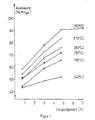
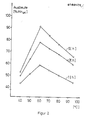
- Figures 1 and 2 are attached.
- the yield of dissolved manganese is plotted against the leaching time in FIG. 1; the yield of dissolved manganese is plotted against the leaching temperature in FIG.
- the ammonium salt solution comes from a manganese-carbonate precipitation stage and contained 1.08 mol / l diammonium sulfate at a pH of 8.0.
- the dissolved heavy metals were precipitated by introducing hydrogen sulfide at a temperature of 60 ° C. and the solids were filtered off.
- the yield of dissolved manganese was 91.8%.
- the manganese was precipitated as manganese carbonate at 60 ° C. and a pH of 8.0 using an ammoniacal, ammonium salt-containing diammonium carbonate solution.
- the filtrate obtained from the manganese-carbonate precipitation was reused for ore leaching. 592 g of reduced Imini ore were leached with 10 l of this filtered ammonium salt solution, containing 1.1 mol / l diammonium sulfate.
- the yield of dissolved manganese was 92.0%.
- the contamination of magnesium was found to be 200 mg / l.
Landscapes
- Chemical & Material Sciences (AREA)
- Organic Chemistry (AREA)
- Engineering & Computer Science (AREA)
- Inorganic Chemistry (AREA)
- Manufacturing & Machinery (AREA)
- Materials Engineering (AREA)
- Mechanical Engineering (AREA)
- Metallurgy (AREA)
- Manufacture And Refinement Of Metals (AREA)
- Inorganic Compounds Of Heavy Metals (AREA)
Abstract
Description
- Die vorliegende Erfindung betriftt ein Verfahren zur Herstellung von ammonsalzhaltigen Mangan(II)-Salzlösungen durch Laugung von manganhaltigen Verbindungen mit Ammonsalz-Lösungen.
- Der Bedarf an reinen Mangansalzen als Zwischenprodukt für die Herstellung von y-Braunstein, der als Rohstoff für die Batterieproduktion dient, steigt ständig.
- Die elektrolytische Abscheidung von y-Braunstein erfolgt aus sauren Mangan(II)-Salzlösungen. Nachteilig hierbei sind die hohen Investitionskosten und der teure Elektrolysestrom. Eine kostengünstigere Art der y-Braunstein-Herstellung ist die oxidierende Röstung von Mangan-Karbonat. Mangan-Karbonat kann aus Mangan(II)-Salzlösungen mit Kohlendioxid und Ammoniak ausgefällt werden.
- Die Laugung von reduziertem Manganerz mit Ammonium-Sulfat-Lösungen zur Gewinnung einer Mangan(II)-Salzlösung ist in der US-PS 1,889,021 vorbeschrieben. Die Erzlaugung erfolgt beim Siedepunkt der Reaktionsmischung, wobei das abgetriebene Ammoniak in einer nachgeschalteten.Reaktionsstufe unter Verwendung von Kohlendioxid zur Ausfällung von Mangan-Karbonat aus der Mangan(II)-Salzlösung eingesetzt wird. Die nach der Abtrennung des Mangan-Karbcnats anfallende AmmoniumSulfat-Lösung wird in die Laugungsstufe rückgeführt.
- Nachteilig jedoch ist, daß nach dem Aufschluß eine Lösung mit 60 - 120 g/l Diammonium-Sulfat und lediglich 20 g/l MnSO47,3 g/1 Mn erhalten wird. Dies bedeutet einen relativ hohen Umlauf an Diammonium-Sulfat-Lösung für die gelöste Manganmenge. Diese Methode ist somit unwirtschaftlich.

- Die US-PS 1,947,457 beschreibt ein Laugungsverfahren zur Gewinnung von Mangan(II)-Salzlösungen aus reduziertem Manganerz, bei dem die Laugung des Manganerzes bei erhöhter oder Siedetemperatur erfolgt und das Ammoniak während des Laugungsprozesses zusätzlich mittels sauerstoffhaltiger Gase ausgetrieben wird. Durch die sauerstoffhaltigen Gase werden gleichzeitig anwesende Eisenverbindungen oxidiert und ausgefällt.
- Zur Erleichterung der NH3-Austreibung wird ein spezieller Reaktor gewählt, der bei großer Oberfläche der Laugungsmaische nur eine geringe FUllhöhe des Reaktors aufweist. Die Ausbeute beim Laugungsprozeß beträgt 80 % bei einer Reaktionstemperatur von 100°F38°C und einer Füllhöhe des Reaktors von 12 in
 30 cm, bzw. 85 % Ausbeute bei 85°F
 29°C und einer Füllhöhe des Reaktors von 0,5 in ∧ 1,25 cm, - jeweils unter Durchblasen von Luft zur Verringerung der NH3-Konzentration in der Laugungsmaische. Die zur Laugung eingesetzte Ammonsalz-Lösung enthält 10 % Diammonium-Sulfat ∧ 0,76 Mol/l. Es werden 10 Teile Diammcnium-Sulfat pro 1 Teil Mangan(II)-Oxid im Erz zur Laugung eingesetzt. Somit ist sowohl die Verfahrenstechnik des Aufschlußreaktors, als auch der niedrige Quotient

- Fitch-Verfahrens wirtschaftlich ungünstig, da große Mengen an Ammonsalz-Lösungen umgewälzt werden müssen. Weiterhin ungünstig wirkt sich der hohe Inertgas-(Luft)-anteil im abgetriebenen NH3-Gas aus für den Fall, daß man das NH3 etwa zu (NH4)2CO3 weiterverarbeiten will, um beispielsweise aus der bei der Erzlaugung gewonnenen Mangan(II)-Salzlösung Mangan-Karbonat auszufällen.
- Die US-PS 1,951,341 beschreibt die Manganerzlaugung mit Ammon-Salzlösung bei 100°C. Unter hohem Energieeinsatz wird NH3 mittels Dampf aus der Laugungsmaische ausgeblasen. Die Mangan-Ausbeute, bezogen auf eingesetztes Erz, ist nicht angegeben, jedoch wird darauf hingewiesen, daß unter diesen Bedingungen die Laugung in zwei aufeinander folgenden Schritten erfolgen muß. Außerdem beträgt der Einsatz pro 1 kg Erz (193 g Mn) 10 kg 10 gewichtsprozentige Ammon-Sulfatlösung. Somit ist auch bei dieser Arbeitsweise der Quotient Mn (gelöst klein und die resultierende Diammonium-Suifat (eingesetzt) Mangan(II)-Salzlösung enthält nur 20 g/1 Mangan.
- Aus einer Beschreibung des Bradley-Fitch-Verfahrens im Pilotmaßstab (E.S. Leaver, Bureau of Mines Information Circular 677o (1934), S. 167-192) geht hervor, daß bei Einsatz von Erzen mit 17 % Mn im ersten Laugungsschritt mit 60 prozentiger Ausbeute eine Mangan(II)-Salzlösung mit 4 % MnSO4 ∧ 14,6 g/l Mangan erhalten wurde, die im zweiten Laugungsschritt (Gegenstrom) auf eine Konzentration von 6 % MnSO4 ∧ 21,8 g/1 Mangan gebracht wurde. Aus dieser Lösung wurde das Mangan ausgefällt; dies jedoch nur mit 50 % Ausbeute, der Rest verblieb in der Ammonsalz-Lösung, welche für den Erzaufschluß rückgeführt wurde. Hierdurch wurde das Lösegleichgewicht zu Ungunsten der Manganerz-Laugung verändert. Weiterhin war der hohe Gangartanteil des verwendeten Erzes von Nachteil, wodurch entweder große Waschwassermengen erforderlich wurden, die eingedampft werden mußten, oder aber über die Filterkuchenfeuchte große Verluste an Mangan(II)-Salz und Ammonsulfat auftraten. Das Verfahren arbeitete somit unwirtschaftlich.
- Schließlich wurde bei keinem der oben erwähnten Verfahren auch eine Sulfidfällung der durch Ammonsulfatlösung bevorzugt gelösten Schwermetalle Cu, Co, Ni usw. angewendet.
- Die vorliegende Erfindung hat sich nunmehr die Aufgabe gestellt, ein Verfahren zur Herstellung von reinen ammonsalzhaltigen Mangan(II)-Salzlösungen aus manganhaltigen Stoffen mit Ammonsalz-Lösungen anzugeben, das mit hohen Auslauge-Ausbeuten und guter Filtrierbarkeit betrieben werden kann, und wobei die Mangan(II)-Salzlösungen nur geringe Magnesium-Verunreinigungen enthalten. Die Erfindung will insbesondere die bei einer Mangan-Karbonat-Fällstufe anfallende Mutterlauge, enthaltend gelöstes Diammonium-Sulfat, zur Laugung von reduziertem Manganerz nutzen.
- Im einzelnen betrifft die Erfindung ein Verfahren zur Herstellung von ammonsalzhaltigen Mangan(II)-Salzlösungen durch Laugung von manganhaltigen Verbindungen mit Ammonsalz-Lösungen, das dadurch gekennzeichnet ist, daß durch Anlegen eines Unterdruckes in der Laugungsmaische eine Siedetemperatur von 57 bis 68°C eingestellt wird. Besonders gute Ergebnisse liefert das Verfahren, wenn durch Anlegen eines Unterdruckes in der Laugungsmaische eine Siedetemperatur von 59 bis 62°C eingestellt wird. Das erfindungsgemäße Verfahren eignet sich gleichermaßen, wenn die zur Laugung eingesetzte Ammonsalz-Lösung 0,5 - 2,5 Mol/l, insbesondere 0,9 - 1,1 Mol/1 Diamnonium-Sulfzt, oder 1,0 - 5,0 Mol/l, insbesondere 1,8 - 2,2 Mol/1 Ammonium-Nitrat enthält oder wenn die zur Laugung eingesetzte Ammonsalz-Lösung aus einer Mangan-Karbonat-Fällstufe stammt und bevorzugt 0,7 - 1,5 Mol/l Diammonium-Sulfat oder 1,4 - 3,0 Mol/l Ammonium-Nitrat enthält.
- Als manganhaltige Verbindungen können gemäß der Erfindung reduzierte hochprozentige Manganerze mit mehr als 55 % Mangan(II)-Oxid eingesetzt werden. Vorteilhaft werden die während der Laugung gelösten, z.B. in dem Manganerz enthaltenen Schwermetalle nach Beendigung des Laugungsvorganges als Sulfide gefällt.
- Das Verfahren kann auch mit Ammonium-Chlarid-Lösungen betrieben werden; allerdings kommt es bei der technischen Durchführung zu Korrosionsproblemen an Stahlteilen.
- Die Vorteile der erfindungsgemäß ausgewählten Arbeitsweise liegen darin, daß bei einer Laugungstemperatur von 57 - 68°C, insbesondere bei einer Laugungstemperatur von 59 - 62°C, und einer Laugungszeit von 3 Stunden Ausbeuten von mehr als 90 %, berechnet auf den.Mangan(II)-Gehalt im reduzierten Erz, erzielt werden. Die Maische ist gut filtrierbar, da die im Erz vorhandene Gangart körnig bleibt und so als Filterhilfsmittel wirkt. Bei Temperaturen unterhalb von 57°C steigt die Viskosität der ammonsalzhaltigen Mangan(II)-Salzlösungen und erschwert so die Filtration; bei Temperaturen oberhalb von 68°C werden schleimige Anteile ausgeschieden, die eine gute Filtration äußerst erschweren.
- Ein weiterer Vorteil liegt darin, daß bei Laugungstemperaturen von 57 - 68°C nur geringe Magnesiumverunreinigungen in der Mangan(II)-Salzlösung enthalten sind. Magnesium-Verbindungen sind aus Mangan(II)-Salzlösung nicht abtrennbar und gelangen bei Weiterverarbeitung der Mangan(II)-Salzlö= sung zu Mangan-Karbonat in das Produkt.
- Bei Einhaltung der erfindungsgemäßen Parameter wird in der benutzten Vorrichtung eine ammonsalzhaltige Mangan-Sulfat- Lösung nach Abtrennung der Feststoffe mit folgender Spezifikation erhalten:

- Bei der Erzlaugung mit Ammonium-Nitrat-Lösung ist die Verunreinigung mit Calcium-Salzen wesentlich höher. Durch einen Sulfatzusatz kann jedoch die Calcium-Verunreinigung in der Mangan-Salzlösung gesenkt werden.
- Die nachfolgenden Beispiele erläutern das erfindungsgemäße Verfahren.
- Je 592 g reduziertes Imini-Erz wurden mit je 10 1 1 molarer Diammonium-Sulfat-Lösung bei Temperaturen zwischen 40-100°C und einer Reaktionszeit von 1-5 Stunden in einem Rührbehälter mit Doppelmantel aufgeschlossen. Das zuvor mit Wasserstoff bei erhöhter Temperatur reduzierte Imini-Erz hatte folgende Zusammensetzung:
- 78,5 Gewichts% Mn0
- 7,1 Gewichts% SiO2
- 1,2 Gewichts% MnO2
- 0,7 Gewichts% Fe 2 0 3
- Durch Anlegen von Unterdruck mittels einer Strahlpumpe wurde die Laugungsmaische im Siedezustand gehalten und das mit Wasserdampf gesättigte Ammoniak abgetrieben. Die Verdampfungswärme wurde mittels eines Warmwasserkreislaufs dem Rürsbehälter über den Doppelmantel zugeführt.
- Dem Rührbehälter wurden stündlich Proben entnommen, in denen die gelöste Manganmenge analytisch ermittelt wurde. Nach Beendigung des Laugungsvorganges wurden durch Einleitung von Schwefelwasserstoffgas die Schwermetalle ausgefällt, der Ansatz filtriert und die analytische Zusammensetzung der Mangan-Salzlösung ermittelt.
- Die Mangan(II)-Salzlösung enthielt im Beispiel 9 32,7 g/l Mangan.
- Die Ergebnisse sind in den Tabellen 1 und 2 zusammengefaßt:


- Schließlich sind die Figuren 1 und 2 beigefügt. In der Figur 1 ist die Ausbeute an gelöstem Mangan gegen die Laugungszeit aufgetragen; in der Figur 2 ist die Ausbeute an gelöstem Mangan gegen die Laugungstemperatur aufgetragen.
- 592 g reduziertes Imini-Erz wurden mit 10-1 Ammonsalz-Lösung bei 60°C 5 Stunden lang im Rührbehälter bei einem Druck von 0,2 bar am Sieden gehalten.
- Die Ammonsalz-Lösung stammt aus einer Mangan-Karbonat-Fällstufe und enthielt 1,08 Mol/l Diammonium-Sulfat bei einem pH-Wert von 8,0.
- Nach 5 Stunden Laugungszeit wurden die gelösten Schwermetalle durch Einleiten von Schwefelwasserstoff bei einer Temperatur von 60°C ausgefällt und die Feststoffe abfiltriert. Die Ausbeute an gelöstem Mangan betrug 91,8 %.
- Aus dieser Mangansalz-Lösung wurde durch eine ammoniakalische, ammonsalzhaltige Diammonium-Karbonat-Lösung das Mangan als Mangan-Karbonat bei 60°C und einem pH-Wert von 8,0 gefällt. Das bei der Mangan-Karbonat-Fällung erhaltene Filtrat wurde zur Erzlaugung wiederverwendet. 592 g reduziertes Imini-Erz wurden mit 10 1 dieser abfiltrierten Ammonsalz-Lösung, enthaltend 1,1 Mol/l Diammonium-Sulfat, gelaugt. Die Ausbeute an gelöstem Mangan betrug 92,0 %. Die Verunreinigung an Magnesium wurde mit 200 mg/l ermittelt.
- Abschließend sei vermerkt, daß unter dem in Ansprüchen, Beschreibung und Beispielen gebrauchten Begriff Lösung im Sinne der vorliegenden Erfindung jeweils wässerige Lösungen zu verstehen sind.
Claims (7)
Applications Claiming Priority (2)
| Application Number | Priority Date | Filing Date | Title |
|---|---|---|---|
| DE19843408031 DE3408031A1 (de) | 1984-03-05 | 1984-03-05 | Verfahren zur herstellung von ammonsalzhaltigen mangan(ii)-salzloesungen |
| DE3408031 | 1984-03-05 |
Publications (3)
| Publication Number | Publication Date |
|---|---|
| EP0160171A2 true EP0160171A2 (de) | 1985-11-06 |
| EP0160171A3 EP0160171A3 (en) | 1987-07-15 |
| EP0160171B1 EP0160171B1 (de) | 1989-02-01 |
Family
ID=6229602
Family Applications (1)
| Application Number | Title | Priority Date | Filing Date |
|---|---|---|---|
| EP85101967A Expired EP0160171B1 (de) | 1984-03-05 | 1985-02-22 | Verfahren zur Herstellung von ammonsalzhaltigen Mangan(II)-Salzlösungen |
Country Status (11)
| Country | Link |
|---|---|
| US (1) | US4600565A (de) |
| EP (1) | EP0160171B1 (de) |
| JP (1) | JPS60204622A (de) |
| AU (1) | AU564141B2 (de) |
| BR (1) | BR8500965A (de) |
| DD (1) | DD235245A5 (de) |
| DE (2) | DE3408031A1 (de) |
| ES (1) | ES540941A0 (de) |
| GR (1) | GR850537B (de) |
| SU (1) | SU1360591A3 (de) |
| ZA (1) | ZA851604B (de) |
Cited By (1)
| Publication number | Priority date | Publication date | Assignee | Title |
|---|---|---|---|---|
| AU567208B2 (en) * | 1984-03-05 | 1987-11-12 | Hoechst A.G. | Process for making manganese carbonate |
Families Citing this family (2)
| Publication number | Priority date | Publication date | Assignee | Title |
|---|---|---|---|---|
| DE3408033A1 (de) * | 1984-03-05 | 1985-09-12 | Hoechst Ag, 6230 Frankfurt | Kontinuierliches verfahren zur herstellung von mangankarbonat |
| CN118880071B (zh) * | 2024-08-13 | 2025-03-25 | 四川大学 | 一种湿法低温硫酸铵浸出碳酸锰矿的方法 |
Family Cites Families (6)
| Publication number | Priority date | Publication date | Assignee | Title |
|---|---|---|---|---|
| US1951341A (en) * | 1926-12-13 | 1934-03-20 | Bradley Fitch Company | Process for recovering manganese values |
| GB284098A (en) * | 1927-03-01 | 1928-01-26 | John C Wiarda & Company | Improvements in or relating to the treatment of manganese ores |
| US2070497A (en) * | 1929-09-23 | 1937-02-09 | Gen Manganese Corp | Process of obtaining manganese values from ores containing them |
| US1889021A (en) * | 1929-11-29 | 1932-11-29 | Bradley Fitch Company | Recovery of manganous compounds |
| US1947457A (en) * | 1930-01-10 | 1934-02-20 | Bradley Fitch Company | Winning manganese values |
| US2343293A (en) * | 1942-02-28 | 1944-03-07 | Cons Mining & Smelting Co | Process for the purification of manganous sulphate solutions |
-
1984
- 1984-03-05 DE DE19843408031 patent/DE3408031A1/de not_active Withdrawn
-
1985
- 1985-02-22 DE DE8585101967T patent/DE3568029D1/de not_active Expired
- 1985-02-22 EP EP85101967A patent/EP0160171B1/de not_active Expired
- 1985-03-04 DD DD85273757A patent/DD235245A5/de not_active IP Right Cessation
- 1985-03-04 GR GR850537A patent/GR850537B/el unknown
- 1985-03-04 AU AU39473/85A patent/AU564141B2/en not_active Ceased
- 1985-03-04 ZA ZA851604A patent/ZA851604B/xx unknown
- 1985-03-04 BR BR8500965A patent/BR8500965A/pt unknown
- 1985-03-04 SU SU853862707A patent/SU1360591A3/ru active
- 1985-03-05 JP JP60042041A patent/JPS60204622A/ja active Pending
- 1985-03-05 US US06/708,299 patent/US4600565A/en not_active Expired - Fee Related
- 1985-03-05 ES ES540941A patent/ES540941A0/es active Granted
Cited By (1)
| Publication number | Priority date | Publication date | Assignee | Title |
|---|---|---|---|---|
| AU567208B2 (en) * | 1984-03-05 | 1987-11-12 | Hoechst A.G. | Process for making manganese carbonate |
Also Published As
| Publication number | Publication date |
|---|---|
| ES8601807A1 (es) | 1985-12-01 |
| DE3408031A1 (de) | 1985-09-05 |
| US4600565A (en) | 1986-07-15 |
| EP0160171A3 (en) | 1987-07-15 |
| ES540941A0 (es) | 1985-12-01 |
| ZA851604B (en) | 1985-11-27 |
| AU3947385A (en) | 1985-09-12 |
| BR8500965A (pt) | 1985-10-22 |
| AU564141B2 (en) | 1987-07-30 |
| DD235245A5 (de) | 1986-04-30 |
| EP0160171B1 (de) | 1989-02-01 |
| SU1360591A3 (ru) | 1987-12-15 |
| JPS60204622A (ja) | 1985-10-16 |
| GR850537B (de) | 1985-07-02 |
| DE3568029D1 (en) | 1989-03-09 |
Similar Documents
| Publication | Publication Date | Title |
|---|---|---|
| EP4225697B1 (de) | Verfahren zur rückgewinnung von metallen aus schwarzer masse | |
| DE3227240C2 (de) | ||
| DE2924657A1 (de) | Verbesserte methode zur gewinnung von metallischem kupfer | |
| DE60004406T2 (de) | Verfahren zur elektrolytischen herstellung von hochreinem zink oder zinkverbindungen aus primärem oder sekundärem zinkrohmaterial | |
| EP2118016B1 (de) | Verfahren zur herstellung von ammoniumheptamolybdat | |
| DE2546425A1 (de) | Hydrometallurgische gewinnung von technischem molybdaentrioxid aus molybdaenitkonzentraten | |
| DE1952751B2 (de) | Verfahren zur hydrometallurgischen verhuettung von schwefel haltigen nickelkonzentraten | |
| DE3437861C2 (de) | ||
| DE3209526A1 (de) | Doppelte ausfaellungsreaktion zur bildung von basischem bleicarbonat hoher reinheit und normalem bleicarbonat hoher reinheit | |
| DE2504783B2 (de) | Verfahren zur erzeugung von nickel aus einer nickelhaltigen legierung | |
| EP0031793B1 (de) | Verfahren zur Herstellung von Phosphorsäure, bei dem Uran in einer gewinnbaren Form erhalten wird | |
| DE2922235A1 (de) | Verfahren zum herstellen von kobaltmetallpulver in extrafeiner koernchengroesse | |
| DE2704545C3 (de) | Verfahren zur Sulfatentfernung aus einer durch Extraktion gereinigten Phosphorsäure | |
| EP0160171B1 (de) | Verfahren zur Herstellung von ammonsalzhaltigen Mangan(II)-Salzlösungen | |
| DE2841271B2 (de) | Verfahren zur Aufarbeitung von Buntmetallhydroxidschlammrückständen | |
| EP0004953A2 (de) | Verfahren und Vorrichtung zur selektiven Trennung des Urans von seinen Begleitmetallen und zu seiner Gewinnung | |
| DE19605243A1 (de) | Verfahren zum Erzeugen von reinem Bleioxid aus verbrauchten Batterien | |
| DE3425582C2 (de) | Verfahren zur Verbesserung der Ausbeute von Natriumcarbonat | |
| DE2729755C2 (de) | Verfahren zur Herstellung von Titandioxid durch diskontinuierliches Aufschließen von Ilmeniterzen mit Schwefelsäure | |
| EP0273244A2 (de) | Verfahren zur Herstellung von hochwertigem Titandioxid nach dem Sulfatverfahren | |
| DE3027474A1 (de) | Verfahren zur gewinnung von uran aus unreiner phosphorsaeure | |
| EP0453913B1 (de) | Verfahren zur Herstellung von Natriumdichromat | |
| DE2126175A1 (de) | Gewinnung von Metallen aus dem Meeres boden | |
| DE1952751C (de) | Verfahren zur hydrometallurgischen Verhüttung von schwefelhaltigen Nickelkonzentraten | |
| EP0368066B1 (de) | Verfahren zur Herstellung von Natriumdichromat |
Legal Events
| Date | Code | Title | Description |
|---|---|---|---|
| PUAI | Public reference made under article 153(3) epc to a published international application that has entered the european phase |
Free format text: ORIGINAL CODE: 0009012 |
|
| AK | Designated contracting states |
Designated state(s): BE DE FR GB |
|
| PUAL | Search report despatched |
Free format text: ORIGINAL CODE: 0009013 |
|
| AK | Designated contracting states |
Kind code of ref document: A3 Designated state(s): BE DE FR GB |
|
| 17P | Request for examination filed |
Effective date: 19870801 |
|
| 17Q | First examination report despatched |
Effective date: 19880711 |
|
| GRAA | (expected) grant |
Free format text: ORIGINAL CODE: 0009210 |
|
| AK | Designated contracting states |
Kind code of ref document: B1 Designated state(s): BE DE FR GB |
|
| ET | Fr: translation filed | ||
| REF | Corresponds to: |
Ref document number: 3568029 Country of ref document: DE Date of ref document: 19890309 |
|
| PGFP | Annual fee paid to national office [announced via postgrant information from national office to epo] |
Ref country code: FR Payment date: 19890317 Year of fee payment: 5 |
|
| PGFP | Annual fee paid to national office [announced via postgrant information from national office to epo] |
Ref country code: GB Payment date: 19890331 Year of fee payment: 5 |
|
| PGFP | Annual fee paid to national office [announced via postgrant information from national office to epo] |
Ref country code: DE Payment date: 19890413 Year of fee payment: 5 Ref country code: BE Payment date: 19890413 Year of fee payment: 5 |
|
| GBT | Gb: translation of ep patent filed (gb section 77(6)(a)/1977) | ||
| PLBE | No opposition filed within time limit |
Free format text: ORIGINAL CODE: 0009261 |
|
| STAA | Information on the status of an ep patent application or granted ep patent |
Free format text: STATUS: NO OPPOSITION FILED WITHIN TIME LIMIT |
|
| 26N | No opposition filed | ||
| PG25 | Lapsed in a contracting state [announced via postgrant information from national office to epo] |
Ref country code: GB Effective date: 19900222 |
|
| PG25 | Lapsed in a contracting state [announced via postgrant information from national office to epo] |
Ref country code: BE Effective date: 19900228 |
|
| BERE | Be: lapsed |
Owner name: HOECHST A.G. Effective date: 19900228 |
|
| GBPC | Gb: european patent ceased through non-payment of renewal fee | ||
| PG25 | Lapsed in a contracting state [announced via postgrant information from national office to epo] |
Ref country code: FR Effective date: 19901031 |
|
| PG25 | Lapsed in a contracting state [announced via postgrant information from national office to epo] |
Ref country code: DE Effective date: 19901101 |
|
| REG | Reference to a national code |
Ref country code: FR Ref legal event code: ST |