EP0156234A2 - Hitzebeständige, eine hohe Reissdehnung aufweisende, nichtgewobene Stoffbahn - Google Patents
Hitzebeständige, eine hohe Reissdehnung aufweisende, nichtgewobene Stoffbahn Download PDFInfo
- Publication number
- EP0156234A2 EP0156234A2 EP19850102788 EP85102788A EP0156234A2 EP 0156234 A2 EP0156234 A2 EP 0156234A2 EP 19850102788 EP19850102788 EP 19850102788 EP 85102788 A EP85102788 A EP 85102788A EP 0156234 A2 EP0156234 A2 EP 0156234A2
- Authority
- EP
- European Patent Office
- Prior art keywords
- nonwoven sheet
- filaments
- heat
- filament
- set forth
- Prior art date
- Legal status (The legal status is an assumption and is not a legal conclusion. Google has not performed a legal analysis and makes no representation as to the accuracy of the status listed.)
- Granted
Links
- 239000004745 nonwoven fabric Substances 0.000 title description 2
- -1 polyethylene terephthalate Polymers 0.000 claims abstract description 53
- 229920000139 polyethylene terephthalate Polymers 0.000 claims abstract description 51
- 239000005020 polyethylene terephthalate Substances 0.000 claims abstract description 51
- 238000009835 boiling Methods 0.000 claims abstract description 10
- XLYOFNOQVPJJNP-UHFFFAOYSA-N water Substances O XLYOFNOQVPJJNP-UHFFFAOYSA-N 0.000 claims abstract description 10
- 238000004080 punching Methods 0.000 claims description 20
- 238000009826 distribution Methods 0.000 claims description 12
- 238000011084 recovery Methods 0.000 claims description 9
- 239000002245 particle Substances 0.000 claims description 6
- KKEYFWRCBNTPAC-UHFFFAOYSA-L terephthalate(2-) Chemical compound [O-]C(=O)C1=CC=C(C([O-])=O)C=C1 KKEYFWRCBNTPAC-UHFFFAOYSA-L 0.000 claims 1
- 230000006866 deterioration Effects 0.000 abstract description 43
- 238000000465 moulding Methods 0.000 abstract description 19
- 238000002425 crystallisation Methods 0.000 abstract description 11
- 230000008025 crystallization Effects 0.000 abstract description 11
- 238000009998 heat setting Methods 0.000 abstract description 6
- 238000000034 method Methods 0.000 description 28
- 238000009987 spinning Methods 0.000 description 20
- 238000010276 construction Methods 0.000 description 19
- 230000008569 process Effects 0.000 description 19
- 238000001816 cooling Methods 0.000 description 18
- 238000012360 testing method Methods 0.000 description 12
- 239000000463 material Substances 0.000 description 11
- 238000005299 abrasion Methods 0.000 description 6
- 239000000428 dust Substances 0.000 description 6
- 238000004049 embossing Methods 0.000 description 6
- 239000012778 molding material Substances 0.000 description 6
- 239000000470 constituent Substances 0.000 description 5
- 239000000523 sample Substances 0.000 description 5
- 238000007664 blowing Methods 0.000 description 4
- 238000004299 exfoliation Methods 0.000 description 4
- 238000010438 heat treatment Methods 0.000 description 4
- 238000005259 measurement Methods 0.000 description 4
- 239000002184 metal Substances 0.000 description 4
- 238000006116 polymerization reaction Methods 0.000 description 4
- 230000009466 transformation Effects 0.000 description 4
- 230000008859 change Effects 0.000 description 3
- 230000007423 decrease Effects 0.000 description 3
- 239000004744 fabric Substances 0.000 description 3
- 239000000835 fiber Substances 0.000 description 3
- 230000006872 improvement Effects 0.000 description 3
- 230000014759 maintenance of location Effects 0.000 description 3
- 238000004519 manufacturing process Methods 0.000 description 3
- 230000003287 optical effect Effects 0.000 description 3
- 238000012856 packing Methods 0.000 description 3
- 238000012805 post-processing Methods 0.000 description 3
- 239000000565 sealant Substances 0.000 description 3
- 239000004952 Polyamide Substances 0.000 description 2
- 238000005273 aeration Methods 0.000 description 2
- 238000007906 compression Methods 0.000 description 2
- 238000010586 diagram Methods 0.000 description 2
- 230000005684 electric field Effects 0.000 description 2
- 238000009499 grossing Methods 0.000 description 2
- 230000000704 physical effect Effects 0.000 description 2
- 229920002647 polyamide Polymers 0.000 description 2
- 229920000642 polymer Polymers 0.000 description 2
- 229920000098 polyolefin Polymers 0.000 description 2
- 238000003892 spreading Methods 0.000 description 2
- 230000007480 spreading Effects 0.000 description 2
- 238000009864 tensile test Methods 0.000 description 2
- 239000004698 Polyethylene Substances 0.000 description 1
- 239000011358 absorbing material Substances 0.000 description 1
- 239000000654 additive Substances 0.000 description 1
- 239000002216 antistatic agent Substances 0.000 description 1
- 239000011230 binding agent Substances 0.000 description 1
- 230000005540 biological transmission Effects 0.000 description 1
- 230000015572 biosynthetic process Effects 0.000 description 1
- 239000003795 chemical substances by application Substances 0.000 description 1
- 239000002131 composite material Substances 0.000 description 1
- 229920001577 copolymer Polymers 0.000 description 1
- 239000002537 cosmetic Substances 0.000 description 1
- 239000006059 cover glass Substances 0.000 description 1
- 238000002788 crimping Methods 0.000 description 1
- 230000006378 damage Effects 0.000 description 1
- 230000003247 decreasing effect Effects 0.000 description 1
- 230000000694 effects Effects 0.000 description 1
- 239000011521 glass Substances 0.000 description 1
- 239000012770 industrial material Substances 0.000 description 1
- 230000001788 irregular Effects 0.000 description 1
- 239000002649 leather substitute Substances 0.000 description 1
- 238000002156 mixing Methods 0.000 description 1
- 239000000049 pigment Substances 0.000 description 1
- 229920000728 polyester Polymers 0.000 description 1
- 229920000573 polyethylene Polymers 0.000 description 1
- 238000003825 pressing Methods 0.000 description 1
- 238000012545 processing Methods 0.000 description 1
- 239000013074 reference sample Substances 0.000 description 1
- 230000001105 regulatory effect Effects 0.000 description 1
- 238000011160 research Methods 0.000 description 1
- 239000004576 sand Substances 0.000 description 1
Images
Classifications
-
- D—TEXTILES; PAPER
- D04—BRAIDING; LACE-MAKING; KNITTING; TRIMMINGS; NON-WOVEN FABRICS
- D04H—MAKING TEXTILE FABRICS, e.g. FROM FIBRES OR FILAMENTARY MATERIAL; FABRICS MADE BY SUCH PROCESSES OR APPARATUS, e.g. FELTS, NON-WOVEN FABRICS; COTTON-WOOL; WADDING ; NON-WOVEN FABRICS FROM STAPLE FIBRES, FILAMENTS OR YARNS, BONDED WITH AT LEAST ONE WEB-LIKE MATERIAL DURING THEIR CONSOLIDATION
- D04H3/00—Non-woven fabrics formed wholly or mainly of yarns or like filamentary material of substantial length
- D04H3/005—Synthetic yarns or filaments
- D04H3/009—Condensation or reaction polymers
-
- D—TEXTILES; PAPER
- D04—BRAIDING; LACE-MAKING; KNITTING; TRIMMINGS; NON-WOVEN FABRICS
- D04H—MAKING TEXTILE FABRICS, e.g. FROM FIBRES OR FILAMENTARY MATERIAL; FABRICS MADE BY SUCH PROCESSES OR APPARATUS, e.g. FELTS, NON-WOVEN FABRICS; COTTON-WOOL; WADDING ; NON-WOVEN FABRICS FROM STAPLE FIBRES, FILAMENTS OR YARNS, BONDED WITH AT LEAST ONE WEB-LIKE MATERIAL DURING THEIR CONSOLIDATION
- D04H3/00—Non-woven fabrics formed wholly or mainly of yarns or like filamentary material of substantial length
- D04H3/08—Non-woven fabrics formed wholly or mainly of yarns or like filamentary material of substantial length characterised by the method of strengthening or consolidating
- D04H3/16—Non-woven fabrics formed wholly or mainly of yarns or like filamentary material of substantial length characterised by the method of strengthening or consolidating with bonds between thermoplastic filaments produced in association with filament formation, e.g. immediately following extrusion
-
- D—TEXTILES; PAPER
- D04—BRAIDING; LACE-MAKING; KNITTING; TRIMMINGS; NON-WOVEN FABRICS
- D04H—MAKING TEXTILE FABRICS, e.g. FROM FIBRES OR FILAMENTARY MATERIAL; FABRICS MADE BY SUCH PROCESSES OR APPARATUS, e.g. FELTS, NON-WOVEN FABRICS; COTTON-WOOL; WADDING ; NON-WOVEN FABRICS FROM STAPLE FIBRES, FILAMENTS OR YARNS, BONDED WITH AT LEAST ONE WEB-LIKE MATERIAL DURING THEIR CONSOLIDATION
- D04H3/00—Non-woven fabrics formed wholly or mainly of yarns or like filamentary material of substantial length
- D04H3/016—Non-woven fabrics formed wholly or mainly of yarns or like filamentary material of substantial length characterised by the fineness
-
- D—TEXTILES; PAPER
- D04—BRAIDING; LACE-MAKING; KNITTING; TRIMMINGS; NON-WOVEN FABRICS
- D04H—MAKING TEXTILE FABRICS, e.g. FROM FIBRES OR FILAMENTARY MATERIAL; FABRICS MADE BY SUCH PROCESSES OR APPARATUS, e.g. FELTS, NON-WOVEN FABRICS; COTTON-WOOL; WADDING ; NON-WOVEN FABRICS FROM STAPLE FIBRES, FILAMENTS OR YARNS, BONDED WITH AT LEAST ONE WEB-LIKE MATERIAL DURING THEIR CONSOLIDATION
- D04H3/00—Non-woven fabrics formed wholly or mainly of yarns or like filamentary material of substantial length
- D04H3/08—Non-woven fabrics formed wholly or mainly of yarns or like filamentary material of substantial length characterised by the method of strengthening or consolidating
- D04H3/10—Non-woven fabrics formed wholly or mainly of yarns or like filamentary material of substantial length characterised by the method of strengthening or consolidating with bonds between yarns or filaments made mechanically
- D04H3/105—Non-woven fabrics formed wholly or mainly of yarns or like filamentary material of substantial length characterised by the method of strengthening or consolidating with bonds between yarns or filaments made mechanically by needling
-
- D—TEXTILES; PAPER
- D04—BRAIDING; LACE-MAKING; KNITTING; TRIMMINGS; NON-WOVEN FABRICS
- D04H—MAKING TEXTILE FABRICS, e.g. FROM FIBRES OR FILAMENTARY MATERIAL; FABRICS MADE BY SUCH PROCESSES OR APPARATUS, e.g. FELTS, NON-WOVEN FABRICS; COTTON-WOOL; WADDING ; NON-WOVEN FABRICS FROM STAPLE FIBRES, FILAMENTS OR YARNS, BONDED WITH AT LEAST ONE WEB-LIKE MATERIAL DURING THEIR CONSOLIDATION
- D04H3/00—Non-woven fabrics formed wholly or mainly of yarns or like filamentary material of substantial length
- D04H3/08—Non-woven fabrics formed wholly or mainly of yarns or like filamentary material of substantial length characterised by the method of strengthening or consolidating
- D04H3/14—Non-woven fabrics formed wholly or mainly of yarns or like filamentary material of substantial length characterised by the method of strengthening or consolidating with bonds between thermoplastic yarns or filaments produced by welding
-
- Y—GENERAL TAGGING OF NEW TECHNOLOGICAL DEVELOPMENTS; GENERAL TAGGING OF CROSS-SECTIONAL TECHNOLOGIES SPANNING OVER SEVERAL SECTIONS OF THE IPC; TECHNICAL SUBJECTS COVERED BY FORMER USPC CROSS-REFERENCE ART COLLECTIONS [XRACs] AND DIGESTS
- Y10—TECHNICAL SUBJECTS COVERED BY FORMER USPC
- Y10T—TECHNICAL SUBJECTS COVERED BY FORMER US CLASSIFICATION
- Y10T428/00—Stock material or miscellaneous articles
- Y10T428/29—Coated or structually defined flake, particle, cell, strand, strand portion, rod, filament, macroscopic fiber or mass thereof
- Y10T428/2913—Rod, strand, filament or fiber
- Y10T428/2933—Coated or with bond, impregnation or core
- Y10T428/2964—Artificial fiber or filament
- Y10T428/2967—Synthetic resin or polymer
- Y10T428/2969—Polyamide, polyimide or polyester
-
- Y—GENERAL TAGGING OF NEW TECHNOLOGICAL DEVELOPMENTS; GENERAL TAGGING OF CROSS-SECTIONAL TECHNOLOGIES SPANNING OVER SEVERAL SECTIONS OF THE IPC; TECHNICAL SUBJECTS COVERED BY FORMER USPC CROSS-REFERENCE ART COLLECTIONS [XRACs] AND DIGESTS
- Y10—TECHNICAL SUBJECTS COVERED BY FORMER USPC
- Y10T—TECHNICAL SUBJECTS COVERED BY FORMER US CLASSIFICATION
- Y10T442/00—Fabric [woven, knitted, or nonwoven textile or cloth, etc.]
- Y10T442/60—Nonwoven fabric [i.e., nonwoven strand or fiber material]
- Y10T442/682—Needled nonwoven fabric
-
- Y—GENERAL TAGGING OF NEW TECHNOLOGICAL DEVELOPMENTS; GENERAL TAGGING OF CROSS-SECTIONAL TECHNOLOGIES SPANNING OVER SEVERAL SECTIONS OF THE IPC; TECHNICAL SUBJECTS COVERED BY FORMER USPC CROSS-REFERENCE ART COLLECTIONS [XRACs] AND DIGESTS
- Y10—TECHNICAL SUBJECTS COVERED BY FORMER USPC
- Y10T—TECHNICAL SUBJECTS COVERED BY FORMER US CLASSIFICATION
- Y10T442/00—Fabric [woven, knitted, or nonwoven textile or cloth, etc.]
- Y10T442/60—Nonwoven fabric [i.e., nonwoven strand or fiber material]
- Y10T442/696—Including strand or fiber material which is stated to have specific attributes [e.g., heat or fire resistance, chemical or solvent resistance, high absorption for aqueous compositions, water solubility, heat shrinkability, etc.]
Definitions
- the present invention relates to a nonwoven sheet composed of polyethylene terephthalate filaments. More particularly, the present invention relates to a nonwoven sheet having an improved heat deterioration resistance and a high elongation and also to a nonwoven sheet having specific properties, and prepared from the above-mentioned nonwoven sheet.
- a highly molecularly oriented, highly crystalline, drawn polyethylene terephthalate filament has a good heat resistance and a good dimension stability, and therefore, filaments of this type are widely used for clothing and industrial materials.
- the filaments have a low elongation at break point, they cannot be used in fields where a post processing such as molding is required.
- Undrawn polyethylene terephthalate filaments have a high elongation at break point and a high heat shrinkability are known, and these filaments can be subjected to a post processing such as molding in the form of nonwoven sheets. Accordingly, these filaments can be applied in various fields. However, these undrawn polyethylene terephthalate filaments are subject to heat deterioration, in that their elongation at break point is reduced when they are heated.
- undrawn polyethylene terephthalate filaments are used for obtaining nonwoven sheets having an improved drape characteristic by preparing a nonwoven sheet while mixing drawn filaments with the undrawn filaments and drawing the nonwoven sheet by utilizing the high elongation of the undrawn filaments in the nonwoven sheet (see Japanese Examined Patent Publication No. 45-6296).
- a second object of the present invention is to provide a nonwoven sheet having the heretofore unknown properties described below by subjecting the above-mentioned nonwoven sheet to appropriate processing.
- the second object of the present invention is to provide a nonwoven sheet of polyethylene terephthalate filaments, in which fluffing or interlaminar peeling is not caused, which is readily elongated at high temperatures, and which has a low heat shrinkability.
- a third object of the present invention is to provide a bulky nonwoven sheet of polyethylene terephthalate filaments having a high fiber density, a high elasticity, and an improved anisotropy of the elongation by an external force.
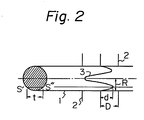
- the first object can be attained by a nonwoven sheet composed of polyethylene terephthalate continuous filaments, wherein the filaments have a shrinkage in boiling water of at least 15%, the filament section is a circular section having a radius R, and the average refractive index n ⁇ (0) of the central portion of the filament section and the average refractive index nll(0.8) of the portion apart by 0.8R from the center satisfy the following requirements:
- This nonwoven sheet will be referred to as "YW type nonwoven sheet” hereinafter.
- the second object of the present invention can be attained by a nonwoven sheet composed of polyethylene terephthalate filaments, which is formed from the above-mentioned YW type nonwoven sheet, wherein the polyethylene terephthalate filaments are partially heat-press-bonded to one another, the heat shrinkage at 150°C is at most 5% and the elongation at break at 150°C is at least 70%, and wherein the filaments have a circular section having a radius R, and the average refractive index n ⁇ (0) of the central portion of the filament section and the average refractive index n ⁇ (0.8) of the portion apart by 0.8R from the center satisfy the following requirements:
- This nonwoven sheet will be referred to as "YH type nonwoven sheet” hereinafter.
- the third object of the present invention can be attained by a nonwoven fabric composed of polyethylene terephthalate filaments, which is formed from the above-mentioned YW type nonwoven sheet, wherein the polyethylene terephthalate filaments are mechanically entangled with one another by needle punching, the heat shrinkage at 150°C is at most 5%, the filament density is such that the ratio of caught particles having a size larger than 15 p is at least 80%, and the elastic recovery is at least 50%, and wherein the filaments have a circular section having a radius R, and the average refractive index n (0) of the central portion of the filament section and the average refractive index n ⁇ (0.8) of the portion apart by 0.8R from the center satisfy the following requirements:
- This nonwoven sheet will be referred to as "YN type nonwoven sheet” hereinafter.
- the refractive index of a filament is characterized by a refractive index nil to a polarized light having an electric field vector parallel to the axis of the filament and a refractive index n ⁇ to a polarized light having an electric field vector vertical to the axis of the filament.
- a green ray (having a wavelength X of 549 mu) is used in all measurements described herein.
- the filament is immersed in a sealant inactive to the filament, which has a refractive index (N) giving an interference fringe deviation of 0.2 to 2 wavelengths, by using an optically flat slide glass and cover glass.
- N refractive index
- Several filaments are immersed in the sealant in such a manner that the individual filaments are not in contact with one another.
- the filaments should be arranged so that the filament axis is vertical to the optical axis of the interference microscope and the interference fringe. The pattern of this interference fringe is photographed and the photo is enlarged to about 1500 magnifications and analyzed.
- optical path difference r is represented by the following equation:
- the distribution of the refractive indexes n ⁇ (or n ⁇ ) of the filament at respective positions can be determined from the optical path differences at the respective points in the region of from the center Ro of the filament to the periphery R of the filament.
- r is a distance to each position from the center of the filament
- X is equal to 1 on the periphery of the filament, and X is in the range of 0 to 1 in other portions.
- the difference of the average refractive index (n ⁇ ) between the inner and outer layers is expressed as n ⁇ (0.8) - n ⁇ (0).
- Thickness (based on JIS L 1096):
- Ten filaments having a length of 30 cm are sampled from a web and are treated under constant length at 160°C for 5 minutes in a hot air drier. Five of the heat-treated filaments are subjected to the tensile test and the average value Ll of the elongation at break is determined. The remaining 5 filaments are allowed to stand in a hot air drier at 150°C for 300 hours and are then subjected to the same tensile test, and the average value L2 of the elongation at break is determined.
- the elongation retention ratio that is, is calculated as a criterion of the heat deterioration.
- a bundle of ten filaments prepared as in the above item (1), or a sample web, is passed for heat-compression between a pair of smooth metal rolls heated at 150°C under a linear pressure of 20 Kg/cm, and the surface speed of the heat rolls is 10 m/min, and the strength and elongation are then measured.
- the retention ratio of the elongation at break after the heat-compression contact is calculated as a criterion of the heat deterioration in the same manner as described above with respect to HR-1.
- test dusts Two kinds of dust particles (siliceous sand) specified in JIS Z-8901 (testing dusts) are uniformly dispersed at a concentration of 100 mg/m 3 under an air feed rate of 1 m 3 /min, and by using a tester shown in Fig. 3 of JIS C-9615 (air cleaner), the test is carried out over the range of from the aeration resistance (Apl) to the two-fold aeration resistance (Ap2) and the dust catching ratio is calculated according to the following formula: wherein wl stands for the amount of dust particles used and w2 stands for the amount of dust particles caught.
- the polyethylene terephthalate filaments employed in the first embodiment, i.e., the embodiment for the YW type nonwoven sheet, the second embodiment, i.e., the embodiment for the YH type nonwoven sheet, and the third embodiment, i.e., the embodiment for the YN type nonwoven sheet, are produced by spinning a material produced through a well-known polymerization process, and may contain additives added ordinarily to polyethylene terephthalate, such as a delustering agent, an antistatic agent, a flame retarder, and a pigment.
- the degree of polymerization is not limited to any particular value, so long as the degree of polymerization is within an ordinary range of polymerization degree for producting filament. Further it is possible to use copolymer with another component so long as the object of the present invention is achieved, and a small quantity of another polymer, e.g., polyamide, polyolefin or the like may be blended therein.
- nonwoven sheet in which the undrawn polyethylene terephthalate filament having the property defined in each claim is used as the total material is described.
- nonwoven sheet in which the undrawn polyethylene terephthalate filaments according to the present invention are blended or plied as the state of nonwoven web with other polyethylene terephthalate filaments produced by a different draw ratio or another filament, e.g., polyamide filament, polyolefin filament or the like, may be included as long as each afore-mentioned object of the present invention is achieved.
- the first embodiment for the YW type nonwoven sheet is described hereinafter.
- a feature of the filaments constituting the nonwoven sheet according to the first embodiment is that the filaments have a construction satisfying the following requirements in the filament section.
- the filament having the above construction is highly molecularly oriented and highly crystallined in the outer layer portion of the filament, and the center portion, is lower molecularly oriented and lower crystallined compared with the outer layer portion of the filament. Therefore, this filament is an undrawn polyethylene terephthalate filament having a two ply construction. Further the filament having the two ply construction according to the present invention has a substantially circular cross section and the orientation and the crystallinity thereof gradually increase from the center portion to the outer layer portion.
- the above requirement (B) must be satisfied to improve the heat deterioration of the filament.
- the requirement (B) is satisfied but the requirement (A) is not satisfied, i.e., the value of nll(0) is over 1.640, a filament having a high elongation cannot be obtained, and accordingly, a nonwoven sheet made of such filaments has a low elongation.
- the value of n ⁇ (0) becomes too small, it becomes difficult to improve the heat 3eterioration of the filaments.
- the preferable range of n ⁇ (0) is "1.580 ⁇ n ⁇ (0) ⁇ 1.630", when, even if the requirement (A) is satisfied, the value of ⁇ n ⁇ (0.8) - n ⁇ (0) ⁇ is less than 6 x 10 -3 , the filaments are easily deteriorated. In the filaments of the present invention, a greater improvement in the heat deterioration appears when the value of ⁇ nll(0.8) - n ⁇ (0) ⁇ is large. To obtain filaments having an improved heat deterioration resistance and high elongation, it is necessary that the filaments satisfy the requirements (A) and (B), and that they have shrinkage factor in boiling water of at least 15%, preferably 20%. In practice, the upper limit of shrinkage factor in boiling water is 70%, however, filaments having a shrinkage factor in boiling water of over 70% may be used.
- the heat deterioration expressed in the first invention means deterioration of the elongation of the filaments after exposing the filaments to a high temperature atmosphere for a long period of time or after placing the filaments in contact with a heat source, and heat shrinkage means a shrinking ratio in boiling water.
- the high elongation expressed in the first invention means that an elongation at a break point of the filaments constituting the nonwoven sheet is over 100% and that the elongation at a break point of a nonwoven sheet of the first invention formed by providing partially heat-press-bonding portions or by mechanically entangling the filaments with one another is over 70%, preferably over 100%.
- An upper limit of the elongation at a break point is practically 300%, however, a filament or a nonwoven sheet having an elongation at a break point of over 300% may be used.
- the average refractive indexes at every point of a filament section are symmetrically distributed about a center of the cross section of the filament. That is, a relationship between the average refractive index n ⁇ (0) of the central portion of the filament section and the average refractive index n ⁇ (0.8) of the portion apart by 0.8R from the center is a minimum value of the average refractive index n ⁇ is at least (n ⁇ (0) - 10 x 10" ) and a difference between the average refractive index n ⁇ (0.8) and n ⁇ (-0.8) is at most 10 x 10 -3 , preferably 5 x 10- 3 . Note, values of n ⁇ (0), n ⁇ (0.8), n ⁇ (-0.8) and An were measured by using the interference microscope on the basis of the method described hereinbefore.
- the nonwoven sheet according to the first embodiment is the nonwoven sheet in which the filaments are restrained by partially heat-press-bonding a web formed from the filaments by means of a pair of embossing roll or the like, or by mechanically entangling the web formed from the filaments by means of a needle-punching device or the like.
- the fineness of the constituent filament constructing the nonwoven sheet according to the first invention is at most 30 denier, preferably 0.5 to 15 denier.
- the nonwoven sheet may be formed of constituent filaments having the same fineness or formed of constituent filaments having a different fineness in a blended state.
- the weight per unit area of the nonwoven sheet is preferably in the range between 10 g/m 2 and 500 g/m 2 , but this range is not usually particulars defined.
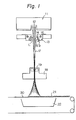
- a filament group 17 extruded from a spinning nozzle 12 arranged on a spinblock is drawn by a high speed air current ejected from a pressure air chamber 19 of an air suction device 18 and is accumulated on a conveyer net 20 moving in the direction shown by an arrow in the drawing and provided with air suction duct 22 below to form a web 21.
- the filament group 17 passes through an air-cooling chamber 13 arranged below the spinning nozzle 12 and is cooled from outside of the filament. Then the polyethylene terephthalate filaments used in the nonwoven sheet according to the first embodiment are formed. As shown in Fig.
- the air-cooling chamber 13 is rotatably supported by an air-blowing- angle-changing lever 16 and a plurality of stream regulating plates 14 are provided near a cooling air outlet 15, therefore the cooling air blowing downward can be applied to the filament group 17 at a predetermined angle against the direction of the advance of the filament group.
- the length L of the cooling air blowing out zone may be, for example, 70 mm, and the blowing angle e toward the filament group may be, for example, 35°.
- the filaments constituting the nonwoven sheet according to the first embodiment are formed into filaments having a two layer construction because the filaments are suddenly drawn directly after spinning and the outer layer portion of the section of the single filaments is more highly oriented and has a higher degree of crystallization than the central portion.
- the cooling effect is insufficient and is biased about the center of cross section of the single filament, it is impossible to obtain a stable two layer construction as defined by the present invention.
- the nonwoven sheet according to the first embodiment is formed by applying a partial heat-press-bonding process, mechanical entangling process, or the like, to the web constitued from the above described polyethylene terephthalate filaments.
- the web is heat-press-bonded by means of a pair of embossed rolls having a convex and concave pattern on a surface of at least one roll, and the temperature of the.heat rolls is 70 to 130°C, preferably 90 ⁇ 120°C, the line pressure between the heat rolls is 5 ⁇ 90 Kg/cm, preferably, 20 m 70 Kg/cm, and the surface speed of the heat rolls is 2 m 100 m/min.
- the area ratio of partial heat-press-bonding is preferably 5 n. 50%.
- the web is punched in a known manner, and the repeat punching is carried out at 50 to 400 punches per cm 2 .
- the nonwoven sheet produced by the process described hereinbefore is constituted from undrawn polyethylene terephthalate filaments having a two layer construction, therefore heat deterioration of the sheet is improved, and the sheet has the features which are essentially part of the undrawn polyethylene terephthalate filaments, i.e., high elongation and heat shrinkage properties. Therefore the nonwoven sheet according to the first embodiment can be used in fields where various heat molding processes are required.
- the softening point of the nonwoven sheet according to the first embodiment is essentially low, and since the sheet is formed by press-bonding or mechanical entangling, and the undrawn polyethylene terephthalate filaments have a high elongation the tear strength of the sheet is high. Therefore, when the nonwoven sheet according to the first embodiment is used as a shrinkable packing material, a shrinkable molding material, a hand craft material having a crimping property, or the like, the nonwoven sheet has excellent properties. Further, since this nonwoven sheet has a high elongation, the sheet can be widely applied to an extendable molding material, an extendable packing material, an impact absorbing material, medical goods, or the like.
- the sheet can be used as various shrinkable packing materials or molding materials.
- a material having further improved properties e.g., a molding material in which fuzzing and exfoliation between layers of the sheet do not easily occur, which can be easily stretched under a high temperature, and has a low heat shrinkage property.
- a heat molding process is used have expanded, and the heat molding process is usually intended to be applied to molding products requiring a large transformation.
- the microstructure of a nonwoven sheet must not be destroyed, even if the sheet is stretched by at least 50%. Further, it is necessary that the sheet does not shrink during the heat moulding process.
- a nonwoven sheet which can be easily stretched and does not shrink when heated is required as a nonwoven sheet capable of producing molding products in which a large transformation occurs. Further, it is necessary that a molding product formed by heat molding the nonwoven sheet has little fuzzing on the surface thereof and that exfoliation between the layers of sheets does not occur.
- the YW type nonwoven sheet described hereinbefore cannot sufficiently satisfy the above mentioned requirements.
- a feature of the filaments comprising this nonwoven sheet is that the filaments have a construction satisfying the following requirements in the filament section.
- the filament is highly molecularly oriented and highly crystallined in an outer layer portion of the filament, and a center portion is less molecularly oriented and less crystallized compared with the outer layer portion of the filament. Therefore, the crystallization and the orientation in the filament is gradually increased from the center portion to the outer layer portion.
- Another feature of the filaments comprising the YH type nonwoven sheet is that the partial distribution of the average refractive index is symmetrical about a center of the filament.
- the formation of the filament structure contributes to an improvement of the heat deterioration.
- the heat deterioration in relation to the second embodiment means a drop in strength and an elongation at a breakage point caused by contact in a pressed and heated state with a heat source, e.g., a metal die in a heat molding process.
- n ⁇ (0) of the filament comprising the nonwoven sheet according to the second embodiment is at most 1.600, the nonwoven sheet becomes brittle and the object of the second embodiment is not achieved. Further when n ⁇ (0) is over 1.670, a nonwoven sheet having a large elongation at break point cannot be obtained. If the above requirement (B) is not satisfied and the above requirement (A) only is satisfied, though the nonwoven sheet having a high elongation at breakage when heated, which is one of the objects of the present invention, is obtained, this nonwoven sheet has a tendency to be easily deteriorated by heat. In the second embodiment, when the value of requirement (B) becomes large, the orientation and crystallization of the outer layer portion of the filament become large, and thus the heat deterioration is strongly improved.
- a relationship between the average refractive index nll(0) of the central portion of the filament section and the average refractive index n ⁇ (0.8) of the portion apart by 0.8 R from the center is a minimum value of the average refractive index n ⁇ is at least (n ⁇ (0) - 10 x 10 -3 ), and a difference between the average refractive index n ⁇ (0.8) and n ⁇ (-0.8) is at most 10 x 10- 3 , preferably 5 x 10- 3 .
- the heat deterioration of the filament does not easily occur and a uniformity of strength and elongation at breakage become small by making the partial distribution of the average refractive index symmetrical about the center of filament.
- a nonwoven sheet according to the second embodiment is comprised of polyethylene terephthalate filaments having the microscopic structure described hereinbefore, and is formed by bonding the filaments together by means of partial heat-press-bonding.
- the features of this nonwoven sheet are that the shrinkage ratio of the nonwoven sheet is at most 5% at a temperature of 150°C and the elongation at breakage is at least 70% at a temperature of 150°C.
- the nonwoven sheet according to the second embodiment is formed by heat setting the nonwoven sheet according to the first embodiment, i.e., the nonwoven sheet produced by applying the partial heat-press-bodning to the web, in a high temperature atmosphere. This heat setting process is necessary to increase the crystallization of molecules. Further it is necessary that the feature of the filaments constituting the nonwoven sheet according to the second invention, i.e., the difference between the average refractive indexes of the outer layer portion and the center portion of the filament section, is substantially maintained at the same level.
- heat setting is performed at 180°C for 20 sec., for example, by means of a tenter machine.
- the n ⁇ (0) of the filament constituting the nonwoven sheet according to the first embodiment is more crystallized by the heat so that the value of n2(0) becomes higher. Accordingly, a range of n))(0) of the filament in the nonwoven sheet according to the second embodiment becomes 1.600 ⁇ n ⁇ (0) ⁇ 1.670.
- the filaments constituting the nonwoven sheet according to the second embodiment produced by the method described hereinbefore have a construction in which the center portion of the filament section has a low crystallization and the outer layer portion of the filament section has a high crystallization and a high orientation, and thus the heat deterioration of this nonwoven sheet is improved. Further, heat shrinkage of the nonwoven sheet is improved by heat setting.
- the nonwoven sheet constituted of the undrawn polyethylene terephthalate filament having the filament construction according to the present invention is a novel nonwoven sheet which can prevent heat deterioration during the post heating process, maintain the high stretch property which is a characteristic of undrawn filaments, and eliminate the heat shrinking property which is a disadvantage of undrawn filaments.
- fuzzing and construction destruction such as exfoliation between the layers does not easily occur when the nonwoven sheet is stretched during the heat molding process, because the filaments are firmly bonded together by the partial heat-press-bonding and heat setting.
- the nonwoven sheet according to the second embodiment can be used as various molding materials, e.g., as a hat material, as an inside tray of a box for cosmetics or the like, as shoes, as a core cloth for a bag, and as an interior material for a motorcar, or the like.
- the third embodiment for the YN type nonwoven sheet is described hereinafter.
- the nonwoven sheet has many end uses. However it has been hitherto impossible to obtain a nonwoven sheet having a bulkiness and an improved anisotropy of an elongation against a force applied from an outside from a nonwoven sheet made of filaments such as a spun bond type nonwoven sheet.
- This third embodiment is intended to provide a nonwoven sheet having the above-mentioned feature and produced by using the nonwoven sheet having an improved heat deterioration.
- the spun bond type nonwoven sheet having the properties by which is either easily stretchable or unstretchable in two directions i.e., a lengthwise direction and a widthwise direction of the nonwoven sheet
- a nonwoven sheet which is easily stretchable in either one direction i.e., a lengthwise direction or a widthwise direction of the nonwoven sheet, but is not stretchable in any other direction
- a nonwoven sheet having a fine structure and a good elasticity, and being stretchable in both the lengthwise direction and the widthwise direction is strongly required.
- a nonwoven sheet which, when a force applied from outside of the nonwoven sheet is relatively small, is not easily stretched (the Young's modulus is large), and when a relatively large force, such as an outside force applied during the molding process or the like, is applied, is easily stretched by a similar amount in both directions, is especially required.
- the bulkiness of the nonwoven sheet is increased, however this nonwoven sheet is easily stretched by an outside force and the improvement of the anisotropy of the elongation is not sufficient.
- the nonwoven sheet of this case has a fine structure caused by shrinkage of the filaments, but has a hard handling because the filaments become hard.
- the inventors of the present invention studied ways to improve the draw backs of the nonwoven sheet consisting of the above-mentioned undrawn polyethylene terephthalate filaments, i.e., the hardness of handling of the nonwoven sheet caused by the hardening of the filaments during the heat shrinkage process and the heat deterioration occurring when the nonwoven sheet is in contact with a high temperature source, and obtained a nonwoven sheet satisfying the object of the third embodiment.
- the inventors found that the above-mentioned object can be accomplished by making the crystallization and the orientation in the outer layer portion of the filament section consisting of the undrawn polyethylene tele- phthalate larger than that in the center portion of the filament section, and thus the third embodiment was attained.
- a feature of the filaments comprising the nonwoven sheet according to the third embodiment and satisfying the above-mentioned term, i.e., the YN type nonwoven sheet, is that the filaments have a construction satisfying the following requirements in the filament section, as for the filaments comprising the YH type nonwoven sheet according to the foregoing second embodiment
- filaments comprising the YN type nonwoven sheet
- the partial distribution of the average refractive index is symmetrical about a center of the filament.
- the nonwoven sheet according to the third embodiments obtained by applying a needle punching treatment to a nonwoven sheet according to the first embodiment, and a heat shrinkage treatment is applied to the above nonwoven sheet to increase the degree of entanglement of the filaments.
- the degree of entanglement before the heat shrinkage treatment is not sufficient to satisfy the object of the third embodiment, i.e., the degree of entanglement giving a construction having a sufficient density of the filaments, because the nonwoven sheet in this state is obtained by two dimensional distribution of the filaments formed at the time of forming a web is only enhanced to increase the entanglement between the filaments in a third dimensional state by means of the needle punching treatment.
- the nonwoven sheet according to the third invention is obtained by eliminating or decreasing air gaps within the construction consisting of a plurality of filaments by applying a heat shrinkage treatment to the needle punched nonwoven sheet so that the density of the filaments is increased and a nonwoven sheet having a fine construction is produced. Consequently, in the nonwoven sheet according to the third embodiment, the filament density is such that the ratio of caught particles having a size larger than 15 p is at least 80%, and the elastic recovery is at least 50%.
- the nonwoven sheet according to the third embodiment has another feature in which the anisotropy of the elongation is increased by the heat shrinkage treatment.
- the value of the anisotropy in the nonwoven sheet according to the third embodiment is 0.8 to 3.0, preferably, 1.0 to 2.0, for the range of elongation of the nonwoven sheet of 10% to 30%.
- the nonwoven sheet according to the third embodiment is produced by applying a heat shrinkage treatment to a nonwoven sheet prepared by applying an entangling treatment including at least a needle punching treatment to the nonwoven sheet according to the first embodiment. It is preferable to heat-press-bond the nonwoven sheet at a temperature of at most 100°C by embossed rolls provided with convex portions on the surface thereof to prevent disturbance of the web before the needle punching treatment. But this heat-press-bonding may be omitted.
- the needle punching may be performed by a known manner in which operational condition thereof is not limited, however, the number of punches per unit area is usually at least 50 puches/cm , preferably, 100 punches/em , most preferably, 500/cm 2 .
- the heat shrinkage treatment for the punched nonwoven sheet should be carried out at a temperature of between 70°C and 200°C, preferably, between 100°C and 180°C, and at a treatment time of at most 60 sec.
- the average refractive index n ⁇ (0) of the filament comprising of the heat shrunk nonwoven sheet must satisfy the following requirement, 1.600 ⁇ n ⁇ (0) ⁇ 1.670
- n ⁇ (0) is at most 1.600
- the obtained nonwoven sheet becomes brittle
- n ⁇ (0) is at least 1.670
- a nonwoven sheet having a large elongation at breakage cannot be obtained.
- the nonwoven sheet is shrunk at least 5%, preferably 10 to 50%, in both the lengthwise direction and the widthwise direction by a tender machine, a cylinder, a loop dryer or the like.
- a spreading treatment for the nonwoven sheet or a smoothing treatment for the surface thereof is performed at a temperature of less than 150°C.
- an embossing treatment at a temperature of at least 150°C may be applied to the heat shrank nonwoven sheet to make patterns on the surface of the nonwoven sheet. Since the nonwoven sheet according to the third embodiment has small heat shrinkage and low heat deterioration, it is possible to apply the spreading treatment, the smoothing treatment and the embossing treatment or the like to the nonwoven sheet.
- the YN type nonwoven sheet according to the third embodiment produced by the method described hereinbefore is comprised of filaments having a low crystallization in the central portion of the filament section and a high crystallization and high orientation in the center layer portion of the filament section. Therefore, hardening and heat deterioration of the nonwoven sheet does not occur when the nonwoven sheet is heat shrunk. Further, since the nonwoven sheet according to the third embodiment is produced by shrinking the nonwoven sheet in the state in which the filaments are rearranged from a two dimensional arrangement to a three dimensional arrangement by a mechanical entangling treatment, this nonwoven sheet has a good bulkiness and a high filament density. As a result, in this construction the dimensions of the air gaps between the filaments and the amount thereof become very small, the elastic recovery of the nonwoven sheet is improved, and the anisotropy of elongations in the lengthwise direction and the widthwise direction is also improved.
- this nonwoven sheet can be used as a replacement for felt, and thus this nonwoven sheet can be used as, for example, a hat material, carpeting, wall material, base cloth of an artificial leather, padding cloth for apparel, and the interior of an automobile, or the like.
- a polyethylene terephthalate having an intrinsic viscosity of 0.75 is extruded at a temperature of 290°C and an extruding rate of 850 g/min by means of a rectangular spinning nozzle having 1000 holes with a diameter of 0.25 mm. Then various filaments are produced by changing the spinning speed and the distance (designated H ⁇ D) between the spinning nozzle and an air suction device used for drawing the filaments, and the filaments are collected on a metal net to make a web.
- the cooling chamber is arranged on both sides of the filament groups at a position by 300 mm directly below the spinning nozzle.
- the blow out zone length (1) is 70 mm and cooling air is uniformly blown from the cooling chamber to the filaments at a temperature of 13°C, a speed of 0.8 m/sec and a blow out angle of 35°.
- Examples 1 and 2 are the filament according to the first embodiment, and reference.examples 3, 4, 5, and 6 are of the filaments which do not belong to the first embodiment. That is, in reference examples 3, 4, and 6, the filaments are produced by taking the predetermined. Spinning speed prepared by changing the H-D and the amount of the pressurized air of the air suction device, and reference example 5 is for a filament having an unsymmetrical construction produced by arranging the cooling chamber on only one side of the filament group.
- Table 1 shows that the filaments constituting the nonwoven sheet according to the first embodiment expressed in examples 1 and 2 are satisfactory in average refractive index, thermal property and heat deterioration. Whereas the filaments expressed in reference examples 3 to 6, which do not belong to the first embodiment, are unsatisfactory in one or the other of the above mentioned properties.
- the same polyethylene terephthalate as that in A is spun at the same spinning temperature by the same spinning unit.
- the distance between the spinning nozzle and the air suction device is determined as 80 mm in this case, and various type webs are formed on the metal net by changing the spinning speed.
- the cooling air at the above temperature blown at an angle of 5° and at a speed of 1.0 m/sec uniformly from a cooling air chamber arranged on both sides of the filament group in a position 200 mm directly below the spinning nozzle onto the filaments under a condition wherein the blow out zone length (L) is 70 mm and the blow out angle (e) is 35°.
- Examples 101 to 103 are the filaments according to the first embodiment and reference example 104 is for the filaments which do not belong to the first embodiment.
- Table 2 shows that the filaments constituting the nonwoven sheet according to the first embodiment expressed in examples 101 to 103 have a satisfactory average refractive index, thermal property, and heat deterioration. Whereas the filament expressed in reference example 104, which do not belong to the first embodiment, is unsatisfactory in one or the other of the above mentioned properties. As can be easily seen by comparing Table 2 with Table 1, the filament having a clear two ply construction and a more improved heat deterioration can be obtained by selecting the optimum cooling condition.
- each nonwoven web having the weight per unit area of about 100 g/m 2 and consisting of the filaments of examples 1 and 2 and reference examples 3 to 6 are heat-press-bonded by a pair of rolls, in which the top roll is an embossing roll having a plurality of convex portions arranged uniformly on a surface thereof and in which the bottom roll has a smooth surface.
- the ratio of the heat-press-bonding portion (designated as heat-press-bond ratio) is 12%, the temperature of both roll is 110°C, and the linear pressure is 20 Kg/cm in the heat-press-bonding.
- the web in example 4 is heat-press-bonded by means of rolls having a temperature of 235°C.
- Examples 11 and 12 are nonwoven sheets produced by the webs according to the first embodiment, respectively, and reference examples 13 to 16 are the nonwoven sheet produced by the webs which do not belong to the first embodiment, respectively.
- Table 3 shows that the nonwoven sheets of examples 11 and 12 according to the first embodiment have high elongation, improved heat deterioration, and good abrasion resistance, respectively.
- the nonwoven sheets expressed in reference examples 13 to 16, which do not belong to the first embodiment are unsatisfactory in one or the other of the above mentioned properties.
- each web of the examples 1 and 2 and the reference examples 3 to 6 are needle punched, respectively.
- a No. 40 needle, a needle pricking depth of 13 mm, and a number of needle punching of 100 punches/cm2 are used for the needle punching process.
- Examples 21 and 22 are the nonwoven sheets according to the first embodiment, respectively and reference examples 22 to 26 are the nowoven sheets which do not belong to the first embodiment, respectively.
- properties of filaments in the nonwoven sheets are the same as the properties of filaments described in Table 1. Therefore, numeral values regarding the properties of filaments in the nonwoven sheets of these examples are omitted from Table 4.
- Table 4 shows that the nonwoven sheets of examples 21 and 22 according to the first embodiment have high elongation and improved heat deterioration. Whereas, the nonwoven sheets expressed in reference examples 23 to 26, which do not belong to the first embodiment, are unsatisfactory in one or the other of the above mentioned properties.
- Various YH type nonwoven sheets according to the second invention are produced from the webs consisting of the filaments obtained in A (including the two examples and the four reference examples) and the properties of each nonwoven sheet are compared.
- each web consisting of filaments having the properties described in Table 1 are heat-press-bonded to entangle the filaments together.
- the heat-press-bonding is performed between a top embossing roll having a plurality of concave portions and a bottom roll having a smooth surface.
- a heat-press-bond ratio of 12%, a temperature of both roll of 120°C, and a linear pressure of 20 Kg/cm are used in the heat-press-bonding.
- the above nonwoven sheets are heat treated at a temperature of 180°C and constant extension for 30 sec by means of a tenter machine.
- reference 34 is a well-known filament nonwoven sheet heat-press-bonded by using the top and bottom rolls at a temperature of 230°C.
- Table 5 shows that the nonwoven sheets having the large value of ⁇ n ⁇ (0.8) - n ⁇ (0) ⁇ are not easily deteriorated by heat and are not easily shrunk by heat. That is, the nonwoven sheets of examples 31 and 32 satisfy the requirements regarding the refractive index, i.e., 1.600 ⁇ n ⁇ (0) ⁇ 1.670 ⁇ n ⁇ (0.8) - n ⁇ (0) ⁇ ⁇ 5 x 10 -3 Further, the heat shrinkage ratio of the above nonwoven sheets is at most 5% and nearly equal to zero. The elongation retention ratio of the above nonwoven sheet is at least 70% at 150°C.
- the filaments used in the above nonwoven sheet are those which the heat deterioration is low.
- reference example 33 shows the nonwoven sheet having a low strength and elongation at break point and inferior heat deterioration
- reference example 34 shows the nonwoven sheet having a high strength and a low abrasion resistance
- reference examples 35 and 36 show the nonwoven sheet having an inferior heat deterioration.
- the nonwoven sheets of the above four reference examples do not have the total or balanced properties obtained by the nonwoven sheets according to the second embodiment.
- the elongation of breakage of the nonwoven sheet of reference 34 is extremely low at a temperature of 150°C, and therefore, the molding ability of this nonwoven sheet is very weak.
- Various YN type nonwoven sheets according to the third embodiment are produced from the webs consisting of the filaments obtained in A (including the two examples and the four reference examples) and the properties of each nonwoven sheet are compared.
- two examples according to the third embodiment i.e., examples 41 and 42, and four reference examples, i.e., reference examples 43 m 46, are prepared and the properties of the filaments constituting the nonwoven sheets and the nonwoven sheets themself are compared in the state wherein intermediate goods are produced by partially heat-press-bonding each web consisting of filaments having the properties described in the Table 1 and then are needle punched, and nonwoven sheets according to the third embodiment is produced by heat shrinking the above mentioned intermediate goods, respectively.
- each web having the weight per unit area of 100 g/m 2 in the A is heat-press-bonded at a temperature of 60°C and a linear pressure 20 Kg/cm by means of a pair of rolls consisting of an embossing roll having a heat press ratio of 12% and a smooth roll and being needle punched at a needle pricking depth of 15 mm and a needle punching number of 300 punches/cm 2 by using a needle No. 40.
- Examples 41a, 42a and reference examples 43a to 46a in Table 7 are further heat shrunk and become examples 41 and 42 and reference examples 43 to 46, respectively.
- the above mentioned heat shrinking treatment is performed at a temperature of 100°C and a treatment time of 30 sec by means of a pinter machine adjusted so that the nonwoven sheets can be shrunk by 30% in both the lengthwise direction and the widthwise direction.
- the reference sample 44 is produced by shrinking the nonwoven sheet at a temperature of 100°C and a treatment time of 30 sec without shrinkage of the nonwoven sheet.
- Table 8 shows that the nonwoven sheets of examples 41 and 42 according to the third embodiment have a fine filament density and are a bulky nonwoven sheet having a satisfactory elastic recovery ratio, rigidity and softness, dust catching ratio, and anisotropy of elongation against an outer force.
- the nonwoven sheet of reference samples 43.44 do not satisfy the object of the third embodiment as shown in Table 8.
- the nonwoven sheets of reference examples 45 and 46 have similar properties to those of the nonwoven sheets of examples 41 and 42.
- a heat deterioration test (HR-2) is applied to the nonwoven sheets of examples 41 and 42 and reference examples 43 to 46.
- the results thereof are shown in Table 9.
- Table 9 shows that the decrease of the elongation at breakage of the nonwoven sheets of examples 41 and 42 according to the third embodiment is low, respectively. This means that the heat deterioration is widely improved in the nonwoven sheet according to the third embodiment.
- the elongation at breakage decreases widely and the strength also decreases. This means that the nonwoven sheets of the reference examples have a remarkably inferior heat deterioration.
- the strength is increased in the heat deterioration. This phenomenon is caused by an increment of the entanglement between filaments to which heat-pressing is applied by means of smooth rolls.
- the YN type nonwoven sheet according to the first embodiment is produced from polyethylene terephthalate filaments having the constitution described hereinbefore, this nonwoven sheet has an improved heat deterioration, and a high elongation and heat shrinkable property. Therefore this nonwoven sheet can be used for end uses requiring heat shrinkage.
- this nonwoven sheet has a superior ability when it is used to make heat molding goods having a large amount of transformation.
- the YN type nonwoven sheet according to the third embodiment has a fine filament density, a high elastic recovery and an improved anisotropy of elongation against outside force. Therefore, this nonwoven sheet has a superior ability in fields in which only known nonwoven sheets could be used, due to their unsufficient properties, i.e., for felt like goods.
Landscapes
- Engineering & Computer Science (AREA)
- Textile Engineering (AREA)
- Chemical & Material Sciences (AREA)
- Chemical Kinetics & Catalysis (AREA)
- Mechanical Engineering (AREA)
- Nonwoven Fabrics (AREA)
Applications Claiming Priority (9)
| Application Number | Priority Date | Filing Date | Title |
|---|---|---|---|
| JP50185/84 | 1984-03-17 | ||
| JP59050184A JPS60199957A (ja) | 1984-03-17 | 1984-03-17 | 熱劣化の改善された高伸度を有する不織シ−ト |
| JP5018584 | 1984-03-17 | ||
| JP50186/84 | 1984-03-17 | ||
| JP50184/84 | 1984-03-17 | ||
| JP59050186A JPS60199958A (ja) | 1984-03-17 | 1984-03-17 | 弾性を有する嵩高性不織布 |
| JP5018484 | 1984-03-17 | ||
| JP59050185A JPS60199961A (ja) | 1984-03-17 | 1984-03-17 | 熱収縮のない高伸度を有する不織布 |
| JP5018684 | 1984-03-17 |
Publications (4)
| Publication Number | Publication Date |
|---|---|
| EP0156234A2 true EP0156234A2 (de) | 1985-10-02 |
| EP0156234A3 EP0156234A3 (en) | 1989-05-10 |
| EP0156234B1 EP0156234B1 (de) | 1992-06-03 |
| EP0156234B2 EP0156234B2 (de) | 2001-01-03 |
Family
ID=27293880
Family Applications (1)
| Application Number | Title | Priority Date | Filing Date |
|---|---|---|---|
| EP19850102788 Expired - Lifetime EP0156234B2 (de) | 1984-03-17 | 1985-03-12 | Hitzebeständige, eine hohe Reissdehnung aufweisende, nichtgewobene Stoffbahn |
Country Status (4)
| Country | Link |
|---|---|
| US (1) | US4578307A (de) |
| EP (1) | EP0156234B2 (de) |
| KR (1) | KR860001835B1 (de) |
| DE (1) | DE3586136T3 (de) |
Cited By (3)
| Publication number | Priority date | Publication date | Assignee | Title |
|---|---|---|---|---|
| EP0247232A3 (en) * | 1986-05-28 | 1989-08-23 | Asahi Kasei Kogyo Kabushiki Kaisha | Formable nonwoven sheet |
| WO2003052179A1 (en) * | 2001-12-14 | 2003-06-26 | The Procter & Gamble Company | High elongation, low denier fibers using high extrusion rate spinning |
| EP2971319A4 (de) * | 2013-03-13 | 2016-11-23 | 2266170 Ontario Inc | Verfahren zur herstellung einer dreidimensionalen vliesstruktur |
Families Citing this family (21)
| Publication number | Priority date | Publication date | Assignee | Title |
|---|---|---|---|---|
| US4847125A (en) * | 1982-06-07 | 1989-07-11 | Biax Fiberfilm Corporation | Tube of oriented, heat shrunk, melt blown fibers |
| JPS626211A (ja) * | 1985-02-06 | 1987-01-13 | Sumitomo Electric Ind Ltd | 高配向性樹脂製補強部材およびその製造方法 |
| CA1339055C (en) * | 1988-09-09 | 1997-07-29 | Dean Arnold Ersfeld | Heat shrinkable bandage cover |
| US4981747A (en) * | 1988-09-23 | 1991-01-01 | Kimberly-Clark Corporation | Composite elastic material including a reversibly necked material |
| US4965122A (en) * | 1988-09-23 | 1990-10-23 | Kimberly-Clark Corporation | Reversibly necked material |
| CA2101833A1 (en) * | 1992-12-14 | 1994-06-15 | Kimberly-Clark Worldwide, Inc. | Stretchable meltblown fabric with barrier properties |
| US5320891A (en) * | 1992-12-31 | 1994-06-14 | Kimberly-Clark Corporation | Particle barrier nonwoven material |
| CA2116081C (en) * | 1993-12-17 | 2005-07-26 | Ann Louise Mccormack | Breathable, cloth-like film/nonwoven composite |
| US6015764A (en) * | 1996-12-27 | 2000-01-18 | Kimberly-Clark Worldwide, Inc. | Microporous elastomeric film/nonwoven breathable laminate and method for making the same |
| US6111163A (en) * | 1996-12-27 | 2000-08-29 | Kimberly-Clark Worldwide, Inc. | Elastomeric film and method for making the same |
| US6037281A (en) * | 1996-12-27 | 2000-03-14 | Kimberly-Clark Worldwide, Inc. | Cloth-like, liquid-impervious, breathable composite barrier fabric |
| US6454989B1 (en) | 1998-11-12 | 2002-09-24 | Kimberly-Clark Worldwide, Inc. | Process of making a crimped multicomponent fiber web |
| US7351673B1 (en) * | 1999-07-30 | 2008-04-01 | Johns Manville | Laminates including two or more layers of organic synthetic filament non-wovens and glass fiber webs and scrims |
| JP2004528222A (ja) * | 2001-06-01 | 2004-09-16 | オウェンス コーニング | ボンネットライナ、ダッシュボードライナ、防火壁ライナ又はエンジンカバーライナ |
| WO2003014451A1 (en) * | 2001-08-07 | 2003-02-20 | The Procter & Gamble Company | Fibers and webs capable of high speed solid state deformation |
| US20040102125A1 (en) * | 2002-11-27 | 2004-05-27 | Morman Michael Tod | Extensible laminate of nonwoven and elastomeric materials and process for making the same |
| US20060003656A1 (en) * | 2004-06-30 | 2006-01-05 | Kimberly-Clark Worldwide, Inc. | Efficient necked bonded laminates and methods of making same |
| US7651653B2 (en) * | 2004-12-22 | 2010-01-26 | Kimberly-Clark Worldwide, Inc. | Machine and cross-machine direction elastic materials and methods of making same |
| JP4885649B2 (ja) * | 2006-03-10 | 2012-02-29 | イビデン株式会社 | シート材および排気ガス浄化装置 |
| US8323436B2 (en) * | 2007-03-28 | 2012-12-04 | The United States Of America As Represented By The Secretary Of The Army | Transparent, reinforced, composite fiber and articles made therefrom |
| US10982441B2 (en) | 2018-03-09 | 2021-04-20 | Tamko Building Products, Llc | Multiple layer substrate for roofing materials |
Citations (4)
| Publication number | Priority date | Publication date | Assignee | Title |
|---|---|---|---|---|
| DE1560797B1 (de) | 1965-10-29 | 1970-11-19 | Lutravil Spinnvlies | Verfahren zur Herstellung verformbarer Spinnvliese |
| JPS4841115A (de) | 1971-09-30 | 1973-06-16 | ||
| JPS57139554A (en) | 1981-02-23 | 1982-08-28 | Teijin Ltd | Polyester binder for non-woven fabric |
| EP0059963A1 (de) | 1981-03-09 | 1982-09-15 | KEIPER RECARO GmbH & Co. | Trägheitsverriegelung für die Rückenlehne eines Fahrzeugsitzes |
Family Cites Families (7)
| Publication number | Priority date | Publication date | Assignee | Title |
|---|---|---|---|---|
| US3912567A (en) * | 1973-05-14 | 1975-10-14 | Kimberly Clark Co | Stabilized nonwoven web and method of preparation |
| US3949130A (en) * | 1974-01-04 | 1976-04-06 | Tuff Spun Products, Inc. | Spun bonded fabric, and articles made therefrom |
| US4134882A (en) * | 1976-06-11 | 1979-01-16 | E. I. Du Pont De Nemours And Company | Poly(ethylene terephthalate)filaments |
| DE2834438C3 (de) * | 1978-08-05 | 1987-12-03 | Fa. Carl Freudenberg, 6940 Weinheim | Spinnvliesstoff aus Polyester-Filamenten zur Verwendung als Trägermaterial für einen tiefziehfähigen Tufting-Teppich |
| EP0013355B1 (de) * | 1979-01-11 | 1982-02-10 | Chemie Linz Aktiengesellschaft | Verfahren zur Herstellung von Spinnvliesen |
| EP0056963B2 (de) * | 1981-01-19 | 1991-01-02 | Asahi Kasei Kogyo Kabushiki Kaisha | Unter normalem Druck färbbare Polyesterfaser und Verfahren zu deren Herstellung |
| DE3151294C2 (de) * | 1981-12-24 | 1986-01-23 | Fa. Carl Freudenberg, 6940 Weinheim | Polypropylen-Spinnvliesstoff mit niedrigem Fallkoeffizienten |
-
1985
- 1985-03-12 DE DE3586136T patent/DE3586136T3/de not_active Expired - Lifetime
- 1985-03-12 EP EP19850102788 patent/EP0156234B2/de not_active Expired - Lifetime
- 1985-03-14 KR KR1019850001637A patent/KR860001835B1/ko not_active Expired
- 1985-03-15 US US06/712,243 patent/US4578307A/en not_active Expired - Lifetime
Patent Citations (4)
| Publication number | Priority date | Publication date | Assignee | Title |
|---|---|---|---|---|
| DE1560797B1 (de) | 1965-10-29 | 1970-11-19 | Lutravil Spinnvlies | Verfahren zur Herstellung verformbarer Spinnvliese |
| JPS4841115A (de) | 1971-09-30 | 1973-06-16 | ||
| JPS57139554A (en) | 1981-02-23 | 1982-08-28 | Teijin Ltd | Polyester binder for non-woven fabric |
| EP0059963A1 (de) | 1981-03-09 | 1982-09-15 | KEIPER RECARO GmbH & Co. | Trägheitsverriegelung für die Rückenlehne eines Fahrzeugsitzes |
Cited By (3)
| Publication number | Priority date | Publication date | Assignee | Title |
|---|---|---|---|---|
| EP0247232A3 (en) * | 1986-05-28 | 1989-08-23 | Asahi Kasei Kogyo Kabushiki Kaisha | Formable nonwoven sheet |
| WO2003052179A1 (en) * | 2001-12-14 | 2003-06-26 | The Procter & Gamble Company | High elongation, low denier fibers using high extrusion rate spinning |
| EP2971319A4 (de) * | 2013-03-13 | 2016-11-23 | 2266170 Ontario Inc | Verfahren zur herstellung einer dreidimensionalen vliesstruktur |
Also Published As
| Publication number | Publication date |
|---|---|
| EP0156234B1 (de) | 1992-06-03 |
| KR860001835B1 (ko) | 1986-10-24 |
| DE3586136D1 (de) | 1992-07-09 |
| DE3586136T2 (de) | 1993-01-14 |
| US4578307A (en) | 1986-03-25 |
| EP0156234B2 (de) | 2001-01-03 |
| EP0156234A3 (en) | 1989-05-10 |
| DE3586136T3 (de) | 2001-08-16 |
| KR850006720A (ko) | 1985-10-16 |
Similar Documents
| Publication | Publication Date | Title |
|---|---|---|
| EP0156234B1 (de) | Hitzebeständige, eine hohe Reissdehnung aufweisende, nichtgewobene Stoffbahn | |
| JP2610408B2 (ja) | 成型性の不織シート及びその製造方法 | |
| RU2041995C1 (ru) | Способ гидросплетения несвязанного нетканого полиолефинового полотна и нетканое гидросплетенное полиолефиновое полотно | |
| US3855046A (en) | Pattern bonded continuous filament web | |
| EP2286705B1 (de) | Verfahren zur herstellung eines reinigungstuches | |
| CN100378261C (zh) | 可拉伸多组分非织造布及其制备方法 | |
| CA2242606A1 (en) | Fine fiber barrier fabric with improved drape and strength and method of making same | |
| US9982375B2 (en) | Thermocompression-bonding filament nonwoven fabric having excellent molding properties | |
| US6821601B2 (en) | Stitchbonded fabric and process for making same | |
| CA1075870A (en) | Process and apparatus for stretching a non-woven web of an orientable polymeric material | |
| US3887417A (en) | Non-woven fabrics | |
| JPS6316504B2 (de) | ||
| JPH08291451A (ja) | 不織布およびその製造方法 | |
| JPS63296936A (ja) | 立体シボを有する成型性不織シ−トとその製造方法 | |
| JP3132202B2 (ja) | 熱融着性複合繊維の製造方法 | |
| JPS60199958A (ja) | 弾性を有する嵩高性不織布 | |
| JPS62141167A (ja) | 複合シ−トの製造方法 | |
| JPH05125645A (ja) | 伸縮性嵩高長繊維不織布及びその製造方法 | |
| JPH0429776B2 (de) | ||
| JPH0147581B2 (de) | ||
| JPH0762310B2 (ja) | 異方伸長性不織シ−ト | |
| JPS61252354A (ja) | 平滑なダル調不織シ−ト | |
| JPH0655987B2 (ja) | バルキ−性不織布とその製造方法 | |
| JPH0782646A (ja) | 混繊長繊維不織布 | |
| JPH03220354A (ja) | クツシヨン材用不織布及びその製造方法 |
Legal Events
| Date | Code | Title | Description |
|---|---|---|---|
| PUAI | Public reference made under article 153(3) epc to a published international application that has entered the european phase |
Free format text: ORIGINAL CODE: 0009012 |
|
| 17P | Request for examination filed |
Effective date: 19850312 |
|
| AK | Designated contracting states |
Designated state(s): DE FR GB IT |
|
| PUAL | Search report despatched |
Free format text: ORIGINAL CODE: 0009013 |
|
| AK | Designated contracting states |
Kind code of ref document: A3 Designated state(s): DE FR GB IT |
|
| 17Q | First examination report despatched |
Effective date: 19910717 |
|
| GRAA | (expected) grant |
Free format text: ORIGINAL CODE: 0009210 |
|
| AK | Designated contracting states |
Kind code of ref document: B1 Designated state(s): DE FR GB IT |
|
| REF | Corresponds to: |
Ref document number: 3586136 Country of ref document: DE Date of ref document: 19920709 |
|
| ET | Fr: translation filed | ||
| ITF | It: translation for a ep patent filed | ||
| PLBI | Opposition filed |
Free format text: ORIGINAL CODE: 0009260 |
|
| 26 | Opposition filed |
Opponent name: HOECHST AG Effective date: 19930303 |
|
| PLAB | Opposition data, opponent's data or that of the opponent's representative modified |
Free format text: ORIGINAL CODE: 0009299OPPO |
|
| R26 | Opposition filed (corrected) |
Opponent name: HOECHST AG Effective date: 19930303 |
|
| APAC | Appeal dossier modified |
Free format text: ORIGINAL CODE: EPIDOS NOAPO |
|
| APAC | Appeal dossier modified |
Free format text: ORIGINAL CODE: EPIDOS NOAPO |
|
| ITPR | It: changes in ownership of a european patent |
Owner name: OFFERTA DI LICENZA AL PUBBLICO;AL PUBBLICO |
|
| REG | Reference to a national code |
Ref country code: GB Ref legal event code: 746 Effective date: 19970228 |
|
| REG | Reference to a national code |
Ref country code: FR Ref legal event code: D6 |
|
| PLBQ | Unpublished change to opponent data |
Free format text: ORIGINAL CODE: EPIDOS OPPO |
|
| PLAB | Opposition data, opponent's data or that of the opponent's representative modified |
Free format text: ORIGINAL CODE: 0009299OPPO |
|
| R26 | Opposition filed (corrected) |
Opponent name: HOECHST AG Effective date: 19930303 |
|
| APAC | Appeal dossier modified |
Free format text: ORIGINAL CODE: EPIDOS NOAPO |
|
| PLAW | Interlocutory decision in opposition |
Free format text: ORIGINAL CODE: EPIDOS IDOP |
|
| PUAH | Patent maintained in amended form |
Free format text: ORIGINAL CODE: 0009272 |
|
| STAA | Information on the status of an ep patent application or granted ep patent |
Free format text: STATUS: PATENT MAINTAINED AS AMENDED |
|
| 27A | Patent maintained in amended form |
Effective date: 20010103 |
|
| AK | Designated contracting states |
Kind code of ref document: B2 Designated state(s): DE FR GB IT |
|
| ITF | It: translation for a ep patent filed | ||
| ET3 | Fr: translation filed ** decision concerning opposition | ||
| REG | Reference to a national code |
Ref country code: GB Ref legal event code: IF02 |
|
| PGFP | Annual fee paid to national office [announced via postgrant information from national office to epo] |
Ref country code: FR Payment date: 20040309 Year of fee payment: 20 |
|
| PGFP | Annual fee paid to national office [announced via postgrant information from national office to epo] |
Ref country code: GB Payment date: 20040310 Year of fee payment: 20 |
|
| PGFP | Annual fee paid to national office [announced via postgrant information from national office to epo] |
Ref country code: DE Payment date: 20040325 Year of fee payment: 20 |
|
| PG25 | Lapsed in a contracting state [announced via postgrant information from national office to epo] |
Ref country code: GB Free format text: LAPSE BECAUSE OF EXPIRATION OF PROTECTION Effective date: 20050311 |
|
| REG | Reference to a national code |
Ref country code: GB Ref legal event code: PE20 |
|
| APAH | Appeal reference modified |
Free format text: ORIGINAL CODE: EPIDOSCREFNO |