EP0154331A2 - Lithium-Mangandioxidzelle - Google Patents
Lithium-Mangandioxidzelle Download PDFInfo
- Publication number
- EP0154331A2 EP0154331A2 EP85102480A EP85102480A EP0154331A2 EP 0154331 A2 EP0154331 A2 EP 0154331A2 EP 85102480 A EP85102480 A EP 85102480A EP 85102480 A EP85102480 A EP 85102480A EP 0154331 A2 EP0154331 A2 EP 0154331A2
- Authority
- EP
- European Patent Office
- Prior art keywords
- manganese dioxide
- lithium
- heat
- mixture
- cell according
- Prior art date
- Legal status (The legal status is an assumption and is not a legal conclusion. Google has not performed a legal analysis and makes no representation as to the accuracy of the status listed.)
- Withdrawn
Links
Images



Classifications
-
- H—ELECTRICITY
- H01—ELECTRIC ELEMENTS
- H01M—PROCESSES OR MEANS, e.g. BATTERIES, FOR THE DIRECT CONVERSION OF CHEMICAL ENERGY INTO ELECTRICAL ENERGY
- H01M4/00—Electrodes
- H01M4/02—Electrodes composed of, or comprising, active material
- H01M4/36—Selection of substances as active materials, active masses, active liquids
- H01M4/48—Selection of substances as active materials, active masses, active liquids of inorganic oxides or hydroxides
- H01M4/50—Selection of substances as active materials, active masses, active liquids of inorganic oxides or hydroxides of manganese
- H01M4/502—Selection of substances as active materials, active masses, active liquids of inorganic oxides or hydroxides of manganese for non-aqueous cells
-
- C—CHEMISTRY; METALLURGY
- C01—INORGANIC CHEMISTRY
- C01G—COMPOUNDS CONTAINING METALS NOT COVERED BY SUBCLASSES C01D OR C01F
- C01G45/00—Compounds of manganese
- C01G45/02—Oxides
-
- H—ELECTRICITY
- H01—ELECTRIC ELEMENTS
- H01M—PROCESSES OR MEANS, e.g. BATTERIES, FOR THE DIRECT CONVERSION OF CHEMICAL ENERGY INTO ELECTRICAL ENERGY
- H01M6/00—Primary cells; Manufacture thereof
- H01M6/14—Cells with non-aqueous electrolyte
- H01M6/16—Cells with non-aqueous electrolyte with organic electrolyte
-
- C—CHEMISTRY; METALLURGY
- C01—INORGANIC CHEMISTRY
- C01P—INDEXING SCHEME RELATING TO STRUCTURAL AND PHYSICAL ASPECTS OF SOLID INORGANIC COMPOUNDS
- C01P2002/00—Crystal-structural characteristics
- C01P2002/70—Crystal-structural characteristics defined by measured X-ray, neutron or electron diffraction data
- C01P2002/72—Crystal-structural characteristics defined by measured X-ray, neutron or electron diffraction data by d-values or two theta-values, e.g. as X-ray diagram
-
- C—CHEMISTRY; METALLURGY
- C01—INORGANIC CHEMISTRY
- C01P—INDEXING SCHEME RELATING TO STRUCTURAL AND PHYSICAL ASPECTS OF SOLID INORGANIC COMPOUNDS
- C01P2006/00—Physical properties of inorganic compounds
- C01P2006/40—Electric properties
-
- Y—GENERAL TAGGING OF NEW TECHNOLOGICAL DEVELOPMENTS; GENERAL TAGGING OF CROSS-SECTIONAL TECHNOLOGIES SPANNING OVER SEVERAL SECTIONS OF THE IPC; TECHNICAL SUBJECTS COVERED BY FORMER USPC CROSS-REFERENCE ART COLLECTIONS [XRACs] AND DIGESTS
- Y02—TECHNOLOGIES OR APPLICATIONS FOR MITIGATION OR ADAPTATION AGAINST CLIMATE CHANGE
- Y02E—REDUCTION OF GREENHOUSE GAS [GHG] EMISSIONS, RELATED TO ENERGY GENERATION, TRANSMISSION OR DISTRIBUTION
- Y02E60/00—Enabling technologies; Technologies with a potential or indirect contribution to GHG emissions mitigation
- Y02E60/10—Energy storage using batteries
Definitions
- This invention relates to a.cathode active material suitably employed in a so-called Li-Mn0 2 cell (lithium-manganese dioxide cell) making use of metal lithium as anode active material.
- Li-Mn0 2 cell lithium-manganese dioxide cell
- the lithium cell making use of metal lithium as anode active material is known as being of the high energy density type because of the large capacity per unit weight of metal lithium, the cell also having a cell voltage as high as approximately 3V because potential of metal lithium. Since the lithium cell can be easily reduced in size and weight while assuring a high energy density, it is increasingly used for example as a backup power supply for an IC memory.
- the Li-Mn0 2 cells are also known in the art in which manganese dioxide which is the cathode active material of the manganese dry cell is used as the cathode active material. These cells are inexpensive to manufacture because the manganese dioxide is readily available at low costs.
- Such manganese dioxide may for example be y-Mn0 2 such as chemical manganese dioxide (CMD) obtained by addition of an alkali permanganate solution to a boiling neutral manganese sulfate solution, or electrolytic manganese dioxide (EMD) obtained by electrolytic oxidation from the acid bath of manganese sulfate or manganese chloride, as in the case of aforementioned manganese dry cell.
- CMD chemical manganese dioxide
- EMD electrolytic manganese dioxide
- y-Mn0 2 are not desirable because they contain a large amount of water which may react with metal lithium of the anode active material to cause an electrolyte leakage or corrosion of the battery can or otherwise deteriorate the preservative character of the cell.
- the cell capacity may be lowered due to admixture of Mn 2 0 3 which is not the active material.
- manganese dioxide obtained by heat-treating the aforementioned y-Mno 2 at a temperature of the order of 150 to 450°C for removing the water contents.
- the resulting manganese dioxide has undergone changes in the crystal structure by the heat-treating temperature so that it exhibits a y-phase at lower than 250°C, a ⁇ -phase at 250° to 350°C and a S-phase at higher than 350°C).
- the lithium-manganese dioxide cell when used as a backup power supply for the IC memory, an improved flatness of the discharge voltage and an increased capacity of the cell are desired, so that a demand exists for further improving the cathode active material.
- the present inventors have conducted researches into a lithium-manganese dioxide cell showing an improved flatness in the discharge voltage and a larger discharge capacity and found that manganese dioxide exhibiting a peculiar X-ray diffraction peak after discharging of the cell is useful for achieving a flat discharge voltage and an improved capacity.
- manganese dioxide may be prepared by any of the following methods.
- High-purity S-manganese dioxide may be obtained by resorting to any of the above-described methods, which will now be explained in more detail.
- EMD or CMD may be thermally decomposed at a higher temperature in advance and converted in this manner into dimanganese trioxide to which nitric acid is added and the resulting mixture is heat-treated to high-purity ⁇ -MnO 2 .
- EMD or CMD is thermally decomposed to dimanganese trioxide (Mn 2 0 3 ) to which nitric acid is added and the resulting mixture is heat-treated two or more times.
- ⁇ -MnO 2 such as EMD or CMD is used as the starting material and previously thermally decomposed for liberation of oxygen and conversion into Mn 2 0 3 .
- the temperature for thermal decomposition for ⁇ -MnO 2 is preferably in the range from 500° to 800°C. When the decomposition temperature exceeds 800°C, Mn 2 0 3 liberates oxygen further to be undesirably converted into Mn 3 O 4 .
- Nitric acid is then added to the resulting Mn 2 0 3 and the resulting mixture is heat-treated two or more times.
- M n 2O 3 is oxidized only insufficiently by a sole heat treatment operation under addition of nitric acid so that Mn 2 0 3 may remain as impurities.
- the heat treatment temperature with addition of nitric acid is preferably in the range from 170° to 500°C. With the heat treatment temperature higher than 500°C, the resulting ⁇ -MnO 2 may be decomposed further to Mn 2 0 3 as impurities. 0.4 ml or more of 13N nitric acid (0.52 gram equivalents) is preferably added to 1.00 g of Mn 2 O 3 during heat treatment.
- High-purity ⁇ -MnO 2 may be yielded by two or more times of heat treatment with addition of nitric acid. It has also been found that ⁇ -MnO 2 having a particle size of the order of may be selectively obtained in accordance with the present invention.
- EMD or CMD is previously heat-treated at an elevated temperature so as to be converted into a ⁇ -MnO 2 /Mn 2 O 3 mixture, to which nitric acid is added and the resulting mixture is heat-treated to high purity MnO 2 .
- the present method consists in heat-treating EMD or CMD adding nitric acid to the resulting product and heat-treating the resulting mixture.
- ⁇ -MnO 2 such as EMD or CMD is used as starting material, and heat-treated under a temperature of 420° to 650°C.
- the product resulting from the heat treatment is a mixture consisting of Mn203 resulting from thermal decomposition and ⁇ -MnO 2 which is the phase-transition product of the aforementioned ⁇ -MnO 2 .
- nitric acid is added to a mixture of Mn 2 0 3 with ⁇ -MnO 2 resulting from the heat treatment and the resulting mixture is again heated for effecting a further heat treatment.
- the temperature of the heat treatment with nitric acid is preferably 170° to 500°C. With the heat treatment temperature exceeding 500°C, the resulting ⁇ -MnO 2 may be further decomposed to Mn 2 0 3 as impurities.
- 0.4 ml or more of 13N nitric acid (0.52 gram equivalent) is preferably used to 1.00 g of the product of thermal decomposition of ⁇ -MnO 2 (a ⁇ -MnO 2 /Mn 2 O 3 mixture). With the amount of nitric acid being less than 0.52 gram equivalent, oxidation may be insufficient and Mn 2 0 3 may remain as impurities.
- the above-described heat treatment with the addition of nitric acid may be performed once and for I all, but may be performed two or more times, as the occasion may demand.
- EMD or CMD may be promptly converted into ⁇ -MnO 2 at a lower temperature through phase transition by addition of nitric acid followed by heating.
- the method resides in adding nitric acid to EMD or CMD and heat-treating the resulting product.
- the heat treatment temperature higher than 170°C is sufficient to cause phase transition from Y-Mn0 2 to ⁇ -MnO 2 . However, it is preferred to use the lowest temperature possible. With a higher heat treatment temperature, the resulting MnO 2 may be decomposed to liberate oxygen and to be converted into Mn 2 0 3 .
- 13N nitric acid (0.52 gram equivalent) is preferably used to 1.00 g of EMD or CMD.
- the heat treatment may be repeated a number of times as the occasion may demand.
- EMD or CMD may promptly undergo phase transition to ⁇ -MnO 2 of high purity and extremely small particle size without yielding impurities through thermal decomposition.
- ⁇ -MnO 2 of extremely high purity may be obtained by addition of nitric acid to the thermal decomposition product of manganese nitrate followed by further heating and heat treatment.
- the method resides in addition of nitric acid to a thermal decomposition product of manganese nitrate followed by a sole operation of thermal decomposition.
- manganese nitrate is subjected to thermal decomposition. While manganese nitrate is known to exist as hexahydrate, tetrahydrate, trihydrate, dihydrate, monohydrate or anhydrous salt, manganese nitrate is usually available and used in the form of hexahydrate (MN(NO 3 ) 2 ⁇ 6H 2 O).
- the thermal decomposition temperature is preferably 170° to 500°C. With the temperature lower than 170°C, thermal decomposition is insufficient. With the temperature higher than 500°C, the resulting Mn0 2 may be further decomposed to liberate oxygen to be converted to M n 2 0 3.
- Nitric acid is then added to the thermal decomposition product to which nitric acid is added and the resulting product is again heated for effecting a further thermal decomposition.
- the temperature employed for the further thermal decomposition is also preferably 170° to 500°C similarly to the preceding thermal decomposition.
- 0.52 gram equivalent of nitric acid is preferably used to 1.00 g of the thermal decomposition product.
- the operation of thermal decomposition may be repeated any number of times as the occasion may demand. By thus repeating thermal decomposition, the resulting S-Mn0 2 may be improved further in purity.
- High-purity ⁇ -MnO 2 may be obtained by the further thermal decomposition with nitric acid.
- the present invention is not limited to manganese dioxide obtained by the above-described methods.
- various manganese dioxides may be checked in advance as to the presence or absence of the aforementioned diffraction peak after discharging and selectively used as cathode active material.
- the commercially available electrolytic manganese dioxide (manufactured by Toyo Soda Co., Ltd., 'HS') was heated to 600°C at the rate of 50°C per hour so as to be converted to Mn 2 o 3 , single phase, by thermal decomposition.
- Dimanganese trioxide (Mn 2 0 3 ) thus obtained by thermal decomposition is charged into a porcelain pot or crucible. Then, concentrated nitric acid (13N) is added to Mn 2 O 3 at a rate of 0.4 ml to 1 g of Mn 2 0 3 and the resulting mixture is charged into an electrical oven so as to be heated to 280°C at the rate of 12°C per hour for effecting a heat treatment. To the resulting heat-treated product is again added concentrated nitric acid in an amount equal to that used in the preceding heat treatment and the resulting product is heated to 280°C at the rate of 12°C per hour for effecting a second heat treatment.
- the resulting product is ⁇ -MnO 2 single phase.
- 90 weight parts of the above specified ⁇ -MnO 2 , 8 weight parts of carbon fluoride are kneaded together, molded under pressure and sufficiently dried in vacuum to cathode pellets 1.
- These pellets are assembled into a battery cathode can 3 through the medium of a spring 2 as shown in Fig. 1.
- a separator 4 is placed on the pellets 1 and a solution of 1 mol of lithium perchlorate (Li ClO 4 ) per liter of mixed solvent of propione carbonate 1, 2-dimethoxyethane is charged as electrolyte.
- a anode can 7 filled with metal lithium 6 as anode active material is placed thereover by the medium of a gasket 5 and the opening is then sealed for completing a lithium-manganese dioxide cell.
- metal lithium as anode active material is generally used in an amount stoichiometrically equal to manganese dioxide as cathode active material.
- metal lithium as anode active material is used in an amount larger than that of manganese dioxide in such a manner that the evaluation is not affected by the amount of metal lithium.
- the lithium-manganese dioxide cell of the present embodiment shows an improved flatness in the discharge voltage and a larger capacity.
- the discharge time until the discharge voltage is lowered to 2.6 V is about 750 hours, while that until the discharge voltage is lowered to 2.4 V is more than 800 hours.
- the discharge characteristics vary only slightly from one sample to another and the cell is highly stable in quality.
- One of the cathode pellets 1 is taken out of the lithium-manganese dioxide cell for X-ray diffraction analysis after termination of the measurement and after discharging of the cell.
- the discharging end point is assumed to be reached when the discharge voltage of the cell lowered to 1.4 V.
- a Fe target and a Mn filter are employed.
- the X-ray diffraction spectrum thus obtained is shown only schematically in Fig. 3.
- the commercially available electrolytic manganese dioxide ('HS' manufactured by Toyo Soda Co., Ltd.) was thermally decomposed for two hours at 550°C to a mixed product of Mn 2 O 3 and ⁇ -MnO 2 .
- the mixed product was taken in a porcelain crucible into which concentrated nitric acid (13N) was added at a rate of 0.4 ml to 1 g of the product.
- the crucible was then charged into an electrical oven and heat-treated by heating to 280°C at a rate of 12°C per hour.
- concentrated nitric acid was again subjected to the above described heat treatment.
- the resulting product was single-phase ⁇ -MnO 2 .
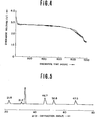
- Discharge characteristics of the lithium-manganese dioxide cell are measured. Five samples of the cell are prepared by using the similar process and their discharge characteristics are measured. The results are shown in Fig. 4.
- the lithium-manganese dioxide cell of the present embodiment also shows an improved flatness in the discharge voltage and a larger capacity.
- the discharge time until the discharge potential is lowered to 2.6 V is about 730 hours and the discharge time until the discharge potential is lowered to 2.4 V is more than 800 hours.
- the discharge characteristics vary only slightly from one sample to another and the cell is of stable and uniform quality.
- One of the cathode pellets is taken out of the lithium-manganese dioxide cell for X-ray diffraction analysis after termination of the measurement and after discharging of the cell.
- the discharging end point is assumed to be reached when the discharge potential of the cell is lowered to 1.4 V.
- a Fe target and a Mn filter are employed.
- the X-ray diffraction spectrum is shown only schematically in Fig. 5.
- the commercially available electrolytic manganese dioxide is used as cathode active material and the lithium-manganese dioxide cell is prepared by using the method similar to that of the preceding
- Discharge characteristics of the resulting cell are measured and the results shown in Fig. 6 are obtained.
- the cell obtained in the present Example shows marked decrease in the discharge potential while the discharge time until the potential is lowered to 2.6 V was only about 450 hours and that until the potential is lowered to 2.4 V is only about 600 hours.
- the commercially available electrolytic manganese dioxide is heat-treated at 350°C for 7 hours and used as cathode active material for preparing the lithium-manganese dioxide by using the method similar to that used in the Example 1.
- Fig. 8 Five cell samples are prepared by using the above described method and their discharge characteristics are measured. The results are shown in Fig. 8. It is seen from Fig. 8 that the cell obtained by the present Example shows a rather unstable discharge potential and the discharge characteristics that vary appreciably from one sample to another, while the discharge time until the discharge potential is lowered to 2.6 V and 2.4 V is shorter than in the preceding Examples and equal only to about 500 to 600 hours and about 750 hours, respectively.
- the commercially available electrolytic manganese dioxide is heat-treated at 450°C for 20 hours and used as cathode active material for preparing the lithium-manganese dioxide by using the method similar to that used in the Example 1.
Landscapes
- Chemical & Material Sciences (AREA)
- Inorganic Chemistry (AREA)
- Chemical Kinetics & Catalysis (AREA)
- Electrochemistry (AREA)
- General Chemical & Material Sciences (AREA)
- Organic Chemistry (AREA)
- Engineering & Computer Science (AREA)
- Manufacturing & Machinery (AREA)
- Battery Electrode And Active Subsutance (AREA)
- Inorganic Compounds Of Heavy Metals (AREA)
Applications Claiming Priority (2)
| Application Number | Priority Date | Filing Date | Title |
|---|---|---|---|
| JP59041406A JPS60189163A (ja) | 1984-03-06 | 1984-03-06 | リチウム・二酸化マンガン電池 |
| JP41406/84 | 1984-03-06 |
Publications (2)
| Publication Number | Publication Date |
|---|---|
| EP0154331A2 true EP0154331A2 (de) | 1985-09-11 |
| EP0154331A3 EP0154331A3 (de) | 1987-09-16 |
Family
ID=12607476
Family Applications (1)
| Application Number | Title | Priority Date | Filing Date |
|---|---|---|---|
| EP85102480A Withdrawn EP0154331A3 (de) | 1984-03-06 | 1985-03-05 | Lithium-Mangandioxidzelle |
Country Status (3)
| Country | Link |
|---|---|
| US (1) | US4585718A (de) |
| EP (1) | EP0154331A3 (de) |
| JP (1) | JPS60189163A (de) |
Cited By (1)
| Publication number | Priority date | Publication date | Assignee | Title |
|---|---|---|---|---|
| EP0348083A1 (de) * | 1988-06-24 | 1989-12-27 | Duracell International Inc. | Verfahren zur Herstellung von Beta-Mangandioxid |
Families Citing this family (25)
| Publication number | Priority date | Publication date | Assignee | Title |
|---|---|---|---|---|
| HU201438B (en) * | 1988-08-31 | 1990-10-28 | Karl Kordesh | Rechargeable zinc-restricted alkali manganese dioxide-zinc cell |
| CA2022898C (en) * | 1989-08-15 | 1995-06-20 | Nobuhiro Furukawa | Non-aqueous secondary cell |
| US5147739A (en) * | 1990-08-01 | 1992-09-15 | Honeywell Inc. | High energy electrochemical cell having composite solid-state anode |
| US5284721A (en) * | 1990-08-01 | 1994-02-08 | Alliant Techsystems Inc. | High energy electrochemical cell employing solid-state anode |
| CA2110097C (en) * | 1992-11-30 | 2002-07-09 | Soichiro Kawakami | Secondary battery |
| US20030166466A1 (en) * | 1995-01-20 | 2003-09-04 | Hoke Jeffrey B. | Catalyst and adsorption compositions having improved adhesion characteristics |
| US6200542B1 (en) | 1995-01-20 | 2001-03-13 | Engelhard Corporation | Method and apparatus for treating the atmosphere |
| US6863984B2 (en) | 1995-01-20 | 2005-03-08 | Engelhard Corporation | Catalyst and adsorption compositions having improved adhesion characteristics |
| US6214303B1 (en) | 1995-01-20 | 2001-04-10 | Engelhard Corporation | Method and apparatus for treating the atmosphere |
| DE69620740T2 (de) | 1995-01-20 | 2002-08-22 | Engelhard Corp., Iselin | Vorrichtung zur schadstoffentfernung aus umgebungsluft in der motorhaube eines fahrzeuges |
| US20020018742A1 (en) * | 1995-01-20 | 2002-02-14 | Engelhard Corporation | Method and apparatus for treating the atmosphere |
| US6818254B1 (en) | 1995-01-20 | 2004-11-16 | Engelhard Corporation | Stable slurries of catalytically active materials |
| US6517899B1 (en) | 1995-01-20 | 2003-02-11 | Engelhard Corporation | Catalyst and adsorption compositions having adhesion characteristics |
| US5601952A (en) * | 1995-05-24 | 1997-02-11 | Dasgupta; Sankar | Lithium-Manganese oxide electrode for a rechargeable lithium battery |
| US6159858A (en) * | 1995-07-04 | 2000-12-12 | Fujitsu Limited | Slurry containing manganese oxide and a fabrication process of a semiconductor device using such a slurry |
| US5604057A (en) * | 1995-11-27 | 1997-02-18 | General Motors Corporation | Secondary cell having a lithium intercolating manganese oxide |
| CN1087765C (zh) * | 1996-06-27 | 2002-07-17 | 富士通株式会社 | 氧化锰研磨膏和利用该研磨膏制造半导体器件的方法 |
| US5997831A (en) * | 1996-07-12 | 1999-12-07 | Engelhard Corporation | Method of catalytically treating the atmosphere and heat exchange devices produced thereby |
| US6156283A (en) | 1998-03-23 | 2000-12-05 | Engelhard Corporation | Hydrophobic catalytic materials and method of forming the same |
| KR100417251B1 (ko) * | 1999-12-15 | 2004-02-05 | 주식회사 엘지화학 | 전기화학적 성능이 향상된 리튬망간 스피넬 산화물의 제조방법 |
| US7557433B2 (en) | 2004-10-25 | 2009-07-07 | Mccain Joseph H | Microelectronic device with integrated energy source |
| US7230321B2 (en) * | 2003-10-13 | 2007-06-12 | Mccain Joseph | Integrated circuit package with laminated power cell having coplanar electrode |
| US20050287425A1 (en) * | 2004-06-25 | 2005-12-29 | Celgard Inc. | Li/MnO2 battery separators with selective ion transport |
| US8033996B2 (en) | 2005-07-26 | 2011-10-11 | Adidas Ag | Computer interfaces including physiologically guided avatars |
| US7718319B2 (en) | 2006-09-25 | 2010-05-18 | Board Of Regents, The University Of Texas System | Cation-substituted spinel oxide and oxyfluoride cathodes for lithium ion batteries |
Family Cites Families (10)
| Publication number | Priority date | Publication date | Assignee | Title |
|---|---|---|---|---|
| US2716078A (en) * | 1953-03-24 | 1955-08-23 | Olin Mathieson | Method for treating activated manganese dioxide |
| US2739914A (en) * | 1954-05-19 | 1956-03-27 | Manganese Chemicals Corp | Manganese dioxide depolarizer |
| JPS5342325A (en) * | 1976-09-29 | 1978-04-17 | Sanyo Electric Co | Method of making cathode of nonnaqueous battery |
| GB1557754A (en) * | 1978-03-02 | 1979-12-12 | Ever Ready Co | Dry electric cells |
| US4246253A (en) * | 1978-09-29 | 1981-01-20 | Union Carbide Corporation | MnO2 derived from LiMn2 O4 |
| US4312930A (en) * | 1978-09-29 | 1982-01-26 | Union Carbide Corporation | MnO2 Derived from LiMn2 O4 |
| JPS6041829B2 (ja) * | 1979-01-06 | 1985-09-19 | 株式会社日立製作所 | 非水電解液電池用正極の製造法 |
| US4277360A (en) * | 1979-03-28 | 1981-07-07 | Union Carbide Corporation | Manganese dioxide |
| FR2466872B1 (fr) * | 1979-10-02 | 1986-03-07 | Celsa Composants Electr Sa | Pile au lithium. bioxyde de manganese et procede de realisation d'une telle pile |
| DE3123100A1 (de) * | 1981-06-11 | 1983-01-05 | Varta Batterie Ag, 3000 Hannover | Mangandioxidelektrode fuer lithium-batterien |
-
1984
- 1984-03-06 JP JP59041406A patent/JPS60189163A/ja active Granted
-
1985
- 1985-02-26 US US06/705,677 patent/US4585718A/en not_active Expired - Fee Related
- 1985-03-05 EP EP85102480A patent/EP0154331A3/de not_active Withdrawn
Cited By (1)
| Publication number | Priority date | Publication date | Assignee | Title |
|---|---|---|---|---|
| EP0348083A1 (de) * | 1988-06-24 | 1989-12-27 | Duracell International Inc. | Verfahren zur Herstellung von Beta-Mangandioxid |
Also Published As
| Publication number | Publication date |
|---|---|
| US4585718A (en) | 1986-04-29 |
| JPH0578142B2 (de) | 1993-10-28 |
| JPS60189163A (ja) | 1985-09-26 |
| EP0154331A3 (de) | 1987-09-16 |
Similar Documents
| Publication | Publication Date | Title |
|---|---|---|
| US4585718A (en) | Lithium-manganese dioxide cell | |
| Xia et al. | Studies on an Li Mn O spinel system (obtained by melt-impregnation) as a cathode for 4 V lithium batteries part 1. Synthesis and electrochemical behaviour of LixMn2O4 | |
| EP0617474B1 (de) | Wiederaufladbare Lithiumzelle und Verfahren zur Herstellung einer Anode für Anwendung in der Zelle | |
| US5316877A (en) | Electrochemical cell | |
| US4405699A (en) | Manganese dioxide electrode for lithium batteries | |
| US5658693A (en) | Manganese dioxide-based material | |
| EP1083614B1 (de) | Lithium einlagerndes Material, das Sauerstoff, Schwefel und Übergangsmetall enthält, dieses Material enthaltende Elektrode und Herstellverfahren für diese, sowie sekundäre Lithiumbatterie | |
| US6670076B1 (en) | Spinel-type lithium-manganese oxide containing heteroelements preparation process and use thereof | |
| JP3221352B2 (ja) | スピネル型リチウムマンガン複合酸化物の製造方法 | |
| US4228226A (en) | Nonaqueous secondary cell using vanadium oxide positive electrode | |
| JPS5834414B2 (ja) | LiM↓2O↓4から誘導されるMnO↓2 | |
| JP3356295B2 (ja) | 酸化マンガン化合物 | |
| US7101409B2 (en) | Primary lithium electrochemical cell | |
| US4590059A (en) | Process for the production of manganese dioxide | |
| EP0624552A1 (de) | Neue Verfahren zur Herstellung von festen Lösungen für sekundäre nicht-wässrige Batterien | |
| JPS58166633A (ja) | 有機溶媒電池用正極 | |
| JPH08306360A (ja) | 非水系電池用正極活物質の製造方法 | |
| US5496664A (en) | Process for producing a positive electrode for lithium secondary batteries | |
| JP3377802B2 (ja) | 二酸化マンガン系材料 | |
| JP2001114521A (ja) | 四三酸化マンガンおよびその製造方法 | |
| JPH10182159A (ja) | リチウムマンガン酸化物及びその製造方法並びにそのリチウムマンガン酸化物を正極として使用するリチウム二次電池 | |
| JP3742646B1 (ja) | リチウム電池用正極活物質 | |
| JPS636496B2 (de) | ||
| JP2003081638A (ja) | 二次電池用リチウムマンガン複合酸化物およびその製造方法、ならびに非水電解液二次電池 | |
| JP2002056847A (ja) | リチウム電池正極用マンガン酸化物の製造方法 |
Legal Events
| Date | Code | Title | Description |
|---|---|---|---|
| PUAI | Public reference made under article 153(3) epc to a published international application that has entered the european phase |
Free format text: ORIGINAL CODE: 0009012 |
|
| AK | Designated contracting states |
Designated state(s): DE FR GB NL |
|
| PUAL | Search report despatched |
Free format text: ORIGINAL CODE: 0009013 |
|
| AK | Designated contracting states |
Kind code of ref document: A3 Designated state(s): DE FR GB NL |
|
| 17P | Request for examination filed |
Effective date: 19880314 |
|
| 17Q | First examination report despatched |
Effective date: 19900926 |
|
| STAA | Information on the status of an ep patent application or granted ep patent |
Free format text: STATUS: THE APPLICATION IS DEEMED TO BE WITHDRAWN |
|
| 18D | Application deemed to be withdrawn |
Effective date: 19910207 |
|
| RIN1 | Information on inventor provided before grant (corrected) |
Inventor name: TAMURA, HIDEMASA Inventor name: SAMESHIMA, YORIKO Inventor name: UEDAIRA, SATORU |