EP0144975A2 - Quaternäre oxalkylierte Polyester, Verfahren zu deren Herstellung und deren Verwendung - Google Patents
Quaternäre oxalkylierte Polyester, Verfahren zu deren Herstellung und deren Verwendung Download PDFInfo
- Publication number
- EP0144975A2 EP0144975A2 EP84114822A EP84114822A EP0144975A2 EP 0144975 A2 EP0144975 A2 EP 0144975A2 EP 84114822 A EP84114822 A EP 84114822A EP 84114822 A EP84114822 A EP 84114822A EP 0144975 A2 EP0144975 A2 EP 0144975A2
- Authority
- EP
- European Patent Office
- Prior art keywords
- formula
- acid
- oxyalkylated
- radical
- integer
- Prior art date
- Legal status (The legal status is an assumption and is not a legal conclusion. Google has not performed a legal analysis and makes no representation as to the accuracy of the status listed.)
- Granted
Links
Classifications
-
- A—HUMAN NECESSITIES
- A61—MEDICAL OR VETERINARY SCIENCE; HYGIENE
- A61Q—SPECIFIC USE OF COSMETICS OR SIMILAR TOILETRY PREPARATIONS
- A61Q5/00—Preparations for care of the hair
- A61Q5/12—Preparations containing hair conditioners
-
- A—HUMAN NECESSITIES
- A61—MEDICAL OR VETERINARY SCIENCE; HYGIENE
- A61K—PREPARATIONS FOR MEDICAL, DENTAL OR TOILETRY PURPOSES
- A61K8/00—Cosmetics or similar toiletry preparations
- A61K8/18—Cosmetics or similar toiletry preparations characterised by the composition
- A61K8/72—Cosmetics or similar toiletry preparations characterised by the composition containing organic macromolecular compounds
- A61K8/84—Cosmetics or similar toiletry preparations characterised by the composition containing organic macromolecular compounds obtained by reactions otherwise than those involving only carbon-carbon unsaturated bonds
- A61K8/85—Polyesters
-
- C—CHEMISTRY; METALLURGY
- C08—ORGANIC MACROMOLECULAR COMPOUNDS; THEIR PREPARATION OR CHEMICAL WORKING-UP; COMPOSITIONS BASED THEREON
- C08G—MACROMOLECULAR COMPOUNDS OBTAINED OTHERWISE THAN BY REACTIONS ONLY INVOLVING UNSATURATED CARBON-TO-CARBON BONDS
- C08G63/00—Macromolecular compounds obtained by reactions forming a carboxylic ester link in the main chain of the macromolecule
- C08G63/68—Polyesters containing atoms other than carbon, hydrogen and oxygen
- C08G63/685—Polyesters containing atoms other than carbon, hydrogen and oxygen containing nitrogen
- C08G63/6854—Polyesters containing atoms other than carbon, hydrogen and oxygen containing nitrogen derived from polycarboxylic acids and polyhydroxy compounds
-
- C—CHEMISTRY; METALLURGY
- C08—ORGANIC MACROMOLECULAR COMPOUNDS; THEIR PREPARATION OR CHEMICAL WORKING-UP; COMPOSITIONS BASED THEREON
- C08G—MACROMOLECULAR COMPOUNDS OBTAINED OTHERWISE THAN BY REACTIONS ONLY INVOLVING UNSATURATED CARBON-TO-CARBON BONDS
- C08G63/00—Macromolecular compounds obtained by reactions forming a carboxylic ester link in the main chain of the macromolecule
- C08G63/91—Polymers modified by chemical after-treatment
- C08G63/914—Polymers modified by chemical after-treatment derived from polycarboxylic acids and polyhydroxy compounds
-
- A—HUMAN NECESSITIES
- A61—MEDICAL OR VETERINARY SCIENCE; HYGIENE
- A61K—PREPARATIONS FOR MEDICAL, DENTAL OR TOILETRY PURPOSES
- A61K2800/00—Properties of cosmetic compositions or active ingredients thereof or formulation aids used therein and process related aspects
- A61K2800/40—Chemical, physico-chemical or functional or structural properties of particular ingredients
- A61K2800/54—Polymers characterized by specific structures/properties
- A61K2800/542—Polymers characterized by specific structures/properties characterized by the charge
- A61K2800/5426—Polymers characterized by specific structures/properties characterized by the charge cationic
-
- A—HUMAN NECESSITIES
- A61—MEDICAL OR VETERINARY SCIENCE; HYGIENE
- A61Q—SPECIFIC USE OF COSMETICS OR SIMILAR TOILETRY PREPARATIONS
- A61Q5/00—Preparations for care of the hair
-
- A—HUMAN NECESSITIES
- A61—MEDICAL OR VETERINARY SCIENCE; HYGIENE
- A61Q—SPECIFIC USE OF COSMETICS OR SIMILAR TOILETRY PREPARATIONS
- A61Q5/00—Preparations for care of the hair
- A61Q5/02—Preparations for cleaning the hair
-
- A—HUMAN NECESSITIES
- A61—MEDICAL OR VETERINARY SCIENCE; HYGIENE
- A61Q—SPECIFIC USE OF COSMETICS OR SIMILAR TOILETRY PREPARATIONS
- A61Q5/00—Preparations for care of the hair
- A61Q5/06—Preparations for styling the hair, e.g. by temporary shaping or colouring
Definitions
- Human hair can be attacked by external influences, in particular physical, chemical and biological influences, and possibly irreparably damaged.
- external influences in particular physical, chemical and biological influences, and possibly irreparably damaged.
- prophylaxis to mitigate such effects and for the cosmetic-treatment of the overall "washed hair are among other means common quaternary ammonium compounds in Haarnach réellestoffn been employed.
- quaternary ammonium compounds are alkyltrimethylammonium halides, dialkyldimethylammonium halides, alkyldimethylbenzylammonium halides (alkyl being a quaternary ammonium compound), and long-chain fatty alkyl radicals being understood here as alkyl-fatty alkyl radicals as well as heterocyclic quaternary ammonium compounds such as imidazolinium or morpholinium compounds.
- polymeric quaternary ammonium salts in shampoos brings an improvement.
- These are, for example, cellulose derivatives which carry quaternary ammonium groups and are known, for example, from US Pat. No. 3,472,840; furthermore in particular polyvinylpyrrolidones or copolymers of vinylpyrrolidone with acrylates or methacrylates (cf. for example DE-OS 21 03 898) which carry quaternary ammonium groups; or also copolymers of dialkenyldialkylammonium salts and acrylamide or methacrylamide, as described in DE-OS - 30 29 306.
- DE-OS 30 32 216 discloses reaction products of oxyalkylated tertiary amines with dicarboxylic acids and their salts with mineral acids or short-chain carboxylic acids, the amine-containing polyesters and their salts thus produced having a degree of polymerization of 2 to 50 and both in hair washing and in Hair rinsing agents should be used.
- the polymeric amines and in particular their salts have the following disadvantageous properties for such use: they are difficult to distribute on the hair; the excess product is difficult to rinse out again and results in an unpleasantly slippery grip on the wet hair treated in this way.
- amines and amine salts have often unsatisfactory dermatological tolerance. There is therefore a need for substances which do not have the aforementioned disadvantages.
- the compounds of formula I are obtained by using an oxyalkylated primary fatty amine of the formula in which R 3 , R 2 , a and b have the meanings given in formula I, with a dicarboxylic acid of the formula - wherein R 1 has the meaning given in formula I, esterified under polycondensation, the ratio of oxyalkylated primary fatty amine to dicarboxylic acid being 0.8: 1 to 1: 0.8, and the reaction product a) obtained with a quaternizing agent which has been selected is from the group methyl chloride, dimethyl or diethyl sulfate, or preferably b) ethylene oxide, propylene oxide or mixtures of these two alkylene oxides, in each case together with a carboxylic acid, with phosphoric acid or hydrochloric acid.
- the starting compounds of the formula II are obtained by known processes by oxyalkylation of primary fatty amines.
- An overview of methods for producing this well-known class of compounds is given in Schönfeldt, "Surface Active Ethylene Oxide Adducts",ticianliche Verlagsgesellschaft, Stuttgart, 1976, pages 70 to 73.
- Preferred amines which can be alkoxylated to give starting compounds of the formula II are the industrially available products stearylamine or behenylamine. However, it is equally possible according to the invention to use other monoamines with a more or less wide alkyl chain distribution or amines with a uniform chain. Fatty amines can also be used individually or in a mixture, the chains of which contain one or more double bonds, such as the residues of oleic, elaidic, linoleic or linolenic acid.
- Dicarboxylic acids suitable for the esterification are aliphatic dicarboxylic acids with C i - to C s -alkylene groups, such as malonic acid, succinic acid, glutaric acid, adipic acid, sebacic acid, aliphatic dicarboxylic acids which are substituted by 1 to 2 OH groups, such as malic acid, tartronic acid, tartaric acid and further also terephthalic acid, fumaric acid or maleic acid.
- Aliphatic dicarboxylic acids with 4 to 8 carbon atoms in the alkylene radical, ie the homologous series from adipin to sebacic acid are particularly suitable. Derivatives of such dicarboxylic acids, in particular their esters and acid halides, are also suitable for the esterification.
- the polycondensation esterification of the compounds of the formula II is carried out according to known methods with a dicarboxylic acid of the formula III in higher-boiling inert solvents, such as toluene or xylene, or preferably without solvent in the melt and covered with a protective gas.
- a dicarboxylic acid of the formula III in higher-boiling inert solvents, such as toluene or xylene, or preferably without solvent in the melt and covered with a protective gas.
- the reflux temperature of the reaction mixture is expediently chosen as the reaction temperature and the water of reaction formed is removed azeotropically.
- the water of reaction is distilled off directly from the reaction mixture.
- the reaction temperatures here are 140 to 220 ° C, preferably 150 to 180 ° C.
- An acid catalyst such as p-toluenesulfonic acid or hypophosphorous acid is used to accelerate the Y reaction.
- the completeness of the reaction is checked by determining the amine and acid number.
- the molar ratio of dicarboxylic acid to compounds of formula II is varied in a certain ratio. As is known, this variation and the degree of conversion of the polycondensation have the following influence on the degree of polycondensation P n wherein p is the degree of conversion of the polycondensation, q is the stoichiometric ratio of dicarboxylic acid to compound of the formula II.
- the ratio of oxyalkylated fatty amine: dicarboxylic acid is varied in the range 0.8: 1 to 1: 0.8.
- 0.83 to 0.92 mol of the dicarboxylic acid and 1 mol of the oxyalkylated amine are used and the conversion is carried out to close to 100%.
- HPLC high performance liquid chromatography
- HPSEC high performance size exclusion chromatography
- the quaternization reaction is carried out with ethylene oxide or propylene oxide or mixtures thereof, preferably with ethylene oxide, at a temperature of 80 to 95 ° C.
- carboxylic acids or mineral acids on which the anions A defined above are based is reacted with an equivalent amount (corresponding to the number of N atoms).
- carboxylic acids are, for example, acetic acid, propionic acid, which can optionally also carry 1 to 3 hydroxyl groups, such as glycolic acid and lactic acid.
- the carboxylic acid can also be an - optionally OH-substituted - di- or tricarboxylic acid, such as succinic acid, malonic, maleic, fumaric, malic, tartaric or citric acid.
- mineral acids are orthophosphoric acid or hydrochloric acid.
- Lactic acid, tartaric acid and orthophosphoric acid are preferred.
- the degrees of quaternization are determined by two-phase titration of the quaternary product of the formula I with sodium dodecyl sulfate at pH 1 to 2 or pH 10.
- the quaternization of the polycondensate produced by the esterification can also take place with quaternizing agents such as methyl chloride, dimethyl sulfate, diethyl sulfate at 80 to 90 ° C., a maximum pressure of 4 bar should not be exceeded.
- This reaction is preferably carried out in an alkanol of lower C chain length. Typical reaction times are in the range of 5 to 12 hours, with degrees of quaternization of up to 98% being achieved. The degree of quaternization is determined as described above.
- the quaternary oxyalkylated polyesters of the formula I can be used universally, in particular in hair cosmetics. While the abovementioned quaternary ammonium salts are almost exclusively suitable only for hair rinsing agents because of their drop in activity in the presence of anionic surfactants, and the polymers mentioned which contain quaternary ammonium groups can be formulated not only for hair rinsing agents, but only for shampoo, for reasons of insufficient thickening with conventional thickening agents , The compounds of formula I according to the invention can be used for a wide variety of purposes in hair cosmetics: they are suitable both for shampoos and for H aarnach Whysch for hair shaping agents, setting lotions and hair dye for hair regeneration, and other hair cosmetic preparations.
- the quaternary oxyalkylated polyesters of the formula I according to the invention can also be used in other fields of cosmetics, for example in skin care products, lotions or in a wide variety of skin cleansing agents, but especially in liquid soaps, bar soaps or shower baths, where they have a pleasant feeling on the skin after use convey.
- Anionic, nonionic or also cationic or zwitterionic surfactants can be added to the compounds of the formula I according to the invention for the stated purposes.
- Suitable non-ionic surfactants which are preferably used in hair aftertreatment agents, are, in particular, oxyalkylated fatty alcohols or alkylphenols, preferably oxyalkylated with ethylene oxide or mixtures of ethylene oxide or propylene oxide; Polyglycol esters of fatty acids or fatty acid amides; Ethylene oxide-propylene oxide block polymers; Glycerol esters and polyglycerol esters; Sorbitol and sorbitan esters; Polyglycol esters of glycerin; oxyethylated lanolin derivatives; Alkanolamides and sucrose esters.
- Anionic surfactants such as are particularly suitable for the formulation of shampoos and other cosmetics include alkyl sulfates; A lkylpolyethersulfate; Alkylaryl polyether sulfates; Alkyl sulfonates; Alkylarylsulfonates; a-olefin sulfonates; Sulfosuccinic acid derivatives; Alkyl glycidyl ether sulfates and sulfonates; Acylalkylolamide sulfates and sulfonates; Acylamide polyglycol ether sulfates and sulfonates; fatty acid tauride; Fatty acid isethionates; Protein condensates; Fatty acid soaps or fatty acid sarcosides.
- zwitterionic and cationic surfactants can also be added, such as, for example, alkyl and alkyl amido betaines; Amine oxides; Sulfobetaines and alkyl sulfatobetaines; Imidazolinium compounds; quaternary ammonium compounds, especially those of fatty amines.
- customary additives such as, for example, consistency regulators, foam stabilizers, perfume oils, preservatives, antidandruff agents, refatting agents, colorants and sequestering agents, can also be added to hair cosmetic preparations for the compounds of the formula I according to the invention.
- the pretreatment of the hair was carried out in practice, by washing with a 1% lauryl diglycol ether sulfate-Katrium salt solution in water. It was then rinsed out with water at +35 ° C.
- the in vivo test was carried out according to the so-called half-head test, that is to say the main hair was parted in the middle and 10 ml of a 2% strength aqueous solution or dispersion of the compound according to the invention were distributed over the wet hair of the head with a pipette. After 5 minutes of exposure, the excess amount was rinsed out with 2 l of tap water at +35 ° C.
- the compounds according to the invention are low-foaming.
- no so-called accumulating effect was found, even after the usual continuous use, which normally has negative effects on the appearance, feel, fullness and shine of the hair.
- the antistatic effect is also better than that of the comparison products.
Landscapes
- Health & Medical Sciences (AREA)
- Chemical & Material Sciences (AREA)
- Life Sciences & Earth Sciences (AREA)
- Public Health (AREA)
- Animal Behavior & Ethology (AREA)
- Organic Chemistry (AREA)
- Veterinary Medicine (AREA)
- Medicinal Chemistry (AREA)
- Chemical Kinetics & Catalysis (AREA)
- General Health & Medical Sciences (AREA)
- Polymers & Plastics (AREA)
- Epidemiology (AREA)
- Birds (AREA)
- General Chemical & Material Sciences (AREA)
- Dermatology (AREA)
- Cosmetics (AREA)
- Organic Low-Molecular-Weight Compounds And Preparation Thereof (AREA)
Abstract
Description
- Das menschliche Haar kann durch äußere Einflüsse, insbesondere durch physikalische, chemische und biologische Einflüsse angegriffen und, gegebenenfalls irreparabel, geschädigt werden. Zur Prophylaxe, zur Minderung solcher Einflüsse und zur kosmetischen Nachbehandlung des ge-" waschenen Haares sind neben anderen Mitteln verbreitet quaternäre Ammoniumverbindungen in Haarnachspülmitteln eingesetzt worden. Mit Hilfe solcher substantiver quaternärer Ammoniumverbindungen lassen sich die gewünschten Konditioniereffekte auf dem Haar erzielen, wobei darunter vor allem eine erleichterte Naß- und Trockenkämmbarkeit des Haares, ein weicher Griff und Volumen und Fülle des gewaschenen Haares zu verstehen ist. Beispiele für solche quaternären Ammoniumverbindungen sind Alkyltrimethylammoniumhalogenide, Dialkyldimethylammoniumhalogenide, Alkyldimethylbenzylammoniumhalogenide (wobei unter Alkyl hier jeweils ein langkettiger Fettalkylrest zu verstehen ist), oxalkylierte quaternäre Ammoniumverbindungen sowie heterocyclische quaternäre Ammoniumverbindungen, wie beispielsweise Imidazolinium- oder Morpholiniumverbindungen.
- Um den bei der Anwendung von Haarnachspülmitteln erforderlichen Arbeitsgang einzusparen, wurde auch schon versucht, quaternäre Ammoniumsalze in Haarwaschmittel einzuarbeiten. Zusammen mit den dort üblicherweise anwesenden anionischen Tensiden bilden sich dabei jedoch sogenannte Elektroneutralsalze, die die erwünschten Konditioniereffekte auf dem Haar nur noch in sehr vermindertem Maße bewirken können.
- Eine Verbesserung bringt die Verwendung von polymeren quaternären Ammoniumsalzen in Haarwaschmitteln. Dies sind zum Beispiel Cellulosederivate, welche quaternäre Ammoniumgruppen tragen und beispielsweise aus der US-PS 3 472 840 bekannt sind; ferner insbesondere Polyvinylpyrrolidone beziehungsweise Copolymere des Vinylpyrrolidons mit Acrylaten oder Methacrylaten (vgl. beispielsweise DE-OS 21 03 898), welche quaternäre Ammoniumgruppen tragen; oder auch Copolymere von Dialkenyldialkylammoniumsalzen und Acrylamid oder Methacrylamid, wie sie in der DE-OS - 30 29 306 beschrieben sind.
- Die Anwendung solcher hochmolekularer quaternärer Ammoniumverbindungen ergibt nach der ersten Haarwäsche zufriedenstellende Konditioniereffekte, die jedoch im Vergleich zur alleinigen Anwendung der eingangs erwähnten niedermolekularen quaternären Ammoniumsalze erheblich schwächer ausgeprägt sind. Weitere Nachteile, die aus dem Einsatz solcher polymerer quaternärer Ammoniumverbindungen resultieren, sind ein starker Akkumuliereffekt bei wiederholter Anwendung solcher Haarwaschmittel und die nicht völlige Klarlöslichkeit in den üblicherweise in Haarwaschmitteln anwesenden anionischen Tensiden.
- Aus der DE-OS 30 32 216 sind Umsetzungsprodukte von oxalkylierten tertiären Aminen mit Dicarbonsäuren und deren Salze mit Mineralsäuren oder kurzkettigen Carbonsäuren bekannt, wobei die so hergestellten aminhaltigen Polyester und deren Salze einen Polymerisationsgrad von 2 bis 50 haben und sowohl in Haarwasch- als auch in Haarnachspülmitteln Einsatz finden sollen. Die polymeren Amine und insbesondere ihre Salze weisen für einen solchen Einsatz jedoch folgende nachteilige Eigenschaften auf: Sie sind auf dem Haar schlecht verteilbar; das überschüssige Produkt ist schwer wieder ausspülbar und ergibt einen unangenehm glitschigen Griff des so behandelten nassen Haares. Außerdem weisen Amine und Aminsalze eine häufig nicht zufriedenstellende dermatologische Verträglichkeit auf. Es besteht daher ein Bedürfnis nach Substanzen, die die vorgenannten Nachteile nicht aufweisen.
- Zur Befriedigung dieses Bedürfnisses werden gemäß der vorliegenden Erfindung quaternäre oxalkylierte Polyester der allgemeinen Formel

- R1 ein Alkylenrest der Formel -(CH2)m-, in der m eine ganze Zahl von 1 bis 8 bedeutet und wobei dieser Alkylenrest gegebenenfalls 1 bis 2 OH-Gruppen tragen kann, ein Vinylen- oder ein p-Phenylenrest ist,
- R2 H oder CH3 ist,
- R3 einen Alkylrest oder Alkenylrest mit 8 bis 23 C-Atomen bedeutet,
- R4 einen Methyl- oder einen Ethylrest oder einen Rest der Formel -(CH2CHR2O) C- H, in der c eine ganze oder gebrochene Zahl von 1 bis 3 ist und R2 die obige Bedeutung hat, bedeutet,
- A das Anion einer Carbonsäure mit 2 bis 6 C-Atomen, einer Hydroxycarbonsäure mit 2 bis 6 C-Atomen und 1 bis 3 OH-Gruppen, das Methosulfat, Ethosulfat, Chlorid-oder das Hydrogenphosphatanion bedeutet,
- a und b, gleich oder verschieden, eine ganze oder gebrochene Zahl von 1 bis 10 ist, und
- n eine ganze oder gebrochene Zahl ist, die Werte von 5 bis 60 annehmen kann,
- zur Verfügung gestellt.
- Vorzugsweise ist in der Formel I
- R1 ein Alkylenrest der Formel -(CH2)m-, in der m Werte von 4 bis 8 annehmen kann,
- R2 = H,
- R 3 ein Alkylrest mit 16 bis 23 C-Atomen,
- R4 ein Rest der Formel -(CH2CH2O)c-H, in der c eine ganze oder gebrochene Zahl von 1 bis 3 bedeutet,
- a und b, gleich oder verschieden, eine ganze oder gebrochene Zahl von 2 bis 4
- n eine ganze oder gebrochene Zahl von 5 bis 20, und
- A das Anion der Milchsäure, der Weinsäure oder der Phosphorsäure.
- Die Verbindungen der Formel I werden erhalten, indem man ein oxalkyliertes primäres Fettamin der Formel


- Die Ausgangsverbindungen der Formel II werden erhalten nach bekannten Verfahren durch Oxalkylierung von primären Fettaminen. Eine Übersicht über Methoden zur Herstellung dieser wohlbekannten Verbindungsklasse wird gegeben in Schönfeldt, "Surface Active Ethyleneoxide Adducts", Wissenschaftliche Verlagsgesellschaft, Stuttgart, 1976, Seiten 70 bis 73.
- Bevorzugte Amine, die zu Ausgangsverbindungen der FormelII oxalkyliert werden können, sind die technisch verfügbaren Produkte Stearylamin oder Behenylamin. Es ist aber gemäß der Erfindung ebensogut möglich, andere Monoamine mit mehr oder weniger breiter Alkylkettenverteilung oder auch Amine mit einheitlicher Kette zu verwenden. Es können auch Fettamine einzeln oder im Gemisch eingesetzt werden, deren Ketten eine oder mehrere Doppelbindungen enthalten, wie die Reste der Öl-, Elaidin-, Linol- oder Linolensäure.
- Zur Veresterung geeignete Dicarbonsäuren sind aliphatische Dicarbonsäuren mit Ci- bis Cs-Alkylengruppen, wie Malonsäure, Bernsteinsäure, Glutarsäure, Adipinsäure, Sebacinsäure, aliphatische Dicarbcnsäuren, die durch 1 bis 2 OH-Gruppen substituiert sind, wie Äpfelsäure, Tartronsäure, Weinsäure sowie ferner auch die Terephthalsäure, die Fumarsäure oder die Maleinsäure. Besonders geeignet sind die aliphatischen Dicarbonsäuren mit 4 bis 8 C-Atomen im Alkylenrest, also die homologe Reihe von der Adipinbis zur Sebacinsäure. Zur Veresterung geeignet sind auch Derivate solcher Dicarbonsäuren, insbesondere deren Ester und Säurehalogenide.
- Die unter Polykondensation verlaufende Veresterung der Verbindungen der Formel II erfolgt nach bekannten Methoden mit einer Dicarbonsäure der Formel III in höhersiedenden inerten Lösungsmitteln, wie Toluol oder Xylol, oder bevorzugt ohne Lösungsmittel in der Schmelze und unter Abdeckung mit einem Schutzgas. Bei Veresterung in einem Lösungsmittel wählt man als Reaktionstemperatur zweckmäßigerweise die Rückflußtemperatur des Reaktionsgemisches und entfernt das gebildete Reaktionswasser azeotrop. Bei Veresterung in Substanz wird das Reaktionswasser direkt aus der Reaktionsmischung abdestilliert. Die Reaktionstemperaturen liegen hier bei 140 bis 220 °C, bevorzugt bei 150 bis 180 °C. Zur Beschleunigung der Y Reaktion verwendet man einen sauren Katalysator, wie zum Beispiel p-Toluolsulfonsäure oder hypophosphorige Säure. Die Vollständigkeit der Reaktion wird über die Bestimmung der Amin- und Säurezahl kontrolliert. Das Molverhältnis von Dicarbonsäure zu Verbindungen der Formel II wird in einem bestimmten Verhältnis variiert. Diese Variation und der Umsetzungsgrad der Polykondensation haben, wie bekannt, folgenden Einfluß auf den Polyondensationsgrad
P n
- Variiert wird im Verhältnis oxalkyliertes Fettamin : Dicarbonsäure im-Bereich 0,8 : 1 bis 1 : 0,8. Bevorzugt wendet man 0,83 bis 0,92 mol der Dicarbonsäure und 1 mol des oxalkylierten Amins an und führt den Umsatz bis nahe 100 %. Die analytische Bestimmung des mittleren Polykondensationsgrades und damit der mittleren Molmasse wird durch HPLC (= high performance liquid chromatography) oder HPSEC (= high performance size exclusion chromatography) vorgenommen. Die Quaternisierungsreaktion wird mit Ethylen- oder Propylenoxid oder deren Gemischen, vorzugsweise mit Ethylenoxid, bei einer Temperatur von 80 bis 95 °C in einem geeigneten Rührautoklaven durchgeführt, wobei ein maximaler Reaktionsdruck von 3-bar zweckmäßigerweise nicht überschritten werden sollte. Dabei wird zur Salzbildung mit einer äquivalenten Menge (entsprechend der Zahl der N-Atome) einer derjenigen Carbonsäuren oder Mineralsäuren umgesetzt, die den oben definierten Anionen A zugrundeliegen. Solche Carbonsäuren sind beispielsweise Essigsäure, Propionsäure, die gegebenenfalls auch 1 bis 3 Hydroxygruppen tragen können, wie Glykolsäure und Milchsäure. Die Carbonsäure kann auch eine - gegebenenfalls OH-substiuierte - Di- oder Tricarbonsäure sein, wie Bernsteinsäure, Malon-, Malein-, Fumar-, Äpfel-, Wein- oder Citronensäure. Schließlich kommen als Mineralsäuren in Betracht Orthophosphorsäure oder Salzsäure. Bevorzugt sind Milchsäure, Weinsäure und Orthophosphorsäure. Die Quaternisierungsgrade werden durch Zweiphasentitration des quaternären Produktes der Formel I mit Natriumdodecylsulfat bei pH 1 bis 2 beziehungsweise pH 10 ermittelt.
- Die Quaternisierung des durch die Veresterung hergestellten Polykondensats kann aber auch mit Quaternierungsmitteln, wie Methylchlorid, Dimethylsulfat, Diethylsulfat bei 80 bis 90 °C erfolgen, wobei ein maximaler Druck von 4 bar nicht überschritten werden soll. Diese Reaktion führt man bevorzugt in einem Alkanol niederer C-Kettenlänge aus. Typische Reaktionszeiten liegen im Bereich von 5 bis 12 Stunden, wobei Quaternisierungsgrade bis zu 98 % erzielt werden. Die Bestimmung des Quaternisierungsgrades erfolgt wie oben beschrieben.
- Die folgenden Beispiele erläutern die Herstellung der erfindungsgemäßen Verbindungen:
-
- a) Herstellung eines Polykondensationsproduktes aus Adipinsäure und einem Stearylamin, das mit 10 mol Ethylenoxid kondensiert ist:
- In einem 1-1-Rührgefäß, versehen mit Wasserabscheider, Gaseinleitung und Heizung, werden 564,3 g (0,81 mol) Stearylamin + 10 mol Ethylenoxid, 98,6 g (0,67 mol) Adipinsäure und 1,7 g 50 gew.-%ige hypophosphorige Säure vorgelegt, unter Stickstoff-Atmosphäre auf 180 °C gebracht und unter kontinuierlicher Wasserabscheidung die Veresterungsreaktion bei dieser Temperatur fortgesetzt. Nach 15stündiger Reaktionszeit wird nach Bestimmung der Säure- und Aminzahl ein praktisch vollständiger Kondensationsumsatz ermittelt.
- b) Quaternisierung des erhaltenen Polykondensats mit Carbonsäure und Alkylenoxid.
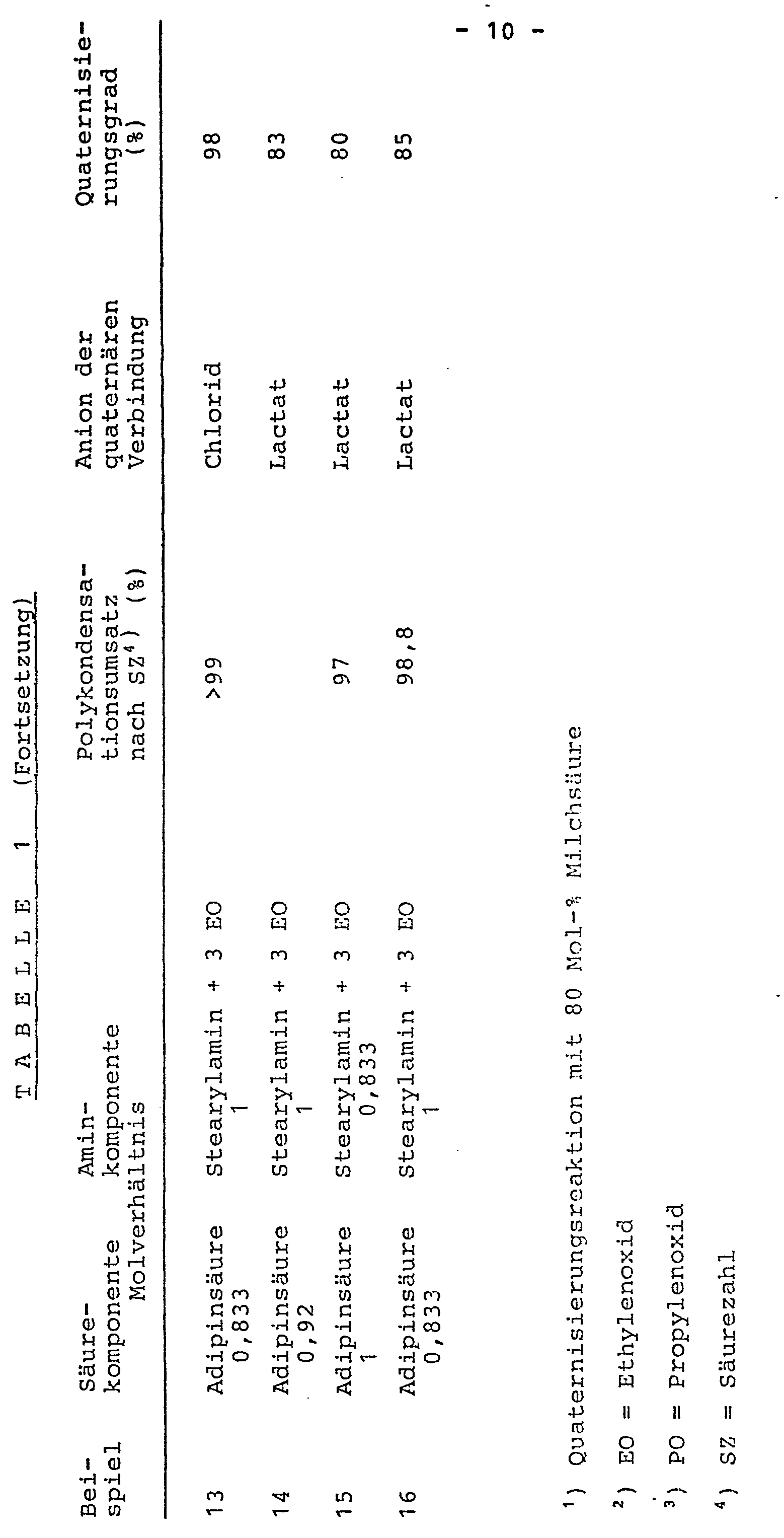
- 377 g (0,45 mol, berechnet auf die wiederkehrende Einheit) des gemäß Beispiel 1a) erhaltenen Polykondensats wird in Gegenwart von 32,4 g (1,80 mol) Wasser und 28 g Ethanol mit 55,8 g (0,45 mol) 70 %iger Milchsäure neutralisiert und mit 99,1 g (2,25 mol) Ethylenoxid guaternisiert. Die Reaktion ist bei einer Temperatur von 85 °C und einem maximalen Druck von 3,0 bar in 7 Stunden beendet. Es resultiert eine bei Raumtemperatur klare Flüssigkeit. Der Quaternisierungsgrad des quaternären Polykondensationsprodukts wird aus dem Verhältnis der sauren beziehungsweise alkalischen Zweiphasentitration mit Natriumdodecylsulfat bestimmt und beträgt 94 %. Unter den in Beispiel 1 beschriebenen Reaktionsbedingungen lassen sich die in folgender Tabelle 1, Beispiele 2 bis 16,angegebenen Reaktionen zu Verbindungen der Formel I mit den aufgeführten Quaternisierungsgraden durchführen:

- 377 g (0,45 mol, berechnet auf die wiederkehrende Einheit) des gemäß Beispiel 1a) erhaltenen Polykondensats wird in Gegenwart von 32,4 g (1,80 mol) Wasser und 28 g Ethanol mit 55,8 g (0,45 mol) 70 %iger Milchsäure neutralisiert und mit 99,1 g (2,25 mol) Ethylenoxid guaternisiert. Die Reaktion ist bei einer Temperatur von 85 °C und einem maximalen Druck von 3,0 bar in 7 Stunden beendet. Es resultiert eine bei Raumtemperatur klare Flüssigkeit. Der Quaternisierungsgrad des quaternären Polykondensationsprodukts wird aus dem Verhältnis der sauren beziehungsweise alkalischen Zweiphasentitration mit Natriumdodecylsulfat bestimmt und beträgt 94 %. Unter den in Beispiel 1 beschriebenen Reaktionsbedingungen lassen sich die in folgender Tabelle 1, Beispiele 2 bis 16,angegebenen Reaktionen zu Verbindungen der Formel I mit den aufgeführten Quaternisierungsgraden durchführen:
-
- a) Herstellung eines Polykondensationsproduktes aus Adipinsäure und einem Stearylamin, das mit 3,5 mol Ethylenoxid kondensiert ist:
- Die Esterbildung wird, wie in Beispiel 1 beschrieben, unter Einsatz von 412 g (1,0 mol) Stearylamin + 3,5 mol EO, 121,7 g (0,833 mol) Adipinsäure und 1,0 g 50 gew.- %ige hypophosphorige Säure durchgeführt. Nach 16stündiger Reaktionszeit wird nach Bestimmung der Säure-und Aminzahl ein praktisch vollständiger Umsatz ermittelt.
- b) Quaternisierung des erhaltenen Polykondensats mit Methylchlorid.
- 125 g (0,25 mol der sich wiederholenden Einheit) des gemäß Beispiel 17a) erhaltenen Polykondensats werden in Gegenwart von 130 g Isopropanol mit 18,7 g (0,37 mol) Methylchlorid umgesetzt. Die Quaternisierung ist nach 10 Stunden Reaktionszeit bei einer Temperatur von 80 °C und einem maximalen Druck von 5 bar beendet. Der Quaternisierungsgrad des Produkts beträgt 90 Y.
- Die erfindungsgemäßen quaternären oxalkylierten Polyester der Formel I sind insbesondere in der Haarkosmetik universell einsetzbar. Während sich die oben erwähnten quaternären Ammoniumsalze wegen ihres Wirkungsabfalls in Gegenwart anionischer Tenside fast ausschließlich nur für Haarnachspülmittel eignen und die erwähnten Polymeren, die quaternäre Ammoniumgruppen enthalten, u.a. aus Gründen einer nicht ausreichenden Verdickung mit üblichen Verdickungsmitteln nicht für Haarnachspülmittel, sondern nur für Haarwaschmittel formulieren lassen, können die erfindungsgemäßen Verbindungen der Formel I für die verschiedensten Zwecke in der Haarkosmetik Anwendung finden: Sie eignen sich sowohl für Haarwaschmittel als auch für Haarnachspülmittel, für Haarverformungsmittel, Haarfestiger und Haarfärbemittel, für Haarregenerierungsmittel und andere haarkosmetische Zubereitungen.
- Die erfindungsgemäßen quaternären oxalkylierten Polyester der Formel I können aber auch auf anderen Gebieten der Kosmetik Verwendung finden, so zum Beispiel in Hautpflegemitteln, Lotions oder in den verschiedenartigsten Hautreinigungsmitteln, insbesondere aber in flüssigen Seifen, Stückseifen oder Duschbädern, wo sie ein angenehmes Hautgefühl nach der Anwendung vermitteln.
- Für die genannten Anwendungszwecke können den erfindungsgemäßen Verbindungen der Formel I anionische, nicht-ionische oder auch kationische oder zwitter-ionische Tenside beigegeben werden. Als nicht-ionische Tenside, die vorzugsweise in Haarnachbehandlungsmitteln Verwendung finden, kommen dafür als Stoffgruppen insbesondere in Frage oxalkylierte Fettalkohole oder Alkylphenole, vorzugsweise oxalkyliert mit Ethylenoxid oder Gemischen von Ethylen- oder Propylenoxid; Polyglykolester von Fettsäuren oder Fettsäureamiden; Ethylenoxid-Propylenoxid-Blockpolymerisate; Glycerinester und Polyglycerinester; Sorbit- und Sorbitanester; Polyglykolester des Glycerins; oxethylierte Lanolinderivate; Alkanolamide und Saccharoseester.
- Als anionische Tenside, wie sie insbesondere für die Formulierung von Haarwaschmitteln und auch von anderen Kosmetika in Betracht kommen, seien genannt Alkylsulfate; Alkylpolyethersulfate; Alkylarylpolyethersulfate; Alkylsulfonate; Alkylarylsulfonate; a-Olefinsulfonate; Sulfobernsteinsäurederivate; Alkylglycidylethersulfate und -sulfonate; Acylalkylolamidsulfate und -sulfonate; Acylamidcpolyglykolethersulfate und -sulfonate; Fettsäuretauride; Fettsäureisethionate; Eiweißkondensate; Fettsäureseifen oder Fettsäuresarkoside.
- Schließlich können auch zwitter-ionische und kationische Tenside beigegeben werden, wie beispielsweise Alkyl- und Alkylamidobetaine; Aminoxide; Sulfobetaine und Alkylsulfatobetaine; Imidazoliniumverbindungen; quaternäre Ammoniumverbindungen, insbesondere solche von Fettaminen.
- Ferner können für haarkosmetische Zubereitungen zu den erfindungsgemäßen Verbindungen der Formel I auch noch übliche Zusatzstoffe gegeben werden, wie beispielsweise Konsistenzgeber, Schaumstabilisatoren, Parfümöle, Konservierungsmittel, Antischuppenmittel, Rückfettungsmittel, Färbemittel und Sequestrierungsmittel.
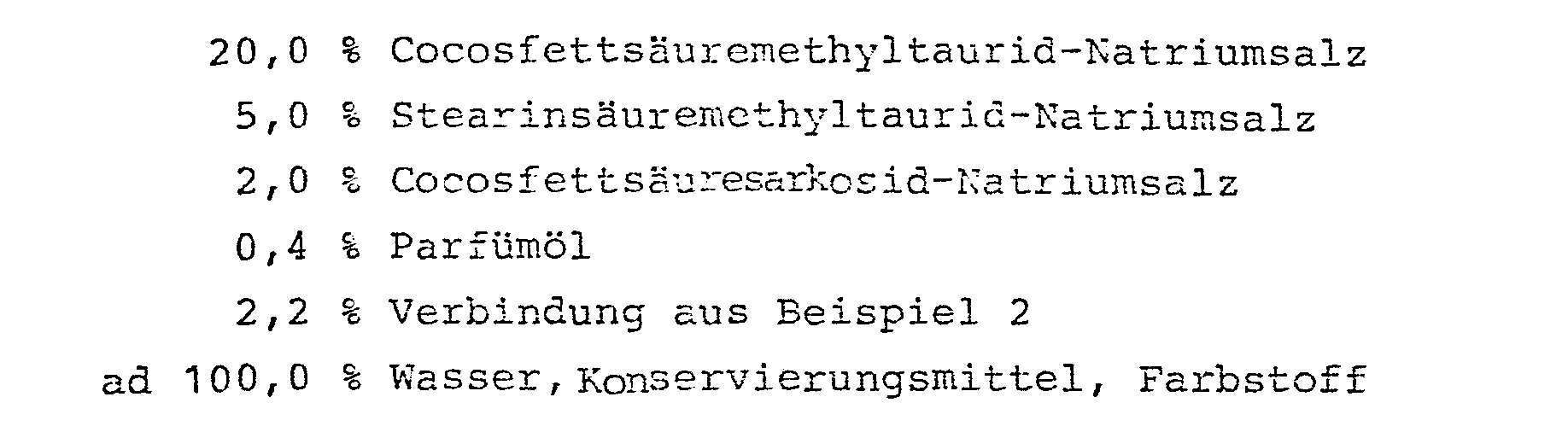
- Die folgenden Rezepturen sollen die Möglichkeiten für die Formulierung von Kosmetika erläutern, ohne die Erfindung auf diese Beispiele zu beschränken (alle im folgenden gegebenen Prozentangaben sind Gewichtsprozent):
- a) Klares, mittelviskoses Haarshampoo

- b) Cremeförmiges Haarshampoo
- c) Flüssiges Handwaschmittel

- d) Haarnachspül-Konzentrat

- e) Klares Haarnachspülmittel

- f) Klares Haarnachspülmittel-Konzentrat

- g) Klares-Haarnachspülmittel

- h) Frisiercreme

- i) Flüssiger Haarfestiger

- j) Mittelviskoses Duschbad

- k) Öl-in-Wasser-Emulsion

- Das anwendungstechnische Verhalten der erfindungsgemäben quaternären oxalkylierten Polyester der Formel I wurde in vivo am Lebendhaar untersucht.
- Die Vorbehandlung der Haare erfolgte in Annäherung zur Praxis durch Waschen mit einer 1 %igen Lauryldiglykolethersulfat-Katriumsalz-Lösung in Wasser. Anschließend wurde jeweils mit Wasser von +35 °C ausgespült.
- Die Durchführung des in vivo-Tests erfolgte nach dem sogenannten Halbkopf-Test, das heißt das Haupthaar wurde in der Mitte gescheitelt und jeweils 10 ml einer 2 %igen wäßrigen Lösung beziehungsweise Dispersion der erfindungsgemäßen Verbindung wurden mit einer Pipette auf das feuchte Kopfhaar verteilt. Nach 5minütiger Einwirkungszeit wurde mit 2 1 Leitungswasser von +35 °C die überschüssige Menge ausgespült.
- Es wurde sodann sowohl das antistatische Verhalten als auch die Kämmbarkeit mit einem Standard-Kamm geprüft.
- Die Beurteilung erfolgte nach folgendem Schema:

- Die dabei erhaltenen Ergebnisse zeigt Tabelle 2. Wie ersichtlich, weisen die erfindungsgemäßen Verbindungen sowohl eine bessere Naßkämmbarkeit als auch eine verbesserte Trockenkämmbarkeit und höheren Glanz, verglichen mit der als Vergleichssubstanz gewählten Verbindung Cetyltrimethylammoniumchlorid, auf.
- Die erfindungsgemäßen Verbindungen sind schaumarm. Bei dem Einsatz der erfindungsgemäßen Verbindungen in Haarshampoos wurde auch nach der praxisüblichen kontinuierlichen Anwendung kein sogenannter akkumulierender Effekt gefunden, der normalerweise negative Auswirkungen auf Aussehen, Griff, Fülle und Glanz der Haare besitzt. Auch ist die antistatische Wirkung besser als bei den Vergleichsprodukten.

Claims (5)


Applications Claiming Priority (2)
| Application Number | Priority Date | Filing Date | Title |
|---|---|---|---|
| DE19833345156 DE3345156A1 (de) | 1983-12-14 | 1983-12-14 | Quaternaere oxalkylierte polyester, verfahren zu deren herstellung und deren verwendung |
| DE3345156 | 1983-12-14 |
Publications (3)
| Publication Number | Publication Date |
|---|---|
| EP0144975A2 true EP0144975A2 (de) | 1985-06-19 |
| EP0144975A3 EP0144975A3 (en) | 1985-07-31 |
| EP0144975B1 EP0144975B1 (de) | 1987-05-06 |
Family
ID=6216874
Family Applications (1)
| Application Number | Title | Priority Date | Filing Date |
|---|---|---|---|
| EP84114822A Expired EP0144975B1 (de) | 1983-12-14 | 1984-12-06 | Quaternäre oxalkylierte Polyester, Verfahren zu deren Herstellung und deren Verwendung |
Country Status (5)
| Country | Link |
|---|---|
| US (1) | US4606916A (de) |
| EP (1) | EP0144975B1 (de) |
| JP (1) | JPS60146853A (de) |
| CA (1) | CA1231717A (de) |
| DE (2) | DE3345156A1 (de) |
Cited By (13)
| Publication number | Priority date | Publication date | Assignee | Title |
|---|---|---|---|---|
| EP0209850A1 (de) * | 1985-07-25 | 1987-01-28 | Hoechst Aktiengesellschaft | Oxalkylierte Polyesteramine,Verfahren zu deren Herstellung und deren Verwendung |
| EP0212265A1 (de) * | 1985-07-25 | 1987-03-04 | Hoechst Aktiengesellschaft | Quaternäre oxalkylierte Polykondensate, Verfahren zu deren Herstellung und deren Verwendung |
| EP0267517A3 (de) * | 1986-11-13 | 1989-06-14 | Hoechst Aktiengesellschaft | Verzweigte Polyoxalkylenmischpolyester, Verfahren zu ihrer Herstellung und ihre Verwendung |
| EP0269887A3 (de) * | 1986-11-13 | 1989-06-28 | Hoechst Aktiengesellschaft | Verzweigte, quaternäre Polyoxalkylenmischpolyester, Verfahren zu ihrer Herstellung und ihre Verwendung |
| WO1989008737A1 (en) * | 1988-03-18 | 1989-09-21 | E.I. Du Pont De Nemours And Company | Improvements relating to fibers |
| WO1990009013A3 (en) * | 1989-01-25 | 1991-04-18 | Epitope Inc | Germicidal barriers |
| EP0358087A3 (de) * | 1988-09-03 | 1991-06-05 | BASF Aktiengesellschaft | Quaternierte Kondensationsprodukte |
| EP0398137A3 (de) * | 1989-05-19 | 1991-11-21 | The Procter & Gamble Company | Wäscheweichspülkomponenten und kationische Polyester als schmutzabweisende Polymere enthaltende Nachspülzusätze in Wäschekonditionniermitteln |
| EP0398133A3 (de) * | 1989-05-19 | 1991-11-27 | The Procter & Gamble Company | Kationische Polyester als schmutzabweisende Polymere |
| EP1136471A1 (de) * | 2000-03-22 | 2001-09-26 | Kao Corporation, S.A. | Esterderivate aus Alkanolaminen, Dicarbonsäuren und Fettalkoholen und daraus erhältliche kationische Tenside |
| US6562780B2 (en) * | 2001-06-07 | 2003-05-13 | Kao Corporation | Esters derived from alkanolamines, dicarboxylic acids and fatty alcohols and the cationic surfactants obtainable therefrom |
| WO2017141117A1 (en) | 2016-02-16 | 2017-08-24 | Arkema France | Use of alkoxylated amines as collector agents for ore beneficiation |
| WO2019034817A1 (fr) | 2017-08-16 | 2019-02-21 | Arkema France | Polyesteramines et polyesterquats |
Families Citing this family (12)
| Publication number | Priority date | Publication date | Assignee | Title |
|---|---|---|---|---|
| US4778919A (en) * | 1986-02-25 | 1988-10-18 | Ciba-Geigy Corporation | Maleic or phthalic acid half esters of alkoxylated fatty amines |
| DE3623730A1 (de) * | 1986-07-14 | 1988-01-21 | Henkel Kgaa | Neue quartaere ammoniumverbindungen und deren verwendung |
| US5833961A (en) * | 1996-06-25 | 1998-11-10 | Inolex Investment Corporation | Polyester-based suncreen formulations |
| US7138366B2 (en) * | 2002-11-01 | 2006-11-21 | Colgate-Palmolive Company | Aqueous composition comprising oligomeric esterquats |
| US20040138091A1 (en) * | 2002-11-01 | 2004-07-15 | Colgate-Palmolive Company | Aqueous composition comprising oligomeric esterquats |
| US20040087474A1 (en) * | 2002-11-01 | 2004-05-06 | Colgate-Palmolive Company | Aqueous composition comprising oligomeric esterquats |
| US6924261B2 (en) * | 2002-11-01 | 2005-08-02 | Colgate-Palmolive Co. | Aqueous composition comprising oligomeric esterquats |
| US20050226829A1 (en) * | 2004-04-07 | 2005-10-13 | Inolex Investment Corporation | Personal care products containing high refractive index esters and methods of preparing the same |
| IT1392811B1 (it) * | 2009-02-06 | 2012-03-23 | Torre | Composizione per uso medico, veterinario o cosmetico. |
| EP3208314B1 (de) | 2016-02-16 | 2018-08-15 | Omya International AG | Verfahren zur herstellung von produkten mit weissen pigmenten |
| EP3444036A1 (de) | 2017-08-16 | 2019-02-20 | Omya International AG | Umgekehrtes flotationsverfahren zur herstellung von produkten mit weissen pigmenten |
| CA3122650C (en) | 2018-12-11 | 2023-04-11 | Nouryon Chemicals International B.V. | Polyester demulsifier |
Family Cites Families (6)
| Publication number | Priority date | Publication date | Assignee | Title |
|---|---|---|---|---|
| US2944025A (en) * | 1957-08-07 | 1960-07-05 | Sinclair Refining Co | Lubricating oil composition |
| DE2054098A1 (de) * | 1970-11-04 | 1972-05-10 | Henkel & Cie Gmbh | Zur Verwendung in Waschmitteln geeignete, quartäre Ammoniumgruppen enthaltende Polyestersalze |
| DE2054097A1 (de) * | 1970-11-04 | 1972-05-10 | Henkel & Cie Gmbh | Zur Verwendung in Waschmitteln geeignete, quartäre Ammoniumgruppen enthaltende Polyestersalze |
| LU73795A1 (de) * | 1975-11-13 | 1977-05-31 | Oreal | |
| LU78153A1 (fr) * | 1977-09-20 | 1979-05-25 | Oreal | Compositions cosmetiques a base de polymeres polyammonium quaternaires et procede de preparation |
| DE3032216A1 (de) * | 1980-08-27 | 1982-04-08 | Henkel KGaA, 4000 Düsseldorf | Haarwasch- und haarbehandlungsmittel |
-
1983
- 1983-12-14 DE DE19833345156 patent/DE3345156A1/de not_active Withdrawn
-
1984
- 1984-12-06 EP EP84114822A patent/EP0144975B1/de not_active Expired
- 1984-12-06 DE DE8484114822T patent/DE3463514D1/de not_active Expired
- 1984-12-12 JP JP59260987A patent/JPS60146853A/ja active Pending
- 1984-12-12 US US06/680,982 patent/US4606916A/en not_active Expired - Fee Related
- 1984-12-13 CA CA000469999A patent/CA1231717A/en not_active Expired
Cited By (19)
| Publication number | Priority date | Publication date | Assignee | Title |
|---|---|---|---|---|
| EP0209850A1 (de) * | 1985-07-25 | 1987-01-28 | Hoechst Aktiengesellschaft | Oxalkylierte Polyesteramine,Verfahren zu deren Herstellung und deren Verwendung |
| EP0212265A1 (de) * | 1985-07-25 | 1987-03-04 | Hoechst Aktiengesellschaft | Quaternäre oxalkylierte Polykondensate, Verfahren zu deren Herstellung und deren Verwendung |
| EP0267517A3 (de) * | 1986-11-13 | 1989-06-14 | Hoechst Aktiengesellschaft | Verzweigte Polyoxalkylenmischpolyester, Verfahren zu ihrer Herstellung und ihre Verwendung |
| EP0269887A3 (de) * | 1986-11-13 | 1989-06-28 | Hoechst Aktiengesellschaft | Verzweigte, quaternäre Polyoxalkylenmischpolyester, Verfahren zu ihrer Herstellung und ihre Verwendung |
| WO1989008737A1 (en) * | 1988-03-18 | 1989-09-21 | E.I. Du Pont De Nemours And Company | Improvements relating to fibers |
| WO1989008673A3 (en) * | 1988-03-18 | 1989-10-05 | Du Pont | Modified hydrophilic polyesters |
| EP0336595A1 (de) * | 1988-03-18 | 1989-10-11 | E.I. Du Pont De Nemours And Company | Überzug für Polyesterfasern |
| EP0358087A3 (de) * | 1988-09-03 | 1991-06-05 | BASF Aktiengesellschaft | Quaternierte Kondensationsprodukte |
| WO1990009013A3 (en) * | 1989-01-25 | 1991-04-18 | Epitope Inc | Germicidal barriers |
| US5326841A (en) * | 1989-01-25 | 1994-07-05 | Epitope, Inc. | Germicidal barriers |
| EP0398137A3 (de) * | 1989-05-19 | 1991-11-21 | The Procter & Gamble Company | Wäscheweichspülkomponenten und kationische Polyester als schmutzabweisende Polymere enthaltende Nachspülzusätze in Wäschekonditionniermitteln |
| EP0398133A3 (de) * | 1989-05-19 | 1991-11-27 | The Procter & Gamble Company | Kationische Polyester als schmutzabweisende Polymere |
| EP1136471A1 (de) * | 2000-03-22 | 2001-09-26 | Kao Corporation, S.A. | Esterderivate aus Alkanolaminen, Dicarbonsäuren und Fettalkoholen und daraus erhältliche kationische Tenside |
| ES2180372A1 (es) * | 2000-03-22 | 2003-02-01 | Kao Corp Sa | Esteres derivados de alcanolaminas, acidos dicarboxilicos y alcoholes grasos, y los tensioactivos cationicos obtenibles a partir de los mismos. |
| US6562780B2 (en) * | 2001-06-07 | 2003-05-13 | Kao Corporation | Esters derived from alkanolamines, dicarboxylic acids and fatty alcohols and the cationic surfactants obtainable therefrom |
| WO2017141117A1 (en) | 2016-02-16 | 2017-08-24 | Arkema France | Use of alkoxylated amines as collector agents for ore beneficiation |
| US11648569B2 (en) | 2016-02-16 | 2023-05-16 | Arkema France | Use of alkoxylated amines as collector agents for ore beneficiation |
| WO2019034817A1 (fr) | 2017-08-16 | 2019-02-21 | Arkema France | Polyesteramines et polyesterquats |
| US11802179B2 (en) | 2017-08-16 | 2023-10-31 | Arkema France | Polyesteramines and polyesterquats |
Also Published As
| Publication number | Publication date |
|---|---|
| US4606916A (en) | 1986-08-19 |
| EP0144975A3 (en) | 1985-07-31 |
| DE3345156A1 (de) | 1985-06-27 |
| CA1231717A (en) | 1988-01-19 |
| JPS60146853A (ja) | 1985-08-02 |
| EP0144975B1 (de) | 1987-05-06 |
| DE3463514D1 (en) | 1987-06-11 |
Similar Documents
| Publication | Publication Date | Title |
|---|---|---|
| EP0144975B1 (de) | Quaternäre oxalkylierte Polyester, Verfahren zu deren Herstellung und deren Verwendung | |
| EP0252441B1 (de) | Neue quartäre Ammoniumverbindungen und deren Verwendung | |
| DE2734654C2 (de) | Quaternäre Ammoniumderivate von Lanolinfettsäuren enthaltende Mischungen | |
| EP0020907B1 (de) | Verfahren zur Herstellung von Betainen | |
| DE2521960C3 (de) | Verwendung von quaternisierten Polymeren zur kosmetischen Behandlung von Haar | |
| DE3719293C2 (de) | Konditionierende Haarspülung | |
| DE69024183T2 (de) | Quaternäre alkoxylierte Alkylglykosid-Ether und ihre Verwendung als Körperpflege | |
| DD297554A5 (de) | Haarpflegemittel | |
| EP1262171B1 (de) | konfektionierte quaternäre Ammoniumzusammensetzungen | |
| DE2629922A1 (de) | Neue quaternisierte polymere, verfahren zu ihrer herstellung und diese enthaltende mittel | |
| WO1995022313A1 (de) | Emulsionen | |
| DE3021447A1 (de) | Grenzflaechenaktive perfluorierte oligomere, verfahren zu ihrer herstellung und diese oligomere enthaltende mittel | |
| DE1643484B2 (de) | Polyhydroxyalkylenpolyätheramin-Gemische, Verfahren zu deren Herstellung und Kosmetika auf deren Basis | |
| DE69004016T3 (de) | Kosmetische Haarzubereitung. | |
| EP1273567A2 (de) | Betainester | |
| EP0259678A2 (de) | Mittel zur Pflege und Nachbehandlung der Haare | |
| DE69905691T2 (de) | Verfahren zur Herstellung von Betainalkylester-Alkohol Mischungen | |
| DE19613567A1 (de) | Zubereitung zur Behandlung keratinischer Fasern | |
| DE1950643A1 (de) | Quaternaere Ammoniumverbindungen zur Herstellung von Koerperpflegemitteln | |
| EP0602078B1 (de) | Milde reinigungsmittel | |
| EP0371339B1 (de) | Oberflächenaktive Mischungen | |
| EP0605503B1 (de) | Zubereitungen zur haarbehandlung | |
| EP0662814B1 (de) | Haarbehandlungsmittel | |
| DE19717687A1 (de) | Zubereitung zur Behandlung keratinischer Fasern | |
| EP0253275B1 (de) | Neue quartäre Ammoniumverbindungen und deren Verwendung |
Legal Events
| Date | Code | Title | Description |
|---|---|---|---|
| PUAI | Public reference made under article 153(3) epc to a published international application that has entered the european phase |
Free format text: ORIGINAL CODE: 0009012 |
|
| PUAL | Search report despatched |
Free format text: ORIGINAL CODE: 0009013 |
|
| AK | Designated contracting states |
Designated state(s): BE CH DE FR GB IT LI NL SE |
|
| AK | Designated contracting states |
Designated state(s): BE CH DE FR GB IT LI NL SE |
|
| 17P | Request for examination filed |
Effective date: 19851017 |
|
| 17Q | First examination report despatched |
Effective date: 19860509 |
|
| GRAA | (expected) grant |
Free format text: ORIGINAL CODE: 0009210 |
|
| AK | Designated contracting states |
Kind code of ref document: B1 Designated state(s): BE CH DE FR GB IT LI NL SE |
|
| ITF | It: translation for a ep patent filed | ||
| REF | Corresponds to: |
Ref document number: 3463514 Country of ref document: DE Date of ref document: 19870611 |
|
| ET | Fr: translation filed | ||
| PLBE | No opposition filed within time limit |
Free format text: ORIGINAL CODE: 0009261 |
|
| STAA | Information on the status of an ep patent application or granted ep patent |
Free format text: STATUS: NO OPPOSITION FILED WITHIN TIME LIMIT |
|
| 26N | No opposition filed | ||
| PGFP | Annual fee paid to national office [announced via postgrant information from national office to epo] |
Ref country code: FR Payment date: 19901119 Year of fee payment: 7 |
|
| PGFP | Annual fee paid to national office [announced via postgrant information from national office to epo] |
Ref country code: SE Payment date: 19901121 Year of fee payment: 7 Ref country code: GB Payment date: 19901121 Year of fee payment: 7 |
|
| PGFP | Annual fee paid to national office [announced via postgrant information from national office to epo] |
Ref country code: BE Payment date: 19901204 Year of fee payment: 7 |
|
| ITTA | It: last paid annual fee | ||
| PGFP | Annual fee paid to national office [announced via postgrant information from national office to epo] |
Ref country code: NL Payment date: 19901231 Year of fee payment: 7 |
|
| PGFP | Annual fee paid to national office [announced via postgrant information from national office to epo] |
Ref country code: DE Payment date: 19910213 Year of fee payment: 7 |
|
| PGFP | Annual fee paid to national office [announced via postgrant information from national office to epo] |
Ref country code: CH Payment date: 19910215 Year of fee payment: 7 |
|
| PG25 | Lapsed in a contracting state [announced via postgrant information from national office to epo] |
Ref country code: GB Effective date: 19911206 |
|
| PG25 | Lapsed in a contracting state [announced via postgrant information from national office to epo] |
Ref country code: SE Effective date: 19911207 |
|
| PG25 | Lapsed in a contracting state [announced via postgrant information from national office to epo] |
Ref country code: LI Effective date: 19911231 Ref country code: CH Effective date: 19911231 Ref country code: BE Effective date: 19911231 |
|
| BERE | Be: lapsed |
Owner name: HOECHST A.G. Effective date: 19911231 |
|
| PG25 | Lapsed in a contracting state [announced via postgrant information from national office to epo] |
Ref country code: NL Effective date: 19920701 |
|
| GBPC | Gb: european patent ceased through non-payment of renewal fee | ||
| NLV4 | Nl: lapsed or anulled due to non-payment of the annual fee | ||
| PG25 | Lapsed in a contracting state [announced via postgrant information from national office to epo] |
Ref country code: FR Effective date: 19920831 |
|
| REG | Reference to a national code |
Ref country code: CH Ref legal event code: PL |
|
| PG25 | Lapsed in a contracting state [announced via postgrant information from national office to epo] |
Ref country code: DE Effective date: 19920901 |
|
| REG | Reference to a national code |
Ref country code: FR Ref legal event code: ST |
|
| EUG | Se: european patent has lapsed |
Ref document number: 84114822.4 Effective date: 19920704 |