EP0144366B1 - Gemische von tricyclodecan-derivaten sowie deren herstellung und verwendung als riech- und aromastoff - Google Patents
Gemische von tricyclodecan-derivaten sowie deren herstellung und verwendung als riech- und aromastoff Download PDFInfo
- Publication number
- EP0144366B1 EP0144366B1 EP84901990A EP84901990A EP0144366B1 EP 0144366 B1 EP0144366 B1 EP 0144366B1 EP 84901990 A EP84901990 A EP 84901990A EP 84901990 A EP84901990 A EP 84901990A EP 0144366 B1 EP0144366 B1 EP 0144366B1
- Authority
- EP
- European Patent Office
- Prior art keywords
- hydrogen atom
- mixtures
- methyl group
- tricyclo
- mixture
- Prior art date
- Legal status (The legal status is an assumption and is not a legal conclusion. Google has not performed a legal analysis and makes no representation as to the accuracy of the status listed.)
- Expired
Links
- 239000000203 mixture Substances 0.000 title claims abstract description 56
- 239000002304 perfume Substances 0.000 title claims abstract description 11
- 238000002360 preparation method Methods 0.000 title claims abstract description 5
- 125000002496 methyl group Chemical group [H]C([H])([H])* 0.000 claims abstract description 25
- 229930040373 Paraformaldehyde Natural products 0.000 claims abstract description 10
- 229920002866 paraformaldehyde Polymers 0.000 claims abstract description 10
- 150000002148 esters Chemical class 0.000 claims abstract description 9
- UMRZSTCPUPJPOJ-KNVOCYPGSA-N norbornane Chemical compound C1C[C@H]2CC[C@@H]1C2 UMRZSTCPUPJPOJ-KNVOCYPGSA-N 0.000 claims abstract description 7
- 238000000034 method Methods 0.000 claims abstract description 6
- 239000000539 dimer Substances 0.000 claims abstract description 5
- 239000002253 acid Substances 0.000 claims abstract description 4
- 150000007513 acids Chemical class 0.000 claims abstract description 4
- WYURNTSHIVDZCO-UHFFFAOYSA-N tetrahydrofuran Substances C1CCOC1 WYURNTSHIVDZCO-UHFFFAOYSA-N 0.000 claims abstract description 4
- WSFSSNUMVMOOMR-NJFSPNSNSA-N methanone Chemical compound O=[14CH2] WSFSSNUMVMOOMR-NJFSPNSNSA-N 0.000 claims abstract description 3
- 125000004435 hydrogen atom Chemical group [H]* 0.000 claims abstract 16
- 125000001424 substituent group Chemical group 0.000 claims abstract 4
- 125000006823 (C1-C6) acyl group Chemical group 0.000 claims abstract 3
- 125000006727 (C1-C6) alkenyl group Chemical group 0.000 claims abstract 3
- 125000004169 (C1-C6) alkyl group Chemical group 0.000 claims abstract 2
- BGJSXRVXTHVRSN-UHFFFAOYSA-N 1,3,5-trioxane Chemical compound C1OCOCO1 BGJSXRVXTHVRSN-UHFFFAOYSA-N 0.000 claims abstract 2
- 239000002841 Lewis acid Substances 0.000 claims abstract 2
- 150000007517 lewis acids Chemical class 0.000 claims abstract 2
- QTBSBXVTEAMEQO-UHFFFAOYSA-N Acetic acid Chemical compound CC(O)=O QTBSBXVTEAMEQO-UHFFFAOYSA-N 0.000 claims description 27
- WFDIJRYMOXRFFG-UHFFFAOYSA-N acetic acid anhydride Natural products CC(=O)OC(C)=O WFDIJRYMOXRFFG-UHFFFAOYSA-N 0.000 claims description 17
- JOXIMZWYDAKGHI-UHFFFAOYSA-N toluene-4-sulfonic acid Chemical compound CC1=CC=C(S(O)(=O)=O)C=C1 JOXIMZWYDAKGHI-UHFFFAOYSA-N 0.000 claims description 12
- 239000001257 hydrogen Substances 0.000 claims description 11
- 229910052739 hydrogen Inorganic materials 0.000 claims description 11
- BDAGIHXWWSANSR-UHFFFAOYSA-N methanoic acid Natural products OC=O BDAGIHXWWSANSR-UHFFFAOYSA-N 0.000 claims description 11
- UFHFLCQGNIYNRP-UHFFFAOYSA-N Hydrogen Chemical compound [H][H] UFHFLCQGNIYNRP-UHFFFAOYSA-N 0.000 claims description 9
- ZSWFCLXCOIISFI-UHFFFAOYSA-N cyclopentadiene Chemical compound C1C=CC=C1 ZSWFCLXCOIISFI-UHFFFAOYSA-N 0.000 claims description 8
- 238000006243 chemical reaction Methods 0.000 claims description 7
- 239000003921 oil Substances 0.000 claims description 7
- 239000003054 catalyst Substances 0.000 claims description 6
- 235000019253 formic acid Nutrition 0.000 claims description 6
- OSWFIVFLDKOXQC-UHFFFAOYSA-N 4-(3-methoxyphenyl)aniline Chemical compound COC1=CC=CC(C=2C=CC(N)=CC=2)=C1 OSWFIVFLDKOXQC-UHFFFAOYSA-N 0.000 claims description 5
- 150000001242 acetic acid derivatives Chemical class 0.000 claims description 5
- 238000009835 boiling Methods 0.000 claims description 5
- 150000002170 ethers Chemical class 0.000 claims description 4
- QDWJUBJKEHXSMT-UHFFFAOYSA-N boranylidynenickel Chemical compound [Ni]#B QDWJUBJKEHXSMT-UHFFFAOYSA-N 0.000 claims description 3
- 239000002537 cosmetic Substances 0.000 claims description 2
- 239000002904 solvent Substances 0.000 claims description 2
- 239000000470 constituent Substances 0.000 claims 2
- IYQYZZHQSZMZIG-UHFFFAOYSA-N tricyclo[5.2.1.0(2.6)]deca-3,8-diene, 4.9-dimethyl Chemical class C1C2C3C=C(C)CC3C1C=C2C IYQYZZHQSZMZIG-UHFFFAOYSA-N 0.000 claims 2
- 239000000463 material Substances 0.000 claims 1
- 239000003880 polar aprotic solvent Substances 0.000 claims 1
- RTZKZFJDLAIYFH-UHFFFAOYSA-N Diethyl ether Chemical compound CCOCC RTZKZFJDLAIYFH-UHFFFAOYSA-N 0.000 abstract description 13
- NFWSQSCIDYBUOU-UHFFFAOYSA-N methylcyclopentadiene Chemical compound CC1=CC=CC1 NFWSQSCIDYBUOU-UHFFFAOYSA-N 0.000 abstract description 12
- QTBSBXVTEAMEQO-UHFFFAOYSA-M Acetate Chemical compound CC([O-])=O QTBSBXVTEAMEQO-UHFFFAOYSA-M 0.000 abstract description 2
- YLQBMQCUIZJEEH-UHFFFAOYSA-N tetrahydrofuran Natural products C=1C=COC=1 YLQBMQCUIZJEEH-UHFFFAOYSA-N 0.000 abstract description 2
- 235000019568 aromas Nutrition 0.000 abstract 1
- 239000000047 product Substances 0.000 description 25
- HEMHJVSKTPXQMS-UHFFFAOYSA-M Sodium hydroxide Chemical compound [OH-].[Na+] HEMHJVSKTPXQMS-UHFFFAOYSA-M 0.000 description 15
- HECLRDQVFMWTQS-RGOKHQFPSA-N 1755-01-7 Chemical compound C1[C@H]2[C@@H]3CC=C[C@@H]3[C@@H]1C=C2 HECLRDQVFMWTQS-RGOKHQFPSA-N 0.000 description 13
- 239000003205 fragrance Substances 0.000 description 13
- 238000005984 hydrogenation reaction Methods 0.000 description 12
- 238000003756 stirring Methods 0.000 description 12
- LFQSCWFLJHTTHZ-UHFFFAOYSA-N Ethanol Chemical compound CCO LFQSCWFLJHTTHZ-UHFFFAOYSA-N 0.000 description 11
- 238000010478 Prins reaction Methods 0.000 description 11
- 150000001875 compounds Chemical class 0.000 description 11
- WSFSSNUMVMOOMR-UHFFFAOYSA-N Formaldehyde Chemical compound O=C WSFSSNUMVMOOMR-UHFFFAOYSA-N 0.000 description 10
- OKKJLVBELUTLKV-UHFFFAOYSA-N Methanol Chemical compound OC OKKJLVBELUTLKV-UHFFFAOYSA-N 0.000 description 9
- XLYOFNOQVPJJNP-UHFFFAOYSA-N water Substances O XLYOFNOQVPJJNP-UHFFFAOYSA-N 0.000 description 9
- 238000005160 1H NMR spectroscopy Methods 0.000 description 8
- 229960000583 acetic acid Drugs 0.000 description 8
- 239000012230 colorless oil Substances 0.000 description 8
- DIOQZVSQGTUSAI-UHFFFAOYSA-N decane Chemical compound CCCCCCCCCC DIOQZVSQGTUSAI-UHFFFAOYSA-N 0.000 description 8
- 238000004821 distillation Methods 0.000 description 8
- 235000019441 ethanol Nutrition 0.000 description 7
- YXFVVABEGXRONW-UHFFFAOYSA-N Toluene Chemical compound CC1=CC=CC=C1 YXFVVABEGXRONW-UHFFFAOYSA-N 0.000 description 6
- 150000001336 alkenes Chemical class 0.000 description 6
- -1 dimethyl acrylate Chemical compound 0.000 description 6
- 0 CC(CC1*CC2)CC1C2(C)C=C(C)C Chemical compound CC(CC1*CC2)CC1C2(C)C=C(C)C 0.000 description 5
- 241000160765 Erebia ligea Species 0.000 description 5
- 239000012043 crude product Substances 0.000 description 5
- 239000007789 gas Substances 0.000 description 5
- 239000011541 reaction mixture Substances 0.000 description 5
- JUJWROOIHBZHMG-UHFFFAOYSA-N Pyridine Chemical compound C1=CC=NC=C1 JUJWROOIHBZHMG-UHFFFAOYSA-N 0.000 description 4
- 229910052799 carbon Inorganic materials 0.000 description 4
- 238000007037 hydroformylation reaction Methods 0.000 description 4
- 150000001298 alcohols Chemical class 0.000 description 3
- 239000012298 atmosphere Substances 0.000 description 3
- 150000004651 carbonic acid esters Chemical class 0.000 description 3
- 238000001816 cooling Methods 0.000 description 3
- 125000002485 formyl group Chemical group [H]C(*)=O 0.000 description 3
- 238000006062 fragmentation reaction Methods 0.000 description 3
- XKBGEWXEAPTVCK-UHFFFAOYSA-M methyltrioctylammonium chloride Chemical compound [Cl-].CCCCCCCC[N+](C)(CCCCCCCC)CCCCCCCC XKBGEWXEAPTVCK-UHFFFAOYSA-M 0.000 description 3
- JRZJOMJEPLMPRA-UHFFFAOYSA-N olefin Natural products CCCCCCCC=C JRZJOMJEPLMPRA-UHFFFAOYSA-N 0.000 description 3
- 238000000425 proton nuclear magnetic resonance spectrum Methods 0.000 description 3
- 239000000126 substance Substances 0.000 description 3
- 238000001644 13C nuclear magnetic resonance spectroscopy Methods 0.000 description 2
- OKTJSMMVPCPJKN-UHFFFAOYSA-N Carbon Chemical compound [C] OKTJSMMVPCPJKN-UHFFFAOYSA-N 0.000 description 2
- 238000005481 NMR spectroscopy Methods 0.000 description 2
- KDLHZDBZIXYQEI-UHFFFAOYSA-N Palladium Chemical compound [Pd] KDLHZDBZIXYQEI-UHFFFAOYSA-N 0.000 description 2
- 239000007868 Raney catalyst Substances 0.000 description 2
- 229910000564 Raney nickel Inorganic materials 0.000 description 2
- NPXOKRUENSOPAO-UHFFFAOYSA-N Raney nickel Chemical compound [Al].[Ni] NPXOKRUENSOPAO-UHFFFAOYSA-N 0.000 description 2
- CDBYLPFSWZWCQE-UHFFFAOYSA-L Sodium Carbonate Chemical compound [Na+].[Na+].[O-]C([O-])=O CDBYLPFSWZWCQE-UHFFFAOYSA-L 0.000 description 2
- 230000015572 biosynthetic process Effects 0.000 description 2
- 238000001460 carbon-13 nuclear magnetic resonance spectrum Methods 0.000 description 2
- 239000007795 chemical reaction product Substances 0.000 description 2
- LPIQUOYDBNQMRZ-UHFFFAOYSA-N cyclopentene Chemical compound C1CC=CC1 LPIQUOYDBNQMRZ-UHFFFAOYSA-N 0.000 description 2
- 238000006471 dimerization reaction Methods 0.000 description 2
- XBDQKXXYIPTUBI-UHFFFAOYSA-N dimethylselenoniopropionate Natural products CCC(O)=O XBDQKXXYIPTUBI-UHFFFAOYSA-N 0.000 description 2
- KLKFAASOGCDTDT-UHFFFAOYSA-N ethoxymethoxyethane Chemical compound CCOCOCC KLKFAASOGCDTDT-UHFFFAOYSA-N 0.000 description 2
- 238000004508 fractional distillation Methods 0.000 description 2
- 238000005194 fractionation Methods 0.000 description 2
- 238000013467 fragmentation Methods 0.000 description 2
- 150000002431 hydrogen Chemical class 0.000 description 2
- 150000004702 methyl esters Chemical class 0.000 description 2
- GDOPTJXRTPNYNR-UHFFFAOYSA-N methylcyclopentane Chemical compound CC1CCCC1 GDOPTJXRTPNYNR-UHFFFAOYSA-N 0.000 description 2
- 239000012299 nitrogen atmosphere Substances 0.000 description 2
- TXFBASMXWNIAGS-UHFFFAOYSA-N octahydro-1h-4,7-methanoinden-1-ylmethyl acetate Chemical compound C1CC2C3C(COC(=O)C)CCC3C1C2 TXFBASMXWNIAGS-UHFFFAOYSA-N 0.000 description 2
- 239000012074 organic phase Substances 0.000 description 2
- BASFCYQUMIYNBI-UHFFFAOYSA-N platinum Chemical compound [Pt] BASFCYQUMIYNBI-UHFFFAOYSA-N 0.000 description 2
- UMJSCPRVCHMLSP-UHFFFAOYSA-N pyridine Natural products COC1=CC=CN=C1 UMJSCPRVCHMLSP-UHFFFAOYSA-N 0.000 description 2
- 150000003254 radicals Chemical class 0.000 description 2
- 238000007127 saponification reaction Methods 0.000 description 2
- 238000004611 spectroscopical analysis Methods 0.000 description 2
- YAQCYZLLBMLGOB-UHFFFAOYSA-N tricyclo[5.2.1.02,6]dec-3-ylmethanol Chemical compound C1CC2C3C(CO)CCC3C1C2 YAQCYZLLBMLGOB-UHFFFAOYSA-N 0.000 description 2
- JVSFQJZRHXAUGT-UHFFFAOYSA-N 2,2-dimethylpropanoyl chloride Chemical compound CC(C)(C)C(Cl)=O JVSFQJZRHXAUGT-UHFFFAOYSA-N 0.000 description 1
- CRZJPEIBPQWDGJ-UHFFFAOYSA-N 2-chloro-1,1-dimethoxyethane Chemical compound COC(CCl)OC CRZJPEIBPQWDGJ-UHFFFAOYSA-N 0.000 description 1
- OOUMJGFBPUZYSR-UHFFFAOYSA-N 3,3-dimethyltricyclo[5.2.1.02,6]dec-1-ene Chemical class C1CC2=C3C(C)(C)CCC3C1C2 OOUMJGFBPUZYSR-UHFFFAOYSA-N 0.000 description 1
- OSDWBNJEKMUWAV-UHFFFAOYSA-N Allyl chloride Chemical compound ClCC=C OSDWBNJEKMUWAV-UHFFFAOYSA-N 0.000 description 1
- UHOVQNZJYSORNB-UHFFFAOYSA-N Benzene Chemical compound C1=CC=CC=C1 UHOVQNZJYSORNB-UHFFFAOYSA-N 0.000 description 1
- JAPMJSVZDUYFKL-UHFFFAOYSA-N C1C2C1CCC2 Chemical compound C1C2C1CCC2 JAPMJSVZDUYFKL-UHFFFAOYSA-N 0.000 description 1
- AHQZRFBZJSCKAV-UHFFFAOYSA-N CC1=CCC=C1 Chemical compound CC1=CCC=C1 AHQZRFBZJSCKAV-UHFFFAOYSA-N 0.000 description 1
- CXOZQHPXKPDQGT-UHFFFAOYSA-N CC1C=CCC1 Chemical compound CC1C=CCC1 CXOZQHPXKPDQGT-UHFFFAOYSA-N 0.000 description 1
- UGFAIRIUMAVXCW-UHFFFAOYSA-N Carbon monoxide Chemical compound [O+]#[C-] UGFAIRIUMAVXCW-UHFFFAOYSA-N 0.000 description 1
- 240000006829 Ficus sundaica Species 0.000 description 1
- BDAGIHXWWSANSR-UHFFFAOYSA-M Formate Chemical compound [O-]C=O BDAGIHXWWSANSR-UHFFFAOYSA-M 0.000 description 1
- 229910004373 HOAc Inorganic materials 0.000 description 1
- 238000005684 Liebig rearrangement reaction Methods 0.000 description 1
- 241000208125 Nicotiana Species 0.000 description 1
- 241000208136 Nicotiana sylvestris Species 0.000 description 1
- 235000002637 Nicotiana tabacum Nutrition 0.000 description 1
- XBDQKXXYIPTUBI-UHFFFAOYSA-M Propionate Chemical compound CCC([O-])=O XBDQKXXYIPTUBI-UHFFFAOYSA-M 0.000 description 1
- 235000004789 Rosa xanthina Nutrition 0.000 description 1
- 241000109329 Rosa xanthina Species 0.000 description 1
- ACIAHEMYLLBZOI-ZZXKWVIFSA-N Unsaturated alcohol Chemical compound CC\C(CO)=C/C ACIAHEMYLLBZOI-ZZXKWVIFSA-N 0.000 description 1
- 235000012544 Viola sororia Nutrition 0.000 description 1
- 241001106476 Violaceae Species 0.000 description 1
- DHKHKXVYLBGOIT-UHFFFAOYSA-N acetaldehyde Diethyl Acetal Natural products CCOC(C)OCC DHKHKXVYLBGOIT-UHFFFAOYSA-N 0.000 description 1
- 150000001241 acetals Chemical class 0.000 description 1
- 150000008065 acid anhydrides Chemical class 0.000 description 1
- YKIOKAURTKXMSB-UHFFFAOYSA-N adams's catalyst Chemical compound O=[Pt]=O YKIOKAURTKXMSB-UHFFFAOYSA-N 0.000 description 1
- 239000000010 aprotic solvent Substances 0.000 description 1
- 229910002091 carbon monoxide Inorganic materials 0.000 description 1
- 125000002915 carbonyl group Chemical group [*:2]C([*:1])=O 0.000 description 1
- 150000001735 carboxylic acids Chemical class 0.000 description 1
- 230000003197 catalytic effect Effects 0.000 description 1
- 239000003638 chemical reducing agent Substances 0.000 description 1
- 235000009508 confectionery Nutrition 0.000 description 1
- 125000002433 cyclopentenyl group Chemical group C1(=CCCC1)* 0.000 description 1
- 239000003599 detergent Substances 0.000 description 1
- MQIKJSYMMJWAMP-UHFFFAOYSA-N dicobalt octacarbonyl Chemical group [Co+2].[Co+2].[O+]#[C-].[O+]#[C-].[O+]#[C-].[O+]#[C-].[O+]#[C-].[O+]#[C-].[O+]#[C-].[O+]#[C-] MQIKJSYMMJWAMP-UHFFFAOYSA-N 0.000 description 1
- DENRZWYUOJLTMF-UHFFFAOYSA-N diethyl sulfate Chemical compound CCOS(=O)(=O)OCC DENRZWYUOJLTMF-UHFFFAOYSA-N 0.000 description 1
- 229940008406 diethyl sulfate Drugs 0.000 description 1
- VAYGXNSJCAHWJZ-UHFFFAOYSA-N dimethyl sulfate Chemical compound COS(=O)(=O)OC VAYGXNSJCAHWJZ-UHFFFAOYSA-N 0.000 description 1
- 150000002009 diols Chemical class 0.000 description 1
- 230000032050 esterification Effects 0.000 description 1
- 238000005886 esterification reaction Methods 0.000 description 1
- RIFGWPKJUGCATF-UHFFFAOYSA-N ethyl chloroformate Chemical compound CCOC(Cl)=O RIFGWPKJUGCATF-UHFFFAOYSA-N 0.000 description 1
- 238000002474 experimental method Methods 0.000 description 1
- 238000000605 extraction Methods 0.000 description 1
- 238000001914 filtration Methods 0.000 description 1
- 235000013373 food additive Nutrition 0.000 description 1
- 239000002778 food additive Substances 0.000 description 1
- 239000012362 glacial acetic acid Substances 0.000 description 1
- 239000011521 glass Substances 0.000 description 1
- 125000002887 hydroxy group Chemical group [H]O* 0.000 description 1
- 238000011065 in-situ storage Methods 0.000 description 1
- 238000011835 investigation Methods 0.000 description 1
- KQNPFQTWMSNSAP-UHFFFAOYSA-N isobutyric acid Chemical compound CC(C)C(O)=O KQNPFQTWMSNSAP-UHFFFAOYSA-N 0.000 description 1
- 230000005923 long-lasting effect Effects 0.000 description 1
- 238000004519 manufacturing process Methods 0.000 description 1
- AFFLGGQVNFXPEV-UHFFFAOYSA-N n-decene Natural products CCCCCCCCC=C AFFLGGQVNFXPEV-UHFFFAOYSA-N 0.000 description 1
- 230000007935 neutral effect Effects 0.000 description 1
- PXHVJJICTQNCMI-UHFFFAOYSA-N nickel Substances [Ni] PXHVJJICTQNCMI-UHFFFAOYSA-N 0.000 description 1
- 125000003518 norbornenyl group Chemical group C12(C=CC(CC1)C2)* 0.000 description 1
- 238000000655 nuclear magnetic resonance spectrum Methods 0.000 description 1
- 229910052763 palladium Inorganic materials 0.000 description 1
- RGSFGYAAUTVSQA-UHFFFAOYSA-N pentamethylene Natural products C1CCCC1 RGSFGYAAUTVSQA-UHFFFAOYSA-N 0.000 description 1
- 239000003208 petroleum Substances 0.000 description 1
- 229910052697 platinum Inorganic materials 0.000 description 1
- 239000002244 precipitate Substances 0.000 description 1
- 150000003138 primary alcohols Chemical class 0.000 description 1
- 235000019260 propionic acid Nutrition 0.000 description 1
- IUVKMZGDUIUOCP-BTNSXGMBSA-N quinbolone Chemical compound O([C@H]1CC[C@H]2[C@H]3[C@@H]([C@]4(C=CC(=O)C=C4CC3)C)CC[C@@]21C)C1=CCCC1 IUVKMZGDUIUOCP-BTNSXGMBSA-N 0.000 description 1
- 230000008707 rearrangement Effects 0.000 description 1
- 230000000717 retained effect Effects 0.000 description 1
- 229910052703 rhodium Inorganic materials 0.000 description 1
- 239000010948 rhodium Substances 0.000 description 1
- MHOVAHRLVXNVSD-UHFFFAOYSA-N rhodium atom Chemical compound [Rh] MHOVAHRLVXNVSD-UHFFFAOYSA-N 0.000 description 1
- 229910000029 sodium carbonate Inorganic materials 0.000 description 1
- 239000007787 solid Substances 0.000 description 1
- 238000001228 spectrum Methods 0.000 description 1
- 238000009987 spinning Methods 0.000 description 1
- 239000007858 starting material Substances 0.000 description 1
- 238000010626 work up procedure Methods 0.000 description 1
Images


Classifications
-
- C—CHEMISTRY; METALLURGY
- C11—ANIMAL OR VEGETABLE OILS, FATS, FATTY SUBSTANCES OR WAXES; FATTY ACIDS THEREFROM; DETERGENTS; CANDLES
- C11B—PRODUCING, e.g. BY PRESSING RAW MATERIALS OR BY EXTRACTION FROM WASTE MATERIALS, REFINING OR PRESERVING FATS, FATTY SUBSTANCES, e.g. LANOLIN, FATTY OILS OR WAXES; ESSENTIAL OILS; PERFUMES
- C11B9/00—Essential oils; Perfumes
- C11B9/0069—Heterocyclic compounds
- C11B9/0073—Heterocyclic compounds containing only O or S as heteroatoms
- C11B9/0076—Heterocyclic compounds containing only O or S as heteroatoms the hetero rings containing less than six atoms
-
- C—CHEMISTRY; METALLURGY
- C07—ORGANIC CHEMISTRY
- C07C—ACYCLIC OR CARBOCYCLIC COMPOUNDS
- C07C31/00—Saturated compounds having hydroxy or O-metal groups bound to acyclic carbon atoms
- C07C31/13—Monohydroxylic alcohols containing saturated rings
- C07C31/137—Monohydroxylic alcohols containing saturated rings polycyclic with condensed ring systems
-
- C—CHEMISTRY; METALLURGY
- C07—ORGANIC CHEMISTRY
- C07C—ACYCLIC OR CARBOCYCLIC COMPOUNDS
- C07C33/00—Unsaturated compounds having hydroxy or O-metal groups bound to acyclic carbon atoms
- C07C33/05—Alcohols containing rings other than six-membered aromatic rings
- C07C33/12—Alcohols containing rings other than six-membered aromatic rings containing five-membered rings
-
- C—CHEMISTRY; METALLURGY
- C07—ORGANIC CHEMISTRY
- C07C—ACYCLIC OR CARBOCYCLIC COMPOUNDS
- C07C5/00—Preparation of hydrocarbons from hydrocarbons containing the same number of carbon atoms
- C07C5/02—Preparation of hydrocarbons from hydrocarbons containing the same number of carbon atoms by hydrogenation
- C07C5/03—Preparation of hydrocarbons from hydrocarbons containing the same number of carbon atoms by hydrogenation of non-aromatic carbon-to-carbon double bonds
- C07C5/05—Partial hydrogenation
-
- C—CHEMISTRY; METALLURGY
- C07—ORGANIC CHEMISTRY
- C07D—HETEROCYCLIC COMPOUNDS
- C07D307/00—Heterocyclic compounds containing five-membered rings having one oxygen atom as the only ring hetero atom
- C07D307/77—Heterocyclic compounds containing five-membered rings having one oxygen atom as the only ring hetero atom ortho- or peri-condensed with carbocyclic rings or ring systems
- C07D307/93—Heterocyclic compounds containing five-membered rings having one oxygen atom as the only ring hetero atom ortho- or peri-condensed with carbocyclic rings or ring systems condensed with a ring other than six-membered
-
- C—CHEMISTRY; METALLURGY
- C11—ANIMAL OR VEGETABLE OILS, FATS, FATTY SUBSTANCES OR WAXES; FATTY ACIDS THEREFROM; DETERGENTS; CANDLES
- C11B—PRODUCING, e.g. BY PRESSING RAW MATERIALS OR BY EXTRACTION FROM WASTE MATERIALS, REFINING OR PRESERVING FATS, FATTY SUBSTANCES, e.g. LANOLIN, FATTY OILS OR WAXES; ESSENTIAL OILS; PERFUMES
- C11B9/00—Essential oils; Perfumes
- C11B9/0042—Essential oils; Perfumes compounds containing condensed hydrocarbon rings
-
- C—CHEMISTRY; METALLURGY
- C07—ORGANIC CHEMISTRY
- C07C—ACYCLIC OR CARBOCYCLIC COMPOUNDS
- C07C2603/00—Systems containing at least three condensed rings
- C07C2603/56—Ring systems containing bridged rings
- C07C2603/58—Ring systems containing bridged rings containing three rings
- C07C2603/60—Ring systems containing bridged rings containing three rings containing at least one ring with less than six members
- C07C2603/66—Ring systems containing bridged rings containing three rings containing at least one ring with less than six members containing five-membered rings
- C07C2603/68—Dicyclopentadienes; Hydrogenated dicyclopentadienes
Definitions
- the cyclopentadiene (1) dimer, dicyclopentadiene (2) is an important starting material for the production of fragrances.
- the esters 3b-c obtained by addition of carboxylic acids e.g. acetic acid, propionic acid
- Formulae 3a has been described in UK Patent 815,232 (6/24/1959) and dimethyl acrylate 3d in US Patent 3,593,745 (8/8/1971).
- Other fragrances from dicyclopentadiene are summarized by Ohloff and Rode-Gawal (in: H. Aebi, E. Baumgartner, HP Fiedler and G. Ohloff, «Cosmetics, Fragrances and Food Additives •, G. Thieme Verlag, Stuttgart 1978, p. 55 -57).
- German Offenlegungsschrift 3 120 700 A1 (February 25, 1982) describes the tricyclodecane derivatives of the general formula 7 and their use as fragrances.
- Methylcyclopentadiene (presentation: overview WT Ford, J. Org. Chem. 25, 3979 (1971)) is as Mixture of the three double bond isomers 4a, b, c before. According to S. McLean and P. Haynes (Tetrahedron 21, 2313 (1965)), 44.5% of the 1-methyl-isomer 4a, 54.5% of the C-2-isomer 4b and only approx. 1% of the C-5 isomers 4c.
- the signals at 1.25 and 1.50 ppm can be assigned to the protons of the C i bridge in analogy to dicyclopentadiene (Sadtler NMR spectra collection No. 6494 M). Only the signals of relatively low intensity at 1.23 and 1.35 ppm can be assigned to the bridgehead methyl groups of 8a-d. This finding and the intensity of the olefinic signals show the predominance of the isomers 8e-h (approx. 85%), while 8a-d are only present in approx. 15%.
- the selective hydrogenation of the norbornane part of the isomeric dimethyldicyclopentadienes 8a-h was achieved by modifying a procedure given by Ch. A. Brown for the selective hydrogenation of dicyclopentadiene (2) (Ch. A. Brown, Chem. Commun. 1969, 952; HC Brown and Ch. A. Brown, J. Am. Chem. Soc., 85, 1004 (1963)).
- the hydrogenation was carried out in methanol, ethanol or another polar, aprotic solvent at temperatures of 20-80 ° C., preferably at 40-50 ° C., and a hydrogen pressure from 30-70 bar, preferably 50-60 bar.
- the resulting mono-enes 9a-h are available according to GC (Fig. 3) as mixtures of three main isomers (approx. 16, 24 and 37%) as well as further secondary isomers, which, like 8a-h, are constitutional isomers, here but can also act stereoisomers. All of these isomers show a very similar mass spectrometric fragmentation pattern, which can be explained by opening the norbornane system to form a methylcyclopentadienyl radical cation (m / z 80) and a methylcyclopentane. In the 'H-NMR spectrum (Fig.
- Singlets at 1.25 and 1.15 ppm can be assigned to bridgehead methyl groups of the isomers 9a-c and two superimposed doublets at 1.05 ppm to the methyl groups in the norbornane part of the isomers 9d-f, which are the main isomers.
- the individual olefins of the mixture 9a-h react differently with formaldehyde, namely the isomers 9a, b, e, f with a methyl group at C-4 with simple addition to the primary alcohols 10a-d (or the acetates 12a-d) of type A and the isomers 9c, d, g, h with a methyl group at C-3 or C-5 with double addition to the tetracyclic ether of type B (11 ac).
- the constitution of 11d is shown in the 1 H-NMR spectrum (Fig. 9) by a doublet at 0.84 ppm (sec. Methyl), a singlet at 1.18 (allylst. Methyl) and multiplets at 3.4- 4.0 ppm (tetrahydrofuran system) and in the 13 C-NMR spectrum (Fig. 10) characterized by singlets at 150 ppm (tetrasubstituted double bond).
- the essential mass spectrometric fragmentations of 11d can be interpreted without difficulty and are consistent with the structure given.
- the dimeric cyclopentadiene (2) can be prepared according to that of Ch. A. Brown (Chem. Commun. 1969, 952), or HC Brown and Ch. A. Brown (J. Am. Chem. Soc. 85, 1004 (1963) ) given given selectively hydrogenated in the norbornane part to 2 '. Prins reaction of 2 'with paraformaldehyde in analogy to the examples 2, 3 and 4 given here gives the unsaturated alcohol 48 and the diols 49a-c, which z. Allow T. to dehydrate to tetracyclic ether 86; 48 can be isolated by fractional distillation.
- the saturated alcohol 68 was obtained from 48 by hydrogenation using conventional catalysts such as Raney nickel, platinum or palladium / activated carbon.
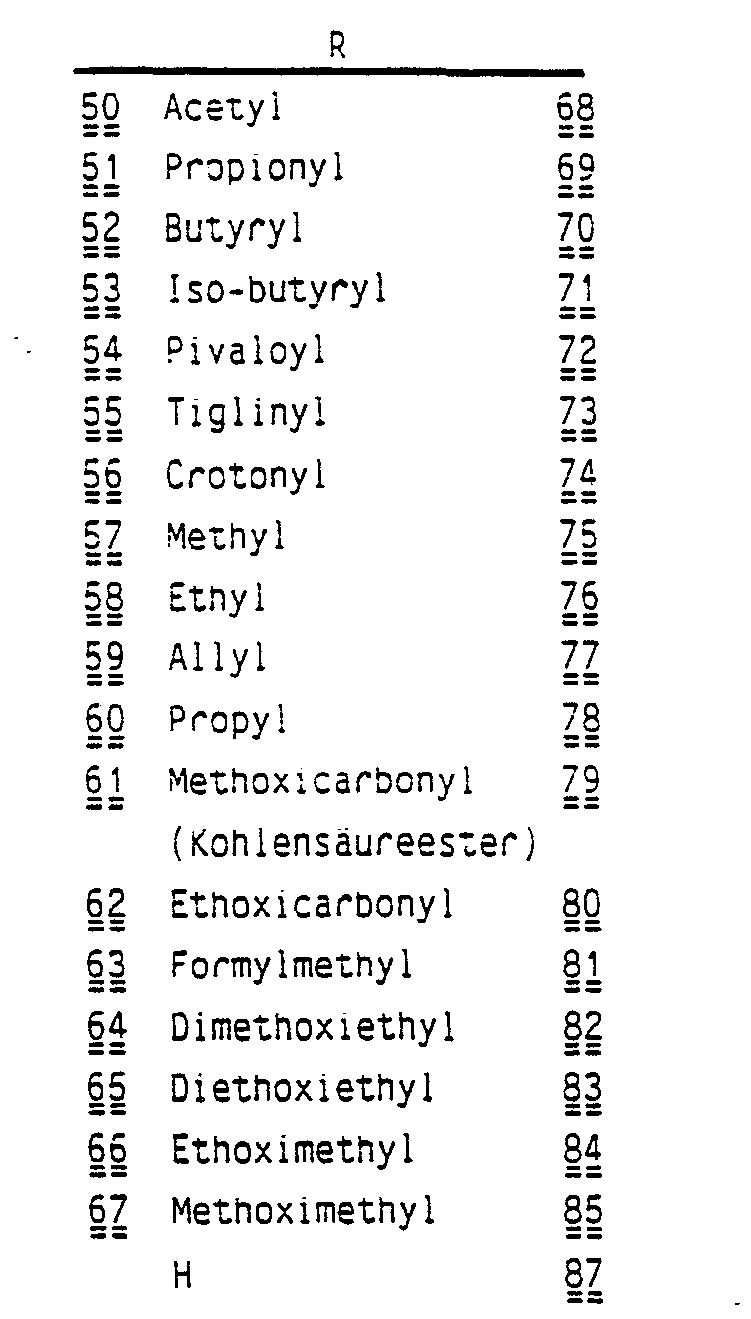
- the corresponding esters, ethers, carbonic acid esters and acetals were obtained from 48 or 68 in analogy to Examples 6-13 (compounds 50-67, 69-85).
- mixtures of the new compounds of general formula A are characterized by woody. fresh or sweet herbaceous smell notes and can be used advantageously as fragrances and incorporated in different perfume oils.
- the main products 12d and 11d were isolated from the product mixture 12a-d + 11a-d by distillation on a spinning band column.
- the isomer 10d was isolated by fractional distillation on a rotating band column.
- This basic mixture has a balanced woody fragrance with fougere aspects.
- new, original fragrance aspects were achieved, with the addition of
- This perfume oil with a relatively high proportion of the new compounds 10a-d + 11a-d is characterized by a long-lasting heavy-flowery, but also fresh note and is therefore particularly suitable for perfuming detergents.
- This perfume oil with a high proportion of the new compounds 15a-d + 11a-d has one radiant floral fragrance with aspects of roses, violets and spring flowers.
- This base with a large proportion of the new compounds 22a-d (+ 11a-d) has a new and harmonious fragrance complex with woody, herbaceous (tobacco) and amber-like aspects.
Landscapes
- Chemical & Material Sciences (AREA)
- Organic Chemistry (AREA)
- Life Sciences & Earth Sciences (AREA)
- Engineering & Computer Science (AREA)
- Chemical Kinetics & Catalysis (AREA)
- Oil, Petroleum & Natural Gas (AREA)
- Wood Science & Technology (AREA)
- Fats And Perfumes (AREA)
- Organic Low-Molecular-Weight Compounds And Preparation Thereof (AREA)
- Detergent Compositions (AREA)
Description
- Das Dimere des Cyclopentadiens (1), Dicyclopentadien (2), ist ein wichtiges Ausgangsmaterial für die Produktion von Riechstoffen. Die durch Addition von Carbonsäuren (z. B. Essigsäure, Propionsäure) erhaltenen Ester 3b-c (Darstellung : Zeilanov et a., Chem. Abstracts, 68, 49319d) sind weltweit in großen Mengen verwendete Riechstoffe. Das Formiat 3a ist in dem UK-Patent 815, 232 (24.6.1959) und das Dimethylacrylat 3d in dem US-Patent 3 593 745 (10.8.1971) beschrieben worden. Weitere Riechstoffe aus Dicyclopentadien werden von Ohloff und Rode-Gawal zusammenfassend beschrieben (in : H. Aebi, E. Baumgartner, H. P. Fiedler und G. Ohloff, « Kosmetika, Riechstoffe und Lebensmittelzusatzstoffe •, G. Thieme Verlag, Stuttgart 1978, S. 55-57).

- Über Produkte aus den Dimeren des Methylcyclopentadiens (4) ist wenig bekannt. In der Europ. Pat. Appl. 0039232 werden die aus den Dimeren des Methylcyclopentadiens (4) erhaltenen Dimethyl-Tricyclodecan-Derivate der allgemeinen Formel 5 als Riechstoffe beansprucht, wobei die gestrichelte Linie eine fakultative Doppelbindung bedeutet. Die Methylgruppe im Norbornan-Teil soll alternativ in den Resten R1 oder R2 und die Methylgruppe im Cyclopenten-Teil alternativ in den Resten R4, R5 oder R6 enthalten sein. Die jeweils nicht substituierten Positionen R1, R2, R4-Rs sollen durch Wasserstoff besetzt sein. Der Molekülteil Y soll eine Carbonyl-, Hydroxyl-, Acetat-, Propionat-, bzw. eine C3- oder C4-Ethergruppe bedeuten. Die Produkte liegen als Gemische von Konstitutionsisomeren vor.
- In der Deutschen Auslegeschrift 1 218 643 (6.6.1966) werden die Verbindungen der allgemeinen Formel 6 beansprucht, die Riechstoff-Eigenschaften besitzen sollen.

- Die Deutsche Offenlegungsschrift 3 120 700 A1 (25.2.1982) beschreibt die Tricyclodecan-Derivate der allgemeinen Formel 7 und deren Verwendung als Riechstoffe.
- Für die Darstellung der neuen Verbindungen der allgemeinen Formel A wurde von dimerem Methylcyclopentadien ausgegangen.
- Methylcyclopentadien (Darstellung : Übersicht W. T. Ford, J. Org. Chem. 25, 3979 (1971)) liegt als Gemisch der drei Doppelbindungsisomeren 4a, b, c vor. Nach S. McLean und P. Haynes (Tetrahedron 21, 2313 (1965)) liegen im Gleichgewicht 44,5 % des 1-Methyl-lsomeren 4a, 54,5 % des C-2-lsomeren 4b und nur ca. 1 % des C-5-lsomeren 4c vor.
- Bei der Dimerisierung eines Gleichgewichtsgemisches von Methylcyclopentadien kann theoretisch eine Vielzahl von Produkten gebildet werden. Unter der Annahme, daß Produkte mit angulärer Methylgruppe sterisch ungünstig sind und nicht in nennenswerter Menge entstehen, und daß die von 4c (< 1 %) abzuleitenden Produkte vernachlässigt werden können, sollten aus Methylcyclopentadien bei Dimerisierung (Gaschromatogramm : Abb. 1) im wesentlichen die Konstitutionsisomeren 8a-h entstehen. Das 1H-NMR-Spektrum (Abb. 2) zeigt im Bereich olefinischer Protonen (5-6 ppm) Signalgruppen, deren Integral 2.2 Protonen entspricht. Die Signale bei 1.25 und 1.50 ppm können in Analogie zum Dicyclopentadien (Sadtler-NMR-Spektren-Sammlung Nr. 6494 M) den Protonen der Ci-Brücke zugeornet werden. Nur die Signale relativ geringer Intensität bei 1.23 und 1.35 ppm können den Brückenkopf-Methylgruppen von 8a-d zugeordnet werden. Dieser Befund und die Intensität der olefinischen Signale zeigen das überwiegende Vorliegen der Isomeren 8e-h (ca. 85 %), während 8a-d nur zu ca. 15 % enthalten sind.


- Die selektive Hydrierung des Norbornan-Teils der isomeren Dimethyldicyclopentadiene 8a-h gelang unter Modifikation einer von Ch. A. Brown für die selektive Hydrierung des Dicyclopentadiens (2) gegebenen Vorschrift (Ch. A. Brown, Chem. Commun. 1969, 952 ; H. C. Brown und Ch. A. Brown, J. Am. Chem. Soc., 85, 1004 (1963)). Unter Verwendung von Nickel-borid, das « in situ erzeugt wurde, erfolgte die Hydrierung in Methanol, Ethanol oder einem anderen polaren, aprotischen Lösungsmittel bei Temperaturen von 20-80°C, vorzugsweise bei 40-50 °C, und einem Wasserstoff-Druck von 30-70 bar, vorzugsweise 50-60 bar. Die dabei erhaltenen Mono-ene 9a-h liegen nach GC (Abb. 3) als Gemische aus drei Hauptisomeren (ca. 16, 24 und 37 %) sowie weiteren Nebenisomeren vor, bei denen es sich wie bei 8a-h um Konstitutionsisomere, hier aber auch Stereoisomere handeln kann. Alle diese Isomeren zeigen ein sehr ähnliches massenspektrometrisches Fragmentierungsmuster, das durch Öffnung des Norbornansystems unter Bildung eines Methylcyclopentadienyl-Radikalkations (m/z 80) und eines Methylcyclopentans erklärt werden kann. Im 'H-NMR-Spektrum (Abb. 4) charakterisieren Signale für olefinische Protonen bei 8 = 5.1-5.3 ppm (1 H) und solche für olefinische Methylgruppen bei 1.7 ppm das Cyclopentensystem mit trisubstituierter Doppelbindung. Singuletts bei 1.25 und 1.15 ppm können Brückenkopf-Methylgruppen der Isomeren 9a-c und zwei überlagerte Dubletts bei 1.05 ppm den Methylgruppen im Norbornan-Teil der Isomeren 9d-f zugeordnet werden, die als Hauptisomere vorliegen.
- Die neuen Verbindungen der allgemeinen Formel A wurden aus dem Gemisch der Olefine 9a-h durch Umsetzung mit Formaldehyd in Gegenwart von Säuren zugänglich. Der Mechanismus der Umsetzung von Olefinen mit Formaldehyd (« Prins-Reaktion •) bei unterschiedlichen Reaktionsbedingungen ist ausführlich untersucht worden (Übersicht in : E. Klein, F. Thömel, A. Roth und H. Struwe, Liebigs Ann. Chem. 1973, 1797). Die einzelnen Olefine des Gemischs 9a-h reagieren unterschiedlich mit Formaldehyd, und zwar die Isomeren 9a, b, e, f mit einer Methylgruppe an C-4 unter einfacher Addition zu den primären Alkoholen 10a-d (bzw. den Acetaten 12a-d) des Typs A und die Isomeren 9c, d, g, h mit einer Methylgruppe an C-3 oder C-5 unter zweifacher Addition zu dem tetracyclischen Ether des Typs B (11 a-c). Bei Verwendung von p-Toluolsulfonsäure/Essigsäure/Acetanhydrid entsteht ein Gemisch der Acetate 12a-d und 11a-d und bei Verwendung von Ameisensäure (und alkalischer Aufarbeitung) ein Gemisch der Alkohole 10a-d und 11a-d. Die Produkte des Typs A und B werden unter den verschiedenen Reaktionsbedingungen in etwas unterschiedlichen Produktverhältnissen gebildet : bei Verwendung von Paraformaldehyd in Eisessig/Acetanhydrid mit katalytischen Mengen p-Toluolsulfonsäure (Beispiel 2/3 ; Gaschromatogramm des verseiften Reaktionsgemischs : Abb. 5) entstehen die tetracyclischen Ether in höherem Anteil als bei Verwendung von Paraformaldehyd in Ameisensäure (Beispiel 4 ; Gaschromatrogramm des Reaktionsgemisches : Abb. 6). Aus dem Reaktionsgemisch (PTS, Essigsäure, Acetanhydrid) wurden durch Destillation die Hauptisomeren 11d und 12d isoliert.


- Die Konstitution von 12d, dem Hauptisomeren des Typs A, ergibt sich aus dem 1H-NMR-Spektrum (Abb. 7) mit einem Dublett bei 0.99 (sek. Methyl), einem breiten Singulett bei 1.69 und einem Multiplett bei 5.41 ppm (olefinisches System), und zwei Dubletts bei 3.96 und 4.00 ppm (stereoisomere Acetoxymethylgruppen). Die massenspektrometrische Fragmentierung (Abb. 8) bestätigt die angegebene Struktur.
- Die Konstitution von 11d, dem Hauptisomeren des Typs B, wird im 1H-NMR-Spektrum (Abb. 9) durch ein Dublett bei 0.84 ppm (Sek. Methyl), ein Singulett bei 1.18 (allylst. Methyl) sowie Multipletts bei 3.4-4.0 ppm (Tetrahydrofuransystem) und im 13C-NMR-Spektrum (Abb. 10) durch Singuletts bei 150 ppm (tetrasubstituierte Doppelbindung) charakterisiert. Die wesentlichen massenspektrometrischen Fragmentierungen von 11d lassen sich ohne Schwierigkeiten interpretieren und stehen mit der angegebenen Struktur in Einklang.


- Bei der Hydrierung der Produktgemische der Prins-Reaktion kann unter Normalbedingungen eine selektive Sättigung der trisubstituierten Doppelbindung (Verbindungen des Typs A) erzielt werden, so daß Gemische der Tricyclodecane 13a-d mit 11a-d entstehen. Verwendung von hohem Druck (100-200 bar) und erhöhter Temperatur ergibt auch die Sättigung der tetrasubstituierten Doppelbindung und führt zu Gemischen von 13a-d mit 14a-d.
-

- Aus dem verseiften Produktgemisch der Prins-Reaktion. 10a-d + 11a-d, sowie dem Produktgemisch der selektiven Hydrierung 13a-d + 11a-d oder dem der vollständigen Hydrierung 13a-d + 14a-d wurden auf übliche Weise die entsprechenden Derivate der Alkoholkomponenten (Typ A), wie Ester, Ether, Acetate, Kohlensäureester und Oxoacetaldehyde dargestellt, die dann jeweils als Gemisch mit den tetracyclischen Ethern (Typ B) vorlagen.
- Das dimere Cyclopentadien (2) kann nach der von Ch. A. Brown (Chem. Commun. 1969, 952), bzw. H. C. Brown und Ch. A. Brown (J. Am. Chem. Soc. 85, 1004 (1963)) gegebenen Vorschrift selektiv im Norbornan-Teil zu 2' hydriert werden. Prins-Reaktion von 2' mit Paraformaldehyd in Analogie zu den hier gegebenen Beispielen 2, 3 und 4 ergibt den ungesättigten Alkohol 48 und die Diole 49a-c, die sich z. T. zum tetracyclischen Ether 86 dehydratisieren lassen ; 48 kann durch fraktionierte Destillation isoliert werden. Durch Hydrierung unter Verwendung üblicher Katalysatoren wie Raney-Nickel, Platin oder Palladium/Aktivkohle wurde aus 48 der gesättigte Alkohol 68 erhalten. Aus 48 oder 68 wurden in Analogie zu den Beispielen 6-13 die zugehörigen Ester, Ether, Kohlensäureester und Acetale erhalten (Verbindungen 50-67, 69-85).
- Die Gemische der Prins-Reaktion an 2' sowie die daraus in Analogie zu den Beispielen 5-13 hergestellten Derivate besitzen erdig-holzige, krautig-holzige und frische Geruchseigenschaften und können daher als Riech- und Aromastoff verwendet werden.
(Siehe Tabelle Seite 7 ff.) -

- Die in dieser Schrift beschriebenen Derivate des Dicyclopentadiens, die durch selektive Hydrierung der Doppelbindung im Norbornenteil und anschließende Prins-Reaktion an der Doppelbindung im Fünfring erhalten wurden, sind neu.

- Sie unterscheiden sich durch ihre spektroskopischen Daten und ihre Geruchsnoten von den in der Dt. Offenleg. 26 54 268 genannten Stoffen, für die irrtümlich die gleiche Konstitutionsformel angegeben worden ist. Diese falsche Strukturzuordnung wurde bereits bei dem durch Hydroformylierung von Dicyclopentadien (Dt. Patent 934 889) gewonnenen Alkohol B (R = H) getroffen. In einer zugehörigen Veröffentlichung (H. P. Kaufmann und G. Steffan, Fette, Seifen, Anstrichm. 67, 784 (1965)) wurde die nunmehr als falsch erkannte Formel B dadurch abgeleitet, daß bei der Hydroformylierungsreaktion zunächst « die gespannte und daher energiereiche Doppelbindung im methylüberbrückten Sechsring bevorzugt hydriert wird •, so daß die nachfolgende Einführung der Formylgruppe am Fünfring erfolgen muß. Die Annahme wurde seinerzeit nicht theoretisch begründet oder durch Versuche überprüft.
- Der Abblauf der Hydroformylierungsreaktion (auch « Oxosynthese genannt) ist seit längerem bekannt (Übersicht in : Advanced Organic Chemistry, McGraw Hill, New York 1977, S. 737 + 738). Bei der Verwendung von Dicobaltoctacarbonyl als Katalysator bildet sich in Gegenwart von Wasserstoff und Kohlenmonoxid das Tetracarbonylhydrocobalt und wird an die Doppelbindung addiert ; dann folgt eine Umlagerung und Reduktion der C-Co-Bindung. Im Fall des Dicyclopentadiens sollte unter kinetischer Kontrolle eine Mono-hydroformylierung unter Anlagerung des Katalysators an die aktivere Doppelbindung im Norbornanteil erfolgen, so daß folglich auch die Formylgruppe am Norbornanteil eingeführt wird. Es wurde gezeigt, daß die Bildung des jeweiligen Alkohols ein zweiter, anschließender Rekationsschritt ist, wobei Tetracarbonylhydrocobalt als reduzierendes Agens wirkt (Aldridge und Jonassen, J. Am. Chem. Soc. 85, 886 (1963)). Im Fall des Dicyclopentadiens war daher mit der Bildung des am Norbornanteil substituierten Produkts C (R = H) zu rechnen. Eine eingehende Untersuchung hat inzwischen gezeigt, daß bei der Hydroformylierung des Dicyclopentadiens unter Verwendung von Rhodiumkatalysatoren bei milden Bedingungen der Einbau der Formylgruppe am Norbornanteil unter vollständiger Erhaltung der Fünfring-Doppelbindung erfolgte ; anschließende Hydrierung führte zu dem gesättigten Alkohol C (R = H) (Y. Fujikura, Y. Inamoto, N. Takaishi und H. ldeda, Synthetic Comm. 6, 199 (1976)).
- Die Nichtidentität der von uns beanspruchten Verbindungen 48-85, die auf eindeutige Weise dargestellt worden sind, mit den in der Dt. Offenleg. 26 54 268 beschriebenen Verbindungen, denen richtigerweise die allgemeine Formel C zuordnen ist, ergibt sich zweifelsfrei aus den 13C-NMR-Spektren. Ein exemplarischer Vergleich ist anhand der Acetate 68 und C (R = Ac) möglich (Fig. 12, 13).
- Die Gemische der neuen Verbindungen der allgemeinen Formel A zeichnen sich durch holzige. frische oder süß krautige Geruchsnoten aus und lassen sich vorteilhaft als Riechstoffe verwenden und in unterschiedlichen Parfümölen einarbeiten.
- Die nachfolgenden Beispiele sollen die Erfindung erläutern, ohne die Anwendungsmöglichkeiten einzuschränken.
- Zu einer Mischung von 139.5 g (0.56 mol) Ni(Ac)2 · 4H20 und 1.9 I Ethanol wurden unter Stickstoff-Atmosphäre 150 ml einer ethanolischen 1 m NaBH4-Lösung unter Rühren zugetropft (15 min.) Hierbei fällt Nickelborid als feinkörniger, schwarzer Niederschlag aus. Nach Zugabe von 1.44 kg (9 mol) des dimeren Methylcyclopentadiens wurde die Stickstoff-Atmosphäre abgesaugt. Die Hydrierung erfolgte in einer Wasserstoff-Atmosphäre innerhalb von 16 Stdn. bei einem Druck von 50-60 bar und einer Temperatur von 40-50 °C. Nach Filtrieren, Einengen und Destillieren lagen 2.57 kg (88 %) 9a-h als farbloses Öl vor; Kp (2.6 mbar) = 76-82 °C ; Dichte : d4° 20° = 0.941 7 ; Brechung nD 20° = 1.498 9. GC : Abb. 3, 1H-NMR: Abb. 4
C12H18(162.4) - Eine Lösung von 1 296 g (8 mol) 9a-h in 1 240 g Essigsäure (wasserfrei) wurde mit 74.4 g p-Toluolsulfonsäure und 457.6 (15.3 mol) Paraformaldehyd unter Rühren versetzt, und langsam auf 90 °C erhitzt. Nach 1 Stde. Rühren bei 90 °C ließ man 137.6 g Acetanhydrid innerhalb von 30 min zulaufen. Das Reaktionsgemisch wurde 6 Stdn. bei 90 °C gerührt. Nach Abkühlung wurde mit 1.8 I Wasser versetzt und mit Petroläther extrahiert. Die aufgearbeiteten organischen Phasen wurden eingeengt und über eine 20 cm-Vigreux-Kolonne destilliert. Man erhielt 1 250 g Rohprodukt ; Kp (1.0 mbar) = 75-165 °C. Durch Fraktionierung des Rohprodukts wurden 875 g (47 %) 12a-d + 11a-d als farbloses Öl erhalten :
- nD 20° = 1.500 1, d4° 20° = 1.025 4.
- Durch Destillation an einer Drehbandkolonne wurden aus dem Produktgemisch 12a-d + 11a-d als Hauptprodukte 12d und 11d isoliert.
- farbloses Öl ; ND 20° = 1.493 2, d4° 20° = 1.026 5. 1H-NMR (60 MHz, CC14) : δ = 0.99, d, J = 6.5 Hz (9-CH3), 1.69, br · s (4―CH3), 1.96, s (―CH2―O―CO―CH3), 3.96 und 4.00, 2d, 2H (―CH2―O―COCH3), 5.41 ppm, m (3-H). IR (Film) : 1 740 cm-1 (Ester). MS : m/z (%) = 174 (24, M+-60), 159 (18), 132 (12), 131 (25), 119 (15), 118 (10), 117 (15), 105 (22), 95 (15), 94 (85), 93 (21), 92 (64). 91 (43), 81 (100), 80 (14), 79 (24), 77 (18), 43 (52), 41 (13).
C15H22O2 (234.34) - farbloses Öl ; nD 20° = 1.506 3, d4° 20° = 1.023 2. 1H-NMR (60 MHz, CCl4; Abb. 9) : 0.84, d, J = 6.5 Hz (9―CH3), 1.18, s (5-CH3), 3.4-4.0 ppm, m (―CH2―O―CH2). 13C-NMR (Abb. 10) : 20.71 (q), 23.86 (q), 33.65 (t), 34.22 (d), 34.31 (t), 41.59 (d), 46.26 (d), 55.04 (d), 55.52 (s), 55.61 (t), 75.95 (t), 79.01 (t), 149.20 (s), 151.50 ppm (s). IR : 1 070, 1 065, 1 040, 1 005 cm―1 (Ether). MS : m/z (%) = 204 (11, M+), 162 (48), 147 (22), 132 (15) 131 (100), 130 (12), 129 (13), 117 (62), 115 (15), 91 (18), 39 (9).
C14H20O (204.31) - Eine Lösung von 117 g 12a-d + 11a-d (Gemisch aus Beispiel 2) und 26 g NaOH in 350 ml Methanol und 9 ml Wasser wurde 1.5 Stdn. zum Sieden erhitzt. Nach Abdestillieren des Lösungsmittels wurden 150 ml Wasser zugegeben. Man extrahierte mit Benzin, arbeitete auf, destillierte das Rohprodukt über eine 20 cm-Vigreux-Kolonne und erhielt 90.2 g (94 %) 10a-d + 11a-d; Kp (1.3 mbar) = 98°C, nD 20° = 1.511 7, d4° 20° = 1.023 3. Gaschromatogramm Abb. 5.
WG 11, 50 m, 150-220 °C, 4°C/min. Prins-Reaktionsprodukte (PTS, HOAc, Ac2O) - Durch fraktionierte Destillation über eine Drehbandkolonne wurde das Isomere 10d isoliert.
- farbloses Öl ; 1H-NMR (CCl4) : 0.97, d, J = 7 Hz (9-CH3), 172,. br.s (4-CH3), 3.5, s (―CH2―OH), 5.33 ppm (3-H). IR : 355 0 cm-1 (OH). MS : m/z (%) = 192 (15, M+), 177 (2), 174 (5), 161 (42), 131 (6), 119 (11), 110 (17), 105 (32), 95 (30), 91 (39), 81 (100).
C13H20O (192.30) - Man suspendierte 22.5 g (0.75 mol) Paraformaldehyd in 125 ml wasserfreier Ameisensäure und rührte solange bei Siedetemperatur, bis eine klare Lösung entstanden war (ca. 5 min). Bei ca. 30 °C ließ man 81 g (0.5 mol) Olefingemisch 9a-h zulaufen (leicht exotherme Reaktion). Die Reaktionsmischung wurde 20 Stdn. bei 38 °C gerührt, nach Abkühlung mit 300 ml Wasser versetzt und mit Benzin extrahiert. Die vereinigten organischen Phasen wurden 30 min mit Natronlauge (20 %ig) gerührt, danach neutralgewaschen und eingeengt. Destillation über eine 20 cm-Vigreux-Kolonne ergab 57.0 g (60 %) 10a-d + 11a-d als farbloses Öl ; Kp. (2 mbar) = 85-115 °C, nD 20°= 1.513 0, d4° 20° = 1.027 7. Gaschromatogramm : Abb. 6. WG 11, 50 m, 150-220 °C, 4 °C/min, Prins-Reaktionsprodukte (HCOOH).
- Eine Lösung von 152 g 11a-d + 12a-d (Produktgemisch aus Beispiel 2) in 400 ml wasserfreier Essigsäure wurde mit 500 mg Platin-(IV)-oxid versetzt und in einer Wasserstoff-Atmosphäre bei Normalbedingungen geschüttelt, bis die Wasserstoff-Aufnahme beendet war. Nach Entfernen des Wasserstoffs wurde filtriert, eingeengt und über eine 20 cm-Vigreux-Kolonne destilliert. Man erhielt 129 g (85 %) 11a-d + 13a-d als farbloses ÖI ; Kp (1 mbar) = 96-115 °C, nD 20° = 1.495 3, D4° 20° = 1,918 6. GC/MS : tr (%) = 30.3 (34, 11d), 34.07 (5, M = 206), 34.7 (3, M = 206), 34.9 (6, M = 236), 35.2 (3, M = 204), 36.5 (12, M = 236), 36.8 (22, M = 236), 37.1 (2.5, M = 236).
- Eine Lösung von 152 g 11a-d + 12a-d (Produktgemisch aus Beispiel 2) in 300 ml Methanol wurde mit 3 g Raney-Nickel versetzt und in einer Wasserstoff-Atmosphäre bei 150 at/100°C gerührt, bis die Wasserstoffaufnhame beendet war. Nach Entfernen des Wasserstoffs wurde filtriert, eingeengt und über eine 20 cm-Vigreux-Kolonne destilliert. Man erhielt 121 g (82 %) 13a-d + 14a-d als farbloses Öl.
- MS (Typ A) : m/z (%) = 176 (10, M+-60), 161 (18), 147 (16), 134 (100), 133 (83), 121 (29), 119 (34), 107 (29), 106 (27), 105 (34), 93 (71), 79 (68).
C15H24O2 (236.35). - MS (Typ B) : m/z (%) = 206 (1, M+), 176 (16), 161 (14), 147 (20), 134 (15), 121 (12), 120 (12), 107 (21), 93 (34), 81 (84), 80 (100).
C14H22O (206.32). - In Analogie zu Beispiel 3 wurde ein Gemisch von 15a-d + 11a-d erhalten ; nD 20° = 1.506 1, d4° 20° = 1.015 1.
- MS : m/z (%) = 194 (6, M+). 176 (12), 163 (64), 147 (6), 121 (32), 107 (41 105 (18), 94 (24), 93 (32). 81 (100), 80 (84), 79 (46), 67 (31), 55 (27).
C13H22O (194.30) - Eine Mischung von 77 g (0.4 mol, bezogen auf 10a-d bzw. 15a-d) des Produktgemisches nach Beispiel 3 (bzw. nach Beispiel 6) und 0.8 mol des jeweiligen Säureanhydrids wurden bei 60-80 °C portionsweise mit 19.5 g Natriumkarbonat unter Rühren versetzt. Nach 6 Stdn. Rühren bei 80-85 °C und Abkühlen gab man langsam 200 ml Wasser zu, extrahierte mit Benzin, arbeitete auf und destillierte über eine 20 cm-Vigreux-Kolonne. Es wurden die jeweiligen Ester in Ausbeuten von 75-85 % erhalten.

- Zu einer Lösung von 77 g (0.4 mol, bezogen auf 10a-d, bzw. 15a-d) des Produktgemisches nach Beispiel 3 (bzw. Beispiel 5) und 4 g « Aliquat 336 » in 240 ml Benzin wurden bei 20-50 °C innerhalb von 1.5 Stdn. 82 g Natronlauge (50 %ig) zugetropft. Nach 1 Stde. Rühren bei 45°C ließ man 103 g (87 ml, 0.67 mol) Diethylsulfat bzw. 84 g (63 ml, 0.7 mol) Dimethylsulfat zulaufen und rührte ca. 20 Stdn. bei 45 °C. Extraktion mit Benzin, Aufarbeiten und Destillation über eine 35 cm-Vigreux-Kolonne ergaben
- 66 g (60 %) 22a-d + 11 a-d, Kp. (1.3 mbar) = 93-96 °C,
- nD 20° = 1.498 4, d4° 20° = 0.991 6.
- 61.5g (58 %) 21a-d + 11a-d, Kp. (1.8 mbar) = 88-91 °C.
- nD 20° = 1.501 9, d4° 20° = 1.002 0.
- MS : m/z (%) = 220, (10, M+), 161 (40), 119 (20), 118 (32), 105 (25), 95 (11), 94 (14), 93 (21), 92 (10), 91 (16), 81 (100), 79 (21 77 (14), 55 (14).
C15H240 (220.35) - MS : m/z (%) = 206 (17, M+), 161 (74), 159 (18), 123 (17), 119 (27), 118 (28), 109 (16), 105 (40), 93 (30), 91 (32), 81 (100), 79 (20), 77 (19), 45 (36).
C14H22O (206.33) - Zu einer Lösung von 43 g (ca. 0.23 mol) des Produktgemisches nach Beispiel 3, bzw. Beispiel 5 in 67 ml Toluol wurden 13.5 g gepulvertes Natriumhydroxid und 3.4 g Aliquat 336 gegeben. Unter Rühren ließ man bei ca. 40 °C 21 g Allylchlorid zutropfen. Nach 12 Stdn. Rühren bei 40-45 °C gab man 100 ml Wasser zu, extrahierte mit Benzin und arbeitete auf. Destillation über eine 20 cm-Vigreux-Kolonne ergab ca. 55 g Produktgemisch 23a-d + 11a-d ; Kp. (15 mbar) = 88-90 °C.
- nD 20° = 1.503 1, d4° 20° = 0.998 1.
- 23d : C16H24O (232.27, bestätigt durch MS).
- Zu einer Lösung von 67.2 g (ca. 0.35 mol) des Produktgemisches nach Beispiel 3 in 250 ml trockenem Pyridin wurden 84.3 g Pivalinsäurechlorid getropft (ca. 30 Min). Nach 2 Stdn. Rühren bei ca. 50 °C wurde aufgearbeitet. Destillation über eine 20 cm-Vigreux-Kolonne ergab 76 g Estergemisch 18a-d + 11a-d, Kp. (1.5 mbar) = 118-122 °C, nD 20° = 1.494 2, d4° 20° = 1.002 6.
- 18d : C18H28O2 (276.42, bestätigt durch MS).
- Einer Lösung von 67.5 g des Produktgemisches nach Beispiel 3 in 36 g Pyridin und 276 ml trockenem Toluol wurden bei ca. 0 °C unter Rühren 49.5 g Chlorameisensäureethylester zugetropft. Nach 10 Stdn. Rühren wurden 300 ml Wasser zugegeben. Aufarbeitung und Destillation ergab 71 g Produktgemisch 16a-d + 11 a-d ;
- nD 20° = 1.496 3, d4° 20° = 1.037 6.
- 26d : C16H24O3 (264.36) (Struktur bestätigt durch MS).
- Methylester 25a-d + 11 a-d : nD 20° = 1.499 0, d4° 20° = 1.046 2.
- 25d : C15H22O3 (250.34) (Struktur bestätigt durch MS).
- 67.5 g des Produktgemisches nach Beispiel 3 und 187.5 g Formaldehyddiethylacetal wurden mit 3 g KSF-Katalysator 4 Stdn. gerührt. Anschließend wurde Ethylalkohol und überschüssiges Formaldehyddiethylacetal über eine 50 cm-Glasfüllkörperkolonne abdestilliert. Destillation des Rohprodukts ergab 65 g des Formaldehydethylacetals 30a-d (+ 11 a-d) ; nD 20° = 1.504 3, d4° 20° = 1.018 1.
- 30d : C16H26O2 (250.38, bestätigt durch MS).
- 77 g des Produktgemisches nach Beispiel 3 wurden mit 24 g NaOH (fest) und 4 g Aliquat 336 vermischt und bei 140 °C mit 49 g (0.4 mol) Chloracetaldehyddimethylacetal versetzt. Nach 36 Stdn. Rühren bei Siedetemperatur wurde aufgearbeitet.
- Dimethylacetat 28a-d (+ 11 a-d) : nD 20° = 1.501 5, d4° 20° = 1.013 9
- 28d : C17H28O3 (280.41)
- 56 g des Produktgemisches nach Beispiel 13 wurden mit 200 g Essigsäure 70 %ig vermischt und 1 Stde. bei 95 °C nachgerührt. Anschließend mit Wasser ausgedünnt, mit Benzin extrahiert und wie üblich aufgearbeitet.
- Oxoacetaldehyde 27a-d (+ 11a-d) : C15H22O2 (234.34).
- In Analogie zu Beispiel 2 wurden 1 340 g (10 moi) Tricyclo [5.2.1.02.6] decen-4 in 1 400 g Essigsäure mit 74.4g p-Toluolsulfonsäure und 458 g (15 mol) Paraformaldehyd umgesetzt und analog Beispiel 3 verseift. Das Rohprodukt wurde über eine 40 cm-Vigreux-Kolonne destilliert und ergab 720 g 48 und 240 g 49a-c als fablose Öle.
- GC (50 m FFAP, 230 °C) : t, = 37.4 min. 'H-NMR (60 MHz, CCI4) : δ = 1.25 und 1.45, 2 br.s (CH2), 2.1-2.4, 2.4-3.2, m (C-H), 3.36, d, J = 7 Hz (―CH2―OH). 5.6 ppm (olefin. H). IR : 3 320 cm-' (OH). MS : m/z (%) = 164 (10, M+), 146 (3), 133 (84), 117 (4), 115 (4), 105 (13), 96 (15), 95 (14), 91 (85), 79 (25), 77 (24), 67 (100).
C11H16O (164.4) - 1H-NMR (60 MHz. CCl4): 8 = 3.2-4.2 ppm, m (―CH2―OH). IR : 3 400 cm-1 (OH). GC (50 m, FFAP, 230°C): t, (min) = 32.9 (10 %, 49a), 60.2 min (72 %, 49b), 60.5 (6 %, 49c). MS (49b, c) : m/z (%) = 194,6 (M+), 176 (24), 162 (83), 149 (100), 131 (25), 117 (21), 105 (57), 91 (84), 82 (60), 79 (90), 66 (36), 55 (21), 41 (51 ).
C12H18O2 (194.3). - GC (50 m, FFAP, 230 °C) : tr = 35.3 min (98 %). 'H-NMR (60 MHz, CCl4) : δ = 1.25 und 1.45, 2 br s (CH2), 1.97, s(―O―CO―CH3), 2.1-2.4, m, 2.8-3.2, m (―C―H). 3.85, d, J = 7 Hz (―CH2―OAc). 5.61 ppm, s (olefin. H). IR : 1 735 cm-' (Ester-Carbonyl). MS : m/z (%) = 146 (7, M+-36), 131 (5), 117 (6), 105 (10), 91 (28), 80 (100), 78 (27), 67 (27), 63 (7), 51 (3), 43 (32).
C13H18O2 (182.4) - GC (50 m, FFAP, 230°C) : tr = 36.2 min. 1H-NMR (60 MHz, CCl4) : δ = 1.3-1.7, m (CH2), 1.97, s (―O-CO―CH3), 2.0-2.3, m (CH), 3.8 ppm, d, J = 7 Hz (―CH2―OAc). IR 1 740 cm-' (Ester). MS : m/z (%) = 148 (23, M+-36), 133 (19), 120 (98), 119 (82), 107 (26), 105 (21), 91 (54), 81 (55), 80 (50), 79 (100), 67 (60), 43 (97). 13C-NMR : s. Abb. 12.
C13H20O2 (184.4) - GC (50 m, FFAP, 230 °C) : tr = 38.6 min. 'H-NMR (60 MHz, CCl4): δ = 1.3-1.7, m (CH2), 1.9-2.3 (CH), 3.6 ppm, d, J = 7 Hz (―CH2OH). IR : 3 350 cm-' (OH). (MS : m/z (%) = 148 (12, M+-18), 135 (85), 133 (22), 120 (65), 119 (61), 107 (63), 105 (19), 93 (58), 91 (64), 81 (65), 80 (67), 79 (90), 67 (100), 55 (19), 41 (45).
C11H18O (166.3) -
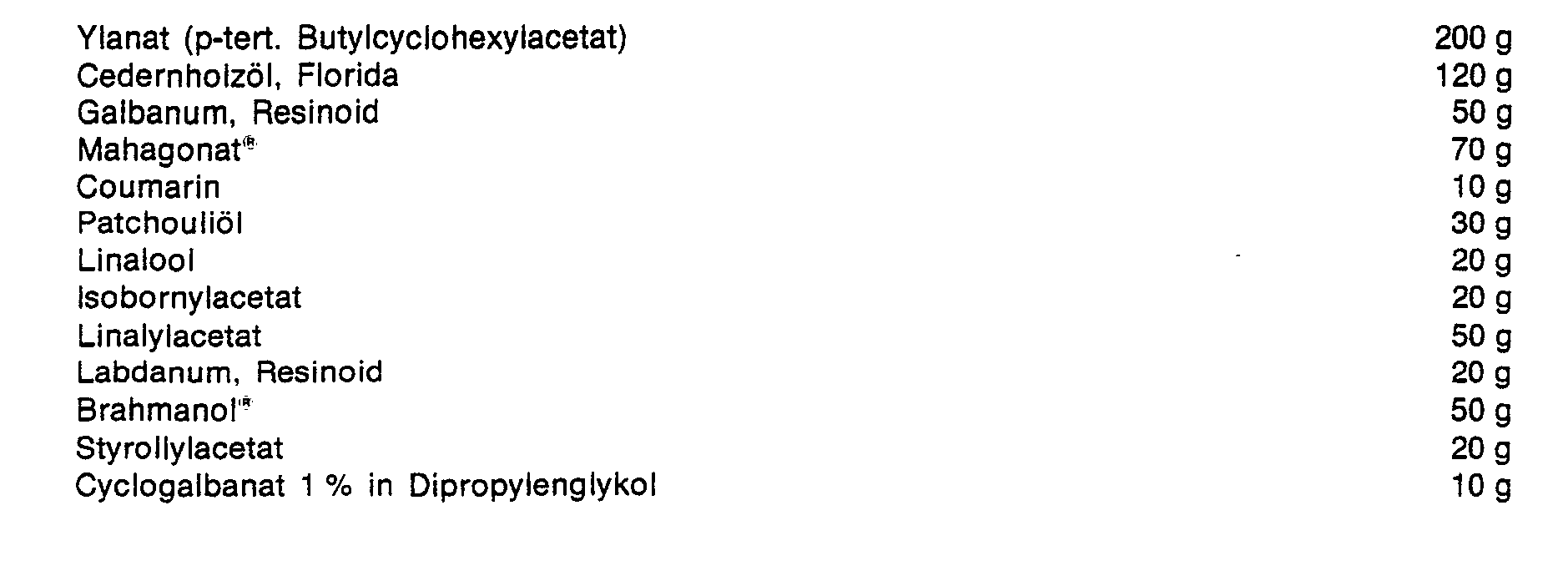

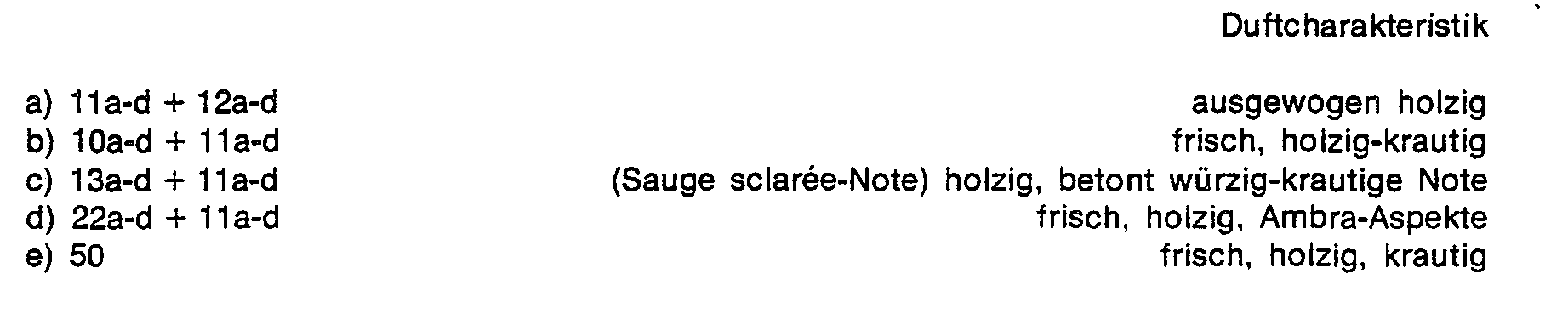
- Diese Grundmischung besitzt einen ausgewogenen holzigen Duft mit Fougere-Aspekten. Durch Zugabe von jeweils 300 g der neuen Verbindungen wurden jeweils neue, originelle Duftaspekte erzielt, und zwar bei Zugabe von
-

- Dieses Parfümol mit einem relativ hohen Anteil an den neuen Verbindungen 10a-d + 11a-d zeichnet sich durch eine langanhaftende schwer-blumige, aber auch frische Note aus und ist daher besonders zur Waschmittelparfümierung geeignet.
-

- Dieses Parfümöl mit einem hohen Anteil der neuen Verbindungen 15a-d + 11a-d besitzt einen ausstrahlenden blumigen Duft mit Aspekten von Rosen, Veilchen und Frühlingsblumen.
-

- Diese Base mit einem großen Anteil an den neuen Verbindungen 22a-d (+ 11a-d) besitzt einen neuartigen und harmonischen Duftkomplex mit holzigen, krautigen (Tabak) und ambraartigen Aspekten.
bzw.
Claims (6)
und die gestrichelten Linien eine C-C-Einfachbindung und eine C-C-Doppelbindung oder alternativ zwei C-C-Einfachbindungen bedeuten.

Applications Claiming Priority (2)
| Application Number | Priority Date | Filing Date | Title |
|---|---|---|---|
| DE3317476 | 1983-05-13 | ||
| DE3317476A DE3317476A1 (de) | 1983-05-13 | 1983-05-13 | Gemische von tricyclodecan-derivaten sowie deren herstellung und verwendung als riech- und aromastoff |
Publications (2)
| Publication Number | Publication Date |
|---|---|
| EP0144366A1 EP0144366A1 (de) | 1985-06-19 |
| EP0144366B1 true EP0144366B1 (de) | 1987-07-29 |
Family
ID=6198918
Family Applications (1)
| Application Number | Title | Priority Date | Filing Date |
|---|---|---|---|
| EP84901990A Expired EP0144366B1 (de) | 1983-05-13 | 1984-05-10 | Gemische von tricyclodecan-derivaten sowie deren herstellung und verwendung als riech- und aromastoff |
Country Status (4)
| Country | Link |
|---|---|
| US (1) | US4683083A (de) |
| EP (1) | EP0144366B1 (de) |
| DE (1) | DE3317476A1 (de) |
| WO (1) | WO1984004520A1 (de) |
Families Citing this family (2)
| Publication number | Priority date | Publication date | Assignee | Title |
|---|---|---|---|---|
| FR2700481B1 (fr) * | 1993-01-18 | 1995-02-24 | Atochem Elf Sa | Installation et procédé de réaction de deux réactifs liquides en présence d'un catalyseur solide. |
| ES2977637T3 (es) | 2017-11-22 | 2024-08-28 | Firmenich & Cie | Ingredientes que contrarrestan el mal olor |
Family Cites Families (17)
| Publication number | Priority date | Publication date | Assignee | Title |
|---|---|---|---|---|
| GB779241A (en) * | 1952-05-31 | 1957-07-17 | Ruhrchemie Ag | Process for the production of a methylol derivative of dicyclopentadiene |
| DE934889C (de) * | 1952-08-02 | 1955-11-10 | Ruhrchemie Ag | Verfahren zur Herstellung von Estern und bzw. oder Polyestern der Tricyclodekanreihe |
| GB815232A (en) * | 1954-12-31 | 1959-06-24 | Exxon Research Engineering Co | Bifunctional products from oxo reaction |
| US3210379A (en) * | 1960-07-25 | 1965-10-05 | Ciba Ltd | Epoxide compounds |
| US3280152A (en) * | 1960-09-13 | 1966-10-18 | Union Carbide Corp | Epoxy alcohol compounds |
| US3270061A (en) * | 1964-04-16 | 1966-08-30 | Norda Essential Oil & Chemical | Oxygen-containing dicyclodiene derivatives |
| US3598745A (en) * | 1968-10-31 | 1971-08-10 | Universal Oil Prod Co | Substituted 4,7-methanoindenes perfume compositions |
| CH602111A5 (de) * | 1975-12-08 | 1978-07-31 | Firmenich & Cie | |
| DE2642519A1 (de) * | 1976-09-22 | 1978-03-23 | Basf Ag | Verfahren zur herstellung von tricyclo-eckige klammer auf 5.2.1.0 hoch 2.6 eckige klammer zu-dec-3-en- 9(8)-yl-alkyl- oder -alkenylaethern |
| JPS5811411B2 (ja) * | 1977-01-25 | 1983-03-02 | 高砂香料工業株式会社 | 1,2,6−トリメチルトリシクロ〔5,3,2,0↑2’↑7〕−ドデカン誘導体およびその製造法 |
| US4386023A (en) * | 1980-04-29 | 1983-05-31 | International Flavors & Fragrances Inc. | Substituted tricyclodecane derivatives, processes for producing same and organoleptic uses thereof |
| US4318863A (en) * | 1980-04-29 | 1982-03-09 | International Flavors & Fragrances Inc. | Substituted tricyclodecane derivatives, processes for producing same and organoleptic uses thereof |
| US4275251A (en) * | 1980-04-29 | 1981-06-23 | International Flavors & Fragrances Inc. | Substituted tricyclodecane derivatives, processes for producing same and organoleptic uses thereof |
| US4346245A (en) * | 1980-04-29 | 1982-08-24 | International Flavors & Fragrances Inc. | Substituted tricyclodecane derivatives |
| US4410740A (en) * | 1980-04-29 | 1983-10-18 | International Flavors & Fragrances Inc. | Substituted tricyclodecane derivatives, processes for producing same and organoleptic uses thereof |
| CH644341A5 (fr) * | 1980-05-27 | 1984-07-31 | Firmenich & Cie | Composes tricycliques hydroxyles et leur utilisation en tant qu'ingredients parfumants. |
| DE3208203C1 (de) * | 1982-03-06 | 1983-07-28 | Dragoco Gerberding & Co Gmbh, 3450 Holzminden | Gemisch von Dimethyl-tricyclo [5.2.1.0?] decyl-methyl-ethern und Gemisch von Dimethyl-tricyclo [5.2.1.0?] decenyl-methyl-ethern,Verfahren zu ihrer Herstellung und ihre verwendung als Riech- bzw. Aromastoffe |
-
1983
- 1983-05-13 DE DE3317476A patent/DE3317476A1/de active Granted
-
1984
- 1984-05-10 EP EP84901990A patent/EP0144366B1/de not_active Expired
- 1984-05-10 US US06/691,567 patent/US4683083A/en not_active Expired - Fee Related
- 1984-05-10 WO PCT/EP1984/000141 patent/WO1984004520A1/de not_active Ceased
Also Published As
| Publication number | Publication date |
|---|---|
| US4683083A (en) | 1987-07-28 |
| DE3317476C2 (de) | 1988-04-07 |
| WO1984004520A1 (fr) | 1984-11-22 |
| EP0144366A1 (de) | 1985-06-19 |
| DE3317476A1 (de) | 1984-11-22 |
Similar Documents
| Publication | Publication Date | Title |
|---|---|---|
| US3806472A (en) | Perfume composition containing hydrogenated indane derivative | |
| DE2849742B2 (de) | Verfahren zur Herstellung von Aldehyden und Verwendung der Verfahrensprodukte als Riechstoffe | |
| US4104203A (en) | Perfume compositions containing catechol-camphene reaction products | |
| US3514489A (en) | Sec-butyl cyclohexane carboxaldenhydes | |
| DE2405568A1 (de) | Cycloaliphatische verbindungen, deren herstellung und verwendung | |
| DE69527045T2 (de) | Tetrahydrofurane und tetrahydropyrane | |
| DE60315776T2 (de) | Spiroverbindungen als Duftstoffe | |
| CH621105A5 (de) | ||
| EP0021356B1 (de) | 4(5)-Acetyl-7,7,9(7,9,9)-trimethyl-bicyclo(4.3.0)-non-1-en, dessen Herstellung und Verwendung als Riechstoff, sowie dieses enthaltende Riechstoffkompositionen | |
| DE2036936B2 (de) | Hydrierte Indanon Derivate, Ver fahren zu ihrer Herstellung und ihre Ver Wendung als Riechstoffe | |
| DE2914109C2 (de) | ||
| DE3120700C2 (de) | Tricyclische Verbindungen und deren Verwendung zur Herstellung von Parfümkompositionen und parfümierten Gegenständen | |
| DE3317476C2 (de) | ||
| EP0183970A1 (de) | p-Alkoxy-cyclohexyl-alkanole und -alkanolester, deren Herstellung und Verwendung als Riechstoffe | |
| EP0102366B1 (de) | Gemisch von dimethyl-tricyclo (5.2.1.0 2,6) decyl- oder decenyl-methyl-ethern, verfahren zu ihrer herstellung und ihre verwendung | |
| US3876562A (en) | 7,7a-epoxy-5,6,7a-tetrahydro-1,1,2,3,3-pentamethyl 4(3ah)-indanone perfume composition | |
| EP0137793B1 (de) | 2,6-exo-konfigurierte tricyclo (5.2.1.0(2,6)) decan-derivate mit funktionalisierter seitenkette an c-8/c-9 und deren verwendung als riechstoffe | |
| US3816350A (en) | Perfume composition containing indanone derivatives | |
| DE2918747A1 (de) | Tricyclo- alpha , beta -ungesaettigte-ketone | |
| DE2935683C2 (de) | 2,2,3-Trimethylcyclopent-3-en-ylmethyl-substituierte alicyclische Ketone und Alkohole, Herstellungsverfahren und deren Verwendung als Riechstoffe | |
| EP0086944A1 (de) | Neue ungesättigte Aether (I), Verfahren zu deren Herstellung, Verwendung von (I) als Riech- und/oder Geschmackstoffe und Riech- und/oder Geschmackstoffkompositionen mit einem Gehalt an (I) | |
| DE3128790A1 (de) | C-8-substituierte 1,5-dimethyl-bicyclo (3.2.1)octan-8-ole | |
| DE3443536A1 (de) | Methylsubstituierte bicyclo(2.2.1)heptan-derivate und deren verwendung als riechstoffe | |
| DE3208203C2 (de) | ||
| US3839368A (en) | 7,7a-epoxy-5,6,7,7a-tetrahydro-1,1,2,3,3-pentamethyl-4(3ah)-indanone |
Legal Events
| Date | Code | Title | Description |
|---|---|---|---|
| PUAI | Public reference made under article 153(3) epc to a published international application that has entered the european phase |
Free format text: ORIGINAL CODE: 0009012 |
|
| AK | Designated contracting states |
Designated state(s): CH FR GB LI NL |
|
| 17P | Request for examination filed |
Effective date: 19850513 |
|
| RIN1 | Information on inventor provided before grant (corrected) |
Inventor name: STRUWE, HARTMUT Inventor name: BRUNKE, ERNST-JOACHIM |
|
| 17Q | First examination report despatched |
Effective date: 19860317 |
|
| GRAA | (expected) grant |
Free format text: ORIGINAL CODE: 0009210 |
|
| AK | Designated contracting states |
Kind code of ref document: B1 Designated state(s): CH FR GB LI NL |
|
| ET | Fr: translation filed | ||
| PLBE | No opposition filed within time limit |
Free format text: ORIGINAL CODE: 0009261 |
|
| STAA | Information on the status of an ep patent application or granted ep patent |
Free format text: STATUS: NO OPPOSITION FILED WITHIN TIME LIMIT |
|
| 26N | No opposition filed | ||
| PG25 | Lapsed in a contracting state [announced via postgrant information from national office to epo] |
Ref country code: GB Effective date: 19890510 |
|
| PG25 | Lapsed in a contracting state [announced via postgrant information from national office to epo] |
Ref country code: CH Effective date: 19890531 Ref country code: LI Effective date: 19890531 |
|
| PG25 | Lapsed in a contracting state [announced via postgrant information from national office to epo] |
Ref country code: NL Effective date: 19891201 |
|
| GBPC | Gb: european patent ceased through non-payment of renewal fee | ||
| NLV4 | Nl: lapsed or anulled due to non-payment of the annual fee | ||
| PG25 | Lapsed in a contracting state [announced via postgrant information from national office to epo] |
Ref country code: FR Free format text: LAPSE BECAUSE OF NON-PAYMENT OF DUE FEES Effective date: 19900131 |
|
| REG | Reference to a national code |
Ref country code: CH Ref legal event code: PL |
|
| REG | Reference to a national code |
Ref country code: FR Ref legal event code: ST |