EP0142741A2 - Cyclohexan-1,3-dionderivate, Verfahren zu ihrer Herstellung und ihre Verwendung zur Bekämpfung unerwünschten Pflanzenwuchses - Google Patents
Cyclohexan-1,3-dionderivate, Verfahren zu ihrer Herstellung und ihre Verwendung zur Bekämpfung unerwünschten Pflanzenwuchses Download PDFInfo
- Publication number
- EP0142741A2 EP0142741A2 EP84112931A EP84112931A EP0142741A2 EP 0142741 A2 EP0142741 A2 EP 0142741A2 EP 84112931 A EP84112931 A EP 84112931A EP 84112931 A EP84112931 A EP 84112931A EP 0142741 A2 EP0142741 A2 EP 0142741A2
- Authority
- EP
- European Patent Office
- Prior art keywords
- carbon atoms
- formula
- cyclohexane
- alkyl
- dimethyl
- Prior art date
- Legal status (The legal status is an assumption and is not a legal conclusion. Google has not performed a legal analysis and makes no representation as to the accuracy of the status listed.)
- Granted
Links
- 0 CC(C(CC(C1[N+](*)[O-])O)P)C1=O Chemical compound CC(C(CC(C1[N+](*)[O-])O)P)C1=O 0.000 description 2
Classifications
-
- A—HUMAN NECESSITIES
- A01—AGRICULTURE; FORESTRY; ANIMAL HUSBANDRY; HUNTING; TRAPPING; FISHING
- A01N—PRESERVATION OF BODIES OF HUMANS OR ANIMALS OR PLANTS OR PARTS THEREOF; BIOCIDES, e.g. AS DISINFECTANTS, AS PESTICIDES OR AS HERBICIDES; PEST REPELLANTS OR ATTRACTANTS; PLANT GROWTH REGULATORS
- A01N43/00—Biocides, pest repellants or attractants, or plant growth regulators containing heterocyclic compounds
- A01N43/02—Biocides, pest repellants or attractants, or plant growth regulators containing heterocyclic compounds having rings with one or more oxygen or sulfur atoms as the only ring hetero atoms
- A01N43/04—Biocides, pest repellants or attractants, or plant growth regulators containing heterocyclic compounds having rings with one or more oxygen or sulfur atoms as the only ring hetero atoms with one hetero atom
- A01N43/22—Biocides, pest repellants or attractants, or plant growth regulators containing heterocyclic compounds having rings with one or more oxygen or sulfur atoms as the only ring hetero atoms with one hetero atom rings with more than six members
-
- A—HUMAN NECESSITIES
- A01—AGRICULTURE; FORESTRY; ANIMAL HUSBANDRY; HUNTING; TRAPPING; FISHING
- A01N—PRESERVATION OF BODIES OF HUMANS OR ANIMALS OR PLANTS OR PARTS THEREOF; BIOCIDES, e.g. AS DISINFECTANTS, AS PESTICIDES OR AS HERBICIDES; PEST REPELLANTS OR ATTRACTANTS; PLANT GROWTH REGULATORS
- A01N43/00—Biocides, pest repellants or attractants, or plant growth regulators containing heterocyclic compounds
- A01N43/02—Biocides, pest repellants or attractants, or plant growth regulators containing heterocyclic compounds having rings with one or more oxygen or sulfur atoms as the only ring hetero atoms
- A01N43/04—Biocides, pest repellants or attractants, or plant growth regulators containing heterocyclic compounds having rings with one or more oxygen or sulfur atoms as the only ring hetero atoms with one hetero atom
- A01N43/14—Biocides, pest repellants or attractants, or plant growth regulators containing heterocyclic compounds having rings with one or more oxygen or sulfur atoms as the only ring hetero atoms with one hetero atom six-membered rings
- A01N43/16—Biocides, pest repellants or attractants, or plant growth regulators containing heterocyclic compounds having rings with one or more oxygen or sulfur atoms as the only ring hetero atoms with one hetero atom six-membered rings with oxygen as the ring hetero atom
-
- A—HUMAN NECESSITIES
- A01—AGRICULTURE; FORESTRY; ANIMAL HUSBANDRY; HUNTING; TRAPPING; FISHING
- A01N—PRESERVATION OF BODIES OF HUMANS OR ANIMALS OR PLANTS OR PARTS THEREOF; BIOCIDES, e.g. AS DISINFECTANTS, AS PESTICIDES OR AS HERBICIDES; PEST REPELLANTS OR ATTRACTANTS; PLANT GROWTH REGULATORS
- A01N43/00—Biocides, pest repellants or attractants, or plant growth regulators containing heterocyclic compounds
- A01N43/02—Biocides, pest repellants or attractants, or plant growth regulators containing heterocyclic compounds having rings with one or more oxygen or sulfur atoms as the only ring hetero atoms
- A01N43/04—Biocides, pest repellants or attractants, or plant growth regulators containing heterocyclic compounds having rings with one or more oxygen or sulfur atoms as the only ring hetero atoms with one hetero atom
- A01N43/14—Biocides, pest repellants or attractants, or plant growth regulators containing heterocyclic compounds having rings with one or more oxygen or sulfur atoms as the only ring hetero atoms with one hetero atom six-membered rings
- A01N43/18—Biocides, pest repellants or attractants, or plant growth regulators containing heterocyclic compounds having rings with one or more oxygen or sulfur atoms as the only ring hetero atoms with one hetero atom six-membered rings with sulfur as the ring hetero atom
-
- A—HUMAN NECESSITIES
- A01—AGRICULTURE; FORESTRY; ANIMAL HUSBANDRY; HUNTING; TRAPPING; FISHING
- A01N—PRESERVATION OF BODIES OF HUMANS OR ANIMALS OR PLANTS OR PARTS THEREOF; BIOCIDES, e.g. AS DISINFECTANTS, AS PESTICIDES OR AS HERBICIDES; PEST REPELLANTS OR ATTRACTANTS; PLANT GROWTH REGULATORS
- A01N43/00—Biocides, pest repellants or attractants, or plant growth regulators containing heterocyclic compounds
- A01N43/02—Biocides, pest repellants or attractants, or plant growth regulators containing heterocyclic compounds having rings with one or more oxygen or sulfur atoms as the only ring hetero atoms
- A01N43/24—Biocides, pest repellants or attractants, or plant growth regulators containing heterocyclic compounds having rings with one or more oxygen or sulfur atoms as the only ring hetero atoms with two or more hetero atoms
- A01N43/26—Biocides, pest repellants or attractants, or plant growth regulators containing heterocyclic compounds having rings with one or more oxygen or sulfur atoms as the only ring hetero atoms with two or more hetero atoms five-membered rings
- A01N43/28—Biocides, pest repellants or attractants, or plant growth regulators containing heterocyclic compounds having rings with one or more oxygen or sulfur atoms as the only ring hetero atoms with two or more hetero atoms five-membered rings with two hetero atoms in positions 1,3
-
- A—HUMAN NECESSITIES
- A01—AGRICULTURE; FORESTRY; ANIMAL HUSBANDRY; HUNTING; TRAPPING; FISHING
- A01N—PRESERVATION OF BODIES OF HUMANS OR ANIMALS OR PLANTS OR PARTS THEREOF; BIOCIDES, e.g. AS DISINFECTANTS, AS PESTICIDES OR AS HERBICIDES; PEST REPELLANTS OR ATTRACTANTS; PLANT GROWTH REGULATORS
- A01N43/00—Biocides, pest repellants or attractants, or plant growth regulators containing heterocyclic compounds
- A01N43/02—Biocides, pest repellants or attractants, or plant growth regulators containing heterocyclic compounds having rings with one or more oxygen or sulfur atoms as the only ring hetero atoms
- A01N43/24—Biocides, pest repellants or attractants, or plant growth regulators containing heterocyclic compounds having rings with one or more oxygen or sulfur atoms as the only ring hetero atoms with two or more hetero atoms
- A01N43/32—Biocides, pest repellants or attractants, or plant growth regulators containing heterocyclic compounds having rings with one or more oxygen or sulfur atoms as the only ring hetero atoms with two or more hetero atoms six-membered rings
-
- C—CHEMISTRY; METALLURGY
- C07—ORGANIC CHEMISTRY
- C07D—HETEROCYCLIC COMPOUNDS
- C07D309/00—Heterocyclic compounds containing six-membered rings having one oxygen atom as the only ring hetero atom, not condensed with other rings
- C07D309/02—Heterocyclic compounds containing six-membered rings having one oxygen atom as the only ring hetero atom, not condensed with other rings having no double bonds between ring members or between ring members and non-ring members
- C07D309/04—Heterocyclic compounds containing six-membered rings having one oxygen atom as the only ring hetero atom, not condensed with other rings having no double bonds between ring members or between ring members and non-ring members with only hydrogen atoms, hydrocarbon or substituted hydrocarbon radicals, directly attached to ring carbon atoms
- C07D309/06—Radicals substituted by oxygen atoms
-
- C—CHEMISTRY; METALLURGY
- C07—ORGANIC CHEMISTRY
- C07D—HETEROCYCLIC COMPOUNDS
- C07D319/00—Heterocyclic compounds containing six-membered rings having two oxygen atoms as the only ring hetero atoms
- C07D319/04—1,3-Dioxanes; Hydrogenated 1,3-dioxanes
- C07D319/06—1,3-Dioxanes; Hydrogenated 1,3-dioxanes not condensed with other rings
-
- C—CHEMISTRY; METALLURGY
- C07—ORGANIC CHEMISTRY
- C07D—HETEROCYCLIC COMPOUNDS
- C07D319/00—Heterocyclic compounds containing six-membered rings having two oxygen atoms as the only ring hetero atoms
- C07D319/10—1,4-Dioxanes; Hydrogenated 1,4-dioxanes
- C07D319/12—1,4-Dioxanes; Hydrogenated 1,4-dioxanes not condensed with other rings
-
- C—CHEMISTRY; METALLURGY
- C07—ORGANIC CHEMISTRY
- C07D—HETEROCYCLIC COMPOUNDS
- C07D321/00—Heterocyclic compounds containing rings having two oxygen atoms as the only ring hetero atoms, not provided for by groups C07D317/00 - C07D319/00
- C07D321/02—Seven-membered rings
- C07D321/04—Seven-membered rings not condensed with other rings
- C07D321/06—1,3-Dioxepines; Hydrogenated 1,3-dioxepines
-
- C—CHEMISTRY; METALLURGY
- C07—ORGANIC CHEMISTRY
- C07D—HETEROCYCLIC COMPOUNDS
- C07D335/00—Heterocyclic compounds containing six-membered rings having one sulfur atom as the only ring hetero atom
- C07D335/02—Heterocyclic compounds containing six-membered rings having one sulfur atom as the only ring hetero atom not condensed with other rings
-
- C—CHEMISTRY; METALLURGY
- C07—ORGANIC CHEMISTRY
- C07D—HETEROCYCLIC COMPOUNDS
- C07D339/00—Heterocyclic compounds containing rings having two sulfur atoms as the only ring hetero atoms
- C07D339/02—Five-membered rings
- C07D339/06—Five-membered rings having the hetero atoms in positions 1 and 3, e.g. cyclic dithiocarbonates
-
- C—CHEMISTRY; METALLURGY
- C07—ORGANIC CHEMISTRY
- C07D—HETEROCYCLIC COMPOUNDS
- C07D339/00—Heterocyclic compounds containing rings having two sulfur atoms as the only ring hetero atoms
- C07D339/08—Six-membered rings
Definitions
- the invention relates to cyclohexane-1,3-dione derivatives, processes for their preparation and herbicides which contain these compounds as active ingredients.
- EP-OS 0071707 discloses heterocyclic-substituted cyclohexane-1,3-dione derivatives with good herbicidal activity against plants from the grass family.
- the compounds of formula I can occur in several forms, all of which are encompassed by the claim:
- the 1,3-dioxepan-5-yl radicals for A in formula I can be replaced by unbranched or branched alkyl radicals having 1 to 8 carbon atoms, such as methyl, ethyl, i-propyl, t-butyl, 1,2-dimethyl-4-butyl, 1-ethyl-n-pentyl or by cycloalkyl or bicycloalkyl having 6 with 12 carbon atoms, such as cyclohexyl, cycloheptyl, cyclooctyl, cyclododecyl, bicycloheptyl, for example bicyclo [3.1.1] -heptyl.
- the cycloalkyl and bicycloalkyl radicals can also carry one or more methyl substituents.
- the 1,3-dioxepan-5-yl radicals can be substituted by an alkylene chain having 4 or 5 carbon atoms, ie tetramethylene or pentamethylene, so that, for example, spiro compounds are formed.
- R 2 in formula I represents unbranched or branched alkyl radicals having 1 to 4 carbon atoms, ie methyl, ethyl, n-propyl, i-propyl, n-butyl, sec-butyl, i-butyl, tert-butyl.
- Residues for R 3 in formula I are propargyl, alkyl with 1 to 4 carbon atoms, alkenyl with 3 or 4 carbon atoms or haloalkenyl with 3 or 4 carbon atoms, which can contain up to three halogen substituents, for example chlorine, bromine, fluorine , for example methyl, ethyl, n-propyl, i-propyl, n-butyl, sec.-butyl, i-butyl, tert.-butyl, allyl, 1-chloroprop-1-en-3-yl, 2-chloroprop. l-en-3-yl, 1,3-dichloroprop-1-en-3-yl, 1,2,3-trichloroprop-l-en-3-yl.
- halogen substituents for example chlorine, bromine, fluorine , for example methyl, ethyl, n-propyl, i-propyl, n-buty
- Preferred cyclohexane-1,3-dione derivatives of the formula I are those in which R 1 is hydrogen and those in which R 2 is alkyl with 2 or 3 carbon atoms means.
- Preferred radicals for A are tetrahydropyran-4-yl, 2,6-dimethyl-tetrahydrothiopyran-3-yl or optionally by alkyl having 1 to 8 carbon atoms, in particular 1 to 4 carbon atoms, alkylene having 4 or 5 carbon atoms or optionally methyl-substituted cycloalkyl or bicycloalkyl 1,3-dioxepan-5-yl radicals substituted with 7 to 12 carbon atoms, in particular 1,3-dioxepan-5-yl radicals or 1,3-dioxepan-5-yl radicals substituted by unbranched or branched alkyl radicals with 1 to 4 carbon atoms.
- salts of the compounds of the formula I are the alkali metal salts, in particular the potassium or sodium salts, alkaline earth metal salts, in particular calcium, magnesium or barium salts, and also manganese, copper, zinc or iron salts and ammonium and phosphonium salts, for example alkylammonium, Dialkylammonium, trialkyl or tetraalkylammonium salts, benzyltrialkylammonium salts, triphenylphosphonium salts, trialkylsulfonium salts or trialkylsulfoxonium salts.
- the compound of formula I can by reacting compounds of formula in which A, R 1 and R 2 have the abovementioned meanings, with hydroxylamine derivatives R 3 O-NH 3 Y, in which R 3 has the abovementioned meanings and Y represents an anion.
- the reaction is expediently carried out in a heterogeneous phase in an inert diluent at a temperature between 0 and 80 ° C. or between 0 ° C. and the boiling point of the reaction mixture in the presence of a base.
- bases are, for example, carbonates, hydrogen carbonates, acetates, alcoholates, hydroxides or oxides of alkali or alkaline earth metals, in particular of sodium, potassium, magnesium, calcium.
- Organic bases such as pyridine or tertiary amines can also be used.
- solvents examples include dimethyl sulfoxide, alcohols, such as methanol, ethanol, isopropanol, benzene, optionally chlorinated hydrocarbons, such as chloroform, dichloroethane, hexane, cyclohexane, esters, such as ethyl acetate, ethers, such as dioxane, tetrahydrofuran.
- alcohols such as methanol, ethanol, isopropanol
- benzene optionally chlorinated hydrocarbons, such as chloroform, dichloroethane, hexane, cyclohexane, esters, such as ethyl acetate, ethers, such as dioxane, tetrahydrofuran.
- chlorinated hydrocarbons such as chloroform, dichloroethane, hexane, cyclohexane
- esters such as ethyl acetate
- reaction product can then be isolated by concentrating the mixture, adding water and extraction with a non-polar solvent such as methylene chloride and distilling off the solvent under reduced pressure.
- a non-polar solvent such as methylene chloride
- the compound of the formula I can also by reacting the compounds of the formula II with hydroxylamines of the formula R 3 0-NH 2 , in which R 3 has the abovementioned meanings, in inert diluents at a temperature between 0'C and the boiling point of the reaction mixture, in particular between 15 and 70 ° C, can be obtained. If appropriate, the hydroxylamine can be used as an aqueous solution.
- Suitable solvents for this reaction are, for example, alcohols, such as methanol, ethanol, isopropanol, cyclohexanol, optionally chlorinated hydrocarbons, such as hexane, cyclohexane, methylene chloride, toluene, dichloroethane, esters, such as ethyl acetate, nitriles, such as acetonitrile, cyclic ethers, such as tetrahydrofuran.
- alcohols such as methanol, ethanol, isopropanol
- cyclohexanol optionally chlorinated hydrocarbons, such as hexane, cyclohexane, methylene chloride, toluene, dichloroethane, esters, such as ethyl acetate, nitriles, such as acetonitrile, cyclic ethers, such as tetrahydrofuran.
- the alkali metal salts of the compounds of formula I can be obtained by treating these compounds with sodium or potassium hydroxide in aqueous solution or in an organic solvent such as methanol, ethanol, acetone. Sodium and potassium alcoholates can also serve as bases.
- the other metal salts e.g. B. the manganese, copper, zinc, iron, calcium, magnesium and barium salts can be prepared from the sodium salts by reaction with the corresponding metal chlorides in aqueous solution.
- Ammonium, sulfonium, sulfoxonium and phosphonium salts can be prepared by reacting compounds of the formula I with ammonium, phosphonium, sulfonium and sulfoxonium hydroxides, optionally in aqueous solution.
- the compounds of the formula II can be obtained from cyclohexane-1,3-diones of the formula III, which may also be present in the tautomeric formulas IIIa and IIIb according to methods known from the literature (Tetrahedron Letters, 29, 2491 (1975)).
- Aldehydes of the general formula A-CHO are obtained by processes known from the literature, for example by oxidation of the corresponding ones Alcohols, reduction of carboxylic acid derivatives, hydroformylation of oleics.
- the cyclohexane-1,3-dione derivatives of the formula I and their salts can be, for example, in the form of directly sprayable solutions, powders, suspensions, and also high-strength aqueous, oily or other suspensions or dispersions, emulsions, oil dispersions, pastes, dusts, scattering agents or granules Spraying, atomizing, dusting, scattering or pouring can be used.
- the application forms depend entirely on the purposes; in any case, they should ensure the finest possible distribution of the active compounds according to the invention.
- Aqueous use forms can be prepared from emulsion concentrates, pastes or wettable powders (wettable powders, oil dispersions) by adding water.
- emulsions, pastes or oil dispersions the substances as such or dissolved in an oil or solvent can be homogenized in water by means of wetting agents, adhesives, dispersants or emulsifiers.
- wetting agents, adhesives, dispersants or emulsifiers, and possibly solvents or oil can also be prepared from active substance and are suitable for dilution with water.
- Powders, materials for broadcasting and dusts can be prepared by mixing or grinding the active substances together with a solid carrier.
- Granules e.g. Coating, impregnation and homogeneous granules can be produced by binding the active ingredients to solid carriers.
- Solid carriers are mineral earths such as silica gel, silicas, silica gels, silicates, talc, kaolin, attaclay, limestone, lime, chalk, bolus, loess, clay, dolomite, diatomaceous earth.
- the formulations contain between 0.1 and 95 percent by weight, preferably between 0.5 and 90 percent by weight, of active ingredient.
- the application can be done pre- or post-emergence. If the active ingredients are less compatible with certain crop plants when they are used after emergence, application techniques can also be used in which the herbicidal compositions are sprayed with the aid of sprayers in such a way that the leaves of the sensitive crop plants are not hit, if possible, while the active ingredients are applied to the leaves underneath growing unwanted plants or the uncovered floor area (post-directed, lay-by).
- the active ingredients are applied to the earth's surface immediately afterwards.
- they are suspended or emulsified in water as a distribution medium and sprayed by means of finely distributing nozzles.
- the application rates are 3.0 kg of active ingredient / ha.
- the vessels are lightly sprinkled to get germination and growth going. Then cover the containers with transparent plastic covers until the plants have grown. This cover causes the test plants to germinate evenly, unless this is affected by the active ingredients.
- test plants are first grown to a height of 3 to 15 cm and then treated.
- the soy plants are grown in a substrate enriched with peat.
- post-emergence treatment either plants that have been sown directly and grown in the same containers are selected, or those that are only grown separately as seedlings and transplanted into the test containers a few days before the treatment.
- the application rates for post-emergence treatment vary between 0.03 and 0.25 kg of active ingredient / ha. There is no cover during post-emergence treatment.
- test vessels are set up in the greenhouse, warmer areas (20 to 35 ° C.) for heat-loving species and 10 to 25 ° C. for those with moderate climates are preferred.
- the trial period spans 2 to 4 weeks.
- the plants are cared for and their response to the individual treatments is evaluated. It is rated on a scale from 0 to 100. 100 means no emergence of the plants or complete destruction of at least the aerial parts.
- the application rates correspond to those of the compound according to the invention to be compared in each case.
- Pre-emergence application In pre-emergence application, the compounds No. 7, 53, 2, 1, 17, 54, 10, 12, 20, 23, 29, 57, 59, 60, for example, prove to be effective at an application rate of 3.0 kg of active ingredient / ha herbicidally active against plants from the grass family. Sinapis alba remains undamaged as a broad-leaved test plant.
- Compounds Nos. 2 and 3 for example with 0.125 kg of active ingredient / ha, have a very good herbicidal action against Gramineae, such as wheat (as unusual wheat) and Bromus spp. The agents are selective in sugar beets. Compounds No. 52 and 53 also control very well with 0.125 kg of active ingredient / ha of grass. At this application rate, for example, compounds Nos. 26, 29 and 55 show a good action against grasses and do not cause damage to wheat which suffers significant damage from comparative agent I. With compound no. 7, millet can be combated as an undesirable type of grass in rice, the crop plant, in contrast to the use of comparative agent I, likewise not being damaged.
- compound no. 6 shows a remarkable activity against grasses at a low application rate and does not cause damage to wheat. Comparative agent II severely damages this grass. Also at low application rates, compound no. 67 can be used to combat undesirable types of grass from a wide variety of vegetation zones - including crops from the gramineae family. The herbicidal activity of compound no. 67 is clearly superior to that of comparative agent IV.
- the compounds according to the invention can also be used in a further number of crop plants for eliminating unwanted wild grasses or grasarti ger crops, if they are undesirable in certain locations, are used.
- the following crops can be considered:
- the cyclohexane-1,3-dione derivatives of the formula I can be mixed with numerous representatives of other herbicidal or growth-regulating active compound groups and applied together.
Landscapes
- Organic Chemistry (AREA)
- Chemical & Material Sciences (AREA)
- Life Sciences & Earth Sciences (AREA)
- Dentistry (AREA)
- Engineering & Computer Science (AREA)
- Plant Pathology (AREA)
- General Health & Medical Sciences (AREA)
- Wood Science & Technology (AREA)
- Zoology (AREA)
- Environmental Sciences (AREA)
- Pest Control & Pesticides (AREA)
- Agronomy & Crop Science (AREA)
- Health & Medical Sciences (AREA)
- Agricultural Chemicals And Associated Chemicals (AREA)
- Organic Low-Molecular-Weight Compounds And Preparation Thereof (AREA)
- Pharmaceuticals Containing Other Organic And Inorganic Compounds (AREA)
- Heterocyclic Compounds That Contain Two Or More Ring Oxygen Atoms (AREA)
- Pyrane Compounds (AREA)
- Heterocyclic Compounds Containing Sulfur Atoms (AREA)
- Medicines Containing Antibodies Or Antigens For Use As Internal Diagnostic Agents (AREA)
- Investigating Or Analysing Biological Materials (AREA)
- Adhesives Or Adhesive Processes (AREA)
- Heterocyclic Carbon Compounds Containing A Hetero Ring Having Oxygen Or Sulfur (AREA)
- Addition Polymer Or Copolymer, Post-Treatments, Or Chemical Modifications (AREA)
- Cosmetics (AREA)
- Medicines Containing Plant Substances (AREA)
- Cultivation Of Plants (AREA)
Abstract
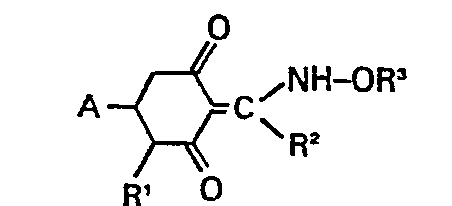
- R' Wasserstoff oder Methoxycarbonyl,
- R2 Alkyl,
- R3 Alkyl, Alkenyl, Halogenalkenyl oder Propargyl bedeuten,
Description
- Die Erfindung betrifft Cyclohexan-1,3-dionderivate, Verfahren zu ihrer Herstellung, sowie Herbizide, die diese Verbindungen als Wirkstoffe enthalten.
- Es ist bekannt, Cyclohexan-1,3-dionderivate zur Bekämpfung unerwünschter Gräser in breitblättrigen Kulturen anzuwenden. Wirkstoffe mit Furyl-oder Thienylsubstituenten zeigen dabei eine relativ schwache Wirkung (DE-OS 24 39 104). Darüber hinaus sind aus der EP-OS 0071707 heterocyclisch-substituierte Cyclohexan-1,3-dionderivate mit guter herbizider Wirkung gegen Pflanzen aus der Familie der Gräser bekannt.
- Es wurde gefunden, daß neue Cyclohexan-1,3-dionderivate, die in 5-Stellung bestimmte heterocyclische Substituenten tragen, eine deutlich stärkere herbizide Wirkung gegen eine Reihe von Grasarten (Wild- und Kulturarten) haben als die zum Stand der Technik gehörenden Wirkstoffe. Dabei zeigen diese Verbindungen eine exzellente Verträglichkeit sowohl für breitblättrige Kulturpflanzen als auch für monokotyle Kulturen, welche nicht zur Familie der Gräser zählen. Darüber hinaus ist ein Teil dieser Verbindungen trotz guter Wirkung gegen Gräser bei gewissen Dosierungen gleichzeitig für die Getreidekultur Weizen verträglich.
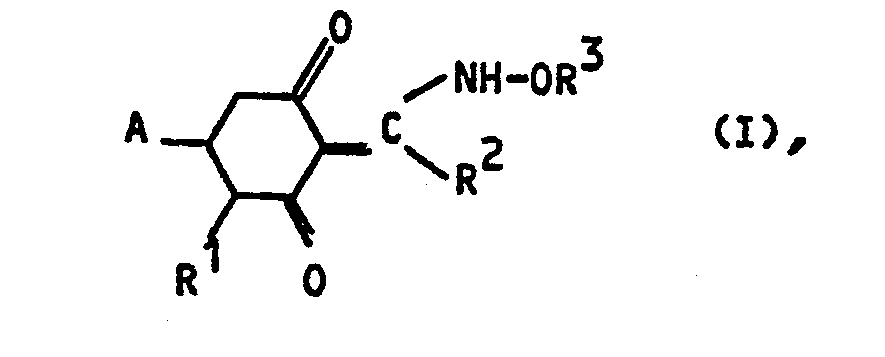
- Die neuen Cyclohexan-1,3-dionderivate haben die Formel

- A Tetrahydropyran-4-yl, 3-Methyltetrahydropyran-4-yl, 1,4-Dioxanyl, 5,5--Dimethyl-1,3-dioxan-2-yl, 2,5-Dimethyl-l,4-dioxan-3-yl, 2,6-Dimethyl--1,4-dioxan-3-yl, 2-Methyl-l,3-dithiolan-2-yl, 2,6-Dimethyltetrahydro- thiopyran-3-yl, 2-Methyl-1,3-dithian-2-yl oder gegebenenfalls durch Alkyl mit 1 bis 8 Kohlenstoffatomen, Alkylen mit 4 oder 5 Kohlenstoffatomen oder gegebenenfalls methylsubstituiertes Cycloalkyl oder Bicycloalkyl mit 6 bis 12 Kohlenstoffatomen substituiertes 1,3-Dioxepan--5-yl,
- R Wasserstoff oder Methoxycarbonyl,
- R 2 Alkyl mit 1 bis 4 Kohlenstoffatomen und
- R3 Alkyl mit 1 bis 4 C-Atomen, Alkenyl mit 3 oder 4 C-Atomen, Halogenalkenyl mit 3 oder 4 C-Atomen und 1 bis 3 Halogensubstituenten oder Propargyl bedeuten.
- Die Verbindungen der Formel I können in mehreren Formen auftreten, die alle vom Patentanspruch umfaßt werden:


- R2 in Formel I steht für unverzweigte oder verzweigte Alkylreste mit 1 bis 4 Kohlenstoffatomen, d. h. für Methyl, Ethyl, n-Propyl, i-Propyl, n-Butyl, sec.-Butyl, i-Butyl, tert.Butyl.
- Reste für R3 in Formel I sind Propargyl, Alkyl mit 1 bis 4 Kohlenstoffatomen, Alkenyl mit 3 oder 4 C-Atomen oder Halogenalkenyl mit 3 oder 4 C-Atomen, das bis zu drei Halogensubstituenten, z.B. Chlor, Brom, Fluor, enthalten kann, beispielsweise Methyl, Ethyl, n-Propyl, i-Propyl, n-Butyl, sec.-Butyl, i-Butyl, tert.-Butyl, Allyl, 1-Chlorprop-1-en-3-yl, 2-Chlorprop-l-en-3-yl, 1,3-Dichlorprop-1-en-3-yl, 1,2,3-Trichlorprop-l--en-3-yl.
- Bevorzugte Cyclohexan-1,3-dionderivate der Formel I sind solche, bei denen R1 Wasserstoff bedeutet, und solche, bei denen R2 Alkyl mit 2 oder 3 Kohlenstoffatomen bedeutet. Bevorzugte Reste für A sind Tetrahydropyran-4-yl, 2,6-Dimethyl-tetrahydrothiopyran-3-yl oder gegebenenfalls durch Alkyl mit 1 bis 8 Kohlenstoffatomen, insbesondere 1 bis 4 Kohlenstoffatomen, Alkylen mit 4 oder 5 Kohlenstoffatomen oder gegebenenfalls methylsubstituiertes Cycloalkyl oder Bicycloalkyl mit 7 bis 12 Kohlenstoffatomen substituierte 1,3-Dioxepan-5-ylreste, insbesondere 1,3-Dioxepan-5-yl oder durch unverzweigte oder verzweigte Alkylreste mit 1 bis 4 Kohlenstoffatomen substituierte 1,3-Dioxepan-5-ylreste.
- Als Salze der Verbindungen der Formel I kommen beispielsweise die Alkalimetallsalze, insbesondere die Kalium- oder Natriumsalze, Erdalkalimetallsalze, insbesondere Calcium-, Magnesium- oder Bariumsalze sowie Mangan-, Kupfer-, Zink- oder Eisensalze und Ammonium- und Phosphoniumsalze, beispielsweise Alkylammonium-, Dialkylammonium-, Trialkyl- oder Tetraalkylammoniumsalze, Benzyltrialkylammoniumsalze, Triphenylphosphoniumsalze, Trialkylsulfoniumsalze oder Trialkylsulfoxoniumsalze in Betracht.
- Die Verbindung der Formel I können durch Umsetzung von Verbindungen der Formel

- Man führt die Reaktion zweckmäßigerweise in heterogener Phase in einem inerten Verdünnungsmittel bei einer Temperatur zwischen 0 und 80°C oder zwischen 0'C und dem Siedepunkt des Reaktionsgemisches in Gegenwart einer Base durch. Geeignete Basen sind beispielsweise Carbonate, Hydrogencarbonate, Acetate, Alkoholate, Hydroxide oder Oxide von Alkali- oder Erdalkalimetallen, insbesondere von Natrium, Kalium, Magnesium, Calcium. Außerdem können auch organische Basen, wie Pyridin oder tertiäre Amine, Verwendung finden.
- Als Lösungsmittel sind beispielsweise Dimethylsulfoxid, Alkohole, wie Methanol, Ethanol, Isopropanol, Benzol, gegebenenfalls chlorierte Kohlenwasserstoffe, wie Chloroform, Dichlorethan, Hexan, Cyclohexan, Ester, wie Essigsäureethylester, Ether, wie Dioxan, Tetrahydrofuran, geeignet.
- Die Umsetzung ist nach wenigen Stunden beendet, das Reaktionsprodukt kann dann durch Einengen der Mischung, Zugabe von Wasser und Extraktion mit einem unpolaren Lösungsmittel, wie Methylenchlorid und Abdestillieren des Lösungsmittels unter vermindertem Druck isoliert werden.
- Die Verbindung der Formel I können außerdem durch Umsetzen der Verbindungen der Formel II mit Hydroxylaminen der Formel R30-NH2, in der R3 die obengenannten Bedeutungen hat, in inerten Verdünnungsmitteln bei einer Temperatur zwischen 0'C und dem Siedepunkt des Reaktionsgemisches, insbesondere zwischen 15 und 70°C, erhalten werden. Gegebenenfalls kann das Hydroxylamin als wäßrige Lösung eingesetzt werden.
- Geeignete Lösungsmittel für diese Umsetzung sind beispielsweise Alkohole, wie Methanol, Ethanol, Isopropanol, Cyclohexanol, gegebenenfalls chlorierte Kohlenwasserstoffe, wie Hexan, Cyclohexan, Methylenchlorid, Toluol, Dichlorethan, Ester, wie Essigsäureethylester, Nitrile, wie Acetonitril, cyclische Ether, wie Tetrahydrofuran.
- Die Alkalimetallsalze der Verbindungen der Formel I können durch Behandeln dieser Verbindungen mit Natrium- oder Kaliumhydroxid in wäßriger Lösung oder in einem organischen Lösungsmittel, wie Methanol, Ethanol, Aceton, erhalten werden. Auch Natrium- und Kaliumalkoholate können als Basen dienen.
- Die anderen Metallsalze, z. B. die Mangan-, Kupfer-, Zink-, Eisen-, Calcium-, Magnesium- und Bariumsalze, können aus den Natriumsalzen durch Reaktion mit den entsprechenden Metallchloriden in wäßriger Lösung hergestellt werden. Ammonium-, Sulfonium-, Sulfoxonium- und Phosphoniumsalze können durch Umsetzung von Verbindungen der Formel I mit Ammonium-, Phosphonium-, Sulfonium- und Sulfoxoniumhydroxiden, gegebenenfalls in wäßriger Lösung hergestellt werden.
- Die Verbindungen der Formel II können aus Cyclohexan-1,3-dionen der Formel III, die auch in den tautomeren Formeln IIIa und IIIb vorliegen können,

- Es ist auch möglich, Verbindungen der Formel II über die Zwischenstufe der Enolester, die bei der Umsetzung von Verbindungen der Formel III eventuell als Isomerengemische anfallen und in Gegenwart von Imidazol- oder Pyridinderivaten umgelagert werden (JP-OS 79/063052), herzustellen.
- Zu den Verbindungen der Formel III gelangt man nach literaturbekannten Verfahren, wie dies aus folgendem Schema hervorgeht:

- Die folgenden Beispiele erläutern die Herstellung der Cyclohexan-l,3-dionderivate der Formel I. In den Beispielen verhalten sich Gewichtsteile zu Volumenteilen wie Kilogramm zu Liter.
- Die 1H-NMR-Spektren wurden in Deuterochloroform als Lösungsmittel mit Tetramethylsilan als innerem Standard aufgenommen. Die 1H-chemischen Verschiebungen sind jeweils in δ[ppm] angegeben. Für die Signalstruktur wurden folgende Abkürzungen benützt:
- s - Singulett, d = Dublett, t - Triplett, q = Quartett, m - Multiplett, stärkstes Signal
- 6,5 Gewichtsteile 2-Butyryl-5-(2-isopropyl-1,3-dioxepan-5-yl)-cyclohexan--1,3-dion, 2,1 Gewichtsteile Ethoxyammoniumchlorid und 1,8 Gewichtsteile Natriumhydrogencarbonat werden in 80 Volumenteilen Methanol 16 Stunden bei Raumtemperatur gerührt. Das Lösungsmittel wird unter vermindertem Druck abdestilliert, der Rückstand mit je 50 Volumenteilen Wasser und Dichlormethan gerührt, die organische Phase abgetrennt, die wäßrige Phase einmal mit 50 Volumenteilen Dichlormethan extrahiert, die vereinigten organischen Phasen werden über Natriumsulfat getrocknet, und das Lösungsmittel wird unter vermindertem Druck abdestilliert. Man erhält 6,2 Gewichtsteile 2-(1-Ethoxyamino-n-butyliden)-5-(2-isopropyl-1,3-dioxepan-5-yl)--cyclohexan-l,3-dion als öl. (Wirkstoff Nr. 1)
n26 D: 1,514
1H-NMR-Spektrum:
δ= 0,90 (d), 1,18 (t), 2,45 (q), 4,15 (q) - 14,0 Gewichtsteile 2-Butyryl-5-(tetrahydropyran-4-yl)-cyclohexan-1,3-dion und 4,2 Gewichtsteile Allyloxyamin werden in 100 Volumenteilen Methanol bei Raumtemperatur 16 Stunden gerührt. Das Lösungsmittel wird unter vermindertem Druck abdestilliert, der Rückstand wird in Dichlormethan gelöst, die Lösung wird dann mit 5 Xiger Salzsäure und Wasser gewaschen, über Natriumsulfat getrocknet. Nach Abziehen des Lösungsmittels unter vermindertem Druck erhält man 12,9 Gewichtsteile 2-(1-Allyloxyamino-n-butyliden)-5-(tetrahydropyran-4-yl)-cyclohexan-l.,3-dion als Feststoff. (Wirkstoff Nr. 2)
Fp. 55 - 56°C
1H-NMR-Spektrum
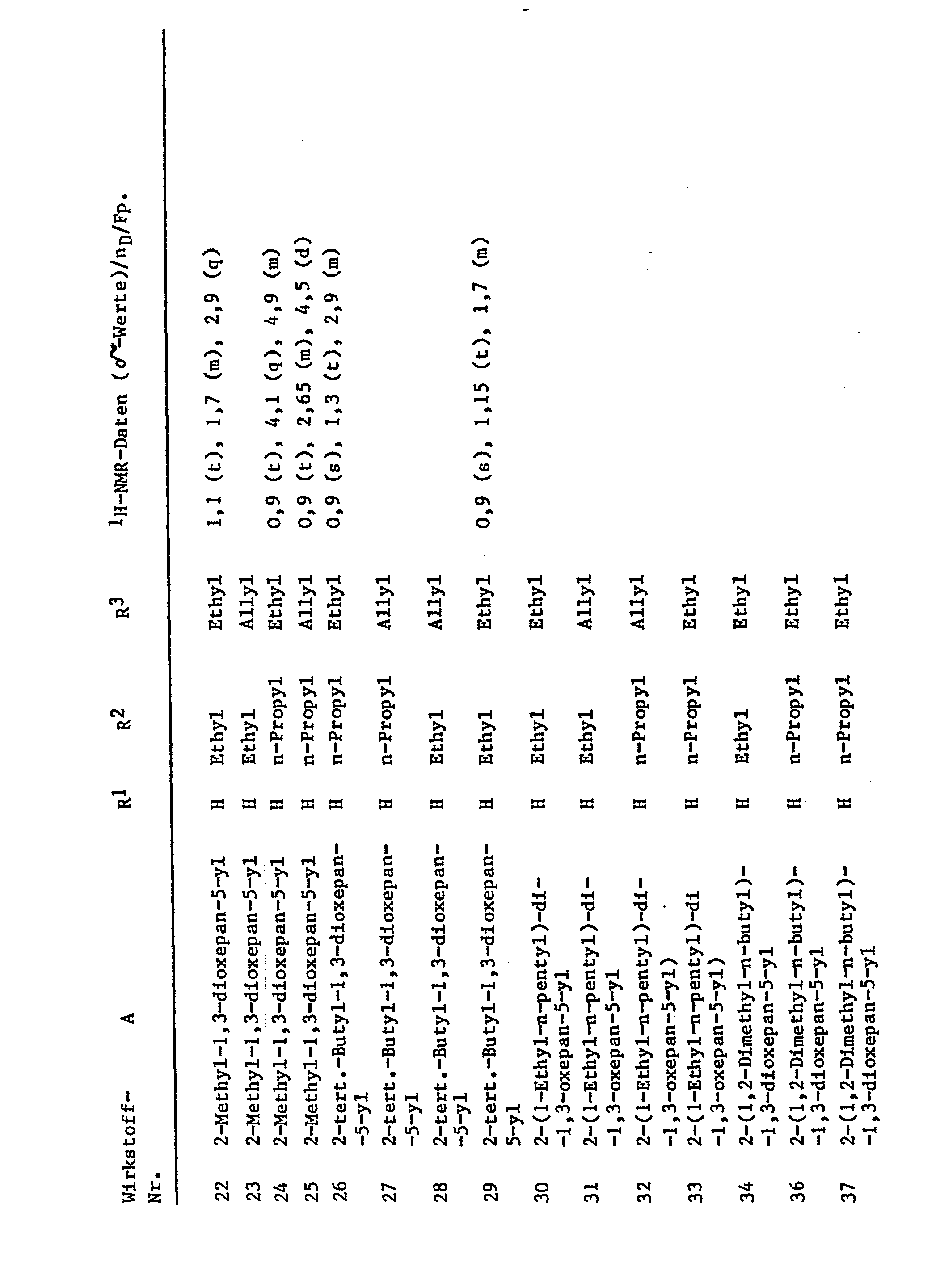
δ= 0,95 (t), 2,85 (t), 3,40 (t), 4,55 (d) - Die folgenden Verbindungen können in gleicher Weise erhalten werden:



- Die Cyclohexan-l,3-dionderivate der Formel I und ihre Salze können beispielsweise in Form von direkt versprühbaren Lösungen, Pulvern, Suspensionen, auch hochprozentigen wäßrigen, öligen oder sonstigen Suspensionen oder Dispersionen, Emulsionen, öldispersionen, Pasten, Stäubemitteln, Streumitteln oder Granulaten durch Versprühen, Vernebeln, Verstäuben, Verstreuen oder Gießen angewendet werden. Die Anwendungsformen richten sich ganz nach den Verwendungszwecken; sie sollten in jedem Fall möglichst die feinste Verteilung der erfindungsgemäßen Wirkstoffe gewährleisten.
- Zur Herstellung von direkt versprühbaren Lösungen, Emulsionen, Pasten oder öldispersionen kommen Mineralölfraktionen von mittlerem bis hohem Siedepunkt, wie Kerosin oder Dieselöl, ferner Kohlenteeröle usw., sowie öle pflanzlichen oder tierischen Ursprungs, aliphatische, cyclische und aromatische Kohlenwasserstoffe, z.B. Benzol, Toluol, Xylol, Paraffin, Tetrahydronaphthalin alkylierte Naphthaline oder deren Derivate, z.B. Methanol, Ethanol, Propanol, Butanol, Chloroform, Tetrachlorkohlenstoff, Cyclohexanol, Cyclohexanon, Chlorbenzol, Isophoron, stark polare Lösungsmittel, wie z.B. Dimethylformamid, Dimethylsulfoxid, N-Methylpyrrolidon, Wasser, in Betracht.
- Wäßrige Anwendungsformen können aus Emulsionskonzentraten, Pasten oder netzbaren Pulvern (Spritzpulvern, Öldispersionen) durch Zusatz von Wasser bereitet werden. Zur Herstellung von Emulsionen, Pasten oder Öldispersionen können die Substanzen als solche oder in einem öl oder Lösungsmittel gelöst, mittels Netz-, Haft-, Dispergier- oder Emulgiermittel in Wasser homogenisiert werden. Es können aber auch aus wirksamer Substanz Netz-, Haft-, Dispergier- oder Emulgiermittel und eventuell Lösungsmittel oder öl bestehende Konzentrate hergestellt werden, die zur Verdünnung mit Wasser geeignet sind.
- Als oberflächenaktive Stoffe kommen Alkali-, Erdalkali-, Ammoniumsalze von Ligninsulfonsäure, Naphthalinsulfonsäure, Phenolsulfonsäure, Alkylarylsulfonate, Alkylsulfate, Alkylsulfonate, Alkali- und Erdalkalisalze der Dibutylnaphthalinsulfonsäure, Laurylethersulfat, Fettalkoholsulfate, fettsaure Alkali- und Erdalkalisalze, Salze sulfatierter Hexadecanole, Heptadecanole, Octadecanole, Salze von sulfatiertem Fettalkoholglykolether, Kondensationsprodukte von sulfoniertem Naphthalin und Naphthalinderivaten mit Formaldehyd, Kondensationsprodukte des Naphthalins bzw. der Naphthalinsulfonsäuren mit Phenol und Formaldehyd, Polyoxyethylenoctylphenoläther, ethoxyliertes Isooctylphenol, Octylphenol, Nonylphenol, Alkylphenolpolyglykolether, Tributylphenylpolyglykolether, Alkylarylpolyetheralkohole, Isotridecylalkohol, Fettalkoholethylenoxid-Kondensate, ethoxyliertes Rizinusöl, Polyoxyethylenalkylether, ethoxyliertes Polyoxypropylen, Laurylalkoholpolyglykoletheracetal, Sorbitester, Lignin, Sulfitablaugen und Methylcellulose in Betracht.
- Pulver-, Streu- und Stäubemittel können durch Mischen oder gemeinsames Vermahlen der wirksamen Substanzen mit einem festen Trägerstoff hergestellt werden.
- Granulate, z.B. Umhüllungs-, Imprägnierungs- und Homogengranulate, können durch Bindung der Wirkstoffe an festen Trägerstoffen hergestellt werden. Feste Trägerstoffe sind Mineralerden wie Silicagel, Kieselsäuren, Kieselgele, Silikate, Talkum, Kaolin, Attaclay, Kalkstein, Kalk, Kreide, Bolus, Löß, Ton, Dolomit, Diatomeenerde,. Calcium- und Magnesiumsulfat, Magnesiumoxid, gemahlene Kunststoffe, Düngemittel, wie z.B. Ammoniumsulfat, Ammoniumphosphat, Ammoniumnitrat, Harnstoffe und pflanzliche Produkte, wie Getreidemehl, Baumrinden-, Holz- und Nußschalenmehl, Cellulosepulver und andere feste Trägerstoffe.
- Die Formulierungen enthalten zwischen 0,1 und 95 Gewichtsprozent, vorzugsweise zwischen 0,5 und 90 Gewichtsprozent, Wirkstoff.
- Beispiele für Formulierungen sind:
- I. Man vermischt 90 Gewichtsteile der Verbindung Nr. 2 mit 10 Gewichtsteilen N-Methyl-alpha-pyrrolidon und erhält eine Lösung, die zur Anwendung in Form kleinster Tropfen geeignet ist.
- II. 20 Gewichtsteile der Verbindung Nr. 3 werden in einer Mischung gelöst, die aus 80 Gewichtsteilen Xylol, 10 Gewichtsteilen des Anlagerungsproduktes von 8 bis 10 Mol Ethylenoxid an 1 Mol ölsäure-N-monoethanolamid, 5 Gewichtsteilen Calciumsalz der Dodecylbenzolsulfonsäure und 5 Gewichtsteilen des Anlagerungsproduktes von 40 Mol Ethylenoxid an 1 Mol Ricinusöl besteht. Durch Ausgießen und feines Verteilen der Lösung in 100 000 Gewichtsteilen Wasser erhält man eine wäßrige Dispersion, die 0,02 Gewichtsprozent des Wirkstoffs enthält.
- III. 20 Gewichtsteile der Verbindung Nr. 1 werden in einer Mischung gelöst, die aus 40 Gewichtsteilen Cyclohexanon, 30 Gewichtsteilen Isobutanol, 20 Gewichtsteilen des Anlagerungsproduktes von 7 Mol Ethylenoxid an 1 Mol Isooctylphenol und 10 Gewichtsteile des Anlagerungsproduktes von 40 Mol Ethylenoxid an 1 Mol Ricinusöl besteht. Durch Eingießen und feines Verteilen der Lösung in 100 000 Gewichtsteilen Wasser erhält man eine wäßrige Dispersion, die 0,02 Gewichtsprozent des Wirkstoffs enthält.
- IV. 20 Gewichtsteile des Wirkstoffs Nr. 17 werden in einer Mischung gelöst, die aus 25 Gewichtsteilen Cyclohexanol, 65 Gewichtsteilen einer Mineralölfraktion vom Siedepunkt 210 bis 2800C und 10 Gewichtsteilen des Anlagerungsproduktes von 40 Mol Ethylenoxid an 1 Mol Ricinusöl besteht. Durch Eingießen und feines Verteilen der Lösung in 100 000 Gewichtsteilen Wasser erhält man eine wäßrige Dispersion, die 0,02 Gewichtsprozent des Wirkstoffs enthält.
- V. 20 Gewichtsteile des Wirkstoffs Nr. 12 werden mit 3 Gewichtsteilen des Natriumsalzes der Diisobutylnaphthalin-alpha-sulfonsäure, 17 Gewichtsteilen des Natriumsalzes einer Ligninsulfonsäure aus einer Sulfit-Ablauge und 60 Gewichtsteilen pulverförmigem Kieselsäuregel gut vermischt und in einer Hammermühle vermahlen. Durch feines Verteilen der Mischung in 20 000 Gewichtsteilen Wasser erhält man eine Spritzbrühe, die 0,1 Gewichtsprozent des Wirkstoffs enthält.
- VI. 3 Gewichtsteile des Wirkstoffs Nr. 52 werden mit 97 Gewichtsteilen feinteiligem Kaolin vermischt. Man erhält auf diese Weise ein Stäubemittel, das 3 Gewichtsprozent des Wirkstoffs enthält.
- VII. 30 Gewichtsteile des Wirkstoffs Nr. 67 werden mit einer Mischung aus 92 Gewichtsteilen pulverförmigem Kieselsäuregel und 8 Gewichtsteilen Paraffinöl, das auf die Oberfläche dieses Kieselsäuregels gesprüht wurde, innig vermischt. Man erhält auf diese Weise eine Aufbereitung des Wirkstoffs mit guter Haftfähigkeit.
- VIII. 20 Teile des Wirkstoffs Nr. 6 werden mit 2 Teilen Calciumsalz der Dodecylbenzolsulfonsäure, 8 Teilen Fettalkohol-polyglykolether, 2 Teilen Natriumsalz eines Phenol-Harnstoff-Formaldehyd-Kondensates und 68 Teilen eines paraffinischen Mineralöls innig vermischt. Man erhält eine stabile ölige Dispersion.
- Die Applikation kann im Vorauflauf- oder im Nachauflaufverfahren erfolgen. Sind die Wirkstoffe bei Nachauflaufanwendung für gewisse Kulturpflanzen weniger verträglich, so können auch Ausbringungstechniken angewandt werden, bei welchen die herbiziden Mittel mit Hilfe der Spritzgeräte so gespritzt werden, daß die Blätter der empfindlichen Kulturpflanzen nach Möglichkeit nicht getroffen werden, während die Wirkstoffe auf die Blätter darunter wachsender unerwünschter Pflanzen oder die unbedeckte Bodenfläche gelangen (post-directed, lay-by).
- Die Aufwandmengen an Wirkstoff betragen je nach Jahreszeit, Zielpflanzen und Wachstumsstadium 0,025 bis 3 kg/ha, vorzugsweise 0,05 bis 0,5 kg/ha. Die herbizide Wirkung der Cyclohexan-1,3-dionderivate der Formel I läßt sich durch Gewächshausversuche zeigen:
- Als Kulturgefäße dienen Plastikblumentöpfe mit 300 cm3 Inhalt und lehmigem Sand mit etwa 1,5 % Humus als Substrat. Die Samen der Testpflanzen werden nach Arten getrennt flach eingesät.
- Bei Vorauflaufbehandlung werden die Wirkstoffe unmittelbar danach auf die Erdoberfläche aufgebracht. Sie werden hierzu in Wasser als Verteilungsmittel suspendiert oder emulgiert und mittels fein verteilender Düsen gespritzt. Bei dieser Applikationsmethode betragen die Aufwandmengen 3,0 kg Wirkstoff/ha.
- Nach dem Aufbringen der Mittel werden die Gefäße leicht beregnet, um Keimung und Wachstum in Gang zu bringen. Danach deckt man die Gefäße mit durchsichtigen Plastikhauben ab, bis die Pflanzen angewachsen sind. Diese Abdeckung bewirkt ein gleichmäßiges Keimen der Testpflanzen, sofern dies nicht durch die Wirkstoffe beeinträchtigt wird.
- Zum Zwecke der Nachauflaufbehandlung zieht man die Testpflanzen je nach Wuchsform erst bis zu einer Wuchshöhe von 3 bis 15 cm an und behandelt sie danach. Die Sojapflanzen werden in einem mit Torfmull (peat) angereicherten Substrat angezogen. Zur Nachauflaufbehandlung werden entweder direkt gesäte und in den gleichen Gefäßen aufgewachsene Pflanzen ausgewählt, oder aber solche, die erst als Keimpflanzen getrennt angezogen und einige Tage vor der Behandlung in die Versuchsgefäße verpflanzt werden. Die Aufwandmengen für die Nachauflaufbehandlung variieren zwischen 0,03 und 0,25 kg Wirkstoff/ha. Eine Abdeckung unterbleibt bei der Nachauflaufbehandlung.
- Die Versuchsgefäße werden im Gewächshaus aufgestellt, wobei für wärmeliebende Arten wärmere Bereiche (20 bis 35°C) und für solche gemäßigter Klimate 10 bis 25°C bevorzugt werden. Die Versuchsperiode erstreckt sich über 2 bis 4 Wochen. Während dieser Zeit werden die Pflanzen gepflegt, und ihre Reaktion auf die einzelnen Behandlungen wird ausgewertet. Bewertet wird nach einer Skala von 0 bis 100. Dabei bedeutet 100 kein Aufgang der Pflanzen bzw. völlige Zerstörung zumindest der oberirdischen Teile.
- Die in den Gewächshausversuchen verwendeten Pflanzen setzen sich aus folgenden Arten zusammen:
- Alopecurus myosuroides (Ackerfuchsschwanz), Avena fatua (Flughafer), Avena sativa (Hafer), Beta vulgaris (Zuckerrübe), Bromus inermis (Unbe-
- Als Vergleichsmittel werden folgende aus der EP-OS 0071707 bekannten Cyclohexan-1,3-dionderivate herangezogen:


- Die Aufwandmengen entsprechen denjenigen der jeweils zu vergleichenden erfindungsgemäßen Verbindung.
- Vorauflaufanwendung: Bei Vorauflaufanwendung erweisen sich beispielsweise die Verbindungen Nr. 7, 53, 2, 1, 17, 54, 10, 12, 20, 23, 29, 57, 59, 60 bei einer Aufwandmenge von 3,0 kg Wirkstoff/ha als herbizid wirksam gegen Pflanzen aus der Familie der Gräser. Dabei bleibt Sinapis alba als breitblättrige Testpflanze unbeschadet.
- Nachauflaufanwendung:
- Bei Nachauflaufanwendung von 0,25 kg Wirkstoff/ha beispielsweise der Verbindungen Nr. 1, 11, 12, 13 und 17 werden bestimmte grasartige unerwünschte Pflanzen oder auch Kulturpflanzen aus der Gräserfamilie, soweit sie an bestimmten Standorten unerwünscht sind, besser bekämpft als mit den Vergleichsmitteln I und III. Sojabohnen als Beispiel für breitblättrige Kulturpflanzen werden dabei nicht geschädigt. Ebenso zeigt die Verbindung Nr. 14 mit 0,25 kg Wirkstoff/ha eine dem Vergleichsmittel VI überlegene Wirkung gegen Sorghum halepense bei voller Verträglichkeit für Sojapflanzen.
- Die Verbindungen Nr. 2 und 3 zeigen beispielsweise mit 0,125 kg Wirkstoff/ha eine sehr gute und den Vergleichsmitteln IV und V überlegene herbizide Wirkung gegen Gramineen, wie Weizen (als Ausfallweizen) und Bromus spp. Die Mittel sind dabei selektiv in Zuckerrüben. Ebenso bekämpfen die Verbindungen Nr. 52 und 53 mit 0,125 kg Wirkstoff/ha Grasarten sehr gut. Bei dieser Aufwandmenge zeigen beispielsweise die Verbindungen Nr. 26, 29 und 55 eine gute Wirkung gegen Gräser und verursachen keine Schädigung an Weizen, der durch das Vergleichsmittel I deutliche Schäden erleidet. Mit Verbindung Nr. 7 läßt sich Hühnerhirse als unerwünschte Grasart in Reis bekämpfen, wobei die Kulturpflanze, im Gegensatz zur Verwendung des Vergleichsmittels I, ebenfalls nicht geschädigt wird.
- Neben einer Selektivität in breitblättrigen Kulturen zeigt die Verbindung Nr. 6 bei einer niedrigen Aufwandmenge eine beachtliche Wirkung gegen Gräser und verursacht dabei keine Schädigung an Weizen. Das Vergleichsmittel II schädigt dieses Kulturgras stark. Ebenfalls bei geringer Aufwandmenge lassen sich mit Verbindung Nr. 67 unerwünschte Grasarten verschiedenster Vegetationszonen - Ausfallkulturen aus der Familie der Gramineen eingeschlossen - hervorragend bekämpfen. Die herbizide Wirkung der Verbindung Nr. 67 ist der des Vergleichsmittels IV deutlich überlegen.
- In Anbetracht der Verträglichkeit und der Vielzahl der Applikationsmethoden können die erfindungsgemäßen Verbindungen noch in einer weiteren Zahl von Kulturpflanzen zur Beseitigung unerwünschter Wildgräser oder grasartiger Kulturpflanzen, sofern sie an gewissen Standorten unerwünscht sind, eingesetzt werden. In Betracht kommen beispielsweise folgende Kulturen:


- Außerdem kann es von Nutzen sein, die neuen Verbindungen allein oder in Kombination mit anderen Herbiziden auch noch mit weiteren Pflanzenschutzmitteln gemischt gemeinsam auszubringen, beispielsweise mit Mitteln zur Bekämpfung von Schädlingen oder phytopathogenen Pilzen bzw. Bakterien. Von Interesse ist ferner die Mischbarkeit mit Mineralsalzlösungen, welche zur Bekämpfung von Ernährungs- und Spurenelementmängeln eingesetzt werden. Es können auch nichtphytotoxische öle und ölkonzentrate zugesetzt werden.
Claims (10)

Priority Applications (1)
| Application Number | Priority Date | Filing Date | Title |
|---|---|---|---|
| AT84112931T ATE49759T1 (de) | 1983-11-08 | 1984-10-26 | Cyclohexan-1,3-dionderivate, verfahren zu ihrer herstellung und ihre verwendung zur bekaempfung unerwuenschten pflanzenwuchses. |
Applications Claiming Priority (2)
| Application Number | Priority Date | Filing Date | Title |
|---|---|---|---|
| DE3340265 | 1983-11-08 | ||
| DE19833340265 DE3340265A1 (de) | 1983-11-08 | 1983-11-08 | Cyclohexan-1,3-dionderivate, verfahren zu ihrer herstellung und ihre verwendung zur bekaempfung unerwuenschten pflanzenwuchses |
Publications (3)
| Publication Number | Publication Date |
|---|---|
| EP0142741A2 true EP0142741A2 (de) | 1985-05-29 |
| EP0142741A3 EP0142741A3 (en) | 1986-03-05 |
| EP0142741B1 EP0142741B1 (de) | 1990-01-24 |
Family
ID=6213688
Family Applications (1)
| Application Number | Title | Priority Date | Filing Date |
|---|---|---|---|
| EP84112931A Expired - Lifetime EP0142741B1 (de) | 1983-11-08 | 1984-10-26 | Cyclohexan-1,3-dionderivate, Verfahren zu ihrer Herstellung und ihre Verwendung zur Bekämpfung unerwünschten Pflanzenwuchses |
Country Status (18)
| Country | Link |
|---|---|
| US (1) | US4654073A (de) |
| EP (1) | EP0142741B1 (de) |
| JP (1) | JPH0676398B2 (de) |
| AT (1) | ATE49759T1 (de) |
| AU (1) | AU577327B2 (de) |
| BR (1) | BR8405678A (de) |
| CA (1) | CA1230344A (de) |
| CS (1) | CS244841B2 (de) |
| DD (1) | DD228156A5 (de) |
| DE (2) | DE3340265A1 (de) |
| DK (1) | DK529184A (de) |
| FI (1) | FI82458C (de) |
| GR (1) | GR80616B (de) |
| HU (1) | HU194017B (de) |
| IE (1) | IE58200B1 (de) |
| NO (1) | NO169631C (de) |
| PH (1) | PH19805A (de) |
| ZA (1) | ZA848688B (de) |
Cited By (9)
| Publication number | Priority date | Publication date | Assignee | Title |
|---|---|---|---|---|
| EP0218233A3 (en) * | 1985-10-10 | 1988-01-27 | Basf Aktiengesellschaft | Cyclohexenon derivatives, process for their preparation and their use in combating the growth of undesirable plants |
| EP0233117A3 (en) * | 1986-02-03 | 1989-06-14 | Eastman Kodak Company | Preparation of 4-carboalkoxy-1,3-cyclohexanedione type compounds |
| US4945178A (en) * | 1986-02-03 | 1990-07-31 | Eastman Kodak Company | Preparation of 4-carboalkoxy-1,3-cyclohexanedione type compounds |
| LT3295B (en) | 1990-05-09 | 1995-06-26 | Basf Ag | Cyclohexenonoxime ethers and herbicidal composition |
| EP0728753A1 (de) * | 1995-02-24 | 1996-08-28 | Basf Aktiengesellschaft | 5-Tetrahydropyranon-Cyclohexenonoximether und deren Verwendung als Herbizide |
| US5744425A (en) * | 1994-08-08 | 1998-04-28 | Basf Aktiengesellschaft | Saccharin derivatives |
| EP2052605A1 (de) | 2007-10-24 | 2009-04-29 | Bayer CropScience AG | Herbizid-Kombination |
| DE102008037632A1 (de) | 2008-08-14 | 2010-02-18 | Bayer Cropscience Ag | Herbizid-Kombination mit Dimethoxytriazinyl-substituierten Difluormethansulfonylaniliden |
| EP2501229A4 (de) * | 2009-11-17 | 2014-08-06 | Univ Rochester | Verbindungen und verfahren zur veränderung der lebensdauer eukaryotischer organismen |
Families Citing this family (6)
| Publication number | Priority date | Publication date | Assignee | Title |
|---|---|---|---|---|
| DE3428457A1 (de) * | 1984-08-02 | 1986-02-13 | Basf Ag, 6700 Ludwigshafen | Verfahren zur erhoehung des zuckergehaltes von pflanzen |
| DE3600642A1 (de) * | 1986-01-11 | 1987-07-16 | Basf Ag | Cyclohexenonderivate, verfahren zu ihrer herstellung und ihre verwendung als herbizide mittel |
| DE3601066A1 (de) * | 1986-01-16 | 1987-07-23 | Basf Ag | Cyclohexenonderivate, ein verfahren zu ihrer herstellung sowie ihre verwendung als herbizide und das pflanzenwachstum regulierende mittel |
| FI92189C (fi) * | 1986-03-17 | 1994-10-10 | Eisai Co Ltd | Menetelmä lääkeaineina käyttökelpoisen difenyylimetaanijohdannaisen valmistamiseksi |
| DE4014983A1 (de) * | 1990-05-09 | 1991-11-14 | Basf Ag | Cyclohexenonoximether, verfahren und zwischenprodukte zu ihrer herstellung und ihre verwendung als herbizide |
| US7214825B2 (en) | 2003-10-17 | 2007-05-08 | Honeywell International Inc. | O-(3-chloropropenyl) hydroxylamine free base |
Family Cites Families (5)
| Publication number | Priority date | Publication date | Assignee | Title |
|---|---|---|---|---|
| US3950420A (en) * | 1973-08-15 | 1976-04-13 | Nippon Soda Company, Ltd. | Cyclohexane derivatives |
| JPS577122B2 (de) * | 1973-12-24 | 1982-02-09 | ||
| DE3121355A1 (de) * | 1981-05-29 | 1982-12-16 | Basf Ag, 6700 Ludwigshafen | Cyclohexandionderivate, verfahren zu ihrer herstellung und diese enthaltende herbizide |
| DE3303182A1 (de) * | 1983-02-01 | 1984-08-02 | Basf Ag, 6700 Ludwigshafen | Cyclohexan-1,3-dionderivate, verfahren zu ihrer herstellung und ihre verwendung zur bekaempfung unerwuenschten pflanzenwuchses |
| DE3412794A1 (de) * | 1983-09-30 | 1985-04-18 | Basf Ag, 6700 Ludwigshafen | Cyclohexenonderivate, verfahren zu ihrer herstellung sowie ihre verwendung zur bekaempfung unerwuenschten pflanzenwuchses |
-
1983
- 1983-11-08 DE DE19833340265 patent/DE3340265A1/de not_active Withdrawn
-
1984
- 1984-10-11 GR GR80616A patent/GR80616B/el unknown
- 1984-10-26 AT AT84112931T patent/ATE49759T1/de not_active IP Right Cessation
- 1984-10-26 DE DE8484112931T patent/DE3481122D1/de not_active Expired - Lifetime
- 1984-10-26 FI FI844215A patent/FI82458C/fi not_active IP Right Cessation
- 1984-10-26 EP EP84112931A patent/EP0142741B1/de not_active Expired - Lifetime
- 1984-10-31 US US06/666,908 patent/US4654073A/en not_active Expired - Lifetime
- 1984-11-01 CA CA000466894A patent/CA1230344A/en not_active Expired
- 1984-11-05 CS CS848405A patent/CS244841B2/cs unknown
- 1984-11-05 IE IE284284A patent/IE58200B1/en not_active IP Right Cessation
- 1984-11-06 PH PH31413A patent/PH19805A/en unknown
- 1984-11-07 ZA ZA848688A patent/ZA848688B/xx unknown
- 1984-11-07 DD DD84269220A patent/DD228156A5/de not_active IP Right Cessation
- 1984-11-07 BR BR8405678A patent/BR8405678A/pt not_active IP Right Cessation
- 1984-11-07 AU AU35186/84A patent/AU577327B2/en not_active Expired
- 1984-11-07 JP JP59233426A patent/JPH0676398B2/ja not_active Expired - Lifetime
- 1984-11-07 DK DK529184A patent/DK529184A/da not_active Application Discontinuation
- 1984-11-07 NO NO844442A patent/NO169631C/no not_active IP Right Cessation
- 1984-11-08 HU HU844129A patent/HU194017B/hu not_active IP Right Cessation
Cited By (10)
| Publication number | Priority date | Publication date | Assignee | Title |
|---|---|---|---|---|
| EP0218233A3 (en) * | 1985-10-10 | 1988-01-27 | Basf Aktiengesellschaft | Cyclohexenon derivatives, process for their preparation and their use in combating the growth of undesirable plants |
| EP0233117A3 (en) * | 1986-02-03 | 1989-06-14 | Eastman Kodak Company | Preparation of 4-carboalkoxy-1,3-cyclohexanedione type compounds |
| US4945178A (en) * | 1986-02-03 | 1990-07-31 | Eastman Kodak Company | Preparation of 4-carboalkoxy-1,3-cyclohexanedione type compounds |
| LT3295B (en) | 1990-05-09 | 1995-06-26 | Basf Ag | Cyclohexenonoxime ethers and herbicidal composition |
| US5744425A (en) * | 1994-08-08 | 1998-04-28 | Basf Aktiengesellschaft | Saccharin derivatives |
| EP0728753A1 (de) * | 1995-02-24 | 1996-08-28 | Basf Aktiengesellschaft | 5-Tetrahydropyranon-Cyclohexenonoximether und deren Verwendung als Herbizide |
| US5677263A (en) * | 1995-02-24 | 1997-10-14 | Basf Aktiengesellschaft | S-tetrahydropyranone cyclohexenone oxime ethers and their use as herbicides |
| EP2052605A1 (de) | 2007-10-24 | 2009-04-29 | Bayer CropScience AG | Herbizid-Kombination |
| DE102008037632A1 (de) | 2008-08-14 | 2010-02-18 | Bayer Cropscience Ag | Herbizid-Kombination mit Dimethoxytriazinyl-substituierten Difluormethansulfonylaniliden |
| EP2501229A4 (de) * | 2009-11-17 | 2014-08-06 | Univ Rochester | Verbindungen und verfahren zur veränderung der lebensdauer eukaryotischer organismen |
Also Published As
| Publication number | Publication date |
|---|---|
| FI844215L (fi) | 1985-05-09 |
| CS244841B2 (en) | 1986-08-14 |
| US4654073A (en) | 1987-03-31 |
| EP0142741A3 (en) | 1986-03-05 |
| DE3340265A1 (de) | 1985-05-15 |
| ATE49759T1 (de) | 1990-02-15 |
| HUT36984A (en) | 1985-11-28 |
| IE842842L (en) | 1985-05-08 |
| JPH0676398B2 (ja) | 1994-09-28 |
| DD228156A5 (de) | 1985-10-09 |
| CA1230344A (en) | 1987-12-15 |
| GR80616B (en) | 1985-02-01 |
| FI844215A0 (fi) | 1984-10-26 |
| EP0142741B1 (de) | 1990-01-24 |
| AU3518684A (en) | 1985-05-16 |
| NO169631C (no) | 1992-07-22 |
| PH19805A (en) | 1986-07-08 |
| FI82458B (fi) | 1990-11-30 |
| DE3481122D1 (de) | 1990-03-01 |
| FI82458C (fi) | 1991-03-11 |
| ZA848688B (en) | 1985-07-31 |
| NO844442L (no) | 1985-05-09 |
| DK529184D0 (da) | 1984-11-07 |
| IE58200B1 (en) | 1993-07-28 |
| JPS60123484A (ja) | 1985-07-02 |
| BR8405678A (pt) | 1985-09-10 |
| HU194017B (en) | 1988-01-28 |
| AU577327B2 (en) | 1988-09-22 |
| DK529184A (da) | 1985-05-09 |
| NO169631B (no) | 1992-04-13 |
Similar Documents
| Publication | Publication Date | Title |
|---|---|---|
| EP0136702B1 (de) | Cyclohexenol-Derivate, Verfahren zu ihrer Herstellung und ihre Verwendung zur Bekämpfung unerwünschten Pflanzenwuchses | |
| EP0177913B1 (de) | Cyclohexenonderivate, Verfahren zu ihrer Herstellung und ihre Verwendung zur Bekämpfung unerwünschten Pflanzenwuchses | |
| EP0142741B1 (de) | Cyclohexan-1,3-dionderivate, Verfahren zu ihrer Herstellung und ihre Verwendung zur Bekämpfung unerwünschten Pflanzenwuchses | |
| EP0066195B1 (de) | Cyclohexan-1,3-dionderivate, Verfahren zu ihrer Herstellung und ihre Verwendung zur Bekämpfung von unerwünschtem Pflanzenwuchs | |
| EP0136647B1 (de) | Cyclohexenonderivate, Verfahren zu ihrer Herstellung sowie ihre Verwendung zur Bekämpfung unerwünschten Pflanzenwuchses | |
| EP0099535B1 (de) | Cyclohexan-1,3-dionderivate, Verfahren zu ihrer Herstellung und ihre Verwendung zur Bekämpfung unerwünschten Pflanzenwuchses | |
| EP0107156B1 (de) | Cyclohexan-1,3-dionderivate, Verfahren zu ihrer Herstellung und ihre Verwendung zur Bekämpfung unerwünschten Pflanzenwuchses | |
| EP0103143B1 (de) | Cyclohexan-1,3-dion-derivate, Verfahren zu ihrer Herstellung und ihre Verwendung zur Bekämpfung unerwünschten Pflanzenwuchses | |
| EP0218233B1 (de) | Cyclohexenonderivate, Verfahren zu ihrer Herstellung und ihre Verwendung zur Bekämpfung unerwünschten Pflanzenwuchses | |
| EP0230235B1 (de) | Cyclohexenonderivate, Verfahren zur ihrer Herstellung und ihre Verwendung als herbizide Mittel | |
| EP0137174B1 (de) | Cyclohexan-1,3-dionderivate, Verfahren zu ihrer Herstellung und ihre Verwendung zur Bekämpfung unerwünschten Pflanzenwuchses | |
| EP0131875B1 (de) | Cyclohexan-1,3-dionderivate, Verfahren zu ihrer Herstellung und ihre Verwendung zur Bekämpfung unerwünschten Pflanzenwuches | |
| EP0088299B1 (de) | Cyclohexan-1,3-dionderivate, Verfahren zu ihrer Herstellung und ihre Verwendung zur Bekämpfung unerwünschten Pfanzenwuchses | |
| EP0120448A1 (de) | Cyclohexan-1,3-dion-derivate, Verfahren zu ihrer Herstellung und ihre Verwendung zur Bekämpfung unerwünschten Pflanzenwuchses | |
| EP0169521B1 (de) | Cyclohexenonderivate, Verfahren zur ihrer Herstellung und ihre Verwendung zur Bekämpfung unerwünschten Pflanzenwuchses | |
| EP0146837B1 (de) | Cyclohexenonderivate, Verfahren zu ihrer Herstellung und ihre Verwendung zur Bekämpfung unerwünschten Pflanzenwuchses | |
| EP0157184B1 (de) | Cyclohexenone, Verfahren zu ihrer Herstellung sowie ihre Verwendung zur Bekämpfung unerwünschten Pflanzenwuchses | |
| EP0228598B1 (de) | Cyclohexenonderivate, Verfahren zu ihrer Herstellung und ihre Verwendung als herbizide und das Pflanzenwachstum regulierende Mittel | |
| EP0183959B1 (de) | Cyclohexenonderivate, Verfahren zu ihrer Herstellung sowie ihre Verwendung zur Bekämpfung unerwünschten Pflanzenwuchses | |
| EP0456089A1 (de) | Cyclohexenonoximether, Verfahren zu ihrer Herstellung und ihre Verwendung als Herbizid | |
| EP0162224B1 (de) | Cyclohexenonderivate und ihre Verwendung zur Bekämpfung unerwünschten Pflanzenwuchses | |
| EP0070495B1 (de) | Cyclohexan-1,3-dion-derivate, Verfahren zu ihrer Herstellung und ihre Verwendung zur Bekämpfung unerwünschten Pflanzenwuchses | |
| EP0325085B1 (de) | Herbizide Tetrahydropyran-2,4-dionderivate | |
| EP0332076B1 (de) | Cyclohexenonverbindungen, Verfahren zu ihrer Herstellung und ihre Verwendung zur Bekämpfung unerwünschten Pflanzenwuchses | |
| EP0172502B1 (de) | Cyclohexenonderivate, Verfahren zu ihrer Herstellung und ihre Verwendung zur Bekämpfung unerwünschten Pflanzenwuchses |
Legal Events
| Date | Code | Title | Description |
|---|---|---|---|
| PUAI | Public reference made under article 153(3) epc to a published international application that has entered the european phase |
Free format text: ORIGINAL CODE: 0009012 |
|
| AK | Designated contracting states |
Designated state(s): AT BE CH DE FR GB IT LI LU NL SE |
|
| RTI1 | Title (correction) | ||
| PUAL | Search report despatched |
Free format text: ORIGINAL CODE: 0009013 |
|
| AK | Designated contracting states |
Kind code of ref document: A3 Designated state(s): AT BE CH DE FR GB IT LI LU NL SE |
|
| 17P | Request for examination filed |
Effective date: 19860117 |
|
| 17Q | First examination report despatched |
Effective date: 19870512 |
|
| GRAA | (expected) grant |
Free format text: ORIGINAL CODE: 0009210 |
|
| AK | Designated contracting states |
Kind code of ref document: B1 Designated state(s): AT BE CH DE FR GB IT LI LU NL SE |
|
| REF | Corresponds to: |
Ref document number: 49759 Country of ref document: AT Date of ref document: 19900215 Kind code of ref document: T |
|
| ITF | It: translation for a ep patent filed | ||
| REF | Corresponds to: |
Ref document number: 3481122 Country of ref document: DE Date of ref document: 19900301 |
|
| GBT | Gb: translation of ep patent filed (gb section 77(6)(a)/1977) | ||
| ET | Fr: translation filed | ||
| PG25 | Lapsed in a contracting state [announced via postgrant information from national office to epo] |
Ref country code: LU Free format text: LAPSE BECAUSE OF NON-PAYMENT OF DUE FEES Effective date: 19901031 |
|
| PLBE | No opposition filed within time limit |
Free format text: ORIGINAL CODE: 0009261 |
|
| STAA | Information on the status of an ep patent application or granted ep patent |
Free format text: STATUS: NO OPPOSITION FILED WITHIN TIME LIMIT |
|
| 26N | No opposition filed | ||
| ITTA | It: last paid annual fee | ||
| EAL | Se: european patent in force in sweden |
Ref document number: 84112931.5 |
|
| REG | Reference to a national code |
Ref country code: CH Ref legal event code: SPCF Free format text: CHSPCFBLW-NR. W 5942/27.01.2000, 26.05.2000 |
|
| REG | Reference to a national code |
Ref country code: GB Ref legal event code: IF02 |
|
| REG | Reference to a national code |
Ref country code: CH Ref legal event code: SPCG |
|
| PGFP | Annual fee paid to national office [announced via postgrant information from national office to epo] |
Ref country code: SE Payment date: 20020923 Year of fee payment: 19 |
|
| PGFP | Annual fee paid to national office [announced via postgrant information from national office to epo] |
Ref country code: AT Payment date: 20020930 Year of fee payment: 19 |
|
| PGFP | Annual fee paid to national office [announced via postgrant information from national office to epo] |
Ref country code: NL Payment date: 20021011 Year of fee payment: 19 |
|
| PGFP | Annual fee paid to national office [announced via postgrant information from national office to epo] |
Ref country code: BE Payment date: 20021022 Year of fee payment: 19 |
|
| PGFP | Annual fee paid to national office [announced via postgrant information from national office to epo] |
Ref country code: FR Payment date: 20031003 Year of fee payment: 20 |
|
| PGFP | Annual fee paid to national office [announced via postgrant information from national office to epo] |
Ref country code: GB Payment date: 20031022 Year of fee payment: 20 |
|
| PG25 | Lapsed in a contracting state [announced via postgrant information from national office to epo] |
Ref country code: AT Free format text: LAPSE BECAUSE OF NON-PAYMENT OF DUE FEES Effective date: 20031026 |
|
| PG25 | Lapsed in a contracting state [announced via postgrant information from national office to epo] |
Ref country code: SE Free format text: LAPSE BECAUSE OF NON-PAYMENT OF DUE FEES Effective date: 20031027 |
|
| PGFP | Annual fee paid to national office [announced via postgrant information from national office to epo] |
Ref country code: CH Payment date: 20031030 Year of fee payment: 20 |
|
| PG25 | Lapsed in a contracting state [announced via postgrant information from national office to epo] |
Ref country code: BE Free format text: LAPSE BECAUSE OF NON-PAYMENT OF DUE FEES Effective date: 20031031 |
|
| PGFP | Annual fee paid to national office [announced via postgrant information from national office to epo] |
Ref country code: DE Payment date: 20031103 Year of fee payment: 20 |
|
| BERE | Be: lapsed |
Owner name: *BASF A.G. Effective date: 20031031 |
|
| PG25 | Lapsed in a contracting state [announced via postgrant information from national office to epo] |
Ref country code: NL Free format text: LAPSE BECAUSE OF NON-PAYMENT OF DUE FEES Effective date: 20040501 |
|
| EUG | Se: european patent has lapsed | ||
| NLV4 | Nl: lapsed or anulled due to non-payment of the annual fee |
Effective date: 20040501 |
|
| PG25 | Lapsed in a contracting state [announced via postgrant information from national office to epo] |
Ref country code: LI Free format text: LAPSE BECAUSE OF EXPIRATION OF PROTECTION Effective date: 20041025 Ref country code: GB Free format text: LAPSE BECAUSE OF EXPIRATION OF PROTECTION Effective date: 20041025 Ref country code: CH Free format text: LAPSE BECAUSE OF EXPIRATION OF PROTECTION Effective date: 20041025 |
|
| REG | Reference to a national code |
Ref country code: CH Ref legal event code: PL |
|
| REG | Reference to a national code |
Ref country code: GB Ref legal event code: PE20 |
|
| REG | Reference to a national code |
Ref country code: CH Ref legal event code: SPCN Spc suppl protection certif: C00142741/01 Representative=s name: SCHMAUDER AND PARTNER AG PATENT- UND MARKENANWAELT |
|
| REG | Reference to a national code |
Ref country code: CH Ref legal event code: SPCL Spc suppl protection certif: C00142741/01 |