EP0137296A2 - Thermoplastische Formmasse - Google Patents
Thermoplastische Formmasse Download PDFInfo
- Publication number
- EP0137296A2 EP0137296A2 EP84110450A EP84110450A EP0137296A2 EP 0137296 A2 EP0137296 A2 EP 0137296A2 EP 84110450 A EP84110450 A EP 84110450A EP 84110450 A EP84110450 A EP 84110450A EP 0137296 A2 EP0137296 A2 EP 0137296A2
- Authority
- EP
- European Patent Office
- Prior art keywords
- styrene
- weight
- maleic anhydride
- acrylonitrile
- copolymer
- Prior art date
- Legal status (The legal status is an assumption and is not a legal conclusion. Google has not performed a legal analysis and makes no representation as to the accuracy of the status listed.)
- Withdrawn
Links
Classifications
-
- C—CHEMISTRY; METALLURGY
- C08—ORGANIC MACROMOLECULAR COMPOUNDS; THEIR PREPARATION OR CHEMICAL WORKING-UP; COMPOSITIONS BASED THEREON
- C08L—COMPOSITIONS OF MACROMOLECULAR COMPOUNDS
- C08L25/00—Compositions of, homopolymers or copolymers of compounds having one or more unsaturated aliphatic radicals, each having only one carbon-to-carbon double bond, and at least one being terminated by an aromatic carbocyclic ring; Compositions of derivatives of such polymers
- C08L25/02—Homopolymers or copolymers of hydrocarbons
- C08L25/04—Homopolymers or copolymers of styrene
- C08L25/08—Copolymers of styrene
- C08L25/12—Copolymers of styrene with unsaturated nitriles
-
- C—CHEMISTRY; METALLURGY
- C08—ORGANIC MACROMOLECULAR COMPOUNDS; THEIR PREPARATION OR CHEMICAL WORKING-UP; COMPOSITIONS BASED THEREON
- C08L—COMPOSITIONS OF MACROMOLECULAR COMPOUNDS
- C08L35/00—Compositions of homopolymers or copolymers of compounds having one or more unsaturated aliphatic radicals, each having only one carbon-to-carbon double bond, and at least one being terminated by a carboxyl radical, and containing at least one other carboxyl radical in the molecule, or of salts, anhydrides, esters, amides, imides or nitriles thereof; Compositions of derivatives of such polymers
- C08L35/06—Copolymers with vinyl aromatic monomers
Definitions
- the invention relates to a transparent and heat-resistant thermoplastic molding composition which is composed of a styrene-acrylonitrile copolymer and a styrene-maleic anhydride copolymer.
- Copolymers of styrene and acrylonitrile are known and e.g. in Ullmann's Encyclopedia of Technical Chemistry, Volume 19, 4th Edition, Verlag Chemie, Weinheim, (1980), pp. 272f (1). They are easy to process thermoplastic, are hard, transparent and have good solvent resistance compared to pure polystyrene. However, their heat resistance allows for many applications, especially long-term contact with boiling water, i.e. Desires open at temperatures above 100 ° C. Various attempts have therefore been made to improve the heat resistance of the SAN copolymers by partially or completely replacing styrene with side-chain or core-alkylated styrenes. However, this is only possible to a limited extent, since the resulting copolymers have a strong yellow color and an increased tendency to depolymerize at the necessarily elevated processing temperatures.
- Copolymers of styrene and maleic anhydride are also known and are described in (1). They have a higher heat resistance. However, their mechanical properties, such as rigidity and toughness, are unsatisfactory and their resistance to stress cracking is not sufficient for many areas of application.
- thermoplastic molding compositions which have high heat resistance, are crystal-clear, transparent, have good toughness in addition to high rigidity and, moreover, have a stress crack resistance comparable to that of styrene-acrylonitrile copolymers.
- thermoplastic molding composition according to claim 1.
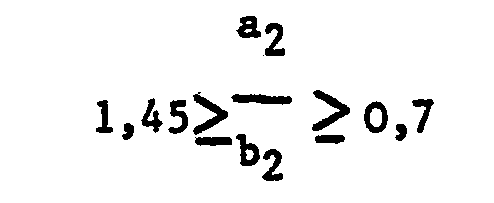
- the molding composition is characterized in that the weight ratio of the comonomers a 2 ) to b 2 ) in the copolymers A) and B) is.
- thermoplastics are miscible with one another; however, the vast majority of plastics prove to be incompatible when trying to make mixtures from two or more components: incompatibility is the rule and miscibility is the exception (see, for example, L. Bohn, Kolloid-Zeitschrift 213, page 55, 1966 or GE Molau, Journal of Polymer Science, Part B, 3, page 1007, 1965, BJ Schmitt, Angew. Chemie 91, 286 (1976)).
- Compatibility is, however, a prerequisite for the fact that plastic mixtures have useful properties: If the components of a plastic mixture are incompatible, the phase boundaries are germs for breakage and are also opaque.
- the polymer mixtures according to the invention made of styrene-acrylonitrile Copolymers and styrene-maleic anhydride copolymers in the areas according to the invention are completely miscible and are therefore crystal-clear transparent.
- the molding compositions according to the invention are characterized by excellent heat resistance, a balanced combination of rigidity / toughness and excellent chemical resistance.
- Rubber-free styrene-acrylonitrile copolymers are used for the molding compositions according to the invention; these consist essentially of copolymers which contain 1 to 50% by weight of acrylonitrile a 2 ) and 50 to 99% by weight of styrene.
- the styrene constituent can be replaced in whole or in part by nuclear-alkylated styrene, in particular p-methylstyrene.
- Styrene-acrylonitrile copolymers are commercially available and can be prepared, for example, according to the teaching of DE-AS 1 001 001 or DE-PS 1 003 436.
- the copolymer A is present in the molding composition according to the invention in a proportion of 5 to 95% by weight, preferably 20 to 80% by weight and in particular 30 to 50% by weight, in each case based on the sum of the individual components A and B.
- the copolymer B is prepared by continuous copolymerization of the monomers b 1 ) and b 2 ) at high temperatures with vigorous stirring.
- the monomers b 1 ) and b 2 ) are introduced continuously into a polymerization vessel and at the same time an amount of the polymerization mixture corresponding to these amounts is withdrawn from the vessel (cf. AW Hanson, RL Zimmermann, Industrial Eng. Chemistry 49, (1957) page 803) .
- the monomer b l which is essentially styrene, but can also be a nuclear-alkylated styrene, such as p-methylstyrene, is in quantities from 50 to 99% by weight, the monomer b 21 maleic anhydride, in amounts of 1 to 50% by weight in the copolymer B.
- the copolymer B is present in the thermoplastic molding compositions according to the invention in a proportion of 5 to 95% by weight, preferably 20 to 80% by weight and in particular 50 to 70% by weight, based on the sum of the individual components A and B.
- the weight ratio of acrylonitrile to maleic anhydride is in a certain range.
- This weight ratio of the monomers a 2 / b 2 must be in the range from less than or equal to 1.45 to greater than or equal to 0.7. At ratios above and below the range mentioned, the values for the mechanics of the mixtures become worse and at the same time the transparency decreases.
- the molding composition according to the invention can contain conventional additives in amounts of 0.1 to 10 parts, based on 100 parts of A + B.
- additives are: pigments, dyes, fillers, flame retardants, other compatible polymers, antistatic agents, antioxidants and lubricants.
- the molding compositions according to the invention are processed into finished parts by the customary processes known for the processing of thermoplastics. They are used in particular for housings for electrical appliances, household appliances, telephones, for plates, pipes, foils, children's toys and in motor vehicle construction.
- the polymer mixtures according to the invention have a crystal-clear transparency with an extremely low intrinsic color, high heat resistance, high rigidity and at the same time good toughness and excellent stress crack resistance.
- the components of the molding compositions of the examples and of the comparative experiments were premixed in the amounts specified in Table 2 in a fluid mixer and then kneaded intimately on a co-kneader at about 220 to 230 ° C. under nitrogen. The residence time was about 4 minutes.
- the granules obtained were melted on a single-screw extruder screw and knocked off to form uniform granules suitable for injection molding.
- Table 2 also lists the properties of the mixtures obtained.
Landscapes
- Chemical & Material Sciences (AREA)
- Health & Medical Sciences (AREA)
- Chemical Kinetics & Catalysis (AREA)
- Medicinal Chemistry (AREA)
- Polymers & Plastics (AREA)
- Organic Chemistry (AREA)
- Compositions Of Macromolecular Compounds (AREA)
- Addition Polymer Or Copolymer, Post-Treatments, Or Chemical Modifications (AREA)
Abstract
- A) 5 bis 95 Gew.%, bezogen auf A+B, eines Styrol-Acrylnitril-Copolymeren, das aufgebaut ist aus a1) 99 bis 50 Gew.%, bezogen auf A, Styrol und/oder einem kemalkylsubstituierten Styrolderivat und a2) 1 bis 50 Gew.%, bezogen auf A, Acrylnitril und
- B) 95 bis 5 Gew.%, bezogen auf A+B, mindestens eines Styrol-Maleinsäureanhydridcopolymeren, bestehend aus b1) 99 bis 50 Gew.%, bezogen auf B, Styrol und/oder einem kemalkylsubstituierten Styrolderivat und b2) 1 bis 50 Gew.%, bezogen auf B, Maleinsäureanhydrid.
Description
- Die Erfindung betrifft eine transparente und wärmeformbeständige thermoplastische Formmasse, die aus einem Styrol-Acrylnitril-Copolymerisat und einem Styrol-Maleinsäureanhydrid-Copolymerisat aufgebaut ist.
- Copolymerisate aus Styrol und Acrylnitril sind bekannt und z.B. in Ull- mann's Encyklopädie der technischen Chemie, Band 19, 4. Auflage, Verlag Chemie, Weinheim, (1980), S. 272f (1) beschrieben. Sie lassen sich gut thermoplastisch verarbeiten, sind hart, transparent und besitzen im Vergleich zu reinem Polystyrol eine gute Lösungsmittelbeständigkeit. Ihre Wärmeformbeständigkeit läßt jedoch bei vielen Anwendungen, insbesondere beim Langzeitkontakt mit kochendem Wasser, d.h. bei Temperaturen über 100°C Wünsche offen. Es ist deshalb verschiedentlich versucht worden, die Wärmeformbeständigkeit der SAN-Copolymerisate durch teilweisen oder vollständigen Ersatz von Styrol durch seitenketten- oder kernalkylierte Styrole zu verbessern. Doch dies gelingt nur in beschränktem Maße, da die resultierenden Copolymeren eine starke Gelbfärbung und eine erhöhte Depolymerisationsneigung bei den notwendigerweise erhöhten Verarbeitungstemperaturen aufweisen.
- Copolymerisate aus Styrol und Maleinsäureanhydrid sind ebenfalls bekannt und in (1) beschrieben. Sie besitzen eine höhere Wärmeformbeständigkeit. Ihre mechanischen Eigenschaften, wie Steifigkeit und Zähigkeit, sind jedoch unbefriedigend und ihre Spannungsrißbeständigkeit ist für viele Anwendungsbereiche nicht ausreichend.
- Es bestand deshalb die Aufgabe, thermoplastische Formmassen herzustellen, die eine hohe Wärmeformbeständigkeit aufweisen, glasklar, transparent sind, neben einer hohen Steifigkeit eine gute Zähigkeit besitzen und zudem eine den Styrol-Acrylnitril-Copolymerisaten vergleichbare Spannungsrißbeständigkeit aufweisen.
- Diese Aufgabe wird durch eine thermoplastische Formmasse gemäß Patentanspruch 1 gelöst.
- Die Erfindung betrifft somit eine thermoplastische Formmasse, enthaltend, vorzugsweise bestehend aus;
- A) 5 bis 95 Gew.X, bezogen auf A+B, mindestens eines Styrol-Acrylnitril--Copolymeren, das aufgebaut ist aus
- a1) 99 bis 50 Gew.-%, bezogen auf A, Styrol und/oder einem kernalkylsubstituierten Styrolderivat und
- a2) 1 bis 50 Gew.%, bezogen auf A, Acrylnitril und
- B) 95 bis 5 Gew.X, bezogen auf A+B, mindestens eines Styrol-Maleinsäureanhydrid-Copolymeren, bestehend aus
- bl) 99 bis 50 Gew.%, bezogen auf B, Styrol und/oder einem kernalkylsubstituierten Styrolderivat und
- b2) 1 bis 50 Gew.%, bezogen auf B, Maleinsäureanhydrid
- C) übliche Zusatzstoffe.
- Die Formmasse ist dadurch gekennzeichnet, daß das Gewichts-Verhältnis der Comonomeren a2) zu b2) in den Copolymerisaten A) und B)

- Es war bekannt, daß einige wenige thermoplastische Kunststoffe miteinander mischbar sind; die weitaus größte Zahl der Kunststoffe erweisen sich jedoch als unverträglich, wenn man versucht, aus zwei oder mehreren Komponenten Mischungen herzustellen: Unverträglichkeit ist die Regel und Mischbarkeit ist die Ausnahme (s. z.B. L. Bohn, Kolloid-Zeitschrift 213, Seite 55, 1966 oder G.E. Molau, Journal of Polymer Science, Teil B, 3, Seite 1007, 1965, B.J. Schmitt, Angew. Chemie 91, 286 (1976)). Verträglichkeit ist aber Voraussetzung dafür, daß Kunststoffmischungen brauchbare Eigenschaften haben: Wenn die Komponenten einer Kunststoffmischung unverträglich sind, stellen die Phasengrenzen Keimstellen für Bruch dar und sind zudem opak.
- Es war deshalb völlig überraschend und für den Fachmann nicht vorhersehbar, daß die erfindungsgemäßen Polymermischungen aus Styrol-Acrylnitril--Copolymerisaten und Styrol-Maleinsäureanhydrid-Copolymerisaten in den erfindungsgemäßen Bereichen vollständig mischbar und deshalb glasklar transparent sind. Darüber hinaus sind die erfindungsgemäßen Formmassen durch eine ausgezeichnete Wärmeformbeständigkeit, eine ausgewogene Steifigkeits/Zähigkeitskombination und eine hervorragende Chemikalienbeständigkeit gekennzeichnet.
- Nachstehend werden die Komponenten der erfindungsgemäßen Formmassen beschrieben.
- Die erfindungsgemäße Formmasse enthält mindestens ein Copolymerisat A und mindestens ein Copolymerisat B; vorzugsweise besteht die Formmasse aus den genannten Copolymerisaten ( A+B = 100 %).
- Für die erfindungsgemäßen Formmassen werden kautschukfreie Styrol-Acrylnitril-Copolymerisate angewendet; diese bestehen im wesentlichen aus Copolymerisaten, die 1 bis 50 Gew.% Acrylnitril a2) und 50 bis 99 Gew.% Styrol enthalten. Der Styrolbestandteil kann, um die Wärmeformbeständigkeit zu verbessern, ganz oder teilweise durch kernalkyliertes Styrol, insbesondere p-Methylstyrol, ersetzt sein. Styrol-Acrylnitril-Copolymerisate sind im Handel erhältlich und können z.B. nach der Lehre der DE-AS 1 001 001 bzw. DE-PS 1 003 436 hergestellt werden. Der Molekulargewichtsbereich der Copolymerisate kann MW = 8.104 bis MW = 5 . 105 (Gewichtsmittel MW aus Lichtstreuung) betragen.
- Das Copolymerisat A ist in der erfindungsgemäßen Formmasse in einem Anteil von 5 bis 95 Gew.%, vorzugsweise von 20 bis 80 Gew.% und insbesondere von 30 bis 50 Gew.%, jeweils bezogen auf die Summe der Einzelkomponenten A und B, enthalten.
- Das Copolymerisat B wird durch kontinuierliche Mischpolymerisation der Monomeren b1) und b2) bei hohen Temperaturen unter starkem Rühren hergestellt. Die Monomeren b1) und b2) werden kontinuierlich in ein Polymerisationsgefäß eingebracht und gleichzeitig wird eine diesen Mengen entsprechende Menge des Polymerisationsgemisches aus dem Gefäß abgezogen (vgl. A.W. Hanson, R.L. Zimmermann, Industrial Eng. Chemistry 49, (1957) Seite 803). Das Monomere bl), das im wesentlichen Styrol ist, aber auch ein kernalkyliertes Styrol, wie p-Methylstyrol sein kann, ist in Mengen von 50 bis 99 Gew.%, das Monomere b21 Maleinsäureanhydrid, in Mengen von 1 bis 50 Gew.% im Copolymerisat B enthalten.
- Das Copolymerisat B ist in den erfindungsgemäßen thermoplastischen Formmassen in einem Anteil von 5 bis 95 Gew.X, vorzugsweise 20 bis 80 Gew.X und insbesondere von 50 bis 70 Gew.X, bezogen auf die Summe der Einzelkomponenten A und B, enthalten.
- Wesentlich für den Aufbau der erfindungsgemäßen Formmasse ist, daß das Gewichtsverhältnis von Acrylnitril zu Maleinsäureanhydrid in einem bestimmten Bereich liegt. Dieses Gewichtsverhältnis der Monomeren a2/b2 muß im Bereich von kleiner gleich 1,45 bis größer gleich 0,7 liegen. Bei Verhältnissen über- und unterhalb des genannten Bereiches werden jeweils die Werte für die Mechanik der Mischungen schlechter und zugleich nimmt die Transparenz ab.
- Zusätzlich zu den Komponenten A und B kann die erfindungsgemäße Formmasse übliche Zusatzstoffe in Mengen von 0,1 bis 10 Teilen, bezogen auf 100 Teile von A+B, enthalten. Als solche Zusatzstoffe seien genannt: Pigmente, Farbstoffe, Füllstoffe, Flammschutzmittel, weitere verträgliche Polymere, Antistatika, Antioxidantien und Schmiermittel.
- Die erfindungsgemäßen Formmassen werden nach den üblichen, für die Verarbeitung von Thermoplasten bekannten Verfahren zu Fertigteilen verarbeitet. Sie finden insbesondere Verwendung für Gehäuse von Elektrogeräten, Haushaltsgeräten, Telefonen, für Platten, Rohre, Folien, Kinderspielzeug und im KFZ-Bau.
- Die Herstellung der erfindungsgemäßen Formmasse kann, wie nachstehend beschrieben, erfolgen:
- Die Komponenten A und B werden als Schmelzen bei Temperaturen zwischen 200 und 280°C auf Extrudern, Walzen oder Knetern bei Verweilzeiten von einigen Minuten gemischt. Man kann aber auch Lösungen der beiden Komponenten A und B vermischen, die Lösungsmittel anschließend entgasen und die Mischungen dann gegebenenfalls mit den Zusatzstoffen abmischen und nochmals konfektionieren. Das Vermischen der Komponenten A und B kann auch gleichzeitig mit den Zusatzstoffen erfolgen.
- Die in den Beispielen und Vergleichsversuchen genannten Parameter wurden wie folgt bestimmt:
- 1. Die Schlagzähigkeit in (KJ/m2) wurde nach DIN 53 453 an spritzgegossenen Normkleinstäben bei einer Massetemperatur von 260°C gemessen.
- 2. Die Steifigkeit wurde anhand des Elastizitätsmoduls gemäß DIN 53 457 beurteilt.
- 3. Die Viskositätszahlen (VZ) sp/c in ml/g wurden bei 25° C in einer 0,5 %igen Lösung in Dimethylformamid gemessen.
- 4. Der Vicat-Erweichungspunkt in °C wurde nach DIN 53 460, Verfahren B, in Silikonöl bestimmt.
- 5. Die Transparenz wurde visuell beurteilt. Dabei wurde nur zwischen transparent und trüb unterschieden. Auf die verschieden starke Trübung der Vergleichsversuche wurde nicht eingegangen.
- 6. Die Eigenfarbe der erfindungsgemäßen Formmassen wurde anhand der Jod--Skala analog DIN 53 403 ermittelt. Angegeben werden mg freies Jod in 100 ml einer wäßrigen Jod-Jodkaliumlösung (s. Tabellen 1 und 2).
- 7. Die Spannungsrißbeständigkeit wurde nach DIN 53 449 ermittelt. Gemessen wurde die Restfestigkeit im Zugversuch. Die Normkleinstäbe wurden für 1 h in iso-Propanol und zum Vergleich 24 h an Luft gelagert. Es wurde folgende Benotung vorgenommen:
- Abfall der Restfestigkeit (Zugfestigkeit) nach Lagerung in iso-Propanol im Verhältnis zu Luftlagerung in x
- Note 1 : 10 %
- Note 2 : 10-40 %
- Note 3 : > 40 %
- Es zeigt sich überraschenderweise, daß die erfindungsgemäßen Polymermischungen eine glasklare Transparenz bei äußerst geringer Eigenfarbe, eine hohe Wärmeformbeständigkeit, eine hohe Steifigkeit und gleichzeitig gute Zähigkeit und eine ausgezeichnete Spannungsrißbeständigkeit aufweisen.
- Für die Herstellung der erfindungsgemäßen Formmassen und von Vergleichsformmassen wurden die nachfolgenden Komponenten verwendet:
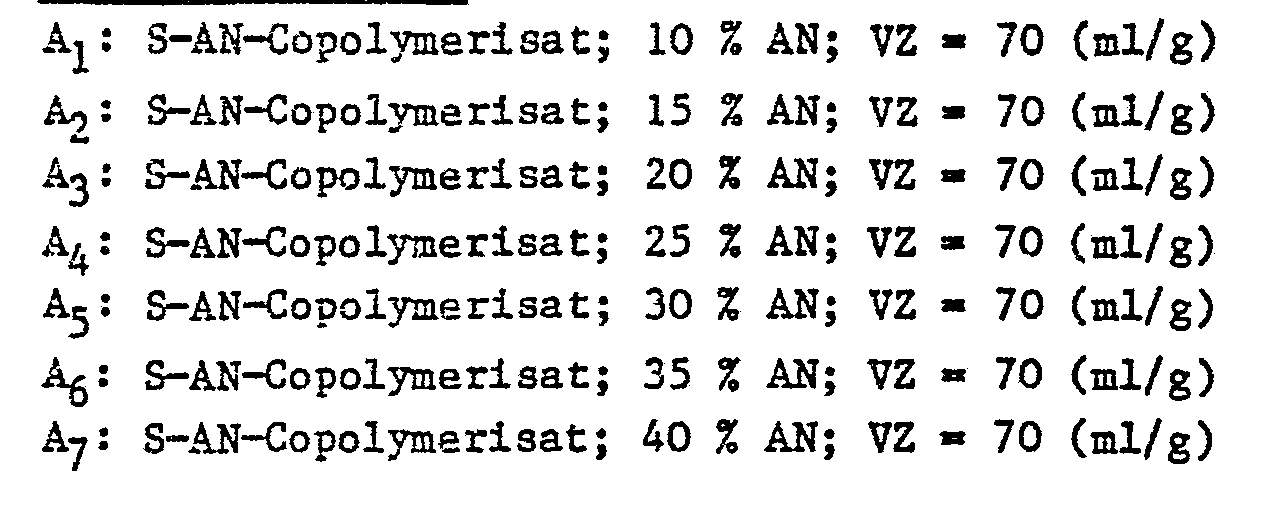
- Komponenten A1-A7
- Komponenten B1-B5

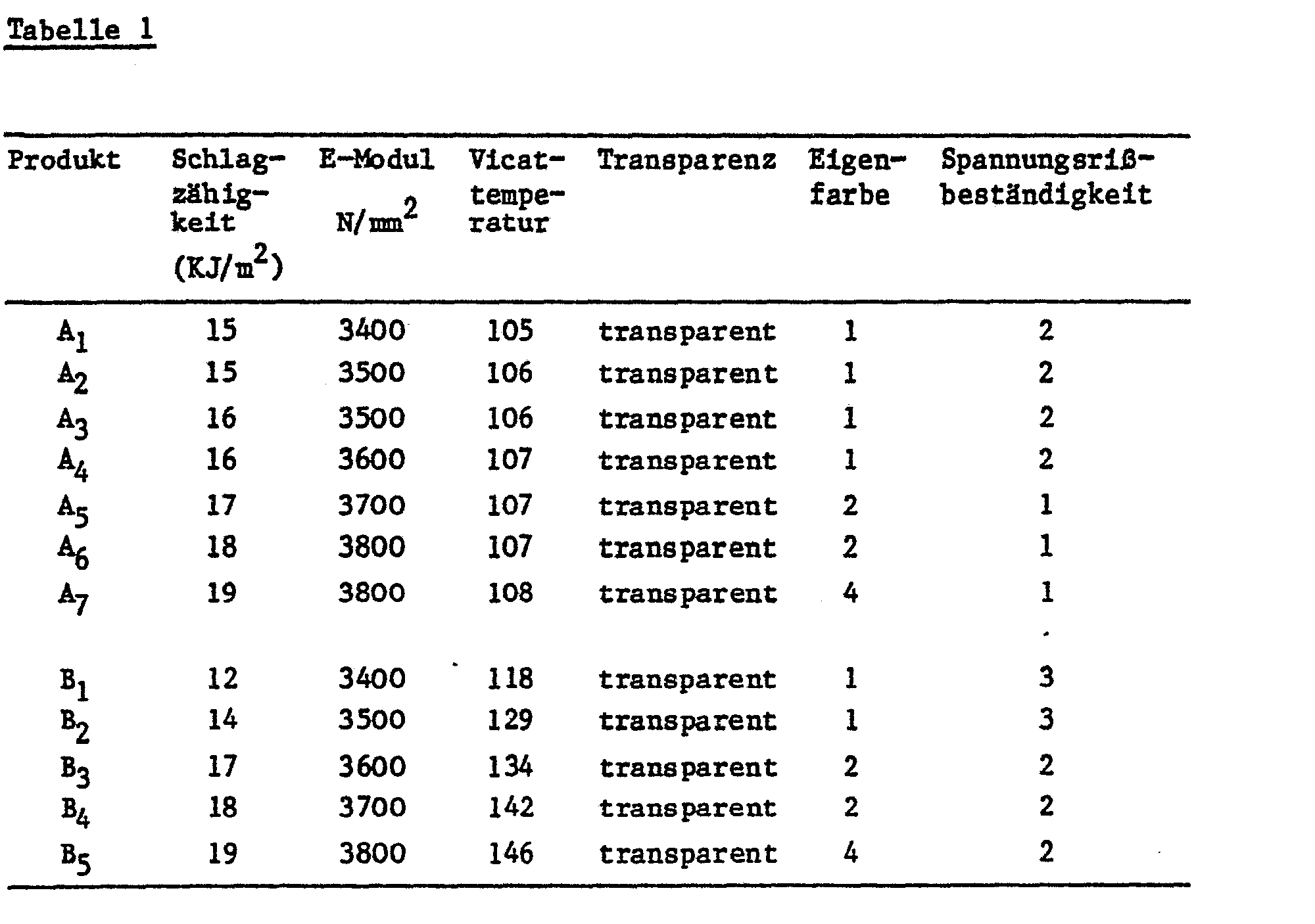
- Weitere Eigenschaften der Komponenten A1-A7 und B1-B5 sind in der Tabelle 1 aufgeführt.
-
- C1: Tetrabrombisphenol A
- C2: Dreiblockcopolymeres der Formel X-Y-X, das einen zentralen Polypropylenoxidblock mit einem Anteil von 90 Gew.% und an den beiden Enden Polyethylenoxidblöcke von zusammen 10 Gew.% aufweist.
- C3: Octadecylalkohol
- C4: Zn-stearat
- Die erfindungsgemäßen Formmassen werden in den nachfolgenden Beispielen näher erläutert, ohne daß damit eine Einschränkung vorgenommen werden soll, wobei die angegebenen Prozente Gewichtsprozente sind, sofern nicht anders vermerkt ist.
- Die Komponenten der Formmassen der Beispiele und der Vergleichsversuche wurden in den in der Tabelle 2 genannten Mengen in einem Fluidmischer vorgemischt und anschließend auf einem Kokneter bei etwa 220 bis 230°C unter Stickstoff innig verknetet. Die Verweilzeit betrug etwa 4 Minuten. Das dabei erhaltene Granulat wurde auf einer Einwellen-Extruder-Schnecke aufgeschmolzen und zu gleichmäßigen, für die Spritzgußverarbeitung geeignetem Granulat abgeschlagen. In der Tabelle 2 sind außerdem die Eigenschaften der erhaltenen Mischungen aufgeführt.


gegebenenfalls enthaltend
Claims (6)
dadurch gekennzeichnet, daß das Gewichtsverhältnis der Comonomeren a2) zu b2) in den Copolymerisaten A) und B)

und
wobei das Gewichtsverhältnis der Comonomeren a2) zu b2) in den Copolymerisaten A) und B)
und
wobei das Gewichtsverhältnis der Comonomeren a2) zu b2) in den Copolymerisaten A) und B)

Applications Claiming Priority (2)
| Application Number | Priority Date | Filing Date | Title |
|---|---|---|---|
| DE19833332327 DE3332327A1 (de) | 1983-09-08 | 1983-09-08 | Thermoplastische formmasse |
| DE3332327 | 1983-09-08 |
Publications (2)
| Publication Number | Publication Date |
|---|---|
| EP0137296A2 true EP0137296A2 (de) | 1985-04-17 |
| EP0137296A3 EP0137296A3 (de) | 1985-11-21 |
Family
ID=6208496
Family Applications (1)
| Application Number | Title | Priority Date | Filing Date |
|---|---|---|---|
| EP84110450A Withdrawn EP0137296A3 (de) | 1983-09-08 | 1984-09-03 | Thermoplastische Formmasse |
Country Status (2)
| Country | Link |
|---|---|
| EP (1) | EP0137296A3 (de) |
| DE (1) | DE3332327A1 (de) |
Cited By (3)
| Publication number | Priority date | Publication date | Assignee | Title |
|---|---|---|---|---|
| EP0201966A1 (de) * | 1985-05-03 | 1986-11-20 | Stamicarbon B.V. | Polymerzusammensetzung |
| EP0464540A1 (de) * | 1990-07-06 | 1992-01-08 | Bayer Ag | Polymerlegierungen |
| NL1017503C2 (nl) * | 2001-03-06 | 2002-09-09 | Dsm Nv | Ketenvertakkingsmiddel en polyamidesamenstelling die dit bevat. |
Families Citing this family (1)
| Publication number | Priority date | Publication date | Assignee | Title |
|---|---|---|---|---|
| US5151464A (en) * | 1991-08-30 | 1992-09-29 | Arco Chemical Technology, L.P. | Miscible polyblends of acid-and anhydride-containing copolymers |
Family Cites Families (1)
| Publication number | Priority date | Publication date | Assignee | Title |
|---|---|---|---|---|
| DE1950599A1 (de) * | 1969-10-08 | 1971-04-15 | Basf Ag | Thermoplastische Formmassen |
-
1983
- 1983-09-08 DE DE19833332327 patent/DE3332327A1/de not_active Withdrawn
-
1984
- 1984-09-03 EP EP84110450A patent/EP0137296A3/de not_active Withdrawn
Cited By (5)
| Publication number | Priority date | Publication date | Assignee | Title |
|---|---|---|---|---|
| EP0201966A1 (de) * | 1985-05-03 | 1986-11-20 | Stamicarbon B.V. | Polymerzusammensetzung |
| EP0464540A1 (de) * | 1990-07-06 | 1992-01-08 | Bayer Ag | Polymerlegierungen |
| NL1017503C2 (nl) * | 2001-03-06 | 2002-09-09 | Dsm Nv | Ketenvertakkingsmiddel en polyamidesamenstelling die dit bevat. |
| WO2002070605A1 (en) * | 2001-03-06 | 2002-09-12 | Dsm Ip Assets B.V. | Chain branching agent and polyamide composition containing the same |
| KR100859066B1 (ko) * | 2001-03-06 | 2008-09-17 | 디에스엠 아이피 어셋츠 비.브이. | 사슬 가지화제 및 이를 포함하는 폴리아미드 조성물 |
Also Published As
| Publication number | Publication date |
|---|---|
| EP0137296A3 (de) | 1985-11-21 |
| DE3332327A1 (de) | 1985-03-28 |
Similar Documents
| Publication | Publication Date | Title |
|---|---|---|
| DE69719751T2 (de) | Mischungen mit cycloolefin-polymer mit verbesserter schlagbeständigkeit ung guter transparenz | |
| DE69129958T2 (de) | Flammhemmende Mischungen von Polycarbonat, ABS und Polyalkylmethacrylat mit erhöhter Zusammenschweissnahtfestigkeit | |
| EP0545181B1 (de) | Thermoplastische Formmasse | |
| DE2418763B2 (de) | Thermoplastische schlagfeste und ermuedungsbestaendige formmasse aus einem polyphenylenoxyd, einem kautschukmodifizierten polystyrol und einem aromatischen polycarbonat | |
| DE2125429C3 (de) | Synthetische, thermoplastische Harzmasse | |
| DE3782567T2 (de) | Mischungen auf basis von polycarbonaten mit verbesserten physikalischen und chemischen eigenschaften. | |
| DE2024940A1 (de) | Thermoplastische Formmassen | |
| DE3332325A1 (de) | Thermoplastische formmasse | |
| EP0137295B1 (de) | Thermoplastische Formmasse | |
| EP0546356B1 (de) | Thermoplastische Formmasse | |
| DE3730026A1 (de) | Vertraegliche polymermischungen (ii) | |
| EP0006562B1 (de) | Transparente schlagzähe Formmassen und Formteile aus diesen | |
| DE3730886A1 (de) | Transparente, schlagfeste thermoplastische formmasse, verfahren zur herstellung derselben und ihre verwendung | |
| EP0071786A1 (de) | Thermoplastische Formmasse | |
| DE4113826A1 (de) | Propylenharzmasse | |
| EP0352455A1 (de) | Schlagzähe Polymethylmethacrylat-Formmasse | |
| DE3332327A1 (de) | Thermoplastische formmasse | |
| EP0200184A1 (de) | Verstärkte thermoplastische Formmasse | |
| DE3689601T2 (de) | Gemische aus vinylaromatischen Polymeren mit Festigkeit und Schlagzähigkeit. | |
| DE69124027T2 (de) | Thermoplastische Harzzusammensetzung | |
| DE3130774A1 (de) | Thermoplastische formmasse | |
| DE3788857T2 (de) | Mischungen auf der Basis von vinylaromatischen Polymeren mit hohem Formfliessvermögen und Wärmebeständigkeit. | |
| EP0306785A2 (de) | Verträgliche Polymermischungen (I) | |
| DE4431733A1 (de) | Transparente, schlagzähe Formmassen mit hoher Fließfähigkeit | |
| EP0271766B1 (de) | Thermoplastische Formmassen |
Legal Events
| Date | Code | Title | Description |
|---|---|---|---|
| PUAI | Public reference made under article 153(3) epc to a published international application that has entered the european phase |
Free format text: ORIGINAL CODE: 0009012 |
|
| AK | Designated contracting states |
Designated state(s): BE DE FR GB NL |
|
| RTI1 | Title (correction) | ||
| PUAL | Search report despatched |
Free format text: ORIGINAL CODE: 0009013 |
|
| AK | Designated contracting states |
Designated state(s): BE DE FR GB NL |
|
| 17P | Request for examination filed |
Effective date: 19851003 |
|
| 17Q | First examination report despatched |
Effective date: 19870217 |
|
| STAA | Information on the status of an ep patent application or granted ep patent |
Free format text: STATUS: THE APPLICATION HAS BEEN WITHDRAWN |
|
| 18W | Application withdrawn |
Withdrawal date: 19870930 |
|
| RIN1 | Information on inventor provided before grant (corrected) |
Inventor name: JUNG, RUDOLF H. DR. Inventor name: ECHTE, ADOLF, DR. Inventor name: ILLERS, KARL HEINZ, DR. Inventor name: HAMBRECHT, JUERGEN, DR. Inventor name: SWOBODA, JOHANN, DR. |