EP0130454A2 - Verfahren zur Herstellung von Reaktionsharzformstoffen - Google Patents
Verfahren zur Herstellung von Reaktionsharzformstoffen Download PDFInfo
- Publication number
- EP0130454A2 EP0130454A2 EP84106960A EP84106960A EP0130454A2 EP 0130454 A2 EP0130454 A2 EP 0130454A2 EP 84106960 A EP84106960 A EP 84106960A EP 84106960 A EP84106960 A EP 84106960A EP 0130454 A2 EP0130454 A2 EP 0130454A2
- Authority
- EP
- European Patent Office
- Prior art keywords
- icr
- molding materials
- resins
- materials according
- production
- Prior art date
- Legal status (The legal status is an assumption and is not a legal conclusion. Google has not performed a legal analysis and makes no representation as to the accuracy of the status listed.)
- Granted
Links
- 229920005989 resin Polymers 0.000 title claims abstract description 89
- 239000011347 resin Substances 0.000 title claims abstract description 89
- 238000000034 method Methods 0.000 title claims description 29
- 230000008569 process Effects 0.000 title claims description 27
- 238000002360 preparation method Methods 0.000 title claims description 13
- 238000000465 moulding Methods 0.000 title description 8
- 239000012778 molding material Substances 0.000 claims abstract description 46
- 239000003054 catalyst Substances 0.000 claims abstract description 31
- 238000006243 chemical reaction Methods 0.000 claims abstract description 22
- 229920000647 polyepoxide Polymers 0.000 claims abstract description 19
- IZXIZTKNFFYFOF-UHFFFAOYSA-N 2-Oxazolidone Chemical compound O=C1NCCO1 IZXIZTKNFFYFOF-UHFFFAOYSA-N 0.000 claims abstract description 17
- 238000004519 manufacturing process Methods 0.000 claims abstract description 17
- 239000004593 Epoxy Substances 0.000 claims abstract description 16
- 150000001412 amines Chemical class 0.000 claims abstract description 14
- 239000005056 polyisocyanate Substances 0.000 claims abstract description 14
- 229920001228 polyisocyanate Polymers 0.000 claims abstract description 14
- 150000002460 imidazoles Chemical class 0.000 claims abstract description 13
- IQPQWNKOIGAROB-UHFFFAOYSA-N isocyanate group Chemical group [N-]=C=O IQPQWNKOIGAROB-UHFFFAOYSA-N 0.000 claims abstract description 13
- 239000000203 mixture Substances 0.000 claims abstract description 13
- 238000004132 cross linking Methods 0.000 claims abstract description 12
- 125000003700 epoxy group Chemical group 0.000 claims abstract description 12
- ZFSLODLOARCGLH-UHFFFAOYSA-N isocyanuric acid Chemical group OC1=NC(O)=NC(O)=N1 ZFSLODLOARCGLH-UHFFFAOYSA-N 0.000 claims abstract description 11
- 238000011417 postcuring Methods 0.000 claims abstract description 3
- -1 1,2-dimethylimidazolium tetraphenylborate Chemical compound 0.000 claims description 10
- 239000000463 material Substances 0.000 claims description 10
- 239000000654 additive Substances 0.000 claims description 5
- WTEOIRVLGSZEPR-UHFFFAOYSA-N boron trifluoride Chemical compound FB(F)F WTEOIRVLGSZEPR-UHFFFAOYSA-N 0.000 claims description 5
- 239000010453 quartz Substances 0.000 claims description 5
- VYPSYNLAJGMNEJ-UHFFFAOYSA-N silicon dioxide Inorganic materials O=[Si]=O VYPSYNLAJGMNEJ-UHFFFAOYSA-N 0.000 claims description 5
- 239000000945 filler Substances 0.000 claims description 4
- 239000000843 powder Substances 0.000 claims description 4
- 150000003839 salts Chemical class 0.000 claims description 4
- XZKLXPPYISZJCV-UHFFFAOYSA-N 1-benzyl-2-phenylimidazole Chemical compound C1=CN=C(C=2C=CC=CC=2)N1CC1=CC=CC=C1 XZKLXPPYISZJCV-UHFFFAOYSA-N 0.000 claims description 3
- 229910015900 BF3 Inorganic materials 0.000 claims description 3
- 239000000370 acceptor Substances 0.000 claims description 3
- XXBDWLFCJWSEKW-UHFFFAOYSA-N dimethylbenzylamine Chemical compound CN(C)CC1=CC=CC=C1 XXBDWLFCJWSEKW-UHFFFAOYSA-N 0.000 claims description 3
- ZOXJGFHDIHLPTG-UHFFFAOYSA-N Boron Chemical compound [B] ZOXJGFHDIHLPTG-UHFFFAOYSA-N 0.000 claims description 2
- KXHPPCXNWTUNSB-UHFFFAOYSA-M benzyl(trimethyl)azanium;chloride Chemical compound [Cl-].C[N+](C)(C)CC1=CC=CC=C1 KXHPPCXNWTUNSB-UHFFFAOYSA-M 0.000 claims description 2
- 229910052796 boron Inorganic materials 0.000 claims description 2
- 239000010459 dolomite Substances 0.000 claims description 2
- 229910000514 dolomite Inorganic materials 0.000 claims description 2
- 239000012765 fibrous filler Substances 0.000 claims description 2
- 229910052500 inorganic mineral Inorganic materials 0.000 claims description 2
- 239000012764 mineral filler Substances 0.000 claims description 2
- TWNQGVIAIRXVLR-UHFFFAOYSA-N oxo(oxoalumanyloxy)alumane Chemical compound O=[Al]O[Al]=O TWNQGVIAIRXVLR-UHFFFAOYSA-N 0.000 claims description 2
- PCCVSPMFGIFTHU-UHFFFAOYSA-N tetracyanoquinodimethane Chemical compound N#CC(C#N)=C1C=CC(=C(C#N)C#N)C=C1 PCCVSPMFGIFTHU-UHFFFAOYSA-N 0.000 claims description 2
- FAQYAMRNWDIXMY-UHFFFAOYSA-N trichloroborane Chemical compound ClB(Cl)Cl FAQYAMRNWDIXMY-UHFFFAOYSA-N 0.000 claims description 2
- 238000004804 winding Methods 0.000 claims description 2
- RTZKZFJDLAIYFH-UHFFFAOYSA-N Diethyl ether Chemical compound CCOCC RTZKZFJDLAIYFH-UHFFFAOYSA-N 0.000 description 10
- 150000001875 compounds Chemical class 0.000 description 10
- 239000012948 isocyanate Substances 0.000 description 9
- 239000003822 epoxy resin Substances 0.000 description 8
- 230000015572 biosynthetic process Effects 0.000 description 7
- LNEPOXFFQSENCJ-UHFFFAOYSA-N haloperidol Chemical compound C1CC(O)(C=2C=CC(Cl)=CC=2)CCN1CCCC(=O)C1=CC=C(F)C=C1 LNEPOXFFQSENCJ-UHFFFAOYSA-N 0.000 description 7
- SJRJJKPEHAURKC-UHFFFAOYSA-N N-Methylmorpholine Chemical compound CN1CCOCC1 SJRJJKPEHAURKC-UHFFFAOYSA-N 0.000 description 6
- 230000009477 glass transition Effects 0.000 description 6
- 125000003698 tetramethyl group Chemical group [H]C([H])([H])* 0.000 description 5
- UPMLOUAZCHDJJD-UHFFFAOYSA-N 4,4'-Diphenylmethane Diisocyanate Chemical compound C1=CC(N=C=O)=CC=C1CC1=CC=C(N=C=O)C=C1 UPMLOUAZCHDJJD-UHFFFAOYSA-N 0.000 description 4
- 150000008065 acid anhydrides Chemical class 0.000 description 4
- 239000007859 condensation product Substances 0.000 description 4
- 150000002513 isocyanates Chemical class 0.000 description 4
- LCFVJGUPQDGYKZ-UHFFFAOYSA-N Bisphenol A diglycidyl ether Chemical compound C=1C=C(OCC2OC2)C=CC=1C(C)(C)C(C=C1)=CC=C1OCC1CO1 LCFVJGUPQDGYKZ-UHFFFAOYSA-N 0.000 description 3
- WSFSSNUMVMOOMR-UHFFFAOYSA-N Formaldehyde Chemical compound O=C WSFSSNUMVMOOMR-UHFFFAOYSA-N 0.000 description 3
- 125000001931 aliphatic group Chemical group 0.000 description 3
- 229920001577 copolymer Polymers 0.000 description 3
- 125000005442 diisocyanate group Chemical group 0.000 description 3
- 150000002148 esters Chemical class 0.000 description 3
- 229920003986 novolac Polymers 0.000 description 3
- 229920000642 polymer Polymers 0.000 description 3
- 238000012545 processing Methods 0.000 description 3
- 239000011342 resin composition Substances 0.000 description 3
- 238000003756 stirring Methods 0.000 description 3
- GIWQSPITLQVMSG-UHFFFAOYSA-N 1,2-dimethylimidazole Chemical compound CC1=NC=CN1C GIWQSPITLQVMSG-UHFFFAOYSA-N 0.000 description 2
- KPZGRMZPZLOPBS-UHFFFAOYSA-N 1,3-dichloro-2,2-bis(chloromethyl)propane Chemical compound ClCC(CCl)(CCl)CCl KPZGRMZPZLOPBS-UHFFFAOYSA-N 0.000 description 2
- RXYPXQSKLGGKOL-UHFFFAOYSA-N 1,4-dimethylpiperazine Chemical compound CN1CCN(C)CC1 RXYPXQSKLGGKOL-UHFFFAOYSA-N 0.000 description 2
- PAMIQIKDUOTOBW-UHFFFAOYSA-N 1-methylpiperidine Chemical compound CN1CCCCC1 PAMIQIKDUOTOBW-UHFFFAOYSA-N 0.000 description 2
- KAKZBPTYRLMSJV-UHFFFAOYSA-N Butadiene Chemical compound C=CC=C KAKZBPTYRLMSJV-UHFFFAOYSA-N 0.000 description 2
- LFQSCWFLJHTTHZ-UHFFFAOYSA-N Ethanol Chemical compound CCO LFQSCWFLJHTTHZ-UHFFFAOYSA-N 0.000 description 2
- 241000428199 Mustelinae Species 0.000 description 2
- ISWSIDIOOBJBQZ-UHFFFAOYSA-N Phenol Chemical compound OC1=CC=CC=C1 ISWSIDIOOBJBQZ-UHFFFAOYSA-N 0.000 description 2
- KKEYFWRCBNTPAC-UHFFFAOYSA-N Terephthalic acid Chemical compound OC(=O)C1=CC=C(C(O)=O)C=C1 KKEYFWRCBNTPAC-UHFFFAOYSA-N 0.000 description 2
- XUCHXOAWJMEFLF-UHFFFAOYSA-N bisphenol F diglycidyl ether Chemical compound C1OC1COC(C=C1)=CC=C1CC(C=C1)=CC=C1OCC1CO1 XUCHXOAWJMEFLF-UHFFFAOYSA-N 0.000 description 2
- 125000003178 carboxy group Chemical group [H]OC(*)=O 0.000 description 2
- 238000005266 casting Methods 0.000 description 2
- 238000004870 electrical engineering Methods 0.000 description 2
- 238000005538 encapsulation Methods 0.000 description 2
- 125000000623 heterocyclic group Chemical group 0.000 description 2
- 230000006872 improvement Effects 0.000 description 2
- 238000011835 investigation Methods 0.000 description 2
- 239000007788 liquid Substances 0.000 description 2
- 238000002156 mixing Methods 0.000 description 2
- UQKAOOAFEFCDGT-UHFFFAOYSA-N n,n-dimethyloctan-1-amine Chemical compound CCCCCCCCN(C)C UQKAOOAFEFCDGT-UHFFFAOYSA-N 0.000 description 2
- 150000002924 oxiranes Chemical class 0.000 description 2
- 239000011541 reaction mixture Substances 0.000 description 2
- 239000002904 solvent Substances 0.000 description 2
- 239000000126 substance Substances 0.000 description 2
- 238000012360 testing method Methods 0.000 description 2
- 239000013638 trimer Substances 0.000 description 2
- WLUJHMKCLOIRSK-UHFFFAOYSA-N 1,2,4,5-tetramethylimidazole Chemical compound CC=1N=C(C)N(C)C=1C WLUJHMKCLOIRSK-UHFFFAOYSA-N 0.000 description 1
- IZUKQUVSCNEFMJ-UHFFFAOYSA-N 1,2-dinitrobenzene Chemical compound [O-][N+](=O)C1=CC=CC=C1[N+]([O-])=O IZUKQUVSCNEFMJ-UHFFFAOYSA-N 0.000 description 1
- OUPZKGBUJRBPGC-UHFFFAOYSA-N 1,3,5-tris(oxiran-2-ylmethyl)-1,3,5-triazinane-2,4,6-trione Chemical compound O=C1N(CC2OC2)C(=O)N(CC2OC2)C(=O)N1CC1CO1 OUPZKGBUJRBPGC-UHFFFAOYSA-N 0.000 description 1
- PCHXZXKMYCGVFA-UHFFFAOYSA-N 1,3-diazetidine-2,4-dione Chemical compound O=C1NC(=O)N1 PCHXZXKMYCGVFA-UHFFFAOYSA-N 0.000 description 1
- SIZPGZFVROGOIR-UHFFFAOYSA-N 1,4-diisocyanatonaphthalene Chemical compound C1=CC=C2C(N=C=O)=CC=C(N=C=O)C2=C1 SIZPGZFVROGOIR-UHFFFAOYSA-N 0.000 description 1
- ONQBOTKLCMXPOF-UHFFFAOYSA-N 1-ethylpyrrolidine Chemical compound CCN1CCCC1 ONQBOTKLCMXPOF-UHFFFAOYSA-N 0.000 description 1
- LFSYUSUFCBOHGU-UHFFFAOYSA-N 1-isocyanato-2-[(4-isocyanatophenyl)methyl]benzene Chemical compound C1=CC(N=C=O)=CC=C1CC1=CC=CC=C1N=C=O LFSYUSUFCBOHGU-UHFFFAOYSA-N 0.000 description 1
- MCTWTZJPVLRJOU-UHFFFAOYSA-N 1-methyl-1H-imidazole Chemical compound CN1C=CN=C1 MCTWTZJPVLRJOU-UHFFFAOYSA-N 0.000 description 1
- AHDSRXYHVZECER-UHFFFAOYSA-N 2,4,6-tris[(dimethylamino)methyl]phenol Chemical compound CN(C)CC1=CC(CN(C)C)=C(O)C(CN(C)C)=C1 AHDSRXYHVZECER-UHFFFAOYSA-N 0.000 description 1
- KOLGWETWPTXLLR-UHFFFAOYSA-N 2-ethyl-4-methyl-1h-imidazol-1-ium;bromide Chemical compound [Br-].CCC=1NC(C)=C[NH+]=1 KOLGWETWPTXLLR-UHFFFAOYSA-N 0.000 description 1
- YTWBFUCJVWKCCK-UHFFFAOYSA-N 2-heptadecyl-1h-imidazole Chemical compound CCCCCCCCCCCCCCCCCC1=NC=CN1 YTWBFUCJVWKCCK-UHFFFAOYSA-N 0.000 description 1
- LXBGSDVWAMZHDD-UHFFFAOYSA-N 2-methyl-1h-imidazole Chemical compound CC1=NC=CN1 LXBGSDVWAMZHDD-UHFFFAOYSA-N 0.000 description 1
- QTWJRLJHJPIABL-UHFFFAOYSA-N 2-methylphenol;3-methylphenol;4-methylphenol Chemical compound CC1=CC=C(O)C=C1.CC1=CC=CC(O)=C1.CC1=CC=CC=C1O QTWJRLJHJPIABL-UHFFFAOYSA-N 0.000 description 1
- LLEASVZEQBICSN-UHFFFAOYSA-N 2-undecyl-1h-imidazole Chemical compound CCCCCCCCCCCC1=NC=CN1 LLEASVZEQBICSN-UHFFFAOYSA-N 0.000 description 1
- UIDDPPKZYZTEGS-UHFFFAOYSA-N 3-(2-ethyl-4-methylimidazol-1-yl)propanenitrile Chemical compound CCC1=NC(C)=CN1CCC#N UIDDPPKZYZTEGS-UHFFFAOYSA-N 0.000 description 1
- BVYPJEBKDLFIDL-UHFFFAOYSA-N 3-(2-phenylimidazol-1-yl)propanenitrile Chemical compound N#CCCN1C=CN=C1C1=CC=CC=C1 BVYPJEBKDLFIDL-UHFFFAOYSA-N 0.000 description 1
- JNRLEMMIVRBKJE-UHFFFAOYSA-N 4,4'-Methylenebis(N,N-dimethylaniline) Chemical compound C1=CC(N(C)C)=CC=C1CC1=CC=C(N(C)C)C=C1 JNRLEMMIVRBKJE-UHFFFAOYSA-N 0.000 description 1
- AHIPJALLQVEEQF-UHFFFAOYSA-N 4-(oxiran-2-ylmethoxy)-n,n-bis(oxiran-2-ylmethyl)aniline Chemical compound C1OC1COC(C=C1)=CC=C1N(CC1OC1)CC1CO1 AHIPJALLQVEEQF-UHFFFAOYSA-N 0.000 description 1
- HLBLWEWZXPIGSM-UHFFFAOYSA-N 4-Aminophenyl ether Chemical compound C1=CC(N)=CC=C1OC1=CC=C(N)C=C1 HLBLWEWZXPIGSM-UHFFFAOYSA-N 0.000 description 1
- UNDWHSZYMRZIOB-UHFFFAOYSA-N 4-ethylmorpholin-4-ium;bromide Chemical compound Br.CCN1CCOCC1 UNDWHSZYMRZIOB-UHFFFAOYSA-N 0.000 description 1
- HVCNXQOWACZAFN-UHFFFAOYSA-N 4-ethylmorpholine Chemical compound CCN1CCOCC1 HVCNXQOWACZAFN-UHFFFAOYSA-N 0.000 description 1
- ULKLGIFJWFIQFF-UHFFFAOYSA-N 5K8XI641G3 Chemical compound CCC1=NC=C(C)N1 ULKLGIFJWFIQFF-UHFFFAOYSA-N 0.000 description 1
- WWAHJQHDOHXANX-UHFFFAOYSA-N 6-[1-(2-phenylimidazol-1-yl)ethyl]-1,3,5-triazine-2,4-diamine Chemical compound C1=CN=C(C=2C=CC=CC=2)N1C(C)C1=NC(N)=NC(N)=N1 WWAHJQHDOHXANX-UHFFFAOYSA-N 0.000 description 1
- YXALYBMHAYZKAP-UHFFFAOYSA-N 7-oxabicyclo[4.1.0]heptan-4-ylmethyl 7-oxabicyclo[4.1.0]heptane-4-carboxylate Chemical compound C1CC2OC2CC1C(=O)OCC1CC2OC2CC1 YXALYBMHAYZKAP-UHFFFAOYSA-N 0.000 description 1
- NLHHRLWOUZZQLW-UHFFFAOYSA-N Acrylonitrile Chemical compound C=CC#N NLHHRLWOUZZQLW-UHFFFAOYSA-N 0.000 description 1
- 239000005995 Aluminium silicate Substances 0.000 description 1
- 102100035526 B melanoma antigen 1 Human genes 0.000 description 1
- KXDHJXZQYSOELW-UHFFFAOYSA-M Carbamate Chemical compound NC([O-])=O KXDHJXZQYSOELW-UHFFFAOYSA-M 0.000 description 1
- OKTJSMMVPCPJKN-UHFFFAOYSA-N Carbon Chemical compound [C] OKTJSMMVPCPJKN-UHFFFAOYSA-N 0.000 description 1
- 229920000049 Carbon (fiber) Polymers 0.000 description 1
- 101000874316 Homo sapiens B melanoma antigen 1 Proteins 0.000 description 1
- 238000004566 IR spectroscopy Methods 0.000 description 1
- KWYHDKDOAIKMQN-UHFFFAOYSA-N N,N,N',N'-tetramethylethylenediamine Chemical compound CN(C)CCN(C)C KWYHDKDOAIKMQN-UHFFFAOYSA-N 0.000 description 1
- UEEJHVSXFDXPFK-UHFFFAOYSA-N N-dimethylaminoethanol Chemical compound CN(C)CCO UEEJHVSXFDXPFK-UHFFFAOYSA-N 0.000 description 1
- 239000004721 Polyphenylene oxide Substances 0.000 description 1
- 239000002253 acid Substances 0.000 description 1
- 230000002378 acidificating effect Effects 0.000 description 1
- 230000000996 additive effect Effects 0.000 description 1
- 239000002318 adhesion promoter Substances 0.000 description 1
- 235000012211 aluminium silicate Nutrition 0.000 description 1
- 238000004458 analytical method Methods 0.000 description 1
- 229940111121 antirheumatic drug quinolines Drugs 0.000 description 1
- 125000003118 aryl group Chemical group 0.000 description 1
- 238000005452 bending Methods 0.000 description 1
- 230000008901 benefit Effects 0.000 description 1
- 239000004305 biphenyl Substances 0.000 description 1
- 235000010290 biphenyl Nutrition 0.000 description 1
- 125000006267 biphenyl group Chemical group 0.000 description 1
- 150000001718 carbodiimides Chemical class 0.000 description 1
- 239000006229 carbon black Substances 0.000 description 1
- 239000004917 carbon fiber Substances 0.000 description 1
- 230000008859 change Effects 0.000 description 1
- 239000003086 colorant Substances 0.000 description 1
- 229930003836 cresol Natural products 0.000 description 1
- 229940118056 cresol / formaldehyde Drugs 0.000 description 1
- 229920006037 cross link polymer Polymers 0.000 description 1
- 229960002887 deanol Drugs 0.000 description 1
- 235000014113 dietary fatty acids Nutrition 0.000 description 1
- 239000000539 dimer Substances 0.000 description 1
- 239000000975 dye Substances 0.000 description 1
- 239000000194 fatty acid Substances 0.000 description 1
- 229930195729 fatty acid Natural products 0.000 description 1
- 150000004665 fatty acids Chemical class 0.000 description 1
- 230000002349 favourable effect Effects 0.000 description 1
- 239000000835 fiber Substances 0.000 description 1
- 125000000524 functional group Chemical group 0.000 description 1
- 239000011521 glass Substances 0.000 description 1
- 239000003365 glass fiber Substances 0.000 description 1
- 239000010439 graphite Substances 0.000 description 1
- 229910002804 graphite Inorganic materials 0.000 description 1
- RRAMGCGOFNQTLD-UHFFFAOYSA-N hexamethylene diisocyanate Chemical compound O=C=NCCCCCCN=C=O RRAMGCGOFNQTLD-UHFFFAOYSA-N 0.000 description 1
- WJRBRSLFGCUECM-UHFFFAOYSA-N hydantoin Chemical compound O=C1CNC(=O)N1 WJRBRSLFGCUECM-UHFFFAOYSA-N 0.000 description 1
- 229940091173 hydantoin Drugs 0.000 description 1
- 125000002887 hydroxy group Chemical group [H]O* 0.000 description 1
- 238000005470 impregnation Methods 0.000 description 1
- 238000009413 insulation Methods 0.000 description 1
- NIMLQBUJDJZYEJ-UHFFFAOYSA-N isophorone diisocyanate Chemical compound CC1(C)CC(N=C=O)CC(C)(CN=C=O)C1 NIMLQBUJDJZYEJ-UHFFFAOYSA-N 0.000 description 1
- NLYAJNPCOHFWQQ-UHFFFAOYSA-N kaolin Chemical compound O.O.O=[Al]O[Si](=O)O[Si](=O)O[Al]=O NLYAJNPCOHFWQQ-UHFFFAOYSA-N 0.000 description 1
- 239000011159 matrix material Substances 0.000 description 1
- 238000005259 measurement Methods 0.000 description 1
- 239000010445 mica Substances 0.000 description 1
- 229910052618 mica group Inorganic materials 0.000 description 1
- 150000002780 morpholines Chemical class 0.000 description 1
- XCOHAFVJQZPUKF-UHFFFAOYSA-M octyltrimethylammonium bromide Chemical compound [Br-].CCCCCCCC[N+](C)(C)C XCOHAFVJQZPUKF-UHFFFAOYSA-M 0.000 description 1
- IGALFTFNPPBUDN-UHFFFAOYSA-N phenyl-[2,3,4,5-tetrakis(oxiran-2-ylmethyl)phenyl]methanediamine Chemical compound C=1C(CC2OC2)=C(CC2OC2)C(CC2OC2)=C(CC2OC2)C=1C(N)(N)C1=CC=CC=C1 IGALFTFNPPBUDN-UHFFFAOYSA-N 0.000 description 1
- ZUOUZKKEUPVFJK-UHFFFAOYSA-N phenylbenzene Natural products C1=CC=CC=C1C1=CC=CC=C1 ZUOUZKKEUPVFJK-UHFFFAOYSA-N 0.000 description 1
- 229920000570 polyether Polymers 0.000 description 1
- 238000006116 polymerization reaction Methods 0.000 description 1
- 238000004382 potting Methods 0.000 description 1
- 125000002943 quinolinyl group Chemical class N1=C(C=CC2=CC=CC=C12)* 0.000 description 1
- 238000007363 ring formation reaction Methods 0.000 description 1
- 230000035939 shock Effects 0.000 description 1
- 239000012265 solid product Substances 0.000 description 1
- 239000003381 stabilizer Substances 0.000 description 1
- UGNWTBMOAKPKBL-UHFFFAOYSA-N tetrachloro-1,4-benzoquinone Chemical compound ClC1=C(Cl)C(=O)C(Cl)=C(Cl)C1=O UGNWTBMOAKPKBL-UHFFFAOYSA-N 0.000 description 1
- HWCKGOZZJDHMNC-UHFFFAOYSA-M tetraethylammonium bromide Chemical compound [Br-].CC[N+](CC)(CC)CC HWCKGOZZJDHMNC-UHFFFAOYSA-M 0.000 description 1
- YMBCJWGVCUEGHA-UHFFFAOYSA-M tetraethylammonium chloride Chemical compound [Cl-].CC[N+](CC)(CC)CC YMBCJWGVCUEGHA-UHFFFAOYSA-M 0.000 description 1
- 239000004753 textile Substances 0.000 description 1
- 229920001187 thermosetting polymer Polymers 0.000 description 1
- 229910052718 tin Inorganic materials 0.000 description 1
- IMNIMPAHZVJRPE-UHFFFAOYSA-N triethylenediamine Chemical compound C1CN2CCN1CC2 IMNIMPAHZVJRPE-UHFFFAOYSA-N 0.000 description 1
- XLYOFNOQVPJJNP-UHFFFAOYSA-N water Substances O XLYOFNOQVPJJNP-UHFFFAOYSA-N 0.000 description 1
Classifications
-
- C—CHEMISTRY; METALLURGY
- C08—ORGANIC MACROMOLECULAR COMPOUNDS; THEIR PREPARATION OR CHEMICAL WORKING-UP; COMPOSITIONS BASED THEREON
- C08G—MACROMOLECULAR COMPOUNDS OBTAINED OTHERWISE THAN BY REACTIONS ONLY INVOLVING UNSATURATED CARBON-TO-CARBON BONDS
- C08G18/00—Polymeric products of isocyanates or isothiocyanates
- C08G18/003—Polymeric products of isocyanates or isothiocyanates with epoxy compounds having no active hydrogen
-
- H—ELECTRICITY
- H01—ELECTRIC ELEMENTS
- H01B—CABLES; CONDUCTORS; INSULATORS; SELECTION OF MATERIALS FOR THEIR CONDUCTIVE, INSULATING OR DIELECTRIC PROPERTIES
- H01B3/00—Insulators or insulating bodies characterised by the insulating materials; Selection of materials for their insulating or dielectric properties
- H01B3/18—Insulators or insulating bodies characterised by the insulating materials; Selection of materials for their insulating or dielectric properties mainly consisting of organic substances
- H01B3/30—Insulators or insulating bodies characterised by the insulating materials; Selection of materials for their insulating or dielectric properties mainly consisting of organic substances plastics; resins; waxes
- H01B3/302—Polyurethanes or polythiourethanes; Polyurea or polythiourea
-
- H—ELECTRICITY
- H01—ELECTRIC ELEMENTS
- H01B—CABLES; CONDUCTORS; INSULATORS; SELECTION OF MATERIALS FOR THEIR CONDUCTIVE, INSULATING OR DIELECTRIC PROPERTIES
- H01B3/00—Insulators or insulating bodies characterised by the insulating materials; Selection of materials for their insulating or dielectric properties
- H01B3/18—Insulators or insulating bodies characterised by the insulating materials; Selection of materials for their insulating or dielectric properties mainly consisting of organic substances
- H01B3/30—Insulators or insulating bodies characterised by the insulating materials; Selection of materials for their insulating or dielectric properties mainly consisting of organic substances plastics; resins; waxes
- H01B3/40—Insulators or insulating bodies characterised by the insulating materials; Selection of materials for their insulating or dielectric properties mainly consisting of organic substances plastics; resins; waxes epoxy resins
-
- Y—GENERAL TAGGING OF NEW TECHNOLOGICAL DEVELOPMENTS; GENERAL TAGGING OF CROSS-SECTIONAL TECHNOLOGIES SPANNING OVER SEVERAL SECTIONS OF THE IPC; TECHNICAL SUBJECTS COVERED BY FORMER USPC CROSS-REFERENCE ART COLLECTIONS [XRACs] AND DIGESTS
- Y10—TECHNICAL SUBJECTS COVERED BY FORMER USPC
- Y10T—TECHNICAL SUBJECTS COVERED BY FORMER US CLASSIFICATION
- Y10T428/00—Stock material or miscellaneous articles
- Y10T428/31504—Composite [nonstructural laminate]
- Y10T428/31547—Of polyisocyanurate
Definitions
- the invention relates to a process for the preparation of oxazolidinone and isocyanurate ring-containing reactive resin molding materials (OX / ICR molding materials) from reactive resin mixtures of polyepoxides and polyisocyanates (EP / IC resins) in the presence of a curing catalyst, and to the use of such OX / ICR molding materials.
- OX / ICR molding materials reactive resin molding materials
- EP / IC resins reactive resin mixtures of polyepoxides and polyisocyanates
- EP / IC resins give OX / ICR molding materials with high heat resistance when crosslinked (DE-AS 11 15 922 and DE-OS 19 63 900).
- EP / IC resins are described (DE-AS 23 59 386) which have an EP: IC molar ratio of ⁇ 1; these EP / IC resins are made using suitable reaction accelerators, i.e. Hardening catalysts, gelled at temperatures from 70 to 130 ° C and then post-cured at temperatures above 200 ° C.
- suitable reaction accelerators i.e. Hardening catalysts
- Prepolymeric oxazolidinones with terminal epoxy groups have been proposed as suitable polyepoxide components for the EP / IC resins (DE-AS 24 40 953). These oxazolidinone prepolymers are made by reacting polyisocyanates with an excess of a polyepoxide. However, the viscosity of the prepolymers is very high, so that they are difficult to access without solvents.
- Another proposal is to use polyglycidyl esters of dimerized fatty acids in mixtures with other polyepoxides in EP / IC resins (DE-AS 25 45 106).
- the object of the invention is to provide a process which - starting from reaction resin mixtures of polyepoxides and polyisocyanates, so-called EP / IC resins - simplifies the production of heat-resistant OX / ICR molding materials, ie reaction resin molding materials containing oxazolidinone and isocyanurate rings mechanical properties allowed, on the one hand to avoid flexibilizing or elasticizing additives and on the other hand to provide easily processable reaction resin mixtures.
- EP / IC resins with a starting molar ratio of the epoxy and isocyanate groups (EP: IC) of 1 to 5 and a viscosity of up to 7,000 mPa ' s at 25 ° C by means of tert .
- Amines or imidazoles as catalysts at gelling temperatures up to 130 ° C and post-curing temperatures from 130 to 200 ° C to OX / ICR molding materials with a molar ratio of oxazolidinone and isocyanurate rings (OX: ICR)> 1 are crosslinked, the conversion of the epoxy and Isocyanate groups after crosslinking is over 90%.
- the improvement in the mechanical properties can be explained by the fact that a higher content of oxazolidinone and polyoxazolidinone structures is incorporated into the network than in EP / IC resins with a batch molar ratio EP: IC ⁇ 1.
- Isocyanurate structures bring about a close-knit network and stiffen the Polymer chain, so that they primarily affect the glass transition temperature of the molding materials.
- the oxazolidinone structures expand the network and lead to greater mobility of the polymer chain.
- the mechanical-thermal properties of OX / ICR molding materials are therefore primarily determined by the molar ratio of the oxazolidinone and isocyanurate structures built into the network.
- the molar ratio OX: ICR is not only increased in favor of oxazolidinone formation, but can also be controlled in a targeted manner by various measures which are combined with one another.
- the batch molar ratio EP: IC which is in the range between 1 and 5, the type - and possibly the concentration - of the reaction accelerator and the crosslinking temperature.
- each molar ratio OX: ICR can be set in the range between 1 and 5.
- each molar ratio OX: ICR can be set in the range between 1 and 5.
- the values in Table 4 show that this reaction takes place appreciably at temperatures above 130 ° C .; With increasing content of epoxides in the pre-crosslinked EP / IC resin, this reaction intensifies.
- the heat resistance values for EP / IC resins A and B are slightly lower than D, the OX / ICR molding materials with glass transition temperatures up to over 200 ° C still have excellent heat resistance.
- the values for the EP / IC resin C also indicate that with a batch molar ratio EP: IC-> 5, no more OX / ICR molding materials can be expected that can be described as highly heat-resistant.
- the comparison of the values for the OX / ICR molding materials from the EP / IC resins E and F gives a picture analogous to the comparison of the molding materials from the resins A and B with D.
- the values for the EP / IC resin E show further that the selection of special polyepoxide components in the EP / IC resin can increase the heat resistance of the OX / ICR molding materials - with good mechanical properties.
- the targeted adjustment of the molar ratio OX: ICR - and thus the control of the mechanical-thermal property level - can be transferred to the existing manufacturing processes in an excellent manner without additional measures.
- the batch molar ratio EP: IC can only be used in a limited range, namely between 1 and 5, to produce OX / ICR molding materials with an excellent overall property level.
- a further increase in the epoxy content in the batch molar ratio EP: IC to values> 5 is of little importance for the technical use of OX / ICR molding materials in electrical engineering, since the glass transition temperatures of the molding materials drop significantly and the mechanical properties are no longer significantly improved . Molded materials with these mechanical-thermal properties can also be obtained with epoxy resins crosslinked with acid anhydride.
- DE-OS 28 25 614 discloses a process for the preparation of crosslinked polymers by reacting liquid epoxy compounds and polyisocyanates containing at least two epoxy groups in the molecule, and optionally polyhydroxyl compounds, in the presence of curing catalysts at temperatures between room temperature and 250 ° C.
- the quantity ratio can be selected in the reaction of an epoxy compound with a polyisocyanate so that 0.1 to 2 isocyanate groups (preferably 0.3 to 1.2 isocyanate groups) are present in one epoxy group in the starting reaction mixture.
- the condensation product containing isocyanate end groups or the unreacted isocyanate compound-containing condensation product can be present in an equivalent ratio of the isocyanate groups to the polyfunctional epoxy compound of 0.2: 1 to 4: 1.
- the isocyanate compounds present in the resin compositions known from DE-OS 25 43 386 are not only expensive and difficult to produce, they are also difficult to use industrially because their viscosity makes them unusable; namely, there are highly viscous to solid products.
- the known resin compositions are therefore also ruled out for practical use as casting and impregnating resins.
- Another disadvantage of these resins is the relatively high setting temperature.
- the reaction resin mixtures used in the process according to the invention have a low viscosity and are therefore outstandingly suitable as casting and impregnating resins, without the use of a solvent.
- An oxazolidinone-modified epoxy novolak resin is known from DE-AS 21 30 156, which is produced by reacting (a) an epoxy novolak resin and (b) an organic diisocyanate or diisothiocyanate, optionally in the presence of a monohydric alcohol, or a carbamate an organic diisocyanate and a monohydric alcohol is obtained in the presence of catalysts, the ratio of NCO or NCS groups to epoxy groups being kept in the range from 0.1: 1 to 0.5: 1.
- this is not the production of molded materials, but the production of resins, ie soluble compounds.
- These resins are modified epoxy compounds that then - in a known manner - are cured, ie there is a pure epoxy resin curing, but no reaction with isocyanate.
- Relatively low-viscosity aliphatic, cycloaliphatic or aromatic epoxides and mixtures thereof are particularly suitable for the polyepoxides used in the process according to the invention.
- Bisphenol A diglycidyl ether, bisphenol F diglycidyl ether, 3,4-epoxycyclohexylmethyl-3 ', 4'-epoxycyclohexane carboxylate, polyglycidyl ether of phenol / formaldehyde or cresol / formaldehyde novolac, diglycidyl ester of phthalic and isophthalic are preferred - or terephthalic acid and mixtures of these epoxy resins used.
- polyepoxides that can be used are, for example, hydrogenated bisphenol-A or bisphenol-F diglycidyl ether, hydantoin epoxy resins, triglycidyl isocyanurate, triglycidyl p-aminophenol, tetraglycidyl diaminodiphenyl methane, tetraglycidyl diaminodiphenyl ether, epetylphenol ether, tylacetylphenyl ether, tetrazoliphenyl ether, tetrachloride) Handbook of Epoxy Resins "by Henry Lee and Kris Neville, McGraw-Hill Book Company, 1967, and in the monograph by Henry Lee” Epoxy Resins ", American Chemical Society, 1970.
- relatively low-viscosity aliphatic, cycloaliphatic or aromatic isocyanates and mixtures thereof are particularly suitable as polyisocyanates.
- Isomer mixtures of 4,4'- and 2,4'-diphenylmethane diisocyanate, polyol-modified polyisocyanates and mixtures of liquid polyisocyanates with higher molecular weight polyisocyanates or carbodiimide polyisocyanates are preferably used.
- Polyisocyanates that can be used are, for example, hexane-1,6-diisocyanate, cyclohexane-1,3-diisocyanate and isomers, 4,4'-dicyclohexylmethane diisocyanate, 3-isocyanatomethyl-3,5,5-trimethylcyclohexyl isocyanate, 1,3-dimethylbenzene-ii, w 'diisocyanate and isomers, 1-methylbenzene-2,4-diisocyanate and isomers, naphthalene-1,4-diisocyanate, diphenyl ether-4,4'-diisocyanate and isomers, diphenylsulfone-4,4'-diisocyanate and isomers as well as tri- or higher functional isocyanates, such as 3,3 ', 4,4'-diphenylmethane tetraisocyanate.
- isocyanates which are masked with phenol or cresol in the customary manner. Dimers and trimers of the polyvalent isocyanates mentioned can also be used. Such polyisocyanates have terminal free isocyanate groups and contain one or more uretdione and / or isocyanurate rings. Methods for making various types of such trimers and uretdiones are described, for example, in U.S. Patents 3,494,888, 3,108,100 and 2,977,370.
- the EP / IC resins can also contain components which are generally not involved in the chemical reactions which lead to the OX / ICR molding materials.
- Such fillers are mineral and fibrous fillers, such as quartz powder, quartz material, aluminum oxide, glass powder, mica, kaolin, dolomite, graphite and carbon black, as well as carbon fibers, glass fibers and textile fibers. Dyes, stabilizers and adhesion promoters as well as other additives of a conventional type can also be added to the EP / IC resins.
- the catalyst which promotes OX and ICR ring formation during crosslinking plays an important role.
- Amines are, for example, tetramethylethylenediamine, dimethyloctylamine, dimethylaminoethanol, dimethylbenzylamine, 2,4,6-tris (dimethylaminomethyl) phenol, N, N'-tetramethyldiaminodiphenylmethane, N, N'-dimethylpiperazine, N-methylmorpholine, N-methylpiperidine, N -Ethylpyrrolidine, 1,4-diazabicyclo (2,2,2) octane and quinolines.
- Suitable imidazoles are, for example, 1-methylimidazole, 2-methylimidazole, 1,2-dimethylimidazole, 1,2,4,5-tetramethylimidazole, 1-benzyl-2-phenylimidazole, 2-undecylimidazole, 2-heptadecylimidazole, 2-ethyl-4- methylimidazole, 1-cyanoethyl-2-ethyl-4-methylimidazole, 1-cyanoethyl-2-phenylimidazole and 1- (4,6-diamino-s-triazinyl-2-ethyl) -2-phenylimidazole.
- latent curing catalysts in the process according to the invention, which ensure a sufficient service life at low temperatures.
- Addition complexes of boron trihalides with tert are particularly suitable as such catalysts, which are also referred to as latent reaction accelerators.
- Amines and imidazoles for example the addition complexes described in DE-PS 26 55 367 of boron trichloride and tert.
- the analog complexes of boron trifluoride of the formula BF3'NR1R2R3 are also suitable, where R 1 , R 2 and R 3 have the meaning given above.
- suitable tert. Amines of the BF 3 and BC1 3 complexes are octyldimethylamine and benzyldimethylamine.
- Morpholine compounds and imidazoles in particular N-methylmorpholine, N-ethylmorpholine, 1,2-dimethylimidazole and 1-benzyl-2-phenylimidazole, are also suitable for the formation of BC13 or BF 3 complexes.
- An extension of the service life of the EP / IC resins used in the process according to the invention can also be achieved if tert as latent catalysts.
- Amines or imidazoles can be used, which are deactivated by the addition of electron acceptors.
- Suitable electron acceptors are, for example: 7,7,8,8-tetracyanoquinodimethane, 2,4-dichloro-5,6-dicyanobenzoquinone, 2,3,5,6-tetrachlorobenzoquinone and 1,2-dinitrobenzene and isomers thereof.
- Onium salts of tert are also suitable as curing catalysts for the EP / IC resins.
- Amines and imidazoles i.e. Onium salts with N as the central atom.
- Examples of usable onium salts are: tetraethylammonium chloride, tetraethylammonium bromide, octyltrimethylammonium bromide, benzyltrimethylammonium chloride, N-ethylmorpholinium bromide, 2-ethyl-4-methylimidazolium bromide, N-ethylmorpholiniumtetraphenylborylylidylbutyl tetramethyl tetramethyl tetramethyl tetramethyl tetramethyl tetrachloride, 1,2-dimethyl tetramethyl tetrachloride, 1,2-dimethyl tetramethyl tetrachloride, 1,2-dimethyl tetramethyl
- the content of the curing catalyst in the EP / IC resins is advantageously 0.01 to 5% by weight, preferably 0.25 to 2.5% by weight, based on the mass of the resin matrix.
- the type and the concentration of the curing catalyst can influence the curing temperature and the curing time.
- OX / ICR molded materials produced by the process according to the invention are particularly suitable for the impregnation and embedding of electrical windings or for the potting and encapsulation of electrical and electronic components.
- EP / IC resins A, B and C were used.
- the individual components (BAGE, MDI and QM I) were stirred in succession into a mixing container preheated to 80 ° C. and stirred at 80 ° C. for 1 hour under reduced pressure ( ⁇ L1 mbar) degassed.
- the EP / IC resins were then cooled to 60 ° C., the curing catalyst was added, and the EP / IC resins were degassed again at 60 ° C. for 1 hour while stirring and under reduced pressure.
- the EP / IC resins were then poured under reduced pressure into standard rod molds preheated to 100 ° C.
- the crosslinking (curing) of the EP / IC resins took place for 1 hour at 100 ° C., then for 3 hours at 125 ° C. and then for 16 hours at 200 ° C.
- the EP / IC resin D was used.
- the preparation of the EP / IC resin and the production of the standard rod molding samples were carried out analogously to Example 1.
- the measured values are also shown in Table 7.
- the EP / IC resin E was used. The preparation of the resin and the production of the standard rod molding samples was carried out analogously to Example 1. However, the EP / IC resin E was poured into standard rod molds preheated to 125 ° C. and then at 125 for 1 hour ° C and crosslinked and hardened at 200 ° C for 16 hours. The measured values are contained in Table 7.
- the EP / IC resin F was used.
- the preparation of the resin and the production of the standard rod molding samples were carried out analogously to Example 5.
- the measurement results are also shown in Table 7.
- the EP / IC resin G was used.
- the preparation of the resin and the preparation of the standard rod molding samples was carried out analogously to Example 1, but this was the case
- EP / IC resin cooled to 40 ° C before adding the curing catalyst.
- the EP / IC resin was then degassed for 10 minutes at 40 ° C. with stirring and reduced pressure and then poured into standard rod molds preheated to 80 ° C.
- the crosslinking (curing) of the EP / IC resin G took 2 hours at 80 ° C, then 2 hours at 100 ° C, then 2 hours at 150 ° C and then 16 hours at 180 ° C. The values found are listed in Table 7.
- the EP / IC resin H was used.
- the processing of the resin and the preparation of the standard rod molding samples were carried out analogously to Example 1.
- the measured values are shown in Table 7.
- the EP / IC resins I and K were used.
- the processing of the resins and the preparation of the standard rod molding samples were carried out analogously to Example 1.
- the EP / IC resins were cooled to 50 ° C. and then at 20 minutes 50 ° C degassed with stirring and reduced pressure.
- the EP / IC resins were then poured into standard rod molds preheated to 100 ° C. and then cured at 130 ° C. for 4 hours and then at 200 ° C. for 16 hours.
- the measured values are listed in Table 7.
Landscapes
- Chemical & Material Sciences (AREA)
- Spectroscopy & Molecular Physics (AREA)
- Physics & Mathematics (AREA)
- Polymers & Plastics (AREA)
- Chemical Kinetics & Catalysis (AREA)
- Medicinal Chemistry (AREA)
- Health & Medical Sciences (AREA)
- Organic Chemistry (AREA)
- Polyurethanes Or Polyureas (AREA)
- Processes Of Treating Macromolecular Substances (AREA)
- Epoxy Resins (AREA)
- Macromonomer-Based Addition Polymer (AREA)
- Macromolecular Compounds Obtained By Forming Nitrogen-Containing Linkages In General (AREA)
Abstract
Description
- Die Erfindung betrifft ein Verfahren zur Herstellung von Oxazolidinon- und Isocyanuratringe enthaltenden Reaktionsharzformstoffen (OX/ICR-Formstoffe) aus Reaktionsharzmischungen aus Polyepoxiden und Polyisocyanaten (EP/IC-Harze) in Gegenwart eines Härtungskatalysators sowie die Verwendung derartiger OX/ICR-Formstoffe.
- In der Elektrotechnik werden als mechanisch-thermisch hochwertige Reaktionsharzformstoffe überwiegend lösungsmittelfreie, säureanhydrid- oder aminisch vernetzbare Epoxidharze eingesetzt. Die thermischen und mechanischen Eigenschaftsforderungen, welche an diese Reaktionsharzformstoffe gestellt werden, werden aber immer höher, da sich insbesondere der Temperaturbereich, in dem die Formstoffe eingesetzt werden, sowohl nach hohen als auch nach tiefen Belastungstemperaturen, immer mehr erweitert. Eine weitere Erhöhung der Wärmeformbeständigkeit der Formstoffe, bei gleichzeitig hoher mechanischer Festigkeit und Temperaturwechselbeständigkeit, stößt jedoch bei mit Säureanhydriden vernetzten Epoxidharzen auf große Schwierigkeiten. Die naheliegende Möglichkeit zur Anhebung der Wärmeformbeständigkeit, nämlich die Anhebung der Glasumwandlungstemperatur durch Erhöhung der Vernetzungsdichte, führt nur bedingt zum Erfolg, da sich dabei das mechanische Eigenschaftsniveau deutlich verschlechtert.
- Es ist bekannt, daß EP/IC-Harze bei der Vernetzung OX/ICR-Formstoffe mit hoher Wärmeformbeständigkeit ergeben (DE-AS 11 15 922 und DE-OS 19 63 900). Zur Herstellung der OX/ICR-Formstoffe werden dabei EP/IC-Harze beschrieben (DE-AS 23 59 386), die ein Ansatzmolverhältnis EP:IC < 1 besitzen; diese EP/IC-Harze werden mit Hilfe von geeigneten Reaktionsbeschleunigern, d.h. Härtungskatalysatoren, bei Temperaturen von 70 bis 130°C geliert und dann bei Temperaturen bis über 200°C nachgehärtet. Es wird dabei darauf hingewiesen, daß zur Herstellung von OX/ICR-Formstoffen mit hohen Glasumwandlungstemperaturen bei gleichzeitig guten mechanischen Eigenschaften das günstigste Ansatzmolverhältnis EP:IC im Bereich von 0,2 bis 0,7 liegt.
- Eigene Untersuchungen haben zwar die hohe Wärmeformbeständigkeit der auf die genannte Weise hergestellten OX/ICR-Formstoffe bestätigt, sie zeigen gleichzeitig aber auch deutlich, daß die mechanischen Eigenschaften dieser Formstoffe, beispielsweise zur Herstellung von Isolierungen mit größeren Isolierwandstärken oder zur Umhüllung von elektrischen und elektronischen Bauteilen, die einer hohen Temperaturwechselbelastung ausgesetzt sind, nicht ausreichen. Werden beispielsweise EP/IC-Harze (Bisphenol-A-diglycidylether, Diphenylmethandiisocyanat und 66 % Quarzmehl) mit einem Ansatzmolverhältnis EP:IC von 0,2 bis 0,7 nach den angegebenen Vernetzungsbedingungen mit tert. Aminen oder Imidazolen als Reaktionsbeschleuniger vernetzt, dann werden außerordentlich spröde OX/ICR-Formstoffe erhalten, deren mechanische Eigenschaften sich mit steigendem Gehalt an Diphenylmethandiisocyanat im EP/IC-Harz zunehmend verschlechtern.
- Es ist deshalb verständlich, daß bereits auch vorgeschlagen wurde, die mechanischen Eigenschaften von OX/ICR-Formstoffen durch den Einbau flexibilisierender bzw. elastifizierender Komponenten zu verbessern. Als geeignete Polyepoxidkomponente für die EP/IC-Harze wurden dabei präpolymere Oxazolidinone mit terminalen Epoxidgruppen vorgeschlagen (DE-AS 24 40 953). Diese Oxazolidinon-Präpolymeren werden durch Reaktion von Polyisocyanaten mit einem Überschuß eines Polyepoxids hergestellt. Die Viskosität der Präpolymeren liegt jedoch sehr hoch, so daß sie lösungsmittelfrei nur schwer zugänglich sind. Ein weiterer Vorschlag besteht darin, in EP/IC-Harzen Polyglycidylester von dimerisierten Fettsäuren in Mischungen mit anderen Polyepoxiden einzusetzen (DE-AS 25 45 106). Diese Polyglycidylester sind zwar niedrigviskos, sie zeigen jedoch ein schlechtes Mischungsverhalten im EP/IC-Harz. Vorgeschlagen wurde ferner, den EP/IC-Harzen als elastifizierende Komponente Copolymere von Butadien, beispielsweise mit Acrylnitril, zuzusetzen (DE-AS 27 46 789). Die Copolymeren besitzen dabei funktionelle Gruppen, wie Hydroxyl- und Carboxylgruppen, wobei die Carboxylgruppen mit Polyepoxiden umgesetzt sein können. Aufgrund der hohen Viskosität sind diese Copolymere, insbesondere bei füllstoffhaltigen EP/IC-Harzen, jedoch kaum einsetzbar; außerdem sind sie schwer verarbeitbar, da sie eine hohe Entmischungstendenz im EP/IC-Harz zeigen.
- Aufgabe der Erfindung ist es, ein Verfahren anzugeben, das - ausgehend von Reaktionsharzmischungen aus Polyepoxiden und Polyisocyanaten, sogenannten EP/IC-Harzen - eine einfache Herstellung von wärmebeständigen OX/ICR-Formstoffen, d.h. Oxazolidinon- und Isocyanuratringe enthaltenden Reaktionsharzformstoffen, mit verbesserten mechanischen Eigenschaften erlaubt, wobei einerseits auf flexibilisierende bzw. elastifizierende Zusätze verzichtet werden soll und andererseits gut verarbeitbare Reaktionsharzmischungen vorliegen sollen.
- Dies wird erfindungsgemäß dadurch erreicht, daß lösungsmittelfreie gieß- und imprägnierfähige EP/IC-Harze mit einem Ansatzmolverhältnis der Epoxid- und Isocyanatgruppen (EP:IC) von 1 bis 5 und einer Viskosität bis zu 7 000 mPa's bei 25°C mittels tert. Aminen oder Imidazolen als Katalysatoren bei Geliertemperaturen bis 130°C und Nachhärtungstemperaturen von 130 bis 200°C zu OX/ICR-Formstoffen mit einem Molverhältnis der Oxazolidinon- und Isocyanuratringe (OX:ICR)> 1 vernetzt werden, wobei der Umsatz der Epoxid- und Isocyanatgruppen nach der Vernetzung über 90 % liegt.
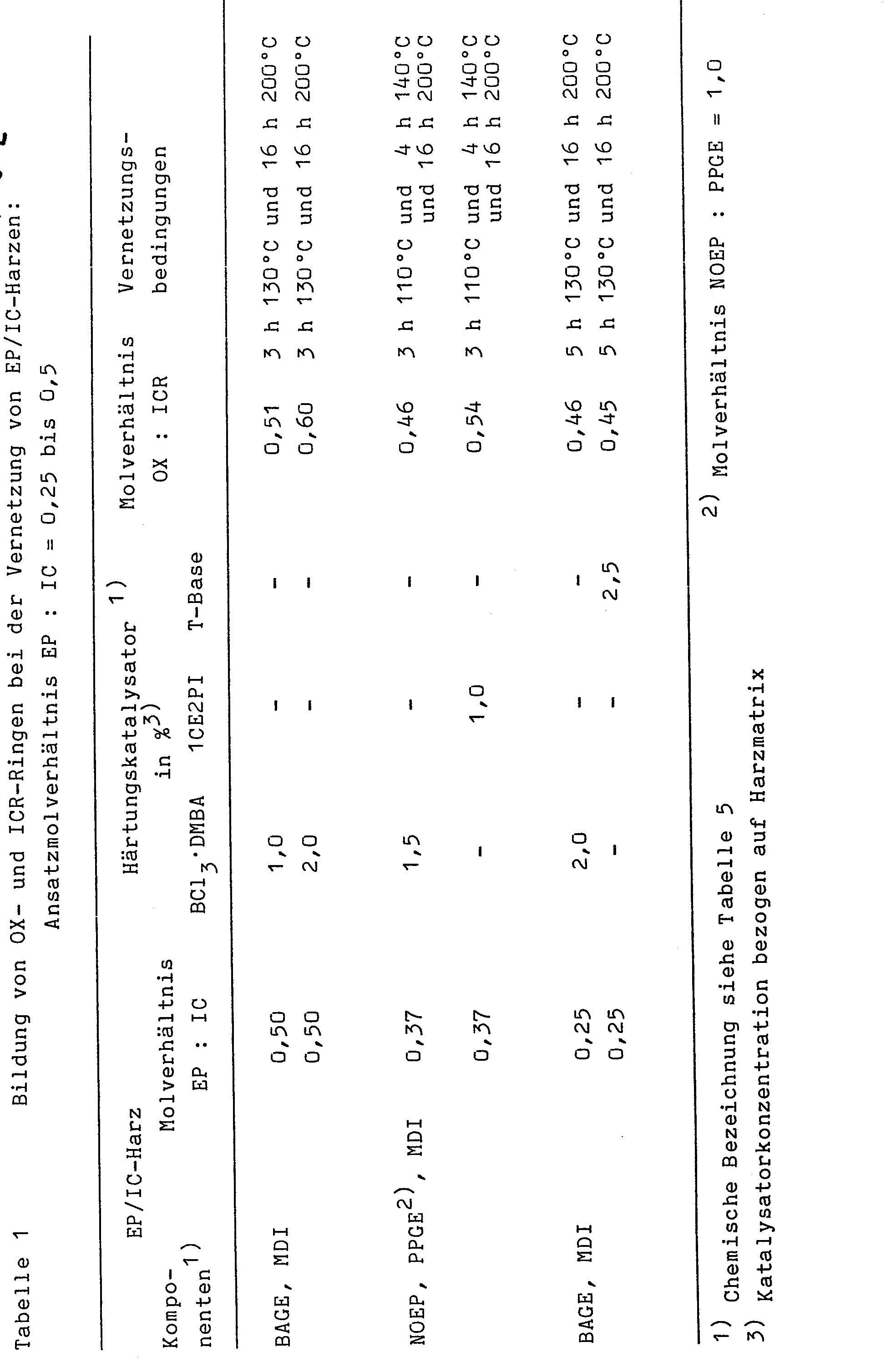
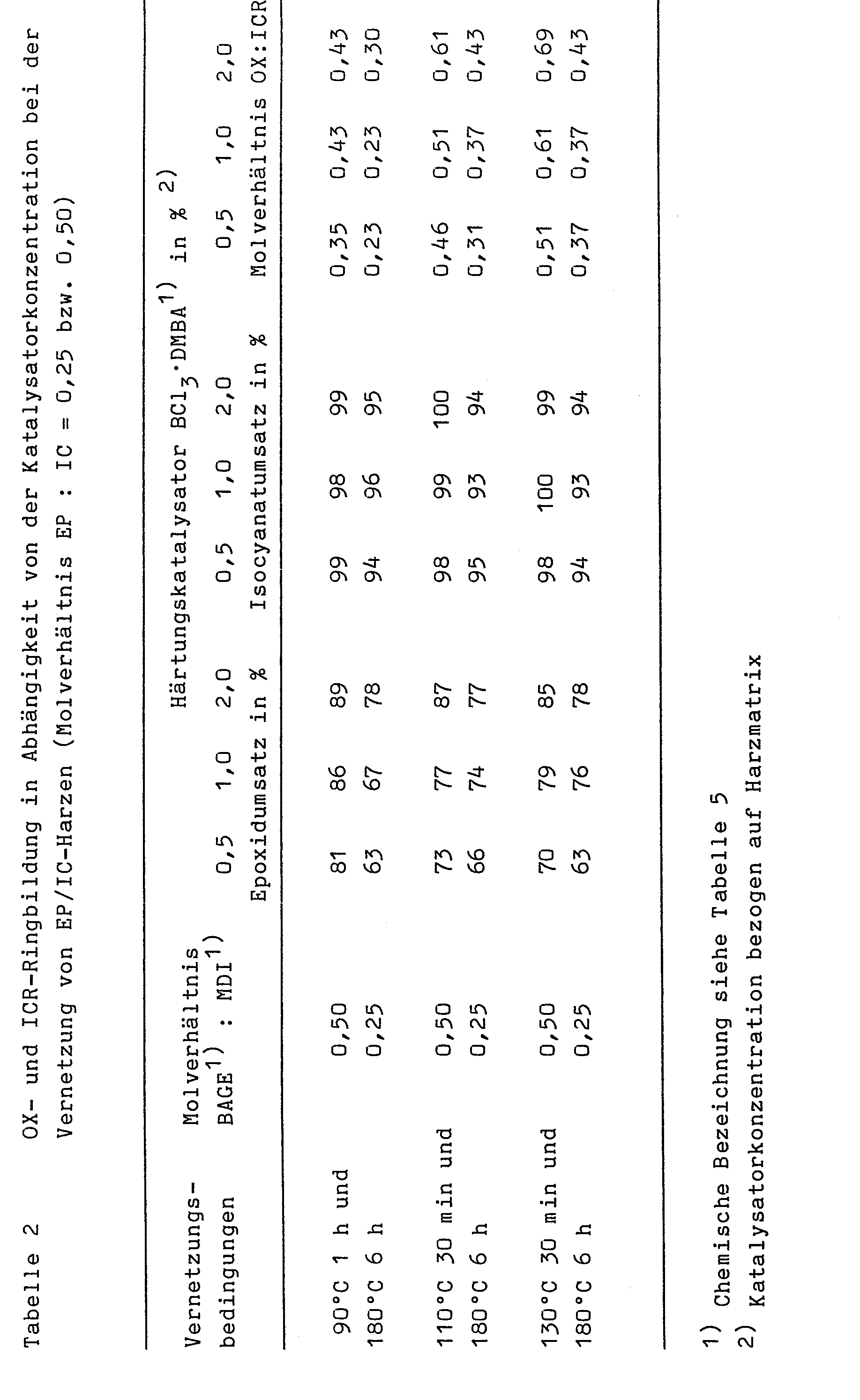
- Die Verbesserung der mechanischen Eigenschaften läßt sich dabei dadurch erklären, daß in das Netzwerk ein höherer Gehalt an Oxazolidinon- und Polyoxazolidinonstrukturen eingebaut wird als bei EP/IC-Harzen mit einem Ansatzmolverhältnis EP:IC< 1. Isocyanuratstrukturen bewirken ein engmaschiges Netzwerk und eine Versteifung der Polymerkette, so daß sie in erster Linie die Glasumwandlungstemperatur der Formstoffe beeinflussen. Im Gegensatz dazu weiten die Oxazolidinonstrukturen das Netzwerk auf und führen zu einer größeren Beweglichkeit der Polymerkette. Die mechanisch-thermischen Eigenschaften von OX/ICR-Formstoffen werden deshalb in erster Linie durch das Molverhältnis der in das Netzwerk eingebauten Oxazolidinon- und Isocyanuratstrukturen bestimmt. Bei den erfindungsgemäß hergestellten Formstoffen werden die mechanischen Eigenschaften auch noch dadurch verbessert, daß der Gehalt der - durch Epoxidpolymerisation entstehenden - Polyetherstrkturen im Polymernetzwerk erhöht wir Eigene Untersuchungen haben ergeben, daß bei der Vernetzung von EP/IC-Harzen mit einem Ansatzmolverhältnis EP:IC von 0,2 bis 0,7 das Molverhältnis OX:ICR der im OX/ICR-Formstoff gebildeten OX- und ICR-Ringe deutlich unter 1 liegt; die in den Tabellen 1 und 2 angeführten Versuchsergebnisse zeigen, daß das Molverhältnis OX:ICR meist im Bereich von 0,4 bis 0,6 liegt. Diese Ergebnisse zeigen weiter, daß die Verwendung unterschiedlicher Reaktionsbeschleuniger und die Variation der Vernetzungsbedingungen im Temperaturbereich von 90 bis 200°C keine Möglichkeit ergeben, die Vernetzung der EP/IC-Harze mit einem Ansatzmolverhältnis EP:IC von 0,2 bis 0,7 dahingehend zu verändern, daß die Oxazolidinonbildung wesentlich verstärkt wird. Dies ist - im Gegensatz dazu - beim erfindungsgemäßen Verfahren aber der Fall. Von besonderem Vorteil ist dabei auch, daß das Molverhältnis OX:ICR nicht nur zugunsten der Oxazolidinonbildung erhöht wird, sondern darüber hinaus durch verschiedene Maßnahmen, die miteinander kombiniert werden, gezielt gesteuert werden kann. Es sind dies das Ansatzmolverhältnis EP:IC, das im Bereich zwischen 1 und 5 liegt, die Art - und gegebenenfalls die Konzentration - des Reaktionsbeschleunigers und die Vernetzungstemperatur.
- Die Versuchsergebnisse in Tabelle 3 zeigen, daß bei Kombination der genannten Maßnahmen jedes Molverhältnis OX:ICR im Bereich zwischen 1 und 5 eingestellt werden kann. Hinzu kommt noch, daß in den vorvernetzten EP/IC-Harzen, die keine Isocyanatgruppen mehr, aber noch Epoxidgruppen enthalten, durch Reaktion von Epoxidgruppen mit Isocyanurat eine weitere Oxazolidinonbildung möglich ist. Die Werte der Tabelle 4 zeigen, daß diese Reaktion bei Temperaturen oberhalb 130°C merklich abläuft; mit steigendem Gehalt an Epoxiden im vorvernetzten EP/IC-Harz verstärkt sich diese Reaktion.
- Die Verbesserung der mechanischen Eigenschaften der nach dem erfindungsgemäßen Verfahren hergestellten hochwärmebeständigen OX/ICR-Formstoffe mit einem Molverhältnis OX:ICR > 1 ergibt sich aus Tabelle 7. Ein Vergleich der Werte in Tabelle 7 zeigt, daß OX/ICR-Formstoffe, die aus EP/IC-Harzen (A und B) mit einem Ansatzmolverhältnis EP:IC> 1 hergestellt wurden, gegenüber Formstoffen aus EP/IC-Harzen mit einem EP:IC-Verhältnis von 0,5 (Harz D) ein deutlich höheres Molverhältnis OX:ICR besitzen und erheblich verbesserte mechanische Eigenschaftswerte ergeben. Diese Werte zeigen weiter, daß beim EP/IC-Harz D, trotz erhöhter Konzentration des Härtungskatalysators, der Epoxidumsatz nur bei 80 % liegt. Die Werte für die Wärmeformbeständigkeiten liegen zwar bei den EP/IC-Harzen A und B gegenüber D etwas tiefer, doch besitzen die OX/ICR-Formstoffe mit Glasumwandlungstemperaturen bis über 200°C immer noch eine ausgezeichnete Wärmeformbeständigkeit. Die Werte für das EP/IC-Harz C lassen aber auch erkennen, daß bei einem Ansatzmolverhältnis EP:IC-> 5 keine als hochwärmeformbeständig zu bezeichnenden OX/ICR-Formstoffe mehr zu erwarten sind. Der Vergleich der Werte für die OX/ICR-Formstoffe aus den EP/IC-Harzen E und F ergibt ein analoges Bild wie der Vergleich der Formstoffe aus den Harzen A und B mit D. Die Werte für das EP/IC-Harz E zeigen weiter, daß durch die Auswahl spezieller Polyepoxidkomponenten im EP/IC-Harz die Wärmeformbeständigkeit der OX/ICR-Formstoffe - bei guten mechanischen Eigenschaften - noch erhöht werden kann. Von besonderer Bedeutung für den technischen Einsatz der EP/IC-Harze ist ferner, daß sich die gezielte Einstellung des Molverhältnisses OX:ICR - und damit die Steuerung des mechanischthermischen Eigenschaftsniveaus - auf die bestehenden fertigungstechnischen Verfahren in hervorragender Weise ohne zusätzliche Maßnahmen übertragen läßt.
- Auch für den Fachmann war nicht vorhersehbar, daß sich die Oxazolidinonbildung und damit die mechanischen Eigenschaften der OX/ICR-Formstoffe bei einem Ansatzmolverhältnis EP:IC > 1 gegenüber einem Molverhältnis EP:IC <1 derart gezielt steuern und verbessern lassen. Überraschend war auch, daß die an und für sich bekannte Reaktion der Oxazolidinonbildung aus Isocyanuraten und Epoxiden noch in den bereits hoch vernetzten EP/IC-Harzen mit einer Glasumwandlungstemperatur größer 150°C so eindeutig abläuft. Es zeigte sich aber auch, daß das Ansatzmolverhältnis EP:IC nur in einem begrenzten Bereich, nämlich zwischen 1 und 5, dazu verwendet werden kann, OX/ICR-Formstoffe mit einem hervorragenden Gesamteigenschaftsniveau herzustellen. Eine weitere Erhöhung des Epoxidgehaltes im Ansatzmolverhältnis EP:IC auf Werte> 5 ist für den technischen Einsatz der OX/ICR-Formstoffe in der Elektrotechnik nur noch von geringer Bedeutung, da die Glasumwandlungstemperaturen der Formstoffe deutlich absinken und die mechanischen Eigenschaften nicht mehr wesentlich verbessert werden. Formstoffe mit diesen mechanischthermischen Eigenschaften lassen sich im übrigen auch mit säureanhydridvernetzten Epoxidharzen erzielen.
- Aus der DE-OS 28 25 614 ist ein Verfahren zur Herstellung von vernetzten Polymeren durch Umsetzung von flüssigen, mindestens zwei Epoxidgruppen im Molekül enthaltenden Epoxidverbindungen und Polyisocyanaten, und gegebenenfalls Polyhydroxylverbindungen, in Gegenwart von Härtungskatalysatoren bei Temperaturen zwischen Raumtemperatur und 250°C bekannt. Dabei kann bei diesem Verfahren - bei der Umsetzung einer Epoxidverbindung mit einem Polyisocyanat - das Mengenverhältnis so gewählt werden, daß im Ausgangsreaktionsgemisch auf eine Epoxidgruppe 0,1 bis 2 Isocyanatgruppen (vorzugsweise 0,3 bis 1,2 Isocyanatgruppen) entfallen. Bei diesem Verfahren werden aber ausschließlich saure Katalysatoren eingesetzt, es ist nämlich zwingend die Verwendung einer Komplexverbindung von BF3 mit einem Ether, einer Phosphoniumverbindung oder mit Wasser, gegebenenfalls zusammen mit einer im Reaktionsgemisch löslichen Sn-, Zn- oder Fe-Verbindung, als Härtungskatalysator vorgeschrieben. Im Gegensatz dazu werden beim erfindungsgemäßen Verfahren ausschließlich basische Katalysatoren eingesetzt. In der DE-OS 28 25 614 findet sich außerdem kein Hinweis auf die beim erfindungsgemäßen Verfahren wesentliche Kombination von EP:IC-Verliältnis (im Reaktionsharz), Härtungskatalysator urd Vernetzungstemperatur, und insbesondere auch kein Hinweis auf das bei den hergestellten Formstoffen wesentliche OX:ICR-Verhältnis.
- Die vorstehenden Ausführungen gelten auch in bezug auf die DE-OS 25 43 386. Aus dieser Druckschrift ist eine wärmehärtende Harzzusammensetzung bekannt, die im wesentlichen folgende Bestandteile umfaßt:
- a) Ein Isocyanat-Endgruppen enthaltendes Kondensationsprodukt, das durch Umsetzung einer Polycarbonsäureverbindung mit wenigstens einem Säureanhydridring mit einem stöchiometrischen Überschuß einer polyfunktionellen Isocyanatverbindung erhalten wird, oder das Kondensationsprodukt, das nicht umgesetzte Isocyanatverbindung enthält,
- b) eine polyfunktionelle Epoxyverbindung,
- c) einen Katalysator, der hauptsächlich zur Bildung von Isocyanurat- und Oxazolidinonringen führt, sowie gegebenenfalls
- d) Additive, wie Färbemittel, Füllstoffe u.s.w.
- Dabei kann das Isocyanat-Endgruppen enthaltende Kondensationsprodukt bzw. das nicht umgesetzte Isocyanatverbindung enthaltende Kondensationsprodukt in einem Äquivalentverhältnis der Isocyanatgruppen zu der polyfunktionellen Epoxyverbindung von 0,2:1 bis 4:1 vorliegen.
- Die in den aus der DE-OS 25 43 386 bekannten Harzzusammensetzungen vorliegenden Isocyanatverbindungen sind nicht nur teuer und schwer herstellbar, sie sind technisch auch kaum einzusetzen, weil sie von der Viskosität her unbrauchbar sind; es liegen nämlich hochviskose bis feste Produkte vor. Die bekannten Harzzusammensetzungen scheiden deshalb auch für den praktischen Einsatz als Gieß- und Imprägnierharze aus. Ein weiterer Nachteil dieser Harze ist die relativ hohe Geliertemperatur. Im Gegensatz dazu weisen die beim erfindungsgemäßen Verfahren eingesetzten Reaktionsharzmischungen eine niedrige Viskosität auf und eignen sich deshalb in hervorragender Weise als Gieß- und Imprägnierharze, und zwar ohne Verwendung eines Lösungsmittels.
- Aus der DE-AS 21 30 156 ist ein oxazolidinon-modifiziertes Epoxy-Novolakharz bekannt, das durch Umsetzung von (a) einem Epoxy-Novolakharz und (b) einem organischen Diisocyanat oder Diisothiocyanat, gegebenenfalls in Gegenwart eines einwertigen Alkohols, oder einem Carbamat aus einem organischen Diisocyanat und einem einwertigen Alkohol in Gegenwart von Katalysatoren erhalten wird, wobei das Verhältnis von NCO- oder NCS-Gruppen zu Epoxy-Gruppen im Bereich von 0,1:1 bis 0,5:1 gehalten wird. Hierbei handelt es sich aber nicht um die Herstellung von Formstoffen, sondern um die Herstellung von Harzen, d.h. löslichen Verbindungen. Diese Harze sind modifizierte Epoxidverbindungen, die dann - in bekannter Weise - gehärtet werden, d.h. es erfolgt eine reine Epoxidharz-Härtung, aber keine Umsetzung mit Isocyanat.
- Für die beim erfindungsgemäßen Verfahren eingesetzten Polyepoxide sind relativ niedrigviskose aliphatische, cycloaliphatische oder aromatische Epoxide sowie deren Mischungen besonders gut geeignet. Bevorzugt werden Bisphenol-A-diglycidylether, Bisphenol-F-diglycidylether, 3,4-Epoxycyclohexylmethyl-3',4'-epoxycyclohexan- carboxylat, Polyglycidylether von Phenol/Formaldehyd- bzw. Kresol/Formaldehyd-Novolak, Diglycidylester von Phthal-, Isophthal- oder Terephthalsäure sowie Mischungen aus diesen Epoxidharzen eingesetzt. Weitere verwendbare Polyepoxide sind beispielsweise hydrierte Bisphenol-A- bzw. Bisphenol-F-diglycidylether, Hydantoinepoxidharze, Triglycidylisocyanurat, Triglycidyl-p-aminophenol, Tetraglycidyldiaminodiphenylmethan, Tetraglycidyldiaminodiphenylether, Tetrakis(4-glycid- oxyphenyl)-ethan, Urazolepoxide und Epoxide, die im "Handbook of Epoxy Resins" von Henry Lee und Kris Neville, McGraw-Hill Book Company, 1967, und in der Monographie von Henry Lee "Epoxy Resins", American Chemical Society, 1970, beschrieben sind.
- Als Polyisocyanate sind beim erfindungsgemäßen Verfahren relativ niedrigviskose aliphatische, cycloaliphatische oder aromatische Isocyanate sowie deren Mischungen besonders gut geeignet. Bevorzugt werden Isomerengemische aus 4,4'- und 2,4'-Diphenylmethandiisocyanat, polyolmodifizierte Polyisocyanate und Gemische von flüssigen Polyisocyanaten mit höhermolekularen Polyisocyanaten oder Carbodiimid-Polyisocyanaten eingesetzt. Weitere verwendbare Polyisocyanate sind beispielsweise Hexan-1,6-diisocyanat, Cyclohexan-1,3-diisocyanat und Isomere, 4,4'-Dicyclohexylmethandiisocyanat, 3-Isocyanatomethyl-3,5,5-trimethylcyclohexylisocyanat, 1,3-Dimethylbenzol-ii,w'-diisocyanat und Isomere, 1-Methylbenzol-2,4-diisocyanat und Isomere, Naphthalin-1,4-diisocyanat, Diphenylether-4,4'-diisocyanat und Isomere, Diphenylsulfon-4,4'-diisocyanat und Isomere sowie tri- oder höherfunktionelle Isocyanate, wie beispielsweise 3,3',4,4'-Diphenylmethantetraisocyanat. Ferner können auch Isocyanate verwendet werden, die in üblicher Weise mit Phenol oder Kresol maskiert sind. Dimere und Trimere der genannten mehrwertigen Isocyanate sind ebenfalls einsetzbar. Derartige Polyisocyanate besitzen endständige freie Isocyanatgruppen und enthalten einen oder mehrere Uretdion- und/oder Isocyanuratringe. Verfahren zur Herstellung verschiedener Arten solcher Trimerer und Uretdione sind beispielsweise in den US-Patentschriften 3 494 888, 3 108 100 und 2 977 370 beschrieben.
- Die EP/IC-Harze können auch Komponenten enthalten, die im allgemeinen an den chemischen Reaktionen, die zu den OX/ICR-Formstoffen führen, nicht beteiligt sind. Als derartige Füllstoffe eignen sich mineralische und faserförmige Füllstoffe, wie Quarzmehl, Quarzgut, Aluminiumoxid, Glaspulver, Glimmer, Kaolin, Dolomit, Graphit und Ruß, sowie Kohlefasern, Glasfasern und Textilfasern. Farbstoffe, Stabilisatoren und Haftvermittler sowie andere Additive üblicher Art können den EP/IC-Harzen ebenfalls zugesetzt werden.
- Beim erfindungsgemäßen Verfahren spielt der bei der Vernetzung die OX- und ICR-Ringbildung fördernde Katalysator eine bedeutende Rolle. Eingesetzt werden dabei tert. Amine und Imidazole. Als tert. Amine eignen sich beispielsweise Tetramethylethylendiamin, Dimethyloctylamin, Dimethylaminoethanol, Dimethylbenzylamin, 2,4,6-Tris(dimethylaminomethyl)-phenol, N,N'-Tetra- methyldiaminodiphenylmethan, N,N'-Dimethylpiperazin, N-Methylmorpholin, N-Methylpiperidin, N-Ethylpyrrolidin, 1,4-Diazabicyclo(2,2,2)-octan und Chinoline. Geeignete Imidazole sind beispielsweise 1-Methylimidazol, 2-Methylimidazol, 1,2-Dimethylimidazol, 1,2,4,5-Tetramethylimidazol, 1-Benzyl-2-phenylimidazol, 2-Undecylimidazol, 2-Heptadecylimidazol, 2-Ethyl-4-methylimidazol, 1-Cyanoethyl-2-ethyl-4-methylimidazol, 1-Cyanoethyl-2-phenylimidazol und 1-(4,6-Diamino-s-triazinyl-2-ethyl)-2-phenylimidazol.
- Die genannten Härtungskatalysatoren reagieren allerdings schon bei niederen Temperaturen und führen so zu relativ kurzen Topfzeiten, was die Verarbeitung der EP/IC-Harze erschweren kann. Bevorzugt werden beim erfindungsgemäßen Verfahren deshalb latente Härtungskatalysatoren eingesetzt, die bei niederen Temperaturen eine ausreichende Gebrauchsdauer gewährleisten. Als derartige Katalysatoren, die auch als latente Reaktionsbeschleuniger bezeichnet werden, eignen sich insbesondere Additionskomplexe von Bortrihalogeniden mit tert. Aminen und Imidazolen, beispielsweise die in der DE-PS 26 55 367 beschriebenen Additionskomplexe von Bortrichlorid und tert. Aminen der allgemeinen Formel BCl3·NR1R2R3, in der R1, R 2 und R3 gleiche oder verschiedene aliphatische, aromatische, heterocyclische oder arylaliphatische Reste sind, die paarweise auch Bestandteil von heterocyclischen Ringen sein können. Geeignet sind auch die analogen Komplexe des Bortrifluorids der Formel BF3'NR1R2R3, wobei R 1, R 2 und R 3 die vorstehend angegebene Bedeutung haben. Spezielle Beispiele für geeignete tert. Amine der BF3- und BC13-Komplexe sind Octyldimethylamin und Benzyldimethylamin. Auch Morpholinverbindungen und Imidazole, insbesondere N-Methylmorpholin, N-Ethylmorpholin, 1,2-Dimethylimidazol und 1-Benzyl-2-phenylimidazol, sind zur Bildung von BC13- bzw. BF3-Komplexen geeignet.
- Eine Verlängerung der Gebrauchsdauer der beim erfindungsgemäßen Verfahren eingesetzten EP/IC-Harze kann auch dann erreicht werden, wenn als latente Katalysatoren tert. Amine oder Imidazole verwendet werden, die durch Zusatz von Elektronenakzeptoren desaktiviert sind. Geeignete Elektronenakzeptoren sind beispielsweise: 7,7,8,8-Tetracyanochinodimethan, 2,4-Dichlor-5,6-dicyanobenzochinon, 2,3,5,6-Tetrachlorbenzochinon und 1,2-Dinitrobenzol sowie Isomere davon.
- Als Härtungskatalysatoren für die EP/IC-Harze eignen sich ferner Oniumsalze von tert. Aminen und Imidazolen, d.h. Oniumsalze mit N als Zentralatom. Beispiele für verwendbare Oniumsalze sind: Tetraethylammoniumchlorid, Tetraethylammoniumbromid, Octyltrimethylammoniumbromid, Benzyltrimethylammoniumchlorid, N-Ethylmorpholiniumbromid, 2-Ethyl-4-methylimidazoliumbromid, N-Ethylmorpholiniumtetraphenylborat, 1,2-Dimethylimidazoliumtetraphenylborat und Tetrabutylammoniumtetraphenylborat.
- Der Gehalt des Härtungskatalysators in den EP/IC-Harzen beträgt vorteilhaft 0,01 bis 5-Gew.-%, vorzugsweise 0,25 bis 2,5 Gew.-%, bezogen auf die Masse der Harzmatrix. Durch die Art und durch die Konzentration des Härtungskatalysators kann dabei die Härtungstemperatur und die Härtungsdauer beeinflußt werden.
- Die nach dem erfindungsgemäßen Verfahren hergestellten OX/ICR-Formstoffe eignen sich insbesondere zur Imprägnierung und Einbettung von elektrischen Wicklungen oder zum Verguß und zur Umhüllung von elektrischen und elektronischen Bauteilen.
- Anhand von Ausführungsbeispielen soll die Erfindung noch näher erläutert werden. Die Zusammensetzung der in den nachfolgenden Beispielen eingesetzten EP/IC-Harze kann dabei den Tabellen 5 und 6 entnommen werden.
- Verwendet wurden die EP/IC-Harze A, B und C. Die einzelnen Komponenten (BAGE, MDI und QM I) wurden nacheinander in einen auf 80°C vorgewärmten Mischbehälter eingerührt und 1 Stunde bei 80°C unter Rühren und vermindertem Druck (<L1 mbar) entgast. Anschließend wurden die EP/IC-Harze auf 60°C abgekühlt, der Härtungskatalysator zugesetzt und die EP/IC-Harze nochmals 1 Stunde bei 60°C unter Rühren und vermindertem Druck entgast. Danach wurden die EP/IC-Harze unter vermindertem Druck in auf 100°C vorgeheizte Normstabformen gegossen. Die Vernetzung (Härtung) der EP/IC-Harze erfolgte 1 h bei 100°C, danach 3 Stunden bei 125°C und danach 16 Stunden bei 200°C. An den so hergestellten OX/ICR-Formstoffen wurden die Biegefestigkeit (BF) nach DIN 53 452, die
- Schlagzähigkeit (SZ) nach DIN 53 453 und die Wärmeformbeständigkeit nach Martens (MT) nach DIN 53 458 gemessen. Die Bestimmung des Molverhältnisses OX:ICR erfolgte infrarotspektroskopisch und die des Epoxid-und Isocyanatgruppengehaltes durch chemische Analyse. Die gefundenen Werte sind in Tabelle 7 aufgeführt.
- Verwendet wurde das EP/IC-Harz D. Die Aufbereitung des EP/IC-Harzes und die Herstellung der Normstab-Formstoffproben erfolgte analog Beispiel 1. Die Meßwerte sind ebenfalls in Tabelle 7 enthalten.
- Verwendet wurde das EP/IC-Harz E. Die Aufbereitung des Harzes und die Herstellung der Normstab-Formstoffproben erfolgte analog Beispiel 1. Das EP/IC-Harz E wurde dabei jedoch in auf 125°C vorgeheizte Normstabformen gegossen und dann 1 Stunde bei 125°C und 16 Stunden bei 200°C vernetzt und gehärtet. Die Meßwerte sind in Tabelle 7 enthalten.
- Verwendet wurde das EP/IC-Harz F. Die Aufbereitung des Harzes und die Herstellung der Normstab-Formstoffproben erfolgte analog Beispiel 5. Die Meßergebnisse sind ebenfalls in Tabelle 7 aufgeführt.
- Verwendet wurde das EP/IC-Harz G. Die Aufbereitung des Harzes und die Herstellung der Normstab-Formstoffproben erfolgte analog Beispiel 1, jedoch wurde hierbei das
- EP/IC-Harz vor der Zugabe des Härtungskatalysators auf 40°C abgekühlt. Das EP/IC-Harz wurde dann 10 Minuten bei 40°C unter Rühren und vermindertem Druck entgast und anschließend in auf 80°C vorgewärmte Normstabformen vergossen. Die Vernetzung (Härtung) des EP/IC-Harzes G erfolgte 2 Stunden bei 80°C, danach 2 Stunden bei 100°C, danach 2 Stunden bei 150°C und danach 16 Stunden bei 180°C. Die gefundenen Werte sind in Tabelle 7 aufgeführt.
- Verwendet wurde das EP/IC-Harz H. Die Aufbereitung des Harzes und die Herstellung der Normstab-Formstoffproben erfolgte analog Beispiel 1. Die Meßwerte sind in Tabelle 7 enthalten.
- Verwendet wurden die EP/IC-Harze I und K. Die Aufbereitung der Harze und die Herstellung der Normstab-Formstoffproben erfolgte analog Beispiel 1. Zur Zugabe des Härtungskatalysators wurden die EP/IC-Harze jedoch auf 50°C abgekühlt und anschließend 20 Minuten bei 50°C unter Rühren und vermindertem Druck entgast. Die EP/IC-Harze wurden dann in auf 100°C vorgewärmte Normstabformen vergossen und anschließend 4 Stunden bei 130°C und danach 16 Stunden bei 200°C gehärtet. Die Meßwerte sind in Tabelle 7 aufgeführt.
-


Claims (11)
Priority Applications (1)
| Application Number | Priority Date | Filing Date | Title |
|---|---|---|---|
| AT84106960T ATE47868T1 (de) | 1983-06-27 | 1984-06-18 | Verfahren zur herstellung von reaktionsharzformstoffen. |
Applications Claiming Priority (2)
| Application Number | Priority Date | Filing Date | Title |
|---|---|---|---|
| DE19833323122 DE3323122A1 (de) | 1983-06-27 | 1983-06-27 | Verfahren zur herstellung von reaktionsharzformstoffen |
| DE3323122 | 1983-06-27 |
Publications (3)
| Publication Number | Publication Date |
|---|---|
| EP0130454A2 true EP0130454A2 (de) | 1985-01-09 |
| EP0130454A3 EP0130454A3 (en) | 1986-03-05 |
| EP0130454B1 EP0130454B1 (de) | 1989-11-08 |
Family
ID=6202511
Family Applications (1)
| Application Number | Title | Priority Date | Filing Date |
|---|---|---|---|
| EP19840106960 Expired EP0130454B1 (de) | 1983-06-27 | 1984-06-18 | Verfahren zur Herstellung von Reaktionsharzformstoffen |
Country Status (8)
| Country | Link |
|---|---|
| US (1) | US4564651A (de) |
| EP (1) | EP0130454B1 (de) |
| JP (1) | JPS6069121A (de) |
| AT (1) | ATE47868T1 (de) |
| BR (1) | BR8403123A (de) |
| DE (2) | DE3323122A1 (de) |
| ES (1) | ES533733A0 (de) |
| IN (1) | IN162185B (de) |
Cited By (10)
| Publication number | Priority date | Publication date | Assignee | Title |
|---|---|---|---|---|
| EP0232540A1 (de) * | 1986-01-14 | 1987-08-19 | Bayer Ag | Wärmehärtbare Reaktionsharzgemische und ein Verfahren zur Herstellung von Formkörpern unter Verwendung dieser Gemische |
| EP0272563A3 (en) * | 1986-12-24 | 1989-02-22 | Bayer Ag | Two-step process for the production of moulded articles two-step process for the production of moulded articles |
| EP0383089A3 (de) * | 1989-02-11 | 1991-01-23 | Bayer Ag | Kalthärtende Reaktionsharzmischung und deren Verwendung |
| EP0435060A3 (en) * | 1989-12-23 | 1991-08-07 | Bayer Ag | Process for the preparation de plastic moulded pieces |
| EP0478606A4 (en) * | 1989-06-06 | 1992-05-13 | The Dow Chemical Company | Epoxy-terminated polyoxazolidones, process of preparation, and electrical laminates therefrom |
| EP0424314B1 (de) * | 1989-10-18 | 1994-12-07 | Ciba-Geigy Ag | Heisshärtbare Gemische |
| EP2803684A1 (de) | 2013-05-13 | 2014-11-19 | Basf Se | Isocyanat-Epoxid-Hybridharze |
| WO2015011269A1 (de) | 2013-07-26 | 2015-01-29 | Basf Se | Isocyanat-epoxy-schaumsystem |
| WO2016102359A1 (de) * | 2014-12-22 | 2016-06-30 | Henkel Ag & Co. Kgaa | Oxazolidinon- und isocyanurat-vernetzte matrix für faserverstärktes material |
| WO2019219608A1 (en) | 2018-05-16 | 2019-11-21 | Huntsman Advanced Materials Licensing (Switzerland) Gmbh | Accelerator composition for the cure of polyfunctional isocyanates with epoxy resins |
Families Citing this family (33)
| Publication number | Priority date | Publication date | Assignee | Title |
|---|---|---|---|---|
| FR2549277B1 (fr) * | 1983-07-13 | 1985-10-25 | Alsthom Atlantique | Procede d'isolation par impregnation d'un bobinage electrique, et vernis sans solvant stabilise utilisable dans ce procede |
| JPH0629397B2 (ja) * | 1985-05-21 | 1994-04-20 | 東芝ケミカル株式会社 | フレキシブル印刷配線板用接着剤組成物 |
| FR2616792B1 (fr) * | 1987-06-17 | 1991-10-04 | Alsthom | Materiau a structure mousse resistant a la chaleur, constitue a partir de polymeres d'oxazolidones et d'isocyanurates |
| US4737564A (en) * | 1987-06-25 | 1988-04-12 | Ashland Oil, Inc. | Polyphenate salts of triethylene diamine and their use in polymerizing a polyisocyanate and a polyepoxide |
| US4906722A (en) * | 1987-12-02 | 1990-03-06 | Ciba-Geigy Corporation | Thermosetting reactive systems |
| ES2126568T3 (es) * | 1990-08-27 | 1999-04-01 | Ciba Geigy Ag | Aductos de resinas epoxi provistas de grupos hidroxilo con isocianatos y utilizacion de los mismos. |
| IT1249056B (it) * | 1991-05-22 | 1995-02-11 | Donegani Guido Ist | Catalizzatori liquidi per la polimerizzazione rapida di composizioni liquide a base di poliisocianati ed epossidi. |
| DE4130329A1 (de) * | 1991-09-12 | 1993-03-18 | Bayer Ag | Waermehaertbare reaktionsharzgemische, ein verfahren zu ihrer herstellung und die verwendung zur herstellung von press-massen und formkoerpern |
| DE4141963C2 (de) * | 1991-12-19 | 1997-03-20 | Hans Dipl Ing Dammer | Harzzusammensetzung, insbesondere Gießharz |
| DE4223632A1 (de) | 1992-07-17 | 1994-01-20 | Siemens Ag | Verfahren zur Herstellung einer flammwidrig eingestellten Epoxidharzformmasse |
| US5314983A (en) * | 1992-11-09 | 1994-05-24 | Enichem S.P.A. | Process for curing polymerizable liquid compositions based on polyisocyanates and epoxides |
| BR9307484A (pt) * | 1992-11-20 | 1999-08-24 | Dow Chemical Co | Pol¡meros de poliureia que t-m estabilidade melhorada a alta temperatura m-todo de obten-Æo dos mesmos |
| JP3626302B2 (ja) * | 1996-12-10 | 2005-03-09 | Jsr株式会社 | 光硬化性樹脂組成物 |
| DE19756577C1 (de) * | 1997-12-18 | 1999-04-08 | Siemens Ag | Akustisch dämpfendes Backingmaterial für Ultraschallwandler |
| GB9817799D0 (en) | 1998-08-14 | 1998-10-14 | Dow Deutschland Inc | Viscosity modifier for thermosetting resin compositioning |
| GB9827367D0 (en) | 1998-12-11 | 1999-02-03 | Dow Deutschland Inc | Adhesive resin composition |
| GB9927431D0 (en) | 1999-11-22 | 2000-01-19 | Ciba Sc Holding Ag | Casting resin and process for the fabrication of resin molds |
| KR100574165B1 (ko) * | 2004-10-08 | 2006-04-27 | 한국엔지니어링플라스틱 주식회사 | 열안정성이 우수한 폴리옥시메틸렌 수지 조성물 |
| JP4633116B2 (ja) * | 2005-04-07 | 2011-02-16 | 旭化成イーマテリアルズ株式会社 | エポキシ樹脂組成物 |
| JP5247368B2 (ja) * | 2008-11-14 | 2013-07-24 | 旭化成イーマテリアルズ株式会社 | エポキシ樹脂の製造方法 |
| ES2373276B1 (es) * | 2010-07-20 | 2012-12-20 | Universitat Rovira I Virgili | Composición y procedimiento para el entrecruzamiento de una resina epoxi con un isocianato, y material entrecruzado obtenido. |
| WO2013003999A1 (en) * | 2011-07-04 | 2013-01-10 | Dow Global Technologies Llc | Adducts as tougheners in thermosettable epoxy systems |
| KR101646977B1 (ko) | 2014-11-11 | 2016-08-09 | 한국엔지니어링플라스틱 주식회사 | 열안정성이 우수한 폴리옥시메틸렌 수지 조성물 |
| JP6674244B2 (ja) * | 2014-12-12 | 2020-04-01 | 株式会社Adeka | 感熱凝固性水系ポリウレタン樹脂組成物、該組成物を用いた皮革様材料の製造方法及び該方法により製造された皮革様材料 |
| DE102014226842A1 (de) * | 2014-12-22 | 2016-06-23 | Henkel Ag & Co. Kgaa | Katalysator-Zusammensetzung zur Härtung von Epoxidgruppen-haltigen Harzen |
| EP3260481B1 (de) * | 2016-06-20 | 2022-02-23 | Henkel AG & Co. KGaA | Gehärtete zusammensetzung mit hoher schlagfestigkeit und temperaturbeständigkeit, basierend auf einem epoxidharz und einem polyisocyanat |
| US11180603B2 (en) | 2017-02-16 | 2021-11-23 | Basf Se | Polyoxazolidones and production thereof |
| CN111065664A (zh) * | 2017-09-01 | 2020-04-24 | 陶氏环球技术有限责任公司 | 热固化组合物 |
| JP7671986B2 (ja) | 2018-12-11 | 2025-05-07 | トリマー テクノロジーズ エルエルシー | ポリイソシアヌレート系ポリマー及び繊維強化複合材料 |
| US11702499B2 (en) | 2018-12-11 | 2023-07-18 | Trimer Technologies Llc | Polyisocyanurate based polymers and fiber reinforced composites |
| JP7647101B2 (ja) * | 2019-11-18 | 2025-03-18 | 東レ株式会社 | 繊維強化複合材料の成形方法、およびそれに用いられるエポキシ樹脂組成物 |
| AU2021217266A1 (en) * | 2020-02-03 | 2022-08-18 | Toray Industries, Inc. | Molding material and fiber reinforced composite material |
| EP3885384A1 (de) * | 2020-03-24 | 2021-09-29 | Covestro Deutschland AG | Verfahren zur herstellung von thermoplastischen polyoxazolidinonen |
Family Cites Families (16)
| Publication number | Priority date | Publication date | Assignee | Title |
|---|---|---|---|---|
| BE593093A (de) * | 1959-09-12 | |||
| US3334110A (en) * | 1965-08-16 | 1967-08-01 | Baker Chem Co J T | Method for preparing epoxyoxazolidinones |
| DE1963900B2 (de) * | 1969-12-20 | 1977-09-08 | Henkel & Cie GmbH, 4000 Dusseldorf | Verfahren zur herstellung von kunststoffen |
| CA960793A (en) * | 1970-06-22 | 1975-01-07 | James A. Clarke | Oxazolidinone-modified epoxy novolac resin molding compositions |
| JPS5231000B2 (de) * | 1972-11-29 | 1977-08-11 | ||
| JPS5315757B2 (de) * | 1973-08-31 | 1978-05-26 | ||
| JPS5058196A (de) * | 1973-09-10 | 1975-05-20 | ||
| JPS5058501A (de) * | 1973-09-19 | 1975-05-21 | ||
| JPS5347277B2 (de) * | 1974-09-30 | 1978-12-20 | ||
| JPS51146600A (en) * | 1975-06-11 | 1976-12-16 | Hitachi Ltd | Flame retardant thermosetting resin composition |
| FR2351139A1 (fr) * | 1976-05-14 | 1977-12-09 | Hitachi Ltd | Composition de resines polymerisable, thermodurcissable |
| JPS52150500A (en) * | 1976-06-08 | 1977-12-14 | Mitsubishi Electric Corp | Epoxy resin compositions |
| JPS5356294A (en) * | 1976-10-30 | 1978-05-22 | Hitachi Chem Co Ltd | Thermosetting resin composition |
| US4130546A (en) * | 1976-10-19 | 1978-12-19 | Hitachi Chemical Company, Ltd. | Thermosetting resin composition |
| CH624968A5 (de) * | 1977-06-14 | 1981-08-31 | Ciba Geigy Ag | |
| EP0035072B1 (de) * | 1980-03-03 | 1984-06-13 | BBC Aktiengesellschaft Brown, Boveri & Cie. | Duroplastisch härtbare lösungsmittelfreie Harzmischung und ihre Verwendung |
-
1983
- 1983-06-27 DE DE19833323122 patent/DE3323122A1/de not_active Withdrawn
-
1984
- 1984-06-08 IN IN391/CAL/84A patent/IN162185B/en unknown
- 1984-06-18 EP EP19840106960 patent/EP0130454B1/de not_active Expired
- 1984-06-18 AT AT84106960T patent/ATE47868T1/de not_active IP Right Cessation
- 1984-06-18 DE DE8484106960T patent/DE3480402D1/de not_active Expired
- 1984-06-26 JP JP59131809A patent/JPS6069121A/ja active Granted
- 1984-06-26 ES ES533733A patent/ES533733A0/es active Granted
- 1984-06-26 BR BR8403123A patent/BR8403123A/pt not_active IP Right Cessation
- 1984-06-27 US US06/624,972 patent/US4564651A/en not_active Expired - Fee Related
Cited By (15)
| Publication number | Priority date | Publication date | Assignee | Title |
|---|---|---|---|---|
| EP0232540A1 (de) * | 1986-01-14 | 1987-08-19 | Bayer Ag | Wärmehärtbare Reaktionsharzgemische und ein Verfahren zur Herstellung von Formkörpern unter Verwendung dieser Gemische |
| EP0272563A3 (en) * | 1986-12-24 | 1989-02-22 | Bayer Ag | Two-step process for the production of moulded articles two-step process for the production of moulded articles |
| EP0383089A3 (de) * | 1989-02-11 | 1991-01-23 | Bayer Ag | Kalthärtende Reaktionsharzmischung und deren Verwendung |
| EP0478606A4 (en) * | 1989-06-06 | 1992-05-13 | The Dow Chemical Company | Epoxy-terminated polyoxazolidones, process of preparation, and electrical laminates therefrom |
| EP0424314B1 (de) * | 1989-10-18 | 1994-12-07 | Ciba-Geigy Ag | Heisshärtbare Gemische |
| EP0435060A3 (en) * | 1989-12-23 | 1991-08-07 | Bayer Ag | Process for the preparation de plastic moulded pieces |
| EP2803684A1 (de) | 2013-05-13 | 2014-11-19 | Basf Se | Isocyanat-Epoxid-Hybridharze |
| WO2014184082A1 (de) | 2013-05-13 | 2014-11-20 | Basf Se | Isocyanat-epoxid-hybridharze |
| US10329370B2 (en) | 2013-05-13 | 2019-06-25 | Basf Se | Isocyanate-epoxide hybrid resins |
| WO2015011269A1 (de) | 2013-07-26 | 2015-01-29 | Basf Se | Isocyanat-epoxy-schaumsystem |
| US10907021B2 (en) | 2013-07-26 | 2021-02-02 | Basf Se | Isocyanate-epoxy-foam system |
| WO2016102359A1 (de) * | 2014-12-22 | 2016-06-30 | Henkel Ag & Co. Kgaa | Oxazolidinon- und isocyanurat-vernetzte matrix für faserverstärktes material |
| US10689476B2 (en) | 2014-12-22 | 2020-06-23 | Henkel Ag & Co. Kgaa | Oxazolidinone- and isocyanurate-crosslinked matrix for fiber-reinforced material |
| WO2019219608A1 (en) | 2018-05-16 | 2019-11-21 | Huntsman Advanced Materials Licensing (Switzerland) Gmbh | Accelerator composition for the cure of polyfunctional isocyanates with epoxy resins |
| US11518846B2 (en) | 2018-05-16 | 2022-12-06 | Huntsman Advanced Materials (Switzerland) Gmbh | Accelerator composition for the cure of polyfunctional isocyanates with epoxy resins |
Also Published As
| Publication number | Publication date |
|---|---|
| BR8403123A (pt) | 1985-06-04 |
| ES8503707A1 (es) | 1985-03-01 |
| EP0130454B1 (de) | 1989-11-08 |
| DE3480402D1 (en) | 1989-12-14 |
| JPS6069121A (ja) | 1985-04-19 |
| EP0130454A3 (en) | 1986-03-05 |
| ES533733A0 (es) | 1985-03-01 |
| DE3323122A1 (de) | 1985-05-23 |
| US4564651A (en) | 1986-01-14 |
| IN162185B (de) | 1988-04-16 |
| JPH0473451B2 (de) | 1992-11-20 |
| ATE47868T1 (de) | 1989-11-15 |
Similar Documents
| Publication | Publication Date | Title |
|---|---|---|
| EP0130454B1 (de) | Verfahren zur Herstellung von Reaktionsharzformstoffen | |
| EP0129787B1 (de) | Verfahren zur Herstellung von Formstoffen | |
| EP0129799B1 (de) | Hitzehärtbare Reaktionsharzmischungen | |
| EP0129800B1 (de) | Hitzehärtbare Reaktionsharzmischungen | |
| EP0408990B1 (de) | Hitzehärtbare Reaktionsharzmischungen | |
| EP0129819B1 (de) | Verfahren zur Imprägnierung und Einbettung von elektrischen Wicklungen | |
| EP0232540B1 (de) | Wärmehärtbare Reaktionsharzgemische und ein Verfahren zur Herstellung von Formkörpern unter Verwendung dieser Gemische | |
| DE2359386C3 (de) | Verfahren zur Herstellung von Isocyanurat- und Oxazolidonringe enthaltenden Duroplasten | |
| DE69531500T2 (de) | Epoxidharzgiessmasse | |
| DE2655367C2 (de) | Heißhärtende Reaktionsharzmischung zur Imprägnierung von Isolierungen elektrischer Geräte und zur Herstellung von Formstoffen mit oder ohne Einlagen | |
| DE102014226838A1 (de) | Oxazolidinon- und Isocyanurat-vernetzte Matrix für faserverstärktes Material | |
| DE2545106B2 (de) | Warmhaertbares gemisch | |
| CH642767A5 (de) | Verfahren zur herstellung elektrischer wicklungen. | |
| DE2543386C2 (de) | Warmhärtende Harzzusammensetzung und ihre Anwendung | |
| EP0383089B1 (de) | Kalthärtende Reaktionsharzmischung und deren Verwendung | |
| DE2721780B2 (de) | Thermisch härtbare polymerisierbare Harzmasse | |
| EP0175638B1 (de) | Heisshärtende Reaktionsharzmischung zur Imprägnierung von Isolierungen elektrischer Geräte und zur Herstellung von Formstoffen mit und ohne Einlagen | |
| WO1981002647A1 (fr) | Melange resineux | |
| EP0639618B1 (de) | Rieselfähige pulverförmige Pressmassen auf Epoxidharzbasis | |
| DE2746789A1 (de) | Hitzehaertbare harzzusammensetzung und ihre verwendung | |
| EP0389433A1 (de) | Flammgehemmte Reaktionsharzmassen | |
| DE3204809A1 (de) | Herstellungsverfahren fuer isocyanursaeure- und oxazolidonringe enthaltende vernetzte polymere | |
| EP0175907B1 (de) | Verfahren zur Herstellung von Formkörpern | |
| KR840002216B1 (ko) | 내열성 수지조성물(耐熱性樹脂組成物) |
Legal Events
| Date | Code | Title | Description |
|---|---|---|---|
| PUAI | Public reference made under article 153(3) epc to a published international application that has entered the european phase |
Free format text: ORIGINAL CODE: 0009012 |
|
| AK | Designated contracting states |
Designated state(s): AT BE CH DE FR GB IT LI NL SE |
|
| 17P | Request for examination filed |
Effective date: 19850822 |
|
| PUAL | Search report despatched |
Free format text: ORIGINAL CODE: 0009013 |
|
| AK | Designated contracting states |
Kind code of ref document: A3 Designated state(s): AT BE CH DE FR GB IT LI NL SE |
|
| 17Q | First examination report despatched |
Effective date: 19871204 |
|
| GRAA | (expected) grant |
Free format text: ORIGINAL CODE: 0009210 |
|
| AK | Designated contracting states |
Kind code of ref document: B1 Designated state(s): AT BE CH DE FR GB IT LI NL SE |
|
| REF | Corresponds to: |
Ref document number: 47868 Country of ref document: AT Date of ref document: 19891115 Kind code of ref document: T |
|
| REF | Corresponds to: |
Ref document number: 3480402 Country of ref document: DE Date of ref document: 19891214 |
|
| ET | Fr: translation filed | ||
| GBT | Gb: translation of ep patent filed (gb section 77(6)(a)/1977) | ||
| ITF | It: translation for a ep patent filed | ||
| PLBE | No opposition filed within time limit |
Free format text: ORIGINAL CODE: 0009261 |
|
| STAA | Information on the status of an ep patent application or granted ep patent |
Free format text: STATUS: NO OPPOSITION FILED WITHIN TIME LIMIT |
|
| 26N | No opposition filed | ||
| PGFP | Annual fee paid to national office [announced via postgrant information from national office to epo] |
Ref country code: SE Payment date: 19910627 Year of fee payment: 8 |
|
| ITTA | It: last paid annual fee | ||
| PG25 | Lapsed in a contracting state [announced via postgrant information from national office to epo] |
Ref country code: SE Effective date: 19920619 |
|
| EUG | Se: european patent has lapsed |
Ref document number: 84106960.2 Effective date: 19930109 |
|
| PGFP | Annual fee paid to national office [announced via postgrant information from national office to epo] |
Ref country code: BE Payment date: 19960612 Year of fee payment: 13 |
|
| PGFP | Annual fee paid to national office [announced via postgrant information from national office to epo] |
Ref country code: NL Payment date: 19960620 Year of fee payment: 13 |
|
| PGFP | Annual fee paid to national office [announced via postgrant information from national office to epo] |
Ref country code: FR Payment date: 19960625 Year of fee payment: 13 |
|
| PGFP | Annual fee paid to national office [announced via postgrant information from national office to epo] |
Ref country code: DE Payment date: 19960819 Year of fee payment: 13 |
|
| PGFP | Annual fee paid to national office [announced via postgrant information from national office to epo] |
Ref country code: CH Payment date: 19960920 Year of fee payment: 13 |
|
| PGFP | Annual fee paid to national office [announced via postgrant information from national office to epo] |
Ref country code: GB Payment date: 19970521 Year of fee payment: 14 |
|
| PGFP | Annual fee paid to national office [announced via postgrant information from national office to epo] |
Ref country code: AT Payment date: 19970602 Year of fee payment: 14 |
|
| PG25 | Lapsed in a contracting state [announced via postgrant information from national office to epo] |
Ref country code: LI Free format text: LAPSE BECAUSE OF NON-PAYMENT OF DUE FEES Effective date: 19970630 Ref country code: CH Free format text: LAPSE BECAUSE OF NON-PAYMENT OF DUE FEES Effective date: 19970630 Ref country code: BE Effective date: 19970630 |
|
| BERE | Be: lapsed |
Owner name: SIEMENS A.G. Effective date: 19970630 |
|
| PG25 | Lapsed in a contracting state [announced via postgrant information from national office to epo] |
Ref country code: NL Effective date: 19980101 |
|
| REG | Reference to a national code |
Ref country code: CH Ref legal event code: PL |
|
| PG25 | Lapsed in a contracting state [announced via postgrant information from national office to epo] |
Ref country code: FR Free format text: LAPSE BECAUSE OF NON-PAYMENT OF DUE FEES Effective date: 19980227 |
|
| NLV4 | Nl: lapsed or anulled due to non-payment of the annual fee |
Effective date: 19980101 |
|
| PG25 | Lapsed in a contracting state [announced via postgrant information from national office to epo] |
Ref country code: DE Free format text: LAPSE BECAUSE OF NON-PAYMENT OF DUE FEES Effective date: 19980303 |
|
| REG | Reference to a national code |
Ref country code: FR Ref legal event code: ST |
|
| REG | Reference to a national code |
Ref country code: FR Ref legal event code: ST |
|
| PG25 | Lapsed in a contracting state [announced via postgrant information from national office to epo] |
Ref country code: GB Free format text: LAPSE BECAUSE OF NON-PAYMENT OF DUE FEES Effective date: 19980618 Ref country code: AT Free format text: LAPSE BECAUSE OF NON-PAYMENT OF DUE FEES Effective date: 19980618 |
|
| GBPC | Gb: european patent ceased through non-payment of renewal fee |
Effective date: 19980618 |