EP0125322B1 - Verfahren zur Anwendung ergotroper Wirkstoff-Kombinationen in der Aufzucht und Mast von Nutztieren - Google Patents
Verfahren zur Anwendung ergotroper Wirkstoff-Kombinationen in der Aufzucht und Mast von Nutztieren Download PDFInfo
- Publication number
- EP0125322B1 EP0125322B1 EP83104643A EP83104643A EP0125322B1 EP 0125322 B1 EP0125322 B1 EP 0125322B1 EP 83104643 A EP83104643 A EP 83104643A EP 83104643 A EP83104643 A EP 83104643A EP 0125322 B1 EP0125322 B1 EP 0125322B1
- Authority
- EP
- European Patent Office
- Prior art keywords
- agents
- combinations
- fattening
- feed
- breeding
- Prior art date
- Legal status (The legal status is an assumption and is not a legal conclusion. Google has not performed a legal analysis and makes no representation as to the accuracy of the status listed.)
- Expired
Links
- 230000002031 ergotropic effect Effects 0.000 title claims abstract description 17
- 238000000034 method Methods 0.000 title claims abstract description 9
- 238000009395 breeding Methods 0.000 title claims abstract description 8
- 230000001488 breeding effect Effects 0.000 title claims abstract description 8
- 241001465754 Metazoa Species 0.000 title claims description 30
- SHVCSCWHWMSGTE-UHFFFAOYSA-N 6-methyluracil Chemical compound CC1=CC(=O)NC(=O)N1 SHVCSCWHWMSGTE-UHFFFAOYSA-N 0.000 claims abstract description 11
- 241000282887 Suidae Species 0.000 claims abstract description 7
- 241000283690 Bos taurus Species 0.000 claims abstract description 5
- 244000144977 poultry Species 0.000 claims abstract description 5
- 229910000071 diazene Inorganic materials 0.000 claims abstract 2
- 239000003795 chemical substances by application Substances 0.000 claims description 12
- 239000000126 substance Substances 0.000 claims description 11
- 239000000969 carrier Substances 0.000 claims description 2
- 230000001419 dependent effect Effects 0.000 claims 1
- 239000011573 trace mineral Substances 0.000 claims 1
- 235000013619 trace mineral Nutrition 0.000 claims 1
- 239000011782 vitamin Substances 0.000 claims 1
- 229940088594 vitamin Drugs 0.000 claims 1
- 229930003231 vitamin Natural products 0.000 claims 1
- 235000013343 vitamin Nutrition 0.000 claims 1
- 239000004480 active ingredient Substances 0.000 description 15
- 238000012360 testing method Methods 0.000 description 11
- 230000000694 effects Effects 0.000 description 10
- 239000000203 mixture Substances 0.000 description 10
- 239000013543 active substance Substances 0.000 description 7
- MLMFUKWWZIZRHX-UHFFFAOYSA-N chembl2103762 Chemical compound NC(=N)NN=C1C=CC(=NNC(N)=S)C=C1 MLMFUKWWZIZRHX-UHFFFAOYSA-N 0.000 description 7
- 239000003242 anti bacterial agent Substances 0.000 description 6
- 229940088710 antibiotic agent Drugs 0.000 description 6
- 238000002474 experimental method Methods 0.000 description 6
- 230000000384 rearing effect Effects 0.000 description 5
- 150000001875 compounds Chemical class 0.000 description 4
- 238000011156 evaluation Methods 0.000 description 4
- 230000000845 anti-microbial effect Effects 0.000 description 3
- XLYOFNOQVPJJNP-UHFFFAOYSA-N water Chemical compound O XLYOFNOQVPJJNP-UHFFFAOYSA-N 0.000 description 3
- 108010001478 Bacitracin Proteins 0.000 description 2
- 235000019750 Crude protein Nutrition 0.000 description 2
- 241000287828 Gallus gallus Species 0.000 description 2
- KDXKERNSBIXSRK-UHFFFAOYSA-N Lysine Natural products NCCCCC(N)C(O)=O KDXKERNSBIXSRK-UHFFFAOYSA-N 0.000 description 2
- XQCFHQBGMWUEMY-ZPUQHVIOSA-N Nitrovin Chemical compound C=1C=C([N+]([O-])=O)OC=1\C=C\C(=NNC(=N)N)\C=C\C1=CC=C([N+]([O-])=O)O1 XQCFHQBGMWUEMY-ZPUQHVIOSA-N 0.000 description 2
- 206010034133 Pathogen resistance Diseases 0.000 description 2
- 229930182555 Penicillin Natural products 0.000 description 2
- CKIHZSGJPSDCNC-UHFFFAOYSA-N Quindoxin Chemical compound C1=CC=C2N([O-])C=C[N+](=O)C2=C1 CKIHZSGJPSDCNC-UHFFFAOYSA-N 0.000 description 2
- VTYYLEPIZMXCLO-UHFFFAOYSA-L calcium carbonate Substances [Ca+2].[O-]C([O-])=O VTYYLEPIZMXCLO-UHFFFAOYSA-L 0.000 description 2
- 244000309466 calf Species 0.000 description 2
- 238000011161 development Methods 0.000 description 2
- 230000035622 drinking Effects 0.000 description 2
- 238000004519 manufacturing process Methods 0.000 description 2
- 235000013336 milk Nutrition 0.000 description 2
- 239000008267 milk Substances 0.000 description 2
- 210000004080 milk Anatomy 0.000 description 2
- 150000002960 penicillins Chemical class 0.000 description 2
- 230000009467 reduction Effects 0.000 description 2
- UCRLQOPRDMGYOA-DFTDUNEMSA-L zinc;(4r)-4-[[(2s)-2-[[(4r)-2-[(1s,2s)-1-amino-2-methylbutyl]-4,5-dihydro-1,3-thiazole-4-carbonyl]amino]-4-methylpentanoyl]amino]-5-[[(2s,3s)-1-[[(3s,6r,9s,12r,15s,18r,21s)-3-(2-amino-2-oxoethyl)-18-(3-aminopropyl)-12-benzyl-15-[(2s)-butan-2-yl]-6-(carbox Chemical compound [Zn+2].C1SC([C@@H](N)[C@@H](C)CC)=N[C@@H]1C(=O)N[C@@H](CC(C)C)C(=O)N[C@H](CCC([O-])=O)C(=O)N[C@@H]([C@@H](C)CC)C(=O)N[C@@H]1C(=O)N[C@H](CCCN)C(=O)N[C@@H]([C@@H](C)CC)C(=O)N[C@H](CC=2C=CC=CC=2)C(=O)N[C@@H](CC=2NC=NC=2)C(=O)N[C@H](CC([O-])=O)C(=O)N[C@@H](CC(N)=O)C(=O)NCCCC1 UCRLQOPRDMGYOA-DFTDUNEMSA-L 0.000 description 2
- 150000004057 1,4-benzoquinones Chemical class 0.000 description 1
- 241000894006 Bacteria Species 0.000 description 1
- RYGMFSIKBFXOCR-UHFFFAOYSA-N Copper Chemical compound [Cu] RYGMFSIKBFXOCR-UHFFFAOYSA-N 0.000 description 1
- 239000004181 Flavomycin Substances 0.000 description 1
- 239000004472 Lysine Substances 0.000 description 1
- TURHTASYUMWZCC-UHFFFAOYSA-N Olaquindox [BAN:INN] Chemical compound C1=CC=C2N([O-])C(C)=C(C(=O)NCCO)[N+](=O)C2=C1 TURHTASYUMWZCC-UHFFFAOYSA-N 0.000 description 1
- 239000004104 Oleandomycin Substances 0.000 description 1
- RZPAKFUAFGMUPI-UHFFFAOYSA-N Oleandomycin Natural products O1C(C)C(O)C(OC)CC1OC1C(C)C(=O)OC(C)C(C)C(O)C(C)C(=O)C2(OC2)CC(C)C(OC2C(C(CC(C)O2)N(C)C)O)C1C RZPAKFUAFGMUPI-UHFFFAOYSA-N 0.000 description 1
- 239000004100 Oxytetracycline Substances 0.000 description 1
- 239000004189 Salinomycin Substances 0.000 description 1
- KQXDHUJYNAXLNZ-XQSDOZFQSA-N Salinomycin Chemical compound O1[C@@H]([C@@H](CC)C(O)=O)CC[C@H](C)[C@@H]1[C@@H](C)[C@H](O)[C@H](C)C(=O)[C@H](CC)[C@@H]1[C@@H](C)C[C@@H](C)[C@@]2(C=C[C@@H](O)[C@@]3(O[C@@](C)(CC3)[C@@H]3O[C@@H](C)[C@@](O)(CC)CC3)O2)O1 KQXDHUJYNAXLNZ-XQSDOZFQSA-N 0.000 description 1
- 229920002472 Starch Polymers 0.000 description 1
- 239000004098 Tetracycline Substances 0.000 description 1
- 239000004182 Tylosin Substances 0.000 description 1
- 229930194936 Tylosin Natural products 0.000 description 1
- HCHKCACWOHOZIP-UHFFFAOYSA-N Zinc Chemical compound [Zn] HCHKCACWOHOZIP-UHFFFAOYSA-N 0.000 description 1
- 239000000654 additive Substances 0.000 description 1
- 230000000844 anti-bacterial effect Effects 0.000 description 1
- PERZMHJGZKHNGU-JGYWJTCASA-N bambermycin Chemical compound O([C@H]1[C@H](NC(C)=O)[C@@H](O)[C@@H]([C@H](O1)CO[C@H]1[C@@H]([C@@H](O)[C@H](O)[C@@H](CO)O1)O)O[C@@H]1O[C@@H]([C@H]([C@H](O)[C@H]1NC(C)=O)O[C@H]1[C@@H]([C@@H](O)[C@@H](O)[C@H](O1)C(=O)NC=1C(CCC=1O)=O)O)C)[C@H]1[C@@H](OP(O)(=O)OC[C@@H](OC\C=C(/C)CC\C=C\C(C)(C)CCC(=C)C\C=C(/C)CCC=C(C)C)C(O)=O)O[C@H](C(O)=O)[C@@](C)(O)[C@@H]1OC(N)=O PERZMHJGZKHNGU-JGYWJTCASA-N 0.000 description 1
- 230000003115 biocidal effect Effects 0.000 description 1
- 230000037396 body weight Effects 0.000 description 1
- 235000010216 calcium carbonate Nutrition 0.000 description 1
- 229960000427 carbadox Drugs 0.000 description 1
- 239000012876 carrier material Substances 0.000 description 1
- 235000010980 cellulose Nutrition 0.000 description 1
- 239000001913 cellulose Substances 0.000 description 1
- 229920002678 cellulose Polymers 0.000 description 1
- 229960005091 chloramphenicol Drugs 0.000 description 1
- WIIZWVCIJKGZOK-RKDXNWHRSA-N chloramphenicol Chemical compound ClC(Cl)C(=O)N[C@H](CO)[C@H](O)C1=CC=C([N+]([O-])=O)C=C1 WIIZWVCIJKGZOK-RKDXNWHRSA-N 0.000 description 1
- 230000000052 comparative effect Effects 0.000 description 1
- 239000012141 concentrate Substances 0.000 description 1
- 229910052802 copper Inorganic materials 0.000 description 1
- 239000010949 copper Substances 0.000 description 1
- ACFNYGLBKAZUDY-UHFFFAOYSA-N cyclohexa-2,5-diene-1,4-diimine Chemical class N=C1C=CC(=N)C=C1 ACFNYGLBKAZUDY-UHFFFAOYSA-N 0.000 description 1
- 229950000246 diaveridine Drugs 0.000 description 1
- LDBTVAXGKYIFHO-UHFFFAOYSA-N diaveridine Chemical compound C1=C(OC)C(OC)=CC=C1CC1=CN=C(N)N=C1N LDBTVAXGKYIFHO-UHFFFAOYSA-N 0.000 description 1
- -1 diethylstilbestrol Chemical compound 0.000 description 1
- RGLYKWWBQGJZGM-ISLYRVAYSA-N diethylstilbestrol Chemical compound C=1C=C(O)C=CC=1C(/CC)=C(\CC)C1=CC=C(O)C=C1 RGLYKWWBQGJZGM-ISLYRVAYSA-N 0.000 description 1
- 229960000452 diethylstilbestrol Drugs 0.000 description 1
- 229940011871 estrogen Drugs 0.000 description 1
- 239000000262 estrogen Substances 0.000 description 1
- 239000000835 fiber Substances 0.000 description 1
- 235000019374 flavomycin Nutrition 0.000 description 1
- 235000013305 food Nutrition 0.000 description 1
- 229960001625 furazolidone Drugs 0.000 description 1
- PLHJDBGFXBMTGZ-WEVVVXLNSA-N furazolidone Chemical compound O1C([N+](=O)[O-])=CC=C1\C=N\N1C(=O)OCC1 PLHJDBGFXBMTGZ-WEVVVXLNSA-N 0.000 description 1
- 235000021384 green leafy vegetables Nutrition 0.000 description 1
- 239000004615 ingredient Substances 0.000 description 1
- 230000000968 intestinal effect Effects 0.000 description 1
- 230000007774 longterm Effects 0.000 description 1
- WPBNNNQJVZRUHP-UHFFFAOYSA-L manganese(2+);methyl n-[[2-(methoxycarbonylcarbamothioylamino)phenyl]carbamothioyl]carbamate;n-[2-(sulfidocarbothioylamino)ethyl]carbamodithioate Chemical compound [Mn+2].[S-]C(=S)NCCNC([S-])=S.COC(=O)NC(=S)NC1=CC=CC=C1NC(=S)NC(=O)OC WPBNNNQJVZRUHP-UHFFFAOYSA-L 0.000 description 1
- 235000012054 meals Nutrition 0.000 description 1
- 150000002736 metal compounds Chemical class 0.000 description 1
- BPMVRAQIQQEBLN-OBPBNMOMSA-N methyl n-[(e)-(1-hydroxy-4-oxidoquinoxalin-4-ium-2-ylidene)methyl]iminocarbamate Chemical compound C1=CC=C2N(O)C(=C/N=NC(=O)OC)/C=[N+]([O-])C2=C1 BPMVRAQIQQEBLN-OBPBNMOMSA-N 0.000 description 1
- 210000002445 nipple Anatomy 0.000 description 1
- IAIWVQXQOWNYOU-FPYGCLRLSA-N nitrofural Chemical compound NC(=O)N\N=C\C1=CC=C([N+]([O-])=O)O1 IAIWVQXQOWNYOU-FPYGCLRLSA-N 0.000 description 1
- 229960001907 nitrofurazone Drugs 0.000 description 1
- 125000004433 nitrogen atom Chemical group N* 0.000 description 1
- 235000021049 nutrient content Nutrition 0.000 description 1
- 235000016709 nutrition Nutrition 0.000 description 1
- 229950010210 olaquindox Drugs 0.000 description 1
- 235000019367 oleandomycin Nutrition 0.000 description 1
- 229960002351 oleandomycin Drugs 0.000 description 1
- RZPAKFUAFGMUPI-KGIGTXTPSA-N oleandomycin Chemical compound O1[C@@H](C)[C@H](O)[C@@H](OC)C[C@@H]1O[C@@H]1[C@@H](C)C(=O)O[C@H](C)[C@H](C)[C@H](O)[C@@H](C)C(=O)[C@]2(OC2)C[C@H](C)[C@H](O[C@H]2[C@@H]([C@H](C[C@@H](C)O2)N(C)C)O)[C@H]1C RZPAKFUAFGMUPI-KGIGTXTPSA-N 0.000 description 1
- 229960000625 oxytetracycline Drugs 0.000 description 1
- 235000019366 oxytetracycline Nutrition 0.000 description 1
- IWVCMVBTMGNXQD-PXOLEDIWSA-N oxytetracycline Chemical compound C1=CC=C2[C@](O)(C)[C@H]3[C@H](O)[C@H]4[C@H](N(C)C)C(O)=C(C(N)=O)C(=O)[C@@]4(O)C(O)=C3C(=O)C2=C1O IWVCMVBTMGNXQD-PXOLEDIWSA-N 0.000 description 1
- 239000000843 powder Substances 0.000 description 1
- 102000004169 proteins and genes Human genes 0.000 description 1
- 108090000623 proteins and genes Proteins 0.000 description 1
- 229950006375 quindoxin Drugs 0.000 description 1
- XMVJITFPVVRMHC-UHFFFAOYSA-N roxarsone Chemical compound OC1=CC=C([As](O)(O)=O)C=C1[N+]([O-])=O XMVJITFPVVRMHC-UHFFFAOYSA-N 0.000 description 1
- 235000019378 salinomycin Nutrition 0.000 description 1
- 229960001548 salinomycin Drugs 0.000 description 1
- 230000001568 sexual effect Effects 0.000 description 1
- RMAQACBXLXPBSY-UHFFFAOYSA-N silicic acid Chemical class O[Si](O)(O)O RMAQACBXLXPBSY-UHFFFAOYSA-N 0.000 description 1
- 235000020183 skimmed milk Nutrition 0.000 description 1
- 238000003307 slaughter Methods 0.000 description 1
- 235000019698 starch Nutrition 0.000 description 1
- 239000008107 starch Substances 0.000 description 1
- 125000001424 substituent group Chemical group 0.000 description 1
- 229940124530 sulfonamide Drugs 0.000 description 1
- 150000003456 sulfonamides Chemical class 0.000 description 1
- IWVCMVBTMGNXQD-UHFFFAOYSA-N terramycin dehydrate Natural products C1=CC=C2C(O)(C)C3C(O)C4C(N(C)C)C(O)=C(C(N)=O)C(=O)C4(O)C(O)=C3C(=O)C2=C1O IWVCMVBTMGNXQD-UHFFFAOYSA-N 0.000 description 1
- 235000019364 tetracycline Nutrition 0.000 description 1
- 150000003522 tetracyclines Chemical class 0.000 description 1
- 229940040944 tetracyclines Drugs 0.000 description 1
- 230000001225 therapeutic effect Effects 0.000 description 1
- 231100000331 toxic Toxicity 0.000 description 1
- 230000002588 toxic effect Effects 0.000 description 1
- 229960001082 trimethoprim Drugs 0.000 description 1
- IEDVJHCEMCRBQM-UHFFFAOYSA-N trimethoprim Chemical compound COC1=C(OC)C(OC)=CC(CC=2C(=NC(N)=NC=2)N)=C1 IEDVJHCEMCRBQM-UHFFFAOYSA-N 0.000 description 1
- 235000019375 tylosin Nutrition 0.000 description 1
- 229960004059 tylosin Drugs 0.000 description 1
- WBPYTXDJUQJLPQ-VMXQISHHSA-N tylosin Chemical compound O([C@@H]1[C@@H](C)O[C@H]([C@@H]([C@H]1N(C)C)O)O[C@@H]1[C@@H](C)[C@H](O)CC(=O)O[C@@H]([C@H](/C=C(\C)/C=C/C(=O)[C@H](C)C[C@@H]1CC=O)CO[C@H]1[C@@H]([C@H](OC)[C@H](O)[C@@H](C)O1)OC)CC)[C@H]1C[C@@](C)(O)[C@@H](O)[C@H](C)O1 WBPYTXDJUQJLPQ-VMXQISHHSA-N 0.000 description 1
- 239000011701 zinc Substances 0.000 description 1
- 229910052725 zinc Inorganic materials 0.000 description 1
Classifications
-
- A—HUMAN NECESSITIES
- A61—MEDICAL OR VETERINARY SCIENCE; HYGIENE
- A61K—PREPARATIONS FOR MEDICAL, DENTAL OR TOILETRY PURPOSES
- A61K31/00—Medicinal preparations containing organic active ingredients
- A61K31/33—Heterocyclic compounds
- A61K31/395—Heterocyclic compounds having nitrogen as a ring hetero atom, e.g. guanethidine or rifamycins
- A61K31/495—Heterocyclic compounds having nitrogen as a ring hetero atom, e.g. guanethidine or rifamycins having six-membered rings with two or more nitrogen atoms as the only ring heteroatoms, e.g. piperazine or tetrazines
- A61K31/505—Pyrimidines; Hydrogenated pyrimidines, e.g. trimethoprim
-
- A—HUMAN NECESSITIES
- A23—FOODS OR FOODSTUFFS; TREATMENT THEREOF, NOT COVERED BY OTHER CLASSES
- A23K—FODDER
- A23K20/00—Accessory food factors for animal feeding-stuffs
- A23K20/10—Organic substances
- A23K20/111—Aromatic compounds
-
- A—HUMAN NECESSITIES
- A23—FOODS OR FOODSTUFFS; TREATMENT THEREOF, NOT COVERED BY OTHER CLASSES
- A23K—FODDER
- A23K20/00—Accessory food factors for animal feeding-stuffs
- A23K20/10—Organic substances
- A23K20/116—Heterocyclic compounds
- A23K20/137—Heterocyclic compounds containing two hetero atoms, of which at least one is nitrogen
Definitions
- the invention relates to a method for the use of ergotropic active substance combinations in the rearing and fattening of farm animals, e.g. of poultry, pigs and cattle.
- the invention relates in particular to a method for using combinations of N-guanidino-N'-thioureido-p-benzoquinone diimide and 6-methyluracil in various quantity relations.
- ergotropic substances includes a wide range of different chemical structures.
- antibiotics such as penicillins, tetracyclines, oxytetracycline, zinc bacitracin, oleandomycin, flavomycin, salinomycin, tylosin and the like. a. to call.
- other antibacterial substances of non-natural origin such as quinoxaline-N, N'-dioxide, z. B. carbadox, quindoxin and olaquindox and substances of the nitrofuran type such as furazolidone and nitrovin.
- a whole range of other substances of natural and synthetic origin such as certain metal compounds of copper, manganese, zinc or 3-nitro-4-hydroxyphenylarsonic acid or estrogens such as diethylstilbestrol, can be used to achieve ergonomic effects.
- a disadvantage primarily of antibiotics and antimicrobial ergotropics is the fact that after a certain period of use the growth effect which can be achieved by these substances is considerably reduced. This makes the use of these substances ineffective with regard to their ergotropic effect and other ergotropics have to be used.
- Another disadvantage of the active ingredients used as ergotropics with antimicrobial activity is the development of cross-resistance of the bacteria in the intestinal flora to therapeutically used substances such as sulfonamides and their combinations with trimethoprim or diaveridine, chloramphenicol, penicillins and other antibiotics.
- This cross resistance resulting from the long-term use of antimicrobial ergotropics prevents the therapeutic effect required in the case of illness when using other antibiotics and substances with a similar effect.
- the aim of the invention is to provide a method for the application of new ergotropics, in which the disadvantages mentioned are eliminated.
- the invention has for its object to provide new combinations of active ingredients in the rearing and fattening of farm animals, e.g. of poultry, pigs and cattle, in which the amounts used can be considerably reduced compared to the individual application.
- the combination of certain active substances can increase their ergotropic effect (final mast weight), the concentration of each active substance being reduced according to the invention in relation to the respective concentrations in the case of individual application. It has also been found according to the invention that the ergotropic effect of the combinations which contain the active compounds according to the invention in a lower concentration than in the single application is greater than in the single application of the same active compounds. This is surprising since, for example, DD 126.626 shows (Example 5) that as the concentrations of the active ingredient (N-guanidino-N'-thioureido-p-benzoquinone diimide) decrease, the fattening effect also becomes significantly less.
- the combinations of the two active substances mentioned can preferably be administered to the animals with the feed, the ratio of the two active substances above the total fattening time remains constant or is varied depending on the nutritional composition of the feed components or the combination of the active ingredients is only applied in part of the fattening or rearing period.
- the combinations of the two active ingredients can be used in the form of a premix, the basic feed (standard feed) itself or else inert inorganic or organic carriers such as calcium carbonates, high-molecular silicic acid compounds of natural and synthetic origin, cellulose, starch or milk as the physiologically acceptable carrier material or milk powder can be used.
- the combinations of the two active substances according to the invention result in advantages over the use of the individual active substances when used.
- the achievable increase in body weight remains essentially constant, or even increases, when combinations of the composition according to the invention are used, this result being achieved according to the invention in that the proportion of each of the two active ingredients in the combination contributes only a small part of the respective dose Single application is.
- the feed saving effect when using the combinations according to the invention is the same or greater than when using the individual active ingredients, again achieved by the combination according to the invention in reduced doses.
- Another advantage can be seen in the fact that the dosage reductions according to the invention in the combinations greatly reduce the risk of toxic side effects, which in turn increases animal health and thus the fattening or rearing success of the entire animal population treated with the combinations according to the invention.
- the advantage is achieved that a lower total amount of active ingredient is required by possible reduction of the doses according to the invention, the economic expenditure for the production of the active ingredients is thereby reduced, while maintaining or improving the ergotropic effect.
- Example 1 Each 24-26 female briol chicks from the Rottenau hybrid breeding were fed in a group feeding trial in floor keeping for 51 days with a basic feed mixture as given in Example 1 and with different combinations of P and A under the same conditions as given in Example 1. The evaluation was carried out in accordance with Example 1.
- Example 1 In an analogous experiment, 11 calves were given the same amount of combination preparation A + P as indicated in Example 1 in the same type of application.
- the size of the control groups, their sexual composition and the type and amount of the other ergotropic agents also corresponded to Example 1.
- the average weight of the animals in the individual groups varied between 44.50 kg and 45.05 kg and was therefore higher than in Example 1
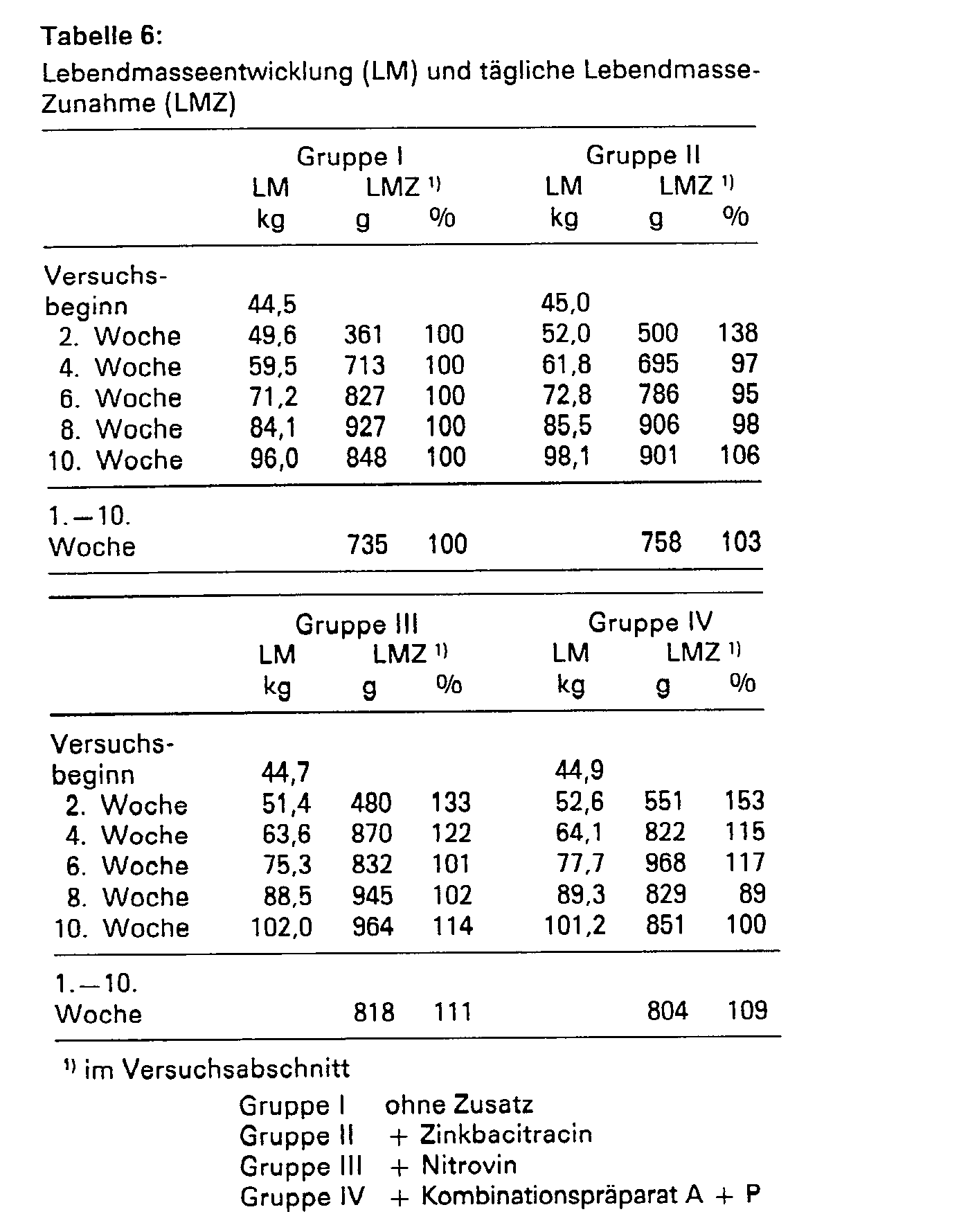
- the evaluation was carried out as indicated in Example 1. Tables 6 and 7 show the test result.
- the animals were divided evenly into 5 groups of 12 animals, taking into account their live weight, including 3 experimental groups and 2 control groups.
- the animals in a control group received pig feed without antibiotics, the animals in the second control group received This feed contains a mixture of active ingredients with 3% antibiotic concentrate with 5% activity.
- the animals of the three test groups received P or A alone or a combination of P and A in addition to the pig fattening feed.
- the feed was administered dry ad libitum, water was available to the animals through self-drinking.
Landscapes
- Life Sciences & Earth Sciences (AREA)
- Chemical & Material Sciences (AREA)
- Polymers & Plastics (AREA)
- Health & Medical Sciences (AREA)
- Animal Husbandry (AREA)
- Zoology (AREA)
- Engineering & Computer Science (AREA)
- Food Science & Technology (AREA)
- Medicinal Chemistry (AREA)
- Pharmacology & Pharmacy (AREA)
- Epidemiology (AREA)
- Animal Behavior & Ethology (AREA)
- General Health & Medical Sciences (AREA)
- Public Health (AREA)
- Veterinary Medicine (AREA)
- Fodder In General (AREA)
- Feed For Specific Animals (AREA)
Description
- Die Erfindung betrifft ein Verfahren zur Anwendung ergotroper Wirkstoffkombinationen in der Aufzucht und Mast von Nutztieren, z.B. von Geflügel, Schweinen und Rindern.
- Die Erfindung betrifft insbesondere ein Verfahren zur Anwendung von Kombinationen von N-Guanidino-N'-thioureido-p-benzochinon- diimid sowie 6-Methyluracil in verschiedenen Mengerelationen.
- Es ist bekannt, daß in der Aufzucht von Mast verschiedener Tierarten, wie Geflügel, Rinder und Schweine, Zusatzstoffe verwendet werden, deren Applikation an die Tiere als Bestandteil des Futters eine Reihe von Vorteilen bringt. So kann damit das Wachstum der Tiere beschleunigt werden und sie erreichen früher das erforderliche Schlachtgewicht. Weiterhin kann damit eine bessere Ausnutzung des Futters erreicht werden; dieser Effekt führt im Ergebnis der Mast zu einem geringeren Futteraufwand.
- Die Natur solcher ergotrop wirkender Substanzen umfaßt ein weites Spektrum verschiedenartiger chemischer Strukturen. An erster Stelle sind die Antibiotika, wie Penicilline, Tetracycline, Oxytetracyclin, Zinkbacitracin, Oleandomycin, Flavomycin, Salinomycin, Tylosin u. a. zu nennen. Darüber hinaus werden weitere antibakteriell wirksame Stoffe nicht natürlichen Ursprungs wie Chinoxalin-N,N'-dioxide, z. B. Carbadox, Quindoxin und Olaquindox sowie Stoffe vom Typ des Nitrofurans wie beispielsweise Furazolidon und Nitrovin eingesetzt. Darüber hinaus können eine ganze Reihe weiterer Stoffe natürlichen und synthetischen Ursprungs, wie bespielsweise bestimmte Metallverbindungen von Kupfer, Mangen, Zink oder 3-Nitro-4-hydroxyphenylarsonsäure oder Östrogene wie Diäthylstilböstrol zur Erzielung ergotroper Wirkungen eingesetzt werden.
- Weiterhin ist durch die DE-OS 2.437155 sowie durch RAAKE u.a. (Berliner und Münchener Tierärztliche Wochenschrift 88,188 (1975) die Möglichkeit zur Verwendung von 6-Methyluracil (Pseudothymin) als Ergotropikum bei verschiedenen Tierarten bekannt geworden. Die zur Erzielung eines optimalen Zuwachses erforderlichen Mengen an Pseudothymin betragen dabei 100 - 200 ppm im Futter.
- Weiterhin ist in der DD 126.626 vorgeschlagen worden, daß bestimmte Derivate das p-Benzochinons, vornehmlich substituierte p-Benzochinondiimine, die an beiden N-Atomen weitere Substituenten tragen, wobei bevorzugte Verbindungen N-Guanidino-N'- (4-methylsemicarbazono)-p-benzochinondiimid, N-Guanidino-N'-thioureido-p-benzochinondiimid u.a. sind, in Mengen von 1-50 ppm im Futter bei Broiler und Schweinen einen das Wachstum stimulierenden Effekt ausüben können.
- Ein Nachteil vornehmlich der Antibiotika und antimikrobiell wirkenden Ergotropika ist die Tatsache, daß sich nach einer gewissen Anwendungszeit der durch diese Stoffe erzielbare Wachstumseffekt beträchtlich verringert. Dadurch wird der Einsatz dieser Stoffe hinsichtlich ihres ergotropen Effekts uneffektiv und es müssen andere Ergotropika eingesetzt werden.
- Diese Umstellungen erfordern in der Produktion der Wirkstoffe erhebliche Anstrengungen technischer und finanzieller Art für neue Wirkstoffe, da der volkswirtschaftliche Bedarf sehr hoch ist.
- Ein weiterer Nachteil der als Ergotropika eingesetzten Wirkstoffe mit antimikrobieller Wirkung besteht in der Herausbildung von Kreuzresistenzen der Bakterien in der Darmflora gegenüber therapeutisch angewandten Stoffen wie Sulfonamiden und deren Kombinationen mit Trimethoprim bzw. Diaveridin, Chloramphenicol, Penicillinen und anderen Antibiotika. Diese durch den langandauernden Einsatz antimikrobiell wirkender Ergotropika entstehende Kreuzresistenz verhindert den im Krankheitsfall erforderlichen therapeutischen Effekt bei Einsatz anderer Antibiotika und ähnlich wirkender Stoffe.
- Das Ziel der Erfindung liegt darin, ein Verfahren zur Anwendung neuer Ergotropika aufzuzeigen, bei dem die angeführten Nachteile beseitigt sind.
- Der Erfindung liegt die Aufgabe zugrunde, neue Kombinationen von Wirkstoffen in der Aufzucht und Mast von Nutztieren, z.B. von Geflügel, Schweinen und Rindern anzuwenden, bei denen die Einsatzmengen gegenüber der Einzelanwendung beträchtlich verringert werden können.
- Es wurde nun erfindungsgemäß festgestellt, daß durch Kombination bestimmter Wirkstoffe deren ergotroper Effekt (Mastendgewicht) gesteigert werden kann, wobei erfindungsgemäß die Konzentration jedes Wirkstoffes gegenüber den jeweiligen Konzentrationen bei Einzelapplikation erniedrigt ist. Es wurde weiterhin erfindungsgemäß festgestellt, daß der ergotrope Effekt der Kombinationen, die die Wirkstoffe erfindungsgemäß in geringer Konzentration als bei der Einzelanwendung beschrieben, enthalten, größer ist als bei der Einzelapplikation derselben Wirkstoffe. Dies ist überraschend, da beispielsweise in der DD 126.626 gezeigt wird (Beispiel 5), daß mit sinkenden Konzentrationen des Wirkstoffes (N-Guanidino-N'-thioureido-p-benzochinon-diimid) auch der Masteffekt deutlich geringer wird.
- Es wurde weiterhin erfindungsgemäß festgestellt, daß dieser Effekt bevorzugt bei der Kombination von 6-Methyluracil mit N-Guanidino-N'-thioureido-p-benzochinondiimid eintritt, wobei erfindungsgemäß die Mengen der beiden Wirkstoffe zwischen jeweils 2 und 100 ppm im Futter betragen in Abhängigkeit von der jeweiligen Tierart.
- Erfindungsgemäß können die Kombinationen der beiden genannten Wirkstoffe den Tieren vorzugsweise mit dem Futter verabreicht werden, wobei das Verhältnis der beiden Wirkstoffe über die gesamte Mastzeit konstant bleibt oder aber auch in Abbängigkeit von der nährstoffmäßigen Zusammensetzung der Futterbestandteile variiert wird oder die Kombination der Wirkstoffe wird nur in einem Teil der Mast- bzw. Aufzuchtperiode appliziert. Erfidungsgemäß können die Kombinationen der beiden Wirkstoffe in Form eines Prämix angewendet werden, wobei als physiologisch unbedenkliches Trägermaterial das Grundfutter (Standardfutter) selbst oder aber auch inerte anorganische oder organische Träger wie Calciumcarbonate, hochmolekulare Kieselsäure-Verbindungen natürlicher und synthetischer Herkunft, Zellulose, Stärke oder Milch oder Milchpulver verwendet werden können.
- Durch die erfindungsgemäßen Kombinationen der beiden Wirkstoffe ergeben sich bei ihrer Anwendung Vorteile gegenüber der Verwendung der Einzelwirkstoffe. So bleibt der erzielbare Mehrsuwachs an Körpergewicht im wesentlichen konstant, oder erhöht sich sogar, wenn Kombinationen der erfindungsgemäßen Zusammensetzung angewendet werden, wobei dieses Ergebnis erfindungsgemäß dadurch erzielt wird, daß der Anteil jedes der beiden Wirkstoffe in der Kombination nur einen geringen Teil der jeweiligen Dosis bei Einzelapplikation beträgt.
- Weiterhin ist der Futtereinsparungs-Effekt bei Verwendung der erfindungsgemäßen Kombinationen der gleiche oder größer als bei Verwendung der Einzelwirkstoffe, wiederum erzielt durch die erfindungsgemäße Kombination in verringerten Dosen. Ein weiterer Vorteil ist darin zu sehen, daß durch die erfindungsgemäßen Dosierverringerungen in den Kombinationen die Gefahr toxischer Nebenwirkungen stark reduziert wird, welches wieder der Tiergesundheit und damit den Mast- bzw. Aufzucht-Erfolg des gesamten mit den erfindungsgemäßen Kombinationen behandelten Tierbestandes steigert.
- Weiterhin wird damit der Vorteil erzielt, daß durch erfindungsgemäßen mögliche Reduzierung der Dosen eine geringere Gesamt-Wirkstoffmenge benötigt wird, die wirtschaftlichen Aufwendungen für die Produktion der Wirkstoffe werden dadurch verringert, bei Beibehaltung oder Verbesserung des ergotropen Effekts.
- Je 24 - 26 männliche Küken der Rottenauer Hybridzucht wurden in einem Gruppenfütterungsversuch in Käfighaltung über 51 Tage mit einer Grundfuttermischung mit einem Rohnährstoffgehalt von
- 90,06 % Trockensubstanz
- 5,94 % Rohasche
- 21,11 % Rohprotein
- 4,22 % Rohfaser
- - durchschnittliche Lebendmasse in jeder Gruppe (in kg und als prozentuale Zunahme)
- - Futteraufwand (kg Futter/kg Zunahme an Körpermasse und als prozentuele Verringerung)
- Das Ergebnis zeigt Tabelle 1.

- Je 24 - 26 weibliche Briolerküken der Rottenauer Hybridzucht wurden in einem Gruppenfütterungsversuch in Bodenhaltung über 51 Tage mit einer Grundfuttermischung wie in Beispiel 1 angegeben und mit unterschiedlichen Kombinationen von P und A unter den gleichen Bedingungen wie in Beispiel 1 angegeben gefüttert. Die Auswertung erfolgte entsprechend Beispiel 1.
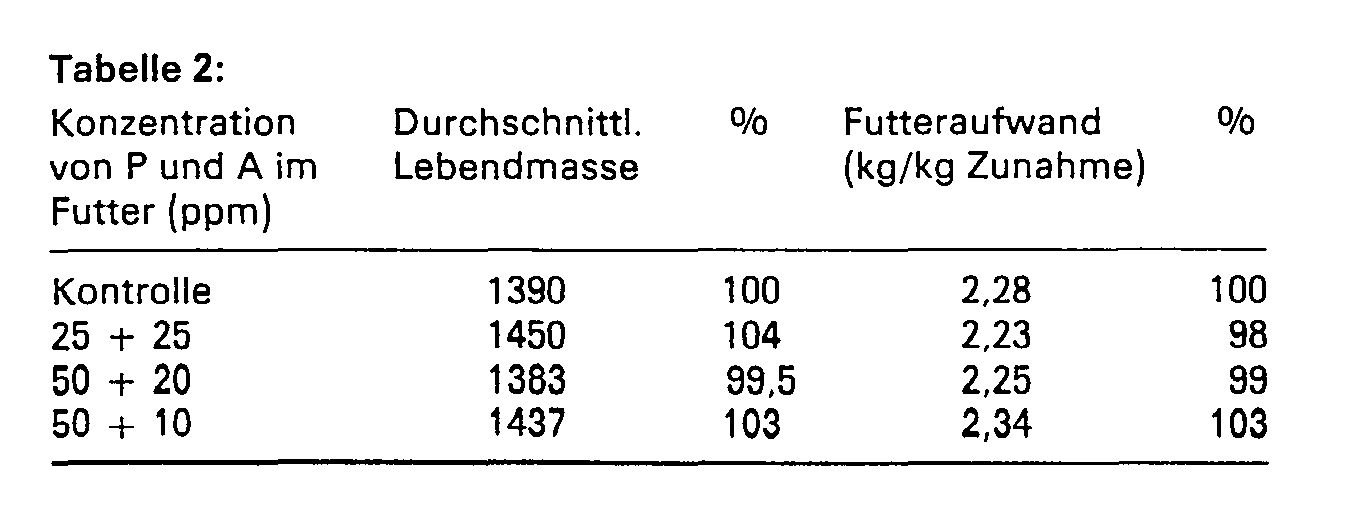
- In einem Vergleichsversuch wurden je 12 männliche Broilerküken der gleichen Zucht in einem Gruppenfütterungsversuch in Käfighaltung über 44 bzw. 51 Tage mit einer Grundfuttermischung wie in Beispiel 1 angegeben und mit unterschiedlichen Mengen P oder A unter den gleichen Bedingungen wie in Beispiel 1 gefüttert.Die Auswertung erfolgte entsprechend Beispiel 1. Das Ergebnis zeigt Tabelle 3.

- In einem Gruppenfütterungsversuch wurden 12 Kälbern (7 männliche und 5 weibliche) eine Mischung von 56 mg 6-Methyluracil (im folgenden mit P abgekürzt) und 28 mg N-Guanidino-N'-Thioureido-p-benzochinondiimid (im folgenden mit A abgekürzt) je Tier und Tag appliziert. Die Wirkstoffmischung wurde den Tieren als Bestandteil der Magermilchtränke gegeben. Parallel dazu wurden 3 Kontrollgruppen fast gleicher Größe und gleicher geschlechtlicher Zusammensetzung gefürt. Die Tiere einer Gruppe erhielten 48 mg Nitrovin pro Tier und Tag, der anderen Gruppe 60 mg Zinkbacitracin, während in der letzten Gruppe kein Ergotropikum appliziert wurde. Die durchschnittliche Lebendmasse aller Tiere lag zu Versuchsbeginn zwischen 39,85 kg und 40,95 kg. Die tägliche Gesamttränkmenge wurde gleichmäßig auf zwei Mahlzeiten verteilt verabreicht. Kraftfutter und Trockengrüngut wurde den Tieren aller Gruppen zur beliebigen Aufnahme angeboten. Wägungen der Tiere erfolgten zu Beginn und am Ende des Versuchsabschnittes an jeweils zwei aufeinanderfolgenden Tagen sowie während des Versuches in Abständen von 14 Tagen.
- Für die Versuchsauswertung wurden herangezogen:
- - Entwicklung der Lebendmasse (LM) und die tägliche Lebendmasse-Zunahme (LMZ)
- - Futteraufwand gemessen als EFr und verdaulichem Rohprotein (vRp)
- Das Versuchsergebnis zeigen die Tabellen 4 und 5.


- In einem analogen Versuch wurden 11 Kälbern die gleiche Mange an Kombinations-Präparat A + P wie in Beispiel 1 angegeben in gleicher Applikationsart gegeben. Die Größ ße der Kontrollgruppen, ihre geschlechtliche Zusammensetzung sowie Art und Menge der anderen Ergotropika entsprachen ebenfalls dem Beispiel 1. Das durchschnittliche Gewicht der Tiere variierte in den einzelnen Gruppen zwischen 44,50 kg und 45,05 kg und lag damit höher als im Beispiel 1. Die Auswertung erfolgte wie im Beispiel 1 angegeben. Das Versuchsergebnis zeigen die Tabellen 6 und 7.
-

- 60 Schweine (Masthybriden E x L x Linie F 150), die bei der Einstallung durchschnittlich je 28 kg wogen, wurden in einem Einzelfütterungsversuch über 134 Tage mit Schweinemastalleinfutter, welches mit 6-Methyluracil (im folgenden P genannt) oder N-Guanidino-N'-thioureido-p-benzochinondiimid (im folgenden A genannt) und mit einer Kombination dieser beiden Wirkstoffe versetzt war, gefüttert. Die wertbestimmenden Inhaltsstoffe des Futters Waren: Energiegehalt (EFs/kg OS): 598 - 610
- - Lysin (g/kg OS): 7,7 - 6,3
- - Rohprotein (g/kg OS): 156 147
- Die Tiere wurden vor Versuchsbeginn unter berüksichtigung ihrer Lebendmasse gleichmäßig in 5 Gruppen zu je 12 Tieren eingeteilt, darunter 3 Versuchsgruppen und 2 Kontrollgruppen. Die Tiere einer Kontrollgruppe erhielten Schweinemastalleinfutter ohne Antibiotikazusatz, die Tiere der zweiten Kontrollgruppe erhielten zu diesem Futter eine Wirkstoffmischung mit 3 % Antibiotikum-Konzentrat mit 5 % Aktivität. Die Tiere der drei Versuchsgruppen erhielten zusätzlich zum Schweinemastalleinfutter P oder A allein oder eine Kombination von P und A. Das Futter wurde trocken ad libitum verabreicht, Wasser stand den Tieren über Selbsttränken zur Verfügung. Ab 120. Versuchstag wurde die Verabreichung der Wirkstoffe P und A bzw. der Kombination von P und A eingestellt, ab diesem Zeitpunkt erhielten die Tiere dieser drei Versuchsgruppen das gleiche Futter wie die tiere der Kontrollgruppe, die von Versuchsbeginn an nur Schweinemastalleinfutter ohne Antibiotikum-Zusatz erhielten.
- Das Versuchsergebnis wurde bestimmt durch folgende Parameter:
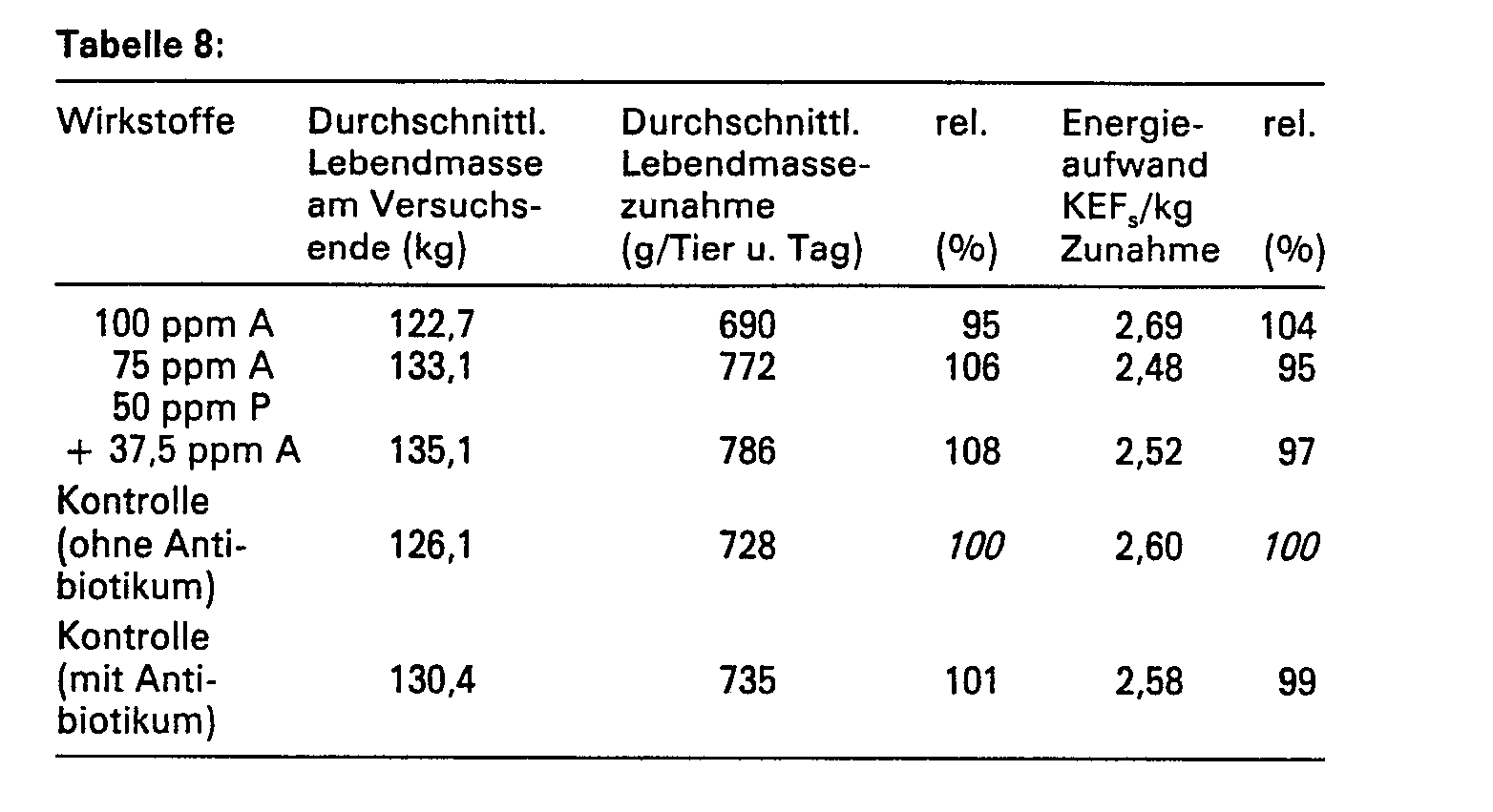
- - durchschnittliche Lebendmassezunahme (g/Tier und Tag)
- - Energiaufwand (KEFg/kg Zunahme an Körpermasse)
- Das Ergebnis zeigt Tabelle 8.
und mit unterschiedlichen Kombinationen von 6-Methyluracil (nachfolgend P abgekürzt) und N-Guanidino-N'-thioureido-p-benzochinon-diimid (nachfolgend A abgekürzt) gefüttert. Futter und Wasser standen den Tieren über Futterautomaten und Nippel-bzw. Durchlauftränken zur freien Verfügung. Das Versuchsergebnis wurde bestimmt durch folgende Parameter:
Claims (4)
Priority Applications (3)
| Application Number | Priority Date | Filing Date | Title |
|---|---|---|---|
| DE8383104643T DE3366405D1 (en) | 1983-05-11 | 1983-05-11 | Process for the use of ergotropic agent combinations in the breeding and the fattening of useful animals |
| EP83104643A EP0125322B1 (de) | 1983-05-11 | 1983-05-11 | Verfahren zur Anwendung ergotroper Wirkstoff-Kombinationen in der Aufzucht und Mast von Nutztieren |
| AT83104643T ATE22389T1 (de) | 1983-05-11 | 1983-05-11 | Verfahren zur anwendung ergotroper wirkstoffkombinationen in der aufzucht und mast von nutztieren. |
Applications Claiming Priority (1)
| Application Number | Priority Date | Filing Date | Title |
|---|---|---|---|
| EP83104643A EP0125322B1 (de) | 1983-05-11 | 1983-05-11 | Verfahren zur Anwendung ergotroper Wirkstoff-Kombinationen in der Aufzucht und Mast von Nutztieren |
Publications (2)
| Publication Number | Publication Date |
|---|---|
| EP0125322A1 EP0125322A1 (de) | 1984-11-21 |
| EP0125322B1 true EP0125322B1 (de) | 1986-09-24 |
Family
ID=8190457
Family Applications (1)
| Application Number | Title | Priority Date | Filing Date |
|---|---|---|---|
| EP83104643A Expired EP0125322B1 (de) | 1983-05-11 | 1983-05-11 | Verfahren zur Anwendung ergotroper Wirkstoff-Kombinationen in der Aufzucht und Mast von Nutztieren |
Country Status (3)
| Country | Link |
|---|---|
| EP (1) | EP0125322B1 (de) |
| AT (1) | ATE22389T1 (de) |
| DE (1) | DE3366405D1 (de) |
Families Citing this family (3)
| Publication number | Priority date | Publication date | Assignee | Title |
|---|---|---|---|---|
| MX2021008769A (es) | 2019-01-24 | 2021-11-12 | Silinnov Srcl | Composición de alimento y agua potable para aves de corral que comprende un complejo de silicio estable y biodisponible. |
| EP3989733A1 (de) | 2019-06-28 | 2022-05-04 | RXW Group NV | Geflügelfutter- und trinkwasserzusammensetzung mit monomethylsilantriol |
| BE1031726B1 (fr) | 2023-06-20 | 2025-02-03 | Apr Pharma Srl | Dispersion de silicium biodisponible pour volaille |
Family Cites Families (2)
| Publication number | Priority date | Publication date | Assignee | Title |
|---|---|---|---|---|
| DE2437155A1 (de) * | 1974-08-01 | 1976-02-12 | Diamalt Ag | Verwendung von pseudothymin als zusatz zu futtermitteln |
| GB1504151A (en) * | 1975-04-17 | 1978-03-15 | Ici Ltd | Methods using and compositions containing quinone derivatives for use in animal husbandry |
-
1983
- 1983-05-11 EP EP83104643A patent/EP0125322B1/de not_active Expired
- 1983-05-11 AT AT83104643T patent/ATE22389T1/de active
- 1983-05-11 DE DE8383104643T patent/DE3366405D1/de not_active Expired
Also Published As
| Publication number | Publication date |
|---|---|
| EP0125322A1 (de) | 1984-11-21 |
| ATE22389T1 (de) | 1986-10-15 |
| DE3366405D1 (en) | 1986-10-30 |
Similar Documents
| Publication | Publication Date | Title |
|---|---|---|
| DE3525902A1 (de) | Antibakterielle nahrungsmittelzusammensetzungen, deren herstellung und verwendung | |
| DE69414180T2 (de) | Zusammensetzung, die die Verdaulichkeit des Futter für Wiederkäuer verbessert | |
| DE69838432T2 (de) | Trinkwasserzusatz für Vögel sowie Verfahren zur Verabreichung desselben | |
| EP0052152A1 (de) | Für Menschen und Tiere geeignetes, Spurenelemente enthaltendes Konzentrat, ein Verfahren zu seiner Herstellung und seine Verwendung | |
| DE3618931A1 (de) | Futterzusatz, verfahren zu dessen zubereitung und verfahren zu dessen verwendung | |
| DE3229109A1 (de) | Futtermittel und futtermittelzusaetze zur foerderung der gewichtszunahme von nutztieren | |
| EP1748702B1 (de) | Alkaloidhaltiges futtermittel bzw. futtermittelzusatz | |
| EP0125322B1 (de) | Verfahren zur Anwendung ergotroper Wirkstoff-Kombinationen in der Aufzucht und Mast von Nutztieren | |
| EP1333728B1 (de) | Futtermittel | |
| DE3628249C1 (de) | Mittel zur Verbesserung des Wachstums und der Futterverwertung bei Schweinen | |
| DE60000914T2 (de) | Verfahren zur verminderung des auftretens von aszites bei geflügel durch natamycin | |
| DE2839730C2 (de) | ||
| DE3002338A1 (de) | Mittel und verfahren zur verbesserung der ernaehrung von vorwiederkaeuern | |
| DE3705186A1 (de) | Veterinaermedizinische zubereitungen | |
| DE3707160A1 (de) | Bacillus polymyxa enthaltende mittel zur verabreichung an tiere | |
| DE2029749A1 (de) | Geschrotetes Viehfutter, insbesondere Ferkelfutter und Verfahren zu seiner Her stellung | |
| CH633690A5 (de) | Beifuttermittel fuer haustiere ohne zellulose-verdauung im pansen. | |
| DD206736B1 (de) | Anwendung ergotroper wirkstoff-kombinationen in der rinderaufzucht und mast | |
| DD206735A1 (de) | Verfahren zur anwendung ergotroper wirkstoff-kombinationen in der gefluegelmast | |
| DE2043798C3 (de) | Futter für Haustiere | |
| DD206734B1 (de) | Anwendung von kombinationen ergotrop wirkender verbindungen in der schweineaufzucht und mast | |
| AT274549B (de) | Mittel zur Beschleunigung des Wachstums von Schlachttieren | |
| AT211644B (de) | Mittel zur Förderung des Wachstums von Tieren | |
| DE1901000C (de) | Beifuttermittel | |
| DE1692478C (de) | Wachstumsfbrderndes Futtermittel |
Legal Events
| Date | Code | Title | Description |
|---|---|---|---|
| PUAI | Public reference made under article 153(3) epc to a published international application that has entered the european phase |
Free format text: ORIGINAL CODE: 0009012 |
|
| AK | Designated contracting states |
Designated state(s): AT CH DE FR LI SE |
|
| EL | Fr: translation of claims filed | ||
| 17P | Request for examination filed |
Effective date: 19850206 |
|
| GRAA | (expected) grant |
Free format text: ORIGINAL CODE: 0009210 |
|
| AK | Designated contracting states |
Kind code of ref document: B1 Designated state(s): AT CH DE FR LI SE |
|
| REF | Corresponds to: |
Ref document number: 22389 Country of ref document: AT Date of ref document: 19861015 Kind code of ref document: T |
|
| REF | Corresponds to: |
Ref document number: 3366405 Country of ref document: DE Date of ref document: 19861030 |
|
| ET | Fr: translation filed | ||
| PG25 | Lapsed in a contracting state [announced via postgrant information from national office to epo] |
Ref country code: AT Effective date: 19870511 |
|
| PG25 | Lapsed in a contracting state [announced via postgrant information from national office to epo] |
Ref country code: SE Effective date: 19870512 |
|
| PG25 | Lapsed in a contracting state [announced via postgrant information from national office to epo] |
Ref country code: LI Effective date: 19870531 Ref country code: CH Effective date: 19870531 |
|
| PLBE | No opposition filed within time limit |
Free format text: ORIGINAL CODE: 0009261 |
|
| STAA | Information on the status of an ep patent application or granted ep patent |
Free format text: STATUS: NO OPPOSITION FILED WITHIN TIME LIMIT |
|
| 26N | No opposition filed | ||
| PG25 | Lapsed in a contracting state [announced via postgrant information from national office to epo] |
Ref country code: FR Free format text: LAPSE BECAUSE OF NON-PAYMENT OF DUE FEES Effective date: 19880129 |
|
| REG | Reference to a national code |
Ref country code: CH Ref legal event code: PL |
|
| PG25 | Lapsed in a contracting state [announced via postgrant information from national office to epo] |
Ref country code: DE Effective date: 19880202 |
|
| REG | Reference to a national code |
Ref country code: FR Ref legal event code: ST |
|
| EUG | Se: european patent has lapsed |
Ref document number: 83104643.8 Effective date: 19880616 |